Introduction
Most people with dementia (PWD) and carers would prefer that a diagnosis of dementia be disclosed to them and not withheld (Marzanski, Reference Marzanski2000; Dautzenberg et al., Reference Dautzenberg, van Marum, van der Hammen and Paling2003; Pinner and Bouman, Reference Pinner and Bouman2003; Byszewski et al., Reference Byszewski, Molnar, Aminzadeh, Eisner, Gardezi and Bassett2007; Mastwyk, Reference Mastwyk2012; Hellstrom and Torres, Reference Hellstrom and Torres2013). The principle reasons given for this opinion were: the opportunity to plan, to receive treatment, to receive information, that it is the patient's right to know (Pinner and Bouman, Reference Pinner and Bouman2003; Mastwyk, Reference Mastwyk2012), and to learn coping strategies (Mastwyk, Reference Mastwyk2012).
How should this conversation, or “feedback session,” be constituted and the information delivered? Two studies have asked PWD what they wanted from the feedback session, others have asked family members. Byszewski et al. (Reference Byszewski, Molnar, Aminzadeh, Eisner, Gardezi and Bassett2007) found that PWD wanted to be told of their diagnosis in a direct manner and preferred open communication with the physician. They preferred progressive disclosure to allow some warning of the potential outcome of the assessment process (Byszewski et al., Reference Byszewski, Molnar, Aminzadeh, Eisner, Gardezi and Bassett2007). Karniele-Miller et al. (Reference Karniele-Miller, Werner, Aharon-Peretz, Sinoff and Eidelman2012) found that PWD wanted to be treated with respect, having felt marginalized in their feedback session.
Carers agreed that the PWD should be informed and that a direct approach was preferable when giving the diagnosis (Byszewski et al Reference Byszewski, Molnar, Aminzadeh, Eisner, Gardezi and Bassett2007). They stressed that a uniform approach would be impractical due to differences in disease severity and course and individual temperament (Holdroyd et al., Reference Holdroyd, Turnbull and Wolf2002; Byszewski et al., Reference Byszewski, Molnar, Aminzadeh, Eisner, Gardezi and Bassett2007). They felt the physician needed to be compassionate (Connell et al., Reference Connell, Boise, Stucket, Holmes and Hudson2004) and considerate of the importance of maintaining hope (Connell et al., Reference Connell, Boise, Stucket, Holmes and Hudson2004; Byszewski et al., Reference Byszewski, Molnar, Aminzadeh, Eisner, Gardezi and Bassett2007). They indicated that more time was needed for discussion (Connell et al., Reference Connell, Boise, Stucket, Holmes and Hudson2004).
Carers wanted the feedback session to include information regarding dementia, available treatments, and the behavioral and psychiatric symptoms of dementia (Wald et al., Reference Wald, Fahy, Walker and Livingston2003). Some felt that being given all of the information at the feedback appointment would be helpful in preparing them for future events but others found that having all this knowledge could be wearing (Wald et al., Reference Wald, Fahy, Walker and Livingston2003). Carers also recommended supporting the verbal information presented with written information and directing the carer to the relevant Alzheimer's Association (Wald et al., Reference Wald, Fahy, Walker and Livingston2003).
Recall of diagnosis
Whilst most patients and carers would prefer that the patient be informed of their diagnosis, disclosure does not always result in recall of the information provided. In a study by Barrett et al. (Reference Barrett, Keller, Damgaard and Swerdlow2006), 60% of PWD could not name their diagnosis within minutes of hearing it, along with 12.5%–33.3% of carers. Byszewski et al. (Reference Byszewski, Molnar, Aminzadeh, Eisner, Gardezi and Bassett2007) found that only 20% of patients could recall their diagnosis. Most carers could recall the most important information regarding diagnosis, prognosis, recommendations, and resources (Byszewski et al., Reference Byszewski, Molnar, Aminzadeh, Eisner, Gardezi and Bassett2007).
In a study by Campbell et al. (Reference Campbell, Stocking, Hougham, Whitehouse, Danner and Sachs2008), 26% of PWD reported having been told of their diagnosis by a clinician but few were able to state the name of their illness. Asking these questions of both patient and carer, Bradford et al. (Reference Bradford2011) found that 24% of patients and 67% of carers recalled being told of the diagnosis but less than half in both groups could remember the name of the dementia. However, 66% of patients and 90% of carers recalled a discussion of cognitive enhancers (Bradford et al., Reference Bradford2011).
Current study
With the exception of two studies, research into the feedback session has consulted family members or hypothetical patients only. The current study explores the experience of the assessment and diagnosis of dementia from the viewpoint of both the patient and their family from an Australian perspective. It addresses the PWD's view of the feedback session, a noticeable gap in the literature. The purpose of this exploration was to identify helpful strategies for clinicians in meeting the wants and needs of this patient group and those of their families.
Methods
The study was a mixed methods design. Basic demographics were collected. Qualitative data were collected via two recorded interviews using semi-structured interview guidelines. The first was conducted with the patient and their next-of-kin at the clinic visit after their “feedback” session, usually the treatment review visit. A follow-up interview was conducted at their next visit to the clinic. The interviews were later transcribed to facilitate analysis.
Mini-Mental State Examination (MMSE) scores were retrieved from the patient's file for the feedback session and the days of the interviews. A feedback sheet was designed for study use by the consultants at the Memory and Related Disorders Clinic (MRDC) and those in private practice based on those used by some Cognitive, Dementia and Memory Services (CDAMS). It contains information regarding the issues discussed: the patient's diagnosis, the medication prescribed, side effects thereof, and recommendations, if any (e.g. Enduring Power of Attorney (EPOA), driving assessment etc.). CDAMS supply a copy to the patient and family. Details of these feedback sheets were recorded as data.
The mixed methods design for this study was chosen to allow new information to be collected regarding assessment and diagnosis of dementia from the patient and carer perspective. Qualitative studies are valuable for obtaining information regarding the experience of individuals within their social framework, especially in inadequately studied areas (Fossey et al., Reference Fossey, Harvey, McDermott and Davidson2002).
Sample
The sample was drawn from attendees at the MRDC, St. George's Hospital, Melbourne, Australia, Melbourne Health's CDAMS, and private patients of two associates of the National Ageing Research Institute (NARI).
Ethics approval
The study was approved by the Human Research and Ethics Committee (HREC) of St. Vincent's Health and the Mental Health arm of the HREC of Melbourne Health.
Recruitment and interview
Patients and their carers were consented to the study on their return to the clinic for their medication review appointment, two to six months following their feedback session. The private patients were informed of the study by their consultant and contacted by telephone prior to this review appointment. The interview was conducted on the same day. All interviews were conducted with the patient and carer present.
The format of the interview was to ask each question of the patient first and then their carer. Every effort was made to enable the patient to provide an answer. If the carer tried to answer for the patient or speak over the patient, they were asked to “hold that thought” or sign language was used to curtail their interjection.
A second interview was conducted with the same patients and carers at the next scheduled visit, about six to nine months after diagnosis, if an appointment with their consultant/clinic had been arranged. (The funding protocol for CDAMS includes that patients are discharged to the care of their general practitioner following their treatment review visit.)
Data were entered into the Predictive Analytic Software Package (PASW) with a comprehensive list of value labels to incorporate all data, quantitative and qualitative, particularly to preserve quotes from respondents. Qualitative data were then counted by frequency. Descriptive statistics were used to describe the samples. t-tests were used to measure correlation between MMSE scores and recall/non-recall of the diagnosis.
Results
First interview
Thirty-two interviews were conducted with the patient and carer using the interview guide: 15 couples from the MRDC, ten from the CDAMS, and seven from the private practice of two NARI affiliates. The CDAMS dyads had received feedback sheets following their feedback session. The interviews of public patients were conducted after the patient and carer had seen the consultant. Interviews with the private patients were conducted before the consultation with the consultant, as the visit was pre-arranged. Mean time elapsed since the feedback session with the consultant was 15 weeks (SD = 11.6).
Participant demographics
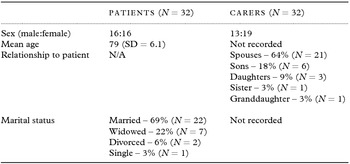
Participant demographics are presented in Table 1.
Participant demographics

Diagnosis and treatment discussed by the doctor
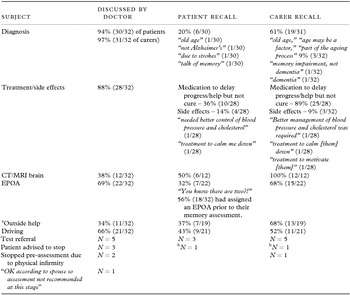
The mean MMSE score at the feedback session was 20/30 (SD = 3.5). From the feedback sheets completed by the consultant/allied health professional, information regarding diagnosis that was provided to the patient and carer were 59% (N = 19) Alzheimer's disease (AD), 18% (N = 6) mixed dementia, 6% (N = 2) frontotemporal dementia (FTD), 6% (N = 2) primary progressive aphasia (PPA), 3% (N = 1) vascular dementia (VaD), and one patient had “evidence of poor memory”. One patient was not told at the spouse's request but the spouse was informed and told the patient at a later time. The feedback sessions were conducted by four old age psychiatrists (OAP) and two geriatricians. Other subjects discussed at the feedback session are presented in Table 2.
Topics discussed by the doctor at the feedback session and patient and carer recall

CT = computerized tomography; MRI = magnetic resonance imaging; EPOA = enduring power of attorney.
aOutside help: Alzheimer's Association; Royal District Nursing Service; Council Help; Meals on Wheels; Dosette/Webster Pack (medication boxes); Aged Care Assessment Service; Private “up skilling” classes. One to three suggestions of outside help were made to 11 patient/carer dyads, totaling 19 suggestions.
bSame patient/carer dyad.
The study feedback sheets provided space to record questions asked by the patient and carer. One to five questions were recorded in 59% (19/32) of the cases. The main questions asked concerned treatment (N = 7) and prognosis (N = 7). Questions regarding medication side effects were asked separately (N = 5). Many asked questions to assist maintenance of their lifestyle – activities/maximizing quality of life (N = 4); memory training aids (N = 3); health maintenance via their general practitioners (GP; N = 2); driving (N = 1) half-priced taxi or disabled parking sticker (N = 1). Others wanted more information regarding the cause (N = 1), relationship to mood (N = 1) and “Can you do something about it?” (N = 1). Other questions concerned future planning – respite care (N = 1), retirement village (N = 1), and details of assigning an EPOA (N = 1) or clinical trials (N = 1).
MMSE and recall of feedback session
The mean MMSE score at the first interview was 22/30 (SD = 4.2), an increase of two since the feedback session (a mean MMSE score of 20/30) in a context of cognitive enhancers usually being prescribed at the feedback session.
After demographic questions, the patient was asked, “What did the doctor tell you about your memory problem at your last appointment? (Prompts: Diagnosis? Cause? Treatment?).”
In response to this question 50% (16/32) of patients did not recall the feedback session or remembered their memory problem being discussed, but they could not offer any details. 20% (6/30) recalled their diagnosis. Recall of the feedback session by patients is presented in Table 2.
An independent-samples t-test was conducted to compare MMSE score at the feedback session and recall of diagnosis. Group one (recall of diagnosis) had a mean MMSE score of 20.0 (SD = 5.2) whereas the mean MMSE for group 2 (non-recall) was 19.9 (SD = 3.3). The independent-samples t-test indicated that this difference was not statistically significant (t(25) = 0.02, p = 0.98). The same test was conducted for MMSE score at the first interview and recall of diagnosis. The recall of diagnosis group had a mean MMSE score of 24 (SD = 3.6), the non-recall group a mean MMSE score of 22 (SD = 4.4). Again, this was not significant (t(23) = 0.8, p = 0.43).
Sixty-one percent (19/31) of carers recalled the patient's diagnosis. Of 19 carers informed that the patient had AD, 17 recalled the diagnosis; of six with AD/VaD (mixed) dementia, zero carers recalled the diagnosis; one of two recalled the diagnosis of FTD, one of two recalled PPA, and zero of two recalled VaD. The daughter of the patient who was informed of “evidence of poor memory” was upset that the patient had not been told the diagnosis as the patient did not believe her when she tried to discuss care issues. Two carers could not remember the discussion at the feedback session. One reported that she took her daughter to the appointment because she knew that if they received bad news she would become too emotional and not remember anything. Of the 11 carers who did not recall the diagnosis, nine were spouses (one PWD with AD; six PWD with AD/VaD; one PWD with FTD; one with PPA), one a son (PWD had AD), and one a granddaughter (PWD had AD/VaD). Some recalled an explanatory detail from the feedback session. A summary of patient and carer recall of the feedback session is presented in Table 2.
Outside help
Gaining access to outside help was discussed by doctors in 33% (11/32) of feedback consultations and in several cases more than one suggestion was made (19 suggestions in total). These suggestions and recall are summarized in Table 2. Several carers who reported that outside help had not been discussed at the feedback session, sought access to services independently afterwards. Local council help was sought by two carers, Aged Care Assessment Service (ACASFootnote 1 ) assessments by three, adult day care by one, Alzheimer's Australia by one, and three carers had arranged outside help prior to the memory assessment because of restrictions on the patient due to physical infirmity.
Imparting a diagnosis of dementia
When asked for the best way to inform patients and their families of a diagnosis of dementia, 25 patients offered up to three suggestions, one patient could not decide, and 30 carers offered up to four suggestions. As their first response, 76% (N = 19) of patients and 66% (N = 20) of carers preferred the direct approach.
In most cases, a suggestion was offered and then qualified in some way. Patients offered “Direct approach, you need to learn the truth,” “straight out and to the point,” “you need to learn the truth,” “it's a shock but you need to know,” “say what you have to say,” “you need to deal with reality,” “you have to know about it sometime,” “tell me the truth every time.” Others were less committed. They considered that it “depends on the individual” (N = 2), should be told “straight out but in a gentle way” (N = 2), “direct but with sensitivity,” “break things gently, not too blunt,” or “don't come straight out with it – that could be damaging.” One patient said, “the doctor needs to be sure of the diagnosis, especially if it's Alzheimer's disease.” Three patients considered that certain attributes were required of the clinician when giving the diagnosis – “the doctor needs to be supportive,” “a good listener,” “easy to understand.” A summary of responses is presented in Text Box 1.
Question: “What is the best way to present a diagnosis of Alzheimer's disease or dementia to patients and their families?”
Summary of patient responses:
“Direct.”
“Straight out.”
“Get it over with one way or the other.”
“It's going to be a shock anyway, you’ve got to accept it and you’ve got to keep going.”
“Forthright, not too sympathetic – you need the real story.”
“Comes as a blow but you’ve got to know.”
“We’re not getting any younger – you have to know.”
Most carers were similarly pragmatic: “straightforward and honest, “too many are not told enough,” (N = 2) “Alzheimer's is a disease just like cancer” (N = 2), “it's best to be precise,” “don't beat around the bush,” “you need to know to take appropriate action,” “you need to know where you’re going,” “it's better for people to understand what's going on,” “tell people how they are situated,” “you need to deal with reality,” “to leave people in the dark is not fair,” “it's worse to have partial information – fear takes over,” “it reduces fear and distress if you’re prepared.” Two carers felt that “it is the patient's right to know.”
Some carers preferred a less direct approach. “It depends on the receiver of the information,” (N = 4) “A direct approach is good for mum, not for fragile people.” Several carers reiterated the patient's response: “Don't come straight out with it – that could be damaging,” (N = 1) “break things gently, not too blunt” (N = 1), and “direct but with sensitivity” (N = 3).
Two carers stipulated that the family should be present; however they still opted for a direct approach: “The direct approach with the family present” and “the direct approach is best for the family.” In addressing their need for information, others felt that all the family should be present “so that everyone is fully aware” (N = 2) and another felt that “someone like him won't accept it. Someone in the family should know.” Others expressed concerns about the content of the feedback session. “It's a big umbrella. I don't know enough about Alzheimer's. I need more information about the disease to understand.” Another commented that “Alzheimer's disease is a strong word compared to dementia.” One carer felt that the feedback session is “hard for the partner who wants to be supportive but can't be.” One carer thought that “the doctor needs to be supportive.” A summary of carer responses is presented in Text Box 2.
Summary of carer responses:
“Direct.”
“Straight out.”
“Present the situation – you can't beat around the bush.”
“All doctors need to be up front.”
“It's like an operation – you have to know.”
“Once you know you can be proactive in helping yourself.”
“To say ‘milder form’ is unrealistic – it gives false hope.”
“I’ve been diagnosed with cancer. The doctor was direct – straight out is best.”
Timing of information
Patients and carers who were interviewed using a revised version of the first interview guidelines (N = 22) were then asked if all the information regarding diagnosis, treatment, and prognosis should be given “up front” with accompanying written information following the feedback session. Twenty patients and 20 carers offered 1–3 responses to these questions, with people adding to their initial answer. Fifty-five percent (N = 11) of patients wanted the information to be given “all at once” while 35% (N = 7) preferred it to be presented in stages – “It's too much. Over a couple of appointments,” “in stages,” “some people need a little bit more each time,” and “over a few interviews.” One patient thought that diagnosis and treatment should be given “up front.” Three patients considered that “it depends on the person you’re dealing with,” and one qualified this with “their background.” Two patients mentioned the need to have someone present for recall. One patient said that “it is important that the patient does not lose confidence – everyone needs hope.” Seventy-five percent (N = 15) of patients thought that written information should accompany the feedback session.
The carer group was divided on the issue of all the information up front or in stages. Half considered that all the information should be given “up front” with carers explaining that “the patient needs this information to maintain independence,” “we need the opportunity to plan,” and another that it was necessary for driving assessment and insurance purposes.
The 50% (N = 10) favoring a staged approach explained their opinion more fully. Several considered that it was too much information to be given at once and others that immediate concerns such as diagnosis and treatment should be dealt with first, secondary concerns dealt with at a later appointment: “Some people need a little bit more each time,” “over a few interviews,” “all at once is not good – you will watch for the next stages,” “there's too much to process,” “you need to access information as you need it and not dwell on the negatives,” “diagnosis and treatment up front,” and “immediate concerns first, later concerns at a second appointment.” Twenty percent (N = 4) thought that “it depends on the person you’re dealing with” and one felt that “it depends on the stage of the illness – as much as the patient can absorb.”
Following the feedback session, one carer thought that a follow up telephone call from a staff member would be helpful – “an opportunity for Q and A” and that a contact number should be provided for this purpose.
Seventy-five percent (N = 15) of patients thought written information would be helpful, one underlining the need for this as “you need written information to go back to after the appointment as there is a lot to take in” and another that “written information may be complicated – just needs simple headings.” One patient commented that “a written summary could be good or bad.”
Eighty percent (N = 16) of carers thought written information would be helpful. Two added that it would be useful to refer to after the appointment; one described a design of the written information as a “précis of what transpired, not too much detail, just the important points” and another commented that if the patient is alone, they need written information. One carer added that being given a contact number at the feedback session and a follow up “telephone call for ‘Q & A’” (sic) about two weeks later would be helpful.
Helpful aspects of the feedback session
Depending on the version of the interview guidelines used, participants were asked “what did you find most helpful at the feedback session?” The common thread through helpful aspects of the feedback session related to the doctor's approach. Six patients offered one or two responses that were related to the physician who provided a comfortable setting and/or offered hope. Two found the approach of the consultant to be – “not daunting, puts you at ease,” one appreciated the opportunity to ask questions, and one felt that the doctor offered some hope – “things to be done.” Three others appreciated the doctor's approach – “his matter-of-factness helped with acceptance,” “his attitude was friendly and professional,” and “his professional approach was helpful.” One patient could not remember anything helpful – “I was in shock.”
Fourteen carers offered one or two responses which were also related to the physician's manner and also from a feeling of empowerment from the information received. One carer reported that having someone to recognize the condition was helpful and two appreciated having the opportunity to ask questions. One felt empowered being told where to find help and one found treatment an “offer of hope.” Other aspects found helpful by carers were related to the consultant's manner: “practical and human,” their “direct approach,” “communicative,” “his matter-of-factness helped acceptance,” “presented objectively, his narrative style was easy to understand,” “he was positive – things to be done,” “attitude was friendly and professional,” “communicative,” “professional,” “helpful, practical suggestions,” “took the time to explain,” “not beating about the bush,” and “the doctor offered some hope.” One carer commented that they felt too emotional and did not remember too much about it, another that “it was awful.”
Second interview
Second interviews were pre-arranged and conducted immediately prior to the patient's scheduled appointment with their doctor, at the same venue. Fourteen interviews were conducted with ten MRDC patients, one CDAMS patient and three private patients. Second interviews were not conducted with the other patient/carer dyads because the decision was made that the data had attained saturation, that is, responses were repetitious and no new information was being provided.
Eight of the patients were male, six were female. The carer representation was evenly divided: seven males and seven females. The time between the first and second interviews was a mean of 20 weeks (SD = 10.9). Mean MMSE score collected from the patient's history after their consultation was 24/30 (SD = 2.9).
The interviews tended to be short and consisted largely of an affirmation of the discussion in the first interview. Again, questions were directed first to the patient and then to the carer. First, the interviewer presented a précis of what had transpired during the previous interview. All patients and carers agreed that this précis was a fair representation of the discussion they recalled.
None of the patients felt differently about anything they had said during the first interview. One patient commented that they “were taking things a step at a time” and another that they “felt calmer knowing about their problem.” The carers did not feel differently about anything they had said. One added the comment that in giving someone a diagnosis of dementia, “there was a need to simplify the information as it is difficult to understand, but the patient needs to know.”
Another said that they “would reinforce that giving the family the opportunity for questions and answers, information for follow up and where to go for support would make life easier.” A third carer said “I think I fully understand the situation.” The two patients and the carer not mentioned above did not feel differently, but they had nothing to add to their previous reports.
Most patients and carers still favored the direct approach be used when presenting a diagnosis of dementia. Two patients thought imparting the diagnosis should be tailored to the individual “Depends on the person” and one reiterated the need for family support.
One carer also thought that it “Depends on the person.” One commented that “the interchange between the consultant and family is helpful.” Another offered that “You need an opportunity at a later stage to ask questions so leave the door open.” Another carer thought that the diagnosis should be given “sitting down.”
Discussion
Although 94% of patients and 97% of carers in the current group were informed of the patient's diagnosis, only 19% of patients and 61% of carers recalled the diagnosis when they were interviewed. Independent-samples t-tests were done to determine the impact of a lower MMSE score on lack of recall on the patients’ part but the results were insignificant. These low numbers may be due both to the emotional impact of the diagnosis and the nature of the condition affecting the patients. At several points during data collection, a patient or family member would comment negatively on their previous experience of dementia in others. Indeed, one carer commented that she had taken her daughter along to the feedback session to take notes, because she would be too emotional to “take anything in.”
It is worth noting that, in the main, carers were able to recall a diagnosis of AD (17/19). The other diagnoses not recalled were AD/VaD (0/6), VaD (1/2), FTD (1/2), and PPA (1/2). Although nine of eleven who did not recall the diagnosis were spouses and therefore older, the names of the diagnoses not recalled suggests a lack of familiarity with these terms or that it was not understood or explained adequately at the feedback session.
Bradford et al. (Reference Bradford2011) found that less than half the patients and carers they interviewed could recall the patient's diagnosis. However, 84% were prescribed a memory enhancing drug which 90% of carers and 66% of patients were able to recall (Bradford et al., Reference Bradford2011). In the current study, 50% of patients and all carers remembered discussion of medication, where applicable. It would seem that some facts from the clinician's report of assessment findings and treatment are stored by the patient and family member. Overload of information could prevent full processing of information. As people recall details of treatment this suggests that giving people an opportunity to do something about the condition helps them to store that information. Taking medication was seen as a proactive step by patients and families – something “to help” and an offer of hope.
Evidently, the current format of the feedback session needs some revision. Recall of topics discussed ranges from 20% (diagnosis) to 50% (brain scan) for PWD and from 52% (driving) to 100% (brain scan) for carers. With so many topics discussed and new terminology used, it would be difficult to remember everything, but a written summary, as recommended by this study group, may increase these numbers. Notably, physicians advised three patients to stop driving and only one patient/carer dyad recalled this information. The use of visual aids may assist as half the patients and all carers who were shown the brain scan recalled this demonstration.
Disclosure of dementia diagnosis – patient and carer perspective
The published literature regarding disclosure of a diagnosis of dementia from the patient and carer perspective is limited. Open communication (Byszewski et al., Reference Byszewski, Molnar, Aminzadeh, Eisner, Gardezi and Bassett2007; Laakkonen et al., Reference Laakkonen2007), progressive disclosure beginning at the initial consultation and a direct approach (Byszewski et al., Reference Byszewski, Molnar, Aminzadeh, Eisner, Gardezi and Bassett2007) tempered by compassion used by the physician at the time of confirming the diagnosis were preferred by patients and carers. Being given all information at once to encompass diagnosis to prognosis was questionable as some carers felt this would be helpful for future planning, whilst others thought it could be wearing (Wald et al., Reference Wald, Fahy, Walker and Livingston2003).
The current study supported and extended these findings. The majority of both patients and carers would prefer a direct approach. A small number in each group saw sensitivity and listening skills to be essential attributes of the physician. Most patients wanted all of the information “up front.” Carers were equally divided on this issue. Fifty percent wanted all the information at once in order to plan, some stipulated concern regarding the necessity of a driving assessment. The other 50% were concerned that receiving all the information at once would have them watching for stages of the disease. A large proportion of each group considered receiving all the information at once too overwhelming. Given that the rates of recall of information presented at the feedback session were quite low, staging of information might be more beneficial.
Five months later, at the second interview, having had time to consider their earlier responses, patients and carers reinforced their viewpoint. They did not want to change anything they had said before. When asked if they could think of a better way of presenting the diagnosis to make it easier for patients and families, they maintained that the direct approach was preferable.
New information provided by our study begins with two patients mentioning the need for someone to be with them at the feedback session for recall of information and for support. In addition the majority of both patients and carers wanted a written summary of the feedback session as a source document for later referral. Only the 10 CDAMS dyads had received a written summary in this study. As patient and carer recall of the feedback session is uncertain, a précis of the information presented would seem essential as only one patient and one carer recalled that the patient had been told to stop driving when in fact this advice had been given to three. One carer saw a written report as a necessity if the patient were alone and one thought a follow up telephone call “for Q and A” would be helpful. Indeed, several reported that the opportunity for “Q and A” was a useful part of the feedback session. Both groups continued to reinforce the need for information and a means of retaining it, demonstrating a preparedness to adapt to living with dementia.
In addition to the opportunity for “Q and A,” aspects of the disclosure session found helpful by patients and carers focused on the attributes of the physician. Not only did people want compassion, they appreciated their honesty, objectivity and professionalism. The “offer of hope” through medication and suggestions of “things to be done” were also features commented on by carers which engendered some with feelings of empowerment. They appreciated openness in discussing the diagnosis and a positive approach to management.
Given the motivation of patients and their next-of-kin in wanting a diagnosis of dementia to be disclosed, it is incumbent upon Memory Clinics and private practitioners to be honest in their dealings with patients and inform them fully. This study supports the existing literature by demonstrating that patients and carers do want the diagnosis to be disclosed. A written summary of the feedback session as a later reference is preferred by patients and their families and given that recall of information is problematic, seems necessary.
Future research
Future research could explore the impact of the provision of written information or “staging” of information when disclosing a dementia diagnosis on recall of the feedback session.
Study limitations
One criticism of this study design is that the patient and carer were interviewed together. The patient may have been unduly influenced by the carer or vice versa or the carer may have provided answers on behalf of the patient. However, based on the experience of the first author, this bias appeared minimal. Although some patients were hesitant in the early stages of the interview, they gained confidence as the interview progressed and gave more detailed responses. Having a family member present in the room may have contributed to giving them more confidence.
In addition, interviews were conducted an average of 15 weeks after the feedback session which may have affected recall. The decision was made to conduct the interviews at the treatment review visits to avoid inconvenience to informants and for ease of contact for the interviewer.
Conclusions
Patients and their families prefer a direct approach to be used by a sensitive, honest and professional doctor with an opportunity to ask questions. They want information regarding treatment and lifestyle and a written summary of the feedback session to refer to afterwards. The support of a family member or friend when they are told of their diagnosis is preferred.
Conflict of interest
David Ames is a former editor of International Psychogeriatrics.
Description of author's roles
M. Mastwyk: study design, recruitment, data collection and analysis, preparation of manuscript, D. Ames, K. Ellis: study design, discussion of themes, review of manuscript, B.Dow: discussion of themes, presentation of qualitative data, review of manuscript. E. Chiu: recruitment, review of manuscript.
Acknowledgments
Thanks to the patients and their families who agreed to discuss their viewpoints surrounding diagnostic disclosure of dementia. Thanks also to the staff of the MRDC and CDAMS clinics and the private psychiatrists who introduced the study to participants, and found room space for the interviews.
Support for this study was provided by the Academic Unit for Psychiatry of Old Age, St. George's Hospital, through the provision of stationery consumables and payment of HREC fees.