Background to the Changes Around Food Experience (CAFE) study
The factors which influence choices around meals and food intake and the impact of these in later life are multifarious. Nutritional perspectives associated with ageing are interrogated regularly in the literature (Vesnaer and Keller Reference Vesnaer and Keller2011; Wakimoto and Block Reference Wakimoto and Block2001), while patterns of food preferences and procurement in later life have received extended attention in a European study (Dean et al. Reference Dean, Raats, Grunert and Lumbers2009). Evidence suggests that physiological changes alone, including reduced appetite or altered senses of smell and taste, will not wholly account for the range or type of adaptations made by older people to their diet and food (Drewnowski and Shultz Reference Drewnowski and Shultz2001). Reasons such as changing food practices, support from family or friends, access to shops and decisions on what is convenient also shape how older people engage with food and meals (Winter Falk, Bisogni and Sobal Reference Winter Falk, Bisogni and Sobal1996; Dean et al. Reference Dean, Raats, Grunert and Lumbers2009). Reduced physical capacities encountered in ageing may also affect the ability or desire of older people to prepare meals (Giles Reference Giles2009).
Older women attribute specific significance to food (Devine Reference Devine2005; Schafer and Schafer Reference Schafer and Schafer1989): their regular involvement in food-related activity is a source of meaning in their social and familial relationships, often bound closely to their sense of identity. A Swedish study found that older women viewed the planning, cooking, presenting and enjoyment of food with others as preparing a gift (Gustafsson and Sidenvall Reference Gustafsson and Sidenvall2002; Sidenvall, Nydahl and Fjellström Reference Sidenvall, Nydahl and Fjellström2000), and both self-managing and disabled older women have been found to value carrying out food-related tasks as independently as possible (Gustafsson et al. Reference Gustafsson, Andersson, Andersson, Fjellström and Sidenvall2003). A Canadian study indicated that older women continue to derive pleasure from sharing and maintaining traditions around food (O'Sullivan, Hocking and Wright-St. Clair Reference O'Sullivan, Hocking and Wright-St. Clair2008). The expectation that women assume responsibility for preparing and providing family meals reflects gendered construction of food practices (DeVault Reference DeVault1991).
Reasons why older women alter their shopping and cooking habits as they age may be linked to transitions including entering widowhood (Quandt et al. Reference Quandt, McDonald, Arcury, Bell and Vitolins2000; Sydner et al. Reference Sydner, Sidenvall, Fjellström, Raats and Lumbers2007), the physiology of ageing (Drewnowski and Shultz Reference Drewnowski and Shultz2001), becoming ‘weary’ of food shopping (Turrini et al. Reference Turrini, D'Addezio, Maccati, Davy, Arber, Davidson, Grunert, Schuhmacher, Pfau, Kozlowska, Szczecińska, Medeiros de Morais, Afonso, Bofill, Lacasta, Nydahl, Ekblad, Raats and Lumbers2010, 260), reduced physical activity (Thompson et al. Reference Thompson, Bentley, Davis, Coulson, Stathi and Fox2011), experiencing frailty (Porter Reference Porter2007), devising strategies to promote social interaction while shopping (McKie Reference McKie1999; Sidenvall, Nydahl and Fjellström Reference Sidenvall, Nydahl and Fjellström2001) and preferring the accessibility of local shops (Sidenvall et al. Reference Sidenvall, Nydahl and Fjellström2001). Choices around food intake in later life may also be partly determined by customs followed through life, with social and familial contexts continuing to shape food and dietary decisions (Wethington and Johnson-Askew Reference Wethington and Johnson-Askew2009). Earlier theories of ageing that have suggested that ageing may entail withdrawal from many aspects of life, such as disengagement theory (Cumming and Henry Reference Cumming and Henry1961), might see reduction in preparation of meals as part of such an overall process signalling increased passivity in later life. However, Baltes and Baltes (Reference Baltes and Baltes1990) suggest that the lived experience of older people may instead demonstrate that they seek ways to compensate for losses and limitations associated with ageing. Actions related to preparing meals may reflect such optimising accommodations.
Research is sparse on the impact of changed shopping and cooking habits on the purposeful activities of older women who have reduced, whether voluntarily or from necessity, their involvement with shopping, planning and cooking food. CAFE was a one-year, qualitative study which, distinct from studies on the nature of food choices and meal preparation in later life (Lumbers and Raats Reference Lumbers, Raats, Shepherd and Raats2006; Delaney and McCarthy Reference Delaney and McCarthy2009), explored the effect on social engagement and purposeful activities of older women's reduced contact with food-related tasks. Its aim was to discover the impact on older women of a major lifecourse transition, relinquishing primary responsibility for preparing and cooking main meals, on the meanings of food, social engagement and wellbeing. This paper examines the dynamics around older women's reduction of contact with preparing and cooking main meals and highlights the diversity in how they related to their changing engagement with food in later life. While attitudes and feelings about food-related tasks – here specifically comprising shopping, planning, preparing and cooking main meals – varied widely among the study cohort, all participants were seen to be actively managing their changing contact with food, many while considering changes in their health, family, social and other aspects of life.
Methodology and sample characteristics
The CAFE study was conducted from April 2007 to March 2008 in the county of Norfolk, United Kingdom (UK), with women aged 65 and above who lived independently and who, between six months to three years previously, had reduced the preparation of their main meals from scratch to no more than two days a week.Footnote 1 The study explored how reduced contact with food may have had an impact on social engagement and wellbeing through discussion of their views, feelings about and practices relating to these changes. While CAFE did not seek to elucidate a lifecourse perspective on food (Wethington and Johnson-Askew Reference Wethington and Johnson-Askew2009), the participants were asked about food memories so as to gather their associations with food and meals and to help them frame their current feelings, experiences and choices about their engagement with food (Winter Falk, Bisogni and Sobal Reference Winter Falk, Bisogni and Sobal1996). Grounded theory informed the research design in both data collection and analysis. Listening to and gathering the self-organised accounts of older women allowed concepts to be systematically generated and the context in which they managed reduced contact with food to be explored.
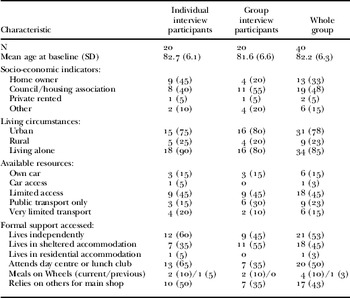
Ethical approval for CAFE was obtained from the University of East Anglia's Faculty of Health Ethics Committee in February 2007. Recruitment took place at lunch clubs, day centres and community organisations, through a leaflet included in one of Age Concern Norfolk's quarterly newsletters, by word of mouth and in response to posters in public venues and notices in the local press. Forty women were recruited aged 65+ (range 65–95; mean 82 years, standard deviation 6) who were living in their own homes. Purposive sampling aimed to cover a diversity of arrangements through which women managed their reduced engagement with food. The sample included women supported by lunch clubs, day centres, mobile meals,Footnote 2 home-delivered frozen meals, shop-bought ready-meals, relatives, friends and/or neighbours. The older women were fluent English-speakers, lived in rural and urban settings with different levels of dependency, came from a range of socio-economic circumstances and none had diagnosed dementia. The majority were widows; three had never married and five had never had children. Half attended a day centre or a lunch club (see Table 1), though frequency of attendance varied from once a month to three days a week.
Characteristics of Changes Around Food Experience (CAFE) participants

Note: All data apart from age expressed as N (%). SD: standard deviation.
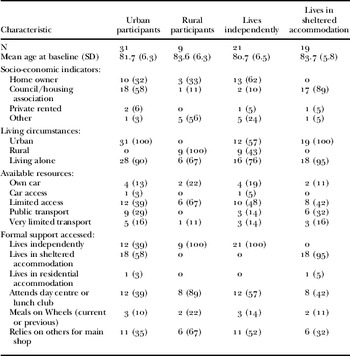
Participant ages were similar across those included in individual or group interviews, living in urban or rural settings, and living independently or in supported settings (Tables 1 and 2). More urban participants lived in council- or housing association-run housing, while more rural participants lived with family. Only those living independently lived in their own homes, while sheltered accommodation was generally rented from council or housing associations. Transport options were particularly limited for those living in rural areas and participants living in rural areas were most likely to rely on others for shopping (Table 2).
Characteristics of Changes Around Food Experience (CAFE) participants by living arrangement

Note: All data apart from age expressed as N (%). SD: standard deviation.
Challenges in recruitment included recruiting women from lower socio-economic groups. Such older women often expressed interest in CAFE but provided consent less frequently than middle-class women, as reported in other studies (Ejiogu et al. Reference Ejiogu, Norbeck, Mason, Cromwell, Zonderman and Evans2011; van der Waerden et al. Reference van der Waerden, Hoefnagels, Jansen, Clemens and Hosman2010). As a mix of socio-economic status was sought in order to reflect a broad spectrum of the cohort population, recruitment took longer than originally envisaged, but was successful in creating a broader socio-economic mix. Fourteen of the participants lived in areas falling into the most deprived quintile in the table of Index of Multiple Deprivation, 13 in the next two quintiles and 13 in the top two quintiles.
Another challenge was finding potential participants who received mobile meals, as relatively few such women were encountered at day centres, lunch clubs and other sites of recruitment. Lastly, as Norfolk is not as ethnically diverse as other UK counties, especially among its older population, very few women from minority ethnic groups were encountered during recruitment and none from these groups joined the study, despite recruitment activities in the more ethnically diverse east-coast region.
Data were collected primarily through semi-structured interviews with 40 older women, all recorded and transcribed in full. Study pseudonyms were chosen by each woman and are used when identifying participants in this paper. Semi-structured interviews were held individually with 20 older women on two successive occasions separated by four or five months. Owing to a steep decline in health, one such participant could not be interviewed a second time. Focus groups were conducted with the other 20 participants, each being run once with two to four members.
For all interviews and focus groups, opening questions explored associations with and memories about food. These were followed by more probing questions to qualify and contextualise in relation to a range of contacts and activities associated with food in the older women's lives. The second interview with individuals was based around a summary of the first interview. Its purpose was to provide participants with an opportunity to note and discuss meaningful changes which occurred between the two interviews, increase participant involvement by helping them make connections with their own experiences, value their input and empower them in further shaping their own narrative. The observations of cooking contextualised the women's activities around food preparation by providing insight into the layout of their kitchens, their use of equipment and how they organised their actions within this space. Because these observations are not the focus of this paper they are not further reported here.
Respondent validation (in the second individual interview), combining in-depth semi-structured interview and focus group, transparency in data collection and data analysis methods including exploration of differing and opposing attitudes, attention to negative cases, evaluation of reflexivity and responsiveness to participant requirements were all used (Murphy Reference Murphy1998). Analysis was iterative, drawing on modified grounded theory, with preliminary analysis after each interview, using results to guide further interviews, carrying out data generation and data analysis simultaneously. Analysis was supported by traditional cut-and-paste exercises with data selection and diagrammatic modelling supported through a Word™ word processor. The first cycle of analysis started with the initial individual interview. This was used to identify further questions to explore in follow-up interviews and focus groups. Half-way through analysis of the focus groups, data saturation was reached but analysis was continued in order to adhere to the study schedule. During the second cycle of analysis, central themes were identified and categorised and open codings assigned based on pre-existing theory as well as new concepts that emerged from the text. Meanings suggested as likely to be relevant by the literature included social relationships, cultural and personal identities, gender identity, maintaining health and showcasing skills.
Findings
This study reveals the wide range of ways in which older women's changing engagement with food related to contingent aspects of their lives. According to their testimony, many of the changes CAFE participants experienced around food reflected common lifecourse themes (Simpson-Young and Russell Reference Simpson-Young and Russell2009; Turrini et al. Reference Turrini, D'Addezio, Maccati, Davy, Arber, Davidson, Grunert, Schuhmacher, Pfau, Kozlowska, Szczecińska, Medeiros de Morais, Afonso, Bofill, Lacasta, Nydahl, Ekblad, Raats and Lumbers2010), especially those relating to health, energy levels, loss of a partner, missing family or friends, changes in caring roles and in socialising, and the consequent exploration of other choices available to them.
Older women's experiences of shopping and cooking: an overview
Different women had contrasting attitudes to food and cooking, even when their ages were similar, as shown by Irene and Kathleen:
And when I look back to my younger days, I mean food was just something, it never loomed in me as an important thing. I can enjoy it, of course I could … but it's never loomed in my life as anything important. (Irene, 90)
I love cooking, I always have done …, and I think that if you cook for yourself the way you've always cooked, you feel healthier. (Kathleen, 90)
Irene's remark contradicts any easy assumption that women would necessarily give prime importance to preparing food, whereas Kathleen's comment suggests its importance for her sense of wellbeing.
Such contrasts prefigure the diversity of responses expressed by these older women about their involvement with shopping, preparing and cooking meals. While many associations were positive to varying degrees, others were neutral or negative, reflecting women's likes or dislikes about food and its related activities. Some women derived positive enjoyment from cooking but not shopping, some actively relished the opportunity to be less engaged, while still others expressed equivocal feelings about shopping, preparing and cooking. Their responses are explored in detail here.
Health
Both gradual and sudden changes in health were reported as triggering changes in meal preparation and shopping which older women attempted to manage in ways that suited them and their own preferences. Scotia's (81) declining eyesight had prompted her a few years previously to avoid larger supermarkets and use smaller shops. In what she felt was the latter's more personalised context, she felt that staff here were ‘very, very good’ in supporting her shopping.
By contrast, a sudden change in health affected Margaret (81), who had broken her hip a few months prior to joining CAFE. She described the shock of her first visit to her usual supermarket after the fracture:
I hadn't realised how big [the supermarket] was. Before I used to go, buzz around, get my shopping, come out, think nothing of it. … I kept getting biffed by trolleys and I came out, I didn't stay.
The size of the supermarket and her worry of being hit by a shopping trolley, which had not affected her before her fracture, made Margaret switch to her small, local shop. Unlike the supermarket, which she felt ‘saps your confidence’, her local shop provided an environment she could manage with less anxiety.
Margaret also changed her pattern of meal preparation after her hip fracture: she opted for home-delivered frozen meals to lessen the challenge of carrying bulky or weighty shopping and to reduce standing while preparing her meals. Home-delivered frozen meals were chosen by several participants who experienced limited mobility after a stroke, heart attack or other illness. Like Margaret, they chose frozen meals to compensate for restrictions on shopping and preparing food and all reported enjoying the variety of meals available.
Some CAFE participants combined different types of meal options when faced with health changes. For example, the increasing severity of Irene's (90) back problems limited her ability to get out of her home. As a result, she began to buy ready-meals occasionally from her village shop and started to attend a local day centre twice weekly. Further support was provided by her daughter, who on her monthly visits from a distant county cooked and froze a large supply of meals.
Most CAFE participants expressed satisfaction gained from shopping for their food. Posh (87), who had mobile meals four days a week owing to a combination of illness and weakness in her lower limbs, took a weekly dial-a-ride bus to her supermarket, which provided a wheelchair service. She described how much she valued this shopping expedition and the pleasure of choosing her own food:
Actually it does get you out to do your own shopping, doesn't it? … I think that's so nice to be able to, [though] I don't go right round the shop, because it's too big. But you can, if you think, ‘Oh, I'll get some apples’, and you can choose your own, can't you?
Some women reported losing interest in food after an illness but made a point of eating their meals. Others found that a health problem changed their appetite but not their interest in food: after a heart attack three years previously, Babs (91) remained ‘interested in food’ but said she did not ‘really feel hungry’. Changes in health therefore meant that these women found that they needed to organise their shopping and meal preparation in ways that helped them to manage within their physical capacity and perhaps altered energies.
Changes in energy
Managing changes in energy was cited by every CAFE participant as a reason for changing some aspects of food-related activities. Although the experience of energy changes varied, the impact this made on preparing main meals tended to be described in similar terms, such as a ‘bother’, ‘effort’ or ‘chore’. For example, Abigail (84) maintained that she had enjoyed cooking throughout her life but within the previous few years had altered her cooking patterns so that she obtained her main meals from visiting a day centre twice a week, using ready-meals and occasionally cooking from scratch. Much as she liked cooking, she thought that ‘it's too much effort now really to start all the while from scratch’. Henrietta (83) said of preparing meals, ‘On the whole, it's a chore now … and I suppose the fact that you get, I get tired more quickly’, while Deena (84) pointed out that she did not miss entertaining as frequently as in former years because ‘I couldn't be bothered, because it makes me too tired these days’.
Equating cooking with time and effort may occur not only because energy levels typically decrease in older age but also because the pleasure of cooking may diminish, thereby making the experience of engaging with food more effortful. As the women in this study indicated, cooking can draw significantly on energy, creating physical, mental and emotional demands which may turn it into a burden.
Reduced energy levels could also be managed by changing from individual to congregate meals. In the four months between her first and second interviews, Honey (70) decided to increase her day centre attendance from two to three days a week, explaining that she found it an increasing effort to fix her main meal and that she enjoyed the company of others at the day centre. This illustrates that, in dealing with age-related change, older women do, wherever possible, devise ways to enhance their sense of wellbeing. For Honey, socialising at the day centre provided more benefit than preparing a meal for herself at home.
One CAFE participant described her difficulty in summoning the physical and mental efforts demanded by cooking tasks. Sally (85) mentioned that within the previous three months she had turned to using ready-meals a few times a week. She stated that she could not be bothered with the necessary time or energy, even for the soups she had once made regularly.
Sally's account set her apart from the other participants in describing these tasks as overwhelming. By contrast, Sally described the pleasure she derived from having a pub lunch with a particular friend. Such occasions, she said, meant no washing up and ‘you can concentrate on being together, and that's more fun’. For this participant, cooking may have lost its appeal but having a meal with a friend remained meaningful.
Changes in energy appeared to prompt changes in the participants’ relationship with food. The CAFE women weighed up their energy and made decisions to engage in different types of food-related tasks or to conserve energy and allocate it to sustaining aspects of their lives that they most valued.
Loss of a partner
The loss of a partner triggered many food-related changes in CAFE women's lives. After she was widowed, Anna (84) experienced a change, not in her direct enjoyment of food and cooking, which remained constant, but in aspects of her social life that might have involved entertaining:
… you don't get invited out when you're a widow very much, except by very close friends.
Other women's interest in food declined markedly after the death of a partner, underlining the social importance of food. Tish (81) reported losing interest in food after her husband died, while Ginger (89) and Helena (84) revealed in their discussion the impact of preparing a meal for themselves alone:
Ginger: But [after my husband died] you've sort of got nobody to cook for, just yourself. And if you're not particularly hungry, well really anything will do, won't it?
Helena: And you don't really bother. No, it's true.
Ginger: There's not the incentive.
Helena: No, there isn't.
Similarly, Emily (80) and Susan (82) felt little motivation to cook main meals from scratch after widowhood, agreeing in their focus group that they did not ‘want to bother so much’ when on their own.
While widowhood often leads to a multiplicity of changes in women's lives, the majority of study participants reported that their attitude to food and socialising over meals did not always remain fixed immediately following this major life event. Two women in their early eighties spoke of the impact of widowhood on food and its appeal to them:
Jas: I was only cooking for one then after that. And it takes you a while to get used to even eating. I'd cook things and then I wouldn't want to –
May: – the eating. … I'd cook a meal and then when I got it cooked, I didn't want it.
Jas: Yeah. But now I cook fairly regular. Now I've done a casserole yesterday.
As this conversation indicates, change can continue during a woman's life as a widow. Several participants even spoke of a consoling aspect to their bereavement as they were no longer tied to previous meal-related obligations and could eat what they preferred:
When my husband died, that was my one consolation, I thought I don't have to cook another pheasant … that's one consolation, you can pick what you like and eat it. (Blacksmith, 82)
Many older women described new situations presented to them by diverse aspects of shopping, cooking and preparing meals after they had been widowed. Matilda (79) ‘did not mind going shopping’ with her husband but after he died said that she found it difficult, as it was not an activity she enjoyed in itself. Some food-related contexts could be emotionally laden. Constance (87) reported at her first interview that motivations and meanings around food were now in flux for her because of her recent widowhood. As a result, she invited only old, close friends for dinner because of her potentially distressed state. Gradually she found she was able to invite newer friends for meals, describing in her second interview that meals remained ‘occasions of much meaning’ and that she was now inviting new friends over in food-related contexts.
Losses associated with widowhood were not always spoken about in disadvantaged or negative terms, as this dialogue between Bubbles (65) and Bananas (69) shows:
Bubbles: You like eating on your own? I really do miss company across the table. That's strange.
Bananas: I enjoy eating with my family, but I do enjoy eating on my own.
While Bananas did not mind eating alone, only one participant, Matilda (79), stated she preferred eating alone, explaining that, for her, ‘food shouldn't be social’ and that even when visiting her daughter she did not want such visits to include meals.
Losing a partner seems therefore to bear directly on older women's interest in and socialising around food. Eating may become less welcome as it is no longer shared and older women experience reduced access to social activities which they may have expected to attend as members of partnerships. While for some women widowhood meant reducing their enjoyment of food, for others it meant losing some of the constraints their partner set on their food-related experiences. For example, four CAFE participants began to use or increased their use of microwaves after being widowed (Lane, Hooper and Poland Reference Lane, Hooper and Poland2010).
Changes in caring roles
Changes in caring roles, such as children leaving the family home or family members moving away, were referred to by participants in the context of adjustments associated with food activities. These changes were felt keenly by several participants. Provision of food in their younger lives was recollected by many older women with poignancy and sometimes described in evocative language, suggesting that their nurturing role continued to be meaningful for them. One woman spoke of family gatherings in earlier days:
It was always nice when we all sat down as a family and had our food … if I could go back in time, it would be when my kids were little, you know, and like mother hen they were all under my wing. (Jayne, 70)
Many food-related activities were missed. In one focus group, four women aged from 72 to 90 referred to purchasing food in anticipation of feeding their families:
Kathleen: I miss very much not feeding my family … even after all these years I still shop too much.
Blacksmith: Do you? I can't get out of the habit of getting so many things.
Kathleen: I cannot get out of the habit of thinking, you know, somebody will want to come home and have this …
Megan: I've always still got that thing that I must have things in for them.
Scotia: I waste more food … most of my family live in various parts of this country and the world, but the ones that are here, they don't come as regularly as they used to do … sometimes I get things in thinking, ‘oh well, you know they may come’ and end up not using them.
This conversation speaks powerfully of the continuity of caring roles and of the desire these women felt to look after others by ensuring they had enough food in the cupboard in anticipation that family might come. For some older women, this may also mean struggling to limit their food purchases to suit themselves alone, rather than no longer buying for a wider family group.
Changes in caring roles sometimes accentuated a sense of loss of contact with food. Later in the same group of four women, Megan (72) spoke about missing cooking for her family:
[my daughters] don't like me cooking for, that's what I miss. They'll come and have a sandwich or something, but they don't like me, you know … I do miss doing it.
Megan's sense of loss connected directly to the food preparation task itself was unusual within the CAFE sample. This may, at least in part, reflect an age factor: at 72, Megan was the fifth youngest study participant and had reported no health problems to impair the range of activities she might still be able to consider.
New and evolving activities
Many CAFE participants demonstrated that in the face of their changing engagement with food they explored options they had not considered or had not deemed relevant previously. Their responses to sudden changes in lifecourse or evolving circumstances indicated adaptability and dynamism.
While traditional meat-and-vegetable meals were reported as the life-long focus of food prepared by nearly all women in CAFE, some participants showed curiosity in trying something new. Helen (84) bought a microwave after she was widowed and found she excelled in using it to cook savoury and sweet dishes. A few women explored food beyond their previous usual register: at her daughter's prompting, Abigail (84) tried soya beans and found ‘they're lovely’, while Milly (81), who had recently been introduced to Hungarian goulash, decided to make it for her family:
And [I] put this great big dish straight out of the oven and they went, ‘Oh! Ain't that lovely!’
Pleasure was derived from preparing and sharing a new dish and from eating with others regardless of whether one had cooked it. Honey (70) talked about the nice feelings when eating at her day centre:
because you're with people and you're enjoying companionship as well as your food … that is a good combination, that is.
Similarly, Irene (90) claimed she valued attending her day centre more for the company and socialising than the meal, ‘however good that is’, she remarked.
Many participants who felt that cooking absorbed time and effort used their reduced physical capacities in ways that allowed them the optimum balance of social activities in their own lives. Sometimes they devised events around food creatively. Bubbles (65) started a monthly ‘drop-in social’ at her home for friends to meet over coffee and a biscuit. Henrietta (83) valued socialising over food but checked her impulse to invite more than two people for a meal in view of her reduced energy. Rather than not see more of her friends and family, she now brought them together over ‘a cup of tea and a bit of cake’.
Even mobile meals offered gains in social opportunities. Jemima (95) received mobile meals on weekdays except Tuesdays. During her second interview, she reported that she had recently switched her regular hairdressing appointment from mid-day to the morning on Tuesdays in order to be at home to receive the meal because she valued her daily conversation with the volunteer who brought the meal.
Jemima's change is illustrative of the frequency with which many participants adapted their food to suit their socialising and contact with others in ways that were meaningful to them.
Building strategies for adapting shopping and cooking
CAFE also highlighted older women's continual development of strategies to extend their shopping and cooking options or change an aspect of these to enhance their lifestyles. For Emily (80), the benefit of her combining ready-meals along with mobile meals was ‘saving time’ for the things that she enjoyed because, she explained:
I enjoy reading and sewing … which I can get back to if I haven't got a lot of meal preparation.
One woman described her habit of consciously omitting an item when she shopped to ensure that she went out the following day to get it:
I will deliberately leave something behind, the cat food or the cat milk or my milk, I will deliberately leave something that I know I've got to go back for the next day! (May, 83)
A contrasting method of staying in control of food procurement was demonstrated by Deena (84), who organised her stocks to minimise her dependency on others:
[I am] keeping a fortnight's food in … I tend to try and keep them in, rather than not be able to find anyone to get me one.
Milly (81) acknowledged she had not always been careful to eat well, but said she now realised that:
this last five, or six, or seven years I've gradually got better in food … if I don't look after myself, and cook for myself … I'm going to go down [in health].
These adaptations were employed by women across the socio-economic groups in CAFE, suggesting that choices were available and could be taken up by the majority of participants.
Some women experienced a narrowing of options in food-related activities, yet were able to adapt shopping and cooking. After a dramatic change of health, Helen (84) took mobile meals for three years. When they began to be brought at an inconvenient time, she switched to home-delivered frozen meals, an option she has continued to use with satisfaction. For Helen, who could not get out to shop, the means by which she obtained her meals had changed but her desire to enjoy food as much as possible remained constant.
By contrast, Fritchie's (81) long-term chronic health problems meant that she had been adapting herself over many years; recent changes included modifying her kitchen for wheelchair access and rearranging cupboards and counter-tops. Smaller-scale adaptations to kitchens were reported by other participants from lower socio-economic groups to help them cope with evolving physical limitations: Abigail's (84) family, for example, moved her fridge nearer to her counter-top and added a shelf immediately beside it to enable access to food and crockery should she decide to remain seated while preparing a meal.
Four women were more limited than most other participants in adapting strategies for shopping owing to considerable restrictions relating to their health. Three spoke in terms of ‘accepting’ their circumstances, though without explicitly giving reasons for this acceptance and while in some cases experiencing regret about those circumstances. The fourth, Tizzie (76), whose stroke restricted her mobility, obtained her meals through home-delivered frozen meals, her weekly day-centre visit and her carer shopping. While she enjoyed the home-delivered meals, she expressed frustration in not being able to shop herself:
I like to have a choice, I'd like to go around a supermarket and have a look and see what I want. … I haven't got no bananas this week. She [my carer]'s forgot them. … See what I mean? And all that sort of thing, whereas I would remember if I went round there.
Reflecting on changing meanings in relating to food
In the course of the study, women articulated the often richly meaningful associations food had held for them throughout their lives. Fritchie (81) said she had ‘many happy associations with food’ from childhood to the present day. She recalled the jam sandwiches she enjoyed as a child at the Christmas parties held by her father's housing association; spoke joyfully of a coastal bicycle ride complete with sandwiches and picnic with her soon-to-be-fiancé; and described their recent ‘wonderfully happy’ diamond wedding anniversary with a ‘marvellous’ dinner, followed by family and friends spending a weekend in four cottages where their son and daughter ‘made up a box of food for each cottage’. In addition to their positive resonances with food, some women spoke happily about the efforts they took in producing family meals. Anna (84) reported that she had been pleased to go to ‘a lot of trouble to make food interesting for [my family]’, making a point of serving different food every day.
Even where women did not ascribe deep significance to food across their whole lives, many nevertheless pinpointed happy associations related to food. For example, Jemima (95) had vivid memories of the cake her mother made for her twenty-first birthday ‘with 21 red roses all around the edge’; Jayne (70) treasured learning to cook from her grandmother; while her daughter's 18th birthday continued to hold special meanings for Matilda (79), who described freezing several sponge cakes, which she and her friends filled for the occasion.
By contrast, a few participants claimed that food had not figured prominently in their lives and their negative or disinterested attitude to food remained unchanged from youth to the present day. Irene (90) said that she ‘never had a deep interest in food’ and Tish's (81) feelings about food were that it ‘never did interest me that much’, adding ‘I eat because I've got to eat’.
Meanings of food and meals could also fluctuate across lifetimes. Sally (85) stated that she had less enthusiasm for cooking now compared with enjoying it ‘as wife and mother’. Nowadays, she said, she did not think a lot about food as she does ‘not care much’ what she eats, while nonetheless enjoying the social connection made when having lunch with her friend. Happy associations with food were not always unalloyed. The social aspect of getting together over food always meant a lot to Violet (82), who said she now misses that because of her health restrictions.
Changes in their relationship with food had also occurred earlier in the CAFE participants’ lives. One participant spoke of the continuing fluidity of her feelings for food:
I love food … as for dealing with it, cooking it, that has changed several times … from regarding it as a chore to quite enjoying it. … when I was teaching, it was probably a chore … but when I acquired a very large step-family, … I suddenly had to cook for far more people than I'd ever cooked for before at any one time and I think I really quite enjoyed it! (Henrietta, 83)
Older age has no monopoly on changes and transitions and this study underlines that neither is older age a period when time stands still or attitudes remain fixed. It might be assumed that changes are harder to make in older age: but whether or not they found making changes difficult, CAFE participants demonstrated that they all dealt with changes with creativity and adaptability with most prepared to diversify and think in new ways. The dynamism of older women's lives in relation to their engagement with food, as evidenced during CAFE, is perhaps one of the study's most significant findings and one which deserves much more attention.
Discussion
This study has shown how older women relate to food in dynamic and diverse ways and how they are able to change their relationships with food over time. Other studies from European and North American contexts have suggested similar reasons for reducing and altering shopping and cooking (Dean et al. Reference Dean, Grunert, Raats, Nielsen and Lumbers2008; Food and Drug Administration 2004; Food In Later Life 2005; McKie Reference McKie1999; Sidenvall, Nydahl and Fjellström Reference Sidenvall, Nydahl and Fjellström2001; Sydner et al. Reference Sydner, Sidenvall, Fjellström, Raats and Lumbers2007; Winter Falk, Bisogni and Sobal Reference Winter Falk, Bisogni and Sobal1996). The CAFE study makes a distinctive contribution in demonstrating how older women actively (rather than passively) respond to and manage changes in their relationship with food.
Where older women have chosen to reduce their cooking from scratch, they are making their own choices so as to use their time and energy for activities they prefer, including socialising and hobbies. This adds to existing evidence which may counter the theory of disengagement that withdrawing from public and social involvement is intrinsic to ageing. Many critics (including Bowling and Gabriel Reference Bowling and Gabriel2007; Cavalli, Bickel and Lalive d'Epinay Reference Cavalli, Bickel and Lalive d'Epinay2007) have questioned how far this theory can account for the observed processes of ageing and have put forward other theories which emphasise the active and continuing engagement of older people with their lives where their circumstances allow (Bowling Reference Bowling2005; Rowe and Kahn Reference Rowe and Kahn1998). The steps of reducing contact with food taken by several CAFE participants indicate that their changed relationship with food either came about through a process during which they exercised a degree of choice or marked their response to restricting circumstances of changes in health or energy, losses in relationships and other factors. The series of adaptations made by CAFE participants can therefore be seen to be both intentional and imposed. This reflects closely the argument of Baltes and Baltes (Reference Baltes and Baltes1990) that successful ageing involves adopting strategies to compensate for and adapt to changes in physical, mental and social states (Cavalli, Bickel and Lalive d'Epinay Reference Cavalli, Bickel and Lalive d'Epinay2007; Fisher and Specht Reference Fisher and Specht1999; van der Goot, Beentjes and van Selm Reference van der Goot, Beentjes and van Selm2012).
While attitudes and feelings about shopping and cooking varied widely among the study cohort, all participants were seen to actively manage their changing contact with food. Many made choices as they considered changes in their health, family, social and other aspects of life. Women whose disability narrowed their options still sought ways to operate flexibly and to exercise choices actively wherever they could, often seeking out information for themselves about a range of support services and other options available to them.
Research has demonstrated that older people prioritise remaining independent in their own homes and sometimes have to struggle in particular ways to retain their independence around food provision (Gustafsson et al. Reference Gustafsson, Andersson, Andersson, Fjellström and Sidenvall2003; McKie Reference McKie1999). While it is not untypical that sharp declines in health also have a major impact on engagement with food, many CAFE participants devised new ways of providing meals for themselves, sometimes trying more than one method (e.g. mobile meals then home-delivered ready-meals) or opting for a combination of different meal types (such as congregate meals and ready-meals), as they adjusted and maintained their independence.
Loss of a partner was often a painful event in the lives of older women and one where food preparation and eating had many resonances to be assimilated within their altered circumstances. The conversation of participants captured the symbolic meaning of loss and of being alone when cooking for oneself and eating alone, which has been reported elsewhere in studies on food and older women (Gustafsson and Sidenvall Reference Gustafsson and Sidenvall2002; Sidenvall, Nydahl and Fjellström Reference Sidenvall, Nydahl and Fjellström2000). Some CAFE participants reported that after loss of their partner their interest in cooking diminished, sometimes dramatically. The absence of a sense of responsibility for someone else could also shape the extent to which an older woman might look after herself. However, the loss of a partner also stimulated departures from previous food-related practices. The participants’ contact and engagement with food continued to change after becoming widowed and some developed different interests such as experimenting with new foods or socialising in new ways around food.
Even when adapting or curtailing their activities in the face of a loss of partner or declining health, older women in CAFE found ways to maximise their chances to keep in touch with what meant most to them – which in nearly all instances involved maintaining social contacts which held meaning for them. For many participants, maintaining social engagement took priority over remaining attached to providing meals for family or friends, as Henrietta and Bubbles attested. The high value CAFE participants assigned to sustaining social networks and social engagement has been seen in other studies (Litwin and Shiovitz-Ezra Reference Litwin and Shiovitz-Ezra2011; McKie Reference McKie1999; Simpson-Young and Russell Reference Simpson-Young and Russell2009) and CAFE results contribute to this body of findings by showing how food can underpin this process, topping up the social and emotional capital provided by social networks.
Reasons for older women's reduced contact with shopping and cooking reflected both their choices and their responses to changing circumstances, typically fluctuations in health and energy, as well as changes in caring roles. CAFE participants experienced these changes in sometimes unexpected ways. Many were able to adapt and often took the initiative, as in starting to shop at smaller supermarkets. Several women spoke of the loss they felt when they were widowed and cooking for themselves alone. A few felt frustrated by their reduced energy levels; one woman was self-critical, describing herself as ‘silly’ for not being able to cook a meal for visitors in the easy way she had done when she was younger. None, however, asked for or appeared to seek forms of support to re-enable more cooking from scratch. Other feelings around reduced contact with food were expressed in positive tones. ‘It's a good miss,’ said one older woman who felt no loss around seldom cooking meals from scratch. Two women in a group discussion both agreed that reduced contact with meal preparation offered them a bonus: ‘you do other things’, they pointed out, one giving an example of having more time for favourite hobbies. On the other hand, the frustration expressed on occasion by participants whose health changes severely restricted their options for getting outside the home to choose their food echoes evidence from research which found that older people who had a stroke missed shopping (Medin et al. Reference Medin, Larson, von Arbin, Wredling and Tham2010).
A few participants, including one with mobility and another with severe visual disabilities, spoke in terms of ‘accepting’ their circumstances, though without being very convincing of this acceptance or providing reasons for it. Both were experiencing considerable restrictions relating to their health and energy; when asked about their feelings, each described herself as being happy with her situation, which may reflect a coping strategy (Reichstadt et al. Reference Reichstadt, Depp, Palinkas, Folsom and Jeste2007). Another participant with very limited mobility greatly missed not being able to shop for herself, a point expressed in various ways by others whose circumstances restricted their mobility. As reported in other studies, managing food procurement is linked to older women's wellbeing (Andersson and Sidenvall Reference Andersson and Sidenvall2001; Sidenvall, Nydahl and Fjellström Reference Sidenvall, Nydahl and Fjellström2001) and the ability to shop is central to maintaining independence in later life (Föbker and Grotz Reference Föbker and Grotz2006), while findings from a Europe-wide study (Turrini et al. Reference Turrini, D'Addezio, Maccati, Davy, Arber, Davidson, Grunert, Schuhmacher, Pfau, Kozlowska, Szczecińska, Medeiros de Morais, Afonso, Bofill, Lacasta, Nydahl, Ekblad, Raats and Lumbers2010) underline the importance of informal food shopping networks with family, friends and neighbours. Within CAFE older women relied on these informal networks, at least in part, for obtaining food and meals. A quantitative study in south-west England has shown that shopping of all sorts, particularly those made by foot or public transport, is an important source of physical activity in older people. Such getting out and about enhances independence, fitness and function, and mental wellbeing in older adults of both sexes (Davis et al. Reference Davis, Fox, Hillsdon, Coulson, Sharp, Stathi and Thompson2011; Fox et al. Reference Fox, Hillsdon, Sharp, Cooper, Coulson, Davis, Harris, McKenna, Narici, Stathi and Thompson2011; Thompson et al. Reference Thompson, Bentley, Davis, Coulson, Stathi and Fox2011).
While CAFE participants did not necessarily seek to continue to prepare food from scratch to the same extent as in their earlier lives, they actively sought to maintain shopping activities. Wherever possible, CAFE women continued to shop, even if they required assistance in the shops or needed support for transport. Resonating with other findings (Brammar Reference Brammar2002; Siddenvall, Nydahl and Fjellström Reference Sidenvall, Nydahl and Fjellström2001), the option to look at and select food for themselves continued to mean a great deal to many older women, who valued the opportunity to decide spontaneously while shopping to ‘get some apples’ or other items. Some women spoke of additional benefits in seeing and purchasing their own food, such as not having to rely on others and the pleasure of getting out and about. Through food, these older women demonstrated a strategy to remain engaged with the world beyond their own homes, whether with friends or with those in the neighbourhood, perspectives which have been discussed by the Economic and Social Research Council Growing Older Programme (Walker Reference Walker2006).
That older women's lives are not necessarily or inevitably passive to changing food circumstances is demonstrated by the new activities initiated or chosen by CAFE participants. The repertoire of altered or new activities reported is extensive: increasing day centre attendance; altering a regular hair appointment to be at home for mobile meal delivery; looking after herself better to maintain her health; changing kitchen arrangements or buying new equipment; starting to socialise with food in a completely new way. This range of responses exhibited among the CAFE cohort suggests a strong degree of resilience among older people in adapting to changing situations (Lamond et al. Reference Lamond, Depp, Allison, Langer, Reichstadt, Moore, Golshan, Ganiats and Jeste2009) that may often be unrecognised or overlooked both in the literature and in wider public perceptions of older people.
Older women were often presented with changes and transitions: fluctuating energy levels, decreased physical capacities, loss of partner or friends, and a changing relationship with food. CAFE showed that sustaining shopping and cooking calls for time, energy, physical and mental skills, as well as a positive inclination. Despite constraints on their food choices, older women managed their shopping and cooking practices in distinct, individual ways. This was especially clear where more options were available in terms of access to transport, variety and economy of ready-meals, use of kitchen or other household gadgets, and attendance at day centres or lunch clubs. While older women may miss aspects of preparing meals from scratch, most did not speak of the loss of this activity in wholly or even predominantly negative terms. CAFE participants were more likely to see reduced or altered shopping and cooking as offering them a means to get out, to maximise their social engagement with family and friends, and to exercise control and maintain independence in their lives. For some, spending less time preparing meals from scratch had led to new forms of socialising or to trying different types of food. The CAFE women's responses to food-related ‘restrictions’ revealed ageing to be a process of varying steps through which they adapted to changes, whether from choice or in responding to factors such as health status, in ways which often reaffirmed what they saw as important to sustain in their lives. Seen in this light, these older women were not following a deterministic path to disengagement but constructing dynamic responses in nuanced stages to changes in their social, public and family spheres. Future research in this field could include an in-depth investigation of what older women see in shopping and cooking as contributing to successful ageing.
Conclusion
The CAFE study has demonstrated how the impact of reduced contact with food preparation led many of these older women to devise optimising strategies and practices to organise their purposeful activities to accommodate many types of life changes while sustaining what was meaningful for them. Passivity was not imposed on them as their circumstances reduced their engagement with food-related activities. Rather, they were seen to continuously make choices and adaptations dynamically as they managed successive changes relating to practices around food and meals. Such specific reduced engagement emphatically did not, therefore, imply any wholesale disengagement from organising their own lives and they were seen to continue other forms of connection with food-related activities. Where their need and desire to socialise over-rode their need to cook and provide meals, the women found ways around this while preserving aspects of what they valued in their engagement with food.
What features strongly in this study is the ability of older women to take the initiative to re-organise their engagement with food around their life priorities, even when their contact with preparing and cooking food reduced. The satisfaction articulated by the majority of women in being able to decide on and shape their responses to change through their own strategies and choices should be noted in developing policies and services which can support them. Their pro-active role in managing such changes deserves wide recognition in public discourse. Reduced contact with preparing food from scratch did not induce or imply passivity, debility or wider disengagement in the CAFE cohort. By contrast, it could often lead to their exploring new means of retaining what was important to them about food in the context of their lived situation and self-managing their wellbeing and social connections. As Irene (90) emphasised:
No, I don't miss cooking. I've got other things I'd rather do with my time.
Acknowledgements
Funding for this study came from the Economic and Social Research Council (Grant RES-000-22-2156). We also acknowledge the support of Age Concern Norfolk (now Age UK Norfolk) and the co-operation of day centres, lunch clubs and community organisations which were approached during the course of this study. All authors were involved in developing the research idea and gaining funding. LH was the primary investigator; KL carried out the recruiting, conducted the interviews and was primarily responsible for data-gathering; KL and LH carried out preliminary analysis with subsequent input and discussion from all authors. KL drafted the paper and FP injected further academic focus and vigour. SF, HM, CV and AW provided a user perspective; NL, JP, MR, PS, LH and FP provided their individual academic and clinical focus; all authors agreed the final draft.