Introduction
The “revival” good death script described by the founders of the hospice and palliative care movement involved a “pain-free death; death at home, surrounded by family and friends; death as personal growth; death according to personal experience; an aware death, in which personal conflicts and unfinished business are resolved; and open acknowledgment of the imminence of death” (Clark, Reference Clark2002). Withholding information from those who are dying is understood by the proponents of the modern hospice and palliative care movement as an impediment to patient autonomy (Field & James, Reference Field, James and Clark1993). An open awareness of dying refers to a context within which the patient, their family, and healthcare professionals are aware of impending potential death and act accordingly (Glaser & Strauss, Reference Glaser and Strauss1965) and, to a certain extent, is believed to offer opportunities for emotional closeness for both terminally ill patients and family members (Seale, Reference Seale1995).
The preference for an aware death may reflect the individualism which characterizes Anglo-Saxon culture (Seale, Reference Seale1998). The affirmation of the project of the self through “awareness of death is a necessary achievement when religious and other traditional narratives no longer sustain the individual” (Seale, Reference Seale1995). The “revivalist” discourse on dying, which calls for an open awareness, might, nevertheless, not be appropriate in “cultures where care of the self is more readily given to others; where there is a willingness to trust in authority and respect tradition, and there remains a degree of formal religious influence in explaining existential problems” (Seale, Reference Seale1998). Thus, it would not be surprising if in countries with a strong familial nature like Portugal (Andreotti et al., Reference Andreotti, Garcia and Gomez2001), the approach to death reflected the dominant ethos of familism, e.g., that the family should be responsible for the welfare of its members (Tavora, Reference Tavora2012).
Evidence from southern Europe suggests that there is a degree of resistance to the dominant discourse of an aware death (Gonçalves & Castro, Reference Ferraz Gonçalves and Castro2001; Gordon & Paci, Reference Gordon and Paci1997). Instead of being interpreted as an act of abandonment or denial, it might be understood as an act of love and support, as the burden of knowledge could be placed on the shoulders of the family, thus protecting the patient from suffering (Seale, Reference Seale1998). This paper aims to explore the extent to which the “revivalist” discourse of a good death, which promotes an awareness of dying, shapes the lived realities of palliative care patients and their families in Portugal.
Palliative care in Portugal
The first National Palliative Care Plan was issued in 2004 by the Portuguese Ministry of Health. This was an important hallmark for palliative care as it was the first governmental attempt to stimulate the development of palliative care in Portugal (Neto et al., Reference Neto, Marques and Gonçalves2010). In 2016, the Portuguese government nominated the members of the National Commission of Palliative Care, which is responsible for the coordination of the National Network of Palliative Care. In that same year, there were 26 palliative care units, 21 home palliative care teams, and 34 hospital-support palliative care teams. In Portugal, coverage (except the Azores and the Madeira Islands) funded by the welfare state was 40% for palliative care units and 21% for home palliative care services. It was estimated that 71,183–84,594 patients would need palliative care in 2016, but, taking this number as a reference point, it has been noted that only 1.9–2.2% was referred for these care types, and just 1.4–1.7% had access to palliative care services. These data demonstrate the lack of palliative care services and the problems in terms of the referral of patients in Portugal (OPSS, 2017).
Methods
This article is part of a wider study that aimed to understand the experiences of terminally ill patients regarding the process of bodily deterioration and decay prior to impending death. The data were gathered using ethnographic research strategies. Participant observation was carried out during 10 months in 2 units, which offered inpatient palliative care services financially supported by the state in Lisbon, Portugal. These units offered terminal care to both patients with and without cancer, albeit most patients who were admitted had cancer. The main researcher spent 3 days per week, 5 hours per day, with patients, family members, and palliative care professionals in their rooms and the communal areas of both units. The observational process was documented in field notes and allowed the main researcher to incorporate the interactions of participants and their day-to-day activities into the analysis of the interview data.
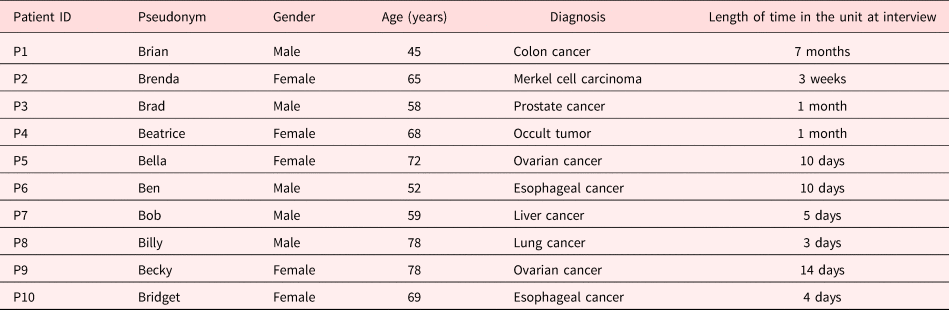
The research sample consisted of a total of 50 participants. A total of 10 terminally ill patients who had cancer took part in the study and interviews were conducted at their bedside after their formal consent was obtained. These patients were at the palliative care units for more than 48 hours, and their clinical condition was stable albeit a few experienced major pain. Patients who were mentally confused, unable to express themselves, or were too unwell to permit data collection were not invited to take part in the study. All patients had cancer and were aged between 45 and 80 years. The characteristics of these patients are presented in Table 1.
Characteristics of patients

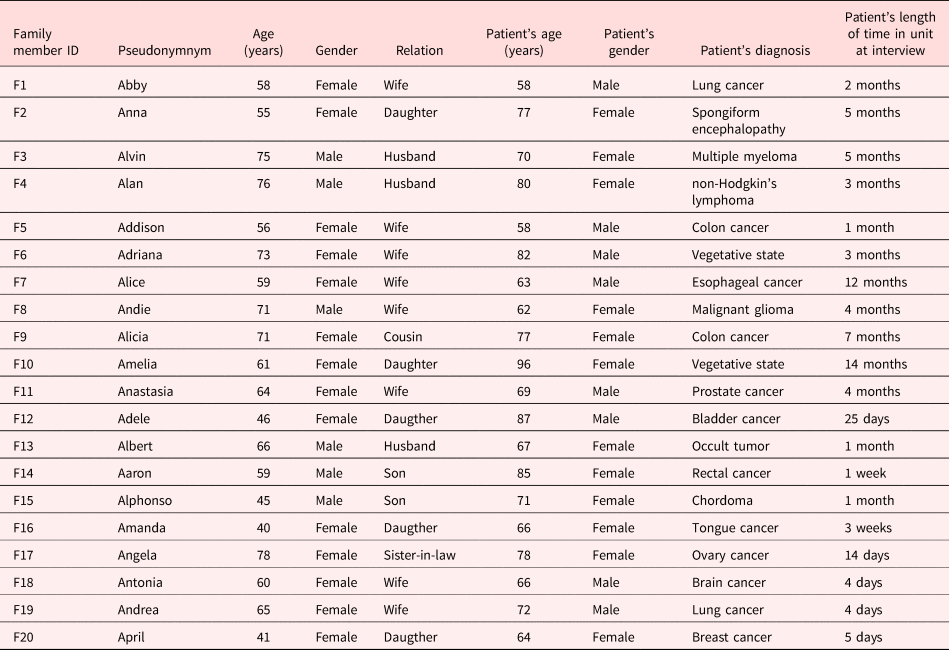
Although the initial intention was to triangulate the accounts of the families and patients, this was not possible as fewer patients, because of their deteriorating condition, were able to take part in the study. Out of the 20 family members, only 2 had a relationship with patients interviewed: Beatrice and Becky. Interviews with family members were conducted in a private area of the palliative care unit, namely in the living room or cafeteria, after obtaining their formal consent. The characteristics of family members are presented in Table 2. As shown in this table, most were female aged 41 to 78 years.
Characteristics of family members

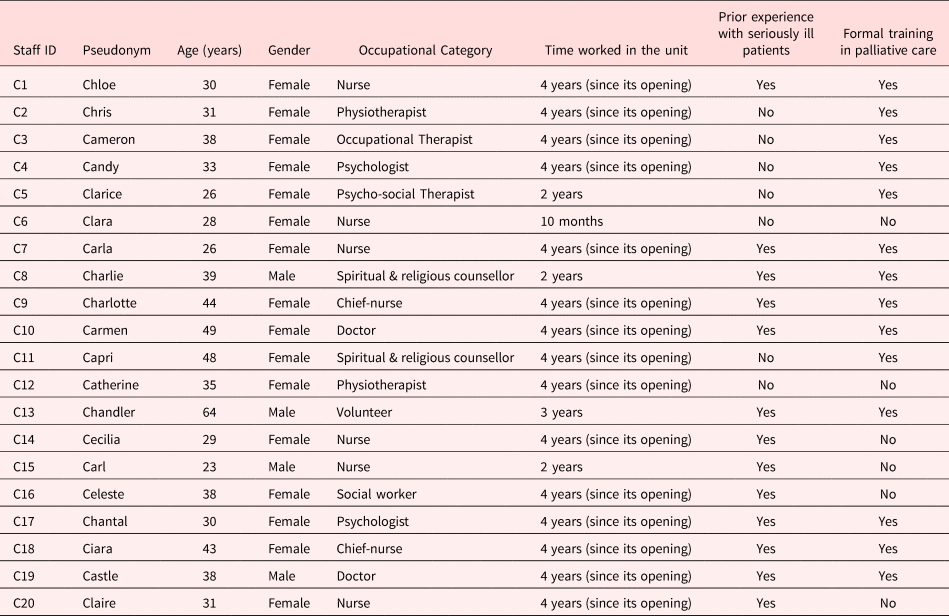
The accounts of palliative care professionals provided a basis for triangulation according to the accounts of the patients and family members. Interviews with 20 palliative care professionals were conducted in a private area of the palliative care unit, namely in the living room or the cafeteria, after formal consent was given. The professionals interviewed had direct contact with the patients and family members interviewed, albeit no mention was made of them during the interview. The characteristics of palliative care professionals are presented in Table 3. Most were women aged between 23 and 64 years.
Characteristics of palliative care professionals

Ethical approval was granted by the institution where the main researcher was based at the time: The Royal Holloway, University of London. No ethical approval was required to conduct the study in Portugal. The palliative care units in which fieldwork was carried out were private; therefore, ethical approval from the Portuguese Health Ministry was not required.
All interviews followed a topic guide, open enough to capture participants’ singularities; these were recorded on a digital voice recorder with the participants’ permission and lasted around 40 to 90 minutes. The interviews were conducted in Portuguese, and their transcripts were imported to Atlas ti5. A constant comparative method was adopted to analyze the data. Through a 3-step coding procedure (open coding, axial coding, and selective coding), first order themes were reduced into a family of codes and, then, to a few core themes (Strauss & Corbin, Reference Strauss and Corbin1998), which will be outlined in the next section. Selected quotations were translated from Portuguese to English, and they will be used to illustrate the results.
Results
The data analysis revealed 4 themes: the “conspiracy of silence,” the maintenance of hope, the experience of “conditional awareness,” and the impact of the disclosure of dying. These themes will be discussed below, and selected quotations translated to English will be used to illustrate them.
The “conspiracy of silence”
The most common situation in this study, as the accounts provided by one-half of the staff members suggested, was one, at the time of admission to the palliative care unit, that patients were not informed about the potential imminence of death. The staff members made comments similar to those of a head nurse:
From our experience, patients arrive here without knowing the prognosis. The majority of patients, I think around 90%, arrive here without having any idea of the prognosis. Most of them arrive here without knowing the disease context. Many patients think they are here for physiotherapy because someone has told them that they will be having a special treatment here and that they will recover here. Only a small number of patients are informed; I don't say well informed but informed. I think around 30% know that they have a serious illness. Only a few know their prognosis.
(Ciara, head nurse)Some staff members indicated that the major reason for patients not being informed about the prognosis was that doctors at the hospital were more likely to discuss this matter with the family than with the patient. This instigated what has been referred to as a “conspiracy of silence” (Seale, Reference Seale1998) in the sense that the truth was hidden from patients, as the following statement from an interview with a psychologist suggests:
I think there are many gaps in terms of communication. We often talk about the ‘conspiracy of silence’ from the point of view of families who do not share with the patient the prognosis, but we don't talk about the ‘conspiracy of silence’ that is made by health care professionals. Specifically, by health care professionals related [to] curative medicine. What we have found is that there are gaps in terms of communication. The problem is given to families by these health care professionals. What we realize is that, most of the time, these health care professionals tell the family but don't tell the patient, and they expect that the family will tell the patient the prognosis.
(Chantal, psychologist)A few staff members contended that family members knew about the prognosis but made considerable efforts to hide this information from the patient, as the following excerpt from an interview with a volunteer indicates:
One of the principles of palliative care is not to hide anything from the patient. This also implies that the family knows about what is happening. And there are families who say: ‘oh please do not say anything to my father! Don't say anything to my grandfather! Please don't speak about this [the prognosis]!’
(Chandler, volunteer)This so-called “conspiracy of silence” was confirmed by some family members, who indicated that their relatives did not know their prognosis and the likelihood of their death. They made comments akin to those of the daughter of an 87-year-old man with bladder cancer:
If my father knows, he does not say so. We never told him about it. He is sick. He's sick. He knows he is sick. But no one told him what [his prognosis was] specifically. We prefer it this way. Because I know my father, and I know if he knew, then he would get worse, it would be very painful for him. We don't talk much about it. He's sick. We have told him that he is here to get better. When he gets better, he will go home. Basically, this is what he believes. He does not know more.
(Adele, daughter)The maintenance of hope
When questioned about why her family had never informed her father that he was likely to die, Adele indicated that they were afraid of the negative consequences this could have on his well-being:
Adele: I thought about telling him [about the prognosis]. If it [were] up to me, he would know. But it is not me who decides.
I: Did you decide altogether [with her other 2 sisters]?
Adele: Yes.
I: Why did you make this choice?
Adele: Because we were afraid that he would get depressed. I believe this would be the case. My sister thinks this way and I agree with her. He was always a very independent person. He was never dependent on others. I think if he knew about his terminal illness, he would give up.
(Adele, daughter)
This respondent feared that her father might lose his will to live if he knew about his terminal condition. Maintaining her father's hope was a central concern for this daughter. Findings indicated that a discourse illuminating uncertainty and hope (Miyaffi, Reference Miyaji1993) was frequently employed by the staff in their interactions with patients and family members. This was evident in a meeting held between Brad, a patient, his relatives, and some members of the team to discuss Brad's clinical condition. Brad, aged 57, had been diagnosed with non-Hodgkin's lymphoma. Because he had brain metastases, he experienced periods of mental confusion. He had lost his ability to walk and move from place to place, and he had to use a wheelchair. His wife had died 20 years earlier from breast cancer. Brad had no children, and his support network was his brother and his 2 sisters, who were all present during the meeting. The doctor began the meeting asking Brad about how he felt and the impression that he had about the unit. After 10 minutes, a trainee doctor came to collect Brad saying that he had a clinical appointment. When Brad left the room, the doctor explained that the patient was very confused, so he would not understand the purpose of the meeting, and, thus, it was best for him not to be present. The doctor started the conversation with Brad's relatives by asking them about their expectations of the illness:
“What are your expectations about your brother's illness?’ Carmen [doctor] asked. His younger sister responded: ‘We don't know. Do you think it is going to kill him?’ Carmen said: ‘I wish I could say no. I wish I could say that he will last a long time.’ His sister broke down in tears: ‘My only wish is that my brother does not suffer.”
(Extract from field notes)The experience of “conditional awareness”
The accounts suggest that health care professionals might give vague information about the prognosis to family members but keep the truth from the patient. A 78-year-old woman with ovarian cancer stressed that although the doctors had told her that she would recover. she knew that this was not so because she felt that her body was deteriorating:
Becky: I feel worse.
I: What has the doctor told you?
Becky: The doctor has told me that I will recover, but, of course, I will not recover. I know because the symptoms I have [i.e., major pain, fecal and urinary incontinence, and body paralysis] are getting worse.
(Becky, terminally ill patient)
The accounts provided by several staff members suggested that some patients were likely to experience a form of “conditional awareness” (McNamara, Reference McNamara2004) in their communication with palliative care professionals and family members in the sense that the disclosure of the prognosis took place over a period of time (Field & Coop, Reference Field and Copp1999). A head nurse articulated this as follows:
Our strategy is that the patient should be informed about what he would like to know. This is our strategy. We inform the family that we do not lie and that we would like to address the patient's needs. What often happens is that we tell little by little. The patient ends up making his own path and questioning some things directly. Then, he ends up knowing about it [the prognosis]. There are many protocols of communication, but, here, we use the Buckman protocol [a 6-step protocol for breaking bad news]. There are others that can be used. There are many ways to do it. Here, we try to work on this issue [the disclosure of the prognosis].
(Ciara, nurse-chief)The impact of the disclosure of dying
The following extract from an interview with the wife of a 58-year-old man diagnosed with colon cancer shows how disclosure could be detrimental to the well-being of the patient and that one should respect a patient's decision not to know about impending potential death:
I: What has the doctor said about his illness?
Addison: The doctor said that he had cancer. He said in a very clear way that he had cancer. That nothing more could be done to cure him. That they could only help to improve his time and quality of life. Nothing else.
I: And was your husband informed about the prognosis?
Addison: Everything happened in his presence.
I: How does your husband deal with it?
Addison: On the day that they told him it was as if his world had collapsed. As expected, he reacted badly. He was scared. It was a surprise for us. Then, it was the anger. He didn't understand why. Why this was happening to him.
(Addison, wife)
The case of Beatrice, a 68-year-old patient with an occult tumor (i.e., a tumor that was hidden or so small that it could not be found), helps to illustrate this issue. Four months after her admission to the palliative care unit, Beatrice asked the nurse about her prognosis. The nurse said that the best thing to do was to question the doctor about it. Two days on, a nurse (Ciara), during the team meeting, indicated that Beatrice had had a frank and open conversation with the doctor about her illness and, thus, was aware of her impending potential death:
Today, in the team meeting, Ciara [nurse] told other staff members that the doctor had told Beatrice that she was suffering from cancer and that she was likely to die. The doctor had explained to Beatrice that all [staff] members would help her during the dying process, and all her needs and wishes would be addressed. Ciara stressed that Beatrice broke down in tears and said that she already suspected this was so. Ciara also stated that later on that night, Beatrice had told a nurse that she was very upset with the fact that everybody knew of her terminal illness except herself.
(Extract from field notes)On the following day, Beatrice confronted her husband (Albert), and he said that he had known, but he had not had the courage to tell her. Albert was afraid of the negative consequences that the disclosure of the diagnosis could have had on the well-being of his wife. In a conversation with her husband, Beatrice stressed that she wished that after her death, Albert should look for another woman to marry so that he would not be alone. Albert and Beatrice were married for almost 40 years. Albert was very disturbed with Beatrice's comment and reported his feelings to the psychologist. Beatrice was very concerned about her husband and became very anxious about it. She became agitated and confused in the weeks that followed. The psychologist of the unit tried to talk with Beatrice about her worries but had no success. The staff also provided spiritual support, but Beatrice was so delirious that she was not able to have a proper conversation. She died 3 weeks after being told about her impending death.
Discussion
The familial nature of Portuguese society is illustrated through the disclosure practices around dying, in the sense that it shows the extent to which the care of self is given to the family (Seale, Reference Seale1998). The belief that communication of a terminal illness is the responsibility of the family (Cardoso, Reference Cardoso2009) that might help to explain why the staff interviewed for this study were less likely to discuss a terminal prognosis with the patient than with the family. The family did not want palliative care professionals to disclose the prognosis to the patient, as they intended to instill hope so that patients could continue living life as normally as possible (Long, Reference Long2004). Not telling their relative about the prognosis is understood by family members as a way to help patients, namely, to support them through a terrible life event (Gordon & Paci, Reference Gordon and Paci1997).
Patients’ decisions not to discuss the prognosis with others could be a strategy employed by them to protect themselves (Exley & Letherby, Reference Exley and Letherby2001). Indeed, denial is an important coping strategy in managing the day-to-day realities of living with a life-threatening illness (Gott et al., Reference Gott, Small and Barnes2008). Also, by avoiding discussing their prognosis, patients were able to “maintain a normal life” (MacArtney et al., Reference MacArtney, Broom and Kirby2017). The refusal to discuss the prognosis could also be because of the perception of the consequences that this might have on their family members (Hilário, Reference Hilário2016) and their desire to protect them (MacArtney et al., Reference MacArtney, Broom and Kirby2016). End-of-life communication is shaped by individual preferences (Broom et al., Reference Broom, Kirby and Good2014) and relational dynamics (MacArtney et al., Reference MacArtney, Broom and Kirby2015).
The idea that “open-awareness and acknowledgment of dying is a script particularly suited to the conditions of late modernity” (Seale, Reference Seale1995: 611) is not in accord with the findings. The projection of self-awareness did not appear to be a central preoccupation for the patients in this sample. What became evident is that a “revivalist” good death might not be suitable for all dying people, as they might not want an open awareness of dying and, thereby, the public acknowledgment of imminent potential death.
Limitations of the study
The first limitation of the study was its sample size. Because of the deteriorating conditions of most patients, it was possible to recruit only 10 terminally ill patients. As the sample of families recruited into the study was not coincidental with the sample of patients recruited because of the practical reasons mentioned, the main researcher, more often than not, was unable to interview members of the same family. Also, as the consent for observational purposes could not be taken for granted in subsequent encounters with patients and family members, the main researcher constantly had to remind them of her role. The fact that participants knew they were being observed for research purposes could have affected their behavior.
Conclusions
As with all organizational entities, palliative care is bound by culture and social expectations (Broom, Reference Broom2012), and, thereby, it is shaped and constrained by the values of the society in which it is based. Findings suggested that the practices of silence around the potential imminence of dying in Portugal need to be located within a larger cultural narrative that Gordon and Paci (Reference Gordon and Paci1997) have referred to as “social embeddedness.” That is, “a narrative of social unity and hierarchy of protection from or adaptation to the inevitable necessities of life, in part by using narrative itself to construct a sense of group protection” (Gordon & Paci, Reference Gordon and Paci1997). This could be explained, to a certain extent, by Catholicism's subsidiary principal that Portuguese society is based upon that family members should protect each other (Tavora, Reference Tavora2012). The “social embeddedness narrative” (Gordon & Paci, Reference Gordon and Paci1997) provides a relational framework for dying well in Portugal and, thereby, offers an alternative to the “revivalist” good death script prominent in Anglo-Saxon culture that calls for an open awareness of death and acknowledgment of the potential imminence of dying (Clark, Reference Clark2002). The findings presented revealed that the meaning of dying well within palliative care is likely to vary according to cultural and social expectations. The “revivalist” good death script (Seale, Reference Seale1998) is not a cultural preference in a palliative care context in Portugal, as it is not in accord with its familial nature. In terms of practice, the findings presented here outline the need for politics of care at the end of life that consider the diversity among the preferences for an aware death.
Author ORCIDs
Ana Patrícia Hilário, 0000-0001-7396-5127
Acknowledgments
The author would like to acknowledge the financial support of the Portuguese Foundation of Science and Technology (FCT) through an individual doctoral grant [SFRH/BD/43293/2008].