Introduction
Design is a multi-criteria decision-making process (Harputlugil et al., Reference Harputlugil, Gültekin and Prins2011), and knowledge, of alternatives and consequences, is a prerequisite for rational decision-making (March, Reference March1997). It is defined as a “body of facts, principles, or techniques accumulated by designers”, which is dependent on the inference of information, that is, design data or observations (Stone and McAdams, Reference Stone and McAdams2001). A final design is the result of a number of prior decisions made (Hazelrigg, Reference Hazelrigg1998; Kemper et al., Reference Kemper, Wei and Linda2006), iteratively at each design stage (Asimow, Reference Asimow1962). Decisions made at the conceptual stage are of utmost importance due to the influence of these decisions on the resultant design with regard to various criteria (Pugh, Reference Pugh1991; Roozenburg and Eekels, Reference Roozenburg and Eekels1995; Pahl and Beitz, Reference Pahl and Beitz1996; Ullman, Reference Ullman1997; Cross, Reference Cross2000; Ulrich and Eppinger, 2008), such as cost and sustainability. At this stage, greater changes maybe incorporated while incurring less expenses, compared to latter stages where most life cycle costs have already been committed (Lindahl, Reference Lindahl2003; Ullman, Reference Ullman2003; Luttropp and Lagerstedt, Reference Luttropp and Lagerstedt2006). Thus, the literature widely recommends the incorporation of environmental criteria for concept decisions (Ullman, Reference Ullman1997; Bhamra et al., Reference Bhamra, Evans, McAloone, Simon, Poole and Sweatman1999; Ritzén, Reference Ritzén2000; Fitzgerald et al., Reference Fitzgerald, Herrmann, Sandborn, Schmidt and Gogoll2005; Srinivasan and Chakrabarti, Reference Srinivasan and Chakrabarti2010a) and suggests the consideration of the life cycle of the design at early stages (Tinkleman, Reference Tinkleman2015). Therefore, decision-making at the conceptual stage toward environmentally benign design has potential to address the issue of environmental sustainability. It is defined as “designs that cause, among the alternatives available, least harm to the natural environment” (Acharya and Chakrabarti, Reference Acharya and Chakrabarti2015) and supporting that it is the key motivation of this research.
The conceptual design stage is characterized by abstraction, and lacks sufficient and precise knowledge (Blessing, Reference Blessing1994; Roozenburg and Eekels, Reference Roozenburg and Eekels1995; Ullman, Reference Ullman1997; Kihlander, Reference Kihlander2009). During this stage, designers explore solutions at different levels of abstractions (French, Reference French1999; Cross, 2000) and firm up several alternatives, or solution variants, of which the principle solution, that is, concept is selected upon evaluation with respect to criteria (Pugh, Reference Pugh1991; Roozenburg and Eekels, Reference Roozenburg and Eekels1995; Pahl and Beitz, Reference Pahl and Beitz1996). Thus, there is a large solution space, that is, knowledge of alternatives at this stage (Chakrabarti et al., Reference Chakrabarti, Johnson and Kiriyama1997) but a lack in the quantitative knowledge of environmental impact (EI) of those alternatives. Currently, quantitative evaluation is only partially addressed by abridged- or hybrid-LCA (life cycle assessment) methodologies due to the requirement of information which is unavailable at this stage (Sigel et al., Reference Sigel, Klauer and Pahl-Wostl2010). Redesign and assessment tools like Solidworks Sustainability (www.solidworks.com/sustainability), which are very useful in later design stages, are difficult to use at this stage due to the time required to generate 3D models and need for detail to perform evaluation. For the same reason, the prevalence of design tools at the conceptual design stage (O'Shea, Reference O'Shea2002; Lindahl, Reference Lindahl2003; Montelisciani et al., Reference Montelisciani, Gabelloni and Fantoni2015) is poor, and those available are mostly methodological and unaccommodating toward the abstractions in conceptual solutions (O'Shea, Reference O'Shea2002; Dewulf and Duflou, Reference Dewulf and Duflou2003, Reference Dewulf and Duflou2006; Fitzgerald et al., Reference Fitzgerald, Herrmann and Schmidt2010).
Krishnan and Ulrich (Reference Krishnan and Ulrich2001) note that, in spite of “how” differently designs are developed across organizations, decisions often remain “fairly consistent at a certain level of abstraction”. A BEES (Building for Environmental and Economic Sustainability) software user survey reports that users find it desirable to not learn anything new or provide “expert input” in order to carry out evaluation (Hofstetter et al., Reference Hofstetter, Lippiatt, Bare and Rushing2002). It is also documented that designers are unable to utilize Design for Environment (DfE) guidelines and LCA reports due to the poor understanding of the same as it requires learning and expertise, and the need for quick incorporation of these guidelines and report results into the design within a short-time duration (Handfield et a l., Reference Handfield, Melnyk, Calantone and Curkovic2001; Lindahl, Reference Lindahl2003). The literature further states that designers also require support in their “thinking and working process” and in use of an “explicit and understandable language” for effective communication of their actions, that is, decisions (Wiggins, Reference Wiggins1989). Ullman (Reference Ullman1997) recommended that the criteria for evaluation and the alternatives being evaluated, must be in the same language and at the same level of abstraction to reduce ambiguity and increase ease of decision-making.
Thus, to support environmentally benign designs, the following research gaps were identified that motivated the development of a computer-based support for decision-making at the conceptual stage:
(i) Need for improved knowledge of consequence, that is, EI estimates with associated confidence, of the solution alternatives as; there is lack of sufficient, accurate, and easy to incorporate environmental data at the conceptual stage and there is low availability of impact assessment tools that consider the inherent abstract nature of the solutions.
(ii) Need for “effective” communication of the knowledge of alternatives and its consequence, that is, the design description of a solution variant at a certain degree of detail and its EI, to the designer in a ready-to-use, designerly language that does not require additional learning, expertise, or time and enables prompt decision-making.
Therefore, a “conceptual Tool for environmentally benign design” – concepTe – is developed to mitigate the gaps and address the above identified “needs” required to support the environmentally benign design at the conceptual stage. The tool is envisioned as a computer-based design decision-making support that provides the designers the EI estimates of conceptual solutions, with associated uncertainties, in spite of the inherent abstractions in the solution definition. Thereby, the tool enables evaluation of the solution variants at the conceptual stage and potentially improves the selection of most environmentally benign design solution amongst the variants as concept, that is, supports decision-making.
Thus, the objectives of this paper are as follows:
1. To discuss the development of a “proof of concept” of the intended tool concept: Based on the underlying EI estimation method proposed and developed for application in the Architectural design, Engineering and Construction (AEC) domain. This is elucidated through the literature review in the “Literature review” section followed by the description of the tool in the “Development of the ‘proof of concept’ of the tool” section.
2. To report the empirical findings from the evaluation the “proof of concept” of the tool: Through design studies conducted to test the effectiveness of the tool in improving decision-making with respect to environmentally benign design at the conceptual stage, as discussed in the “Evaluation of tool for effectiveness in supporting decision-making” section.
Literature review
The literature review is conducted in two parts – on the existing method on which the tool is conceptualized (see “The underlying method for EI estimation of conceptual solutions behind the intended tool” Section), and for clarifying the specific requirements for development of the intended and its “proof of concept” applicable in a domain-specific context (see “The need of domain-specific knowledge support for EI estimation and effective communication” and “A review of the literature for development of a domain-specific ‘proof of concept’” Sections).
The underlying method for EI estimation of conceptual solutions behind the intended tool
At the conceptual stage, solutions have piecemeal descriptions, and maybe described using different ontologies. The Function–Behavior–Structure (Gero, Reference Gero1990) ontology is one means of describing a design, and several design decision tools, such as Eco-PAS methodology (Dewulf and Duflou, Reference Dewulf and Duflou2003) and Function Impact Matrix (FIM) methodology (Devanathan et al., Reference Devanathan, Ramanujan, Bernstein, Zhao and Ramani2010), have been developed on the functional basis (Stone and Wood, Reference Stone and Wood2000). However, “function” in itself exists at different levels of abstraction, with requirements co-evolving with the solutions during the design process (Pahl and Beitz, Reference Pahl and Beitz1996; Dorst and Cross, Reference Dorst and Cross2001; Wood et al. (Reference Wood and Greer2001)). Also, the conceptual solution is often uncommitted to structure and, hence, to life cycle processes, which is the key determinant of the EI of the final product (Bras, Reference Bras1997; Kota and Chakrabarti, Reference Kota and Chakrabarti2010).
However, associating quantitative EI values to a solution at the conceptual stage, based on the known set of design structure that satisfies its functions, that is, on the functional basis, was found to limit the exploration of alternatives by Acharya and Chakrabarti (Reference Acharya and Chakrabarti2015). The need for a “richer” description of conceptual solutions that captures its abstract nature and allows impact evaluation of alternatives, without committing to a specific design was inferred, upon the empirical study. The SAPPhIRE model of causality (Chakrabarti et al., Reference Chakrabarti, Sarkar, Leelavathamma and Nataraju2005) was found to be an appropriate ontological basis for design descriptions of conceptual solutions. It has constructs, namely Action (A), State change (S), Phenomenon (Ph), Effect (E), Input (I), Organ (O), and Part (P), that are Outcomes present in every design at different levels of abstraction (Srinivasan and Chakrabarti, Reference Srinivasan and Chakrabarti2010b) and can be used to describe a solution as a “set of Outcomes at different levels of abstraction”. Also, the EI propagates along the flow of causality in the model and allows association of EI of an outcome at a higher level as the summation of impacts of all its subsequent lower-level outcomes (Acharya and Chakrabarti, Reference Acharya and Chakrabarti2015). The EI of a Part (P) can be calculated upon considering all its life cycle phases and its associated uncertainty can be calculated by accounting the other sources of uncertainty, such as data quality and methodological choices, as reported by Acharya and Chakrabarti (Reference Acharya and Chakrabarti2017).
However, as discussed earlier, the configuration of these “parts” to define a solution is uncertain in the conceptual stage but is essential to assess the workability of the solution for further embodiment. The uncertainty in a solution's configuration, termed as “solution definition”, brings in inaccuracies into the estimate values with respect to life cycle phase information (Acharya and Chakrabarti, Reference Acharya and Chakrabarti2017). The uncertainty in solution definition with respect to LCA propagates hierarchically and so is systemically subcategorized as working structures (WS), working principles (WP), organs (oR), part (P), and form (F) corresponding to system, subsystem, relationship, entity, and feature level of the embodied product's structure. A “working structure” (WS) is at the highest level of the system hierarchy. It is an organization of working principles (WP), which, in turn, is an organization of phenomena and effects realized by parts (P) having some form (F), and all the relationships vaguely describable through physical properties and conditions, that is, organs (oR), required to make the solution work. Thus, a solution comprises of several decomposed sub-solutions, each resolved via a working structure, working principle, organ, and part each with a form. Therefore, the following method of EI estimation of a solution at the conceptual stage is proposed by the following equation:
 $$\eqalign{{\rm EI}\lpar {{\rm Solution}} \rpar _{\,j}& = {\rm no.} \,{\rm of}\,{\rm WS}\,{\rm in}\,{\rm the}\,{\,j\hbox{-}{\rm th}}\,{\rm Solution}_{{k} = 1}\sum {{\rm EI}{\lpar {{\rm WS}} \rpar }_{{\,jk}} + {\rm no.} \,{\rm of}\,{\rm WP}\,{\rm in}\,{\rm the}\,{\,j\hbox{-}{\rm th}}\,{\rm Solution}_{{l = 1}}} \cr &\quad \sum {{\rm EI}{\lpar {{\rm WP}} \rpar }_{{\,jl}} + {\rm no.} \,{\rm of}\,{\rm Organs}\,{\rm in}\,{\rm the}\,{\,j\hbox{-}{\rm th}}\,{\rm Solution}_{{m = 1}}} \cr &\quad \sum {{\rm EI}{\lpar {{\rm oR}} \rpar }_{{\,jm}} + {\rm no.} \,{\rm of}\,{\rm Parts}\,{\rm in}\,{\rm the}\,{\,j\hbox{-}{\rm th}}\,{\rm Solution}_{{n} = 1}} \sum {{\rm EI}{\lpar {\rm P} \rpar }_{{\,jn}}}} $$
which draws relevant information from any life cycle inventory (LCI) database for “Part” level, upon considering the volume associated to it by its form or shape (Agudelo et al., Reference Agudelo, Nadeau, Pailhes and Mejía-Gutiérrez2017). The method subsequently calculates the EI for each of its hierarchically higher solution definition subcategories, that is, oR, WP, and WS.
The “concepTe” tool, initially envisioned as an assessment tool, estimates the EI of a solution using the proposed method [Eq. (1)] upon considering the inherent uncertainty in the conceptual stage of design with respect to LCA. Thus, the designer can assess a solution at any systemic level by providing the input to the “environmentally benign Design Assessor” (eDA) in the form of the solution definition subcategories, that is, WS, WP, oR, or P, and it calculates the EI of a solution's alternatives, each at different degrees of detail, which accounts for the confidence on the estimate value. This is accounted by the categorization of “uncertainty in the conceptual design stage with respect to LCA” (Acharya and Chakrabarti, Reference Acharya and Chakrabarti2017), based on which a method for EI estimation of conceptual solutions was proposed. The SAPPhIRE-based domain-agnostic ontology offers the advantage of supporting the application of the tool across several domains.
The need of domain-specific knowledge support for EI estimation and effective communication
However, the mapping of parts of a solution with its specific organs to achieve its higher hierarchical solution definition subcategories of working structure has been found to be challenging outside the purview of a domain, as highly abstract conceptual solutions can be resolved in a number of ways depending on the design intent or domain. For example, “comfort” is an action-level design requirement outcome that maybe achieved by the phenomena of “ergonomics” for the industrial design domain, whereas the same maybe achieved through “adequate ventilation” in the architectural design domain. The resulting domain-specific working structure, though devised on generic working principles and related through organs that are universal physical properties and conditions, can be realized only depending on available and usable parts with respect to the specific domain. Therefore, it is concluded that the assessor module of the tool, that takes input as solution definition, requires the support of the domain contextualized knowledge support module to scope LCI information accurately for evaluation of conceptual solutions. It was also noted that the knowledge should be such that the designers need not learn the “expert input”, instead the tool can provide effective communication of the evaluation results in a language that aids designers in decision-making. The knowledge base should be devised such that it not only provides design knowledge and supports evaluation, but allows semantic operability of the knowledge in the domain language familiar to the designer, that is, decision-maker, across a computer interface, thereby holistically addressing the identified research gaps.
The principles of knowledge engineering, “concerned with acquisition, representation, and manipulation of human knowledge in symbolic form” (Gero, Reference Gero1989), are found relevant for design of the knowledge support, due to the following characteristics:
• aids in design analysis, visualization, and evaluation (Manago and Gero, Reference Manago and Gero1987; Gero, Reference Gero1989),
• has the potential to translate database descriptions (Gero and Maher, Reference Gero and Maher1988) into an appropriate, that is, ontological form of knowledge-based description, and
• can support common access to information, and indexing and search from repository (Uschold and Jasper, Reference Uschold and Jasper1999).
A review of the literature for development of a domain-specific “proof of concept”
The literature is further reviewed to clarify the requirements for development of a knowledge base. The domain of AEC is investigated, as it has significant canned design data from Standards and Codes and LCI data. But more importantly, because this domain is a significant contributor toward the global EI with up to 60% of global material resource consumption (Hawken et al., Reference Hawken, Lovins and Lovins1999) and 50% of climate change, landfill waste, and ozone depletion of the annual global pollution, attributed to buildings alone (Brown and Bardi, Reference Brown and Bardi2001).
Knowledge-base support in the AEC domain
There is much research conducted in the AEC domain with respect to supporting decision and design process via knowledge-based systems. Rosenman and Gero (Reference Rosenman and Gero1985) used this principle to evaluate buildings against the building code. Fenves et al. (Reference Fenves, Flemming, Hendrickson, Maher and Schmitt1990) integrated a number of knowledge bases, namely ARCHPLAN by Schmitt in 1987, HI-RISE by Maher, 1984, SPEX by Garrett, 1986, EDESYN by Maher in 1987, and CONSTRUCTION PLANEX by Hendrickson in 1987, to develop “an integrated software environment for building design and construction”. Borkowski et al. (Reference Borkowski, Fleischmann and Bletzinger1993) proposed a support for “Decisions in Structural Design”, and discussed issues of intelligent access to the previous design experience stored in the database; automatic generation and comparison of plausible alternatives; and acquisition of new knowledge through algorithmic structural optimization. Carra et al. (Reference Carrara, Fioravanti and Novembri2001) are involved with ongoing work in the area of “Knowledge-based System to Support Architectural Design Shift toward Collaborative Design”. König et al. (Reference König, Dirnbek and Stankovski2013) proposed a prototype of an open knowledge-base system relying on “mainstream linked data technologies of the semantic web to capture, distill, analyze, and share information on building sustainability among the stakeholders”. Castro-Lacouture et al. (Reference Castro-Lacouture, Quan and Yang2014) developed a framework for integrating information from building information models (BIMs), construction schedules, construction cost estimates, geographic information systems, and constructability reviews. Thus, knowledge, be it externalized or internalized/tacit, is distinct from information, as it has an essence of reasoning that makes the design process effective (Gero, Reference Gero1989; Hubka and Eder, Reference Hubka and Eder1996; Hubka, 2002).
A knowledge-based system requires an ontology for explication of design rationale and semantic interoperability, etc., and has been termed as a “metadata schema” (Mizoguchi, Reference Mizoguchi2004; Kitamura, Reference Kitamura2006) for systematization of knowledge. Functional basis for conceptual knowledge has been explored extensively (Kitamura et al., Reference Kitamura, Sano, Namba and Mizoguchi2002; Kitamura et al., Reference Kitamura, Kashiwase, Fuse and Mizoguchi2004). However, Kitamura (Reference Kitamura2006) notes that “functional modeling tends to be ad hoc because it is subjective”, beckoning the need for an appropriate ontological basis for richer description of conceptual designs, as maybe provided by the SAPPhIRE model for solution descriptions (Acharya and Chakrabarti, Reference Acharya and Chakrabarti2015). Yoshioka et al. (Reference Yoshioka, Umeda, Takeda, Shimomura, Nomaguchi and Tomiyama2004) developed KIEF (Knowledge Intensive Engineering Framework) upon integrating several ontological models of theories of engineering tools and based it on a “physical concept” ontology of entity, relation, attribute, and physical phenomena, and a physical law to describe CAE systems. This further asserts merit in the basis of the ontology of the SAPPhIRE model of causality (Chakrabarti et al., Reference Chakrabarti, Sarkar, Leelavathamma and Nataraju2005) for systematization of knowledge.
Kraus and Myer (Reference Kraus, Myer and Moore1970) made the following suggestions on the formatting of information on a computer-based system to respond to the uniquely “architectural” way of thinking – focus on the geometric form, permitting visual assimilation; permit the designer to select the scale at which to operate, that is, in parts or wholes, or the broader context of the building; enable simultaneous consideration of a number of variables; and help the designer to improve the creative insights during the design process. Burnette Charles and Associates (1979) recommend certain guidelines for an information system for architectural use, upon investigating how architects use information and data, of which two are “information must be presented in a form to be readily used” and “should appear consistently in the same format” that stress on the need for classification of the data for consistent and easy assimilation. The ISO 12006-2 is the international standard for “Building construction – Organization of information about construction works”, offering a framework for several classification systems, such as MASTER FORMAT (CSI and CSC, 2004), UNIFORMAT II (CSI, 2012; CSI and CSC, 2010), UNICLASS 2 (CPIC, 2013), and OMNICLASS (OmniClass, Reference OmniClass2006). These standardized classification of design data are in a language familiar to the designers, and Uniformat II hierarchically classifies the building design element data at different systemic levels.
State-of-the-art on LCA in the AEC domain
While some tools though not designed specifically for the AEC domain are in use, such as EIO-LCA model – an online tool (CMU, USA), MIET 2.0 (Leiden University, Netherlands), and Tool for Environmental Analysis – TEAMTM (Ecobilan, France); a number of LCA-based software tools and databases providing standardized assessment models and inventory data at multiple scales have been developed (Cabeza et al., Reference Cabeza, Rincón, Vilariño, Pérez and Castell2014; Haapio and Viitaniemi, Reference Haapio and Viitaniemi2008), mostly by research institutes, such as Building Environmental Assessment Tool – BEAT 2002 (Danish Building Research Institute (SBI), Denmark), EcoEffect (Royal Institute of Technology (KTH), Sweden), EcoProfile (Norwegian Building Research Institute (NBI), Norway), Eco-Quantum (IVAM, The Netherlands), Environmental Status Model – Miljöstatus (Association of the Environmental Status of Buildings, Sweden), EQUER (École de Mines de Paris, Centre d′Énergétique et Procédés, France), ESCALE (CTSB and the University of Savoie, France), LEGEPs – previously known as Legoe (University of Karlsruhe, Germany), and PAPOOSE (TRIBU, France). These tools have been classified into three tiers (Trusty and Horst, Reference Trusty and Horst2005): product comparison tools, such as BEES (NIST, USA), SimaPro (PRé Consultants), and GaBi (PE Int′l); whole-building decision support tools, such as Athena Eco-Calculator (ATHENA, Canada) and Envest 2 (UK) (BRE Group); and whole-building assessment systems and frameworks, such as Athena Impact Estimator (ATHENA, Canada) and the LEED rating system (U.S. GBC, USA). Several attempts are currently underway to integrate LCA with BIM (Antón and Diaz, Reference Antón and Diaz2014; Najjar et al., Reference Najjar, Figueiredo, Palumbo and Haddad2017) and is a promising direction for further development of the tool.
LCA (ISO 14040: 2006) is keenly being incorporated into the architectural design and construction domain for decision-making, that is, evaluation and selection of environmentally benign products, and optimization of construction processes (Sartori and Hestnes, Reference Sartori and Hestnes2007; Bribián et al., Reference Bribián, Usón and Scarpellini2009; Cabeza et al., Reference Cabeza, Rincón, Vilariño, Pérez and Castell2014; Anand and Amor, Reference Anand and Amor2017). Energy consumption and EI are the two key measures with respect to environment that are assessed by LCA for buildings, scoped broadly across three life cycle phases, namely pre-operation or cradle-to-gate (C2G), operation, and end of life (EoL), characterized as “embodied impact and potential energy for C2G and EoL” and as “operational energy and impact” for use phase or operations. Bribián et al. (Reference Bribián, Usón and Scarpellini2009) summarizes, upon the extensive literature review, the requirements for reducing EI in the building sector and stresses the need of methods and tools for evaluation over the entire life cycle, apart from several other recommendations.
Traditionally, energy efficiency has been a primary focus for environmental design of buildings, with the use phase dominating the LCA of buildings due to the high-energy demand for operation (Sartori and Hestnes, Reference Sartori and Hestnes2007; Anand and Amor, Reference Anand and Amor2017). Operating energy measured as the energy required for operations and maintenance of the building in use, along with energy for HVAC (heating, ventilation, and air conditioning), domestic hot water, lighting, and for running appliances, is easy to be measured (Ramesh et al., Reference Ramesh, Prakash and Shukla2010) but difficult to integrate into the decision-making process during the design stages with certainty. The pre-operations life cycle phase is measured by the embodied energy of the building, traditionally scoped by C2G, that is, it encompasses the raw material extraction, processing, and manufacturing into “parts”, transportation, and distribution to the construction site, and eventually installation and construction phases of the life cycle. Thus, the embodied energy of a building is calculated as the summation of all energy content of design elements and technical installations, and those incurred for new construction and renovation of the building, prior to use phase. LCA for EoL quantifies the eventual EI, negative if planned, and demolition energy required at the end of the buildings’ service life. Therefore, for a holistic LCA of a building design, both operational and embodied impact and energy must be addressed, but with the life span of a building being over several decades, it is difficult to gauge the operational behavior of the building and its occupants. This has led to a shift of focus onto design decisions to reduce the environmental footprint of the building (Wall and Wimmers, Reference Wall and Wimmers2018), that is, from the operational phase to the pre-operations phase (Anand and Amor, Reference Anand and Amor2017).
This lack of synchrony between material service life (the parameter determining material renewal intervals) and building service life (the operation phase duration) makes both the measures, that is, EI and energy consumption, heavily dependent on material choice, though often there exists a trade-off between material choice and building energy demand (Heeren et al., Reference Heeren, Mutel, Steubing, Ostermeyer, Wallbaum and Hellweg2015). Heeren et al. (Reference Heeren, Mutel, Steubing, Ostermeyer, Wallbaum and Hellweg2015) proposed a holistic view of effects and trade-offs, with a model that combines analysis of building energy demand and material use, and provides the results for different environmental methods. From a designer's perspective, appropriate material selection, mentioned as directive toward energy efficient design, is the critical design decision (Wall and Wimmers, Reference Wall and Wimmers2018), as such issues influence not only the operational energy performance of the building but also the total embodied energy of the building and its potential impact (Ramesh et al., Reference Ramesh, Prakash and Shukla2010; Franzoni, Reference Franzoni2011; Florez and Castro-Lacouture, Reference Florez and Castro-Lacouture2013; Ding, Reference Ding2014; Heeren et al., Reference Heeren, Mutel, Steubing, Ostermeyer, Wallbaum and Hellweg2015). Another key determinant of the overall embodied energy is the after-use consideration or EoL, as this has the ability to mitigate potential impacts through planning and strategies, beyond decisions on materials, such as techniques to reduce dust, noise, soil, and water contamination in the construction process; measures to manage and minimize waste during construction, building use, and demolition; and measures to achieve a greater degree of material reuse and recycling during the reintegration phase from EoL (Lombera and Rojo, Reference Lombera and Rojo2010).
Discussions and inferences
• It is inferred that design knowledge support is required to provide the assessor module of the tool with the solution definition of the design element, describable by SAPPhIRE constructs (ontology), for calculating its EI, and that a knowledge base has the capability to support this required domain-agnostic to domain-specific iterative, semantic translation. Also, the one-to-one mapping of the design elements to their corresponding solution definition is found rational to support EI estimation of solutions as per the proposed method (Acharya and Chakrabarti, Reference Acharya and Chakrabarti2017).
• For developing knowledge base for the “proof of concept”, the AEC domain, particularly building design, is looked into due to the high impact this domain has on the environment. Thus, the purview of decision-making is at the discretion of the designer, as there exists several trade-offs to be mitigated between embodied and/or operational, impact and/or energy and also, scope of the assessment depending on the life cycle phases being considered. Accordingly, LCA data is required to provide the corresponding values for estimation and evaluation during the design process.
• The knowledge base should also provide designers with standardized design data in domain language that supports the to and from communication of solution (input) and its EI estimate results (output) between the support and the designers effectively. The designer is not required to learn anything new or provide “expert input” in order to carry out evaluation.
• The primary functionality of “concepTe” is to provide “environmentally benign design assessment” support to designers for evaluating and selecting solutions at the conceptual design stage by the proposed EI estimation method (Acharya and Chakrabarti, 2017).
Based on the above, a “proof of concept” of the tool for building design is conceptualized and developed, as described in the following section.
Development of the “proof of concept” of the tool
The task of developing the tool maybe summarized as follows: to develop a decision-making support for evaluation, and eventual selection, of the most environmentally benign solution variant as concept, upon considering the inherent abstractions and uncertainties of the conceptual design stage.
Scope and limitations of the “proof of concept” developed for building design application
Buildings are “complex products, which require multiple material data” for LCA assessment (Takano et al., Reference Takano, Winter and Hughes2014). A “material” in the context of building design is not merely a “raw material” but a design element at the lowest level of abstraction, that is, “part”. It may either be viewed as a processed material (e.g., construction sand – a material class), or a product, processed from several materials and primarily having geometric specification (e.g., a brick or concrete block). In turn, each such “part” amalgamates into “working structures” to realize “working principles” that utilize physical laws and properties, that is, “organs and forms”. Building design elements that are part-level outcomes, at the lowest level of abstraction, have reducible uncertainty with respect to LCA in the presence of relevant inventory data. Thus, EI (along with energy) can be estimated, with associated uncertainty, for solution variants with different solution definition due to their hierarchical, systemic relationship. However, the EI and energy are calculated separately; this is because “embodied” is scoped across C2G and reduced upon considering EoL; whereas “operational” is scoped for the use phase only. Hence, every design element, be at whatever level of the solution definition, has a quantifiable embodied EI (and energy), to be traded-off against the operational EI (and energy) associated with it. These two values of EI allow designers to perceive the holistic implication of the conceptual design, and accordingly take decisions.
Further, the standardized classification of building design elements, through systems such as Uniformat II, is akin to the systemic hierarchy of “solution definition” subcategories and can support one-to-one mapping of domain-specific design elements to domain-agnostic solution definition. This accounts for the uncertainty in the solution (configurational) definition and allows exploration of alternatives for each element. This type of knowledge systematization also establishes the fundamental logic behind the semantic conversion of domain-specific inputs from the designer to domain-agnostic inputs for the eDA and back, providing results to the designer, for decision-making, in a familiar language and at the same level of abstraction. Therefore, the “proof of concept” comprises of two subsystems: (i) the domain-agnostic eDA that estimates the EI of a solution and (ii) the domain-specific knowledge-base “AEC design library” (Ad-lib) that interpolates domain design data, with its corresponding LCI information, to the input format required by eDA and translates the results back into the domain language familiar to the designers.
The limitations of the “proof of concept” are as follows:
• The knowledge-base Ad-lib is developed for building design, that is, built spaces and built objects or products, as standalone design “elements”. It does not consider the interactions between these elements, their inter-dependencies and constraints.
• Associated LCI data of building design elements is plugged in to the knowledge base from other sources. Currently, only one database is used; however, with incorporation of other databases, data quality and methodological uncertainties in the EI results will vary.
• The trade-off, between embodied EI and energy, and operational EI and energy, in the design decisions, though important, is currently outside the scope of the tool developed in this work. The tool predominantly focuses on evaluation during design and it is the onus of the designer to bring in as many considerations from across the life cycle as possible. For evaluation of the “proof of concept”, the tool is limited to the LCA data on embodied EI and energy, that is, the C2G and EoL phases of the building, provided by the Quartz database (www.quartzproject.org), and not for operational or use phase.
Therefore, the tool is currently limited to certain life cycle phases, and not the entire life; the EI estimate and the preliminary evaluation are limited to observe the influence of the availability of this result on the selection.
Description of the “proof of concept” of the tool
A paper-based (noncomputer-based) “proof of concept” is realized to test the applicability of the intended “concepTe” tool and to evaluate its effectiveness to aid decision-making during the conceptual stage of architectural design.
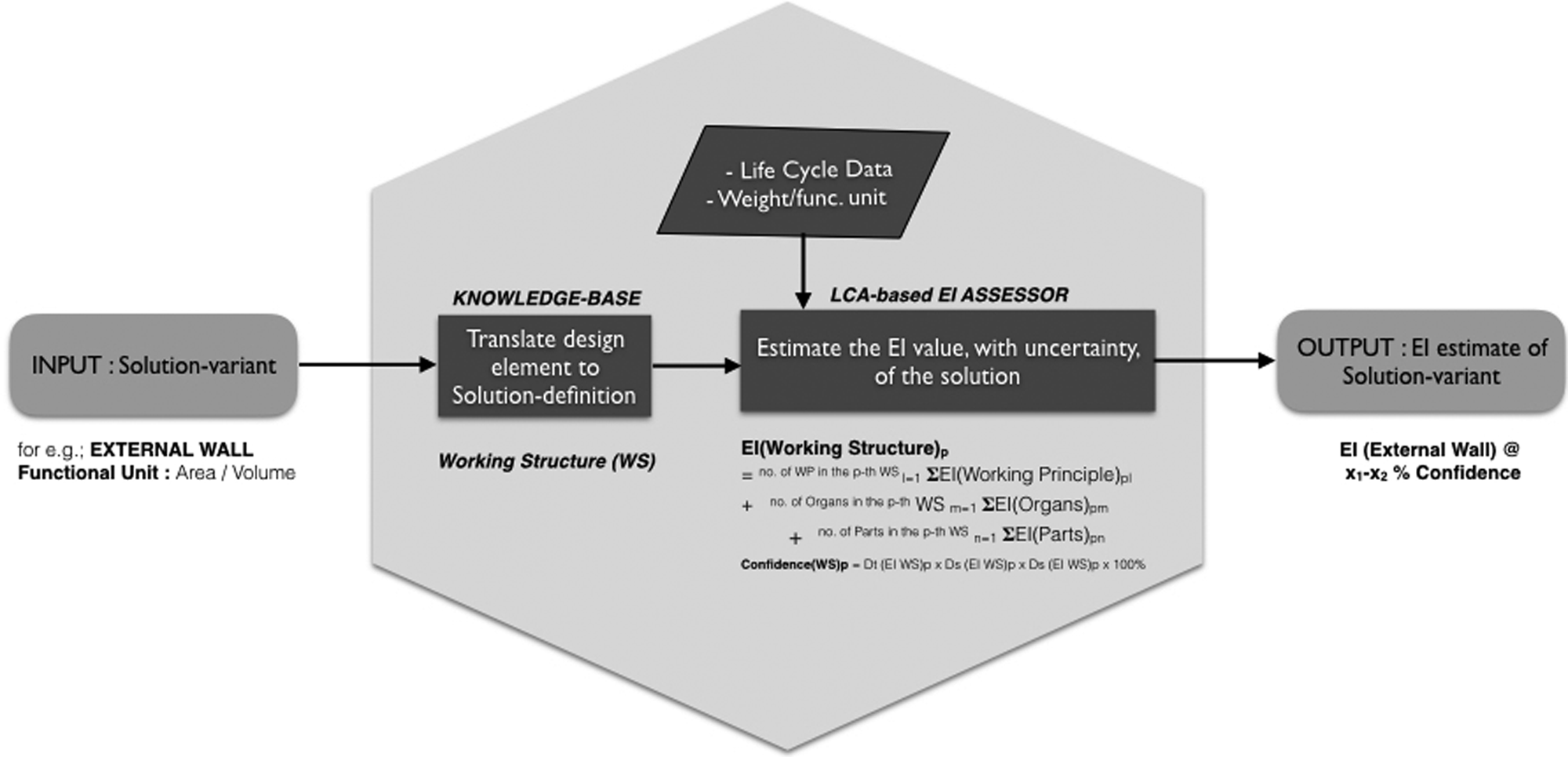
Exemplified with design of an external wall for a building (Fig. 1), the input to the tool is a conceptual solution for an “external wall”. The “concepTe” tool with its two subsystems, that is, knowledge base that translates this input to its appropriate solution definition (working structure) and eDA that uses the translation in its calculation, provides the designer the result of estimation of EI and associated confidence, for the level of abstraction of the solution, without requiring the designer to learn or interpret.
The Input/Output diagram of the tool.

Two key subsystems of the tool are realized are as follows:
(i) eDA for architectural design
The eDA functionality is realized by an excel spreadsheet housing the EI estimation method formulae to calculate the impact upon considering (i) the life cycle phase-wise information considered by the designer and (ii) the calculation of the actual weight of the solution, that is, design element, with respect to the functional unit (area/volume) specified by the form created by designer. LCI information is drawn from the open-sourced “Quartz Common Product Database” for the building design industry, with 102 common building products enlisted with respect to Uniformat II and Masterformat classification. It offers mid-point values for EI, and these are scoped with respect to C2G and EoL life cycle stages, as is adequate for embodied impact energy calculation of a solution variant. Also, to calculate the “kg/functional unit” at the part level, building codes are referred and dead load of the elements are manually input. Confidence is calculated separately with respect to data quality attributes, considering that the methodology chosen for assessment is consistent for a given database. The designer provides the inputs and receives the results, while the eDA performs the calculation task in the background. Depending on the LCA scope selected by designer, for both C2G and EoL, the mid-point values are extracted from the Quartz database. On integrating the dead load of the material (wt. in kgs), the actual EI is calculated and presented to the designer. The reference year is, in turn, used to calculate the confidence on the EI estimate offered.
(ii) The Ad-lib knowledge base
A knowledge base is necessarily integrated into the tool for supporting evaluation of solutions, across a user-friendly interface (UI). The designer can search relevant or choose required design element from the knowledge base and is supported with pertinent knowledge to aid design decision-making.
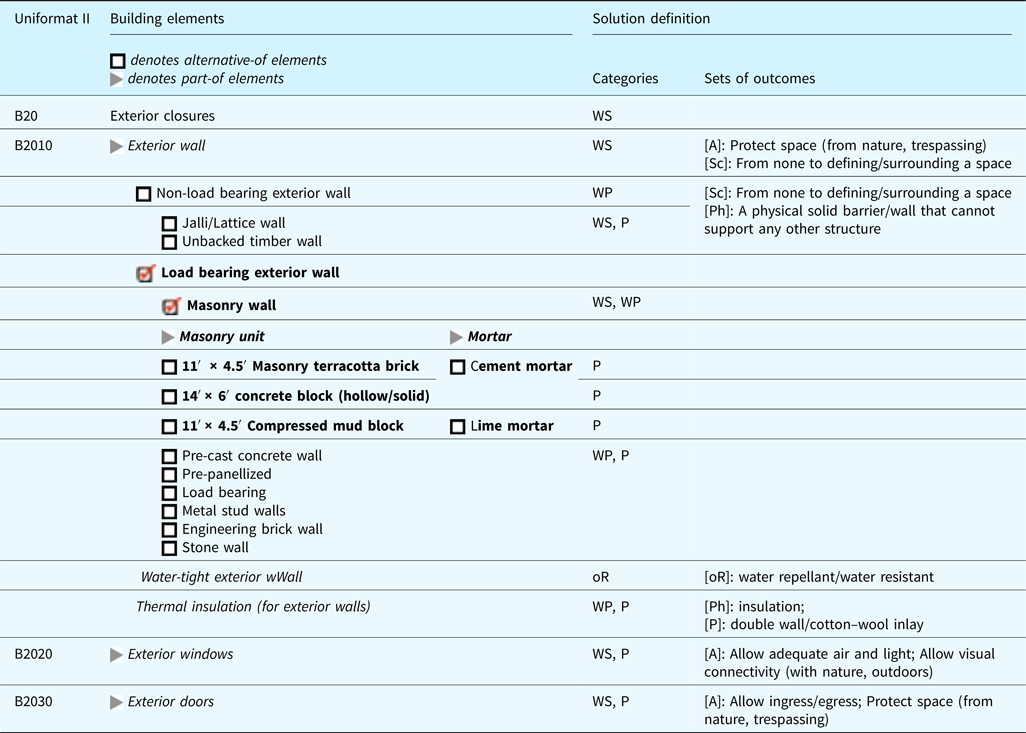
The Ad-lib knowledge base is devised upon referencing National Building Code (India, 2015) International Building Code (USA, 2012), Nuefert Architect's Data (), Time Saver c for Architectural Design Data (Watson, Reference Watson2004), and Uniformat II Classification for all AEC design elements standardized in practice. The design elements, classified as per Uniformat II's tiered levels – lvl.1, lvl.2 for group elements and lvl.3 for individual elements, are further categorized as “part-of” or “alternative-of” subsequent elements.
The Ad-lib knowledge base, illustrated partially in Table 1, enlists architectural design elements, classified as per Uniformat II's tiered levels, with lvl.1, lvl.2 for group elements and lvl.3 for individual elements. These domain-specific elements are further categorized as “part-of” or “alternative-of” subsequent elements. These are then tagged with respect to the domain-agnostic solution definition subcategories of Working Structure [WS], Working Principle [WP], Organs [oR], Form [F], and Part [P]. These subcategorized solution-definitions (design element) are, in turn, tagged to its higher-level “sets of Outcomes” that are abstract, that is, action or state change constructs. For example, building element “exterior wall” is part-of the “exterior closure” at lvl.1 and has an alternative “load bearing”, which is further classified with respect to their alternative elements, such as pre-cast concrete wall or masonry wall, and part elements, such as terracotta brick and cement mortar. These further tagged to the corresponding solution definition categories, that is, brick is at the part level [P], the exterior wall is at the working structure level [WS], and it being load bearing is a working principle [WP]. The [WS] wall is a solution for more abstract design outcome, such as the requirement of a “protected space from natural calamities and trespassers” and hence is mapped in the table as well.
Knowledge base for AEC domain (Ad-lib) in the “concepTe” tool

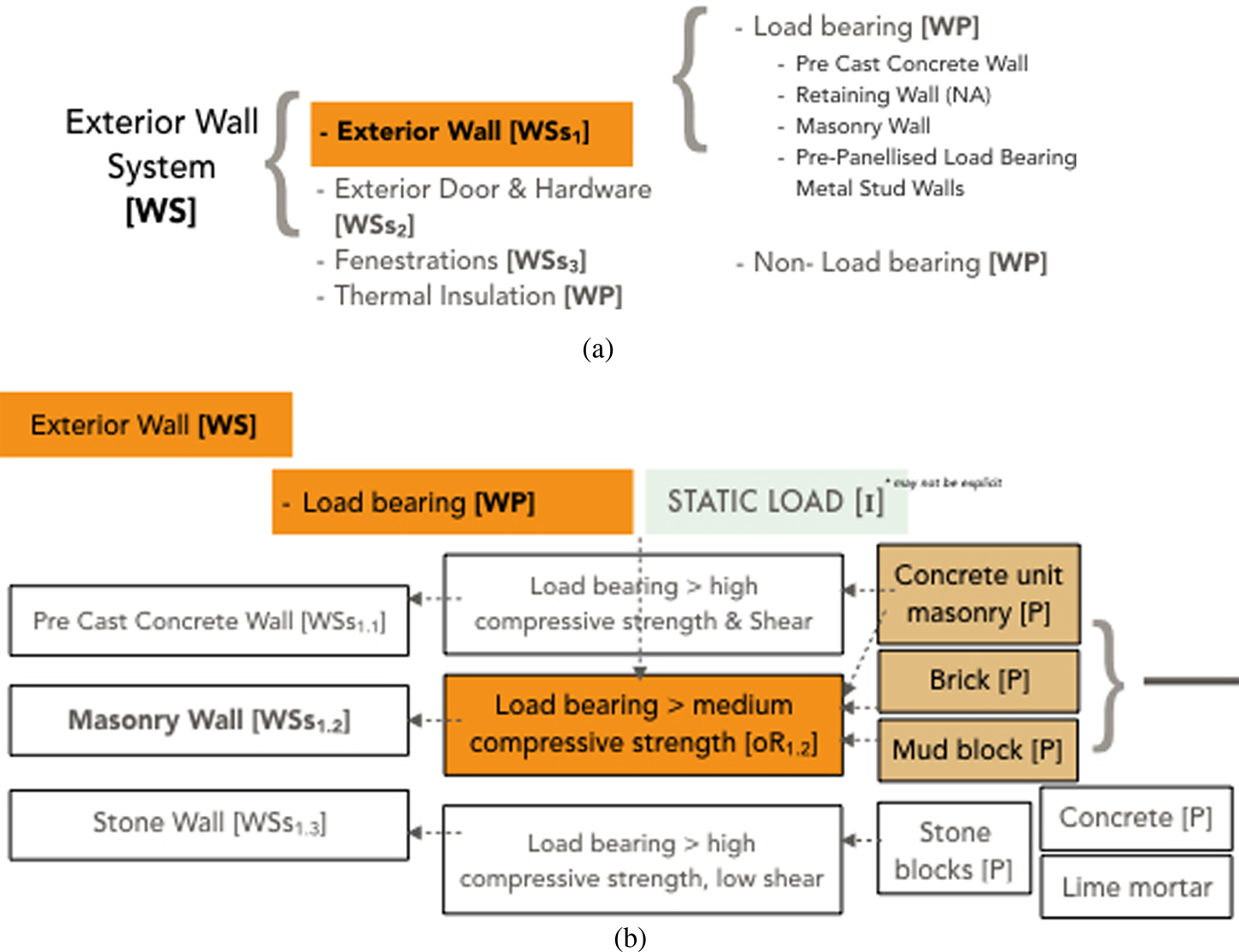
For the “proof of concept”, the open-sourced “Quartz Common Product Database” with 102 common building products is used. It is scoped with respect to the life cycle phases of C2G and EoL, to be considered as per the designer's prerogative, and does not contain operational energy or impact values. Both mid-point as well as end-point impact values are calculated from this source. For example, if a designer is designing a larger built system and is currently focusing on the exterior wall system, the tool presents the knowledge on the subsequent systemic levels from the Ad-lib, as shown in Figure 2a. The designer can narrow in on the domain-specific design element to be designed and can select (highlighted in orange) for further design development.
(a) Knowledge-base support on UI domain-specific design element tagged to domain-agnostic solution definition. (b) Knowledge presentation on UI: relevant knowledge in domain language to aid decision-making at different systemic levels.

As the design progresses, the tool appropriately provides further knowledge at on the design to aid the designer in decision-making. The previously selected design element, “exterior wall” tagged as “WS”, can be either load bearing or non-load bearing. As the designer decides the requirement of “load bearing” principle for the exterior wall, its alternative solutions are represented, as shown in Figure 2b.
At this point, the designer is flexible to choose several alternatives, not necessarily at the same level of abstraction, by dragging the solution variants to the eDA, based on the process flow described above. Thus, the designer is empowered with knowledge at different systemic levels and can take decisions in real time during the conceptualization stage.
Functions of the tool, process flow, and steps of use
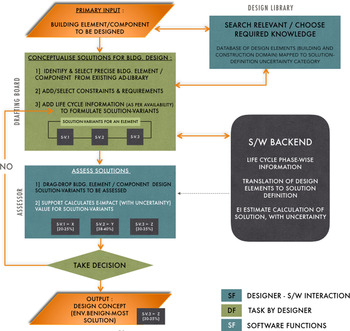
To assess the Environmental benignity of design solutions at the conceptual design stage, the main functions and subfunctions of “concepTe” are given below, with the process flow of the tool illustrated in Figure 3:
1. To estimate EI of the solution variant (primary function) with respect to proposed method that accounts for uncertainty, and in turn, improve knowledge of consequence, an eDA for estimation of EI is conceptualized which
i. estimates EI of the Solution (millipoints/kg weight) by drawing LCI data from the integrated Quartz database inventory, characterized with respect to the US EPA's TRACI 2.1 (Tool for the Reduction and Assessment of Chemical and other environmental Impacts) methodology;
ii. appropriately converts the EI value with respect to the input of the functional unit of application (area or volume) of the solution; and
iii. calculates the confidence on the EI estimate with respect to the temporal, spatial, and sample size of the data available (Kota and Chakrabarti, Reference Kota and Chakrabarti2010).
2. To translate AEC design element input to solution definition subcategory, through semantic tagging, a knowledge base is conceptualized as the Ad-lib which
i. allows search and filter options across knowledge base to access and select desired design element at different systemic levels;
ii. in case of diagrammatic or sketch inputs, allows labeling of the solution with respect to the design elements available in the knowledge base; and
iii. interpolates the solution as design element into its corresponding solution definition subcategory as input for assessment.
iv. Supports designer–computer interaction with effective communication of knowledge.
Process flow of the “concepTe” tool.

The steps of use of the “proof of concept”, with an example, are given below:
STEP 1: [DF] The designer generates or modifies solution variants as texts, diagrams, or sketches, on paper. For designing an external wall, for example, the designer ideates a few possible solutions.
STEP 2: [D-S] A designer browses/searches the Ad-lib the appropriate design element(s), as possible solutions, at any level of the systemic hierarchy. The Ad-lib offers the designer knowledge of various “working structures” and “working principles” for design of the external wall. As designs are explored, “part-of” and “alternative-of” the element are presented.
STEP 3: [DF] The designer generates/modifies solution variants with knowledge from the knowledge base and inputs the functional unit (area or volume) as per the design element being designed. For the architectural building design, the functional unit will mostly be “square foot (sq ft.)”; however, if there is a particular design requirement or constraint, for example, maximum height of external wall, designer can input the functional unit for 20 ft wall as “sq ft/length”.
STEP 4: [D-S] Designer may input or drag–drop solution variant to eDA for evaluation. The designer affirms the solution variants and gives these to the researcher, who performs the tasks of calculation in excelsheets on behalf of the intended computer tool.
STEP 5: [SF] The designer is presented with the EI estimate value, with uncertainty association, as per the proposed estimation method. As the Quartz database offers mid-point values, the results for six impact categories, namely Acidification potential, Eutrophication potential, Smog potential, Global warming potential, Ozone depletion potential, and Primary energy demand, are presented and the highest impact is highlighted.
STEP 6: [SF] The highest impact amongst the categories is highlighted of each solution variant.
STEP 7: [DF] Designer takes decision, that is, selects a concept.
In the following section, the “proof of concept” is evaluated through empirical studies and the above steps guide the participants in the use of the tool.
Evaluation of tool for effectiveness in supporting decision-making
The effectiveness of the “concepTe” tool is investigated by testing the “proof of concept” for the following hypothesis – “use of the tool improves the soundness of the design decision, which increases the chances of selection of the most environmentally benign solution as concept”. To evaluate the effectiveness of the tool in improving soundness of decision-making ability at the conceptual stage, that is: (i) improving the evaluation, that is, the confidence on the decision with respect to environmentally benign design and (ii) improving the selection of the environmentally benign most solution as concept, the following comparative empirical studies were conducted:
Case 1: A single sample of participants performing design exercises with and without the use of the proposed tool; this is to assess the influence of the tool on decision-making.
Case 2: Two samples of participants, with different (levels of) domain expertise, performing the same design tasks with the use of the tool; this is to assess the variability in the influence of the tool in supporting designers from the domain (architects) versus designers from outside the domain (nonarchitects).
Methodology for the empirical study
Design exercises were conducted for two problems in two sessions – one without and other with the use of the tool. Prior to the exercises, an Introductory workshop (1 h in duration) was given to the participants (designers) by the researcher (author). It was an interactive session with presentation of the literature on environmentally benign design, life cycle thinking, systematic design process (Pahl and Beitz, Reference Pahl and Beitz1996) with focus on the conceptual design stage, and a brief overview of the Ad-lib knowledge base.
Design objective and tasks
The objective of the design tasks in the empirical study was “to design environmentally benign conceptual solutions and select the most appropriate solution as concept”. The design tasks were realistic, as the problem briefs given were based on real cases considered for renovation of the space mentioned in these briefs. The design tasks for the two design sessions conducted, one with and the other without the use of the tool, were as follows:
Design Session 1 [up to 2 h]: To design solutions for two problems, namely P1 and P2 (described in detail in the "Problem briefs, duration, deliverables, and instructions" section) without the eDA tool but with reference to Ad-lib, affirm solution variants and then select a concept.
Design Session 2 [up to 2 h]: To evaluate the design solutions, generated in Design Session 1, with the use of eDA and submit change in the selection of concept, if at all. The two sessions were conducted in different days as the researcher required time in between to perform the calculations manually over excelsheets.
Problem briefs, duration, deliverables, and instructions
The following problem briefs were given to the participating designers:
P1: Redesign the department lobby space, in front of the office, as an exhibition-cum-workshop space, upon considering access and location of the other facilities, such as multi-media classroom (MMCR), labs, meeting room, and office.
P2: Redesign the department for barrier-free (popularly referred to as “universal design”: design that accommodates those with physical or other disabilities, involving the provision of alternative means of access to for those with mobility problems) movement.
Exercise duration: Approximately 2 h per design session for each problem.
Observed process: Task clarification and conceptual design stages.
Deliverable: Selection of the most environmentally benign solution as concept.
Participants, sample size, and instructions
Two groups of participants were chosen to perform the design exercises as follows:
(i) Assessment 1 (paired, dependent sample) on decision-making, “without” and “with” the use of the tool: A single sample of graduate students in design with backgrounds in mechanical, civil, production, architecture, or electrical engineering, all considered at the same level of proficiency by virtue of their current occupation were evaluated, with 17 participants in P1 and 15 participants for P2.
(ii) Assessment 2 (unpaired, independent sample) on decisions by designers from the domain (architects) versus designers from other domains: Two independent samples were evaluated, each with participants from a different domain, that is, architects with vocation in the domain specific to the available knowledge base, versus (nonarchitect) designers with background in other domains. 8 architects and 13 nonarchitects for P1, and 8 architects and 11 nonarchitects for P2.
Methodology of analysis
For evaluation of the effectiveness of the eDA part of the “concepTe” tool, analysis of solutions for each design problem was performed.
Data for analysis: Data was collected in the form of texts, diagrams, and design sketches and responses to given questionnaire.
Criterion for analysis: Measurable criterion for analyzing the effectiveness of the tool EI value, with uncertainty association, of the solution selected as concept. A change in selection of the concept from Session 1 to Session 2 depends on the quantitative difference in the EI value of the solutions provided by the eDA.
Success criterion for effectiveness of the tool = Improvement in design decision, that is: (i) improvement in the evaluation, that is, the confidence on the decision and (ii) improvement in the selection of the environmentally benign most solution as concept.
The change in selection of the most environmentally benign solution as concept, from Session 1 to Session 2 attributed to the support of eDA, is interpreted as “the tool is useful or successful” and is qualified with scores.
Unit of analysis: Each design session was used as the unit of analysis. Qualitative scoring, from 0 to 2, is assigned to assess the “improvement in decision” based on quantitative evaluation of solutions, that is, EI estimate and confidence provided by the tool, and the change of selection of solution as concept across the two design sessions. The concept selected with the use of the tool is compared with the concept selected without the tool as benchmark.
The resulting data was observed to broadly adhere to one of the three instances of decision-making and was qualitatively scored on a scale from 0 to 2, as noted below:
Instance 1: EI of concept 1 > EI of concept 2, resulting in “change in the selection of concept” with respect to Environment = Decision and Confidence Improved [Score 2].
Instance 2: EI of concept 1 < EI of concept 2, resulting in “no change in the selection of concept” with respect to Environment = Decision Not Improved but Confidence on Decision Improved confirming earlier decision [Score 1].
Instance 3: EI of concept 1 > EI of concept 2, yet “no change in the selection of concept” with respect to Environment due to some other criteria = Neither Decision Nor Confidence Improved [Score 0].
The qualitative improvement based on the scores is further statistically analyzed by “Student's t-test for paired or dependent samples” for (i) and “Welch's t-test, or unequal variances t-test” for (ii) to infer overall effectiveness of the tool.
Assumptions and limitations of the study
• Due to the dearth of time, multiple iterations of the design could not be made.
• The evaluation of the tool was narrowed, with respect to usability and applicability, as the researcher performed the functionality of the eDA, requiring a number of calculations and steps for EI estimation.
• The design problems were made to be as generic yet its realization is limited to design of architectural “space and object” within the scope of building design, as only that can be currently supported by Ad-lib.
• Design methods, especially those pertaining to evaluation and selection of solutions, though briefly introduced in the workshop, were not taught rigorously to the designers, which may have aided in mitigating certain decisions.
Findings from the study
Assessment of Case 1: Single-sample tested with and without tool
• Overall, approximately 90.63% of the total number of design decisions, that is, 29 out of 32, were “improved” with the use of the tool, indicating potentially favorable results with respect to the effect of the tool in positively influencing decision-making ability.
• In P1, 11 cases of instance 1, where confidence on evaluation and selection is improved, and 4 cases of instance 2, where confidence on evaluation supports decision taken, hence, selection is not changed. Therefore, a total of 15 out of 17 cases for P1, that is, 88.23% of design decisions were “improved” with the use of the tool.
• Similarly, in P2, 8 cases of instance 1, where confidence on evaluation and selection is improved, and 6 cases of instance 2, where confidence on evaluation supports decision taken, hence, selection is not changed. Therefore, a total of 14 out of 15 cases for P2, that is, 93.3% of design decisions were “improved” with the use of the tool.
Assessment of Case 2: Two-samples, of architects and non-architects, tested with the tool
• Overall, approximately 92.5% of the total number of design decisions, that is, 37 out of 40, were “improved” with the availability of the tool across both groups, that is, architects and nonarchitects, indicating potential of the tool on enhancing decision-making ability.
• For P1, architects improved their decisions with the use of tool in 7 out of 8 cases (87.5%), of which 6 cases of instance 1, where confidence on evaluation and selection is improved, and 1 case of instance 2, where confidence on evaluation supports decision taken, hence, selection is not changed. While non-architects improved decisions in 12 out of 13 cases (92.3%), of which 8 cases of instance 1, where confidence on evaluation and selection is improved, and 2 cases of instance 2, where confidence on evaluation supports decision taken, hence, selection is not changed.
• For P2, architects improved their decisions with the use of tool in all of the 8 cases (100%), of which 5 cases of instance 1, where confidence on evaluation and selection is improved, and 3 cases of instance 2, where confidence on evaluation supports decision taken, hence, selection is not changed. While non-architects improved decisions in 10 out of 11 cases (90.9%), of which 8 cases of instance 1, where confidence on evaluation and selection is improved, and 2 cases of instance 2, where confidence on evaluation supports decision taken, hence, selection is not changed.
• It is interesting to note that in P2, architects did not evaluate decisions with respect to criteria other than environment, though other criteria, such as aesthetics, ease of construction, durability, and designer's choice to integrate a certain technology, were considered (for generating requirements and their solutions).
Statistical analysis and results
To understand the significance of the “effectiveness of the concept tool”, statistical analysis was undertaken on the two cases. The Student's t-test is commonly used to statistically compare two samples, and the t-score, a ratio between the difference between two groups and within the groups, shows the significance in the comparison. To assess the effect of the tool on decision-making, within a sample and amongst two independent samples; the correlated pairs t-test and unequal variances t-test (Welch's t-test) are performed, respectively.
Assessment of Case 1: Correlated pairs t-test (dependent sample)
With the paired t-test, the null hypothesis is that the pairwise difference between the two samples is equal (H0: μd = 0). Upon statistically analyzing the findings from Case 1, where without the tool is the control (H0) and with the tool is compared to it, it is found that the calculated t is greater than the critical value, that is, (8.79 > 2.12) for P1 and (8.88 > 2.15) for P2. Therefore, the means of “without the tool” and “with the tool” are significantly different at p < 0.05 for both cases.
Assessment of Case 2: Welch's t-test (unpaired, independent sample)
For the independent samples t-test, the null hypothesis is μ1 = μ2. Upon statistically analyzing the findings from Case 2, where decision-making with the use of the tool by architects and nonarchitects are compared, it is found that the calculated t is smaller than the critical value, that is, (0.86 < 2.093) for P1 and (0.61 < 2.11) for P2. Therefore, the means of “decisions improved by architects” compared to “decisions improved by non-architects” with the use of tool is not significantly different at p < 0.05 for both cases.
Inferences and discussions on the evaluation
The overall empirical results show the potential of the “concepTe” tool in supporting environmentally benign design at the conceptual stage. The use of the tool lead to improvement of design solutions as opposed to without tool, as seen in assessment of case 1 with significant difference, showcases its usefulness to support decision-making. The improvement of decision with use of tool by designers with different domain vocation, as seen in assessment of case 2 with no significant difference, establishes the effectiveness of the tool and highlights its contribution towards the selection of the design concept. However, the presence of “instance 3” in decision-making reflects the influence and importance of other criteria on decision-making in spite of the design brief stating “environmentally benign design” to be the intent. The influence of the knowledge base was not explicitly captured during the exercises as the primary intent was to offer quantitative evaluation. However, the ability of the tool to positively support designers across domains stresses on the relevance of quantitative evaluation, i.e., the primary functionality of the eDA, which is one of the core contributions of this research. Thus, it is concluded that the “proof of concept” of the intended support, concepTe, has been achieved through empirical and statistical evaluation of the actual developed tool, and that it is effective in supporting decision-making towards environmentally benign design at the conceptual stage.
Summary, conclusions and discussions
The “concepTe” tool is conceptualized based on the previous work (Acharya and Chakrabarti, Reference Acharya and Chakrabarti2017), where a method for estimation of EI of a solution, in spite of its abstract nature, at the conceptual design stage was proposed. The tool houses an eDA that calculates the EI of a solution based on the proposed method and fetches the pertinent design data and its corresponding LCI data, contextualized to domain by a semantically tagged knowledge base. The knowledge base scopes the accurate LCI information mapped to the solution definition of the element being designed, ontologically describable and hierarchically mapped from part-level design elements to higher systemic levels. It further supports effective communication of the knowledge at the same level of abstraction, through semantic translation of the domain-specific input to domain-agnostic solution definition required by eDA and then reverts back the results in a language that designers are familiar with to aid prompt decision-making. The user interface of the tool presents the knowledge with respect to domain-specific design elements, such that the designer need not give “expert input” to the eDA and receives the corresponding EI estimate in an easily understandable, readily usable format for decision-making.
In conclusion, the “concepTe” tool shows promise in supporting decision-making at the conceptual design stage toward environmentally benign design. It addresses the research gaps identified earlier, as follows:
(i) The tool aids in estimating the EI value of solutions, with associated confidence, upon considering the abstract nature of solution descriptions and the inherent uncertainty prevalent in the conceptual stage. The knowledge of consequence of a decision in favor of an alternative is improved by the use of tool, as seen through empirical studies, on two accounts – either by improvement in decision and confidence, that is, change in the selection of the solution as concept upon evaluation and by reducing the uncertainty in the impact value calculated, as in instance 1, or by improving the confidence on the impact value alone but not the decision, that is, no change in selection of the concept but reduced uncertainty on the EI values, as in instance 2. Overall, the use of the tool consistently yielded improved decisions.
(ii) The tool offers effective communication of the knowledge of alternatives and its consequence to the designer through the UI, backed by the knowledge base that semantically translates the design data and its corresponding LC data, offers it to the eDA and reverts the results back to the designer in a ready-to-use, designerly language that does not require additional learning, expertise, or time.
It was also noted that the “search and select” operation of the Ad-lib knowledge base aided the designers in generating new solutions and modifying existing ones. Currently, the development of the computer-based “concepTe” tool is underway.
Limitations and future work
The following are the limitations of the current work and the possible future directions:
• There is scope of expansion of the present knowledge base for the AEC domain with respect to (i) region-specific design elements with their indigenous materials and vernacular construction techniques, as many of these are known to be environmentally benign options and (ii) environmentally benign design strategies such as resource optimization and material conservation, energy efficiency, water conservation and efficiency, indoor environment quality (IEQ), and waste management.
• Also, knowledge bases for different domains can be developed and integrated to further the application of this tool. However, the onus of successful evaluation, however, rests on the comprehensiveness of the knowledge base with respect to the domain of application, the integration of relevant LCI data, and the pertinent meta data required to make all this information usable. Therefore, future work must entail encapsulating the experience of developing a knowledge base as a guideline for other domains.
• Currently, the effectiveness of the “concepTe” tool has been found to be positive in supporting improvements in decision-making with the use of the tool during the conceptual design stage with respect to environment as the criterion. However, design is a multi-criteria decision-making process, and therefore, the full potential of the tool can be realized only when it is capable of supporting decision-making for several criteria. The literature recommends “decision-matrices” to address this issue and integration of such methods is one possible direction for the further development of the tool.
• Also, from the empirical study, it was noted that the tool had possibility of supporting the design process beyond evaluation as designer's referred to the Ad-lib during generation of initial solutions and later, upon evaluation with the eDA, showed interest to refer again to suitable modify the solutions prior to selection of the concept. Thus, another possible future direction for the development of the tool is to develop it as a holistic conceptual design tool supporting all activities of design, namely generation–evaluation–modification–selection and allowing multiple iterations, as is the nature of conceptual design.
• An imperative future work is the migration, if not integration, of this tool to BIM software as it is a versatile platform for effective communication between all stakeholders and allows dynamic design changes through the life cycle of the built environment. Currently, work is in progress to further develop the tool in compatibility with BIM.
Shakuntala Acharya, PhD, is an architect and a post-doctoral research associate at the Centre for Product Design and Manufacturing (CPDM), Indian Institute of Science, Bangalore. Over her tenure as a doctoral scholar at Indian Institute of Science, she had pursued several international collaboration projects, seeped in problem-based learning – one under the purview of the Indo-US CoE for Design of Sustainable systems (with UC Berkeley, NIST, Washington State U, Syracuse U, CSTEP Bangalore, IIM Ahmedabad, National Innovation Foundation) and the other with Japan Advanced Institute Science and Technology (JAIST). She has mentored design sessions and workshops on topics of sustainability, design thinking and design methodology, her key areas of research. She also has experience of professional practice in urban design, landscape design, and historic preservation.
Amaresh Chakrabarti, PhD, is a senior professor and current Chairman of the Centre for Product Design and Manufacturing (CPDM) and Chair of the IISc Press (in collaboration with Cambridge U Press, World Scientific Publishing Co.) He is the convenor of the Innovation, Design Study and Sustainability Laboratory (IdeasLab), “Smart Factory” Lab, Virtual Reality Laboratory (VR Lab), and the Indo-US CoE on Design of Sustainable Products, Services and Mfg Systems. He heads the IISc-TCS Innovation Centre and is the conference chair of the International Conference on Research into Design (ICoRD). He has authored several books on design research and is also on the editorial board of several other journals such as Design Science Journal (CUP), Research in Engineering Design (Springer), and Journal of Remanufacturing (Springer). His key areas of research are Design Synthesis and Creativity, Eco-Design and Sustainability, AI and Data Analytics, Product Informatics, Smart Manufacturing and Biomedical Devices.