Introduction
The implementation of Duddingtonia flagrans chlamydospores as a viable tool for the control of gastrointestinal nematodes (GIN) in grazing animals must consider a practical method of spore dosage. Such administration schemes aim at providing spores on a regular basis to achieve a constant arrival of spores to the faeces of parasitized hosts where they can become a biological control agent. Spore administration relied on individual dosage of animals through different technologies such as syringes (Larsen et al., Reference Larsen, Faedo, Waller and Hennessy1998), gelatin capsules (Faedo et al., Reference Faedo, Larsen and Waller1997) and rumen cannulae (Faedo et al., Reference Faedo, Barnes, Dobson and Waller1998; Larsen et al., Reference Larsen, Faedo, Waller and Hennessy1998). The combination of an aqueous spore suspension combined with molasses in the feed of sheep and goats has also been used successfully (Ojeda-Robertos et al., Reference Ojeda-Robertos, Mendoza-de-Gives, Torres-Acosta, Rodríguez-Vivas and Aguilar-Caballero2005, Reference Ojeda-Robertos, Torres-Acosta, Aguilar-Caballero, Ayala-Burgos, Cob-Galera, Sandoval-Castro, Barrientos-Medina and Mendoza-de-Gives2008; Mendoza-de-Gives et al., Reference Mendoza de Gives, Zapata-Nieto, Liébano Hernández, López-Arellano, Herrera Rodríguez and González-Garduño2006; Arroyo-Balán et al., Reference Arroyo-Balán, Mendoza-de-Gives, López-Arellano, Liébano-Hernández, Vázquez-Pratz, Miranda-Miransa and Ortiz-de-Montellano-Nolasco2008). However, the practicality of such individual dosage systems is limited, especially for large flocks or herds. Thus, it is evident that the best strategy to achieve the dosage of animals at the farm level will be to induce animals to ingest their own dose of spores. It is possible to dose the spores by mixing them within the animal's food (Paraud et al., Reference Paraud, Hoste, Lefrileux, Pommaret, Paolini, Pors and Chartier2005) or by dosing them inside urea–molasses blocks (UMB) (Waller & Faedo, Reference Waller and Faedo1993; Waller et al., Reference Waller, Knox and Faedo2001a; Chandrawathani et al., Reference Chandrawathani, Jamnah, Adnan, Waller, Larsen and Gillespie2003; Sagués et al., Reference Sagués, Fusé, Fernández, Iglesias, Moreno and Saumel2011). In the former it is important to serve the food with spores regularly, while this is not relevant with the UMB. However, the limitation of the UMB technology is that animals may have a limited consumption of such a product, thus the dose level required is not reached (Waller et al., Reference Waller, Faedo and Ellis2001b; Chandrawathani et al., Reference Chandrawathani, Jammah, Waller, Hoglund, Larsen and Zahari2002). Furthermore, Larsen (Reference Larsen2006) speculated that the shelf-life of chlamydospores contained in UMB might be very limited due to its physical features (high humidity content). Nutritional pellets (NP), designed for sheep consumption, represent a novel chlamydospore dosage technology developed in Mexico. Freshly made NP are consumed easily by sheep and the chlamydospores contained in them develop good trapping efficacy against Haemonchus contortus L3 larvae (Casillas-Aguilar et al., Reference Casillas-Aguilar, Mendoza-de-Gives, López-Arellano and Liébano-Hernández2008). The UMB and the NP can also be used to improve the host's nutrition, leading to the improvement of the animal's resilience and/or resistance against GIN (Torres-Acosta et al., Reference Torres-Acosta, Sandoval-Castro, Hoste, Aguilar-Caballero, Cámara-Sarmiento and Alonso-Díaz2012). However, before the NP technology is offered to farmers as a convenient vehicle to dose chlamydospores (and nutrients) for the control of GIN, some practical issues need to be evaluated. One of those issues is to define the shelf-life of D. flagrans chlamydospores within the NP when exposed to different storage conditions. The present study evaluated the in vitro trapping ability of D. flagrans chlamydospores contained inside nutritional pellets (NP) maintained in different storage conditions for up to 8 weeks.
Materials and methods
This work was performed in the National Centre for Disciplinary Research in Veterinary Parasitology (CENID-PAVET, INIFAP) in Jiutepec, Morelos, Mexico, located in a tropical sub-humid area where rainfall ranges between 800 and 1400 mm. The yearly average temperature ranges from 18.0 to 27.7°C. Most rainfall occurs from June to September, and the dry season lasts from December to May.
Collection and use of H. contortus infective larvae and D. flagrans chlamydospores
Infective larvae of H. contortus were obtained from faecal cultures of a donor sheep with a monospecific infection. Larvae were harvested using Baermann's technique. They were cleaned using density gradients of 50% saccharose solution, rinsed and suspended in sterile water. The number of larvae in the suspension was estimated by counting them in ten 10 μl aliquots (Mendoza-de-Gives et al., Reference Mendoza-de-Gives, Flores-Crespo, Herrera-Rodríguez, Vázquez-Prats, Liébano-Hernández and Ontiveros-Fernández1998).
A Mexican isolate of D. flagrans (FTHO-8) was used. This fungus was isolated from a sample of sheep faeces, taken directly from the rectum of a sheep from a farm in Fierro del Toro, Huitzilac, Morelos, Mexico (Llerandi-Juárez & Mendoza-de-Gives, Reference Llerandi-Juárez and Mendoza-de-Gives1998). Large quantities of chlamydospores were produced in wheat bran extract agar plates (20 g agar+50 g wheat bran extract per litre). Culture plates were incubated at room temperature (25–30°C) for 4 weeks. Chloramphenicol (Clorafen capsules, Merck Serono, Geneva, Switzerland; at 500 mg/l) was added to the culture medium as a wide-spectrum antibiotic to inhibit the growth of bacteria. Spore harvesting was performed by scraping the agar surface and rinsing with sterile water to remove and collect most of the spores. Freshly produced spores suspended in water were used to manufacture the NP.
Production and storage of nutritional pellets
For the present study, NP were designed using a newer formulation than that described by Casillas-Aguilar et al. (Reference Casillas-Aguilar, Mendoza-de-Gives, López-Arellano and Liébano-Hernández2008). The new NP included ingredients that could provide sheep with dietary protein, energy and minerals. Thus, the manufacture of NP considered the use of feedstuffs commonly available in the region of study. The NP were formulated with sorghum meal (7%), soybean meal (51%), wheat bran (20%), sugar cane molasses (18%), commercial mineral mix (2%) and calcium (2%) to provide 2.6 MCal/kg and 25.1% crude protein fresh basis. The dry matter of the pellets was 87.4%. The size of the NP was previously established based on acceptability by sheep in previous studies (diameter, 3 cm; height, 1 cm). The weight of each NP was 12 g. Batches of NP were prepared with the same methodology used for multinutritional blocks described by Rubio & Vidal (Reference Rubio and Vidal2000). They were dried at room temperature for 24 h and, after the drying period, they were exposed to the different storage conditions evaluated in this study. A total of 200 NP were produced, each containing 4 × 10⁶D. flagrans chlamydospores. Additionally, the same number of NP without spores was produced (control batch). Both kinds of NP were produced on the same day and using the same ingredients and machinery. The batch with spores was produced after the batch without spores to avoid any spore contamination of the control batch.
Four experimental storage conditions were explored (48 NP with spores and 48 without spores for each storage condition). Indoors (shelves) (T1), the NP were placed on plastic trays inside plastic bags on shelves at room temperature. Refrigeration (T2), the NP were placed on plastic trays inside plastic bags and were maintained inside a refrigerator at 4°C. Outdoors (under a roof) (T3), the NP were placed on plastic trays. Trays were placed inside a metallic wire cage to prevent rodent or bird attack but no plastic bag protection was used. These NP were exposed to the outdoor conditions under a protective roof. Outdoors (100%) (T4), the NP were managed as in T3 except for the absence of a protective roof (NP were directly exposed to sunlight, rain, etc.).
The temperature and humidity were recorded daily (for 56 days) for the different storage conditions (indoors, outdoors and refrigeration). Rainfall was also recorded daily in situ with a pluviometer.
Assessment of the trapping ability of D. flagrans
Six NP from each batch (with and without chlamydospores) and each treatment (T1, T2, T3 and T4) were analysed each week for the duration of the trial (8 weeks) to evaluate the viability of chlamydospores contained in the NP. The duration of the trial was decided considering a period of time in which the nutritional value of the ingredients inside the NP was preserved. Every NP was individually crushed and placed in an individual plastic bag clearly marked with the pellet batch, treatment group and sampling date. The ground material was homogenized in the bag. Once the NP were ground and homogenized, a 1 g aliquot was spread on the surface of individual 2% water agar plates, followed by the addition of 200 H. contortus infective larvae in each plate. These plates were incubated for 8 days under the laboratory conditions. After this period, the agar plate surface was observed under the microscope to identify the fungal germination and the formation of trapping devices, followed by the nematode capture.
In order to harvest the H. contortus infective larvae from experimental plates (for quantification and comparison between treated and control groups), the total content of each plate was individually placed on a Baermann funnel system. Captured larvae were expected to remain with the agar in the funnel. Non-captured larvae were recovered from the tube sediment.
Larvae recovered from the Baermann systems were placed in test tubes as an aqueous suspension of known volume (3 ml). Larvae present in ten 5 μl aliquots were counted and the average of recovered larvae from different treatments was estimated and recorded for the comparison between the NP with and without spores. The estimation of the reduction rate percentage was obtained every week with the following formula (Arroyo-Balán et al., Reference Arroyo-Balán, Mendoza-de-Gives, López-Arellano, Liébano-Hernández, Vázquez-Pratz, Miranda-Miransa and Ortiz-de-Montellano-Nolasco2008):
 $$\begin{eqnarray} Reduction\,\,percentage\,\,( R \%) = [(mean\,\,larvae\,\,yield\,\,of\,\,C - mean\,\,larvae\,\,yield\,\,of\,\,T)/mean\,\,larvae\,\,yield\,C]\times 100 \end{eqnarray}$$
where C represents the control NP without spores and T represents the NP with chlamydospores in the different weeks and storage conditions.
Data analysis
Mean ambient temperature (minimum and maximum) and humidity (minimum and maximum), recorded for 56 days either under indoor (shelves) or outdoor conditions, were compared using respective Student's t-test. The rainfall recorded for the T4 group, as well as the temperatures and humidity recorded under refrigeration, were not compared statistically with any other group as there were obvious differences with the rest of the storage conditions.
Mean larvae recovered from the six NP from each storage group (T1, T2, T3 and T4) on each date (weeks 1 to 8) was compared with their own control group (without spores) on the same date, using respective Student's t-tests. The NP in each storage group were considered as independent events on the different dates evaluated. Before the statistical analysis, normal distribution of data and the variance homogeneity of the data were confirmed using GraphPad Prism 5 (2009, GraphPad Software Inc., San Diego, California, USA).
Linear regression equations were calculated to identify whether any treatment was statistically different from the others for the duration of the study, using the statistical program GraphPad Prism 5. The regression equation for each treatment was determined corresponding to the larval reduction efficiency of D. flagrans NP throughout 8 weeks of storage time. Robust regressions were carried out in case any data were considered aberrant, to remove outliers. Then a least-squares regression was performed and slopes of different groups were compared with GraphPad Prism 5. The estimated P value was used to prove the null hypothesis that the slopes of the different treatments were identical (parallel lines). A P value higher than 0.05 indicated that slopes were not different.
Results
Ambient parameters recorded in the different storage conditions
Mean values of maximum temperature under indoor and outdoor conditions did not show statistical differences (28.6 ± 0.17 vs 28.3 ± 0.09°C, respectively). In contrast, mean values for the minimum temperatures of the indoor and outdoor conditions were significantly different (26.5 ± 0.09 vs 19.8 ± 0.1°C; P< 0.0001). Mean humidity values (maximum and minimum) recorded for indoor (56.8 ± 0.1 and 54.02 ± 0.1%) and outdoor (81.9 ± 0.9 and 50.5 ± 0.9%) conditions were also significantly different (P< 0.001). As expected, the conditions of temperature and humidity found under refrigeration were constant (4°C and 54%, respectively) and were not compared with the environmental conditions recorded either indoors or outdoors. The NP maintained under outdoor conditions (T3 and T4) were exposed to high humidity, especially during the rainy days when humidity was higher than 90%. Mean accumulated rainfall per week for the outdoor conditions was 7.98 mm (from 0.86 to 18.23 mm/week). Total rainfall registered during the 8 weeks of the study was 63.85 mm.
Larval reduction percentage per week for the different storage conditions
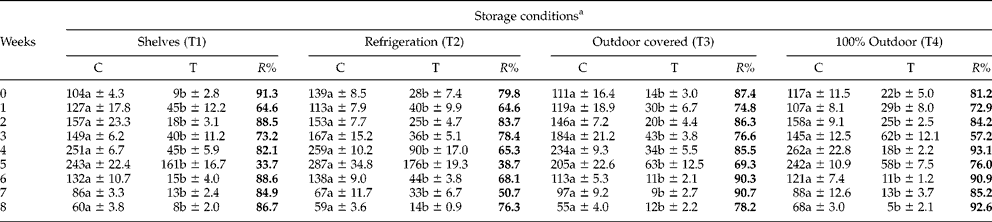
Results of the in vitro trapping efficacy assay are shown in table 1. The number of larvae recovered from the NP with chlamydospores was significantly lower than that of their own control (without spores) in all the weeks of the trial (P< 0.005). The overall mean larval reduction percentages attributed to D. flagrans activity was similar in the different storage conditions (mean ± SEM): shelves (77.1 ± 6.1%), refrigeration (67.3 ± 4.9%), outdoor covered (82.1 ± 2.5%) and 100% outdoors (81.5 ± 3.8%). Both outdoor storage conditions (T3 and T4) showed a non-significant tendency towards a better reduction percentage compared to the indoor and refrigeration storage conditions (table 1).
Mean larval recovery (±SD) of Haemonchus contortus from aqueous agar plates with crushed nutritional pellets containing chlamydospores (T) of Duddingtonia flagrans and controls (C) under four storage conditions T1–T4.

R% = percentage reduction/week/storage group. For each storage condition and time, significant differences at P< 0.05 between T and C are indicated by lower-case letters.
a n= 6 pellets per storage condition and per week for C and T groups.
Comparison of larvae reduction between treatments for the duration of the study
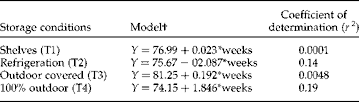
The regression analysis indicated the absence of a functional relation between the sampling time and the larval reduction percentages. The larval reductions were similar at all times and were not affected by the storage conditions or storage time (R 2< 0.2; P>0.05) (table 2).
Linear regression analysis and coefficients of determination (r 2) for the percentage reductions (%) of Haemonchus contortus larvae obtained with chlamydospores of Duddingtonia flagrans relative to storage conditions (T1–T4) and time of sampling (weeks).
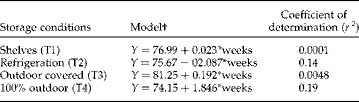
† P values >0.05 indicate slopes are not different.
Discussion
Results obtained in this trial confirmed that D. flagrans chlamydospores contained in the NP maintained their ability to trap H. contortus L3 larvae for up to 8 weeks under the four storage conditions tested. Casillas-Aguilar et al. (Reference Casillas-Aguilar, Mendoza-de-Gives, López-Arellano and Liébano-Hernández2008) worked with an earlier version of NP for sheep (containing 2 × 10⁶ chlamydospores). Spores contained in freshly made NP were capable of developing adhesive nets on agar plates and the in vitro trapping ability was evident (reduced the number of H. contortus by 81.2%, range = 42.1–97.8 %). In the present trial, it was decided to test the trapping efficacy of spores incorporated in NP after different periods of storage time and also different storage conditions. The results of the present study, using the new NP with different ingredients and a higher quantity of chlamydospores per NP (4 × 10⁶), provided evidence of the continuation of the larval reduction efficacy of D. flagrans against H. contortus larvae for up to 8 weeks. The in vitro larval reductions ranged between 67 and 82% for the whole period. In addition, regression analyses showed that time of storage did not affect significantly the reduction efficacy of the spores in all the storage conditions tested. The latter suggests that longer storage periods could be explored for commercial purposes. However, it will be essential to consider the impact of longer storage periods on the nutritional value of the ingredients contained in the NP.
The main purpose of any storage system is to preserve the material of interest (i.e. the NP containing D. flagrans chlamydospores). For that purpose, it must provide the best conditions to preserve the quality of all the ingredients for the longest period of time at the lowest possible cost. In this case, the idea was to find the effect of different storage conditions on the survival of D. flagrans spores within the NP. This was measured as the ability of spores to form traps and to trap nematodes. To our knowledge, there is no information about the best storage conditions to maintain viable D. flagrans spores, and less so in the case of spores contained in the NP. We hypothesized that the different storage conditions could affect differently the trapping efficacy of D. flagrans against H. contortus. In particular, we expected that indoors storage (shelves in a closed room) or refrigeration could be the best storage candidates compared to outdoor conditions. Also, we expected that the outdoor storage conditions (covered outdoors and 100% outdoors) could be extremely adverse for the spores (diminish the viability of D. flagrans chlamydospores in a short period of time). The results obtained in the present study proved that both of our hypotheses were incorrect. The spores endured even the harshest storage conditions.
The fact that spores endured the 100% outdoor storage conditions for 8 weeks was remarkable. We propose the following explanations for the long shelf-life in this situation: (a) the spores simply resisted exposure for a long time, or (b) the environmental stress stimulated the spores in the NP to use the nutrients contained in the ingredients to promote spore germination and fungal growth to produce new spores. Chlamydospore germination within the feed blocks has been evoked as a negative feature of this technology (Chandrawathani et al., Reference Chandrawathani, Jamnah, Adnan, Waller, Larsen and Gillespie2003). Perhaps they did not consider that germinated fungi producing more chlamydospores in the block is a possible advantage. The feasibility of producing D. flagrans spores using grain as a substrate is not unthinkable. Waller et al. (Reference Waller, Knox and Faedo2001a), for instance, produced D. flagrans chlamydospores using barley grains (4–5 weeks of incubation). Then, the barley grains were mixed with molasses and urea to prepare feed blocks for the control of sheep parasitic nematodes.
With this trial we have provided the first evidence of the shelf-life of the spores contained in the NP and confirmed that the storage conditions caused minimal negative impact on the viability of the spores. The latter suggests that NP can be stored under economic conditions without refrigeration, saving the cost of electricity and refrigeration equipment. Obviously, we are not encouraging the practice of leaving the NP without protection from rain, sun and other stressing elements described in the present study, not because of their effect on the spores' viability, but mainly to preserve the nutritional quality of the NP. In other words, we advise avoiding changes that may affect the voluntary ingestion of NP by the animals, the digestibility of the NP ingredients or the contamination with other fungi that may produce toxins. The results obtained in this trial can be useful for researchers and manufacturers exploring efficient ways to administer the spores of D. flagrans, or any other nematophagous fungi, to ruminants.
The viability of D. flagrans chlamydospores against H. contortus infective larvae was maintained for up to 8 weeks in the four storage conditions tested in the present trial (indoors, refrigeration, outdoors covered and 100% outdoors). Thus, any of the storage conditions tested could be selected according to the available facilities. Storage conditions should also be selected aiming at maintaining the nutritional value and palatability of the NP rather than the spore viability per se.
Acknowledgements
The authors wish to express their gratitude to MSc Rosa Ofelia Valero-Coss for her expert and valuable support in the laboratory work.
Financial support
The trial was sponsored by CONACYT-SAGARPA, Mexico (Project No. 11990).
Conflict of interest
The authors of this manuscript have no financial or personal relationships with other people or organizations that could inappropriately influence or bias the content of the paper.
Ethical statement
The authors assert that all procedures contributing to this work comply with the ethical standards of Mexico (compatible with NOM-062-ZOO-1999) and the Institutional guides of the Universidad Autonoma de Yucatán on the care and use of laboratory animals (sheep).