Civilian casualties have long been considered a central driver of civil war violence.Footnote 1 Morality and pragmatism have coalesced around the belief that belligerents incur steep costs for inflicting harm on civilians indiscriminately. Counterinsurgents might find that their careless violence has sparked new grievances among the populace, bolstering insurgent ranks while sparking new rounds of revenge-seeking violence.Footnote 2 Tearing families apart and destroying property can also lower the opportunity costs for participating in armed rebellion, pushing fence-sitting civilians into the arms of the insurgency.Footnote 3 Exposure to harm might also shift civilian support to the insurgent cause, solidifying its territorial control while encouraging the clandestine sharing of tips about counterinsurgent movements, augmenting insurgent capabilities.Footnote 4 Insurgents, too, may not escape these dynamics. Civilians can punish wayward insurgents for their brutality by providing tips to counterinsurgent forces, in turn forcing them to fight harder to maintain their grip.Footnote 5
What happens, however, when humanitarian assistance is delivered after a civilian casualty incident? Can the presumed link between civilian victimization and (increased) insurgent violence be dampened, if not severed completely? To date, humanitarian aid programs that focus on civilian casualties have been administered in diverse conflict settings, including Iraq, Mali, Yemen, Somalia, Syria, and Afghanistan yet we have few studies of their effectiveness, especially at the subnational level.Footnote 6 And while it is plausible that these programs might reduce motives and opportunities for armed rebellion, the evidence from existing crossnational studies is sobering. A near consensus now maintains that humanitarian aid increases the odds of civil war onset as well as the duration and lethality of these wars.Footnote 7 The combination of aid and civilian casualties may therefore be an especially combustible one with wide-ranging implications: humanitarian assistance increased from USD 16.1 billion in 2012 to USD 27.3 billion in 2016, with seven of the ten top recipients embroiled in civil wars.Footnote 8
There is, then, pressing need to examine the subnational effectiveness of wartime humanitarian aid. To do so, I draw on the Afghan Civilian Assistance Program II (ACAP II), a USD 64 million USAID-funded initiative tasked with providing immediate assistance to civilians harmed by the International Security Assistance Force (ISAF) or Taliban in Afghanistan. The program investigated 1,061 civilian casualty incidents from 2011 to 2013. While humanitarian aid programs can be difficult to evaluate in wartime settings, ACAP II had two features that facilitate causal inference. First, all victims were civilians harmed accidentally by ISAF or the Taliban. The program took strict precautions to exclude actions that deliberately targeted civilians, helping lessen concerns about selection effects. Second, ACAP II aid, which consisted of food and household items, was administered through a bureaucratic process that approximated as-if randomization. By virtue of an unwieldy authorization process, ACAP II was allowed to respond to only just over half (55.8%) of the original 1,061 incidents it investigated. The remaining incidents, which closely resemble the authorized ones across seventy different covariates, were abandoned, receiving no aid despite confirmation of civilian harm and property destruction. These abandoned incidents provide counterfactuals for estimating how aid affects Taliban attacks against ISAF, Afghan National Defense and Security Forces (ANDSF), and civilians.
Unlike existing crossnational studies, I find that ACAP II aid is associated with a marked 23 percent reduction in Taliban attacks against ISAF for up to two years after aid disbursement. Substantively, this reduction translates into nearly 12,000 “missing” Taliban attacks in the two years following aid delivery compared with locations that received no assistance. This is all the more remarkable given the modest value of aid provided, typically about USD 195 per beneficiary. Taliban violence against ANDSF units was unchanged by aid delivery, however. More encouragingly, ACAP II aid did not provoke increased Taliban targeting of civilians, a notable concern for organizations programming in conflict zones. ACAP II aid proved most effective in locations close to ISAF military bases (within four square kilometers) and when responding to events with only moderate numbers of civilian casualties or property damage. Aid was not uniformly effective, however. Instead, aid's violence-reducing properties were conditioned by the identity of the belligerent responsible for inflicting harm. Aid provided after ISAF-inflicted casualties was far less effective in reducing violence than after similar harm by the Taliban, suggesting the presence of persistent in-group biases that led aggrieved parties to discount ISAF's humanitarian efforts. Together, these findings suggest several modifications to existing theories of insurgent violence and wartime humanitarian assistance.
Humanitarian Aid and Violence
Three simple theoretical positions can be derived from the small literature on humanitarian aid and insurgent violence in civil wars.
First, humanitarian assistance can increase postincident insurgent attacks relative to locations that experienced civilian casualties but received no aid. Several non-exclusive mechanisms are likely at work. Insurgents might attack aid sites or workers in an attempt to forestall aid delivery, contributing to a net increase in violence. Food and medical supplies might become a prize for insurgents to capture, especially if programming occurs in contested or insurgent-controlled areas.Footnote 9 Modest aid programs also risk enflaming grievances if material assistance is deemed insufficient for perceived needs or, more generally, if the aid is poorly designed or delivered. Anger, too, might accompany foreign-funded aid programs if they underscore the host government's inability to render assistance to its own citizens, further delegitimizing it. In this situation, humanitarian aid might encourage individuals to take up arms and carry out attacks on their own or to join already existing insurgent organizations. Bitter individuals might also share information with insurgents about government forces, facilitating increased insurgent attacks. Finally, there are second-order consequences to consider. Aggrieved citizens hurt by insurgent violence might share tips with the government that lead to diminished insurgent attacks in the near term. Yet reputational demands might lead insurgents to step up their attacks to demonstrate their continued control of a given area, swamping the initial decrease in attacks.Footnote 10
Second, it is plausible that humanitarian assistance might have violence-reducing properties. Timely aid might increase the opportunity costs associated with armed rebellion if it manages to restore individuals (and families) to pre-incident levels of income and employment. This is especially likely if aid repairs or replaces income-generating property. Public acknowledgement of the harm inflicted by the counterinsurgent might also reduce grievances, preventing insurgents from capitalizing on casualties as a recruitment tool. Gratitude for material and symbolic restitution might further increase victims’ willingness to provide actionable intelligence to counterinsurgents after being harmed by insurgent actions. Aid might, in other words, grease the skids of information sharing, helping counterinsurgents reduce insurgent capacity for violence via raids and other direct action. Insurgents themselves may be sensitive to public opinion, and so might reduce their attacks after killing civilians if assistance is being used to “spotlight” insurgent brutality.
Of course, aid may have no net effect on subsequent insurgent violence. The violence-increasing and -reducing properties of aid may both be present, canceling each other out. Harmed individuals may simply pocket the proffered aid while leaving their underlying political preferences and associated behavior unaltered.Footnote 11 Aid's effects may also be highly individualistic: some harmed civilians might be assuaged by humanitarian aid while others are angered, generating countervailing pressures. One-time aid flows may also have only short-term effects; violence may eventually return to its pre-incident equilibrium in a given area.Footnote 12 Aid programs might also simply be irrelevant, taking a backseat to intra-village and familial support networks.
Aid's effects might also be conditional in nature. It is plausible, for example, that aid has differential effects depending on which belligerent was responsible for inflicting harm. Earlier research has identified the existence of wartime intergroup bias—the persistent tendency to interpret the actions of one's own group more favorably than those of an out-group—that shapes how individuals assign blame and punish those belligerents deemed at fault for causing civilian harm.Footnote 13 In this view, harm by one's own group (normally the insurgents) carries a different set of implications for postincident behavior than victimization by the out-group (typically the counterinsurgent). If these intergroup biases are present, then they likely shape an individual's understanding of the event, her reception to the proffered aid, and subsequent behavioral responses, including taking up arms against the guilty party. Civilian casualty incidents therefore represent unexpected shocks that lead individuals to recast, or reinforce, prior beliefs about the motives, competency, and appropriate level of support for belligerents.
We should therefore expect the counterinsurgent to struggle to harness the violence-reducing properties of aid after incidents in which it was directly responsible for harming civilians. In this situation, civilian deaths or property damage merely confirm existing prejudices against the out-group, including the belief that these actions reflect its true disposition as a hostile and uncaring actor. Moreover, these incidents fall right into the hands of insurgent efforts to shape the postincident narrative through propaganda designed to activate these biases. Facing these headwinds, counterinsurgent aid programs are unlikely to reach their full conflict-reducing potential. Instead, these efforts may stumble and falter, particularly if angry locals dismiss aid as mere tokenism.
A different dynamic unfolds when insurgents inflict harm on their own supporters, however. Past research has demonstrated that civilians who share ethnic ties with an insurgency typically do not levy a stiff penalty, measured by a loss of support, for civilian casualties.Footnote 14 But introducing aid after these civilian casualty events might actually reduce postaid violence to a greater extent than after the counterinsurgent's indiscriminate violence, for several reasons. In these settings, the bulk of the blame, if not all of it, has shifted to the insurgents. This creates space for representatives of the out-group (e.g., the state, NGOs) to interact with injured parties without the weight of blame for killing civilians. Increased contact between these groups may lead to a partial reassessment of prior beliefs and biases about the counterinsurgent's motives.Footnote 15
Providing aid also creates the opportunity for the out-group to demonstrate its competency, which can lead individuals to revise their views on government performance.Footnote 16 For their part, insurgents are on the rhetorical defensive in the battle to control the narrative after they harm civilians. Instead of stoking prejudices against the out-group, they must now work to deflect blame for their own indiscriminate violence. Together, these processes might attenuate intergroup bias, leading individuals to withdraw (some) support from the insurgency, reducing attacks. At the extreme, insurgents may be forced to withdraw from a location, especially if these biases relent enough for the population to start sharing tips about insurgent activities with the counterinsurgent. In short, the violence-reducing nature of humanitarian aid is likely higher after casualties inflicted by the insurgent than after counterinsurgent violence if the population and insurgents share group identities.Footnote 17
Finally, postincident aid might also have variable effects across different categories of insurgent violence. For example, theories that privilege revenge as driving insurgent violence implicitly assume that aggrieved parties take up arms quickly against the counterinsurgent, increasing the number of insurgent attacks. These individuals are likely to be novices in wartime tactics, and so their attacks should typically be low skill and simple in nature. By contrast, certain tactics, including the use of improvised explosive devices and complex ambushes, require a high degree of specialized skill and organizational capacity. Their success also rests on a broader societal base, requiring at least tacit collaboration by locals to keep insurgents’ identities and preparatory actions secret. The combination of a robust organization and community support might render these attacks more resistant to aid-induced changes than simple small arms attacks by harmed individuals whose specific grievances could be assuaged by aid.
Context
The protracted war in Afghanistan has been deadly for civilians. By one estimate, some 28,291 civilians were killed, and another 52,366 were injured, between 2009 and 2017.Footnote 18 The ACAP II program arose out of a desire to alleviate the suffering caused by the accidental harm of civilians and their property during combat between ISAF and Taliban forces. It was funded by USAID and implemented by International Relief and Development (IRD) in partnership with the Afghan Ministry of Labor, Social Affairs, Martyrs, and Disabled (MoLSAMD) and local Afghan NGOs. Between 2011 and 2015, ACAP II administered immediate assistance to 41,141 individuals in 7,444 families across twenty-nine of Afghanistan's thirty-four provinces. Total aid disbursed reached USD 52.4 million.Footnote 19 Civilian casualty incidents were identified and verified by ACAP II's own extensive monitoring system, which included local police, nongovernmental organizations, journalists, district and provincial authorities, and USAID's own On-Site Monitors (OSMs) posted to major ISAF bases. For the period under consideration here, ACAP II investigated 1,061 incidents from 7 October 2011 to 14 September 2013 for possible humanitarian assistance.
ACAP II's strict protocol deemed incidents eligible for assistance if they met two of three criteria: (1) the harmed parties were civilians; (2) these individuals were harmed as a direct result of ISAF's actions; or (3) these individuals were harmed by the Taliban as a result of ISAF's presence in a given area. ACAP II's mandate outlines its “blame blind” nature: “ACAP II provides assistance regardless of who is at fault, if the loss was incurred due to US and Coalition Forces targeting the Taliban and other insurgent groups involved in the armed conflict or due to the Taliban and other insurgent groups targeting US and Coalition Forces; however, civilians harmed by Afghan National Security Forces or solely by the Taliban and insurgents without the presence of US and Coalition Forces will not be Approved for ACAP II assistance.”Footnote 20
Eligible ISAF-initiated events include air strikes, including accidental weapons releases; military operations and night raids that accidentally killed civilians; road accidents; and escalation of force (EOF) incidents where civilians failed to heed soldiers’ traffic instructions. Taliban-initiated events include accidental deaths arising from suicide bombings that targeted ISAF convoys and bases but missed (or failed to breach the walls); improvised explosive devices (IEDs) that failed to detonate near their intended target and instead harmed civilian passersby; Taliban offensives within villages that accidentally hurt civilians; and errant rocket attacks against ISAF bases and patrols. Table A1 in the online appendix summarizes these incidents by frequency and responsible party.
When authorized to provide aid, ACAP II distributed immediate assistance in the form of food and household supplies, including materials to repair damaged compounds. Cash transfers were prohibited. A total of USD 11,147,910 in assistance was delivered during the 2011–13 study period. An estimated 30,304 individuals from 5,488 families received assistance during 2011–13. Mean assistance was USD 195 per beneficiary, with beneficiaries rarely receiving more than USD 400. Immediate assistance was standardized in kind and value across all recipients in a given village.
Aid distributions ranged from a single beneficiary who received USD 85 after a traffic collision to a massive USD 1.79 million aid package for 4,472 beneficiaries after a 23 November 2012 truck bomb that killed three, injured 120, and damaged an estimated thirty vehicles, 800 shops, 200 houses, and fifteen public properties. On average, a village received USD 10,507 worth of in-kind assistance. Aid distribution was a one-time affair, with all harmed individuals (or their representatives) gathering in a central location to collect their assistance once notified of its delivery, typically two weeks to two months after an incident. Biometric data were collected at these sites to confirm beneficiary identities, helping prevent aid diversion as well as ensuring the strict definition of “civilian” was upheld.Footnote 21
Empirical Strategy
Humanitarian aid programs are especially difficult to evaluate in conflict settings. Potential selection effects abound: aid organizations may be barred from the most dangerous areas or, conversely, choose to operate only in them. The sudden and unpredictable nature of civilian casualty incidents can eliminate the possibility of collecting baseline data, while counterfactual observations may be difficult to identify. Randomized control trials, the gold standard of impact evaluations, are unethical given the need to withhold aid (even temporarily) from harmed populations to create control observations.Footnote 22
As one possible strategy, I exploit as-if random variation surrounding the authorization of ACAP II aid delivery. Owing to bureaucratic obstacles inherent to the authorization process, nearly half of all civilian casualty events investigated by ACAP II were unfortunately abandoned by IRD, receiving no assistance despite verified civilian casualties and property damage.
Indeed, while ACAP II was responsible for identifying and investigating civilian casualty incidents, USAID mandated that ISAF's own Civilian Casualty Mitigation Team (CCMT) also confirm that ISAF units were involved in the incident before aid could be released. The CCMT lacked the capacity to conduct its own investigations, however, and a bottleneck in the approval process quickly developed. Unable to keep pace, CCMT began haphazardly issuing confirmations, resulting in the arbitrary neglect of many incidents. As a result, only 592 of the 1,061 incidents ACAP II verified (55.8%) were actually approved for assistance. The remaining cases never received a reply from ISAF, forcing IRD to abandon them. It bears emphasizing that these incidents met all the requirements for initiating assistance—all had substantial documentation from multiple eyewitnesses and agencies—and lacked only final confirmation from the CCMT to initiate programming.Footnote 23
Claims of “as-if” randomization of assignment to treatment demand a high standard of evidence. This is especially true when a sharp discontinuity is not produced by an ex ante official policy threshold. Fortunately, we can confirm the plausibility of as-if random assignment in several ways.
First, interviews with stakeholders in each of these organizations, as well as direct participant observation, reveal the broken nature of the authorization process. A near consensus among IRD, USAID, CCMC, and ACAP II personnel existed around the belief that the process was “haphazard” and “chaotic.” Officials cited various reasons for this state of affairs, including low bureaucratic capacity, frequent CCMT personnel turnover, and changing personal dynamics that conspired to delay authorizations. The pace of ACAP II's caseload also contributed: it submitted 1.36 requests daily to the CCMT for twenty-six months. USAID's own review of ACAP II noted that “the slow USAID incident verification process and a lack of coordination with ISAF challenged ACAP II through its first two years of programming.”Footnote 24 It concluded that “ISAF was not a reliable partner for USAID from the start of the ACAP II program.”Footnote 25 CIVIC, a nongovernmental organization tasked with an external audit of the CCMT, similarly concluded that its “severely limited” capabilities could not keep pace with incident approval demands.Footnote 26 Tellingly, USAID ultimately junked its partnership with ISAF in late 2013, asking the United Nations Assistance Mission to Afghanistan (UNAMA) to verify incidents instead to prevent so much need from going unmet.
The immediate concern is that the CCMT, or perhaps ISAF more generally, selectively authorized approval of certain incidents according to an unknown selection criteria. Perhaps the most lethal ISAF-initiated incidents were buried to avoid calling attention to ISAF's culpability, especially in light of the politically sensitive nature of civilian casualties. Alternatively, perhaps ISAF was prodded to grant aid only after public outcry, and so approval should be tied to the most destructive incidents. ISAF may also have intervened in the authorization process to ensure that all Taliban-initiated events were granted aid as a means of spotlighting Taliban cruelty for political gain.
None of these fears about selection into authorization appear warranted, however. I test balance across both incidents and villages by regressing a host of incident-level, spatial, and village-level covariates on approval status. In total, I draw on seventy covariates; only two have a difference at p < 0.05. Although the design cannot, by definition, guarantee balance across unobserved covariates, the decision to approve certain incidents does not hinge on the most important (and obvious) properties of the incident itself (see Table A2). The belligerent responsible, the number of civilians killed and wounded, property damage, and the cumulative damage (casualties and property) suffered by a village all fail to predict aid assignment. Abandoned incidents had an average of 1.72 individuals killed and 2.65 wounded; approved ones had 1.5 and 3.38, respectively. Property damage occurred in 41 percent of abandoned incidents and 45 percent of approved ones. Nor was assignment sensitive to the type of incident (e.g., air strikes, suicide bombings). Of the ten different categories of civilian casualty events, only one, “crossfires,” was different at p < 0.05.
Designed as a national program, approved and abandoned incidents were distributed similarly across Afghanistan. Programming was especially dense in eastern Afghanistan, the site of heavy fighting in 2011–13. I plot the location of all incidents in Figure A7. In many cases, approved and abandoned villages were neighbors. Moreover, 104 of the 607 villages in the sample (17%) experienced both approved and abandoned incidents, an odd pattern if ISAF was restricting aid to certain villages. I also test balance across the five Regional Commands (RCs), the top five provinces for ACAP II incidents, and a dummy variable for sharing a border with Pakistan to examine whether ISAF was cherry picking certain regions based on strategic concerns (see Table A3). Once again, only one of these eleven covariates, the eastern province of Khost, is different at p < 0.05.
Finally, there is excellent balance across forty-six village-level covariates (Table A4). Key demographic traits, including population size, dominant language spoken (a proxy for ethnicity), and a binary Pashto indicator, are well balanced. So, too, are important spatial characteristics of these villages, including their elevation, distance from the district center, and number of neighboring villages within a five square kilometer radius. Prior aid from the National Solidarity Program (NSP), as measured by spending per capita, the number of NSP projects, and the number of beneficiary families, is also balanced. The number of ISAF and ANDSF military installations within three, five, and ten square kilometers radii, as well as distance to the nearest base (in kilometers), is also similar across approved and abandoned villages. Perhaps most importantly, these villages share similar pre-incident levels of Taliban attacks against ISAF, ANDSF, and civilian targets across four different time periods: seven, ninety, 180, and 365 days before the civilian casualty event. These similarities hold whether we use all Taliban attacks against these targets or use a subset that include only improvised explosive devices (IEDs). I also include a measure from CIDNE that tracks ISAF's own military activities in and around these villages for the same time periods. None of these forty-six covariates is different at p < 0.05; one is significant at p < 0.10.
No design is without limitations, of course. One threat to inference here lies in the possibility that ISAF's authorization process created a temporal imbalance between approved and abandoned incidents. If all early incidents were approved, and all later ones abandoned, then the absence of overlap between the two types of incidents weakens the case for using abandoned incidents as counterfactuals. How concerned should we be?
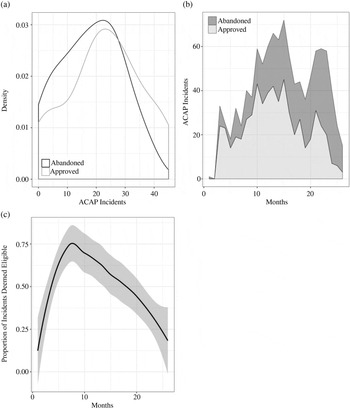
Panel A in Figure 1 plots the monthly density of approved and abandoned incidents. While the overlap is not perfect, a two-sample Kolmogorov-Smirnov test for equality of distribution functions confirms that these population densities are not unequal.Footnote 27 Panel B in Figure 1 examines the monthly frequency of incidents using a stacked area plot. These trends do closely approximate one another. Crucially, both types of incidents are represented across each month for the entire program. It is not the case that eligible incidents are confined to specific months. Finally, I plot the proportion of events approved monthly in Panel C in Figure 1. This smoothed plot confirms the general pattern revealed in the interviews; the CCMT was quickly swamped by ACAP II authorization requests, falling behind as early as eight months into programming. Although the proportion of incidents approved falls over time, it never reaches 0 in any month, indicating that events were still approved even in ACAP II's final stages. Finally, the mean approval rate across these twenty-six months was 0.51. While monthly variance does occur, the overall approval rate is remarkably close to even odds over ACAP II's programming cycle. While a strong case can be made for the plausibility of abandoned incidents as counterfactuals, I nonetheless estimate all regressions using quarterly fixed effects to adjust for this temporal lumpiness.
Distribution of ACAP II incidents over time, 2011–13

Estimation Strategy
I adopt a Neyman-Rubin counterfactual framework that compares approved (“treated”) villages with abandoned (“control”) villages to generate difference-in-difference estimates of changes in Taliban violence.Footnote 28 Formally, for each village and for each time period I estimate:
 $$ \quad{\rm DD} = \lpar {Y_1^t - Y_0^t} \rpar - \lpar {Y_1^c -Y_0^c} \rpar \quad\quad\quad\quad\quad\quad\quad\quad\quad\quad\quad\quad\quad\quad\quad\quad\quad\quad\quad\quad\quad $$
where Y x ∈ (0, 1) are pre- and post-treatment periods, T denotes the treatment group (approved aid), and C denotes the control group (abandoned aid).
I use a purpose-built SQL program to calculate the number of Taliban attacks before and after a series of preset temporal windows ranging from seven days to two years before and after the date of the civilian casualty incident (for controls) or aid distribution (for treated villages). Spatially, all attacks within two square kilometers for each treated/control village are counted.Footnote 29 This disaggregated empirical strategy maximizes the advantages of microlevel data in two ways. Instead of anchoring its analysis in subnational units like provinces or districts, it focuses on the appropriate unit of analysis, namely, the location that was exposed to indiscriminate violence and that (possibly) received assistance. It also introduces flexibility into its treatment of time, moving away from fixed and coarse annual trends and instead exploring variation over meaningful periods with start dates dictated by the incident itself.
Data
I draw on two event data sets to track changes in Taliban violence over time. First, I use declassified data from ISAF's own Combined Information Data Network Exchange (CIDNE), which records the date, location, and type of insurgent attack against ISAF forces and installations. These data permit highly disaggregated study of Taliban violence; most incidents are assigned geographic coordinates down to one meter resolution. There are 431,774 recorded incidents against ISAF forces (including 36,891 improvised explosive detonations) from 1 January 2008 to 1 January 2015.Footnote 30 Attacks against Afghan forces and civilians are excluded from CIDNE, however. As a result, I draw on a second data set, iMMAP, that was compiled by international and local NGOs, media, and foreign embassies to record attacks against Afghan forces and civilians. iMMAP recorded 31,600 Taliban attacks against ANDSF targets from 1 January 2008 to 30 April 2014 and a further 14,117 attacks against civilians.Footnote 31 These data sets are not exhaustive of every Taliban attack (a clear impossibility given wartime conditions). They do, however, represent the best collection efforts to date by separate monitors to verify and catalogue Taliban violence across different but complementary targets and victims.
Village-level data are pooled from a variety of sources, including USAID, ISAF, and various Afghan government ministries. Population size, the village's elevation (in meters), and the dominant language spoken are included, as well as a binary indicator for Pashto-speaking villages. Spatial factors are also addressed, including the village's distance to its district capital (a measure of ruralness and difficulty of access), the length of paved roads in the village's district, and the number of villages within a five-square-kilometer radius. I also include distance (in kilometers) to the nearest ISAF or ANDSF military installation, including forward operating bases and combat outposts, to take into account dynamics of contestation as well as the availability of military targets for the Taliban to strike. To capture the density of ISAF's presence, I generated counts for the number of military installations within various bands around each village (3 km2, 5 km2, and 10 km2). Since ACAP II was not operating in isolation, I collected data on the prior distribution of National Solidarity Program (NSP) grants to these villages, including the number of projects, spending per capita, and total number of beneficiary families. The NSP is Afghanistan's largest aid program, typically distributing block grants of around USD 60,000 to selected villages for investment in infrastructure and other labor-intensive activities that might boost social cohesion and resilience.Footnote 32 Finally, all models include a binary indicator for Afghanistan's so-called “fighting season” (April to September) as well as quarterly fixed effects to adjust for temporal trends in wartime violence.
Findings
I begin by examining the association between ACAP II and Taliban attacks against ISAF in the days, months, and years following aid delivery. I then repeat the analysis for ANDSF personnel and civilian victims. Next, I explore how various factors, including the perpetrator's identity, ACAP's size, civilian fatalities, and proximity to military bases, might condition postincident violence.
Insurgent Attacks Against ISAF
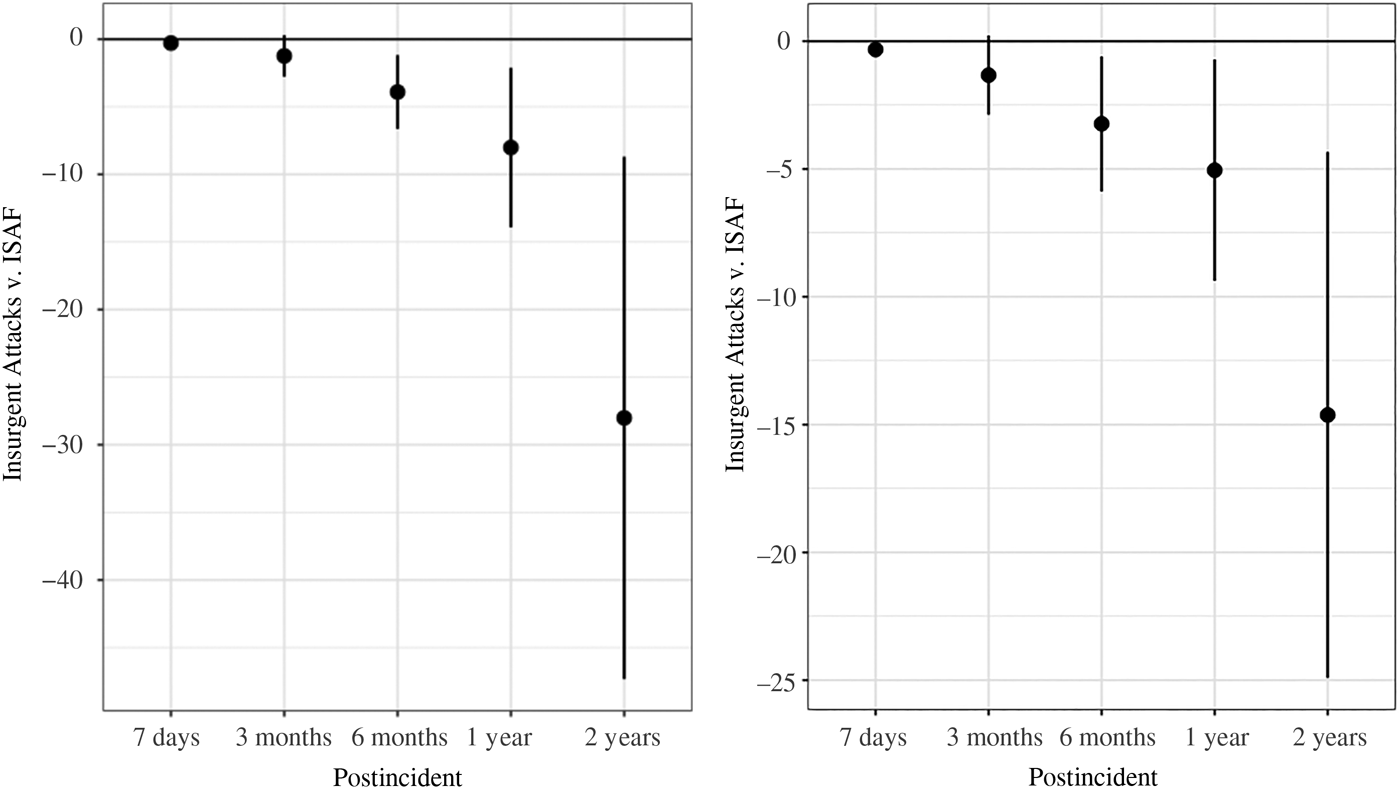
Is ACAP II assistance associated with changes in Taliban attacks? As panel A of Figure 2 illustrates, the frequency of Taliban attacks drops markedly for up to two years after a village receives aid.Footnote 33 Just seven days after aid delivery, Taliban violence has been reduced by 0.289 attacks (with a 95% confidence interval at -0.495, -0.083). In substantive terms, this represents a 35 percent reduction in the mean number of attacks relative to the baseline seven days before the incident (with 95% CI at -60%,-10%). At the ninety-day mark, Taliban attacks have decreased an average of 1.238 attacks (95% CI at -2.772, 0.297), representing an 11 percent decrease (95% CI at -25.6%, 2.6%) in the mean number of attacks over the identical pre-incident baseline.
DD estimates of ACAP II effects on Taliban attacks v. ISAF over time

Over time, we observe even sharper reductions in Taliban attacks. At the 180-day postincident mark, Taliban violence has fallen by a mean 3.910 attacks (95% CI at -6.64, -1.18), representing an 18 percent reduction in attacks relative to the same pre-incident period (95% CI at -30.7%, -6.1%). We observe a further 8.014 reduction in mean Taliban attacks at the one-year post-aid-delivery benchmark (with 95% CI at -13.91, -2.12), about 19 percent of pre-incident Taliban violence (or -33.3%, -5.1%). These findings can be stretched to the two-year post-aid-delivery mark, though with some hesitation since 380 observations are right-censored because of the absence of sufficient CIDNE data to complete the full two-year time frame. Villages that received ACAP II aid are still associated with a mean reduction of 28.01 attacks (-47.33, -8.70). This represents a sizable 30.7 percent reduction in the mean of pre-aid delivery means (-52%, -9.5%). Two year estimates probably represent the outer edge of feasible estimation since the parallel trends assumption underpinning DD estimation likely becomes increasingly untenable as time from aid lengthens.
Taken together, we observe an average 23 percent reduction in the mean number of Taliban attacks against ISAF in approved villages across the first two years postaid delivery (or -40.2%, -8.76%). This decrease is substantively meaningful even in the early days after ACAP II aid disbursement. For example, approved villages were collectively the site of 465 Taliban attacks in the week preceding aid delivery. The treatment effect of ACAP II aid is thus equivalent to 107 “missing” attacks in the week following its delivery (or 187 to 41). The number of missing attacks scales up quickly as time elapses. Approved villages cumulatively totaled 52,099 Taliban attacks in the two years preceding aid delivery. Our estimate of ACAP II's effect would result in 11,983 “missing” attacks in the two years following aid disbursement (or 20,944 to 4,564). Even allowing for possible double counting of attacks given repeated civilian casualty events in the same location within this two-year window, ACAP II's effect is substantively large.
We might worry that these findings are driven by large cities (especially Kabul) that have been focal points for armed conflict. I therefore reestimated these models while excluding all locations with ≥50,000 inhabitants (“rural sample”).Footnote 34 Yet, as panel B of Figure 2 indicates, a similar reduction is observed. Taliban violence has already dropped by a mean 0.327 attacks only seven days after aid disbursement (95% CI at -0.558, -0.097). This represents a large 44 percent decrease from the pre-aid mean number of attacks (95% CI at -75.5%, -13.1%). By the ninety-day postaid mark, Taliban attacks have fallen by 1.328 attacks (95% CI at -2.878, 0.221), a 13 percent decrease from the preceding ninety days (95% CI at -28.5%, 2.2%). Six months after aid disbursement, Taliban violence continues to decrease, with a mean 3.234 reduction in attacks recorded (95% CI at -5.871, -0.597). This amounts to a 16 percent decrease from the pre-aid baseline (95% CI at -29.9%, -3%). A further 5.049 drop in mean Taliban attacks (95% CI at -9.377, -0.721) is noted at the one-year mark, a 13 percent decrease (95% CI at -25%, -1%) compared to the baseline. Finally, at the extreme edge of the sample, we observe a 14.626 reduction in mean Taliban attacks two years after aid disbursement (95% CI at -24.912, -4.340), a 16 percent decrease (95% CI at -29.9%, -3%). Overall, ACAP II aid is associated with an average 20.8 percent decrease in Taliban violence across these five measurement periods (95% CI at -38%, -3.6%), a decrease comparable to that obtained in the full sample. Substantively, 371 attacks were recorded in the cumulative seven-day window prior to aid disbursement. Applying the average reduction of attacks yields an estimate of about seventy-seven “missing” attacks in the seven days following disbursement (95% CI at 141, 13). Similarly, there were 42,533 attacks in the cumulative two-year pre-aid disbursement window for approved villages, suggesting 8,847 “missing” attacks as a result of ACAP II aid (95% CI at 16,162 to 1,531).
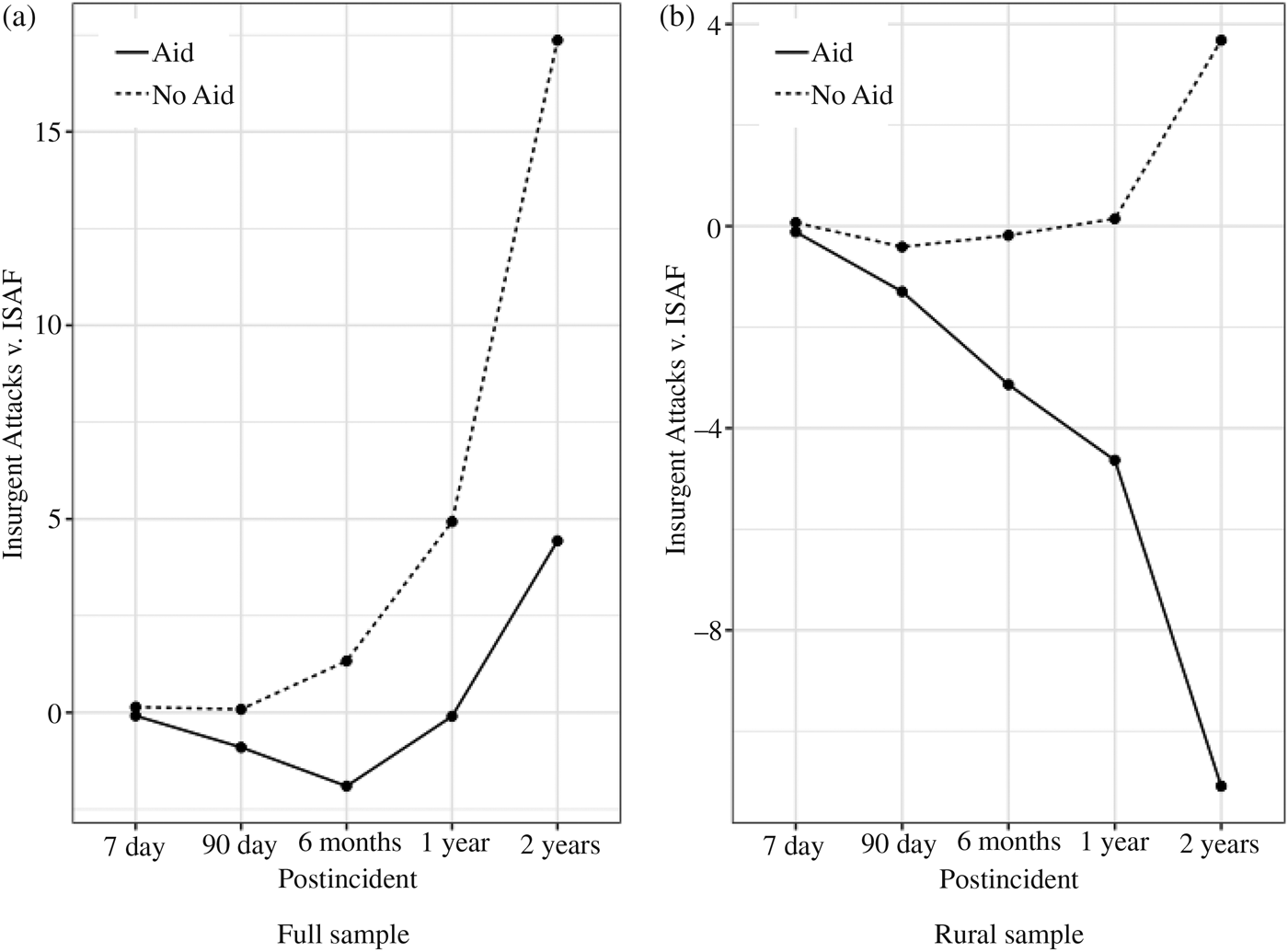
What remains unclear, however, is whether aid pushed Taliban violence below pre-incident levels or, alternatively, whether the frequency of attacks in these locations was simply outpaced by surging violence in villages denied assistance. To explore how this overall reduction was obtained, Figure 3 plots the relative difference in postincident/aid violence by whether a location received aid.Footnote 35 In the full sample (panel A), the observed reduction in violence is caused mostly by an absolute decline in Taliban attacks in and around villages that received aid for the first six months. After that point, the mean number of Taliban attacks increased absolutely in abandoned villages, while aided villages lagged behind considerably. By the two-year mark, aided villages remained far behind their abandoned counterparts in terms of mean attacks, though these villages did record greater attacks than their pre-incident baseline as well. As panel B outlines, once the cities are dropped from the sample, nearly all of the observed violence reduction occurred in the approved villages. Abandoned villages record only a modest uptick in the mean number of attacks at the two-year mark; approved villages, by contrast, have plunging levels of Taliban attacks. It appears that even modest aid can actually reduce attacks, not simply suppress the anticipated blowback from aggrieved communities. In fact, these findings suggest that civilian casualties are not met with immediate armed responses; revenge may take months, even years, to manifest as violence.
Differences in postincident attacks v. ISAF, by aid status

These findings survive multiple robustness checks. Approved remains statistically significant and associated with reduced postaid Taliban attacks when all other covariates are dropped from the models, for example (Table A8). I also dropped all villages that received more than one ACAP II disbursement due to multiple incidents; the results remain broadly similar (see Table A9).Footnote 36 Replacing approved with the (logged) number of beneficiaries (beneficiaries) also returns similar results (see Table A10). Finally, I conducted a placebo test by randomly reassigning new aid disbursement dates (see Table A11). As expected, approved is no longer associated with a statistically significant difference in Taliban violence after (pseudo-)aid delivery in any time period.
Additional Data: Attacks Against ANDSF and Civilians
To examine how aid might affect violence against other actors, I use iMMAP data to count Taliban attacks against ANDSF and civilians for up to one year after aid disbursement. iMMAP data have three desirable properties. First, CIDNE data simply omit these attacks, leaving us blind to possible changes in Taliban violence against these targets. Second, since ACAP II specifically excluded events that involved ANDSF units, we can use iMMAP data as a falsification check. That is, we can use a non-equivalent dependent variable that should not respond to the ACAP II intervention to test claims that the ACAP II intervention is shifting popular attitudes or material circumstances among harmed individuals. Empirically, we should observe no difference between approved and abandoned villages in terms of anti-ANDSF violence since these units were excluded from ACAP II. Third, civilians (and villages) that received ACAP II assistance may be singled out for punishment. Taliban commanders may use violence to forestall their loss of control over these villages, using ACAP II aid as a signal that a village is shifting into the pro-government camp.Footnote 37 Perhaps ACAP II assistance merely shifted the burden of Taliban violence from ISAF onto the shoulders of civilians.
As panels a and b in Figure 4 demonstrate, ACAP aid had no effect on violence against Afghan forces for at least a year after disbursement (see also Table A12). This nonfinding is likely driven by several factors. First, and perhaps most importantly, the exclusion of Afghan-initiated events from the ACAP program denied Afghan forces the opportunity to make amends publicly for the harm inflicted. Without its participation, aggrieved locals, likely skeptical of ANDSF motives, had no chance to update their beliefs through positive postincident interaction with Afghan forces. Moreover, it is plausible that aid's violence-reducing properties might be greater after an ANDSF-initiated event compared to an ISAF-initiated one since Afghan forces represent a less distant out-group than foreign occupying forces. Persistent in-group biases might be more pliable when the face of the perpetrator is an Afghan one rather than an outsider. And, given the infrequent nature of joint Afghan-ISAF patrols at this stage of the war, there is little prospect of an indirect “halo effect” of aid spilling over from ISAF to Afghan forces since the link between the two was likely still weak in the eyes of locals.
DD estimates of ACAP II effects on Taliban attacks v. ANDSF and civilians

Violence against civilians also appears unconnected to aid delivery. As panels c and d in Figure 4 illustrate, the relationship between aid and subsequent Taliban attacks on civilians is consistently negative, though it never reaches conventional levels of statistical significance (see also Table A13). In some senses, this finding is reassuring because it suggests that it is possible to provide assistance in highly violent settings without jeopardizing the safety of intended recipients. Modest amounts of highly tailored aid may also simply not offer enough incentive for insurgents to expend effort to disrupt or capture these resources. In fact, IRD never recorded a Taliban attempt to derail aid distribution, either through threats or actual violence, despite programming deep in Taliban-controlled and -contested areas and despite its proclivity for targeting aid workers.Footnote 38
Discussion: Conditional Effects
There are important nuances nestled within these broader findings. I explore four conditional effects of aid on Taliban violence here.
First, the magnitude of the violence-reducing properties of ACAP assistance hinges on who inflicted the harm. Figure 5 plots the difference-in-difference estimates for ISAF- and Taliban-initiated events in which at least one civilian was killed.Footnote 39 Under these conditions, in-group biases should be activated and salient, resulting in ISAF experiencing an attenuation of aid's effects on Taliban violence relative to the Taliban's own killing of civilians. This is indeed what we find: the reduction in violence after ISAF incidents is of a lesser magnitude, and only intermittently statistically significant, compared with Taliban events, where the reduction remains large and (mostly) significant.Footnote 40 These findings are consistent with prior research documenting the presence of a wartime coethnic bias among Pashtuns for the Taliban.Footnote 41 Taliban propaganda designed to capitalize on ISAF's indiscriminate violence also likely reinforced these in-group biases, creating significant headwinds for ISAF in reducing violence after its own incidents.Footnote 42 Though we cannot directly observe the attitudinal mechanisms at work, the downturn in violence after the Taliban harm civilians does suggest that in-group biases are not immutable. Even modest aid efforts can make inroads, perhaps softening bias against the out-group and thereby dampening insurgent violence.
ACAP II effects after incidents with ≥1 fatality, by belligerent responsible

Second, evidence suggests that ACAP aid had uneven effects across different insurgent tactics. I reestimated earlier models focusing only on successful improved explosive detonations (see Table A20). While ACAP's conflict-reducing properties are still present, they have attenuated considerably compared to estimates that pool all forms of Taliban attacks. Postaid IEDs are reduced by 0.045 in the first seven days after aid disbursement (95% CI at -0.087, -0.002), halving the number of observed IED detonations for this period (95% CI at -96%, -2%). This reduction can still be seen at the two-year mark, with mean IED attacks reduced by 1.454 detonations (95% CI at -2.695, -0.212), or about 17 percent of overall IED detonations (95% CI at -31%, -2%). Although still negative, the relationship fades in the intervening time periods, failing to reach conventional levels of statistical significance. These temporal inconsistencies, along with the modest reduction in the mean number of IED detonations, suggest that ACAP II's effects are concentrated primarily among revenge-seeking individuals engaging in low-skill attacks. Small amounts of aid may therefore be insufficient to sway beneficiaries to denounce insurgents or to cripple sophisticated Taliban attacks.
Third, it remains an open question whether these reductions in Taliban violence are sensitive to the size of aid disbursement. I therefore recoded approved as a continuous variable using the value of the aid distributed in a specific village (in USD, logged), with abandoned villages assigned USD 0. As Table A21 reports, the main relationship observed here continues to hold—an important robustness check. Yet nearly all of ACAP II's leverage on Taliban violence is obtained when moving from no aid to some aid. Indeed, Taliban violence appears insensitive to the actual amount of spending allocated, whether measured as a function of the overall aid expenditure (Table A22) or as aid per capita of a given incident location (Table A23) when we restrict our focus to approved villages only. This somewhat counterintuitive result stems from the fact that aid disbursements track with an incident's destructiveness; the greater the harm a village suffers, the larger the disbursement, but with ACAP II immediate assistance capped at about USD 400 per beneficiary, it is likely that such limited aid becomes less effective at higher levels of destructiveness.Footnote 43 It simply may be a bridge too far to expect small amounts of aid to stitch shattered lives back together after incidents that affect entire villages. Similarly, urban settings represent extremely difficult environments where significant numbers of civilian casualties, along with attendant property damage, are likely to swamp modest efforts like ACAP II. Caution is warranted in extending an unmodified ACAP-style program to war-ravaged cities like Raqqa or Mosul.Footnote 44
Finally, these fine-grained data help add nuance to ongoing discussions about the relationship between security and aid effectiveness. Prior studies of development assistance in Iraq and Afghanistan have suggested that such programs are most effective when projects are small and counterinsurgent troop strength is high.Footnote 45 Although development and humanitarian assistance have different aims, I find a similar result. As Figure 6 illustrates, a sharp spatial discontinuity exists in ACAP II's effectiveness: its violence-reducing properties are mostly tied to approved villages located less than four kilometers from an ISAF military installation, including small forward operating bases and even smaller combat outposts.Footnote 46 Once this distance is exceeded, approved typically turns insignificant, indicating no difference in postaid Taliban violence when compared with abandoned villages. We should not conclude, however, that these areas are safe or secure, or that ISAF had full control. In reality, many of these areas were dominated by the Taliban despite (and possibly because of) the presence of multiple bases. Moreover, it is perhaps unsurprising that violence reduction is steepest near ISAF bases; these are, after all, magnets for Taliban attacks. Rather than treating security as a precondition for success, the ACAP II program reveals that small programs can operate successfully in violent insurgent-controlled settings without large numbers of counterinsurgent forces. But there are limits; drift too far from bases, and aid's violence-reducing effects fade.
ACAP II effects by distance from nearest military base

Conclusion
Taken together, the findings surrounding ACAP II's programming in Afghanistan stand in sharp contrast to prevailing expectations that humanitarian aid might worsen violence in conflict settings. Instead, ACAP II was associated with a marked, and remarkably durable, reduction in Taliban violence for up to two years after aid delivery. These reductions were largest after Taliban-inflicted casualties, in locations near ISAF bases, and persisted in both cities and smaller rural locations. Encouragingly, this assistance was delivered without Taliban reprisals against beneficiaries, indicating that some forms of humanitarian aid may not create a violent insurgent backlash.
These findings suggest several theoretical and empirical avenues for further investigation. Grievance-based explanations of violence may overstate the automaticity of vengeance seeking, for example. Small aid packages appear able to dampen the flames of revenge for a considerable period of time, and even reduce it absolutely. Even rural settlements that never received assistance—the most likely location for a revenge-fueled spike in attacks—were slow to rebound to pre-incident levels despite civilian deaths.
Similarly, “hearts and minds” accounts that privilege information sharing may need to be updated to take into account the conditioning role of intergroup biases. Indeed, in the absence of aid, attacks against ISAF were higher after Taliban-inflicted casualties, not lower, indicating that tips may not be flowing to the counterinsurgent as expected. These biases also shape how blame is assigned for the incident and the motive thought to underpin it. These perceptions in turn likely bleed over into how humanitarian assistance is understood by intended recipients, influencing the subsequent production of violence. Aid therefore is unlikely to have uniform effects among victimized populations, a useful corrective for both our theories of violence and for policymakers seeking to program in these settings.
Above all, there is need to deepen our theorizing to include questions of how different forms of rebel governance and insurgent organization condition the direction, magnitude, and longevity of aid's effects in wartime contexts.Footnote 47 This will necessarily require different types of microlevel data. Attitudinal data, whether obtained via surveys or interviews, are especially important for testing the mechanisms underpinning these relationships. And while this study has privileged insurgent attacks, other behavioral measures—resilience and social cohesion, trust, collective goods provision—could be adopted to test aid's other effects.
Policy recommendations also flow from these findings. Policymakers should know that even modest programs can have outsized effects on insurgent violence even (or especially) in difficult settings. ACAP II had its largest effects among rural populations near ISAF military bases after events with fairly low thresholds for casualties and property damage, providing clues about best sites for programming. Expectations should be kept reasonable: there is no guarantee that increasing the amount of assistance will reap greater dividends. The opposite may in fact be true. Practitioners should also experiment with other forms of assistance, including cash, with an eye toward reducing postincident violence even further. In an ideal world, ethical considerations would preclude any form of civilian harm in wartime. In reality, civilians suffer enormously in civil wars. These findings underscore the need to buttress moralistic appeals designed to reduce civilian casualties with a pragmatic focus on post-harm mitigation once civilians inevitably find themselves trapped between warring parties.
Supplementary Material
Supplementary material for this research note is available at <https://doi.org/10.1017/S0020818319000262>.
Acknowledgments
Disclosure: I served as technical advisor for USAID's MISTI program in Afghanistan (2012–15), where I was tasked with the independent evaluation of ACAP II. I played no role in its design or implementation. In Afghanistan, I thank Quincy Diep, Stacey Frank, Brian Kirchoff, John Roscoe, Zach Scheid, Erin Simpson, Monica Stalcup, and especially Tony Haslam and Gilbert Namwonja for their support and feedback, as well as local field teams for their tireless dedication in extremely difficult circumstances. I also thank Annie Anderson, Sarah Zukerman Daly, Simone Dietrich, Amaney Jamal, Benjamin Laughlin, Paul Staniland, and Yuhki Tajima, as well as audiences at Georgetown University, the Harris School of Public Policy at the University of Chicago, University of Rochester, University of Wisconsin-Madison, and Washington University in St. Louis for helpful feedback. I also thank the editor and two anonymous reviewers at International Organization for detailed comments. This research was approved by Yale's Human Subjects Committee under IRB protocol #1211011138. Data from the International Security Assistance Force (ISAF) were declassified by ISAF HQ CMD COM CJ2 authorization (20 July 2009; 10 October 2009) and subsequently extended repeatedly under MDR-14-53. These findings and conclusions do not represent the official policy or views of AFOSR, International Relief and Development (IRD), or the US Agency for International Development (USAID).
Funding
I gratefully acknowledge financial support from the Air Force Office of Scientific Research (#13-005025-001).