The supreme photoplay will give us things that have been but half expressed in all other mediums allied to it […] At present they are in blind and jealous warfare.
Nicholas Vachel LindsayFootnote 1
On 22 April 1922, New York's Metropolitan Opera House grandly bade farewell to the soprano Geraldine Farrar. The Met's most celebrated diva, Farrar had enjoyed an exceptionally distinguished career since her début in 1906, while establishing herself more recently as one of the most highly paid and lavishly garlanded actresses in Hollywood. The vehicle chosen for her retirement was one of her latest and most unexpected triumphs: the title role in Ruggero Leoncavallo's Zazà (1900). Farrar's departure was charged with special poignancy as it followed by less than a year the death of her frequent stage partner (and fellow Met luminary) Enrico Caruso, with whom she had also made a series of bestselling recordings. If Farrar's retirement seemed to signal the end of an era, however, it also provided an opportunity to celebrate the success of a real American opera star – one who had conquered a venerable European tradition, while promoting her career via a self-consciously modern theatrical persona. Both a remembrance of things past and an intimation of things to come, Farrar's farewell offered a resonant occasion for marking the operatic present.
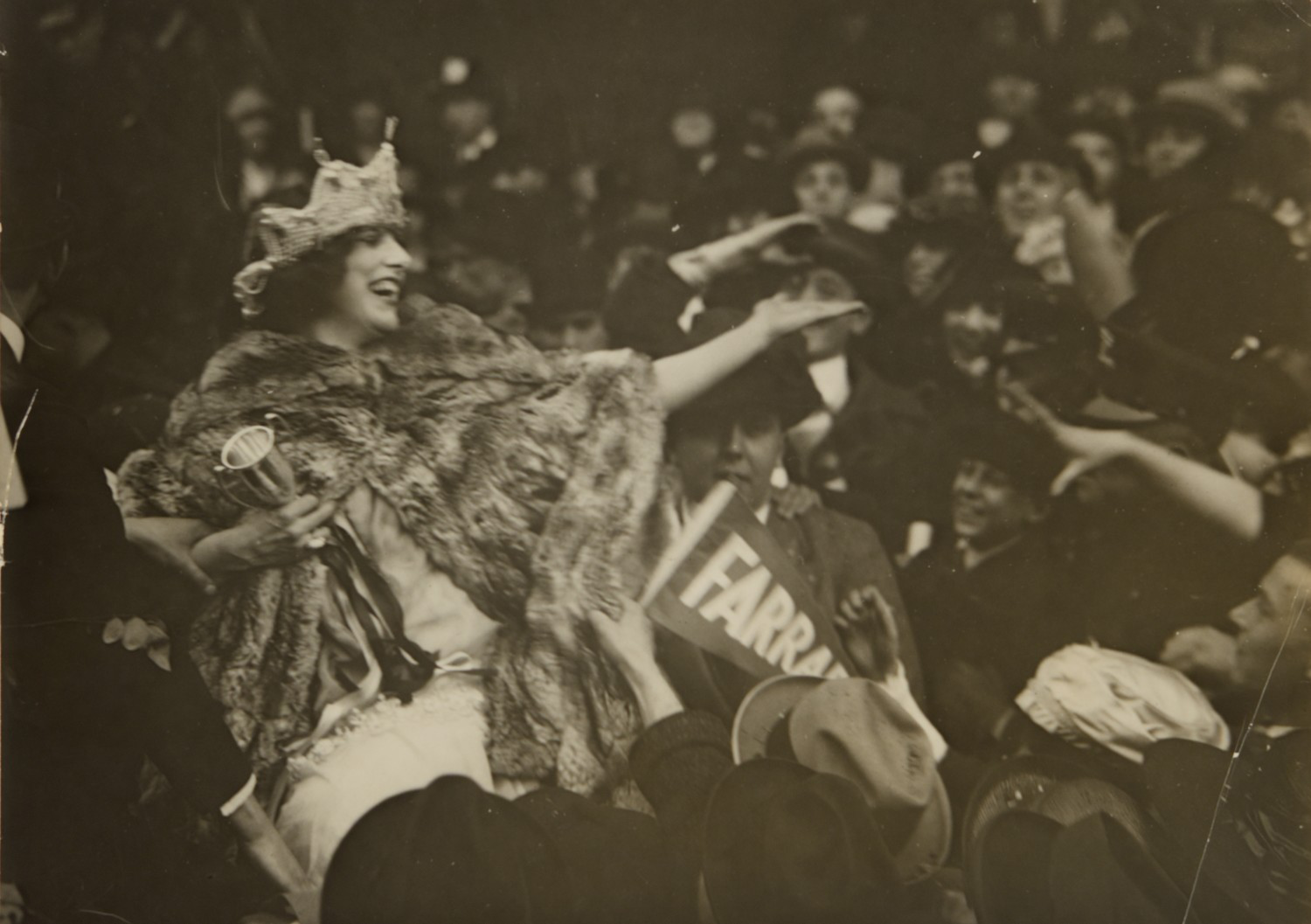
Newspaper reports of the occasion record an event of extraordinary splendour. The New York Times dubbed it ‘a demonstration as has never before been known in the annals of the Metropolitan Opera House’, while Ruth Crosby Dimmick concurred that ‘there had never before been so thrilling an ovation extended to any artist under the Metropolitan roof’.Footnote 2 The stage was festooned with bouquets of flowers at every interval; audience members whistled, wailed and applauded at each of Farrar's appearances; and loyal fans distributed pennants bearing the soprano's name coloured in red, white and blue. Upon exiting the theatre, Farrar climbed atop a motor car (still in her stage makeup) to greet a crowd of thousands, bringing traffic to a halt as she waved to the shrieking multitude (see Figure 1). A profile in the Literary Digest three weeks later aptly summarized the symbolism of the occasion when it captioned a photograph of Farrar's departure ‘Find her beneath the flag’: the soprano was literally buried beneath the accoutrements of ceremony.Footnote 3 In her farewell speech at the close of the opera, Farrar had herself gestured towards the cultural significance of the occasion, reportedly declaring:
Some twenty years ago, when I was working and slaving with the hope of some day giving you what it has been possible for me to do during these sixteen years, I prayed that I might some day attain the position of a prophetess in her own country. But I never expected anything like this.Footnote 4
Farrar's farewell parade. Unidentified newspaper cutting, Washington DC, Library of Congress, Geraldine Farrar Collection, Box 48.

The continuity between onstage and offstage events – and the audience's willing abandonment of any suspension of disbelief – made it clear that the focus of attention on this occasion was Farrar herself, rather than Leoncavallo's opera. Newspaper reviews even noted that Farrar's Pekinese dog, Sniffles (a frequent companion in her publicity photos), was featured as an onstage prop during the first act, accompanying his mistress in her dressing-room scene and thus blurring distinctions between performer and role to a still greater degree. And yet such an elision between Farrar's offstage persona and her onstage performances had already been a striking feature of the reception of the soprano's earlier appearances in Zazà. First performed at the Met in January 1920 in a production supervised by David Belasco, Leoncavallo's operatic tale of a French music-hall singer's ill-fated affair with a married man had proved an enormous box-office success for the theatre, and the title role had become indelibly associated with Farrar. More than simply an apt match for the soprano's vocal and histrionic skills, however, Zazà had in the eyes of many critics been transformed by her from the start into a vehicle for her own complex iconography. Rather than embodying a theatrical role, the soprano had instead projected her own persona into the work and her presence had in turn transformed Leoncavallo's opera. By these means, Farrar had reanimated a little-known, critically maligned verismo melodrama and turned it into a nationwide hit – a success story that made it a particularly apt choice for the patriotic display unleashed at her farewell performance, which would also be the opera's final outing at the Met.Footnote 5
As a celebrated Hollywood star, as well as the Met's most prominent American performer, Farrar was uniquely situated to mediate between different art forms and to provide a focal point for discussions of opera's past and future. An examination of the Met Zazà through Farrar thus offers a compelling insight into the complex position of opera in New York in the early 1920s – a moment when opera's status was strongly challenged by the emergence of American mass culture, and above all by the rise of cinema.Footnote 6 Scholarly discussions of opera's troubled fortunes in the twentieth century have repeatedly turned to cinema as a prime cause, arguing that the new art form decisively supplanted lyric theatre's capacity to deliver spectacle to a mass audience.Footnote 7 Critical studies of the two forms' early interactions have, however, focused primarily on how cinema was influenced by opera; when scholars have looked in the opposite direction, their attention has tended to remain fixed on composers.Footnote 8 The ways in which operatic spectatorship and performance were shaped by the emergence of cinema have remained largely unexplored, despite the topic's multiple present-day resonances.Footnote 9 New York here provides an especially rich site for such an enquiry, as the era has often been characterized as one of radical modernity in the city – a moment when it decisively broke away from the shadow of European traditions and embraced innovation as part of a wider process of social transformation.Footnote 10 Focusing upon Farrar – and in particular the case of her Met Zazà – therefore provides a lens through which to consider the ways in which viewing and staging opera were redefined by cinema in this period, as audiences circulated between rival entertainments and opera sought to demonstrate its continued relevance within a changing cultural nexus.
The turn to the diva is by now a familiar move in opera studies. Recent scholarship has demonstrated the enduring influence of singers on nineteenth-century operatic culture, as well as their involvement more generally with various forms of technological mediation.Footnote 11 The continued forms of agency exercised by singers within this period were, however, perhaps even more strikingly played out in relation to older works: particularly so as operatic culture became marked by ever greater uniformity via the emergence of staging manuals and the ongoing consolidation of the operatic canon.Footnote 12 Farrar's movements across media also resonate with recent interest in the intermedial. As Mary Simonson has recently argued, the early decades of the twentieth century witnessed a flurry of performers who exploited different media to examine shifting notions of gender, class, race and sexuality, and therefore invite a broadening out of musicology's usual purview.Footnote 13 Yet even when performers did remain fixed within one medium, audiences generally did not. Farrar's popular triumph in Zazà therefore promises a glimpse at shifting understandings of opera in the cinematic age, as the status and meaning of live performance was brought into question.
Zazà and the operatic museum
By the time Zazà appeared in New York in January 1920, Leoncavallo's opera had already been on stage for nearly 20 years and had appeared in several major European capitals. It was premièred at the Teatro Lirico in Milan in November 1900, the first performances starring Rosina Storchio and conducted by Arturo Toscanini, assuring the work a distinguished and high-profile opening.Footnote 14 While the work's length attracted some criticism, the opera was broadly judged a success, and by the end of 1906 it had been heard throughout Europe and regularly been greeted with multiple curtain calls.Footnote 15 More sceptical views were voiced at the Parisian première in 1905, but the Met's general manager, Giulio Gatti-Casazza, nonetheless expressed interest in producing Zazà when he met Leoncavallo in Paris in the spring of 1910, while accompanying Toscanini (and Farrar) on a Met tour of the French capital.Footnote 16
Despite Gatti-Casazza's enthusiasm for staging the work, however, a decade would pass before such plans were finally realized: a period during which the Great War would leave European operatic activity severely reduced and Leoncavallo himself would pass away. The eventual announcement that Zazà would be staged at the Met in the 1919–20 season was therefore greeted with little enthusiasm, and interpreted instead as an indication of the multiple struggles facing the operatic industry. Writing in the New York Tribune, Grenville Vernon summarized the mood:
There has been no excitement in operatic circles over Mr Gatti-Casazza's announcement of the revivals and novelties which will occur next season at the Metropolitan Opera House, and excitement there probably will be none. ‘Dull’ is the adjective many would apply to the Metropolitan's programme. But perhaps it could not be otherwise. The world is in artistic stagnation; Europe for four years has been a Sahara, and America has not as yet, in music at least, reached any sort of creative level. So we go drilling into the past, resurrecting musical mummies and decking them out in a grandeur with which they were never surrounded in the days of their vigor.Footnote 17
Gloomy pronouncements such as these were hardly unique to New York, nor were such anxieties entirely new. Already before the war, reviewers had begun to complain about the repetitiveness of the repertoire presented at the Met, and about the poor quality of new works arriving at the theatre. Such pessimism was encouraged further by the negative reception of recent works such as Alberto Franchetti's Germania (1902; Met première 1910) and Pietro Mascagni's Lodoletta (1917; Met première 1918), which – as Davide Ceriani has argued – reinforced beliefs that the Italian operatic tradition in particular was in terminal decline.Footnote 18 This apparently desperate state of Italian opera had been stressed by the New York Evening Post back in 1908, upon the appointment of Gatti-Casazza: ‘Is it wise to go abroad for such a man? Is it necessary to have an Italian? Is not everything done already for Italian opera that can possibly be done, even to the extent of producing such works as Fedora and Adriana Lecouvreur, because no better ones are left to produce?’Footnote 19 The paucity of the American repertoire nonetheless made the wider operatic situation particularly poignant, and underlined the awkward position occupied by the Met in a post-war context otherwise marked by self-confidence about the USA's creative possibilities.Footnote 20 Since his arrival as general manager, Gatti-Casazza had in fact pursued plans to present a new opera by an American composer virtually every season.Footnote 21 Although such ambitions were widely welcomed, the success rate of these works was disappointingly low: few of the works premièred in the 1910s were performed beyond their initial run, and by the end of the decade the critical mood had begun to turn sour, as the Met's failure to discover an enduring American classic raised questions about the theatre's seriousness concerning the task.Footnote 22 ‘Shall we look to America for relief ? Not if we judge the future by the past,’ declared Henry T. Finck in 1926, reflecting back upon the ‘damnable iteration’ that had infected New York's operatic culture during his lifetime.Footnote 23 Reviewing the recent operas presented at the theatre, James Gibbons Huneker drolly remarked at the decade's end: ‘We confess that we can't say that the prospect of original native opera is cheerful, although moving picture houses may have cause for rejoicing’ – a bald admission that operatic composers had thus far failed to achieve the popular success of their cinematic contemporaries, and that perceptions of both media were beginning to shift.Footnote 24
By 1919, the USA's reputation as the world centre of the motion-picture industry was firmly established, and most of the business had relocated from its initial base in New York to Hollywood.Footnote 25 The move to Los Angeles's year-round sunshine and open spaces strengthened emerging rhetoric that framed cinema as a distinctly American medium – one that had broken away from staid European traditions and instead reflected a uniquely New World consciousness.Footnote 26 As Nicholas Vachel Lindsay argued in 1915 (the year of Farrar's screen début), cinema could offer a new ‘hieroglyphics' suited to the American character, disposing of stylized artistic conventions and instead empowering the viewer through its commitment to visual realism.Footnote 27 If cinema continued to be portrayed by some critics as an impoverished art suitable only for the lower classes, those unsophisticated qualities were also paradoxically a strength for those seeking to define a quintessentially American entertainment – perceptions that would be maintained as it relocated to picture palaces and other middle-class venues during the 1910s.Footnote 28 In 1914, cinema's threat to live theatre had already been highlighted by the opening of the Strand Theatre in New York, the largest movie palace in the world, occupying a building originally intended to stage musical theatre.Footnote 29
Cinema was, moreover, making its presence felt directly within the opera house, as growing numbers of theatres began to rent out their spaces for film screenings during the summer off season. Plans to rent out the Met itself fell through in 1917 owing both to financial reasons and to the management's concerns at the intrusion of cinema into the theatre. Yet such efforts also highlighted the tensions surrounding the two media and their shared promise of theatrical spectacle.Footnote 30 ‘Are the movies a menace to the drama?’ asked the prominent theatre scholar Brandon Mathers in 1917: ‘These questions are insistent; they are important; and they are not easy to answer.’ Mathers identified spoken and sung drama as possessing philosophical and non-commercial qualities unmatched by cinema, while also recognizing the advances the new art form had made in the visual domain. The moving picture, he wrote,
has of late been bold enough to ‘picturize’ – if that is to be the new word describing a new thing – popular plays, popular novels, popular operas. It has made these picturizations long enough to provide entertainment for a whole evening. And it has discovered it can present a story with an amplitude of effect not possible in the theatre. It has at its command resources impossible to the regular drama […] the director of the motion-picture is able to show the heroic deed itself, visible to all the spectators.Footnote 31
Even if cinema was defined by an unprecedentedly realistic visual language, the continuity of listening practices and performance conventions from the opera house to the film theatre at the same time threatened to undermine opera's place within the entertainment marketplace, and signalled for opera houses' managements a worrying permeability between the two aesthetic experiences.Footnote 32 While the war dramatically slowed down operatic production and increased the Met's reliance upon a canon of older works, film screenings in opera houses could only highlight the new medium's vitality and emphasize its separation from beleaguered European traditions.
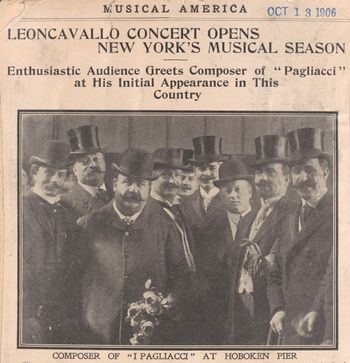
In such a context, the decision to stage Zazà in 1920 was easy to interpret as a desperate effort to inject some novelty into an otherwise stale operatic culture. The negative expectations surrounding Zazà were further amplified by earlier public exposure to Leoncavallo's music and by the recent history of Italian opera in New York, which reinforced perceptions of Zazà as at once new and peculiarly old and out of date. Vernon's references to resurrecting ‘musical mummies' reminded readers that extracts from Zazà had in fact already been heard in New York in 1906, when the composer visited on a highly publicized tour with the La Scala orchestra and singers (see Figure 2). Leoncavallo's visit prompted the most extensive media coverage of the composer's work in New York during his lifetime, and would inform the reception of the complete Zazà in 1920 in several ways.Footnote 33 The tour also provided an opportunity to hear excerpts from a number of Leoncavallo's other works that had not yet crossed the Atlantic, and thus gave rise to assessments both of Leoncavallo's career and of the health of contemporary Italian opera more generally.Footnote 34 Critical response was overwhelmingly negative, despite an enthusiastic public reception. ‘It is undeniable that the excerpts from Mr Leoncavallo's later operas suffered severely last night by close comparison with the vital bubbling of “Pagliacci” which had preceded them,’ intoned the New York Herald, with Zazà's discursive melodic writing apparently offering a bloated version of I pagliacci's earlier innovations.Footnote 35 The New York Tribune, meanwhile, interpreted Leoncavallo's career as an emblem of a larger historical narrative. ‘In its way the concert was a progressive object lesson in the growth of the passionate melody of the younger (but not the youngest) school of Italian opera composers – its origin, its development into a tiresome formulary and its decay,’ it commented – a judgment which left the creative vitality of the newest generation of Italian composers unexamined, but firmly sealed Leoncavallo's reputation as a one-hit wonder.Footnote 36
‘Leoncavallo Concert Opens New York's Musical Season’, Musical America, 13 October 1906. New York Public Library for the Performing Arts, Music Division.

Although Leoncavallo expressed admiration for the city's lively operatic culture, press reports of the tour often sought to present him as a novelty figure and attributed his popular success primarily to the presence of an Italian immigrant claque. Such comments reflected the complex position occupied by Italian repertoire in New York's operatic culture in the preceding decades – something that would become increasingly pronounced in the years leading up to Zazà's Met début and would complicate perceptions of Italian opera as straightforwardly elite. The New York Sun asserted that despite the music revealing the composer's ‘fatal facility and his utter indifference to the bald repetition of his own ideas’, a large audience, ‘mainly consisting of compatriots of the musician, applauded everything without the slightest discrimination, insisted upon encores at all times and shook the heavy air with salutations in Italian from Little Italy’.Footnote 37 The Brooklyn Eagle similarly criticized the composer's ‘hopeless' attempt to combine Italian lyricism with Germanic harmony, and noted that ‘most of the Americans assembled for the occasion were born in Italy, and their attitude toward their guest was one of unfaltering enthusiasm’ – the only sensible reason to applaud extracts from Zazà.Footnote 38 More enthusiastic reviewers did, however, celebrate the opportunity Leoncavallo's presence offered to understand the ‘Latin spirit’, which would teach Americans the true art of music and melody.Footnote 39 In either case, however, perceptions of Italian opera were inseparable from attitudes to contemporary Italian culture more broadly; and questions about Italian opera's social status lurked uncomfortably around the margins, as audiences that lacked appropriate levels of ‘discrimination’ called into question opera's supposedly elite associations and foregrounded wider concerns about opera's position within a changing cultural nexus.Footnote 40
Against this background, it was perhaps unsurprising that Zazà's forthcoming arrival at the Met was greeted with pessimism. The obituaries of Leoncavallo that appeared during the summer of 1919 reiterated the belief that his talent had faded after I pagliacci, with the composer displaying in the words of the Washington Times ‘a perfect genius for begetting ghastly failures’.Footnote 41 The Zazà production thus took on the air of an unplanned requiem for the deceased composer: an opportunity to reflect upon the dashed hopes attached to a once promising member of the ‘new’ Italian school, as well as the crises perceived to pervade operatic culture more generally. The scepticism surrounding the production crystallized a wealth of contemporary anxieties, as Zazà could appear by turn both too elite and too popular, at once disappointingly foreign and strikingly local, and both superficially new and tiresomely old. In light of these prejudices, Gatti-Casazza needed an interpreter whose facility with Leoncavallo's music would be matched by a public persona that could convince doubters of the relevance of Zazà to contemporary culture, and who could add a dash of sophistication and glamour to a musically questionable work. Fortunately for him, he had the ideal performer close at hand.
Farrar the mediator
Geraldine Farrar's credentials as a distinctly modern, American operatic celebrity were established early in her life. The daughter of the well-known baseball player Sidney Farrar, she was born in Melrose, Massachusetts, in 1882 and gave her first public recital at the age of 13. Three years later she was profiled in the New York Herald, her singing having prompted the cautious hope that ‘perhaps very soon, this Boston girl will be electrifying metropolitan audiences as Mlle. Farrarini, the latest operatic comet’ – a wry acknowledgement of the way previous American singers had sought to repackage themselves as European in order to be acclaimed on home soil.Footnote 42 She declined the opportunity to début in Mignon at the Met shortly thereafter in order to pursue further study in Germany, thus following the established path of aspiring American talents. She made her operatic début in Faust in 1901 (in Berlin) and finally appeared at the Met in Roméo et Juliette in 1906, before an audience primed by months of media reports discussing her European training and her rumoured affair with Kaiser Wilhelm II. ‘With an assurance which never would have been manifested by a trained veteran the juvenile prodigy of easy Paris and complacent Berlin faced the most critical audience in the world,’ declared the New York Sun, invoking tense hierarchies between New York and Europe to emphasize the scrutiny to which Farrar was subjected.Footnote 43 Other reviewers were more direct about the patriotic hopes invested in her return: the Boston Herald declared that ‘the triumph of the American girl, returned to her own people, was fully felt’, while a subsequent Philadelphia tour prompted another critic to confess, ‘Miss Farrar discloses the real thing in operatic art as it is understood and practised in Europe. Nothing less should be accepted here.’Footnote 44
Such a reference to ‘authentic’ operatic performance rehearsed anxieties that had already been expressed in earlier reviews of visiting celebrities – namely that American audience standards might be considered lower than European ones, and that performers might therefore modify their effort accordingly.Footnote 45 Despite some reservations over her vocal technique, however, Farrar was swiftly embraced as an American ambassador for an aristocratic art form who had been garlanded in Europe and had now returned home to secure her reputation. Media commentary repeatedly invoked her as an emblem for modern American femininity, while simultaneously highlighting her worldly connections and European pedigree. An interview conducted by Vogue shortly after her New York début encapsulated the twin threads of her reception:
Miss Geraldine Farrar is said to be the youngest prima donna of grand opera on the stage today, and since this singer's brilliant debut as Juliette at the Metropolitan, all New York has been discussing the peculiarly interesting fact that the youthful diva, now famous on both sides of the Atlantic, is essentially a typical American girl, who is ‘German-made’ only in her wonderful lyric art […] At the appointed hour I was welcomed by a young woman of medium height and graceful figure, who, in her manner seemed to reflect the wholesome charm, naturalness and vivacity of a thoroughbred American girl effectively blended with the poise and graciousness that come only from a knowledge of the social and artistic world in its best phases.Footnote 46
Combining American liveliness with worldly poise, Farrar's identity nonetheless seemed to hover uncertainly between national categories, her ‘essentially’ American character ‘effectively blended’ with a more cosmopolitan set of behaviours. Even her speaking voice seemed marked by this internationalism: possessing a ‘deliciously clear and musical quality’, it was also perceived to carry ‘a slight suggestion of a foreign accent which intensified the charm of her speech’.Footnote 47 Farrar's identity therefore seemed to reinforce and disturb national stereotypes in a way that was quintessentially theatrical – allowing audiences to identify with her, while also experiencing a tantalizing sensation of distance.
The ‘Gerry-Flapper’ phenomenon cemented Farrar's American and feminist credentials further. Coined by William James Henderson in the 1910s, the term brought together an affectionate abbreviation of Farrar's forename with the self-conscious independence of the Flapper movement in order to describe (as one journalist put it) the ‘thousands of girls who look upon Geraldine Farrar as the embodiment of what the American girl can accomplish with the aid of talent and determination’.Footnote 48 Several generations of American female popular performers had already exploited the theatre as a space for self-definition, in which the New Woman could stage her independence through the medium of theatrical spectacle.Footnote 49 Farrar could build upon such a lineage in her public persona; indeed, she was reported to have studied the role of Tosca with Sarah Bernhardt.Footnote 50 At the same time, however, Farrar's large female following enabled her to preach lessons about appropriate gender relations and the need to preserve existing standards of respectability in ways that suggest her feminism was in part a theatrical prop. A list of ‘Geraldine Farrarisms' published in 1915 included ‘I could never love a man if I made more money than he did’ and ‘A man, for me, must be a man's man with a man's way of earning a living.’Footnote 51 Equally striking was the lament that ‘I have been born several thousand years too late’ – a sign that, notwithstanding her modern credentials, Farrar's mores belonged to a vanishing age and that even more than most opera singers she could be viewed as a ghost haunting the present musical landscape.
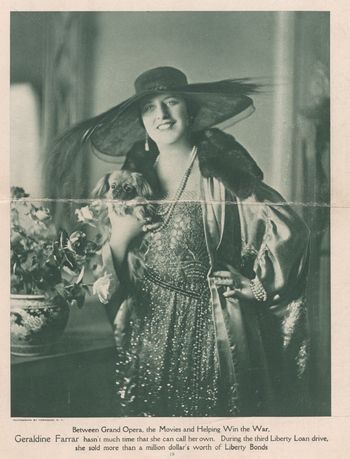
As for many cosmopolitan performers, the eruption of the First World War posed challenges for Farrar and further encouraged her self-representation as an American symbol (see Figure 3).Footnote 52 Farrar remained unapologetic about her devotion to Germany, her former home (‘I am pro-German because Germany made me what I am,’ she declared in 1915), but still sought to highlight her American allegiances in multiple ways.Footnote 53 Public statements explicitly sought to dismiss accusations of subversive German loyalties as slander and ‘vicious lies’: ‘I am an American first, last and all the time. I was born here, brought up here and am living here now.’Footnote 54 A Vanity Fair profile published in 1922 shortly after her retirement remarked how Farrar had ‘stormed the metropolis of music in Germany’ before returning to become ‘the American idol’, thus (perhaps inadvertently) signposting through bellicose rhetoric some of the tensions which existed within such a mediation.Footnote 55
Farrar at home during the war. Metropolitan Magazine, July 1918. New York Public Library for the Performing Arts, Music Division.

Yet despite her vaunted Americanness, Farrar's onstage repertoire remained defiantly foreign. During her 16-year career at the Met, she sang no English-language roles.Footnote 56 Rather than promoting native music, in fact, Farrar made repeated public pronouncements about the impoverished character of American musical life. A radio lecture entitled ‘What's the Matter with our Music?’, given a few years after her operatic retirement, contrasted the superficial improvements in training in America with the still undeveloped critical standards exhibited by musicians and public alike. ‘Can it be that there is a meridian of longitude somewhere in mid-ocean, where one's entire artistic perspective becomes changed?’ she asked.Footnote 57 Dismissing America's relative youth as an inadequate explanation for a musical culture that is ‘sporadic, hectic, and undisciplined’, she condemned the business interests and ‘false glamour’ that shaped American life, echoing contemporaries who lamented that an American Beethoven or Wagner had failed to materialize.Footnote 58 The singer's own voice – both literal and metaphorical – on one level contradicted such bleak statements, however: if American opera houses struggled to locate gifted young composers to replenish the operatic repertoire, Farrar herself provided an example of how European music might be refashioned to fit an American identity, and how opera might be repackaged to suit the aesthetics of modern life.
Farrar's complex relationship with both history and geography was ultimately consolidated by her recording and film activities. Between 1915 and 1920, she starred in 14 silent films for the Paramount, Goldwyn and Pathé companies.Footnote 59 Her recording legacy with the Victor Talking Machine Company was similarly prolific, and she often appeared in advertisements for the company, supplementing her own publicity shots which featured her using modern inventions such as the telephone. Farrar's operatic background in fact proved central to her on-screen presentation: several of her films featured her impersonating a singer and drew upon her reputation for portraying onstage tempestuous figures who challenged societal norms. The frequently exotic locations of her films – and the physical bravado she demonstrated within them – provided Farrar with a further opportunity to present herself as an American New Woman, even if the recurrent metatheatricality of her portrayals also reminded viewers of Farrar's underlying gentility: a distancing mechanism within the mimetic framework.Footnote 60 The camera's intent gaze allowed audiences unprecedentedly close access to the singer's mobile body, a fact acknowledged by Farrar's occasionally direct stare at the viewer.Footnote 61 Yet these acts of cinematic voyeurism paradoxically exposed a further layer of performativity – one rooted in the singer's absent voice. The film Carmen, for example, highlighted the paradoxes inherent in Farrar's movements across media: premièred in October 1915, it offered the spectacle of an opera singer performing a stage role silently on screen, as a live group of operatic soloists and full symphony orchestra provided a musical accompaniment. If Farrar was (as one journalist would have it) ‘the only personage to sing herself into motion picture prominence’, then the price of visual magnification was a corresponding loss of voice.Footnote 62
The tension between Farrar's on-screen silence and the ways in which her screen roles frequently alluded to her operatic career thus illustrates some of the anxieties surrounding liveness and embodiment that emerged as reproductive media became widely available.Footnote 63 The spectacle of an opera singer silently impersonating a singer on-screen indicates how dependent recordings were upon live media for their meaning, and how the body had its own textuality that might be read for medial traces – in Farrar's case, the body even trumping the voice in its centrality to her identity as a performer. As Melina Esse observes in a recent study of Farrar's Carmen, the treatment of Farrar in her screen roles in this way suggests an effort ‘to harness the diva's physicality in order to efface [film's] own mechanicity’, in a manner that echoes Benjamin's famous theory of the aura.Footnote 64 As Esse suggests, the musical accompaniment to Farrar's Carmen acted as another tool to evoke the singer's physical presence, as audiences were directed towards an imagined sound source and distinctions between diegetic and non-diegetic sound were collapsed.Footnote 65 The relentless physicality of Farrar's films nevertheless also offered audiences new modes of engaging with the singer – just as the widespread dissemination of her films provided new audiences access to an American icon.
Farrar's operatic credentials likewise allowed her to negotiate cultural divisions between ‘elite’ and ‘popular’ entertainment, despite concerns that her own reputation would be sullied by her involvement with cinema. Her operatic background was instead invoked as a means to make a mildly disreputable art form more respectable. As the general manager Samuel Goldwyn proclaimed in the press release announcing her first film contract, Farrar was ‘doing the entire picture art a favor by contributing to it her extraordinary prestige and genius’, and her presence would convince remaining doubters of the validity and stature of cinema. The doyen of the American theatre Belasco was similarly referenced as a means to guarantee the pedigree of the enterprise. His relationship to Farrar and the film industry more generally had been central to persuading her to commit to the contracts, and rumours circulated that he might direct her in a film version of Madama Butterfly.Footnote 66
Audiences of Farrar's films were therefore continually invited to view them through a double lens, her screen performances ‘redeemed’ by her offstage experience. Farrar was herself quick to defend her new ventures, arguing that cinema was an intrinsically more democratic art form.
Opera in America is for the very limited public, the public that can pay $6 for orchestra seats. The graphophone [sic] reaches a much larger public, and through it my voice has been carried to thousands who will never hear me sing. But the movies reach the millions, and so I have added a vast new public to the restricted one I had before.Footnote 67
Rejecting claims of recording's ‘embalming’ qualities, she asserted that a singer was ‘not trapped, but rather multiplied in the cinema’.Footnote 68 ‘Multiplication’ was at one level an equally deadening kind of reproduction, to which the animism and materiality of her stage performances were opposed. Yet Farrar's image also hints at a more complex reality: that reproduction could function as a hall of mirrors, in which different media interact recursively and mutually inform an audience's perception. Cinema could make Farrar's corporeality hyperreal through embedding it in layers of reproduction, even as it traded off her flesh-and-blood performances in the opera theatre.
The counterpart to such celebrity, however, was a recurrent critical emphasis on Farrar's ‘realism’. In operatic circles, of course, the word ‘realism’ had a complex recent history that reflected the paradoxes of applying ideas of verisimilitude to an inherently unrealistic genre, as well as the shifting priorities of those who sought to invoke the category.Footnote 69 Farrar's penchant for verismo roles and French repertoire certainly placed her within a lineage of recent performers who had prioritized visual values and detailed acting.Footnote 70 As Roberta Pearson has argued, cinematic acting had similarly undergone a stylistic shift in the years preceding Farrar's first movie projects, with a histrionic approach increasingly supplanted by a ‘verisimilar code’, a move touted as helping to broaden cinema's appeal beyond the lower classes.Footnote 71 Within New York, discussions of ‘realism’ were likewise charged by the self-conscious spectacle and conspicuous consumption that had become defining features of the city's commercial culture since at least the 1880s – part of the broader effort to position the city as a global marketplace that could rival London or Paris.Footnote 72 As Ann Douglas observes, by the 1920s, more than anywhere else in the USA, ‘New York's essential product was attention itself’, as the city supplanted Boston and Chicago as the nation's artistic and economic centre and rose to become the world's most powerful city.Footnote 73 Realism in New York, then, emerged camera-ready: spectacular, disruptive, yet also inseparable from notions of reproduction and mediation, and entangled with a burgeoning rhetoric of democratization. This commodification likewise shaped Farrar's offstage representations, through her extensive use of promotional photographs, interviews and recordings – a trend by no means unique to Farrar, but which her cinematic activities reinforced to an unprecedented degree.Footnote 74
Rather than conveying specificity, one potential meaning suggested by Farrar's ‘realism’ might instead be self-conscious display – the spectacle of a body marked by performance and familiar through various forms of representation. Such appearances nonetheless challenged existing conventions of movement on the operatic stage, suggesting that Farrar's presence could disturb a uniform theatrical surface through the incursion of a more vivid, yet mediatized form of display. Newspaper reports of Farrar's performances repeatedly drew attention to her highly ‘realistic’ acting, which bore comparison with the finest theatrical and cinematic performers, and which was at times visibly shaped by her on-screen adventures – most obviously her performances as Carmen.Footnote 75 Farrar herself seemed to invite such associations, arguing that cinema provided a vehicle for more nuanced forms of physical expression, which would eventually influence opera itself. ‘When you see my Carmen of the pictures you will see my real Carmen, and some day I am going to liven things up a bit at the opera,’ she declared on returning from Hollywood in 1915.Footnote 76 Within ostensibly live performances, then, Farrar's appearances were continually marked by various forms of mediation, and could be interpreted by audiences as modern precisely because of the complex relationship she exhibited to time: immediate yet familiar, symbol and symptom of New York's culture of self-advertisement.
By the time she appeared in Zazà, Farrar was thus already characterized as a figure who could mediate between America and Europe, between cinema and opera, and between elite and popular culture. The metatheatricality of her cinematic roles ensured that audiences were habituated to drawing connections between her theatrical roles and her offstage persona, while aiding the creation of a myth which enabled her to promote works that might otherwise have escaped critical attention. Such qualities would make her an ideal ambassador for Leoncavallo's work when it finally made its belated début at the Met.
Zazà as Geraldine Farrar
Zazà's eventual American première occurred on a historic date in New York history. After years of heated debate, prohibition laws were finally implemented on 16 January 1920, and the sale, transportation and manufacture of alcohol were banned across the country.Footnote 77 Within such a context, the opera's opening-act depiction of bawdy, alcohol-fuelled encounters in a late-night cabaret club could hardly fail to raise eyebrows and to support arguments that associated the ‘Latin spirit’ with prostitution and sloth. At the same time, Zazà's music-hall setting and the score's profusion of waltzes edged the opera further towards popular culture, and chimed with concerns already raised in New York by the recent history of Italian opera. Before a note had been sung, then, dissension and public curiosity were guaranteed.Footnote 78
Zazà extended the fascination with Parisian society and the theatrical milieu that Leoncavallo had already displayed in La bohème and I pagliacci, and featured a libretto written by Leoncavallo himself.Footnote 79 Set in contemporary Saint-Étienne as well as Paris, the opera opens backstage at the Alcazar Theatre, where Zazà works under the management of her former lover, Cascart. A vaudeville singer of gypsy origins, Zazà was rescued by Cascart from an unhappy childhood with her exploitative and alcoholic mother, Anaide. As the opera opens, a group of male spectators are seen drinking, and the evening's performances at the Alcazar can be heard playing out in the wings of the theatre. Zazà arrives, and in the privacy of her dressing room she confesses to Cascart her love for a mysterious stranger, Milio. She then moves offstage to perform her new revue, ‘Il bacio’, and returns to seduce Milio at the conclusion of the scene. The second act takes place six months later, and opens in Zazà's living room, where she is initially seen relaxing with Milio. He is shortly due to depart for America for several months, but Zazà persuades him to delay his trip. After he leaves for Paris, Cascart and Anaide arrive and beg Zazà not to abandon her profession and instead remember the fleeting nature of passion. Cascart then eventually reveals that he has seen Milio in Paris in the company of another woman. A distraught Zazà laments her suffering and leaves for the capital in the company of her maid.
The third act provoked the most conflicted responses in many of the opera's first productions, and indeed contains the most striking episode in the work's experimentation with operatic realism. Set in Milio's Paris apartment, the act opens with the tenor singing a lament over the realization that he must leave Zazà forever. His wife, Mme Dufresne, enters to accompany him to the station and reminds their servant that she is expecting a visitor. Zazà arrives shortly after their departure and comes across a letter addressed to Mme Dufresne which reveals the true situation to her. Milio's young daughter, Totò, now enters and begins to address Zazà, telling her that she is awaiting her parents' return and remembering the pain of her father's recent absence. A spoken role, the character of Totò awakens Zazà to the gravity of her behaviour and forces her to recall her own unhappy childhood. To the accompaniment of Totò performing Cherubini's Ave Maria at the piano, Zazà sings an aria acknowledging the sacrifice she must make and the contrast between her own history and the innocent Mme Dufresne. In the concluding act the action returns to Zazà's home, in which Cascart reminds her of the necessity of leaving Milio and resuming her stage career. Milio arrives and Zazà eventually confronts him over his marriage, revealing that she has visited his home. Violently rejected by Milio, she initially claims to have exposed his infidelity to his wife, but soon confesses the truth and asks him to leave. Seeing him through the window as he finally exits from her life, she cries and sobs his name, suggesting that the dismissal may have been an unsuccessful ruse to secure his commitment indefinitely.
The New York première of Pierre Berton and Charles Simon's source play had already aroused considerable controversy when it occurred in 1899. Starring Mrs Leslie Carter, the production was directed by Belasco using his own translation and was a tremendous critical and popular success.Footnote 80 Hailed as ‘the biggest dramatic triumph of the times’, the production nonetheless prompted some strongly worded condemnations for the apparent impropriety of its subject matter.Footnote 81 Rejecting the title character's eventual acquiescence to convention as an unconvincing attempt to ‘Americanize’ the play, one critic for example described it as a ‘sewer’, whose popular success indicated the ‘magic of sensual corruption wherewith Circe turned Ulysses's mates into swine’.Footnote 82 The bourgeois status of the audience was invoked by other reviewers as a potential defence against contamination, foreshadowing arguments that would be played out with regard to Farrar's own provocative performances.Footnote 83
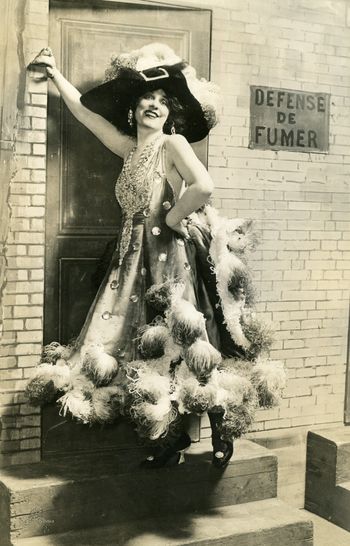
Beyond its theatrical incarnations, Zazà was also the source for a number of silent films, including a widely circulated one made in 1915, starring Pauline Frederick and scripted by Belasco.Footnote 84 Heralded as ‘one of the best [movies] which [have] been at the Strand this season’, the Zazà film had marked Frederick's first appearance in cinema after a celebrated stage career, and had been an especially expensive and time-consuming production for the Famous Players Film Company.Footnote 85 Critics nonetheless noted the challenges involved in performing as flamboyant a role as Zazà without the luxury of sound: ‘Deprived of the important medium of the voice, Miss Frederick must rely utterly upon the medium of pantomime.’Footnote 86 Although ‘realism’ was a touchstone in the reception of both Carter's and Farrar's performances, by 1920 the character of Zazà increasingly hovered in the realm between myth and reality, as the object of multiple representations and moreover as a character both emphatically modern and highly familiar from countless nineteenth-century portrayals of the ‘fallen woman’. On that basis, Emilio Sala's description of the lady of the camellias as a ‘sounding myth’ might be even more aptly applied to Zazà: her interpretation across media emphasized her mythical qualities, supplementing sexual promiscuity with medial transgression.Footnote 87 Zazà, like Farrar, might therefore be viewed as a provocatively intermedial figure – one whose reputation was shaped by representations across diverse media, yet now manifest to New York audiences in live audiovisual form (see Figure 4).
Farrar in her Act 1 costume. Metropolitan Opera Archive.

The brief summary offered above already indicates several features that would prove central to the way in which the Met Zazà was staged and interpreted by audiences. Most obvious is the work's metatheatricality – the ways in which the act of musical performance is thematized, and diegetic and non-diegetic music are brought into tension. In that respect, Zazà bears comparison not only with I pagliacci, but with many other contemporary Italian operas that feature prominent moments of musical display within the drama. As Arman Schwartz has argued, such scenes potentially allowed composers to smuggle old-fashioned lyrical set pieces into musical works otherwise dominated by veristic effects.Footnote 88 More equivocally (as Schwartz has outlined in relation to Tosca), this recurrent thematization of performance also suggests the imperilled status of singing at this historical moment, a concern which Zazà plays out in manifold ways at the level of plot. Before pursuing this idea further, however, it should be noted that the most immediate effect of Zazà's metatheatre is that performer and role are brought closer together: even more so than in Berton and Simon's source play, Zazà and her impersonator might be thought to bear some essential similarity.
An identification between a performer and their role had, of course, a lengthy tradition, extending all the way from Handel's ‘rival sirens' via early nineteenth-century suitcase arias. Even as the status of singers declined in relation to that of composers, moreover, the importance of star singers to the opera business was not in doubt: one of the key reasons for the German seasons at the Met in the 1890s was the higher fees charged by star singers of the Italian repertoire. Nevertheless, by 1900 singers' interventions in the musical work were in relative decline, particularly with regard to older works, as even cadenzas and other moments of performer spontaneity were becoming standardized. Storchio, Leoncavallo's first Zazà, was, for example, known for her lively stage presence; yet reviewers of the première maintained a distinction between Storchio and Zazà, and the soprano seems to have sought to realize the composer's intentions to the letter.Footnote 89
The critical response to Farrar's début in the role was therefore unprecedented. Rather than seeking to personify an established operatic character, Farrar had projected herself into the role, transforming it into a vehicle for her own celebrity status. ‘Zazà as Geraldine Farrar’, announced the New York World, parodying playbills that advertised a performer's embodiment of a theatrical part; ‘Zazà in the role of Geraldine Farrar is a sensation. She reawakened last night, did she, this disreputable but interesting drab […] She had taken possession of the physical habitation of Geraldine Farrar; therefore she was beautiful, therefore she was reborn with a golden throat,’ it continued, framing Farrar's performance as a redemptive act through which the music-hall singer was made great.Footnote 90 Rather than being sullied by the part, Farrar had instead saved it by turning it into herself. In the New York Sun, William J. Henderson was equally explicit: ‘Leoncavallo's Zazà is just Geraldine Farrar with vocal and scenic accessories,’ he declared.Footnote 91 Later reviews were equally lavish in their praise of Farrar, and noted her powers to redeem a fallen work: ‘In seeking a reason for the Metropolitan Opera's attempt to resuscitate Ruggiero [sic] Leoncavallo's lyric cadaver […] Mmms [sic] Farrar, as a fact, is the opera; indeed, more than the opera […] there is no wonder that Mms Farrar sought the juicy morsel for her own,’ argued one critic, invoking metaphors of death and reanimation already familiar from the earlier season announcement.Footnote 92 Musical America was equally emphatic: ‘Geraldine, Geraldine, and Geraldine is the thing […] gripped by the potency of the portrayal the beholder forgets the vapid music of Leoncavallo.’Footnote 93
The stark contrast between Farrar's brilliance and the work's poverty was reiterated in many reviews, as critics from a variety of publications sought to distinguish between the performance they had actually attended and the imaginary musical work. Despite it being the opera's first performance in New York, reviewers were adamant that Zazà was musically a disaster and that Farrar's presence alone had turned the performance into a success. Finck's comments in the Performance Herald a year later summarized the collective viewpoint succinctly: ‘It is well known that Miss Farrar has, by the charm of her personality, her singing, and her acting made a first class success of an opera which previously had been a dismal failure […] This opera is, from a purely musical point of view, a dismal bore. Such is the magic of personality.’Footnote 94 The work's negative earlier reception in New York and Paris evidently shaped such opinions, and critics were likewise primed for musical disappointment, given the history of new Italian operas at the Met. The elite position occupied by many (if not all) of New York's stalwart reviewers doubtless also encouraged a barbed attitude towards Leoncavallo's work, which brought into fierce contrast the persuasive power of the Met production. Farrar's triumph in the title role was thus implicitly a success for the performer as a creative agent, and furthermore for a specifically American one who could redeem a sordid Italian failure. If Leoncavallo's work was ‘stereotyped, shallow and commonplace’, then Farrar was altogether more dignified and exceptional: ‘[Farrar] is Zazà. She is its alpha and omega, its first cause and its last.’Footnote 95
Tropes of mummification and death were thus linked to ideas of reanimation and magic, crediting Farrar with other-worldly powers on account of her reawakening of an operatic corpse. Such comments were often suggestively ambiguous, in that they allowed the possibility that Zazà might once have been vital and merely needed to be woken from its operatic slumber. Certain reviews in fact described Farrar in ways that invoke her as an operatic Dr Frankenstein: ‘Were it not for Farrar there would no longer be a Zaza. It is her vitality which galvanizes the opera with a semblance of life.’Footnote 96 Such comments seem to imply that Zazà is a relic from a different age – an opera whose purpose was to be performed briefly and put to rest rather than expected to live on forever in canonical form. Lacking timeless gravitas, Leoncavallo's opera instead requires the touch of a magician in order to be made alive again. The opera lived but is now dead; Farrar alone can revive it once more, rendering it modern and relevant through her American theatrical persona and transgressive medial powers.
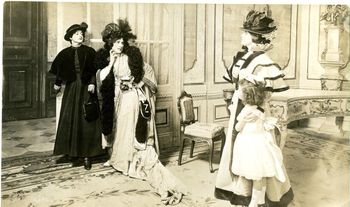
When reviewers discussed the performance more closely, several features drew particular attention. Belasco's 1899 production of the play was frequently referenced, and Farrar's stage acting was favourably compared with Carter's – in the estimation of some reviewers, in fact, it far exceeded anything they had ever witnessed before. Max Smith confessed that he found it ‘the most sincerely felt, convincing and moving impersonation this remarkable singing actress has ever put to her credit […] one of the most remarkable histrionic achievements by any woman […] on the contemporary lyric stage’ (see Figure 5).Footnote 97 At the same time, however, the involvement of Belasco with the operatic Zazà reinforced a sense of the work's pastness. Ostensibly set in the present day, the opera's 20-year delay in arriving at the Met left the stage designs looking historic, and Belasco's backstage presence gave the production the peculiar sense of a revival. The director's well-documented penchant for preserving productions furthered the sense that the 1899 production had been preserved in aspic.Footnote 98 The almost complete absence of references to the production's credited director, Richard Ordynski, emphasized the extent to which Zazà was interpreted as a Belasco product. Farrar's vocal animism was in this way located within a performance heavily associated with the turn of the century; and her multimedia persona helped to create a rupture within the work's doggedly realist, even quasi-mechanical framework.
The Act 3 confrontation scene. Metropolitan Opera Archive.

Turning to specific moments within the work, Farrar's physical mobility familiar from her film work – and her decision to undress without the aid of a screen in the opening act – prompted extensive commentary, and indeed created a minor scandal. The Washington Times noted the ‘violent, tropical, passionate love-making of Farrar’ during the performance, outdoing anything on stage or screen and awakening audiences to ‘possibilities hitherto unsuspected’.Footnote 99 Other viewers were more offended. When the production toured to Atlanta, the Rev. Dr Stratton inveighed against the moral corruption offered by Farrar's partial nudity, asking: ‘In her intense devotion to her art, her desire to realize the fullest purpose of composer and author, did she not become too realistic?’Footnote 100 Stratton's moral outrage may have been a local concern, yet his sense that Farrar had transgressed the boundaries of realism was not unique. The ‘startling realism’ of Farrar's performance – the ways in which Zazà had ‘never been so real’ – recurred as a theme throughout newspaper reports, as Farrar's performance was interpreted as at once a unique expression of her own personality and a remarkable presentation of modern reality.Footnote 101 Although earlier productions by Belasco had sought to extend existing forms of stage realism – most famously through the use of ‘real coffee’ and cooking smells in The Governor's Lady (1912) – Farrar's performance nevertheless offered an unprecedented example of operatic realism, through her extravagant self-performance.Footnote 102 Exposing her body on stage was therefore a logical conclusion to Farrar's self-advertisement, through which her physical presence as a singer was flaunted. Zazà and Farrar were collapsed into one material body. The distinction performance scholars have long made between ‘presence’ and ‘representation’ – the performance's ephemeral immediacy versus the alternative reality it seeks to portray – was thus eroded through the audience's investment in Farrar's presence; the ossified work was overcome by the singer's corporeality.Footnote 103 If Zazà was transformed into Farrar, then the ultimate expression of that self-exposure would be to remove one's clothes.
Live on screen
The critical reactions to Farrar's exhibitionism begin to suggest how her film work had come to shape audiences' perceptions of her stage performances by 1920. If silent films traded on and alluded to Farrar's operatic liveness, her operatic performances could be similarly interpreted through the prism of her cinematic appearances: as moments when the performer took control of the audience's gaze and transformed the production that surrounded her through her familiar physicality. Pursuing Laura Mulvey's influential theory of cinema's male gaze, one might add that the camera's commodification of the female body was likewise countered by Farrar, through her manipulation of the audience's perception via her cinematically marked body.Footnote 104 Farrar's Zazà therefore complicates distinctions between cinema and operatic performance that have typically centred upon permanence, immateriality and reproducibility on the one hand versus ephemerality, liveness and uniqueness on the other; or that have made claims about the media's fundamentally different attitudes towards the visual and the acoustic. Contrasting cinema's ‘promise of continuity and inheritance’ with opera's ephemerality, for example, Michal Grover-Friedlander argues that the two media are locked into a permanent dialectic of attraction and opposition on account of the operatic voice's inseparability from death.Footnote 105 Yet Farrar's performances instead seem to disclose a more porous division between cinematic and operatic representations – one in which Farrar's corporeality was by turns invoked, displayed and nuanced through prior representation in both media. If audiences were habituated to gazing at Farrar's body through the camera lens, then the operatic stage was a space in which her physical mobility could likewise counter the increasing mechanicity of operatic production – a physical mobility that was nevertheless redolent of her previous cinematic adventures.
The enmeshing of operatic and cinematic modes in Farrar's Zazà takes on a yet more complex character when considered in the context of Zazà's wider concerns with spectatorship and performance. These sought to focus the audience's attention on the acts of looking and hearing and on broader questions of representation onstage, and moreover aligned Zazà with an earlier operatic classic. Critical comparisons between Zazà and Verdi's La traviata have typically centred upon the most obvious similarities of plot: 50 years after Verdi's opera, Leoncavallo's work translated Violetta's courtesan life into a more provincial and impoverished setting, which fuelled accusations in New York that Zazà was itself a lower-class reheating of an established masterpiece. As Marco Ladd has observed, however, the two operas are united further by their reliance on interior settings: in marked contrast to contemporary urban operas such as La bohème or Charpentier's Louise (1900), all of Zazà takes place indoors, and primarily in the characters' apartments.Footnote 106 These domestic settings arouse an immediate sense of intimacy with an audience and support Alan Mallach's claim that Zazà is ‘the first opera of the time set in a milieu that has been stripped of even the most minimal distance from its audience’, instead inviting a form of spectatorship rooted in profound identification.Footnote 107
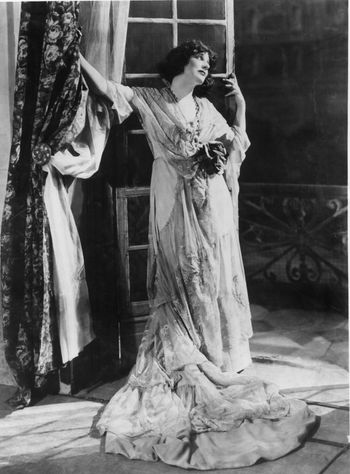
The relationship between interior and exterior space – and by extension between the stage world of the characters and the world offstage – is crucial, however, to the opera's dramaturgy. Zazà is dominated by moments in which the object of desire is beyond visual or auditory reach, and the audience is consequently sutured into the characters' experiences of longing.Footnote 108 The opening café scene, for example, is filled with offstage music, which replaces the embodied experience of musical performance with concealed sounds. As with several fin-de-siècle Italian works, the singing voice is presented as an elusive object, and the audience's own experience of desire is mimicked on stage.Footnote 109 The letter which reveals Milio's marriage to Zazà, by contrast, is read aloud only in parlando fragments, denying the audience access to Madame Dufresne's voice and instead turning Zazà's physical reactions into the locus of attention.Footnote 110 Window scenes moreover feature prominently in both the second and fourth acts, allowing Zazà to see Milio depart but not to hear or speak to him, and thus underlining the existence of an offstage space that promises physical unity (see Figure 6). These experiments with stage space and realism reach their climax in Zazà's conversation with Totò – a scene that came in for particular attention in many New York reviews, and whose technical challenges have continued to plague the opera's performance history.Footnote 111 The child's spoken dialogue is placed within a set of musical themes associated with Zazà's consciousness, and a disjunction is thus created between the soprano and the child's spoken interjections. This tension is heightened when Totò proceeds to perform at the piano – a moment when diegetic music is finally placed centre stage, and in which Leoncavallo's experimentation with musical realism is brought together with a moment of heightened interiority on Zazà's part. Totò's speech registers as an other-worldly, even hyperreal effect within the work's overall metatheatre, and the ensuing soprano descant above the piano line seeks to bring these opposing realities together: Zazà's lyric voice becomes a mediating space between the onstage music and the orchestra's below-stage commentary, between Totò's speech and piano-playing and the ambient swelling of the orchestral strings.
Zazà at the window. Metropolitan Opera Archive.

These multiple blockages and separations throughout the opera act on one level as synecdoches for the social boundaries that block Zazà and Milio's relationship – limits that can be sensed beyond but not fully overcome, and which render physical unity tragically out of reach. Such scenes by extension highlight the very act of spectatorship and draw attention to the overlapping forms of representation and performance the audience has to negotiate as Zazà slides in between the work's mimetic levels, from stage music to offstage singing, speech and non-diegetic singing, and the orchestral swirling below. Zazà's difficulties in translating her stage life into a successful romantic drama are thus reflected in the opera's manipulation of different forms of mimesis. She therefore becomes the site of overlapping forms of realism, as well as the object of the audience's collective desire: a voice-object that resides on the cusp of different modes of representation and promises a corporeal integrity repeatedly denied elsewhere.
Such observations echo Richard DeCordova's classic analysis of the film star as containing a complex interplay of different levels of identity: a fictional character, an actor with certain techniques, a recognizable image which crosses between films and a publicized life off screen.Footnote 112 All of these identities are mediated through the same body, and audiences are required to negotiate between these different mimetic levels, so that they are led outside the text to ‘a contemplation of the enunciation and particularly to the contemplation of the identity of an enunciating subject’.Footnote 113 This experience sets up a particular kind of hermeneutic for the spectator, who has to disentangle the reality constructed by overlapping identities and in turn is brought into an intense relationship with a performer's elusive physical presence. Farrar's cinematic roles had of course exploited a similar dialectic, as her identity as a singer was variously invoked, elaborated upon and rejected in her screen appearances, the fourth wall periodically broken. These overlapping forms of reality intersect closely with the multiple diegetic levels at play in Zazà, in which the character's stage life as a romantic singer is set against the alternative reality of her affair, and furthermore against the spoken drama of her lover's child. In both Zazà and early film-star vehicles, the audience's attention is continually directed towards a central performer's body, whose identity spills out beyond the boundaries of the stage and screen and whose meaning is dependent upon a communion with an audience of followers.
The conflation of Farrar and Zazà, I suggest, thus echoed newly emerging forms of spectatorship associated with cinema, which centred on particular mediations of a performer's identity. As Miriam Hansen has argued, the film spectator first began to emerge as a meaningful category during the 1910s, when films were viewed in specialist theatres rather than at nickelodeons and other mixed entertainment venues.Footnote 114 Films could respond to these developments through the construction of varying kinds of cinematic gaze associated with different audiences and sought to anticipate their own eventual reception. The emergence of the American film star thus gave rise to a particular kind of hermeneutic literacy, as audiences learnt to make distinctions between an actor's overlapping identities and films sought to create a relationship of technologically mediated intimacy between a particular performer and their audience. Farrar's cinematic appearances had likewise trained viewers to draw connections between her on-screen and off-screen appearances, and had created a persona that transcended individual impersonations. Farrar's star ‘personality’ in that sense exceeded the boundaries of any given representation, and was instead aligned precisely with Zazà's own experimentation with different forms of realism. The opera's tension between competing forms of representation was thus transformed into one between Farrar's ‘startling realism’ and the more ordinary realism surrounding her. Farrar's identity as a singer, actress and American idol could therefore be conflated with Zazà herself, in the process overwhelming the operatic work.
More broadly, I propose that the critical and popular success of Farrar's Zazà was ultimately rooted in its status as a quasi-cinematic entertainment – one that moreover transcended existing cinematic technologies for coordinating sound and image.Footnote 115 Farrar's distinctive vocal talents and the melodic charms of Leoncavallo's work doubtless also played their part for some listeners, while the source play's earlier adaptation as a film certainly attested to the enduring fascination of Zazà's storyline within early twentieth-century New York and positioned the character of Zazà herself as a curiously contemporary, intermedial figure. Yet it is the complex interplay between Farrar's own intermedial persona, Zazà's liminal position within New York's cultural economy, the Met production's mechanical qualities and the opera's own rich metatheatrical and mimetic play that offers the most convincing explanation of the production's extraordinary critical reception, as well as being most revealing of attitudes towards operatic performance at the dawn of the cinematic age. The conflation of Farrar and Zazà – the sense that Farrar herself had become the centre of the performance – reflected a specifically cinematic approach to media by the 1920s that was already beginning to shape encounters with opera in the theatre. Audiences who attended Farrar's screen portrayals did so, at least in part, in order to experience a sensation of proximity to the singer, as her constant, operatically inflected screen persona sought to compensate for her physical absence and was presented in an ‘infinite variety’ of exotic images. Even if operatic audiences attended partly to see and hear Farrar perform, experiencing the show primarily as an expression of Farrar herself was by 1920 a mode of perception firmly associated with cinema – precisely the kind of symbiotic relationship between live and mediatized performances that Philip Auslander has posited as distinctive of late twentieth-century modernity.Footnote 116 Even though Zazà depicts a singer's tragic fate and vocality's increasingly fraught position, Farrar's intermedial status enabled her to triumph: her combination of liveness and mechanicity empowered her to reanimate an operatic corpse.
Mechanical marvels
The negative critical response to Zazà stood in stark contrast to the production's commercial success. The show was revived in the following two seasons and travelled as far as San Francisco. By December 1921 even the most curmudgeonly of reviewers acknowledged that ‘all over the country people are crazy to see Geraldine Farrar in Zazà’.Footnote 117 So popular was the show in San Francisco, in fact, that tickets were sold only in conjunction with another opera in which Farrar did not appear.Footnote 118 Leoncavallo's dream that Italian opera might flourish once again in America was thus briefly realized, as Zazà unexpectedly emerged as an operatic sensation via Farrar's advocacy. Although the opinions of non-professional opera-goers are lost to history, the production's press reception suggests that audiences similarly experienced the work as an emanation of Farrar herself, and hence replicated the sensibility continually brought to bear upon her screen performances, even beyond the production's initial New York context.
The Met Zazà might in some ways appear exceptional, yet its popularity is highly revealing of the complex status of live operatic performance at the dawn of the cinematic age. Opera, it would seem, was not merely threatened but in important ways also transformed and revivified by the emergence of cinema. In a radio broadcast given in 1935, Farrar herself lamented the challenges that opera had received from new technologies during the final years of her stage career, in a retreat from her earlier position: ‘The encroachment of mechanical marvels began to seriously affect the art of the theatre and the opera; its aristocratic frame began to splinter […] the nervous, excitable audiences, en masse, are accustomed to noise, speed and little sentimental reflection.’Footnote 119 Complaints about audience attention strike a nostalgic note; but Farrar's comments also point to how ‘mechanical marvels' had begun to affect operatic performance by the 1920s. Cinema could offer audiences newly intimate modes of spectatorship within a spectacular mass entertainment. And yet in deploying the conventions of opera, it also partially undermined the metaphysics of presence – and cultural elitism – surrounding live performance by drawing attention to the interplay between embodiment and repetition in both media at this time, and to their shared mediation through human bodies. By 1930, Mario Marafioti, the Met's voice specialist, could pessimistically declare: ‘Opera as such is dead. There will only be opera on the screen.’Footnote 120 And yet ‘dead’ opera did continue to be performed, albeit in ways that variously drew upon cinematic techniques and reacted against them. Farrar's final stage appearances could therefore take on the appearance of a requiem not only for Leoncavallo, but for existing conventions of staged opera itself, as ‘the prophetess in her own country’ indicated the future paths the medium would need to take in order to survive in the age of mechanical reproduction.
Arguments about cinema's influence upon opera, then, extend beyond questions of acting technique, and instead address broader configurations of the live and the mediatized in this period and beyond. Yet the body nevertheless remained a key site for concerns about agency and presence. With the rise of cinema, discussions of acting style certainly did intensify in operatic discourse, and audiences were encouraged to identify with celebrity performers to an ever greater degree.Footnote 121 Farrar's Zazà nonetheless also raises broader questions about the ways in which distinctions between the live and the recorded have been negotiated by performers and audiences from the early twentieth century onwards, and about the historical, social and ideological contingencies that continue to shape such definitions. More specifically, I would argue, such perceptions also inform the contexts we choose to excavate in search of past works and events, and the medial frameworks within which we place early twentieth-century operatic performances. In that sense, Farrar's Zazà might help to nuance current ideas about intermediality in opera studies more generally: not only by directing our attention towards live performance, but also by focusing to a greater extent upon audiences and by conceiving spectatorship itself as inherently intermedial.Footnote 122 As Meike Wagner has observed, intermediality might best be understood not as a discrete set of categories but instead as a matrix formed by embodied perceivers as well as moving bodies on stage.Footnote 123 Rather than locating the triumph of the Met Zazà solely around Farrar's agency, then, the notion of intermediality might instead urge us to consider how operatic performance and spectatorship have been shaped by a variety of optical and auditory media throughout history, and to address the recursive relationships between audiences and performances that define operatic spectacle.Footnote 124
Even as audiences approached Zazà in ways shaped by cinema, however, the production's success was indisputably contingent upon Farrar's live presence in the theatre. In that sense, the audience's more cinematic appreciation of Zazà existed alongside a persistent commitment to the value of live performance on Farrar's part, and suggests the conflicted status of the opera singer at this historical moment. Shadowed by the rise of cinema, the opera singer's power to reanimate a past work imbued singers with a new kind of aura, as they themselves seemed to slip into the realms of history.Footnote 125 As the operatic canon became more entrenched and operatic works more marked by an emerging culture industry, performers were ever more important in mediating an audience's response – in Farrar's case, even acting as a node or ‘quilting point’ for the production's medial web.Footnote 126 Farrar's resurrection of Leoncavallo's opera might then seem merely a particularly revealing example of celebrity commodity culture, in which even the most meagre goods can be sold at a profit through the illusion of intimacy. The critical response and public acclaim elicited by Farrar's performances in Zazà suggest a more complex reality, however: one in which performers did not simply sell a work to audiences, but actively shaped the public's relationship with it. More than a commodity, singers could instead function as nodes of meaning within a changing cultural landscape. Rather than being in decline, in fact, performers continued to wield the power of life or death.
I would like to thank Marco Ladd, Ceri Owen, Enrique Sacau, Francesca Vella, Benjamin Walton, Gavin Williams and Flora Willson for their support in developing this article, as well as the editors of and the anonymous readers for this journal. John Pennino (at the Metropolitan Opera House) and archivists at the Library of Congress and New York Public Library for the Performing Arts all generously provided help with images. Earlier versions of this article were presented at the Tosc@Bologna conference in July 2015, and the ‘Operatic Immersions' conference in Leeds and Huddersfield in January 2016.