In Egypt in 2011, the military generals decided to side with the protestors even though Mr Mubarak had ordered them to open fire. That same year in Libya, it was reported that soldiers from the Libyan army had refused orders to open fire on anti-regime demonstrators, while pilots flew their aircraft abroad. However, coercive leaders in China, including military officials and police chiefs, have remained loyal to the Chinese Communist Party (CCP) in the face of domestic revolts. How does the CCP secure the loyalty of its coercive leaders? The answer has important implications for explaining the resilience of the Chinese authoritarian state.Footnote 1
Despite the importance of coercion in sustaining regime stability, very few studies, and even fewer quantitative studies, have been conducted on coercive leaders in China.Footnote 2 This is surprising given the fact that coercion occupies such a pivotal place in theories of the modern nation state.Footnote 3 In this article, I present the first quantitative analysis of coercive leaders, and public security (gong'an 公安) chiefsFootnote 4 in particular, in contemporary China. Drawing on an analysis of an original time-series cross-section data set of provincial public security chiefs and public security funding, I demonstrate that the CCP has empowered its coercive leaders by incorporating public security chiefs into the core leadership team (lingdao banzi 领导班子), and that public security chiefs seated on the leadership team have stronger bargaining power over budgetary issues. I show that the Party's move to empower the police is a response to potential regime stability threats. Fieldwork, qualitative interviews and an analysis of Party documents complement the statistical analysis. The findings in this study shed light on understanding of regime durability, contentious politics and the bureaucracy in contemporary China.
This article begins with an overview of the public security system in China. This is followed with a discussion of the police and coercion, and continues with an analysis of how the CCP empowers public security chiefs by appointing them to the leadership team. The fifth section examines the fiscal consequences of public security chiefs' bureaucratic rank by analysing police budgeting, and the last section concludes with a summary of the findings and broader implications of the study.
The Chinese Public Security
The origin of the Chinese public security system can be traced back to the 1930s, when the CCP established the Chinese Soviet government in Jiangxi province. The State Political Security Bureau (guojia zhengzhi baowei ju 国家政治保卫局) simply replicated Stalin's State Political Directorate, which later became the KGB.Footnote 5
After the People's Republic of China (PRC) was founded in 1949, the state public security system was established with personnel drawn directly from the military.Footnote 6 In 1950, Mao Zedong issued the most important organizational directive in Chinese police work: “security work must especially emphasize Party leadership … and in reality accept direct leadership by Party committees.”Footnote 7 This has resulted in a public security system which is highly decentralized and under the firm control of Party committees. The system grants local governments and CCP committees the primary leadership over public security organs and personnel. The organizational, personnel and financial power structures of the police create powerful incentives for local police units to obey their local Party and government “principals” rather than their superior public security “principals” or the central leadership.Footnote 8
The hierarchy of the public security system parallels the government system. The Ministry of Public Security (gong'an bu 公安部) is a national organ under the direct control of the State Council. Public security bureaus (gong'an ting/gong'an ju 公安厅/公安局) are established at the provincial level, and public security offices (gong'an chu/gong'an ju 公安处/公安局) are at the prefectural level. There is a public security sub-bureau (gong'an ju/gong'an fenju 公安局/公安分局) in each county-level unit. Similar to the CCP committees, the “reach” of the police goes down to the very local level.Footnote 9 At the county level, there are many public security stations (gong'an paichusuo 公安派出所), depending on social conditions and population density.
The scope of Chinese police coverage is extensive. Each public security station is established at the street (jiedao 街道) level. Depending on population density and area, each urban district has 15–20 public stations, each managing between 20,000 to 40,000 people.
The number of police nationwide is rising. In 1986, the number was 600,000, but it climbed to 1,600,000 in 2006, with a growth rate of 166.7 per cent.Footnote 10 This growth rate is eight times more than the growth rate of the Chinese population. Police per 100,000 people in 2006 was 120. This number is relatively low compared to many countries that have over 200 police per 100,000 head of population.Footnote 11
The Chinese Police and Coercion
The Chinese police, including the People's Armed Police (renmin wuzhuang jingcha 人民武装警察, hereafter PAP), are responsible for “everyday forms of social management,”Footnote 12 including monitoring the population and internet users; the management of the family registration system (hukou 户口); reporting early signs of social unrest; spying on political dissidents; controlling small-scale protests; and suppressing large-scale protests. This differentiates the police from the military, which is only responsible for defending the country from foreign invasion and repressing rare cases of large-scale revolts. On most occasions, it is the police who are on the frontline preventing small-scale protests from escalating into large-scale revolts.
Organizationally, the PAP is a separate institution from the public security system. The separation was institutionalized in 1954 when the PRC passed its first constitution. While the public security system is under the sole leadership of the State Council, the PAP is under the dual leadership of both the State Council and the Central Military Affairs Commission. The PAP also has local branches at provincial, municipal and county levels, independent of the public security hierarchy, although in most cases the leaderships of these two systems overlap. The PAP is a semi-military institution, and accordingly, its tasks are more specialized than those of the public security and include eliminating threats to state security, safeguarding major state leaders, and defending the country against foreign invasion during war.Footnote 13 In recent years, the PAP has played an active role in controlling large-scale social unrest and restoring social order, as seen during the 2008 Tibetan uprisings and 2009 Xinjiang riots.
The public security, on the other hand, is responsible for managing small-scale protests and preventing them from escalating. In an interview, the public security chief in County L told me,
In most cases, mass incidents develop from legitimate troublemaking (youli qunao 有理取闹) to illegitimate troublemaking (wuli qunao 无理取闹) and then to street demonstrations. For legitimate troublemaking, we primarily rely on persuasion, education and problem-solving. For illegitimate troublemaking, we crack down decisively.Footnote 14
For the past 20 years, with a few exceptions (for example, the 1999 falun gong protests, the 2008 Tibetan unrest, and the 2009 Xinjiang riots), China has scarcely witnessed any massive demonstrations that have broad support, target the national government, and spill over from one locality into another. To a large extent, this is the result of the police successfully suppressing protests before they escalate.
However, the number of “mass incidents” (quntixing shijian 群体性事件) has skyrocketed over the last couple of decades, from about 8,700 in 1993, to 32,000 in 1999, 50,000 in 2002, and surpassing 58,000 in 2003.Footnote 15 In 2009, The New York Times estimated that the number of mass incidents had jumped to 120,000 in 2008.Footnote 16 Recent literature on resistance in China has focused on the “stabilizing” effects of social protests suggesting that “rightful resistance” or “regularized protests” can serve as a “safety valve” to strengthen Party rule.Footnote 17 Accordingly, it is best practice for local police to adopt the strategy of tolerating moderate protests to allow for a release of the social pressures built up by inequality, local malpractice, labour disputes, judicial corruption, and environmental degradation, while at the same time managing such protest actions in order to prevent them from escalating.
The Chinese police have a strong incentive to crack down on protests, but have varying levels of capacity. The incentive to repress mass protests is determined by two factors. First, local leaders' tenure in office and opportunities for advancement are, to some extent, determined by their performance in the cadre evaluation system.Footnote 18 Interviews with local officials have revealed that their performance ratings in economic development and social stability are crucial to their evaluations. The occurrence of a large-scale mass protest is a “black mark” in an official's political career.Footnote 19
Second, despite the recent shift towards “political pluralization of the policy process”Footnote 20 in some arenas, through the power of the nomenklatura and fiscal system, the CCP committees at each level exert a strong influence over the public security bureaus. On the one hand, since the 1950s, local Party committees have dominated the management of leading police cadres. Formally, superior police organs one level up are only authorized to “assist” local Party and government officials by making “suggestions” about cadre decisions that local leaders are supposed to “consider.” In cases of “major disagreements in principle,” the decision may be referred to higher levels, but the final decision still goes to the superior-level territorial Party committee, and not to the police organ.Footnote 21 On the other hand, the local governments also control the purse strings of the public security bureaus. Although the national government periodically provides fiscal aid to local police organs, the bulk of police budgets comes from the coffers of local governments at the same level.Footnote 22
While the Chinese police bureaus all share the incentive to maintain social stability, their capacity to do so varies. The police's coercive capacity comes down to fiscal health and human resources. First, policing is costly. The police's capacity to implement an order to a large extent depends on whether they have the financial resources to do so. Investigating a crime, tracking down a criminal, surveillance of the population, and suppressing a demonstration all require fiscal investment. Poorly funded police departments are often unable to take action in a timely manner to crack down on protestors before they take to the streets.Footnote 23
In addition, successful coercion requires skills and experience. In an interview, the public security chief in High County recounted the elaborate manoeuvres used to quell a protest:
We came up with the following plan. We divided the police into three teams. The first team was [made up of] secret police. They were disguised as normal villagers and dispatched to the villages to communicate with protest leaders. The second was the propaganda team. They were sent to the villages to publicize the Party's policies. The third team was composed of “liars.” They were sent to the villages to spread rumours that if they stopped protesting, the government would soon solve their problems. This plan worked very well. The villagers who were planning on protesting were all settled.Footnote 24
Empowering the Public Security Chiefs
How does the CCP secure the loyalty of its coercive leaders? Over the last 20 years, the CCP has empowered its coercive leaders by bringing them into the core decision-making organs of the Party-state. Recent literature on Chinese politics has examined the institutional tactics used by the centre to control its local agents. As Dali Yang argues, the “Key to the Chinese Communist Party's longevity has been its power over personnel appointments.”Footnote 25 Both Susan Whiting and Pierre Landry show how the national government uses the cadre evaluation system to incentivize and discipline local officials.Footnote 26
When confronting stability threats, the CCP has utilized the dominance of the nomenklatura to empower China's major coercive leaders by incorporating them into the core Party organs: a higher bureaucratic rank and more personal financial benefits have closely tied the interests of the public security chiefs to the fate of the regime.
At each level of government, the CCP has established a leadership team that includes major Party and government leaders. For example, the leadership team in a province includes all CCP standing committee members and government Party group (dangzu 党组) members. In theory, only provincial/ministerial-level (buji/fu buji 部级/副部级) cadres are included in the provincial leadership teams. Provincial public security chiefs are de jure bureau-level (juji 局级) leaders rather than provincial-level leaders. However, in most provinces at most times, public security chiefs are the de facto provincial level-leaders and serve as members of the provincial leadership teams. This is in stark contrast to presidents of provincial high people's courts and presidents of provincial high people's procuratorates, who are de jure provincial-level leaders but de facto bureau-level leaders.Footnote 27 Presidents of provincial courts and procuratorates are rarely included in the provincial leadership teams.Footnote 28
Being a member of the leadership team gives a public security chief a higher rank in the bureaucratic hierarchy. While most bureau chiefs (for example, the head of the labour bureau) are at the bureau level, public security chiefs in the leadership team are provincial-level cadres. Being a provincial-level cadre in China entails all kinds of benefits, such as VIP rooms in hospitals, first-class air travel, bodyguards, better pension and health-care packages, and higher salaries.
More importantly, leadership team members have access to classified information and a stronger voice in the decision-making process. In most cases, important meetings covering a wide range of issues, including budgets, security, economic plans, law-making, personnel decisions and urban planning, are open only to leadership team members. Non-members of the leadership teams are excluded from such meetings, even when the issues discussed relate directly to their jurisdictions.
Including public security chiefs in the leadership teams was an informal rule until 2003, when the CCP central committee issued a document that made it explicit:
To further strengthen the Party's leadership in public security work, to make sure that public security organs better enforce the Party and the government's policies and decisions, Party committees at all levels can gradually appoint public security heads at the provincial, prefectural, and county levels to positions in the Party committee standing committee or deputy positions in the government based on local realities and cadre qualifications.Footnote 29
Moreover, this document makes clear the motivation behind Beijing's push to raise the status of the public security organs:
Western powers never give up westernizing and sabotaging our country… At present, we are at a critical stage of reforms, some deep contradictions constantly emerge, criminal offences and economic crimes are detrimental, mass incidents and emergent events are affecting social stability, the problem of the internet influencing stability looms large. To maintain social stability at this strategic stage is a daunting task that is extremely important.
It is obvious that the motivation behind the CCP's push to empower the police is to ensure their loyalty in the face of possible revolts. It is also evident that the initiative was propelled by Zhou Yongkang 周永康, who was a Politburo member and the minister for public security in 2002–2007. Zhou's powerful position in the Politburo gave him a strong voice in the Party's decisions concerning security work. Zhou's push was one reason why the Party's directive has been strictly enforced at the local level. It is reported that after Zhou's visit to Guangxi province in 2008, most police chiefs in Guangxi were promoted.Footnote 30
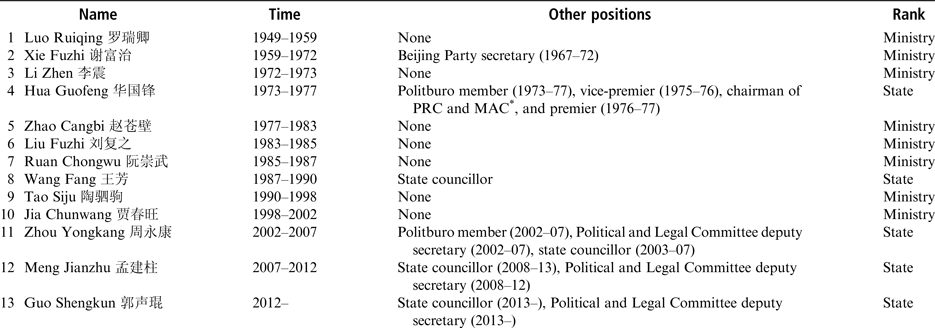
Zhou was one of the most powerful public security ministers in PRC history. Table 1 shows the ministers of public security since 1949, their positions and ranks. The ministers prior to Zhou did not hold concurrent positions, with the exception of Hua Guofeng 华国锋 and Wang Fang 王芳. Hua was an outlier since he was Mao's successor and occupied all powerful positions at that time. Wang was another exception owing to the high frequency of student protests in the late 1980s. Zhou and his successors, Meng Jianzhu 孟建柱 and Guo Shengkun 郭声琨, held important positions at the state level while they were ministers. This reflects the importance of security work in the last decade.
Percentage of Police Chiefs Seated on the Provincial Leadership Teams (1992–2012)

The PRC's Ministers of Public Security and Their Ranks (1949–2013)
Source: CLLD. Note: *MAC means the CCP's Military Affairs Commission. It is the highest military organ in China.
To examine whether the empowerment strategy is prevalent nationwide, we have constructed the Chinese Legal Leaders Database (CLLD), which includes biographies of provincial police chiefs from 1992 to 2012. The data collection effort is limited to provinces during these 21 years because this is when and where data for most police chiefs' biographies exist publicly.Footnote 31
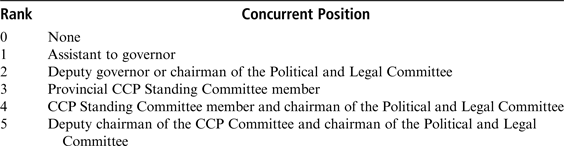
A close examination of the data reveals several patterns. First, most provincial police chiefs at most times were members of the leadership team, although their positions vary. Figure 1 shows the percentage of police chiefs who were provincial leadership team members from 1992 to 2012. As shown, before 2005, over half of the provincial police chiefs were already members of the leadership team. However, there was a significant jump in 2005, two years after the central document was issued. By 1 March 2012, over 90 per cent of provincial police chiefs had already been incorporated into the leadership team. However, their positions vary. Table 2 lists the concurrent positions a provincial police chief could hold. Some have no concurrent positions. Once included in the leadership team, the lowest position held by a police chief is assistant to the governor (shengzhang zhuli 省长助理), and the next level up is deputy governor or chairman of the Political and Legal Committee (zhengfawei 政法委, PLC). The PLC is a powerful organ that is responsible for leading all the legal bodies, including the public security bureaus, the courts, the procuratorates, the prison system, and the legal bureaus. Recent reforms have discouraged the appointment of police chiefs as chairmen of the PLC to enhance judicial autonomy.Footnote 32 The next higher level is being member of the CCP standing committee. This is a critical step in a public security chief's political career. Serving on the Party's standing committee means that the police chief has become one of the highest leaders in the locality. Some public security chiefs even hold multiple positions while serving on the standing committee, such as chairman of the PLC or/and deputy Party secretary. These are the most powerful provincial police chiefs. In 1992–2012, only one provincial public security chief held this top position: while serving as the public security chief in Guangdong, Chen Shaoji 陈绍基 was also deputy Party secretary and chairman of the PLC in Guangdong in 1998–2000.
Possible Concurrent Positions of Provincial Public Security Chiefs
Second, variations exist across space and over time. Figure 2 shows the changes in public security chiefs' ranks across 31 provinces in 1992–2012.Footnote 33 On the vertical axis, “1” means being a member of the leadership team and “0” means otherwise. With a few exceptions, most public security chiefs were promoted into the core decision-making organ in the last seven years. Some localities such as Beijing, Chongqing, Guizhou, Qinghai, Shanghai, Xizang (Tibet), and Zhejiang always have their public security chiefs in the leadership team.
Provincial Public Security Chiefs' Ranks (1992–2012)
The regional variation is owing to the importance of security work in the locality. In “strategic” localities, such as Beijing and Shanghai or provinces with ethnic tensions such as Tibet, public security chiefs hold higher ranks. On the other hand, serial variations are owing to cadre qualifications. Usually, public security chiefs are not promoted to the leadership team during their first years in the job, and often they are only promoted after they have worked in the government for a few years. For example, Zhu Changjie 朱昌杰, the current public security chief in Xinjiang, took office in 2009 but was only promoted to the leadership team as a deputy governor in 2011.
Public data on public security chiefs at lower levels of governments do not exist systematically. However, it is reported that over half of county-level public security chiefs had been incorporated into the leadership teams by 2009.Footnote 34
“Pork Barrel” in Public Security Funding
What are the fiscal consequences for public security bureaus when their chiefs are incorporated into the leadership team?? Do politically empowered public security chiefs actually enjoy stronger bargaining power over financial matters? Police funding is crucial to securing police loyalty, especially the loyalty of the rank and file. I show that public security bureaus led by leadership team members receive more funding than bureaus led by non-members. This implies that empowered police chiefs do have a stronger voice in the decision-making process and thus can benefit the police force financially. This further ensures that the coercive organization will obey the leadership of the Party in the face of rebellions.
The redistributive consequences of representation is commonly referred to as “pork barrel” politics in the United States.Footnote 35 Few studies have applied the theory to a context outside of the United States, and even fewer studies have examined pork barrel politics in China.Footnote 36 This study shows that in terms of police funding, representation in the leadership team does have redistributive consequences.
The causal mechanism is that public security chiefs who are members of the leadership team have stronger bargaining power vis-à-vis the provincial government, which is responsible for drawing up the annual budget. Therefore, public security bureaus with chiefs who are leadership team members are able to secure a bigger piece of the government budget pie. Hypothesis 1 summarizes this argument:
a provincial government allocates a larger proportion of its budget to the public security if the public security chief is represented in the leadership team in the province, all other things being equal.
The fieldwork conducted in High County provides preliminary evidence that a seat on the leadership team matters. The public security chief in High County moved from Rich County in 2007. During his first year in office, he was not a member of the leadership team so he was unable to attend Party meetings. One day, he arranged a meeting with the county head to ask for a 500,000 yuan increase in public security funding. The county head refused his request. One year later, he was promoted to the county CCP standing committee and made chairman of the county political and legal committee. He requested an increase in budget again, but this time in a Party committee meeting. The county head agreed to increase the public security funding by 790,000 yuan per year.Footnote 37
This story implies that there are two parts to the public security budget: routine and bonus. The routine part is calculated by considering the previous year's budget, the current year's fiscal revenue, and demand (i.e. number of criminal cases). This decision is made by the Party-state and implemented by major leaders in a locality. There is also a bonus part that is the result of the individual bargaining by public security chiefs, and the amount is determined by the performance of the public security force in the past and the bargaining power of the public security chief. In the following analysis, factors that determine the routine part, such as last year's budget, fiscal revenue, number of crimes and population, are controlled for so that the independent effect of the efforts of individual public security chiefs can be seen.
To test the hypothesis systematically, a time-series cross-section data set of provincial public security funding in 1995–2006 was collated. Again, the data frame is limited to these 12 years at the provincial level because most data are available only for this period at that level.
Local public security primarily relies on governments at the same territorial level for funding. The funding pays for the salaries of police personnel and other necessities, including vehicles, equipment and office supplies. The data are collected from Local Finance Statistics, published by the Ministry of Finance of the PRC. The reports were previously classified but are now public and available at Beijing's National Library.
One caveat is that public security funding is an aggregate number including funding at all administrative levels within a province, whereas the public security chief rank used here is measured at the provincial level.Footnote 38 Does the incorporation of a provincial public security chief into the leadership team influence the budgeting across different levels of government in a province? I contend that it does, but indirectly. Personnel changes at higher levels often have a “trickle-down effect” on those at lower levels. Although systematic data below the provincial level do not exist, there is evidence that after a provincial public security chief is promoted, all localities within the province would follow suit. For example, after the public security chief in Jiangsu province was promoted to deputy governor, all municipal public security chiefs were promoted to the post of deputy mayor.Footnote 39 In another case, all public security station heads were incorporated into the township leadership team after the city public security chief was promoted in Yongcheng 永城 city in Henan province.Footnote 40
The dependent variable is the proportion of the government's budget allocated to public security (“Police funding”). This variable measures the priority of security work in the provincial government. Since various departments are competing for the budget, a larger piece of the pie indicates the greater power of the department. This is especially true when we compare police funding with court funding and procuratorate funding. As discussed before, the provincial high people's court and procuratorate are de jure provincial-level organs. However, in reality, the court and the procuratorate are powerless organs and de facto bureau-level organs. They receive much less funding than the police. Figure 3 shows police funding (solid lines), court funding (dashed lines), and procuratorate funding (dotted lines) as percentages of overall government budgets across China's 31 provinces between 1995 and 2006. It is obvious that the police received much more funding than the other two entities. This is still true on a per capita basis: while the average police budget (1,904,070,000 yuan) is almost six times that of a court's budget (344,820,000 yuan) and procuratorate's budget (361,250,000 yuan), the police population size (about 500,000 in 2004) is only 1.5 times more than the number of court personnel (300,000) and three times more than the number of procuratorate personnel (183,194).Footnote 41
Provincial Police Funding (% of Overall Government Budget) Compared to Court Funding and Procuratorate Funding (1995–2006)
To explain these variations, I use the ranks of public security chiefs as the independent variable. One measure (“Rank 1”) is a dichotomous measure with “1” indicating that the public chief is a leadership team member, whereas “0” means otherwise. This measure tests the hypothesis that there is a qualitative difference between being included in the leadership team and being excluded.
An alternative measure (“Rank 2”) is an ordinal variable measuring the actual position of the public security chief. The coding is based on Table 2, that is, “0” indicates that the individual held no concurrent positions, and “5” indicates that the person was also the deputy Party secretary and the chairman of the PLC, which is the highest position a public security chief can hold. The values 1–4 are somewhere in between. This measures the actual power of the public security chief. Positive effects of both measures on police funding were expected.
I also control for a public security chief's first year by including a dichotomous variable “First year,” with “1” indicating the first year in office and “0” otherwise. This is also a measure for “lame duck” public security chiefs, because the first year of a new chief is also the last year of the previous chief. I expect to find a negative effect of this variable because a police chief's bargaining power in the first year is weak.
A province's fiscal health is also taken into account. As Bellin argues, fiscal health is an important predictor of a state's coercive capacity.Footnote 42 I included two measures: the first is provincial per capita fiscal revenue, which includes both the government's budgetary income and extra-budgetary income, and the second is provincial per capita fiscal expenditure. This measures a provincial government's ability to spend. As a usual practice, both variables are log transformed to capture their diminishing marginal effects on police funding.
The police are not the only instrument through which a state controls its population. It is argued that, in China, state-owned enterprises (SOEs) play an important role in monitoring the workforce.Footnote 43 Therefore, SOEs should substitute for the police in social control. Therefore, it can be expected that police control would be strengthened in places where a large proportion of the population is employed outside the state sector. In addition, the privatization of small and medium-size SOEs resulted in lay-offs of a large number of workers, many of whom took to the streets.Footnote 44 Consequently, as the downsizing of the state sector leads to an increased number of protests, it is also expected to generate a demand for more police funding. To test this, two variables are controlled for: one is the proportion of SOE employees in the total urban labour force (“SOE labour”), and the second is the proportion of urban workforce employed in the private sector (“Private labour”). I expect that SOE labour has a negative effect on police funding, while private labour has a positive effect.
Tanner and Green noticed that, “police funding levels are now principally a function of local levels of economic development and political support for security, rather than actual social order conditions.”Footnote 45 To control for the level of economic development, per capita GDP (log transformed) and GDP growth rate are included. It is expected that richer provinces and faster growing provinces would invest more in the police because they have more financial resources to do so, and they have more social contradictions to deal with. Rich provinces in particular tend to have a larger migrant population and more labour protests, and faster growing provinces tend to have more land disputes owing to real estate development. These challenges all demand that the government focuses more on security work to maintain social stability.
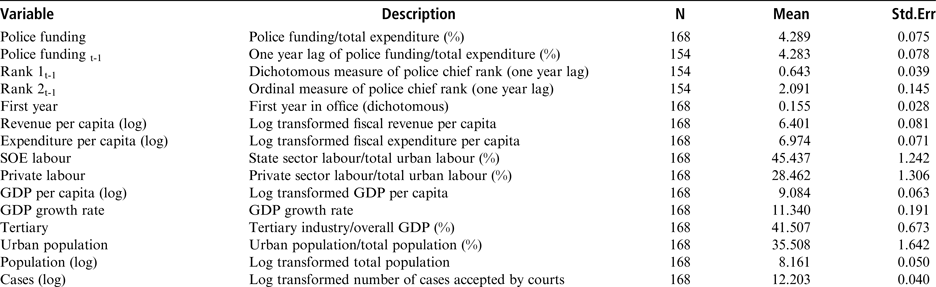
Local statistics on protests are never public. To control for this “demand-side” variable, some proxies are included. The first is the weight of tertiary industry in the overall GDP (“Tertiary”). A significant number of protests in recent years have been labour protests in manufacturing industries.Footnote 46 A higher weight of tertiary industry in the economy means a larger migrant population, higher labour mobility, and an increased likelihood of labour protests. The second proxy is the proportion of urban population in the overall provincial population (“Urban population”). This measures the urban bias of social movement and security work.Footnote 47 I also control for the size of the population (log transformed) in a province (“Population”). Finally, there is a control for the number of cases (log transformed) (including the number of crimes), accepted by courts each year (“Cases”). This measures how contentious the society is in a province in a particular year. Descriptions and summary statistics of all variables are to be found in the Appendix.
Pooled time-series cross-section analysis is used to test the following model:
 $$police\, fundin{g_{i\comma t}} = {\alpha _o} + {\alpha _1}\;Police\, fundin{g_{i\comma t - 1}} + {\beta _1}\, Ran{k_{i\comma t - 1}}\, + {\bi X\beta} + {\lambda _t} + {\varepsilon _{i\comma t}}$$
where α1 is the effect of the lagged dependent variable. A lagged dependent variable is included first to account for the stickiness of the budgetary process, because the budget for the next year is based on the current year's budget. It is also included to eliminate serial correlation of the errors.Footnote 48 β1 is the marginal effect of the independent variables (Rank 1 or Rank 2). Please note that the variable is lagged one year to account for the fact that the budget is made at the end of the previous year. Thus, a police chief who was promoted in 2000 would only have an effect on the budget in 2001. X is a vector of controls; λt is the year “fixed effects,” which include dummy variables for each year that capture the remaining serial variation not explained by the independent variables, such as national policy shift (e.g. yanda 严打). Please note that unit “fixed effects” are excluded in the model because the independent variable is partially time invariant, that is, it does not vary much over time in some provinces (Figure 2). The inclusion of unit dummies makes it impossible to estimate the effect of time invariant exogenous variables and severely biases the estimate of time invariant variables.Footnote 49 Therefore, only one-way fixed effects models are estimated. εi,t is the error term.
The regression analysis is limited to the 14 provinces for which complete information was obtained on the key independent variable: Rank.Footnote 50 The number of observations is 168 (N = 14, T = 12).Footnote 51
Results
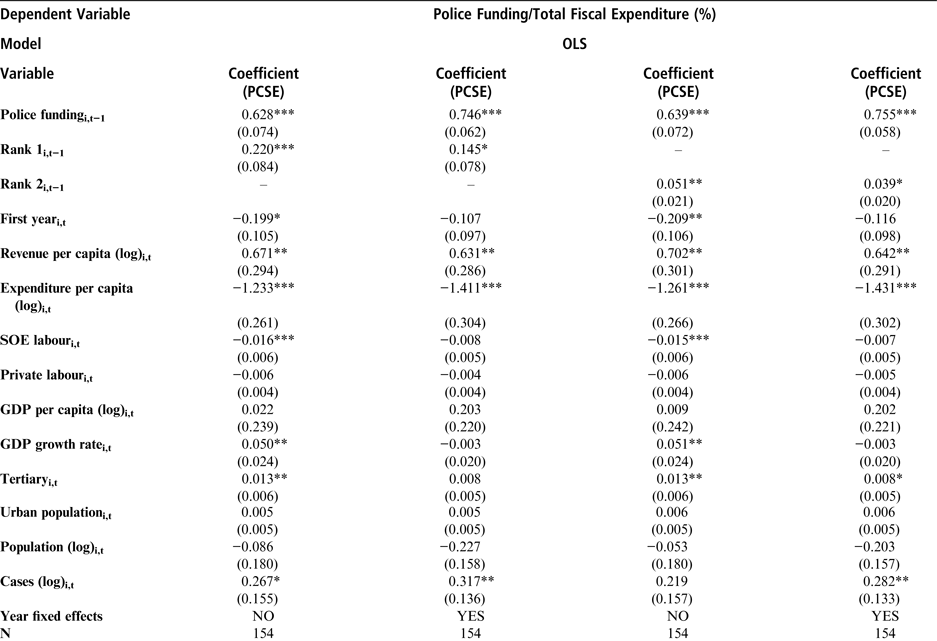
Pooled ordinary least squares (OLS) regressions with panel corrected standard errors (PCSE) are used to estimate Equation (1).Footnote 52Table 3 presents the results.
Determinants of Police Funding (1995–2006)
Notes: *p < 0.1, **p < 0.05, ***p < 0.01.
Columns 1–2 in Table 3 show the regression results with Rank 1 (dichotomous measure) as the independent variable. Column 1 does not include the time “fixed effects,” whereas column 2 does. First, a public security chief's rank measured by a dummy variable indicating whether he or she is in the leadership team makes a big difference in how much funding the police receive. Substantively, a police department with a head who is in the provincial leadership team gets 0.2 per cent more funding in the overall fiscal budget. Using Beijing in 2006 as a benchmark, this means a 259 million yuan difference. After including the year dummies that absorb some serial variations, this effect is still significant.
The same results are shown with the alternative measure of rank. In columns 3–4, the ordinal measure of rank – Rank 2 – also has a significant positive effect on police funding. The effect is also substantial. For example, being promoted from deputy governor to a seat on the provincial CCP standing committee in Guangdong in 2005 would create a 114 million yuan increase in police funding in the whole province. Of course, this number includes increases across all levels within a province, which should not be attributed directly to the promotion of the provincial public security chief, as discussed earlier. This effect also remains significant after controlling for year “fixed effects.” This suggests that not only being in the leadership team matters, but the position also matters: higher positions mean more power, which will bring more funding.
These results support the hypothesis that being in the leadership team has redistributive consequences: public security bureaus that are represented on the leadership team obtain more funding from the provincial governments.
There are also some interesting results from the control variables. First, public security chiefs in their first years do have weaker bargaining power. The variable has a negative effect on police funding. However, the effect fails to show any significance after controlling for year dummies. This is probably because year dummies absorb “too much” serial variation.Footnote 53
In addition, coercive capacity is related to the government's fiscal health. This shows that provincial governments with more per capita fiscal revenue do spend more on the police. However, the effect of per capita expenditure is negative. There is no clear explanation for this, and this is a topic for further research.
The results also show that SOEs are substitutes for the police. If a larger proportion of the urban population is employed in the state sector, the government will spend less on the police. This confirms Walder's argument that SOEs serve as “monitors” of the workforce.Footnote 54 It might also reflect the fact that many protests are organized by laid-off SOE employees.Footnote 55 However, there is no significant effect of private sector employment on police funding. My interpretation is that the “Private labour” variable does not completely capture the population outside the state sector. A notable feature of the labour market in China is informalization, that is, a large proportion of workers are working in the “unregulated private sector.” The share of the informal labour force in the total urban labour force began to increase in the late 1990s, when privatization was first introduced, and reached 40 per cent in 2003.Footnote 56 These workers, however, are not counted in official statistical yearbooks because they or their employers are not officially registered. The rise of informal employment, rather than labour in the official private sector, might explain the rise in police funding. However, owing to data limitations, this hypothesis cannot be tested.
Among the variables measuring economic development, I find that it is not the level but the speed of economic development that matters. This is consistent with Shen and Wang's finding that Chinese citizens are more contentious in those places with higher growth rates because the societies in these places are undergoing profound transformations, and because traditional social networks are collapsing.Footnote 57 In this case, provinces that are growing rapidly have a larger migrant population, higher social mobilization and more unrest. This also echoes Huntington's argument about the positive correlation between development and instability.Footnote 58 But, the effect of the growth rate loses its significance when controlling for year dummies. This, again, is owing to the fact that time “fixed effects” absorb serial variations.
Finally, it is shown that the weight of tertiary industry in the economy has a positive effect on police funding. Again, this confirms the intuition that protests are more likely to happen in manufacturing industries. I also find that the number of court cases matters. As discussed earlier, this is a measure of the contentiousness of the society. However, there are no significant effects of “Urban population” and “Population,” probably because protests happen in both rural (land disputes) and urban areas (labour protests), and the size of the population does not determine the frequency of protests.
Conclusion
This article has shown that the Communist Party in China, in the face of rising challenges from society, has taken deliberate steps to empower its coercive leaders. The Party does this by appointing the public security chiefs to leadership teams at every level of government. By 2009, over 90 per cent of provincial public security chiefs were incorporated into the leadership team. A seat on the leadership team provides the public security chiefs not only with many personal benefits, but also access to higher levels of information and stronger bargaining power.
This article shows that representation on the leadership team has redistributive consequences. Public security bureaus led by leadership team members are able to secure a larger piece of the government budget “pie.” Through both the nomenklatura and fiscal systems, the CCP has attempted to secure the loyalty of its coercive organizations.
However, it is necessary to place a distance between the findings presented here and the argument that links China's regime stability in the last 30 years solely to coercion. It is far more than coercion. The China field has provided a wide spectrum of theories explaining the macro-level stability of the regime, including the CCP's revolutionary tradition and cultural resources,Footnote 59 institutionalization,Footnote 60 the cadre evaluation system,Footnote 61 the media,Footnote 62 nationalism,Footnote 63 the Party's cooptation strategy,Footnote 64 and foreign direct investment.Footnote 65 Here, I argue that coercion is one reason for China's regime durability.
Summary Statistics