In searching for biological correlates of emotional disorders, researchers have found reliable associations between the presence of mood disorders and sometimes anxiety disorders and disturbances of functioning in the hypothalamic–pituitary–adrenal (HPA) axis. For example, many studies have shown both hypercortisolism and lowered feedback sensitivity of the HPA axis to be correlates of moderate to severe major depressive disorder (MDD; see Cowen, Reference Cowen2010; Ehlert, Gaab, & Heinrichs, Reference Ehlert, Gaab and Heinrichs2001; Thase, Reference Thase, Gotlib and Hammen2009, for reviews). Given its role as a stress-sensitive allostatic system, elevations in cortisol, one of the primary products of the HPA axis, are also observed in nonclinical populations in relation to elevations of negative affect within and across days and in response to life stressors (Adam, Hawkley, Kudielka, & Cacioppo, Reference Adam, Hawkley, Kudielka and Cacioppo2006; Jacobs et al., Reference Jacobs, Myin-Germeys, Derom, Delespaul, van Os and Nicolson2007; Peeters, Nicolson, Berkhof, Delespaul, & deVries, Reference Peeters, Nicolson, Berkhof, Delespaul and deVries2003). However, little attention has been given to whether the HPA axis alterations seen in emotional disorders might be accounted for by increased life stress or by the increased levels of negative mood that are part of the phenomenology of emotional disorders. Using an Ecological Momentary Assessment approach in a high school sample of youths at varying risk for the development of emotional disorders, the present study examined whether associations between both past and recent MDD and anxiety disorder diagnoses and HPA axis activity, and between dimensional measures of internalizing symptomatology and HPA axis activity, were accounted for by greater life stress in the prior year and by higher levels of negative emotion experienced by youths on the days of cortisol testing. We further examined whether internalizing symptoms, high levels of life stress, and daily negative emotion were predictive of similar alterations in cortisol among youths without MDD or anxiety disorder diagnoses.
Concurrent Associations Between Cortisol and Internalizing Disorders
Cortisol is one of the primary hormonal products of the HPA axis, one of the body's two major physiological stress systems (Kirschbaum & Hellhammer, Reference Kirschbaum and Hellhammer1989). Normative levels of cortisol are high upon wakening in the morning, increase 50% to 60% in the first 30 to 40 min after wakening (known as the cortisol awakening response [CAR]), decline quickly in the subsequent few hours, and slowly decrease to reach the lowest point near midnight (Adam & Kumari, Reference Adam and Kumari2009; Pruessner et al., Reference Pruessner, Wolf, Hellhammer, Buske-Kirschbaum, von Auer and Jobst1997). There is considerable evidence of associations between depression in adults and disturbances in HPA functioning, including cortisol hypersecretion and diminished negative feedback regulation (Cowen, Reference Cowen2010; Parker, Schatzberg, & Lyons, Reference Parker, Schatzberg and Lyons2003). A recent meta-analysis (Lopez-Duran, Kovacs, & George, Reference Lopez-Duran, Kovacs and George2009) found that across 17 studies examining basal cortisol levels in youths, those who were depressed had higher cortisol levels throughout the day (hypercortisolism) when compared with those who were nondepressed. However, this study did not examine the effect of comorbid disorders that might modify associations between MDD and cortisol. Other studies of nonclinical adolescents found that high levels of cortisol or flatter basal rhythms were associated with internalizing symptoms (Colomina, Canals, Carbajo, & Domingo, Reference Colomina, Canals, Carbajo and Domingo1997; Shirtcliff & Essex, Reference Shirtcliff and Essex2008), which could suggest that alterations in cortisol diurnal rhythms are associated with the full range of internalizing symptoms rather than simply clinical levels of symptomatology.
In terms of anxiety disorders, diurnal cortisol levels were higher in both children and adolescents with posttraumatic stress disorder (PTSD) associated with maltreatment (De Bellis et al., Reference De Bellis, Baum, Birmaher, Keshavan, Eccard and Boring1999) and in subthreshold PTSD (Carrion et al., Reference Carrion, Weems, Ray, Glaser, Hessl and Reiss2002) relative to healthy controls. However, this is contrary to research in adults, which found that PTSD was associated with hypocortisolism (e.g., Yehuda, Southwick, Nussbaum, Giller, & Mason, Reference Yehuda, Southwick, Nussbaum, Giller and Mason1990). Other than PTSD, prior research has not found consistent evidence of links between the HPA axis and anxiety disorders. For example, several studies have found no significant differences in diurnal patterns between adolescent and adult patients with panic disorder or social anxiety disorder and healthy controls (Uhde, Tancer, Gelernter, & Vittone, Reference Uhde, Tancer, Gelernter and Vittone1994; van Veen et al., Reference van Veen, van Vliet, DeRijk, van Pelt, Mertens and Zitman2008). Nonetheless, examining the impact of comorbid anxiety on associations between MDD and cortisol may be important, given that studies of children and adolescents have estimated that approximately 30% of such cases of MDD are comorbid with anxiety disorders (e.g., Costello, Mustillo, Erkanli, Keeler, & Angold, Reference Costello, Mustillo, Erkanli, Keeler and Angold2003). Furthermore, a recent study of adults (Vreeburg et al., Reference Vreeburg, Hoogendijk, van Pelt, de Rijk, Verhagen and van Dyck2009) found altered cortisol rhythms in individuals with comorbid anxiety and depression compared to a nondisordered control group. It is possible that previous studies of anxiety disorders and cortisol in youths have found conflicting associations because they have not accounted for comorbid depression.
Negative Affect and Chronic and Episodic Life Stress
Chronic and episodic life stressors have been linked to the onset and severity of depressive episodes (for a review, see Monroe, Slavich, & Georgiades, Reference Monroe, Slavich, Georgiades, Gotlib and Hammen2009). Recent reviews estimate that almost 70% of depressive episodes are preceded by a stressor (e.g., Hammen, Reference Hammen2005). There is far less research linking life stress and anxiety disorders. It has been hypothesized that uncontrollable or unpredictable life stressors precede the onset of an anxiety disorder such as PTSD, panic disorder, and agoraphobia (for a review, see Barlow, Reference Barlow2002; Mineka & Zinbarg, Reference Mineka, Zinbarg and Hope1996, Reference Mineka and Zinbarg2006).
Negative affect is a core part of the symptomatology of MDD (Clark & Watson, Reference Clark, Watson, Becker and Kleinman1991) and previous studies have found that individuals experiencing a major depressive episode (MDE) have high levels of daily negative affect (e.g., Watson, Clark, et al., Reference Watson, Weber, Assenheimer, Clark, Strauss and McCormick1995). Furthermore, studies have found that highly anxious youths also experience other negative emotions in their daily life such as stress, anger, and sadness (e.g., Henker, Whalen, Jamner, & Delfino, Reference Henker, Whalen, Jamner and Delfino2002).
As noted earlier, both stressful life events and negative mood states have been shown to activate and alter diurnal HPA axis activity, even among individuals without emotional disorders. For example, chronic stress, sadness, loneliness, job stress, anger, and fatigue have all been related to alterations in basal HPA axis diurnal activity and reactivity in nonclinical samples of adolescents and adults in naturalistic settings (Adam, Reference Adam2006; Adam & Gunnar, Reference Adam and Gunnar2001; Doane & Adam, Reference Doane and Adam2010; Steptoe, Owne, Kunz-Ebrecht, & Brydon, Reference Steptoe, Owne, Kunz-Ebrecht and Brydon2004). Furthermore, several theories have posited that activation of the HPA axis may be the pathway through which acute and chronic life stressors contribute to the development of MDD (Ehlert et al., Reference Ehlert, Gaab and Heinrichs2001).
Present Study
The present study examines whether individual differences in life stress or negative emotion experienced on the days of cortisol testing help to account for HPA axis differences in youths with and without MDD and anxiety diagnoses. If the HPA axis alterations observed among individuals with MDD or anxiety disorders are explained by the effects of recent life stress and concurrent negative emotion on cortisol, it suggests the possibility that the HPA axis alterations are a response to the affective experience of the disorder on the days of cortisol testing (more of a “state” effect) rather than being a stable biological property of the disorder or risk for disorder. If recent life stress and negative emotion on the days of cortisol testing do not explain associations between diagnoses and dimensional measures of mood and anxiety disorders and cortisol, that suggests that the HPA axis changes associated with internalizing disorders may be a more stable or traitlike property of the disorder rather than being due to the effects of acute emotional experience and perceived stress on cortisol on the days of cortisol testing. In contrast, an alternative explanation is that daily negative emotion or elevations in life stress are proxies for the vulnerability factors associated with cortisol, such that we may find associations in youths both with and without disorder. While these alternative explanations cannot be fully explored without several years of longitudinal data, in the present study we embarked on an initial exploration.
Data for the current study were collected as part of the larger Youth Emotion Project, a longitudinal study of late adolescence being conducted at Northwestern University and the University of California, Los Angeles (see Zinbarg et al., Reference Zinbarg, Mineka, Craske, Griffith, Sutton and Rose2010). A series of related questions were examined, with the aim of understanding the role of proximal life stress and emotional experience in understanding the associations between mood and anxiety disorders and cortisol. We evaluated which of several HPA axis functioning indices (morning levels of cortisol, evening levels of cortisol, slope of the diurnal rhythm across the waking day, or the CAR) was associated with a recent presence or past history of MDD and anxiety disorders. Within these analyses, we specifically examined comorbidity of MDD and anxiety disorders in addition to the presence of a single disorder. We then tested whether or not dimensional variations in depressive and anxious symptomatology were associated with HPA axis functioning above and beyond clinical diagnoses. Next, we asked whether recent life stress and daily negative emotion on the days of cortisol sampling were related to cortisol rhythms and whether these variables accounted for associations between the presence of emotional disorder and HPA axis changes. We tested these latter associations in youths with and without major depression and anxiety disorders to see whether associations were specific to, or stronger for, youths with emotional disorders.
In summary, the current study examined (a) whether there were individual differences in HPA axis activity based on the presence or history of MDD and anxiety disorders; (b) whether comorbidity of MDD and anxiety disorders was associated with HPA axis activity; (c) whether there were differences in HPA axis activity based on dimensional variations in depressive and anxious symptomatology as opposed to diagnoses of MDD and anxiety disorders; (d) whether associations between psychopathology and cortisol were accounted for by levels of episodic and chronic life stress or daily negative emotion; and (e) whether HPA axis activity associations with internalizing symptoms, life stress, and daily negative emotion are unique to individuals with MDD or anxiety disorders.
Method
Participants
Participants were recruited from two large public high schools, one in suburban Chicago and one in suburban Los Angeles. Students participated in this study as part of a larger investigation of risk for mood and anxiety disorders, called the Youth Emotion Project (see Zinbarg et al., Reference Zinbarg, Mineka, Craske, Griffith, Sutton and Rose2010). Juniors in high school (N = 1,976) were screened and invited to participate in the study based on their scores on the neuroticism scale of the Eysenck Personality Questionnaire—Revised (EPQ-R-N; Eysenck & Eysenck, Reference Eysenck and Eysenck1975). Neuroticism is a known risk factor for the development of mood and anxiety disorders (e.g., Clark, Watson, & Mineka, Reference Clark, Watson and Mineka1994). Students who scored in approximately the upper third on this measure were oversampled (~59% of the total sample) in order to increase the number of students in the sample at high risk for the subsequent development of mood and anxiety disorders. Participants were recruited in three consecutive cohorts. The current study used available data from the first full wave of data collection from all three cohorts. Of the 1,976 students who were screened, 1,269 were invited to participate in the longitudinal study, 668 (53%) consented, and 627 (94% of consented sample) completed the baseline assessment.
Of this full sample, we invited a random subsample of 491 youth participants to participate in the cortisol sampling, and 70% of those invited completed the time-intensive cortisol sampling procedures. In total, 344 (250 females) youths took part in the cortisol measurement portion of the study. Exclusion criteria for the current analyses were use of corticosteroid-based medications, presence of psychotic symptoms or PTSD, provision of insufficient data, or a greater than 4 month delay between psychopathology and cortisol measurements. For one or more of these reasons, 44 youths were excluded from the current analyses, leaving a final sample size of 300 (225 female, 75%). The racial/ethnic distribution of the final analytic sample consisted of participants who were 48% White, 11% African American, 20% Hispanic, 5% Asian or Pacific Islander, and 16% multiple or other ethnicities. Age ranged from 16 to 18 years (M = 17.07, SD = 0.38). In this subsample, 61% were considered high EPQ-R-N scorers, 23% medium EPQ-R-N scorers, and 16% low EPQ-R-N scorers. There were no significant differences by race/ethnicity, gender, or EPQ-R-N scores between the subsample and the full sample.
Procedure
Participants who agreed to take part in the longitudinal study attended an initial session in which they were interviewed for lifetime Axis I psychopathology using the Structured Clinical Interview for DSM-IV-TR Axis I Disorders (SCID; First, Spitzer, Gibbon, & Williams, Reference First, Spitzer, Gibbon and Williams2002) to determine current and past diagnoses of mood and anxiety disorders. They also completed the UCLA Life Stress Interview assessing chronic and episodic stress in the last 12 months (Hammen, Reference Hammen1991; Hammen, Gordon, Burge, & Adrian, Reference Hammen, Gordon, Burge and Adrian1987). In addition to the interviews, participants completed a series of self-report questionnaires including questions about depressive and anxious symptomatology.
Students randomly selected for the cortisol procedures were later contacted by phone and invited to participate in the cortisol portion of the study, which included providing saliva samples and completing diary entries six times a day for 3 consecutive weekdays. We asked participants to avoid atypical days such as days when important exams were taking place, birthdays, or vacations. Participants received $40 for completion of the SCID, Life Stress Interview, and self-report questionnaires, and $10 for completion of the cortisol portion of the study. Participants completed the cortisol assessment approximately 1.5 months (M = 46 days, SD = 35) following the diagnostic and life stress assessments.Footnote 1
Diary reports and saliva sampling
This study used Ecological Momentary Assessment (Stone & Shiffman, Reference Stone and Shiffman1994), which involved diary reports of where they were, who they were with, and what they were thinking and feeling, six times per day when scheduled to do so and when prompted to do so by a preprogrammed watch. We also asked adolescents to provide samples of saliva immediately after each diary report, to examine HPA activity in relation to everyday events.
Participants received a study packet that included a programmed digital wristwatch, three diary booklets, and straws and 18 vials for saliva sampling. A research assistant explained the study procedures to the participants by phone. Participants also received a reminder call the night before they were to start during which procedures were reviewed and any remaining questions were answered. Participants were asked to complete a diary form and provide a saliva sample immediately after they woke up, 40 min later, at bed time, and three other times throughout the day when signaled by the preprogrammed watch. In the morning, participants provided a saliva sample first and then provided a diary report. Forty minutes after waking, at bedtime, and at the three semirandom beeps throughout the day, the participants first completed their diary report and then provided the saliva sample. The midday samples, signaled by the watch, occurred at approximately 3, 8, and 12 hr after participants' typical wake-up times so as to avoid meal times. These beeps were set to vary from day to day around the above-mentioned times (within ±30 min) so that the exact timing of the signal would not be anticipated by participants.
Measures
Cortisol
Salivary cortisol was collected by passive drool. Each participant expelled saliva through a straw into a sterile vial. They then labeled the vial with the time and date of sampling and placed it into a sealable plastic bag, which was returned via a school drop box or the mail (United States Postal Service). Once returned to the laboratory, samples were refrigerated at –20°C until they were sent by courier to Biochemisches Labor at the University of Trier in Germany to be assayed. Prior research has indicated that cortisol values are not significantly affected by transport over a period of several days without refrigeration (Clements & Parker, Reference Clements and Parker1998). Samples were assayed in duplicate, using a solid phase time-resolved fluorescence immunoassay with fluorometric endpoint detection, which is called dissociation-enhanced lanthanide fluorescent immunoassay. Fluorescence was detected using a dissociation-enhanced lanthanide fluorescent immunoassay fluorometer (Dressendorfer, Kirschbaum, Rohde, Stahl, & Strasburger, Reference Dressendorfer, Kirschbaum, Rohde, Stahl and Strasburger1992). The intraassay coefficient of variation for this assay is between 4.0% and 6.7%, and the interassay coefficients of variation are between 7.1% and 9.0%. Cortisol values were transformed using the natural log transformation to correct for a strong positive skew in the distribution. Cortisol values were also windsorized at 1.81 µg/dl (equivalent to 50 nmol/l; Nicolson, Reference Nicolson, Luecken and Gallo2008).
We calculated and evaluated four measures of cortisol activity across the day: the slope from wake up to bedtime (excluding the cortisol awakening response), the size of the CAR, waking levels, and bedtime levels. The slope was calculated by regressing the log transformed cortisol values for each participant on the time of day that samples were collected, excluding the second sample of the day (CAR, collected 40 min after waking). The CAR was determined by taking the difference between the log transformed cortisol wake-up sample from the log transformed second sample (40 min later).
Diary emotion variables
Participants were asked to indicate how much they felt each of the following mood states when they were beeped: happy, tired, friendly, cooperative, nervous, lonely, sleepy, active, frustrated, caring, worried, relaxed, irritable, stressed, sad, and cheerful. Each mood state was rated on a scale of 0 (not at all) to 3 (very much). The mood states were subjected to a principal axis factor analysis, using an oblimin rotation. Parallel analysis (Patil et al., Reference Patil, Singh, Mishra and Donavan2007) using randomly generated data suggested three factors for which the random eigenvalues generated were lower than the corresponding eigenvalues using the actual data. Three factors were identified: Positive–Social (Cronbach α = 0.86), Nervous–Stress (α = 0.83), and Sad–Lonely (α = 0.78).Footnote 2 All items that met criteria for inclusion were standardized and averaged together to calculate the scale score at the momentary (just prior to each cortisol sample), daily (average across each day of cortisol measurement), and person (average across all momentary reports across all days of cortisol measurement) levels of analysis.
Diagnostic assessment
During the initial assessment period, the SCID was administered to assess current and lifetime psychiatric diagnoses. A subset (n = 69) of the interviews were coded by a second interviewer who observed the interview and asked clarification questions if needed. When all disorders were aggregated, the κ values were on average 0.82 (see Zinbarg, Reference Zinbarg, Mineka, Craske, Griffith, Sutton and Rose2010). In the current analysis, we focused on current and past clinical major depression (MDD) and anxiety disorders. We only selected youths who were experiencing or had experienced a past MDE (but not dysthymia, minor depressive disorder, or depressive disorder not otherwise specified [NOS]) and/or anxiety disorders (panic disorder with or without agoraphobia, social phobia, and generalized anxiety disorder; but not specific phobia as consistent with prior literature; e.g., Vreeburg et al., Reference Vreeburg, Hoogendijk, van Pelt, de Rijk, Verhagen and van Dyck2009).Footnote 3 Youths were classified as having a disorder in the past or having it recently (currently or within the last 3 months).Footnote 4 We also included several covariates to represent the presence of dysthymia, minor depressive disorder, and depressive disorder NOS or lifetime diagnosis of bipolar disorder I and II (including NOS) to ensure that results were not due to the presence of these comorbid disorders.
Chronic and episodic life stress
The initial assessment included the UCLA Life Stress Interview (Hammen, Reference Hammen1991; Hammen et al., Reference Hammen, Gordon, Burge and Adrian1987) for chronic and episodic life stress. Chronic stress was assessed over the past year in 10 different domains. Each domain was rated in half-point intervals by the interviewer on a 5-point scale that indicated the severity of chronic stress in that domain, with 1 indicating optimal functioning or minimal stress in the domain and 5 indicating very stressful circumstances with specific behavioral anchors for each point on the scale. To determine chronic life stress scores, the interviewer used general probes to elicit relevant objective information. For the present study, we used the four chronic interpersonal stress domains, which were romantic relationships, close friendships, social group relations, and relationships with family members, given that prior research with the Youth Emotion Project sample has indicated that chronic interpersonal life stress is associated with depression (Uliaszek et al., Reference Uliaszek, Zinbarg, Mineka, Craske, Sutton and Griffith2010). Baseline reliability for chronic stress for the present study, completed at both sites, was assessed by rating 76 intersite and intrasite audiotaped interviews. Intraclass correlation coefficients (ICCs; 2.2) ranged from 0.57 to 0.91 for each domain, and averaged 0.73 across all domains. The ICC (2.2) for the interpersonal domain was 0.71.
Episodic life stress was also assessed during the interview. Youths were asked to report if there were particular stressful events that happened in the last year that were out of the ordinary. Interviewers obtained detailed information regarding the nature and circumstances of the event, including the duration of the event, consequences of the event, and whether the event was expected or not. These events were then presented to a blind team of reviewers who assessed the severity of impact on the participant that ranged from 1 (little to no impact) to 5 (extremely severe impact), as well as the independence of the event, ranging from 1 (completely independent of the actions of the participant) to 5 (completely dependent on the participant). Examples of events ranged from a close family member passing away, to breaking up with a significant other, a major argument with a parent, moving to college, or an academic failure. In order to obtain a sense of the total episodic stress in a participant's life, for each participant, we summed the severities of events with a severity of 2.5 or higher (2 = mild severity, 3 = moderate severity).Footnote 5 The ICC (2.2) for the severity of the event was 0.84 and the ICC (2.2) for the independence of the event was 0.90.
Self-reported symptoms of depression and anxiety
Participants completed comprehensive questionnaires at each time point to assess dimensional measures of anxiety and depressive symptoms. The Mood and Anxiety Symptom Questionnaire (MASQ; Watson, Clark, et al., Reference Watson, Clark, Weber, Assenheimer, Strauss and McCormick1995) consists of 90 items that the participant rates on a 5-point scale scale (1 = not at all, 5 = extremely). This analysis focused on three of the five subscales from the MASQ (Watson, Clark, et al., Reference Watson, Clark, Weber, Assenheimer, Strauss and McCormick1995) following Watson and Clark's (Reference Clark, Watson, Becker and Kleinman1991) tripartite model: general distress mixed, anxious arousal, and anhedonic depression. In this study, all three scales had good internal consistency (α > 0.84), which mirrors work in other adolescent and adult samples (Watson, Weber, et al. Reference Watson, Weber, Assenheimer, Clark, Strauss and McCormick1995).
Neuroticism composite
Given prior research with this sample that found associations between neuroticism and cortisol (Hauner et al., 2008) and that neuroticism was used in our recruitment and sampling strategy, we included it as a covariate in all models. The neuroticism questionnaires used were the International Personality Item Pool-NEO-PI Revised (Goldberg, Reference Goldberg1992), the Behavioral Inhibition Scale (Carver & White, Reference Carver and White1994), and the Big Five Mini-Markers neuroticism scale (Saucier, Reference Saucier1994). In this study, we used a composite measure that was composed of the measures listed above, as well as the EPQ-R-N (Eysenck & Eysenck, Reference Eysenck and Eysenck1975), which was administered only once for screening purposes. We calculated the composite by standardizing each scale and then averaging them. The Cronbach alpha for the neuroticism composite was 0.85.
Health covariates
Participants completed a health questionnaire at the time of cortisol assessment. This questionnaire included questions regarding the participant's health history and habits. Specifically, it asked about caffeine, alcohol, and nicotine consumption; exercise habits; self-reported medical conditions such as asthma or allergies; typical waking and bedtimes; and medication use (both prescription and nonprescription). As noted above, current use of steroid-based medications was used as exclusion criteria. Given that past research has found many health variables are associated with cortisol measures, we used the remainder of the health variables noted here as covariates (Adam & Kumari, Reference Adam and Kumari2009). Finally, we included a variable representing the average time between the first and second sample of the day as well as a variable indicating the percentage of samples completed by each participant as covariates for general compliance with study protocol.
Data analysis
Descriptive statistics and bivariate correlations were examined for dependent and independent variables. All independent variables were standardized before analysis. The associations among cortisol, diagnoses of MDD and anxiety disorders, dimensional measures of depressive and anxious symptomatology, and daily emotion and life stress were tested using hierarchical linear modeling (Bryk & Raudenbush, Reference Bryk and Raudenbush1992). In these growth models, level of cortisol for each person at each moment was regressed on time of day as well as time-varying predictors (changing from moment to moment, included in Level 1 of the model). Stable predictors (constant across all moments, included at Level 3) and day-level predictors (constant across all moments within each day and included at Level 2) were included to predict the Level 1 coefficients. Analyses of variance were used to explore individual differences in life stress and daily emotions within the disorder groups.
Models
We first analyzed the within-person, within-day basal cortisol rhythm. A time variable indicating how long since waking the sample was given (the growth parameter), a time since waking squared variable to capture the quadratic curvilinear components of change in cortisol across the day, and a dummy variable representing the CAR were all included at Level 1. We then included youth-level demographic covariates (age, race, and gender) and health covariates (as detailed above) at Level 3 to assess whether they influenced slope across the waking day or the CAR. No predictors were included for the quadratic term. Next, past and recent psychopathologyFootnote 6 (MDD and anxiety disorders) were included at Level 3 to evaluate whether they were related to morning levels, the size of the CAR, or the cortisol slopes across the day. In these models we also included neuroticism as a covariate. In a second model, indicators of depressive and anxious symptomatology were entered into the model at Level 3. In Model 3 we included chronic interpersonal stress and episodic stress over the past year to understand whether or not it was associated with cortisol independently from past or recent psychopathology. In a final and fourth model we included momentary emotion (just before each cortisol sample and at Level 1), day-specific emotion factors (at Level 2), and average daily emotion factors across the 3 days of sampling (at Level 3). The final model was specified by the equations. For Level 1,
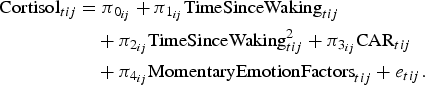 $$\eqalign{ \hbox{Cortisol}_{tij}&={\rm\pi}_{0_{ij}}+{\rm\pi}_{1_{ij}}\hbox{TimeSinceWaking}_{tij}\cr & \quad +{\rm\pi}_{2_{ij}} \hbox{TimeSinceWaking}^2_{tij}+{\rm\pi}_{3_{ij}}\hbox{CAR}_{tij}\cr & \quad +{\rm\pi}_{4_{ij}}\hbox{MomentaryEmotionFactors}_{tij}+e_{tij}.}$$
For Level 2,
 $$\eqalign{ {\rm\pi}_{0_{i}}\!-\!{\rm\pi}_{4_{i}}&={\rm \beta}_{00}+{\rm \beta}_{01}\!\hbox{Waketime}_{0_{ij}}\cr & \quad +{\rm \beta}_{02}\hbox{Day-SpecificEmotionFactors}_{0_{ij}}+{\rm \rho}_{0_{i}}.}$$
For Level 3,
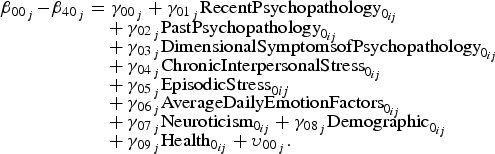 $$\!\eqalign{ {\rm \beta}_{00_{\,j}}\!-\! {\rm \beta}_{40_{\,j}}&={\rm \gamma}_{00_{\,j}}+{\rm \gamma}_{01_{\,j}}\hbox{RecentPsychopathology}_{0_{ij}} \cr & \quad +{\rm \gamma}_{02_{\,j}} \hbox{PastPsychopathology}_{0_{ij}}\cr & \quad +{\rm \gamma}_{03_{\,j}} \hbox{DimensionalSymptomsofPsychopathology}_{0_{ij}}\cr & \quad +{\rm \gamma}_{04_{\,j}} \hbox{ChronicInterpersonalStress}_{0_{ij}} \cr & \quad +{\rm \gamma}_{05_{\,j}} \hbox{EpisodicStress}_{0ij}\cr & \quad +{\rm \gamma}_{06_{\,j}}\hbox{AverageDailyEmotionFactors}_{0_{ij}} \cr & \quad +{\rm \gamma}_{07_{\,j}}\hbox{Neuroticism}_{0_{ij}}+{\rm \gamma}_{08_{\,j}}\hbox{Demographic}_{0_{ij}}\cr & \quad +{\rm \gamma}_{09_{\,j}} \hbox{Health}_{0_{ij}}+\upsilon_{00_{\,j}}.}$$
Results
Descriptive statistics
Psychopathology
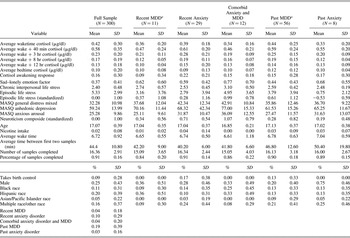
In this sample (N = 300), 54 (18%) youths had a MDE in the past but did not meet criteria at baseline assessment, 9 (4%) had recently (within 3 months of the cortisol assessment) met criteria for MDD but had not experienced a previous episode and did not also have an anxiety disorder, and 2 (1%) had experienced at least one past episode and met criteria at the baseline assessment as well,Footnote 7 for a total of 65 lifetime cases of unipolar MDD. Eight (3%) participants had a past diagnosis of an anxiety disorder but did not meet criteria at baseline, and 29 (10%) met criteria for certain anxiety disorders (panic disorder with or without agoraphobia, social phobia, and generalized anxiety disorder) at baseline and did not have comorbid MDD, for a total of 37 lifetime anxiety disorder cases. Twelve (4%) participants had recent comorbid anxiety disorders and MDD disorders (within the past 3 months). Table 1 provides descriptive statistics on all dependent and independent variables by diagnostic group.
Descriptive statistics (N = 300)

Note: Raw cortisol values (μg/dl) are presented for descriptive purposes but log transformed values are used in all analyses. MASQ, Mood and Anxiety Symptom Questionnaire (Watson et al., Reference Watson, Clark, Weber, Assenheimer, Strauss and McCormick1995a); MDD, major depressive disorder.
aTwo youth are included in both recent MDD as well as past MDD because they were recurrent cases.
MASQ symptoms of depression and anxiety
The mean level of the MASQ general distress mixed for the full analytic sample was 32.28 (SD = 10.98). The mean level of MASQ anhedonic depression was 59.24 (SD = 13.99), and the mean level for MASQ anxious arousal was 25.28 (SD = 9.86). There were no significant differences by age or by gender; however, there were a few differences by race/ethnicity. African American and multiple/other race youths reported higher levels of MASQ anxious arousal than their White counterparts (African American: F = 4.36, p < .05; multiple/other: F = 4.30, p < .05).
Chronic and episodic life stress
Averaging across the four interpersonal domains, the mean level for the past year of chronic interpersonal stress in the full analytic sample was 2.40 (SD = 0.48), and there were no significant differences by age or gender. African American youths reported more chronic interpersonal life stress over the last year as compared to White youths (F = 5.11, p < .05); however, there were no other differences by race/ethnicity. The average for episodic life stress was 5.33 (SD = 3.00); this was computed for all events with a severity at or above 2.5 (2 = mild severity, 3 = moderate severity) and was the sum of the severities of all of those events. There were no significant differences by age, gender, or race/ethnicity on this indicator.
Average daily emotion
There were no differences by age in average experiences of daily emotion on the days of cortisol sampling and few differences by gender or race/ethnicity. Hispanic youths reported lower levels of nervous–stress than their White counterparts (Cohen d = 0.42; F = 8.00, p < .01) and males reported lower levels of nervous–stress than females (Cohen d = 0.41; F = 6.11, p < .05).
Intercorrelations among independent variables and cortisol
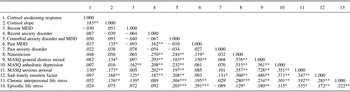
Past episodes of MDD were associated with flatter cortisol slopes (r = .14, p < .05), whereas recent MDD and recent comorbid MDD and anxiety disorders were not significantly associated with cortisol slopes (r = .05, p < .25; r = .09, p < .25). Several dimensional measures of depressive and anxious symptomatology were associated with cortisol (Table 2). The MASQ general distress mixed was associated with flatter cortisol slopes (r = .13, p < .05), and anxious arousal was associated with a greater CAR (r = .13, p < .05), as well as flatter cortisol slopes (r = .18, p < .05). Average feelings of sad–lonely on the days of cortisol testing were associated with flatter cortisol slopes (r = .17, p < .05), and chronic interpersonal life stress was associated with flatter cortisol slopes (r = .18, p < .05).
Intercorrelations of main independent variables, covariates, and dependent variable (N = 300)
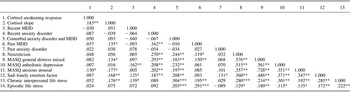
Note: MDD, major depressive disorder; MASQ, Mood and Anxiety Symptom Questionnaire (Watson et al., Reference Watson, Clark, Weber, Assenheimer, Strauss and McCormick1995a).
* p < .05. **p < .01. ***p < .001.
Cortisol diurnal rhythm and variation within and across youth
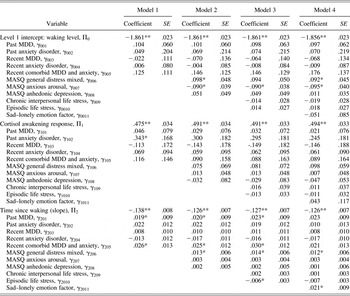
The first model (Table 3) illustrates the average daily rhythm. The intercept, Π00, is –1.861 and represents the average wake-up level of cortisol (log cortisol), which corresponds to 0.155 µg/dl in raw cortisol. The CAR was significant and positive (Π10 = 0.475, p < .01), indicating that on average youths experienced about a 60.8%Footnote 8 increase in cortisol levels in the 40 min after waking. Finally, the time of day was negatively and significantly related to cortisol (Π20 = 0.138, p < .01), indicating that at wake-up youths experienced a 14.8% decrease per hour on average.Footnote 9
Cortisol predicted by psychopathology, life stress, and daily emotion (N = 300)
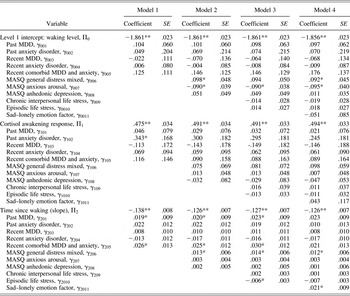
Note: MDD, major depressive disorder; MASQ, Mood and Anxiety Symptom Questionnaire (Watson et al., Reference Watson, Clark, Weber, Assenheimer, Strauss and McCormick1995a). In Model 4 also controlling for emotion factors (positive-social, sad-lonely and nervous-stress at Level 1, Level 2 and Level 3. In all models also controlling for time since waking, race, gender, nicotine, waketime on days of testing (Level 2), percentage of time spent alone, age, birth contol use, time between interview assessment and cortisol assessment, percentage of samples completed, presence of other mood disorder in the past and in the present, and neuroticism.
*p < .05. **p < .01.
Cortisol parameters, health, and demographic covariates
Health and demographic covariates were also included in the model (results not shown in Table 3). Male gender was associated with lower wake-up levels of cortisol (γ0012 = –0.25, p < .01) and smaller CARs (γ1012 = –0.26, p < .01). African American race (γ2013 = 0.03, p < .01) was associated with flatter slopes across the waking day. This follows prior research (Cohen et al., Reference Cohen, Schwartz, Epel, Kirschbaum, Sidney and Seeman2006; see also DeSantis et al., Reference DeSantis, Adam, Doane, Mineka, Zinbarg and Craske2007, from this same study), which has shown that African Americans have flatter cortisol slopes across the day. Taking birth control was associated with higher wake-up levels of cortisol (γ0016 = 0.23, p < .01).
Multivariate associations between cortisol and psychopathology (Research Questions A, B, and C)
As shown in Table 3, Model 1, initial analyses indicated that both current and past MDD and anxiety disorders were associated with alterations in patterns of cortisol activity across the day. On average, the diurnal slopes across the day are negative, such that a positive coefficient is indicative of “flatter” slopes, while a negative coefficient indicates steeper slopes. Participants who had a past diagnosis of MDD (N = 56) had significantly flatter slopes across the waking day (γ201 = 0.019, p < .05), about 2% flatter than youths without an MDD or anxiety disorder. Youths with a recent diagnosis of comorbid anxiety disorders and MDD also had significantly flatter slopes across the waking day (γ205 = 0.026, p < .05), about 2.6% flatter than youths without a history of MDD or an anxiety disorder. Youths with a remitted anxiety disorder had significantly greater CARs than youths without MDD or an anxiety disorder (γ102 = 0.343, p < .05); however, there were no differences in the CAR by any other diagnostic group. There was also no indication that youths with recent or past MDD or anxiety disorders had higher wake-up cortisol levels. There were no significant associations among neuroticism and cortisol waking levels, CAR, or slope across the waking day.
Three-dimensional measures of mood and anxiety disorders (MASQ general distress mixed, anhedonic depression, and anxious arousal subscales) were next entered into the model (see Table 3, Model 2). Youths with 1 SD higher levels of general distress had higher levels of cortisol at waking (γ006 = 0.098, p < .05), while youths who had 1 SD higher levels of anxious arousal had lower levels of cortisol at waking (γ007 = –0.090, p < .05). However, youths with 1 SD higher levels of general distress had flatter cortisol slopes across the day (γ206 = 0.013, p < .05) independent of their diagnostic status. There were not significant differences in cortisol based on levels of anhedonic depression. The inclusion of these variables did not alter the associations between past MDD or recent comorbid MDD and anxiety and cortisol. In this model, the association between remitted anxiety disorder and the CAR (γ102 = 0.300, p < .10) was no longer significant.
Life stress and daily emotion (Research Question D)
To examine whether differences in cortisol by diagnostic group may potentially be accounted for by differences in recent life experiences or levels of emotions of participants with these disorders, a one-way analysis of variance was used to test whether the participants with past MDD and those experiencing recent comorbid MDD and anxiety also experienced differences in daily emotion on the days of cortisol testing and/or greater levels of episodic and chronic stress. Results indicated that youths with recent comorbid disorders did not differ from youths without those disorders in their levels of feeling positive–social or nervous–stressed. However, they did experience significantly more feelings of sad–lonely (Cohen d = 1.09, F = 13.47, p < .01), significantly more chronic life stress (d = 1.63, F = 30.36, p < .01), and significantly more episodic life stress over the past year (d = 1.06, F = 12.83, p < .01). Youths who had a past diagnosis of MDD did not significantly differ from other youths in levels of daily emotion on any of the mood state factors, but they did experience significantly greater levels of chronic life stress (d = 0.51, F = 11.79, p < .01) and episodic life stress (d = 0.78, F = 25.50, p < .01) as compared to their counterparts without a disorder. Finally, youths with a remitted anxiety disorder (n = 8) experienced higher levels of feeling sad–lonely (d = 0.82, F = 5.19, p < .05) as compared with youths without a disorder.
Indicators of recent chronic and episodic life stress and momentary and average daily emotion on the days of testing were entered next into the hierarchical linear models (Table 3, Models 3 and 4) to formally test whether these variables were independently associated with cortisol. Entering chronic and episodic life stress (Table 3, Model 2) into the model did not substantially change the associations between the past and recent MDD and anxiety disorders measures and cortisol, and there was only one multivariate association between chronic and episodic life stress and cortisol. Youths who experienced 1 SD greater episodic life stress had steeper cortisol slopes (γ2010 = –0.006, p < .05). In contrast, when the emotion factors were included in the model at the momentary, daily, and person level of analysis (Table 3, Model 3), average feelings of sad–lonely across the 3 days was independently associated with cortisol slopes. Youths who experienced 1 SD higher average feelings of sad–lonely across the days of cortisol testing had significantly flatter slopes across the waking day (γ2011 = 0.021, p < .05), about 2.2% flatter slopes as compared to youths on average. Inclusion of this variable did not alter the associations between the past MDD and cortisol; however, the size of the association between recent comorbid anxiety disorders and MDD and cortisol slopes was reduced substantially (γ205 = 0.021, p > .10). In this final set of analyses, general distress was also associated with flatter slopes across the waking day (γ206 = 0.012, p < .05). In this analysis, none of the momentary or daily within-person changes in emotion were significantly associated with cortisol.
General distress and sad–lonely in individuals without MDD and anxiety disorders (Research Question E)
To test whether the associations among general distress and average experiences of sadness and loneliness and cortisol were present for youths who had never experienced an internalizing disorder, we ran our final model as outlined above (Model 4) in our sample of youths without past MDD, past anxiety disorder, recent comorbid anxiety and MDD, or recent MDD or recent anxiety disorder (N = 186). The results indicated that MASQ general distress was still associated with flatter cortisol slopes across the day (γ206 = 0.017, p < .01). Average daily experiences of sad–lonely were no longer significantly associated with flatter cortisol slopes across the day (γ2011 = 0.023, p = .12), but momentary experiences of feeling sad–lonely were associated with momentary increases in cortisol (γ600 = 0.043, p < .05) in the subsample of youths without a history of internalizing disorders.
Discussion
The results of this study illustrate the importance of examining the role of dimensional variation in internalizing symptomatology, emotions, and life stress at the time of cortisol measurement in understanding the associations between diagnoses of psychopathology and HPA axis activity. We found that cortisol diurnal activity was associated with both recent and past psychopathology. Although we did not find multivariate associations between life stress and cortisol, we found that negative emotions experienced on the days of cortisol testing, specifically higher feelings of sadness and loneliness, were associated with flatter diurnal cortisol rhythms. When sadness and loneliness were included in multivariate models, the associations between recent comorbid MDD and anxiety and cortisol was no longer evident. In addition, we found that higher levels of general distress, a dimensional measure of internalizing psychopathology, was associated with higher waking levels of cortisol and flatter diurnal cortisol rhythms. Furthermore, the associations between flatter slopes and general distress were found not only in the full sample but also in youths without a history of internalizing disorders. This underscores the importance of investigating associations between a continuum of psychopathology and cortisol, not just clinical diagnoses.
Prior cross-sectional research relating cortisol to major depression in adolescents found that lower morning values, elevated evening values, and flatter cortisol slopes across the waking day were associated with the presence of MDD (for review and meta-analysis, see Lopez-Duran et al., Reference Lopez-Duran, Kovacs and George2009). The results in the current study replicated and extended Lopez-Duran et al.'s conclusions. Although youths with recent MDD only (without comorbid anxiety) did not display altered cortisol activity, youths with recent comorbid MDD and anxiety did have significantly flatter slopes across the waking day. Furthermore, youths who had experienced MDD in the past (but not at baseline) also had flatter cortisol slopes across the waking day.
We found limited evidence of associations among anxiety disorders and basal cortisol levels. Although our results indicated that youths with a remitted anxiety disorder had significantly greater CARs than youths without a disorder, we must caution that this is inconsistent with some prior research, and therefore these findings should be replicated with larger samples. We did not find associations between a current anxiety disorder (without comorbid depression) and cortisol basal rhythms. These findings are similar to those from studies using adult samples (Uhde et al., Reference Uhde, Tancer, Gelernter and Vittone1994; van Veen et al., Reference van Veen, van Vliet, DeRijk, van Pelt, Mertens and Zitman2008). In contrast, another recent study of adults (Vreeburg et al., Reference Vreeburg, Hoogendijk, van Pelt, de Rijk, Verhagen and van Dyck2009) did find altered cortisol rhythms in individuals with comorbid anxiety and depression compared with a nondisordered control group. It is possible that previous studies of anxiety disorders and cortisol in youths have shown mixed results because they have not accounted for and examined comorbid depression.
Beyond finding associations between psychopathology and cortisol, we also found associations among general distress, recent chronic life stress and emotion on the days of cortisol testing, and cortisol diurnal rhythms. Prior research with adolescents has demonstrated links between cortisol and negative mood, ranging from nervousness and anger to sadness and loneliness (e.g., Adam, Reference Adam2006; Doane & Adam, Reference Doane and Adam2010), and research with adults has illustrated associations between life stress and cortisol in naturalistic settings (Adam & Gunnar, Reference Adam and Gunnar2001; Gerritsen et al., Reference Gerritsen, Geerlings, Beekman, Deeg, Penninx and Comijs2010). Although we did not find significant associations between episodic life stress and cortisol, we did find significant univariate associations between chronic interpersonal life stress and flatter cortisol slopes and lower waking levels of cortisol, which is consistent with prior research showing that chronic stress is associated with altered basal rhythms of cortisol (for a meta-analysis and review, see Miller, Chen, & Zhou, Reference Miller, Chen and Zhou2007). However, there were no significant associations between chronic interpersonal life stress and cortisol in multivariate analyses, suggesting that other variables in the multivariate model, such as negative emotion on the days of cortisol testing, may help account for associations between chronic life stress and flatter cortisol diurnal rhythms.
We also found that both feelings of general distress (a dimensional measure of internalizing psychopathology) and average feelings of sadness/loneliness on the days of cortisol testing were significantly associated with flatter slopes in both univariate and multivariate analyses. Levels of general distress were also associated with higher waking levels of cortisol. Although there is much work showing that negative emotion states in the form of anger, tension, nervousness, and perceived stress impact momentary cortisol reactivity (Peeters et al., Reference Peeters, Nicolson, Berkhof, Delespaul and deVries2003; van Eck, Berkhof, Nicolson, & Sulon, Reference van Eck, Berkhof, Nicolson and Sulon1996), the current study provides evidence of altered cortisol levels over a longer time course, with high average levels of negative emotion predicting alterations of the rhythm across 3 days. These results are similar to those in another study by Adam et al. (Reference Adam, Hawkley, Kudielka and Cacioppo2006), where higher daily levels of tension/anger were associated with flatter diurnal cortisol slopes. Although there is inconsistency within the literature regarding which negative emotion is the “active ingredient” in predicting alterations in cortisol, this study and others conducted on adolescent samples (e.g., Doane & Adam, Reference Doane and Adam2010; Matias, Nicolson, & Friere, Reference Matias, Nicolson and Friere2011) seem to implicate feelings of solitude or sadness and loneliness as a potent predictor.
It is interesting that, in follow-up analyses on a subsample of youths without a history of internalizing disorders, momentary experiences or within-person changes of sadness and loneliness predicted momentary increases in cortisol, rather than the longer time course over the 3 days that predicted flatter cortisol slopes in the full sample. This is consistent with prior work with adolescents and adults, which demonstrated more acute or momentary cortisol increases in response to emotions (e.g., Adam, Reference Adam2006). Perhaps in those with a history of internalizing disorders, this more subtle or acute allostatic regulatory mechanism is less responsive and has been replaced by a more chronic compensatory adaptation of the HPA axis like an overall flattening of the diurnal rhythm. Additional research contrasting HPA axis activity in response to everyday life experiences in those with and without a history of disorder is needed to confirm this hypothesis.
Explaining associations between MDD and anxiety disorders and cortisol rhythms
Individuals with recent and past MDD and anxiety disorders had higher levels of life stress and higher negative emotion across the days of cortisol testing. How do these experiences and emotional states at the time of cortisol measurement relate to the psychopathology–cortisol associations? Our results suggest that, in the case of recent comorbid mood and anxiety disorders, feelings of sadness/loneliness may be a proximal indicator of comorbid MDD and anxiety disorders and cortisol slopes. Given that feelings of sadness and loneliness are part of the phenomenology and symptomatology of MDD, we hypothesize that the experienced affective symptoms of the disorder are involved in the flattening of cortisol slopes among individuals with comorbid MDD and anxiety disorders.
The hypothesis that negative affect is the important ingredient that contributes to flattened cortisol rhythms is further supported by the fact that general distress, a dimensional measure of internalizing psychopathology, is associated with flatter diurnal rhythms even among those without a clinical mood or anxiety disorder. Thus, we are capturing associations between negative mood states and cortisol rhythms along a continuum of internalizing symptoms ranging from daily emotions of sadness and loneliness or dimensional variation in levels of general distress to clinical diagnoses of mood and anxiety disorders. That recent comorbid MDD and anxiety disorders predicted flatter diurnal rhythms in the current study, when noncomorbid recent diagnoses did not, may be explained by the individuals with current comorbid diagnoses having higher levels of loneliness and sadness than those with only mood, or only anxiety, disorders.
Including negative emotions on the days of cortisol testing, dimensional variations in internalizing psychopathology, and levels of episodic and chronic life stress into our models did not alter the associations between past MDD and flatter diurnal cortisol rhythms. Flatter slopes after the offset of MDD may therefore represent a form of biological embedding; a biological “scar” that results from the past experience of a MDE (e.g., Bhagawar & Cowen, Reference Bhagwagar and Cowen2008). This is in contrast to research on adults with remitted MDD that finds a normalization of cortisol functioning after successful treatment (e.g., Hennings et al., Reference Hennings, Owashi, Binder, Horstmann, Menke and Kloiber2008; Tafet & Bernardini, Reference Tafet and Bernardini2003; for meta-analysis see McKay & Zakzanis, Reference McKay and Zakzanis2010). However, research on the role of treatment for MDD and cortisol has been conducted on adult populations rather than adolescents and has focused on cortisol reactivity to stressors or the dexamethasone/corticotropin-releasing hormone suppression tests, rather than daily diurnal rhythms of cortisol; future research should clarify whether normalization of rhythms also fail to occur in remitted adults or whether this effect is specific to adolescent populations. Alternatively, given recent evidence that certain genotypes moderate the prospective associations between HPA axis activity and major depression (Goodyer, Bacon, Ban, Croudace, & Herbert, Reference Goodyer, Bacon, Ban, Croudace and Herbert2009), we cannot rule out the possibility that alterations in HPA axis activity might actually be a trait marker or “liability toward distress” that is associated with flatter cortisol rhythms across the day that predisposes individuals to both MDD and greater negative emotions.
Future research should also examine whether the extent, timing, or duration of past exposure matters for the degree of alteration in cortisol rhythms observed. This discrepancy between present and past disorder associations with cortisol highlights the great need for future prospective longitudinal research examining changes in cortisol activity in relation to onsets and offsets of disorder.
Limitations and future directions
There are several limitations of the current research. First, the ability to draw causal conclusions from these results is restricted by the cross-sectional and correlational nature of these data. Retrospective reporting of lifetime diagnoses allowed us to understand how past disorders are associated with current functioning. A longitudinal analysis following changes in cortisol prospectively in relation to the onset and offset of disorder will be an important next step. Second, this study is also limited by the time course of data collection. One limitation of the data collection is that we did not have precise measurement of who was experiencing MDD or anxiety during the exact time of cortisol assessment due to a 1–3 month delay in recruitment for the cortisol portion of the study because of staff and time constraints. Many youths with a recent diagnosis may still have been experiencing the disorder at the time of cortisol assessment, but it is likely that some were not. Thus, we focused on associations with recent, rather than current, disorder. Third, we were not able to measure objective compliance with cortisol sampling protocol, externalizing symptoms, pubertal status, or body mass index in this study, which have all been associated with alterations in cortisol activity (DeSantis et al., Reference DeSantis, Adam, Doane, Mineka, Zinbarg and Craske2007; Gunnar, Wewerka, Frenn, Long, & Griggs, Reference Gunnar, Wewerka, Frenn, Long and Griggs2009; Oskis, Loveday, Hucklebridge, Thorn, & Clow, Reference Oskis, Loveday, Hucklebridge, Thorn and Clow2009; Ruttle et al., Reference Ruttle, Shirtcliff, Serbin, Fisher, Stack and Schwartzman2011) and thus may be confounding factors for which we were not able to account.
Fourth, we had a small number of youths in several of the psychopathology categories (past anxiety and comorbid MDD and anxiety) and relatively small effect sizes such that these results will need to be replicated in larger community samples or clinical/control samples where we might be able to detect larger effect sizes. We believe that, although small, these differences are biologically and clinically meaningful. It is worth noting that alterations in cortisol rhythms are only a small part of pathways whereby depression and other stressors impact health. Although any individual effect is likely to be small in absolute terms, over time, small changes to the system can accumulate and result in a meaningful effect. For example, a study by Kumari, Shipley, Stafford, and Kivimaki (Reference Kumari, Shipley, Stafford and Kivimaki2011) found significant links between cortisol slopes and cardiovascular disease mortality in the Whitehall Study. The mean diurnal slope values for individuals who went on to die was –0.1143, whereas the mean value for individuals who survived on average was –0.1290. Therefore, the difference in cortisol slopes across the day was approximately 0.0147, which is similar to some of the effect sizes found in this study. Although these effect sizes may seem small in absolute terms, we hypothesize that they are clinically meaningful.
This study extends previous research in several ways. First, it benefited from having sampled cortisol at six time points across multiple days from adolescents in their naturalistic environment. Second, it had a large, highly diverse high school sample, which included individuals with a broad range of psychopathology, large variations in cortisol functioning, and measures of daily emotion and recent life stress. It is important that we measured all of these constructs within a relatively short period and within the same sample of youth; prior research has only looked at one or two constructs at a time, rather than attempting to tease apart which of these effects are overlapping versus independent.
In summary, this study found that both past diagnoses of MDD and recent comorbid MDD and anxiety were associated with flatter cortisol slopes across 3 days in a group of adolescents assessed in their everyday lives. Flatter slopes were also associated with elevations in general distress for all youths and with greater levels of sadness and loneliness in youths with histories of internalizing disorders. The results of this study highlight the importance of utilizing multiple indices to reflect the circumstances of an individual, rather than simply looking at individual psychosocial or biological risk variables in isolation. By carefully measuring several indices of stress, social and emotional experiences, HPA axis activity, and psychopathology in naturalistic settings, we have started to unravel the intricacies of how social and psychological experiences, and also experiences of psychopathology, can get under the skin and become embedded in the daily physiological functioning of adolescents.