Introduction
Despite the number of expected natural disasters in the United States, many people do not prepare adequately, exposing themselves and their property to the perils of natural disasters: “The message from the literature is that much of the public is not ready to respond to serious events.”Reference Annis, Jacoby and DeMers 1 For example, according to the US Coast Guard report following Hurricane Katrina (Gulf Coast, USA; 2005), approximately 60,000 people were left to fend for themselves for days.Reference Greenberg, Dyen and Elliott 2 This was the case even though campaigns in recent years had attempted to better prepare individuals and communities under greatest threat from disasters. 3 The Federal Emergency Management Agency (FEMA; Washington, DC USA) had in fact launched the “Ready” campaign in February of 2003.Reference Uscher-Pines 4 However, personally experiencing a disaster seems to increase motivation for better planning and preparation by individuals leading to increased awareness of preparedness campaigns, a willingness and need to become better prepared, and for possession of an emergency preparedness kit.Reference Kohn, Lipkowitz-Eaton, Feroz, Bainbridge, Hoolacha and Barnett 5 - Reference McCormick, Pevear, Rucks and Ginter 8
Personal and community preparation commonly is lacking for expected natural disasters for many reasons, including prior limited experience, ineffective education, perception and trust of authorities, or financial ability. Older age, more education, and higher incomes are associated with increased emergency preparedness in the US,Reference Kung and Chen 9 though there was an identified gap between perceived and actual preparedness.Reference Uscher-Pines 4 However, cultural and individual factors such as age, gender, and level of education were not primary factors, but acted as “mediators or amplifiers of the main causal connections.”Reference True, Adedoyin, Shofer, Hasty and Brice 10 Some of the most pronounced reasons for the lack of personal preparedness are the shortages in social resources, limited education, and low income as disaster preparedness requires a large financial investment. Personal spending priorities focus on food, rent, medical costs, and other basic needs over disaster preparation. Limited resources are emphasized among minorities, such as Latino and African-American communities, in the US who are associated with less preparedness.Reference Kohn, Lipkowitz-Eaton, Feroz, Bainbridge, Hoolacha and Barnett 5 , Reference Wachinger, Renn, Begg and Kuhlicke 11 , Reference Murtiv, Bayleyegn and Stanbury 12 Privileged populations are often better prepared for natural disasters than others.Reference Castillo 13
Access to, understanding of, and application of disaster preparation information is crucial to develop disaster preparedness measures.Reference McCormick, Pevear, Rucks and Ginter 8 , Reference Castillo 13 Understanding of available information provided by community resources may be underestimated significantly and comprehension may vary greatly between sub-populations despite hearing the same message.Reference Uscher-Pines 4 In the aftermath of Hurricane Katrina, researchers found that entire communities were failed through a lack of effectively communicated disaster education, along with limited community planning and guidance from the State.Reference Ablah, Konda and Kelley 14
Community resilience (CR) refers to a set of practices focusing on traditionally vulnerable communities, such as with minority and low socioeconomic groups, which may be taught in advance. The creation and development of CR mitigates the negative consequences of a disaster.Reference Daniels, Kettl and Kunreuther 15 , Reference Chandra, Williams and Plough 16 The Homeland Security Presidential Directive 21 (HSPD-21; Department of Homeland Security; Washington, DC USA) has introduced a CR program of “education, empowerment, practice, social networks, and familiarity with local health service systems.” This national initiative seeks to “enhance communities’ self-sufficiency for disaster preparedness, response, and rehabilitation.”Reference Chandra, Williams and Plough 16 The importance of this education is highlighted by the fact that having a disaster preparedness plan was the only statistically validated shared factor increasing likelihood of seeking shelter when warned of an impending disaster.Reference Moore, Chandra and Feeney 17 Despite national directives focusing on educational aspects of disaster preparation, US citizens also do not engage in preparing for these circumstances due to a number of factors, including personal unverified and untested preconceptions on natural disasters. Many downplay the impact and magnitude of natural disasters suggesting that long-held false assumptions on natural disasters, and lack of validated knowledge, undermine disaster preparedness.Reference Greenberg, Dyen and Elliott 2 , Reference Cong, Liang and Luo 18 , Reference Smith and Notaro 19
In line with other government agencies, the US Navy adopted the Readiness and Emergency Management Flight, with Emergency Management Representatives in all units touting the Comprehensive Emergency Management Plan (CEMP) 10-2.Reference McGinnis 20 However, active duty families are unique in having potentially disruptive impacts due to deployments and frequently changing duty stations, which often causes lack of social support structure. Readiness is a prime requirement for active duty personnel and their families for deployments.
In times of natural or manmade disaster, Navy personnel should be available to respond as needed. If these persons are not prepared personally to have their household cope during this time, they become part of the problem and not part of the response to the problem. The authors wished to establish whether or not the current Navy educational efforts are any more successful than the national average at encouraging disaster preparedness and increasing realistic risk perception, thereby assessing the success of the current efforts. The authors were also interested in assessing the levels of preparedness, perception of risk, and barriers to preparedness among Navy beneficiaries in the Greater San Diego Region (California, USA).
Currently, there appear to be only two standardized disaster preparedness questionnaires used nationally to assess preparedness: the Centers for Disease Control and Prevention’s (CDC; Atlanta, Georgia USA) Behavioral Risk Factor Surveillance System (BRFSS 2012) 21 has an optional module used consistently only by two states; and the FEMA Citizen’s Corp National Survey (CCNS 2009). 22
Methods
This was a Naval Medical Center San Diego (NMCSD; San Diego, California USA) Institutional Review Board approved study protocol. The authors conducted an anonymous, voluntary, 29-question, paper survey that was distributed among active duty Navy personnel, reservists, retirees, and dependents beneficiaries of NMCSD over a four week period. The questions were modified and validated from questions originally formulated for a previous unpublished study conducted internationally by author Heather Annis. The survey was conducted during a patient’s waiting room stay for the emergency department (ED), pharmacy, or acute care clinic. The survey was distributed by the staff of the ED, pharmacy, and acute-care clinic and the researchers. Patients were recruited by asking whether or not they would be willing to participate in a voluntary, anonymous survey. The survey was self-administered and responses were collected in marked collection boxes within the waiting areas to further assure anonymity and voluntary participation.
Disaster preparedness was defined as having the items that FEMA recommends as the minimum requirements for basic preparedness. This consists of 72 hours worth of non-perishable food and potable water for each individual in the household, as well as medications and a few other necessary items.
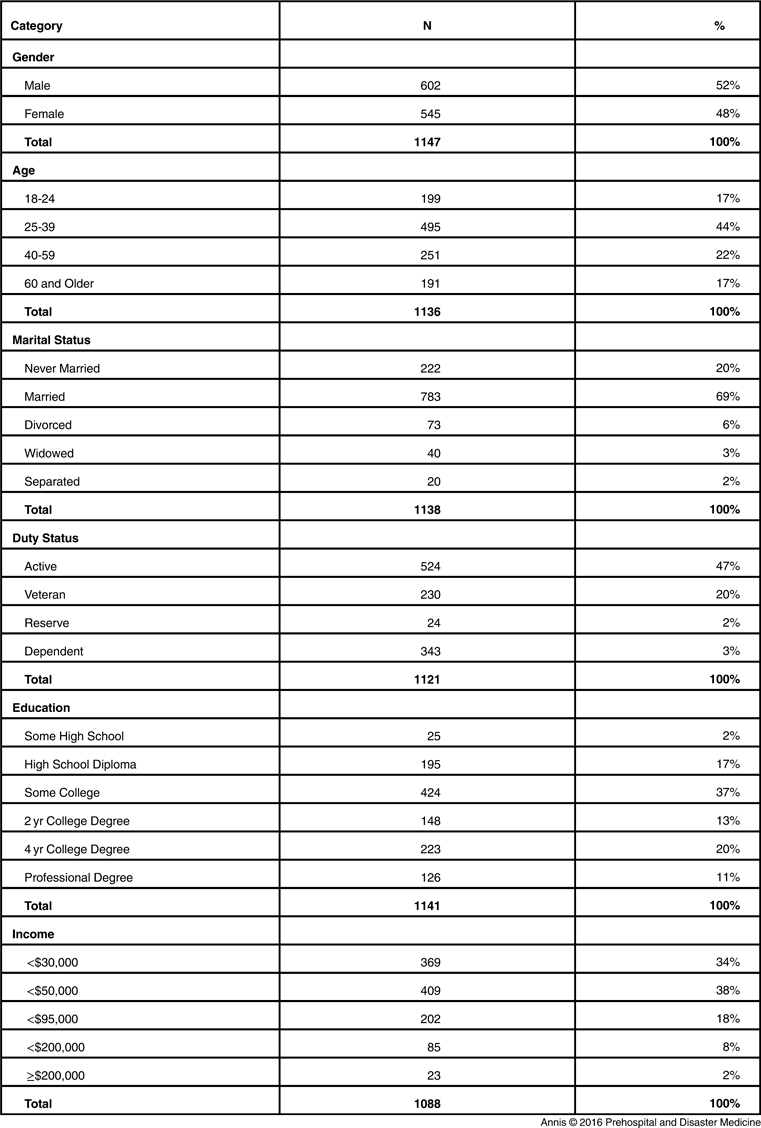
The survey was divided into three sections. The first section contained demographic questions, including gender, marital status, education, income, minor children in home, duty status, and deployment status. The second section evaluated risk perception with questions about prior experience with disasters, disaster-specific education, residing in a disaster prone area or within 60 miles of a nuclear reactor, and five Likert scale questions asking about the respondents’ feelings regarding the likelihood of a disaster and their concern for being affected by a disaster within 12 months, five years, and their lifetime timeframes. The third section asked specific questions about basic disaster preparedness, such as having 72 hours of nonperishable food and one gallon per day potable water per household member, access to an immediate shelter, access to a community shelter, a communication plan, an evacuation plan, and a will. An extended state of disaster readiness was also evaluated with all the components of basic preparedness with a two-week duration of supplies. Demographic information was collected to determine the correlation between these factors and the perception of risk and preparedness as related to a natural or manmade disaster (Table 1). There was also a comments section at the end. One thousand one hundred and fifty surveys were returned and data were collected in a Microsoft Excel 2010 Spreadsheet (Microsoft Corp.; Redmond, Washington, USA).
Navy Beneficiary Population DemographicsFootnote a

a Demographic information provided on questionnaires.
Analysis
Data were analyzed with SAS/STAT Version 9.4 software (SAS Institute Inc.; Cary, North Carolina USA). A power analysis for a confidence level of 99% and margin of error of <5% was performed with a sample size of >660 required. By enrolling more than 1,000 participants from NMCSD, significant representation was assured and mitigation against drop-out for incomplete surveys. To insure high significance and power <95% of the results, the author’s chose a P value (α) of.01. Statistical analysis included the bi-variate analysis of association between the study outcomes (ie, 3-day preparedness) and potential correlates (ie, demographics and occupation). Two-way tables, box-plots, and single predictor logistic regressions were used as the primary analytic tools. The authors also investigated whether some variables had to be transformed for reliable data analysis. Transformations included variance stabilizing transformations and categorization for continuous variables, and merging categories with small count into larger but realistic groups for nominal and ordinal variables, as discussed in the regression model below. The Wald test was used when a relationship within or between data items could be expressed as a statistical model with parameters estimated from the sample.
Logistic regression analysis was used to investigate conditional associations and build the best model for predicting the 3-day preparedness for a disaster. Before proceeding with the regression model, data fields were transformed as discussed above. Marital status was collapsed into three groups with “divorced,” “separated,” and “widowed” consolidated. Within the education category, “some high school” and “high school graduate” were combined. Within income, the two highest brackets were combined because the highest bracket contained only 11 individuals. The model was built on a randomly selected subset of 66% of all surveys. Then, the model was validated on the rest of the data (34% of the data). The Receiver Operating Characteristic (ROC) curve and the area under the ROC curve were used to describe predictive measures.
Results
The results of the survey revealed that Navy beneficiaries from NMCSD, although on the higher end of the national average, were no more likely than the general public to be prepared. As with the general public, higher rates of preparedness were seen in married persons, those with a college degree, higher income, and those with prior experience with a disaster. Unlike results seen in the general public, those with chronic health care needs were more, rather than less, likely to be prepared and those with minor children were less likely, rather than more likely, to be prepared. Duty status was assessed and only veterans were significantly more likely than most to be prepared. Unfortunately, deployment status could not be assessed due to the ambiguity of the question, as evidenced in the comments made by subjects. As can be seen in Table 2, those who had taken a preparatory disaster-preparedness class, those who acknowledged living in a disaster prone area, and those with high risk-perception were all significantly more likely to be prepared. The presence of a will was the most significant non-disaster related variable associated with preparedness. Sixty-six percent of all respondents meeting standards for basic preparedness had a will, and 54% of respondents with a will had basic preparedness, which was significantly greater than average.
Navy Beneficiary Disaster Preparation Results

a The first three columns of data compare 72 hr. preparedness (basic preparedness) for an individual response to a question illustrating how each variable affects basic preparedness. (For example, only 36.5% of those who had not been affected by a disaster were prepared compared to 49.7% of those who had).
b The remaining three data columns compare variability within each state of basic preparedness. (For example, 23.1% of those who were not prepared had previously experienced a disaster whereas 34% who were prepared had).
Of the 1,150 surveys that were collected, 983 contained the data required for regression analysis and were used to derive the data required to formulate a prediction tool for assessing preparedness.
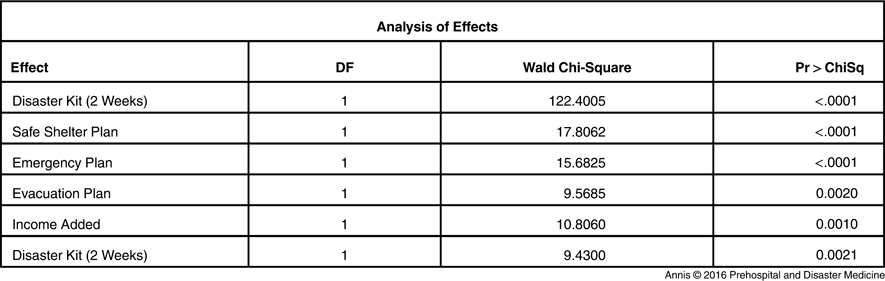
The relationship between being minimally prepared per the above defined criteria and various other preparedness activities were analyzed for effect using the Wald test. Having an extended preparedness (two weeks) disaster kit, safe shelter, emergency plan, emergency evacuation plan, living in a known disaster area, and income were found to be significant (Table 3). “Income added” was the additive effect seen per income level as the respondents moved up within income brackets. Following logic, having a two-week disaster kit had the largest effect on preparedness.
Analysis of Effects of Individual Preparedness Related Activities on Basic Disaster Preparedness

Abbreviation: DF, Degrees of Freedom.
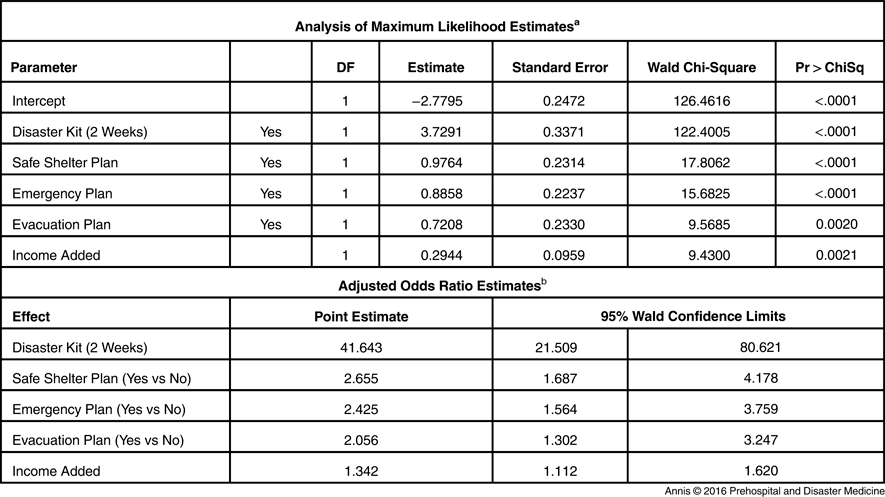
The likelihood of the effect of each of the various individual preparedness activities having an effect on minimal disaster preparedness was then analyzed (Table 4). From these data, the predicted probability that any individual would be minimally prepared for a disaster was obtained using the regression equation:
 $Pc(Prepared\,\mid\,)= {{e^{x} } \over {1 {\plus} e^{x} }}$
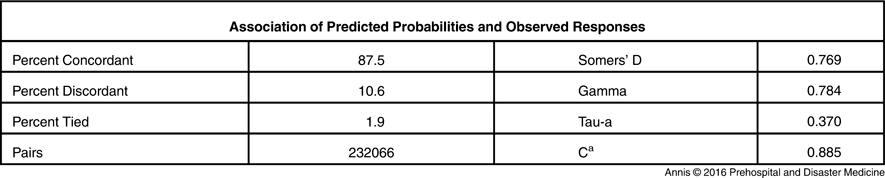
where x is the sum of the intercept and the estimated maximum likelihood ratios. These other statistically significant disaster preparedness activities were then analyzed to find the estimated adjusted odds ratio. This was the estimated multiplicative influence by which each individual activity enhanced the likelihood of the basic minimal level of preparedness (Table 4). These data again verified the obvious effect of a subject’s two-week extended preparedness, but also confirmed the valuable effect of having a safe shelter and emergency and evacuation plans. The association between observed responses and preparedness was then used to develop a predictive probability that an individual would in fact be prepared for a minor disaster (Table 5). The five most closely associated activities, if present within any individual surveyed, would predict that this individual was indeed prepared basically. Based upon these data, the resultant c signified that these individuals have an 88.5% chance of having basic preparedness for a disaster as defined by FEMA. The “c – statistic” is the average ROC.
Maximum Likelihood Ratio and Odds Ratio Estimates

Abbreviation: DF, Degrees of Freedom.
a Individual variable’s effect on preparedness.
b Multiplicative influence of each individual activity on the likelihood of the basic minimal level of preparedness.
Association of Predicted Probabilities and Observed Responses

a C being the predictive power of this association.
Discussion
The authors realize that military installations are at higher risk of manmade disasters due to domestic or foreign terrorist attacks; however, base and command level preparedness are outside the scope of this study. Despite the efforts of federal and state governments, along with non-government agencies, to educate the general public on the need for disaster preparedness, national reported rates remain low. The figures for basic preparedness, as defined by FEMA, appear to range between 19% and 42% nationwide and seem to correlate with the efforts to educate the public at the state and local levels. Alabama (USA), with its proactive “Get 10” campaign, appears the most successful with 42% reporting having the basic FEMA recommendations. 23
Navy personnel receive routine training in readiness and preparation for short-notice deployments as missions dictate and have access to numerous informational resources on preparedness. In addition to required predetermined deployment care plans for these personnel and their families, there are several recommended disaster preparedness resources through web sites, such as the US Fleet Forces Command disaster preparedness web page and Navy Knowledge Online, to take classes in preparedness. Members are also required to register and keep current all personal information with the Navy Family Accountability and Assessment System (NFAAS). Immediately following a declared disaster, members are required to muster with their command or shelter in place, as advised, and complete a needs assessment with NFAAS as soon as possible.
This led the authors to speculate that Navy personnel, retirees, and dependents might be better prepared than the average citizen. In Navy beneficiaries, low income and limited education mirrors the general public’s association with limited preparedness and poses the greatest threat. Individuals with low income are more often unable to afford the materials required to prepare for any disaster,Reference McCormick, Pevear and Xie 24 and they are less able to cope with the burden imposed by a disaster.Reference Kung and Chen 9
The Navy has disaster preparedness guidelines that are geared mainly towards protection of the families of people working with the Navy. This normally entails a home fire escape plan, Family Emergency Plan (which includes an evacuation plan and a communication plan), emergency contact cards, and an emergency supplies kit,Reference McGinnis 20 and yet the Navy population was no better prepared than the average person. There were two areas where the Navy population differed from the general public. This population was no more likely than average to be prepared in households with minor children, whereas this demographic among the general public was better prepared. In this population, those with chronic illness were better prepared than average, whereas this demographic was less prepared in the general public. One is hesitant to speculate as to why this might be. However, in those with chronic medical conditions, it might be related to perceived income security and/or comprehensive medical coverage, which until recently, was not readily available to the general public, especially low-income persons.
Limitations
The survey was provided to a convenience sample during the times that the research associates were working certain shifts, particularly daytime hours. Coverage during nights was less frequent and may offer a possible selection bias, though a majority of patient volume for this facility occurs during daytime operations. Subjects, due to survey design limitations, may have misinterpreted survey questions. Other non-measured considerations for disaster preparedness of beneficiaries involve individual factors, provision and access to educational opportunities, and resources that were not measured in the following survey. Finally, this was a survey conducted in a single center, which may not reflect adequately other regions of Navy-based beneficiary risk perception or preparedness levels.
Conclusion
Disaster preparedness requires the commitment of means bilaterally by the personal and the government. Coordinating efforts with the surrounding community and ascertaining a strong rapport with the beneficiaries is crucial to mitigating disaster risks. The finding is that a majority of the subjects have not prepared adequately for a natural or manmade disaster. Certain groups reflect the trends of the general population and are at higher risk of poor preparedness, like those with lack of financial and social exchequer. Education with accurate intelligence is imperative in assuring that suitable measures are pursued for preparedness, but this requires knowledge of local hazards posing reasonable risks. In addition, there are several factors that relate to an individual’s perception of risk and preparedness for a disaster.
Navy leadership and commands may devise policies designed to supporting better disaster preparedness by providing more access to informational and logistical resources. Further study is needed to identify and extirpate the obstacles preventing disaster preparedness in the surveyed population. A prepackaged, 72-hour emergency kit is available to beneficiaries at the Navy Exchange for less than US $70, which would suggest removal of the financial barrier for anyone with sufficient awareness. With proper marketing, even low-income Navy personnel, retirees, reservists, and veterans can afford this emergency kit. With the addition of sufficient potable water along with preparations for an escape, evacuation, communication, and shelter plan, they may meet minimum standards of disaster preparedness. Navy training efforts should be tailored to educating personnel and beneficiaries in disaster preparedness through an all-hazards approach in addition to highlighting potential local disaster risks. Access to military, local community, and online resources should be reviewed at command orientation and offered to the other beneficiaries through ombudsmen programs, informational media, or other resources. A wealth of information at Ready.gov and Fleet Forces Command are examples of potential reference sites for disaster preparedness.Reference McGinnis 20 , 25 , 26
Acknowledgements
Supported, IN PART, by the National Center for Advancing Translational Sciences, National Institutes for Health (Bethesda, Maryland USA), through Grant Number 8UL1TR000055; and with the generous assistance of Paul Henderson, PhD PPA, ENS MSC USN, and James Matos, HM2 USN.