Evidence is accumulating in support of the notion that child personality and negative parenting practices are related to adolescent adjustment problems (McLeod, Weisz, & Wood, Reference McLeod, Weisz and Wood2007; Rothbaum & Weisz, Reference Rothbaum and Weisz1994). Although it is important to identify factors related to adjustment problems, it should also be acknowledged that these factors are neither perfectly stable (Roberts & DelVecchio, Reference Roberts and DelVecchio2000; Roberts, Walton, & Viechtbauer, Reference Roberts, Walton and Viechtbauer2006), nor independent from each other (De Clercq, Van Leeuwen, De Fruyt, Van Hiel, & Mervielde, Reference De Clercq, Van Leeuwen, De Fruyt, Van Hiel and Mervielde2008; Prinzie et al., Reference Prinzie, Onghena, Hellinckx, Grietens, Ghesquiere and Colpin2004). Ecological transactional models of the etiology of adjustment problems suggest that individual risk factors (child personality) and contextual risk factors (negative parenting) shape each other over time (Cicchetti & Toth, Reference Cicchetti and Toth1998). However, few studies have examined how interrelated changes in child characteristics and negative parenting are related to adjustment problems (Lengua, Reference Lengua2006). This is especially true for the transition to adolescence.
The transition to adolescence is an important developmental period for both children and parents. Children need to adjust to the physical and hormonal changes that accompany the onset of puberty (e.g., Paikoff & Brooks-Gunn, Reference Paikoff and Brooks-Gunn1991) as they transition to secondary school and face the developmental task of increasing autonomy (Galambos & Costigan, Reference Galambos, Costigan, Weiner, Lerner, Easterbrooks and Mistry2003). Parents need to facilitate this increasing autonomy by learning to relax some control and remain supportive. Rates of parent–child conflict increase during this transition, indicating that the parent–child relationship is under pressure during this period (Laursen, Coy, & Collins, Reference Laursen, Coy and Collins1998). How children and parents handle these changes might be important for subsequent adolescent adjustment (Graber & Brooks-Gunn, Reference Graber and Brooks-Gunn1996). The transition to adolescence is also a period characterized by an increase in problem behaviors. Rates of internalizing problems are quite low in childhood, but highly prevalent in adolescence (Petersen et al., Reference Petersen, Compas, Brooks-Gunn, Stemmler, Ey and Grant1993). Externalizing behavior problems, such as delinquency and status violations, have also been reported to increase across adolescence (Bongers, Koot, van der Ende, & Verhulst, Reference Bongers, Koot, van der Ende and Verhulst2004; Lahey et al., Reference Lahey, Schwab-Stone, Goodman, Waldman, Canino and Rathouz2000). As the transition to adolescence brings challenges to children and parents, and adjustment problems are heightened after it, this period is especially important to investigate in this regard. The present study contributes to the literature on adjustment problems by investigating how intraindividual changes in child personality and overreactive parenting during this transition, are related to adolescent adjustment problems. Including both child personality and overreactive parenting, as well as both internalizing and externalizing problems, allows us to identify the relative contribution of each risk factor to each type of adjustment problems.
Child Personality and Overreactive Parenting as Risk Factors for Adjustment Problems
We adopt the Big Five approach to child personality. This cross-culturally replicated model is among the best established and most used in research on adult personality, and applies to adolescent personality as well (Shiner & Caspi, Reference Shiner and Caspi2003). A major advantage of investigating the Big Five in younger populations is the possibility to integrate findings with literature regarding adults. The Big Five are classically labeled as follows: (a) extraversion, (b) agreeableness/benevolence, (c) conscientiousness, (d) neuroticism versus emotional stability, and (e) openness/imagination. Low agreeableness and conscientiousness are associated with externalizing problems (Lynam et al., Reference Lynam, Caspi, Moffit, Raine, Loeber and Stouthoemer-Loeber2005; Ozer & Benet-Martinez, Reference Ozer and Benet-Martinez2006), whereas low extraversion and emotional stability are most related to internalizing problems (Muris, Meesters, & Blijlevens, Reference Muris, Meesters and Blijlevens2007; Van Leeuwen, Mervielde, Braet, & Bosmans, Reference Van Leeuwen, Mervielde, Braet and Bosmans2004).
Although child personality has been identified as a risk factor for adjustment problems, the relation between changes in Big Five characteristics and adjustment problems has not been examined. Personality is theoretically viewed as stable across time and situations (Shiner & Caspi, Reference Shiner and Caspi2003), but empirical evidence shows that personality changes substantially over time. Mostly mean-level change has been investigated during the transition to adulthood. Individuals tend to become more extraverted, agreeable/benevolent, conscientious, and imaginative/open to experience, suggesting that personality tends to become more mature (Roberts & Delvecchio, Reference Roberts and DelVecchio2000; Roberts et al., Reference Roberts, Walton and Viechtbauer2006; Shiner, Masten, & Tellegen, Reference Shiner, Masten and Tellegen2002). Findings regarding personality development in adolescence are more scarce and reveal a somewhat different picture. In line with the maturity principle openness to experience has been found to increase across early adolescence (Branje, Van Lieshout, & Gerris, Reference Branje, Van Lieshout and Gerris2007; Branje, Van Lieshout, & Van Aken, Reference Branje, Van Lieshout and Van Aken2004; Klimstra, Hale, Raaijmakers, Branje, & Meeus, Reference Klimstra, Hale, Raaijmakers, Branje and Meeus2009; McCrae et al., Reference McCrae, Costa, Terracciano, Parker, Mills and De Fruyt2002). Girls' personality development across adolescence, assessed with another measure than the Big Five, is for a large part also directed at maturity (Johnson, Hicks, McGue, & Iacono, Reference Johnson, Hicks, McGue and Iacono2007). However, there are also findings that do not support the maturity principle: decreases in conscientiousness and imagination (De Fruyt et al., Reference De Fruyt, Bartels, Van Leeuwen, De Clercq, DeCuyper and Mervielde2006), as well as decreases in extraversion have been reported across adolescence (Branje et al., Reference Branje, Van Lieshout and Gerris2007).
Another type of stability is differential or rank-order stability. It is assessed by test–retest correlations, which convey information on invididuals' relative standing on a personality dimension. A meta-analysis revealed that, in general, differential stability increases with increasing age. The estimated population correlation controlling for the time interval of the longitudinal study was .43 for ages 10 to 19 (Roberts & Delvecchio, Reference Roberts and DelVecchio2000). De Fruyt and colleagues (2006) report a higher degree of differential stability across a 3-year time interval for children aged 8 to 11: test–retest correlations ranged from .63 for emotional stability to .82 for conscientiousness. This higher degree of stability is likely because of the fact that the parents reported on the child's personality at each time. Parents might show a tendency to retain a stable picture of their children. Prinzie and Deković (Reference Prinzie and Deković2008), who had teachers report on the child's personality (a different teacher every measurement wave), report much lower rank-order stabilities in 6- to 9-year-old children across a 3-year interval, ranging from .38 for emotional stability to .59 for imagination.
Even if both mean level stability and differential stability are substantial, individual differences in the degree of stability may occur. Studying intraindividual changes in risk factors for adjustment problems may reveal unique information. Individuals might be at low risk relative to others, but still experience adjustment problems because they have experienced an increase in risk across the transition to adolescence. The stress of facing the biological, psychological and social changes that accompany the transition to adolescence potentially increases children's risk for adjustment problems during this period (Cicchetti & Rogosch, Reference Cicchetti and Rogosch2002). This increase in risk may include decreases in extraversion, benevolence, conscientiousness, emotional stability, and imagination.
In addition to the individual level risk factor of child personality, we examined overreactive parenting as a contextual risk factor (Arnold, O'Leary, Wolff, & Acker, Reference Arnold, O'Leary, Wolff and Acker1993). Overreactive parenting is a tendency to respond with anger, frustration, and meanness to children's problematic behavior. It is a parenting behavior that is closely related to harsh or coercive parenting (Patterson, Reference Patterson1982) and includes behaviors such as insulting and hitting the child. This hostile style of disciplining may reinforce oppositional behavior (Patterson, Reference Patterson1982), and provide a model of hostile interaction styles, resulting in heightened risk for externalizing problems (Pettit & Dodge, Reference Pettit and Dodge1993). At the same time, children may withdraw from parents in an attempt to avoid unpleasant interactions (Bender et al., Reference Bender, Allen, Boykin McElhaney, Antonishak, Moore and O'Beirne Kelly2007), and develop low self-esteem, both increasing risk for internalizing problems (MacPhee & Andrews, Reference MacPhee and Andrews2006). Overreactive parenting may be especially problematic for children transitioning to adolescence, as children need support from parents while they are striving for increasing autonomy. Overreactive parenting is power-assertive behavior and not likely to be supportive of autonomy in the child, resulting in a poor fit between the adolescent's developmental stage and the parenting context (Eccles et al., Reference Eccles, Midgley, Wigfield, Miller Buchanan, Reuman and Flanagan1993). Increases in overreactive parenting during this developmental stage may thus put children at increased risk for adjustment problems.
When investigating the relative contribution of child personality and overreactive parenting to adjustment problems, it is important to realize that the two may be interrelated in several ways. These interrelations, when not specifically investigated, might obscure the true predictive value of either factor. First, child personality characteristics may elicit changes in overreactive parenting (Belsky, Reference Belsky1993). Second, overreactive parenting may elicit changes in child personality. We know of only one study investigating transactional relations between initial levels and changes in the Big Five and parenting behavior in adolescents, which found no such relations (Branje et al., Reference Branje, Van Lieshout and Van Aken2004). However, no study has investigated these relations during the transition to adolescence, and no study has investigated transactional relations between Big Five child personality dimensions and overreactive parenting. Studies on the relation between temperament and other aspects of negative parenting have documented these types of transactions. For instance, higher levels of child irritability predict increases in inconsistent discipline, lower levels of self-regulation predict increases in harsh parenting, and lower levels of effortful control predict increases in rejection by parents. At the same time, higher parental inconsistency has been shown to increase irritability and fearfulness in children (Brody & Ge, Reference Brody and Ge2001; Lengua, Reference Lengua2006; Lengua & Kovacs, Reference Lengua and Kovacs2005). In addition to these transactional relations between initial levels and changes, changes in child personality and overreactive parenting may be correlated, independent of initial levels. The parallel continuities hypothesis states that individual behavior is stable when the environment is stable, but when either the individual or the environment changes, the other changes in order to adjust (Caspi, Reference Caspi, Funder and Parke1993). For instance, increases in adolescent agreeableness, conscientiousness, and emotional stability are related to increases in parental support (Branje et al., Reference Branje, Van Lieshout and Van Aken2004). Thus, when investigating the relative contribution of child personality and overreactive parenting to adjustment problems, possible transactional relations as well as correlated change between these two predictors, should be taken into account.
Present Study's Aims and Hypotheses
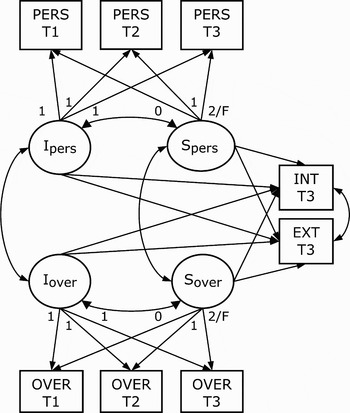
We investigated the relative contribution of changes in Big Five child personality and overreactive parenting during the transition to adolescence, to adjustment problems. Multivariate latent growth curve modeling was performed, containing information on individual- as well as population-level change (Curran & Willoughby, Reference Curran and Willoughby2003). A longitudinal design allowed us to model development from 8 to 14 years of age. Reports of multiple informants were combined to reduce reporter bias. For a graphical representation of the hypothesized model, see Figure 1.
Multivariate latent growth model of the interrelations between child personality (PERS), overreactive parenting (OVER), internalizing problems (INT), and externalizing problems (EXT). F, freely estimated; I, intercept; S, slope; T, time. Numbers along the arrows represent intercept and slope loadings.

We hypothesized that child personality and overreactive parenting would be interrelated. Although we know of no studies investigating over time relations between child personality and overreactive parenting, we base our expectations on findings relating child temperament to various other aspects of negative parenting. Temperament is viewed as the genetically determined base that, under environmental influences, becomes differentiated into later personality (Shiner & Caspi, Reference Shiner and Caspi2003). Higher levels of temperamental trait fear predict decreases in rejection and inconsistent discipline, higher levels of child irritability predict increases in inconsistent discipline, and lower levels of effortful control predict increases in parental rejection. At the same time, higher levels of parental rejection predict increases in temperamental trait fear in the child (Lengua, Reference Lengua2006). Based on these findings, we hypothesized that lower levels of benevolence and emotional stability in late childhood are related to increases in overreactive parenting over time, whereas higher levels of overreactive parenting in late childhood are related to decreases in emotional stability and benevolence. The investigation of the other personality dimensions was exploratory, because of a lack of previous empirical studies. We further expected changes in overreactive parenting to be associated to changes in child personality dimensions. Based on findings regarding parental support (Branje et al., Reference Branje, Van Lieshout and Van Aken2004), we hypothesized that decreases in benevolence, conscientiousness, and emotional stability are related to increases in overreactive parenting. Generally, we expected that benevolence, conscientiousness, and emotional stability would show stronger relations to overreactive parenting than extraversion and imagination, as these are characteristics that are more visible to parents and determine how easy the child is to handle.
Although as far as we know there are no studies relating changes in Big Five personality to adjustment problems, we based our expectations on findings regarding absolute levels (Lynam et al., Reference Lynam, Caspi, Moffit, Raine, Loeber and Stouthoemer-Loeber2005; Muris et al., Reference Muris, Meesters and Blijlevens2007; Ozer & Benet-Martinez, Reference Ozer and Benet-Martinez2006; Van Leeuwen et al., Reference Van Leeuwen, Mervielde, Braet and Bosmans2004). We hypothesized that decreases in emotional stability and extraversion are most strongly related to internalizing problems, whereas decreases in conscientiousness and benevolence are related to externalizing problems.
Regarding overreactive parenting, we expected that when parents increase their overreactive parenting, children experience more adjustment problems. With regard to the relative strength of the prediction of internalizing versus externalizing problems, two meta-analyses indicate that harsh parenting explains more of the variance in externalizing than internalizing problems, indicating that children could be more likely to “act out” than withdraw in response to overreactive parenting (McLeod et al., Reference McLeod, Weisz and Wood2007; Rothbaum & Weisz, Reference Rothbaum and Weisz1994). We hypothesized that overreactive parenting is more predictive of externalizing than of internalizing problems. Changes in two other aspects of negative parenting have been related to adjustment problems: increases in inconsistent discipline predict higher levels of externalizing problems, and increases in parental rejection predict higher levels of externalizing and internalizing problems (Lengua, Reference Lengua2006).
Regarding the relative contribution of child personality versus overreactive parenting, child personality is likely most important as it is most proximal to the child's problem behavior (Cicchetti & Toth, Reference Cicchetti and Toth1998). We hypothesized that adjustment problems are more strongly predicted by changes in child personality than by changes in overreactive parenting.
Finally, as girls are more socialized toward relationship-oriented strategies of emotion regulation (Morris, Silk, Steinberg, Myers, & Robinson, Reference Morris, Silk, Steinberg, Myers and Robinson2007), and may thus be more susceptible to negative parenting practices, we hypothesized that overreactive parenting would be more strongly related to adjustment problems in girls than in boys. For instance, maladaptive parental coping has been found to predict depressive symptoms, alcohol problems, and delinquency in girls but not in boys (Davies & Windle, Reference Davies and Windle1997).
Method
Participants
This study is part of a larger project: “The Flemish Study on Parenting, Personality, and Development.” For detailed information on the sample, see Prinzie and colleagues (2004). We used data from the third (2001; Time 1), fourth (2004; Time 2), and fifth (2007; Time 3) wave, as these contained the measures of interest. To obtain a sample of children who transitioned from childhood to adolescence, we selected data for children who were 8 or 9 years old at Time 1, resulting in a sample of 290 target children. Target children's mean age was 8 years 10 months (SD = 7 months, range = 8 years to 9 years, 11 months) at Time 1, 11 years 9 months (SD = 6 months, range = 11 years to 12 years, 11 months) at Time 2, and 14 years, 9 months (SD = 6 months, range = 14 years to 15 years, 11 months) at Time 3. There were 141 boys (48.6%), and 149 girls (51.4%). Girls and boys did not differ in age, t (288) = 0.70, p = .49. For these 290 children, 289 mothers, 277 fathers, and 247 teachers participated at Time 1; 244 mothers, 232 fathers, and 217 teachers participated at Time 2; and 235 mothers, 215 fathers, and 150 teachers participated at Time 3. Target children gave self-reports at Time 3 (n = 233). The mothers' mean age at Time 1 was 42 years, 7 months (SD = 3 years, range = 36–49 years). The fathers' mean age at Time 1 was 45 years, 2 months (SD = 3 years 9 months, range = 36–61 years). Percentages of mothers' and fathers' educational levels for elementary school were 1.0% and 3.0%, for secondary school 40.5% and 42.2%, for nonuniversity higher education 37.0% and 23.3%, and for university or higher 21.4% and 31.5%, respectively. These percentages are representative of the Belgian population. All the parents had the Belgian nationality.
Missing data points across the study mounted to 11.7% for the mother data, 12.3% for the father data, and 10.7% for the teacher data. Little's MCAR test indicated that data were missing completely at random (χ2/df = 1.10). Missing data were imputed using expectation maximization, a maximum likelihood procedure that uses iterations to impute missing values based on all available data. This procedure is a highly efficient way to use available data under the assumption that data are missing at random (Schafer & Graham, Reference Schafer and Graham2002).
Measures
Adjustment problems
Mothers, fathers, and target children reported on the child's internalizing and externalizing problems at Time 3. Mothers and fathers completed the Dutch translation of the Child Behavior Checklist (CBCL; Achenbach, Reference Achenbach1991a; Verhulst, van der Ende, & Koot, Reference Verhulst, Van der Ende and Koot1996). Target children rated the Dutch translation of the Youth Self-Report (Achenbach, Reference Achenbach1991b; Verhulst, van der Ende, & Koot, Reference Verhulst, Van der Ende and Koot1997). Both questionnaires consist of an internalizing and an externalizing problem behavior scale. The internalizing problem behavior scale consists of three subscales, measuring withdrawn behavior, somatic complaints, and anxious/depressed behavior (e.g., “My child cries a lot”). The externalizing problem behavior scale consists of two subscales, measuring aggressive and delinquent behavior (e.g., “My child steals”). Each item is rated: 0 (not true), 1 (sometimes/somewhat true), or 2 (often/very true). The CBCL is a well validated, reliable instrument to measure child behavior (Vignoe, Bérubé, & Achenbach, Reference Vignoe, Bérubé and Achenbach2000). An internalizing and an externalizing problem behavior score was obtained for each respondent by summing the scores across the items for each subscale. Cronbach αs ranged from 0.81 to 0.89. The average intercorrelations between reporters were .61 between mothers and fathers, .39 between mothers and adolescents, and .36 between fathers and adolescents. We performed confirmatory factory analysis (CFA) to assess the feasibility of combining reports. A multitrait, multimethod model with correlated uniqueness (i.e., estimated error covariances) within method (mother report, father report, adolescent report) was used (Marsh, Byrne, & Craven, Reference Marsh, Byrne and Craven1992). The CFA based on the covariance matrix and using maximum likelihood estimation, demonstrated an adequate fit to the data (χ2/df = 1.18, root mean square error of approximation [RMSEA] = 0.03). All item loadings were significant and in the expected direction (average = 0.67). These results supported the feasibility of aggregating scores across respondents. Composite scores were created by averaging the scores of the available respondents. These were used for all further analysis.
Child personality
Fathers, mothers, and teachers completed the Hierarchical Personality Inventory for Children (HiPIC; Mervielde & De Fruyt, Reference Mervielde, De Fruyt, Mervielde, Deary, De Fruyt and Ostendorf1999). The HiPIC is an empirically derived questionnaire, based on an extensive analysis of free parental descriptions of their children. This instrument includes 144 items, 8 items per facet, assessing 18 facets that are hierarchically structured under five higher order domains. The domains are labeled as follows: (a) extraversion (32 items; e.g., “Bubbles with life”). This scale contrasts emotional, social, and verbal expressiveness with shyness, inhibition, self-isolation, withdrawal, and nonassertiveness. (b) Benevolence (40 items; e.g., “Defends the weak”). This scale covers the broad area of prosocial versus antisocial interactions. The scale contrasts a warm, empathic consideration of other people's needs, emotions, and interests, and open, trustful, interpersonal orientations with dominance, egocentrism, and irritation. To distinguish the broader content from the adult agreeableness factor, this factor was labeled as benevolence. This scale includes typical adult agreeableness facets such as compliance, egocentrism, and altruism but also facets that are primarily related to other Big Five factors in adults, such as dominance and irritability. Dominance primarily loads on the extraversion domain in adults, whereas irritability is more related to neuroticism. (c) Conscientiousness (32 items; e.g., “Works with sustained attention”). This scale refers to conscientiousness in worklike situations and combines a concentrated, reliable, and achievement oriented attitude in work situations with high levels of involvement and perseverance. (d) Emotional stability (16 items; e.g., “Has confidence in own abilities”). In this scale, self-reliance, emotional balance, and being easygoing are opposed to being fearful, anxious, and emotionally disorganized under stress, and having low self-esteem. (e) Imagination (24 items; e.g., “Asks many why questions”). This scale is composed of the three facets: creativity, curiosity, and intellect. The items of this scale emphasize openness to new ideas and experiences in terms of creativity, fantasy, curiosity, imagination, humor, and resourcefulness in initiating activities. Items were rated on a 5-point Likert-type scale, ranging from 1 (barely characteristic) to 5 (highly characteristic). The HiPIC's factor structure and high internal consistencies of domains have been established (Van Leeuwen et al., Reference Van Leeuwen, Mervielde, Braet and Bosmans2004). We obtained one score per respondent for each domain, by averaging the scores across the items. Cronbach αs ranged from 0.87 to 0.98. The average intercorrelations between reporters were .70 between mothers and fathers, .38 between mothers and teachers, and .38 between fathers and teachers. Multitrait, multimethod CFAs with correlated uniqueness were conducted for each of the time points to assess the feasibility of aggregating scores. A good fit to the data was demonstrated for Time 1: χ2/df = 1.89, RMSEA = 0.06; Time 2: χ2/df = 16.82, RMSEA = 0.05; and Time 3: χ2/df = 1.53, RMSEA = 0.04. All factor loadings were significant and in the expected direction (average = 0.38). Composite scores were created by averaging the scores of the available respondents. These were used for all further analysis.
Overreactive parenting
Fathers and mothers reported on a Dutch translation of the overreactivity subscale of the Parenting Scale (Arnold et al., Reference Arnold, O'Leary, Wolff and Acker1993; Prinzie, Onghena, & Hellinckx, Reference Prinzie, Onghena and Hellinckx2007). The subscale contains nine items and measures parents' tendency to respond with anger, frustration, and meanness to their child's problematic behavior. Items represent discipline encounters (e.g., “When my child misbehaves . . .”), followed by two opposite anchor points for a 7-point Likert-type scale (e.g., I speak to my child calmly versus I raise my voice or yell). The overreactivity subscale has adequate test–retest reliability, distinguishes clinical from nonclinical samples, and has been validated against behavioral observations (Arnold et al., Reference Arnold, O'Leary, Wolff and Acker1993; Irvine, Biglan, Smolkowski, & Ary, Reference Irvine, Biglan, Smolkowski and Ary1999; Prinzie et al., Reference Prinzie, Onghena and Hellinckx2007). We obtained one score for each respondent by averaging the scores across all items. Cronbach αs ranged from 0.74 to 0.81. The average intercorrelation between mothers' and fathers' reports was .22. A multitrait, multimethod CFA with correlated uniqueness showed an acceptable fit to the data: χ2/df = 3.60, RMSEA = 0.10. All factor loadings were significant and in the expected direction (average = 0.49). Composite scores were created by averaging the scores of the available respondents. These were used for all further analysis.
Statistical analyses
We performed statistical analyses in three steps. First, we fitted univariate growth curves to the child personality dimensions and overreactive parenting to determine the type of change (linear or nonlinear). We also examined whether there was variability in change over time, as indicated by either a significant slope variance, or a significant intercept-slope covariance, as this is a necessary condition for including change as a predictor (Duncan, Duncan, & Strycker, Reference Duncan, Duncan and Strycker2006). Second, we examined the interrelations between child personality and overreactive parenting, and their contribution to adjustment problems. We tested five multivariate models, including the intercept and slope of a personality dimension and overreactive parenting, and Time 3 internalizing and externalizing problems. Third, we performed multigroup analyses to investigate gender differences in the strength of the associations.
We used the LISREL 8.54 software (Jöreskog & Sörbom, Reference Jöreskog and Sörbom2003) to fit the models to the observed mean vector and covariance structure using Maximum Likelihood estimation. We assessed model fit with the comparative fit index (CFI), with CFI > 0.90 indicating a good fit; and the RMSEA, with RMSEA < 0.05 indicating a good fit, and RMSEA < 0.08 indicating an acceptable fit (for an overview of model fit statistics, see Hu & Bentler, Reference Hu, Bentler and Hoyle1995). MacCallum, Browne, and Sugawara (Reference MacCallum, Browne and Sugawara1996) have elaborated on these cut points and noted that RMSEA < 0.10 indicates mediocre fit. We used the chi-square difference test to assess significance of incremental fit in nested model comparison.
Results
Descriptive statistics
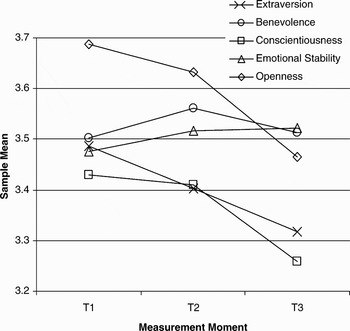
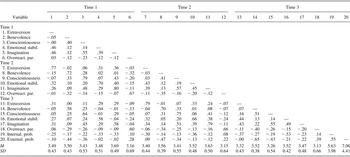
Descriptives of the measures and their intercorrelations are presented in Table 1. For a graphical representation of the mean level estimates of the five personality factors across the three timepoints, see Figure 2.
Mean levels of the five personality dimensions across the three time points.

Intercorrelations and descriptive statistics for the study variables (N = 290)

Note: Correlations greater than |.11| are significant at p < .05. Correlations greater than |.14| are significant at p < .01.
Rank-order stabilities from Time 1 to Time 2 were 0.77 for extraversion, 0.72 for benevolence, 0.79 for conscientiousness, 0.70 for emotional stability, 0.80 for imagination, and 0.67 for overreactive parenting. Rank-order stabilities from Time 2 to Time 3 were 0.79 for extraversion, 0.70 for benevolence, 0.75 for conscientiousness, 0.66 for emotional stability, 0.79 for imagination, and 0.66 for overreactive parenting. Rank-order stability was lower from Time 1 to Time 3: 0.31 for extraversion, 0.58 for benevolence, 0.64 for conscientiousness, 0.58 for emotional stability, 0.58 for imagination, and 0.60 for overreactive parenting. Most of the associations between the personality dimensions and overreactive parenting on the one hand, and internalizing and externalizing problems on the other hand, were significant.
Univariate latent growth models
Univariate linear and nonlinear growth models were fitted to determine the type of change. When the nonlinear model did not provide significant incremental fit, the more parsimonious, linear model was selected. Linear growth models were preferred for extraversion: linear model, χ2 (3) = 3.59, CFI = 0.999, RMSEA = 0.03; compared to nonlinear model, Δχ2 (1) = 0.27, p = .60, benevolence: linear model, χ2 (3) = 14.52, CFI = 0.969, RMSEA = 0.12; compared to nonlinear model, Δχ2 (1) = 0.45, p = .50, emotional stability: linear model, χ2 (3) = 5.51, CFI = 0.993, RMSEA = 0.05; compared to nonlinear model, Δχ2 (1) = 0.06, p = .81, and overreactive parenting: linear model, χ2 (3) = 0.55, CFI = 1.000, RMSEA = 0.00; compared to nonlinear model, Δχ2 (1) = 0.12, p = .73. Nonlinear growth models were selected for imagination: nonlinear model, χ2 (2) = 5.27, CFI = 0.993, RMSEA = 0.08; compared to linear model, Δχ2 (1) = 11.31, p < .01, and conscientiousness: nonlinear model, χ2 (2) = 10.37, CFI = 0.981, RMSEA = 0.12; compared to linear model, Δχ2 (1) = 12.76, p < .01.
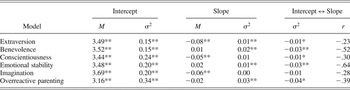
Parameter estimates of the final univariate models are shown in Table 2. The significant mean slopes of extraversion, conscientiousness and imagination were negative, indicating that, on average, children became less imaginative, conscientious and extraverted from late childhood to midadolescence. Extraversion decreased linearly, whereas conscientiousness and imagination decreased more from early to midadolescence than from late childhood to early adolescence. The mean slopes of benevolence, emotional stability, and overreactive parenting were not significant, indicating that, on average, children retained their levels of benevolence and emotional stability over time, and parents retained their levels of overreactive parenting. For all measures except imagination, either the slope variance or the intercept-slope covariance was significantly different from zero. As either of these must be significant to include the slope as a predictor in the multivariate models, the slope of imagination was excluded from subsequent analyses (Duncan et al., Reference Duncan, Duncan and Strycker2006).
Parameter estimates of the univariate latent growth models (N = 290)

* *p < .05. **p < .01.
Multivariate latent growth models
To investigate the relations between child personality, overreactive parenting, and internalizing and externalizing problems, multivariate models were fitted for each of the personality dimensions separately. The models showed an acceptable fit: extraversion, χ2 (11) = 19.37, CFI = 0.992, RMSEA = 0.05; benevolence, χ2 (11) = 44.99, CFI = 0.977, RMSEA = 0.10; conscientiousness, χ2 (10) = 25.60, CFI = 0.987, RMSEA = 0.07; emotional stability, χ2 (11) = 20.72, CFI = 0.990, RMSEA = 0.06; imagination, χ2 (16) = 48.63, CFI = 0.970, RMSEA = 0.08.
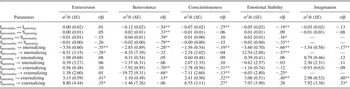
Parameter estimates of the relations between child personality and overreactive parenting, and the regression paths from child personality and overreactive parenting to adjustment problems are shown in Table 3.
Parameter estimates for the multivariate latent growth models (N = 290)

Note: Dashes indicate the parameter was not estimated; Ipersonality, intercept personality; Spersonality, slope personality; Iparenting, intercept overreactive parenting; Sparenting, slope overreactive parenting.
* *p < .05. **p < .01.
Regarding the interrelations between child personality and overreactive parenting, the intercept correlations showed that children who were initially less benevolent, conscientious, and emotionally stable, had parents who exhibited more overreactive parenting. The over time intercept–slope correlations indicated that children who were more benevolent initially, had parents who increased their overreactive parenting over time, whereas parents who exhibited more overreactive parenting initially, had children who became more benevolent and emotionally stable over time. Decreases in benevolence and emotional stability in the child were related to increases in overreactive parenting.
Regarding the prediction of adjustment problems, internalizing problems were negatively predicted by the intercepts of all five personality dimensions, indicating that children who were initially less extraverted, benevolent, conscientious, emotionally stable, and imaginative, experienced more internalizing problems. As expected, the relations were strongest for extraversion and emotional stability. For these dimensions, the changes over time were also predictive of internalizing problems, indicating that children who became less extraverted and emotionally stable over time also experienced more internalizing problems. Overreactive parenting was not related to internalizing problems in any of the models.
As expected, externalizing problems were negatively predicted by the intercepts of benevolence and conscientiousness, indicating that children who were less benevolent and conscientious initially, showed more externalizing problems six years later. Regression paths from the intercept of overreactive parenting to externalizing problems were significant and positive in all multivariate models, indicating that when parents exhibited more overreactive parenting initially, children showed more externalizing problems. In addition to these initial levels, the slopes of benevolence, conscientiousness, and emotional stability predicted externalizing problems, indicating that when children became less benevolent, conscientious and emotionally stable over time, they showed more externalizing problems. When extraversion, conscientiousness, and imagination were taken into account regression paths from the slope of overreactive parenting were significant, indicating that children of parents who increased their overreactive parenting, exhibited more externalizing problems.
Multigroup models
Finally, the multivariate models were fitted for boys and girls simultaneously. A model with all parameters freely estimated, was compared to a model with the between-variable covariances and the regression paths from the intercepts and slopes of personality and overreactive parenting to internalizing and externalizing problems, constrained to be equal across boys and girls. The constrained model did not fit the data significantly worse for any of the personality variables: extraversion, Δχ2 (12) = 14.06, p = .30; benevolence, Δχ2 (12) = 3.69, p = .99; conscientiousness, Δχ2 (12) = 11.34, p = .50; emotional stability, Δχ2 (12) = 14.11, p = .29; imagination, Δχ2 (8) = 12.55, p = .13, indicating that the strength of the associations did not differ significantly between boys and girls.
Discussion
This study examined how interrelated changes in Big Five child personality dimensions and overreactive parenting during the transition from middle childhood to adolescence, predict adolescent adjustment problems. Changes in child personality dimensions predicted both internalizing and externalizing problems, whereas changes in overreactive parenting predicted only externalizing problems. In addition, child personality and overreactive parenting predicted changes in each other, and changes in child personality and overreactive parenting were associated. Finally, the strength of the associations between child personality, overreactive parenting, and adolescent adjustment problems did not differ between boys and girls.
In general, rank-order stabilities of the personality dimensions revealed that individuals kept their relative standing on the personality dimensions to a large degree. The magnitude of rank-order stability found in the present study was highly comparable to that reported in the study by De Fruyt and colleagues (2006), and higher than reported in the meta-analysis by Roberts and Delvecchio (Reference Roberts and DelVecchio2000). This is likely because of the fact that we used the same instrument to measure child personality as De Fruyt and colleagues, whereas the instruments included in the meta-analysis were different. Second, we also included parent reports in our study, as did De Fruyt and colleagues. Parents likely show a tendency to retain a stable picture of their children.
Although rank-order stability was high, the group as a whole did show personality changes. Indeed, the present findings regarding mean level personality changes add to the picture of the transition to adolescence as a potentially difficult time for children (e.g., Galambos & Costigan, Reference Galambos, Costigan, Weiner, Lerner, Easterbrooks and Mistry2003). On average, children became less extraverted, conscientious, and imaginative. In contrast, findings on Big Five personality development of adolescents transitioning to young adulthood consistently reveal increases in extraversion, agreeableness, conscientiousness, emotional stability, and imagination (Roberts, Caspi, & Moffit, Reference Roberts, Caspi and Moffit2001; Roberts et al., Reference Roberts, Walton and Viechtbauer2006). These findings have led researchers to formulate the maturity principle: personality development tends to be aimed at becoming more mature. The findings of the present study indicate that the transition to adolescence is different from the transition to adulthood in terms of personality development, as this is a time in which personality does not appear to change toward becoming more mature. Possibly, this reflects temporary difficulties that children face when confronting the challenges of this developmental transition. Several studies investigating parent-reported personality change during adolescence report findings that are more in line with the maturity principle. Openness has been reported to increase during adolescence (Branje et al., Reference Branje, Van Lieshout and Van Aken2004), as well as agreeableness and emotional stability (Klimstra et al., Reference Klimstra, Hale, Raaijmakers, Branje and Meeus2009). However, an investigation of a sample more similar in age to ours, also reported decreases in imagination and conscientiousness (De Fruyt et al., Reference De Fruyt, Bartels, Van Leeuwen, De Clercq, DeCuyper and Mervielde2006). It thus appears that the transition to adolescence is not only different from the transition to adulthood but also from changes during adolescence in terms of personality development.
In contrast to these mean level changes for several child personality dimensions, mean levels of overreactive parenting were stable. The rank-order stability of overreactive parenting was also high. Patterson's coercion theory (1982) posits that overreactive or coercive parenting reinforces rather than reduces problematic behavior in the child, which in turn, reinforces coercive parenting. These coercive cycles may lead to an early stabilization of negative parent–child interactions. More recently, however, Granic and Patterson (Reference Granic and Patterson2006) have stressed that this stability may be broken during periods of transition, such as the transition to adolescence. Indeed, the mean level stability in this study should not be interpreted as strict stability. As we performed latent growth curve modeling, we revealed individual differences in changes in overreactive parenting as well as child personality.
Interrelations between child personality and overreactive parenting
In contrast to many studies investigating risk factors for adjustment problems, the present study is sensitive to the notion that children and parents engage in a reciprocal process of interaction (Magnusson, Reference Magnusson, John and Pervin1999). The longitudinal investigation allowed us to study how changes in risk factors were interrelated over a period of 6 years. As expected, children who were initially less benevolent, conscientious, and emotionally stable had parents who exhibited more overreactive parenting. However, contrary to expectation, children of parents who were more overreactive initially, became more benevolent and emotionally stable over time. At first glance, overreactivity appears to positively influence personality development. Perhaps children of parents who were more overreactive became more benevolent and emotionally stable (at least in appearance to their parents) in an effort to avoid future overreactive behavior from their parents. Contrary to expectation, we found that children who were more benevolent in late childhood had parents who increased their overreactive parenting. This relation seems even more difficult to explain. However, here it is important to note that all the relations in the model should be taken into account simultaneously, when interpreting these transactional relations. An alternative explanation of these findings then becomes evident: higher initial overreactive parenting was related to decreases in overreactive parenting over time. The same was true for benevolence and emotional stability: higher initial levels were related to decreases over time. Parents who were high on overreactive parenting decreased their overreactive parenting over time, and children who were high on benevolence or emotional stability became less benevolent and emotionally stable over time. Although the parents might still be relatively high on overreactive parenting, their children may have become more benevolent and emotionally stable in response to these decreases. Similarly, parents may have perceived the increases in benevolence in their children and become less overreactive in response. That decreases in overreactive parenting were related to increases in benevolence and emotional stability, supports this view. These correlated changes also support the parallel continuities hypothesis: individual behavior is stable when the environment is stable, but if either of the two changes, the other adjusts to the changing environment (Caspi, Reference Caspi, Funder and Parke1993).
In contrast to the aforementioned personality characteristics, extraversion and imagination were not related to overreactive parenting concurrently or prospectively. Similarly, extraversion and imagination are not related to changes in parental support (Branje et al., Reference Branje, Van Lieshout and Van Aken2004). Benevolence, conscientiousness, and emotional stability are dimensions that determine the child's manageability for teachers and parents. Children who are benevolent are compliant, children who are conscientious do what they are supposed to, and emotionally stable children are easy to handle. These characteristics are likely to be related to how much the child is disciplined and the degree of frustration the parent will feel when interacting with the child. Indeed, benevolence, conscientiousness, and emotional stability have been found to cohere as a metatrait, and it has been suggested that this is because they all somehow reflect the outcome of the socialization process (Digman, Reference Digman1997). These domains are thus more likely to be related to overreactive parenting than extraversion and imagination, which are dimensions that are much less related to this “manageability.” Especially imagination is a characteristic that is mostly internal to the child and not likely to elicit overreactive parenting.
Child personality and overreactive parenting as risk factors for adjustment problems
Extraversion and emotional stability are frequently found to be potent predictors of internalizing problems (Muris et al., Reference Muris, Meesters and Blijlevens2007; Van Leeuwen et al., Reference Van Leeuwen, Mervielde, Braet and Bosmans2004). The present study extends these findings by revealing that, in addition to initial levels, decreases in these dimensions are predictive of internalizing problems. These findings indicate that adolescents might be relatively high on extraversion and emotional stability (decreases were related to higher initial levels), and still experience internalizing problems, if they decrease in these dimensions during the transition to adolescence. For externalizing problems, too, we found that not only the initial level, but also the changes in personality (decreases in benevolence, conscientiousness, and emotional stability) were significant predictors. These findings indicate that studying changes in risk factors over time can reveal information that studying absolute levels cannot. Although an adolescent might have been at low risk for adjustment problems during childhood, facing the stressors associated with the transition to adolescence may have initiated personality change, leaving him/her at increased risk in adolescence. Although not many studies have investigated the risk associated with changes in personality dimensions, one study found that low levels of emotional stability are related to higher levels of mortality in adult men, but only when combined with decreases in emotional stability over time (Mroczek & Spiro, Reference Mroczek and Spiro2007).
Initial overreactive parenting contributed to externalizing problems, and when extraversion, conscientiousness, and imagination were taken into account, increases in overreactive parenting also contributed to externalizing problems. Overreactive parenting was not related to internalizing problems. Apparently, adolescents were more likely to act out than withdraw in reaction to overreactive parenting. This pattern of findings may be specific for the present concept of overreactive parenting, as more harsh physical discipline has, for instance, been shown to be related to internalizing problems (Bender et al., Reference Bender, Allen, Boykin McElhaney, Antonishak, Moore and O'Beirne Kelly2007). Overall, these findings support our expectations regarding the relative contributions of child personality and overreactive parenting: overreactive parenting contributes more to externalizing than to internalizing problems, and child personality is the more important predictor overall.
Finally, the processes by which child personality and overreactive parenting affected adjustment problems were the same for boys and girls. Although girls may be socialized to be more concerned with interpersonal concerns (Morris et al., Reference Morris, Silk, Steinberg, Myers and Robinson2007), they did not experience more adjustment problems in response to overreactive parenting than boys did. Similarly, changes in parental rejection and inconsistency during the transition to adolescence are equally related to adjustment problems in boys and girls (Lengua, Reference Lengua2006).
Limitations
There are several limitations to the present study. First, because of the immense complexity of a model including all five personality dimensions, interrelations among the five personality dimensions could not be modeled with the present sample size. Interrelations among the personality dimensions could, however, influence the results, such that certain dimensions could be partially related to adjustment problems through their relation to the other personality dimensions. In addition, we did not distinguish between separate informants who provide unique views that are lost when aggregating their scores. However, our strategy of combining reports of multiple informants reduces reporter bias, resulting in more objective assessments. Third, as information on adjustment problems from the adolescents themselves was available only for the final measurement moment, we could not include adjustment problems at previous times in the analyses. In other words, we examined how changes in child personality and overreactive parenting were associated with levels of adjustment problems, rather than changes in adjustment problems. Future research, including multiple measurements of adjustment problems, could investigate this possibility, as well as tell us more about the direction of effects between child personality and overreactive parenting on the one hand and adjustment problems on the other. It is quite possible that child personality and overreactive parenting drive changes in adjustment problems and that adjustment problems drive changes in child personality and overreactive parenting. Fourth, although we included transactional relations between personality and parenting, other types of relations are imaginable and should be investigated in future studies. For instance, interactions between personality and parenting are also found to occur, such that certain personality characteristics could for instance increase vulnerability to overreactive parenting (Manders, Scholte, Janssens, & de Bruyn, Reference Manders, Scholte, Janssens and de Bruyn2006; Prinzie et al., Reference Prinzie, Onghena, Hellinckx, Grietens, Ghesquiere and Colpin2003). Fifth, although we investigated gender differences in the relations between personality, overreactive parenting, and adjustment problems, we did not investigate gender differences in mean initial levels and changes of personality and parenting. As previous studies have found gender differences in personality development across adolescence (Branje et al., Reference Branje, Van Lieshout and Gerris2007; Klimstra et al., Reference Klimstra, Hale, Raaijmakers, Branje and Meeus2009; McCrae et al., Reference McCrae, Costa, Terracciano, Parker, Mills and De Fruyt2002), future studies could investigate whether there are also gender differences in personality development across the transition to adolescence. Sixth, research on the relation between personality and problem behavior has been criticized by stating that the associations between traits and problem behavior result primarily from item overlap. However, a strong indication that personality and adjustment problems are conceptually and empirically distinct comes from a study by Prinzie, Onghena, and Hellinckx (Reference Prinzie, Onghena and Hellinckx2005), who demonstrated that removal of the possibly confounded items in the measures used in the present study did not affect the pattern of relations between dimensions and indicators of adjustment. Similar results have been reported in studies investigating temperament and adjustment problems (Eisenberg et al., Reference Eisenberg, Spinrad, Fabes, Reiser, Cumberland and Shepard2004; Lemery, Essex, & Smider, Reference Lemery, Essex and Smider2002; Lengua, West, & Sandler, Reference Lengua, West and Sandler1998), demonstrating that item contamination in trait and problem behavior measures is rather limited. Seventh, it could be argued that the effect sizes for the present study were quite small. For instance the mean changes in the personality dimensions were 0.72 SD for extraversion, 0.45 SD for conscientiousness, and 0.56 SD for imagination over 6 years. However, although these may seem small effects, such changes may have substantial impact. For instance, every 0.5 SD decrease in emotional stability per decade, has for adults been associated to a 40% increase in mortality (Mroczek & Spiro, Reference Mroczek and Spiro2007), indicating that small effects in personality research are certainly not negligible.
Implications for psychopathology and intervention
Taken together, the present study showed that changes in Big Five personality dimensions predict adolescent internalizing as well as externalizing problems. Overreactive parenting predicted externalizing problems only, implying that interventions aimed at overreactive parenting may be more successful in reducing children's externalizing than internalizing problems. Intervening on overreactive parenting may be equally important for boys and girls, as this parenting behavior was equally related to externalizing problems in boys and girls. Furthermore, early intervention aimed at reducing overreactive parenting may have a positive effect on the child's personality development. As the child's personality was the more important predictor of adolescent adjustment problems overall, intervention efforts should also be aimed at positively influencing personality development. Finally, the present study shows that a person's absolute level on a risk factor does not convey all information on that person's risk, indicating that a person's history, in terms of possible changes in risk factors, should also be taken into account. Even though personality has been viewed as largely stable across time, the present study shows that changes do occur, both at the group and at the individual level. Furthermore, these changes are meaningful in that they may put a person at increased risk for internalizing as well as externalizing problems.