Vigiliae are attested to in the West by St Jerome, c.404,Footnote 1 and in 422 by Paulinus in his biography of St Ambrose.Footnote 2 Paulinus may conceivably have been referring to a one-time vigil, the stand-off in Milan in 385 when troops of Empress Justina surrounded the bishop and his congregation in the cathedral for the days and nights of the siege, but Jerome did clearly mean the office of Vigils, the penitential preparation for festivals, the principal subject of this article.
Fasting was expected before saints’ festivals and festivals ‘of the Lord’ (such as Christmas, Epiphany, Easter and Ascension), and the breaking of the fast after Mass became, it seems, an excuse for overindulgence and unseemly revels.Footnote 3 We learn from Guillaume DurandFootnote 4 that such excesses, mentioned by Jerome, were a problem still in the thirteenth century. Because of such concerns, and perhaps also because of the growing burden of the public liturgy in an increasingly civil society, Vigils – in regions that followed the Roman rite – were very severely curtailed: a Synod in Rouen in 1231Footnote 5 prohibited all except for the dedication of the patronal church. In Ambrosian regions they may also have been restricted, but not to the same degree: Ambrosian books specify Vigils, not only for the dedication festivals of Santa Maria Maggiore and Santa Tecla, the two ancient cathedrals of Milan,Footnote 6 but also, as in earlier centuries, for the feasts of numerous saints.
The most important Ambrosian service books are the antiphoners, whose earliest known copy is from the early twelfth century; the Manuale, which contains the texts and some rubrics for the Mass and offices, and dates from the early eleventh century; and the ordinal compiled by BeroldusFootnote 7 shortly after 1126.Footnote 8
The remarkable Marco Magistretti, a canon of the Duomo in Milan, edited both the ordinal and the Manuale. In the latter he collated manuscripts from the early eleventh to the thirteenth century, and he also included valuable information from a copy of the ordinal augmented in 1286 – a bookFootnote 9 usually referred to as the Beroldo novo. The eponymous Beroldus certainly composed some of the directions contained in his ordinal, but he incorporated existing documents, and much of what he included applies quite certainly to centuries earlier than the twelfth; indeed, some of the directions were old enough to be outdated – superseded, but left in place.
Ambrosian vigils are quite developed, and their content (hymns, lessons and responsories, antiphons with psalmody and, of course, prayers)Footnote 10 resembled that of the daily-recurring offices. What distinguishes Vigils most obviously is that these observances were stational, and featured public processions to Milanese churches that were taken over for the occasions by the archbishop and his clergy. Such excursions, the penitential tone, and the assignment of lessons and responsories at stations are features also of the annual processions held on the Monday, Tuesday and Wednesday following Ascension.Footnote 11
Vigils are the main subject of this article, but to clarify the practices of this office, whose details are sketchy, incomplete or misleading in the Milanese service books, it has proved helpful to examine the analogous stations of the three-day Litany, and also those, twice daily, in the two ancient baptistries of Milan. Although these digressions might seem to lead us farther afield than is necessary, looking at all the occasions of the external liturgy clarifies their practices, and resolves certain ambiguities in the practices of the cathedral itself.
The hours-long Ambrosian office of Vigils remained a remarkably important component of the Milanese liturgy through the eleventh, twelfth and thirteenth centuries. How important may be gauged from their frequency, and from the participantsFootnote 12 who, as we learn from the ordinal of Beroldus, included the dozens of clergy on the duty-roster for the week (priests, deacons, subdeacons, lectors, notaries, custodiansFootnote 13 and other acolytes – even the archbishop himself),Footnote 14 and also men and women of the laity, probably a considerable number.Footnote 15 The occasions were numerous; specified in the Manuale for thirty-four festivals, and provided for additionally in the Commune for all categories of saints (apostle, martyr, confessor, virgin), they may have been even more frequent than appears. Although it seems impractical, episcopal Vigils might conceivably have been held for any or all of the saints’ festivals important enough to have proper items entered in the Manuale and the antiphoners (proper,Footnote 16 meaning that they were not drawn from the Commune). Such potential occasions total as many as fifty-seven.Footnote 17 But even the smaller figure of thirty-four seems surprising when we take into account the periods of year when saints’ festivals were not normally celebrated: the six weeks of the Ambrosian Advent, the six weeks of Lent and the seven weeks of Eastertide.
A number of descriptions and synopses of the Ambrosian liturgy have been published, but none is really comprehensive, especially as regards Vigils. Even the redoubtable Henry Jenner barely mentions them.Footnote 18 That such summaries are incompleteFootnote 19 is partly, no doubt, because their principal purpose was to facilitate a comparison with Gregorian practices – in the case of some Milanese observances no direct comparison can be made – but also because the Ambrosian service-books, as we know them, present the daily offices in ways which make a synopsis particularly challenging. The treatment of Vigils offers a good case in point: the liturgical order of the components and chants of this office does not correspond with the order of the entries in the Manuale. And this is not the only difficulty. Although the Manuale and the Ambrosian ordinal contain an immense amount of detail, the rubrics are not infrequently problematic and even conflicting, because not only were revisions and insertions in these documents neither marked nor properly integrated, but also, over time, even the general sense of some of the directions has been compromised by accidental defects in the text. Ambiguities sometimes remain even where the sense is clear as far as it goes. The Milanese episcopal liturgy, which evolved continuously, became so complex that no ordinal could be expected to do it justice. It would seem that only clergy who took part daily could ever have mastered its minutiae.
The general directions for Vigils
Let us begin with the ordinal's general rubric for Vigils:
When there are Vigils of the saints … the presiding clergyFootnote 20 … always [that is to say, even when the episcopal liturgy was celebrated in the other cathedral]Footnote 21 sing Terce in the winter church; then they set out in procession to the [place of the] festival singing [processional] chants of the [three-day] Litany, those of the day to which that particular festival church is assigned. If it is assigned in the [circuit of the] first day, they begin with Domine Deus virtutum, if to the second, Quem deprecemur, if to the third, Dei genitrix.Footnote 22
(In vigiliis sanctorum … ordinarii … semper canunt tertiam in ecclesia hyemali, deinde proficiscuntur ad [locum] festum cum processione cantando cantus letaniarum secundum diem cui ipsa ecclesia festi ipsius data est. Si primo [circuitio] data est, incipiunt [canentes] Domine Deus virtutum, si secundo, Quem deprecamur [recte, deprecemur], si tertio, Dei genitrix. Footnote 23)
We should take note of the time of the Vigils. Terce was usually sung around nine in the morning, and so we know, whatever the earlier practice, that the processions and other observances of the medieval Vigils took place – in spite of the name, which suggests wakefulness in the night – in the full light of day.
The general rubric of the ordinal presents some difficulties. The church where the penitential vigil was held was also the church where the saint's festival was celebrated (this is potentially confusing), and the wording, in places, seems awkward (the text may be faulty). Moreover, as we will see, the directions were partly superseded. There can be no doubt, however, about its original meaning: the processional chants sung on the way to Vigils were to be those assigned in the three-day Litany for one of the three circuits of churches that were visited.
The procession from the cathedral concluded in the Vigils churchFootnote 24 with the usual closing formulae: the triple Kyrie etc. (see just below). The general rubric continues:
As soon as they enter the choir, the chief notary, together with his other notaries, sings the triple Kyrie, and then the chief lector does the same with his other lectors. The Agnus Dei follows, the Gloria patri, the Sicut erat, the Suscipe deprecationem and [again] the Agnus Dei. The triple Kyrie is sung by all, then the archbishop or [presiding] priest opens [the office] with Deus in adiutorium meum intende.Footnote 25 The Te deum laudamus Footnote 26 follows. He then gives the greeting [Dominus vobiscum], after which the customary [recitation of the complete] Psalter begins.
(Statim ut intrant chorum primicerius notariorum ter dicit Kyrie, suis sequentibus eum, et primicerius lectorum similiter cum suis. Sequitur Agnus Dei [qui tolis peccata mundi miserere nobis]. Gloria patri, Sicut erat, Suscipe deprecationem, [et iterum] Agnus Dei. Ter Kyrie communiter, sed archiepiscopus aut presbyter incipit [Vigilias, dicans] Deus in adjutorium meum intende. Sequitur Te deum laudamus. Deinde [presbyter] salutat [dicans Dominus vobiscum]. Postea incipit[ur] Psalterium, sicut mos est.Footnote 27)
At this point, the rubric – obviously corrupted, since it assigns two specific chants in what is otherwise a general direction – is interrupted by an insertion. The added words assign readers for optionalFootnote 28 lessons from the life or martyrdom of a saint. There is, moreover, an identifiable insertion within the insertion (in parentheses in the citation below) further amplifying the direction:
And if there are lessons, an account of the life or martyrdom [of the saint], notaries read [them] … The first [lesson] is with Quid gloriaris, the second with Domine exaudi (the [primicerius] of the notaries sings [first] in the responsory Quid gloriaris; … and the secundicerius in the responsory, Domine exaudi).
(Et si lectiones habentur, [i.e.] vita vel passio, notarii legunt … unam [lectionem] in Quid gloriaris, alteram in Domine exaudi. ([Primicerius] notarius etiam [canit] ℞ in Quid gloriaris … et secundicerius semper canit ℞ in Domine exaudi).Footnote 29)
The insertion is doubly problematic: the two chants it names as responsories are actually antiphons.Footnote 30 But if not trustworthy in every respect, the extra text (as will be seen later) leads to an important conclusion.
The rubric continues:
When the psalms are finished, the archbishop or the officiating priest sings Mass as usual. [At Mass] a terminarius Footnote 31 of the week reads the [Gospel], the claviculariusFootnote 32 on duty sings the cantus and, at Vespers, the lucinarium.
(Finitis psalmis archiepiscopus aut presbyter ebdomadarius canit missam sicut mos est; terminarius ebdomadarius legit lectionem; [ad missam] clavicularius ebdomadarius canit cantum, et lucernarium ad Vesperas.Footnote 33)
Later in the same general direction we read about the processions after Vigils concluded:
And be it known that for all these festivals, when [the clergy] return to the Winter Church, they come in procession, singing, with all the verses of its psalm, the psallendaFootnote 34 intoned [after] Vespers … except for the vigil of St Dionysius, which [procession] they terminate in [his church] at the altar where his body rests, [the vigil] of St Protasius [the fourth-century archbishop of Milan, not the martyr],Footnote 35 which they conclude [at the main altar] in the church of St Vitalis,Footnote 36 [the vigil] of St Nabor, which they bring to a close in front of the [main] altar [in the church] of St Maternus, and [the vigil] of St Satyrus, which they conclude at the [main] altar [of the church] of St Ambrose.
(Et sciendum, quia in his omnibus festis, quando revertuntur, veniunt cum processione in ecclesiam hyemalem cum psallenda quae fuit in vesperis intonata, cum singulis versibus sui psalmi … excepto in vigilia s. Dionysii, quam finiunt ante altare ubi ejus corpus requiescit, et in s. Protasii quam finiunt [ad altare maius] in ecclesia s. Vitalis, et in s. Naboris quam finiunt ante altare [maius ad ecclesiam] s. Materni, et in s. Satyri quam finiunt ante altare [maius] s. Ambrosii.Footnote 37)
Special circumstances that affected when Vigils were held
Vigils were usually held the day beforeFootnote 38 the date of the festival entered in the calendar. The exceptions are set out in the general rubric, although the direction seems to have been corrupted. The following citation has twice been translated with an important emendation, ‘vesperum ad vigiliam’ for ‘vesperum et vigiliam’:
except if the festival should fall on Sunday, in which case [they sing] the Psalter, the Mass while fasting and Vespers of the vigil [perhaps only the first part] always on the Saturday – Vespers after the midday meal.Footnote 39 The antiphona in choro is always sung on Saturday and [again, with the rest of Vespers] on Sunday. [The same] if the festival should fall on Monday: they sing everything, Psalter, Mass [and Vespers] on the Saturday – the Vespers [of the saint that were sung] at the vigil [again] on Sunday.Footnote 40
(excepto si festum venerit in dominico, quando [canunt] psalmos et missam cum jejunio; post prandium vero vesperum [ad] vigiliam, et antiphonam in choro semper in sabbato, et [iterum] in die dominico ad vesperas. Si vero festum venerit in secunda feria, canunt [similiter] psalmos et missam, [et vesperum] tantum in die sabbati; in die dominico [iterum] vesperum [ad] vigiliam.Footnote 41)
The explanation for these exceptions is that all Sundays were considered festivals, and the penitential observances of Vigils on a Sunday would have been inappropriate. As for the reference to the antiphona in choro, which followed the opening hymn of Vespers, part of the rubric seems to be missing, but we should probably infer that on that occasion (perhaps always when Vigils were held on Saturdays or Mondays), Vespers were not completed on the same day. Finishing Vespers in a church other than where the office was begun is described in the Manuale and the ordinal for a number of occasions.Footnote 42
The reference to fasting and the singing of Vespers after the midday meal should also be explained. The Mass at Vigils was penitential, cum ieiunio – those in attendance were fasting. But Vespers, which followed (perhaps after a sumptuous meal), were not penitential – in fact, their tone was notably joyous. For several of the saints, the responsory after the hymn was ‘cum [in]fantibus’, that is, sung by the boy scholars (this is typical of festive occasions) and, moreover, was adorned with two melismas of the kind Notker called ‘longissimae melodiae’ – the second, even longer and more extravagant. Even though the (corrected) formulation ‘vesperum ad vigiliam’ confuses the issue, Vespers were not really part of Vigils, but rather the first office of the feast itself. A saint's festival started with Vespers on the day before the date entered in the calendar, and ended with the festival Mass in the same church the following morning. So it was that on the actual date entered in the calendar for a festival, Vespers were not those of the saint or saints celebrated earlier in the day at Mass, but the ferial Vespers of whatever day of the week it was or, as not infrequently happened, the first office of another festival that concluded the following day: the evening office on 26 December was not that of St Stephen, whose day it was, but rather (sung in the church of this saint's Vigils), Vespers of St John the Evangelist, whose feast was entered in the calendar for 27 December. There is an exception we will return to shortly: the Vespers for an ordinary Sunday were not sung in the case of the major and minor dedications; instead, the office sung (or begun) at Vigils (the vesperae ad vigiliam) were repeated – becoming, in effect, second-vespers of the feast.
Vespers sung at the Vigil church and also at the cathedral
It will emerge from what follows now that Vespers of the saint were sung twice on the same day: in the Vigils church and in the cathedral. In the general directions cited earlier, we are told that the clergy set out after Terce in procession from the cathedral to the church where Vigils were held. But a subsequent rubric gives (to the same effect) a slightly different direction:
On the vigil of festivals whose celebration is carried out by the ordinarii, they set out for [the place of] the festival after Vespers are signalled.
(In vigilia festivitatum quas ordinarii faciunt et celebrant, sonito vespere, vadunt ad [locum] festum.Footnote 43)
For whom could this signal for Vespers be intended if not for clergy remaining behind in the cathedral? The general rubric does not direct that the entire clergy was to attend at Vigils (as is specified for some of the other public processions)Footnote 44 only the ordinarii and perhaps not all of them. Observatores, the clergy on the roster for the following week (a contingent whose number was obviously about the same as those on duty), and any ordinarii left behind in the cathedral would form a group numerous enough to warrant some accommodation when the principal locus of the liturgy was elsewhere.Footnote 45
It is not clear to what extent the laity attended at cathedrals, but we can be sure that in Milan some were present daily, especially at Mass and Vespers. Not all of the devout of Milan would have been free to follow the cathedral clergy and take part in day-long observances, and it must seem that for those who were not required to participate – the observatores, the lay people other than the Schola of St Ambrose and any of the ordinarii left behind – the daily offices would have continued in the cathedral. Although the laity could always have attended at parish churches (the liturgy was surely not suspended in all the churches of Milan except the church of the festival) it may be assumed that the observatores would not have left their own precincts. This (even without the reference to the signalling of Vespers as the clergy left the cathedral) would be reason enough to conclude that on days with Vigils, ordinarii who perhaps stayed behind for the purpose, or observatores, conducted Vespers and the other required offices in the cathedral for any that were present. That Vespers were always sung in the cathedral would explain why cues to the office are always entered in the Manuale before the entries for Vigils. This would be its original position, before the book was expanded to include the entries for Vigils. It was simply taken for granted that the evening office would be sung also at the festival church.
Processions to the baptistries on days with Vigils
If, on days with Vigils, Vespers were sung in the cathedral as well as in the church of the festival, it must seem that the customary processions to stations in the two ancient baptistries would have followed. These stations were obviously of great importance: they were stipulated after Matins at all times of the year (except only on Monday to Saturday in Holy Week), even on ordinary weekdays.Footnote 46 They are specified after Vespers as well, although not usually after Vespers in the festival church. But in these instances, visits to the baptistries would not normally be specified: the relevant rubrics were intended for ordinarii presiding in outlying churches too distant – even when they were returning directly to the cathedral – for them to reach the baptistries in time to take part (clergy in procession move in a stately manner, not quickly).
Vigils of the dedication festivals
Although for the reasons just given rubrics pertaining to the observances at the churches where vigils were held and the saints’ festivals celebrated do not normally mention processions after Vespers to the baptistries, there were two exceptions, namely when the Vigils were held in the cathedrals, as was the case for the two dedication festivals.
The directions in the Manuale for the Dedicatio maior, that of Santa Maria Maggiore, and the Dedicatio templi, that for Santa Tecla, are rather complicated and not entirely clear. Both festivals were celebrated on the same (very busy) day, the third Sunday of October. Usually, as we know from the general rubric, the ordinarii, on the day before a festival, would go in procession from the principal cathedral to the church where Vigils were held. But in the case of the Dedicatio maior, a procession would have been unnecessary: Vigils were held in Santa Maria Maggiore itself. According to the protocol for festivals that fell on Sunday, Vespers would be sung twice: on the Saturday (perhaps only as far as the antiphona in choro) and again on Sunday.
For the dedication of the Summer Church, the minor cathedral, ordinarii (obviously not the same clerics presiding at the same time in the principal cathedral) would have left Santa Maria Maggiore after Terce in a procession to Vigils at Santa Tecla. In this case, too, the protocol for Sunday festivals direct that Vespers would have been sung (or at least begun) on Saturday, and sung in Santa Tecla a second time on the following day, that is, the actual occasion of festival of the Minor Dedication.
Vespers of the dedication festivals were sung (partly at least) on the Saturday and again on Sunday, and for the dedication of the principal cathedral processions to stations in the baptistries are specified after the Magnificat on both days.Footnote 47 In the case of the other cathedral, Santa Tecla, the psallenda, Templum domini sanctum, cued after the Vespers chants on Saturday, must be intended for such a procession. This is the same chant specified after the Magnificat in the principal cathedral on the same day. There is no specific direction for a procession to the baptistries from Santa Tecla on the Sunday,Footnote 48 but since two processions that were assigned the same psallenda, with the same destination, on the same day, at more or less the same time, can hardly be intended, we may safely assume that on the Saturday and Sunday both, the two groups of ordinarii presiding – one at the major dedication and one at the minor – combined for the processions and the external stations, or that one group did service for both.
The misordering of the entries in the Manuale
What exactly was sung at Vigils, and where, is nowhere systematically explained. And that the entries in the Manuale are not in liturgical order only adds to the uncertainty. The clearest picture emerges from details added in some copies of the Manuale and ordinal for some of the most important saints of the Milanese calendar. Especially helpful are the clarifications in the Beroldo novo.
The winter antiphoner opens with festival of St Martin, entered in the calendar for 11 November. The first heading is ‘in vigilia’ (it should be noted that the service books, when referring to the penitential office, use vigilia, vigiliae and even vigilium, sometimes confusingly). Under this first heading are incipits of the chants of a penitential Mass without alleluia,Footnote 49 and cues to the chants of the Vespers of St Martin, which were sung, as the general rubric makes clear, on 10 November in the church where Vigils were held.
The entries that follow make the misordering obvious. Vespers, as we have seen, were sung at the end of the observations in the church where the vigil was held, just before those participating left the building. But in the Manuale, following the cues to the Vespers chants and the first of the ‘antiphons’Footnote 50 that were sung in the procession of return, we find the heading ‘ad vigilias’ and incipits of chants that were certainly sung earlier.
The first entries expressly for St Martin are cues to three responsories, three antiphons with psalmody, and three prayers.Footnote 51 Since the procession to the place of Vigils left the winter cathedral directly after Terce, we can be sure that the three responsories and antiphons were sung elsewhere. Where is never stated clearly, but since these are the first items specific to St Martin, our expectation would naturally be that these were sung in the Vigils church, an assumption that is supported by the problematic insertion in the general rubric, namely the words referring to optional lessons. The position of the insertion would indicate that the readings were after the recitation of the Psalter and before Mass. We may therefore infer that these three responsories (each followed, as in the case of readings in morning and evening office, by an antiphon and psalm) would have followed any such lessons.
Lessons
It might be helpful to say something here about lessons in general. Except for the pericopes of the Mass, readings were variable – often a local option – and it is perhaps understandable that assignments would not be included in service books that also served churches other than the cathedral, indeed, all the churches that followed the Ambrosian rite. We can probably suppose that lessons would be listed, or perhaps written out, in rotuli, parchment scrolls such as that mentioned in the following rubric:
On days when there were Vigils of the saints … a minor custos on duty for the week places on the [main] altar [of the winter cathedral] the appropriate (sicut competit) scroll of the litanies for each occasion [i.e., the supplications, ‘God, have mercy, Christ have mercy, Holy Mary, pray for us’, etc.], whence, before the procession [to the Vigils church], the priest takes it up.
(In vigiliis sanctorum … minor custos ebdomadarius ponit rotulum letaniarum super altare uniuscuiusque diei sicut competit, deinde presbyter tollit illum ante processionem.Footnote 52)
Readings are very seldom specified in the service books, but we cannot assume that when not, there were none. In the Beroldo novo, lessons are specified at all the stations of the three-day Litany, and we know from the insertion in the general rubric that they were sometimes sung at the stations on the way to or from Vigils. When responsories were assigned, were they always meant to follow lessons? The question concerns more than Vigils. Responsories were sung in the baptistries at all the many stations after Matins and Vespers, and were assigned also in the cathedral as supernumerary chants on certain occasions – for example, at the corner of the altar after the Magnificat on Wednesdays in Lent – but with none of these chants are lessons specified.
It has always been believed that psalms are pleasing to God, and since a responsory, when its text is taken from the Psalter, can plausibly be considered an abbreviated psalm (the psalms were known by heart, and a significant citation would be enough to recall the whole to mind, or even stand in its place), it is not improbable that some responsories, especially the longer and more musically elaborated examples, were always meant to be sung independently.
Returning now to the specific assignment of St Martin: after the first entries under the heading ‘ad vigilias’ (i.e., the three responsories and three antiphons) we find the heading ‘psallentium’, that is, procession, and cues to psallendae that must – because the destination, as we will see in a moment, was the festival church – have been sung on the way to Vigils. The misordering seems egregious. A likely explanation is that additions to the book were originally inserted (as would be typical) in the margin or between the lines, and never properly incorporated in a way that would make clear the continuity of the liturgy. We must always remember that what seems misleading to us would not have misled the presiding clergy of the day – for them a simple list of chants would probably have sufficed.
On the eve of the feast of St Martin, after leaving the cathedral, the clergy stopped first at Sanctus Victor, where a responsory and an antiphon with psalmody were sung. After this station the procession continued on to Sanctus Martinus, the church of the festival, where Vigils of St Martin were held.
Similar details are given for the Vigils of St Andrew and those for the festival of Sts Protasius and Gervasius. The components of the office are the same as those for St Martin, and the entries in the Manuale exhibit the same misordering. For the Vigils of St Andrew, as for St Martin, there is a cue to the first psallenda sung as the clergy left the Vigils church. But we learn from the Beroldo novo an interesting detail: that this psallenda (and no doubt all the others assigned similarly on other occasions) was sung with the verses of a psalm.Footnote 53 There were four stations in this particular procession to the Vigils church: at Sanctus Andreas (where three responsories and three antiphons were sung), at Sanctus Satyrus, where a single responsory is assigned, at Sanctus Vitalis, where only the supplications of a litany are cued,Footnote 54 and at Sanctus Nabor, where the usual single responsory was sung. After this station the procession advanced to Sanctus Ambrosius, which, as we learn from the Beroldo novo,Footnote 55 was the principal venue of Vigils of St Andrew.
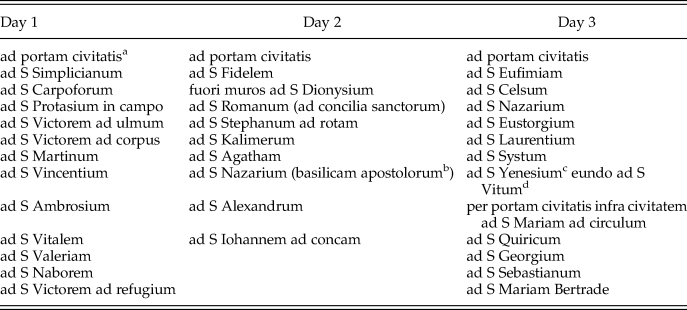
That there were three responsories and three antiphons assigned at Sanctus Andreas – which was not where Vigils of the apostle were held – is probably to be understood as a mark of special respect in a church whose patron was the saint celebrated that day. It is interesting that Sanctus Andreas is not entered in the Manuale's list of the churches visited on the three days of the great Litany (see Table 1). The church of St Andrew was perhaps a newer establishment, built after the original compilation of the Manuale, and this conjecture suggests that even the latest copies of the Manuale were out of date with respect to the circuits of churches visited. This is, in fact, borne out in a processionale copied in 1492,Footnote 56 where the list of processions, their routes and the psallendae differ significantly from those specified in older books.
Stations specified in the Manuale for the three-day litany.

a Which city gate is not specified in the Manuale. It is not clear why, on each of the three days, the first station after the clergy left the cathedral would have been one of the gates in the wall: Sanctus Simplicianus, the first church visited on Day 1, was in the centre of the city. Perhaps the gate was where all those taking part, clergy and laity, were mustered. The processionale at the Universtiy of Sacre Cuore, identifies (fol. 2v) the gate on Day 1 as the ‘carrubium porta’, that is, the Porta Ticinese, but on Day 2 the procession went directly from the ‘Winter Church to [the Church of] Sanctus Fidelis’ (fol. 22r), and on Day 3 ‘from the Summer Church to [the Porta] Canossa’ (fol. 38r). The processionale may have been copied in 1492, but these directions are at least a century older, before the building of the Duomo (begun in 1386), which replaced both of the old cathedrals.
b The church of San Nazaro Maggiore was originally dedicated to the Apostles.
c That is, Genesium. The titles of the churches in the table are as they are given in Magistretti's edition of the Manuale.
d The church of St Vitus was near the Ticino gate. Nothing was assigned there, and it may be that the direction was meant only to indicate where the procession re-entered the walled city.
The provisions for Sts Protasius and Gervasius in the Manuale provide only a few extra details. On the way to the Vigils church there was a stop at Sanctus Nabor, where three responsories and three antiphons with psalmody were sung (this seems to have been a particularly important station), after which the procession continued to the principal venue of Vigils, Sanctus Ambrosius, where (to this day) the bodies of Protasius and Gervasius lie. After Vigils, the procession stopped at Sanctus Vitalis where (as we learn from the Beroldo novo) the Vespers begun in the Vigils church were concluded.Footnote 57 It is unclear whether Sanctus Vitalis was where the procession ended, or was a station on the way back to the cathedral.
Vigils prior to the eleventh century
Finally, in this brief article are a few conclusions that might be drawn from the jumbled and conflicting directions for Vigils in the Manuale and the ordinal – conclusions pertaining to the time before the eleventh century. As we have seen, the general rubric for the office, given in the ordinal Beroldus compiled shortly after 1126, stipulates that psallendae from the three-day Litany – all of them penitential, and none specific to a stationFootnote 58 – were sung in the processions from the cathedral to the church where Vigils were held. But in fact, as early as the beginning of the eleventh century in the Manuale's oldest copy, all of the psallendae that were specified for those processions, all the responsories and antiphons sung at the main venue of Vigils, and all the chants sung at stations on the way and on the way back were either proper to the saint whose feast it was, or selected from the chants for the appropriate category (apostles, martyrs, confessors, virgins) of the Commune sanctorum. Beroldus, obviously (and obliviously), had incorporated rubrics that were outdated.
The revisions in the assignment of chants for Vigils are symptomatic of the liturgy as a whole. Times had changed, and the liturgy with them. It had evolved from comparatively simple, with relatively few chants whose texts were appropriate for a wide range of occasions, to something much more complex that favoured texts that were appropriate for specific days, hence the addition of saints’ chants to observances that had been purely penitential. The changing times saw changes in a civil society more and more occupied by secular pursuits, and this just as the ever-growing number of saints’ festivals with Vigils (all Western liturgies tended towards inflation, so to speak) was adding to the religious burden. In Gregorian regions, Vigils were severely curtailed, partly, as I suggested at the beginning of this article, because of this burden; and nothing demonstrates better the conservative nature of the Ambrosian liturgy – and the influence of the archbishop – than their continuance in Milan until the end of the Middle Ages if, that is, the contents of unrevised service books may be taken as evidence of continuing practices.
There is another observation to be made about Vigils earlier than the eleventh century. The stipulation that psallendae of a particular day were to be sung in the processions to the churches where Vigils were held, and the large number of such penitential chants (totalling seventy-six, thirty-eight for Day 3 alone) implies a connection between the one-day penitential office and the three-day Litany, a connection that went well beyond the simple reassignment of processional antiphons. The number of processional chants that were available on any of the three days is far greater than would be necessary to bring the clergy to the stations actually specified in the Manuale as we know it. There, it is made clear that on some occasions the procession returned directly from the Vigils church to the cathedral. But we may reasonably speculate that on the days when this office was held, it had once been customary to repeat (probably with the same readings and responsories at the stations) one of the circuits of the three-day Litany – whichever included a visit to the festival church. There, the observations were perhaps just as they were later: the Te Deum, the complete Psalter, any lessons, a penitential Mass and Vespers of the festival. In any case, there can be little doubt that at this church there were special observances.
The earlier practice for Vigils probably differed from the later in another respect as well. We learn from the invaluable Beroldo novo that after the last station of Day 1 of the Litany – and presumably on the other days as well – the clergy returned in procession to the cathedral, where Mass and Vespers were sung.Footnote 59 The eleventh-century general direction for Vigils in the Manuale prescribes, after Vespers in the festival church, processions that either returned to the cathedral or concluded in another church. But the premise that a complete circuit of the great Litany had been followed on days with Vigils would lead us to conclude that in earlier times, after the observances in the Vigils church, the procession carried on until that particular circuit of churches was completed, and then returned directly to the cathedral singing the last of the day's penitential psallendae.