I. INTRODUCTION
The phosphates with whitlockite-type structure crystallize in trigonal symmetry (Dickens et al., Reference Dickens, Schroeder and Brown1974). The whitlockite-type (β-TCP) structure is built of isolated PO4 tetrahedra, which connect the MO n polyhedra into a three-dimensional framework via common vertices. The crystal structure encloses five crystallographic sites different in size and oxygen coordination (M1, M2, M3, M4, and M5) (Yashima et al., Reference Yashima, Sakai, Kamiyama and Hoshikawa2003). The M1, M2, and M3 sites have eight-fold oxygen coordination. The M5 is the smallest and site has octahedral coordination. The surrounding of M4 and M6 sites are M4O15 and M6O13, respectively. The structural studies show that ions with radii ~1–1.6 Å, for example, cations of alkali metals and lead (Shannon, Reference Shannon1976; Sandstrom and Bostrom, Reference Sandstrom and Bostrom2006; Deyneko et al., Reference Deyneko, Stefanovich, Mosunov, Baryshnikova and Lazoryak2013), can occupy this (M4) site.
In connection with the substitution scheme (3Са2+) → (2Ln3+ + □) supplementary vacancies are generated and located in M4 site. The non-centrosymmetric structure leads to ferroelectric properties and observing phase transitions. Besides, phosphates with whitlockite-type structure demonstrate multifunctional properties, such as ferroelectric (Lazoryak et al., Reference Lazoryak, Morozov, Belik, Stefanovich, Grebenev, Leonidov, Mitberg, Davydov, Lebedev and Van Tendeloo2004), antiferroelectric (Stefanovich et al., Reference Stefanovich, Belik, Azuma, Takano, Baryshnikova, Morozov, Lazoryak, Lebedev and Van Tendeloo2004) luminescence (Benhamou et al., Reference Benhamou, Bessiere, Wallez, Viana, Elaatmani, Daoud and Zegzouti2009), termoluminescence (Bessiere et al., Reference Bessiere, Benhamou, Wallez and Lecointre2012), and ion conduction (Lazoryak et al., Reference Lazoryak, Baryshnikova, Stefanovich, Malakho, Morozov, Belik, Leonidov, Leonidova and Van Tendeloo2003). The distribution of REE was studied in phosphates Ca9Ln(PO4)7 (Bessiere et al., Reference Bessiere, Benhamou, Wallez and Lecointre2012). Measure of occupancy of M1, M2, M3, and M5 sites by RE3+ depends on ionic radius. In case of Eu3+ only three sites M1, M2, and M3 can be occupied by Eu3+. It was confirmed by Mossbauer (Lazoryak et al., Reference Lazoryak, Vitting, Fabrichnyi, Furnes, Salmon and Hagenmuller1990) results and luminescence spectroscopy (Lazoryak et al., Reference Lazoryak, Golubev, Salmon, Parent and Hagenmuller1989). The incorporation of high polarizable ion, such as Pb2+ or Bi3+ leads to noticeable changes of ferroelectric (Deyneko et al., Reference Deyneko, Stefanovich, Mosunov, Baryshnikova and Lazoryak2013) and luminescence (Yonglei et al., Reference Yonglei, Haifeng, Ran, Wenzhi, Qiang, Ran and Chengyu2014; Zhang et al., Reference Zhang, Song, Maa, Zhang, Yue and Liu2014) properties.
Therefore, in this paper, a detailed study of the structural and nonlinear optical properties of Ca9– x Pb x Eu(PO4)7 (0 ≤ x ≤ 1) phosphors is reported.
II. EXPERIMENTAL
A. Sample preparation
The new phosphates Ca9– x Pb x Eu(PO4)7 were synthesized by solid state reaction from stoichiometric amounts of Eu2O3, CaCO3, CaHPO4·2H2O, and PbO at 1223–1273 K for 120 h. The mixture was heated progressively with intermittent grinding at 473 K (12 h), 773 K (12 h), 973 K (12 h), 1173 K (24 h), and 1253, 1233, 1213 K (24 h) (for x = 0.2, 0.5 and 1, respectively) in air atmosphere.
B. Powder diffraction data collection and reduction
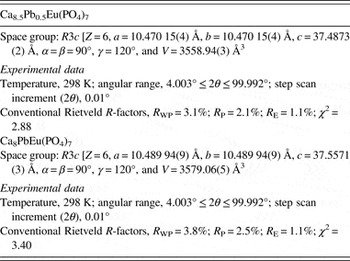
The room temperature powder X-ray diffraction patterns of the Ca9– x Pb x Eu(PO4)7 were recorded on Bruker Smart X2S. The main details of the data collection are given in Table I. To determine the lattice parameters, Le Bail decomposition (Le Bail et al., Reference Le Bail, Duroy and Fourquet1988) was applied. The Rietveld refinement of the structure was performed using the JANA2006 software (Dusek et al., Reference Dusek, Petrícek, Wunschel, Dinnebier and Van Smaalen2001; Petrícek et al., Reference Petricek, Dusek and Palatinus2014).
Crystallographic data and details in the data collection and refinement parameters for the Ca9– x Pb x Eu(PO4)7.

The second harmonic generation (SHG) response of powder samples was measured with a Q-switched YAG:Nd laser at λ ω = 1064 nm in the reflection mode. The experimental set-up is described elsewhere (Kurts and Perry, Reference Kurts and Perry1968). The intensities of the SHG signal (I 2ω) from the sample and that from a reference sample (polycrystalline α-SiO2 with 3–5 μm particles size) were registered.
The powders were checked for centrosymmetry by SHG tests, which were performed with a laser system using fine powders as described elsewhere. The SHG signal was excited by the 1.064-μm line of a Minilite Q-switched pulsed Nd:YAG laser. The second harmonic intensity was measured as a function of temperature at a wavelength of 0.532 μm in reflection geometry using both powder and ceramic samples. The optical nonlinearity of the materials was evaluated from the second-harmonic signal intensity I 2ω relative to that of a α-quartz reference powder with a particle size in the range 3–5 μm.
III. RESULTS AND DISCUSSION
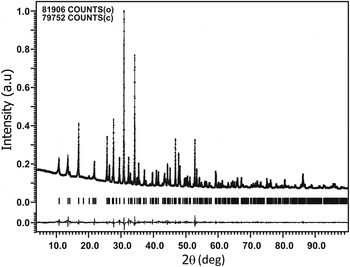
The experimental powder diffraction pattern is shown in Figure 1. Structural parameters are given in Table I.
Rietveld plot for Ca8PbEu(PO4)7 observed (crosses), calculated (solid) and angular positions of possible Bragg reflections (bars). Lower plot: (I c–I o) difference curve.

The unit cell parameters for Ca9– x Pb x Eu(PO4)7 are listed in Table I. All solid solution crystallizes in polar space group R3c, Z = 6. Initially, the structure refined by the Rietveld method was carried out starting from data (Benhamou et al., Reference Benhamou, Bessiere, Wallez, Viana, Elaatmani, Daoud and Zegzouti2009). Further, the population of the cation positions was refined. The JANA2006 program was ran using the pseudo-Voigt profile function to refined atomic coordinates and distances. The Ca/Eu splitting was not used in structure refinement.
At first, it was determined, that M5 site is fully occupied by Ca2+ ions. After that the occupancy of M1–M3 sites with Ca2+, Eu3+, and Pb2+ ions was found.
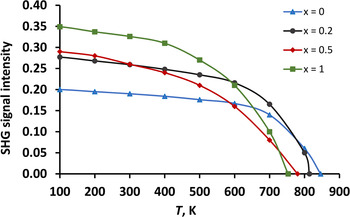
After the last refinement, there was a good agreement between the observed and calculated patterns. According to the obtained data, Eu3+ ions preferentially occupy M1, M2, and M3 sites with calcium, contradicting previously published Mössbauer results (Lazoryak et al., Reference Lazoryak, Vitting, Fabrichnyi, Furnes, Salmon and Hagenmuller1990). M5 site fully occupied by Ca2+. Pb2+ ions primarily enters into the M3 site and only then shares positions M1, M2 with calcium or Eu3+ ions. SHG tests evidenced higher nonlinear optical activity of Pb2+-containing compositions in comparison with Ca9Eu(PO4)7, and it also reveals ferroelectric type phase transitions to centrosymmetric group R3c → R–3c between 750 and 850 K (Figure 2).
(Color online) Temperature dependence of SHG intensity for Ca9– x Pb x Eu(PO4)7.

Structural mechanisms and dielectric features of phase transitions are strongly influenced by the exact distributions of guest atoms over the positions.
ACKNOWLEDGEMENT
This work was supported by RFBR, project no. 14-03-01100a.
SUPPLEMENTARY MATERIALS AND METHODS
The supplementary material for this article can be found at http://www.journals.cambridge.org/PDJ