Introduction
There has been a renewed call for a revaluing of care in order to counter the way that it is undervalued, taken for granted and invisible (Harding et al., Reference Harding, Fletcher and Beasley2017). Travel and transport planning is one area where a detailed critique of this issue has emerged with the concept of ‘mobility of care’ (Sanchez de Madariaga, Reference Sanchez de Madariaga and Roberts2013). However, this concept has only been applied in relation to younger age groups, and our understanding of mobilities of care in later life remains underdeveloped. This paper documents and explores the mobilities of care in later life, drawing on the mobility narratives of 99 older (aged 55 and above) people living in three different locations in the North of England who participated in a two-year qualitative longitudinal study that explored the inter-play between mobility, wellbeing and life transitions. We preferred to focus on the experience of managing life transitions rather than assume that chronology per se determines wellbeing. The study was part of Co-Motion, a three-year multi-disciplinary project that investigated the links between mobility and wellbeing in later life. Our intention is to demonstrate how caring routines and practices are a fundamental and previously under-recognised and rarely documented driver of some older people's patterns of mobility, and how enabling the mobility of others or ‘care-ful’ mobility is in turn an act of care.
Increasing longevity in modern societies, although rightfully celebrated, presents well-documented global challenges (Lloyd-Sherlock, Reference Lloyd-Sherlock2002; World Health Organization, 2015). Enabling people to live well and independently as they age, to access increasingly dispersed services and facilities, continue in paid employment, and remain socially connected with family, friends and the wider world is a major concern of policy makers. Maintaining mobility, conceptualised as ‘overcoming of any type of distance between a here and a there, which can be situated in physical, electronic, social, psychological or other kinds of space’ (Ziegler and Schwanen, Reference Ziegler and Schwanen2011: 758), is seen as key to this endeavour (Schwanen et al., Reference Schwanen, Banister and Bowling2012; Mackett, Reference Mackett2015; Ormerod et al., Reference Ormerod, Newton, Philips and Musselwhite2015; Shergold et al., Reference Shergold, Lyons and Hubers2015; World Health Organization, 2015). Thus, mobility in later life has been the subject of international multi-disciplinary attention where the focus has been variously directed to health, wellbeing, built environments, accessible transport systems, and older people's experiences and motivations (Hjorthol et al., Reference Hjorthol, Levin and Sirén2010; Andrews et al., Reference Andrews, Evans and Wiles2013; Murray, Reference Murray2015; Steele, Reference Steele2015; Graham et al., Reference Graham, de Bell, Flemming, Sowden, White and Wrightin press). Mobility, particularly active mobility such as walking and cycling, promotes physical and cognitive health and delays the onset of disabilities, thus enhancing life satisfaction and subjective wellbeing (Roe and Aspinall, Reference Roe and Aspinall2011; Gatrell, Reference Gatrell2013; Beute and de Kort, Reference Beute and de Kort2014; Nordbakke and Schwanen, Reference Nordbakke and Schwanen2014, Reference Nordbakke and Schwanen2015; Musselwhite et al., Reference Musselwhite, Holland and Walker2015; Northey et al., Reference Northey, Cherbuin, Pumpa, Smee and Rattray2017). Mobility in later life is associated with important values such as freedom, autonomy and flexibility (Mollenkopf et al., Reference Mollenkopf, Marcellini, Ruoppila, Széman, Tacken and Wahl2004). It is also a marker of inequality (Delbosc and Currie, Reference Delbosc and Currie2011; Adorno et al., Reference Adorno, Fields, Cronley, Parekh and Magruder2018; Franke et al., Reference Franke, Sims-Gould, Chaudhury, Winters and McKay2019). Mobility in later life is not just determined by physical capacities, but also by personal motivations (Ziegler and Schwannen, Reference Ziegler and Schwanen2011), financial resources, physical, cultural and social environments, the availability and accessibility of transport systems and assistive technologies that may help overcome any functional limitations, and social networks (Gilroy et al., Reference Gilroy, Attuyer, Bevan, Croucher, Tunstall, Murray and Robertson2016). Mobility is, therefore, not just the product of individual decisions by autonomous agents (Manderschied, Reference Manderschied2014), thus policy and research need to address the wider role of social and spatial contexts and inequalities, rather than over-emphasise the maintenance of physical health, understanding mobility not just as the physical capacity to move, but as the means by which people connect with and care and support others (Stephens et al., Reference Stephens, Breheny and Mansvelt2015).
Mobility in later life that is specifically related to informal caring has rarely been considered, although a small literature does explore caring and mobility. Wiles (Reference Wiles2003) explored the geography of care-givers (aged 40–80 years) caring for an older person at home, and considers aspects of care-givers’ mobility both in the home and beyond. Koker (Reference Koker2009) noted the costs of overcoming distance for ‘extra-resident’ carers. There are various studies, mainly from the United States of America, on ‘caring at a distance’, which reminds us that informal caring does not require co-presence although these studies do not explore the mobilities associated with caring at a distance, partly because defining distance is problematic (Cagle and Munn Reference Cagle and Munn2012; Douglas et al., Reference Douglas, Mazanec, Lipson and Leuchtag2016; Suanet et al., Reference Suanet, Borese van Goenou and Van Tilberg2019). There is also a literature on the global care chain and the transnational movement of workers in the care sector (see Yeates, Reference Yeates2012). Surveys of transport rarely ask questions about caring responsibilities as a purpose for mobility (Cornick et al., Reference Cornick, Byron, Templeton and Hurn2018). Therefore, as Sanchez de Madariaga (Reference Sanchez de Madariaga and Roberts2013) argues convincingly, the mobilities associated with care go unnoticed and unrecorded, in part because caring is generally invisible, unpaid work usually undertaken by women. However, her focus, as with other studies of gendered mobilities, appears to be on (younger) women juggling paid work and family caring responsibilities often for children (Grant-Smith et al., Reference Grant-Smith, Osbourne and Johnson2017; Jiron and Gomez, Reference Jiron and Gomez2018).
There has been little investigation of the mobilities associated with informal caring in later life and yet, as data from the English Longitudinal Survey of Ageing reveal, 60 per cent of all carers over 50 in the United Kingdom (UK) do not live with the person for whom they care (Vlachantoni, Reference Vlachantoni2010).
First we describe the Co-Motion study, then discuss what we mean by mobilities of care, drawing on the narratives of some of the study participants.
The Co-Motion study: purpose and methods
Co-Motion was a three-year multi-disciplinary, cross-institutional project designed as nine different work packages that investigated the links between mobility and wellbeing amongst older people in three North of England locations.Footnote 1 Ethical approval was granted by the University of York's Social Policy and Social Work Departmental Ethics Committee.
The concept of mobilities of care emerged during the analysis of data from the Transitions Work package, a two-year qualitative longitudinal study that explored the inter-play between mobility and wellbeing of 99 participants aged 55 or older (of whom 95 continued till the end of the project) as they moved through one or more critical, but common, life transitions:
• Stopping work due to retirement, redundancy, illness or disability.
• Stopping driving (through health, financial reasons or simply choice).
• Losing a significant part of sight or hearing.
• Starting to live alone due to bereavement, divorce, separation or a partner going into care.
• Taking on child-care responsibilities.
• Becoming a carer for a relative, friend or neighbour or stopping care responsibilities.
• Starting or considering using a mobility scooter or mobility device such as a walker, stick or wheelchair.
• Moving house.
All transitions were chosen for their potential impacts, both negative and positive, on mobility which in turn might be mediated by biographical or structural factors. Giving up driving might be embraced with relief or feelings of great personal loss, and may be eased or made difficult by the availability of alternative transport. Starting to use a walking stick or a mobility scooter requires a new presentation of self, and will be experienced differently in different places (such as poorly maintained or historical environments). Retirement might be a positive experience if a personal choice but less positive if forced by poor health, caring responsibilities or redundancy, or if constrained by disability or lower income. Spousal bereavement might be accompanied by a societal withdrawal when going out alone is experienced as lonely, an increase in driving for those whose spouse was the main driver or a shrinkage of activities if the deceased partner was the only car driver in their household.
Evidence highlights how later life is dynamic, and how the lifecourse has been deinstitutionalised (Hyde and Higgs, Reference Hyde and Higgs2004; Grenier, Reference Grenier2012), thus we focused on the experience of facing and managing transitions rather than assuming that chronology has special relevance in determining wellbeing in later life. Older individuals may be adjusting to one or several transitions as well as gradually changing physical or cognitive capacity, changing support networks, and structural change, all of which impact upon wellbeing. For example, 55 is the average age for becoming a grandparent and one characterised by being caught in the ‘sandwich generation’; perhaps exploring early retirement or moving closer to family to manage multiple responsibilities. Longitudinal methods that map both change and adjustment to change over time allow the exploration of the inherent dynamism of these experiences (Neale et al., Reference Neale, Henwood and Holland2012; Lloyd et al., Reference Lloyd, Calnan, Cameron, Seymour, Smith and White2017; Neale, Reference Neale2018).
Recruitment
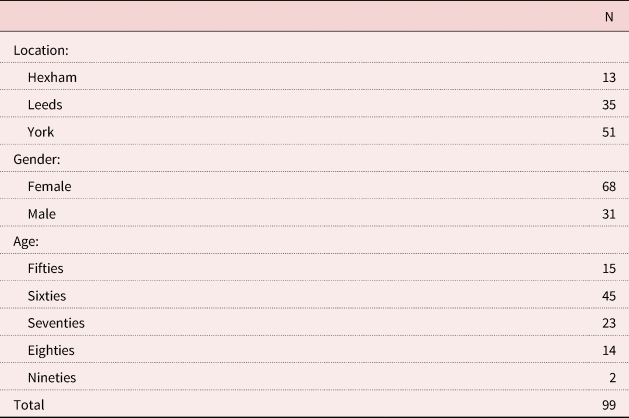
Participants were recruited using a variety of means to ensure diversity in age, gender, socio-economic status and ethnicity, including advertisements in local newspapers, posters and leaflets left in commercial and health-care locations, and distributed to a range of community organisations and organisations that support older people (Table 1). Researchers also visited various older people's social groups to introduce the project. No attempt was made to ensure an even distribution of participants across the spectrum of transitions, recognising firstly that in the course of the longitudinal study other transitions might take place and secondly that those who entered the study had often confronted or were still challenged by other non-declared life changes.Footnote 2
Co-Motion participants by location, gender and age

Methods
The Transitions Work package involved six transactions over a two-year period (2014–2016) between participants and the research team: a face-to-face semi-structured interview at the beginning and end of the project (spring 2014 and autumn 2016) both lasting usually about 90 minutes; and in between there were four shorter telephone interviews usually lasting about 20 minutes.
Telephone interviews are sometimes perceived as a less-effective means of gathering qualitative data due mainly to the absence of visual clues, although evidence is contradictory (Novick, Reference Novick2008; Drabble et al., Reference Drabble, Trocki, Salcedo, Walker and Korcha2016). Coming after the first face-to-face interview in the participant's home, when the researcher and participant had already established a rapport, the telephone interviews were a continuation of an ongoing conversation about change over time. We were also concerned not to over-burden participants with visits (Attuyer et al., Reference Attuyer, Gilroy and Croucherin press).
In the first face-to-face interviews we explored participants’ patterns of ‘getting out and about’, regular and less-regular trips and destinations, journeys participants would like to make, preferred means of travel, and the purpose, nature, value, importance and practical challenges of outings and journeys. We also discussed their recent transition and its impact on mobility. Telephone follow-up interviews focused on changes to mobility routines and practices. Final face-to-face interviews explored how participants’ patterns of mobility had changed over the course of the project, and how they had adjusted to the transition that had brought them into the project and any other transitions that had since occurred. All interviews (up to six for each participant) were audio recorded and transcribed (with participants’ permission for recording, otherwise notes were taken). More than 500 interviews were collated.
Data analysis
There is no standard framework for the analysis of qualitative longitudinal data (Soldana, Reference Soldana2003; Thompson and Holland, Reference Thompson and Holland2003; Neale, Reference Neale2018); studies vary in scale, are context-specific, with their own unique research aims, questions and conceptual frameworks. Data collated over time allows both cross-sectional (synchronic) analysis at key points and the exploration of change (diachronic analysis), as well as opportunities to develop and challenge initial interpretations. Analysis of the Transitions Work package data was undertaken over the course of the project in two main phases. The first followed the initial face-to-face interviews when interviews were coded using NVivo. The researcher team collectively generated the headings for the coding process, using the interview questions as an initial framework, but engaging in a process of critical reflection on the usefulness of the headings, generating sub-headings and new headings as themes emerged from the interviews. The telephone interviews were also coded, and again codes were revised following discussion within the team. The final stage of analysis followed the last face-to-face interviews, allowing the refinement and development of themes that emerged over the course of the study, and new themes arising from new questions, for example, personal strategies for adjusting to change over time. We produced a unique dynamic mobility narrative for each participant mapping various changes over time (Thompson, Reference Thompson2007). These narratives were then grouped into various thematic clusters, using the life transitions that had brought the participant into the study as the starting point, but then exploring other themes that emerged from analysis of the narratives.
The questions at the first face-to-face interview that asked about mobility routines and journeys people would like to make were those that revealed in the initial analysis how caring for non-co-resident older people shaped the mobilities of some participants. Few participants gave started caring as a transition at entry to the study. More often caring narratives stretched back in some cases years prior to the commencement of the project and for some participants had generated other more recent transitions, notably retirement and, in one case, moving house. Those who came into the study because they had ‘stopped’ caring had usually also been bereaved, often creating another major life transition, that of starting to live alone.
There were also many examples of journeys prompted by visiting or caring for grandchildren, adult children with impairments or chronic health problems, as well as individuals whose everyday mobilities were largely enabled by others. These important narratives will be considered in other papers.
What do we mean by care?
It is useful at this point to reflect briefly on what we mean by care in the context of the Transition Work package. We are mindful that ‘care’ can and has been defined in various ways (see Twigg and Atkin, Reference Twigg and Atkin1994; Conradson, Reference Conradson2003; Sevenhuijsen, Reference Sevenhuijsen2003; Fine and Glendinning, Reference Fine and Glendinning2005; Milligan and Wiles, Reference Milligan and Wiles2010; Wiles, Reference Wiles2011; Barnes, Reference Barnes2012), and definitions can be contested, indeed the words ‘care’ and ‘carer’ have been rejected by some in the disability movement as it places the ‘cared-for’ and ‘carers’ in a false position of opposition; caring is often reciprocal although enacted in different ways and sometimes at different times (Oldman, Reference Oldman2002; Molyneaux et al., Reference Molyneaux, Butchard, Simpson and Murray2011; Wiles, Reference Wiles2011; Barnes, Reference Barnes2012). A distinction is sometimes made between ‘caring about’ and ‘caring for’ (Milligan and Wiles, Reference Milligan and Wiles2010). ‘Caring about’ is considered part of any human relationship, it is a concern for the wellbeing of others. ‘Caring for’ is widely understood to refer to the practical ‘hands-on’ aspects of care where some tasks might be very personal and intimate, such as assisting with bathing, dressing and going to the toilet, and others less so – preparing food, organising finances, shopping and so forth (Parker and Lawton, Reference Parker and Lawton1994). Care can also be understood to ‘include everyday acts of practical and emotional support’ (Wiles, Reference Wiles2011), or even more broadly as ‘activities needed for the sustaining of daily life’ (Sanchez de Madariaga, Reference Sanchez de Madariaga and Roberts2013). Our questions were framed around mobility practices, thus we did not seek to explore in detail the nature of participants’ caring activities, however, it was clear that the purpose of many journeys was about more than simply social visiting, or for pleasure. Indeed, some participants described the purpose of particular journeys as being about ‘caring for’ non-co-resident significant others, including parents, siblings, ex-partners, friends and neighbours. Often visits involved undertaking various chores and household tasks and sometimes more personal aspects of care, as well as ‘going with’, taking people out sometimes for purely functional trips (shopping, health-care appointments), sometimes to enable someone to continue with regular social activities, and sometimes to go further afield for a change, outing or a holiday. Others spoke about ‘doing for’ others or visiting because people were lonely, ill or housebound, offering practical and emotional support. Thus, in the context of this paper, care is to be understood in its broadest sense to include personal care, and practical and emotional support.
How does caring shape mobilities?
It was clear there was no typical journey associated with the mobilities of care. These journeys could be short or long. Various travel modes were used including walking, cycling, driving, public transport (buses, taxis, trains), lifts from family, friends and neighbours, or a combination of these. However, for many of those whose mobility narratives were primarily driven by caring responsibilities, a car was essential even for short journeys, particularly when numbers of journeys had to be made, sometimes daily.
Regardless of distance, journeys could be more or less complex, for example, if there was no direct bus route or where a short car ride might terminate in struggling to find a suitable and safe place to park. They could be costly in terms of money, time, and the demands they made on individuals’ physical and emotional resources and capacities.
Some journeys were to ‘go to’ another person, most usually to their home, or residential care home or hospital. Some journeys were about ‘going with’ someone who was not able to travel very easily by themselves for a variety of reasons – poor health, sensory impairment, a lack of confidence or motivation to go out alone, or simply because they lacked their own transport. Some journeys were a combination of both – ‘going to’ someone's home and then ‘going with’ them to another destination.
There were various challenges associated with these journeys even when they were relatively short. For those journeys that were ‘going to’, participants spoke about carrying food, washing, shopping, small gifts – easy with a car, but not as easy on public transport or by bike or on foot. There were challenges too associated with journeys that needed to be made at short notice, perhaps outside the hours of public transport or when it was dark or the weather unseasonable and people would otherwise have remained indoors. For those journeys that were ‘going with’ there were the challenges of fitting aids (and people) into a car, finding parking spaces close to destinations, or negotiating public transport, identifying locations and activities that worked well for people with impairments, and ensuring people's wellbeing, comfort, safety and dignity while on the move.
Regular journeys that were part of an ongoing routine of caring, as well as the need to be available to respond to a crisis or emergency, obviously meant lost opportunities to go elsewhere and do other things. Some participants limited other commitments and activities, not planning too far ahead, not going away for long periods of time or travelling great distances, and for some deferring long-cherished plans to use the freedom of retirement to travel more.
These were journeys of great and varied emotions. They could generate anxiety, dread, fear, sometimes resentment, a sense of responsibility and, conversely, great pleasure from sharing happy experiences, being able to help someone and demonstrate love, affection, loyalty, or from simply feeling needed, and doing something worthwhile and important. These mobilities carried a certain and sometimes heavy imperative, quite unlike mobilities associated with social or leisure activities or day-to-day errands that might easily be postponed or re-organised or undertaken in a different way (e.g. internet shopping or banking) without serious consequence.
Narratives of care and mobility
To illustrate some of the key themes emerging from a larger cluster of narratives, we focus on seven narratives where caring responsibilities and practices were the main driver of mobility over the course of the project. All participants have pseudonyms to provide anonymity.
All are women's narratives as those in the study who spoke most about caring were women, possibly because the participants’ experiences reflected broader gendered patterns of caring (Haberkern et al., Reference Haberkern, Schmid and Szydlik2015; Carmichael and Ercolani, Reference Carmichael and Ercolani2016). However, this paper is not intended to explore the gendered nature of care relationships. There were male participants who talked about visiting parents or friends where the relationships were clearly mutually supportive, but these were usually described as social visits and meetings. Clearly this set of narratives needs further exploration with a focus on the language of care used by men.
Mobility and caring practices
We begin with the narratives of three participants – Kelly, Jessica and Kathleen – all women in their early sixties, too young in the UK to draw their state pensions, who had retired in the year prior to entering the study, in part due to caring responsibilities for ageing parents. Their mobility routines over the course of the project were almost entirely shaped by caring practices for which a car was essential for ‘going to’ and ‘going with’.
Kelly's story: ‘Commuting to care’
Kelly's mobility narrative focused almost entirely on journeys to see her father whom she had been visiting three or four times a week for the previous six years. He was in his nineties, living alone almost 50 miles away, a car journey of 45 minutes via a busy motorway. She described these journeys as ‘stressful’, ‘a nightmare’, like ‘commuting’. The cost of running her car consumed almost all her modest occupational pension. This small pension and her husband's income disqualified her from claiming any carers’ benefits. Occasionally she travelled by bus, which was ‘therapeutic and relaxing’ and cheaper with her free bus pass but took two to three hours and involved three buses. A car was essential not just because it made her journeys quicker and more convenient, but because she needed to take her father out by car.
As I say, in petrol and in maintaining the car, it's taking all my money that I've got, virtually, but no, no, the car is something … If that was gone then I'd be really snookered, and he [father] would as well, yes … So whether he was in [city] or whether he was here, it would be really important to be able to drive and do the things that we need to do. Yes. Yes. Yes, yes, and it's freedom for him as well. It's not just for me.
These regular visits precluded other types of journeys, for example, visiting children who lived abroad. Towards the end of the study a family crisis generated new caring responsibilities, and Kelly could not continue to visit so regularly. Her father, who had consistently refused to consider help from outside the family, found other ways of getting the help he needed in the home, and with transport. At final interview she reflected:
No way do I ever see anything about carers travelling. I think there's a difference between caring indoors and living with a person. I'm not saying it is better or worse, but the fact of having to travel through rush-hour traffic on the motorways and the volume of traffic and everything else, and with winter just starting now as well, that has an impact greatly.
Jessica's story: ‘You need to be fairly fit to be a carer’
Jessica had spent most of her first year of retirement helping her parents, both in their late eighties, to move from their former home some 40 miles away to sheltered housing nearer to where she lived, although still a short car journey away. Her parents settled well in their new home with more company and easier access to local amenities. At first interview Jessica spoke about the relief she felt in being able to visit them more easily, describing this as a ‘massive improvement’, and pleasure in taking them for outings, something they all enjoyed:
So, that's pleasurable, that part of the journey when I turn off the ring road, down to [village]. It always feels a relief to me that they're there and that it's nice. When I take them out, we go out into the [National Park] or we'll go over to the moors or to [seaside] on Saturday. That's very pleasurable, yes.
She talked about what made outings easier or more difficult, for example, being able to lift and fit mobility aids in her car, and disabled parking badgesFootnote 3 that allowed use of designated parking spaces:
My mother uses a walker. That's great, it's a great thing the walker but of course it's to put in the car, so my car's just big enough for instance to put a walker in the boot. We've had a wheelchair; I've borrowed a wheelchair a few times from [charity] which is really good but, again, actually getting that wheelchair into the car. You know, if I wasn't fit and able, my dad couldn't do it anymore. So, in that respect you need to be fairly fit to be a carer of somebody using a walker or a wheelchair, or even just a stick, you know, for my mum; you've got to be fairly fit.
Without those blue badges it would be very, very difficult to take them anyway at the moment. They're a godsend, absolute godsend … It means you don't have to walk, they don't have to walk so far and also it's safer, so, even just going to [supermarket], if you can get a disabled place close to the doors it is safer. It's not particularly the cost; it's just the fact that it's safer and more convenient for them.
Over time her parents became increasingly frail. They both spent periods in hospital, meaning more visits both to the hospital and to the parent at home alone. At final interview Jessica's own mobility was increasingly constrained. She took less exercise, using her car more simply to save time. She postponed surgery on her foot because it would limit her mobility albeit for a short period, and she needed to be mobile to assist her parents. Travelling further afield for social or leisure purposes was curtailed and retirement travel plans postponed:
Yes, I would say I'm on the road driving an awful lot more than I was, yes, and that is because of the need to get to [parents’ home] sometimes twice a day, there and back twice a day, certainly to the hospital. That's been since July really, so yes, that's a big change for me. I used to walk into town. Every time I went to town, I walked. I haven't done that for months, no, just not had time to do it really, which is a shame.
Kathleen's story: ‘I find it embarrassing’
Kathleen had retired with a certain reluctance as her parents, in their late eighties, needed more help and this was difficult to manage with full-time work. They lived within walking distance of her home, and she visited them almost daily, usually going by car so she could take them out, sometimes individually to give them a break from each other's company:
So I try and take him [father] out somewhere just for a little walk in the park. Also he needs to be separated from my mum. So, I don't take them together. Mum can't walk now anyway. So that's another responsibility with trying to make sure he gets out and that my mother does as well.
She also spoke about the value of disabled parking badges, but noted their limited usefulness when key destinations often lacked sufficient designated disabled parking spaces. Her preference was sometimes to use taxis, something her parents felt was extravagant:
For example, this week my mum had an appointment at the [hospital] for a hearing aid and I said, ‘Mum we will not get a place to park. I know what it's like on an afternoon. Let's get a taxi.’ Well, we had the most massive row about trying to use a taxi which I knew would be a door-to-door service. In the end we did go by taxi and there wasn't anywhere to park and for me as a carer to take somebody to these public places it isn't easy at all.
She also spoke candidly about her feelings of embarrassment when out with her mother:
Because she's got visual impairment, we wouldn't let her go out looking a mess and yet often she does because she finds it difficult with personal care. She can't brush her hair. She doesn't know if the clothes are dirty and we say, ‘Mum your trousers need changing’ or she wears a lot of white – well I don't wear white – and there are stains and we say, ‘Mum…’, ‘Oh just leave it. I'll cover it up with a scarf’, and it is just things like that. My sister and I struggle with that more than anything because you don't want to see your mum or a close member of your family like that.
But if we go to the supermarket, I know what things my mother likes and if it's not there she doesn't believe me and she'll start grabbing whoever is there, ‘Can you just see if they've got…?’. And it's often not an assistant even. Well, I find it embarrassing.
These narratives illustrate several central themes. Having a car and being able to drive is central to mobility and caring routines regardless of distance, enabling flexibility and freedom for all. Public transport was not a viable alternative, except for door-to-door services such as taxis. They also demonstrate the limitations of car travel: parking can be problematic; vehicles might not easily accommodate people with impairments or their various mobility aids. They demonstrate how care-ful mobilities, or going with, are a major element of caring practices and responsibilities, consuming carers’ time and physical, emotional and financial resources. The varied emotions generated by the mobilities of care are also clear in these narratives: anxiety, stress, pleasure and embarrassment.
Mobility and caring: bringing pleasure and interest
The narratives of Rebecca and Celia, again both recently retired and in their early sixties, focused on their journeys to or with parents living in supported accommodation. The purpose of these journeys was not ‘hands-on’ care but to bring pleasure and interest to their parents. These journeys were considered the ‘most important’, and were made usually at least weekly.
Rebecca's narrative focused on her trips with her father. He was living with dementia and had recently moved to supported housing near to her home where he received assistance with day-to-day domestic tasks. She remarked that prior to this move she and her husband had spent more time on the road making the 300-mile round trip to visit him every weekend than they had actually spent with him during their visits, which had been rushed and focused on practicalities such as ensuring there was food for the week in the fridge. He was able to find his way to her house but was unable to make other journeys unaccompanied. She took him out at least three times a week, and indeed felt guilty if she went out without him:
Taking dad out can be a pleasure; on the other hand, it depends what sort of mood he's in because he's got Alzheimer's so some days, he's fine. Other days, the lights are on and nobody's in; it can be difficult.
In the final interview, after her father had died, she reflected on the challenges and rewards of the journeys they had made together. She described her anxiety while out with her father, making sure he had his bus pass ready when he got on the bus rather than hold up the queue searching for it, avoiding crowded places as she needed to keep him in sight all the time in case he got lost:
If I'd lost him, I'd have been in a right panic but it was like taking a two-year-old with you because you'd got to make sure he hadn't stopped or wandered off, because if you'd lost him then I don't think he could have got back home and that thought was scary.
While it could be stressful, she was obviously delighted with the pleasure these outings gave him, particularly a singing group for people living with dementia:
Dad used to love going out. He didn't know where he was going or what he was doing but he just liked to go out looking at things. He was an engineer and he loved to see how things worked and he'd stand and stare at things for ages working out how it worked, and he just liked being out, he liked doing things, he liked going to the supermarket. He'd spend an hour going for a small basket of things but … he loved going to the singing group, he really loved that. If I'd have realised how much I would have tried to get into it earlier.
Celia's story: ‘It's important to her that she gets a visitor’
Celia had recently retired and was looking forward to this new phase in her life. At first interview, talking about her most regular journey – visiting her mother in a care home – she struggled to describe the purpose of her visits. Her mother had Alzheimer's disease. The visits could sometimes be distressing:
Visiting my mother, I would like to say hand on heart that it was for pleasure. But it's kind of … duty, yes. You know it's a difficult thing really, isn't it? I'm the only sibling left up here … so if I don't go, she doesn't get a visitor. Sometimes it's hard. Sometimes it's a really nice experience.
However, Celia was clear that these visits were the ‘most important’ journeys that she made. She would usually drive, but on occasions she would get someone else to take her:
The important trip is actually going to see my mum, at the end of the day. That is supporting in its way. I do have to drive there. I can get there by train, but I have to go into [city] and get the train back out again. Like this week I can't drive, obviously, because of my eye. I would have gone this morning but I'm having to wait until Saturday, when somebody can take me.
Her mother's care home was a good distance away, but chosen because Celia was confident in the quality of the care:
She's such a long way away because the home is owned by a friend of mine that I've known her since she was 14 … and I feel comfortable that my mum's being looked after because you have really horror stories. So, it's worth the 40-minute drive.
The return journey from her visits provided an opportunity to relieve some of the distress she experienced when visiting her mother:
I do tend to go and do some retail therapy after I've been to see her, just as a bit of light relief, if you like. Just a release, even if it's only just a wander around the shopping centre, just so that you're not just going there and back. You're going into the country, as well, which is nice.
During the study Celia's mother died. At final interview she reflected how she was now able to commit to doing more. Previously she had been ‘on call’:
Even though I only used to go over once a week to the care home, I was always on call, if you like, and there quite a few times I was called out. So now I haven't got that, I do tend to be able to feel that I can involve myself more in regular activities. I can commit more to going out and being part of a walking group or, yes, I'll be able to do this, then, whereas before I always used to say, ‘Well, I don't know. I'll be able to tell you nearer the time’, sort of thing. So yes, it has altered. I can have more going on in my life because I can plan better. I felt as if I couldn't plan before.
Rebecca's narrative illustrates ‘going with’ or caring on the move, and how enabling the mobility of another person is an act of care. Being mobile enabled Celia to choose her preferred (and distant) care setting for her mother, to visit and to be ‘on call’.
Mobilities of non-kin support
Finally, we present the narratives of two older participants – Jackie and Isla. Both visited numbers of other older people regularly, usually bringing practical and emotional support, sometimes ‘hands-on’ care, and playing an important role in a wider network of family support and formal care provision. Neither had a car, either walking, in Jackie's case cycling, or using public transport and lifts from others to make their journeys.
Jackie's story: ‘Doing for poorly people’
Jackie was 78 at first interview. She had mobility problems all her adult life, and recently had started using a walking stick – the transition that brought her into our study. Jackie had never driven, making local journeys by bicycle or on foot, and journeys further afield by public transport. She had a wide social network and was a member of various faith, social and voluntary-sector groups, however, her mobility narrative over the course of the project focused on two older people that she visited several times each week. At the first interview she said:
So, I do two poorly people at the moment.
Both these individuals were old friends. Lawrence, a widower in very poor health, was effectively housebound. Alice, a friend for almost 60 years, was living with dementia. They both lived alone but nearby. Both had family support. Lawrence had paid carers visiting daily. At first interview Jackie described cycling to visit them:
From [home] it's pushing my bike up a hill halfway to him and then another bit of a hill to get to her and then it's flat. I've got lights on my back; I only do pavements at night. I'm illegal on the pavements I know but nobody's ever got me.
She was unwilling to take on other regular activities:
Because if you commit yourself to one thing every day, I can't just suddenly go somewhere when people need you.
Jackie's visits to Lawrence involved in the main taking pre-prepared home-cooked meals. She had also paid a retired neighbour with a car to drive them for a ‘little run out’ into the countryside. Her visits to Alice were partly sociable but also involved acts of care, for example, Jackie described going to a specialist shop to purchase some easy-fit slippers for Alice:
I had to go to Alice's to see if her slippers fit … She wanted wine and the only colour they had in size five was navy and she was thrilled to bits. So, I left her wearing them.
As well as these regular commitments that continued over the course of the project, Jackie talked about various journeys that had care as the main purpose. For example, she had taken a friend to visit another friend in a taxi:
Because [friend] isn't fit to go on her own, she's a bit wobbly now, she's 87, has a stick, but [they] have been friends for years.
She was helping another friend, recently widowed, to get used to public transport:
When she passed [her driving test] she hardly ever drove you see, her husband did. Now he's gone, I'm going to have to get her bravely from place to place on buses … I've got to try and get her brave, she's 86, but not a doddery 86.
By the end of the project her two friends that she saw almost every day had deteriorated in health. Trips by bicycle were sometimes replaced by taxi rides, paid for by Lawrence so Jackie could bring his washing home. However, payment was problematic as Lawrence was no longer allowed by his family to keep money at home because it was alleged that one of his paid carers had been stealing from him. Once she had to ask a neighbour to drive her to Lawrence's house in the early hours of the morning as he had fallen; they waited two hours with him for the ambulance.
Alice's family would call on Jackie in an emergency. One New Year's Day they rang Jackie and asked her to visit Alice and ensure she had something to eat, which Jackie did. At final interview she said:
Since I've seen you last, and because of all the trauma with these people, my sleep patterns have changed a bit. I've found I don't sleep as well because I'm thinking, what can I do tomorrow?
Isla's story: ‘I try and do as much as what I can’
Isla, a widow aged 81 at first interview, lived alone. She volunteered regularly and belonged to various social groups. She had many friends, some nearby but others further away, all mostly of her own age, many of whom she had known for years. Her transition was giving up driving which did not trouble her greatly as she had never been a confident driver, was fit and well, and most services were within walking distance of her house which meant she exercised more. Family and friends gave her lifts if needed. Her only regret was not being able to visit old friends as easily, particularly those who were unable to get out very much and had depended on her for lifts, shopping and so forth. Over the course of the study she spoke often about various visits to old friends who were for the most part unwell which were more than just social or for pleasure:
I was visiting one yesterday that I must have known for 50 years, and she's just had a heart attack … I haven't got the car now, so I caught two buses, but then I walked back, so that's about mile, so that did me good. Whilst I was there I washed her hair, which was good … I felt quite happy that I was able to go and visit this friend that's had this and help her. I didn't like waiting at bus stops – it was a bit cold.
On another occasion she spoke about going out with another life-long friend who had serious health problems:
Well, my daughter went with me, and this [friend] said, ‘Oh no, I'm too tired to go out’, but we made her go out, and we took her to park, and we had a coffee. In fact, my daughter took a photo of the two of us, which I am going to put in a frame.
Isla also regularly visited another friend who lived nearby more, it seemed, out of kindness than for pleasure:
I really pity her, I try and help, well I feel sorry for her because she's one that keeps to herself and when she's depressed she's got to cope with it by herself and she won't go on medication or anything … But other people would have packed her in because she can be quite nasty, but I think it's just her. In fact, she's actually said, ‘I don't know why you keep friends with me.’ I go say once a month and she won't come over here. I wouldn't cut her off, and she says she feels better for talking, so I try and do as much as what I can.
When asked about journeys she would like to make, Isla spoke about visiting a friend who had moved to a care home, a long and difficult journey by public transport:
But it's [care home] difficult to get to. It's sort of out of [city] and then it's in a little village outside [place name], and the link up to get home from this care home into [city] you've got to leave at, oh, well I think about four o'clock, well – by the time you get there. The school friend that takes me out on a Wednesday said that she'd drive me over, but I don't really like asking her. Well I mean I haven't asked, she's volunteered, and I feel very – it's an awful shame.
These narratives illustrate themes of friendship in later life, and how caring practices extend beyond family, and indeed can underpin family and formal support. They also illustrate how those without a car use a variety of modes of transport – bike, by foot, buses and lifts from others with a car.
Discussion
The rich longitudinal qualitative data, the relatively short time between each wave of the study, the large number of participants and low attrition rate allowed us to identify nuanced patterns and changes over time in mobility, revealing caring as a previously under-recognised motivation and purpose for mobility in later life. The idea of the mobilities of care in later life builds on but is distinctive from the work of Sanchez de Madariaga (Reference Sanchez de Madariaga and Roberts2013), and sits at the interface between the various schools of social gerontology and human geography (Skinner et al., Reference Skinner, Cloutier and Andrews2014).
These data highlight how personal mobility mediates caring relationships with others, and caring responsibilities mediate personal mobility. Caring routines and practices were often dependent on access to private transport; mobility unrelated to caring was constrained by caring responsibilities. The data also demonstrate the interdependency of mobilities, as the mobility of different individuals come together in chains in a variety of ways. As Kelly remarked, her car gave her and her father freedom; Celia's father would have been unable to go out without her; Isla and Jackie travelled independently, but occasionally had lifts from family and friends to enable them to visit and support others. Individual narratives also consistently document how ‘going with’ or care-ful mobilities enable the mobility of others and are acts of care. Thus, we would argue that the mobilities of care have a particular and under-recognised significance in the lives of older people, and are distinctive from the usual motivations presented to explain their mobility, and used to inform policy and practice across different domains of transport, housing and neighbourhood planning.
Jensen (Reference Jensen2013) emphasises the relational nature of mobility and its importance for identity construction, that mobility is an embodied experience that can alter our disposition and sense of self. These mobilities of care tell us much about identity in later life – being a dutiful child, loyal friend or just a caring person – enacting roles that are and have been key over the lifecourse to people's sense of self, particularly as they and others in their family and social networks age, and face later-life transitions.
Clearly ‘going to’ and ‘going with’ journeys of care can generate a range of emotions: pleasure from being with others and seeing others enjoying themselves, the sense of doing the right thing, a sense of purpose, as well as anxiety, stress and sometimes embarrassment highlighting the sensory and emotional experiences of movement, as well as some of the difficulties and barriers faced by people with impairments and care-givers undertaking shared journeys (Law, Reference Law1999; Wiles, Reference Wiles2003; Adey, Reference Adey2010; Gaete-Reyes Reference Gaete-Reyes2015).
LaPierre and Keating (Reference LaPierre and Keating2013) make a distinction between less-intensive or less-personal care that friends provide that offers more protection against loneliness and social isolation, and the care that family provide that is more personal, given in times of illness or growing disability. Bowlby (Reference Bowlby2011) suggests that some types of care require bodily co-presence, thus ‘friendship’ support depends on being local. Our data suggest a more nuanced reading is required. Some individuals made long journeys to see friends, giving personal care as well as support and company. We would argue that these ‘lighter’ tasks should be more valued given the pernicious effects of loneliness and social isolation (Department for Digital, Culture, Media and Sport, 2018). Moreover, such journeys and visits often underpinned formal care services and family care, illustrating the various ecologies of care that support many older people. Our work might inform thinking about the relatively unexplored geographies of friendship, particularly in later life (Bowlby, Reference Bowlby2011). Are our friendships in later life mediated by our mobilities rather than geographical distance? Jerrome and Wenger (Reference Jerrome and Wenger1999) showed older people's friendship networks changing over time, with a withering or fading of previous friendship networks. Is this about incapacity, mortality or does mobility play its part? It may be argued that digital connectivity might play a greater part in maintaining relationships. Many participants were comfortable with technology, using internet banking, shopping and Skype for long-distance family conversations. However, connecting with friends was telephone-based or a face-to-face activity, particularly when someone was ill or housebound. These issues are clearly dynamic.
Social networks over time and space
The narratives also highlight the need to consider how social networks rather than just physical environments support older people to live well. Boyle et al. (Reference Boyle, Wiles and Kearns2016) suggest that it is not just the immediate physical spaces that enable ageing in place, but the social relations developed by older adults across different spatial scales and over time. The participants’ narratives demonstrate that older people's social networks, both family and friends, extend across a wide geographical territory. The mobilities associated with care require going further afield than just neighbourhood and indeed reflect mobility across the lifecourse. The idea that older people are static, ‘in place’ (living in the same house, same neighbourhood, connecting with the same geographically close social networks) is clearly flawed, particularly in an era where personal mobility and social networks have at least for some become so extended. Personal ecologies of care and support – including both giving and receiving – extend widely across space and time.
Active ageing
The narratives certainly support those who challenge the dominant model of active ageing with its focus on the individual self-supporting and self-focused older person, keeping fit, continuing to work, an informed consumer, taking an ‘active’ role in their communities, civically engaged and crucially not burdening the public purse (Martinson and Minkler, Reference Martinson and Minkler2006; Clarke and Warren, Reference Clarke and Warren2007; Higgs et al., Reference Higgs, Leontowitsch, Stevenson and Jones2009; Hung et al., Reference Hung, Kempen and De Vries2010; Liang and Luo, Reference Liang and Luo2012; Macnicol, Reference Macnicol2015). For some participants later life was a time when there was a prolonged focus on the needs of others, often at no small cost to personal health, and financial and emotional resources. The retirement transition was for some shaped by caring responsibilities and the ageing processes of others rather than being a time to ‘exploit the possibilities for a new, active and positive phase of life’ (Principi et al., Reference Principi, Santini, Socci, Smeaton, Cahill, Vegeris and Barnes2018). This supports ideas of solidarity in later life (Phillipson, Reference Phillipson2015) and exposes simplistic assumptions that older people are only concerned with personal autonomy rather than actively continuing with or taking on caring and support roles. With the continuing retrenchment of state support in care, older people will increasingly be supporting other older people – kin and non-kin. Being mobile is key to these caring intentions and practices; the mobile will be better equipped to offer care and support to others. The narratives remind us of ‘the need to develop a robust alternative to the individualising and ultimately sterile dominance of the autonomous subject of neo-liberalism’ (Barnes, Reference Barnes2012: 183).
Conclusions
This exploration of mobilities of care supports ongoing calls for better design of built environments, streetscapes, transport systems and vehicles in line with age-friendly agendas, and has also revealed several transport and social issues which could be addressed by changes in policy and practices.
A systematic enquiry is required into the mobilities of care through inclusion of explicit questions related to caring in transport surveys, and questions relating to mobility in surveys of carers. While qualitative data can highlight themes and lived experiences, focused survey questions would allow some measure of the numbers and mobilities of carers. Such enquiries might better inform transport planning, and possibly temper the current policy emphasis on active travel and the environmentally preferred use of public transport which may not fully recognise the needs of those who are travelling for the purpose of caring, or those who are caring on the move.
Concessionary travel for older people should allow others to travel with them at reduced costs (as is the case in Ireland where a Free Travel Companion Card is available). Carers’ benefits and allowances (where these are available) should take account of travel costs associated with caring.Footnote 4
Finally, there is a need to pause and consider the wider implications of extending working lives and acknowledge the caring roles of older people.
Data
Further information about the data and conditions for access are available on the University of York's Research Database: 10.15124/aa7fa95c-8d7d-4b5d-b843-070a3f1e1ca3.
Acknowledgements
We thank the Co-Motion participants.
Author contributions
All authors have reviewed and contributed to the writing of the submission, and approved submission to the journal.
Financial support
This work was supported by the Engineering and Physical Sciences Research Council (EPSRC) (grant number EP/K03748X/1) as part of the EPSRC's programme Design for Wellbeing: Ageing and Mobility in the Built Environment. The EPSRC played no role in the design, execution, analysis and interpretation of the data, or writing of the study.
Conflict of interest
The authors declare no conflicts of interest.
Ethical standards
Ethical approval was granted by the University of York's Social Policy and Social Work Departmental Ethics Committee.