Mass gatherings (MGs) and special events typically involve large numbers of people in unfamiliar settings, and are commonly related to sports, arts, political, religious, or other community events. Special events can create situations that are highly unpredictable and volatile, as the infrastructure for large crowds is often temporary, attendees are unfamiliar with their environment, and the location or venue may not be designed for the numbers of people attracted to the event.Reference Lund, Gutman and Turris 1 Accordingly, such events require special planning to address the increased incidence of illness and injury among those attending and mitigate the impact on local health service levels in the host community.
Mass casualty incidents (MCIs) occur in the context of special events and present unique challenges. Lund and colleagues have suggested that many aspects of providing medical support for MGs overlap with the skill set and expertise required to plan and implement a successful medical response to a natural disaster, terrorist incident, or other form of disaster.Reference Lund, Gutman and Turris 1 World news sources have reported examples of MCIs in the context of MGs such as fires during music concerts, stage collapses during music festivals, and deaths due to human stampedes. The recent bombing at the finish line of the 2013 Boston, Massachusetts, marathonReference Jangi 2 underlines the importance of advancing our knowledge regarding MGs and MCIs.
Although the literature related to MCIs is substantial and exploring MG medicine is growing, little information is available to guide emergency services and onsite medical teams in planning and preparing for potential MCIs at MGs. We believe that this study represents a first step in addressing this gap in the literature. The purposes of this study are to document and analyze the types of MCIs that have occurred in the context of MGs in the past 30 years.
Literature Review
A review of the literature found 1 systematic review of MCIs in the setting of MGs. Soomaroo and Murray reviewed 21 published cases regarding crowd-related disastersReference Soomaroo and Murray 3 and developed 4 categories related to event success: crowd control, fire safety, emergency preparedness, and emergency response. The authors acknowledged the difficulty of completing a systematic review with so few published reports in the peer-reviewed literature.
Methods
In the context of special events, this study presents an analysis of worldwide MCIs reported in the English-language academic and gray literature. The primary research question for this review was concerned with what is currently known about MCIs in the setting of MGs. Specifically, we focused on understanding the numbers and types of MCIs having occurred in MGs or special events: (1) sources, quality, and limitations of the evidence available for analysis; ways to classify and categorize MCIs inductively for use by researchers and event planners; and (3) common themes regarding MCIs at MGs that might guide prevention and mitigation efforts.
We conducted a search of English language articles published in academic and mainstream media between 1982 and 2012. An iterative search strategy began with the review of selected online databases, including OVID, PubMed, EBSCO, MEDLINE, CINAHL, Business Continuity & Disaster Recovery Reference Center, and Google Scholar (Table 1).
Health Care Databases and Other Sources Searched

As noted by Soomaroo and Murray,Reference Soomaroo and Murray 3 the academic literature on MCIs in MGs is limited. Hsieh and coworkers have indicated that nontraditional sources must be used to develop an understanding of the epidemiology of MCIs.Reference Hsieh, Ngai, Burkle and Hsu 4 Thus, the search was expanded to include selected Internet-based gray literature.
Evidence about the burden of disease (ie, measurement used to assess and compare the relative impact of different diseases and injuries on populations) would allow quantification of the injury problem and the exploration of causative factors. In addition, such data would support the development of preventive measures.Reference Polinder, Haagsma and Lyons 5 The current project analyzed the best evidence available at the time.
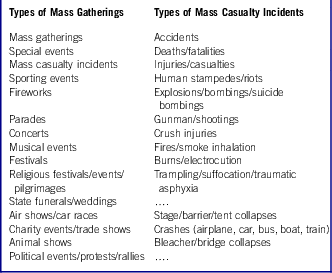
The initial search terms focused on types of MGs. However, as cases were identified and examined, the search terms were expanded to include types of incidents that were causing injuries during the MGs (Table 2).
Search Terms Used

Inclusion and Exclusion Criteria
Cases were selected for review if they (1) described an MCI in the setting of a special event (eg, sporting events, festivals, parades, fireworks displays, nightclub special performances, political rallies, and religious gatherings; (2) resulted in injury or death of 10 or more people (a threshold based on the assumption that most urban emergency departments could manage fewer than 10 injured people at any given time, depending on the severity of the injuries); (3) occurred between 1982 and 2012; and (4) were published in English.
Reports were excluded if participation in the special event itself was the cause of the injuries or illnesses (eg, individuals who sought care while running a marathon, no matter how high the presenting numbers, did not constitute an MCI for the purposes of this study). A secondary incident had to have taken place in the context of an MG (eg, individuals who sought care for running related injuries while participating in a marathon, no matter how high the presenting numbers, did not constitute a MCI for the purposes of this study). Also, reports were excluded if the MCI was not associated with a special event but took place in a location or setting where large numbers of people routinely are together (eg, airports, schools, factories, prisons).
Data Extraction
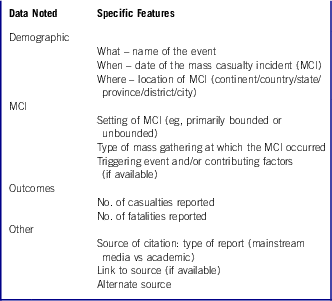
Each case was entered into a computer spreadsheet (Excel) with a specific focus on the variables of interest (Table 3). Classification and categories for MCIs were identified inductively, as the data were collected and analyzed. MCIs were then summarized using descriptive statistics.
Data Extracted for Manuscript and Mainstream Media Review

Research Rigor
Data extraction criteria were generated by 2 of the authors (S.T. and A.L.) based on (1) research questions, (2) expert opinion as presented in MCI reports, and (3) decades of experience in the field of MG health and special events. To prevent data collection “drift” and reduce internal bias,Reference Stratton 6 the authors submitted the study plan (ie, literature search parameters, variables of interest, data extraction spreadsheet) for internal expert review by an MG medicine research team (R.B., and others) at the Justice Institute of British Columbia before starting the study. When questions arose regarding inclusion or exclusion of data, issues were taken to this group for clarification and consensus.
Ethics approval was not required, as data were collected from publicly available reports and publications.
Results
Descriptive Statistics
A total of 290 cases met the study criteria. Full details are available on request (http://www.ubcmgm.ca). The data available in the current literature on these cases have been included here. Of 290 cases, 63 (22%) were from academic literature; the remaining 257 cases (78%) were drawn from other sources.
Demographic Data
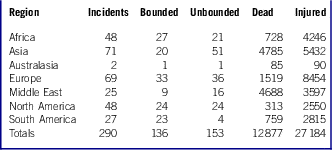
Incidents were distributed across 7 geographic areas: Asia (71; 24%), Europe (69; 24%), Africa (48; 17%), North America (48; 27%), South America (27; 9%), the Middle East (25; 9%), and Australasia (2; 1%) (Table 4).
Locations and Characteristics of Mass Gathering Events

Event/Incident Data
According to the setting, MGs were classified into 1 of 4 categories based on a taxonomy developed by the authors. The majority of cases were related to sports (100; 35%), followed by arts (87; 30%), and religious or political (72; 25%) events. The remaining cases (31; 10%) were categorized as miscellaneous. The majority of events had no fixed physical boundaries (unbounded: 153; 53% vs bounded: 136; 47%).
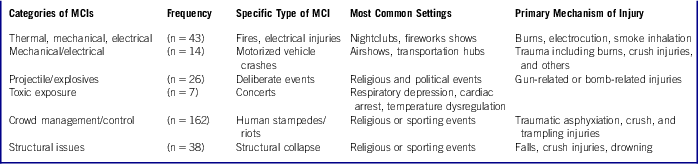
The initial categorization of the MCIs occurring at special events was based on the primary reason or cause for the majority of casualties or deaths. The most frequently reported mechanism of injury involved the movement of people under crowded conditions (162; 55.9%) followed by special hazards (eg, airplane crashes, pyrotechnic displays, car crashes, boat collisions; 57; 19.6%), structural failures (eg, building code violations, balcony collapses; 38; 13.1%), deliberate events (26; 9%), and toxic exposures (7; 2.4%). Table 5 shows the conceptual classification and associated categories of MCIs in this study.
Categories and Classifications of Mass Casualty Incidents (MCIs)

Outcomes Data
Outcomes data were difficult to determine. A report published on the day of an MCI would provide a fatality count; however, different figures were sometimes published in the weeks and months thereafter. Accordingly, the most conservative figures were inserted for the spreadsheet (eg, several injured was interpreted as 3, dozens of injured as 24, scores of injured as 40, and hundreds as 200). This approach was similar to that used by Hsieh and colleagues in their review of human stampedes.Reference Hsieh, Ngai, Burkle and Hsu 4 Given these factors, the figures reported herein should be interpreted as estimates. Based on our findings, in the 290 cases reviewed 12 877 people died and 27 184 were injured.
Discussion
Underdeveloped Knowledge Base
Several themes emerged in the process of completing this review. One of these concerns was the paucity of information. Because MCIs do not occur every time large numbers of people gather, we intended to evaluate the differences between MGs with and without MCIs. Unfortunately, the overall lack of detail in the majority of available reports provided little knowledge about the root causes of MCIs. Similarly, injury patterns that might be expected during a human stampede, fire, or a stage collapse were not always well described. In contrast, injuries patterns were well described within the deliberate events literature (ie, blast injuries in open and closed spaces).Reference Koshashvili, Loebenberg and Lin 7
MCIs occur in MGs, and many may be preventable; however, the science behind such prevention efforts is not well developed. In addition, few descriptions detail onsite medical teams and/or operational responses, which make it impossible to determine the impact of such teams on patient outcomes. Further growth of knowledge will depend on the rigorous collection of data.
Assuming that good data have been collected about a specific incident, opportunities exist to develop further the knowledge base underlying MCIs. Table 5 uses a rudimentary framework to categorize and describe MCIs. In terms of the published literature, this framework contributes to the incorporation of broad categories regarding the mechanism of injury underpinning MCIs at MGs. For clinicians and medical directors, these categories may provide a way of thinking about, and anticipating, the types of MCIs that may occur in the context of a specific event. An analysis of this type could, at minimum, shape the event's communication plan and staff orientation, as well as inform equipment and supply requests. For researchers, a robust framework for categorization will potentially support the comparison of incidents according to their root causes.
Failures of Crowd Control and Crowd Management
Crowd-related MCIs such as human stampedes were the most commonly reported type of MCI. Failures of crowd management (eg, a proactive approach of planning for safe events by addressing access and egress, number of attendees admitted) and crowd control (eg, a reactive approach of addressing an unplanned incident) contributed to crowd-related injuries and fatalities. In the current study, the majority of MCIs were caused by crowd movement, which resulted in injuries and deaths due to trampling and/or traumatic asphyxiation.
As Ngai etal reported, little academic attention has been directed toward understanding human stampedes; what is known comes primarily from anecdotal reports.Reference Ngai, Burkle, Hsu and Hsu 8 The authors identified 2 main crowd motivations: craze (ie, people rush toward something perceived to be gratifying such as free merchandise at a store opening) or fear (ie, people rush away from something perceived to be threatening such as the sound of gunfire). In addition to crowd motivation, crowd dynamics play a role. For example, human stampedes sometimes occur in response to flow disruptions caused by people falling at the front of a crowd or in a high traffic area of an event, creating a disruption of crowd movement. The disruption, adding to crowding, can lead to panic, which worsens the situation and leads to deaths from traumatic asphyxiation.Reference Ripley 9
Due to the incidence of human stampedes, the most dangerous events to attend were observed to be sporting events and religious celebrations. Multiple contributing factors were found at sporting events. Team rivalry was identified as a contributing feature in the majority of reports describing MCIs at sporting events; altercations between fans of rival teams were regularly reported in the popular media. Football hooliganism has been a well-recognized phenomenon, and much work being done in this area has focused on understanding the social context of sport-related riots.Reference Armstrong 10 - Reference Stott and Reicher 20
Creative efforts to reduce the incidence of these events were documented. For example, in Turkey, on September 21, 2011, an estimated 41 000 women and children attended a football (soccer) match. The tickets for this event were free and no men were allowed to attend the match owing to unruly behavior by male fans during previous matches. No violent incidents were reported.Reference Head 21 The Danish also have developed a countercultural approach to hooliganism, which they term roliganism. The movement promotes good humor and positive social behavior at football matches, positing that alcohol intoxication does not have to lead to violence and riots.Reference Peiterson 16 Exploration of the phenomenon of roliganism in Denmark has led to much international research into crowd behavior during football matches.Reference Giulianotti 14 - Reference Stott and Reicher 20
In addition to social issues, systemic issues have been identified as root causes of sports-related riots and stampedes. For example, ticket sales in Africa are frequently not controlled, so event planners do not know how many people are in the stadium or if seating capacity has been exceeded. Moreover, tickets are not sold in advance of the event, as theft is a high risk; rather, they are sold on the morning of the event, which leads to long waiting lines before a scheduled event.Reference Lee 22 In addition, seats in African football (soccer) stadiums often have no numbers. If someone leaves a seat, that place is not saved. Consequently, using a bathroom and obtaining food or beverages are difficult, which possibly contributes to a crowd, which has waited for hours in the sun for tickets, to become restless and hungry. Accordingly, a focus on planning access, geography, and architecture of an event (eg, selling tickets in advance to numbered seats; removing ticket booths from the sightline of those lining up for tickets; and controlling the amount of alcohol consumed on site) may reduce the occurrence of crowd-related MCIs.
Findings in the current study also found that religious and political events were a common setting for MCIs related to crowd dynamics. Stampedes that occurred during charity events such as Zakat distributions characterized a subset within these data. Zakat is a religious directive within Islamic religions that requires wealthy Muslims to tithe 2.5% of their annual savings to the poor, either as goods or cash.Reference Begum 23 During Zakat distributions, several stampedes were reported of crowds of people striving to obtain these limited resources.
In religious and political special events, the trigger for a human stampede was typically an individual falling at the front of the crowd, restricting the movement of people in a given direction. Because the religious events were well attended, overcrowding was a contributing factor. The second most commonly associated trigger in these settings was rumor. In the close quarters of a crowd, a rumor of suicide bombers created panic that altered the crowd dynamic and caused people to move quickly and in a disorderly fashion.
Failure of Structures and Architectural Features
In this study, a number of structural failures caused MCIs and were broadly conceptualized as permanent or temporary failures. Permanent failures were the result of engineering issues, and typical triggers included weather conditions (eg, stage collapse due to high winds) or overcapacity (eg, bridge collapse due to exceeding weight allowance) and were therefore to some extent predictable and preventable (eg, through engineering solutions and/or crowd management strategies). Temporary failures were the result of crowd behavior (eg, pushing against barricades) and were less preventable.
Extreme Exposure to Thermal Forces
Fires were a common cause of MCIs during MGs. Mahoney etal noted that outdoor fire disasters tend to have low on-scene mortality and that victims presented with significant burns on body surface areas. In contrast, indoor fires tended toward high on-scene mortality rates due to smoke inhalation.Reference Mahoney, Harrington, Biffl, Metzger, Oka and Cioffi 24 In this study, we found that nonlicensed venues, overcrowding, and hazardous pyrotechnic displays were contributing factors in the majority of cases. Fires were also triggers for human stampedes that took lives.
A contributing factor for the substantial morbidity and mortality rates were actions taken by event planners such as blocking fire exits (ie, to prevent nonticketed patrons from entering), overselling tickets, and using nonlicensed venues. These and similar actions have contributed to thousands of injuries and fatalities in nightclubs during the past 3 decades.Reference Soomaroo and Murray 3 In the current study, an added dimension emerged—the not infrequent incidence of fireworks-related mishaps in indoor and in large outdoor events. Outdoors, the unintentional ignition of all fireworks simultaneously produced by wayward rockets 25 , 26 occurred most recently in Madrid, Spain, when fireworks accidentally entered a church bell tower and ignited all of the fireworks stored inside the church, injuring 28 people. 25 Also, low-flying wayward rockets and other fireworks explosions have caused large-scale injuries to crowds. 26 - 29 Indoors, fires causes by wayward rockets or indoor pyrotechnic displays have led to fatalities due to smoke inhalation and stampede-related injuries. 30 - 32
Extreme Weather Conditions
Climate instability served as a trigger for several MCIs including a hailstorm in a Nepal sports stadium that created the ideal conditions for a human stampede, yachts capsizing during a sailing event in Australia, numerous outdoor stage collapses, and lightning strikes causing electrical fires. Many additional examples of weather-related incidents did not meet our inclusion criteria (eg, several stage collapses that occurred in the 2012 event season were excluded for insufficient numbers of casualties and/or fatalities).
Recommendations
Based on the findings and analysis of this study, the following recommendations are included to increase the evidence base and support safer mass gatherings.
-
• Along with other members of the MG research community, we support the development and maintenance of a central database for MCI data.Reference Carley, Mackway-Jones and Donnan 33 - Reference Marres, Eijk, Bemelman and Leenen 35 A standardized reporting format, accomplished via a minimum dataset detailing variables of interest will be essential moving forward.
-
• Because understanding crowd dynamics is essential to prevention and mitigation efforts in the field of MG health, MG researchers should follow and make contributions to the growing body of literature regarding crowd dynamics.
-
• In addition to the collection of rigorous data on the epidemiology of MCIs, the development of a robust classification system for causes of MCIs would make the data useful to policy makers and others responsible for public safety and building standards.
-
• Given the pronounced scarcity of academic reports of MCIs, MG researchers should undertake, whenever possible, to publish their findings in the field, thereby strengthening partnerships with disaster response teams, local emergency departments, and prehospital care providers to facilitate this work. In this way, MG researchers will be well positioned to contribute to specific situations requiring a disaster response.
Limitations
The overall accuracy of data in reports in the popular media was suspect as numbers of deaths and injuries may have been rounded to the nearest 10 (ie, 20, 30, 40, ≥100 injuries). In reports that included some level of detail, estimates regarding the number of injured were from sources among first responders at the scene. This lack of precision was also identified by Ngai and colleaguesReference Ngai, Burkle, Hsu and Hsu 8 in their review of human stampedes and by numerous other researchers in the field. The quality of the reports did not always permit a determination of the severity of the injuries (eg, hospital treatment and/or admission was required or the injured were treated at the scene and able to return home or to work).
These numbers were also affected by the “second wave” phenomenon described in the disaster literature, which represents those who present for treatment or who die days or weeks later as a result of injuries sustained.Reference Coppola 36 In multiple cases (n = 27), the number of fatalities was discussed without corresponding reports of injured, in spite of a mechanism of injury severe enough to cause fatalities. In addition, the number of MCIs in the setting of MGs was likely grossly underestimated because only reports written in English were reviewed.
Conclusions
The results of this study, we believe, contribute to the understanding of the effects of MGs on local communities. MCIs occur at MGs and should not be considered rare or unpredictable events. Based on a review of the published and gray literature from 1982 to 2012, MCIs at MGs were classified and categorized. Using this approach triggers and contributing factors to these events could be identified. Reviewing previous incidents at similar types of events can inform event planners about the potential risks of an MCI most likely to occur in the future and allow effective emergency
Our review of the literature emphasized how limited and lacking in detail is the existing academic literature on MCIs at MGs. This lack of evidence was similarly noted by Barillo and Wolf in their literature review of major burn disasters,Reference Barillo and Wolf 37 by Hsieh and colleagues in their review of human stampedes,Reference Hsieh, Ngai, Burkle and Hsu 4 and by Soomaroo and Murray in their review of MCIs at MGs.Reference Soomaroo and Murray 3 This current state may be due to the unexpected nature of MCIs, for which the focus is less on prospective data collection and more on life-saving measures and damage containment during and after the event. Perhaps a researcher should be part of every disaster team to promote the recording and publication of data. In this way, what is learned from each event reaches beyond our individual professions to greater rescue and health care communities. Welling and colleagues have noted that templates for disaster reporting exist but are underutilized.Reference Lennquist 34 , Reference Marres, Eijk, Bemelman and Leenen 35 , Reference Welling, Van Harten and Patka 38 A focus on rigorous reporting in the health care literature is urgently required for the advancement of knowledge and to support policy changes aimed at prevention of MCIs at MGs.
Acknowledgment
Kerrie Lewis and Dr. Greg Anderson, PhD, served as members of the expert panel for this study; Chris Dearing, Melissa Erasmus, Kate Maki, and Alana Miles contributed to an early version of this project, doing an initial search on the web to locate incidents and categories of incidents involving mass casualties and Pat Boileau and Marjorie Jardine were the reference librarians for this project.