Implications
Performance of birds is reduced under heat stress. Thus, any information on environmental effects on animal physiology and metabolism is beneficial. In this study, we observed by analysis of the expression of genes related to antioxidant capacity and by biological markers of stress that methionine hydroxy analogue supplementation could mitigate the effects of stress and decrease the mortality rate of 42-day-old broilers. Future studies should be conducted to expand on the information obtained in our study.
Introduction
The ambient temperature is one of the most diverse topics examined in research on poultry production (Yang et al., Reference Yang, Tan, Fu, Feng and Zhang2010). When the temperature is above the thermal comfort zone, animals experience heat stress (HS), which causes many physiological and metabolic problems, including those that result in lower feed intake (FI) and reduced weight gain (WG) (Oliveira et al., Reference Oliveira, Donzele, Abreu, Ferreira, Vaz and Cella2006). Moreover, the effects of HS may also be related to oxidative stress (Mujahid et al., Reference Mujahid, Sato, Akiba and Toyomizu2006), which is defined as an imbalance between the production of reactive oxygen species (ROS) and the elimination of ROS caused by a deficiency in antioxidant mechanisms (Shie, Reference Shie1997). The ROS are produced in typical aerobic metabolism, with the most common forms superoxide (O2 −), hydrogen peroxide (H2O2) and the hydroxyl radical (OH.) (Ray et al., Reference Ray, Huang and Tsuji2012).
Reactive oxygen species damage biomolecules such as DNA, proteins and lipids (Willemsen et al., Reference Willemsen, Swennen, Everaert, Geraert, Mercier, Stinckens, Decuypere and Buyse2011) and therefore are deleterious to the organism. One of the effects of HS that is shared with oxidative stress is the alteration of the activity of some enzymes in the blood plasma, for example, a reduction in creatine kinase (CK) activity (Del Vesco et al., Reference Del Vesco, Gasparino, Grieser, Zancanela, Soares and Neto2015a). Thus, to avoid further damage, an organism can activate several antioxidant defence mechanisms, which include enzymatic mechanisms such as those based on the actions of the enzyme superoxide dismutase (SOD) and the glutathione systems (Harris, Reference Harris1992) and also nonenzymatic antioxidants (Birben et al., Reference Birben, Sahiner, Sackesen, Erzurum and Kalayci2012).
The essential amino acid methionine is one of the antioxidant nutrients that act to mitigate the deleterious effects of ROS to cells (Levine et al., Reference Levine, Laurent, Berlett and Stadtman1996). In addition to involvement in glutathione synthesis (Swennen et al., Reference Swennen, Geraert, Mercier, Everaert, Stinckens, Willemsen, Li, Decuypere and Buyse2011), the amino acid methionine has a direct protective effect against oxidative stress (Levine et al., Reference Levine, Moskovitz and Stadtman2000).
Supplementation of methionine as free amino acid can be provided as dl-methionine or its analogue, dl-2-hydroxy-4-methylthiobutanoic acid (dl-HMTBA). Our research group has demonstrated the effects of dl-methionine supplementation on the antioxidant capacity of broilers subjected to HS (Del Vesco, Reference Del Vesco, Gasparino, Grieser, Zancanela, Soares and Neto2015a and Reference Del Vesco, Gasparino, Grieser, Zancanela, Voltolini, Khatlab, Guimarães, Soares and Neto2015b). According to the literature, dl-methionine and dl-HMTBA are precursors of cysteine and glutathione. This research demonstrates that the action of dl-HMTBA supplementation on the activity of antioxidant components is linked to the glutathione system (Willemsen et al., Reference Willemsen, Swennen, Everaert, Geraert, Mercier, Stinckens, Decuypere and Buyse2011). However, the effect of dl-HMTBA supplementation on the action of other antioxidant pathways has not yet been fully clarified.
Therefore, this study was based on the assumption that HS would increase the production of ROS and that methionine hydroxy analogue supplementation would help to combat ROS to minimize the deleterious effects induced by HS. To test this hypothesis, we used broilers aged 1to 21 or 22 to 42 days and evaluated the effects of HS and methionine supplementation (MS) on the performance, mortality, expression of genes involved in the metabolism of ROS elimination (i.e. SOD, thioredoxin (TRx), thioredoxin reductase 1 (TRxR1) and methionine sulfoxide reductase A (MsrA)) and blood plasma levels of biological markers of stress.
Material and methods
This experiment followed the guidelines of the Committee on Animal Care of the Universidade Estadual de Maringá, Brazil.
Experimental design and animals
Experiment 1: starter period, age 1 to 21 days
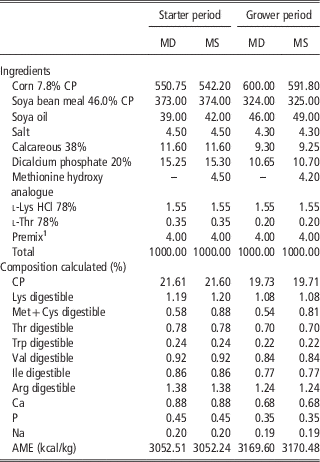
A total of 240 male broilers (Cobb 500) were used in the starter period experiment. The experiment was a completely randomized factorial design, with two thermal environments (thermal comfort zone or HS at 38°C for 24 h)×2 levels of MS (without supplementation of methionine, methionine deficient (MD), or with supplementation of methionine at the recommended level, MS; Rostagno et al. Reference Rostagno, Albino, Donzele, Gomes, Oliveira, Lopes, Ferreira and Barreto2011; Table 1). Methionine was supplemented as dl-HMTBA. The animals were distributed in the four treatments with four replications (pens) per treatment, and each replicate contained 15 birds. Throughout the experimental period, the animals had free access to food and water.
Experimental diets centesimal composition (expressed as-fed basis)

MD=methionine deficient; MS=recommended level of methionine supplementation; AME=apparent metabolizable energy.
1 Supplied by kilogram of diet: retinyl-acetate, 3.44 mg; cholecalciferol, 50 µg; dl-α-tocopherol, 15 mg; thiamine, 1.63 mg; riboflavin, 4.9 mg; pyridoxine, 3.26 mg; cyanocobalamin, 12 µg; d-pantothenic acid, 9.8 mg; d-biotin, 0.1 mg; menadione, 2.4 mg; folic acid, 0.82 mg; niacinamide, 35 mg; selenium, 0.2 mg; iron, 35 mg; copper, 8 mg; manganese, 60 mg; zinc, 50 mg; I, 1 mg; choline, 650 mg; salinomycin, 60 mg; avilamycin, 5 mg; butyl hydroxy toluene, 80 mg. The digestibility coefficient suggested by Rostagno et al. (Reference Rostagno, Albino, Donzele, Gomes, Oliveira, Lopes, Ferreira and Barreto2011) was used to obtain digestible amino acids.
All animals were raised in a climate-controlled room in the thermal comfort zone (according to the Cobb guide) until 20 days of age, and then 120 animals (60 from each diet) were acutely stressed with heat at 38°C for 24 h. After 24 h, the animals from both groups (comfort zone and HS) were slaughtered by cervical dislocation at 21 days. Before slaughter, the rectal temperature was measured in both groups.
To calculate the WG of the broilers from the thermal comfort zone, the animals were weighed on days 20 and 21 of the starter period. To calculate the WG of the animals under HS, the specimens were weighed at the beginning (day 20) and at the end of the stress period (day 21). The FI was calculated as the difference between the amounts of feed offered at day 20 and the feed residues at the end of the trial (day 21) in both environments. The FI and the WG were corrected for mortality. Mortality was measured during the 24-h thermal comfort period and the 24-h stress period.
Experiment 2: grower period, age 22 to 42 days
A total of 240 male broilers (Cobb 500) were used for the grower period experiment. The animals were raised conventionally until 21 days and were fed a balanced diet based on the nutritional demands (Rostagno et al., Reference Rostagno, Albino, Donzele, Gomes, Oliveira, Lopes, Ferreira and Barreto2011). After 21 days, the animals were divided as they were in the first experiment.
All animals were raised in a climate-controlled room in the thermal comfort zone (according Cobb guide) until 41 days of age, and then 120 animals (60 from each diet) were acutely stressed with heat at 38°C for 24 h. After 24 h, the animals from both groups (comfort zone and HS) were slaughtered by cervical dislocation at 42 days. Before slaughter, the rectal temperature was measured in both groups.
To calculate the WG of the broilers in the thermal comfort zone, the animals were weighed on days 41 and 42 of the grower period. To calculate the WG of the animals under HS, the animals were weighed at the beginning (day 41) and at the end of the stress period (day 42). The FI was calculated as the difference between the amounts of feed offered on day 41 and the feed residues at the end of the trial (day 42) for the broilers in both environments. The FI and the WG were corrected for mortality. Mortality was measured during the 24-h thermal comfort period and the 24-h stress period.
Plasma analyses and relative weights
At the end of each trial period, to evaluate relative weights, the liver, heart, legs, breasts and abdominal fat of eight specimens from each treatment group (comfort MS, comfort MD, stress MS and stress MD) were weighed to obtain the proportional organ weights, which were calculated as (organ weight/bird weight)×100.
Simultaneous with slaughter, blood was collected from five animals per treatment for analyses of the contents of homocysteine, uric acid and creatinine and the plasma activities of CK, alanine aminotransferase (ALT), and aspartate aminotransferase (AST). Blood was collected from the jugular vein into heparin tubes and was kept on ice. After centrifugation (3024×g, 10 min, 4°C), the plasma was collected and stored at −20°C until further analyses.
The plasma homocysteine content was determined with the ADVIA Centaur (Siemens Healthcare Diagnostics, Deerfield, IL, USA) system using the chemiluminescence method with kit 09087913 (Siemens Healthcare Diagnostics). The uric acid and the creatinine content and the ALT, AST and CK activity analyses were performed based on colorimetric methods with the following kits: uric acid, MS 80022230171; creatinine-PP, MS 80022230066; ALT, MS 80022230086; AST, MS 80022230083; and CK-NAC-PP, MS 80022230088. The manufacturer’s recommendations for the kits were followed (Gold Analisa, Belo Horizonte, Minas Gerais, Brazil). The enzymatic activity of ALT and AST in the samples was calculated based on the decrease in absorbance at 340 nm when NADH was converted to NAD+. One unit (U) of CK activity was defined as the amount of enzyme required to convert 1 mmol of creatine into creatine phosphate/min at 37°C, pH 9.0.
Gene expression
For the analyses of the gene expression levels, liver samples were collected from five animals from the four treatments for both the starter and the grower periods, which were stored in RNA Holder (BioAgency Biotecnologia, São Paulo, Brazil) at −20°C until total RNA extraction.
Total RNA was extracted using Trizol® (Invitrogen, Carlsbad, CA, USA), according to the manufacturer’s instructions (1 ml/100 mg of tissue). All materials used were previously treated with the RNase inhibitor RNase AWAY® (Invitrogen). The concentration of total RNA was measured with a spectrophotometer at a wavelength of 260 nm. The RNA integrity was analysed using a 1% agarose gel that was stained with 10% ethidium bromide, with visualization under UV light. The RNA samples were treated with DNase I (Invitrogen) according to the manufacturer’s instructions to remove possible genomic DNA contamination.
A SuperScriptTM III First-Strand Synthesis Super Mix kit (Invitrogen) was used for complementary DNA synthesis according to the manufacturer’s instructions. The samples were stored at −20°C until further use.
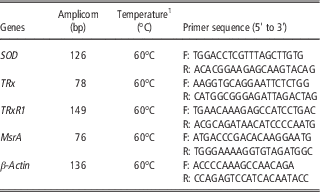
The real-time PCR reactions were performed using the fluorescent dye SYBR GREEN (SYBR® GREEN PCR Master Mix; Applied Biosystems, Carlsbad, CA, USA), according to the manufacturer’s instructions. The primers used in the SOD, TRx, TRxR1 and MsrA amplification reactions were designed based on the gene sequences deposited at www.ncbi.nlm.nih.gov (accession nos: NM_205064.1, NM_205453, NM_001030762.2 and XM_004935891, respectively) using the site www.idtdna.com (Table 2). Two endogenous controls, ß-actin and GAPDH, were used, and ß-actin (accession no. L08165) was selected, because the amplification of ß-actin was more efficient. All analyses were performed in duplicate, each in a volume of 25 µl. The primers for the analysed genes were adequate for the real-time PCR analyses. The amplification efficiencies were similar for the genes of interest, with 90% to 110% efficiency. The analyses of the dissociation curves did not reveal any unspecified products or the formation of primer dimers, which demonstrated the reliability of the data in estimating expression of the mRNA of the evaluated genes. The β-actin used as the endogenous control did not show any statistically significant differences among the treatments, which verified the efficiency of ß-actin as the endogenous control.
Primer sequences used for quantitative real-time PCR

SOD=superoxide dismutase; TRx=thioredoxin; TRxR1=thioredoxin reductase; MsrA=methionine sulfoxide reductase A; bp=base pairs; F=forward; R=reverse.
1 Annealing temperature (°C).
Statistical analyses
Statistical analyses were performed separately for each period. The
 $$2^{{{\minus}\Delta C_{T} }} $$
method was used to analyse the relative gene expression. The results are expressed as the average and standard error. The Shapiro–Wilk test was applied to evaluate the normality of the data. The experiment was a completely randomized factorial design, with two thermal environments (thermal comfort and HS) and two levels of MS (MD and MS). The averages were compared using Tukey’s tests (P<0.05) (SAS Institute Inc., Cary, NC, USA).
Results
Performance
In both experimental periods (1 to 21 or 22to 42 days of age), the acute HS (38°C for 24 h) increased the body temperatures of the birds: 40.42°C±0.62 (thermal comfort) v. 41.78°C±0.35 (HS) (P<0.0001) for the starter period and 41.31°C±0.63 v. 42.44°C±0.58 (P<0.0001) for the grower period.
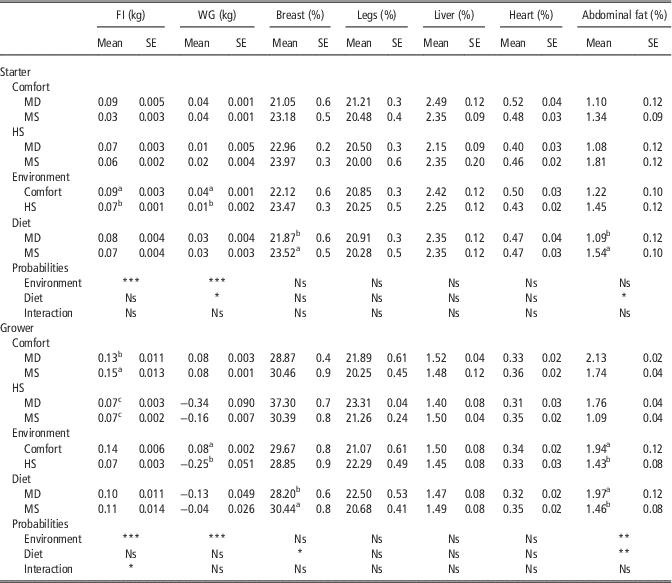
The WG, FI and proportional weights of the liver, heart, abdominal fat, breast and legs of the animals from the starter and grower periods are shown in Table 3.
Feed intake (FI), weight gain (WG) and proportional weight of organs and cuts of broilers from the starter and grower periods

MD=methionine deficient, MS=recommended level of methionine supplementation; HS=heat stress.
a,bMean values within a row with different superscript letters are significantly different.
*P<0.05, **P<0.01, ***P<0.001.
The animals exposed to HS from the starter period had lower WG (P<0.0001) and lower FI (P<0.0001) than those of birds in thermal comfort. For the MS, the animals on the MS diet had a higher abdominal fat content than that of the animals fed the MD diet (P=0.0120).
The animals from the grower period in the thermal comfort zone had higher WG (P=0.0004) and abdominal fat content (P=0.0048) than those of the HS-treated animals. For the MS, the lowest abdominal fat content and the highest proportional weight of the breast were observed in the animals that were fed the MS diet. We also observed a significant environment×diet interaction effect on FI (P=0.0400); the animals that remained in the thermal comfort zone and that were fed the MS diet had the highest FI. In the HS environment, the differences in intake between the MD and MS diets were not significant.
Mortality was measured during the 24-h thermal comfort period and the 24-h stress period at each age (21 or 42 days). Death was observed only in older birds subjected to HS and fed the MD diet and was 5%.
Gene expression
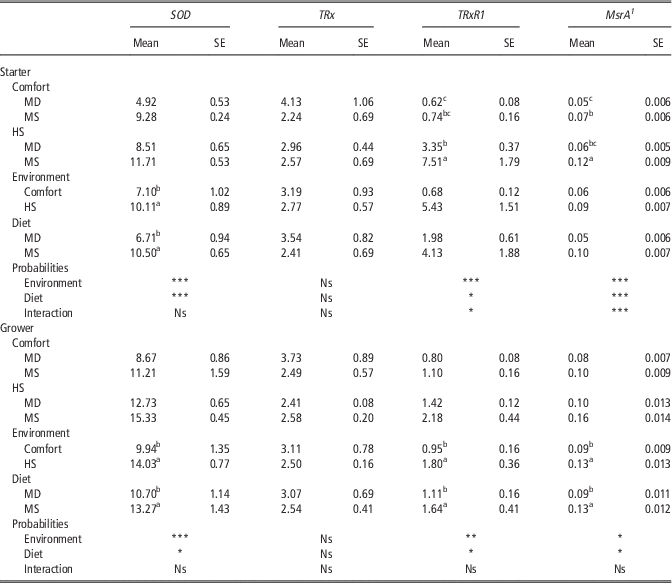
The levels of gene expression in the birds from the starter and grower periods for the two diets and the two environments are shown in Table 4. In the starter period, the gene expression levels of TRxR1 (P=0.0403) and MsrA (P=0.0006) in the liver were influenced by the interaction between temperature and diet. The animals that experienced HS with the MS diet had the highest expression levels of TRxR1 (7.51 AU) and MsrA (0.12 AU) genes, and the values were lower in the animals that remained in the thermal comfort zone on the MD diet.
Superoxide dismutase (SOD), thioredoxin (TRx), thioredoxin reductase 1 (TRxR1) and methionine sulfoxide reductase A (MsrA) gene expression in the liver of broilers from the starter and grower periods

MD=methionine deficient; MS=recommended level of methionine supplementation; HS=heat stress.
a,b,cMean values within a row with different superscript letters are significantly different.
1 Expressed as arbitrary unity (AU).
*P<0.05, **P<0.01, ***P<0.001.
The gene expression of SOD was influenced by both MS (P<0.0001) and HS (P<0.0001). The levels of SOD gene expression were higher in the animals that received the MS diet than in the animals on the MD diet, and the levels were higher in the HS animals than in the animals maintained in the thermal comfort zone.
In the grower phase, the effect of the interaction between diet and temperature was not significant for the expression of any gene. However, the expression of SOD, TRxR1 and MsrA genes was influenced by both study variables. The expression of these genes increased in the HS animals compared with the animals in the thermal comfort zone. For the MS, the animals on the MS diet had higher levels of expression than those of birds on the MD diet.
Plasma analyses
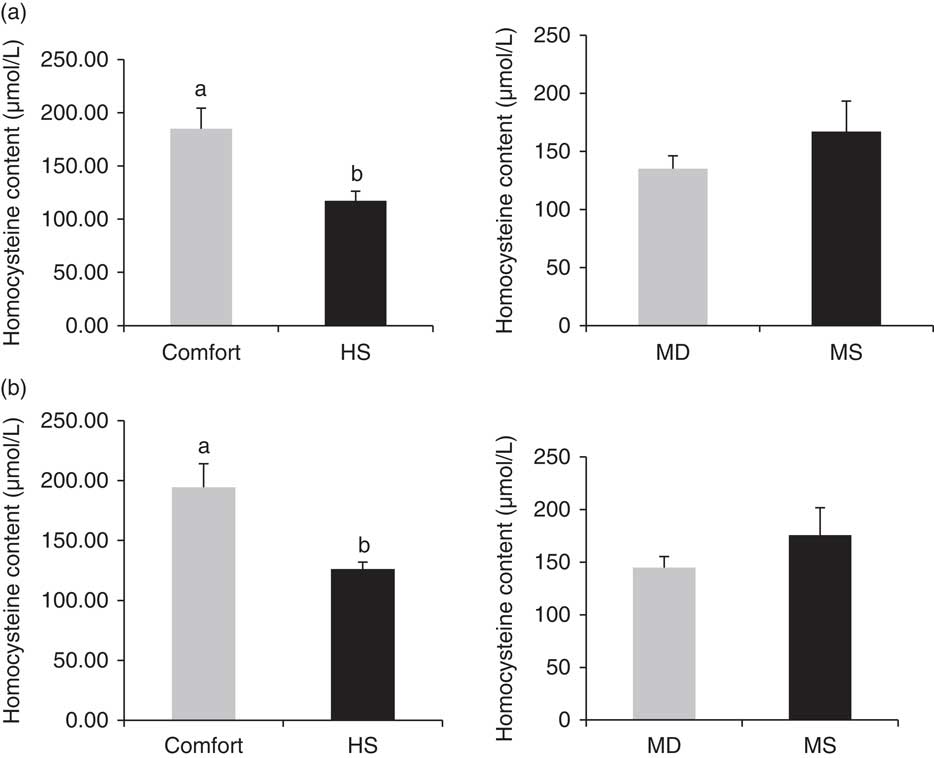
The thermal environment was the only influence on the homocysteine content in the animals in the starter (P=0.0071) and grower phases (P=0.0046). The HS-treated animals from both phases had lower contents of homocysteine than those of birds that remained at the thermal comfort temperature (117.37 v. 184.88 and 126.15 v. 194.38, for starter and grower phases, respectively; Figure 1).
Effects of methionine supplementation and environment on plasma homocysteine level of birds from the starter (a) and grower (b) periods. The results are expressed as μmol/l. The results are shown as the average, and the standard error is represented as the vertical bars. The different letters between the treatment groups represent a significant difference (P<0.05). HS=heat stress; MD=methionine deficient; MS=recommended level of methionine supplementation.

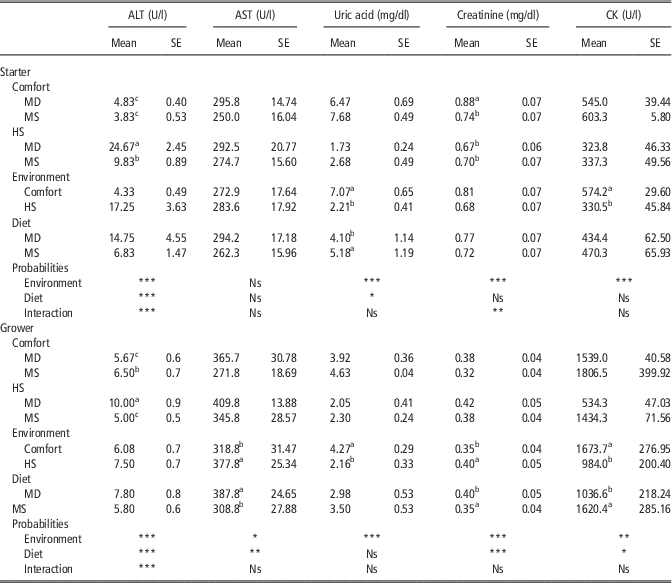
The effects of MS and high temperature on the plasma parameters from the starter and grower periods are shown in Table 5.
Plasma analyses of alanine aminotransferase (ALT), aspartate aminotransferase (AST) and creatine kinase (CK) activity and uric acid and creatinine content of broilers from the starter and grower periods

MD=methionine deficient, MS=recommended level of methionine supplementation; HS=heat stress.
a,b,cMean values within a row with different superscript letters are significantly different.
*P <0.05, **P<0.01, ***P<0.001.
In the starter period, a significant interaction effect between the two factors was observed on creatinine content (P=0.0042) and ALT activity (P<0.0001). The highest value of creatinine was observed in the animals that were maintained in the thermal comfort zone and fed the MD diet (0.88 mg/dl). The highest value of ALT activity was found in the animals that experienced HS with the MD diet (24.67 U/l), and the lowest values were found in animals that remained at the thermal comfort temperature, independent of the diet.
We observed an effect of the thermal environment on CK activity (P<0.0001), with lower activity found in the HS animals than in those without the HS. In addition, MS (P=0.0449) and thermal environment (P<0.0001) affected the uric acid content, with the highest values occurring in the animals on the MS diet and in the animals in the thermal comfort zone.
The treatments did not affect AST activity in birds that were 1to 21 days of age.
However, in the grower period, the interaction between temperature and diet influenced the plasma ALT (P<0.0001) activity. The highest ALT activity was observed in the HS animals on the MD diet (10.00 U/l).
Both study variables influenced AST and CK activity levels and creatinine content. The HS animals had increased levels of AST activity and creatinine content and decreased levels of CK activity. Regarding the diet, the AST and creatinine values were higher and the CK activity level was lower in the animals on the MD diet than those in birds on the MS diet.
We also observed an environment effect on the uric acid content (P<0.0001), with a lower value found in the HS animals than in those of the thermal comfort zone (4.27 v. 2.16 mg/dl).
Discussion
The high production rates observed in broiler chickens are the result of not only intense animal breeding and rigorously balanced nutrition but also all the changes that have occurred in the management of these chickens through the years. The environmental temperature is a factor that directly affects the rates of production, and therefore, temperature remains the subject of many studies (Yang et al., Reference Yang, Tan, Fu, Feng and Zhang2010; Song et al., Reference Song, Xiao, Ke, Jiao, Hu, Diao, Shi and Zou2014).
Elevated temperatures cause a state of thermal stress in chickens, which negatively affects FI with the consequent reductions in BW and poor animal development (Oliveira et al., Reference Oliveira, Donzele, Abreu, Ferreira, Vaz and Cella2006). Thus, as expected, in this study, we observed that the birds subjected to HS (38°C for 24 h) had lower FI and lower BW gain.
In addition to the ambient temperature, nutrients such as amino acids influence animal performance. Our research group has been investigating the effect of MS on the expression of genes related to protein deposition when broilers are under HS. Results from our research suggest that MS can be beneficial, because the expression of genes related to protein synthesis increased and the expression of genes related to protein breakdown decreased (Del Vesco et al., Reference Del Vesco, Gasparino, Grieser, Zancanela, Voltolini, Khatlab, Guimarães, Soares and Neto2015b). In this study, during a 24-h period, the environment×diet interaction had no effect on broiler performance. However, because mortality was observed only in birds exposed to HS and fed the MD diet, we suggest that methionine analogue supplementation in the diet of heat-stressed birds prevented mortality. Part of this capacity could be due to the antioxidant action of methionine, which participates in the synthesis of cysteine, S-adenosylmethionine and glutathione (Swennen et al., Reference Swennen, Geraert, Mercier, Everaert, Stinckens, Willemsen, Li, Decuypere and Buyse2011), and a direct protective effect from oxidative stress (Moskovitz et al., Reference Moskovitz, Bar-Noy, Williams, Requena, Berlett and Stadtman2001). Because methionine participates in glutathione synthesis, several studies have evaluated the effect of MS on glutathione action in HS broilers. In our previous work, birds exposed to HS and fed diets supplemented with dl-methionine had increased expression of cystathionine β-synthase (CBS), glutathione synthetase (GSS) and glutathione peroxidase (GPx) (Del Vesco et al., Reference Del Vesco, Gasparino, Grieser, Zancanela, Soares and Neto2015a); these enzymes are involved in the production of cysteine via the trans-sulfuration pathway, in glutathione synthesis and in glutathione metabolism, respectively (Stipanuk, Reference Stipanuk2004). These results suggested a greater antioxidant capacity in the birds fed the supplemented diet than that in birds on a diet without the MS. Confirming that result in this work, HS birds had lower concentrations of homocysteine than those in the birds in the thermal comfort zone, which indicates that in situations of stress, much homocysteine is used for the production of cysteine to ensure increased glutathione production. The supplementation of dl-HMTBA in diets of HS broilers has also been previously tested (Willemsen et al., Reference Willemsen, Swennen, Everaert, Geraert, Mercier, Stinckens, Decuypere and Buyse2011), and dl-HMTBA supplementation partially prevented the effects of chronic HS because of methionine action on glutathione metabolism.
With this previous knowledge, in this study, our primary objective was to evaluate the effect of dl-HMTBA on the expression of genes related to the direct effect of methionine as an antioxidant. Methionine has a direct effect because of the ability to react with ROS (Levine et al., Reference Levine, Moskovitz and Stadtman2000) in which the methionine is oxidized reversibly to form methionine sulfoxide, which protects the cell from the damaging action of free radicals. Then, the reduction reaction of methionine sulfoxide to methionine is catalysed by the enzyme MsrA (Weissbach et al., Reference Weissbach, Resnick and Brot2005). After the reduction, the methionine residues in proteins can again react with ROS. The reduction process of the methionine sulfoxide is dependent on the action of the enzyme TRx. In this reaction, TRx is oxidized and then is reduced through the reactions catalysed by TRxR1. Therefore, based on this complex and coordinated enzymatic cycle, the methionine residue-dependent catalytic elimination of reactive oxygen and nitrogen species occurs (reviewed by Luo and Levine, Reference Luo and Levine2009). Accordingly, in our study, the highest expression levels of TRxR1 and MsrA occurred in the HS animals on the MS diet, which suggested that the animals exposed to high temperatures had increased requirement for the action of antioxidants and that dl-HMTBA supplementation met this requirement.
In addition to the glutathione and TRx systems, animals have several other enzymatic antioxidant systems, which include the actions of the enzymes SOD and catalase. Superoxide dismutase is found in different forms at different locations, and together, these forms act to control the production of free radicals. Superoxide dismutase is essential for the elimination of the superoxide free radicals that are generated in the dismutation reaction. The H2O2 that is formed is eliminated by the reactions catalysed by catalase or by the glutathione system (Fang et al., Reference Fang, Yang and Wu2002). In the present study, we observed increased levels of SOD expression when animals were exposed to a stressful situation, and when stressed, animal ROS production increases (Azad et al., Reference Azad, Kikusato, Sudo, Amo and Toyomizu2010), forcing the organism to increase expression of enzymes with antioxidant effects to assist in the protection from ROS. Notably, we showed that the expression of SOD was also higher in animals fed the diets supplemented with the analogue of methionine than in those fed the MD diet. This result most likely was not related to the direct action of methionine as an antioxidant as mentioned above but possibly to the ability of this amino acid to modulate the action of some antioxidant enzymes.
The activity of some enzymes can be used as a marker of oxidative stress. For example, high blood activities of AST and ALT are found in animals that experience some type of injury (Khan et al., Reference Khan, Alhomida, Sobki, Habib, Aseri, Khan and Moghairi2013), and low CK activity is found in stressed animals (Melesse et al., Reference Melesse, Maak, Schmidt and Lengerken2011). Here, as expected, we observed increased activities of AST and ALT in the animals exposed to HS. However, importantly, birds subjected to stress fed the diet supplemented with methionine analogue had levels of AST and ALT activity that were relatively similar to those of animals that remained in the thermal comfort zone. Moreover, the levels of CK activity were lower in HS animals, and animals fed the MS diet had higher CK activity than animals on the MD diet. This result was most likely caused by the protection that glutathione provided in favour of CK, because the reduction in the concentration of extracellular glutathione is one factor related to reduced CK activity according to Gunst et al. (Reference Gunst, Langlois, Delanghe, De Buyzere and Leroux-Roels1998).The activity of the enzymes in this study when birds were fed with methionine analogue was similar to the activity observed when broilers were fed with dl-methionine (Del Vesco et al., Reference Del Vesco, Gasparino, Grieser, Zancanela, Soares and Neto2015a). These findings are consistent with the increase in antioxidant capacity due to the supplementation of methionine analogue, which we also observed in terms of both MsrA and TRxR1 enzyme expression and activity of enzymes used as biological markers of stress. With exposure to HS, which increased the body temperature of broilers and likely induced oxidative stress, dl-HMTBA supplementation limited the mortality rate, although positive effects on growth performance were not observed for our experimental conditions. Our results suggest that the analogue of methionine could act on mechanisms protecting the bird from major damage caused by oxidative stress through the actions of several enzymatic and nonenzymatic antioxidant systems, in particular some genes related to TRx.
Acknowledgement
The National Council for Scientific and Technological Development – CNPq supported this study.