Introduction
In 1872 the Liberal Member of Parliament Sir John Lubbock (1834–1913) stood before the House of Commons and argued for a national approach to schooling that treated education as a kind of cognitive therapy. The minds of the working-class masses, in his view, could be educated away from violence via the cognitive modifications afforded by literacy. The occasion of his speech was a debate over the nation's newly minted universal education system. Rather than being taught solely what to think, Lubbock argued that children must also be taught how to think. In making this argument, he synthesized several core principles of liberalism and Darwinian evolution in a manner that was politically expedient. This essay investigates the scientific and political context that made this kind of synthesis possible. More specifically, it sheds light on how emerging developmental theories of education interacted with questions of governance, particularly those asked by politicians interested in the state's ability to shape the minds of its youngest and poorest citizens.
There is, of course, no shortage of books that address the political and educational varieties of Victorian liberalism. The same could be said of Darwinism and political economy. Likewise, historians have given due attention to nineteenth-century notions that the working classes could be educated away from violence and towards capitalistic productivity. Many of these studies will be cited throughout this essay. My goal, however, is not to offer exhaustive definitions of these notions or concepts. Rather, I want to establish how an expert on liberalism, Darwinism and political economy wove together a single vision that treated state-regulated education as an indispensable mode of cognitive conditioning. In following this path, I present a fresh way to problematize why scientific facts and theories were introduced into Parliamentary debates; that is, into a context in which laws were being made.
In what follows I use the science and politics surrounding the career of Sir John Lubbock, a leading evolutionary thinker and a prominent Liberal Member of Parliament, as a focal point that helps us further understand how it was possible for a Victorian scientist to mobilize his disciplinary expertise to conceptualize a social problem which could be solved with the legislative tools of political economy. In Lubbock's case, the science in question was the developmental model of cognition advanced by Charles Darwin and his followers. The political issue at stake was the implementation of the Liberal Party's progressive platform during the middle decades of the century. The social problem in question was the high rate of illiteracy that existed within Britain's working-class population. The answer that Lubbock's scientifically influenced political economy provided was universal education, the notion that the state was responsible for ensuring that all children went to primary and secondary school.
To understand how Darwinism and liberalism fitted together we must go on a journey with a view to connecting several episodes that underpinned Lubbock's conceptualization of universal human development. In other words, we must turn to the intertwined personal, political and professional factors that informed his views on public policy when he became a Member of Parliament. In following this line of enquiry I take inspiration from studies which point to the importance of exploring the political ambitions and trajectories of nineteenth-century reform-minded scientists and physicians;Footnote 1 and from research that problematizes the historical relationship between scientific experts and public policy.Footnote 2 I approach Lubbock's career via four thematic sections, each of which unpacks different connections that he and his intellectual circle drew between science and politics. The first section uses his early years to reveal the reciprocal relationship that existed between liberalism and the progressive forms of education that he himself experienced as a child. The importance of education was reinforced by the relationship that Lubbock had with Charles Darwin from his teenage years and through adulthood. The next section explores this relationship, giving special attention to the developmental framework of human cognition that Lubbock learned from Darwin.
Unlike some Darwinians, Lubbock held that all humans were born with the same cognitive abilities. This form of cognitivism was one of the hallmarks of the research that transformed him into one of the foremost experts on human evolution. The next section lays out the egalitarian foundation of Lubbock's cognitive model and explains how it was closely linked to the forms of moral order promoted by liberalism. The model led him to see the minds of schoolchildren as plastic entities ripe for shaping by the state, particularly through a national education policy that established schools for the working class. The final section explores this aspect of Lubbock's political economy by examining how his views on cognition directly impacted the speeches he made in Parliament about schools and literacy in the decades after the passage of the national education Act in 1870. Drawing together all of Lubbock's views on politics and cognition, it argues that he saw the national curriculum as a collective form of cognitive treatment that could lead the working class away from crime and towards a happier existence.
Liberalism and the educated mind
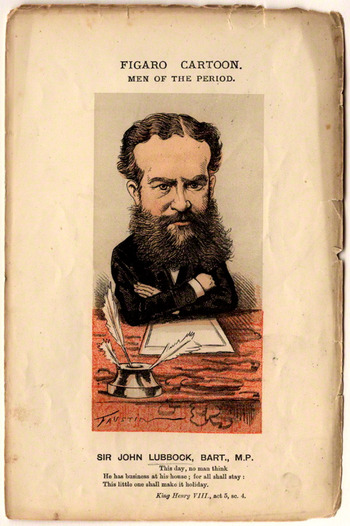
Sir John Lubbock was born in 1834 into a wealthy London banking family with ties to the reform movement (Figure 1).Footnote 3 His liberal conception of learning was influenced by his own education and by his involvement with liberal politicians and intellectuals early in his career. This section uses Lubbock's teenage years and early adulthood to unpack these pedagogical and political facets of his liberalism with a view to showing why he became interested in the cognitive developmental models based on Darwinian evolution that he would use later in his career to rationalize his views on universal education.
Faustin Betbeder, ‘John Lubbock, 1st Baron Avebury’, London Figaro, 1871. © National Portrait Gallery, London. Lubbock was an active Member of Parliament. The Shakespeare quotation in this image is a reference to his work on the Bank Holidays Act of 1871.

The seeds of Lubbock's liberalism were sown before he was born. His father, Sir John William Lubbock, ran unsuccessfully for Parliament as a radical candidate for Cambridge in 1832. As a member of the Royal Society of London, Lubbock Sr had placed his formidable skills in mathematical probability at the service of liberal initiatives such as currency reform. He also participated in populist projects such as the Society for the Diffusion of Useful Knowledge, run by the Whig MP Henry Brougham. Likewise, Lubbock's mother, Harriet Hotham, was a progressive thinker and based her pedagogical views on French educational theories.Footnote 4
Like other upwardly mobile families of the time, the aspirational Lubbocks sent their son to private school and then to Eton, with a view to cultivating useful connections within the political establishment. At the age of fourteen, Lubbock left Eton and began working for his father's banking firm. Unsatisfied by the conservative, classical education he had received at Eton, he began an intense programme of liberal self-education under the guidance of his parents that included a strong dose of science, economics and philosophy.Footnote 5 This instruction, as we shall soon see, significantly affected his views on children and their relationship with the state.
The instruction methods of Lubbock's parents were notably influenced by what Sarah Winter and Elaine Hadley have called the ‘liberal pedagogy’, the nineteenth-century notion that the goal of education should be to teach children to be self-regulated, self-improved and self-realized thinkers who were able to see the world through the eyes of others.Footnote 6 The roots of this pedagogy stretched back to the writings of Enlightenment philosophers such as John Locke and Jean-Jacques Rousseau, particularly their views that the mind of a child was shaped by its habitus. Liberal pedagogy blossomed during the early nineteenth century through the republication of their works and slowly became integrated into the reform agenda supported by Whig politicians and, later in the century, by the Liberal Party.Footnote 7
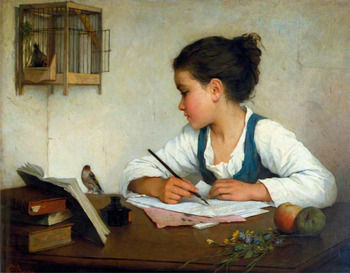
Lubbock's home-based learning was aided by the ‘object lessons’ from nature that his mother gave him and from the scientific apparatus and instruction given to him by his father. The link between object lessons and progressive models of cognition reached as far back as Locke's Some Thoughts Concerning Education (1693). The importance of such lessons increasingly gained traction in the early nineteenth century through the work of liberal pedagogues and educational reformers influenced by the publications of Elizabeth Hamilton, Joseph Lancaster and Johann Heinrich Pestalozzi.Footnote 8 By the time of Lubbock's education and early adulthood, object lessons were promoted by progressive pedagogues such as Herbert Spencer and were increasingly represented by artists such as Henriette Browne in prints and paintings that depicted children learning. As can be seen by the fruit, flowers and bird in Browne's A Girl Writing (c.1860–1890), naturalia played an important role in object lessons and were used in conjunction with reading and writing to reinforce ordered, moral associations in the mind (Figure 2).Footnote 9
Henriette Browne, A Girl Writing; The Pet Goldfinch, c.1860–1890. © Victoria and Albert Museum, London.

Concurrent with his object lessons and his broader education within the self-actualizing tradition of the liberal pedagogy, Lubbock learned much about evolutionary theory during his teenage years from none other than Charles Darwin. Other than Darwin's own children, Lubbock is one of the very few young learners for whom Darwin served as an educational mentor. Lubbock originally met Darwin because they were neighbours. The Lubbock family's house in Kent – High Elms – was next to Down House, the residence of Charles and Emma Darwin. During the 1840s and 1850s the young Lubbock developed a close relationship with Darwin and this experience exposed him to evolutionary ideas a decade before The Origin of Species was published in 1859. The friendship led Lubbock to adopt an evolutionary mindset early in his life and laid the foundation for his understanding of children's minds and, by extension, state-sponsored education.
Lubbock's eclectic educational experiences prepared him for the political liberalism that emerged during the middle of the century, especially the stress it placed upon education and its appeal to the scientific method as the ultimate mode of producing the kind of objective and verifiable evidence that could serve as the basis of political economy.Footnote 10 The Liberal Party was officially founded in 1859 and it consisted of a heterogeneous mixture of Whigs, Peelites and radicals. Political liberalism was a wide-ranging movement that in many respects defies any single definition. It had, however, a cluster of core concerns that revolved around civil liberties, free trade, public morality and the fiscal responsibility of the government. There were also elements of populism, localism and anticlericalism.Footnote 11
By the time Lubbock finished his education, liberal politics had firmly embraced the liberal pedagogy. Nowhere was this marriage more apparent than in the works of the liberal intellectual Herbert Spencer. When writing about the importance of instruction in his bestselling Education: Intellectual, Moral and Physical (1860), he noted that the question was not whether a child produced exemplary pieces of work in school. Rather, the question was ‘whether it is developing its faculties’.Footnote 12 Put another way, education was not just a product; it was a process that taught children how to think. It was precisely this aspect of liberal pedagogy that underpinned Lubbock's view of education during his entire political career. But whereas Spencer did not believe that the state should be involved with the process, Lubbock thought that it did.
Lubbock officially entered politics during the mid-1860s. By this time the liberal pedagogy had become firmly wedded to the moral and economic platform of the new Liberal Party, where it played a major role in justifying universal education, and acted as a central plank in their critique of the established system of schools advocated by the Conservative Party.Footnote 13 Though liberal politicians and intellectuals were interested in reforming all forms of education, they increasingly focused their attention on the state's role in working-class education. Promoting a platform of educational reform, Lubbock ran unsuccessfully for the House of Commons in the general elections of 1865 and 1868. Though initially unfruitful, the educational message about universal education promoted by Lubbock and the Liberal Party eventually took root on account of the inefficacy of Britain's patchwork structure of primary and secondary schools. There was a growing public perception that Britain was falling behind the higher standard achieved, particularly in science, by the more centralized school systems of Germany and France.Footnote 14
Despite several investigations by political bodies such as the Committee of Council on Education and the Newcastle Commission, no significant legislation was passed and the educational fate of Britain's children remained unresolved during the 1850s and 1860s.Footnote 15 An important event that changed this situation was the Representation of the People Act of 1867. It extended the vote to working men and effectively doubled the size of Britain's electorate. An immediate consequence of the law was that politicians from all parties began to realize that the fate of democracy in Britain depended upon a literate population. One of the results was the Elementary Education Act of 1870, which established universal education for the working class.Footnote 16
The liberal politicians who campaigned for the Act were notably influenced by the liberal pedagogy and its wider commitment to creating liberal subjects. By the time Lubbock ran for Parliament for a third time in 1870, Liberal politicians had managed to draw clearer connections between the rational progress of science, nationalism, free trade and public morality.Footnote 17 Lubbock promoted these connections in the campaign that saw him elected Member of Parliament for Maidstone. Once elected, he continued to promote the principles of liberal pedagogy by serving on various governing boards of schools around the family estate of High Elms and supporting the numerous educational Acts and committees introduced by Parliament during the 1870s and 1880s. Overall the liberal pedagogy fitted well with Lubbock's rising role as a public intellectual, giving his position a moral and authoritative manliness that was characteristic of late Victorian liberal religion and politics in general.Footnote 18
Human development and the mind
In addition to his banking connections and political endeavours, Lubbock was a leading expert on human evolution, particularly the mental capacities of early humans. Unlike the language-based models of early Victorian anthropologists, Lubbock's knowledge of the subject was based firmly on the empirical evidence offered by the tools made and used in prehistoric societies. Needless to say, when he rose to give a speech in the House of Commons, his expertise in fields as diverse as banking, economics and science made him a distinctively qualified commentator on many topics. In this section I want to excavate the roots of his scientific expertise by unpacking his conceptualization of evolution and human cognition with a view to revealing the principles that underpinned his position on state-sponsored education.
As Lubbock became a young man, his relationship with Darwin remained strong. This meant that he possessed an impressive scientific pedigree when he decided to enter the gentlemanly scientific world of 1850s London. Darwin's influence helped Lubbock in many ways. Lubbock's first scientific paper, for instance, was based on specimens from Darwin's natural-history collection.Footnote 19 It was published in Natural History Review, a journal edited by Thomas Henry Huxley, who warmly gave Darwin's protégé advice. Lubbock continued to pursue various scientific projects and soon found himself a member of the X-Club, a group of scientists that met regularly in the London area to discuss scientific subjects. Its members included Darwin, Huxley, Spencer, Joseph Dalton Hooker and John Tyndall, all of whom had liberal sympathies and had accepted evolution. As a result of the club's influence, Lubbock was successfully nominated to be a fellow of the Royal Society of London in 1858.Footnote 20 Lubbock remained grateful for this assistance for his entire career. After Darwin died in 1882, Lubbock described his mentor as his ‘dear master’ and successfully campaigned for him to be buried in Westminster Abbey.Footnote 21
In the years surrounding the educational debates of the 1860s, Lubbock expanded his scientific activity by joining the Ethnological Society of London and the Anthropological Society of London. He also authored Pre-historic Times (1865) and The Origin of Civilisation and the Primitive Condition of Man (1870). Both books applied Darwin's ideas to human evolution and quickly established Lubbock as a leading expert in the emerging fields of ethnology and anthropology. His acceptance of Darwin's ideas, however, was not blind or absolute. Like other prominent developmentalists such as Alfred Russel Wallace and H.G. Wells, Lubbock felt natural selection's focus on physical attributes prevented the theory from explaining the forms of cognitive evolution that had occurred when prehistoric simians evolved into humans.Footnote 22 He held that this transformation was a form of social evolution and was too recent to have been affected by the long time spans required by natural selection.Footnote 23 This commitment to social forms of mental causation made education, particularly literacy and numeracy, the central transformative force in the cognitive development of modern humans.
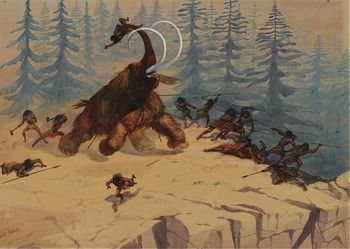
Though optimistic about the psychology of prehistoric humans, Lubbock judged their accomplishments against his standard of liberal realism. There was no denying that they lived in a violent world. His fear and fascination with this kind of violence is perhaps best illustrated by a series of nineteen paintings that he commissioned sometime around 1870 (Figure 3).Footnote 24 Painted by the artist Ernest Griset, they depicted the struggles experienced by illiterate prehistoric humans. Many of the paintings featured energetic hunting scenes, with bare-chested men wielding simple weapons at large, extinct animals. These striking images were painted in the very same year that Lubbock was elected to Parliament and in many ways serve as a visual reminder of the evolutionary framework that guided his views on human behaviour when he defended the bills and laws tabled by the Liberal Party. To fully understand the connections that Lubbock drew between prehistory and public policy, therefore, we need to take a closer look at his views on evolution and how they framed his developmental understanding of childhood and cognition.
Ernest Griset, The Mammoth Hunters, c.1870. Bromley Museum accession number 71.1.7, Courtesy Bromley Museum Services. Painting commissioned by Sir John Lubbock.

Many liberal intellectuals whose views influenced Lubbock from the 1850s to the 1870s sought to apply the principles of human evolution to childhood learning. This was especially the case for Darwin, Spencer and Huxley, all of whom were experimenting with evolutionary interpretations of child psychology.Footnote 25 Though they sometimes disagreed on how Darwinian conceptions of primate evolution could be used to interpret the behaviour of children, they all used a developmental model of cognition. A core feature of this emerging developmental approach to childhood was associationism, an influential cognitive model that framed ideas as mental units that could be grouped together through repeated routines of thought or action.Footnote 26 As Lubbock's anthropological works reveal, he too developed similar views on child cognition from the 1860s onward, but, as I show in the final section, he sought to apply them directly through his work as a Member of Parliament.
Associationism was an extremely broad model of cognition and, though historians have paid some attention to it, a definitive history of its pervasive presence within the nascent disciplines of the human and social sciences has yet to be written. Lubbock, like most associationists (including Darwin), held that ideas associated through repeated behaviour were somehow preserved in the material structure of the brain.Footnote 27 But the nature of that structure, or even the possibility of ever finding out what it was through neurological or chemical means, was by no means settled. In this context, ‘associations’ functioned as a central metaphor through which different schools of anthropology, psychology and psychiatry were able to describe and discuss ‘mental’ causation without quickly falling into disagreement.Footnote 28 On balance, Lubbock's view of association was influenced by his early exposure to Darwin's developmental interpretation of human evolution and, by extension, cognition. It was this view, as we will see in the next section, that underpinned the connections that Lubbock drew between the development of children's minds and the process of state-regulated education.
Within liberal circles, particularly in the works influenced by Spencer's ideas, associationism was employed throughout the nineteenth century to argue for educational systems that improved the minds of working-class and middle-class children.Footnote 29 Following the developmental mindset employed by liberal pedagogues, Lubbock's thoughts on the relationship between science, reform and the education of working-class children were aided by associationism and its implicit connection to various forms of ethnological observation. He took mental associations to be self-evident and universal, operating in the minds of all humans across the globe. In making this move, he followed in the footsteps of liberals like Spencer, Harriet Martineau and J.S. Mill, who used association to argue that learning behavioural habits was just as important as learning facts.Footnote 30
Like many politicians, Lubbock strategically avoided the scientific (material or mental) specifics of his understanding of association and human development in his political speeches or magazine essays, mainly because his views could have easily been misinterpreted or misrepresented by politicians or the press. But, of course, there were other places where a scientist could develop and express evolutionary views, particularly through publishing scholarly monographs and through being a member of a scientific society. Lubbock embraced both of these options. Accordingly, in order to gain a deeper insight into how he used a developmental form of evolutionary associationism to interpret childhood education, we need to look at his anthropological publications and the evolutionary debates taking place in the societies of which he was an active member.
Cognitivism and moral minds
As mentioned above, Pre-historic Times and The Origin of Civilisation and the Primitive Condition of Man established Lubbock as a leading expert on human evolution.Footnote 31 In addition to their scientific merit, they also carried a political resonance, especially since they were written on the eve of the Education Act of 1870; that is to say, during the years he was becoming a politician who promoted the Liberal Party's platform of universal education. This means that these books provide a helpful picture of the developmental model of cognition that led him to support the moral expediency of state-funded education for children.
Both books promoted the liberal principle that all humans are born with the same mental capacities. Lubbock repeatedly drew an analogy between the minds of children and the minds of ‘savages’ living in Africa, Australia and the Americas. In Pre-historic Times, for example, he reasoned that ‘the savage is like a child’ and that ‘savages have the character of children’.Footnote 32 He also pointed out similarities in the ways in which they perceived time and learned to speak languages. Likewise, in The Origin of Civilisation he wrote, ‘I would also call particular attention to the remarkable similarity between the mental characteristics of savages and those of children’, and on several occasions he reaffirmed the notion that both children and ‘savages’ demonstrated similar linguistic abilities.Footnote 33 In addition to making this link numerous times, the book is replete with references to the ways in which children learned in colonial contexts.
Lubbock's presentation of the child and ‘savage’ cognitive analogy was optimistic. But pessimistic interpretations of the analogy were also in play at the time. There was an alternative interpretation in which children were born as savages, as regressions or recapitulations to an earlier time of animality. Some believed that children could be educated away from this original savagery. Others held that children of ‘degenerate’ groups in society, such as the urban poor, had retrogressed beyond the help of education. Lubbock's working assumption was that all children were born capable of being civilized, thereby minimizing the importance of evolutionary recapitulation theories.Footnote 34
Although his basic views on the similarities shared by the minds of children and ‘savages’ remained the same throughout the rest of his career, his growing experience as a politician led him to make a few adjustments to his portrayal of early childhood learning in the later editions of his works. In the first edition of Pre-historic Times, for example, he reasoned, ‘Savages have often been likened to children, but so far as intelligence is concerned, a child of four years old is far superior; although if we take for comparison a child belonging to a civilised race at a sufficiently early age, the parallel is fair enough’.Footnote 35 However, seven years after he wrote Pre-historic Times and had gained more experience visiting schools and debating education in the House of Commons, he extended the analogy to apply to all children (not just those below the age of four) in the third edition that was published in 1872.Footnote 36 The developmental analogy that Lubbock drew between children (a term that was sometimes used to refer to adolescents) and colonial indigenes, moreover, extended a view that already existed in nineteenth-century publications on prehistory.Footnote 37 He saw both groups as comprising individuals whose minds ‘slumbered’ because they had not been allowed to achieve their full rational potential. The slumber made it virtually impossible for them to develop the behavioural characteristics of self-control and self-improvement that he jointly associated with ‘civilized’ culture and liberalism.Footnote 38
The natural history of cognition and morality was, in Lubbock's interpretation, closely linked to the development of ‘habits’. This link, as we will see below, featured in his speeches on education in Parliament. At the time, many anthropologists and pedagogues believed that habits were repetitive thoughts or actions that played an important role in shaping beneficial or destructive associations in the mind. Consequently, habits were the key to moulding traits such as honesty or dutifulness. Honesty was perhaps the most important trait that Victorians wanted all children to acquire, either at home or, in the case of homeless, indigent, orphaned or unparented working-class children, in state-funded schools.Footnote 39 As evinced in The Origin of Civilisation, Lubbock thought honesty was a natural trait in the human mind and that, though present from birth, it could be distorted or strengthened through habit.Footnote 40 In other words, he thought that children had to learn how to be honest (or dishonest) through repeated associations. In his words: ‘Hence we have a deeply-seated moral feeling, and yet, as anyone who has children may satisfy himself, no such decided moral code. Children have a deep feeling of right and wrong, but no such decided or intuitive conviction which actions are right and which are wrong’.Footnote 41
Lubbock's reference to intuition was implicitly responding to a debate raging during the 1860s and 1870s over whether mental characteristics acquired through associative habits by parents (when they were children or adults) could be passed on permanently as intuitions to their children. Perhaps the most prominent voice associated with this position was Lubbock's erstwhile X-Club colleague Herbert Spencer, who famously proposed that mental associations, over time, could become part of an organism's nervous tissue and be passed on to future generations as intuitions. Spencer even went so far as to suggest that utility (a key component of Victorian morality) was one such inherited intuition, thereby intimating that it could be cultivated in all classes through education.Footnote 42 Despite the fact that utility played an important role in the political and moral philosophy advocated by Lubbock and liberalism more generally, Lubbock rejected Spencer's position as an incipient form of determinism that undermined the notion that all humans – rich, poor, civilized, ‘savage’ – were born with the same cognitive abilities.Footnote 43 In taking this position, Lubbock followed the lead of Darwin, who, despite Spencer's attempts to argue for the inheritability of honest or dishonest traits, focused more on the social causes of habit and instinct.Footnote 44
Lubbock held that the cognitive foundations for mental intuitions such as honesty, or even utility, had appeared through the impersonal force of natural selection before the emergence of humans. As his discussions of the natural history of morality indicate, such selections had taken place a long time ago. As such, they were shared by all humans and, by extension, all children.Footnote 45 This evolutionary precept led him to assume that all children's minds operated according to the associative cognitive model, and that education, as a systematized routine used to train habit, was the main mode for instilling the psychological order required for a moral mind to function. Crucial to his evolutionary understanding of education was attention; that is, the operations of the mind that allowed a person to focus on one topic for a sustained period of time. The cognitive and financial benefits of attention had been deeply ingrained in the education policies proposed by liberals since the late eighteenth century,Footnote 46 mainly because it was seen as being one of the main causes of the rapid social and intellectual changes brought about by industrialization and the rise of media technologies.Footnote 47 Attention functioned as a cognitive focal point for ethnologists and, less often, anthropologists seeking to establish a conceptual bridge between liberal theories of self-possession and human history.
As shown in the work of Henrika Kuklick and George Stocking, many of Lubbock's fellow members of the Ethnological Society of London tended to combine Victorian liberalism with their thoughts on human evolution, particularly since many of its members were deeply interested in the role played by education in the meritocratic ideas fostered by modern and prehistoric societies.Footnote 48 Some – George O. Cutler, for example – explicitly focused on the abilities associated with attention, commenting on the relationship between primitive cognition and the kinds of educational reform being promoted by liberalism. Other corresponding members of the Ethnological Society, such as Gilbert Malcolm Sproat, addressed attention as a key cognitive ingredient in turning children and ‘savages’ alike into loyal liberal subjects of the British Empire.Footnote 49
Lubbock was the secretary of the Ethnological Society of London during the 1860s, when he was writing or revising Pre-historic Times and The Origin of Civilisation. Like his peers, his books emphasized the importance of the cognitive role played by attention in the ways that children and savages learned, or, to use his phraseology, became ‘civilized’. To fully appreciate the stress that his interpretation of liberalism and human development placed upon inculcating attentive routines, we only need to turn to the introductory chapter of The Origin of Civilisation, where he discusses the ‘savage intellect’. Lubbock first reminds his reader that ‘the mind of the savage, like that of the child, is easily fatigued, and [that in that condition] he will then give random answers to spare himself the trouble of thought’. He goes on to quote approvingly a passage from Sproat's Scenes of a Savage Life explaining how the weak and slumbering minds of the North American Ahts Indians could be awakened and strengthened through repetitive questions that roused their attention.Footnote 50
Lubbock's assessments of the ‘primitive intellect’ throughout The Origin of Civilisation cited authors like Sproat in order to establish the notion that ‘lower savages’ all over the world exhibited inattentiveness. His comments reveal that he saw attentiveness as the antithesis of indolence, or perhaps even of idleness. In his interpretation, attentiveness took effort and required a strong mind. Indolence did not require effort and, thus, was an attribute of the kind of weak mind that Lubbock wanted to eradicate in England through state-funded education. Over the next two decades many educational psychologists advocated a similar view on attention. The educational expert and influential child psychologist James Sully, for instance, continued to use the phrase ‘movements of attention’ during the 1880s and 1890s to describe the associative routines through which educators could teach children to mentally order trains of images and verbal series.Footnote 51
Overall, the links that Lubbock drew between cognition and childhood education were firmly, but subtly, based upon his evolutionary views and his expertise as an anthropologist. The analogy that he drew between the ‘weak’ minds of colonial indigenes and children laid the groundwork for his views on the kinds of routine that teachers could use to teach schoolchildren how to be attentive. Children's minds – like those of ‘savages’ – slept, and had to be awakened through education. Like the objects and artefacts being used by ‘savages’ to learn about the world, Lubbock argued that the indolent minds of British children needed to be stimulated through techniques of observation that were acquired through object lessons involving tangible things like natural-history specimens and experimental apparatus.Footnote 52 In short, education was a form of cognitive conditioning.
Political economy and the regulated mind
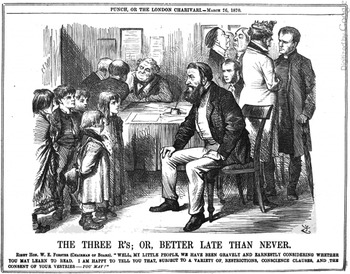
In March of 1870 the artist and political cartoonist John Tenniel published a picture in Punch entitled ‘The three R's; or, better late than never’. The Education Act had been passed in January and the image depicts five young, dishevelled children standing before the bearded, well-dressed William Edward Forster, Lubbock's fellow Liberal MP from Bradford who had fought for the bill for the past two decades. The children stand silent as Forster explains that the government has been ‘gravely and earnestly’ debating whether they should learn to read. He then says, ‘I am happy to tell you that, subject to a variety of restrictions, conscience clauses, and the consent of your vestries – YOU MAY!’ (Figure 4).Footnote 53
John Tenniel, ‘The three R's; or, better late than never’, Punch, 26 March 1870, 121. Tenniel's cartoon satirized the complexities of instituting a curriculum that satisfied the Elementary Education Act of 1870.

Forster was widely seen as the architect and shepherd of the Act. It was sometimes called ‘Forster's Act’. Yet the hard stares of the children and Forster's references to ‘restrictions’ and ‘clauses’ signify that the Act merely signalled the beginning of a national education policy and that Parliament had yet to create a curricular standard. As indicated by the gentlemen, clergy and royalty crowded in the background of Tenniel's image, there were many views as to how the Act should be implemented. The 1870s, therefore, were crucial years for the Act and liberal MPs worked diligently to make sure that it was not repealed or watered down. It is in this context that John Lubbock's liberal evolutionary views become a striking part of the story, because he was one of the most vocal supporters of the Act in Parliamentary debates that took place during the 1870s and 1880s.
A blend of political economy and scientific expertise, Lubbock's liberal and evolutionary convictions underpinned the speeches that he made in the House of Commons. They also influenced the essays that he wrote to popularize what he was saying on the Commons floor.Footnote 54 These debates show that, even if his fellow Members of Parliament did not agree with the political lessons that he drew from evolution, they certainly recognized him as a gentlemanly scientist and, in some instances, as a polite and informative expert who could be called upon for friendly scientific advice. In an 1876 debate on the education code, for instance, the Conservative MP Dudley Francis Stuart Ryder (Viscount Sandon) questioned Lubbock's views on the place of science in the national curriculum but freely admitted that Lubbock was ‘preeminently qualified’ to deal with scientific subjects.Footnote 55
Lubbock's Parliamentary speeches about the national education system built firmly upon the associative principle that all children were born with the same universal cognitive capacities. In many respects, this was a scientized interpretation of what post-colonial historian of childhood Karen Vallgårda has called the concept of the ‘universal child’, the nineteenth-century idea that all children, no matter where they were born, were endowed with the same intellectual and moral capacities at birth.Footnote 56 The concept of universal mental capacities was an extension of a larger strand of thought running through Victorian liberalism and evangelicalism alike which upheld the unity of the human species and the progression of civilizations from disordered ‘savages’ to ordered states.Footnote 57
Consequently, even though many of the politicians listening to Lubbock's speeches in Parliament might not have accepted or understood the evolutionary theory that sustained his developmental interpretation of liberalism and childhood, they certainly would have been receptive to the modes of teaching emanating from the associationist pedagogy that he promoted, particularly the notion that education could be used to cognitively condition the minds of the Victorian working class. As Lubbock put it in an 1872 speech, a ‘natural system’ of state-funded education needed to ‘cultivate’ the ‘tastes’ of children.Footnote 58
According to Lubbock's universal conception of human development, all children could awaken the incipient ‘tastes’ in their minds through repetitive and intensive acts of association that only could be gained by becoming educated, and then practising those mental routines when they became adults. The idea that children needed to be improved and adjusted fitted well with liberalism's larger desire to use national education to engineer liberal subjects who could easily and undisruptively function in Britain's free-market economy.Footnote 59 The notion that the universal savage within every child had to be conditioned through education underpinned the arguments made in many of Lubbock's Parliamentary speeches, particularly those that focused on the inclusion of extracurricular subjects such as drawing, geography and science. In an 1874 speech to the House of Commons, for example, he boldly suggested that if England's children were not properly educated, then they would be in an even worse state than the ‘savage’ who at least possessed a basic working knowledge of geography and natural phenomena such as the movement of the stars and changing of the seasons.Footnote 60 Lubbock's suggestion played on the Victorian fear that children might return to their original savage state if left uneducated. To add weight to this point, he quoted fellow X-Clubber Thomas Henry Huxley: ‘“The savage,” says Professor Huxley, “knows the bearing of every hill and mountain range, the directions and junctions of all the streams, the situation of each tract characterised by peculiar vegetation … His eye is always open to the direction it is going”.’Footnote 61 In addition to the colonial undertones of this quotation, the examples were meant to illustrate the fact that England's urban children were not even being educated to the standard of their universal mental counterparts across the world, and, correspondingly, that such a state of affairs threatened the social and economic stability of Britain.Footnote 62
When Lubbock's thoughts on the mental capacities of children are set side by side with his comments on universal education in Parliament, it can be seen that he viewed education as a form of state-regulated cognitive treatment, one that conditioned the minds of children, especially those of the working class, before they could become socially disruptive adults. True to his liberal principles, he was also keen to cast education as a form of self-regulating therapy that must be learned by children if the ‘civilized’ state was to survive and prosper. This view perhaps was most clearly voiced in an 1874 Parliamentary debate in which Lubbock drew a firm distinction between instruction (the teaching of facts) and education (teaching children how to think), going on to say that state-funded education needed to be calibrated so that it might ‘protect our children against the temptation of drink and other sensuous indulgences’.Footnote 63
In other Parliamentary debates, Lubbock repeatedly argued that the national programme of education needed to instil a way of thinking that harmonized a child's mind with the goals of the liberal state. While debating the education code in 1876, he stated,
The real question was, whether we [the state] had given them [children] a wish for knowledge and a power of acquiring it. What they learnt at school would soon be lost, if it was not added to. The great thing was to interest, and not so much to teach them as to make them wish to teach themselves.Footnote 64
In Lubbock's mind, the cognitive conditioning offered by the state-regulated educational system promoted liberalism's larger commitment to frame, in the words of Sarah Winter, ‘the acquisition of knowledge as a process leading to self-possession’.Footnote 65 The aim was not to teach children lists of facts per se. Rather, it was to teach them how to think through information in a liberal, autodidactic manner. Like other liberally minded intellectuals of the time such as Harriet Martineau and J.S. Mill, Lubbock saw this classic liberal goal as being beneficial to all children.
The autodidactic component of Lubbock's liberal pedagogy led him repeatedly to emphasize his conviction that compulsory primary education was not a matter of simply learning to read and write. Indeed, ‘savages’ could do this quite well. Literacy was more than grammar, history was more than dates, and geography was more than the names of places. Such facts were, of course, important, but they were not unique to modern civilizations. It was this line of reasoning that led him to press for the inclusion of extra subjects, particularly those of a scientific nature, in the national curriculum because he believed that the thinking routines they instilled would prevent the ‘hostility between labour and capital’.Footnote 66 He was so committed to the cognitive benefits of extra subjects that he praised their virtues in almost every speech he gave in Parliament about education during the 1870s and 1880s.Footnote 67
Since ‘savages’ were naturally inquisitive about the phenomena surrounding the sun, moon, planets, stones and plants, he reasoned that such naturalia would inherently attract the attention of the children attending Britain's schools. The inclusion of extra subjects, particularly geography and natural history, also laid the platform for teachers to use ‘the commoner objects by which children were surrounded’ and led to a ‘knowledge of things’.Footnote 68 As mentioned earlier in this essay, the notion of the ‘object lesson’ had been around in liberal pedagogical circles since the early part of the century. By the 1850s, Spencer had brought its cognitive relevance into the wider political debate, extolling the use of objects to England's Committee on the Council on Education. Spencer advised the committee to consider promoting the use of ‘well-selected object lessons’ in primary schools to better train ‘the faculties of younger children’.Footnote 69
Rather than simply giving evidence to a committee tasked with advising the government, Lubbock gave his views on object lessons directly to fellow MPs who respected his opinions as coming from a scientific expert on cognition. The link he drew between attention and natural objects such as rocks and plants built directly on his own research suggesting that the minds of ‘savages’ and, hence, children, slumbered and needed to be awakened with visual and tactile sensations. To drive this point home in an 1882 Commons debate, he recounted how object lessons ‘brightened up’ and ‘seemed to have a magical effect’ upon otherwise inattentive schoolchildren. In other words, object lessons woke up their inattentive, slumbering minds.Footnote 70
After the universal Education Act of 1870 had been in place for a few years, Lubbock actively sought to draw links between state-organized education and the behaviour of England's working-class population. Citing statistics from the national census, for instance, he pointed out that the rate of juvenile crime fell by more than 50 per cent in the decade that followed the universal Education Act. He cited similar rates of decline in adult crime and poverty.Footnote 71 Thus it was universal education, in his reading, that safeguarded Victorian civilization and prevented its children from retaining the untrained, savage-like minds that they inherited at birth.
Throughout Lubbock's career he continued to promote education as a form of behavioural modification that made the working classes more attentive and, hence, productive, happy and content with their lot in life.Footnote 72 This notion of ‘happiness’ was the kind in which children learned to accept their current and future place on the Victorian economic and social ladder. Whereas this hierarchical, and potentially classist, view was not unique to Lubbock, his case is significant because it sheds light on how cognitive science was used to advance and justify a solution on the floor of Parliament that was expedient to the needs and goals of a political party (the Liberals in this case). As such, it reveals the long-standing interactions, and potential tensions, between scientific experts and public policy.
Concluding thoughts
A year after the 1870 Education Act was passed Thomas Henry Huxley stood before the nascent London school board and famously suggested that a modern, successful educational system needed to establish a ‘great educational ladder, the bottom of which would be in the gutter and the top in the University and by which every child who had the strength to climb might, by using that strength, reach the place intended for him’.Footnote 73 The comparison of education to a ladder was common in Victorian times, but Huxley's words were uttered at a moment when politicians, educationists and members of the general public were strenuously debating how to implement the requirements of the Education Act. Huxley was attempting to use the analogy to argue for a unified educational system that managed primary and secondary schools concurrently.Footnote 74 Nevertheless the meritocratic undertones of his analogy were hard for his opponents to ignore. In the end, the oil of Huxley's personality did not mix with the institutional water of politics, leading him to step down from the London Board of Education soon after he had been appointed.
At the very same time Huxley was presenting his evolutionary interpretation of the liberal pedagogy to the London public, Lubbock, who shared many of Huxley's views on the liberal pedagogy, began to make a subtler, science-based case in the gentlemanly corridors and chambers of Parliament for a state-managed education system. Unlike Huxley, Lubbock stayed the political course. For the next three decades he perceptively used his liberal interpretation of human evolution to frame his views on publicly funded education and to guide the Parliamentary speeches that he gave on the relationship between political economy, learning and literacy. Yet though Lubbock was perhaps more eloquent and sociable than other liberals or Darwinians promoting reforms under the banner of evolution, he certainly shared their view that education was a ladder of cognitive conditioning that mitigated against the violence that existed, in the words of Huxley, in the ‘gutter’. Lubbock's evolutionary interpretation of cognition and pedagogy drove his desire to teach the children of the working and middle classes to think morally and, correspondingly, to turn away from the forms of violence that he associated with prehistoric humans and ‘savages’.
As evinced in the correlation that Lubbock later drew between higher literacy and declining crime during the 1880s, he truly believed that the Education Act was a powerful form of cognitive conditioning that could prevent violence. But, as he warned, literacy – like the symbolic forms of representation used by early humans – did not guarantee a peaceful or liberal society. As so clearly illustrated in Griset's paintings of prehistoric life, violence had played a central role in early human society. On Lubbock's reading, violence was an ever-present spectre that could possibly form the minds of an uneducated electorate – a spectre that he believed could be educated away through the cognitive training of literacy. Only when this was done would Britain be truly safe from the ‘savage’ minds of children and the uneducated working classes.