In 1878, Clements Markham, president of Britain's Royal Geographical Society, proclaimed in his influential overview of meteorology in India that ongoing atmospheric research ‘promises to be attended with the greatest and most speedy results’. Meteorologists, in his assessment, were on the verge of attaining the power to foresee weather on timescales unimaginable in temperate Europe. Seasonal rainfall would soon be calculated ‘some months in advance’, he assured his readers, concluding, ‘it is within the power of science to solve this problem, I see no reason to doubt’.Footnote 1 To Markham's mind, there was good reason for such optimism. Since the first edition of his Memoir on the Indian Surveys in 1871 – in which his outlook on the progress of atmospheric science was decidedly grimmer – the Government of India (GOI) had established a centralized weather office: the India Meteorological Department (IMD, f. 1875). Almost immediately, the horrific southern Indian famine of 1876–8 thrust tropical weather to the forefront of imperial debates. As images and accounts of widespread starvation circulated in newspapers, condemnation of GOI famine policy across Europe and India catalysed new political will to confront the threat of drought – or at least to be seen to try. To declare monsoon prediction to be on the horizon was to recast the disastrous famine as a tragic but surmountable natural event within the imperial narrative of ‘moral and material progress’.Footnote 2 Markham's sanguine outlook on weather forecasting also resonated with a prominent group of sunspot researchers affiliated with Kew Observatory, who postulated physical connections between the newly discovered eleven-year solar cycle and periodic Indian droughts.Footnote 3 These experts assured policy makers that through patient measurement and statistical study, they would soon establish order in the atmosphere. The stakes were clear: if monsoon ‘failures’ were made predictable, famine might be abolished, perhaps without resort to costly relief works.
Still, not all were convinced that long-term prediction would be so easily performed. The exuberance emanating from certain corners of Britain's scientific community juxtaposed awkwardly against the precarious situation of the fledgling IMD, which faced insufficient funding, infrastructure and expertise. As its first director, Henry Francis Blanford's (dir. 1875–89) initial mission was to centralize and standardize the formerly independent provincial weather organizations to produce congruent atmospheric ‘statistics’. Driven by the exhortations of the Famine Commissioners, Blanford's IMD next turned its attention to the formidable monsoon. For his part, Blanford refrained from endorsing sunspot–weather theories without reservation, noting that the periodicities of solar radiation and terrestrial drought did not reliably align.Footnote 4 Still, he too ventured that the ‘laws of the monsoons’ could be ascertained through a programme of targeted observation at minimal expense.Footnote 5 Such anticipations were rewarded with the first public forecast of the monsoon in June 1886 after only four years of scientific trials.
However, early confidence gave way to reluctance. After Blanford retired in 1889, later IMD directors whose signatures sanctioned annual forecasts hesitated to stake their professional reputations on experimental predictions. Nevertheless, they issued monsoon forecasts year after year. Demand for this public service came from heterogeneous social groups all invested in calculable futures: speculators in London, GOI finance officials preparing budgets, provincial administrators monitoring for famine, and rural and urban commercial interests in India. Compelled to perform this annual ritual against their professional judgement, IMD scientists belaboured the principles of statistical error and the limitations of their data, hoping to downplay expectations.Footnote 6 Newspaper commentators derided the ‘usual reservations and qualifications’ that encumbered annual projections.Footnote 7 Even so, careful explications of ‘probability’ did not inoculate meteorologists from public criticism when forecasts proved incorrect. By 1950, retiring director general Sudhansu Kumar Banerji concluded that ‘it is possible that part of the variation of a season's rainfall is not predictable in advance’.Footnote 8 How did such widespread hopes for the forecast yield to restraint, and even admission of resigned defeat? More puzzlingly, why, despite meteorologists’ serious misgivings about its accuracy, did cancellation of the service become impossible?
This article probes the particular history of the long-term forecast for insights into the GOI's governing philosophies and practices from the ‘high noon’ of Victorian empire through the early post-Independence period. It argues that British imperial imperatives in India produced a particular culture of meteorology in which the state's responsibility to estimate future rainfall became central to its own logic. Forecasts of seasonal crop yields and state revenue underpinned the administrative technologies of the expanding bureaucracy. But they also exposed state scientists to public critique. Over this period, the idea of seasonal forecasting as a duty of government became simultaneously ingrained and discredited in popular opinion. ‘Modern’ meteorology – distinguished by its use of precision instrumentation, bureaucratized standardization, and synoptic visualization – was at its most vulnerable when required to foresee the future, especially of a phenomenon so public as rainfall. As we will see, long-range weather forecasting did not successfully project state authority; for that reason, it fits uneasily into characterizations of ‘modern science’ as a ‘tool of empire’ or oppressive colonial knowledge.Footnote 9 Instead, the monsoon forecasts became at once symbols of responsible modern government and of the limitations of European science in India.
I restrict my focus here to the south-west monsoon forecast issued in early June, timed to coincide with the rainstorms on the Malabar coast that famously heralded its onset. The IMD issued two other annual forecasts: a revised monsoon forecast in August, and a forecast of the ‘winter rains’ in December.Footnote 10 The June forecast was the most highly anticipated public service offered by the IMD because it speculated on the most crucial period of rainfall for agriculture over most of the subcontinent. The forecast fed a growing appetite for ‘current news’. It could be read alongside reports on trade statistics, local steamship arrivals and departures, international and domestic politics, and daily weather.Footnote 11 Yet the monsoon forecast's long-awaited appearance in official gazettes and other subscribing newspapers in June carried a momentousness that set it apart from routine, weekly reportage.
Extreme weather and the spectre of famine loomed large in India, and indeed other regions designated ‘tropical’. This fact, while not ignored by earlier scholarship, has only recently returned to clear analytical focus. In his recent monograph Unruly Waters, historian Sunil Amrith has persuasively written the monsoon back into the broad sweep of South Asia's intellectual and political history by foregrounding the driving importance of water in policy making and scientific research over the modern period.Footnote 12 Amrith's account reveals that monsoon research and prediction became a preoccupation of government. Yet it leaves the detailed practices and popular reception of seasonal forecasts largely unexplored. New questions open up when we shift focus from the monsoon phenomenon to the monsoon forecast. I suggest that closer attention to the cultural and material dimensions of scientific forecasts is fruitful for understanding the public authority of weather science and scientists, on the one hand, and the integration of ‘nature’ into bureaucratic procedures, on the other. As unusual entities, seasonal forecasts provide a window into the particular priorities, constraints and cultures of meteorology in India, where ‘the monsoon’ was the defining feature.
This article also shows that modern seasonal-scale forecasting – a precursor to today's long-range prediction modelling – has a tropical genealogy. When they first appeared, state-sanctioned monsoon forecasts were unique to British India, relying neither upon direct precedents by European or American meteorologists nor upon the expertise of the region's many rival and indigenous forecasters.Footnote 13 As the best-resourced and most extensive weather service in the lower latitudes, the IMD played a decisive role in the formulation of theoretical and empirical knowledge about tropical weather.Footnote 14
By emphasizing the place in which this branch of atmospheric science developed, I join other historians seeking to ‘re-locate’ histories of global meteorology.Footnote 15 Notably, historian Deborah Coen's rich portrait of Austro-Hungarian patronage of ‘dynamic climatology’ – a scientific metaphor for ‘unity in diversity’ originating in the specific political context of its empire – has resoundingly proved the error of assuming the Western European history to be typical.Footnote 16 But the IMD's history fits neither European model well. Unlike ‘Continental’ imperial meteorology, the ‘subcontinental’ science was oriented around statistical production in service of anxious military and economic control of a racialized geography – an enterprise that prioritized forecasting at great social and physical remove. Indeed, while IMD leaders might have used ‘the monsoon’ to support an argument for dynamic ‘unity’ in a region of climatic diversity, British views on Indian climate were too pessimistic to nurture such a celebratory metaphor. The United States appears a more fitting comparison, as a colonized territory vulnerable to violent hurricanes. But upon closer examination, the divergent political dynamics of North American settler colonialism are obvious. Jamie Pietruska's account of the co-development of speculative futures trading and meteorological forecasting in the United States finds parallels in British India, where commercial lobbies wielded considerable political influence. However, these dynamics manifested within an authoritarian context where British rulers sought not to displace local people, but instead to govern (and profit) through and around them. India's forecasting was, in important ways, a defensive strategy by minority rulers against a landscape perceived as irredeemably hostile and foreign; as such, it emerged out of a logic different to either the Austrian or American cases.
To explore the paradoxical necessity and impossibility of the seasonal monsoon forecast, this article situates it within larger histories of political economy, bureaucracy and science. The first two sections outline the setting in which long-range forecasting emerged as an administrative imperative at the nexus of conceptual, political and economic developments. They argue that the forecast operated as an officially sanctioned projection of the future, tied to procedures of annual budget making and, notably, famine policy. Next, the article examines the forecast as a product of meteorological science that changed considerably in form and technique, a fact that calls into question its comparability across this long timeline. Finally, it evaluates newspaper commentary during a particularly perilous decade for meteorologists after 1899 to gauge public perspectives on annual forecasts. My analysis will not proceed along a strictly chronological path but instead scrutinize the seasonal forecast in its many guises: as administrative technology, publication and spectacle.
Empire in a monsoonal landscape
The post-1857 restructuring of the Indian Empire under direct Crown rule coincided with a period of institutional reform for science in metropolitan Britain. In the aftermath of the Great Rebellion, known to the British as the ‘Mutiny’, Parliament established an India Office in London, helmed by a Secretary of State who worked in coordination with a ‘viceroy’ in India. These figures had vast executive scope to reconfigure imperial policies and institutions to prevent future anti-imperial insurgencies. Overall, the period of Crown rule (1858–1947) witnessed continual bureaucratic expansion characterized by a profusion of reports and surveys designed to support ‘rationalized’ administration grounded in empirical ‘statistics’ – a government by number rather than by negotiation with colonial subjects.Footnote 17 Historical scholarship has rightly concentrated on the fateful census and caste classification projects of this period, but attention to meteorology shows that not only India's peoples but also its variable atmosphere became subject to quantification and surveillance. Architects of the newly organized Department of Revenue and Agriculture (f. 1881) coordinated meteorology, agriculture and land-revenue programmes under the banner of famine prevention.Footnote 18 The authors of the pivotal 1880 Famine Report recommended that the new IMD monitor the ‘daily progress’ of seasonal rainfall across all the provinces of British India in order to keep provincial and central governments abreast of seasonal fluctuations in rainfall ‘supply’. Eventually, ‘with the advance of knowledge’ obtained by careful statistical inquiries, they recommended that the IMD should search for patterns and on that basis issue seasonal forecasts ‘with due caution’.Footnote 19
Additionally, a group of scientists straddling India and the United Kingdom lobbied policy makers to envision meteorological enterprises as arms of a broader project to strengthen the British Empire and nation. In particular, professionalizing scientists encouraged Parliament to invest in observatory sciences (including meteorology) that, they argued, could not feasibly advance through private funding, too great were the expenses and too remote the pay-offs. As historian Katharine Anderson has shown, certain metropolitan meteorologists believed that the key to advancing their field lay in the tropical latitudes. Closer to the sun's radiation and unperturbed by polar currents, the tropical atmosphere appeared to obey simplified natural laws. The comparatively regular cycles of annual and diurnal oscillations in South Asia, combined with its geographically bounded atmosphere – fenced in by the Himalayas to the north and the Indian Ocean on all other sides – appeared to European meteorologists to present an unusually controlled, natural research setting.Footnote 20 Coupled with this ‘laboratory’ metaphor, the fear of disastrous droughts in the wake of ‘monsoon failure’ supported an argument for state investment of public resources.
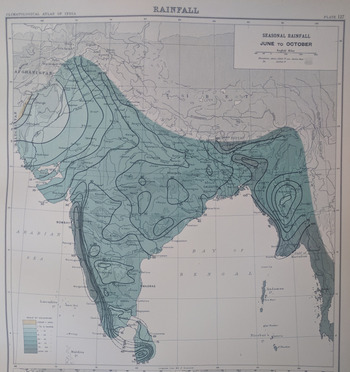
The monsoon was an amorphous concept invested with huge significance in scientific and popular imaginations of India. In different contexts and communities, ‘the monsoon’ could refer to annual wind patterns, a quantity or type of rainfall, or the region's major rainy season.Footnote 21 The English term appears to derive from mausam, the Arabic word for ‘season’, used in sailing networks spanning the Indian Ocean; through merchant traders, it became integrated into European lexicons, to denote the twice-yearly reversals of regional trade winds. By contrast, monsoon vocabularies among agricultural communities tended to refer to local occurrence of rain (br̥ṣṭi jala, bāriśa, varṣā, among numerous other terms).Footnote 22 ‘The monsoon’ came to characterize – and even stand in for – India in evocative travelogues that circulated around Europe from the seventeenth century. It acquired greater scientific significance as it entered prominently into conversations surrounding climate, public health and geography in the nineteenth century. By the time the GOI had established a centralized meteorological office, administrative procedures took the existence of such a phenomenon as ‘the monsoon’ for granted.Footnote 23 Meteorologists agreed upon a technical definition: for them, ‘the monsoon’ designated a prevailing wind pattern, which blew from the south-west roughly between May and October, and from the north-east from November until April. Their practical duties, nevertheless, revolved around rainfall, especially associated with the south-west current (Figure 1). Popular conflation of monsoon winds and rainfall caused confusion.Footnote 24 As one commentator complained in 1914, early-June debates about the arrival of the monsoon invariably devolved into a ‘childish wrangle’ due to conflicting definitions of the phenomenon. ‘If people would only first decide what they mean by the monsoon’, he wrote, ‘there might be some profit in the discussion’; yet agreement was unlikely, because ‘no two persons attach the same meaning to the term’.Footnote 25
John Eliot visualized the ‘monsoon season’ in terms of total average rainfall in a chart for his climatological atlas, drawing isolines to render patterns of rainfall distribution spatially legible. While the south-west monsoon wind pattern extended from roughly May to November, the four months June to September saw the period of most intensive rainfall, which Eliot called the ‘south-west monsoon proper’. John Eliot, India Meteorological Department, Climatological Atlas of India, Edinburgh, Messrs. John Bartholomew & Co., 1906.

In fact, the notion that historical data and telegraphic signalling might be used to project a scientific forecast on any timescale was a relatively new one. In 1861, the British admiral Robert Fitzroy became the first to deploy the English term ‘forecast’ as an official meteorological category. Fitzroy used it to distinguish the short-term storm warnings issued by his new Meteorological Office from other kinds of prediction circulating within sailing communities.Footnote 26 Very soon his ‘forecast’, too, became laden with baggage; after Fitzroy's suicide in 1865, the Royal Society terminated the public service, embarrassed by its inaccuracies. But in the following years, the ‘forecast’ became ever more insistently identified with meteorology, and British authorities were forced to reinstate those services. Despite similar controversies, in the 1860s many European governments assumed responsibility for protecting their subjects from dangerous weather through the provision of ‘timely’ information. And only a decade later, senior Indian administrators encouraged their official meteorologists to speculate even further – not days, but months – into the future.
Monsoon forecasting as economic technology
The monsoon forecast performed vital work for the British Indian government by reassuring readers of the imminent achievements of rationalized administration. Assertive forecasts supported by charts and tables smoothed over the chaotic insecurity of policy making and upheld the imperial social order. Beyond these performative functions, however, GOI leadership valued the monsoon forecast primarily for its supporting role in government budget administration. Seasonal prediction developed in close conversation with numerical bureaucratic techniques related to fiscal policy. Buttressed by accumulated ‘statistics’ (data), the GOI's annual revenue and expenditure estimates – long-range forecasts of another kind – acquired new scientific overtones, even if they remained reliably conservative. Monsoon forecasts, in spite of their widely criticized ‘failures’, allowed responsible governors to claim that their procedures accounted for the risks of drought.Footnote 27
Blanford drew upon prevailing associations of rainfall with political economy when he submitted his 1874 proposal for the organization of the meteorological department. He declared determination of the laws of monsoons as the problem that ‘predominates over all others in India’ because of both its ‘intrinsic scientific importance’ and, equally, its ‘economic bearings’.Footnote 28 With this phrase, he gestured toward state coffers. While land taxes in many provinces had been settled at fixed rates, actual government revenue depended upon annual harvests. For this reason, provinces from Bengal to the North-Western Provinces and Oudh had already begun haphazardly to calculate statistical rainfall ‘normals’ for annual comparison. By 1875, most governments required district officers to submit monthly weather-and-crop reports. Using standardized forms and (less standardized) rain gauges, they recorded the dates and measurements of rainfall and estimated acreage of principal crops throughout their districts. In some cases, these latter figures were labelled ‘crop forecasts’, underlining their kinship – functional, more than methodological – with weather prediction.Footnote 29 In theory, agricultural monitoring by local officers facilitated government preparation for seasons of potential drought and grain scarcity, a duty that the GOI gradually devolved onto the provinces by 1920.
Central finance members continually emphasized the connections between weather and budgeting. Certainly, drought affected the GOI's revenue sources – including land revenue, but also income, customs and other taxes.Footnote 30 Famously, GOI finance minister Guy Fleetwood Wilson lamented in 1909 that ‘estimating in this country is largely a gamble in rain’.Footnote 31 This pithy statement has been repeated ad infinitum by economists, politicians and meteorologists in the decades since – a banality that owes its popularity to its honesty about the imaginary foundations of government planning. In the following year's report, Wilson recast his earlier phrasing as ‘infelicitous’ and declared gambling a faulty metaphor for budget planning.Footnote 32 Chastened, he insisted that state policy was based upon scientific rainfall ‘probabilities’ rather than bets. But Wilson repeated his view that annual monsoon rainfall was a crucial factor for which ‘hope must of necessity take the place of calculation’ in budgeting for the coming year. Not gambling, then, but faith partially underlay his approach to financial forecasting.Footnote 33
Monsoon fatalism persisted as a trope in budget and monetary discussions even as economic theories evolved. In metropolitan debates on Indian finance policy in 1914, then, economic experts repeatedly invoked uncertain rainfall to justify end-of-year budget surpluses and combat Indian criticism about tight-fisted social spending. Assistant under-secretary of state Lionel Abrahams submitted to the Royal Commission that annual budgets could not be improved due to the notorious ‘incalculability of the monsoon’. He wrote,
Such forecasts must always be uncertain, since the rainfall from June to September is the deciding factor in the financial results of each year. A very good monsoon may swell the receipts from Railways, Customs, and Excise to a figure for which no prudent Government could estimate; while a bad monsoon may depress to a very low level the receipts from the sources mentioned and from Land Revenue; and may also necessitate very large expenditure on famine relief.Footnote 34
Abrahams deployed ‘the monsoon’ as a natural excuse for the GOI's policy of fiscal conservatism to counter growing economic nationalism fuelled by discontent about its lack of investment in irrigation and food security. As the idea that India comprised a singular, territorially bounded economy consolidated in nationalist imaginations, they expected government to take an active role in its development.Footnote 35 If short-range forecasts served commercial and financial markets, long-range forecasts underpinned an emerging notion of a ‘national economy’.
Other governments also drew similar connections between ‘national economies’ and seasonal weather at this conjuncture. As Jamie Pietruska has demonstrated, the turn-of-the-century United States witnessed a flourishing and increasingly ‘routinized … culture of prediction’ where forecasts of crops, weather and commodity prices suffused public discourse.Footnote 36 Prominent American meteorologists invoked India's seasonal forecasting programme as a model with future potential for the US, even as they strove to discredit popular ‘long-rangers’ at home.Footnote 37 Similarly, in Australia, where a monsoon system predominated over the northern part of the continent, rival self-fashioning meteorologists sparred over the possibility of seasonal forecasting in the 1890s, competing for official and public patronage by proving their economic utility.Footnote 38 Evidently, at this moment long-range forecasting became a global concern – but notably, it was in India that resources were first and most consistently applied to this goal.
The association between monsoon and economy remained ingrained beyond India's Independence in 1947, reflecting the continued centrality of agriculture to national wealth and identity. Post-war planners specialized in developmental forecasting using complex models of ‘the national economy’. Their predictive efforts were directed towards maximizing growth across sectors in line with prevailing macroeconomic theories – a stark contrast with the cautious imperial prioritization of stability. But for South Asia's technocrats, like their imperial forebears, rainfall played a vexing role in their plans. Business economist Phiroze B. Medhora lamented in 1970,
As in other countries, economic forecasting in India is of more recent origin than meteorological forecasting; but unlike in these countries, in India it is heavily dependent upon the weather. It is, therefore, subject to some hazards of meteorological forecasting – in addition to the hazards normal to all economic forecasting.Footnote 39
For Medhora and many of his post-war peers, South Asia's economic futures continued to depend upon meteorological ones.
Weather and state finances, then, became durably intertwined. Throughout this period, economic experts expressed a conviction that as the industrial sector developed, the monsoon's vagaries would gradually impact the subcontinent's economy less. But India's imperial governors never invested in an industrial transition; instead, at the behest of British politicians and lobbying interests, they tailored pre-war economic policies to industrial Manchester's advantage. By the end of British rule, the situation had hardly changed. Retired director general Charles Normand opened his public lecture on monsoon forecasting in 1953 by stating that ‘failures of the monsoon rains … would still embarrass the budget of the Central Government and thoroughly upset the budgets of the Provincial Governments in the famine areas’.Footnote 40 This vulnerability presented an opportunity for meteorologists. Throughout these decades, IMD scientists knew that if they could transform nature's uncertainties into calculable risk, they could simultaneously strengthen the authority of their science and their government. To that end, they continually renovated their methods of prediction in search of a reliable model.
Producing the forecast
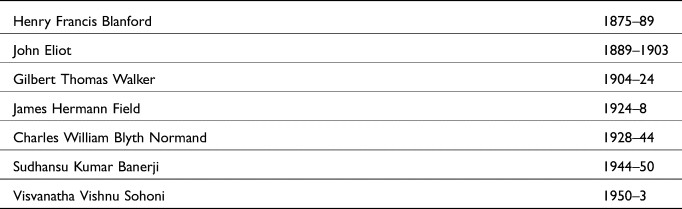
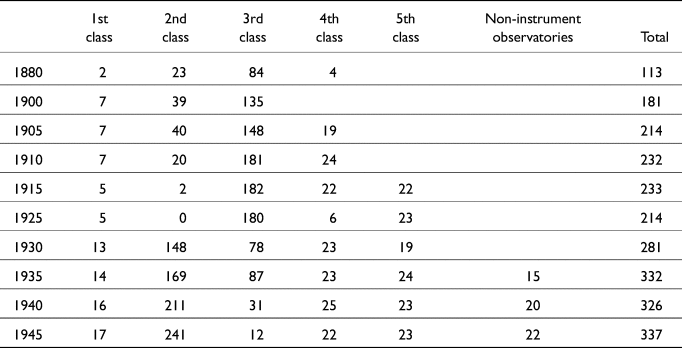
The continuity of the IMD forecast's annual issue belied meaningful changes in evidence and technique, tracking developments in statistical mathematics, physics and economic theory. This section will describe how the official ‘seasonal monsoon forecast’ publication mutated throughout the decades between 1886 and 1953. IMD directors John Eliot, Gilbert Walker and Charles W.B. Normand each overhauled the office's approach to long-term prediction early in their respective tenures (Table 1). Reforms reflected their disciplinary training, reigning administrative philosophies and personal predilections, as well as the evolving infrastructure of the observatory network (Table 2). In May each year, a central office staff of computers, draftsmen and clerks reduced incoming data and prepared time series and charts, retrieving files from past years for comparison. Based on these materials, the IMD director finalized the prediction and composed the qualitative text of the forecast. He then submitted the forecast to the Viceroy's Council for approval for public distribution via the official gazettes and daily weather telegram. A juxtaposition of selected specimens of the forecast illustrates how methods and standards of success shifted over these decades.Footnote 41 Ultimately, I suggest, it was the official practice of publishing the long-range forecast each year – regardless of the continually revised methods underlying the calculation – that entrenched the forecast's position as a ‘duty’ of state.
Meteorological reporters to the Government of India, also directors general of Indian observatories after 1899. The responsibility for sanctioning and publishing the annual monsoon forecast rested at the top of the IMD organization.

Observatories in the IMD's ‘Indian’ Network, divided by class, as documented in annual reports. Class 1 observatories contained auto-registering instruments and kept continuous records; each succeeding class took measurements less frequently using fewer specialized instruments, according to a standardized protocol designed by the central office. The exact specifications distinguishing each class changed over time, but this table gives a sense of a network expanding in range and complexity.

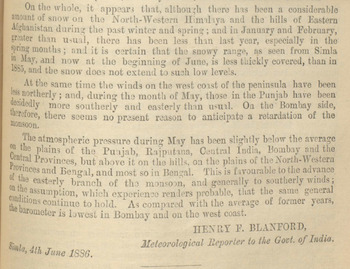
Blanford first expressed hope that he had identified a sound basis for rainfall prediction in a paper read before the Royal Society in April 1884.Footnote 42 There, he noted the coincidence of persistent dry westerly winds on the northern plains, with abnormally heavy snow cover in the Himalayas. On this basis, Blanford hypothesized that late-season snowfall might prolong winter patterns of subcontinental pressure and temperature, thereby preventing physical establishment of the wetter, oceanic monsoon current.Footnote 43 Reliable records for rainfall in the north-west dated from only 1865, and reports of Himalayan snowfall from remote alpine stations were regrettably qualitative. Still, using his meagre data set, Blanford identified a tendency for a ‘late’ monsoon to follow heavy snowfall in the north-west mountain ranges. As he admitted, its impacts on total seasonal rainfall were tentative. But Blanford was encouraged by his successful anticipation of a ‘retarded’ monsoon for the 1883 season and another success the following year. He submitted his snowfall hypothesis to the broader scientific community, while urging against ‘too wide an application’ of his theories.Footnote 44 Based on snowfall reports and the assumption of persistent pressure distributions across the subcontinent, Blanford issued public forecasts from 1886 until his retirement in 1889, under the unassuming heading ‘Memorandum on the snowfall of the Himalaya and western mountains’. These government announcements, circulated to officers across the colony and republished in the Gazette of India, were strictly three pages in length. Only in closing did Blanford turn to brief speculation. In 1886, he asserted on the basis of prevailing winds that there was ‘no present reason to anticipate a retardation of the monsoon’ (Figure 2).
Excerpt from the first official IMD seasonal forecast. These few paragraphs closed the memorandum with tentative suggestions of what observed winter snowfall might mean for the upcoming monsoon season. ‘Extract from the proceedings of the GOI in the Revenue & Agriculture Dept. of Meteorology, dated Simla, 10th June 1886’, Supplement to the Gazette of India, 12 June 1886, p. 881. Courtesy of Library of Congress.

Consider next the 1891 prediction by John Eliot – the first to include the word ‘forecast’ in the title. By contrast with the reticent Blanford, Eliot confidently highlighted his predictions within the larger report. This publication consisted of a list of eight ‘chief inferences’ related to the ‘probable character of the monsoon’. Each inference specified a climatological sub-region of South Asia, projected the character and distribution of rainfall (favourable, normal or unfavourable), and volunteered an assessment of the anticipated onset (timely or delayed) of monsoon conditions. In the surrounding text, Eliot invoked the authority of ‘probability’, while curiously neglecting to describe how he calculated its value. Because the physical relationships between atmospheric variables were unconfirmed, he projected future developments by noting resemblances to historical scenarios. One notable aspect of Eliot's forecasts was the lengthy section labelled ‘Comparison with previous years’, where he provided short synopses of each recorded season presenting similar starting conditions: in 1891, for instance, he noted similarities with 1868, 1877, 1878, 1883 and 1885. Using this largely descriptive presentation strategy, he intended to render transparent his thinking for contemporary peers and future forecasters. Eliot was keenly aware that his successors might benefit by using the document as reference as mathematical forecasting methods became more sophisticated – for the moment, he did the work of identifying patterns and organizing pertinent information.
To defend himself against criticism, Eliot elaborated upon his complex considerations and choices. Correspondingly, his forecasts swelled in size. In 1900, his official printed forecast totalled forty-four pages. By this time, Eliot subscribed to the view that oscillations of pressure and temperature around the globe were connected. He had begun his tenure in 1889 with an initiative to gather more data from ships in the Indian Ocean, where he believed the south-west monsoon current formed. By 1900, he suspected connections farther afield, looking toward Cape Town and Mauritius, and his reports included new sections on conditions in Persia and ‘General conditions in the Indian monsoon region, South Africa, and the Indian Ocean’.Footnote 45 But even as the IMD monsoon forecast presented an ever-expanding synoptic view, his final prediction depended largely upon the same factor: the timing and accumulation of snowfall in the Himalayas. Ultimately, the predictions rested on Eliot's intuition and judgement, an uncomfortable fact that he occasionally acknowledged. As he later explained,
My chief effort has been to make [my forecasts], on the one hand, as clear and precise as I possibly can under the circumstances, and, on the other hand, to guard not myself but the Government and the public, from placing a greater confidence in them than I do myself.Footnote 46
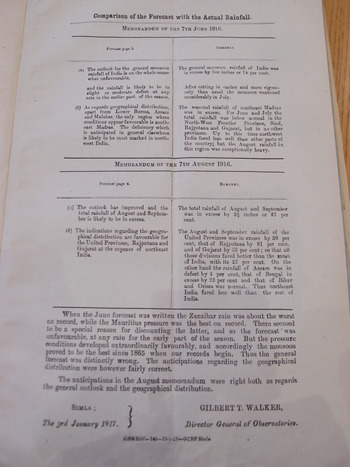
When his tenure as director general began in 1904, Gilbert Walker renewed research on seasonal forecasting – he called it one of the two ‘chief objects’ of his new meteorological programme.Footnote 47 An accomplished mathematician, Walker took a new approach. As he declared in a proposal to reorganize the IMD: ‘It is now clear that over a large part of the world there are relationships of the weather with that of India’.Footnote 48 In consultation with India's new Board of Scientific Advice, Walker diverted resources from the daily production of Indian Ocean charts for synoptic comparison, to global statistical studies, using novel correlation methods to detect probable interdependencies between far-flung variables. Upper-air measurements at Agra's Aerological Observatory from 1912 added a vertical dimension to data collection and remained a source of hope for the improvement of forecast formulae over the next several decades. Still lacking a theoretical basis for predicting the monsoon, Walker relied on historical data like earlier directors. However, he applied new standards of statistical rigour that drastically reduced the role of human judgement. At the same time, he committed to transparency in his retrospective evaluations of forecast effectiveness. Walker began publishing separate comparisons of seasonal forecasts with ‘actual rainfall’ in 1907.Footnote 49 In his first year using this system, he determined that his projections of rainfall in the June and August forecasts had both been inaccurate, a result he attributed to ‘the preponderating evidence of some unknown factor’. But this failure reaffirmed his sense that larger oscillations were at work, and that the season's ‘deficient’ monsoon ‘has been due to general and not to local causes’.Footnote 50
Comparison of forecasts and ‘actuals’ for the initial and updated monsoon forecasts in 1916, illustrating Walker's deliberate transparency in evaluating his predictions. Gilbert T. Walker, Statement of Actual Rainfall in June, July, August and September 1916 and a Comparison of the Forecasts with the Actual Rainfall, Simla, 1917. Information provided by the National Meteorological Library and Archive – Met Office, UK.

Walker's application of correlation coefficients to long-range forecasting earned him widespread renown. Globally, he became a scientific celebrity for his mathematically abstracted methods of weather prediction, where tests of co-variation determined which atmospheric variables deserved careful monitoring and input into predictive formulas. Through statistical collection and correlation, Walker and his frequent collaborator E.W. Bliss studied atmospheric patterns, eventually identifying numerous ‘centres of action’ which they believed powered the dynamic global weather system. These were locations of stored energy that fuelled the seesawing patterns of ‘world weather’, in a large-scale system known today as the El Niño southern oscillation (ENSO).Footnote 51 As Walker's formulas replaced narrative descriptions, the public forecast released in newspapers became increasingly concise.
Charles W.B. Normand and his scientific assistants cut down the forecast even further, excising historical and narrative description almost entirely. Typically, the 1933 document was brief, at 1.5 pages. The forecast was summarized in one sentence: ‘There is an eighty per cent. chance of the monsoon rainfall being normal in the Peninsula, above ninety per cent. of the normal in northwest India and above ninety-five per cent of the normal in northeast India’.Footnote 52 By this time, meteorologists had identified several multi-year oscillations affecting global weather. Accordingly, IMD correlations in 1933 took into account atmospheric data from far afield – from South America, Java and the Aleutian Islands.Footnote 53 In 1931, Normand instituted a ‘performance test’ of the factors used in seasonal forecasting formulas, using data collected since his tenure began as randomized samples that could be used to test Walker's earlier regression calculations.Footnote 54 To Normand's surprise, his (human) computers discovered that many formerly significant variables no longer reliably correlated with seasonal rainfall, pointing toward the influence of unknown, longer-term oscillations or non-periodic variations. By the 1930s, IMD meteorologists were newly sceptical that correlation analysis would yield enduring findings, including physical explanations for inter-annual weather variation. Normand proposed no alternative method to replace it, however. In certain years, he refused to issue a forecast if important variables conflicted in their indications. Overall, he sought to distance his professional reputation from long-range forecasting, casting himself as merely ‘a close onlooker and practitioner’, not an active researcher.Footnote 55
Normand's highly abbreviated version of the monsoon forecast may have mitigated the risk of ‘failure’, but it displeased his administrative superiors. India's governors, determined to apply IMD predictions to concrete bureaucratic purposes, did not appreciate vague projections or abstract mathematics. As one frustrated figure in the India Office declared (signed H.M. – perhaps the Secretary of State), it was ‘perfectly preposterous’ to call a forecast successful, if the IMD simplified its conclusions to attain 80 percent certainty as Normand's standards required. In this critic's view, such tentative estimates risked turning the IMD into a ‘laughing stock’. When Normand tepidly agreed to push his predictions ‘as far as he dare in future’, his interlocutor shot back,
There is nothing vital about these forecasts. Dr. Normand has not the same standing in the agricultural world as the local astrologer. It matters therefore to no one except to Dr. Normand and his staff whether the forecasts are right or wrong. And it never will matter so long as they continue to be so cautious as to be absolutely useless. I hope that Dr. Normand will take his courage in both hands and go as far as he dare. It is not expecting much to expect him to back the faith that is in him to that extent.Footnote 56
Despite this stinging rebuke by his superior, Normand did not dramatically alter the criteria or format of the forecast in future years. Already, the merits of correlation-based forecasting were disputed. While he concurred that his forecasts had little practical utility, Normand saw no way to reform them without jeopardizing the integrity of the department.
This episode lays bare the stakes of the ongoing conflict between scientists cultivating their professional reputations and administrators intent on governing via forecasts. The India Office leadership's frustration betrayed the predicament in which the two parties found themselves. While both agreed the predictions were worthless, bureaucratic procedure required Normand to produce long-term forecasts so that government and the wider ‘public’ could make plans for the year. These parties disagreed fundamentally about whether accuracy or utility was possible. As meteorologists sought to shield themselves from public ridicule by shifting seasonal prediction into the register of mathematical statistics, they lost the ability to communicate with non-specialist audiences. But if the India Office feared that timid predictions might discredit the government, blatantly inaccurate forecasts ultimately proved more dangerous to the IMD's scientific authority.
The spectacle of prediction
While government administrators were the primary intended audience for long-term forecasts, in moments of heightened anxiety over drought lay communities also paid close attention. The breadth and depth of public interest in the IMD's forecasts are difficult to gauge. An evaluation of English-language newspaper commentary in India confirms two points. First, the monsoon forecast occasionally became a site of fierce public controversy. Second, the region's multiple public spheres accommodated a range of opinions about meteorology and the IMD specifically. The most riveting period in the historical record spans the decade after 1899. In these distressing years, the vulnerabilities of meteorological science were exposed to the unsparing light of public attention.Footnote 57
Eliot's monsoon forecast failed dismally in 1899. His predictions of a ‘normal’ season after several years of deficient rainfall proved tragically wrong, and the drought-stricken Deccan region descended into famine. Indian presses reacted vociferously to this catastrophe, and several editors engaged in critique, mockery and condemnation of the practice of seasonal forecasting. The Anglo-Indian Pioneer, based in Allahabad, was among the most disparaging. An editorial in October declared, ‘One result of this year's experience must be to destroy all faith in the credibility of the meteorological forecast’.Footnote 58 In contrast with earlier approving portrayals, The Pioneer's editors dismissed IMD projections as ‘Delphic utterances’.Footnote 59 The reasons for the condemnation became clearer in another editorial, published two months later. There, the authors charged the IMD with endangering the foundation of British rule as rooted in rational scientific principles, writing, ‘The signal failure of our Meteorologist has been used to point to the moral that Western science is useless as well as helpless’. Apparently, the failed forecast had unleashed a ‘reactionary spirit’ that ran ‘rampant’ in the vernacular presses.Footnote 60 The episode inspired several newspapers, most notably the long-standing Bombay Samachar, to revel in the humiliation of British science and champion Sanskrit knowledge systems in its stead.Footnote 61 In The Pioneer's view, the IMD had undermined British leadership by exposing ‘Western science’ as insecure, speculative and foreign, puncturing its aura of authority. This was a withering assessment.
Eliot defended himself in a nearly full-page response. With characteristic verbosity, he defended his work and condemned The Pioneer's reporting as incompetent, premature and, above all, unfair. Eliot reproached the editors for maligning his forecast without attempting to diagnose its faults. To his frustration, these journalists seemed uninterested in identifying whether the underlying theories were themselves faulty, or whether they had been used in ‘erroneous application’. Alternatively, as Eliot contended, the problem might lie in deficient infrastructure. To his mind, resource obstacles had stymied his predictions, and forecast failures stemmed from underinvestment in global observational networks. Against criticisms of his forecasts, Eliot pointed to explicit warnings in the text reminding readers of the ‘limits of their value … [and] the extent of my ignorance as well of my knowledge’ (by which he meant a shortage of data, rather than personal intellectual deficiency).Footnote 62 He was also defended by the editors of Calcutta's Friend of India, who criticized The Pioneer's editors as ‘childish’ and ‘ignorant’ on the science of ‘probabilities’, even arguing that ‘the forecasts are not put forward as prediction’.Footnote 63
Eliot was particularly distressed, by his own admission, because The Pioneer addressed ‘the most intelligent public in India’ – that is, his own peers within the insular club of the Indian civil service. By way of closing, he defended the importance of long-term forecasting: ‘I can assure you of more public interest and importance than you appear to be disposed to concede’.Footnote 64 But privately, he surrendered. Eliot requested that future seasonal forecasts become confidential; indeed, they remained hidden from public view until 1906, when Gilbert Walker, as the new director general, reinstated them.Footnote 65 The embarrassing incident, a disappointing finish to a decades-long career in India, did not dissuade Eliot from the sincere belief that his object was achievable. He insisted, ‘My own opinion founded on upwards of 25 years’ study of Indian meteorology is that long period forecasting is possible in India’.Footnote 66
This historical spectacle had a long afterlife for India's reading publics as well. The following decade saw an explosion of extra-official weather forecasts in various newspapers, especially those less closely tied to the GOI establishment, notably the Times of India. Journalists frequently portrayed professional scientists as equivalent to Hindu jyotiṣīs (Sanskrit astrologers), who discerned indications of the weather in astral conjunctions. In the vacuum of authority opened by the consequential 1899 famine, authority over the monsoon forecast became vigorously contested. Prognostications abounded, from the lunarist Hugh Clements in England to the Sholapur-based theosophist G.E. Sutcliffe and numerous ‘Hindu astrologers’. In particular, Clements gained notoriety, cheered on as ‘our weather prophet’ by several English-language newspapers as he competed for headlines with the ‘Official Weather-Prophet’: the director of the IMD.Footnote 67 Meteorologists could not escape these trivializing comparisons. In these articles – many of which were humorous, although some were quite serious – weather scientists represented not rationality, but modern divination.
This historical moment exposed the struggle of meteorologists to demarcate the boundaries between their scientific discipline and the work of rival forecasters.Footnote 68 Challengers continued to question IMD expertise and propose alternative methods. One correspondent of the Calcutta nationalist newspaper Amrita Bazar Patrika suggested (rather superficially) that wireless radio signalling and Clementsian prediction techniques should be combined, writing, ‘Perhaps the ideal combination of genius would be the Clements–Marconi Weather Bureau!’Footnote 69 Even so prominent a figure as journalist William Digby, who had earned fame for his strident criticism of government policy during the 1877 famine, expressed doubt about the state's investments in meteorology. A few years before his death, he became an ardent admirer of Clements and published a tract extolling the virtues of his lunar theories. Clements believed that the gravitational pull of the Moon, determined by its aspect and position, affected the oceans, the atmosphere and terrestrial fluids equally, producing a series of ‘tides’ that could be calculated in advance.Footnote 70 Indian jyotiṣīs also commonly grouped together events of diverse types in their public prophecies, predicting wars, imperial policies and rebellions alongside atmospheric cataclysms. The notable failure of the 1899 forecast laid IMD authority open to an eruption of public challenges that state scientists were unable to suppress.
Still, this turbulent decade for the authority of state forecasting was somewhat anomalous. The newspaper commentary highlighted above gives us a sense of how the reputation of meteorology in India was different from that of other imperial scientific disciplines.Footnote 71 Commentators displayed occasional scorn and bemusement, sometimes gratitude or hopefulness, but more often complete lack of interest. Unlike anthropology, medicine and public health – disciplines dealing in the management of human bodies and societies – meteorology did not inspire sustained popular passion. State meteorology did not appear to penetrate much deeper than the thin layer of colonial bureaucracy. Indeed, popular disinterest was not unwelcome. Beyond their policy of distributing seasonal forecasts to subscribing newspapers, IMD officials made little effort to reach out to agriculturalists, fishing communities or even urban Indian elites to encourage attention to these services. Ultimately, the official monsoon forecast offers the greatest insights into the culture of GOI administration, which over this period became dependent upon forecasting for both its fiscal operation and its moral legitimation.
Conclusion
In the opening editorial of the inaugural issue of the Indian Journal of Meteorology and Geophysics in April 1950, director V.V. Sohoni declared that ‘the development of the forecasting technique must forever remain the main pre-occupation of meteorologists’. But while he expressed confidence in the improvement of short-range forecasting, he recommended that the IMD should avoid issuing long-term predictions at all ‘under the present state of knowledge’. In his view, without a physical model supplying the causes for the ‘formation, movement, persistence and decay’ of seasonal weather phenomena, it was impossible to calculate future atmospheric effects.Footnote 72 In his own piece, addressed (improbably, for a professional journal) to the ‘general public’, retiring director S.K. Banerji similarly chose to emphasize forecasting's limitations, insisting, ‘All that can be achieved in a seasonal forecast is the probable departure from normal of the season's rainfall over a fairly extensive region’.Footnote 73 As India's First Five-Year Plan for economic development launched in 1951, the new nation's senior meteorologists did not envision a pivotal role for their own institution.
From his new position at the Royal Meteorological Society in London, Normand was similarly candid about the poor prospects for seasonal forecasting, and sceptical of the utility of broadcasting predictions to a wider public. His pessimism rang out in a speech in 1953. While he supported the continuation of long-range research, his endorsement was remarkably feeble: ‘I am in favour of continuing the practice of forecasting for the whole monsoon each year, if only to keep the subject alive and in the hope that ideas for progress will emerge’.Footnote 74 At the end of their careers, Normand and Banerji had each reached conclusions similar to Eliot's fifty years earlier, but with larger data sets and a longer history of disappointment informing their positions. As this paper has shown, Indian meteorologists struggled to control public opinion of their work. In the 1920s, director Gilbert Walker rebranded seasonal ‘forecasting’ as ‘foreshadowing’ in an attempt to convey its approximate and tentative capabilities, an evocative – even literary – revision that juxtaposed strangely against the crisp, quantitative methods he championed.Footnote 75 However, the re-signification was unsuccessful. Walker's new term did not catch on beyond his immediate circle and faded away after his retirement. Nevertheless, his lonely attempt captures the long-range forecaster's quandary. Despite the potential that India originally seemed to offer scientists as a ‘tropical laboratory’ for atmospheric experiments, it is here that the promise of exact weather prediction failed most spectacularly.Footnote 76
To return to our opening question: why, in light of this undignified history, did IMD meteorologists continue to submit these forecasts to the general public year after year? The most satisfactory explanation lies in the transformation of state bureaucracy and economic theory – and the statistical reformulation of both domains – producing an integrated mathematical orientation toward the future. It became unjustifiable for any Indian government, provincial or national, to submit its budget without a ‘scientific’ estimate of agricultural revenue or famine expenditure. Good fiscal administration also entailed an annual projection of seasonal precipitation, however dubious its accuracy. Demand for these forecasts came not so much from below, but from the imperial administration itself. Rainfall prediction operated as a ritual performance of responsible governance in a tropical, monsoonal setting.Footnote 77 Simultaneously, the seasonal forecast served as a reminder of the future promises of state science, buttressing moralizing arguments for British rule. These commitments transcended changes in political fortunes, prevailing through reorganizations of government, the gradual institution of electoral politics, and eventual decolonization. The seasonal forecast's history shows how challenges specific to the region and its atmospheric patterns shaped the lines along which meteorology unfolded in the Indian subcontinent. It enriches our understanding of the multiple genealogies of forecasting, as well as meteorologists’ struggles to claim authority across a variety of contexts: here, in an anxious, distrustful and racialized imperial setting. When recombining these strands of analysis, the seasonal forecast looks at once more ambitious and more tenuous than at first glance – a site and symbol of the Indian government's ambitions to rationalize tropical ecologies and societies.
Acknowledgments
For their crucial feedback, I would like to thank my two anonymous referees, Gyan Prakash, Erika Lorraine Milam, Projit Bihari Mukharji, Jeremy Adelman, Charu Singh, Devika Shankar, Sria Chatterjee and other colleagues at Yale University, Princeton University, the University of Chicago and the National University of Singapore where I presented earlier versions of this paper. Special thanks are also owed to Parthasarathi Mukhopadhyay, Ravi Shankar Nanjundiah, R. Krishnan and Ranjan Kelkar at the Indian Institute for Tropical Meteorology who facilitated my archival work in Pune, as well as the gracious librarians at the UK National Meteorological Library & Archive. Research for this article was funded by Princeton University's Department of History, the US Fulbright Program, the US–India Educational Foundation and Northwestern University's Science in Human Culture Program.