Childhood neglect is associated with long-term negative developmental (Vasileva & Petermann, Reference Vasileva and Petermann2018), mental health (Norman et al., Reference Norman, Byambaa, De, Butchart, Scott and Vos2012; Vasileva & Petermann, Reference Vasileva and Petermann2018) and neuropsychological outcomes (Kavanaugh, Dupont-Frechette, Jerskey, & Holler, Reference Kavanaugh, Dupont-Frechette, Jerskey and Holler2017). However, the interpretation of such associations is hindered by design limitations common to observational studies. For instance, many studies rely on retrospective reports of neglect (Hardt & Rutter, Reference Hardt and Rutter2004; Norman et al., Reference Norman, Byambaa, De, Butchart, Scott and Vos2012) occurring in biological families of individuals either specifically identified or self-selected as a result of the development of mental health problems. This makes it difficult to disentangle early adversity from familial genetic and environmental risk (including continuing adversity) and subsequent psychopathology.
The English and Romanian Adoptees (ERA) study utilizes a unique natural experiment – the large-scale adoption of infants and young children from the Romanian institutions after the fall of Ceaușescu's regime in 1989 – with a prospective design, thus addressing some of these methodological problems to strengthen causal inference. Adoptees entered institutions in the first weeks of life and were then exposed to up to 43 months of global deprivation, a particularly severe type of neglect marked by limited cognitive stimulation, minimal social interaction with adult carers, and poor diet and hygiene (Sonuga-Barke et al., Reference Sonuga-Barke, Kennedy, Kumsta, Knights, Golm, Rutter and Kreppner2017). They were subsequently adopted into well-resourced UK families where they received high-quality care. This led to a precisely-timed, sudden and dramatic change in their rearing environment, which was largely determined by historical circumstances. Crucially, this meant that the duration of deprivation exposure was unlikely to be confounded with variations in either genetic or pre-institutional risk and/or post-adoption circumstances. Further, because the adoptees entered the study based on their deprivation exposure, rather than because they displayed the adverse effects of deprivation (e.g. psychopathology), the association between deprivation exposure and neuropsychological impairment can be disentangled from deprivation-related psychopathology.
The ERA study followed-up the adoptees at ages 4, 6, 11 and 15 years, and most recently in young adulthood (aged 23–25 years). For nearly all of the adoptees, an initial devastating effect of deprivation on development was recorded at the time of adoption. This was followed, for many, by marked recovery by age 6 years (Rutter, Reference Rutter1998). Nevertheless, a substantial minority of adoptees, especially those exposed to >6 months deprivation, presented with a heterogeneous yet distinctive pattern of neurodevelopmental problems in comparison to non-deprived adoptees. Most pronounced were symptoms of attention-deficit/hyperactivity disorder (ADHD; Kennedy et al., Reference Kennedy, Kreppner, Knights, Kumsta, Maughan, Golm and Sonuga-Barke2016), autism spectrum disorder (ASD; Rutter et al., Reference Rutter, Kreppner, Croft, Murin, Colvert, Beckett and Sonuga-Barke2007) and disinhibited social engagement (DSE – indiscriminate friendliness and a lack of social boundaries; Kennedy et al., Reference Kennedy, Kreppner, Knights, Kumsta, Maughan, Golm and Sonuga-Barke2017). These problems have persisted to a striking degree through to adulthood, in spite of exposure to positive and nurturing family environments in the intervening period (>20 years in some cases; Kennedy et al., Reference Kennedy, Kreppner, Knights, Kumsta, Maughan, Golm and Sonuga-Barke2017; Sonuga-Barke et al., Reference Sonuga-Barke, Kennedy, Kumsta, Knights, Golm, Rutter and Kreppner2017). This persistence has led to the hypothesis that these problems are the result of deep-seated changes in underlying neuropsychological processes (McCrory, Gerin, & Viding, Reference McCrory, Gerin and Viding2017; Nelson, Zeanah, & Fox, Reference Nelson, Zeanah and Fox2019; Rutter & O'Connor, Reference Rutter and O'Connor2004). In support of this hypothesis, deprivation-specific neurodevelopmental difficulties were in many cases accompanied by cognitive impairment, as indexed by low IQ – although a degree of catch-up in IQ has occurred across childhood and adolescence (Sonuga-Barke et al., Reference Sonuga-Barke, Kennedy, Kumsta, Knights, Golm, Rutter and Kreppner2017). Extended childhood deprivation was associated with deficits on neuropsychological tests of social cognition and executive function at age 11 (Colvert et al., Reference Colvert, Rutter, Kreppner, Beckett, Castle, Groothues and Sonuga-Barke2008b). Furthermore, we have recently reported MRI data confirming deprivation-related reductions in total brain volume and regional alterations in frontal and temporal lobes (Mackes et al., Reference Mackes, Golm, Sarkar, Kumsta, Rutter, Fairchild and Sonuga-Barke2020).
Our study is the first to provide data on the persistence of adverse neuropsychological effects into adulthood, as all previous research on post-institutionalized individuals have included either children or adolescents (Almas, Degnan, Nelson, Zeanah, & Fox, Reference Almas, Degnan, Nelson, Zeanah and Fox2016; Bick, Luyster, Fox, Zeanah, & Nelson, Reference Bick, Luyster, Fox, Zeanah and Nelson2017; Bos, Fox, Zeanah, & Nelson, Reference Bos, Fox, Zeanah and Nelson2009; Colvert et al., Reference Colvert, Rutter, Kreppner, Beckett, Castle, Groothues and Sonuga-Barke2008b, Reference Colvert, Rutter, Beckett, Castle, Groothues, Hawkins and Sonuga-Barke2008a; McDermott et al., Reference McDermott, Troller-Renfree, Vanderwert, Nelson, Zeanah and Fox2013; Merz, McCall, Wright, & Luna, Reference Merz, McCall, Wright and Luna2013; Moulson et al., Reference Moulson, Shutts, Fox, Zeanah, Spelke and Nelson2015; Wade, Fox, Zeanah, & Nelson, Reference Wade, Fox, Zeanah and Nelson2019). We also investigated the relationship between deprivation-related effects on neuropsychological functioning and two of the hallmark neurodevelopmental effects of institutional deprivation – ADHD and ASD symptoms. DSE was not included in this analysis because it was limited almost exclusively to those individuals with extended deprivation.
We selected four neuropsychological domains for investigation, in addition to IQ. This selection process was guided by evidence from previous waves of the ERA study, clinical interviews with the adult adoptees performed during the most recent assessment wave (the ERA Young Adult Follow-up) and prior evidence suggesting a link between these domains and early neglect, childhood maltreatment in general and/or ADHD or ASD symptoms. These domains were: (i) Inhibitory control – this is impaired in individuals who have experienced institutional deprivation (McDermott et al., Reference McDermott, Troller-Renfree, Vanderwert, Nelson, Zeanah and Fox2013; Merz et al., Reference Merz, McCall, Wright and Luna2013) and is associated with both ADHD (Huizenga, van Bers, Plat, van den Wildenberg, & van der Molen, Reference Huizenga, van Bers, Plat, van den Wildenberg and van der Molen2009; Lipszyc & Schachar, Reference Lipszyc and Schachar2010; Miller, Ho, & Hinshaw, Reference Miller, Ho and Hinshaw2012; Miranda-Casas, Baixauli-Fortea, Colomer-Diago, & Rosello-Miranda, Reference Miranda-Casas, Baixauli-Fortea, Colomer-Diago and Rosello-Miranda2013) and ASD (Geurts, van den Bergh, & Ruzzano, Reference Geurts, van den Bergh and Ruzzano2014). At the age 11 wave of the ERA study, inhibitory control deficits statistically mediated the relationship between deprivation and ADHD symptoms (Colvert et al., Reference Colvert, Rutter, Kreppner, Beckett, Castle, Groothues and Sonuga-Barke2008b). It is now recognized that inhibitory control can be separated into two elements – proactive inhibition, the recruitment of executive resources in preparation to withhold a response before its initiation to a target, and reactive inhibition, the ability to stop a response after its initiation in response to a target (Meyer & Bucci, Reference Meyer and Bucci2016). Proactive and reactive inhibition represent equally important aspects of inhibitory-based executive control. However, most tasks are unable to distinguish between these different elements of inhibition. We therefore decided to use a cued Go-NoGo task to isolate proactive inhibition from the conventional analysis of commission errors on non-cued tasks which would index failures of reactive inhibition. To date no studies of proactive inhibition have been conducted in maltreated samples. In children with ADHD (Pani et al., Reference Pani, Menghini, Napolitano, Calcagni, Armando, Sergeant and Vicari2013; van Hulst et al., Reference van Hulst, de Zeeuw, Vlaskamp, Rijks, Zandbelt and Durston2018) and ASD (van Hulst et al., Reference van Hulst, de Zeeuw, Vlaskamp, Rijks, Zandbelt and Durston2018), deficits seem to be primarily limited to reactive inhibition. However, adult studies are lacking. (ii) Prospective memory – deficits in prospective memory, the ability to remember to undertake an action in the future, were reported by ERA participants during clinical interviews conducted before we designed this study. Previous reports suggest that adolescents with a history of maltreatment are impaired in prospective (Lin et al., Reference Lin, Bai, Sun, Guo, Zhang and Cao2017) and other forms of memory. Prospective memory has also been found to be impaired in children and adults with ADHD (Fuermaier et al., Reference Fuermaier, Tucha, Koerts, Aschenbrenner, Westermann, Weisbrod and Tucha2013; Talbot, Mueller, & Kerns, Reference Talbot, Mueller and Kerns2018) and ASD (Sheppard, Bruineberg, Kretschmer-Trendowicz, & Altgassen, Reference Sheppard, Bruineberg, Kretschmer-Trendowicz and Altgassen2018). (iii) Emotion recognition impairments are commonly reported in children and adolescents following institutional deprivation (Bick et al., Reference Bick, Luyster, Fox, Zeanah and Nelson2017; Colvert et al., Reference Colvert, Rutter, Beckett, Castle, Groothues, Hawkins and Sonuga-Barke2008a; Doretto & Scivoletto, Reference Doretto and Scivoletto2018; Moulson et al., Reference Moulson, Shutts, Fox, Zeanah, Spelke and Nelson2015; Nelson, Westerlund, McDermott, Zeanah, & Fox, Reference Nelson, Westerlund, McDermott, Zeanah and Fox2013). Individuals with ADHD and ASD also display emotion recognition deficits (Borhani & Nejati, Reference Borhani and Nejati2018; Lozier, Vanmeter, & Marsh, Reference Lozier, Vanmeter and Marsh2014). (iv) Decision-making about outcomes varying in amount and probability is impaired in maltreated children (Guyer et al., Reference Guyer, Kaufman, Hodgdon, Masten, Jazbec, Pine and Ernst2006), children with a history of early stress (Birn, Roeber, & Pollak, Reference Birn, Roeber and Pollak2017; Hanson et al., Reference Hanson, Albert, Iselin, Carre, Dodge and Hariri2016), and adolescents exposed to institutional deprivation (Mehta et al., Reference Mehta, Gore-Langton, Golembo, Colvert, Williams and Sonuga-Barke2010). Additionally, it is impaired in individuals with ADHD (Sonuga-Barke, Cortese, Fairchild, & Stringaris, Reference Sonuga-Barke, Cortese, Fairchild and Stringaris2016; Sorensen et al., Reference Sorensen, Sonuga-Barke, Eichele, van Wageningen, Wollschlaeger and Plessen2017) though findings are inconsistent in ASD (Carlisi et al., Reference Carlisi, Norman, Murphy, Christakou, Chantiluke, Giampietro and Rubia2017; Dillon et al., Reference Dillon, Holmes, Birk, Brooks, Lyons-Ruth and Pizzagalli2009).
We studied performance on neuropsychological tests measuring these domains to address five questions in relation to institutional deprivation and the associated outcomes of ADHD and ASD symptoms:
(1) Is time-limited institutional deprivation related to neuropsychological deficits in early adulthood?
(2) If present, were these effects most pronounced in those individuals exposed to the most extended periods of deprivation?
(3) Are these effects simply due to deficits in general cognitive ability (IQ), which we know exist in the extended deprivation group?
(4) Are deprivation-related ADHD and ASD symptoms associated with neuropsychological deficits and are these effects independent of one another?
(5) Is the association between childhood institutional deprivation and adult ADHD and/or ASD symptoms explained by the former's association with adult IQ or other neuropsychological deficits?
Methods and materials
Participants
The current sample included 70 adult Romanian adoptees who experienced between 3 and 41 months of institutional deprivation (mean age = 25.3 years; 50% female) and a control group of 23 UK never-institutionalized adoptees (mean age = 24.6 years; 39% female) – representing 49% and 44% of the original sample, respectively. To assess whether selective attrition had occurred, we compared all ERA Brain Imaging Study (ERABIS) participants (n = 93) with ERA participants who did not take part in ERABIS (n = 103) in terms of deprivation status, IQ and ADHD and ASD symptoms at age 6 years. The two groups did not differ on any variable (robust t tests with 20% trimmed means and bias-corrected bootstrapped confidence intervals; ps > 0.16; see online Supplement 1). One UK adoptee was excluded from all subsequent analyses due to low IQ (<60), reducing the UK adoptee group to 22 participants (mean age = 24.6, 41% female).
Measures
Inhibitory control
In the cued Go/No-Go (GNG) task (Criaud, Wardak, Ben Hamed, Ballanger, & Boulinguez, Reference Criaud, Wardak, Ben Hamed, Ballanger and Boulinguez2012), participants had to either press a button when a ‘go’ target (white circle) was present or inhibit their response to a ‘no-go’ target (white ‘X’) presented on each trial in the center of the computer screen. The response interval was 1000 ms (stimulus presentation duration: 950, 50 ms inter-stimulus interval). Two conditions, each with 108 trials, were compared to isolate an individual's ability to mobilize and maintain resources required for an upcoming inhibitory response (i.e. proactive inhibition). A ‘possible inhibition’ trial was indicated by a pre-target red cross (+) cue (2000 ms or 6000 ms) to indicate that either a ‘no-go’ or ‘go’ target would be presented (both n = 48). This cue alerted the participant to prepare to inhibit their response. This was compared to a control ‘never inhibit’ condition where a white cross (+) indicated that only ‘go’ targets (n = 81) would be presented and thus proactive mobilization of inhibitory resources was not required. Proactive inhibition was indicated by slowing of reaction times to correct ‘go’ target responses for ‘possible inhibition’ compared to the ‘never inhibit’ cues. The remaining trials in each condition (n = 12 for ‘possible inhibition’ and n = 27 for the ‘never inhibit’) were null trials in which no target was presented. The dependent variables were proactive inhibition and commission errors – the failure to withhold a reaction to a stop target.
Prospective memory
The Memory for Intentions Screening Test (Raskin, Reference Raskin2009) involved a word-search puzzle as a distractor task during which participants were requested to remember to respond to instructions delivered throughout the task either at specified times or to pre-determined events at either short (2 min) or long (15 min) intervals. Responses could be made in response to verbal (e.g. ‘In two minutes, please tell me two things you forgot to do this week’) or action-based cues (e.g. ‘When I give you a red pen, sign your name on your paper.’). The dependent variable was the total sum score with higher scores indicating better prospective memory functioning.
Decision-making quality
In the Risky Choice Task (adapted from Clark et al., Reference Clark, Li, Wright, Rome, Fairchild, Dunn and Aitken2012), participants had to choose between two roulette wheels offering different sums of money and different probabilities of receiving a gain v. a loss. Each wheel was divided into eight segments, each segment contained a number depicting a possible win (+) or loss (–) amount – marked in different colors. The amount available to be won or lost and the probability of winning (indexed by the number of win v. loss segments) was systematically varied across trials. At the beginning of each new block, participants started with 100 points. On each trial after a 1000 ms delay, ‘please choose now’ appeared on the screen and the participants had to select a wheel. There was no time limit. After the choice was made, the selected wheel was presented on its own and a ticker span around the wheel for 2000 ms before landing on a segment. The amount of money won or lost was then displayed for 2000 ms and added to or subtracted from the total score, followed by a 2000 ms inter-stimulus-interval. Eight trial types involved a choice between a control gamble and an experimental gamble. The experimental gamble could result in either a larger gain or loss with varying probabilities (25 or 75%), while the control gamble could result in either a small gain or loss (see online Supplement 2). Overall, there were 76 trials divided into four blocks. There were two dependent variables: Decision-making quality – the probability of choosing the most valuable wheel –was computed by first weighing the probability with which each participant chose the experimental gamble with its expected value and then averaging across those newly computed values to create a single score $( \bar{x} = 1/n( \mathop \sum \nolimits ( F_i\ast E_i) ) )$ . Risk proneness – the average probability of choosing the experimental gamble $( \bar{x} = 1/n( \mathop \sum \nolimits ( F_i) )$
 .
Emotion recognition
The emotion recognition task was taken from the EMOTICOM battery (Bland et al., Reference Bland, Roiser, Mehta, Schei, Boland, Campbell-Meiklejohn and Elliott2016), which had two conditions. In the experimental condition, one of four emotional faces (happy, sad, anger or fear; each n = 21) was presented for ~500 ms in the center of the screen and participants selected the emotional label (happy, sad, anger or fear) that best described it. The dependent variable was the number of correctly identified expressions expressed as a percentage. Because they were highly correlated (rsSpearman ⩾ 0.34, all ps ⩽ 0.001) the scores for individual negative emotions (anger, sadness, fear) were combined to produce a single emotion recognition score. The recognition score for happy faces was excluded as it did not correlate with the negative emotion recognition scores (rsSpearman ⩽ 0.04, all ps ⩾ 0.703). During the control condition neutral faces of individuals aged across the lifespan (child, young adult, middle-aged or elderly; each n = 4) were presented, and participants were required to assign age labels to each stimulus (child, young adult, middle-aged or elderly). As there were no effects of deprivation or ADHD/ASD symptoms on performance on the age recognition task (all ps ⩾ 0.057, see online Supplement 3), we present only the results for the negative emotion trials from the condition.
Cognitive ability
IQ was assessed using the Wechsler Abbreviated Scale of Intelligence (Wechsler, Reference Wechsler2011), which consists of four subscales – two verbal –(vocabulary and similarities) and two performance (block design and matrix reasoning).
ADHD and ASD symptoms
Parents reported on participants' ADHD symptoms using the two ADHD subscales of the Conners Behavior Rating Scales, a reliable and well-validated instrument (Conners, Pitkanen, & Rzepa, Reference Conners, Pitkanen, Rzepa, Cicchetti and Cohen2011). Ten items measured DSM-5-based inattention symptoms and 10 items assessed hyperactivity/impulsivity symptoms. Parents reported on ASD symptoms using a 15-item version of the Social Communication Questionnaire (SCQ; Rutter, Bailey, and Lord, Reference Rutter, Bailey and Lord2003), recently adapted for use with adults (Kennedy et al., Reference Kennedy, Kreppner, Knights, Kumsta, Maughan, Golm and Sonuga-Barke2016, Reference Kennedy, Kreppner, Knights, Kumsta, Maughan, Golm and Sonuga-Barke2017). It has three scales: social reciprocal interaction, social communication and repetitive and stereotyped behavior (see Sonuga-Barke et al., Reference Sonuga-Barke, Kennedy, Kumsta, Knights, Golm, Rutter and Kreppner2017 for the items retained). All items were answered on a ‘yes/no’ basis. ADHD and ASD parent reports were chosen over self-reports for two reasons despite the fact that many young people were not living at home at the time of assessment. First, because there are doubts about the validity of self-reports of ADHD symptoms (Du Rietz et al., Reference Du Rietz, Cheung, McLoughlin, Brandeis, Banaschewski, Asherson and Kuntsi2016) and ASD (Pearl, Edwards, & Murray, Reference Pearl, Edwards and Murray2017); Second, to maintain continuity with previous analyses in the ERA study (Kennedy et al., Reference Kennedy, Kreppner, Knights, Kumsta, Maughan, Golm and Sonuga-Barke2017; Sonuga-Barke et al., Reference Sonuga-Barke, Kennedy, Kumsta, Knights, Golm, Rutter and Kreppner2017; Stevens et al., Reference Stevens, Sonuga-Barke, Kreppner, Beckett, Castle, Colvert and Rutter2008). Crucially, there was no difference in correlations between symptoms and neuropsychological test performance for those living and those not living at home (see online Supplement 4).
Procedure
Clinical data (including parent-report) were collected during home visits to the families as part of the ERA Young Adult Follow-up (described in Kennedy et al., Reference Kennedy, Kreppner, Knights, Kumsta, Maughan, Golm and Sonuga-Barke2016). Neuropsychological data were collected at the Centre for Neuroimaging Sciences, King's College London, as part of the ERA Brain Imaging Study. Neuropsychological testing was undertaken by trained researchers as part of an 8-h assessment conducted either over two consecutive days or one day depending on participants' preferences and perceived capacity. Completion of the tasks described above took approximately 2 h, and the task order was varied in order to reduce the impact of order effects. We asked participants to abstain from cigarettes and caffeinated drinks on the testing day and, if prescribed stimulant medication, for 24 h before testing. In addition to a lunch break, breaks were provided as required by the participant. Participants provided written informed consent before the ERA and ERABIS assessments. Ethical approval for ERABIS was obtained from the University of Southampton's Ethics Committee and the Camberwell and St Giles NHS Research Ethics Committee (14/LO/0477). Ethical approval for the ERA Young Adult Follow-up was obtained from the University of Southampton's Ethics Committee.
Statistical analysis
SPSS 25 (IBM Corp, 2017) and R 3.3 and R 3.6.1 (R Core Team, 2016, 2019) utilizing the WSR2 package (robust tests) and the RVAideMemoire package (e.g. partial Spearman correlations) were used for data analysis. All analyses were false discovery rate (FDR) corrected for multiple comparisons (Benjamini & Hochberg, Reference Benjamini and Hochberg1995). First, robust t tests (Wilcox, Reference Wilcox2016) using 20% trimmed means and bias-corrected bootstrapped confidence intervals (1000 bootstraps as recommended minimum by Field and Wilcox, Reference Field and Wilcox2017) were used to compare the Romanian and UK adoptees across neuropsychological domains. Second, we used Spearman correlations with bootstrapped confidence intervals (to ensure a high level of stringency we used 1000 bootstraps) to examine links between duration of deprivation and neuropsychological performance. Third, to test whether observed effects could be explained by deficits in general cognitive ability, we used a robust regression method to regress IQ onto the neuropsychological scores and then compared the residuals of the neuropsychological scores. Fourth, we examined the associations between neuropsychological outcomes and ASD and ADHD symptom dimensions and their independence from each other using partial Spearman correlations with bootstrapped confidence intervals (1000 bootstraps; minimum number of bootstraps recommended by developer), adjusting for effects of ASD symptoms on the association between ADHD-related symptoms and neuropsychological function and vice versa. Finally, we tested whether the link between childhood deprivation and adult ADHD and/or ASD symptoms was explained by the former's association with adult neuropsychological performance (including IQ) using stepwise multiple regression. Deprivation status was included in step 1. All neuropsychological variables shown to be independently related to deprivation in the above analyses were then introduced at subsequent steps – one at a time – to assess their independent contribution to explaining the link between deprivation and symptom outcomes. The outcome variables were ADHD and/or ASD symptom scores, depending on whether they showed an independent association with neuropsychological functioning.
Results
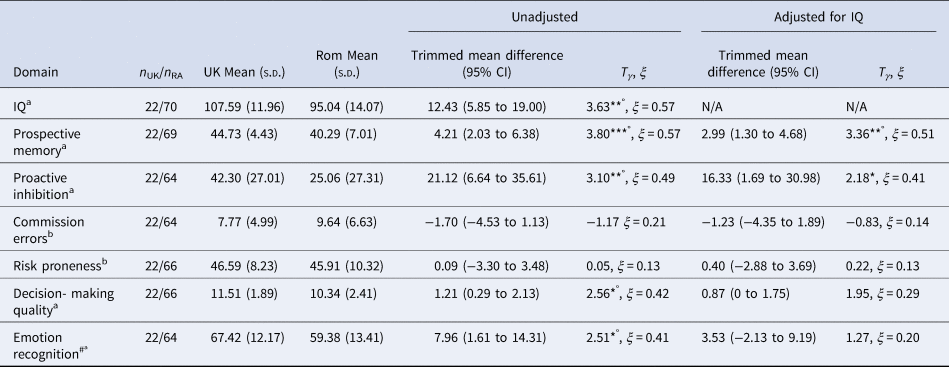
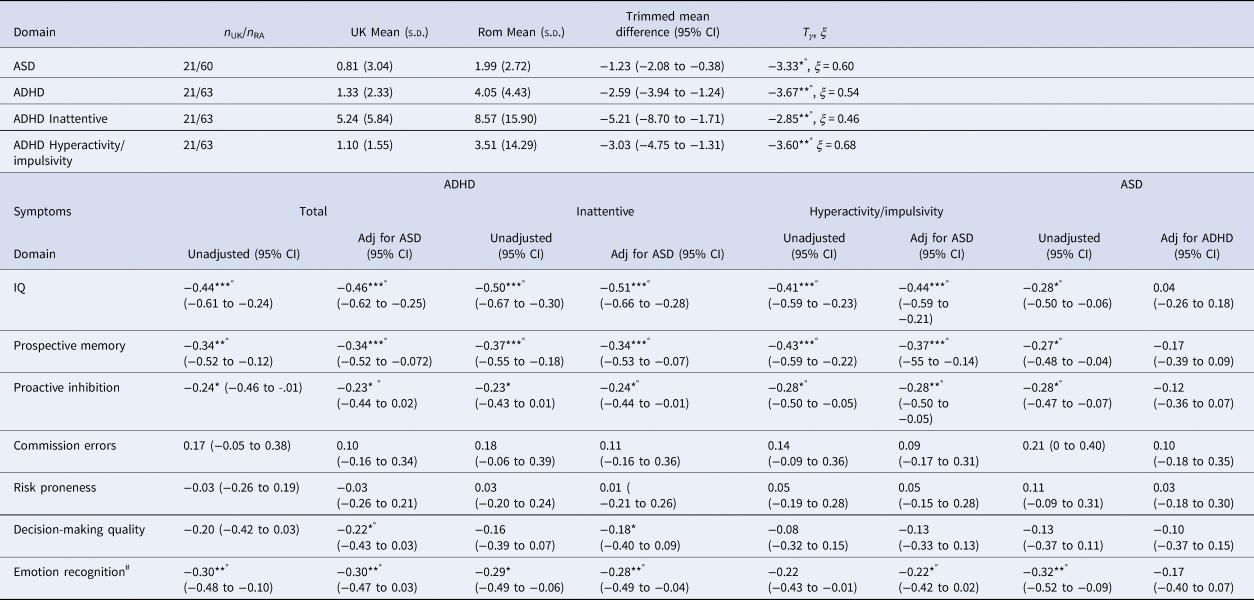
Relative to non-deprived adoptees, Romanian adoptees had lower IQs, and displayed deficits in proactive inhibition, prospective memory, decision-making quality and emotion recognition (p < 0.05, Table 1). The effects ranged from moderate to large in size for significant differences according to Wilcox (Wilcox, Reference Wilcox2016). Duration of deprivation was not significantly correlated with any neuropsychological outcome within the Romanian group (r Spearman = −0.19 to r Spearman = 0.07, all ps ⩾0.112; see online Supplement 6). Only the group effect for prospective memory remained significant after adjusting for IQ (p < 0.05, FDR; see Table 1). Table 2 reports the group differences for ADHD and ASD symptoms and correlations between ASD symptoms ADHD symptoms (and the ADHD sub-dimensions of inattention and hyperactivity/impulsivity) and neuropsychological test performance. A history of early deprivation had a moderate to large effect on the occurrence of neurodevelopmental symptoms in adulthood. ADHD symptoms were associated with lower IQ and deficits in prospective memory (moderate correlation) and emotion recognition (small correlation). When ASD symptoms were controlled for, all correlations with ADHD symptoms reported above remained significant and additional correlations with impaired decision-making quality and proactive inhibition emerged. ASD symptoms correlated with low IQ and impairment in prospective memory, proactive inhibition and emotion recognition. However, after controlling for ADHD symptoms none of these correlations remained significant. After FDR-correction, neuropsychological test performance was not significantly correlated with either self or parent-rated young adult emotional problems in any measured domain (see online Supplement 5).
Neuropsychological performance in the non-deprived UK and Romanian adoptees exposed to institutional deprivation

CI, confidence interval; IQ, intelligence quotient.
°Significant after FDR-correction.
Tγ,Robust comparison of means via the Yuen-Welch method with bootstrapped confidence intervals (Wilcox, Reference Wilcox2016); ξ,Robust exploratory measure of effect size; ξ = 0.15 (small effect), ξ = 0.35 (moderate effect); ξ = 0.50 (large effect) (Wilcox, Reference Wilcox2016); #Emotion recognition is based on the aggregate score across all negative emotions.
a Lower values indicate relative impairment.
b Higher values indicate relative impairment.
*p < 0.05, ** p < 0.01..
Symptoms of ADHD and ASD in the non-deprived UK and Romanian adoptees exposed to institutional deprivation and correlations between ASD and ADHD symptoms and neuropsychological performance across the five domains investigated

Adj., adjusted.
°Significant after FDR-correction. #Emotion recognition based on the aggregate score for all negative emotions.
Partial Spearman correlations with bootstrapped 95% confidence intervals (1000 bootstraps) with and without controlling for symptoms of ASD (or ADHD).
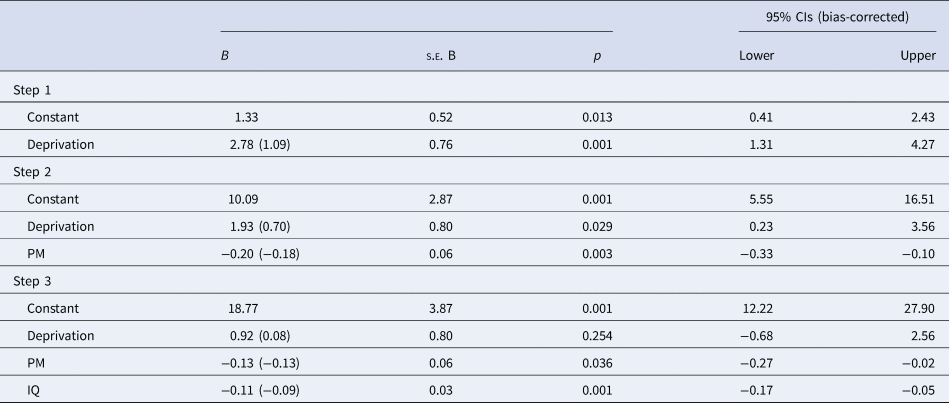
Only IQ and prospective memory met the criteria for predictors, and only ADHD symptoms met the criteria for outcomes, in the multiple regression analysis (Table 3). There was a strong association between deprivation status and adult ADHD symptoms when the former was introduced alone in step 1. Prospective memory was introduced into the model in step 2. It was significantly associated with ADHD symptoms independent of deprivation status. Although deprivation status was still significantly associated with ADHD symptoms, the effect was substantially reduced in this case. IQ was then introduced into the model in step 3. Both IQ and prospective memory were significantly associated with ADHD symptoms – independently of one another. The association between deprivation and ADHD symptoms was no longer significant in this case. This suggests that the link between deprivation and ADHD symptoms was fully accounted for by the former variable's links with IQ and prospective memory.
The results of the regression analysis illustrating that the association between deprivation and ADHD symptoms was carried by deprivation-related effects on IQ and prospective memory

PM, prospective memory; IQ, intelligence quotient; CIs, confidence intervals; s.e., standard error.
Note: Step 1: R 2 = 0.09; Step 2: R 2 = 0.18; Step 3: R 2 = 0.30; Robust Bs are provided in brackets.
Discussion
The ERA study has shown that extended institutional deprivation experienced in early childhood has a long-term impact on neurodevelopmental outcomes in adulthood – with adult ADHD, ASD and DSE symptoms especially pronounced (Sonuga-Barke et al., Reference Sonuga-Barke, Kennedy, Kumsta, Knights, Golm, Rutter and Kreppner2017). Here we explore the long-term impact of deprivation on neuropsychological performance, and investigate whether deprivation-related neurodevelopmental outcomes are related to neuropsychological deficits, by studying links between deprivation and adult neuropsychological function across a range of domains predicted to be: (i) affected by deprivation; and (ii) linked to deprivation-specific neurodevelopmental problems. These domains were proactive inhibition, emotion recognition, decision-making quality and prospective memory – as well as general cognitive ability (indexed by IQ). There were several noteworthy findings.
The first major finding was that early childhood institutional deprivation was associated with impairment in young adulthood across a broad range of neuropsychological domains – IQ, prospective memory, proactive inhibition, decision-making quality and emotion recognition. Analysis of the residuals obtained after regressing out IQ showed that for emotion recognition, proactive inhibition, and decision-making quality these associations were attributable to deprivation-related deficits in general cognitive ability (i.e. IQ). However, this was not the case for prospective memory. It has been previously shown that IQ co-varies with a wide range of neuropsychological functions (Diaz-Asper, Schretlen, & Pearlson, Reference Diaz-Asper, Schretlen and Pearlson2004) and our results confirm this for proactive inhibition, decision-making quality and emotion recognition in previously institutionalized young adults. Although it may not be surprising that the effect of deprivation on proactive inhibition is accounted for by lower IQ, our observation that this also contributed to group differences in emotion recognition was somewhat unexpected (see Bland et al., Reference Bland, Roiser, Mehta, Schei, Boland, Campbell-Meiklejohn and Elliott2016). While our previous assessment at the age 11 follow-up (Colvert et al., Reference Colvert, Rutter, Beckett, Castle, Groothues, Hawkins and Sonuga-Barke2008a) and a meta-analysis (Luke & Banerjee, Reference Luke and Banerjee2013) support the existence of emotion recognition deficits in institutionally deprived children and adolescents, many previous studies did not directly test the hypothesis that such deficits were part of a more general pattern of adversity-related cognitive impairment. One longitudinal study found that IQ mediated the effects of maltreatment on emotion recognition in adulthood (Young & Widom, Reference Young and Widom2014). This suggests that the effects of maltreatment on emotion recognition – especially in adulthood – are small and, at least partly, reflect reductions in general cognitive ability, as indexed by IQ. The only domain of neuropsychological performance where no impact of institutional deprivation was observed was risk-proneness – there was no evidence that Romanian adoptees were either more risk-seeking, or risk-averse, than the UK adoptee comparison group. While few studies have looked at the more general effects of maltreatment on this form of decision-making quality, there are suggestions that more general social disadvantage may increase levels of risk-taking (Petridou et al., Reference Petridou, Zavitsanos, Dessypris, Frangakis, Mandyla, Doxiadis and Trichopoulos1997). The current findings may help to explain why extended deprivation is not associated with engagement in risky behaviors such as substance abuse in the ERA sample (manuscript in preparation).
The association between IQ and institutional deprivation reported here, and its role in driving the effects of institutional deprivation on specific neuropsychological deficits in adulthood, appears to be at odds with the evidence of almost complete remission of cognitive impairment by adulthood in the most severely deprived Romanian adoptees (those exposed to >6 months of deprivation (Sonuga-Barke et al., Reference Sonuga-Barke, Kennedy, Kumsta, Knights, Golm, Rutter and Kreppner2017). One possibility is that lower IQ cases were selectively retained in ERABIS. However, our selective attrition analysis did not support this over-representation of lower IQ individuals in the ERABIS sample. However, IQ was included as a continuous measure in the current paper, instead of the categorical definition of cognitive impairment (IQ<80) in our previous reported finding of IQ deficits remitting with age. This suggests that despite the observed recovery from cognitive impairment – with previously impaired individuals who had experienced extended deprivation moving into the normal range (i.e. above IQ above 80) – average IQ remained significantly lower in the Romanian adoptees.
The second major finding of note is that the severity of neuropsychological deficits in the Romanian adoptees was unrelated to the duration of deprivation. On the face of it, this is surprising given the step-like duration-related effects that have been reported previously by us for neurodevelopmental disorders such as ADHD and the remarkable persistence of such impairments from childhood to adulthood (Sonuga-Barke et al., Reference Sonuga-Barke, Kennedy, Kumsta, Knights, Golm, Rutter and Kreppner2017). Interestingly, in the Bucharest Early Intervention Project deprivation duration was also unrelated to the cognitive outcomes of memory performance and executive function in a group of Romanian children (~8 years of age) with a history of institutionalization compared to never institutionalized children (Bos et al., Reference Bos, Fox, Zeanah and Nelson2009). The difference between the effects of deprivation on neurodevelopmental/clinical outcomes as reported previously, on one hand, and neuropsychological outcomes reported here on the other, suggests a complex and non-deterministic relationship between neuropsychological deficits (largely accounted for by IQ in this study) and clinical outcomes. This moves us away from simple causal models in which deprivation impairs neuropsychological functioning, which in turn drives disorder in a direct fashion (Morton & Frith, Reference Morton and Frith1995). In fact, it would seem that neuropsychological deficits, at least as measured in adulthood, display an all-or-nothing relationship with institutional deprivation – with even children who suffered deprivation for a relatively short amount of time (i.e. 3 months) experiencing a negative effect on later functioning. Despite this, these children are almost completely indistinguishable from the non-deprived UK adoptees in terms of neurodevelopmental and clinical problems (Sonuga-Barke et al., Reference Sonuga-Barke, Kennedy, Kumsta, Knights, Golm, Rutter and Kreppner2017).
Third, neuropsychological performance across a number of domains was associated with ADHD but not ASD symptoms (once ADHD symptoms were controlled for). The finding of ADHD-related prospective memory deficits (Talbot et al., Reference Talbot, Mueller and Kerns2018) is consistent with the general neuropsychological literature on ADHD. It constituted the only neuropsychological domain that was related to both institutional deprivation and ADHD symptoms in univariate analyses, apart from IQ. Crucially, the multiple regression analysis suggested that the association between childhood deprivation and adult ADHD symptoms was fully explained by the link between deprivation and IQ and prospective memory – with each of these neuropsychological domains making an independent contribution. Prior research has identified similar deficits in prospective memory in adults with idiopathic (non-deprivation related) ADHD (Altgassen, Kretschmer, & Kliegel, Reference Altgassen, Kretschmer and Kliegel2014; Fuermaier et al., Reference Fuermaier, Tucha, Koerts, Aschenbrenner, Westermann, Weisbrod and Tucha2013, Reference Fuermaier, Tucha, Koerts, Weisbrod, Lange, Aschenbrenner and Tucha2017; Talbot et al., Reference Talbot, Mueller and Kerns2018) that may be restricted to time-based prospective memory tasks (Altgassen et al., Reference Altgassen, Kretschmer and Kliegel2014). This suggests a degree of neuropsychological equivalence between deprivation- and non-deprivation-related ADHD symptoms, although the fact that the combination of deprivation, IQ and prospective memory explained 30% of the variance in ADHD symptoms provides support for a strong environmental influence on the neuropsychological underpinnings of ADHD in this sample. Relevant to this, a recent meta-analysis demonstrated working memory deficits in clinical and non-clinical samples of adults who had experienced early life stress (Goodman, Freeman, & Chalmers, Reference Goodman, Freeman and Chalmers2019).
The lack of correlations between ASD symptoms and neuropsychological performance was surprising given the literature suggesting that ASD is related to deficits in all of the domains assessed here (Carlisi et al., Reference Carlisi, Norman, Murphy, Christakou, Chantiluke, Giampietro and Rubia2017; Geurts et al., Reference Geurts, van den Bergh and Ruzzano2014; Lozier et al., Reference Lozier, Vanmeter and Marsh2014; Sheppard et al., Reference Sheppard, Bruineberg, Kretschmer-Trendowicz and Altgassen2018). There are a number of possible explanations for this finding. First, deprivation-related ASD symptoms may be neuropsychologically distinct from ASD symptoms in non-deprived samples. Second, the current analysis focused on ASD symptoms as a dimension, rather than on individuals who met clinical cut-offs – so the severity of the ASD symptoms may not have been sufficient to lead to neuropsychological deficits and only a small number of individuals presented with high levels of ASD symptoms in the current sample. Finally, while the symptoms were rated through a validated questionnaire, this may not be sufficient to record the full extent to which individuals display features of ASD which would require a clinical assessment.
The present study had several distinctive features and strengths. In particular, it employed a natural experimental design to disentangle the impact of early, time-limited deprivation from the confounding effects of genetic and environmental risk factors that are frequently present in studies of maltreated children. It included a relatively large sample of severely deprived individuals with known duration of deprivation. As part of the ERA study we have also followed up a comparison group of non-deprived UK adoptees and they were included here to control for the effects of adoption per se. This allowed the effects to be studied in a design that reduces the risk of confounding by genetic factors or ongoing adversity. The study was also subject to several limitations. First, for practical reasons (i.e. time considerations) it could only focus on the range of neuropsychological domains presented here. Tasks measuring constructs such as Theory of Mind and temporal discounting would have been valuable additions given earlier evidence from the ERA study (Colvert et al., Reference Colvert, Rutter, Kreppner, Beckett, Castle, Groothues and Sonuga-Barke2008b). The fact that all neuropsychological assessments were cross-sectional vis-à-vis clinical measures necessarily, limits our interpretation with regard to the causal relationships between neuropsychological performance and ADHD symptoms. Furthermore, we used a dimensional approach to analyzing ADHD and ASD symptoms and did not attempt to categorize individuals according to ‘clinical’ cut-offs. This is consistent with suggestions that ADHD should be viewed as a dimensional construct rather than a categorical diagnosis (McLennan, Reference McLennan2016). Third, the study lacked a non-deprived Romanian comparison group which limited our ability to disentangle effects of institutional care from other socio-economic disadvantages that Romanians were subject to in the harsh conditions of the 1980s. Nevertheless, the Bucharest Early Intervention Project included such a comparison group and still found children with a history of institutionalization to perform worse on neuropsychological tasks (Almas et al., Reference Almas, Degnan, Nelson, Zeanah and Fox2016; Bos et al., Reference Bos, Fox, Zeanah and Nelson2009; Wade et al., Reference Wade, Fox, Zeanah and Nelson2019). The use of one source of information about ADHD and ASD information is also a potential limitation especially as we were reliant on parent ratings for both individuals who lived at home and those that had left home. However, as mentioned above our analysis showed no difference in parent ratings between these two groups. Finally, although this is an unusually large sample of such severely deprived individuals, it still provides only limited statistical power. It is, therefore, possible that we were unable to detect some important, though statistically small, effects. This constraint is particularly relevant to the multiple regression analyses, which typically require large sample sizes.
In conclusion, time-limited severe deprivation in early childhood has enduring effects on neuropsychological performance in young adulthood across a range of domains including prospective memory, proactive inhibition, decision-making quality and emotion recognition – but only the deficit in prospective memory was independent of deprivation-related effects on IQ. ADHD symptoms were related to a range of neuropsychological deficits, but only prospective memory explained variance beyond influence of IQ. This is the first study of prospective memory deficits and their relationship to neurodevelopmental symptoms in previously institutionalized individuals. Such effects were observed over 20 years later, despite adoptees living with well-resourced and supportive families in the intervening period, demonstrating the long-term impact of adverse experiences during sensitive periods of development.
Supplementary material
The supplementary material for this article can be found at https://doi.org/10.1017/S0033291720001294.
Acknowledgements
We thank the families who took part in the study – this research would not have been possible without their continued support and dedication. Our study team acknowledges the support of the National Institute for Health Research Clinical Research Network (NIHR CRN). We also thank Niall Bourke for his assistance with data collection and Laura Archer for her preparatory work on the Go-NoGo data. The Young Adult Follow-up was funded by the Economic and Social Research Council (E.S-B., RES-062-23-3300). The Brain Imaging Study was funded by the Medical Research Council (E.S-B., M.M., G.F., MR/K022474/1). This study represents independent research that was part-funded by the National Institute for Health Research (NIHR) Biomedical Research Centre at South London and Maudsley NHS Foundation Trust and King's College London.
Conflicts of interest
None.
Ethical standards
The authors assert that all procedures contributing to this work comply with the ethical standards of the relevant national and institutional committees on human experimentation and with the Helsinki Declaration of 1975, as revised in 2008.