Introduction
The role of vitamin D in calcium homeostasis and bone health has been recognized for decades, and it continues to be an important agent in preventing osteomalacia and reducing fragility fractures in older people. Given the wide range of physiological systems that vitamin D affects, interest remains high in other potential therapeutic uses for vitamin D – particularly around cancer prevention, cardiovascular health and immune function. This review article will outline the physiological role of vitamin D, the disease processes that have been associated with insufficiency and examine whether vitamin D supplementation can ameliorate these disease processes in older people.
Search strategy
The content of this review was based on results from several recent systematic reviews performed by one of the authors, supplemented by PubMed searches (key search terms ‘vitamin D’ AND [‘trial’ OR ‘systematic review’]). Searches were focused by incorporation of further terms specific to each topic area, and were then further supplemented by inclusion of references from the authors’ personal library.
Vitamin D metabolism
Vitamin D synthesis
Endogenous vitamin D is synthesized when UVB radiation (UVB) reaches the 7-dehydrocholesterol (7-DHC) contained in the skin layers, with further conversion from pre-vitamin D3 to the vitamin D3 molecule (cholecalciferol). From here it preferentially binds to the vitamin D-binding protein (VDBP) and enters the circulation. Cutaneous production is limited by factors such as the zenith angle of the sun, skin pigmentation and proportion of skin exposed to sunlight.Reference Linos, Keiser, Fu, Colditz, Chen and Tang1
Other sources of vitamin D
Vitamin D is also obtained from the diet, present as vitamin D3 (cholecalciferol) or vitamin D2 (ergocalciferol). A few foods contain vitamin D3 such as fatty fish, fish liver oils and small amounts in liver, cheese and egg yolks. Mushrooms, particularly those irradiated by UVB, contain vitamin D2. A number of foods such as cereals, cheese and yoghurt are fortified with vitamin D. Ingested vitamin D is absorbed in the gut and transported in chylomicrons before binding VDBP in the circulation. Few populations achieve sufficient vitamin D intake from the diet; endogenous production from sunlight accounts for the majority of vitamin D supply.Reference Lamberg-Allardt2, Reference Macdonald, Mavroeidi and Fraser3
Vitamin D metabolism
Vitamin D itself is a prohormone, and must undergo two hydroxylations to produce the final, biologically active moiety. The first of these occurs in the liver, converting vitamin D to 25-hydroxyvitamin D or 25OHD (calcidiol), the main circulating form of vitamin D. The hydroxylation is controlled by four hepatic cytochrome P-450 enzymes. Three are microsomal forms (CYP2R1, CYP2J2 and CYP3A4), whilst CYP27A1 is mitochondrial. The second hydroxylation occurs mainly, but not exclusively, in the kidney where 25OHD becomes active 1,25-dihydroxyvitmain D or 1,25OHD (calcitriol). Control is via CYP27B1 (1α-hydroxylase) activity.Reference Battault, Whiting, Peltier, Sadrin, Gerber and Maixent4 Importantly, 1-α hydroxylation can occur at other sites, including in macrophages and other target tissues, potentially allowing high local concentrations of 1,25OHD to be delivered to target organs.Reference Gottfried, Rehli, Hahn, Holler, Andreesen and Kreutz5
Vitamin D metabolite levels are regulated through several feedback loops. UVB radiation leads to increased skin melanin content, which competes with the 7-DHC to absorb photons and limit conversion to previtamin D3. Some of the previtamin D3 forms biologically inert lumisterol or tachysterol. Low blood calcium levels lead to parathyroid hormone (PTH) increase, increased CYP27B1 expression and onward increase in 1α-hydroxylase activity in the kidney. Higher levels of 1,25OHD provide negative feedback for PTH and 1-α hydroxylase expression within the kidney, which is also influenced by calcium, phosphate and fibroblast growth factor-23 levels. Further regulation of active vitamin D occurs via control of hydroxylation to 24,25-hydroxyvitamin D, an inactive metabolite.
Vitamin D targets
In the final 1,25OHD form there is binding to vitamin D receptors (VDR) and activity upon cells and organs in a hormone-like manner. The VDR dimerizes with the retinoid X receptor (RXR), forming a 1,25(OH)2D–VDR–RXR complex which binds to vitamin D-responsive elements (VDREs). These are capable of regulating the transcription of various genes in target cells.Reference Haussler, Jurutka, Mizwicki and Norman6 There are various other reactions in which the 1,25OHD plays a role, including inducing more rapid responses in tissues, e.g. secretion of insulin by β-cells in the pancreas. It has been postulated that these more rapid actions are mediated by a cytoplasmic variant of the vitamin D receptor which, unlike the nuclear variant which is highly specific for 1,25OHD, binds 25OHD and 1,25OHD with similar affinity. Given that circulating levels of 25OHD are a thousandfold higher than 1,25OHD levels, it is conceivable that this cytoplasmic variant might therefore be physiologically activated by 25OHD. The large number of cell types that express VDR gives biological plausibility to the range of health conditions and physiological functions with which vitamin D has been associated.
Classical effects of vitamin D
The classical effects of vitamin D on calcium metabolism and bone health have been recognized for decades. Vitamin D promotes calcium absorption in the gut and, in response to low serum calcium levels, PTH and 1,25OHD act together on bone to maintain serum calcium levels. Vitamin D metabolites act directly on both osteoblasts and osteoclasts, and are critical in driving mineralization of osteoid; hence the occurrence of rickets and osteomalacia in severe vitamin D deficiency.
Non-classical effects of vitamin D
For many years it was thought that vitamin D had influence only upon bone health and calcium, but it is now known that VDR are present in most tissues in the body, suggesting a much more widespread set of physiological roles for vitamin D. Similarly, 1-α-hydroxylase is also widely distributed, allowing vitamin D derivatives to act in a paracrine or autocrine fashion by delivering high concentrations of 1,25OHD to the target tissue.
Vitamin D insufficiency
Controversy continues as to the level of vitamin D necessary for optimum health, and the amount of vitamin D required to reach these levels. Recommended levels are gradually being revised upwards (e.g. the maximum tolerable dose set by Canada recently rose to 2000 units per day), although such recommendations are not based on robust evidence of increased efficacy. The exhaustive US Institute of Medicine reportReference Ross, Manson and Abrams7 suggested that a level of 50 nmol l−1 of 25OHD was sufficient, and that the recommended daily intake for older people should remain at 800 IU per day of vitamin D3.
Definitions of vitamin D deficiency and insufficiency
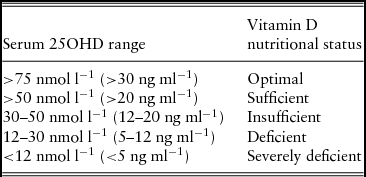
The short half-life of 1,25OHD (only a few hours), and lack of correlation between vitamin D production and 1,25OHD levels means that 25OHD is used instead to define levels of vitamin D sufficiency. There are a number of different figures quoted for the half-life of 25OHD, ranging from 3 weeks to over 2 months.Reference Vieth8Table 1 highlights one suggested categorization of vitamin D nutritional status in relation to different levels of 25OHD.
Definition of stages of vitamin D insufficiency

The definition adopted depends on which physiological system one is examining. A threshold of 25–30 nmol l−1 was traditionally used to define deficiency as, above this level, rickets or frank osteomalacia are unlikely; these diseases become progressively more prevalent as levels decline below 25 nmol l−1. A study, examining 35 UK South Asian adults with clinically confirmed osteomalacia, found that the concentration of 25OHD was below 7.5 nmol l−1 in all the affected patients.Reference Preece, Tomlinson and Ribot9 As discussed below, levels for optimum health in other organ systems, including bone, cardiovascular and immune function may be higher.
Who is at risk of vitamin D insufficiency?
Vitamin D insufficiency is a common problem in many parts of the world. The people most likely to be affected are those living in areas of high latitude, who have limited exposure to sunlight for long periods of time during the year. Even at the latitude of London, UK, there is insufficient ultraviolet light between October and March to drive vitamin D synthesis; the low angle that the sun subtends to the horizon causes marked extinction of ultraviolet light, even at midday. Groups who receive little exposure to sun are also at risk.Reference Macdonald, Mavroeidi and Fraser3 These include the housebound, people living in institutional care, and those who do not expose their skin for cultural reasons. Also at risk are people with dark coloured skin and older people – these groups do not produce vitamin D efficiently in the skin. People with hepatic or renal impairment are unable to convert vitamin D to the active form. People with poor nutritional intake or malabsorption are also at an increased risk of vitamin D insufficiency.
Within-person vitamin D levels change markedly throughout the year, depending upon season and exposure to sunlight. A study of healthy individuals aged between 20 and 94 years found that the average 25OHD level was lowest in April–May (73 nmol l−1) and at its highest in October (96 nmol l−1).Reference Maxwell10 The 1958 British Cohort Study looked at 25OHD levels in 7437 white individuals and found that vitamin D insufficiency was very common during winter and spring, with 87% <75 nmol l−1, 47% <40 nmol l−1 and 16% <25 nmol l−1. During the summer and autumn months these figures were 61, 15 and 3%, respectively.Reference Hypponen and Power11
Prevalence of vitamin D insufficiency
The UK National Diet and Nutrition Survey published in 1998 found that 5% of men and 6% of women aged 65–74 years had a serum 25OHD level <25 nmol l−1. This figure rose to 13% of men and 25% of women over the age of 85, and over a third of both sexes living in care homes over the age of 65. The Health Survey for England (HSE) 2000 also examined vitamin D levels in older adultsReference Hirani and Primatesta12 and found that, amongst men living in private households, the mean 25OHD level was 58 nmol l−1 for those aged 65–79, falling to 48 nmol l−1 for those over the age of 80 years. For men living in institutional care these levels fell to 40 and 37 nmol l−1 for the respective age groups. In women living in private households the mean 25OHD levels were 49 nmol l−1 for those aged 65–79 and 45 nmol l−1 for those aged over 80 years. Amongst those living in institutions this fell to 37 and 36 nmol l−1 for the respective age groups. These low levels persisted on re-examination 5 years later.Reference Hirani, Tull, Ali and Mindell13
Certain groups are even more likely to have low vitamin D levels, such as those admitted with osteoporotic fracturesReference Francis, Anderson, Patel, Sahota and van Staa14 and those attending falls clinics – 72% of those attending a falls clinic in London, UK had 25OHD levels of <50 nmol l−1.Reference Dhesi, Moniz, Close, Jackson and Allain15
Results from observational and intervention studies
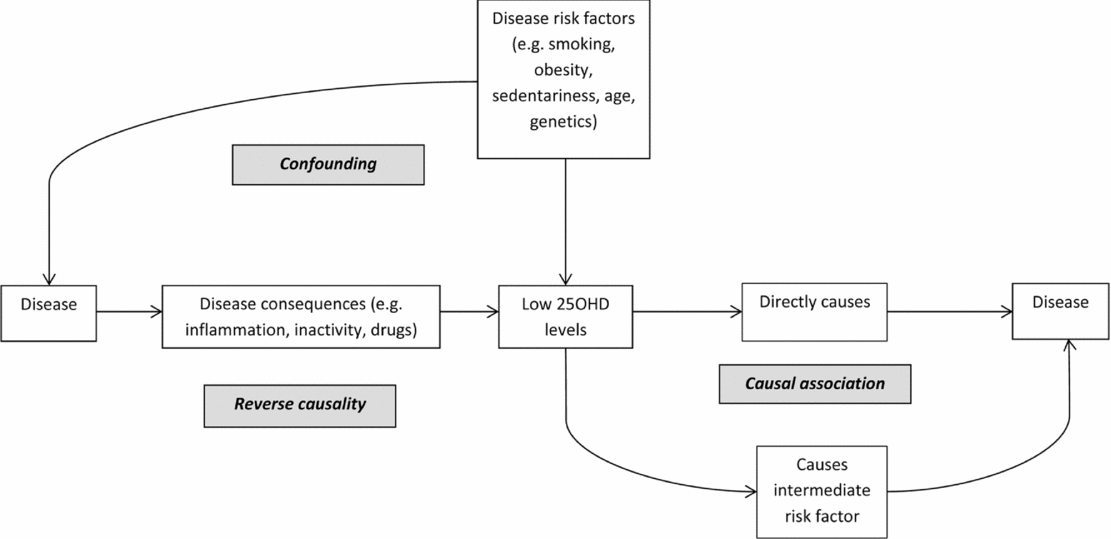
A huge number of studies now link low 25OHD levels to a myriad of different disease states. However, interpreting observational data in this field is fraught with difficulty due to the problems of reverse causality and confounding factors. Firstly, any illness is likely to reduce activity levels and hence sun exposure, leading to low 25OHD levels. Secondly, inflammation suppresses 25OHD levels – 25OHD levels 48 h after elective knee surgery fell significantly compared with pre-operative levels.Reference Reid, Toole and Knox16 Furthermore, smoking, older skin and obesity are all independent causes of lower circulating 25OHD levels,Reference Martins, Wolf and Pan17, Reference Isaia, Giorgino, Rini, Bevilacqua, Maugeri and Adami18 and fully adjusting for the confounding effect of these variables is extremely difficult. Hence, however attractive the observational data, only interventional trial data can really dissect out which disease states vitamin D supplementation is likely to improve. A summary of potential causal and confounding pathways is given in Fig. 1.
Potential pathways linking vitamin D to disease

Osteoporosis, falls and fractures
Obeservational data
Vitamin D insufficiency is particularly common in patients with osteoporotic fractures. It has been shown that those patients with osteoporotic fractures tend to have lower levels of 25OHD than individuals without a history of fracture; studies of older people admitted to hospital with hip fracture have shown that between 75 and 92% have serum 25OHD of <50 nmol l−1, with 68% having serum 25OHD of <30 nmol l−1.Reference Francis, Anderson, Patel, Sahota and van Staa14 In another study looking at vertebral fractures in patients with established osteoporosis it was found that 39% had serum 25OHD levels of <30 nmol l−1.
Insufficiency of vitamin D is associated with an increased risk of falling. Body sway increases as 25OHD levels fall below 50 nmol l−1, and muscle weakness occurs when these levels fall below 30 nmol l−1.Reference Pfeifer, Begerow and Minne19 A correlation exists between 25OHD levels and proximal lower limb muscle strength, and a 23% difference in quadriceps strength exists depending on the VDR polymorphism present in non-obese women over the age of 70 years.Reference Janssen, Samson and Verhaar20
Intervention data
There remains considerable uncertainty over whether vitamin D supplementation affects muscle strength and the risk of falls and fractures in older adults, despite a number of large randomized controlled trials. Results differ significantly depending on the population under study, and whether calcium is co-administered. Meta-analysis suggests a small benefit of borderline statistical significance on postural sway (effect size –0.20, 95% CI –0.39 to –0.01, P = 0.04) and timed Up-and-Go test (effect size –0.19, 95% CI –0.35 to –0.02, P = 0.03), with no effects on upper limb grip strength, and improvement in lower limb strength confirmed to those with 25OHD levels <25 nmol l−1.Reference Muir and Montero-Odasso21, Reference Stockton, Mengersen, Paratz, Kandiah and Bennell22 Vitamin D supplementation does not appear to be of significant benefit to older hospitalized patients; no effect was seen on indices of physical function or falls in older hospitalized patients,Reference Corless, Dawson and Fraser23, Reference Burleigh, McColl and Potter24 and another study found that frail, older people who had recently been in-patients in hospital and were treated with vitamin D did not gain any benefit in terms of physical function or rehabilitation.Reference Latham, Anderson, Lee, Bennett, Moseley and Cameron25
Calcium and vitamin D therapy reduced the risk of hip fracture by 43% in French care home residents after 18 months of treatment with 800 IU day−1 vitamin D and 1200 mg day−1 calcium. Since this seminal study,Reference Chapuy, Arlot and Duboeuf26 a number of other large trials have been performed. Recent meta-analyses agree that, in institutionalized older people, the combination of calcium and vitamin D does reduce falls and fractures (relative risk 0.84 for hip fractures, 95% CI 0.73 to 0.96).Reference Avenell, Gillespie, Gillespie and O'Connell27 Whether vitamin D alone also reduces fractures is much less clear, with different analyses reaching different conclusions.Reference Avenell, Gillespie, Gillespie and O'Connell27, Reference Bischoff-Ferrari, Willett and Orav28 Older people outside institutional care appear to benefit less from supplementation, as evidenced by the lack of effect of calcium and vitamin D supplementation in the MRC RECORD trial, amongst others.Reference Grant, Avenell and Campbell29 The dose and route of vitamin D delivered may also be important – a single 300,000 unit intramuscular dose of vitamin D given once yearly did not reduce fractures in older women,Reference Smith, Anderson, Raphael, Maslin, Crozier and Cooper30 and a very large (500,000 unit) oral dose of vitamin D even appeared to increase falls in the first few months after dosing in a recent osteoporosis trial.Reference Sanders, Stuart and Williamson31
Blood pressure
Observational data
Meta-analysis of cross-sectional and longitudinal studies confirms that low 25OHD levels are associated with higher blood pressure and an increased risk of incident arterial hypertension.Reference Burgaz, Orsini, Larsson and Wolk32 Aggregate data from 283,537 individuals from the general population suggest the relative risk for incident arterial hypertension was 0.70 (95% CI 0.58–0.86) when comparing 25OHD levels between lowest and highest tertiles.Reference Kunutsor, Apekey and Steur33 Such relationships extend to older people; a study of 237 individuals aged 65 and over found a significant negative association between 25OHD levels and both systolic BP (r = –0.15, P = 0.02) and diastolic BP (r = –0.15, P = 0.02).Reference Almirall, Vaqueiro, Bare and Anton34 Vitamin D affects vascular smooth muscle cell proliferation, inflammation, vascular calcification and the renin–angiotensin system,Reference Beveridge and Witham35 all of which are known to be risk factors for cardiovascular disease and may provide a biological basis for the association between low vitamin D levels and hypertension. The Framingham study showed that not only did low 25OHD levels predict incident cardiovascular events, but the combination of hypertension and low vitamin D was a particularly powerful predictor of future cardiovascular events.Reference Wang, Pencina and Booth36
Intervention data
Several small trials have now examined the effects of vitamin D supplementation on blood pressure. Meta-analysisReference Witham, Nadir and Struthers37 suggests a small (4/3 mmHg) reduction in blood pressure in studies with a mean baseline blood pressure of >140/90, but no effect on those without hypertension at baseline. More recent studies have been mixed; a study in black Americans suggested a modest reduction in blood pressureReference Forman, Scott and Ng38 but a trial of intermittent, high-dose vitamin D3 given for 1 year to patients aged 70 and over with isolated systolic hypertensionReference Witham, Price and Struthers39 failed to show any reduction in blood pressure.
Diabetes
Observational data
Low levels of 25OHD are associated with impaired glucose tolerance, type 2 diabetes and insulin resistance.Reference Pittas, Chung and Trikalinos40–Reference Autier, Boniol, Pizot and Mullie42 In both animals and humans it has been shown that vitamin D insufficiency is associated with impaired pancreatic insulin secretion and glucose intolerance. There is also evidence that type 1 diabetes in some populations is associated with certain polymorphisms within the VDR gene.Reference Ponsonby, Pezic and Ellis43 These observational data are, however, prone to confounding due to the strong relationship between obesity and impaired glucose homeostasis; obesity could explain both the lower 25OHD levels and the increased risk of diabetes seen in prospective observational studies.
Intervention data
A small number of studies have examined the effect of supplementation on markers of glucose metabolism and also on the incidence of diabetes. No effect was evident on HbA1c levels in a recent meta-analysis;Reference Autier, Boniol, Pizot and Mullie42 patients with frank diabetes or impaired fasting glucose showed a small improvement in insulin resistance in another meta-analysis.Reference George, Pearson and Witham44 In the small number of trials examining diabetes incidence as a secondary endpoint, no reduction in the incidence of diabetes was seen.Reference Avenell, Cook, Maclennan and McPherson45
Cardiovascular events
Observational data
A series of large observational studies have shown that low 25OHD levels are associated with an increased risk of future cardiovascular events, with a 30–50% increase in risk of events in the lowest quantile of serum 25OHD compared with the highest quantile.Reference Scragg46 Adjustment for risk factors including obesity, smoking and age attenuate, but do not abolish, such associations. Associations have been demonstrated in health community-dwelling patients,Reference Wang, Pencina and Booth36 patients with known vascular disease and patients attending for coronary angiography, amongst others.Reference Dobnig, Pilz and Scharnagl47
Intervention data
No trials have specifically set out to test whether vitamin D can reduce cardiovascular events. However, meta-analysis of cardiovascular events in osteoporosis trials does not support an association between vitamin D therapy and myocardial infarctionReference Elamin, Abu Elnour and Elamin48 (hazard ratio (HR) 1.02, 95% CI 0.93–1.13). Large trials underway in the USA, New Zealand and Finland are designed to answer this question, and will start reporting in 2017.
Stroke
Observational data
Low levels of vitamin D, reduced bone mineral density and an increased risk of fracture exist in long-term stroke survivors, and patients admitted with acute stroke have lower levels of vitamin D on admission than controls.Reference Poole, Loveridge and Barker49 Seventy-seven per cent (34 out of 44) fell within the insufficient range for vitamin D (<50 nmol l−1). A meta-analysis of seven studies with 47,809 participants and 926 cerebrovascular events showed that the risk of cerebrovascular disease was reduced in those with high 25OHD levels.Reference Chowdhury, Stevens, Ward, Chowdhury, Sajjad and Franco50 The relative risk from highest to lowest tertile was 0.60 (95% CI 0.48–0.72). This result is similar to another meta-analysis of prospective studies including 1214 stroke cases, which demonstrated a relative risk of stroke of 1.52 (95% CI 1.20–1.85) for the lowest versus highest 25OHD tertile.Reference Sun, Pan, Hu, Manson and Rexrode51
Intervention data
No trials have tested the ability of vitamin D supplementation to reduce stroke as their primary aim. One trialReference Witham, Dove, Sugden, Doney and Struthers52 showed no significant improvement in markers of vascular health with vitamin D supplementation in patients who had had a previous stroke, and a meta-analysis of stroke rates in osteoporosis trialsReference Elamin, Abu Elnour and Elamin48 suggested no reduction in stroke rates with supplementation (odds ratio (OR) 1.05, 95% CI 0.88–1.25; P = 0.59).
Heart failure
Observational data
Heart failure patients almost universally have low 25OHD levels. This may in part be due to their poor exercise capacity and lack of sunlight exposure from outdoor activity. There are correlations between low levels of 25OHD and worse left ventricular function, disease severityReference Shane, Mancini and Aaronson53 and higher levels of natriuretic peptides.Reference Zittermann, Schleithoff, Tenderich, Berthold, Korfer and Stehle54 In an Israeli population study of 3009 patients, vitamin D deficiency (25OHD < 25 nmol l−1) was an independent predictor of increased mortality in patients with heart failureReference Gotsman, Shauer and Zwas55 with HR of 1.52 (95% CI 1.21–1.92).
The vitamin D receptor is present in multiple cardiovascular tissues, including endothelial cells, myocytes and vascular smooth muscle cells. Being a steroid hormone, vitamin D influences the expression of many genes that regulate cytokines and hormones that play a prominent role in the progression of heart failure, including the renin–angiotensin system, pro-inflammatory cytokines such as tumour necrosis factor alpha, and vasculotoxic factors such as parathyroid hormone (PTH).Reference Witham56
Intervention data
Few intervention studies have examined the effect of vitamin D in heart failure. Trials to date have shown no effect on exercise capacity, ventricular remodelling or quality of life.Reference Witham, Crighton, Gillespie, Struthers and McMurdo57–Reference Boxer, Kenny, Schmotzer, Vest, Fiutem and Pina59 One study showed a reduction in tumour necrosis factor (TNF)-alpha levels, another showed a reduction in B-type natriuretic peptide (BNP) levels, but these effects were not consistent across studies. One study combined low-dose vitamin D (10 mg daily) with several other vitamins and mineralsReference Witte, Nikitin and Parker60 and demonstrated a significant improvement in exercise capacity, but the combined intervention makes it impossible to attribute any benefit to vitamin D alone. These results do not exclude a beneficial effect on death and hospitalization in the longer term, but much larger studies will be needed to examine these outcomes.
Pulmonary disease
Observational data
Cross-sectional analysis of the Third National Health Nutrition and Examination Survey found that there was a significant relationship between vitamin D insufficiency and reduced lung function.Reference Black and Scragg61 Similar studies have shown a correlation between worse disease (measured by GOLD stage: Global Initiative for Obstructive Lung Disease) and lower 25OHD levels;25-OHD levels correlated significantly with forced expiratory volume in 1 s (FEV1) (r = 0.28, P < 0.0001). Compared with 31% of the smokers with normal lung function, as many as 60 and 77% of patients with GOLD stages 3 and 4 exhibited deficient 25-OHD levels <20 ng ml−1 (P < 0.0001)Reference Janssens, Bouillon and Claes62. There are several possible mechanisms for this, including the anti-inflammatory effect of vitamin D and possibly effects upon lung remodelling. In addition, certain variants of the VDR have been associated with an increased risk of chronic obstructive pulmonary disease (COPD).Reference Wright63 Longitudinal data examining whether low vitamin D levels predispose to more rapid declines in lung function or hospital admissions are, however, lacking; and it is therefore equally possible that low vitamin D levels in COPD are a result of reduced physical activity and consequently lower sun exposure.
Intervention data
Trial data are sparse, but do not support a role for vitamin D supplementation in COPD. No effect on the frequency of exacerbations was seen in a trial of 182 patients with moderate to severe COPD, despite receiving monthly doses of 100,000 units of vitamin D3.Reference Lehouck, Mathieu and Carremans64 Vitamin D has also been trialled as an adjunct to antimicrobial therapy in tuberculosis;Reference Martineau, Timms and Bothamley65 again, no clinically important difference was noted between intervention and placebo groups, although the intervention group had a non-significantly shorter time to sputum conversion (36 vs 44 days; P = 0.14).
Cancer
Observational data
Recent meta-analysis results have thrown into doubt the relationship between vitamin D status and cancer. Vitamin D levels are lower in patients with cancer than in healthy controls, and the degree of aggressiveness of a variety of cancers (e.g. melanoma, breast cancer) correlates inversely with 25OHD levels. However, this may again be due to confounding due to ill-health and the degree of inflammation precipitated by aggressive tumours, and meta-analysis of prospective cohort studies do not support a link between low 25OHD levels and most cancers – including lung, breast, skin, ovarian, prostate and oesophageal cancer.Reference Autier, Boniol, Pizot and Mullie42 There is, however, a higher incidence of colorectal cancer in people with lower baseline 25OHD levels (pooled OR 0.66, 95% CI 0.54–0.81).Reference Gandini, Boniol and Haukka66
Intervention data
It has been suggested by the authors of one studyReference Lappe, Travers-Gustafson, Davies, Recker and Heaney67 that treating a group of post-menopausal women with calcium and vitamin D for osteoporosis could reduce the incidence of cancer. The numbers of patients who developed cancer in either the calcium, the calcium plus vitamin D or the placebo group were very small, however, and although significantly fewer cancers were found in the calcium+D group compared with placebo, there was no significant difference between cancer incidence in the calcium arm and the calcium+D arm. No reduction in colorectal cancer was seen in the Women's Health Initiative (WHI) trial of calcium and vitamin DReference Wactawski-Wende, Kotchen and Anderson68, although the dose of vitamin D used in this study (400 units per day) was very small.
Age-related macular degeneration
Vitamin D insufficiency has been associated with early age-related macular degeneration (ARMD),Reference Parekh, Chappell, Millen, Albert and Mares69 but this link has not been seen in those with advanced ARMD, and not all observational studies support an association.Reference Golan, Shalev, Treister, Chodick and Loewenstein70 Vitamin D could in theory have a beneficial effect as a result of its anti-inflammatory or anti-angiogenic properties, but intervention data are lacking.
Periodontal disease
It has been demonstrated in one study that there is an inverse relationship between vitamin D levels and periodontal disease in men and women over the age of 50 years. This relationship persisted after adjustment for bone mineral density.Reference Dietrich, Joshipura, Dawson-Hughes and Bischoff-Ferrari71 No clinical trials have yet reported on whether supplementation with vitamin D can improve periodontal disease, although a secondary analysis of one osteoporosis trial found a lower rate of tooth loss in the supplementation group (OR 0.5, 95% CI 0.2–0.9).Reference Krall, Wehler, Garcia, Harris and Dawson-Hughes72
Infections
No intervention trials have specifically set out to examine the effect of vitamin D supplementation on reducing infections in older people. However, a reanalysis of data from the MRC RECORD fracture prevention study suggested a non-significant trend to reduced infection rates in the group receiving 800 IU oral vitamin D3 per day (adjusted OR 0.90, P = 0.23).Reference Avenell, Cook, Maclennan and Macpherson73 No reduction in infection rates was seen in the MAVIS trial of multivitamins in community-dwelling older people, although the vitamin D dose was very low (only 200 IU per day).Reference Avenell, Campbell and Cook74 A pooled analysis of the effect of vitamin D supplementation on influenza-like illness also failed to show benefit,Reference Jorde, Witham and Janssens75 a finding reflected by other, similar analyses.Reference Autier, Boniol, Pizot and Mullie42
Cognition and mental health
There is some evidence that vitamin D insufficiency is associated with impaired cognitive function and higher rates of dementia. The effect of 25OHD insufficiency is modest; participants who were severely 25OHD deficient declined by an additional 0.3 MMSE points per year compared with those with sufficient levels of 25OHD.Reference Llewellyn, Lang and Langa76 Observational studies show a strong cross-sectional relationship between depressive symptoms and 25OHD levels,Reference Autier, Boniol, Pizot and Mullie42 which would be expected given the impact of depression on physical activity levels.
The only trial to have examined the effect of vitamin D supplementation on cognition to date was a substudy of the WHI trial; 4143 post-menopausal women received either 1 g per day of calcium plus 400 units vitamin D3 or dual placebo. No difference in the rate of new dementia diagnoses (HR 1.11, 95% CI 0.71–1.74) or new mild cognitive impairment diagnoses (HR 0.95, 95% CI 0.72–1.25) was evident over a mean 8-year follow-up.Reference Rossom, Espeland and Manson77 Although several studies have examined the impact of vitamin D supplementation on mood, most studies to date have not focused on older people and have not focused on patients with confirmed depression. Most studies to date have been negative, but one trial assessing the effect of vitamin D on depressive symptoms in obese patientsReference Jorde, Sneve, Figenschau, Svartberg and Waterloo78 showed improvement in Beck Depression Inventory scores after 1 year of treatment compared with placebo.
All-cause mortality
Observational data
A meta-analysis of prospective studies examining the relationship between 25OHD levels and all-cause mortality confirms a strong association; mortality was lower in the highest category of 25OHD levels versus the lowest level (HR 0.71, 95% CI 0.50–0.91)Reference Zittermann, Iodice, Pilz, Grant, Bagnardi and Gandini79. Although most studies suggest progressively reduced mortality even at the highest levels of 25OHD, a very large Danish study (250,000 people)Reference Durup, Jorgensen, Christensen, Schwarz, Heegaard and Lind80 suggested a U-shaped relationship, with the lowest mortality at between 50 and 60 nmol l−1.
Intervention data
Perhaps the strongest evidence that vitamin D supplementation may have important effects on a range of health outcomes is provided by meta-analyses examining the effect of vitamin D supplementation on total mortality.Reference Elamin, Abu Elnour and Elamin48, Reference Rejnmark, Avenell and Masud81 These analyses of randomized trials suggest that intake of vitamin D supplements may decrease total mortality by 5–6% (an absolute risk reduction of approximately 0.3%). Several of the trials included involved frail, older people, often with low levels of 25OHD and at risk of falls and fragility fractures. The reduction in mortality is greater than can be explained solely by the effect of calcium and vitamin D on fracture rates, but as most included trials were designed to enrol patients with osteoporosis, the applicability of these results to the general older population is unclear. Large trials in unselected older people are underway in Finland, New Zealand and the USA, and the results from these trials will provide an adequate test of the effect of vitamin D supplementation on total mortality.
Safety and side-effects of vitamin D
Like any potentially efficacious therapy, vitamin D has adverse effects. These are principally connected to its ability to increase serum calcium, and patients with a predisposition to hypercalcaemia (including those with sarcoidosis, primary hyperparathyroidism and metastatic cancer) should not receive large doses of vitamin D.
Increased calcium excretion in the urine can potentially lead to renal calculi, and even at the low dose of 400 IU day−1, the WHI trial found a significant excess of renal calculi in the vitamin D group.Reference Jackson, LaCroix and Gass82 On rare occasions, high-dose vitamin D can cause malignant calcification of the kidneys with acute renal failure. Animal studies have suggested that high-dose vitamin D may promote vascular calcification in some models; this observation has not been borne out by experience to date in humans, and indeed, vascular calcification in humans is associated with low vitamin D levels.Reference Watson, Abrolat and Malone83 However, caution is necessary; an analysis of the Framingham cohort suggests a trend towards an increased rate of cardiovascular events at serum levels above 60 nmol l−1.Reference Wang, Pencina and Booth36 A recent cohort studyReference Durup, Jorgensen, Christensen, Schwarz, Heegaard and Lind80 on a quarter of a million Danes also found a U-shaped curve for mortality, with lowest mortality rates at 50–60 nmol l−1 of 25OHD, and a hazard ratio for death of 1.4 for those with the highest 25OHD levels.
Although vitamin D has well-documented anti-inflammatory effects, the downside may be a shift from Th1-type immune responses to Th2 (allergic)-type responses. Expectant mothers with serum vitamin D levels >75 nmol l−1 had children with a greater chance of developing eczema aged 9 months and asthma aged 9 yearsReference Gale, Robinson and Harvey84 and, in a large cohort study, people with 25OHD levels >135 nmol l−1 had increased levels of circulating IgE.Reference Hypponen, Berry, Wjst and Power85
The other recent area of controversy pertains to the use of calcium supplementation. Whilst calcium supplementation alone does appear to be associated with an increased risk of cardiovascular events,Reference Bolland, Avenell and Baron86 the combination of calcium and vitamin D has not been found to increase mortality in randomised trialsReference Rejnmark, Avenell and Masud81 – a reassuring finding given that the combination has efficacy in reducing falls and fractures that vitamin D alone lacks.
What is the optimum level of serum vitamin D?
Despite decades of use, the answer to this question remains unclear; 25–30 nmol l−1 appears to be protective against osteomalacia, but levels of 50 nmol l−1 are associated with reductions in PTH in studies of older patients with osteoporosis, suggesting that at least this level is required for physiological repletion. Observational studies suggest that patients with levels greater than 75–80 nmol l−1 have the lowest incidence of disease including cancer;Reference Bischoff-Ferrari, Giovannucci, Willett, Dietrich and Dawson-Hughes87 there is a suspicion from analysis of data from the Framingham cohort that the optimum level may be approximately 50 nmol l−1 for cardiovascular health, with a slight increase in cardiovascular events above this level.Reference Wang, Pencina and Booth36
Vitamin D dosing
Route
Vitamin D can be given orally, intravenously or intramuscularly. The oral route appears to have much better pharmacokinetics than the intramuscular route, with a much quicker peak and higher area under the curve (AUC).Reference Romagnoli, Mascia and Cipriani88 This finding may explain the lack of effect of intramuscular vitamin D in some large fracture prevention trials.Reference Smith, Anderson, Raphael, Maslin, Crozier and Cooper30
Dose
The dose of vitamin D needed to increase levels to above a threshold of 50 or 75 nmol l−1 remains unclear, especially in older people, who often have a very low starting level, may not absorb vitamin D as readily, and may distribute the drug differently from young, healthy volunteers. One American study tested an algorithm that predicted the dose of vitamin D3 that was likely to be required to ensure adequate levels across a range of patients. Doses were altered on several occasions based on the response to a starting dose; the mean daily dose predicted to raise levels to >75 nmol l−1 in all patients was 3800 units for those with a starting level of >55 nmol l−1, and was as high as 5000 units for those with starting levels of <55 nmol l−1.Reference Aloia, Patel and Dimaano89 Other studies have suggested that 1000 units per day may be adequate to replete healthy post-menopausal women,Reference Wood, Secombes and Thies90 and that there is little extra benefit in escalating the daily dose above 2000 units day−1.Reference Hoeck, Li and Qvist91 More recent systematic reviews suggest that, on average, each microgram of vitamin D3 (40 IU) increases serum 25OHD levels by approximately 2 nmol l−1.Reference Autier, Gandini and Mullie92 However, the increase is less at higher baseline 25OHD levels, and concomitant calcium administration leads to smaller increments – perhaps due to the lower adherence. Body weight is also an important predictor of response to dosing, explaining 34% of the variation in achieved levels.Reference Zittermann, Ernst, Gummert and Borgermann93 Taken together, these data suggest that for most older people (who are likely to have baseline 25OHD levels of <50 nmol l−1), a dose of 800 IU per day or equivalent is sufficient to raise 25OHD level to >50 nmol l−1, but to raise levels to >75 nmol l−1 requires between 2000 and 5000 IU per day of oral vitamin D3.
Interval
Vitamin D can be given daily, weekly, monthly or even longer between doses. High-dose oral preparations have a half-life of 6–12 weeks. One study compared daily, weekly and monthly doses in older nursing home residents;Reference Chel, Wijnhoven, Smit, Ooms and Lips94 levels at 4 months were higher in those receiving daily doses as opposed to weekly or monthly doses. Nursing staff preferred administering daily doses, although adherence rates were similar with all three dosing intervals. It is unclear whether daily, weekly or monthly dosing is associated with better adherence to therapy in community-dwelling patients; adherence to combined calcium and vitamin D supplements has been suboptimal in large trials such as RECORD.Reference Grant, Avenell and Campbell29 It also remains unclear whether intermittent dosing has biologically equivalent effects to daily dosing.
Pharmacological form of vitamin D
In most studies, vitamin D3 appears to increase serum 25OHD levels considerably more than vitamin D2 for a given dose.Reference Romagnoli, Mascia and Cipriani88, Reference Autier, Gandini and Mullie92 In patients with significant renal impairment (eGFR <45 ml min−1), clinical practice to date has been to give 1 alpha hydroxylated vitamin D, on the basis that patients with significant renal impairment will be unable to perform 1 alpha hydroxylation. However, it is possible that 1-alpha hydroxylation, either by the kidney or by target tissues, may occur in many patients with at least moderate renal impairment,Reference Jean, Terrat and Vanel95 suggesting that unactivated vitamin D could be used instead; recently completed studies demonstrate that this may indeed be the case.Reference Molina, Gorriz and Molina96
Other vitamin D analogues (including paricalcitol and doxerocalciferol) have been developed, but their use is currently confined to patients with kidney disease, and they fall outside the scope of this review.
Conclusion
Vitamin D exerts a wide range of biological effects across many organ systems. Low 25OHD levels are common, especially in older people, but the strong associations between low 25OHD and a range of illnesses seen in observational studies are highly prone to confounding and reverse causality. Intervention trials to date have been disappointingly negative, with no strong evidence to support a role for vitamin D in preventing cardiovascular disease, diabetes, infections or COPD exacerbations. Evidence for a role in preventing cancer and cognitive decline is lacking. It remains possible that vitamin D may reduce all-cause mortality in the wider population of older people; trials underway currently should be able to answer this question.
For now, vitamin D is indicated in older people with frank osteomalacia, as an adjunct to bisphosphonate therapy to treat osteoporosis, and in combination with calcium in frail, institutionalized older people to reduce the risk of falls and fractures. Trial evidence points to a dose of at least 800 IU per day being required for these functions, and current evidence supports giving vitamin D in combination with calcium, not alone. In the absence of good evidence for other treatment indications, there is currently no case for measuring or supplementing vitamin D in older people for other indications.
Conflicts of interest
M.D.W. has received grant funding to conduct vitamin D trials from Diabetes UK, Scottish Government, Heart Research UK, ME Research UK and Chest Heart and Stroke Scotland.