Respiratory illness is a leading cause of emergency department (ED) visits nationwide, with a wide range of clinical presentations including pneumonia (one of the top causes of mortality in the United States).Reference Falsey, Murata and Walsh 1 – Reference Rui, Kang and Albert 3 With the overwhelming burden of respiratory illness caused by viral pathogens, the American College of Physicians and the Centers for Disease Control and Prevention provide evidence-based guidelines to encourage clinicians to avoid unnecessary antibiotic usage for viral infections.Reference Harris, Hicks and Qaseem 4 However, antibiotic prescribing rates remain inappropriately high, especially in outpatient settings, and this is linked to increased risk of resistant bacterial infections, adverse effects, and the development of Clostridium difficile infection. 5 – Reference Pichichero 9
Distinguishing between viral and bacterial causes of respiratory illness has a direct impact on the clinical decision to prescribe antibiotics. Rapid polymerase chain reaction (PCR) testing can detect the presence of viral pathogens in respiratory samples with a high level of accuracy and a rapid turnaround time.Reference Layman, Gordon, Elegino-Steffens, Agee, Barnhill and Hsue 10 Multiplex PCR is a nucleic acid amplification testing method that can detect multiple pathogens in a single test, and it has significantly advanced providers’ clinical diagnostic capabilities at the point of care.Reference Poritz, Blaschke and Byington 11 Indeed, with the increasing use of this diagnostic tool, many patients are now able to leave the ED with a diagnosis of a specific viral respiratory infection (VRI) confirmed to the level of a particular viral pathogen. Despite a viral diagnosis by PCR, however, many patients continue to receive prescriptions for antibiotics. 5 , Reference Pichichero 9 Potential explanations may include a concern for a concurrent or secondary bacterial infection, particularly in patients with more severe infection requiring hospitalization. Up to 40% of patients with a severe VRI may have a concurrent bacterial infection.Reference Falsey, Murata and Walsh 1 Reported frequencies of either concurrent or secondary bacterial infections vary at outpatient settings, but the prevalence is better understood for secondary bacterial infections associated with influenza virus specifically.Reference Dawood, Chaves and Perez 12 , Reference Klein, Monteforte and Gupta 13 Concern for secondary bacterial infection may influence a decision to prescribe antibiotics for patients with specific characteristics or medical fragility. Alternatively, many patients with VRI may simply receive antibiotics because optimal incorporation of the results from PCR into decision making is still evolving.
Hospitalized patients with VRI generally receive antibiotics initially, reflecting an assertive approach for patients with more severe illness.Reference Ghazi, Nicolau, Nailor, Aslanzadeh, Ross and Kuti 14 – Reference Rogers, Shankar and Jerris 16 Implementation of rapid diagnostics has played a vital role in antibiotic stewardship among hospitalized patients.Reference Lowe, Payne and Puddicombe 17 To our knowledge, however, the factors that influence antibiotic prescribing for outpatients evaluated in the ED with a confirmed VRI have not been investigated. Improving our understanding of clinical practice surrounding the viral PCR is a necessary first step in efforts to improve the judicious use of antibiotics in the ED, and ideally, this improved understanding will mitigate future unnecessary use for this large population of patients. In this study, we aimed to describe the frequency of antibiotic prescriptions in patients with VRI who were deemed clinically stable to be discharged from the ED and to identify patient characteristics that may influence the decision to prescribe antibiotics despite a diagnosis of VRI.
Methods
Study design, setting, and participants
After receiving institutional review board approval and waivers of consent and authorization, we performed a retrospective, observational study of patients discharged from the ED between October 2016 and March 2017 (the respiratory season) at 3 EDs from 1 health system in California. Patients were identified through the electronic medical record and were subsequently included in the primary analysis (1) if they were evaluated in the ED and discharged and (2) if they had a FilmArray rapid respiratory PCR (BioFire Diagnostics, Salt Lake City, UT) ordered during their ED visit with at least 1 positive viral pathogen identified from a nasopharyngeal swab. Multiplex PCR was utilized to detect the following pathogens: adenovirus, coronavirus HKU1, coronavirus NL63, coronavirus 229E, coronavirus OC43, human metapneumovirus, human rhinovirus, enterovirus, influenza A, influenza A/H1, influenza A/H3, influenza A/H1-2009, influenza B, parainfluenza virus 1, parainfluenza virus 2, parainfluenza virus 3, parainfluenza virus 4, respiratory syncytial virus (RSV), Bordetella pertussis, Chlamydophila pneumoniae, and Mycoplasma pneumoniae. Patients were excluded if they met at least 1 of the following criteria: (1) their ED visit resulted in a hospital admission, (2) they presented with other indications for antibiotics (eg, comorbid infection), or (3) bacteria were identified as the exclusive cause of illness. Patients meeting the above criteria were then divided into 2 groups for further analysis depending on whether the PCR result was available prior to discharge. Those patients whose PCR results were available prior to discharge were the main focus of this study because we presumed that the provider had knowledge of the result before the decision regarding antibiotics was made.
Data collection
For each eligible patient, the following data were collected: age, gender, pertinent comorbid conditions (eg, chronic lung diseases, diabetes, chronic kidney disease, HIV infection, active malignancy, pregnancy), clinical symptoms and duration, recent antibiotic use for similar respiratory symptoms, vital signs, pertinent laboratory parameters (eg, white blood cell count, hemoglobin, procalcitonin), chest radiograph results, acute diagnosis, PCR results, and receipt of prescription for antibiotics upon discharge from the ED.
Statistical analysis
Statistical analysis was performed using the R Core Team (R Foundation for Statistical Computing, Vienna, Austria). 18 As this study is of exploratory nature, missing values were treated as is and were not imputed. If any variable contained missing values, the total number of available data points is noted in the table. Patients with PCR results available before and after discharge were compared and delineated. Those with PCR results available prior to discharge were the main focus of this study and were divided into 2 groups: those who did or did not receive an antibiotic prescription. The characteristics of these groups were analyzed using a Wilcoxon rank sum test for numerical variables and a χ2 or Fisher exact test for categorical variables.
Logistic regression was used to examine the relationship between the antibiotic treatment upon discharge and patient features. Model selection began by fitting a univariate model with each predictor variable. Any predictor having a univariate model with a P value < .25 was selected as a potential predictor for fitting a multivariate logistic model.Reference Bursac, Gauss, Williams and Hosmer 19 Afterward, the multivariate model was refined using stepwise backward elimination. Odds ratios, P values, and 95% confidence intervals (CIs) are reported.
Results
During the study period, 424 patients were identified with a positive viral PCR result from a nasopharyngeal swab and discharged from the ED. Of those 424 patients, 323 (76.2%) had positive PCR results available to the provider prior to discharge from the ED, whereas the remainder of the patients’ results were available after the patients had been discharged. Only 1 patient (included in the sample of 323) was diagnosed with an additional bacterial infection on the multiplex PCR (M. pneumoniae). The 101 patients with positive results for viral detection not reported to clinicians prior to discharge were younger (median age, 23 vs 49 years) and healthier (immune compromised, 12% vs 20%; median duration of reported symptoms, 2 vs 3 days; diagnosis of influenza, 19% vs 39%) than the 323 patients whose results were available prior to discharge. Of these 101 patients, 16 were prescribed antibiotics at discharge.
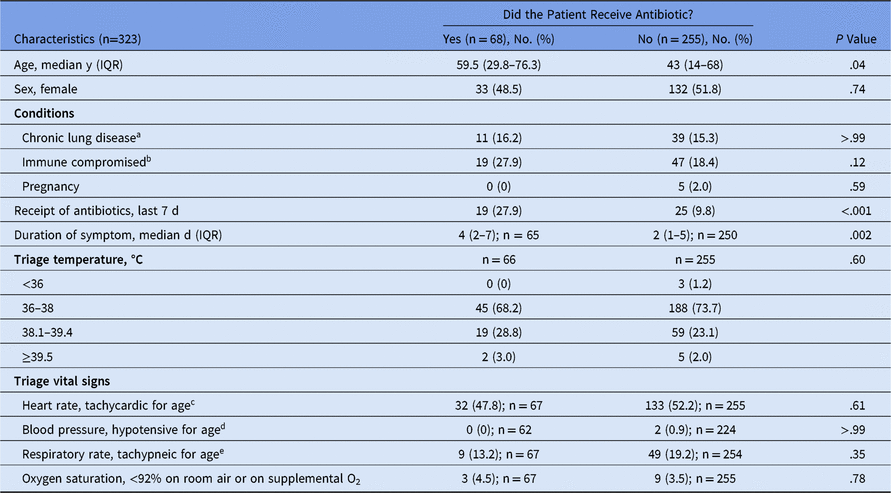
Among the 323 patients, 255 patients (78.9%) were discharged without antibiotics, and 68 (21.1%) were prescribed antibiotics. The baseline characteristics of the study population are described in Table 1. In comparing the patients who did and did not receive antibiotics despite a known VRI, the groups were similar with regard to gender, comorbid conditions (including chronic lung diseases, immune compromising conditions, and pregnancy), and vital signs upon presentation to the ED. However, patients who were prescribed antibiotics were older (median, 59.5 vs 43 years; P = .04) and had a longer duration of reported symptoms (median, 4 vs 2 days; P = .002) than those patients who were not prescribed antibiotics. Notably, the patients who presented to the ED having received antibiotics from another prescriber recently were more likely to be prescribed another course of antibiotic than those who had not (27.9% vs 9.8%; P < .001).
Baseline Characteristics of Study Groups Classified as Received Antibiotic Prescription Versus Not Received Antibiotic Prescription Upon Discharge from the Emergency Department

Note. IQR, interquartile range.
a Chronic lung disease is defined as asthma, chronic obstructive pulmonary disease, or interstitial fibrosis.
b Immune compromised includes diabetes mellitus, chronic kidney disease, HIV Infection, active malignancy.
c Heart rate is expressed in beats per minute. 0–1 y, >180; 1–5 y, >140; 5–12 y, >130; 12–17 y, >110; ≥18 y, >90.
d Blood pressure is expressed in mm Hg. 0 d to 1 week, <59; 1 week to 1 mo, <79; 1 mo to 1 y, <75; 1–5 y, <74; 6–12 y, <83; >12 y, <90.
e Respiratory rate is expressed in breaths per minute. 0–1 y, >34; 1–5 y, >22; 6–12 y, >18; 13– 18 y, >14; >18 y, >20.
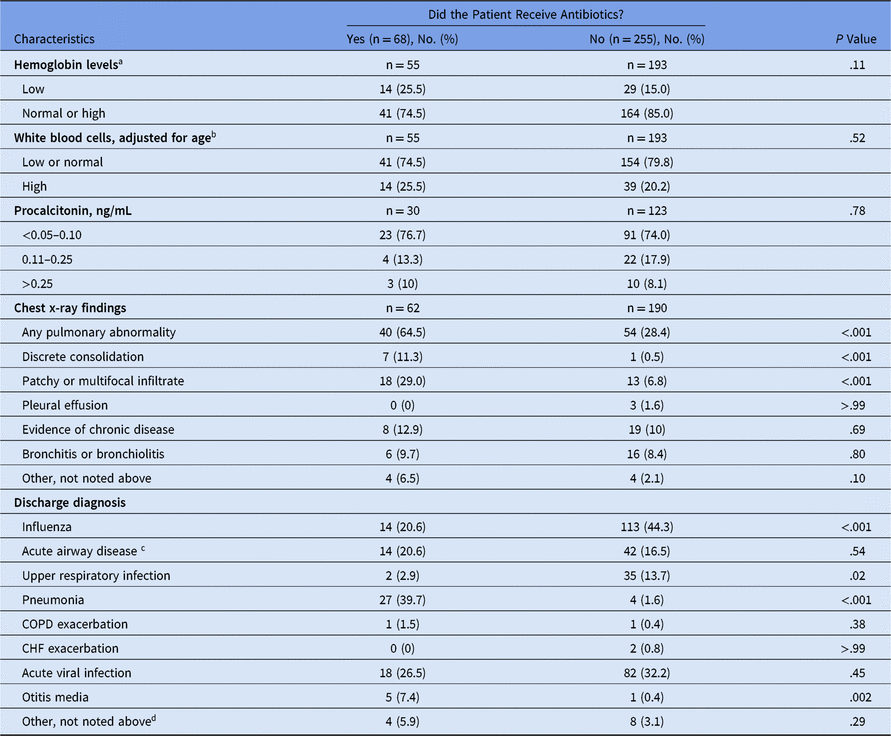
We detected no significant associations between the decision to prescribe antibiotics and leukocyte count, hemoglobin, or procalcitonin levels (Table 2). However, those patients prescribed antibiotics were more likely to have an abnormal chest radiograph (64.5% vs 28.4%; P < .001), including a discrete consolidation (11.3% vs 0.5%; P < .001) or patchy or multifocal infiltrates (29.0% vs 6.8%; P < .001). Of the 323 patients in the study population, 127 (39.3%) were diagnosed with influenza by PCR. Of 127 patients, 14 (11.0%) patients with influenza were prescribed antibiotics, whereas 54 of 196 patients (27.6%) who had a noninfluenza virus isolated were prescribed antibiotics. Patients with specific discharge diagnoses of pneumonia and otitis media were more likely to receive antibiotics (P < .001 and P = .002 respectively), and those with the more general diagnosis of upper respiratory infection (2.9% vs 13.7%; P = .02) were less likely to be prescribed antibiotics.
Laboratory Findings and Discharge Diagnoses in Study Groups Who Received Antibiotic Prescription Versus Not Received Antibiotic Prescription upon Discharge from the Emergency Department

a Hemoglobin levels are expressed in g/dL. 0 to 17 y, <11.5: low; 11.5–16.0: normal; >16.0: high. Women 18+ y, <11.0: low; 11.0–15.5: normal; > 15.5: high. Men 18+ y, <13.0: low; 13.0–17.0: normal; >17.0: high.
b Expressed in 103/μL. 0–4 years, <5.0: low; 5.0–18.0: normal; >18.1: high. 5 to 9 y, <5.0: low; 5.0–13.0: normal; >13.0: high. 10+ y, <3.9: low; 4.0–-10.0: normal; >10.1: high.
c For example, asthma exacerbation, bronchitis, bronchiolitis.
d Other diagnoses include febrile seizure, bronchiectasis exacerbation, Mycobacterium avium intracellulare, delirium, dental infection, hyperemesis gravidarum, panic attack, chronic pericarditis, solitary pulmonary nodule, and unspecified abdominal pain.
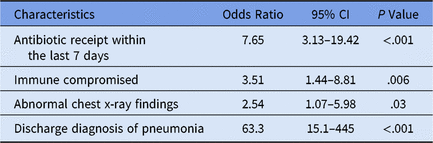
A multivariate model was created with the following predictors, each with a P value < .25 when fitted individually using univariate models: age; immunocompromised condition; antibiotic receipt within the preceding 7 days; duration of symptoms; hemoglobin levels; chest x-ray results; and a discharge diagnosis of influenza, upper respiratory infection, pneumonia, and otitis media. The final regression model predicted that patients were more likely to be prescribed antibiotics if the patient had a recent history of exposure to antibiotics (OR, 7.65; P < .001), was immune compromised (OR, 3.51; P = .006), had an abnormal chest x-ray (OR, 2.54; P = .03), or had a discharge diagnosis of pneumonia (OR, 63.3; P < .001) (Table 3).
Multivariate Modeling: Predictors Influencing Decision to Prescribe Antibiotic in Patients with Confirmed Viral Respiratory Infection upon Discharge from the Emergency Department

Note. CI, confidence interval.
Discussion
In this retrospective analysis of 323 patients presenting to the ED with acute respiratory illness who were diagnosed with VRI by rapid respiratory PCR, 68 (21.1%) were discharged from the ED with a prescription for an antibiotic. Multivariate analysis identified several factors correlating with a provider’s decision to prescribe an antibiotic upon discharge, and most of these factors were related to increased clinical concern for a secondary bacterial infection or medical fragility. Those with a recognized immune compromising condition, an abnormal chest X-ray, or a discharge diagnosis of pneumonia were more likely to receive an antibiotic. Interestingly, patients who were already taking an antibiotic for similar respiratory illness prior to the ED visit were more likely to be prescribed antibiotics. We speculate that providers are reluctant to contradict a previous diagnosis of a bacterial infection and, therefore, feel pressure to extend or rearrange previous antibiotic treatment despite a new VRI diagnosis. Approximately two-fifths of the total study population was confirmed to have influenza based on PCR, and patients with influenza were less likely to receive antibiotics than those with a noninfluenza VRI diagnosis. This finding may reflect the provider’s reverence for influenza virus’ potential to cause sufficiently severe disease, which may fully explain the clinical presentation without concern for an occult bacterial process. Alternatively, this practice pattern may indicate the important role of antiviral agents for influenza as an active intervention compared with the supportive care that is more generally recommended for other viral illness. Further study of antiviral prescribing patterns in parallel to those for antibiotics in outpatients with influenza infection may be instructive.
The primary focus of this study was the group of patients with a VRI confirmed by PCR prior to discharge. Patients with a PCR result time stamped after the discharge order were not included in the primary analysis because we felt that the provider did not have the diagnosis of a viral illness prior to determining the need for antibiotics and thus were not the primary focus of interest. The group with a PCR result available after discharge, however, included 101 patients who were younger and healthier compared with the main group of 323 patients. Approximately 1 of every 4 patients for whom a PCR was ordered was discharged before results became available. In many scenarios, providers likely felt sufficiently confident in their ability to assess illness severity and predict bacterial or viral illness using clinical judgement and, thus, were comfortable making antibiotic decisions at discharge regardless of PCR results. Nevertheless, this raises questions regarding optimization of healthcare resources and may indicate the need for healthcare systems to implement more stringent stewardship of molecular diagnostics. The multiplex PCR can bring increased cost to emergency room care. If providers do not plan to utilize results prior to antibiotic and other treatment decisions, they might consider a more cost-effective diagnostic approach.
Antibiotic prescribing behaviors are complex in the outpatient setting and several limitations to this study are noted. As a retrospective analysis without longitudinal follow-up, we could not evaluate patient outcomes in relation to their treatments, including antibiotic prescriptions. Determining appropriateness of antibiotic treatment is multifaceted and relies upon many factors, including the presence or absence of specific diagnostic criteria, the accuracy of diagnoses, and appropriateness can be supported by knowledge of a patient’s clinical course. In the absence of comprehensive details of the clinical presentations permitting definitive diagnosis, the results are inconclusive as to whether practice patterns met or were in conflict with evidence-based guidelines.Reference Harris, Hicks and Qaseem 4 Other studies have explored provider-based factors and patient satisfaction in relation to antibiotic prescribing;Reference Martinez, Rood, Jhangiani, Kou, Boissy and Rothberg 20 , Reference May, Gudger and Armstrong 21 however, these were not investigated in this study. We hypothesize that there may be significant differences among clinicians regarding PCR utilization, and further study might reveal factors such as a provider’s experience or comfort level with PCR as a newer diagnostic test. Finally, additional investigation of outpatients with influenza may be particularly instructive, including the impact of provider opinion regarding secondary bacterial infections and the effect that antiviral prescribing rates have on those for antibiotics. With our improved understanding of clinician prescribing practices for outpatients with VRI, many questions remain regarding strategies to optimize best practices for antibiotic prescribing, patient education, and provider-patient communication in an era of rapid viral diagnostics.
This study contributes to the small but growing body of literature in the outpatient setting aiming to illuminate PCR utilization with respect to antibiotic prescribing behaviors. Opportunities exist for partnered antimicrobial and diagnostic test stewardship strategies. It is vital that lessons are learned and that information is disseminated efficiently and effectively around optimizing diagnostic test utilization, patient education regarding viral illnesses and treatments, and provider support surrounding clinical decision making in the era of rapid molecular tests. Ideally, this will promote judicious diagnostic testing such as PCR, with ultimate goals of improving patient outcomes and cost-effective care.
Author ORCIDs
Jing Li 0000-0002-1911-6252
Acknowledgments
The authors would like to thank Cameron Selent, MD, and Kyle Deacon for their assistance with study design and data collection, as well as Peggy Sue Fike for her assistance with data abstraction, and the staff of the Sage Medical Library for their assistance with the literature search.
Financial support
No financial support was provided relevant to this article.
Conflicts of interest
All authors report no conflicts of interest relevant to this article.