

1. Introduction
In recent decades, there have been important changes in family formation. People get married and have their first child later, and fertility rates have decreased. This is partly the result of personal choices. Tanturri and Mencarini (Reference Tanturri and Mencarini2008) find that women increasingly express their deliberate decision not to have children. However, these changes in personal choices may also be a reaction to the difficulties of childbearing, such as (a) the lack of jobs with flexible and reduced working hours; (b) precarious working conditions that make it difficult for young adults to live on their own and raise a family; in Spain, these conditions entail skyrocketing temporality rates; (b) insufficient public policies to support parenting and reconciliation (e.g., limited availability of public childcare facilities for under threes and direct family support/benefits) and (c) gender inequality in domestic and care work (Castro-Martín et al., Reference Castro-Martín, T., J. and M.2020; Neyer et al., Reference Neyer, Lappegård and Vignoli2013). Even if the distribution of household responsibilities is fairly equal when a couple starts to live together, it tends to become more “traditional” and, therefore, more asymmetric with the arrival of the first child (González & Jurado-Guerrero, Reference González and Jurado-Guerrero2015).
Spain and other countries in the Mediterranean regime with similar institutional traits and low levels of “defamiliarization” in childcare provision (Greece, Italy, and Portugal) are characterized by unstable working conditions and weak family support policies (Saraceno, Reference Saraceno2010). Female employment rates in Mediterranean countries have increased considerably, but they are still low by European standards (except for Portugal). At the same time, many men, particularly in younger cohorts, are no strangers to job and income insecurity, which might also influence their expectations about fatherhood and their reproductive patterns. This issue has received much less attention in the scientific literature than women's decisions and expectations about motherhood and fertility. Both phenomena have resulted in a sharp decline in fertility in the past four decades, which is now just over one child per woman, while cultural models and gender roles have not changed substantially.
Interestingly, the average number of children desired by both men and women is quite stable, hovering around twoFootnote 1 in most European countries (Sobotka & Beaujouan, Reference Sobotka and Beaujouan2014). Therefore, if fertility rates have fallen to very low levels, many men and women will have had their family plans frustrated. Fertility levels below the reproductive aspirations of people reveal a deficit of well-being in contemporary social organization. Their persistence in an ageing population represents a grave challenge for the welfare state, especially for the sustainability of public pension schemes and the organization of the care system (Castro-Martín et al., Reference Castro-Martín, T., M. and J.2021).
At this point, we intend to answer the following research questions: Do men and women report similar levels and patterns of discontent with their fertility? Is this discontent driven by the same set of factors? Our main objective, therefore, is to detect possible gender differences in the probability of having fewer children than desired, as the choice to have (more) children will depend on the distribution of the costs and benefits derived from parenthood for each member of the couple (if applicable), and this distribution is far from equal. Therefore, if the mother-to-be ends up bearing most of the burden of childcare, she may not be willing to have a child even if her spouse were strongly in favor (Doepke & Kindermann, Reference Doepke and Kindermann2019). For single adults, attitudes toward parenting and family planning would be different between genders as well. In Spain, we would expect motherhood career penalties, insufficient public support for parenting and family conciliation and inequality in care responsibilities between parents to exacerbate these gender differences.
We use a representative sample of men and women in Spain that allows us to analyze this phenomenon in individuals from both sexes. The sample is taken from the 2018 Fertility Survey, which is conducted by the National Statistics Institute (INE) (Penit, Reference Penit2019) and is targeted at adults aged 18–55 years old. It aims to identify the determinants of current, recent, and expected fertility, the conditions for parenthood decisions, and the reasons for delayed motherhood and fatherhood. The sample consists of 14,556 women and 2,619 men.
We estimate the probability of having fewer children than desired using a binary probit, and we show gender-specific results across two groups: childless men and women and already parents. We hope this will contribute to the empirical evidence on the gap between observed and desiredFootnote 2 fertility in Spain. Additionally, by differentiating between childless adults and already parents, we also hope to produce interesting, nuanced evidence on this topic as this distinction is rather infrequent in the literature.
Our main results show that for women, educational level, potentially unstable employment, and one's partnership status are factors that can increase the risk of not reaching one's desired number of children. For men, low or unstable income levels are more associated with the gap between desired and actual parenthood. Differences between childless adults and already parents arise mostly in women: childless women seem more influenced by employment and one's partnership status, while mothers are constrained more by housing arrangements and family values.
The structure of the paper is as follows. Following this introduction, section 2 presents the theoretical framework and a brief review of the empirical evidence. Section 3 presents the database and the sample analyzed. Section 4 is devoted to the methodology and the discussion of the main results obtained in the estimation of the probit model. Finally, section 5 presents the paper's most relevant conclusions.
2. Theoretical framework and literature review
Numerous academic debates have arisen about reproductive decisions (childbirth postponement, spacing between pregnancies, etc.) as a consequence of increasing information about family planning and access to contraceptives. To analyze these debates, one crucial theoretical framework is provided by Warren Miller's TDIB (Traits-Desires-Intentions-Behavior) model, according to which a sequence of motivational dispositions and conscious states leads humans to behaviors aimed at having or avoiding having children (see Miller, Reference Miller1994, Reference Miller1995, Reference Miller2011). Along with this model, different theoretical approaches from economics and demography will provide the hypotheses to test in this paper. Some of them rely on the power of personal preferences, and later, critical perspectives focus attention on the constraints that hinder the realization of families' fertility plans. In this section, we will briefly compile the key messages from several of them and derive hypotheses about the variables that influence fertility gaps and the differences we expect to find between the sexes in this regard.
Conventional economic theories of fertility assume that couples achieve their reproductive preferences, which results in similar actual and desired fertility levelsFootnote 3 (Amarante & Cabella, Reference Amarante and Cabella2016). The New Economics of the Family, developed by Gary Becker in the 1960s (Becker, Reference Becker1960; Cigno, Reference Cigno1991), would be an example of this rational approach to fertility decisions. In this model, the family unit (i.e., the couple) decides how much time it will jointly devote to paid work and household production. Each member of the family/couple will specialize in the activity in which he or she has the greatest comparative advantage (i.e., the greatest efficiency or productivity), which is created by his or her stock of human capital. Therefore, the main factor that explains the allocation of time to the household and the labor market is the individual's endowment of human capital. To maximize the returns of their investments, highly educated individuals will extend their time in the labor market at the expense of time for household production, including childbearing. This means postponing their first birth, which also limits the remaining time for later/subsequent births (Neels & De Wachter, Reference Neels and De Wachter2010; Ní Bhrolcháin & Beaujouan, Reference Ní Bhrolcháin and Beaujouan2012), particularly for women, and reduces their overall fertility levels.
From the arguments described above, we expect to find the following patterns:
– H1: more educated adults will face higher fertility gaps.
– H1g: education attainment will be particularly relevant amongst women.
Changes in fertility patterns in Europe can also be analyzed from the perspective of the Second Demographic Transition (Van de Kaa, Reference Van de Kaa1997). This phenomenon entails reduced fertility, a higher share of non-married couples and dissociation between marriage and procreation. These are some of the social and value transformations and preferences that result from, among other factors, women's increasing presence in the labor market. On a related note, the theory of the gender revolution (Goldscheider et al., Reference Goldscheider, Bernhardt and Lappegård2015) would argue that the above-mentioned transformations result in changes in relations between the sexes and favors men's involvement in the domestic sphere. The gender revolution would therefore have two stages: the first is defined by the entry of women into the public sphere, and the second (still in progress) is the entry of men into the private sphere. In this sense, we can hypothesize the following about the employment status of potential parents:
– H2: employment status and job stability in particular will contribute to reducing the risk of unmet fertility plans.
– H2g: employment status and job stability in particular will be more relevant for women than for men.
Still, the abovementioned social changes do not advance at the same pace for all the members of a given community: they are rooted in family traditions and cultural or religious values that may also affect actual and desired fertility. There is evidence that fertility patterns are transmitted across generations, so the more siblings one person has, the more children she will desire (Kotte & Ludwig, Reference Kotte and Ludwig2011). Also, immigrants' fertility patterns vary across countries of origin (Mussino & Ortensi, Reference Mussino and Ortensi2018), with migrants in Spain often holding more traditional family patterns than natives (Adsera, Reference Adsera2011). Similarly, practicing Catholics and people whose parents never divorced would be expected to want and have more children and, consequently, would be less likely not to achieve their desired number of children.
From the patterns explained above, we expect to find the following outcomes:
– H3: individuals which hold traditional values or are from larger families will want and have more children, which will produce smaller fertility gaps.
– H3g: no differences between the sexes are expected in this regard.
Despite the abovementioned driving forces based on changes in societal values, greater opportunities for women, and more equal contexts, women do not achieve their preferred family size (nor do men):Footnote 4 the lower fertility of educated women is not always the result of a voluntary and conscious choice as the human capital model would predict. In fact, there is evidence that more educated women rather prefer larger families (Kuhnt et al., Reference Kuhnt, Kreyenfeld, Trappe, Kreyenfeld and Konietzka2017; Morgan & Rackin, Reference Morgan and Rackin2010; Testa, Reference Testa2012) and are less likely to satisfy their fertility desires than less educated women (Beaujouan & Berghammer, Reference Beaujouan and Berghammer2019; Berrington & Pattaro, Reference Berrington and Pattaro2014; Morgan & Rackin, Reference Morgan and Rackin2010; Nitsche & Hayford, Reference Nitsche and Hayford2020).
This evidence indicates that constraints associated with parenting/childbearing urgently need more attention. In this regard, the classic study by Bongaarts (Reference Bongaarts2001) identifies drivers of the gap between actual and desired fertility: (a) first parenthood postponement; (b) involuntary infertility; and (c) so-called “competing preferences.”
The progressive delay at the birth of the first child responds to the way in which opportunity costs evolve over one's career, in line with the abovementioned human capital approach: interrupting one's career or reducing one's pace of work to have children has more severe implications for the career when it affects the accumulation of specific human capital. Delaying the birth of the first child ensures families are more able to bear the costs of child-rearing but reduces fertility, often below initially desired levels, by de facto shortening the fertile period of individuals (as confirmed by Berrington et al. [Reference Berrington, Stone and Beaujouan2015] for the UK). Therefore, this argument would support hypotheses H1 and H1g.
Bongaarts (Reference Bongaarts2001) notes three involuntary factors that may cause failure to achieve one's reproductive goals: the difficulty of finding a suitable partner, marital breakups, and infertility. Living with a partner is an important source of emotional, instrumental, and economic support for women; lack of a suitable partner is the main reason women report for not fulfilling their fertility desires (Esteve & Treviño, Reference Esteve and Treviño2019; Testa, Reference Testa2012). Furthermore, delayed reproductive decisions are also associated with a higher probability of involuntary infertility due to greater biological difficulties in conceiving or carrying a pregnancy to term after a certain age (Beaujouan & Sobotka, Reference Beaujouan, Sobotka and Stoop2018).
Involuntary infertility factors will be captured in our empirical analysis through cohabitation status and former breakups. Unfortunately, information about biological infertility is not available in the survey. The following hypotheses may be derived:
– H4: single people are less likely to fulfil their fertility plans, particularly if they no longer live with a partner.
– H4g: women are expected to be more affected by the lack of a partner than men. Previous breakups may be correlated with unmet fertility with the previous partner(s) and the wish to complete their families as childless couples and those with just one child are significantly more prone to break up (Bernardi & Martínez-Pastor, Reference Bernardi and Martínez-Pastor2011). Instead, separated or divorced fathers do not usually live with their child(ren) and may adapt (reduce) their parenting preferences after their first partnership.
– H5: the delay of the first birth will contribute to unmet fertility desires.
– H5g: the delay of the first birth will have a more severe impact on women, whose fertile cycle is shorter.
Nonetheless, it is also true that preferences and desires change over time, and the desired number of children decreases with age, especially among women (Kuhnt et al., Reference Kuhnt, Kreyenfeld, Trappe, Kreyenfeld and Konietzka2017; Savelieva et al., Reference Savelieva2021).
As for “competing preferences,” Bongaarts (Reference Bongaarts2001) refers to women's desire to have a career. Economic and residential independence or even freedom from childcare responsibilities may lead some of them to renounce childbearing before they have reached their desired or ideal number of offspring. When striving for those objectives, they will face constraints due to the economic situation and the conditions of the labor market and the housing market, which have been found to determine the mismatch between desired and observed fertility (Adsera, Reference Adsera2011). Instability in labor income disincentivizes childbearing: women delay motherhood until they land a stable job, and this initially transitory postponement may become permanent if the right conditions are never met (Tanturri et al., Reference Tanturri2015).
In the multivariate analysis, “competing preferences” will be observed in different ways. The first is through employment status. Hypotheses H2 and H2g would also hold in this framework. The second is from personal income and family budgetary constraints and would lead to the following expected patterns:
– H6: personal income and family budget constraints contribute to reducing fertility gaps.
– H6g: higher levels of personal income might proxy higher opportunity costs of parenting for women and the possibility to raise children (income effect) for men. Therefore, high-income levels may mean larger fertility gaps for women and lower ones for males.
Finally, as regards preference for residential independence, our analysis will consider the financial burden of housing costs, resulting in the last set of hypotheses:
– H7: constraints due to financial burdens from housing costs will exacerbate fertility gaps.
– H7g: no differences between the sexes are expected in this regard.
3. The database and the sample
To analyze childbearing decisions, knowing the context in which they take place is crucial, and fertility surveys gather a large amount of information about it. There have been six fertility surveys in Spain. They were carried out in 1977, 1985, 1995, 1999, 2006, and 2018 and usually conducted by the Spanish National Statistical Office (INE). In this paper, the analysis is performed on the 2018 survey, whose sample is representative of 18- to 55-year-old men and women residing in family dwellings throughout Spain. The sample is comprised of 14,556 women and 2,619 men.
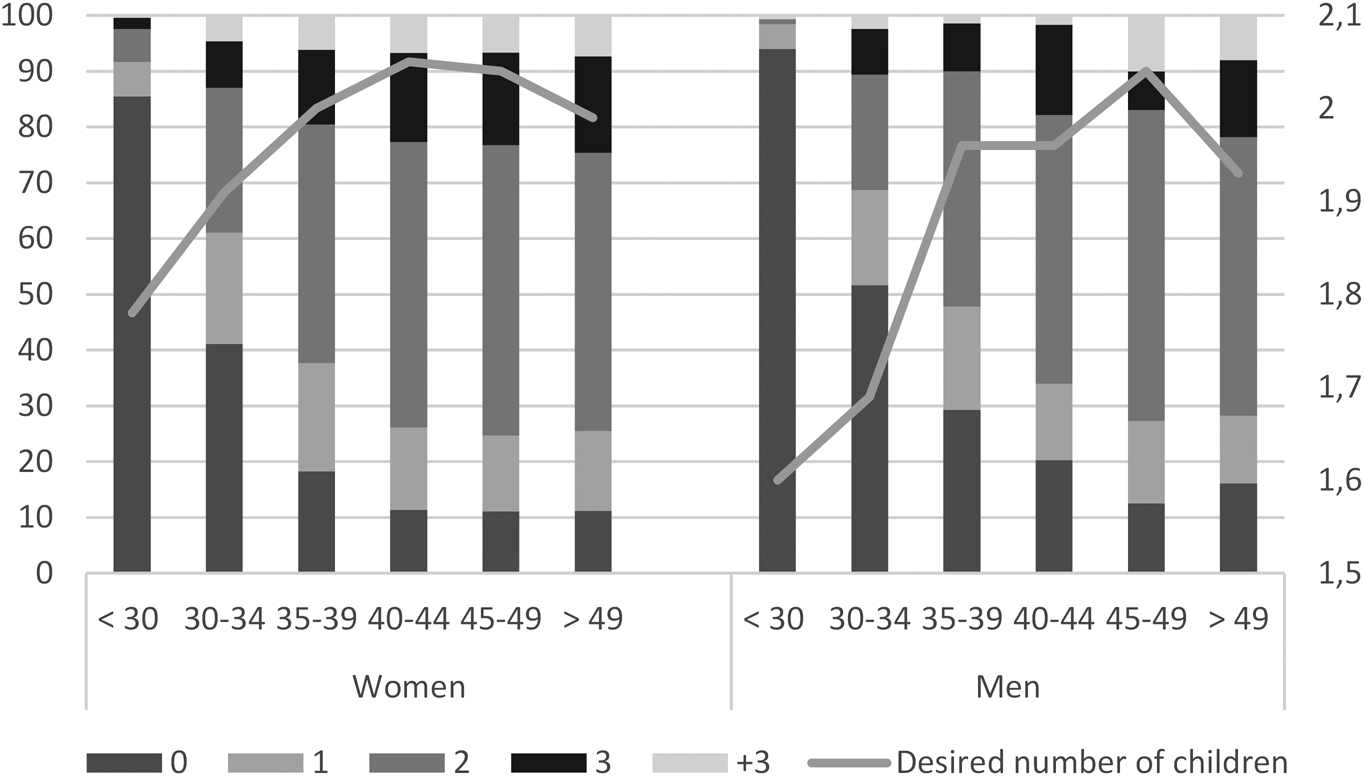
Since the aim of the 2018 Fertility Survey is to identify current, recent, and expected fertility and their drivers, the questionnaire captures a wealth of information about interviewees' fertility history. The distribution of observed fertility across age groups is displayed in Fig. 1. The proportion of childless adults decreases with age and reaches its minimum (about 12%) at the age of 40–44 for women and 45–49 for men. Most respondents with children end up having two, and about 20% of persons over the age of 40 have more than two. The distribution evolves more or less in line with the average desired number of children expressed by respondents in the survey. It should be noted that the desired number of children is lower for men (particularly those under 35) than for women.
Number of children by age group of Spanish women and men.
Source: Spanish Fertility Survey (2018), INE.

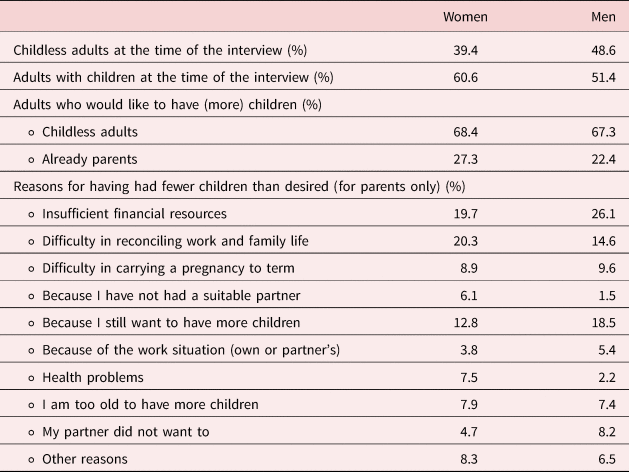
Most studies in developed countries indicate that a significant proportion of people of reproductive age would like to have more children. This is illustrated in Table 1: a large majority of childless adults (68.4% of women and 67.3% of men) would like to have children, and a significant proportion of already parents (27.3% of mothers and 22.4% of fathers) have fewer children than they would like.Footnote 5 For mothers,Footnote 6 the main reported reason is the difficulty of reconciling work and family life (20.3%), followed closely by insufficient financial resources (19.7%), which is the commonest answer by fathers (26.1% compared to 14.6% who report difficulties in reconciling family and personal life).
Childless adults and parents, share of those who desire more children and the main reasons for this gap

Source: Spanish Fertility Survey (2018), INE.
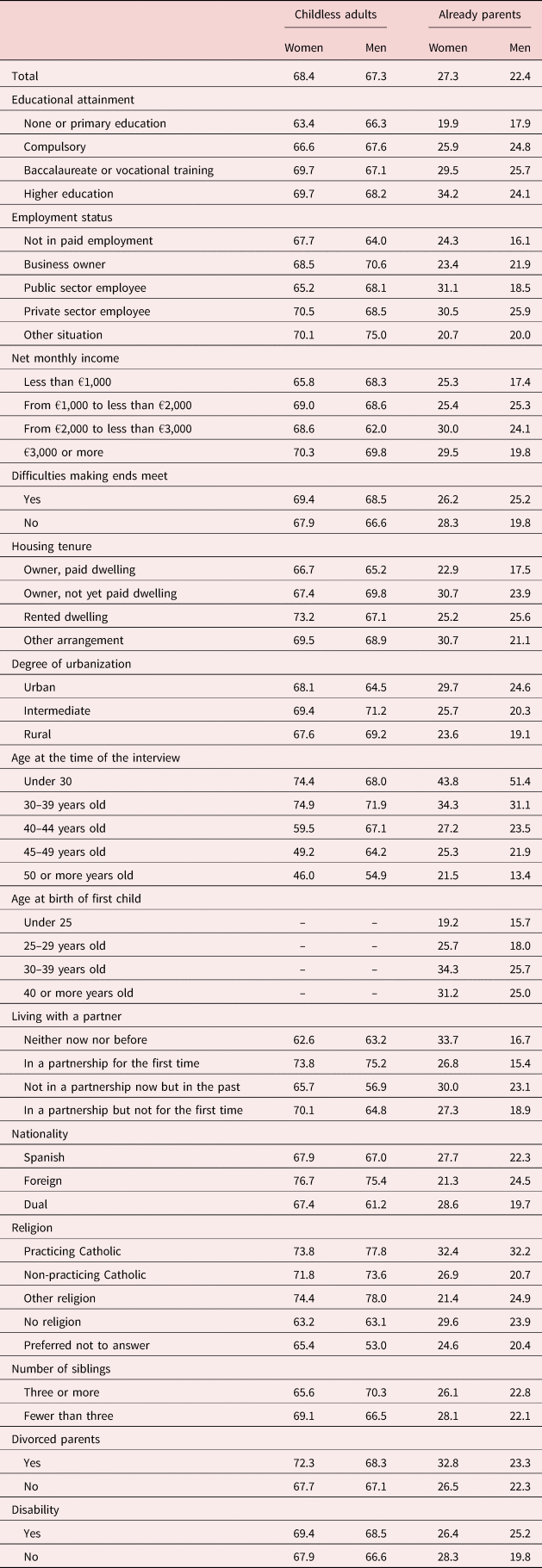
The information displayed in Table 1 illustrates the advantage of distinguishing between parents and childless adults when analyzing the gap between desired and actual fertility. Table 2 shows the proportion of people who have not achieved their desired number of children. The figures are broken down by parenthood status and sex across educational level, age, employment status, net monthly income, age at the birth of the first child, and living with a partner at or before the time of the interview to contrast the hypotheses of Bongaarts (Reference Bongaarts2001). All these variables have proven relevant in the economic and demographic literature. Educational attainment is positively correlated with the gap between desired and effective fertility, and the education gradient in that gap is more pronounced for women than for men, particularly if they already have children. As they get older, some childless adults end up adapting their preferences to their circumstances. Some people who are already parents have more children as they age, so their gap shrinks, while others, particularly when they are older, also might adapt their preferences to their actual number of children.
Adults who report fewer children than desired, according to different variables

Source: Spanish Fertility Survey (2018), INE.
As regards employment status, private sector employees are more likely not to fulfil their desired fertility than people in other employment statuses. For public sector employees, differences with other labor market statuses are not consistent between the sexes or across parenting groups. There is no clear pattern in the distribution of net monthly income, either: the proportion of adults who do not reach their desired family size tends to increase with income in all groups except for fathers.
As regards the profile of unsatisfied fertility according to Bongaarts (Reference Bongaarts2001), there is a clearly positive gradient in the age at the birth of the first child up to the age of 39. Beyond that threshold, the trend changes, most likely because of adjustments in fertility plans. Not living with a partner is correlated with wanting more children amongst those who are already parents, while the opposite holds true for childless adults. If they are no longer in their first partnership, men are generally less keen to have children than women. For those who are already parents, the opposite holds; maybe some of them wish to complete their families with new partners.
The distribution of fertility gaps across nationalities, religious faiths, and traditional family backgrounds does not follow clear patterns, either: foreign nationals wish to become parents more often than Spanish nationals, but amongst parents, fertility gaps do not differ much across nationalities. The same holds for individuals who manifest no religious affiliation: if childless, they tend to wish to have children less often than the rest, but when they are already parents, the distance with other categories becomes negligible.
4. Methodology and results
4.1. Methodology
Our multivariate analysis is intended to contrast the differences in unmet fertility across diverse groups described above. To that end, we estimate the probability of having fewer children than desiredFootnote 7 using a binary probit model where the dependent variable (D) is assumed to take the value 1 if the interviewee has fewer children than desired and 0 otherwise. Equation (1) presents the specification of the model:

$D_i^{}$ is a variable that represents the probability of having fewer children than desired. The explanatory variables will be organized as follows. First, vector $X_i^E$
 collects the drivers referenced in the economic and demographic literature for the planned number of children and the voluntary delay in childbearing: educational level and employment status. Second, several variables aim to identify cultural and family values and characteristics of the family of origin that may shape one's preferences for family size. The vector $X_i^F$
 includes having foreign or dual nationality, religious affiliation, the number of siblings in the parental home, and whether the respondent's parents ever divorced.
Third, we try to identify some of the factors from Bongaarts (Reference Bongaarts2001) as regards involuntary infertility and “competing preferences” for economic and residential independence. Vector $\;X_i^B$ comprises age at the time of the interview and, in the subsample of parents, age at the birth of the first child, and living with a partner at the time of the interview or in the past, as previous breakups might also mark fertility preferences and expectations.Footnote 8 We also control for disability as it may influence both (1) the likelihood of living with a partner and unwanted infertility and (2) greater difficulty in having children (Bloom et al., Reference Bloom, W., J., H. and R. B.2017). It also covers personal and household economic status, which is captured by net monthly personal income, the difficulties of the household in making ends meet and the tenure status of the dwelling. We add the degree of urbanization as higher living costs in large cities compared with rural areas may hinder achieving the desired family size (Adsera, Reference Adsera2006). Finally, ɛi is an error term.
Two specifications are estimated separately for men and women, one for parents and another for non-parents. The only difference between them is that the specification for parents includes age at the birth of the first child. The mean values of the variables included in the multivariate estimations (Appendix Table A.1) indicate relevant differences between childless adults and parents. Foreign-born persons living with their partners, members of households with difficulties making ends meet, those with a large number of siblings, and those who profess a religion are overrepresented in the sample of parents, whereas individuals with higher education are overrepresented in the sample of childless adults, especially in the case of women. Finally, mothers are characterized by a significantly lower employment rate than fathers.
4.2. Results
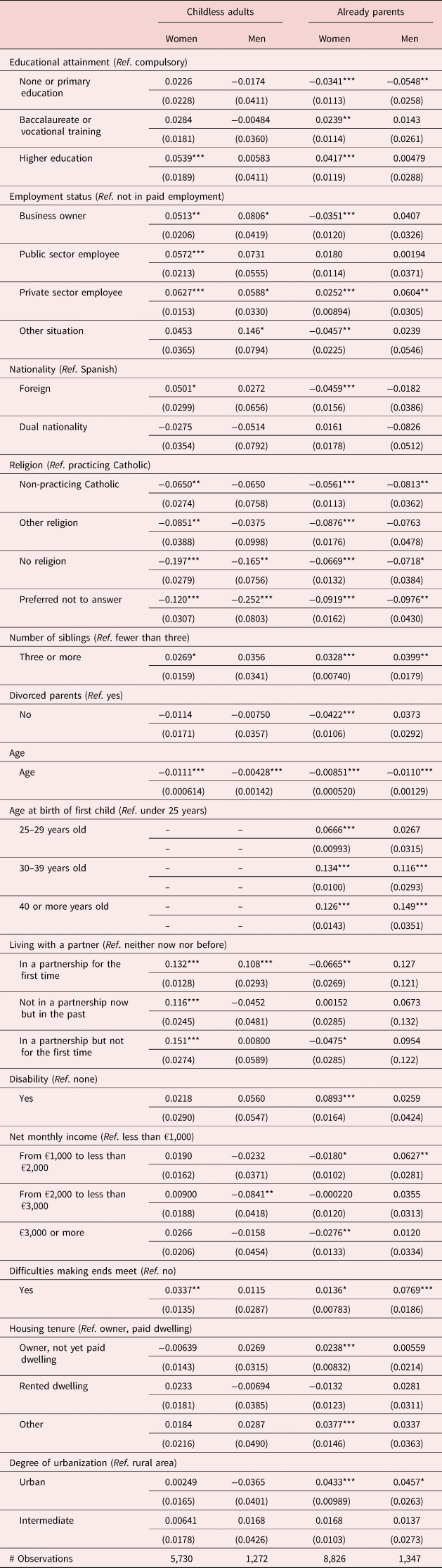
Table 3 shows the average marginal effects for the probit models that estimate the probability of having fewer children than desired. The table shows results for two specifications childless adults and already parents, broken down by sex. We analyze the influence of each covariate across the different specifications.
Probability of having fewer children than desired (AME from a binary probit model) by sex and parenthood status at the moment of the interview

Source: Spanish Fertility Survey (2018), INE. Standard errors in parentheses ***p < 0.01, **p < 0.05, *p < 0.1.
First, we look at the impact of relevant socioeconomic characteristics (level of education and employment status). The level of education is a very relevant factor in unmet fertility amongst women (particularly amongst mothers), while it hardly correlates with it unmet fertility amongst men. Higher education is associated with a significantly higher likelihood (5.5 and 4.2 percentage points higher for childless persons and mothers, respectively) of not having the desired number of children than low-medium education. This is in line with the results obtained in Beaujouan and Berghammer (Reference Beaujouan and Berghammer2019) for several European countries.
The connection between employment status, job stability,Footnote 9 and unmet fertility is also different for men and women. Hardly any differences arise amongst childless men across employment categories. Amongst fathers, the only distinctive category is private sector employees, where more difficulties reconciling family and work are met. Among childless women, all sorts of paid employment are associated with unfulfilled fertility (between 5 and 6 percentage points more likely to experience it than their non-employed counterparts). For mothers, salaried jobs in the private sector are related to a higher probability of not reaching the desired number of children (by 2.4 percentage points) than non-employment. Interestingly, self-employment and entrepreneurship are associated with a lower risk (by 3.6 percentage points) of unmet fertility than non-employment. Furthermore, and in line with the results obtained by Adsera (Reference Adsera2006), the gap between observed and desired fertility in mothers working in the public sector is not significantly different from that observed in non-working mothers. Amongst childless women, non-employed ones are equally distant from both public and private sector employees, though. We might interpret this difference in the following way: salaried work is associated with postponing the first birth in both the public and private sectors, but after the first birth takes place, higher levels of employment stability and greater work–life balance in the public sector seem to allow mothers to better align their fertility plans with their preferences.
Now we compile the results of the variables related to family and cultural values which are potentially associated with the desired number of children (vector of explanatory variables XF). First, only foreign mothers have a lower probability of not having reached the desired number of children (4.6 percentage points) than Spanish mothers. In the rest of the groups, this variable is not significant. The results for respondents' religious self-identification in 2018 reflect the expectations: women who identified as practicing Catholics were more likely than others in the rest of the categories to have fewer children than desired.Footnote 10 The pattern is similar between men who do not express any religious affiliation and those who do. Interestingly, these results differ from those obtained by Adsera (Reference Adsera2006) with two prior Spanish fertility surveys (1985 and 1999) in which women's religious denomination was not a major factor in the gap between observed and desired fertility.
Parental family composition is identified by number of siblings and parental divorce. Number of siblings is significant only for already mothers and fathers, for whom having three or more siblings is associated with a higher probability (between 3 and 4 percentage points) of not reaching their desired number of children. Parental divorce is correlated with unmet fertility only for mothers: their probability of having fewer than the desired number of children decreases by 4.1 percentage points if their parents never divorced.
Third, we describe the results for the variables in the vector XB. As age increases, the probability of not having reached the desired number of children decreases in all four groups, which is in line with Iacovou and Tavares (Reference Iacovou and Tavares2011). This is because observed fertility increases over a lifetime, with stable albeit slightly declining desired fertility in elder adults (shown in Fig. 1). In the subsample of parents, age at the birth of the first child is strongly associated with a higher risk of having fewer children than desired, which is similar to the findings of Berrington et al. (Reference Berrington, Stone and Beaujouan2015). However, this risk is observed only for males age 30 and older, which is consistent with their longer fertile cycle. Finally, and partially in line with the results of Bloom et al. (Reference Bloom, W., J., H. and R. B.2017), who show a larger gap between observed and desired fertility for disabled women, disability here is related to a higher probability of unmet fertility (9 percentage points), though only amongst mothers; disability therefore seems unrelated to unmet fertility in childless women.
Cohabitation at the time of the interview is also related to the risk of involuntary infertility in Bongaarts's (Reference Bongaarts2001) approach. Here we add an interesting nuance to the discussion thanks to the inclusion of information about previous partnerships in the 2018 Fertility Survey. Childless women systematically report a higher likelihood of wishing to become mothers if they are in or have been in a partnership. The gap is particularly pronounced when they are in a partnership that is not their first one (15.1 percentage points). By contrast, only the first partnership is significantly correlated with unmet fertility in childless men. Only mothers in their first partnership have a lower risk (6.6 percentage points) of unmet fertility than those who have never had a partner. Mothers no longer in a partnership or in a new partnership report no special fertility gap in contrast to those who have never been in a partnership. They probably readjusted their childbearing preferences after their previous partnership ended. For fathers, there are no significant differences between current and past partnerships.
Once employment status is controlled for, income and household economy constraints have little impact per se on unmet fertility. Specifically, net monthly income is significant only for mothers if it is greater than €3,000. In this case, the probability of not reaching the desired family size decreases by just 2.8 percentage points. This may indicate an income effect rather than the expected opportunity cost.Footnote 11
As regards the personal and household economic situation, the potential correlation between personal income and unmet fertility is not clear amongst men; only fathers in poor personal or household situations report unmet fertility. Also, difficulties making ends meet are associated only with the probability of having fewer children than desired amongst childless women (3.4 percentage points), while the pressure from mortgages makes mothers significantly more likely to have fewer children than desired (just around 2.4 percentage points) than mothers who live in their own, purchased house. Consistently, mothers who reside in urban areas are 4.3 percentage points more likely to fall short of the desired family size than those in rural settings, possibly because of the greater budgetary constraints they face. These results are in line with Adsera (Reference Adsera2006), who finds a larger gap between actual and desired fertility in large Spanish cities, which might be because of higher housing prices.
5. Conclusions
This paper has used the 2018 Fertility Survey conducted by the INE (Penit, Reference Penit2019) to estimate the probability of having fewer children than desired for both women and men, distinguishing between parents and non-parents. Our results show important differences across the four groups of interest.
We have seen a steeper education gradient in the desire to have (more) children for women – especially already mothers – than for men (H1 and H1g are verified). Also, employment status is more important for women than for men, but employment stability is associated with lower levels of unmet fertility only for mothers (H2 is verified, but H5g is only partially confirmed).
Amongst variables related to family values, the significant differences observed when breaking down the data by religiosity (and in line with H3) are rather new as they seem much more relevant than in previous fertility surveys. The composition of the parental family and traditional family values would be related only to certain groups (parents and mothers, respectively), which would partially align with H3. Family values and religiosity seem more relevant for women than for men, so H3g is not confirmed.
As for factors that play a role in involuntary infertility, being in a partnership is a strong influence for childless adults (H4 partially confirmed). Previous partnerships also influence childless men and women differently. Women who are no longer in a partnership (or live with a new partner) report a significantly greater desire to have children than women who have always been single, but this is not the case for their male counterparts. Once women become parents, being in a partnership is no longer such a strong predictor of unmet fertility, probably because of a readjustment of fertility-related preferences (H4g partially confirmed). Also, the postponement of the first childbirth accentuates the experience of unmet fertility in parents, particularly for mothers (H5 and H5g are confirmed).
Finally, in the presence of employment status, personal and household income are not as relevant as might be expected (H6 is partially confirmed). They are not necessarily more correlated with mothers' than with fathers' fertility preferences, and neither has a different significance for mothers and fathers (H6g is not confirmed). Financial strains in the household affect nearly all groups, but in different ways. Experiencing difficulties making ends meet is correlated with unmet fertility in fathers and childless women, while pressures from mortgages and higher prices in urban areas are more relevant for mothers (H7 holds, but H7g does not).
With these results, we hope to have contributed to the empirical literature on the determinants of the differential between observed and desired fertility in Spain. We have found that patterns of delayed childbearing in 2018 were still anchored to both economic needs and income instability and the opportunity cost associated with childbearing for educated women. We also found different effects of one's partnership status on unmet fertility by sex, particularly in childless adults. These results should guide future research to explore the influence of breakups on the desired number of children and their differences by sex.
In the future, it might also be interesting to distinguish between birth cohorts. For childless adults, birth cohorts can help to differentiate between those who are probably just postponing parenthood from those who are no longer expected to have children. For already parents, more recent birth cohorts would also capture more educated men and women with family histories and cultural and religious values that are probably more related to preferences for low fertility levels. Mothers in younger birth cohorts may be more integrated in the labor market, while fathers may be more affected by precarious employment. Given all these potentially distinctive features, it might be worth exploring cohort-based differences in fertility gaps.
Our analysis of the gap between observed and desired fertility has several limitations due to the use of cross-sectional information and its focus on adults rather than households. In the future, it would be interesting to use, when available, longitudinal data to capture changes in reproductive preferences over time or the dynamic process of achieving them. Furthermore, exploring datasets focused on households would provide information about partners and address possible misalignments of fertility preferences within couples.
Supplementary material
The supplementary material for this article can be found at https://doi.org/10.1017/dem.2024.26.