Artilleryweed, also known as artillery fern, artillery plant, rockweed, and gunpowder plant, is a low-growing short-lived perennial or annual herb in the Urticaceae family (Friis Reference Friis1989). Its native range includes parts of southern Florida, the West Indies, and Mexico, and extends south to tropical South America (Wagner et al. Reference Wagner, Herbst and Sohmer1999). Artilleryweed was once widely planted as an ornamental groundcover (Gilman Reference Gilman1999; McConnell and Muniappan Reference McConnell and Muniappan1991) and utilized in gardens and landscapes as a foliage or groundcover ornamental plant (Blessington and Collins Reference Blessington and Collins1993). It is still available in the nursery trade for use in indoor arrangements or for seasonal interest in northern climates. Variegated forms (P. microphylla ‘Variegata’) are now available. Artilleryweed has since escaped cultivation and become a problematic weed species in tropical and subtropical environments worldwide (PIER 2010). Specimens have been documented across the southeastern United States and as far north as Michigan (USDA 2016), although it is most problematic in Hawaii and Florida (UG-CISEH 2017) where it is commonly found as a weed of landscapes and gardens, as well as ornamental plant production, greenhouses, and container nurseries (SC Marble, unpublished data). Artilleryweed is typically found in moist areas and can be found even in heavy shade (PIER 2010). While it prefers areas that remain moist throughout the year, it has been found growing in rock gardens, along walls (Dos Reis et al. Reference Dos Reis, Lombardi and De Figueiredo2006), and in cracks and crevices of pavement and hardscapes (PIER 2010). In container nurseries in Florida, it is most often observed in greenhouses and unheated covered houses and growing on ground cloth and gravel of production areas as well as in potted nursery crops. It can become especially problematic for container growers using “air root-pruning pots” (described by Gilman et al. Reference Gilman, Harchick and Paz2010), which allow artilleryweed germination and growth along the outside perimeter of the container. Previous studies have noted the presence of artilleryweed in the production of bromeliads [such as Alcantarea imperialis (Carrière) Harms] (Rodrigues et al. Reference Rodrigues, Ferreira, Grossi, Barbosa, Paula and Reis2007), Assai palm (Euterpe oleracea Mart.) (Romani et al. Reference Romani, Quiroz, Silva, Alves and Pivetta2013), and orchids (Cattleya species, Epidendrum ibaguense H.B.K., Dendrobium spp.) (Battistus et al. Reference Battistus, Klein, Costa, Guimarães and Hoffmann2014; Freitas et al. Reference Freitas, Grossi, Barros, Mesquita, Ferreira and Barbosa2007).
Artilleryweed reproduces by seed or vegetatively from stem fragments often left behind following hand-weeding (Henty and Pritchard Reference Henty and Pritchard1973). Artilleryweed is monoecious; pollen is forcibly discharged at maturity, creating a small, dust-like cloud, hence the name “gunpowder plant”. Seeds are extremely small (0.5 mm) and are ejected from ripe fruit (Whistler Reference Whistler1995) and have no dormancy requirement. Artilleryweed has been previously identified as a host of several pest species, most notably parasitic reniform nematodes (Rotylenchulus reniformis Linford and Oliveira), which cause economic losses over a wide range of crop species (Robinson et al. Reference Robinson, Inserra, Caswell-Chen, Vovlas and Troccoli1997).
Although artilleryweed is an increasingly problematic species, little research has been conducted to determine effective control options in nursery crops. Currently, artilleryweed is not listed on the label of any PRE or POST herbicide labelled for use in the United States. Romani et al. (2007) showed 100% control of established artilleryweed with oxyfluorfen at rates ranging from 72 to 144 g ai ha−1. Klein et al. (Reference Klein, Battistus, Hoffman, Vilanova da Costa, Kestring, Bulegon and Guimaraes2015) also observed over 90% control of artilleryweed 49 days following treatment with flumioxazin at 12.5 g ai ha−1, but ineffective control with mesotrione and nicosulfuron. Conover and Stamps (Reference Conover and Stamps1994) reported over 90% control of artilleryweed with oxadiazon (Ronstar 50 WP) plus the addition of a nonionic surfactant at 0.50%, although no herbicide rates were reported. Poor control of artilleryweed was also observed from POST applications of glyphosate (<50%), and also prodiamine, isoxaben, imazaquin, and fluometralin (CIBA-GEIGY Corporation, Plant Protection, Greensboro, NC) (Conover and Stamps Reference Conover and Stamps1994).
With the exception of a few POST graminicides, there are virtually no over-the-top POST herbicide options for ornamental crops. Thus, producers rely on PRE herbicides and hand-weeding for weed management in container-grown crops. As artilleryweed is primarily a concern in container ornamentals, determining PRE herbicide efficacy is paramount. Neel (Reference Neel1997) and Knox (Reference Knox1986) reported effective control of artilleryweed with granular and wettable powder formulations of oxadiazon applied at 2.24 kg ai ha−1. However, multiple herbicides have been registered for use in ornamental plant production and landscapes since this research was completed, and efficacy information for those PRE herbicides is lacking.
Previous research (Conover and Stamps Reference Conover and Stamps1994) and industry reports indicate that glyphosate offers poor POST control. Herbicides that have shown POST efficacy, such as spray-applied oxyfluorfen or oxadiazon, would have limited applicability in ornamental plant nurseries or landscapes due to safety concerns (or label restrictions in the case of oxyfluorfen). The objective of this trial was to evaluate commonly used PRE and POST herbicides for efficacy on artilleryweed. Herbicides were chosen based upon previous research, industry reports, and utility of the herbicides in specific production or landscape situations.
Materials and Methods
All trials were conducted in Apopka, FL, in a shaded (40%) greenhouse in 2015 and 2016. In all cases, the substrate used for experiments was an industry standard bagged mix containing pine bark, peat, perlite, vermiculite, dolomitic limestone, and wetting agent (Fafard® 52 growing mix, SunGro Horticulture, Agawam, MA), amended with Osmocote® Plus 15-9-12 at a rate of 5.6 kg m−3. A nontreated control group was included in all trials for comparison.
POST Experiments
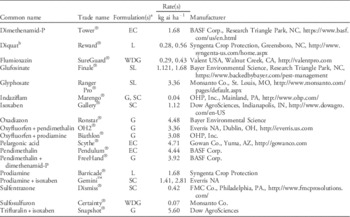
Two experiments were conducted during 2015 and 2016 to evaluate artilleryweed response to POST herbicide applications (Table 1). In both experiments, PRE herbicides including indaziflam, oxadiazon (experiments 1 and 2), dimethenamid-P, pendimethalin, and flumioxazin (experiment 2) were evaluated POST because previous reports have shown POST control of artilleryweed (Conover and Stamps Reference Conover and Stamps1994; Klein 2015) or early POST control on other species (Brosnan et al. Reference Brosnan, Breedon, McCullough and Henry2012; Judge and Neal Reference Judge and Neal2006; Marble et al. Reference Marble, Gilliam, Wehtje, Van Hoogmoed and Palmer2011, Reference Marble, Gilliam, Wehtje and Samuel-Foo2013, Reference Marble, Chandler and Archer2016). Additionally, dimethenamid-P, oxadiazon, or pendimethalin can be applied over-the-top to container-grown ornamentals, which would provide additional management options for growers. For the first preliminary experiment, 531-mL plastic nursery containers were filled with potting substrate mix and amendments as described previously. Approximately 100 artilleryweed seeds were sown to the surface of each pot. Pots were placed in the greenhouse and irrigated 1.3 cm each day via single-cycle overhead irrigation. After 8 wk, plants were blocked based upon overall size. At the time of treatment, all plants were 8 to 11 cm in height and had flowered. On December 31, 2015 (clear, 27 C, 71% relative humidity, winds 4 m s−1), plants were removed from the greenhouse and herbicides (Table 2) were applied using a CO2-pressurized backpack sprayer calibrated to deliver 187 L ha−1 using an 8004 flat-fan nozzle (TeeJet Technologies, Wheaton, IL). A nonionic surfactant (Capsil®, Aquatrols, Paulsboro, NJ) was included in treatments at 0.125% (v:v), as recommended on manufacturer labeling (Table 1). Oxadiazon, which is granular, was applied using a hand-held shaker. After treatment, plants were placed back inside the greenhouse. All plant foliage was dry at the time of application, and plants were not irrigated until 19 h following herbicide application, at which time plants received 1.3 cm irrigation daily via one overhead irrigation cycle for the remainder of the trial. Experiment 1 was designed as a randomized complete block design with 10 single-plant replications per herbicide treatment. Data collected included biweekly visual control ratings for 4 wk after treatment (WAT) on a scale of 0 to 100, with 0 meaning no plant response and 100 meaning complete control, compared with nontreated controls. At 4 WAT, plant shoots were cut at soil level and shoot fresh weights (FW) were determined and converted to percent control ratings using the following formula: (Nontreated – Treated)/Nontreated)*100. After collecting FW, plants remained inside the greenhouse to evaluate regrowth. Regrowth of FW was recorded using the aforementioned procedure at 8 WAT.
Herbicides, rates, formulations, and manufacturers

a Abbreviations: EC, emulsifiable concentrate; L, liquid; WDG, water-dispersible granule; SL, soluble liquid; G, granule; SC, soluble concentrate.
b Applied with the addition of a nonionic surfactant (Capsil®, Aquatrols, Paulsboro, NJ) at 0.125% (v:v).
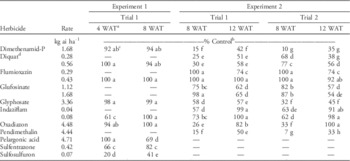
Postemergence control of artilleryweed in greenhouse container experiments in Apopka, FL

a WAT indicates weeks after treatments were applied (treatments were applied on December 31, 2015 in experiment 1, and on April 8 and September 15, 2016, in trials 1 and 2, respectively, in experiment 2.
b Shoot fresh weights were recorded initially at 4 or 8 WAT, and regrowth was recorded at 8 and 12 WAT in experiments 1 and 2, respectively. Percent control value is derived from the following equation: 100 − (Weight of treated/Weight of nontreated)×100. Mean weight of the nontreated control was 13.8 and 4.3 grams per pot at 4 and 8 WAT in experiment 1, and 10 and 7.5 grams per pot and 22.6 and 4.6 grams per pot at 8 and 12 WAT, respectively, in trials 1 and 2 in experiment 2.
c Means followed by the same letter within a column are not significantly different according the Fisher’s Protected LSD (P≤0.05).
d Applied with the addition of a nonionic surfactant (Capsil®, Aquatrols, Paulsboro, NJ) at 0.125% (v:v).
A second experiment was conducted evaluating POST herbicide efficacy on transplanted seedlings. The treatment list was expanded to include pendimethalin, additional rates of diquat, flumioxazin, and indaziflam, and two rates of glufosinate (Table 2). Artilleryweed seedlings were collected from natural populations at the Mid-Florida Research and Education Center in Apopka, FL. None of the plants had been treated previously with herbicides. Three uniform seedlings (2.5 to 3.8 cm in height and rooted) were transplanted into each 531-mL plastic nursery container filled with the substrate mix described above, and the containers were placed inside the shaded greenhouse and received 1.3 cm irrigation per day. Transplanted seedlings were allowed to grow for 7 wk until reaching 10 to 12 cm in height, at which time all were flowering and producing fruit. After 7 wk, plants were blocked based upon overall size. Herbicides were applied, using the same method described previously, on April 8 (trial 1) (clear, 26.1 C, 45% relative humidity, calm), and the procedures were repeated on Sept. 15, 2016 (trial 2) (overcast, 29 C, 65% relative humidity, calm). Plant foliage was dry at the time of application, and plants remained dry for 17 h after treatment, at which time they were irrigated as previously described. This experiment was designed as a completely randomized block with 7 and 8 single-plant replications per treatment in trials 1 and 2, respectively. Data were collected in a similar manner to the preliminary trial, with the exception that FW was recorded first at 8 WAT and regrowth assessed at 12 WAT. Data from both POST experiments were subjected to ANOVA in SAS software (SAS 9.4, Cary, NC) and treatment means were separated using Fisher’s Protected Least Significant Difference test at the 0.05 significance level. Because different treatment combinations were used, the preliminary experiment was analyzed separately. Because of significant trial-by-treatment interactions, results from the two trials in the second experiment are reported separately. The relationship between visual control ratings and FW was assessed for each treatment using the PROC CORR procedure in SAS. Due to a high degree of correlation for most treatments (data not shown), especially at 4 and 8 WAT, only FW is reported.
PRE Experiment
All PRE trials were conducted in 2016 inside the shaded greenhouse previously described. On April 7, 1-L nursery pots were filled with substrate and amendments previously described. Spray-applied herbicides (Table 3) were applied using a CO2-pressurized backpack sprayer calibrated to deliver 468 L ha−1 using an 8004 flat-fan nozzle (TeeJet Technologies), while granular treatments were applied using a hand-held shaker. All pots received 1.3 cm irrigation via overhead sprinklers immediately after herbicide application. On April 8, approximately 50 artilleryweed seeds were surface-sown to each pot. Pots subsequently received 1.3 cm irrigation daily for the remainder of the trial. Data collected included biweekly percent control ratings based upon artilleryweed coverage on the container surface in each pot on a scale of 0 to 100 (0 meaning no control, 100 meaning complete control) for 10 WAT. At 10 WAT, FW was recorded and converted to percent control ratings using the formula described previously. This study was repeated using similar procedures on September 15. PRE trials were completely randomized, with 10 single-pot replications for each herbicide treatment. Data were analyzed in the same manner described for POST treatments. No experiment by treatment interactions were observed; therefore data from PRE experiments were combined for analysis and presentation.
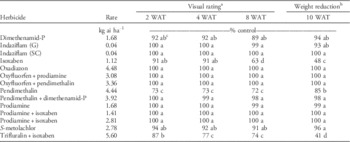
PRE control of artilleryweed in a pine bark–peat soilless substrate in Apopka, FL. Data were pooled across two experimental repetitions.

a Visual ratings are on a scale of 0 to 100, with 0 meaning 0% control (or 100% weed coverage), and 100 meaning 100% control (or 0% weed coverage), in comparison with nontreated plants. Mean percent coverage in nontreated pots was 23%, 42%, and 87% coverage at 2, 4, and 8 WAT in experiments 1 and 2, respectively. Abbreviation: WAT, weeks after treatment.
b Control value derived from the following equation: 100 − (Shoot weight of treated/Shoot weight of nontreated)×100. Mean weight of the nontreated control was 37.6 and 24.2 grams per pot for experiments 1 and 2, respectively.
c Means followed by the same letter within a column are not significantly different according to Fisher’s Protected LSD (P≤0.05).
Results and Discussion
POST Control
In experiment 1, diquat, flumioxazin, and pelargonic acid provided 100% FW reduction at 4 WAT (Table 2). Dimethenamid-P (92%), glyphosate (98%), and oxadiazon (94%) also provided similar control at this time point. Indaziflam and sulfentrazone both provided greater than 60% control, but were not as effective as other treatments. All herbicide treatments were more effective than sulfosulfuron, which only provided 20% control at 4 WAT. Regrowth evaluated at 8 WAT showed again that high levels of control were achieved by diquat, flumioxazin, and glyphosate. However, by 8 WAT, dimethenamid-P, indaziflam, and oxadiazon also provided similar control (all >94% control). While pelargonic acid provided 100% at 4 WAT, control decreased to 69% by 8 WAT due to regrowth from the established root system.
Due to a high level of efficacy noted with dimethenamid-P, which was applied as an EC (emulsifiable concentrate) formulation, an additional EC-formulated PRE herbicide, pendimethalin, was included in experiment 2, along with additional rates of diquat, flumioxazin, and indaziflam and two new rates of glufosinate. Sulfosulfuron, sulfentrazone, and pelargonic acid were not included in experiments 2 and 3 due to low efficacy (sulfosulfuron and sulfentrazone) or significant regrowth following treatment (pelargonic acid).
In experiment 2, both rates of flumioxazin (0.29 and 0.43 kg ha−1) and glufosinate at 1.68 kg ha−1 provided the greatest reductions in FW at 8 WAT (Table 2). As observed in the first experiment, artilleryweed treated with 0.43 kg ha−1 flumioxazin had little to no regrowth 12 WAT; however, the 0.29 kg ha−1 rate only reduced FW 74%. Also similar to experiment 1, little to no regrowth was observed in pots treated with either rate of indaziflam. Artilleryweed also had much less regrowth following application of oxadiazon at 12 WAT (82% to 100% reduction) compared with FW reductions observed at 8 WAT (26% to 33%). In contrast to results observed in experiment 1, glyphosate provided poor control on all evaluation dates (45% to 57% reduction at 12 WAT), which is consistent with growers’ reports and previous research (Conover and Stamps Reference Conover and Stamps1994). Diquat also showed reduced efficacy in experiment 2. Pendimethalin had a little effect in experiment 2.
Flumioxazin provided effective control of artilleryweed in all three experiments, with a greater efficacy observed at the higher rate (0.43 kg ha−1), which is consistent with previous reports of 90% control 49 days after treatment (Klein et al. Reference Klein, Battistus, Hoffman, Vilanova da Costa, Kestring, Bulegon and Guimaraes2015). While glyphosate provided 99% control in experiment 1, control ratings of 45% to 57% were observed in experiments 2 and 3. Diquat provided similar control in all three experiments at 2 WAT (data not shown), but reduced efficacy was observed at later dates in experiment 2 because of significant regrowth following the treatment. Artilleryweed response differences were likely due to growth differences in experiment 1 compared to both trials in experiment 2, in which larger artilleryweed was evaluated and FW was also determined later. Although root growth was not assessed prior to treatment, it would be expected that transplanted seedlings allowed to grow for 7 wk in experiment 2 would have produced greater root growth compared to artilleryweed germinating from seed and allowed to grow for 8 wk prior to treatment. Further work may also potentially be warranted on this species to determine existence and differences of biotypes in regards to herbicide efficacy. Glufosinate showed a high degree of efficacy, although regrowth did occur, particularly at the lower rate. Therefore, repeated applications would likely be necessary for a complete control.
In all three experiments, indaziflam and oxadiazon POST showed low efficacy early in the trial, but artilleryweed did not regrow following initial FW collection. These herbicides are most commonly applied PRE, but have been shown to have some early POST activity on a variety of weeds at the very early stages of growth, e.g., the cotyledon to one-leaf growth stage (Brosnan et al. Reference Brosnan, Breedon, McCullough and Henry2012; Marble et al. Reference Marble, Gilliam, Wehtje, Van Hoogmoed and Palmer2011, Reference Marble, Gilliam, Wehtje and Samuel-Foo2013, Reference Marble, Chandler and Archer2016; Senseman 2007). Both herbicides have caused stunting and growth reductions in certain nursery crops (Altland et al. Reference Altland, Gilliam, Kessler, Wallace and Riggs2001; Miller and Peachey Reference Miller and Peachey2013; Walker et al. Reference Walker, Neal and Derr2010). In trials by Conover and Stamps (Reference Conover and Stamps1994), oxadiazon applied as a WSP (water-soluble powder) formulation provided over 95% control of mature artilleryweed. The G (granule) formulation was utilized in this trial with the goal of determining efficacy of a formulation that could be applied over-the-top to nursery crops. Although oxadiazon is predominately absorbed by shoots (Senseman 2007), root absorption and translocation to shoots has been observed (Ishizuka et al. Reference Ishizuka, Hiroaki and Fukunaga1975; Senseman 2007). It is also possible that due to the growth habit of artilleryweed, granules became trapped in foliage, also causing some degree of control. Similarly, research by Brosnan et al. (Reference Brosnan, Breedon, McCullough and Henry2012) showed root absorption of indaziflam is required for POST control of smooth crabgrass [Digitaria ischaemum (Schreb.) Schreb. ex Muhl.] and annual bluegrass (Poa annua L.). Further research would be needed to determine the movement of these herbicides in artilleryweed and how various placements would impact efficacy. From a practitioner’s standpoint, both indaziflam and oxadiazon appear to offer some degree of suppression when applied POST but would likely be ineffective as stand-alone tools.
PRE Control
Oxadiazon, oxyfluorfen plus prodiamine, oxyfluorfen plus pendimethalin, and prodiamine plus isoxaben (high and low rates) provided 100% control of artilleryweed on all evaluation dates. These treatments were excluded from analysis due to zero variance associated with these means. All other treatments evaluated provided complete control at 2 WAT with the exception of dimethenamid-P (92%), isoxaben (91%), pendimethalin (73%), S-metolachlor (94%), and trifluralin plus isoxaben (87%) (Table 3). Similar results were observed at 4 WAT and 8 WAT, with the exception of isoxaben, for which control declined from 91% 4 WAT to only 63% by 8 WAT. Data from FW measurements 10 WAT showed similar trends. Percent reduction in FW was greater than 90% for all treatments except isoxaben (48%), pendimethalin (85%) and trifluralin plus isoxaben (41%).
All treatments containing prodiamine or oxyfluorfen provided >99% control of artilleryweed for 10 wk. Previous reports have shown a high degree of artilleryweed control with spray-applied formulations of oxyfluorfen (Freitas et al. Reference Freitas, Grossi, Barros, Mesquita, Ferreira and Barbosa2007; Romani et al. Reference Romani, Quiroz, Silva, Alves and Pivetta2013); however, previous research has focused solely on POST applications. Based upon the results from this trial, many labelled PRE herbicides control artilleryweed. Exceptions include isoxaben applied alone or in combination with trifluralin provided short-term suspension. Additionally, although less effective than most other treatments, pendimethalin EC applied alone reduced artilleryweed biomass by 85%.
Results from these experiments show that many of the PRE herbicides commonly used in container nursery production and landscape areas provide effective control of artilleryweed. Following establishment, POST control was most consistently achieved with applications of flumioxazin (0.43 kg ha−1), and secondly glufosinate (1.68 kg ha−1), when considering both initial FW at 8 WAT and regrowth at 12 WAT. Little to no regrowth at 12 WAT following treatments of indaziflam or oxadiazon applied POST indicate that these herbicides would likely provide some degree of suppression when applied POST, but low levels of control at the initial FW collection indicate they would likely not be effective stand-alone tools for POST control. Glyphosate provided almost complete control when applied to smaller plants in experiment 1, but only provided a 45% to 57% reduction in FW when applied to larger plants and when evaluated for 12 wk in experiment 2. Artilleryweed has become an increasingly problematic species in both container nurseries and landscape areas. These experiments provide evidence that artilleryweed can be managed effectively using herbicides already labeled for these sites. Additionally, management should focus primarily on development of PRE programs, as few POST options are effective or labeled for these sites. As this species has not been previously studied in depth, further work is needed to determine the impact of temperature, soil moisture, and light on artilleryweed seed production and germination, as well as its response to other environmental factors.