There was a time in political science when the meaning of elections seemed unambiguous. For Joseph Schumpeter competitive elections were the sine qua non of democracy.Footnote 1 For Samuel Huntington, elections, with a high degree of contestation and participation in a Dahlian sense, were sufficient to mark the transition from autocracy to democracy.Footnote 2 And non-competitive elections were widely seen by scholars of democracy and democratization as “window-dressing,” inconsequential for the substance of rule. This assessment was based on observed practice in many authoritarian regimes.
For instance, in communist regimes across the world there were regular elections. However, standard voting procedure was for there to be a single list of candidates. Voters were asked to vote up or down on it. Those who either wanted to vote “no” or, when possible, to strike off individual candidates, faced the prospect of leaving the line of those dropping their ballot into an urn of affirmation, and depositing it into a different urn altogether. And the legislatures that were elected under such procedures convened only several days a year and were little more than rubber stamp bodies, rarely conducting debates or changing the substance of the legislation they ratified. Soviet-type elections were either seen as a means of legitimizing non-democratic regimes through rituals of pseudo-democracy or as forms of compliance that demonstrated subordination to non-democratic practices.Footnote 3
Within political science, this simple dichotomy in the understanding of elections began to break down with the third wave of democratization. Authoritarian incumbents, particularly in Latin America, attempted to hold elections to ratify schemes of liberalized authoritarianism (e.g., Brazil in 1982, Chile in 1988, and Uruguay in 1980). The blatant attempt by authoritarian incumbents to manipulate elections to extend their rule bred skepticism over whether elections in themselves were constituent of democracy. Free and fair elections were qualified only as a necessary condition for democracy, and a number of prominent observers cautioned against engaging in the “electoralist” fallacy of assuming that even competitive elections are sufficient for declaring a country a democracy.Footnote 4 Others also discussed how shortcomings in other political subsystems could pose hindrances to the emergence of full-blown democracy despite competitive elections.Footnote 5
Since 2000 or so, the importance of elections under authoritarian rule in the post-Cold War period has been an important theme in comparative politics, conceptualized in two different and contradictory fashions. We label these approaches “electoral authoritarianism” and “democratization by elections.” Proponents of the former see elections and the representative institutions they spawn as a stabilizing mechanism for authoritarian regimes. Proponents of the latter argue that elections are dangerous for authoritarian leaders, and maintain that once introduced, elections can establish a path to incremental democratization. Both of these approaches challenge the notions that elections are sufficient for democracy, and that they are inconsequential under authoritarian conditions. Of the earlier understandings about the place of elections in different regime types, the only one left intact is that free and fair elections are a necessary condition for democracy.
One finds arguments concerning the stabilizing effect of elections on authoritarian rule both in the literature on regime change and in the study of more stable authoritarian regimes. In the former case this interest in elections under authoritarianism grew out of the failures of the transition paradigm in its more teleological versions. As many countries, particularly in Africa and Eurasia, failed to consolidate democratic rule or backslid in a more authoritarian direction while also retaining electoral institutions, a number of observers discussed the emergence of “hybrid” or “competitive authoritarian” regimes.Footnote 6 The most comprehensive treatment of the phenomenon to date, Steven Levitsky and Lucan Way's Competitive Authoritarianism, defines competitive authoritarian rule as “civilian regimes in which formal democratic institutions exist and are widely viewed as the primary means of gaining power, but in which incumbents' abuse of the state places them at a signifcant advantage vis-á-vis their opponents.”Footnote 7 Through a combination of unfair competition, stilted media coverage, harrassment of political opponents, and irregularities in the voting process, competitive authoritarian rulers attempt to diminish the probability that they will lose elections. Under competitive authoritarianism rulers can reap at least some of the benefits of democratic elections (legitimation, coalition building, international recognition) while diminishing their prospects of losing power.
A second set of authors have generated a new institutionalist literature on authoritarian stability which argues that elections and representative institutions are key to the persistance of authoritarianism. Whereas the “window-dressing” thesis was defensible in the context of communist monopartism, recent scholarship has shown that in authoritarian contexts that permit greater degrees of social and institutional pluralism, such claims are not sustainable. Jennifer Gandhi and Adam Przeworski, for example, argue that dictatorships that hold elections are more durable because they use legislatures as a forum to devise policy concessions.Footnote 8 Ellen Lust-Okar sees such institutions as a means to distribute patronage and other spoils, whereas Beatriz Magaloni touts their utility in signaling and sustaining credible commitments to supporters.Footnote 9
In contrast to these theories of electoral authoritarian stability, a number of authors have argued that elections have become a mechanism for democratization. In one version of “democratization through elections” Staffan Lindberg argues that elections are not just an end of democracy but can be a means of democratization.Footnote 10 He makes this argument in a study of contemporary Africa in which he finds that repeated multiparty elections facilitate the initiation of democracy and bring improvements in civil liberties. In a similar vein, Marc Howard and Philip Roessler have done important cross-national work on how “liberalizing electoral outcomes” in authoritarian contexts create opportunities to initiate democracy.Footnote 11 A second variety of important work on elections as a means of democratic change examines the wave of color revolutions in postcommunist Eurasia. Mark Beissinger, Valerie Bunce and Sharon Wolchik, and Michael McFaul do not focus on repeated elections. Instead they explain democratic success as a product of how oppositions contest elections.Footnote 12
With the shattering of the consensus within political science on the meaning of elections for regime type, we focus here on the developing role of elections in the postcommunist context. Given the region's diverse outcomes (classical transitions, neo-authoritarian outcomes, and color revolutions), it is a ripe testing ground to understand whether and under what conditions elections are mechanisms of authoritarian stabilization or democratization. Given the contingent and contradictory nature of both cross-national and regional findings (addressed later), a new test on a region which has not been subjected to statistical investigation on this question represents a fruitful step in assessing these competing theories and moving the debate forward. Our goal is thus to analyze the varying functions of elections in postcommunist settings.
In what follows we present a large-n comparative analysis of elections in postcommunist Eurasia, and then compare the results to those of other regions. We use the differences we detect to frame further refinements to the understanding of the region, employing small-n comparison of within-case accounts of the impact of elections in Slovakia and Belarus. We find a unique set of patterns in postcommunist Eurasia. First, we find little evidence that elections in themselves are democratizing mechanisms. Second, in paying close attention to the potential effects of resource wealth, long considered to be a barrier to democratization in the region, we confirm that it is a major cause of authoritarianism. However, unexpectedly we discover that such wealth promotes moderation in authoritarian settings. Finally, our large-n results show that higher levels of mobilization and electoral turnout have not promoted democracy in the way scholars of other regions and time periods have observed. Rather, democracy is much more likely in countries that have moderate levels of turnout, whereas high levels are most commonly associated with plebiscitary authoritarianism.
This leads us to re-examine the issue of popular mobilization in theories of electoral democratization. Instead of focusing only on how opposition mobilization can increase electoral turnout (which we term the absolute level of electoral mobilization), we coin a new concept which we call relative mobilization capacity. The difference here is that this also takes into account how oppositional political activity can also demobilize electoral support for authoritarian incumbents. Rather than the absolute number of voters being critical, it is the balance between supporters of the incumbent and the opposition. We examine how this works in contrasting accounts of successful democratization in Slovakia and its repeated failure in Belarus. We show that it is just as important, or even more important, to undermine the ability of the authoritarian regime to turn out people to the polls as it is for the opposition to increase turnout.
These findings lead to a much more measured prognosis for regional democracy compared to the optimism that accompanied the color revolutions. Democratic stirrings in those parts of the postcommunist world (as well as other regions), where the initial transitions of 1989–1991 had stalled or never even taken off, led to hope for a renewal of democracy. McFaul talked of the emergence of a “Fourth Wave” of regime change.Footnote 13 And Beissinger, as well as Bunce and Wolchik, argued that models of democratization were transferable from country to country.Footnote 14 Developments since then lead us to temper that optimism. Despite this, we believe that focusing on the relative mobilization capacities of the opposition and the incumbent holds the key to explaining past cases of success and failure and also allows us to understand how democracy can persist in a region where it has by no means become universal and where it will periodically be challenged by a competitive authoritarian alternative.
Competing Perspectives on Elections and Democratization
A handful of researchers have run large-scale cross-national tests to see if elections have an impact on the level of democracy. Jan Teorell and Axel Hadenius find a positive correlation between the number of elections held and the Freedom House civil liberties score in a sample of 150 countries over a thirty-year period.Footnote 15 They note, however, that the substantive effect is quite modest, requiring an out-of-sample election frequency to move the score one point on the scale in fully-specified models. Roessler and Howard show that in the period at the end of the Cold War all types of authoritarian regimes (electoral or otherwise) exhibited the same propensity to undergo democratic transition.Footnote 16 About five years after that historical juncture though, competitive authoritarian regimes began to exhibit a greater propensity to make transitions to democracy than other types of authoritarianism. Jason Brownlee does not find evidence of vulnerability for authoritarian regimes that hold elections, but does find that when they fail, robust electoral competition enhances their prospects of being succeeded by electoral democracies.Footnote 17 However, in a follow-up study he finds that authoritarian regimes that allow for greater competition are more likely to make a transition to democracy and that those who restrict electoral competition are more likely to remain authoritarian.Footnote 18
All of these findings are somewhat contingent in their conclusions.Footnote 19 Teorell and Hadenius acknowledge that the effect they uncover is weak. Roessler and Howard show different effects in different time periods, and in their design, as countries democratize, the regional composition of the sample changes as well. Brownlee's work presents evidence that elections are a democratizing mechanism for some forms of authoritarianism, while promoting survival in others.
There have also been studies that examine these questions in regional contexts. Lindberg has updated his earlier analysis of Africa and confirmed his initial finding.Footnote 20 However, McCoy and Hartlyn did not uncover a democratizing effect in Latin America.Footnote 21 Had they found support there, in a region marked by classic transitions to democracy with founding elections, this would have represented strong confirmation of Lindberg's views. Lust-Okar, writing on the Middle East, also does not find much evidence of elections as a mechanism for democratization.Footnote 22 Given that the recent challenges to regimes in the Middle East have been initiated by protest campaigns unlinked to elections, the logic of her argument is upheld by recent events. These negative findings would seem to indicate that Lindberg's theory is a case of African exceptionalism.
The significance of elections in authoritarian postcommunist states has also drawn substantial attention because of the “color revolutions”—the Bulldozer Revolution in Yugoslavia (2000), the Rose Revolution in Georgia (2003), the Orange Revolution in Ukraine (2004), and the Tulip Revolution in Kyrgyzstan (2005). There have also been abortive attempts to use elections and protest to bring down authoritarian regimes in several other states. This combination of success and failure has allowed small-n analysts to investigate the sources of success in such challenges to postcommunist authoritarianism. Many authors highlight somewhat different factors, but all situate the possibility for change within electoral challenges to authoritarian incumbents.Footnote 23 The most developed theory is the “electoral model” framed by Valerie Bunce and Sharon Wolchik. According to them, this model of non-violent opposition rests on a package of organizational strategies and political responses, including the formation of a united oppositional party bloc, strong mobilization of civil society, pressure on the regime for free and fair elections, strong voter mobilization, the ability to independently monitor voting outcomes independent of official results, and a willingness to engage in extensive popular protest in the case of electoral fraud by the incumbents.Footnote 24
In marked contrast to the electoral model's stress on the importance of a strong and unified opposition for electoral change, Levitsky and Way explain change as a product of the actions of incumbents and their failure to effectively defend their power. Their theoretical account is less interested in the tactics and resources of the political opposition, whose strength is not even a major variable in their calculus of stability since they view successful mobilization as dependent on the incumbent's organizational power, and even endogenous to it.Footnote 25 They concentrate on the incumbent's organizational capability—the reestablishment of the capacities of the state, including its coercive apparatuses, as well as ruling parties and other organizational tools of rule.
Our perspective on this issue is that both views have merit. Both the strength of authoritarian incumbents and the effective action of oppositions are crucial to explaining episodes of democratization. This is why we introduce a new concept, the relative mobilization capacity of the regime and opposition, after our quantitative tests do not prove to be completely congruent with the model of electoral change. This concept sees the relative balance between incumbent and opposition strength as the key to the success or failure of democratization.
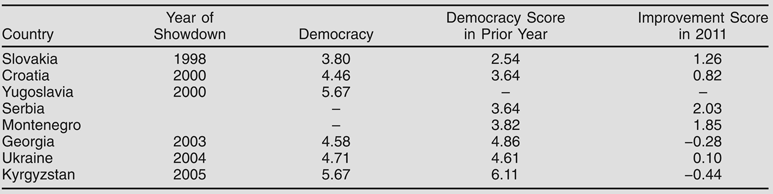
Levitsky and Way's view and our reservations notwithstanding, the preponderant view that emerges from the literature on the color revolutions is that elections as exercises of popular mobilization have been the central instrument of democratization. Like Lindberg, this view holds that elections are “political episodes that hold the promise of improving subsequent prospects for democratic change” even if the mechanisms specified—the electoral model versus the repetition of elections—are different.Footnote 26 With hindsight, however, the color revolutions, particularly the later ones, do not hold up as episodes of democratization. Table 1 presents democracy scores from Freedom House's Nations in Transit series for the successful electoral challenges to postcommunist dictatorship outlined in Bunce and Wolchik.Footnote 27
The effect of electoral confrontations with authoritarian incumbents shows a mixed record of improvement in the level of democracy. Curiously, while the color revolutions dislodged incumbent authoritarian leaders, the only unambiguous case of democratic progress would seem to be Serbia/Montenegro. Other “non-revolutionary” cases of substantial improvement include Slovakia and Croatia. The overall impact on the level of democracy in the other three color revolutions—Georgia, Kyrgyzstan, and Ukraine—is negligible, even slightly negative in the first two cases. Overall, some cases seem to provide evidence of the potentially democratizing effect of elections, whereas others seem to have returned to their starting points following brief, more democratic interregna.
Given the somewhat contradictory and contingent findings of the large-n literature, differences between studies that concentrate on single regions, and the seemingly mixed record of the color revolutions, we make use of cross-national data and quantitative methods to statistically test the theory of democratization by elections over all cases in the region. While we start with a replication of Lindberg's study, our purpose in doing so is broader than mere replication. We do this to compare the postcommunist region to other regions and to the claims that larger statistical studies make about the impact of elections generally. By adding postcommunist Eurasia to Africa, Latin America, and the Middle East, we add to the debate over whether elections have similar effects across regions or whether they are playing different roles in different parts of the globe. Further, the tests provide additional leverage to assess the competing electoral model of democratization.
We do see important regional differences in postcommunist Eurasia. Like the earlier studies on Latin America and the Middle East, we see little evidence of the democratizing impact of repeated elections. This does not invalidate Lindberg's findings on Africa but provides more evidence that they are an instance of African exceptionalism. Our failure to find a democratizing impact should not be seen as evidence of the stabilizing impact of elections posited by theories of electoral authoritarianism.
The differences in regional findings help to explain why research at the global level has only found a weak or highly contingent relationship between holding elections and democratization. The regional studies have only found a strong unambiguous pattern in Africa. When Africa and other world regions are brought together in global tests, it should not be surprising that the African finding is not robustly reproduced. When regional studies uncover different relationships between elections and regime types, it should be hard to uncover a strong relationship between elections and regime in a global sample. Despite the proliferation in electoral regimes since the end of the Cold War, this surface similarity masks important differences in how these institutions have been integrated into politics in diverse regions of the globe.
How Postcommunist Elections Are Different
The quantitative side of our analysis looks at all thirty-three Eurasian postcommunist countries beginning in 1990. We include all elections in the period up to 2011, both executive and legislative. To see if elections lead to improvements in democracy, we use Freedom House's Civil Liberties Index (CL). The index takes into account freedom of expression, conscience, association, and assembly, as well as rule of law and individual autonomy.Footnote 28
We use the CL Index for three reasons. First, the literature that tries to assess the impact of elections on democracy uses it and we want our findings to be comparable. If we were to use a different operationalization, any difference between our findings and the extant ones could be attributed to measurement. Second, if we used a more holistic measure like the combined Freedom House score, Polity, or other less frequently used graded measures, we would create endogeneity problems. Such measures often include voting rights. The utility of the CL Index is that it captures an important part of the nature of democracy but does not include the political rights central to elections (which are coded separately in Freedom House's Political Rights Index).
Third, the CL scores are particularly useful in this context because they represent a core component of democracy that is substantially weaker in all types of authoritarian regimes. By looking at civil liberties scores, one can gauge whether a country is moving towards democracy. Higher CL scores are indicative of regimes that have crossed the line from competitive authoritarianism to a minimalist specification of democracy by attaining the kinds of protections required by Dahl in his discussion of “polyarchy.”Footnote 29
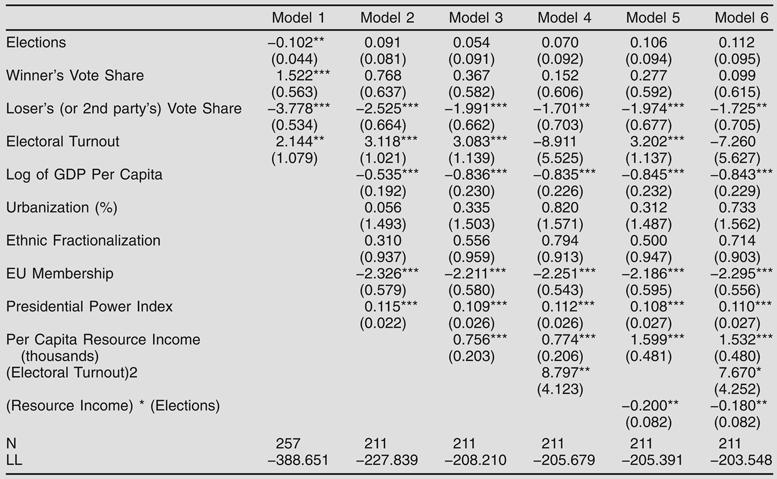
We begin by looking at whether uninterrupted sequences of elections improved the protection of civil liberties as they do in Africa.Footnote 30 At first glance the raw data seem promising. Across elections, civil liberties in postcommunist Eurasia improve (the CL Index falls across elections), similar to what Lindberg observes in Africa.Footnote 31 However, when we look at the effect of elections in a regression analysis that controls for the other important causal factors, as well as a normal set of control variables, the resemblance between the two regions ends. Looking at the first line in Table 2, which reports our regression results, the coefficient for elections only attains statistical significance in the first model (a basic model without any controls).Footnote 32 In all subsequent models, it fails to do so and the positive coefficient suggests that it increases the CL index score (i.e., reduces the protection of civil liberties). These results mean that repeated elections in postcommunist Eurasia do not have a democratizing effect.
Ordered Probit Regressions on the Effect of Uninterupted Elections on Civil Liberties Scores

Clustered robust standard errors reported in parentheses
* p < 0.1,
** p < 0.05,
*** p < 0.01, two tailed tests
Next we look at whether more competitive elections enhanced the protection of civil liberties. In Africa Lindberg found that elections got more competitive over time and that this increase in competitiveness contributed to greater protection of civil liberties. Given the focus of the postcommunist literature on the use of electoral means to remove or provoke showdowns with dictators in competitive authoritarian regimes, we expected to find that the competitiveness of elections would be an important factor in determining the level of democracy. And while we do find this, we note some differences with the findings on Africa.
We measure competitiveness looking at both the winner's and loser's share of the vote.Footnote 33 Lower winner's share and higher loser's share are indicative of more competitive electoral systems. The raw data on competitiveness in postcommunist Europe holds no major surprises. We found that fair elections are more competitive (both lower winner's share and higher loser's share) than flawed elections. In both fair and flawed elections winner's share fell and loser's share rose over subsequent elections.Footnote 34 In our statistical tests of competitiveness (i.e., impact of winner's and loser's share on the protection of civil liberties), our results partially confirm our expectation (lines two and three of Table 2). In the first model both winner's and loser's shares are significant. But as we add controls, the significance on the coefficient for winner's vote share disappears. However, the impact of loser's share is consistent across all model specifications.
This means that the strength of the political opposition is important to the protection of civil liberties. More specifically, the coefficients for loser's strength indicates that the probability of having the kind of protection of civil liberties necessary for electoral democracy (three or lower on the CL) is one-third higher when the opposition captures one-third of the vote share compared to a country in which it receives only a negligible vote total.
Given the cultural, developmental, and historical differences between postcommunist Eurasia and sub-Saharan Africa, it is important for our statistical tests to control for essential differences between the two. Because of the centrality of the “resource curse” in explaining poor democratic performance of the countries in the postcommunist world, we look at whether energy income affects the protection of civil liberties.Footnote 35 Lindberg did not detect that energy income had a significant impact in Africa despite the presence of several energy-rich countries (Nigeria, Angola, Equatorial Guinea, Sudan).Footnote 36 We take the exploration of this question a bit further, examining whether the impact of energy income is affected by elections.
There has been a long, rich debate on whether energy production hurts or helps prospects for democracy. Early on, Terry Karl argued that it could strengthen democracy, whereas Michael Ross and Michael Herb argued it had a negative effect.Footnote 37 More recent studies have made contingent arguments in which the impact depends on the broader context into which resource income flows.Footnote 38 In the postcommunist world, the replacement of bureaucratic allocation by markets open to the world economy provoked sharp contractions in manufacturing. In energy-producing and -exporting countries this enhances the importance of the energy sector in the economy. Thus based on Thad Dunning's expectation that energy-sector domination of the economy hurts prospects for democracy, we do not expect elections to have a democratizing effect in countries with energy intensive economies.Footnote 39
The logic behind this is provided by the theory of rentierism. If authoritarian incumbents possess ample resources from energy production, it will be easy to build support on the basis of material incentives. In line with this set of expectations, we do find that countries with a high degree of resource dependence had weaker protection of civil liberties. We also address an additional question that has yet to be examined: whether the repeated holding of elections could affect the way in which resource income influences regime outcomes. When we looked at the effect of the interaction between resource dependence and the number of elections, we discovered that elections promoted milder forms of authoritarianism in resource-rich contexts.
Looking at the statistical results in Table 2, resource income per capita (third variable from the bottom) is strongly significant and signed positively (models 3 and 4). This means that greater levels of energy income are associated with an increase in the civil liberties index, meaning weaker protection of civil liberties. Substantively, the effect is strong—compared to a country with negligible resource income, a country with resource income of $1,000 per capita has a .11 greater probability of having poor protection of civil liberties (a CL score of five or higher) holding the other variables at their means.
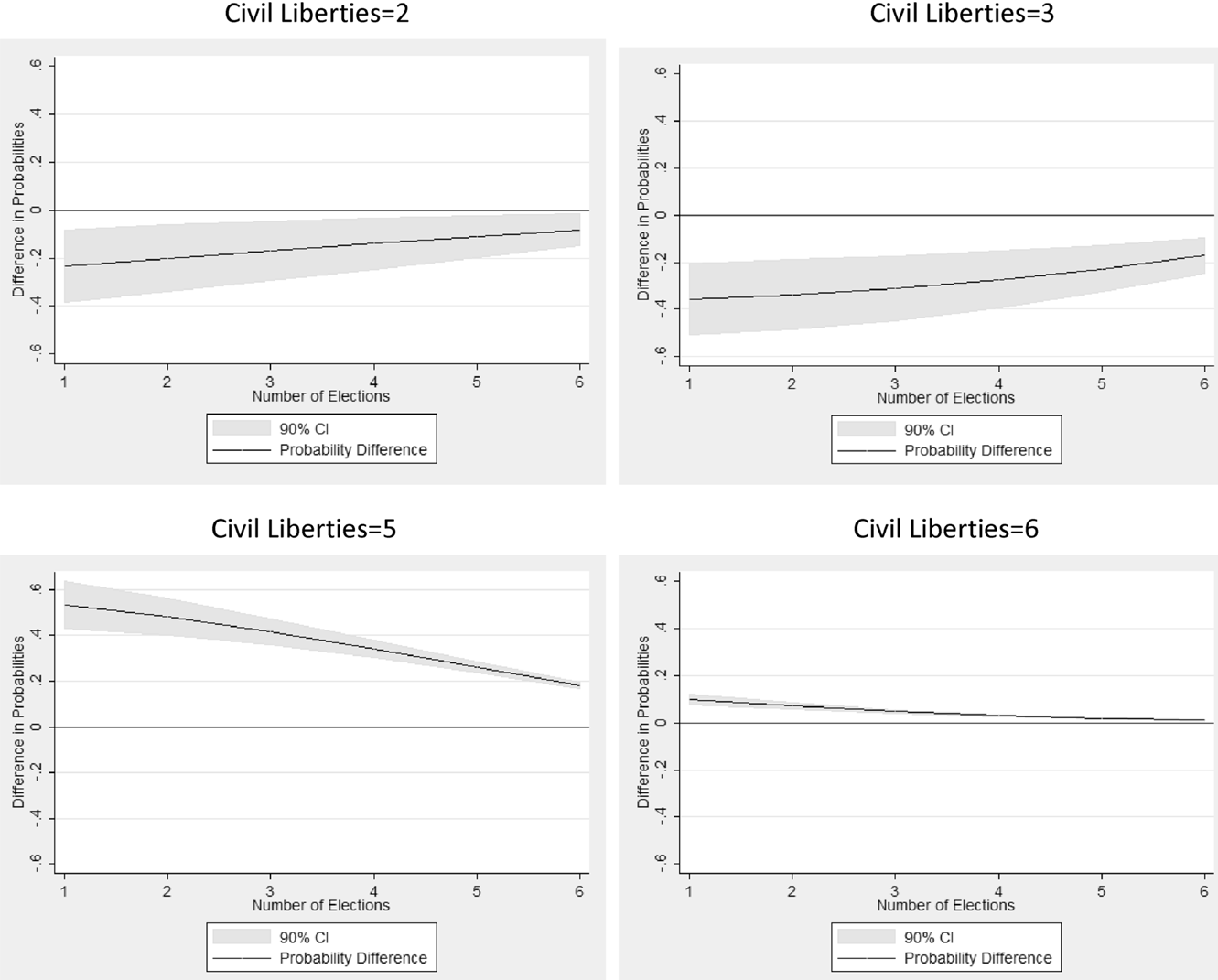
When we introduce an interaction term to capture the impact of repeated elections on the impact of resource income (bottom line, models 5 and 6), this too is significant. Because of the complexity of summarizing such interaction effects from regression coefficients, we illustrate the impact of elections in resource-rich environments in Figure 1.Footnote 40 We compare probabilities of different CL scores in resource-rich and -poor countries based on the number of elections. The figure displays differences in the probabilities of attaining different CL scores for resource-rich and no-resource-income countries, along with 90 percent confidence intervals. We omit the panels for those scores where the interaction effect is insignificant.Footnote 41
Probability Differences for Civil Liberties Scores for Energy Rich and Energy Poor Countries
The top two panels show that resource-rich countries have a lower probability of strongly protecting civil liberties. Compared to resource-rich countries, resource-poor countries have substantially higher probabilities of having stronger protection of civil liberties (CL scores of 2 or 3) at the first election. The trend across elections in each panel shows that the gap between the two is decreasing. By the sixth election this gap has narrowed substantially. We see the mirror image of this in the bottom two panels. Here the probability of having weaker protection of civil liberties (CL scores of 5 or 6) is much higher for resource-rich countries. Again, the performance gap narrows with repeated elections.
In further analysis of the absolute probabilities for CL scores for resource rich countries, we find that holding elections largely works to increase the probability of a CL score of 4 for resource-rich regimes at the expense of more repressive scores of 5 or 6. The impact of the narrowing of this gap displayed in the table is thus to promote CL scores associated with milder forms of authoritarianism, rather than democracy. Thus elections in high resource-income countries on balance mitigate the harshness of rule, but largely within the range of scores that we normally associate with authoritarianism.
This finding is consistent with our thesis that when a country possesses substantial resource income, the authoritarian leadership has the option of pursuing a form of rentierism, where they can buy political support and forgo full-blown repression of the population. This is an unexpected finding, in that elections move the CL scores in the direction anticipated by Lindberg, but most notably within the confines of the range of authoritarian political outcomes. Thus the impact is to stabilize authoritarianism, in line with the expectations of theories of electoral authoritarianism in this narrow set of cases.
Another important area where we expect important differences between postcommunist Eurasia and other regions is the issue of the role of electoral mobilization in democratic regime change. Given the role that electoral confrontation has played in the weakening of authoritarian regimes in the region, as well as other parts of the world, the common sense intuition would be that increased electoral participation would lead to improvements in democracy. However, there is a unique legacy of communism in which higher participation may well not lead to improvements in democracy in a simple linear fashion. The conventional association of participation and level of democracy is based on the experience of the longstanding democracies of North America and Western Europe, where barriers to participation were a roadblock to full democratization.Footnote 42 This is also the case in Africa, where postcolonial experiments with democracy gave way to an authoritarianism that triggered a wave of “departicipation” following popular mobilization in the struggle for independence.Footnote 43 Communist regimes, on the other hand, mobilized their populations in shows of support at election time. Such plebiscitary exercises in obedience led to near 100 percent turnout. In the postcommunist era, it is important not to interpret turnout as a sign of democratic exuberance. It could just as easily represent the retention of authoritarian mobilization capacities by less-than-fully-democratic successor regimes.
Still, it is not our contention that participation should always inhibit the protection of civil liberties. Rather we expected that higher turnout would lead to improvements in democracy, up to a point in line with the logic of those who see higher levels of voluntary involvement by citizens as good for democracy. However, exceedingly high turnout (which is common enough in the region) is more likely to be the product of mobilization by the state apparatus or even outright fraud.Footnote 44 This is precisely what we find, that increases in electoral turnout have a positive effect on the protection of civil liberties, but only until a threshold, when it begins to have a negative effect.
An examination of the raw data that we use in our regressions is highly consistent with this picture of postcommunist difference.Footnote 45 Turnout in flawed elections is higher compared to the fair elections in our sample, and in both it tends to go down over the election cycle.Footnote 46 This is starkly at odds with theories on turnout and Lindberg's study in Africa, where he observes increasing turnout across all elections, and finds in his statistical analysis a positive correlation between turnout and civil liberties.
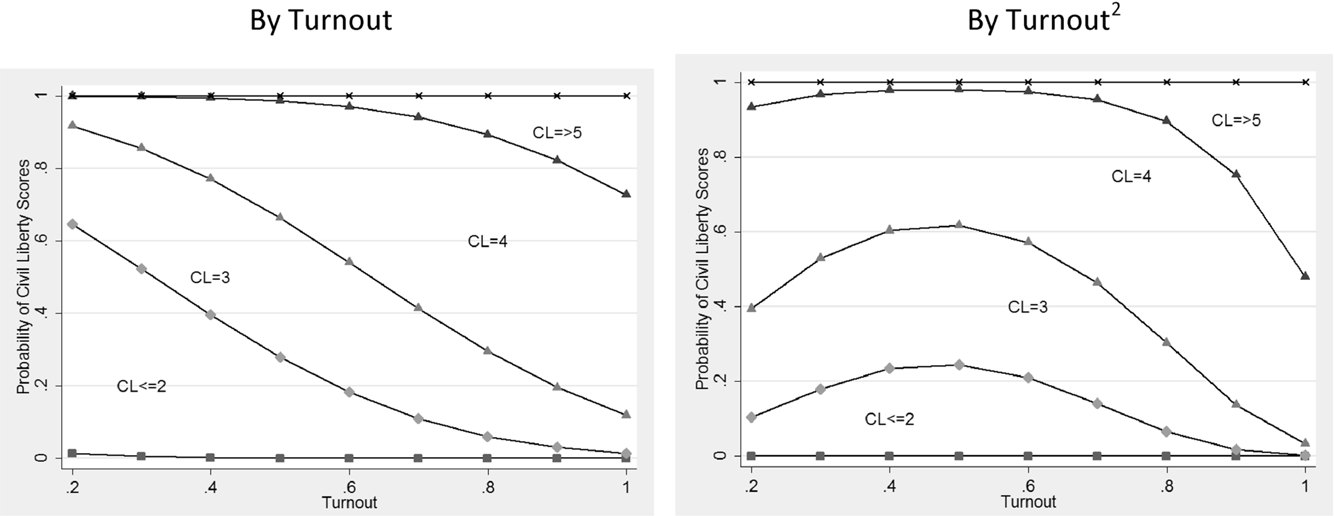
In order to model the threshold effect we hypothesize for turnout we include a quadratic term (turnout-squared) in some of our models. Looking at the results of electoral turnout alone in Table 2 (the fourth line in models 1, 2, 3, and 5), we see that the coefficient is significant and signed positively. This seemingly means that increased turnout leads to weaker protection of civil liberties. However, in models 4 and 6 we add the square term (second to last line in the table). In these models, turnout on its own loses significance and turnout squared is highly significant.Footnote 47 In Figure 2 we show what this means for the relationship between electoral turnout and civil liberties.
Cumulative Probability of Civil Liberty Scores by Turnout and Turnout-squared
Figure 2 explicitly contrasts the findings for the models that include only turnout and those that include the quadratic term. It shows how the cumulative probabilities of different levels of civil liberties change with levels of turnout. Here, to understand the specific probability for each CL score, it is necessary to look at the distance between the curves at specific values of turnout. The turnout-only model in the first panel would lead us to believe that increased turnout decreases the probability of observing a CL score of 2 or better. Conversely, the probability of observing a CL score of 4 or worse steadily rises as turnout increases from 20 to 100 percent.
When we plot the effect of the quadratic term on CL scores in the second panel, we see in contrast that turnout has a positive effect on CL scores, up until around the fifty percent level. At this point the probability of having a CL score of three or lower hits its maximum and then begins to decline. CL scores above 3 have a probability of about .61 at low levels of turnout, fall to .38 in the middle range and then begin to grow, especially after 60 percent.
This finding supports our theory on how participation should work differently in postcommunist contexts. It shows that elections can function as tools of authoritarian control when dictators can mobilize populations to participate in plebiscitary approval-type voting. This is very consistent in what we see in the cases in our dataset. Elections, in countries like Azerbaijan, Czechoslovakia, Mongolia, Tajikistan, Turkmenistan, and Uzbekistan have reported 95 percent turnout or higher in at least one election. This level of turnout, except for the founding elections in Czecho-Slovakia and Mongolia, include some of the most authoritarian cases in the dataset.
Our results concerning electoral competitiveness and participation raise a flag with regard to the electoral model used to explain the color revolutions and other cases of electoral democratization. While the positive impact of competitiveness corresponds to what the electoral model of change tells us about the importance of the strength of opposition, the curvilinear finding on turnout does not quite conform to expectations on popular mobilization.
If we bring this concern down to the level of individual cases of electoral change, the data are inconclusive with regard to the claim that a surge of opposition mobilization is crucial to liberalization in the postcommunist context.Footnote 48 In the six cases covered in table one, the four color revolutions (as well as Slovakia and Croatia), turnout only went up in two elections—in Slovakia (from 75 to 84 percent from 1994 to 1998) and in Croatia (from 69 to 77 percent from 1995 to 2000). Yet in the other four cases turnout stayed the same or even dropped a little in comparison to the previous election. In the Georgian parliamentary election of 2003, turnout fell to 60 from 68 percent in 1999. The corresponding figure in Kyrgyzstan is a drop from 64 to 57 percent from 2000 to 2005. Both Ukraine (from 75 to 77 percent turnout in the presidential election of 2004) and Yugoslavia (from 63 to 64 percent in the parliamentary contest of 2000) stayed essentially the same.
However, the idea that change is predicated on civil society mobilization around elections in the postcommunist case is not necessarily refuted by this finding. Opposition mobilization would not necessarily lead to an absolute increase in electoral participation given the understanding of turnout that informed our hypotheses. If the issue of democratizing change in postcommunist societies is decided by the strength of the authoritarian state's mobilization capacities vis-à-vis an insurgent opposition and civil society, then it makes sense to think in terms of the relative mobilization/demobilization of supporters of different camps. The mobilization of civil society may well impede the ability of the authoritarian leadership to mobilize the apathetic to the polls to signal their acquiescence to dictatorship, while at the same time emboldening potential opponents of the regime to turn out and vote. This could well change the balance between regime supporters and opponents in elections. This is consistent with our statistical findings on both loser's share and turnout.
We next turn to a paired comparison of Slovakia and Belarus in order to illustrate how relative mobilization capacities of the authoritarian state and its political opposition are both essential, and to demonstrate that the causal logic of the electoral model of change applied to the color revolutions should adopt this more nuanced view of mobilization. We choose these two cases because the first was a success that served as an exemplar for the electoral model of democratization and the second has been a repeated failure in its attempts to soften entrenched dictatorship.Footnote 49 The Slovak opposition confronted an elected leader, Vladimir Mečiar, who failed to institutionalize a competitive authoritarian regime, whereas the authoritarian Lukashenka regime in Belarus has been successful in defending its rule despite repeated electoral challenges.
Relative Mobilization Capacity and Electoral Change in Slovakia and Belarus
Inherent in any authoritarian electoral situation is the prospect of defeat for the incumbent. In the electoral model of change, the success of democratic challengers is predicated on a broad mobilization of the political opposition and previously depoliticized civil society groups. In cases where the opposition can effectively turn out voters, win elections, and make them stick via social mobilization if necessary, democratization by elections is possible.
Despite the lack of long-term democratic improvements brought about by many of the color revolutions and our statistical finding that higher turnout is not, on balance, associated with more democratic regimes in the region, we believe that the electoral model of change still works if attention is paid to relative mobilization levels, rather than absolute. The concept of relative mobilization capacity takes into account the mobilization capabilities of both the authoritarian incumbents and the political opposition. This approach does not seek the full explanation for outcomes on the basis of authoritarian state capacity in the manner of Levitsky and Way, or on the basis of effectively organized action by the opposition, like Bunce and Wolchik. Instead, relative mobilization looks at the interaction between the two. It neither rejects the importance of authoritarian state capacity nor the actions of the opposition in explaining regime stability, but does not accept that either on its own fully explains outcomes. The success of a potential democratic opening through elections depends on whether the opposition wins the battle of relative mobilization in run-up to the vote, and if necessary in its aftermath.
In the postcommunist world, authoritarian incumbents have a number of means at their disposal to block democratic mobilization. Resort to violence and repression are tools of last resort, but are not preferred given that a wide application is likely to undermine the notion that the regime is truly competitive.Footnote 50 Communist regimes were quintessential mobilization regimes where the official public space was monopolized by mass transmission-belt organizations under monoparty control. While mobilization was not as intense as it had been under Stalinism, it was exercised regularly in the post-totalitarian phase of communism, especially during public holidays and elections. In those cases where ex-communist politicians were able to maintain themselves in power by donning the mantle of reform or nationalism, both the apparatuses of the state and regime-sponsored mass organizations remained at their disposal. However, with the waning of ideological fervor, bureaucratic compliance became to a greater extent dependent on satisfying the material interests of the bureaucracy (though that process was clearly underway in the late communist period).Footnote 51 Thus postcommunist apparatuses of power had to be cultivated and maintained through more extensive networks of patronage. This was an absolute necessity to the reestablishment of authoritarian rule. Neo-authoritarianism was predicated on cooptation or repression of potential opponents, as well as maintenance of the loyalty of elites and sub-elites to prevent defection to the opposition and thus the weakening of the state.Footnote 52 Depending on the state in question the transformation from state socialism to neopatrimonial dictatorship was relatively smooth.Footnote 53 In cases where its consolidation was interrupted, such as the Orange Revolution in Ukraine, elite defection helped to make the electoral challenge to the authoritarian incumbent successful.
State apparatuses and residual mass organizations became a means by which authoritarian incumbents could both mobilize voters in plebiscitary elections, and continue to dominate the public space. Control of the state allowed leaders to politically direct privatization to build neopatrimonial networks even if this was less direct or reliable than the hierarchical control provided by communist-era party-states. One example of this was Aliaksandr Lukashenka's ability to build iron-fisted control after defeating Viachaslau Kebich, who tellingly neglected this source of organizational power.Footnote 54 In particular, the control of mass media and organizations with protest capacity, such as trade unions, has remained quite useful for authoritarian regimes. In the latter case, Robertson and Radnitz have shown in some contexts that organized protest can be as much about elite manipulation as about mass discontent and opposition mobilization.Footnote 55 An illustration of a successful attempt to control the public space can be seen in Vladimir Putin's exile or arrest of several oligarchs who have crossed him (Berezovsky, Khodorkovsky, Gusinsky). This has both silenced critical voices in the media and closed off sources of funding to the political opposition.
One other effective countermeasure that does not rely on the conversion of old regime resources is the creation of what Robertson calls “ersatz social movements” that attempt to crowd out real grass roots organizations. A textbook case of this is the pro-regime youth movement “Ours” in Russia, which Putin's supporters created to counter the threat of the sort of youth mobilization that lay at the center of several of the color revolutions. Where extensive resources remain under the control of the state, the opposition will find it harder to effectively raise the resources to challenge incumbents.
For this reason we pay attention to the relative mobilization capacity of the regime and opposition. In the following two case studies we look at the mobilization and countermobilization efforts of both challengers and incumbents in Slovakia (1998) and Belarus (2001, 2006, 2010), both before and during moments of electoral contestation. Even when overall turnout numbers may not change in such moments, what is crucial is the relative balance of the two competing forces. Specifically, both sides will try to turn out their own supporters and demobilize those of the other. In the case of turnover, we would expect to see the opposition perhaps successfully mobilize new voters into the electoral contest, but also to dissuade those who have turned out in the past for the regime to stay at home or change their vote. The latter seems more important given that elections in competitive authoritarian regimes are often high-turnout events. Where authoritarian incumbents maintain their ability to use state and mass organizational assets to deter and isolate the opposition and its potential electorate, they will continue to be able to rally the masses necessary for plebiscitary approval.
Slovakia
Slovakia achieved independence in 1993. It emerged from Czecho-Slovakia with a political structure that was electoral in form, but which Levitsky and Way classify as competitive authoritarian from 1993 to 1998, a period of rule by Prime Minister Vladimír Mečiar.Footnote 56 Mečiar was a founder of the political party Movement for a Democratic Slovakia (HZDS), which emerged in 1991 as a more openly nationalistic successor to Public Against Violence (VPN), the movement that led the Gentle (i.e. Velvet) Revolution in Slovakia.
HZDS emerged as the most powerful party in Slovakia, winning a plurality of votes and seats in the election of 1992 both in the Slovak National Council and among Slovak parties to both houses of the National Parliament. It was the Slovak party most strongly behind the push for separation, and when it found a willing Czech partner in Václav Klaus and the Civic Democratic Party (ODP), the two negotiated the separation.
Mečiar became the first Prime Minister of Slovakia and his fellow HZDS politician Michal Kováč became the first president. Defections from the parliamentary delegation of the HZDS and a growing rift with Kováč led to the fall of his government in early 1994 and its replacement by an opposition-led government under Jozef Moravčík. In elections that fall the HZDS again won a plurality (35 percent) of the vote, and formed an improbable coalition government under Mečiar which included the far right National Party and the leftwing Union of Slovak Workers.
There are several reasons why many observers saw Slovakia under Mečiar as less than fully democratic. There was substantial state control of the mass media and the HZDS used it aggressively as a political tool to serve its ends. Independent media, on the other hand, was harassed by the government, which cancelled broadcasting licenses and pursued trumped-up libel suits against critics.Footnote 57 While not the only case of corruption in Slovakia, the privatization program under Mečiar was highly politicized with many of the most lucrative firms channeled to party loyalists.Footnote 58
As the falling out between Mečiar and Kováč intensified over time, Mečiar began to break the law flagrantly. This included an incident where the security services kidnapped the president's son, who was wanted on charges in Austria linked to a corruption scandal, and deposited him across the border. In 1997 Mečiar defied a successful petition drive to include a ballot question regarding direct election of the president on a scheduled referendum. The Constitutional Court ordered him to comply but he refused anyway.Footnote 59 And when Kováč's presidential term expired in 1998 and the parliament deadlocked over who should succeed him, Mečiar himself assumed many of the responsibilities of the office on an “acting” basis. Generally speaking, when the conflict over the presidency sharpened in the last period of Mečiar's rule there seemed to be an increase in the use of violent sanctions as well as widespread illegal wiretapping against his opponents.Footnote 60
Faced with the growing threat from Mečiar and the disappointing results in the previous election (1994), the leaders of opposition parties agreed to cooperate more closely and forged an electoral alliance. The core of this was the center-right “blue coalition” composed of the Christian-Democrats (KDH), the Democratic Party (DS), and the Democratic Union (DU). This group had been cooperating since 1996 and was the force behind the ballot initiative on the direct election of the president. In 1997 both the Greens and Social-Democrats (SDSS) joined in and the group was renamed the Slovak Democratic Coalition (SDK). In 1998 the Hungarian Party (SMK), the Party of Civic Understanding, and the Party of the Democratic Left (SDL) pledged to cooperate with the SDK.Footnote 61
The parliamentary elections of 1998 became a showdown between Mečiar and the SDK. Though not considered one of the color revolutions, Bunce and Wolchik pinpoint it as one of the important precursor cases.Footnote 62 In its efforts, the party-based opposition was supported by a broad-based mobilization in civil society, notably youth movements, trade unions, and independent think tanks. Turnout in Slovakia had been relatively high in 1994 (75 percent), and the campaign had the effect of boosting it (84 percent).Footnote 63 The organization Civic Campaign 98 (OK98) was particularly important in these efforts because of its focus on youth and new voters. Whereas only twenty percent of first-time voters turned out in 1994, eighty percent turned out in 1998, and only eleven percent of these voted for Mečiar's HZDS.Footnote 64
Unlike some of the color revolutions, the Slovak case did include an increase in turnout in this watershed election. Nonetheless, we also see a demobilization effect on support for the incumbent. Turnout in favor of Mečiar and his allies dropped, and this (as much as the turnout of new voters) was responsible for the opposition's victory. It is important to remember that HZDS won both elections with a plurality. In 1994 it won 35 percent of the vote and carried 61 out of 150 seats in the parliament. Its two coalition partners, the Union of Slovak Workers and the Slovak National Party, won 13 and 9 seats respectively to constitute the governing majority. The opposition result was much more diffuse, with four parties taking places two to five, all taking around ten percent of the vote and only 67 of the 150 seats combined.Footnote 65
In 1998 the HZDS only took 43 seats (27 percent of the popular vote), where the Slovak Democratic Coalition took 42 (26 percent). The HZDS lost close to 100,000 or about ten percent of its voters between 1994 and 1998. Its coalition partners had mixed results, which resulted in fewer mandates in total. The Union of Slovak Workers fell from over 200,000 votes to less than 45,000. It secured no mandates because it failed to exceed the five percent representation clause. The SNS on the other hand saw its vote almost double and its representation increase from nine to fourteen mandates. Overall, Mečiar's coalition saw a drop in voter support from 47 to 37 percent. This meant a loss of over 100,000 votes for the three parties in an electorate that grew by over 150,000. The combined effect of the mobilization of new voters and the demobilization of Mečiar's support carried the opposition to victory. A new government was formed under Prime Minister Mikuláš Dzurinda, the leader of the SDK, including the SDL, SOP, and SMK. The four allies took almost sixty percent of the vote and 80 of the 150 seats in the parliament.Footnote 66
Slovakia thus represents a strong confirmation of our argument about relative mobilization capacities. Not only did the opposition and civil society turn out new voters, but also by proving to citizens that it was possible to contest Mečiar's power, they substantially depressed turnout for the incumbent. It is important to note that the increase in turnout was not sufficient in itself to guarantee a change of governments. Demobilization not only changed the balance of forces in the legislature but also denied Mečiar the possibility of finding coalition partners. The opposition won the battle of relative mobilization by both increasing its vote and in undermining support for Vladimir Mečiar and his allies, thus blocking the institutionalization of a competitive authoritarian regime, and restoring democracy.
Belarus
One of the fifteen successor states to the USSR, Belarus formally gained independence in 1991. It was led to independence by Stanislau Shushkevich, Chairman of the country's Supreme Soviet. Initially, independent Belarus had a relatively open political environment, though reforms were slow to come. The country's only election that was close to being free and fair was held in 1994. After an initial round in which Shushkevich was eliminated, a run-off election was held. The establishment candidate and favorite was Viachaslau Kebich, who was the last premier of the Belarusan Soviet Republic (1990–1991) as well as the first prime minister of the Republic of Belarus (1991–1994). He came in second in the first round, only polling 18 percent of the vote.
The winner of the first round with 46 percent of the vote was Aliaksandar Lukashenka, a former collective-farm chairman and a member of parliament who ran on a populist anti-corruption platform. Lukashenka had gained notoriety in the past on more than one occasion. He was the only parliamentarian who voted against independence in 1991 and was head of a parliamentary anticorruption committee that had accused Shushkevich and dozens of other high state officials of embezzling.Footnote 67 Despite using state media to promote his candidacy, Kebich lacked strong control over state resources and neither contender was able to rig the elections.Footnote 68 Lukashenka won the second round in a landslide, capturing 80 percent of the vote.
There were vague hopes that the elections of 1994 might lead to democracy. Freedom House called the country partly free until 1996.Footnote 69 Yet just two years after winning the election against Kebich, Lukashenka worked quickly to establish his dictatorship with the support of Russia.Footnote 70 He overcame his lack of strong ties with the state apparatus whose representatives he had just accused of corruption and dispatched electorally, and used his popular mandate to take charge of the state and eliminate competition.Footnote 71 Despite opposition from the heads of the election commission, Viktar Hanchar, and the parliament, Semyon Sharetskii, he curtailed the powers of the constitutional court and parliament and shut down several media outlets.Footnote 72
The coup de grace was delivered by the referendum of November 1996, which expanded presidential powers at the expense of parliament and other countervailing institutions. The overwhelming verdict on the fairness of the vote that yielded a margin of 88 percent to 12 percent in support of Lukashenka was that it was rigged.Footnote 73 After 1996, Lukashenka fully consolidated his rule and created tight control over the state apparatus and utilized its ability to mobilize the population in an electoral authoritarian fashion. Prominent opposition figures have been arrested or disappeared, opposition candidates in parliamentary elections have been disqualified, and NGOs were closed. Lukashenka ended term limits for the president and was elected a fourth time in 2010.Footnote 74
With the consolidation of his rule and control of the state, Lukashenka consistently has been able to mobilize the masses and win elections by overwhelming majorities. Like Putin, Lukashenka has learned the lessons of the color revolutions and has worked hard to maintain the support of the population, especially by attracting youth, a crucial source of oppositional support in many postcommunist electoral breakthroughs.Footnote 75 In terms of authoritarian mobilization, the Belarusan case is highly consistent with the findings in our models with regards to losers' share and turnout. Since Lukashenka came to power, turnout has increased over both the presidential and parliamentary electoral cycles and the quality of civil liberties has deteriorated. Since 2000, turnout levels have approached Soviet proportions (90 percent).Footnote 76 Whereas Lukashenka continues to win presidential elections with a more than comfortable percentage of the votes, the percentage of support for the main oppositional presidential candidate has declined from 16 to a record low of 3 percent in 2010. This decline, along with increasing turnout levels from the 1994 presidential election (70 percent) to 2010 (91 percent), not only shows the increasing mobilization capabilities of the Lukashenka regime, but also the failure of the opposition to effectively countermobilize.
In Belarus, there are three critical reasons for the consistent failure of the opposition. First, unlike in successful cases of mobilization and democratic breakthrough, the Belarusan opposition has usually failed to agree on a single candidate or to mobilize a substantial segment of civil society against Lukashenka's authoritarian administration. And in the 2006 presidential election in which the political opposition achieved its highest level of unity, it did not manage either to effectively coordinate with civil society groups or to find a way to get its message out due to regime control of the major news outlets.Footnote 77 The official results showed that Lukashenka won 84 percent of the vote, with the highest turnout (93 percent) in Belarusan history.
Following the election of 2006, there were protests in the capital including a tent city patterned on the Orange Revolution in Ukraine. The regime easily dispersed such mobilization efforts and has continued to harass the opposition and silence troublesome NGOs. The climate has become so harsh that many organizations have disbanded rather than trying to continue to operate.Footnote 78 The second reason for the failure of the opposition has been the effective use of coercion by the Lukashenka regime. Attempts to organize protest of the presidential election results in 2001, 2006, and 2010 were all met with harsh repression. The police have beaten and arrested Lukashenka's competing presidential candidates. Aliaksandar Kazulin was arrested and imprisoned for two years following the electoral campaign of 2006. This is mild in comparison to others who have crossed Lukashenka such as Viktar Hanchar and Jury Zacharanka, whose bodies have never been found.Footnote 79 Even after his overwhelming victory in 2010 the Lukashenka regime saw fit to arrest over 700 oppositionists including 7 of the 9 competing presidential candidates.Footnote 80
Finally, Lukashenka's success in part has been predicated on the fact that Belarusans show a sharp preference for strong leadership and economic success over a desire for a more democratic politics.Footnote 81 According to the Eurobarometer surveys, trust in the government and legislature has increased since Lukashenka assumed power in 1994.Footnote 82 This level of public support has made it possible for Lukashenka to legitimize his dictatorial rule, consistently mobilize the masses, and increase turnout over the electoral cycle, while isolating the opposition and disabling its capacity to countermobilize. In stark contrast to what we observed in Slovakia, Lukashenka has consistently won the battle of relative mobilization capacity, enhancing his own ability to control the electoral space while enfeebling that of the opposition.
Final Remarks: The Changing Role of Voting and New Challenges for Democracy
It is worth briefly summing up our findings before we turn to their larger significance. We find little evidence that holding of elections in themselves serves as a catalyst for democracy. This follows on other regional studies that suggest Lindberg's findings are African specific, and suggests why they are difficult to replicate in a broader global sample. We also find a unique pattern with regard to electoral turnout. It does not promote more democratic civil liberties in a simple linear fashion, but has a complex curvilinear relationship in which the middle range is most fruitful for democracy. This is an important legacy of the communist state. Both our large-n finding on loser's vote share and our paired-case comparison are consistent with the claim that mobilization against authoritarian incumbents can liberalize and even democratize electoral authoritarian regimes when the opposition is coordinated and unified. However, when paired with our finding on electoral turnout, this requires qualification. Our case studies show that the ability to demobilize supporters of the incumbent—to negate both the residual organizational advantages they may have inherited from the old regime as well as more contemporary neo-patrimonial sources of support—is equally important.
Finally we find, despite confirming that there is a resource curse in the region, holding of elections only seems to promote a more moderate form of authoritarianism in energy-rich states. This finding can be productively linked to the role of relative mobilization capacity in the stability of postcommunist authoritarian regimes. The additional resources that energy-rich regimes possess allow them to rely more on material, rather than coercive, incentives to win the electorate and keep the opposition at bay, and thus rule less harshly.
These findings and the more measured perspective that they present allow for a careful reconsideration of the prospects for postcommunist democracy. There is a long history of regime change and innovation in the large swath of Europe and Asia that now constitutes postcommunist Eurasia. The large number of states that were spawned by the breakup of the Russian, Austro-Hungarian, German, and Ottoman Empires at the end of the First World War also was a major laboratory for the creation and destruction of both liberal and non-liberal modern regimes. In the interwar period, an initial struggle between the principles of Wilsonian liberalism and Leninism was later complicated and overwhelmed by emergence of fascism. In the wake of Soviet imperial collapse the region has again figured prominently in a major reconsideration of elections and their changing role in the politics of emergent regimes and our understanding of them.
Not since that brief flourishing of Wilsonian democracy at the end of the First World War has democracy been as powerful a legitimizing principle for holders of political power globally. And despite a general adoption of democratic institutions by many new or transformed states in the region after World War I, the experiment was not successful. Reflecting on the interwar era, Gale Stokes has written:
But it is a fact that when the East European countries came to political consciousness they had very little choice as to the style of organization their new nations would adopt—it would be the modern state, with its legislature, courts, centralized bureaucracy and intrusive mentality. By the time Czechs were able to establish such an entity, their long socioeconomic development had prepared them for bringing the state's power under the control of a pluralist democracy … In the Balkans, however, introduction of a state on the European model occurred in a social situation that was almost completely unprepared for it. The state, being the most developed institution … became also the dominant element, but whereas it operated using the same forms as its models in the West, the actual content of political activity was more consistent with traditional status societies than with the more legalistic societies from which the state form was copied.Footnote 83
It is also clear twenty years after the demise of Soviet-type regimes in Eurasia that this experience also had differential effects. Some areas were better prepared to institutionalize democracy in the contemporary period as well. In many countries in the region, while the institutions of democracy were adopted, elites have found ways to use those forms in ways “more consistent” with their own interests. Authoritarian leaders continue to sponsor elections because of the legitimacy they confer both on a popular level and among the very elites they rely on to rule.
The adoption of the institutions of democracy and their transformation into tools of a new form of plebiscitary authoritarian rule is a novel, widespread development that marks the post-Cold War period as unique and challenges our longstanding understanding of the role of elections in politics. Given its history and flirtation with both liberal and illiberal forms of modern rule, it is not surprising that postcommunist Eurasia exhibits a new diversity of regime types. Our work highlights a trifold division across the region—a record number (in historical terms) of relatively stable liberal democracies, a substantial number of institutionalizing competitive authoritarian regimes, as well as a few highly patrimonial conventional dictatorships, often based on resource wealth. One hopeful sign is that the contemporary alternatives to democracy in the region are not nearly as pernicious as they were in the interwar era. Competitive and patrimonial authoritarianism are far less threatening to their own populations or those of their neighbors than fascism or Leninism.
The failure to find that the repeated holding of elections helps to build democracy as it does in Africa is a sign that competitive authoritarianism is a viable, probably long-term, regime form in the region. The heady days where Color Revolutions or their antecedents swept away a pack of dictators has clearly lost momentum. Democratic change of this type seems to have lasted only in Slovakia and the Balkans. Even in Ukraine, the Orange Revolution seems only to have slowed the consolidation of competitive authoritarianism, not to have made short work of it. In Georgia and Kyrgyzstan the rulers may have changed but democracy seems no closer.
For democrats there are also some troubling signs. Politicians in a number of democratic countries, who in their desire to reduce uncertainty about their tenure in office or preferred policy outcomes, have begun to use some of the tricks from the competitive authoritarian arsenal. Recent patterns of change in two postcommunist countries, which at least until recently had been considered stable democracies, seem to be a harbinger of the weakening of democracy in the region. Since an outsized legislative victory in Hungary in 2010, the ruling Fidesz–Hungarian Civic Union under Prime Minister Viktor Orban has adopted measures that grant the party substantial control of the agenda in the legal system, a greater say in the control of the media, weakened the Constitutional Court and packed it with additional appointees, and enacted a series of changes to the electoral system that will privilege the party in future electoral contests.Footnote 84
In Romania a coalition government of the Social Democratic Party and the National Liberal Party, under Prime Minister Victor Ponta, managed to neutralize most of the other countervailing powers in the system of government over the course of several weeks in the summer of 2012. They have removed the speakers of both houses of parliament and the government ombudsman, barred the high court from considering whether legislation is constitutional, and threatened its justices with impeachment.Footnote 85 The parliament then passed a law making it easier to remove the president from office, and then proceeded to impeach President Traian Băsescu. He has been able to retain office due to the failure of a plebiscite that overwhelmingly voted to remove him, but which failed to reach the constitutionally-mandated turnout threshold of 50 percent plus one vote. The Parliament also enacted an electoral law that favors the ruling coalition. These moves could be seen as a kind of stealth coup enacted under cover of law, which has raised concerns among Romania's EU partners. But it is not yet clear whether this will make a difference.
All this has occurred in countries that are members of the EU and NATO. Whereas Romania had a lengthier and more difficult democratization process, Hungary for a long time was considered a highly successful case of consolidated democracy in the postcommunist world. These cases show that the greatest threat to democracy may not be an overt series of spectacular regime changes as in earlier eras, but a stealthy hollowing out of its content while maintaining its form. The measures that reduce uncertainty hold attractions for self-interested politicians. Dirty tricks like gerrymandering, rewriting rules to provide advantages in media time or campaign funding, neutralizing countervailing powers, and intimidating or demoralizing the supporters of opponents constitute threats to democracy even if enacted under rule of law.
However, our research shows that such moments need not be fatal to democracy. Slovakia successfully prevented Mečiar from consolidating competitive authoritarianism. It is quite clear that the political opposition and civil society are the points where the defense needs to begin. Actors committed to the defense of democracy need to focus on limiting the creation of authoritarian spheres of political power through which aspiring authoritarian rulers can mobilize the population, demoralize the opposition, demobilize and depoliticize civil society, and successfully turn competitive elections into a plebiscitary exercise in the ratification of dictatorial power.
Supplementary Materials
Appendix Sections 1–7 http://dx.doi.org/10.1017/S1537592713002119