Introduction
Psychosis has traditionally been seen as a categorical entity with well-defined boundaries wherein ‘cases’ meet DSM-IV or ICD-10 criteria for the various types of psychotic disorders. However, several epidemiological studies have established that psychosis exists as a continuum in the general population (Johns & van Os, Reference Johns and van Os2001; Verdoux & van Os, Reference Verdoux and van Os2002; Loch et al. Reference Loch, Wang, Rössler, Tófoli, Silveira and Andrade2011), ranging from normal at one end of the spectrum to intermediate subclinical forms and full psychosis at the other extreme end (Broome et al. Reference Broome, Woolley, Tabraham, Johns, Bramon, Murray, Pariante, McGuire and Murray2005; Kelleher & Cannon, Reference Kelleher and Cannon2011). A systematic review and meta-analysis revealed that the population prevalence of subclinical psychotic experiences was around 5% and the incidence was about 3% (van Os et al. Reference van Os, Linscott, Myin-Germeys, Delespaul and Krabbendam2009). Risk factors associated with subclinical psychotic experiences included child and adult social adversity, psychoactive drug use, male sex and migrant status.
In a study by Hanssen et al. (Reference Hanssen, Bak, Bijl, Vollebergh and van Os2005) of individuals with new, incident subclinical psychotic experiences followed up for 1 year, 84% no longer presented with any psychotic experiences and 8% made the transition to a clinical disorder. The Dunedin Birth Cohort Study showed that approximately 25% of those who reported experiencing ‘strong’ psychotic symptoms at age 11 developed schizophreniform psychosis at the second follow-up at age 26 (Poulton et al. Reference Poulton, Caspi, Moffitt, Cannon, Murray and Harrington2000). Rössler et al. (Reference Rössler, Riecher-Rössler, Angst, Murray, Gamma, Eich, van Os and Gross2007) concluded that the two dimensions of ‘schizotypal signs’ and ‘schizophrenia nuclear symptoms’ (based on factor analyses of psychosis symptoms), although differing sharply in predictor profiles, were associated with similar negative social consequences. Individuals with a high symptoms load in both dimensions showed significant functional impairments, suggesting that subclinical psychosis that may or may not develop into psychotic disorder does have clinical implications. Psychosis proneness was also found to be associated with an increased risk of affective disorder at follow-up (Verdoux et al. Reference Verdoux, van Os, Maurice-Tison, Gay, Salamon and Bourgeois1999). Kelleher et al. (Reference Kelleher, Keeley, Corcoran, Lynch, Fitzpatrick, Devlin, Molloy, Roddy, Clarke, Harley, Arseneault, Wasserman, Carli, Sarchiapone, Hoven, Wasserman and Cannon2012) found that adolescents who reported psychotic symptoms were at a high risk of having multiple co-occurring disorders, thus suggesting that subclinical psychosis may be a non-specific marker of psychological disturbance.
However, few studies have examined the latent construct of psychotic symptoms or distinguished between the latent construct (i.e. psychosis) and its manifest indicators (e.g. hallucinations). Meehl (Reference Meehl1995) noted that categorical or taxonic latent variables can yield manifest indicator variables that are distributed continuously and, vice versa, latent dimensions can yield manifest variables that are categorical. Statistical methods such as cluster analysis or latent class analysis (LCA) presuppose and impose structure on data rather than offering direct comparisons of the fit of taxonic and dimensional structures to the data. A recent study by Ahmed et al. (Reference Ahmed, Buckley and Mabe2012) was the first to suggest that taxometric methods should be used to determine whether the latent structure of psychotic symptoms in the population is taxonic or dimensional.
An alternative approach that could be used to support taxometric findings includes a new method called factor mixture modeling (FMM), which combines features of dimensional analysis [item response theory (IRT) or factor analysis (FA)] and categorical analysis (LCA) into a hybrid model (Lubke & Neale, Reference Lubke and Neale2006; Markon & Krueger, Reference Markon and Krueger2006; Muthén, Reference Muthén2006). FMM is based on the idea that complex phenotypes require complex measurement models. One of the novel aspects of FMM in relation to taxometric methods is that FMM goes beyond class detection and allows the specification of hypothesis-based multi-dimensional factor models within each class (Georgiades et al. Reference Georgiades, Szatmari, Boyle, Hanna, Duku, Zwaigenbaum, Bryson, Fombonne, Volden, Mirenda, Smith, Roberts, Vaillancourt, Waddell, Bennett and Thompson2013). Thus, for the study of complex phenotypes, FMM may be superior to taxometric methods in terms of class detection and class assignment (Lubke & Tueller, Reference Lubke and Tueller2010). In the present study we used the FMM approach to examine the latent structure of psychosis symptoms.
The aims of this current study were (i) to investigate the latent structure of psychotic symptoms based on data from the Singapore Mental Health Study (SMHS) using FMM analyses and (ii) to use the best-fitting model obtained and examine its sociodemographic and clinical correlates as well as its association with quality of life and help-seeking.
Method
Sample
The SMHS is based on an adult representative sample of the Singapore population. The respondents were selected randomly from a national registry that maintains the names, sociodemographic details such as age, gender and ethnicity, and household addresses of all residents in Singapore. The respondents were then approached at the household address provided by the registry. Disproportionate stratified sampling was used where the three main ethnic groups (Chinese, Malays and Indians) were sampled in equivalent proportions of about 30% each rather than in proportion to the ethnic distribution in the general population. As Malays and Indians were oversampled, the data were adjusted accordingly. The weighted data were then adjusted to represent the Singapore population based on the 2007 population figures. The study was approved by the relevant Institutional Ethics Committee (National Healthcare Group, Domain-Specific Review Board) and written informed consent was obtained from all participants. Face-to-face interviews were conducted by professional survey interviewers from December 2009 to December 2010. Completed interviews were obtained from 6616 respondents, giving a survey response rate of 75.9%. The study methodology is described in detail in our earlier article (Subramaniam et al. Reference Subramaniam, Vaingankar, Heng, Kwok, Lim, Yap and Chong2012).
Measures
The diagnoses of mental disorders were established using the World Mental Health (WMH) Composite International Diagnostic Interview version 3.0 (CIDI 3.0; Kessler & Uston, Reference Kessler and Ustun2004). Diagnostic modules for lifetime and 12-month prevalence of affective disorders [including major depressive disorder (MDD), dysthymia and bipolar disorder], anxiety disorders [including generalized anxiety disorder (GAD) and obsessive–compulsive disorder (OCD)] and alcohol use disorders (i.e. alcohol abuse and alcohol dependence) were included in the survey. Diagnostic hierarchy rules and organic exclusion criteria were applied to all diagnoses.
Psychotic symptoms were assessed by using the Psychosis Screen section of the CIDI 3.0. The introduction to this section is carefully worded and aimed at normalizing the experience to improve the accuracy of response to potentially embarrassing survey questions (Kessler et al. Reference Kessler, Wittchen, Abelson, Zhao, Stone, Turrkan, Bachrach, Jobe, Kurtzman and Cain2000). It states: ‘The next questions are about unusual things, like seeing visions or hearing voices. We believe that these things may be quite common, but we don't know for sure because previous research has not done a good job asking about them. So please take your time and think carefully before answering’. This introduction was followed by six fully structured questions with yes/no response options that asked about the DSM-IV delusions and hallucinations found in the National Comorbidity Survey (Kendler et al. Reference Kendler, Gallagher, Abelson and Kessler1996) to be the strongest predictors of clinician-diagnosed non-affective psychosis (Kessler et al. Reference Kessler, Birnbaum, Demler, Falloon, Gagnon, Guyer, Howes, Kendler, Shi, Walters and Wu2005). Respondents who endorsed any of the psychotic symptom questions were asked: ‘Could you give me a brief example of a time when this happened?’ and ‘What do you think caused this to happen?’ Interviewers probed for complete responses and recorded responses verbatim. Psychotic experiences that occurred only when respondents were dreaming, half-awake or under the influence of alcohol or other drugs were categorized as subthreshold symptoms. Follow-up questions then asked about age of first onset of these symptoms (‘How old were you the very first time any of these things happened to you?’), 12-month prevalence, lifetime and 12-month help-seeking specifically for dealing with psychotic experiences and, among those who sought help, diagnoses and names of the medications prescribed. We also used the ‘Services’ module of the CIDI 3.0 to collect data on help sought by participants from any professional for problems with emotions, nerves or use of alcohol or drugs and also details on the type of professional seen by them.
We used the EQ-5D, a standardized measure of health status developed by the EuroQol Group, to measure health-related quality of life (HRQoL). The EQ-5D provides a simple, generic measure of health for clinical and economic appraisal (EuroQol Group, 1990). It comprises a descriptive system and a visual analog scale (VAS). We did not use the EQ-VAS data for this study. Sociodemographic data were collected using a structured questionnaire. Body mass index (BMI) was defined as weight in kilograms divided by the square of height in meters (kg/m2); both weight and height were based on self-report by respondents.
Statistical analyses
Descriptive statistics were performed to establish the sociodemographic characteristics and prevalence of psychotic symptoms of the study population. The estimates were weighted to adjust for oversampling and post-stratified for age and ethnicity distributions between the survey sample and the Singapore resident population in 2007.
To determine whether the latent construct of psychotic symptoms is continuous or categorical in nature, we used FMM analyses. All indicators for the FMM analyses were based on a binary symptom (1/0). Only those who endorsed at least one of the symptoms, ever in their lifetime, when not dreaming, not half-asleep and not under the influence of alcohol or drugs were coded as ‘1’, or else coded as ‘0’. The FMM analyses were implemented in Mplus software version 6.1 using robust maximum likelihood estimation (Muthén & Muthén, Reference Muthén and Muthén2009). The FMM method involves fitting models with different numbers of classes and sometimes different within-class factor structures. In the current analyses, we allowed factor variances, factor loading and thresholds within each class to vary across the classes. We set the factor mean to zero. These model specifications were included so that the overall fit statistics did not reflect fit (or lack of fit) of these parameters but rather reflected differences in the number and type of latent variables included in the model (Muthén, Reference Muthén, Hancock and Samuelsen2008). To compare the fit of the different models, which have different assumptions about the structure of the phenotype of psychosis, we used an information-theoretic approach (Markon & Krueger, Reference Markon and Krueger2006) based on the Bayesian information criterion (BIC) (Schwartz, Reference Schwarz1978) and bootstrapped or adjusted versions of the likelihood ratio test (Lo et al. 2001). The BIC index is reported to perform better in simulation studies in terms of correctly identifying the true population model compared to using Akaike's information criterion (AIC) and sample size-adjusted BIC indices (Nylund et al. Reference Nylund, Asparouhov and Muthén2007). Therefore, we based our comparison mainly on the BIC indices (Lubke & Tueller, Reference Lubke and Tueller2010). To examine the sociodemographic and clinical correlates of the latent structure of psychosis symptoms, we related the best-fitting model to covariates and distal outcomes simultaneously in a structural equation modeling framework using multiple linear and logistic regressions. Standard errors (s.e.) and significance tests were estimated using the Taylor series linearization method to adjust for the weighting. Multivariate significance was evaluated using Wald χ 2 tests based on design-corrected coefficient variance–covariance matrices. Statistical significance was evaluated at the p < 0.05 level using two-sided tests.
Results
Sample characteristics
A total of 6616 respondents were included in the analysis. The sample comprised 51.5% females and 48.5% males with a mean age of 44 years (range 18–89 years). With regard to ethnicity, 76.9% respondents were of Chinese descent, 12.3% were Malays, 8.3% were of Indian descent, and 2.4% belonged to other ethnic groups. The majority of the sample were currently married (62.4%) and employed (71%).
Prevalence of psychotic symptoms
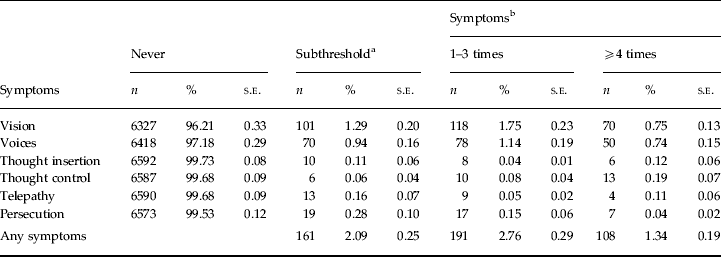
Table 1 shows the frequencies of psychotic symptoms in Singapore using the six items from the CIDI 3.0 screener. The total sample consisted of 6616 respondents. The overall weighted lifetime prevalence of any psychotic experience based on the CIDI 3.0 psychosis screening was 3.8% after excluding subthreshold experiences. The summary weighted prevalence of individual symptoms is presented in Table 1. The prevalence of any psychotic symptom was significantly higher among those with a low income (versus a high income) and those who were current and past smokers (versus never smoking). Those who were married had a lower prevalence of any psychotic symptom compared to those who were single.
Frequencies of psychotic symptoms in the Singapore Mental Health Study (n = 6616)

s.e., Standard error.
a Each experience had happened when respondents were dreaming, half-asleep and/or under the influence of alcohol or drugs.
b The number of times the experience had happened when respondents were not dreaming, not half-asleep or not under the influence of alcohol or drugs.
FMM
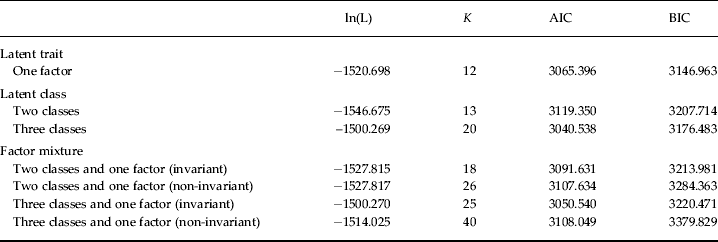
We examined the latent structure of psychosis using FMM, a latent statistical framework that included latent trait, latent class and mixture models. We tested seven hypothesized models: a one-factor latent trait model, a two-class and a three-latent class model, and four factor mixture models, two with two classes (invariant and non-invariant) and two with three classes (invariant and non-invariant). The summary results of the fit of the models based on the number of free parameters for each model, the log-likelihood values, and AIC and BIC values are presented in Table 2. The results indicate that the best-fitting latent structure for psychosis symptoms was with one-factor latent trait model. These findings support the dimensional nature of the latent structure for psychosis.
Summary of the fit of latent trait, latent class and factor mixture models for psychosis experience

ln(L), log-likelihood; K, number of parameters; AIC, Akaike's Information Criterion; BIC, Bayesian Information Criterion.
Relationship between psychosis symptoms and sociodemographic variables
The total sum scores of psychosis symptoms estimated from the best-fitting model was directly regressed to sociodemographic and clinical variables simultaneously within the structural equation modeling framework. We found that female gender, vocational education, and current and past history of smoking were positively associated with the ‘psychosis’ total score, whereas those who were married and had middle-level incomes were inversely associated with the ‘psychosis’ total score.
Relationship between psychosis symptoms total score and psychiatric disorders
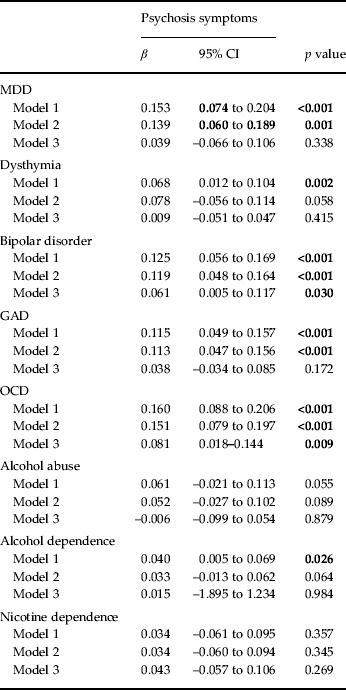
We examined the relationship between ‘psychosis’ total score with lifetime psychiatric disorders in our sample using multiple linear regression models. Table 3 summarizes the relationship between ‘psychosis’ (total score) and psychiatric disorders. We found that, after adjusting for sociodemographic variables and chronic physical conditions in multiple linear regression models, lifetime MDD, bipolar disorder, GAD and OCD were positively associated with the ‘psychosis’ total score (model 2). However, when we included co-morbid psychiatric illness in the regression model (model 3), only bipolar disorder and OCD remained significantly associated with the ‘psychosis’ total score.
Relationship between psychosis symptoms (total score) and lifetime psychiatric disorders

MDD, Major depressive disorder; GAD, generalized anxiety disorder; OCD, obsessive–compulsive disorder; CI, confidence interval.
Model 1: unstandardized β coefficient derived from multiple linear regression analyses and adjusted for sociodemographic variables.
Model 2: unstandardized β coefficient derived from multiple linear regression analyses and adjusted for sociodemographic variables and any chronic physical condition.
Model 3: unstandardized β coefficient derived from multiple linear regression analyses and adjusted for sociodemographic variables, any chronic physical condition and co-morbid mental disorders.
Bold font indicates significant p values.
Relationship between psychosis symptoms and HRQoL, health-care utilization and BMI
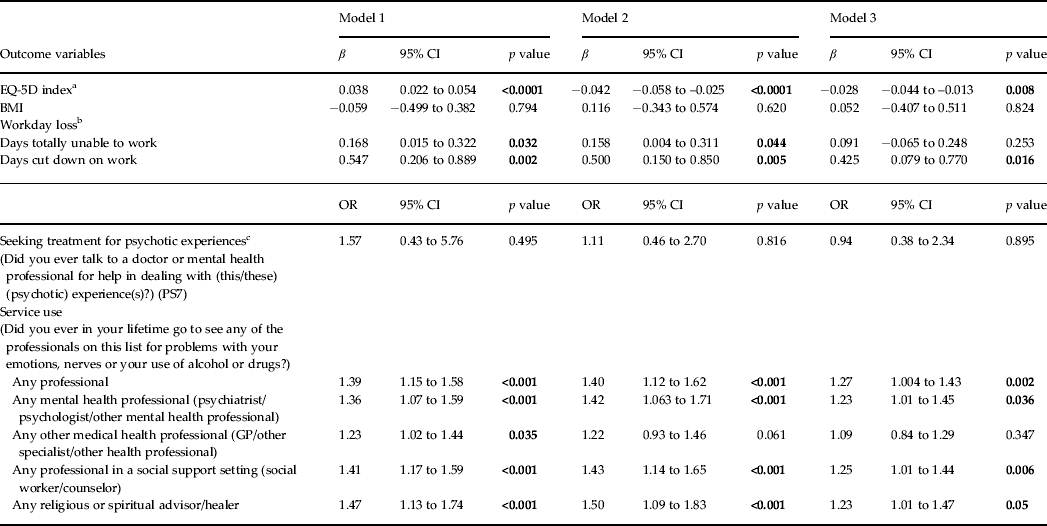
Table 4 summarizes the relationship between ‘psychosis’ (total score) and HRQoL and health-care utilization. After adjusting for sociodemographic variables in multiple linear regression models, the ‘psychosis’ total score was inversely associated with the EQ-5D index score and positively associated with workdays cut down. The weighted rate of seeking treatment among those with at least one psychosis symptom was 5.6%. Those with a higher psychosis total score were not more likely to seek help from a doctor or a mental health professional for dealing with their psychotic experiences [odds ratio (OR) 0.94]. However, those with a higher psychosis total score were significantly more likely to seek help from ‘any of the professionals for problems with their emotions, nerves, or their use of alcohol or drugs’ even after adjusting for sociodemographic correlates, any mental disorder and also any chronic physical condition. Analyzing the type of professional seen, those with a higher psychosis total score were significantly more likely to seek help from any mental health professionals (includes a psychiatrist, psychologist and other mental health professional) (OR 1.23); any professional in a social support setting (social worker/counselor) (OR 1.25); and any religious or spiritual advisor/healer (OR 1.23). No significant relationship was observed between psychosis total score and BMI.
Relationship between psychosis symptoms (total score) and the EQ-5D index, BMI, workday loss and service utilization

BMI, Body mass index; CI, confidence interval; OR, odds ratio; GP, general practitioner.
a Total of 5594 cases available for EQ-5D analysis.
b Workday loss measured using the 30-day Functioning and Module of CIDI 3.0.
c Total of 312 cases available (only respondents who had reported at least one symptom of the six psychosis symptoms were asked the PS7 question).
The weighted rate of seeking treatment was 5.6%.
Model 1: unstandardized β coefficients and ORs were derived using simple linear and logistic regression analyses.
Model 2: unstandardized β coefficients and ORs were derived using multiple linear and logistic regression analyses adjusted for sociodemographic variables.
Model 3: unstandardized β coefficients and ORs were derived using multiple linear and logistic regression analyses adjusted for sociodemographic variables, any mental disorder and any chronic physical condition.
Discussion
The overall weighted lifetime prevalence of any psychotic experience based on the CIDI 3.0 psychosis screen was 3.8% in the SMHS after excluding subthreshold experiences. Our rates are slightly lower than the rate of 5% reported by van Os et al. (Reference van Os, Linscott, Myin-Germeys, Delespaul and Krabbendam2009) in their meta-analysis. Nuevo et al. (Reference Nuevo, Chatterji, Verdes, Naidoo, Arango and Ayuso-Mateos2012) recently reported data from nationally representative samples of 52 countries worldwide, and established the overall prevalence of any one psychotic symptom as 5.89%. Our prevalence was very similar to that reported by Alptekin et al. (Reference Alptekin, Ulas, Akdede, Tümüklü and Akvardar2009) from Turkey of 3.6% and that reported from China of 3.3% (Nuevo et al. Reference Nuevo, Chatterji, Verdes, Naidoo, Arango and Ayuso-Mateos2012).
Our FMM analysis clearly supports the dimensional model of the latent construct of psychotic symptoms. This is in accordance with the findings of Ahmed et al. (Reference Ahmed, Buckley and Mabe2012) who used a different methodology (taxometric method) in their study examining data from the 1990–1992 National Comorbidity Survey and the 2001–2003 Collaborative Psychiatric Epidemiological Surveys. Our analysis also supports the assertion by various studies that psychotic experiences are distributed continuously in the population (Johns & van Os, Reference Johns and van Os2001; Verdoux & van Os, Reference Verdoux and van Os2002; van Os et al. Reference van Os, Linscott, Myin-Germeys, Delespaul and Krabbendam2009). On summing all of the six items to derive the total score for ‘psychosis symptoms’ in accordance with the one-factor latent trait model, and correlating it with sociodemographic factors, we found that female gender, vocational education, and current and past smokers were positively associated with the ‘psychosis’ total score, whereas the married, widowed and middle-income group were inversely associated with the ‘psychosis’ total score. Some of these factors have been shown to be associated with an increased risk of schizophrenia in previous studies (Kendler et al. Reference Kendler, Gallagher, Abelson and Kessler1996; Xiang et al. Reference Xiang, Ma, Cai, Li, Xiang, Guo, Hou, Li, Li, Tao, Dang, Wu, Deng, Lai and Ungvari2008). Our finding that female gender was associated with psychosis symptoms is similar to that reported by Alptekin et al. (Reference Alptekin, Ulas, Akdede, Tümüklü and Akvardar2009), but we are unable to postulate the reasons for this.
Although we found several psychiatric disorders to be co-morbid with psychosis symptoms, after adjusting for co-morbidity only OCD and bipolar disorder remained significantly associated with the psychosis symptoms total score. Shared neurobiological and environmental risk factors could contribute to the association between psychosis symptoms and OCD (Tibbo & Werneke, Reference Tibbo and Warneke1999). Studies have found a 11.0–15.2% prevalence of OCD in patients with first-episode psychosis (Strakowski et al. Reference Strakowski, Keck, McElroy, Lonczak and West1995; Poyurovsky et al. Reference Poyurovsky, Fuchs and Weizman1999). Some studies have also suggested that obsessive–compulsive symptoms manifest as part of the psychosis prodrome (Shioiri et al. Reference Shioiri, Shinada, Kuwabara and Someya2007; Poyurovsky et al. Reference Poyurovsky, Faragian, Shabeta and Kosov2008). The occurrence of psychotic symptoms in affective disorders have also been reported (Guardiano et al. Reference Guardiano, Dairymple and Zimmermann2009), although in our study we found an association only with bipolar disorder and not with MDD. The link between bipolar disorder and psychosis is possibly more robust, as suggested by the evidence that bipolar disorder and schizophrenia have an overlapping genetic origin (Lichtenstein et al. Reference Lichtenstein, Yip, Björk, Pawitan, Cannon, Sullivan and Hultman2009). Studies have also shown that young people experiencing mild psychotic symptoms ultimately go on to develop bipolar disorder, suggesting that psychosis symptoms can be prodromal of bipolar disorder (Thomson et al. Reference Thomson, Conus, Ward, Phillips, Koutsogiannis, Leicester and McGorry2003; Correll et al. Reference Correll, Lencz, Smith, Auther, Nakayama, Hovey, Olsen, Shah, Foley and Cornblatt2005). A possible explanation for the absence of any association with MDD is that the presence of psychotic symptoms is likely to be found in those with severe MDD and, given the relatively low rate of psychotic symptoms and MDD (Chong et al. Reference Chong, Vaingankar, Abdin and Subramaniam2012) in this population, the association may not have reached the level of significance.
We also found that the ‘psychosis’ total score was inversely associated with the EQ-5D index score, that is the higher the number of psychotic symptoms experienced by the respondents, the worse was the perceived quality of life. The rate of help-seeking, specifically for dealing with psychotic experiences, was low, although higher total psychosis scores were significantly associated with help-seeking for ‘problems with emotions, nerves, drug or alcohol use’. The significantly higher odds of help-seeking persisted even after controlling for any psychiatric diagnosis. Thus, although respondents may not seek help specifically for psychotic experiences, the reasons for which were not explored in this study, they do seek help for their emotional distress. It is noteworthy that those with higher psychosis scores had significantly higher odds of seeking help from religious and spiritual advisor/healers. The belief systems of the society and cultural explanatory models of mental illness influence the perception of the problem and the choice of where to seek help. In many parts of the world, including Asia, mental illness is often perceived to be due to witchcraft, evil or ancestral spirits. A study of help-seeking and pathways to care among patients with first-episode psychosis in Singapore found that 20% of patients had sought consultation with a traditional healer before consulting a psychiatrist (Chong et al. Reference Chong, Mythily, Lum, Chan and McGorry2005). Razali & Najib (Reference Razali and Najib2000) observed that, among Malay psychiatric patients, the majority had consulted a traditional healer before consulting a psychiatrist. They concluded that the strength of social support and the belief of the patients, friends and/or relatives in supernatural causes of mental illness were strongly associated with preference for traditional treatment. These deep-seated cultural beliefs were also a major barrier to psychiatric treatment.
One of the limitations of our study is that this was a household survey that excluded those who were institutionalized. The data are also based on respondents' self-report and there could be an element of recall bias and under-reporting due to the stigma associated with mental health disorders, especially psychotic symptoms. We did not include substance use disorders, post-traumatic stress disorders and panic disorders, which have all been associated with psychosis. The cross-sectional design of the study precluded any temporal association between the psychotic symptoms and other health outcomes. The measure of psychosis is limited in CIDI 3.0 and this may have affected our results. Lastly, we did not conduct a clinical validation in the sample population. These limitations notwithstanding, the strength of our study is that it was a nationally representative sample (with a relatively high response rate). Diagnoses of mental illnesses were established using structured instruments. Our study is one of the first not only to establish the latent structure of psychosis using the FMM method but also to obtain the score of psychosis symptoms in line with the best-fitting model for establishing the correlates. This is also one of the few population-based studies that has studied the impact of psychosis symptoms on HRQoL in a community setting.
By using these statistical methods we were able to show that psychosis is indeed continuously distributed in a population. We also found that these individuals with higher psychosis total scores had significant co-morbidities, lower HRQoL indices, and were significantly more likely to seek help for their ‘emotional and nervous’ problems. Furthermore, this finding adds fuel to the heated debate that has been going on since the American Psychiatric Association's Psychotic Disorders workgroup proposed adding a new category of ‘Psychosis Risk Syndrome’ or ‘Attenuated Psychosis Syndrome’ to describe a ‘condition with recent onset of modest, psychotic-like symptoms and clinically relevant distress and disability’ in the DSM-V. Although the workgroup appreciated that these individuals were at a significantly increased risk of conversion to a full-blown psychotic disorder, they also recognized that a majority of individuals with this condition did not develop a psychotic disorder and that most individuals with this condition had relevant clinical needs leading to help-seeking other than the risk of transition (Carpenter & van Os, Reference Carpenter and van Os2011). Kendler et al. (Reference Kendler, Zachar and Craver2011) suggested that, according to the ‘mechanistic property cluster model of kinds … we might expect the “syndrome” space in the multi-dimensional matrix of mind/brain states to have a central area containing more prototypal cases and various outlying groups that would share with these cases some, but not all, of the syndromes’ features’; it is thus possible that those with a psychotic disorder form the central core of the syndrome comprising the prototypal cases whereas those along the spectrum may be the outlying groups. Borsboom et al. (Reference Borsboom, Cramer, Schmittmann, Epskamp and Waldorp2011) suggested that symptoms are unlikely to be merely passive psychometric indicators of conditions, instead they indicate properties with autonomous causal relevance. They suggest that symptoms can cause other symptoms on their own and that direct relationships exist between symptoms. Although our study was not designed to explore symptom networks, our model suggests that symptoms may have an additive effect that in turn may lower quality of life and impair functioning. We have also shown a high co-morbidity between symptom scores and psychiatric disorders.
In conclusion, there is a need for an increased understanding of, and research into, this intermediate state of ‘psychosis symptoms’ that do not exactly meet diagnostic criteria for psychosis. It is also important to learn more about the group of individuals in the community who may have preserved functioning to elucidate the protective factors that prevent transition to psychosis.
Acknowledgments
This study was supported by funding from the Singapore Millennium Foundation and the Ministry of Health, Singapore.
Declaration of Interest
None.