Introduction
Delirium is a neuropsychiatric condition characterized by an acute onset of fluctuating confusion and inattention, linked to one or more triggering factors (Young and Inouye, Reference Young and Inouye2007). It is associated with a number of adverse effects, including increased mortality, dependency, increased length of stay (Siddiqi et al., Reference Siddiqi, House and Holmes2006), and accelerated cognitive decline (Fong et al., Reference Fong2009). Average daily costs are 2.5 times greater for patients with delirium than those without (Leslie et al., Reference Leslie, Marcantonio, Zhang, Leo-Summers and Inouye2008).
Delirium is commonly encountered across multiple domains of hospital medicine with a prevalence of 20%–30% on medical wards, and up to 50% after some surgical procedures (NICE CG103). It is often the first and only sign of a serious medical condition in older people. Failure to attend and diagnose may result in excess morbidity and mortality (Inouye et al., Reference Inouye, Schlesinger and Lydon1999). Despite its high prevalence, recognition of delirium is poor in UK, as the syndrome remaining undiagnosed in two-thirds of retrospectively identified cases (Collins et al., Reference Collins, Blanchard, Tookman and Sampson2010) and largely unrecorded in hospital episode statistics (Clegg et al., Reference Clegg, Westby and Young2011). The reasons for this are complex. Attitudinal elements such as therapeutic nihilism in older people have been implicated (Inouye et al., Reference Inouye, Schlesinger and Lydon1999). The common failure of identification of delirium means that screening for cognitive impairment and delirium in high-risk populations such as acute medical admissions is vital. However, a systematic approach to screening for cognitive impairment across acute hospitals has only recently been rolled out at a national level in England. Inconsistent and inaccurate terminology has also played a role with the lay term “confusion” mislabeling a symptom as a diagnosis and other nomenclature such as “acute confusional state” adding to diagnostic imprecision. At an individual level, the fluctuating course of delirium with lucid intervals as well as the predominating hypoactive and withdrawn phenotypic sub-type may make delirium a diagnostic challenge. Diagnosis itself is clinical: the National Institute of Health and Clinical Excellence (NICE) recommend CAM to confirm cases in patients with delirium indicators (NICE CG103). However, if CAM is used by those without training, sensitivity decreases (Inouye et al., Reference Inouye, Foreman, Mion, Katz and Cooney2001). One survey of UK trainee general physicians found that doctors lacked knowledge of delirium diagnosis and management, but were well informed of the importance of delirium and, with delirium traditionally not well covered in undergraduate and postgraduate curriculums (Davis and MacLullich, Reference Davis and MacLullich2009), identified a clear wish for more training. With this lack of knowledge identified as one factor linked to poor delirium care, educational interventions have been employed to improve treatment. A number of studies have shown that focused instruction could improve delirium detection rates (Rockwood et al., Reference Rockwood1994). Education interventions have also impacted at patient level outcomes. Tabet et al. (Reference Tabet2005) employed an intensive education package (including regular one-to-one and small group discussion sessions) in an acute medical ward, finding reduced prevalence and increased detection rates of delirium. These interventions have been labor intensive, and challenging to implement outside the research setting and across large hospitals. With the ubiquity of patients at risk of delirium across the breadth of hospital departments, and with the competing demands of packed education curriculums and service provision, a practical and wide-ranging educational intervention is required to improve the treatment of people at risk of delirium in hospitals.
In the current project, we postulated that through deploying a multifaceted educational approach, knowledge of delirium could be improved across a large cohort of junior medical staff in a busy teaching hospital. We wanted to assess the impact of this approach on delirium knowledge in the domains of detection and treatment, the use of a recognized delirium diagnosis tool and the initial investigation of the delirious patient.
Methods
This study was conducted at an inner city acute teaching hospital, which is split across two sites. Adult medical patients are initially admitted and assessed on the medical admissions unit. Patients selected for frailty and presence of geriatric syndromes are transferred to the Older Persons’ Unit (three 28 bedded specialist wards), usually within 72 hours of admission. Clinical staff are expected to use the hospital's delirium management guideline: CAM should be applied to those with clinical features suggestive of delirium, followed by identification and treatment of reversible causes (eight common ones are listed on the guideline) and delirium specific pharmacological and non-pharmacological interventions implemented. Questionnaires were designed to assess across three areas: precipitants, diagnosis and pharmacological management. We asked trainees to name the NICE recommended tool used for diagnosing delirium. Other questions were in the format of either best of five or “true or false.” It also asked if trainees had received delirium training and for feedback on the delirium cards through a five point Likert scale and free text. By approaching doctors in wards and during teaching sessions, the questionnaire was distributed to a convenience sample of postgraduate years 1–4 medical trainees in February of 2011, prior to delivering the intervention. To audit clinical practice, clinical notes for all patients in the older peoples’ wards on a pre-identified day in February 2011 were examined for indication of whether the clinical team had made a delirium diagnosis during the admission. For delirium cases, documentation was assessed for the use of CAM in diagnosis and screening for any of the eight common delirium precipitants identified by the hospital's delirium guideline.
The intervention
We carried out the following between March and June 2011:
-
1. The hospital delirium guidelines were updated in accordance with NICE CG 103 (Delirium: diagnosis, prevention and management).
-
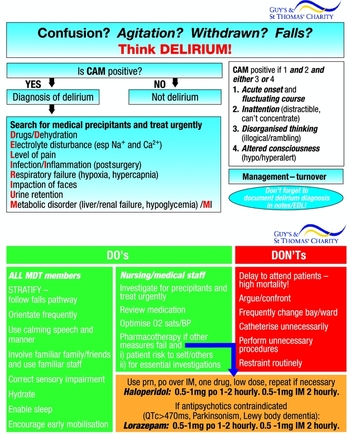
2. A7 sized cards were designed to display a guideline summary (Figure 1). One side displayed common delirium indicators and precipitants and a flow chart on how to diagnose delirium. The other side detailed the “Do's and Don’ts” of delirium management in a traffic light color coded system. This card was designed to be carried alongside identification badges at all times. It was distributed to doctors through teaching sessions, delirium promotion days and during contact on the wards.
-
3. A4 and A3 sized posters were produced detailing information on the four components of CAM and common delirium precipitants and placed on wards throughout the hospital.
-
4. The delirium poster was used as the screen saver across hospital computers for two weeks.
-
5. Single one hour delirium teaching sessions were given to postgraduate years 1–4 medical trainees.
-
6. A delirium promotion day was held on each of the two hospital sites. Stands displaying delirium posters were set up, handing out delirium cards and information leaflets and discussing delirium with staff and public.
The “Delirium Card” guideline summary.

In July 2011, questionnaires were re-distributed to postgraduate years 1–4 doctors (completed without recourse to the delirium card), again by dissemination at teaching sessions and opportunistically approaching trainees not already allocated questionnaires on wards over a four week period. The audit of clinical notes was repeated.
All data was dichotomized and frequencies pre and post-intervention were compared using χ2 tests.
Results
Twenty-five delirium cases were retrospectively identified – 14 pre and 11 post-intervention.
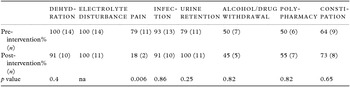
There was a significant increase in documented use of CAM for inpatient delirium assessments (0 (0%) vs. 8 (73%), p <0.01). Table 1 shows the percentage of delirium precipitants screened for in confirmed delirium cases. A mean of 75% of delirium precipitants were addressed per patient. There was no change post-intervention except for a significant reduction in screening for pain.
Percentage of delirium precipitants screened per delirium case

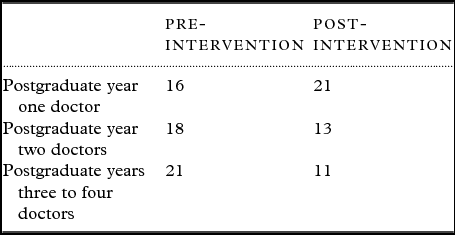
Of a potential 170 trainees working in the hospital at foundation training in postgraduate years at 1 and 2 and in postgraduate years 3 and 4 in medicine, 55 pre-intervention and 45 post-intervention questionnaires were answered giving a response rate of 32% and 26% respectively. Their seniority grade is displayed in Table 2. There was a non-significant trend towards more junior grades in the post-intervention sample.
The grade of medical trainees completing the questionnaire

There was significant improvement in naming CAM as the diagnostic assessment tool for delirium (13 (24%) vs. 32 (71%), p <0.01); correctly recognizing each of the four components of CAM (p <0.01 for each component); recognizing haloperidol as the first line pharmacological management for delirium (30 (55%) vs. 44 (98%), p <0.01); recognizing the correct initial dose of haloperidol (22 (40%) vs. 30 (67%), p <0.010) and recognizing prolonged QTc as a contraindication for haloperidol (32 (58%) vs. 38 (84%), p <0.01). A mean of five delirium precipitants were named both pre and post-intervention (p = 0.28).
Approximately 60% of year 1–2 trainees and 50% of 3–4 trainees were exposed to the teaching sessions. There was no significant difference pre and post-intervention (34 (61%) vs. 31 (69%) in the proportion who perceived that they had received “delirium training.”
In the questionnaire free text responses, responders described the delirium cards as “very useful when encountering delirium on the wards,” “easily accessible,” “handy to carry around,” and even “an essential tool every junior doctor should have.” Eighty two percent of trainees found the delirium card very helpful on the Likert scale. Seventy percent carried the card at all times.
Discussion
In this study we found that a multifaceted intervention based around education of junior doctors in a large teaching hospital improved trainee doctors’ knowledge of the pharmacological management of delirium, the tools used in its diagnosis and in the use of CAM in delirium diagnosis on an Older Persons’ Unit. Once a case of delirium had been recognized, clinical practice did not change.
Prevention is the most important aspect of minimizing the impact of delirium, with randomized controlled trials indicating it to be approximately 30% preventable across surgical and medical cohorts. Less evidence exists for the benefits of treatment of established delirium, although an approach revolving around treating precipitants and continuing the tenants of delirium prevention has shown some promise (Pitkala et al., Reference Pitkala, Laurila, Strandberg and Tilvis2006) and is widely advocated (NICE CG103). The most widely disseminated intervention for delirium prevention is the Hospital Elder Life Program developed by Inouye et al. (Reference Inouye, Schlesinger and Lydon1999). This multicomponent intervention strategy delivered by trained volunteers and staff consists of targeting delirium risk factors by providing orientation and cognitive stimulation, preventing sleep deprivation, encouraging early mobilization, correction of sensory impairment and oral fluid repletion. Marcantonio et al. (Reference Marcantonio, Flacker, Wright and Resnick2001) added focus on prevention of medical complications, pain management, oxygen delivery, nutritional support, delirium symptom treatment and medication review to a geriatric liaison model in patients with hip fracture. However, such fundamental service provision interventions were outside the limits of this project. Education of existing medical personal offers an alternate route to improving delirium care, with knowledge deficits identified as a barrier to high care stands (Irving et al., Reference Irving, Detroyer, Foreman and Milisen2009).
Unsurprisingly, providing delirium education results in increased knowledge in important aspects of delirium care including diagnosis, prevention and treatment (Irving et al., Reference Irving, Detroyer, Foreman and Milisen2009). Patient level outcomes have also been achieved, but only with intense training on individual wards (Tablet et al., Reference Tabet2005). However, delirium is common across many areas of hospital activity including surgical units, most medical sub-specialties as well as unselected acute admission wards. Thus delivering training is important across the breadth of hospital departments, and the current study provides some practical insights into the application of these educational goals.
The training sessions were likely to have been important despite similar numbers of trainees reporting they had received “delirium training” pre and post-intervention. The A7 sized delirium card was also likely to have been also important in facilitating learning. This innovative way to promote delirium knowledge was a successful part of the project. It was designed to be carried and consulted contemporaneously at work so as to allow the salient aspects of the delirium guideline to be easily applied to clinical scenarios encountered. In this way, knowledge gained through the lecture-based intervention could be re-enforced. One important barrier to further success in the delirium education package was that not all trainees were able to attend the lecture program. This reflects real life difficulties in ensuring complete educational coverage of junior doctors providing service delivery. However, cards were distributed to those who were not able to attend, and it may be that the information imparted via the cards would have reached even those who did not receive our training package. The cards received high popularity amongst trainees, and are a low cost intervention which could readily be adapted for use in other clinical settings. Another important feature of the package was the widespread promotion of the delirium syndrome through screen savers, posters and promotional days, highlighting delirium not only to hospital staff but also to members of the public. This may have also provided impetus to improve knowledge of delirium care.
As well as improving knowledge among trainees, we were interested to measure patient level outcomes. From the clinical notes audit, although CAM was used more post intervention, an important limitation was that the project was not designed to assess for any impact on prevalence rates. We found no significant increase in the number of delirium precipitants screened for after the diagnosis was suspected. The rates of screening for electrolyte disturbance and infection were high both pre and post-intervention, possibly as these can easily be picked up through blood tests. However, drugs or alcohol withdrawal was only considered in half of the cases. The challenge to increase these rates remains.
Other barriers to successful implementation of the project were deficits in education delivery across inter-professional domains including nursing, pharmacy and allied health professionals and to more senior surgical trainees. Further projects aim to educate these groups along similar processes. Formalized embedded changes to service provision were not implemented in this project. Such changes may in the future include routine assessments of cognition and conscious levels both on admission and throughout inpatient stay to aid delirium detection.
This study has limitations. The notes based element is limited by documentation accuracy, and it may be that precipitants may have been considered but not recorded. It was only conducted within one hospital and the numbers of notes surveyed were small. The experience levels of trainees of each grade were not matched in pre and post-intervention questionnaires, although knowledge of delirium improved despite having increased numbers of less experienced doctors in the post-intervention questionnaire. It is possible that any improvement seen may have been attributed to on-going knowledge acquisition of trainees and unrelated to our intervention, although starting the project in February meant that trainees had six months to gain skills before the interventions started. A higher response rate to questionnaires would have improved the reliability of our results. One cause was the multiple medical specialities involved in UK foundation training (for example general practice and paediatrics) meant that not all trainees were present at the medical and surgical teaching sessions or present on the wards and so could not be assessed within our convenience sampling.
In future work, it would also be interesting to see if improvements in diagnostic strategy and management could affect patient level outcomes such as delirium incidence, its duration and prescribing patterns in this clinical setting. E-learning in delirium education has been gaining increasing attention (Irving et al., Reference Irving, Detroyer, Foreman and Milisen2009) and could provide another avenue for learning.
In summary, this study has demonstrated that this low cost multifaceted intervention has improved knowledge of delirium and use of CAM. However, no change in behavior was noted in the investigation of established delirium cases. Similar interventions could be applied in other clinical settings according their own requirements.
Conflict of interest declaration
None.
Description of authors’ roles
SC, JF, and TE conceived the study. SC, JF, TE, and FM planned and carried out the interventions. SC and JF collected and analyzed the data. JF and SC drafted the initial manuscript and all authors reviewed and amendment the document.
Acknowledgments
The authors would like to thank the Guy's King's and St Thomas Charity for providing funds to print the “Delirium cards,” Siobhan Gee for assisting with the drug administration section of the guidelines and Hannah Buckley for distributing and collating questionnaires.