The special history of Modern Hebrew (MH) makes it particularly interesting for the study of language change. Both sociolinguistic factors and language-internal factors contribute to the accelerated changes the language is undergoing. As a mother tongue in a community of speakers, MH is very young, only about a hundred years old. The language, which was revived by literate adults on the basis of older stages of the language, took a different course of development once it acquired native speakers. The constant tension between the natural development of MH and normative demands is still very strong and plays a role in shaping the structure of the language (Ravid, Reference Ravid1995a:6–8).
One specific domain of instability in the language is morphophonology. The morphology of MH is largely that of Biblical Hebrew. Its phonology is strongly influenced by the phonologies of the native languages of the revivers. The incongruity between a Semitic morphology and a non-Semitic phonology rendered many morphophonological alternations opaque, resulting in rapid changes in the language (Ravid, Reference Ravid1995a:7). Both types of tension—that between normativism and natural language development, and that between the phonology and the morphology of the language—are very active in the language and its community of speakers, contributing to the constant flux in patterns of the language. This situation, often quite unsettling for the speakers, is very fortunate for linguists, as it facilitates studying these changes and the factors that bring them about while they are taking place.
One of the most noticeable developments in the language is the change in the system of cardinal numerals. This change, denigrated by language teachers and planners, is very robust, characterizing the language of speakers from all socioeconomic backgrounds (Ravid, Reference Ravid1995b). Previous studies of the phenomenon (Bolozky, Reference Bolozky1982; Ravid, Reference Ravid1995b) focused on the neutralization of gender marking in the free forms of the numerals. The present study is concerned with the less studied forms of the system, the bound forms, which mark definiteness distinctions. The study consists of eliciting production and grammaticality judgments of noun phrases (NPs) containing bound numerals from five different age groups of native speakers. The analysis of the results makes two novel theoretical claims: (a) The prosodic structures of forms, more specifically their stress patterns, play an important role in shaping the emergent system, (b) Morphological production and perception processes are shaped by different, somewhat conflicting constraints. This tension has often been argued to play a role in shaping phonological changes and grammaticalization processes. The present study shows that it figures in morphological changes as well.
PROPERTIES OF CARDINAL NUMERALS IN HEBREW
Cardinal numerals in Hebrew, like other noun modifiers such as adjectives and demonstratives, agree in both gender (masculine and feminine) and definiteness (definite and indefinite) with the nouns they modify. However, the morphological marking of these two grammatical categories on cardinal numerals differs in significant respects from other nominal modifiers. Gender marking in numerals is the opposite of what is found in all other systems in the language: the general pattern in the language is that masculine forms are basic, and feminine forms are derived by suffixation of a special feminine marker (-a or -t), as in (1).Footnote 1 In numerals, in contrast, the feminine forms are basic, while the masculine forms are marked by suffixation of -a, as in (2).
(1) nexmad (nice, masc.)—nexmad-a (nice, fem.); tipši (foolish, masc.)—tipši-t (foolish, fem.)
(2) šaloš (three, fem.)—šloš-a (three, masc.); šeš (six, fem.)—šiš-a (six, masc.)
This morphological reversal in gender marking in numerals is characteristic of the Semitic languages in general (Blau, Reference Blau1972), though its origin is unclear.Footnote 2
Agreement in definiteness is also marked differently in numerals than in adjectives and demonstrative pronouns. In the latter, definiteness agreement is marked by the absence or presence of the definite prefix ha- on the modifier: a modifier co-occurring with a definite head noun is preceded by ha-,Footnote 3 but a modifier accompanying an indefinite head is not. In numerals, agreement in definiteness is encoded by the contrast between free and bound forms of the numerals. This contrast is parallel to the one between free (absolute) and construct forms in nominals.
The construct state construction, traditionally called smixut, involves the adjacency of two nouns with no intervening element between them. The construction is a common device for compounding in the language, exhibiting “… the full range of possible internominal relations… . as well as the relation of possession” (Berman, Reference Berman1978:231). The construction is left-headed, and the head often, though not always, takes a special modified phonological form (the construct state form), which differs from the free form in its vocalic pattern and sometimes in its syllable structure (3a). The feminine marker -a is replaced by -at or -et in the construct form (3b), sometimes accompanied by other phonological changes (3c).
(3)
a. xadár yeladim (room-(const.)–children, “children's room”; free form xéder)
b. hacagat mikre (show-(const.)–case, “case-study”; free form hacaga)
c. memšélet yisra'el (government-(const.)–Israel, “the government of Israel, the Israeli government”; free form memšalá)
One of the noteworthy characteristics of smixut is its definiteness pattern.Footnote 4 In contrast with NPs with nonsentential modifiers, where the definite marker spreads to the modifiers as well (4a), in smixut the definite marker appears only once. Moreover, it is attached not to the head noun, which is the first element in the compound, but rather to the modifier (4b). Hence, it is the definiteness marking on the modifier that determines the definiteness of the entire smixut construction (Berman, Reference Berman1978:248).
(4)
a. bayit gadol (house big, a big house); ha-bayit ha-gadol (the-house the-big, the big house)
b. beit mišpat (“house-(const.)–law,” “a courthouse”); beit ha-mišpat (“house-(const.) the-law,” “the courthouse”)Footnote 5
Returning to numerals, the definiteness distinction is encoded not only by the presence or absence of ha-, but also by two different forms taken by the numerals. In the case of an indefinite NP, the numeral takes the free form (5a). When the NP is definite, the phrase takes the form of smixut. The numeral takes the form and the position of the head: it is the left-most element and appears in a special morphological form, the bound form. The noun takes the position of the modifier and carries the definite article (5b).Footnote 6
(5)
a. šloša sfarim (“three (masc.) books”); šaloš maxbarot (“three (fem.) notebooks”)
b. šlošet ha-sfarim (three (masc.) the-books, “the three books”); šloš ha-maxbarot (“three (fem.) the-notebooks,” the three notebooks)Footnote 7
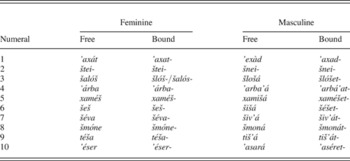
Because numerals encode both the masculine-feminine distinction and the definite-indefinite distinction, each numeral, in principle, has four forms. However, in the feminine forms, the definiteness distinction has disappeared because of phonological changes that MH underwent since its revival. Certain phonological distinctions that existed in earlier stages of the language (and are still manifested in writing by the “nikud” (lit. “pointing”), the vocalizing diacritics) are neutralized in MH (e.g., the distinction between [e] and [ɛ] or between [a] and [ ]). Consequently, the distinction between the bound and free forms of the feminine, which was manifested only by vowel change in earlier stages of the language, is no longer apparent in MH. The only numeral in which the distinction is not entirely neutralized is 3: the free from is šaloš, while the bound form is šloš-. However, the form šloš- is rapidly disappearing from the vernacular, and the form šaloš is becoming the sole feminine form in the system. Table 1 presents the forms of the numerals from 1 to 10 in current language use.Footnote 8
Bound and free forms of cardinal numerals in Modern Hebrew

The numerals 1 and 2 differ from the other numerals in the table. The free forms of 1 follow their head noun, unlike all other cardinal numerals in the language (sefer 'exad—book one, “one book,” vs. šmona sfarim—eight books, “eight books”). As for the numeral 2, the definiteness distinction is neutralized; the bound form precedes both definite and indefinite nouns (šnei sfarimim/ha-sfarim—“two books, the two books”). The free forms are used only to count and label (e.g., bait mispar štáyim—“house no. 2”), that is, the numeral in such cases does not modify any noun. All numerals higher than 10 do not mark definiteness distinctions. Because the present study is concerned with the interaction between the two grammatical categories—gender and definiteness—we focus only on the numerals 3–10.
THE MARKEDNESS OF THE SYSTEM
The system of cardinal numbers in Hebrew is marked from a variety of perspectives. First, as pointed out above, its morphological marking of gender is the reverse of gender marking in all other systems in the language. The marking of definiteness is also different from that of other noun modifiers. Second, the position of cardinal numerals also differs from that of adjectives and demonstratives. Numerals precede the nouns they modify, but adjectives and demonstratives follow the head noun. In their syntactic position, then, numerals resemble other quantifiers and measure phrases in Hebrew and not adjectives. However, quantifiers in Hebrew do not inflect for gender (6a, b). Numerals, therefore, are the only prehead modifiers that are marked for gender in the language (7a, b).
(6)
a. kol ha-yeladim (“all the boys”); kol ha-yeladot (“all the girls”)
b. harbe yeladim (“many boys”); harbe yeladot (“many girls”)
(7)
a. xamiša yeladim (“five (masc.) boys”); xameš yeladot (“five (fem.) girls”)
b. xamešet ha-yeladim (“five (const-masc.) the-boys,” the five boys); xameš ha-yeladot (“five (const-fem.) the-girls,” the five girls)
From a psycholinguistic point of view, the position of the numerals with respect to the agreement controller (the head noun) arguably places more burden on production processes, because the directionality of the agreement is backward rather than forward. In backward agreement, the speaker needs to determine the form of the agreement target (the numeral) before uttering the agreement controller; that is, the speaker needs to represent and retain in memory the agreement controller to determine the form of the agreement target, but to utter the agreement target first. Backward agreement processes are therefore more complex, and quite often gender distinctions are neutralized in such contexts in MH. For example, although subject-verb agreement is a general robust property of Hebrew sentence structure, Berman (Reference Berman, Ornan, Ben-Shachar and Turi1992) points out that in certain verb initial sentence structures, such as existential, possessive, and unaccusative constructions, the verb is often in the third person singular form (the unmarked form in Hebrew) and does not agree with its subject.
Hebrew numerals show yet another peculiarity: there is nonisomorphism in markedness between the morphological level and the semantic level. Morphologically, the feminine form is unmarked, and the masculine form is the derived/marked form. However, semantically, the masculine form is unmarked, in that it can refer to both a group of masculine nouns (8a) as well as to a mixed group (8b), whereas the feminine form can refer only to a group consisting of feminine nouns (8c, d).
(8)
a. 'esrim ve-xamiša yeladim (twenty and five (masc.) boys, “twenty five boys”)
b. 'esrim ve-xamiša yeladim ve-yeladot (“twenty and five (masc.) boys and girls”)
c. 'esrim ve-xameš yeladot (twenty and five (fem.) girls, “twenty five girls”)
d. *'esrim ve-xameš yeladim ve-yeladot (“twenty and five (fem.) boys and girls”)Footnote 9
In addition, the masculine form has two allomorphs—the bound and the free forms—but the feminine numerals have only one form. Allomorphy is characteristic of the unmarked element in the paradigm. Thus from the point of view of semantics and allomorphy, the masculine is unmarked, but from a morphological (word formation) point of view, the masculine is the marked form, as it is derived from the feminine form by suffixation. Waugh and Lafford (Reference Waugh, Lafford, Booij, Lehmann and Mugdan2000:273) point out that such nonisomorphism between different linguistic levels is quite rare and causes instability in the system. As we shall see shortly, this indeed characterizes the Hebrew numeral system.
DIRECTIONS OF CHANGES IN THE SYSTEM
As the above section shows, the cardinal numeral system in MH is very marked from a synchronic perspective. Marked systems are more prone to change (Berman, Reference Berman, Ornan, Ben-Shachar and Turi1992). Indeed we find that this system is undergoing rapid changes in current use of the language, in both the free and bound forms.Footnote 10
The free forms
One might expect that the change in the system would be in reversing the morphological marking of gender on numerals, by analogy to all other gender marked elements in the language. That is, normative feminine numerals would replace masculine and vice versa. However, this is not the change attested in the language. In the free forms, what we find is neutralization of gender marking: the distinction between masculine and feminine forms is disappearing, and native speakers of Hebrew tend to use the feminine forms of the numerals irrespective of the gender of the head noun (Bolozky, Reference Bolozky1982; Bolozky and Haydar, Reference Bolozky and Haydar1986; Glinert, Reference Glinert1989; Ravid, Reference Ravid1995b; among others). Ravid (Reference Ravid1995b) explains this direction of change in terms of two basic tenets of analogical change proposed by Kurylowicz (Reference Kuryłowicz1949) and Manczak (Reference Manczak and Fisiak1980). Kurylowicz suggests that contrasts of marginal significance tend to be abandoned in favor of maintaining major contrasts in the language. Because gender marking in Hebrew numerals is the reverse of gender marking in all other morphological systems in the language, the change is toward abandoning a minor difference (gender in numerals) to maintain the more general gender marking system in the language. Manczak (Reference Manczak and Fisiak1980) further proposes that in analogical changes, shorter morphemes/words tend to remain more often than longer ones and to cause reformation of the latter more often than the former (p. 284). In the case of Hebrew numerals, we find that the two free forms collapse into the morphologically shorter, unmarked form, the feminine form.
Bolozky (Reference Bolozky1982) suggests a different approach, arguing that the preference for feminine forms is prosodic in nature. His argumentation is as follows: MH has a subsidiary stress pattern, in which stressed syllables rhythmically alternate with unstressed ones. The distribution of subsidiary stress is automatic. Once the main stress of a word is determined, every second syllable to its left is assigned secondary stress. In the case of vowel deletion in casual speech, the stress pattern is rearranged according to the new configuration. This rhythmic pattern is observed in compounds as well, in that stress is redistributed in compounds when a “clash” of two stressed syllables occurs. Thus, kàdurégel (“soccer”) originated from kadúr-régel (ball-foot, “soccer”), with stress reassigned in the first member so as to avoid a sequence of two stressed syllables (p. 279). Bolozky further suggests that the tendency to avoid stress clash plays a role in the distribution of the free forms of numerals in the language, namely the preference for the feminine forms over the masculine ones. Hebrew numerals form a prosodic constituent with the noun they modify. If the noun is stressed on the first syllable, and the numeral is stressed on the ultimate, as in šiv'á dólar (“seven (masc.) dollars”)Footnote 11 or tiš'á yèladim (“nine (masc.) children”) (1982:284) an undesired stress clash occurs. If, however, the numeral is stressed on the penultimate, no such clash occurs, as in téša yèladót (“nine (fem.) girls”). All the masculine free forms have final stress. In the feminine forms, in contrast, only three forms have final stress (šalóš, “three”; xaméš, “five”; šeš, “six”); the other five forms are stressed on the penultimate ('árba, “four”; šéva, “seven”; šmóne, “eight”; téša, “nine”; 'éser, “ten”). Hence feminine numerals are preferred because they contribute to a more regular rhythmic pattern in the language.
That prosody may play a role in shaping linguistic changes has been suggested elsewhere. Bloch (Reference Bloch1971) notes that in many colloquial dialects of Arabic, the classical numeral system (parallel to that of Classical Hebrew) had collapsed, giving rise to a new system. In these dialects (e.g., Serian, Lebanese, Palestinian, Moroccan, and others), the unsuffixed forms (originally the feminine forms) became the dependent forms: that is, they are used when preceding a head noun. The suffixed (originally masculine) forms became the independent forms, used when the numeral occurs in isolation (e.g., in counting). Bloch argues convincingly that this distribution results from a general tendency in language to avoid monosyllables in isolation and to attach them to neighboring forms. Because most of the unsuffixed forms are monosyllabic in these dialects, the tendency is to use them as dependent (bound) forms, and their polysyllabic counterparts (the suffixed forms) are used as independent forms.
Bolozky and Haydar (Reference Bolozky and Haydar1986) further offer a prosodic account for the contrasting preferences of Hebrew and Lebanese Arabic with respect to the forms appearing in counting paradigms. Hebrew, as discussed above, uses the unsuffixed forms for counting, but in Lebanese Arabic, the suffixed forms are used. Bolozky and Haydar argue that despite the superficial dissimilarity between the languages, they obey they same principle: “Both languages prefer sequential counting paradigms with (roughly) alternating trochaic rhythm, which is most easily acquired in the language leaning process.” (1986:24).
Turning back to Hebrew free numerals, it might very well be that both factors, prosody and analogy, played a role in shaping the change. Prosodic factors may have favored some feminine numerals, and the others (final stressed feminine numerals) followed by analogy. Notice that the neutralization of gender marking reduces the markedness of the systems in other areas as well (Meir, Reference Meir2005): numerals then behave like other prehead modifiers, in that they are not marked for gender. Additionally, the problematicity of backward agreement is solved: because numerals are no longer marked for gender, there is no gender agreement between the numeral and its head noun, and hence the psychological burden imposed by backward agreement disappears.
The bound forms
In the bound forms of certain numerals, a different direction of change is attested: the masculine forms become more prevalent and quite often co-occur with feminine nouns as well (Meir, Reference Meir2005). Such forms are quite common in spoken language, but can also be found in written texts as well, as the following examples illustrate.Footnote 12
(9) yufseku limudav šel talmid … le'axar šenixšal be-kurs xova kolšehu me-hatoxnit be-šlošet (masc.) ha-šanim (fem.) (University of Haifa Catalog, 2005:636). “A student's studies will be suspended if he fails any required course in the program during the three years.”
(10) šlošet (masc.) ha-xavarot (fem.) ha-'axerot yiftexu 'et merkazei ha-ta'asuka šelahen … (Haaretz, 2005b:1) “The other three companies will open their employment centers… .”
(11) 'axar kax hu boxer 'axat mi-šlošet (masc.) ha-glimot (fem.) ha-mefo'arot še-huxnu me-roš (Yediot Axaronot, 2005).Footnote 13 “Then he chooses one of the three magnificent gowns that had been prepared in advance.”
(12) ha-mivxan yitkayem be-xufšat xanuka be-'arba'at (masc.) ha'arim (fem.) ha-gdolot (Organization for Excellence in Education, 2004). “The exam will take place during the Hanukah vacation in the four big cities.”
(13) gveret bakši lehuta limco xatanim … 'avur arba'at (masc.) bnoteha (fem.) (MasterCard brochure, 2005). “Mrs. Bakshi is anxious to find grooms for her four daughters.”
(14) ‘anaxnu nivxar, mi-bein kol ha-haca’ot, ‘et xamešet(masc.) ha-haca'ot(fem).) hatovot be-yoter. (Tapuz forum 2003). “We will choose, among all the submissions, the best five submissions.”
(15) bi-tresar ha-xodašim šele'axar miken huxpal mispar hamarot ha-dat le'umat ha-memuca šel xamešet (masc.) ha-šanim (fem.) ha-kodmot (Eilon, Reference Eilon and Orbach2004:217). “In the twelve months following that, the number of religious conversions was doubled compared to the means of the five previous years.”
(16) ba-turnir lokxot xelek šmonat(masc.) ha-kvucot(fem.) ha-bxirot bi-sfarad. (Salnews, 2007). “The eight leading teams in Spain participate in the tournament.”
(17) hit'angu 'al kol tiš'at (masc.) ha-ta'arovot (fem.) ha-nifla'ot šel nespreso (Nespresso Club, 2005). “Enjoy all the nine terrific blends of Nespresso.”
Only in one case did I find the reverse pattern, that is, a feminine numeral co-occurring with a masculine noun, in a written text (18). In this example, the head noun krav (fight) is a masculine noun that nonetheless takes the feminine plural ending -ot, which might explain the reverse agreement.
(18) xameš(fem). ha-maftexot(masc.) li-vri'ut ba-mazon. (Me'a, 2007). “The five keys for healthy food.”
Why is it that the change in the bound forms is the opposite of that attested in the free forms? Two possible lines of explanations are suggested (Meir, Reference Meir2005):
(1) A functional explanation: The language strives to maintain an existing contrast and to retain one-to-one mapping of form and function. The contrast between [+definite] and [−definite], encoded by the bound and free forms of the numerals, is apparent only in the masculine forms. Adopting the feminine forms to mark [+definite] would result in neutralization of the contrast. To maintain the contrast in definiteness, the morphological system adopts the only forms marked for definiteness in the system, the masculine forms.Footnote 14
(2) A prosodic explanation: Following Bolozky's argumentation, one might suggest that the preference for penultimate stressed numerals holds for the bound forms as well, because the bound forms, even more than the free forms, form a syntactic and prosodic constituent with the head noun. However, the stress pattern of the bound forms differs from that of the free forms. In the free forms, only the feminine paradigm has penultimate stress forms. In the bound forms, five of the eight masculine forms are stressed on the penultimate (3, 4, 5, 6, 10). The feminine bound forms are identical to the free forms, that is, five numerals have penultimate stress (4, 7, 8, 9, 10). Hence there is no prosodic preference for one paradigm over the other. Rather, speakers tend to prefer bound numerals with penultimate stress, whether masculine or feminine.Footnote 15
These two explanations make different predictions: the functional explanation predicts that in all numerals, the tendency would be to use the masculine forms as the bound forms, so as to maintain the contrast in definiteness. The prosodic explanation predicts that bound forms will be either masculine or feminine—depending on which form has a stressed penultimate. Thus, in numerals 3, 5, and 6, the masculine forms would be preferred, because they are stressed on the penultimate, whereas the feminine forms are stressed on the ultimate. The situation is reversed for 7, 8, and 9, and hence the prediction is that for these numerals the feminine forms are preferred. In case of 4 and 10, where both forms have penultimate stress, both forms are predicted to occur with equal or random frequency in the language.
SOURCES OF VARIATION IN MH
Ravid (Reference Ravid1995a) suggests that three factors contribute to the linguistic variation found in MH. The first is the tension, or even friction, between prescriptive demands and the natural development of the language. Hebrew was revived as a spoken everyday language by literate adults, who were native speakers of Indo-European languages and proficient in Classical and Medieval Hebrew. Their aim was to revive the language on the basis of Classical Hebrew and to retain the “true” spirit of the language. However, when the language acquired native speakers, it took a different course of development that deviated from the Classical forms, especially in the domain of morphophonology. Purists have been trying, from as early as the 1920s until the present, to deprecate what they regard as the deterioration of the language and to suggest ways to correct it. In spite of these efforts, the vernacular has taken a life of its own, giving rise to forms that often deviate from the prescriptive norm. Speakers are often aware of this friction and suffer from what Ravid calls “a basic insecurity regarding their mother tongue” (1995a:7). They would often try to recollect the “correct forms,” in most cases to no avail.
The second source of linguistic variation is age. The language of an individual changes throughout his/her lifetime, due to the combined effects of maturation and literacy. Cognitive and linguistic maturation are responsible for the dramatic linguistic developments that occur from birth until early adolescence. By the age of five, children have already mastered the fundamental phonological, morphological, and syntactic structures of their mother tongue. Yet their language is still utterance-centered, focusing on sentence-internal structure. It is only after the age of five that children use their linguistic abilities to stretches larger than the utterance, that is, expanded discourse (see Ravid, Reference Ravid1995a and references cited therein). As the child grows, she/he shows mastery of more complex linguistic structures (e.g., pronominalization, relative clause formation, and gerund formation), larger vocabulary, and sensitivity to different registers and styles, as well as to convention of usage.
These developments in linguistic competence and performance are further boosted by literacy. Learning the written language demands certain metalinguistic operations, such as distinguishing speech units—phonemes, syllables, words, and sentences. The physical stability of the written language encourages planned organization of the discourse and enhances decontextualization, the spatiotemporal separation of the speaker and hearer in the communication situation. This, in turn, forces specific use of vocabulary and morphological and syntactic structures on the part of the speaker (writer) and parallel abilities to comprehend a decontextualized text on the part of the hearer.
In the case of Hebrew, the written language further adds to the reader's awareness of central typological features of the language. Hebrew orthography is generally consonantal, with the vowels represented by a special augmentative system of diacritics. Most of the texts are not vocalized. In such texts, only the consonantal skeleton is fully represented; representation of vowels is partial and inconsistent. Written texts, therefore, highlight the primacy of the consonants in the language on the one hand and demand that the reader reconstruct the vocalic pattern of the words, based on prior knowledge of the possible morphological patterns in the language, and the syntactic structures in which they occur. In addition, Hebrew orthography draws attention to the highly bound nature of Hebrew morphology. Many, if not most, grammatical markers occur as inflectional affixes or clitics on words or stems. They are represented in the writing system by letters attached to a word. For example, the word  (uxšenifgašnu, “and-when-that-meet (past tense, nif'al template)-we”), contains six bound morphemes, all represented as a single orthographic word.
The effects of literacy go beyond the grammatical structure of the language. The literate Hebrew speaker has encountered a wide array of styles, registers, and texts from all periods of Hebrew. Children start learning the Bible from as early as second grade. Throughout their school years, they are exposed to texts from different historical periods of the language. They also get formal instruction in grammar, including drills and exercises on prescriptive forms and rules. Therefore, maturation together with literacy, as is experienced in the school system and beyond, contribute to the linguistic variation among different age groups.
The effects of age in a linguistic community as young as that of MH go beyond maturation and literacy of the individual. Different age groups also represent different stages in the development of MH and its community of speakers. Speakers in their 60s and older were born before the establishment of the state of Israel. They acquired Hebrew when the language was still very young as a spoken language, and many of its speakers then were nonnative speakers. Speakers in that age group who acquired the language as their mother tongue are in most cases first-generation native speakers. Speakers 40–50 years of age were born after the establishment of the state of Israel and were exposed to Hebrew as their sole vernacular and official language. Many speakers of this generation are second generation native speakers. These two age groups differ from younger speakers in the community in that they were exposed to a somewhat different register of literary Hebrew. Written Hebrew of 40–50 years ago was characterized by a formal and archaic register, which was especially noticeable in children's books of that time. The style of children's book has changed considerably since; the language of current children's books is not archaic and is much closer to the vernacular. The difference between the two styles is so outstanding that children today refuse to read children's books of 40 years ago. This situation has led to a wave of new translations of classics such as Winnie the Pooh, Alice in Wonderland, The Little Prince, and many others. A famous Israeli author, Yemima Avidar-Tschernovitz, rewrote one of her own books (“šmona be-'ikvot 'exad,” Eight on the Track of One) in a more current style, when she discovered that children no longer read the original version, written in 1945.Footnote 16 Age, then, includes at least three different facets contributing to linguistic variability: cognitive and linguistic maturation of the individual, level of literacy, and the age and developmental stage of the language itself.
Literacy also plays a major role in the third source of variation in MH, namely the emergence of two sociolects: that of the upper-middle class and that of the lower-middle class. These two speech varieties are better regarded as two ends of a continuum, each characterized by distinct phonological, morphological, syntactic, and lexical properties. Though various parameters may be relevant to defining socioeconomic status (SES), it seems that with respect to language variation, the most relevant ones are the number of years of formal education and level of literacy (see Ravid, Reference Ravid1995a:30 and references cited therein). As mentioned above, school-goers are exposed to a variety of registers and styles, to texts from different periods of Hebrew, and to formal, prescriptive study of the language. The exposure to more archaic and formal forms of the language serves to counterbalance the natural tendencies toward change in the language. People with fewer years of formal education have less exposure to these language varieties; hence their language is more prone to changes. The language of uneducated speakers can serve as what Berman (Reference Berman, Ornan, Ben-Shachar and Turi1992) calls “diagnostic focal center for change”; in many cases, changes in the language may first be attested in lower SES speakers, and only in later stages spread to other groups of speakers.
Of the three sources of variation mentioned above, two play a role in the present study. The friction between prescriptive demands and natural linguistic developments lies in the heart of the study. The numeral system of Classical Hebrew, and that of bound numerals in particular, is all but disappearing, giving rise to a new system. This change is taking place in spite of deliberate efforts on the part of the prescriptive organizations such as the Academy for the Hebrew Language, language consultants, and language teachers. The study aims to explore the factors that shape the newly emerging system.
Age is the independent variable in the study. Because the linguistic change under investigation here is still taking place in the present, it is to be expected that age-related factors, such as the type of language exposure in childhood, as well as amount of exposure to formal registers and explicit instruction of prescriptive forms, make a difference in linguistic performance and competence. Therefore the subjects in the study are from five different age groups, as is specified in detail in “Subjects.”
The social aspect is neutralized. As pointed out previously, educated speakers are more change-resisting than uneducated speakers, because of their familiarity with formal and archaic varieties of language. Therefore, attesting a deviation from the norm in the vernacular of educated speakers testifies to the robustness of the change. Based on my familiarity with the community of MH speakers (as one of its members), I argue that the change in the bound numeral system is already widespread in the community. To substantiate this claim, the subjects participating in the study are all highly educated. As the results show, high (academic) education does not shield the speakers from the forces of change.
THE STUDY
The purpose of the present study is to select between the two competing hypotheses delineated in “The Bound Forms” section, by eliciting production and grammatically judgments of bound numerals from native speakers and examining the results in light of the predictions made by each hypothesis.
Subjects
The subjects were 56 native speakers (28 females and 28 males) in five different age groups: two groups of school-age children: (I) ten 14–15 year olds (5 boys, 5 girls, all in 8th grade), (II) ten 17–18 year olds (5 boys, 5 girls, all in 11th grade); one group of young adults: (III) sixteen 20–25 year olds (8 male, 8 female, mean age 23.25, range 20–25); and two groups of adults: (IV) ten 35–55 year olds (5 male, 5 female, mean age 43, range 35–52), and (V) 65+ year old (5 male, 5 female, mean age 69.3, range 65–72). All subjects are educated native speakers of Hebrew. Subjects in Groups III–V have had an academic education, and the school-aged subjects are from highly achieving schools (based on the success rates in the national matriculation exams) in Haifa and the vicinity. The choice of this SES background ensures that the linguistic performance of the subjects, in particular deviation from the norm, cannot be attributed to poor education or lack of exposure to more literary or formal registers of the language. The only constraint on subjects in Groups III–V is that they do not study or hold a profession related to Hebrew grammar and linguistics.
The five age groups represent different stages in the development of MH and its community of speakers, as delineated in the “Sources of Variation in MH” section. Group V subjects were born before the establishment of the state of Israel and acquired Hebrew when the language was still very young as a spoken language. Group IV subjects were born after the establishment of the state of Israel and were exposed to Hebrew as their sole vernacular and official language. These two groups differ from the other groups in the study (Groups I–III) in that they were exposed to a somewhat different register of literary Hebrew in their childhood (see “Sources of Variation in MH”). It might be expected that this difference has an effect on their language.
Groups I–III are by and large third generation native speakers and have had much less exposure to the archaic register of literary Hebrew. The difference between these three groups lies in their formal training in Hebrew grammar. Hebrew grammar is taught in the school system for about ten years, from 2nd grade up to 10th or 11th grade. The studies are usually not intensive (one or two weekly hours), except for the last year, at the end of which the students take the matriculation exam in grammar. The Hebrew grammar curriculum comprises various aspects of normative grammar, including cardinal numerals. However, emphasis is given to the free forms of the numerals; bound forms are mentioned, but are hardly drilled. Subjects in Group I, who are 8th graders, had studied Hebrew grammar as a subject in school for five or six years, but not intensively. Subjects of Group II, in contrast, had just taken the matriculation exam in Hebrew grammar and had therefore had intensive tutoring in topics related to normative Hebrew grammar in the months preceding the study. Subjects in Group III are all university students, and because they are at least 20 years old, they have had at least three years of break since they took the matriculation exam in Hebrew grammar.
The test
The test consisted of two tasks: a production task and a grammaticality judgment task. The production task, modeled after Ravid (Reference Ravid1995b), consisted of nine arithmetical problems, suitable for children as young as fifth graders. These problems contained the numerals from 3 to 10, in a linguistic context that required the use of the bound form (that is, the head noun was definite). Each numeral appeared twice, once with a masculine noun and once with a feminine noun. All numerals appeared in numeric form, so that the subjects would have to determine their morphophonological form when reading them aloud. The problems contained a few NPs free from numerals (that is, the head noun was indefinite) and numbers higher than 10; these also appeared in numeric form, but were not taken into account when computing the results. The instructions for the subjects were to read each problem out loud and to solve the arithmetical problem orally as fast as they could. All responses were recorded (the questionnaire appears in the appendix).
After the subjects completed the production task, the grammaticality judgment task was administered. This task consisted of the same sixteen noun phrases that appeared in the production test, but each NP appeared twice: once with the numeral in the masculine form and once in the feminine form. For example, the NP 4 ha-yeladim (“the 4 children”) appeared once as 'arba'at (masc. form) ha-yeladim and once as 'arba (feminine form) ha-yeladim. Hence each subject heard 32 NPs, 16 with a masculine numeral and 16 with a feminine numeral. From a prescriptive point of view, 16 NPs were grammatically correct and 16 incorrect. The NPs were randomly ordered, with the condition that the two forms of each NP were separated by at least four NPs. The NPs were read out to the subjects by a research assistant, and the subjects were asked to judge whether the NP “sounds OK” to them. They were specifically instructed to answer quickly and to rely on their intuitions.
Predictions
According to the functional hypothesis, subjects were predicted to produce more masculine forms than feminine forms and to judge as grammatical more NPs containing masculine forms than ones containing feminine forms. According to the prosodic hypothesis, subjects were predicted to favor penultimate stress forms over final stress forms in both tasks.
Both exposure and formal schooling are predicted to have an effect on language production and grammaticality judgments. Hence the adult groups (Groups IV and V) are predicted to perform closer to the normative demands in both tasks, due to their more extensive exposure to archaic form of the language. In addition, Group II subjects are predicted to outperform Groups I and III because of their intensive tutoring in normative aspects of Hebrew grammar in the period prior to the study.
Results
Comparison to normative well-formedness
The results show that no subject got 100% correct answers on the production task, and only one subject (of Group II, the matriculation group) got 100% correct answers on the judgment task, from a prescriptive point of view. The rate of success of the various groups was between 61% and 79% in the production task and 63% and 71% in the grammaticality judgment task. The group with the highest scores in the production task was indeed the oldest group (Group V), but on the grammaticality judgment task the highest achieving group was Group II. The group with the lowest scores in the production task was the youngest group (Group I), and Group III in the grammaticality judgment task.
The range between the lowest and highest scores was much wider in the production task: there was a difference of 18% between the highest and lowest achieving groups. In the grammaticality judgment task, the range was much narrower—8%. Also, in Groups III–V, the scores were higher for the production task. In the youngest group, we see the reverse pattern: scores were higher for the judgment task (67% vs. 61%). In Group II, there was almost no difference between the scores for the two tasks. The results are summarized in Table 2.
Mean percentage of correct scores in both tasks (in parentheses—total number of responses for each group)

Additionally, in the judgment task, out of the 1792 phrases that were read to the subjects, 1014 were judged as grammatical. Because only half of the phrases (896) are prescriptively grammatical, 118 ungrammatical phrases (13%) were judged as grammatical.
Production task
In the NPs produced by the subjects, an overall preference for the feminine forms was found: out of the 878 forms produced, 486 of the numerals were feminine (55%).Footnote 17 However, this preference did not characterize all the numerals. In the numerals 3 and 6, a clear preference for the masculine forms was found: 65% and 63%, respectively. This preference is statistically significant (p < 0.03, see Table 3). In the numerals 5, 7, 8, and 9, we find the reverse: a strong (statistically significant, p < 0.05) tendency to use the feminine forms. The numerals 4 and 10 showed a slight tendency to use the feminine forms (55%), but this preference was not found to be statistically significant. A comparison between the different age groups shows that although all groups produced more feminine than masculine forms (except for Group IV, which produced an equal number of feminine and masculine forms), this difference was significant only in the youngest group (p < 0.01, see Table 4).
Mean percentage of masculine forms in the production task

Notes:
ap < 0.01
bp < 0.05
cp < 0.03
Mean percentage of masculine forms produced according to age groups (in parentheses–total number of responses for each group. See fn. 17)

Note:
ap < 0.01
Grammaticality judgment task
In this task, there was a clear preference for the masculine forms. Out of 1014 forms that were judged as grammatical, 593 (59%) were masculine. This preference characterizes all numerals, except for the numeral 9, where a slight preference for the feminine forms (51%) was found. However, a nonparametric test (Mann-Whitney) shows that only in three numerals (3, 4, 6, i.e., the penultimately stressed forms; in the numeral 10, the difference was close to being significant, p = 0.075) the difference between the masculine forms and the feminine forms was statistically significant (p < 0.03), as is shown in Table 5.
Mean percentage of masculine forms out of all forms judged as grammatical

Note:
ap < 0.01
bp < 0.03
cp = 0.075
A comparison between the different groups reveals that the preference for masculine forms is significant (p < 0.01) only in the two older groups, Group IV and Group V. In Group II, the older group of the school children, this preference is less salient (p < 0.06). In Groups I and III, the preference for the masculine forms was not statistically significant (Table 6).
Mean percentage of masculine forms out of all forms judged as grammatical according to age groups (in parentheses—total number of forms judged as grammatical for each group)

Note:
ap < 0.06 (p = 0.051, significant when p < 0.06)
bp < 0.01
DISCUSSION
Deviation from the norm
The deviation of all groups from the norm indicates that the grammatical system of bound numerals in Hebrew is indeed undergoing a change. The full normative system does not constitute part of the linguistic competence of native speakers. The subjects' linguistic intuitions do not conform to the norm. Some subjects were aware of this gap and tried to rely on their formal training from school in the judgment task.Footnote 18 However, after a few attempts to invoke their formal knowledge (which did not result in better performance), they would get confused and revert to relying on their intuitions.
That the system is currently undergoing change is supported by other observations as well. In the grammaticality judgment task, there were many cases where subjects accepted as grammatical both the feminine and the masculine form with the same noun; that is, they accepted as grammatical both 'arba ha-'arugot and 'arba'at ha-arugot (“the four flowerbeds”). In other cases, they rejected both forms. Even more telling is the fact that some subjects rejected forms that they themselves produced in the performance task. In addition, forms that deviate both from the feminine forms and from the masculine forms were produced, such as šévat-, šmónet-, téšat-. These forms, all stressed on the penultima, seem like a blend of the masculine and feminine forms and will be discussed below.
As mentioned above, the gap between the highest achieving and the lowest achieving groups was wider in the performance task than in the grammaticality judgment task. A possible explanation for this difference is that as the system is changing, speakers are exposed to a variety of linguistic forms. When asked to judge the grammaticality of forms, speakers often say “I don't speak like this, but many people do.” In other words, the extensive use of nonstandard forms makes these forms prevalent and speakers often get used to them, even if they rarely produce them. This tolerance for nonnormative forms is further supported by the fact that in the grammaticality judgment task, 13% of the ungrammatical NPs were judged as grammatical.
The type of exposure and formal training to which subjects were exposed do make a difference. The two adult groups achieved higher scores on the production test and performed almost as well as Group II in the judgment task. The clear advantage of Group II over Groups I and III in both tasks may be attributed to the effect of the intensive tutoring that precedes the matriculation exams. However, the effect of this exposure seems to diminish rapidly after completing the formal studies of Hebrew grammar, as the low scores of Group III indicate. Notice that this effect cannot be attributed to schooling in general, as the subjects of Group III are all university students, that is, they have had more years of education than the subjects of Group II. Rather, it is the special focus on normative Hebrew grammar in the 11th grade that makes the difference. The fact that this effect is short suggests that exposure in childhood has more long-lasting effects on speakers' language than formal tutoring focused on normative grammar in school; the linguistic system of Groups IV and V, which are much farther from their school years than that of Group III, is much closer to the normative standard.
Comparing the results of production and grammaticality judgment tasks
As noted in “The Bound Forms” section, the two competing hypotheses outlined there make different predictions. The functional approach predicts that the masculine forms would be favored, whereas the prosodic approach predicts preference for forms with penultimate stress. A comparison of the results of the two tasks suggests that each task supports the predictions of a different hypothesis.
The results of the production task confirm the predictions made by the prosodic explanation. Forms with penultimate stress were produced more often than forms with final stress. Out of the 896 forms produced, 585 (65%) had penultimate stress. Yet a closer look at the results for each of the numerals suggests that there is an additional factor playing a role in the choice of the numeral's form—the number of syllables. Specifically, disyllabic forms are preferred over trisyllabic. In the production of bound numerals, then, we find that forms are preferred that adhere to two constraints: penultimate stress (PS), and disyllabicity (D). When the competing forms are monosyllabic and disyllabic, the penultimate stress constraint suffices to determine the preferable form. However, when the competition is between disyllabic and trisyllabic forms, the disyllabicity constraint plays a role as well.Footnote 19 The interaction between the two constraints yields the following possibilities:
(a) The numerals 3 and 6: The masculine forms (šlóšet- and šéšet-) are disyllabic and have penultimate stress. The feminine forms (šloš- and šeš) are monosyllabic and therefore stressed on the ultima (the sole syllable). The form šloš- is actually no longer in use.Footnote 20 Only 1 out of the 56 subjects used it. All other subjects used šalóš-, which is disyllabic and has a final stress. In these numerals, it is the masculine forms that obey the PS constraint, and the feminine forms violate it. Indeed, we find a significant preference for using the masculine forms. The experimental results are supported by my own impressions concerning natural discourse in the community: the form šlóšet- seems to become the sole bound form for the numeral 3; šalóš- is hardly ever used by people other than Hebrew language teachers and scholars.
(b) The numerals 7, 8, 9: This is the mirror image of the situation in (a). Both forms are disyllabic, but they differ in their stress pattern. The feminine forms (šéva-, šmóne-, téša-) have penultimate stress, but the masculine forms (šiv'át-, šmońat-, tiš’át-) are stressed on the ultima. This explains the clear, statistically significant preference to use the feminine forms.
(c) The numerals 4 and 10: Both the feminine forms ('árba- and 'éser-) and the masculine forms ('arbá'at- and 'aséret-) obey the PS constraint. However, they differ in their syllabic structure. The feminine forms are disyllabic, and the masculine forms are trisyllabic. We find a tendency to prefer the feminine forms, but this tendency is not as strong as in (b) and is not statistically significant. It might be that the prosodic constraint of PS is stronger than the D constraint, hence the difference in preference is not as noteworthy as in (a) and (b) above.
(d) The numeral 5: In this case, each form violates one constraint: the feminine form violates PS (xaméš-), and the masculine form (xaméšet-) violates D. The predictions are that both forms would be equally favored. If PS is stronger than D, as suggested above, then a bias in favor of using the masculine forms is to be expected. Impressions from naturalistic data support these predictions, as the masculine form quite often co-occurs with feminine nouns.Footnote 21 However, the predictions are not confirmed by the experimental results, which show a clear preference for using the feminine form. We have no explanation for this.
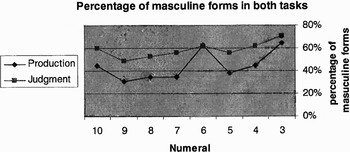
The results of the grammaticality judgment task show a clear preference for masculine forms. Out of 1014 forms that were judged as grammatical, 593 (59%) were masculine forms. This preference was more pronounced in some numerals (3, 4, 6, 10, the forms with penultimate stress) than in others (7, 8, 9, the forms with final stress), but in all numerals, with the exception of 9, masculine forms were preferred. (The numeral 9 showed a very slight preference—51% to 49%—for the feminine forms). Thus, although in both tasks the penultimate stressed forms exhibit distinct behavior from the final stressed forms, the overall preference is different: in the production task, the preference is for those forms that obey both prosodic constraints; in the judgment task, there is a preference for the masculine forms. As pointed out above, it is only the masculine paradigm that encodes the contrast in definiteness, because in the feminine paradigm both bound and free forms are identical in form. Hence in the judgment task, the preference is for the paradigm that has a clear bound form, distinguished from the free form. The results for the two tasks are presented in Figure 1.
Percentage of masculine forms in both tasks.

Competing forces: Production vs. perception
It seems then, that production processes and judgment processes are sensitive to different kinds of factors: in production processes, prosodic factors play a more significant role, but in judgment processes, functional factors (such as maintaining an existing contrast and preserving one-to-one mapping between form and meaning) are more important. This is reminiscent of the tension between different kinds of factors that shape phonological processes and changes in the language, namely, ease of production vs. ease of perception. It has often been noted that many phonological rules act to smooth out articulation (“ease of articulation,” the speaker's perspective), and others enhance distinctness or discriminablity (“ease of perception,” the hearer's perspective). Because the linguistic code is used by both speakers and hearers, phonological processes and changes are shaped by these two, often contrasting, forces (Liberman & Mattingly, Reference Liberman and Mattingly1989; Pinker & Jackendoff, Reference Pinker and Jackendoff2005; Slobin, Reference Slobin and Macnamara1977).Footnote 22 This tension can be regarded as a product of the more general tension between two forces acting on language: the tendency toward simplification of the linguistic system on the one hand, and the tendency toward maximal expressivity on the other (Slobin, Reference Slobin and Macnamara1977).
The study reported here shows a similar kind of tension on the morphological level. Prosodic factors, such as the stress pattern and number of syllables, are more closely related to production processes, that is, the speaker's point of view. Such factors channel the speakers' preference to produce forms with certain prosodic features. In fact, when asked why they prefer the form 'šlóšet ha-banot' to 'šlóš ha-banot' and šéva ha-banot to šiv'át ha-banot, speakers often reply that these forms are “more comfortable,” or that they “flow more easily.” However, in judgment processes, which are related to perception processes (the hearer's point of view), there is a tendency to prefer maximal distinction, that is, to prefer those forms that maintain one-to-one mapping of form and function. Because the morphological marking that encodes the semantic distinction in definiteness is encoded only by the masculine paradigm, the hearers show a clear preference toward NPs containing the masculine forms. From a perception point of view, the contrast between the feminine forms and masculine (bound) forms no longer marks a gender contrast, but rather a contrast in definiteness. The short, morphologically unmarked forms encode the semantically unmarked form ([−definite]), and the morphologically marked form (the masculine bound forms) encodes the semantically marked form ([+definite]).
Interesting evidence supporting the existence of such tension is the innovative forms produced by some of the subjects. Forms such as šévat-, šmónet-, and téšat- seem to constitute a compromise between the two competing tendencies. They are disyllabic and have penultimate stress, as required by the production constraints, yet they are also marked as bound by the -t suffix, adhering to the one-to-one mapping principle from the perception end.
CONCLUSIONS
This study provides evidence that the system of bound numerals in MH is undergoing change, shaped by two forces: (a) the tendency toward disyllabic forms with penultimate stress and (b) the tendency toward encoding definiteness distinctions by the contrast between free and bound forms, thus preserving one-to-one mapping between the morphology and the semantics.
As is obvious from the study, the change is still in the making. Is it possible to predict what its end point would look like? Joseph (Reference Joseph, Spencer and Zwicky1998) points out that morphological change is often tied to particular lexical items, and hence its spread may be sporadic. Language change is also affected by language use, hence forms that are more common may react to a specific developmental trait differently from less common ones (e.g., Bybee, Reference Bybee2001). Thus, Joseph concludes that “it may well be that for morphological change, a general theory—that is, a predictive theory—is not even possible… . In that sense, accounts of morphological change are generally retrospective only, looking back over a change that has occurred and attempting to make sense of it.” (1998:366).
Bearing this in mind, I would still like to sketch three possible scenarios for the resulting system. The first scenario is that the prosodic factors outrank other factors, resulting in a paradigm whose members are disyllabic and penultimately stressed, but is morphologically inconsistent, because it contains both suffixed and unsuffixed forms. A second possibility is that both factors are equally dominant, creating new forms that are both suffixed and have the required prosodic features, as the forms šévat-, šmónet-, and téšat- mentioned above. Such forms deviate from the norm, and would probably not easily penetrate the written language, but nevertheless can become quite prevalent in casual speech. The third scenario is toward neutralization of the definiteness distinction altogether, paralleling the change in the free form paradigm. The outcome would be that all three forms of cardinal numerals (feminine, free masculine, and bound masculine) collapse into one paradigm, consisting of the unmarked (historically feminine) forms. The scores of the youngest group point to this direction. The youngest group shows a noticeable preference for the feminine forms in both tasks. In the production task, they used the masculine forms in only 33% of their responses. Their preference for the feminine forms compared to the other groups was statistically significant. In the judgment task, their preference for the masculine forms was lower than other groups (55%). It might be argued, however, that the preference for the unmarked forms is due to less exposure to literary and normative forms, as the subjects of this group have had fewer years of schooling and education. Whether their linguistic behavior signals the course of change of the language system, or just a transient stage in their linguistic development, remains to be seen.
APPENDIX A
The head nouns used in the tasks

APPENDIX B
The questionnaire for the production task
(The NPs relevant for the study are underlined.)
1. Thirteen children participate in a sports class. Some of them take the bus and some walk to the class. The 4 children who take the bus come from Haifa, and the rest come from Nahariya. How many children come from Nahariya?
2. Dan has red and yellow candies. He put the 3 red candies in the cupboard, and gave the 7 yellow candies to his sister. How many candies did Dan have?
3. Nirit read a book for 8 days. In the first 3 days she read the first 10 pages, and in the rest, she read 10 pages a day. How many pages did she read altogether?
4. A car traveled a distance of 50 km. In the first 9 minutes it traveled 20 km, and in the following 5 minutes 12 km. How many kilometers does it still need to travel?
5. Ehud wrote 12 poems, some short and some long. Each of the 7 short poems consists of 3 verses, and each of the 5 long poems consists of 6 verses. How many verses did Ehud write?
6. Dana bought books. She covered the first 6 books with brown paper and the other 9 books with colorful paper. How many books did Dana cover?
7. Nir got new stamps for his collection. The 8 stamps from China are worth 11 NIS each, and the 2 stamps from France are worth 6 NIS each. What is the value of the stamps he got?
8. Nadav and Orit are working in the garden. In each of the 4 flowerbeds that Nadav waters there are five plants, and in each of the 6 flowerbeds that Orit waters there are three plants. How many plants did Nadav and Orit water?
9. Daniella's photo album has 30 photos in it. The first 10 photos are from the field trip, the next 8 photos are from the graduation party, and the rest of the photos are from her birthday party. How many photos are from her birthday party?