Introduction
Fossils can inform the study of modern ecosystems by showing how species interactions in ancient communities compare with those of today. To reconstruct ancient interactions, it is essential to infer the modes of life of key players from data on the relationships among form, function, and habit in living counterparts, supplemented by evidence from the fossils themselves.
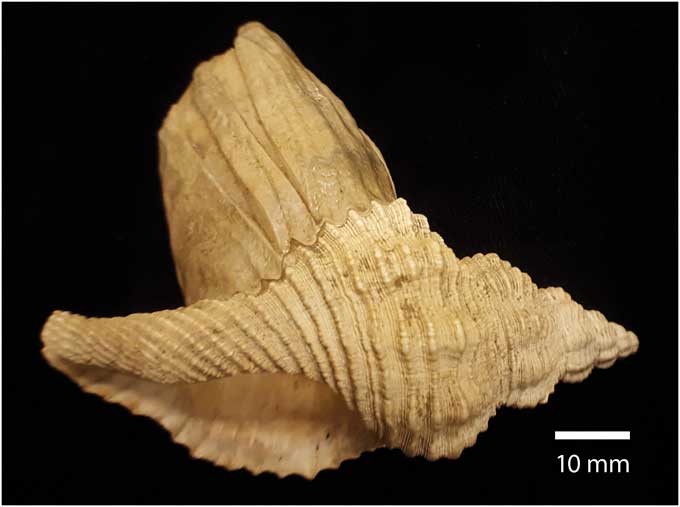
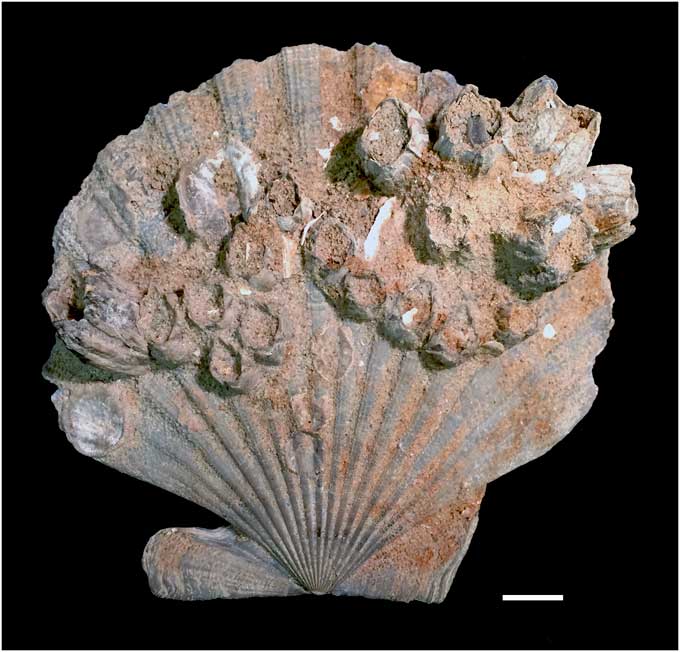
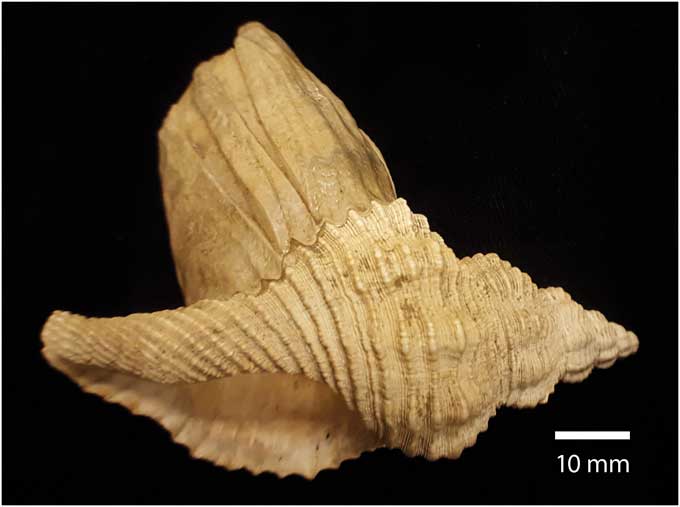
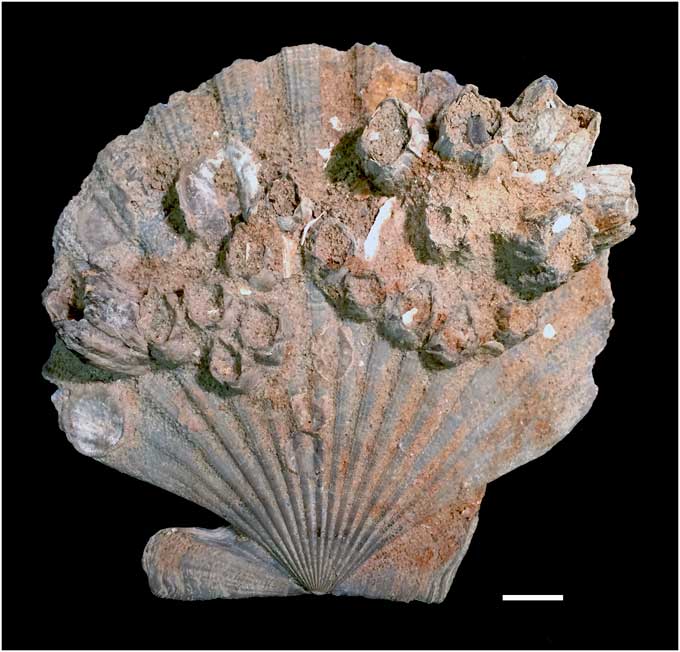
To illustrate how independent sources of evidence can be used to infer the habits and ecological relationships of common fossil species, and to evaluate how extinction is selective not only at the species level but also with respect to entire modes of life, we investigated two large mollusks in the St. Mary’s Formation of late Miocene (Tortonian) age in Maryland, the buccinid gastropod Conradconfusus parilis (Conrad) (Fig. 1) and the scallop Chesapecten santamaria (Tucker) (Fig. 2). Both species are common at the Chancellor’s Point locality in Zone 24 of the Windmill Point Member (Petuch, 1988, 1993, Reference Petuch2004; Ward, Reference Ward1992; Petuch and Drolshagen, Reference Petuch and Drolshagen2010). Conradconfusus parilis is the youngest member of a lineage that extends back in the Chesapeake region to the early Miocene (Petuch, Reference Petuch1993) as Buccinofusus. Its taxonomic placement remains unsettled, but we tentatively assign it to the Buccinidae because of its morphological similarity to such genera as Kelletia, Penion and Troschelia. Snyder (Reference Snyder2002) noted that the genus name Buccinofusus, to which Conradconfusus parilis had been assigned by earlier authors, was preoccupied, and therefore established the name Conradconfusus for this taxon. Chesapecten santamaria, a scallop that likely swam during young stages but became more sedentary as an adult (Gould, Reference Gould1971), likewise belongs to a Chesapeake lineage extending back to the early Miocene (Ward and Blackwelder, Reference Ward and Blackwelder1975).
Buccinofusus parilis, CAS 90301, length 80 mm, with a single large Chesaconcavus chesapeakensis on its dorsal side. Scale bar=10 mm.
Chesapecten santamaria, CAS 90302 (right valve) with a cover of Chesaconcavus chesapeakensis. Note the barnacles at the edge going toward but not beyond the shell margin. Scale bar=10 mm.
The life habits of Conradconfusus parilis have not been investigated. Here we ask whether it was epifaunal, living and crawling on a hard surface, or infaunal, living and burying itself beneath the surface of soft sediments. Second, we determined what kind of predator Conradconfusus parilis was. In particular, we asked whether this gastropod consumed hard-shelled prey by wedging the shell’s outer lip between the valves of prey bivalves, or whether it used methods not involving its shell lip.
Relationships of the animal to the sediment can be assessed in two ways. First, the shells of epifaunal and infaunal gastropods can usually be distinguished on the basis of morphology. Elsewhere, Vermeij (Reference Vermeij2017) has established criteria, based on streamlining and other traits of form and shell sculpture, that are associated with active sand burial. These include a streamlined shape (fusiform or high-spired, with a gently tapering spire and without angulations or an open umbilicus), the presence of terraced features in which the leading edge of ridges or sutures is less steep than the trailing edge, and a pattern of bioerosion and epibiont cover in which the colonists affect only the dorsal side of the shell of a living gastropod.
Second, epibionts can be used as additional evidence for the habits of living gastropods. At Chancellor’s Point, Conradconfusus parilis is frequently colonized by the large barnacle Chesaconcavus chesapeakensis Zullo, Reference Zullo1992. If barnacles settled on living hosts, they should be concentrated on the upper and lateral surfaces of the shell, and no barnacle should extend its base beyond the edge of the shell’s outer lip or grow on the shell’s interior surfaces. Furthermore, many barnacles should curve in the direction of the host’s spiral growth, indicating that they grew in size as the gastropod host added shell material at the outer lip in a spiral direction. Barnacles settling on empty shells or on shells occupied by hermit crabs would not be subject to spatial restrictions and would not be expected to curve in the direction of growth because empty and hermit-crab-occupied shells cannot grow. Interior shell surfaces of empty or crab-occupied shells would normally be colonized by epibionts, whereas they would remain smooth in living snails (Walker, 1988, Reference Walker1992).
Chesaconcavus chesapeakensis also colonized other substrata, including the shells of the large pectinid Chesapecten santamaria. Here again we asked whether barnacles settled on living scallops or on shells after the hosts’ death. In the former case, barnacles should be confined to the outer shell surface and to grow to but not beyond the valve margins. The feeding habits of some predatory snails can be inferred from the contour of the outer lip. In busyconines and fasciolariids that prey on bivalves by wedging the lip between the valves or chipping the valve edges by striking the edge of the lip against the valve margins, the predator’s outer lip has a convex sector where force is concentrated (Dietl, 2003a, Reference Dietlb, Reference Dietl2004; Dietl et al., Reference Dietl, Durham and Kelley2010; Durham et al., Reference Durham, Dietl and Visaggi2012; Vermeij, Reference Vermeij2015). Convex-lipped species often show repeated repaired damage resulting from attempts to wedge or chip prey valves. The predator’s outer lip often sustains damage when the prey shuts its valves in defense. The damage is rarely lethal and is easily and rapidly repaired. Species that do not use the outer lip to subdue molluscan or barnacle prey tend to have a planar outer lip.
We place our investigation of the barnacle, the gastropod, and the bivalve in the broader context of comparative paleoecology by asking how the Miocene community at Chancellor’s Point differs from modern shallow-water marine communities in the same geographical area, the northwestern Atlantic coast of the United States between Cape Cod, Massachusetts, and Cape Hatteras, North Carolina. We also consider other studies of barnacles on shells to assess how our findings compare with those in other fossil and living communities.
Materials and methods
We studied mollusks from Chancellor’s Point, St. Mary’s County, Maryland, collected by Roy K. Kropp in the late 1980s when the site was still accessible. Material comes from what Petuch (Reference Petuch2004) called the Chesapecten santamaria community, a shallow subtidal assemblage in pale silty sand from the Windmill Point Member (Zone 24) of the St. Mary’s Formation of late Miocene (early Tortonian) age. Besides the focal species Conradconfusus parilis and Chesapecten santamaria, the assemblage contains such common large mollusks as the gastropods Coronafulgur coronatus (Conrad), Turrifulgur fusiformis (Conrad, 1840), Gradiconus diluvianus (Green), Ecphora gardnerae Wilson, Mercenaria tetrica (Conrad), Dosinia thori Ward, Reference Ward1992, Dallarca idonea Conrad, and Chesacardium laqueatum (Conrad) (for taxonomy, see Ward, Reference Ward1992; Petuch, 1993, Reference Petuch2004; Petuch and Drolshagen, Reference Petuch and Drolshagen2010). The many endemic lineages in this assemblage existed under warm-temperate conditions (Ward, Reference Ward1992).
We have no information on the method of collection, but the presence of numerous small shells in the collection indicates that material was collected nonselectively with respect to size, epibiotic cover, or other characteristics relevant to this paper. Nevertheless, given that our study deals with specimens from only one locality, we have avoided over generalizing our results and adding undue significance to them.
For Conradconfusus parilis and Chesapecten santamaria, we examined each specimen for the presence and position of barnacles and other epibionts, with particular attention to whether the barnacles would have interfered with the activity of living hosts. Host–barnacle relations at Chancellor’s Point were compared to examples in the Recent fauna, both published and as represented in material from Friday Harbor, Washington, in the Vermeij collection. All material discussed is housed in the Vermeij collection. Each specimen of Conradconfusus parilis was examined for signs of outer-lip damage and repair. We recognized repairs as significant deviations from the normal growth lines on the shell’s last whorl.
Repositories and institutional abbreviations
All material discussed in this paper is in the Vermeij collection at the University of California, Davis. Figured specimens are at the California Academy of Sciences (CAS).
Results and discussion
Barnacles on shells
We found 78 individual and basal scars of barnacles (Chesaconcavus chesapeakensis) distributed among 16 of 27 Conradconfusus parilis, giving an incidence of 59% of barnacle-bearing gastropods and an average of 4.9 barnacles per colonized shell. Specimens with barnacles range in length from 38 mm to 91 mm with a mean of 65.7 mm; specimens without barnacles range from 34 mm to 97 mm with a mean of 65.5 mm. The largest barnacle, on a shell 80.2 mm long, has a diameter of 30 mm and a height of 50 mm. Most barnacles are bent in the host’s direction of growth, and none encroaches upon the host’s aperture in a way that would preclude the shell from clamping to a hard substrate. No epibionts were found in the apertures of Conradconfusus parilis. Our data therefore indicate that barnacles settled and persisted on living Conradconfusus parilis gastropods.
The presence of large barnacles on gastropod hosts as seen in the late Miocene Conradconfusus parilis is noteworthy in part because so few similar cases are known in the living fauna. Small barnacles of various species sporadically settle and achieve adulthood on intertidal gastropods on productive coastlines such as those in Venezuela, Pacific Panama, New South Wales, Chile, and the North Atlantic, but they rarely affect more than 20% of individuals of a given host species (unpublished observations in the Vermeij collection). Barnacles are extremely rare on gastropods and other hard surfaces on reefs (Newman, Reference Newman1960); where they do occur, as on some specimens of Menathais armigera (Link) collected by Vermeij near the reef crest in Palau, the barnacles are flat, not extending above the level of the gastropod shell’s large blunt tubercles.
The only comparable example in the living fauna known to the senior author is the association between the sedentary suspension-feeding or kleptoparasitic gastropod Trichotropis cancellatus (Hinds) in subtidal waters of the San Juan Islands, Washington, and the barnacle Balanus rostratus Hoek. Like Chesaconcavus chesapeakensis, B. rostratus has a cylindrical profile and is cemented to the substrate.
In a sample of 121 T. cancellatus from Rock Point, dredged at a depth of 60 to 75 m, 49 (30%) have one or more barnacles on the shell, and one has an attached brachiopod. This 30% incidence is about half the 59% incidence on fossil Conradconfusus parilis and identical to the 30% reported by Schmitt and colleagues (1983) for the subtidal teguline trochoidean Norrisia norrisi (Sowerby) in southern California. The high incidence of barnacles on T. cancellatus is surprising in view of the periostracal hairs, which discourage settlement by epibionts (Iyengar et al., Reference Iyengar, Sitvarin and Cataldo2008).
Given the limited data available, we have refrained from analyzing these differences in frequency statistically. The significant point is that the observed frequency of barnacles on our sample of Conradconfusus parilis is higher than that on any living gastropod species reported in the literature or as observed in the Vermeij collection, but we make no claims about the representativeness of this high frequency in the Miocene of Maryland.
In the case of the scallop Chesapecten santamaria, barnacles occur on seven of 12 left valves (58%) ranging in shell height from 68 to 115 mm and with a mean height of 85±12 mm; and on two of 12 right valves (17%) with heights of 57 and 134 mm. The five left valves without barnacles range in height from 77 to 136 mm with a mean height of 102±23 mm. Barnacles situated at the valve margin never crossed the margin, but in the single articulated specimen available to us, with a height of 81 mm, barnacles are concentrated near the hinge of both valves, perhaps limiting the bivalve’s ability to open the shell. This example is the only case where the possibility of postmortem settlement by barnacles cannot be dismissed. Inner valve surfaces are free of epibionts but do display traces of repaired damage from endolithic organisms boring into the shell.
We have five examples of large clusters of Chesaconcavus chesapeakensis that seem to have lain and perhaps been rolled on the seabed. Similar so-called balanuliths have been described from the living fauna in the North Sea (Cadée, Reference Cadée2007; Donovan, Reference Donovan2007) and from the Pliocene of Chile (Nielsen, Reference Nielsen2009). In these cases, the initial substrate was the shell of a mollusk, which after death was completely enveloped by the barnacle aggregation. The only other gastropod host that would have been large enough and common enough to have hosted large barnacles at Chancellor’s Point is the busyconine Coronafulgur coronatus. None of the 12 specimens we examined had epibiotic barnacles.
The two hosts supporting abundant Chesaconcavus chesapeakensis at Chancellor’s Point (Conradconfusus parilis and Chesapecten santamaria) have strongly sculptured shells that would seem ideal for settlement by the barnacle’s cyprid larvae. The deep sutures between whorls and the valleys between spiral cords of Conradconfusus parilis as well as the grooves between radial folds of Chesapecten santamaria offered protection for settling larvae and correspond well to the known preference of living cyprids to settle in furrows and grooves on ridged surfaces (Crisp and Barnes, Reference Crisp and Barnes1954; Crisp, Reference Crisp1961; Wethey, Reference Wethey1986). Coronafulgur coronatus may have been less suitable because of its semi-infaunal habits and relatively smooth shell despite its deeply channeled sutures.
Our data on Chesapecten santamaria are too limited to make a strong case that the presence of barnacles limits growth, but the greater size of left valves without barnacles compared to left valves with barnacles is consistent with that hypothesis. Among living species, barnacle epibionts have been shown to interfere with the host’s growth and reproduction in the gastropods Stramonita haemastoma (Linnaeus) in Tunisia (El Ayari et al., Reference El Ayari, Lahbib and El Menif2015), Littorina littorea (Linnaeus) in Germany (Thieltges and Buschbaum, Reference Thieltges and Buschbaum2007), and Batillaria zonalis (Bruguière) in Hong Kong (Chan and Chan, Reference Chan and Chan2005). Similar effects were detected in the mussel Mytilus edulis Linnaeus in Germany (Buschbaum and Saier, Reference Buschbaum and Saier2001) and the scallop Chlamys hastata (Sowerby) in British Columbia (Farren and Donovan), and especially in Mizuhopecten yessoensis (Jay) in eastern Russia (Silina and Zhukova, Reference Silina and Zhukova2016). A heavy load of barnacles impedes the escape response of the Californian Norrisia norrisi (Schmitt et al., Reference Schmitt, Osenberg and Bercovich1983). Such effects would not apply to the sedentary Trichotropis cancellatus and would likely have been minor for Conradconfusus parilis, which like most living buccinids would not have had a well-developed escape response to predators.
Mode of life of Conradconfusus parilis
The presence of abundant barnacles on living individuals, together with details of shell form and sculpture, indicate that Conradconfusus parilis was an epifaunal predator. The strong spiral cords, wide rounded axial ribs, angular whorl profile, and axially straight siphonal canal are consistent with an epifaunal mode of life and inconsistent with the burrowing habit (Vermeij, Reference Vermeij2017). The species lacks adaptations such as ratchet sculpture, a streamlined shape, and other features often or invariably associated with active infaunal locomotion.
The profile of the outer lip of the shell of Conradconfusus parilis is planar when seen from the ventral side. The planar lip implies that Conradconfusus parilis employed neither wedging nor chipping as a method of feeding, which is associated with a convex outer lip (see Introduction). Moreover, only four of 27 individuals (15%) show signs of shell repair, with only one repair per individual, indicating that the species did not damage the shell lip during feeding and that shell breakage by predators was rare. Where damage occurs, it extends over much of the contour of the last whorl, in one case including the siphonal canal, and is thus not limited to the central sector as it is in convex-lipped species that chip or wedge their prey. In these latter species, shells are damaged repeatedly, often showing 10 or more scars per shell in living busyconine and fasciolariine gastropods.
These inferences are supported by the known diets of morphologically similar living species. A planar outer lip, horizontally straight and extended siphonal canal, angular whorl profile, and variably developed symmetrical spiral and axial sculptural elements characterize many melongenids (Hemifusus, Pugilina, Rexmela, and Volegalea), the fasciolariid Triplofusus, buccinids (Kelletia, Neptunea, and Penion), and the turbinellid Syrinx. The melongenids feed on mollusks and, in the case of Volegalea cochlidium (Linnaeus), on barnacles, either by suffocating the prey in the foot or by stealthily approaching prey and then rapidly inserting the proboscis between valves or into the aperture (Morton, 1985, Reference Morton1986; Matthews-Cascon et al., Reference Matthews-Cascon, Matthews and Ferreira Belúcio1990; Bowling, Reference Bowling1994; Tan and Phuah, Reference Tan and Phuah1999; for updated taxonomy of melongenids, see Vermeij and Raven, Reference Vermeij and Raven2009; Landau and Vermeij, Reference Landau and Vermeij2013; Abbate and Simone, Reference Abbate and Simone2015). Species of Neptunea feed on completely closing bivalves and on polychaetes, again by inserting a long proboscis (Shimek, Reference Shimek1984). Kelletia kelleti (Reeve) feeds on bivalves and carrion (Rosenthal, Reference Rosenthal1971). Unlike fasciolariids with a medially convex outer lip, which wedge or chip bivalve prey, species of Triplofusus feed on bivalves and gastropods with methods similar to those of melongenids and Neptunea (Kent, Reference Kent1983; Stupakoff, Reference Stupakoff1986). Syrinx aruanus Linnaeus feeds on large tube-dwelling infaunal polychaetes by thrusting its very long proboscis into the tubes while remaining on the sediment surface (Taylor and Glover, Reference Taylor and Glover2003). Planar-lipped individuals of the buccinid Buccinum undatum Linnaeus also do not wedge or chip their bivalve prey, unlike individuals of the same species with a convex lip (Nielsen, Reference Nielsen1975; Scolding et al., Reference Scolding, Richardson and Luckenbach2007). From these modern examples, we conclude that Conradconfusus parilis fed on prey mollusks and/or polychaetes and perhaps barnacles without the use of its outer lip to subdue prey.
Comparison with modern communities
The genus Conradconfusus became extinct at the end of the Miocene (Petuch, Reference Petuch1993). Not only did it fail to leave descendants, but no gastropod fills its ecological role in the modern northwestern Atlantic fauna on the coast between Cape Cod and Cape Hatteras. Modern predatory gastropods in this region today include large infaunal drilling naticids, small drilling muricids, and large shell-wedging and shell-chipping semi-infaunal busyconine whelks. Large drilling muricids, represented in Miocene and Pliocene communities of the northwestern Atlantic by species of Ecphora (Casey et al., Reference Casey, Farrell, Dietl and Veilleux2015), also disappeared. In short, the extinction of large epifaunal predatory gastropods left an ecological void that has not been reoccupied in the temperate northwestern Atlantic.
The high abundance of large barnacles on shells and other substrates, together with other evidence, points to high planktonic primary productivity at Chancellor’s Point. Experiments in the Java Sea, which like the Neogene Chesapeake region is an epicontinental sea, have shown that abundant suspension-feeding epibionts on shells are associated with high plankton concentrations (Lescinsky et al., Reference Lescinsky, Edinger and Risk2002). The fauna of the Java Sea includes large suspension-feeding bivalves (Placuna, Anadara) and gastropods (Turritella) as well as large predatory gastropods (Hemifusus). Likewise, at Chancellor’s Point, large barnacles lived alongside very large suspension-feeding bivalves of the genera Chesacardium, Chesapecten, Costaglycymeris, Dallarca, Glossus, Mercenaria, and Panopea. Together with large predatory Ecphora and Conradconfusus, these genera show size increases from the early Miocene to the late Miocene and in some cases the Pliocene (Vermeij, Reference Vermeij2012), indicating that planktonic productivity rose during this interval in the Chesapeake region.
Late Pliocene cooling and the ensuing Pleistocene glaciations ended this trend and radically changed community composition in the temperate northwestern Atlantic. Along with some small-bodied clades, most large-bodied lineages of mollusks with a maximum shell dimension of 5 cm or more became globally or regionally extinct. These include epifaunal Chesaconcavus, Chesapecten, Conradconfusus, Conradostrea, Crucibulum, Ecphora, Hippochaeta, Mariafusus, and Perna; soft-bottom epifaunal to semi-infaunal gastropods Coronafulgur, Scaphellopsis, Sycopsis, Turrifulgur, and Volutifusus; nonsiphonate soft-bottom bivalves Costaglycymeris, Dallarca, Granoarca, Glossus, and Marvacrassatella; and siphonate burrowing bivalves Chesacardium, Dosinia, Leptomactra, Mactrodesma, Panopea, and Stewartia (Ward, Reference Ward1992; Zullo, Reference Zullo1992; Petuch, 1993, Reference Petuch2004; Vermeij et a1., 2008; Vermeij, Reference Vermeij2012). Chesapeake lineages of large size surviving to the Recent in the northwestern Atlantic include the epifaunal Crepidula and Placopecten, infaunal bivalves Ensis and Mercenaria, and the infaunal gastropods Euspira and Neverita. Large-bodied lineages colonizing this region from the south include the epifaunal to semi-infaunal Argopecten, Busycon, Busycotypus, Crassostrea, and perhaps Geukensia; the nonsiphonate burrowing bivalves Lunarca and Eontia; and the siphonate burrowers Hemimactra and perhaps Scobinopholas and Tagelus. The epifaunal mussel Mytilus and the siphonate burrowing bivalve Mya entered the region from the North Pacific via the Arctic. Among large-bodied clades, then, standing clade diversity dropped from 21 to 11 in the category of epifauna and semi-infauna, and from 10 to seven in the active infauna. These declines of 48% and 30%, respectively, mirror the greater vulnerability of nonsiphonate as compared with siphonate bivalves observed by Stanley (Reference Stanley1986) in the late Pliocene to Pleistocene of the North Pacific. They suggest a shift from an epifauna-rich to an epifauna-impoverished community of large mollusks. Whether similar shifts have occurred during the same time interval elsewhere has not been investigated.
The coast between Cape Cod and Cape Hatteras is unusual among temperate marine regions for lacking ecological equivalents to the extinct Conradconfusus parilis. Large subtidal epifaunal predatory gastropods that do not use drilling, wedging, or chipping as means of subduing prey occur in the cold-temperate northern hemisphere (Neptunea, Buccinum), the North Pacific (Fusitriton, Kelletia), and Australasia (Argobuccinum, Fenion), as well as on continental shores in the tropics (Melongenidae, Triplofusus and Syrinx, among others). No large barnacle has replaced Chesaconcavus between Cape Cod and Cape Hatteras, again contrasting with the presence of large subtidal barnacles on most other coasts. Whether these absences are related to the relative dearth of subtidal hard bottoms, to the lack of suitable ancestors in the surviving species pool, or to the unusually high seasonal fluctuations in seawater temperature in this part of the northwestern Atlantic is not known.
The important point that emerges from these ecological comparisons is that the faunal composition of the modern shallow subtidal ecosystem of the temperate northwestern Atlantic is atypical. Although some of this uniqueness is attributable to current conditions, much of the peculiar character of the living fauna makes sense only in the context of history, in which extinction and subsequent colonizations from the warmer northwestern Atlantic, the cold North Pacific, and the temperate northeastern Atlantic were the most important agencies of ecological change (Vermeij, Reference Vermeij2005; Vermeij et al., Reference Vermeij, Dietl and Reid2008). It must be noted that, despite these far-reaching changes, the temperate northwestern Atlantic ecosystem has continued to function. Although not the same as the ecosystems of the past, it remains productive, with all trophic levels represented by a mix of native survivors and newcomers. This part of the marine world offers cogent testimony to the resilience of the ecosystems in the face of significant disruptions. Let us hope that this resilience continues under human hegemony.
Conclusions
The history of life is more than simply a changing of the guard as expressed by a blizzard of names and distributions over time. It is instead the story of organisms interacting and evolving with each other in conditions that change over geological time. In this paper, we have set a particular example—barnacles occurring on the shells of living gastropod and bivalve hosts in the St. Mary’s Formation of the Miocene of Maryland—in the broader context of ecological changes in the temperate northwestern Atlantic. We show that several guilds of large predatory gastropods and that of large-bodied barnacles, together with evidence on the life habits of the gastropod Conradconfusus parilis (one of the hosts), disappeared without replacement during the late Neogene. The lack of replacement by ecologically equivalent taxa in the post-Pliocene northwestern Atlantic is surprising in view of the geographic expansion of taxa into this area from both the subtropical western Atlantic and the cool-temperate North Pacific. The Recent biota in this region is unusually impoverished compared to biotas in climatically similar assemblages elsewhere. Although extinction would seem to be largely responsible for this impoverishment, the factors preventing guild replacement in the northwestern Atlantic remain obscure. Future research should take a similar approach to that taken here to place the history of the marine northwestern Atlantic in a larger comparative framework in order to assess the roles of extinction and other agencies in determining the taxonomic and functional composition of the modern fauna in different parts of the world.
Acknowledgments
We thank G. P. Dietl and P. Kelley for carefully reviewing this manuscript, and A. Henry and J. Fong for technical assistance.