1 Introduction
All natural languages have numerous lexical resources, which are quite useful both for human users and Natural Language Processing (NLP). However, their construction and maintenance are very expensive. Some resources are limited to the specific needs of their applications using various structures without any unified linguistic concepts. The reuse of such resources is difficult when the challenge is to merge them in order to obtain a new richer resource. More generally, the exchange remains a difficult (and expensive) issue when nothing has been scheduled for this purpose. To meet this challenge, several projects were conducted such as ACQUILEX (Bogurev et al. Reference Bogurev, Briscoe, Calzolari, Cater, Meijs and Zampolli1988), GENELEX (Antoni-Lay, Francopoulo and Zaysser Reference Antoni-Lay, Francopoulo and Zaysser1994), TEI (Véronis and Ide Reference Véronis, Ide and Piotrowsky1996), Eagles (Calzolari, Mc Naught and Zampolli Reference Calzolari, Mc Naught and Zampolli1996), Multext (Calzolari and Monachini Reference Calzolari and Monachini1996), SIMPLE (Lenci et al. Reference Lenci, Busa, Ruimy, Gola, Monachini, Calzolari and Zampolli2000) and ISLE (Bertagna et al. Reference Bertagna, Calzolari, Lenci and Zampolli2000).Footnote 2 These projects led to the emergence of the LMF (Lexical Markup Framework) ISO standard for the lexical structure modeling (ISO 24613) (Francopoulo Reference Francopoulo2003), (Francopoulo and George Reference Francopoulo and George2008) in association with the ISO Data Categories Registry (DCR)Footnote 3 following ISO 12620 (Ide and Romary Reference Ide and Romary2004). These standards were designed by a group of sixty ISO experts coming from different cultures, languages and continents. Numerous developments followed in different parts of the world.Footnote 4
Unfortunately, the Arabic language did not immediately benefit from the emergence of these standards, although it is spoken by more than 300 million people around the world, and is the official language of more than twenty countries. The language still uses references to different printed dictionaries based on incompatible lexicographical schools. Only few works tried the application of LMF on the Arabic language out, according to previous revisions of this standard. Some developments were made in morphology (Khemakhem, Gargouri and Abdelwahed Reference Khemakhem, Gargouri and Abdelwahed2006), (Romary, Salmon-Alt and Francopoulo Reference Romary, Salmon-Al and Francopoulo2004), (Salmon-Alt, Akrout and Romary Reference Salmon-Alt, Akrout and Romary2005) and some studies were conducted in syntax (Loukil, Haddar and Ben Hamadou Reference Loukil, Haddar and Ben Hamadou2008). However, these works were developed during the drafting of the LMF standard and were not updated according to the ISO validation.
Obviously, the situation of the Arabic lexical resources is below expectation. In case of human use, for instance, most of the existing electronic dictionaries are digitized from a printed version and are not well structured to facilitate access and browsing (Taleb Reference Ait Taleb2005). This situation is largely due to a lack of modeling efforts to face the linguistic richness and the evolution of the Arabic language. In fact, apart from the common data categories (i.e. verb, noun, particle), the Arabic language uses specific subcategories (e.g. deficient verb, common noun, masdar) involving various and numerous kinds of morphological, syntactic and semantic markers. Besides the lexical meanings and connotations, verbs, nouns and particles have syntactic behaviors. And since Arabic is a derivational and inflectional language, Arabic has specific issues related to the links between the original forms and the generated ones, what inevitably influences the organization of the dictionary. For the derivational aspect, the question is to know which original form (i.e. root, lemma) should be considered in order to derive a new lemma and, associated to this rationale, whether the root has (or not) to be considered as an entry. Some irregular forms of nominal inflection (i.e. broken plural) suggest that the inflected forms be entries. In addition, the evolution of the Arabic language forces the lexicographer to introduce new entries that do not respect the classical derivational process based on a root form. It should be noted that the rather popular Arabic edition of WiktionaryFootnote 5 shares our concerns. However, it deals with a superficial structure of resources. Its syntactic model is very light and does not link synonyms to related meanings. Moreover, the relations between meanings and syntactic knowledge are not covered.
In the NLP context, several models have been developed without consensus and are, in general, limited to specific needs while using no common data categories. Therefore, the reuse of most Arabic electronic dictionaries is difficult and their models are incomplete. For example, DIINAR (Abbès, Dichy and Hassoun Reference Abbès, Dichy and Hassoun2004) covers only the morphological level; Arabic WordNet (Elkateb et al. Reference Elkateb, Black, Vossen, Farwell, Rodríguez, Pease and Alkhalifa2006) focuses on the semantic level and some lingware systems use their appropriate lexical resources such as MORPH2 (Chaâben, Hadrich and Ben Hamadou Reference Chaâben, Hadrich and Ben Hamadou2010).
From a lexicographic standpoint, the construction of Arabic electronic dictionaries is confronted with some difficulties observed in the two conventional steps (Ben Mrad Reference Ben Mrad1987): (1) the theoretical study of the content and the organization of the lexical entries (LEs) and (2) the practical step of the population. Given the fact that the population step depends on the quality of the theoretical study, we focused on the difficulties related to this latter. We suggested a solution to the problems mentioned above and related to the modeling of a large Arabic lexical resource. Such a solution was performed during the framework of the validating process of the LMF (ISO 24613) (Khemakhem et al. Reference Khemakhem, Gargouri and Abdelwahed2006), (Khemakhem, Elleuch, Gargouri and Ben Hamadou Reference Khemakhem, Gargouri, Abdelwahed and Francopoulo2007) and through the population of the DCR (ISO 12620), specifically for Semitic languages. The proposed model now covers all linguistic levels (i.e. morphological, syntactic and semantic) with respect to the specificities of Arabic language (Khemakhem, Gargouri and Ben Hamadou Reference Khemakhem, Gargouri and Ben Hamadou2012) with the convention that, in the current text, we use the Habash–Soudi–Buckwalter transliteration scheme (Habash, Soudi and Buckwalter Reference Habash, Soudi, Buckwalter, van den Bosch and Soudi2007). Our model contains the required knowledge for human users and for the NLP in an explicit way while remaining open to extension. The data is associated with a running software tool in order to search, conjugate and collaboratively modify.
The remaining of this paper is organized as follows. We start with the presentation of the Arabic lexicography and give an overview on the related electronic dictionaries. Then, we describe the main ISO standards useful for our work and we specify the standardization of some data categories which are appropriate for the Arabic language. After that, we detail the modeling of the dictionary covering the core and then, the morphological, syntactic, semantic sections. Afterwards, we comment on the implementation of the dictionary and present the systems ensuring its query and practical population. Thereafter, we provide a discussion based on a comparison between the proposed model and those related to some well-known dictionaries.
2 Arabic lexicography
According to Darwish (Reference Darwish1956) and Haywood (Reference Haywood1960), the lexicography of Arabic dictionaries focuses on two main issues that need to be solved. The first issue is the determination of the nature of LEs comprising roots, derived forms and foreign words. This is the macrostructure. The second issue is the internal description of each LE, which includes speech, phonological, morphological, syntactic and semantic information. This is the microstructure and of course, this distinction is not specific to Arabic lexicons but concerns also English lexicons (Landau Reference Landau2001) and French ones (Rey-Debove Reference Rey-Debove1971), for instance.
2.1 Macrostructure
Arabic is a derivational language based on roots that may generate derived forms, considered as lemmas of this language. Each root is a sequence of generally three or four letters, but not considered as a word. The description of entries depends mainly on the nature (root or derived form) of the LE. The words that are not of Arab origin can be either integrated into the language as an Arabic word (Almuςar ~ ab,
 ) that easily supports the application of the derivational aspect and some inflection like
 diynaAr, or added using their transliteration (aldaxil,
 ), like computer
 kambyuwtar and Internet
 ‘antarnaAt. The old dictionaries (i.e. until the end of the nineteenth century) used the root as a LE that groups all its derived forms (lemmas). Such arrangement is supported by the first lexicographic school called ‘the radical school’ (
 Almadrasa
 u Alji∂riya
u). The retrieval process in such dictionaries is difficult: this process is based on human intuition and education, in particular his ability to know in advance the root of the words. In order to overcome this difficulty, many other kinds of arrangements related to other lexicographic schools were proposed, such as the phonetic school (
 Almadrasa
u AlSawtiya
u), the terminal school (
 Almadrasa
u AlqaAfiya
u) and the alphabetic school (
 Almadrasa
u AlhijaA’iya
u AlnuTqiy ~ a
u). The most widespread lexicographic school is ‘the alphabetic school’. It considers each lemma as a LE. All these entries are presented in the alphabetical order of letters (
 ) (Alouani Reference Alouani2008).
2.2 Microstructure
The description of entries depends mainly on the intended use of the dictionary. In old dictionaries, entries have non-regular structures and their contents are varied and based on contexts and examples. However, there are studies that specify the main components of LEs such as the study of Ben Mrad (Reference Ben Mrad1987) that defines three parts to describe an LE:
-
• Part of speech: noun (
 ‘ism), verb (
), adjective (
Sif
), adverb (
Ďarf), particle (
‘adaA
),
-
• Lexical morphology: gender of noun with their inflected forms,
-
• Lexical semantic: definition and context.


Nowadays, electronic versions favor the construction of more detailed and more explicit microstructures than those of printed versions. The organizational problem does not arise within the electronic representation, as it was the case for the printed versions. The explicit representation allows seeking knowledge using simple query languages without knowing the organization of the dictionary. It is rather the microstructure which is the most important issue concerning the development of dictionaries notably with the continuously evolving content. Thus, new requirements in dictionaries’ contents appeared with the electronic version such as conjugation, semantic relations (i.e. synonym, antonym), syntactic behavior and multimedia knowledge (i.e. sounds, videos, pictures).
3 Overview of electronic Arabic dictionaries
3.1 Dictionaries for human use
Electronic Arabic dictionaries dedicated to human users are extremely rich in linguistic, lexicographical and cultural information. However, they are generally poorly structured: this is a difficulty for the computer operations which require cleanly coded information. The search tools are unable to extract the best information from the current organization of these dictionaries. Both human experience and intuition are required in such cases. The situation of these dictionaries makes their reuse a costly and laborious process. Moreover, the internal content of LEs is borrowed without any adaptation to the technological innovation. Examples of these dictionaries are the SakhrFootnote
6
computerization of the old dictionaries ‘lisan Alarab’
 ‘Alqamous AlmuwhiT’
 ‘AlwasiyT’
 , ‘Elganiy ~ i’
 . Moreover, there are some bilingual dictionaries (e.g. Ajeeb, Larousse and Alexandria) that result from a simple translation of words to foreign languages. Other works as Dutch-Arabic bilingual dictionary (Maks, Tiberius and Van Veenendaal Reference Maks, Tiberius and Van Veenendaal2008) are based on LMF. These dictionaries are incomplete and very poor in linguistic knowledge.
3.2 Dictionaries for NLP use
Most of the existing lexical resources deal with a unique linguistic level and are generally adapted to the specific needs of the intended applications. Examples of lexicons covering the morphosyntactic level are the Buckwalter lexicon (Buckwalter Reference Buckwalter2004), Morph2 system lexicon (Chaâben et al. Reference Chaâben, Hadrich and Ben Hamadou2010), ElixirFM lexicon (Smrž Reference Smrž2007), DIINAR lexical database (Abbès et al. Reference Abbès, Dichy and Hassoun2004), Nooj Arabic Dictionary (Mesfar and Silberztein, Reference Mesfar and Silberztein2008), AraComLex lexicon (Attia et al. Reference Attia, Pecina, Lamia, Toral, Van Genabith, Mahlow and Piotrowski2011), AraLex (Boudelaa and Marslen-Wilson Reference Boudelaa and Marslen-Wilson2010), Unitex lexicon (Doumi et al. Reference Doumi, Lehireche, Maurel and Alicherif2013) and SALMA lexicon (Sawalha, Atwell and Abushariah Reference Sawalha, Atwell and Abushariah2013). For the semantic level, the Arabic WordNet (Elkateb et al. Reference Elkateb, Black, Vossen, Farwell, Rodríguez, Pease and Alkhalifa2006) seems to be the most used one. The models and structures of such resources are not extendable and they are difficult to reuse in a different lingware environment. For example, the DIINAR does not represent the lemmas, but it generates them from roots, using a set of rules. Doing so, the meanings cannot be associated to the lemma (absent in this case). Some resources, like Arabic WordNet, focus exclusively on the semantic relations and are of limited linguistic coverage. It is worth noting that some resources are dedicated to Arabic dialects, used as an informal means of communication (Diab et al. Reference Diab, Habash, Rambow, Al Tantawy and Benajiba2010), (Maamouri et al. Reference Maamouri, Bies, Buckwalter, Diab, Habash, Rambow and Tabessi2006).
4 ISO standards related to lexical resources
There are two main standards for the modeling of lexical resources, that work together. The first is LMF (ISO 24613), which proposes a consensus for the structure (or skeleton) of the data. The second is the DCR (ISO 12620), which describes the linguistic concepts by means of data categories. The latter is used to enrich the structures defined by means of the former (i.e. LMF).
4.1 Lexical markup framework: ISO 24613
LMF is a meta-model that provides a common standardized framework for the construction of NLP lexicons and Machine Readable Dictionaries (MRD). The specification is an ISO standard defined in Unified Modeling Language (UML), whose aim is to manage data exchange, and enable the merging of a large number of individual electronic sources from extensive global electronic resources. The meta-model is organized as different extensions and an obligatory core package. It should be adorned by data categories that are selected from the DCR.
4.2 Data category registry: ISO 12620
Data Categories represent basic linguistic concepts (e.g. /part of speech/, /grammatical number/) and describe the specific linguistic properties of a language, independently of a specific model. In order to share data categories within the community, the ISO TC 37/SC 4 developed the online DCR, especially used simultaneously with the other standardization activities. The DCR specifies the names and definitions for data categories relevant to the language resource domain as well as the management procedures for a DCR for Language Resources.
4.3 Modeling process
The LMF standardization process for lexical resources construction starts with the selection of the necessary classes to represent the lexical resource from the model that includes a core and a set of extensions such as morphology, morphological pattern, syntactic, semantic and MRD. The presence of the core is mandatory according to LMF. The selected classes are then enriched with data categories that are selected from the DCR. In addition, we can define a set of new data categories that are needed but unavailable in the DCR. This supplemental set of data categories should be registered with the DCR Registration Authority and managed according to ISO 12620.
5 Specific lexical concepts of Arabic
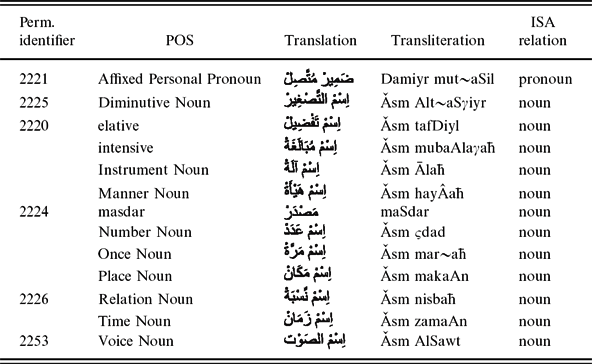
Most of the Arabic words are characterized by a root and a scheme, which are respectively normalized under the permanent identifiers number 2231 and 2174 in the DCR. These words refer to three categories: noun, verb and particle. Each category has many specific subcategories in order to improve the morphosyntactic analysis. For example, masdar is a subcategory of the noun that can replace the verb in a nominal sentence. This specification is supported by the standard that uses subcategories as well as main categories as part-of-speech (POS). It links the main category and their subcategories by the ‘is a’ relation. However, there are some values that are necessary for the Arabic language, but that are not registered in the DCR, so we have added several POS values. The specific nominal subcategories are presented in the following Table 1.
The specific subcategories of Arabic nouns

Among the characteristics of nouns, there is elInclusion (2219 in the DCR) indicating if the noun may be associated with the article Al ‘
 ’. The inflection of some nouns stands by a morphological feature: broken plural (2218 in the DCR) that does not have any inflection. The specific subcategory of the Arabic verbs is deficient verb (3007 in the DCR), knowing that these verbs have two subcategories: plain and deficient. Among the characteristics of verbs, we indicate the aspect and mode that are requested in the conjugation. The aspect may take these values: accomplished (cessative), unaccomplished and imperative; the first two values are respectively normalized under numbers 2001 and 2217 in the DCR. The unaccomplished may have the indicative, subjunctive and apocopeFootnote
7
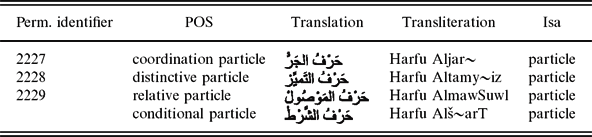
moods. The latter is normalized under number 2254 in the DCR. The specific subcategories of the Arabic particle are presented in the following Table 2.
The specific subcategories of Arabic particles

6 Core modeling
The LMF core model is the mandatory part of a normalized resource. This core contains two types of information: general and common. The general information describes the entire lexicon of the language, the version, the creation date and the authors. The common information is needed at several linguistic levels such as LE Footnote 8 , Form and Sense. The LE has a very important role in organizing the various portions of the lexical resource and can serve as a connector that links all related knowledge.
6.1 Main directives
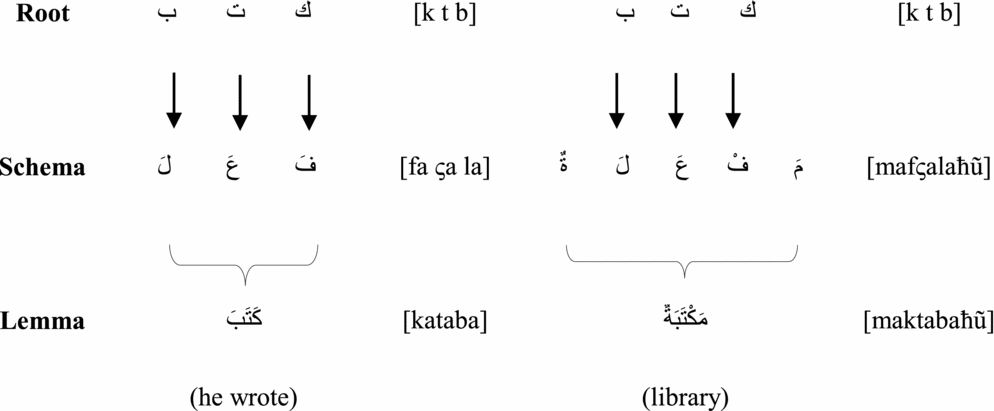
We believe that the core model of the Arabic language should be structured by its derivational aspect, which is based on roots and schemas. A large part of Arabic words are derived forms obtained by using a generation process. This generation process consists in replacing the three consonants of the schema (
 [f ς l]) by the consonants of the concerned root, while preserving the same order of letters. The lemma is obtained by replacing the consonants of the schema
 respectively with the consonants of the root
 , while maintaining the other components of the schema (
 ) for the second example. We can classify the schemas into two types: the verbal schemas and the nominal schemas. Thus, from a root, we can generate nouns and verbs according to the used schema. In Figure 1, the verb
 [kataba] is obtained using the verbal schema
 [faςala], whereas the noun
 [maktaba
ũ] is obtained by applying the nominal schema
 [mafςala
ũ]. Thus, the schema is considered as a mold on which the root flows, as shown in the following figure.
Example of derivation from the root.

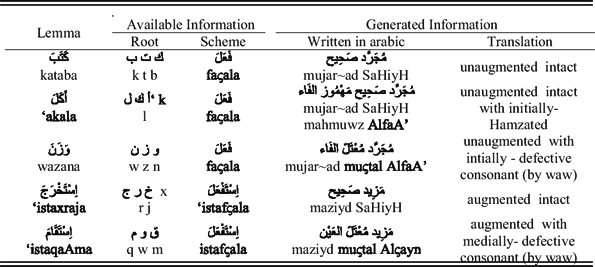
The derivational aspect has influenced Arabic lexicographers in the choice of the type (root or derived form) of the LE for their dictionary. The resources for human use are organized according to the roots while including all their derived forms or according to the derived forms, which represent their roots as complementary information. For NLP use, many works such as DIINAR (Abbès et al. Reference Abbès, Dichy and Hassoun2004), Buckwalter lexicon (Buckwalter Reference Buckwalter2004), ElixirFM (Smrž Reference Smrž2007) and SALMA (Sawalha and Atwell, Reference Sawalha, Atwell and Abushariah2013) are based on derivational rules for generating morphosyntactic knowledge including the derived forms. In this case, the population of such resources by other levels, particularly the semantic level, hit serious problems because the words are not persistent. The rules used can generate forms, but cannot generate their meanings with their syntactic particularities. For this reason, we have chosen the extensional representation for the derivational aspect. Accordingly, we presented the derived forms and the roots as LEs and we used the morphological relations to ensure the link between these two types of entries. In this way, we can satisfy the different lexicographical schools. In addition, for each derived form, we identify its schema and the relation with its root (see Section 7.1). The schema and the root used for generating a derived form can indicate several other morphological, syntactic and even semantic informations (see Table 3) and avoid their presence in the dictionary as unaugmented or augmented, intact or initially-defective or medially-defective knowledge.
Examples of morphological information generated

It shall be noted that a second level of derivation process can be applied on a word (and not on a root) in order to obtain another derived word (see Section 7.1).
6.2 Core model for Arabic
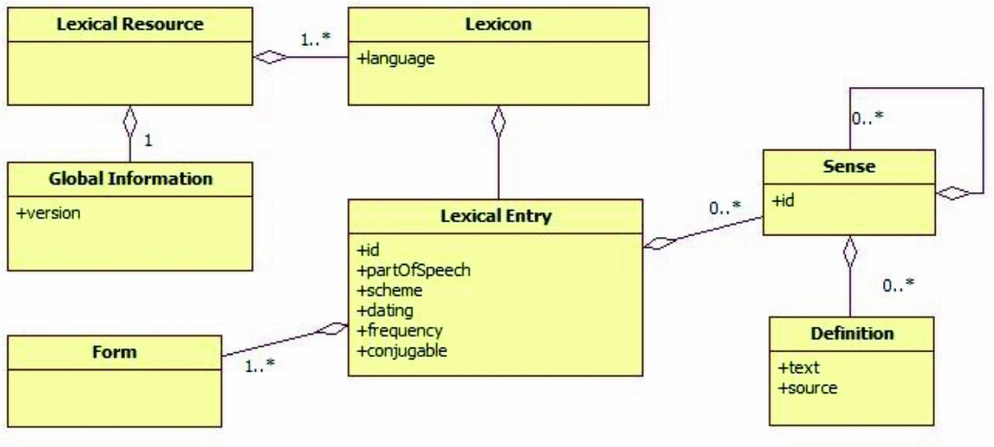
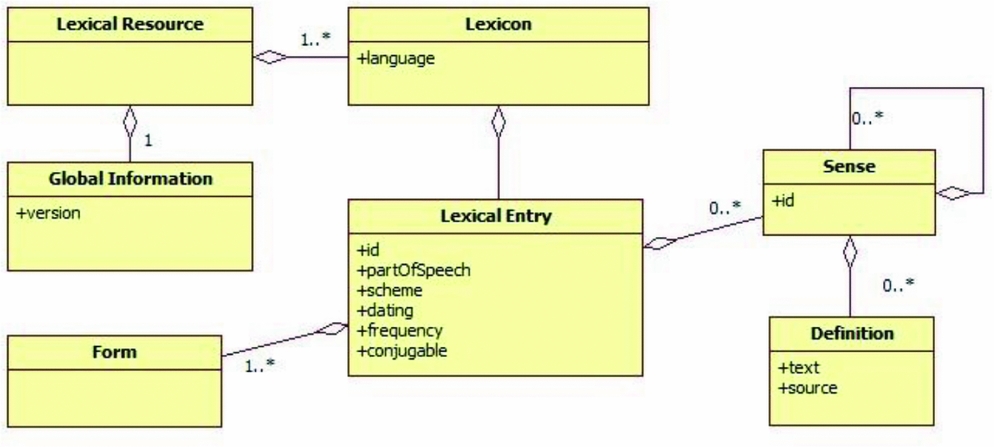
The following Figure 2 specifies the classes and the main data categories of the core model.
Core model diagram for Arabic.
The core model is composed of the following classes:
-
• Lexical Resource: It is made up of one or more Lexicons and Global Information instances.
-
• Global Information: It includes all the general pieces of information of a lexical resource such as title, version and creation date.
-
• Lexicon: It is made up of one or more LE instances and characterized by a language. It has a very important role, because it can contain components that are shared by several LEs as Morphological Pattern and Subcategorization Frame instances.
-
• Lexical Entry: It is the most important class that represents the words of a language and consists of one or more Form instances. It can represent roots (i.e.
/k t b/,
/l ‘ b/), derived forms (i.e.
/kâtib/ ‘writer’), letters (i.e.
), invariable words (i.e.
/kam/ ‘how’,
/wa/ ‘and’) or words of the non-Arabic origin (i.e.
/kambyûtar/ ‘computer’). An LE can bring together several meanings or it may not indicate any meaning as in the case of roots. For each LE, we assigned an identifier.


If an LE is a root, then the Data Category (DC) type should be set as ‘root’. Else, the LE should hold multi-valued POS information. These values are the grammatical categories (for the Arabic language: noun, verb and particle) or the subcategories (e.g. for nouns: common noun, masdar). In addition, each category of words has a set of specific DCs as follows:
-
• Verbs: schema, etymology, etc.
-
• Nouns: schema, etymology, etc.
-
• Particles: etymology, etc.
-
• Letters: nature (defective/saint), characteristic (aloud/whisper), phonetic output, etc.
-
• Sense: This class can have several definitions and several sub-meanings. Each meaning must have an identifier that allows us to ensure the semantic links between them. Besides, it can be characterized by the DC: semanticClass and nature (metaphorical/literal).
-
• Definition: It contains a text and its source. We note that, according to LMF, each meaning may have more than one definition.
-
• Form: It is an abstract class representing a lexeme or a morphological variant. It has subclasses, such as Lemma and WordForm, which belong to the morphological extension.
7 Morphological modeling
The morphology of an Arabic word is characterized by the derivational and the inflectional aspects. The description of these aspects is given first, in order to argue the morphological model.
7.1 The derivational aspect: complementary description
It should be recalled that the derivational aspect is based on a root and a schema to give a derived form. This can be the basis of the derivation, that is to say, a schema can also be applied on a word (already derived form) to generate a new derived form. So we have two levels of derivation: the first is based on a root, and the second is based on a derived form. For example, as illustrated in Figure 3
 [x r j – xaraja – maxrajũ] belongs to the same derivational chain, which is based on the root ‘

 ’ [x r j]. This root is combined with the schema ‘
 ’ [faςala] to give us a derived form «
 »[xaraja]. This can be the basis of a derivation, that is to say, it can be combined with a schema «
 »[mafςalũ] to give us a new derived form «
 »[maxrajũ]. The LE «
 »[xaraja] must have a link to ensure the connection with its root «
 »[x r j], and another link (i.e. a stem link) to ensure the connection with its derived form «
 »[maxrajũ].
Derivation.

7.2 The inflectional aspect
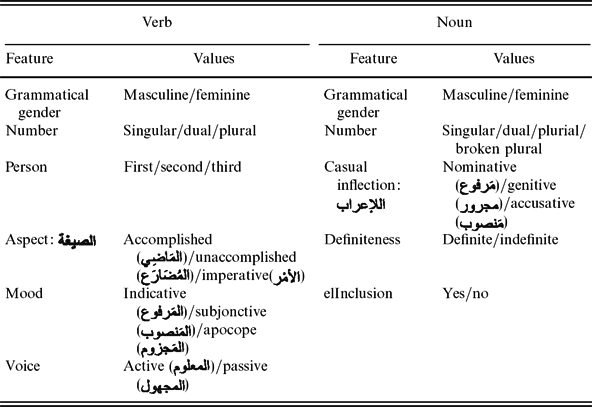
For the inflectional aspect, we adopt a representation that includes the minimum lexical information ensuring maximal coverage. The representation is mainly descripted in intensionFootnote 9 by means of symbolic features and not in extension by listing all inflectional forms. The intensional representation is applied to regular inflections of verbs and nouns (i.e. the dual, the regular feminine plural, see Section 8). The extensional representation is used for irregular inflections, especially the nouns that are broken plural. For the nouns which have an irregular inflection, we save all their inflectional forms with their morphological features. The presence of this information in a dictionary improves the results of the analyzers and provides human users with precise information about the conjugation of Arabic words. The morphological features that characterize the Arabic verbs and nouns are presented in the following table.
7.3 The Arabic morphological model
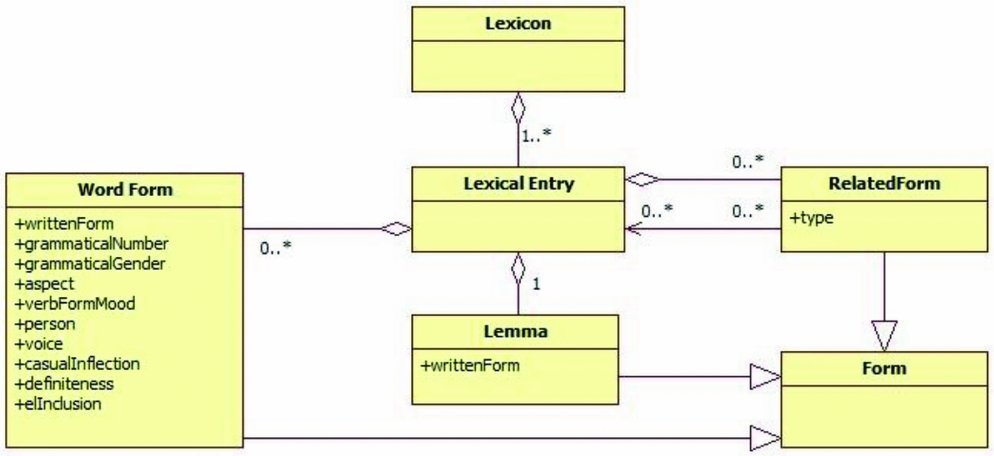
The LMF standard offers a morphological extension for the representation of the morphological knowledge of a LE. In the following Figure 4, we present the classes and the main DCs of the Arabic morphological extension.
The Arabic morphological model diagram.
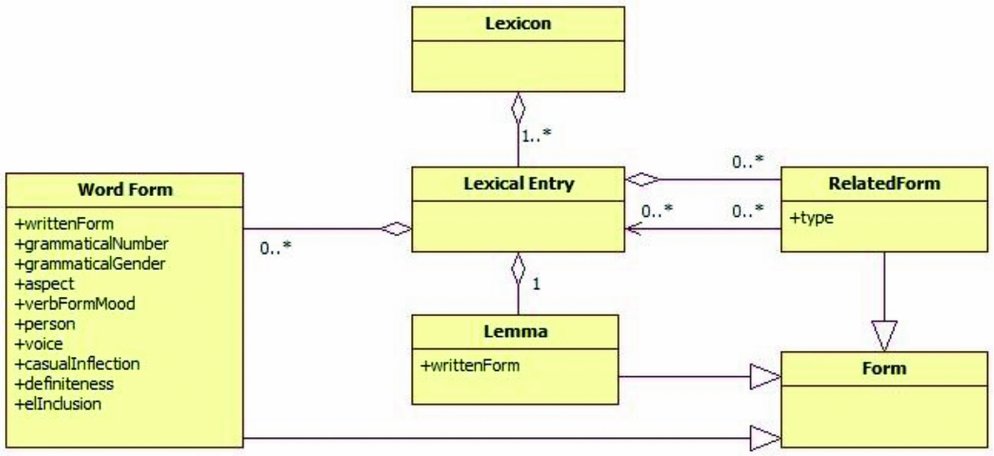
The model of the morphology extension is composed of three classes:
-
• Lemma: This class is required for each LE. It represents the canonical form of a word into the written form DC. If the word is a noun, its canonical form must be singular. If the word is a verb, its canonical form must be accomplished with the third person singular. To maximize the coverage of linguistic information, we opted for the representation of vowelled words. We note that it is unnecessary to submit the unvowelled form of a word since it can be generated. However, we removed the last vowel of the names that have no importance to the morphological level because its presence creates an explosion of syntactic base. This vowel varies according to the position of the name within the sentence.
-
• Word Form: It presents an inflection form of the LE in its DC written Form. The other DCs vary with the category of the LE. For example, following DCs are used for nouns: grammatical number, grammatical gender, casual inflection, definiteness, elInclusion (see Table 4).
Table 4.The morphological features for Arabic verbs and nouns
-
• Related Form: Its aim is the representation of the derivational aspect. The DC type allows the specification of the derivation links between the different LEs.

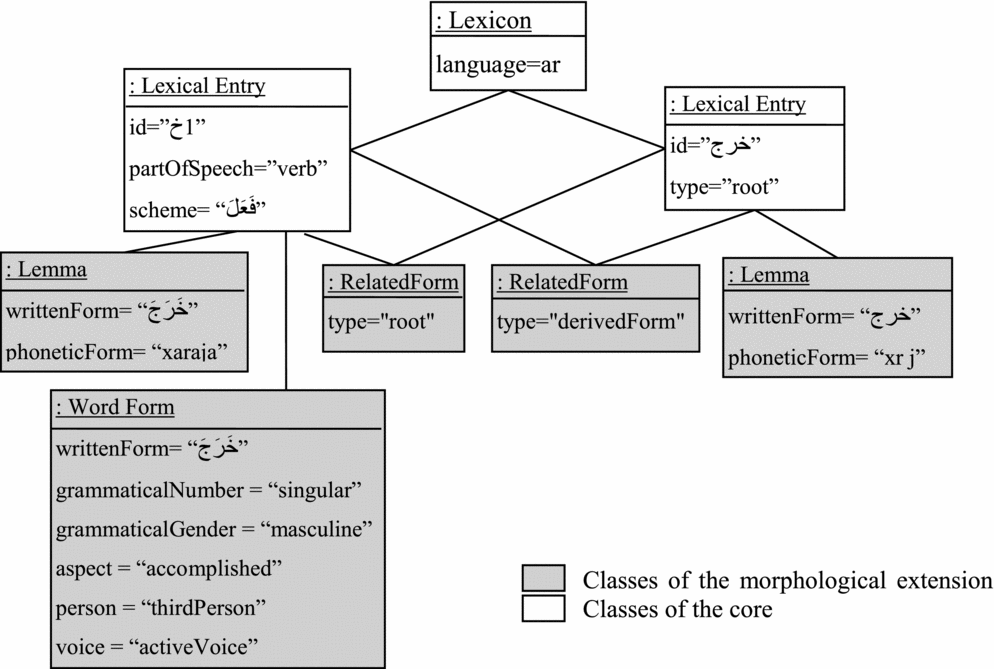
In the following figure, we applied our model on a part of the example presented earlier. It should be noted for the user who is not familiar with UML, that this is an object diagram, in other terms, a diagram for an example, with instances instead of classes (with the class name being underlined, following UML conventions). In contrast, the previous UML diagrams were model diagrams, in other terms, general diagrams.
Figure 5 gives an UML object diagram of two LEs: ‘
 ’ and ‘
 ’ which are connected with two Related Form objects. The left object belongs to the entry ‘
 ’ in order to link its root, which is another entry. The latter is ‘
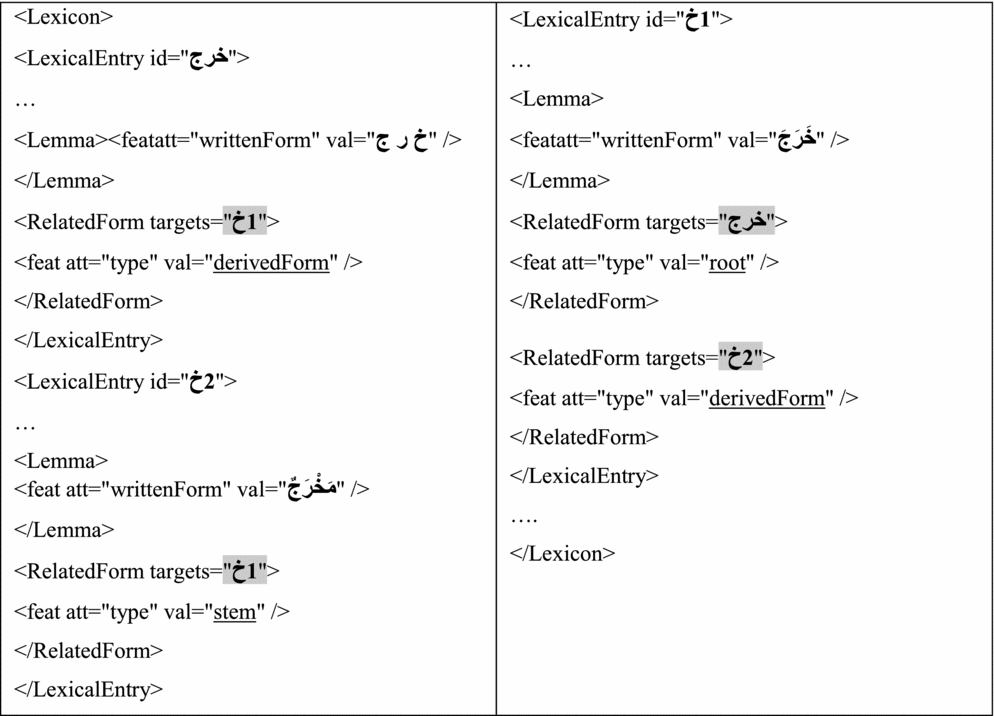
 ’ (a root), which has the second object Related Form to connect one of its derived forms. This example is represented in Figure 6 with the identifiers used in the binding being graphically shaded.
The object diagram for two entries ‘
 ’ and ‘
 ’.

XML extract related to the morphological relationship of three entries.

8 Morphological pattern modeling
A deep study of the conjugation process facilitates the generation of the inflected forms and promotes the lemmatization process while providing interesting morphological features. In the Arabic language, both nouns and verbs are inflected. Nouns present many irregular forms, whereas the regular ones use phonological rules. However, the verbs inflection is more complex and concerns about 16,000 verbs. In this section, we focus on the Arabic verbs inflection.
8.1 The inflection of Arabic verbs
An Arabic verb is conjugated in two steps:
-
• The first step is a rule application to get the basis form depending on aspect, mood and voice.
-
• The second step is the addition of an affix, which depends on gender, number and person.
The following Figure 7 illustrates the conjugation process for the verb ‘
 ’.
An example of calculating the inflected form for the verb ‘
 ’.

The paradigm of conjugation of a verb depends on its root (the nature and the number of consonants) and its schema. We identified forty-two classes of roots and twenty-two classes of schemas. The combination of these two kinds of classes led, after refinement, to 256 paradigms (Khemakhem et al. Reference Khemakhem, Gargouri, Abdelwahed and Francopoulo2007) representing an exhaustive grid of Arabic verbs inflection.
8.2 The model of morphological pattern
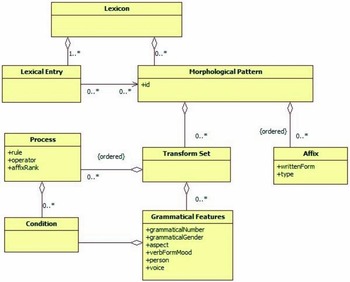
The LMF standard provides a powerful representation of the morphological patterns, which allows the distinction between the conjugation rule and the addition of an affix to calculate an inflected form. Being designed for all language morphologies, the system is rather complex and due to space limitations, only a short outline is presented here. The following Figure 8 gives the model of the morphological pattern showing the main DCs.
The Arabic morphological pattern model diagram.

The model of the morphological pattern extension consists of six classes:
-
• Morphological Pattern: It is characterized by an identifier. It has several ordained affixes and zero or more Transform Set instances. We will use this class to present an inflectional paradigm bending that generates all the inflected forms of a word. It must be referenced by one or more LEs.
-
• Affix: It presents the affixes used by a pattern. It has the DC written Form and type that can take the values: prefix and suffix.
-
• Transform Set: It includes all the processing needed to compute the inflected forms of a given aspect, mood and voice. It consists of a set of processes that present the treatments, and one Grammatical Feature, which includes the features of a basic form which is common to a set of inflected forms.
-
• Process: It represents a single treatment. This treatment may be either a rule or an operation of adding an affix. If the process presents an operation, then it must have an instance of the Condition class.
-
- To specify a rule: We use the DC rule, which generates the basic form. This DC is composed of two parts: the first presents the original form of the LE, and the second presents the transformations to apply to the LE: <
>. Braces mark these transformations. -
- To specify an operation: we use the DCs operator, affixRank. This operation allows the addition of an affix with respect to a given gender, number and person. Thus, the operator specifies addAffix. The affixRank specifies the serial number of the affix.
-
-
Condition: It is made up of a Grammatical Feature, which includes the features specific to the addition of an affix.
-
Grammatical Features: It includes a set of morphological features that characterize an inflected form.

9 Syntactic modeling
For the Arabic language, there are two types of sentences: nominal and verbal. A nominal sentence is distinguished by the absence of a complete verb (
 Al’afςaAl Alt ~ aAma
) and can be influenced by the deficient verbs (
 Al’afςaAl Aln ~ aAqiSa
) or the functional particles (
 AlHuruwf AlςaAmila
). Thus, besides the complete verbs, the deficient verbs and functional particles have idiosyncratic syntactic information. We specify the subcategorization frames of complete verbs, deficient verbs and functional particles.
9.1 The complete verbs
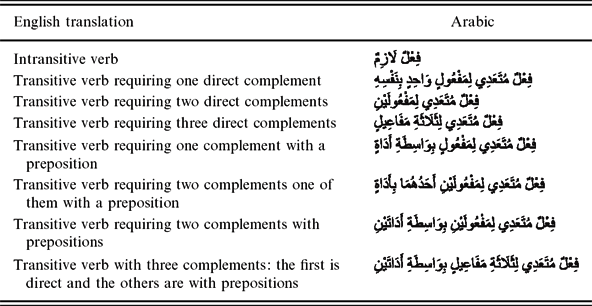
In the case of complete verbs, the types of subcategorization frame depend on the number of necessary complements to the verb and the need of one or several particlesFootnote 10 with these complements. In the following Table 5, we present the eight subcategorization frame types of the complete verbs, specified in earlier work (Loukil et al. Reference Loukil, Haddar and Ben Hamadou2008).
Types of subcategorization frame for complete verbs

9.2 The deficient verbs
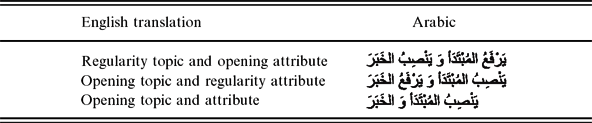
The deficient verbs are used with the nominal sentences that are made up of a topic and an attribute. The types of subcategorization frame depend on the mode of the components of the nominal sentence. We have three types of subcategorization frame for deficient verbs illustrated in the Table 6.
Types of subcategorization frame for deficient verbs

9.3 The functional particles
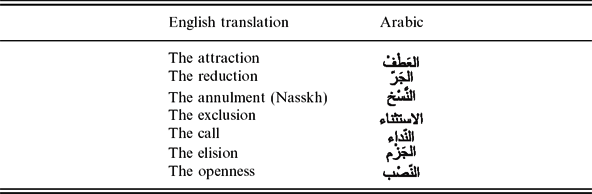
Concerning functional particles, these letters are used with nominal sentences. The types of subcategorization frame depend on the mode and the nature (noun, verb) of the components of the nominal sentence. We have retained seven types of subcategorization frames for particles, indicated in Table 7.
Types of subcategorization frame for particles

9.4 The Arabic syntactic model
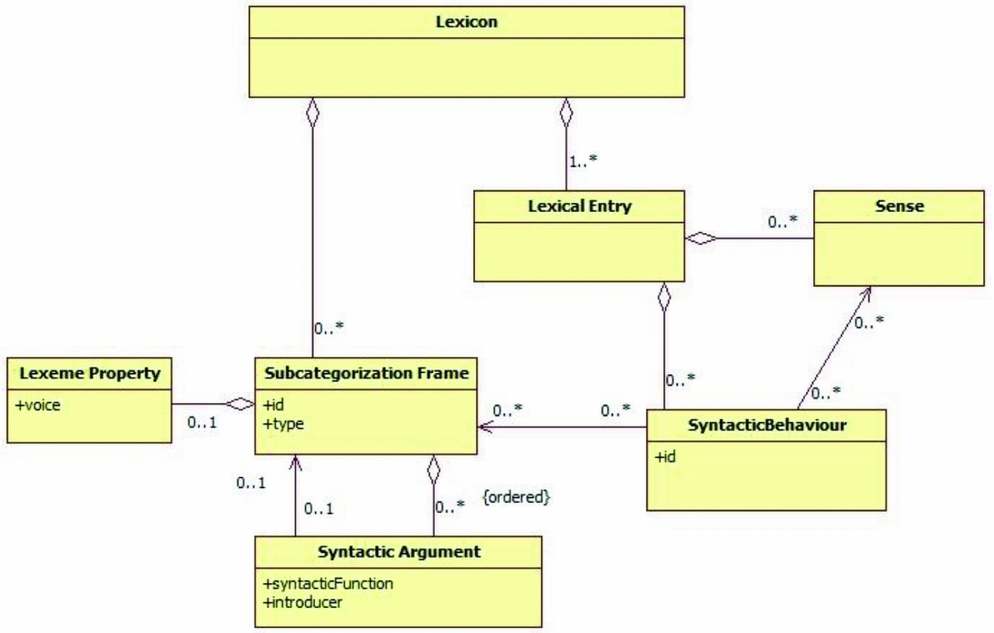
The syntactic extension allows the representation of the syntactical context (i.e. in a sentence) of an LE through subcategorization frames. Therefore, we have to specify the possible frames for an LE and their appropriate matching to the various meanings.
The following Figure 9 specifies the model of the syntactic LMF extension.
Syntactic Arabic model diagram.
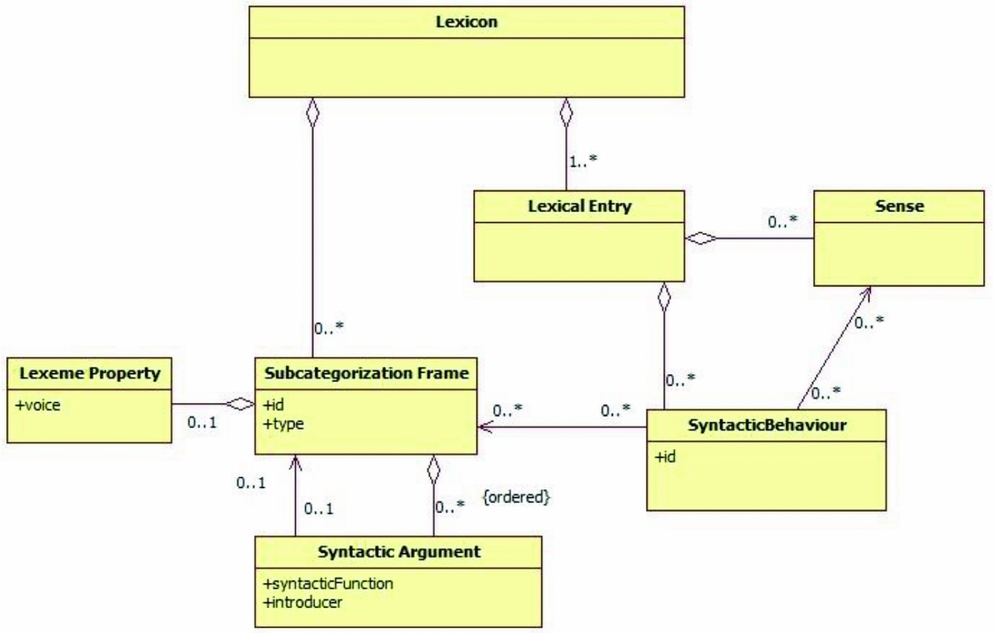
This model is composed of the following classes:
-
• Subcategorization Frame: It is specific to a lexicon. It is composed of a set of Syntactic Argument instances and a Lexeme Property instance includes the characteristics of the central node of this frame. It is characterized by an identifier and a type.
-
• Syntactic Argument: It represents an argument of a Frame and has two DCs, syntactic Function and introducer. The introducer is usually a particle that precedes this argument. The syntactic Function can take values that depend on the sentence described by the frame:
-
• If the sentence is verbal to active voice, then it can take the values: agent (
faAςil), complement (
mafςuwl bihi). -
• If the sentence is verbal to passive voice, then it can take the values: pro-agent (
naA’ib AlfaAςil). -
• If the sentence is nominal, then it can take the values: topic (
mubtada’), attribute (
xabar).
-
-
• Lexeme Property: It represents the features of the central node of the frame. Generally, the node is a verb that must specify these features as the voice.
-
• Syntactic Behavior: The main role of this class is the specification of meanings which agree with a subcategorization frame as shown in Figure 10. It is characterized by an identifier.


Example of a syntactic link.

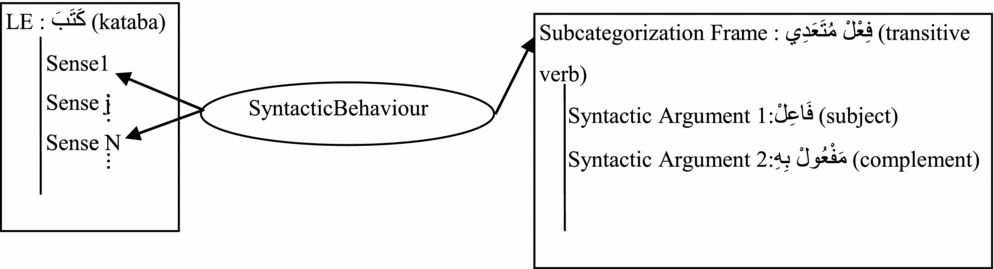
Figure 11 shows the connection between the senses of the LE
 kataba and the subcategorization frames using a Syntactic Behavior class.
Example of connecting between an entry and subcategorization frame.

10 Semantic modeling
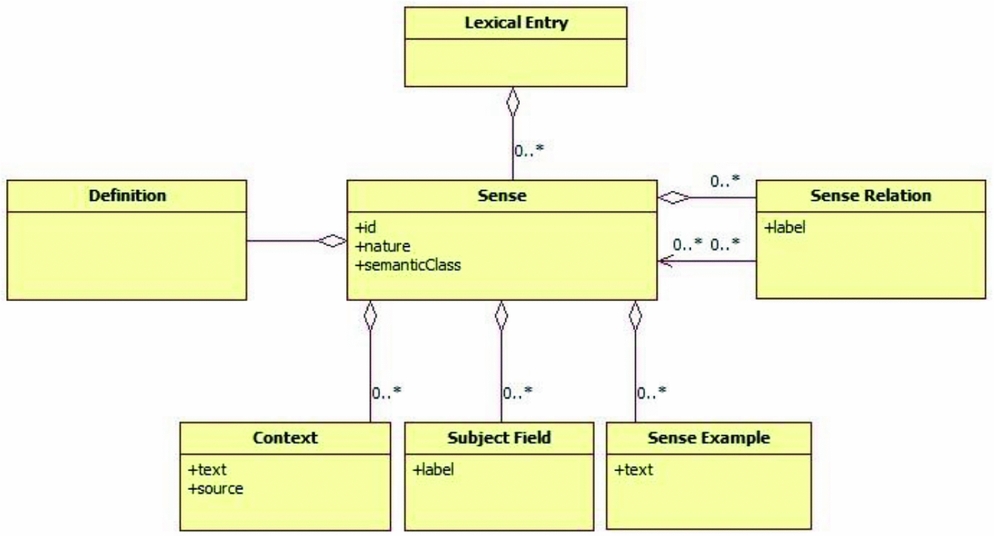
According to LMF, the semantic knowledge is spread across the core, the semantic and the MRD extensions. In the following Figure 12, we present the selected classes and the DC added in the Sense class.
Arabic semantic model diagram.

Each sense is characterized by its nature (literal or metaphorical) and semantic class (i.e.
 AlςaTfu,
 AlĎan,). In addition, we selected two classes of the semantic extension:
-
• Sense Relation: It allows connecting the senses belonging to different LE. There are several types of relationships. We quote mainly the synonym and the antonym. We present the type of link in the DC label.
-
• Sense Example: It represents an instance or a sample of meaning.
We selected two classes from the MRD extension:
-
• Subject Field: It is used when the meaning is specific to a particular area.
-
• Context: It represents an example of using an LE in the frame of a given meaning. It has the DC text that takes a sentence and a source representing the origin of this sentence.
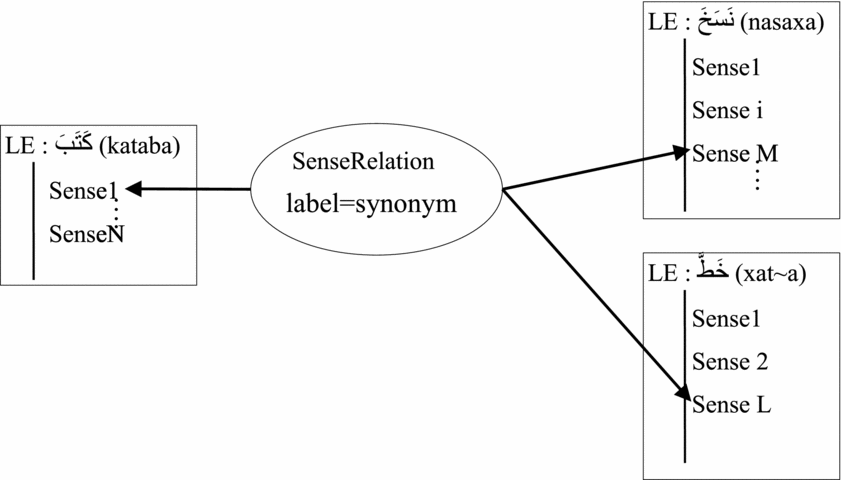
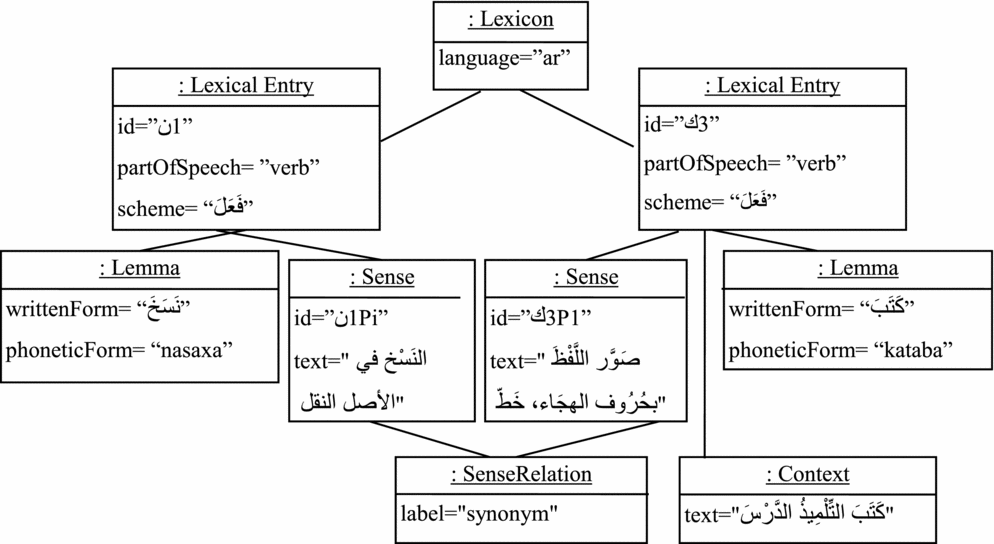
Figure 13 illustrates the principle of semantic link between entries supporting the meaning of the verb ‘to write’ using Sense Relation. In this illustration, we link the synonymous meanings of the three LE, but not the entries. The same example is given in the following figure, when applying the normalized model. Figure 14 shows an example of link between the two entries ‘
 ’ kataba and ‘
 ’ nasaxa through their synonymous meanings using the Sense Relation object.
Illustration of the semantic link principle between ‘
 ’ and ‘
 ’.

Part of the object diagram for the entries ‘
 ’ and ‘
 ’.

11 Syntactic/semantic interface
LMF specifies the interface between syntax and semantics within the semantic extension. This interface consists mainly of syntactic arguments and their semantic equivalent, an example and a definition as shown in Figure 15 below.
-
• Predicative Representation: This class represents the interface between syntactic and semantic levels. It is specific to one meaning, it consists of a syntactic behavior, a semantic predicate and the correspondence between the two.
-
• Semantic Predicate: This class represents a general meaning with its associated arguments that are represented in the Semantic Argument class. The examples of the predicate can generate a new meaning which is presented by the Definition class.
-
• Semantic Argument: It is a class representing each argument of a given semantic predicate.
-
• SynSemCorrespondence: This class represents a set of SynSemArgMap instances for a given Subcategorisation Frame instance.
-
• SynSemArgMap: It is a class that links each semantic argument to its corresponding syntactic argument.
Arabic syntactic–semantic model diagram.

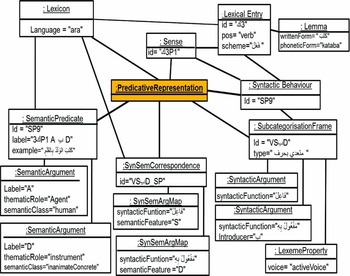
The originality of our model is in the representation of the semantic predicate (using Semantic Predicate and Semantic Argument classes) and its link with the syntax through Predicative Representation class that sets the interface between syntactic and semantic levels. It is specific to one meaning and consists of a syntactic behavior, a semantic predicate and the correspondence between the two instances.
In the previous example, given in Figure 16, we show how to ensure the link between a meaning of LE, one syntactic behavior, one semantic predicate and their correspondence using Predicative Representation class. The semantic predicate has two semantic arguments. The first has the following attributes: thematic role = ‘agent’ and semantic class = ‘human’. The second argument has the attributes: thematic role = ‘instrument’ and semantic class = ‘inanimate concrete’. In addition, we link the semantic arguments to their corresponding syntax. Thus, the specification of the semantic features in each argument is useful in filtering, checking the compatibility and enriching of the semantic representation.
Example of syntactic–semantic link.

12 Implementation
12.1 XML serialization
As recommended by LMF, we use XML to implement our model. Furthermore, with the richness and complexity of this model, notably the various relationships between the dictionary knowledge (e.g. LE, sense, subcategorization frame), we resort to a rigorous knowledge codification. Moreover, in order to manage the huge number of LEs and their related knowledge properly, we propose an appropriate organization in order to facilitate its population and exploitation.
12.2 Collaborative acquisition tool
The richness of the Arabic language and the fineness of the proposed model make the population process of the dictionary difficult and time consuming. To overcome these problems, we are in favor of a collaborative approach. This is why we developed a user-friendly website which allows the lexicographers to participate in the populating of the dictionary. This website is a system formed by a graphical interface that covers the whole description of a LE and a set of API (Application Programming Interface), which controls the acquisition of knowledge using completeness and consistency rules. The implemented tool consists of a main Web page (see below) for the acquisition of general information and appropriate for Web Pages for each linguistic level. All the Web Pages act dynamically according to the type of knowledge like POS and subcategorization frame.
In this main web page, there are four zones (Figure 17). The first zone is for the lemma of the LE. The second is for the category specification (verb, noun and particle). The category specification is mandatory and it constrains the other zones. For example, in zone 3, if the LE is a particle, the scheme, stem and root are not considered. In zone 4, which encompasses the three sides, the morphological side does not appear since particles do not have morphological characteristics and are invariable.
Example of a population interface for a verb.

12.3 Dictionary
In order to accelerate the feeding of the dictionary, we converted the content of print dictionaries into a normalized dictionary (Khemakhem et al. Reference Khemakhem, Elleuch, Gargouri and Ben Hamadou2009). We carried out the conversion of El-Ghany dictionary [http://www.alfaseeh.com]. Doing so, we obtained 40% of our current entries. A group of lexicographers have participated in the validation of the conversion results and have enriched the obtained entries by specific knowledge according to the proposed model such as subcategorization frames, semantic classes, thematic roles and semantic predicates. Twenty students and four professors worked on a partial time basis over a period of eight years, and it is difficult to give accurate figures concerning the manpower spent in these manual operations.
Concerning the API associated to the built dictionary, we implemented the tools of the collaborative acquisition/population that will be available online as soon as possible. Moreover, we have implemented and made available the query tools for human use on the Web: http://elmadar.miracl-apps.com. Theses query tools cover, among others, the service of generating inflectional forms based on morphological patterns of the model.
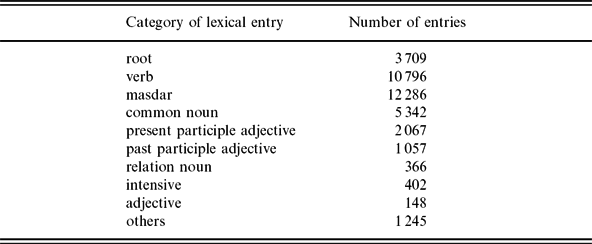
At present, the lexicon contains 37,418 LEs that are distributed according to their categories (see Table 8), knowing that we have used the word ‘others’ that gather the LE categories which have a low number of occurrences, such as diminutive noun, once noun and particle.
Distribution of entries according to their category

In this following Table 9, we give the number of morphological relationships.
Distribution of morphological relationships

13 Discussion
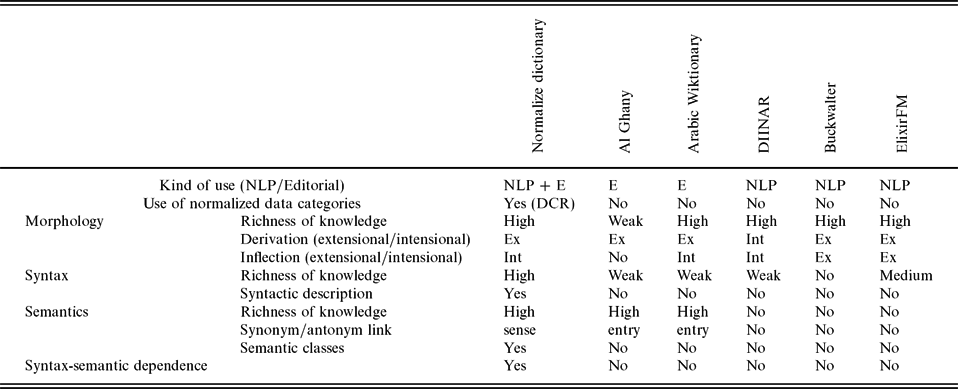
The aim of the present section is to compare El Madar (i.e. our lexicon) with the models of some well-known dictionaries such as DIINAR, Buckwalter, ElixirFM, Al-Ghany and Wiktionary. To this end, we retain the criteria related to the kind of use, the compliance to standards and the linguistic coverage while highlighting the models fineness. Thus, as it is shown in Table 10 given below, we clearly note that El Madar is the only one to deal with both human and NLP uses and to apply normalized data categories. Concerning the morphological coverage, we observe that several dictionaries including El Madar are rich enough. They generally apply an extensional representation of derived words. This can be beneficial to each derived word to fix its knowledge such as meanings. Only the DIINAR dictionary uses the linguistic rules to generate derived words. However, regarding the inflectional aspect, El Madar as well as Wiktionary and DIINAR resort to the intensional representation using inflectional rules, whereas the other dictionaries use an extensional representation. As for syntactic richness, we can state that only El Madar has a high coverage. The others either have an average coverage, like ElixirFM, or a weak and even null one, as Buckwalter. In addition, El Madar is the only one that represents syntactic behaviors. Regarding the semantic representation, only human use dictionaries including El Madar are rich enough. However, El Madar is characterized by the representation of semantic classes of entries. It is also the only dictionary that links synonyms and antonyms to the appropriate meanings and not to the entries, while providing flexibility of choice of the semantic relationship through the link Sense Relation. Moreover, the other novelty of this dictionary stems from its reliance on syntactic and semantic knowledge (Khemakhem, Gargouri and Ben Hamadou Reference Khemakhem, Gargouri and Ben Hamadou2011).
Comparison of Arabic dictionaries models

El Madar widely fulfills the requirements of human use while ensuring a good coverage at all linguistic levels. In addition, it is very powerful for the NLP use and contains finely structured knowledge favoring a selective access. In this regard, several Lexical Web services have been developed to query the normalized dictionary for both human and NLP uses (Ben Abderrahmen et al. Reference Ben Abderrahmen, Chaari, Gargouri and Jmaiel2006), (Ben Abderrahmen, Gargouri and Jmaiel Reference Ben Abderrahmen, Gargouri and Jmaiel2009). Furthermore, the normalized model is so rich and explicit that it enhanced our team to propose an approach to generate domain ontologies (Baccar, Gargouri and Ben Hamadou Reference Baccar, Gargouri and Ben Hamadou2010), (Baccar, Gargouri and Ben Hamadou Reference Baccar, Gargouri and Ben Hamadou2011), (Baccar, Gargouri and Ben Hamadou Reference Baccar, Gargouri and Ben Hamadou2012).
14 Conclusion, current and future work
In this paper, we propose a normalized model of an electronic dictionary for the Arabic language. The originality of our model lies in offering several gathered features that, to our knowledge, no other Arabic dictionary provides. Besides, the advantages provided by the use of ISO standards (i.e. LMF-ISO 24613, DCR-ISO 12620) such as unification of linguistic concepts, flexibility, extensibility and interoperability, the proposed model is useful for human as well as NLP uses. Moreover, it covers all linguistic levels (i.e. morphological, syntactic, semantics) and their intersection aspects. Furthermore, the model is finely structured and rich in relationships in such a way that it allows us to seek all linguistic concepts and relations between them. The morphological patterns provide the generation and lemmatization of the corresponding derived forms by means of a factorized and optimal set of linguistic structures. The dictionary promotes the analyses of Arabic texts by providing explicit knowledge like syntactic behaviors and semantic predicates, useful for the syntactic–semantic analyses. In order to illustrate this model, we developed an appropriate tool for the collaborative population and query for large lexicon. At present, the dictionary contains more than 37,000 entries covering various categories (i.e. root, verb, noun, adjective) connected by different links (i.e. morphological, semantic, syntactic–semantic). An appropriate codification has been used in order to optimize both knowledge representation and access time. To this end, an appropriate API is now implemented, based on the Web services approach (Ben Abderrahmen et al. Reference Ben Abderrahmen, Gargouri and Jmaiel2009), (Baklouti et al. Reference Baklouti, Fakhfakh, Gargouri and Jmaiel2013). This piece of software is used to test a new generation approach of domain ontologies, which shows very promising results. We intend to expand the use of the developed collaborative population system by making it available publicly on the Net.
Our current work is to confront the lexicon with the Penn Arabic Treebank to compute a precise percentage of coverage. Our future work will be to confront the lexicon with pages which are collected automatically from the Web in order to be sure that most frequent modern neologisms, buzz words and proper nouns are effectively covered.
We also follow the work done within the W3 C Ontology-Lexica Community GroupFootnote 11 based on LMF and LemonFootnote 12 concerning the relation between ontologies and lexicons in association with Resource Description Framework (RDF), but the specifications are not stable enough to be concretely applied.