Natural disasters kill, on average, 60 000 people globally each year. Reference Ritchie and Roser1 Disasters include tornadoes, wildfires, earthquakes, hurricanes, and man-made acts of mass violence. Health care providers must be trained to quickly respond to these disasters to prevent the delay of treatment or failing to rescue those most in need. Personnel deployed to disasters are thrust into extreme circumstances, facing destruction and danger while trying to care for survivors. Immersive training that teaches providers to react competently in caring for affected populations will save lives.
Current literature identifies a paucity of training and experts in disaster response, creating a need to research how to prepare for the worst situations we can face. Reference Turale2 This lack of knowledge creates delays in an effective response and management of a crisis. Current disaster response training for health care students is insufficient and has traditionally consisted of either case studies or 1 simulation. Training in a safe college simulation center for 1 class or even 1 day does not give the students the experience that responders face when deployed to a disaster. There is a demand for adequate training in responding to disasters. The World Health Organization states that due to the gaps in knowledge and familiarity with disaster response, it is difficult to recruit and provide trained responders. 3 Additionally, many responders arrive out of moral obligation and willingness to help. Untrained volunteers arrive with no understanding of their role and can potentially become a burden to the response by draining resources and time. Additionally, health care providers who have been deployed previously are requesting experiential training to understand the physical, psychological, emotional, and ethical challenges when faced with disasters. Reference Li, Li and Chen4,Reference VanDevanter, Raveis and Kovner5
The purpose of this pretest, posttest, single group pilot study was to assess the effectiveness of a 3-day immersive disaster education intervention for undergraduate health care and emergency management students. The study’s aim was to assess the disaster response familiarity of these students exposed to an intervention with experiences that mimic true disasters. The intervention included the fatigue, psychological challenges, physical stresses that are faced in real disasters, which allowed us to measure the effectiveness of the immersive interprofessional education. This provided students with realistic experiences coupled with faculty guidance. With training and practice in immersive realistic events, the health care providers can react appropriately when disaster strikes and they are faced with devastating outcomes. The improved competency of the health care providers in austere settings that would be found in true disasters may reduce mortality and promote a more effective response.
Methods
Intervention
The Missouri Hope scenario was based on a devastating EF5 multivortex tornado similar to the one that struck Joplin, Missouri in 2011. A 3-day realistic immersive education event began with creating four supervised interdisciplinary teams. The response framework was based on the Incident Command Structure from the National Incident Management System. 6 Each team rotated through 6 challenges with each iteration lasting 3 hours. The participant teams were required to adapt and overcome each challenge utilizing their collaborative expertise with the goal of rescuing as many survivors as possible. Faculty from the Consortium for Humanitarian Service and Education (CHSE) included a Brigadier General, a representative from the Institute of Peace in Washington DC, Homeland Security personnel, a Green Beret, professors in economics, nursing, emergency management, and business, with additional faculty of firefighters and law enforcement officers. All exercise staff have previously responded to global and national disasters and represented 8 universities with 25 partnering state and county emergency response agencies assisting.
Each interdisciplinary team of 10 to 12 students was guided by 2 faculty whose focus was to team build, helping the students progress through processes and organizational challenges while learning leadership and followership. The students were tasked with 6 challenges that included high building rescues, water rescue, incident command post or creation of a field hospital, a disaster village mass casualty situation, a nighttime search and rescue, and water treatment training. Two to 4 additional faculty were stationed at each challenge to guide the tasks associated with the specific challenge while the team’s faculty focused on the process and organization challenges. A minimum of 4 faculty at each challenge guided the 10-student team. Just-in-time training on triage, safety, medical field first aid, psychological first aid, occurred on Friday morning prior to deployment in a round robin fashion. Realism was accomplished by adding Missouri National Guard medics and police role players who also assisted in training the students in field triage and treatment. Four times over the weekend, the student teams were rotated to one of the challenges. They were presented with opportunities to practice and care for survivors with limited supplies and available support personnel. After each challenge, a targeted debriefing occurred for reflection and guidance. Real moulage role players were used at each challenge point. As an example, the field hospital received 65 patients to triage, treat, and arrange for safe transport in a 3-hour period staffed by 4 nursing students equipped with a purposeful lack of supplies. Real ambulances, helicopters, boats, and tents were used, and the students were faced with a lack of technology and ongoing communication issues to increase the realistic frustrations and stress experienced in real disaster events. The Red Cross attended these training events, and when requested, Red Cross supplies for medicine, dressings,and food were provided as a Red Cross donation drop box. This approach of providing realistic stresses over a 3-day period allowed the students to experience the positive and negative emotions and the incredible fatigue associated with disaster response.
Instrument
The 18-question adapted Emergency Preparedness Information Questionnaire (EPIQ) survey was administered pre- and post-intervention. This is a 5-item Likert scale that assesses familiarity with disaster response concepts. The tool has been provien to be valid and reliable in previous studies and psychometric tests. Reference Georgino, Kress, Alexander and Beach7 The survey’s sub-concepts/domains include: disaster triage, assessing critical resources and reporting, incident command, isolation, quarantine, and decontamination procedures, psychological issues in disaster situations, epidemiological and critical decision making, and communication and connectivity.
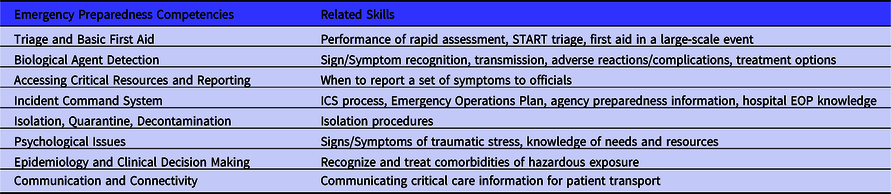
Competencies for Triage and Basic First Aid included performance of Simple Triage and Rapid Treatment (START) and administering first aid in several mass casualty events. For Biological Agent Detection, performance included recognition, transmission, adverse reactions/complications, and treatment options. Competencies in Accessing Critical Resources and Reporting was assessed by challenging the students with limited resources and a surge of incoming survivors to the field hospital. Communication with Incident Command and Logistics to attempt to meet the influx of up to 80 injured, and only 4 nursing personnel tested the students’ competency to adapt and overcome. Incident Command competencies included emergency operation processes, collaboration with an actual hospital emergency room, ambulances, air ambulances, the Red Cross, police, and fire departments. Psychological Issues required identification by the students of signs and symptoms of traumatic stress and performance in treating/supporting the survivors. Epidemiology and Clinical Decision Making included hazardous exposure victims and communicable disease identification. Throughout the exercise, Communication and Connectivity was tested with communication failure injects and creation of slow responses from Incident Command.
The original tool was regressed to emergency department nurses’ familiarity with large-scale disasters (r2 = 0.734, F = 264, P < 0.001). All 8 dimensions were statistically significant (P < 0.001). A factor analysis was arranged from 0.83 to 0.94 with an alpha for the total instrument at 0.97. Reference Garbutt, Peltier and Fitzpatrick8 This survey tests the Experiential Learning Theory’s abstract conceptualization change from pre- to post-intervention.
Data Management/Analysis
Inclusion criteria to attend the event comprised college students from 6 national universities whose curriculum has demonstrated personnel and supply support for previous trainings. Exclusion criteria for this study included the inability to read English as demonstrated by not being able to follow the survey instructions. Data were collected on paper and then entered into the REDCAP data management system. Data were cleaned and missing data were identified. Data were analyzed using IBM SPSS Statistics for Windows, Version 25. A Wilcoxon Ranked test was conducted with an alpha of 0.05. This study was categorized exempt from the University of Missouri Kansas City (UMKC) institutional review board No. 2017404.
Results
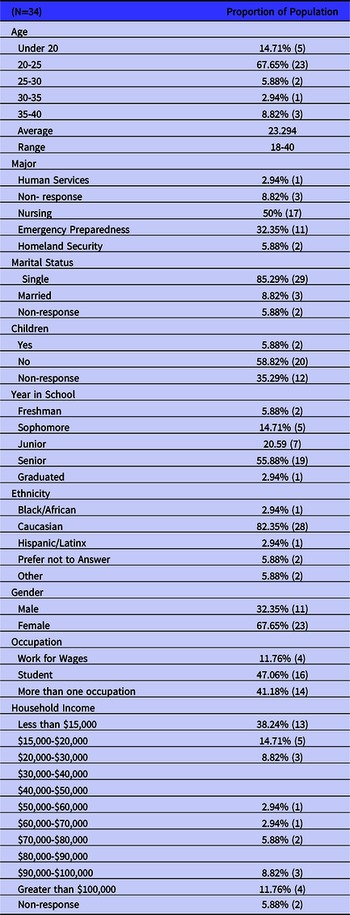
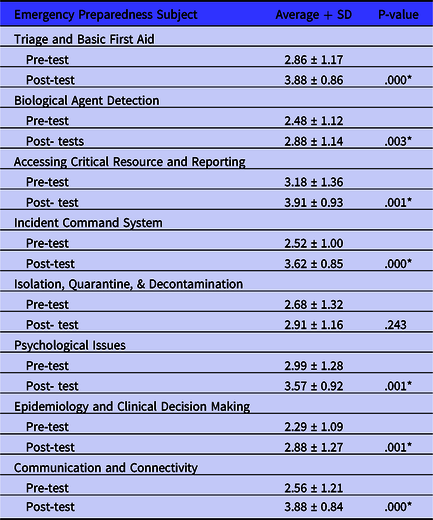
Forty students were approached, 36 consented with 2 surveys eliminated due to the pretest demographic information not matching the posttest information. A total of 34 participants’ data were analyzed. Missing data included 1 cell in the pretest data and 2 cells in the posttest data from 3 different participants and 3 different questions. Statistically significant improvements in triage, biological agent detection, assessing critical resources, incident command, psychological issues, clinical decision making, and communication (range of P = 0.000–0.003). Isolation, quarantine, and decontamination were not statistically significant (P = 0.243). Improvement in clinical significance resulted in a change from limited knowledge to familiarity with the subject in all cases except isolation, quarantine, and decontamination. The demographic results are displayed in Table 1. All exploratory results are displayed in Table 2.
Sample demographics

Self-efficacy ranking averages N = 34, (triage and basic first aid N = 33)

Significance set at <0.05 designated with an *. SD = Standard Deviation
Key: (1=I have no knowledge of this subject, 2= I know terminology but no knowledge over the subject, 3= I know terminology but have limited knowledge over the subject, 4= I am familiar with this topic but not extremely proficient in the subject, 5= I am familiar and an expert in proficiency on this subject)
Competencies

Discussion
Current disaster response training is inadequate in today’s high-risk world. Innovative techniques that improve rescue techniques in a lived experience are imperative to lessen the catastrophic outcomes that large scale disasters produce. Our study results provide strong evidence that in 3 days, interdisciplinary students learned important concepts and reactions in a disaster situation. Our study reported statistical and clinical improvements in all areas, except isolation and quarantine, and demonstrates the effectiveness of immersive education. Isolation and quarantine are not an objective of this exercise so the non-significant results were expected. These results are similar to studies conducted by Park and Kim, Reference Park and Kim9 and Huh and Kang, Reference Huh and Kang10 who reported success with their immersive disaster response training.
Experiential learning concepts incorporated in this immersive training provided tactile, visual, vestibular, and auditory stimulation with lights, sirens, fatigue, smells, and visual realities. This intervention was as close to the actual experience as possible and allowed faculty discussion with students about improvements, misadventures, concepts, and organization while supporting the responder’s mental, emotional, and psychological status. Gaillard describes the necessary attributes required for improved response, stating that for disaster risk reduction to occur, improvement in personal and collective capacity is required to respond correctly, efficiently, and with knowledge. Reference Gaillard, Cadag and Rampengan11 Current artificial (simulation) and partial (classroom) experiences do not provide the personal growth and teamwork needed for efficient capable responses.
Full-scale trainings such as this have their own challenges. This training accommodates only 50 students at a time. At present, the organizations and faculty volunteer their talent, time, and supplies, and the 3 events held by the Consortium do not overburden this system but increasing the number of training events require monetary and academic support. This limits the number of participating students. To expand this training, funding and support from communities and academic institutions would have to be sought to accommodate larger numbers. Additionally, if further research is conducted over immersive training, considerations should be taken during replication through an Institutional Review Board in order to address potential challenges, efforts, and risks to participants.
Limitations
Results from this limited study need to be viewed in context. Participants were fatigued when the posttest was given, and mentoring faculty potentially influenced responses, creating a Hawthorne effect. The small numbers, lack of diversity, and homogeneity of the sample could introduce bias. Although the gender mix was representative, the predominantly Caucasian students render the results less broadly representative. Therefore, these results should be interpreted appropriately in light of these limitations.
Conclusions
Interdisciplinary immersive education for disaster training is successful both statistically and clinically. Immersive education gives the participants real crisis situations helping students improve responses and cope with fatigue, stress, and challenges they will face in a real disaster. To increase the number of similar large-scale events, organizations and faculty must be recruited and funding sought. Future randomized controlled trials with multicenter events are needed to determine the efficacy of this intervention.
Funding statement. This project was supported by University of Missouri Kansas City, Office of Undergraduate Research and Creative Scholarship through a SEARCH grant, “The Effect of Immersive Training on Emergency Preparedness Self- Efficacy.”