Introduction
There have been significant changes in the youth labour market and in the school-to-work trajectories of young people over the last three decades in Britain and, indeed, globally (Bynner, Reference Bynner2001; Lawy, Reference Lawy2002). Shifting social and economic conditions resulted in record rises in youth unemployment in the 1980s and the collapse of the traditional route of early school-leaving and rapid entry into employment (Pollock, Reference Pollock1997). The transition to adulthood has become more individualised, with educational attainment increasingly important in shaping young people's life chances – something likely to have impacted especially the poorest and lowest-achieving young people (Pollock, Reference Pollock1997; Bynner, Reference Bynner2001).
Some research suggests that young people and their parents often have poor knowledge of available post-16 options and thus cannot make effective plans for destinations after compulsory schooling (see Taylor, Reference Taylor1992). However, there is a dearth of research examining the link between young people's aspirations for future occupations and their labour market outcomes.
In this study, we use longitudinal data from the British Youth Cohort Study (BCS70) to examine whether young people who hold uncertain occupational aspirations, or aspirations that exceed likely educational attainment at age 16 (Schneider and Stevenson, Reference Schneider and Stevenson1999), are more likely to be NEET than those whose aspirations are certain and aligned with their educational expectations. Using a nationally representative dataset allows us to explore potential moderating factors, such as social class, on the link between age 16 ambitions and subsequent NEET status. We first turn our attention to a consideration of the contemporary importance of ‘NEET’ in British social policy. We then describe the changing context of youths’ transition into the labour market, followed by a discussion of young people's aspirations and the implication of uncertain aspiration for becoming NEET.
Labour market restructuring and the emergence of ‘NEETs’
With the collapse of the youth labour market in the 1980s, young people who were not in work, education or training became a point of increasing concern for British policy-makers. The government response in the United Kingdom focused on what were seen as individual failings of unemployed young people such as their lack of skills, qualifications or motivation. There emerged what France calls ‘a concentrated system of programmes aiming to discipline the young to the new economic environment and job market’ (Reference France2007: 19). Numerous changes were made between 1980 and 1993 to the official status of unemployed young people and their access to benefits (France, Reference France2007).
Since the election of New Labour in 1997, many of these issues were reframed into concern for the ‘social exclusion’ of young people, conceived as a combination of factors, including poor physical and mental health, substance abuse, poor quality housing, crime, poverty, family breakdown, and future long-term unemployment (Social Exclusion Unit [SEU], 1999). The importance of employment was set out early on: ‘the best defence against social exclusion is having a job, and the best way to get a job is to have a good education, with the right training and experience’ (SEU, 1999: 6). Policy began to focus on the situation of young people not in education, employment, or training, who became known by the acronym ‘NEET’. The reduction of the numbers of NEET young people became a key government performance target for youth services (National Audit Office, 2004).
Early policy discussions recognised the diversity of the NEET population, and focused on the varying difficulties associated with young people's exclusion and disengagement (SEU, 1999). There soon evolved, however, a policy perspective conceptualising NEET as an inherently negative situation connected to educational under-achievement, long-term unemployment, low aspiration and social exclusion (DfES, 2002). Such use of the NEET label has been criticised for, among other things, its lack of focus and its aggregation of different sub-groups of young people under one label that defines them by what they are not (see Yates and Payne, Reference Yates and Payne2006). It is thus not entirely unproblematic to apply the label retrospectively to the BCS70 population, who would have been in their late twenties when it emerged as a classificatory category.
Nevertheless, through the turbulent economic circumstances and service arrangements of the last 12 years, tackling the assumed problems associated with NEET young people has remained a central focus in policy (for example, DfES, 2002, 2005; HM Treasury, Reference Treasury2007a). Recent policies have aimed to engage young people in positive activities and raise their aspirations as a means of combating social exclusion (for example, HM Treasury, Reference Treasury2007a, Reference Treasury2007b). However, there remains little research exploring directly the interaction of young people's aspirations for future occupations and their educational expectations in relation to their likelihood of becoming NEET.
Occupational aspirations, inequalities and ‘fractured transitions’
There has been considerable research into the risk factors that lead young people to become NEET (for example, Bynner and Parsons, Reference Bynner and Parsons2002) and on their aspirations and transition pathways (for example, Furlong and Biggart, Reference Furlong and Biggart1999; Schoon, Reference Schoon2007). One key finding is that successful transition to secure employment has come to rely upon having the required knowledge and ability to negotiate more diverse and complex pathways through education, training and employment (Pollock, Reference Pollock1997; Lawy, Reference Lawy2002). The proportion of young people remaining in post-compulsory education increased from one-third in the mid-1970s to nearly 80 per cent by the mid-1990s (Furlong and Cartmel, Reference Furlong and Cartmel1997), with a range of new career paths centred on vocational courses latterly in place (Fergusson et al., Reference Fergusson, Pye, Esland, McLaughlin and Muncie2000).
Higher-achieving and better-off young people are generally able to negotiate this path with comparatively little difficulty. However, studies show new forms of polarisation in transition trajectories. Lower-achieving young people and those from poorer backgrounds become more likely to experience ‘fractured transitions’, moving from one status position (such as leaving education) without securing a stable outcome in another (such as obtaining a job) (for example, Coles, Reference Coles1995; Furlong and Cartmel, Reference Furlong and Cartmel2004). Polarisation and the relationship between parental social class and economic hardship at age 16 are greater for the 1970 than the 1958 cohort (Schoon et al., Reference Schoon, Martin and Ross2006). Young people from the lowest socio-economic groups continue to be the most likely to be disengaged from education, to leave school with the fewest qualifications and to become NEET (see Office for National Statistics, 2008).
Another concern is gender inequalities in labour market outcomes. While gender differences in the attainment of educational qualifications have disappeared (Ianelli and Smyth, Reference Ianelli and Smyth2008), and young women tend to have higher occupational aspirations than young men (Schoon et al., Reference Schoon, Martin and Ross2006), occupational segregation and employment inequalities by gender remain. Across Europe, young women are less likely to access paid employment than men, and this inequality is strongest among those from more disadvantaged backgrounds with less-qualified parents (Ianelli and Smyth, Reference Ianelli and Smyth2008). One explanation is the differential effects of early parenthood on occupational outcomes. Men and women who become parents relatively earlier in their lives are more likely to experience adverse labour market outcomes (Hobcraft and Kiernan, Reference Hobcraft and Kiernan2001). However, this effect is more marked for young women, especially those from disadvantaged backgrounds, who are both more likely to become parents earlier in life and to suffer negative occupational outcomes as a result (Schoon et al., Reference Schoon, Martin and Ross2006).
These labour market changes have been associated with the creation of pressures for new forms of participation in post-16 education and training for many young people who might be ‘ill-informed. . . or unable to identify or pursue a preferred option’ (Fergusson et al., Reference Fergusson, Pye, Esland, McLaughlin and Muncie2000: 209). Research on British youth cohort datasets (NCDS and BCS70) by Bynner and Parsons (Reference Bynner and Parsons2000) and Schoon (Reference Schoon2007) shows an upward trend in young people's aspirations and work ethic – ‘an ethical standpoint which values work as a major source of fulfilment’ (Bynner and Parsons, Reference Bynner and Parsons2002: 237) – and operationalised as the desire to have any job, even if it represents a non-preferred option. Members of the later-born cohort were more likely to favour a professional career and to exhibit a stronger commitment to the pursuit of their chosen occupation. This trend mirrors the availability of the type of jobs providing possibilities of secure employment for each cohort. However, it masks an increased alienation and reduced work ethic among the lowest-achieving (Bynner and Parsons, Reference Bynner and Parsons2000). There is an overall concern that rising overall aspirations and increasing desires for secure and valued work mean that many young people – especially the lowest-achieving – may not form aspirations that reflect the realities of the labour market they are about to enter (Bynner and Parsons, Reference Bynner and Parsons2002; Schoon, Reference Schoon2007).
Some research suggests that young people's aspirations tend to be shaped by their educational experiences. For instance, Schoon and Parson's (Reference Schoon and Parsons2002) examination of NCDS and BCS70 data shows a correlation between educational attainment and aspirations that is stronger for young people in the 1970 cohort than for their counterparts born 12 years earlier. This reflects the greater importance academic achievement had for labour market outcomes for members of the 1970 cohort. Additionally, Furlong and Biggart's (Reference Furlong and Biggart1999) longitudinal study of young people over the last four years of compulsory schooling in ‘contrasting areas of Scotland’ showed that aspirations of those who expected to perform well were fairly buoyant, but those whose expected attainment placed them in the lower half of the age cohort showed sharp declines in aspirations between ages 13 and 16. Overall, educational attainment was the most significant factor predicting occupational aspirations. However, not much appears to be known about the consequences of aspirations and attainment remaining misaligned.
Individualised transitions and structural inequality
The breakdown of age- and class-based predictability in young people's trajectories, the central importance of investment in education and/or training for making successful transitions and the emphasis on individuals’ aspirations and capacities in government policy have been taken as indications that young people's transitions have become more individualised. That is, young people are increasingly required to act individually, and to take responsibility for navigating their own way through increasingly complex options (France, Reference France2007).
The individualisation of responsibility for one's own life and biography has been noted as a defining feature of contemporary societies (for example, Giddens, Reference Giddens1991; Bauman, Reference Bauman2001; Beck and Beck-Gernsheim, Reference Beck and Beck-Gernsheim2002). The breakdown of stable pathways through life and the stable biographies that go with them connected to class, community, religion or other collectivities has been accompanied by the emergence of an impetus to live ‘a life of one's own’, to engage as an individual in the newly reflexive activity of creating one's own ‘biographical solutions’ (Beck and Beck-Gernsheim, Reference Beck and Beck-Gernsheim2002) to one's movements through education, work, family and so on. Individuals become impelled to pursue elective biographies in the choices and self-investments they make in education or training, the careers they pursue and the lifestyles they choose. There emerge new arenas of engagement and new fields of decision-making in which individuals must participate. The opportunities and risks that might previously have been perceived in the realms of social class or community ‘must now be perceived, interpreted, decided and processed by individuals themselves’ (Beck and Beck-Gernsheim, Reference Beck and Beck-Gernsheim2002: 4).
The breakdown in stability in young people's transitions to work and their ongoing engagement in reflexive projects of self identity (Giddens, Reference Giddens1991) can be seen in Fergusson et al.'s (Reference Fergusson, Pye, Esland, McLaughlin and Muncie2000) research into experiences of post-compulsory education. Their study found significant numbers of young people engaged not in stable, linear and ‘traditional’ transition trajectories, but in complex and often circular movements through multiple post-16 destinations. Almost a third of their participants did not settle in their first destination, and almost 10 per cent moved destination repeatedly, up to six times in total (Fergusson et al., Reference Fergusson, Pye, Esland, McLaughlin and Muncie2000). Furthermore, rather than being disaffected by experiences of instability and relocation, many young people embrace them as opportunities to create ‘hybridised’ identities, in which their ‘elective biographies’ (Beck and Beck-Gernsheim, Reference Beck and Beck-Gernsheim2002) draw upon social and consumer identities alongside ‘proto-adult’ identities fostered through work and education (Fergusson et al., Reference Fergusson, Pye, Esland, McLaughlin and Muncie2000).
This process of drawing upon flexible and individualistic criteria in creating one's biographical identity is notably celebrated in Arnett's (for example, Reference Arnett2006) theory of ‘emerging adulthood’. Arnett argues that the tendency of young people increasingly to pursue individualistic markers of adulthood focused on individual responsibility and personal development is a reflection of a new period of freedom from structural constraints. This allows young people to explore a range of possible identities, experiences and goals, and also enables those from poorer background to turn around negative life circumstances (Arnett, Reference Arnett2006). Arnett thus contends that early occupational aspirations are of little importance, and that ‘the pervasive requirement in Europe that individuals decide by age 15 which general occupational path to follow will be increasingly resisted by emerging adults’ (Reference Arnett2006: 118). However, this perspective has been criticised for wrongfully attributing changing socio-economic factors to a psychological developmental phase, and neglecting the impact of structural constraints, particularly on the poorest-off (see Bynner, Reference Bynner2005).
It is important to note that theories of individualisation do not axiomatically diminish the importance of structural inequality. For example, Beck and Beck-Gernsheim note that the historical break that releases people (or cuts them off) from traditional class, family and community ties and supports also simultaneously ‘throws them onto their own resources and their own fate in the labour market’ (Reference Beck and Beck-Gernsheim2002: 30). This process is attended by new risks as well as new freedoms and opportunities. Inequalities do not disappear; ‘they merely become redefined in terms of an individualisation of social risks’ (Beck and Beck-Gernsheim (Reference Beck and Beck-Gernsheim2002: 39).
A range of research has demonstrated the continuing (even increasing) effects of inequality and polarisation on outcomes (for example, Furlong and Cartmel, Reference Furlong and Cartmel1997). The growing individualisation of transitions thus becomes noted not (or not only) as freeing young people from previous structural constraints, but as creating new, individualised pressures for the worst-off to participate in new post-16 options for which they might be unwilling and ill-equipped (for example, Fergusson et al., Reference Fergusson, Pye, Esland, McLaughlin and Muncie2000; Lawy, Reference Lawy2002).
Misaligned occupational aspirations and educational attainment
As already mentioned, there is little research on the implications of ill-matched occupational aspirations and educational attainment among young people. In one of the few studies on this topic, Croll (Reference Croll2008) uses the British Household Panel Survey (BHPS) and finds that, despite a general tendency to aspire to the types of professions held by their parents, young people overall are very ambitious. The aspiration for professional, managerial and technical occupations is widespread even among young people from ‘manual work’ backgrounds. However:
the availability of jobs in higher socio-economic-status occupations is not going to keep up with the ambitions of the young people. . . professional jobs are over-subscribed by about three ambitious young people for each job. (Croll, Reference Croll2008: 253)
Young people who aspire to high-level careers generally also have appropriate ambitions for post-compulsory education, regardless of their background. However, ambitious young people from manual backgrounds are much less likely than their peers from professional, managerial or technical (PMT) backgrounds to achieve the required examination grades or to remain in education after age 16 (Croll, Reference Croll2008). Additionally, compared to those from PMT backgrounds, substantially fewer young people from manual backgrounds enter PMT occupations when they do not achieve examination results consonant with their high ambitions.
In light of these issues, and the clearly and recently stated government goals of raising the individual aspirations of the young in the UK and the United States, some important questions are suggested that we address in this study through analysis of BCS70 data:
• What implication does low aspiration during teenage years have on labour market outcomes?
• What are the implications of unrealistic early occupational aspirations that exceed likely educational attainment?
• Does social background have a moderating effect on the impact of aspirations on labour market outcomes?
• Do these processes differ for young men and young women?
Data
We draw on the British Cohort Study (BCS70) to investigate the impact of uncertainty in young people's aspirations and of misalignment between young people's occupational aspirations and their educational expectations on NEET status. BCS70 comprises data from over 17,000 individuals born in Britain in April 1970. The sample was followed up at ages 5, 10, 16, 26, 30 and 34 (Bynner et al., Reference Bynner, Ferri and Shepherd1997). The data include a month-by-month record of statuses relating to education, employment and training from age 16, which allows identification of periods of unemployment and NEET status.
The analysis is based on the cohort members with complete data for the key variables of interest, namely occupational aspirations and educational expectations at age 16, and NEET status between age 16 and 18 (3,163 women and 2,202 men). The reduction in sample size is due to a teacher's strike in 1986, which affected data collection for more than half of cohort members at age 16. This issue did not affect the demographic characteristics of the sample (Shepherd, Reference Shepherd, Bynner, Ferri and Shepherd1997); however, there were regional differences between urban and rural areas which must be considered when interpreting our results. Furthermore, potential biases from attrition of the sample during childhood are minimal despite under-representation of males and individuals from the lowest occupational status (Schoon and Parsons, Reference Schoon and Parsons2002).
In order to address potential bias resulting from item-missing data, we used multiple imputation – program ICE in STATA version 10 – to regain respondents who were missing information on the control variables. The command ICE in STATA version 10 uses tailored prediction equations to impute the values. This method has been proved to perform well with categorical variables (see Johnson and Young, Reference Johnson and Young2009) and to give unbiased estimates of the mean (Rubin, Reference Rubin1987; Allison, Reference Allison2001). We imputed values into six datasets, with all independent measures included in the imputation procedure (Rubin, Reference Rubin1996). After imputation, our analysis sample included 18,978 women and 13,212 men with complete information on career aspirations and educational expectations at age 16 and NEET status between age 16 and 18 (that is, 3,163 women and 2,202 men for each of the six combined datasets).
Measures
NEET status
Following Bynner and Parsons (Reference Bynner and Parsons2002), ‘NEET status’ is defined as spending a combined total of six months (or one-quarter of the 24 months between age 16 and 18) outside of work, education or training. Young people who worked part-time were not counted as NEET. From our estimation, 5 per cent (111) of men and 5.8 per cent (183) of women were so identified. The higher proportion of women partly reflects the status of those who were out of the labour market because of motherhood (Bynner and Parsons, Reference Bynner and Parsons2002).
Misaligned and uncertain ambitions
At age 16, cohort members responded to the following question: ‘Nearly everybody of your age has some sort of idea of what they will want to do in life. Here is a list of types of jobs/careers/professions for which various amounts of training are necessary. How about your choice? Please tick a box to indicate your first choice for the type of career and as many other choices for careers that you may do.’ Among the options given were professional, managerial, clerical, administrative, worker in agriculture, fishery or farm, craftsman, maintenance worker, processing worker, restaurant worker, salesman, health worker, transport worker, manufacturing, service work, armed forces, other jobs or ‘cannot decide’. Those respondents who could not decide represent our first group of young people with uncertain aspirations (6.4 per cent of women and 7.3 per cent of men).
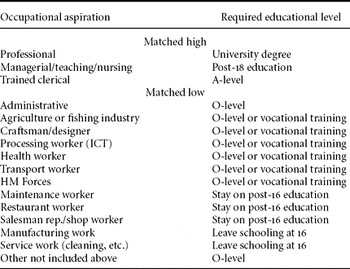
Cohort members also reported their educational expectations. Available educational options up to age 18 were: taking O-levels (secondary school examinations at 16), A-levels (examinations at 18) or other training and vocational courses. For education post-18, options were university, teacher-training, technical college or college of arts, music and drama. Table 1 shows levels of education matched to careers. The education required to pursue a professional career was a university degree. For managerial, teaching or nursing careers, post-18 education was required, and so on. Some of the professions listed are broad and hence we made some assumptions about minimum educational requirements. For instance, we assumed completing compulsory schooling as suitable for work in the restaurant industry.Footnote 1
Education required for occupations aspired: BCS 1970

Source: BCS70 age 16 survey.
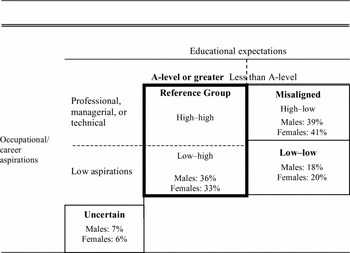
We generate four categories for the relationship between career aspirations and educational expectations: high career aspirations with high educational expectations (I. high–high in Figure 1); high career aspirations but low educational expectations (II. high–low); low aspirations and high educational expectations (III. low–high); and low aspirations with low educational expectations (IV. low–low). Since the analysis is carried out for men and women separately, and due to the relatively small sample size available from the BCS70 at age 16, we had to merge the group having high aspirations and high educational expectations with those having low career aspirations and high educational expectations. Thus, young people with high educational expectations (denoted by the bold box in Figure 1) form the comparison group against which odds ratios for the probability of experiencing NEET status are calculated for young people with misaligned ambitions (high–low) and those with low aspirations and expectations (low–low).
Cross-tabulation of ambition alignment among youth: BCS70

We acknowledge Croll (Reference Croll2008) and Schneider and Stevenson's (Reference Schneider and Stevenson1999) point that there are potential problems for young people whose aspirations and achievements are ‘misaligned’ because their educational achievements exceed their aspirations. However, our data suggest that only 1.3 per cent of young males who had high and aligned ambitions were NEET, and this percentage is similar to young males whose educational expectations were higher than their career aspirations, of whom only 1.5 per cent were NEET. Similarly for young females, 1.6 per cent of those with high and aligned ambitions and 1.4 per cent of those with educational expectations above their career aspirations were NEET. Croll's (Reference Croll2008) findings also support this contention. Therefore, we define ‘misaligned’ specifically as holding career aspirations that exceed educational expectations. Of 2,202 men, 36 per cent are classified as high–high or low–high (the reference group), 18 per cent as low–low, 39 per cent as high–low (or ‘misaligned’), and 7 per cent as uncertain about occupational aspiration. Of 3,163 women, 33 per cent are classified as the reference group, 20 per cent as low–low, 41 per cent as misaligned, and 6 per cent as uncertain.
The longitudinal structure of the data enables us to include controls from birth to age 16 that might predict the formation of career aspirations and educational expectations and may also be related to NEET status. These factors may confound the relationship between career aspirations and educational expectations and NEET. The selection of confounding factors was based on their support to control for the intergenerational transmission of educational success, indicators of deprivation during childhood, performance in education, behaviour, parental attitudes towards schooling and the home environment.
Controls at birth include black or other minority ethnicities, low birth weight (less than 2.515kg), age at which parents left full-time education and cohort member being born to a mother in her teenage years. Controls at age 5 include cognitive development (assessed using the Human Figure Drawing Test), attentiveness and problem behaviours (assessed using mothers’ ratings on the Rutter Behaviour Problem Scales), the number of days per week cohort members were read to by parents, and the number of weekdays respondents watched television after 6 p.m. Age 10 controls are teachers’ assessments of parental interest in the cohort member's schooling, and mother's report on whether the cohort member read books often.
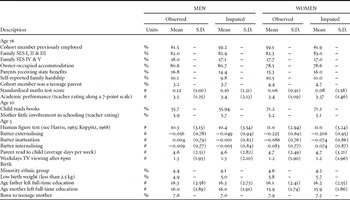
At age 16, when ambitions were also measured, we include controls for standardised maths test scores and assessment of academic performance by teachers’ ranking of cohort members’ classroom standing along a 7-point scale ranging from ‘top 5 per cent’ to ‘bottom 5 per cent’, family background (measured by the Registrar General Social Class Scale and based on the occupation of the parent holding the job with the highest social-economic status), family material hardship (self-assessment of the family financial situation), families in receipt of state benefits (excluding pensions and child-care), and whether respondents resided in owner-occupied accommodation. We also introduce an indicator of whether the cohort member had previously been employed, as early work experiences have been shown to reduce misalignments between aspirations and education expectations among young people in the US (Schneider and Stevenson, Reference Schneider and Stevenson1999). Finally, as we explain in more detail below, we conditioned out the possible impact of teenage parenthood on NEET status, by controlling for whether the cohort member was a parent by age 16. Table 2 shows descriptive statistics for control variables used in this study, both observed and imputed.
Descriptive statistics for control variables (1970 British cohort, men and women)

Note: Numbers in parentheses are standard deviations.
Source: BCS70.
Estimation methods
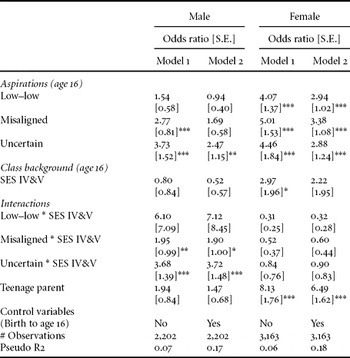
We employ logistic regression to estimate the impact of aspirations on NEET status using Rubin's (Reference Rubin1996) rule for combining estimates from imputed datasets. Separate estimations were performed for male and female cohort members. We first estimated the impact of misaligned and uncertain aspirations on NEET status, controlling for parental social class, cohort members’ educational expectations and whether they were teenage parents (Model 1). In Model 2 we then include the variables measured from birth to age 16 shown in Table 2 to control for further confounding factors. Finally, we included interactions between ambitions and parental social class in Models 1 and 2 with emphasis on those from working-class backgrounds. Three interactions were included: (1) cohort members from working-class backgrounds (parents in semi-skilled or unskilled occupations) with low and aligned ambitions; (2) cohort members from working-class backgrounds with misaligned aspirations; and (3) cohort members from working-class backgrounds with uncertain ambitions. This allows investigation of whether social class moderates the relationship between aspirations and NEET status.
Results
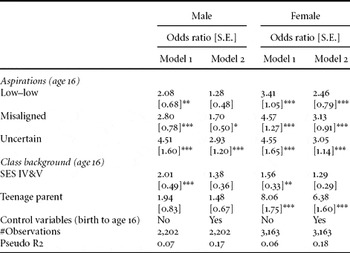
Table 3 shows the estimated impact of misaligned aspirations and educational expectations and uncertainty on NEET status for male and female cohort members. Controlling for parental social class and whether they were teenage parents (Model 1), males with low aspirations and educational expectations in the cohort are twice as likely to have become NEET as those with high and aligned ambitions (that is, high–high) or whose educational expectations were higher than the minimum education required for their desired occupation (that is, low–high). However, these differences become statistically non-significant when we include additional controls for potential confounding factors (Model 2). Females with low career aspirations and expectations are more than twice as likely to have become NEET as those in the comparison high–high/low–high group (Model 1), and these differences remain even after accounting for background factors (Model 2). Similarly, the risk of NEET status for young people with misaligned ambitions – those whose educational expectations are below the necessary level of their desired job – relative to young people in the high–high/low–high comparison group is 1.7 times greater for males and over three times greater among females, after controlling for background factors.
Odds ratios from logistic regressions of the impact of uncertain and misaligned aspirations on NEET status

Notes: Odds ratios and robust standard errors obtained using MIM command in STATA v.10. Asterisks *, **, *** indicate significance at 10, 5 and 1 per cent level, respectively.
Source: BCS70.
Uncertainty in aspirations is also associated with increased probability of NEET status. As shown in Table 3 (Model 1), both males and females with uncertain aspirations are well over three times as likely to have become NEET as the comparison group. Even after accounting for background factors, uncertain males and females are three times as likely to have experienced NEET status. Interestingly, young people from less advantaged backgrounds have a greater risk of NEET status, though this is explained by background factors. Also, the odds of NEET status for teenage mothers are six times those of non-teenage mothers, indicating the importance of controlling for teenage parenthood when investigating NEET status for females.
Next, in Table 4 we consider whether social class moderates the effects of uncertain and misaligned ambitions on NEET status. The findings indicate that the greater likelihood of becoming NEET associated with misaligned and uncertain aspirations is particularly heightened for males from less advantaged backgrounds (socioeconomic status (SES) groups IV and V). As shown in Table 4, having misaligned or uncertain aspirations leads to greater odds of NEET status for males from SES IV and V relative to those from the higher SES groups (SES I, II and III). However, the additional effect of misaligned and uncertain aspirations on NEET status for lower SES young people is not observed for females, possibly due to the very large effect that teenage pregnancy has on NEET status for females – an effect concentrated more heavily on those from lower socio-economic backgrounds.
Odds ratios from logistic regressions of the role of class background as moderator of aspiration effects on NEET status

Notes: Odds ratios and robust standard errors obtained using MIM command in STATA v.10. Asterisks *, **, *** indicate significance at 10, 5 and 1 per cent level, respectively.
Source: BCS70.
Discussion
The purpose of this study was to estimate the impact of young people's ambitions and social background on their future employment outcomes. The significant changes in the youth labour market and in the school-to-work trajectories of young people over the last three decades in Britain resulted in record rises in youth unemployment in the 1980s and the collapse of the route of early school-leaving and rapid entry into employment traditionally followed by those from poorer backgrounds. We argued that these conditions are a source of uncertainty for young people and create new pressures for individual participation in a range of options that may not be well understood by them or their families.
Before discussing the significance of our results, the inevitable set of problems relating to uncontrolled heterogeneity of the populations represented in the data must be acknowledged. Although we have attempted to isolate the impact of uncertainty and mismatch by controlling for confounding variables, we cannot claim to have conditioned out all possible extraneous factors that might influence the formation of aspirations or educational expectations or the entry into NEET status. For instance, the data cannot take account of local labour market factors that could explain some of the variations in aspirations and expectations.
Some scepticism is thus – as always – appropriate when moving from logistic regression with a specific dataset to statistics that might be seen as causally predictive in a more universal sense. With these caveats in mind, this study yields some important findings for understanding the transition to adulthood among young people with misaligned educational and occupational ambitions or uncertain career aspirations.
First, in our data both misaligned and uncertain aspirations are associated with increased likelihood of becoming NEET for at least six months between the ages of 16 and 18. Specifically, relative to young people with high and aligned ambitions and those with higher educational expectations than their aspired career, young men with mismatched aspirations and educational expectations were almost twice as likely to become NEET. Young women with misaligned ambitions were three times as likely to become NEET. Also, young men and women with uncertain aspirations were roughly three times more likely to become NEET. These findings become significant when one considers that approximately 40 per cent of the cohort held occupational aspirations exceeding their educational expectations, and approximately 7 per cent were uncertain about their occupational aspirations.
It is important to note that the impetus to provide a range of specialist careers and education guidance professionals was still being conceptualised in the mid-1980s. More recently, providing young people with effective advice and guidance about post-16 options and careers has been an important focus of UK government policy. However, Croll's (Reference Croll2008) more recent analysis of data from the BHPS shows that a substantial number of young people still apparently aspire to occupations for which they are unlikely to meet the educational requirements.
Perhaps our most notable findings, however, concern the difference in consequences of misaligned or uncertain aspirations depending on SES. Misaligned and uncertain aspirations are considerably more widespread and detrimental for young people from lower SES groups in the BCS70 dataset. Almost twice the proportion of low-SES young people had misaligned aspirations compared to their high-SES counterparts (52 per cent versus 28 per cent). The prevalence of uncertainty among low-SES young people was 10 per cent compared to 6 per cent for high-SES young people. Additionally, for young men from lower SES groups, misalignment and uncertainty in aspirations were both associated with a substantial increase in the probability of becoming NEET compared to their peers from high SES backgrounds. Low SES background increased the risk of NEET for young men with misaligned aspirations by 90 per cent, and for those with uncertain aspirations by nearly 300 per cent.
It should be reiterated that this negative moderating effect of social background is not observed for young women. Overall, young women with misaligned or uncertain aspirations had slightly higher odds of entering NEET status than their male counterparts, but the significant increase in this risk for lower-SES young men was not reproduced for young women. Our findings support arguments discussed earlier that gender-related employment inequality is likely to be caused by the differential adverse impact of early parenthood for young men and young women (Schoon et al., Reference Schoon, Martin and Ross2006; Ianelli and Smyth, Reference Ianelli and Smyth2008). While we did not observe a significant impact of early parenthood for young men, for young women it increased the odds of early NEET status by 6.5 times after the inclusion of controls. While it is perhaps not surprising that young mothers would be NEET for some time, the scale of this association and the lack of effect for young men highlights this as an area of specific concern for social policy.
Individualisation and inequality in transitions
Our findings have implications for how we conceptualise young people's transitions to work and for considerations of individualisation and inequality. The breakdown of traditional class-based routes into secure employment during the 1970s and 1980s has been well established (for example, Bynner, Reference Bynner2001). Our analyses support this observation in that significant numbers of young people from low SES backgrounds aspired to occupations other than those suggested by their social backgrounds (52 per cent aspired to occupations exceeding their likely educational achievement) or were uncertain about what job they wanted to pursue (10 per cent).
As suggested by Lawy (Reference Lawy2002), France (Reference France2007) and others, our findings also indicate that the individualisation of transitions – the situation of being ‘thrown on one's own fate’ in the labour market as outlined by Beck and Beck-Gernsheim (Reference Beck and Beck-Gernsheim2002) – is not experienced equally by all young people. Despite the common emphasis on individuals’ own capacities and responsibilities for making their transitions to work in the individualised world of late modernity, structural inequality remains an important factor in predicting the trajectories of the BCS70 cohort. However, given Arnett's (Reference Arnett2006) conception of individualisation as empowering young people from poorer backgrounds to ‘turn around’ negative life-chances in their late-teens and twenties, it would be desirable to examine long-term outcomes for the various groups of young people discussed.
In supplementary analyses of BCS70, there is evidence suggesting poorer long-term outcomes for young people who had misaligned or uncertain aspirations and who experienced NEET status as teenagers. For instance, only 58 per cent of those uncertain at age 16 who went on to experience early NEET status were employed at age 34 – though it should be noted that this is derived from a relatively small number of cases (results available upon request). For comparison, 82 per cent of non-NEET uncertain young people and 80 per cent of NEET young people with high educational expectations were employed at age 34. For many of those with high educational expectations, it seems then that a period of being NEET is not particularly detrimental in the context of their longer-term transitions. However, these findings seem to support the picture of a number of lower-achieving uncertain young people (including, of course, those who are alienated from education and the labour market) ‘floundering’ into NEET status and going on to poor long-term outcomes.
It must be acknowledged that theories of individualisation and ‘emerging adulthood’ and use of the ‘NEET’ label itself emerged after the BCS70 cohort would have left school. In 1986, when the cohort reached age 16, about 50 per cent of the 16-year-old population were leaving full-time education (Bynner and Parsons, Reference Bynner and Parsons2002). Youth unemployment was also very high, and by 1988 all benefits ceased for unemployed young people between ages 16 and 18. The role of uncertain or misaligned aspiration was perhaps especially important for this cohort. Some caution might therefore be expected in our use of this dataset to draw conclusions about individualisation, inequality, aspirations and NEET status.
However, the social and economic changes connected to the historical break noted by Beck that cut people loose from class ties and stable biographies in the labour market can be traced back to the time of deindustrialisation in the 1970s and early 1980s in the UK. This would have defined this cohort's transitions. It was at this time that the Conservative government was drawing upon the language of individualisation to reconceptualise unemployed young people and shape youth-oriented policy. France (Reference France2007) argues that a ‘blame culture’ painting young people either as deficient in their skills and motivations or delinquent and dysfunctional was carried through from this time into New Labour's focus on NEETs, social exclusion and (latterly) aspirations. We acknowledge the problems with the ‘NEET’ label, but see it primarily as a proxy category for exploring the impact of ‘fractured transitions’ (Coles, Reference Coles1995). The findings discussed here can be thus seen as relevant to current concerns with young people's social exclusion, aspirations and employment outcomes, even if they must be interpreted with some caution.
In future research, we plan to address more extensively the long-term consequences of experiencing NEET status during teenage years. Croll's (Reference Croll2008) more recent analysis of BHPS data is also relevant here. As stated, his focus is somewhat different to ours, but his findings also suggest that misalignment between aspirations and educational attainment were more common and more detrimental for those from manual backgrounds in that they were much less likely than their peers from PMT backgrounds to go on to achieve high-status occupations. Our results, then, might be seen as complementing Croll's (Reference Croll2008), and together supporting the interpretation that the individualisation of responsibility for negotiating one's pathway from school to work and to ‘adulthood’ in post-industrial modernity has created pressures for individual choice, participation and engagement which are problematic for the most vulnerable and disadvantaged segments of the population. In particular, those least prepared or able to make appropriate investments in education or training or to make good decisions about a complex range of post-16 options are more likely to do poorly in their transitions to employment.
The aspirations (or the lack of them) of young people at age 16 thus appear to be very important in shaping their life trajectories as an increasing number form aspirations for the limited number of high-level occupations able to provide stable careers (see also Croll, Reference Croll2008). Uncertainty of aspiration appears to be especially detrimental for young men from poor backgrounds. It seems likely that at least some of these uncertain young men will be those alienated from engagement with education, training and the labour market, as identified by Bynner and Parsons (Reference Bynner and Parsons2000). For these young people, the aim of raising their aspirations – where this must also mean re-engaging them and addressing their alienation – would seem to be a positive step.
A more widespread problem in our findings was that of aspirations exceeding educational expectations; 52 per cent of low-SES young people fell into this category, and had increased odds of becoming NEET. Clearly, simply raising the aspirations of this group is not likely to improve their post-16 trajectories. Rather, it is the difference between their relatively high aspirations and their educational attainments that seems to be one of the contributing factors to their ‘fractured transitions’. If it is considered, as some have suggested, that this low-SES group of young people is the least well-equipped to make effective post-16 plans or to adapt to set-backs in their trajectories, and to be confronted with the least palatable alternatives to the secure and well-paid jobs to which they aspire and thus to ‘flounder’ into NEET status (for example, Kerchoff, Reference Kerchoff, Mortimer and Larson2002), then social policy faces a different challenge than simply raising their aspirations. This is also the case with low-SES young women, for whom not aspirations but early parenthood has overwhelmingly the most significant negative labour market impact.
Conclusion
Our findings are consistent with numerous studies that show how the changes to the youth labour market over the last few decades particularly affected the pathways into employment of lower-achieving and lower-SES young people. These groups disproportionately experienced the effects of fragmented and insecure transitions (for example, Furlong and Cartmel, Reference Furlong and Cartmel2004). Significant numbers of the BCS70 cohort were uncertain at age 16 about their aspirations for future occupation or held aspirations that exceeded their educational expectations. This was associated with an increased likelihood of becoming NEET that was especially pronounced for young men from low-SES backgrounds.
Our conclusions are tempered by the inevitable problems relating to unobserved heterogeneity of the cohort. It is impossible to say with certainty that we have conditioned out all possible extraneous variables. Nevertheless, as far as possible with regression analysis, these findings do suggest that the increased individualisation of the transition from school to work that gathered pace in the 1980s has been detrimental for those least well-equipped to negotiate the changes in the youth labour market. Rather than seeing the emergence of a positive period of exploration in the late teens, this individualisation of transitions might instead (or also) be seen as placing burdens, to make the right choices and the right investments in human capital, on young people that some are ill-prepared or ill-equipped to handle. Lower-SES young women face a different set of challenges connected to the negative impact of early parenthood.
Social policy responses to the problem of young people's ‘fractured transitions’ face the challenge of a population of young people whose overall rising aspirations are not reflected in the make-up of available occupations and for whom the importance of certain and appropriate aspirations appears to vary according to social background. Our findings probably represent only the surface of a deeper set of issues concerning a lack of traditional, valued and secure jobs for lower-achievers, negative orientations towards non-standard and insecure work, generally rising aspirations and the alienation of those with the least human and social capital. While re-engaging young people who are alienated from education, training and employment might be expected to have positive results, it seems unlikely that simply raising aspirations of all young people will ease their ‘fractured transitions’.
These conclusions seem best to explain the results observed, but it must also be noted that they very much invite further investigation, both in terms of a wider examination of the reasons for and effects of uncertain and misaligned aspirations, and a comparable study of a more contemporary cohort of young people.