

The rights of children, including those with disabilities, to express their views and make decisions regarding matters affecting them were articulated in the United Nations Convention on the Rights of the Child (1989) and the United Nations Convention on the Rights of Persons with Disabilities (2006). This emphasis on children's rights has inadvertently led to an increasing recognition among researchers about the necessity to seek the perspectives of children with disability in research concerning them (Prunty, Dupont, & McDaid, Reference Prunty, Dupont and McDaid2012). Additionally, it has been demonstrated that the worldviews of adults and children may be fundamentally different as a result of their differing sociocultural contexts (Llewellyn & Leonard, Reference Llewellyn and Leonard2010). A study by Fattore, Mason, and Watson (Reference Fattore, Mason and Watson2009) examining the conceptualisation of wellbeing from children's perspectives revealed that although adults believed that children's wellbeing is a multidimensional construct, children conceptualised their wellbeing as mostly consisting of their emotional lives. It is therefore essential that researchers adopt appropriate research techniques that are well suited to the needs and abilities of children with disability to enable them to participate meaningfully in research (Whiting, Reference Whiting2015). Interviews and focus group discussions are well-established research techniques that have often been used to capture the voices of children (Carter & Ford, Reference Carter and Ford2013). These techniques undoubtedly have their merits, their usefulness in engaging children with autism spectrum disorder (ASD) during the research process, and eliciting responses from them. However, one limitation of these techniques is that they rely heavily on the verbal fluency of research participants and may not cater to the unique needs of this group of children.
Individuals with ASD have qualitative impairments in social communication, and restrictive, repetitive patterns of behaviours, interests, or activities (American Psychiatric Association, 2013). Some of their social communication difficulties include (a) initiating and maintaining conversations with others (Banda, Hart, & Liu-Gitz, Reference Banda, Hart and Liu-Gitz2010), (b) lacking an understanding of pragmatic uses of language (Carpenter, Reference Carpenter, Hyde, Carpenter and Conway2013), (c) maintaining appropriate eye contact during social interactions (Schohl et al., Reference Schohl, Van Hecke, Carson, Dolan, Karst and Stevens2014), and (d) understanding nonverbal behaviours (Lindsay, Proulx, Scott, & Thomson, Reference Lindsay, Proulx, Scott and Thomson2014). Due to their repetitive patterns of behaviours, interests, or activities, individuals with ASD tend to insist on sameness, have a strong preference for routines (Ray-Subramanian & Ellis Weismer, Reference Ray-Subramanian and Ellis Weismer2012), and possess an interest that is unusual in intensity (Spiker, Lin, Van Dyke, & Wood, Reference Spiker, Lin, Van Dyke and Wood2012). Researchers have documented how the characteristics associated with ASD have hampered the ability of children with ASD to engage in research interviews (Harrington, Foster, Rodger, & Ashburner, Reference Harrington, Foster, Rodger and Ashburner2014). Preece and Jordan (Reference Preece and Jordan2010) revealed that it was not an easy task obtaining the views of children with ASD about their daily life experiences and aspirations, as these children had difficulties with understanding abstract concepts, and possessed limited personal insights about the future. Loyd (Reference Loyd2015) explored the participation of students with ASD in drama sessions and reported that students with ASD displayed anxiety, sat apart from the interviewer, and engaged in activities unrelated to the interviews.
Due to the problems faced by researchers in engaging and eliciting responses from students with ASD in qualitative research studies, it is unsurprising that researchers are often reluctant to seek the perspectives of these students in their research studies and instead consult the views of adults, such as parents and teachers, who play a significant role in their lives (Mandleco, Reference Mandleco2013). Thus, only a small body of research has been devoted to the voices of students with ASD (Harrington et al., Reference Harrington, Foster, Rodger and Ashburner2014). Although adults’ perspectives are important, omitting the views of students with ASD could easily lead researchers to make interpretations and draw conclusions that provide only a partial picture about matters concerning these students (Dyches, Cichella, Olsen, & Mandleco, Reference Dyches, Cichella, Olsen and Mandleco2004; Thomson, Reference Thomson2008). Hence, it is imperative for researchers to adopt participatory techniques that cater to the unique needs of students with ASD. This prevents the risk of overlooking their rights to participate meaningfully in research and at the same time increases the likelihood that the authentic voices of students with ASD can be heard.
Photo-Elicitation
Photo-elicitation has the potential to support students with ASD to meaningfully participate in research. This qualitative visual research technique was developed in 1957 by John Collier, who sought to use photographs as prompts to facilitate rich responses during interviews (Bugos et al., Reference Bugos, Frasso, FitzGerald, True, Adachi-Mejia and Cannuscio2014; Kurtz & Wood, Reference Kurtz and Wood2014). The photographs may be taken or selected by the researcher, as they may be deemed meaningful to participants. Researchers may also invite participants to take photographs and discuss them during an interview (Kurtz & Wood, Reference Kurtz and Wood2014; Mandleco, Reference Mandleco2013). This is termed participant-driven photo-elicitation (PDPE). The terms photo-elicitation and photovoice have been used interchangeably (Bugos et al., Reference Bugos, Frasso, FitzGerald, True, Adachi-Mejia and Cannuscio2014; Carter & Ford, Reference Carter and Ford2013). Photovoice is a community and participatory action research strategy that uses the photographs taken by participants to engage in critical dialogue with policymakers and influential advocates promoting social change (Povee, Bishop, & Roberts, Reference Povee, Bishop and Roberts2014). Thus, although PDPE is a component of photovoice, it is distinct in that its emphasis is on the interview process (Povee et al., Reference Povee, Bishop and Roberts2014).
There are three distinct stages in PDPE (Kurtz & Wood, Reference Kurtz and Wood2014). In the first stage, participants need to be taught how to take photographs with a device. Ethical issues about photograph-taking should also be discussed (Lapenta, Reference Lapenta, Margolis and Pauwels2011). In the next stage, participants will photograph objects, people, or places regarding the topic examined in the research study. Lastly, depending on the criteria set by the researcher, some or all of the photographs taken by the participants will be discussed during an interview or focus group (Kurtz & Wood, Reference Kurtz and Wood2014).
PDPE has been frequently used with marginalised and vulnerable groups of people such as children, youths who are homeless, individuals with health issues, and individuals with a disability (Bugos et al., Reference Bugos, Frasso, FitzGerald, True, Adachi-Mejia and Cannuscio2014). It has also been utilised by researchers in various fields such as health (FitzGerald et al., Reference FitzGerald, Frasso, Dean, Johnson, Solomon, Bugos and Cannuscio2013), anthropology (Johnson, Reference Johnson2011), education (Fitzgerald, Bunde-Birouste, & Webster, Reference Fitzgerald, Bunde-Birouste and Webster2009; Jones, Reference Jones2013), and special education (Dyches et al., Reference Dyches, Cichella, Olsen and Mandleco2004; Lamb, Firbank, & Aldous, Reference Lamb, Firbank and Aldous2016; Obrusnikova & Cavalier, Reference Obrusnikova and Cavalier2011). Only a limited number of researchers have adopted PDPE to examine the experiences of students with ASD. Dyches et al. (Reference Dyches, Cichella, Olsen and Mandleco2004) adopted PDPE as a research technique in their US study with 15 students with ASD aged between 5 to 21 years to examine what is important to them from their perspectives. Obrusnikova and Cavalier (Reference Obrusnikova and Cavalier2011) used PDPE to assess the factors that enhanced or prevented after-school physical activity for students with ASD in the US. A total of 14 students with ASD aged between 8 to 14 years participated in the study. Lamb et al. (Reference Lamb, Firbank and Aldous2016) used PDPE with five students with ASD from the UK who were aged between 12 to 16 years to empower them to share their views about physical education.
It is paramount that researchers document and report on the processes, challenges, and benefits of adopting a research technique with individuals with ASD (Harrington et al., Reference Harrington, Foster, Rodger and Ashburner2014). Such accounts enable researchers to better utilise a research technique to ensure that it is suitably appropriate for this group of individuals (Harrington et al., Reference Harrington, Foster, Rodger and Ashburner2014). These honest reflections could also contribute to a ‘step-by-step’ guide on using participatory and inclusive research techniques (Povee et al., Reference Povee, Bishop and Roberts2014) with individuals with ASD. However, out of the three studies, only Dyches et al. (Reference Dyches, Cichella, Olsen and Mandleco2004) reported on the process of PDPE with students with developmental disabilities. The researchers also reflected on their experience of using photography as a research technique with this group of students. They reported that students with developmental disabilities were capable of gathering data for researchers through the photographs that they take. Photography also provided the means for students with developmental disabilities to communicate visually what they had difficulty communicating verbally. One of the challenges, as indicated by Dyches et al. (Reference Dyches, Cichella, Olsen and Mandleco2004), of using PDPE was that adults such as parents might stop children from taking certain photographs, which could affect the results of the study. Applicability of the study to this article is limited by the fact that only three out of the 15 participants had ASD and the rest included students with a range of developmental disabilities, such as intellectual disability and traumatic brain injury. Additionally, it has been more than 10 years since Dyches et al.’s (Reference Dyches, Cichella, Olsen and Mandleco2004) study was conducted, and advancements in technology, especially with the increased ownership and usage of devices such as smartphones by students, during the past decade have influenced the way PDPE may be carried out by researchers.
Due to the limited literature on studies documenting the use of PDPE with students with ASD, this paper contributes to the literature by offering a reflection of its use with this group of students. Focusing specifically on PDPE (a component of photovoice), the objectives of this paper are to report on the (a) research process, (b) benefits, and (c) challenges of using PDPE with students with ASD. It draws on the first author's research study conducted in Sydney, Australia, to examine how student wellbeing is conceptualised by parents, teachers, and students with ASD themselves. To collect data, interviews were conducted with parents and teachers, while photovoice was used with students with ASD. The findings of this research will not be presented in this paper. A reflection on the use of PDPE with students with ASD is offered instead.
The Research Process
After ethics approval for this research study was received from the University of New South Wales Human Research Ethics Committee (Approval #HC14251), as well as the Department of Education and Communities (SERAP Approval 2014150), emails were sent to 192 principals of mainstream public high schools in Sydney, Australia. Seven principals provided their consent to collaborate in this research study. The researcher then contacted a teacher in each school who was tasked with coordinating the research study by inviting teachers who had taught or were teaching students with ASD as well as parents or caregivers to participate in the study. Parents and caregivers of students with ASD were also asked to provide consent for their child's participation in the study. Once verbal and written consent were received from teachers, the teacher in charge made arrangements for the interviews to be carried out in the school. An easy-to-read participant information statement and consent form was created for students with ASD, and verbal and written consents were obtained from the students during the first meeting.
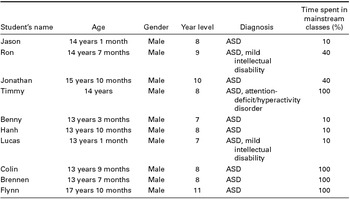
A total of 10 high school boys diagnosed with ASD participated in this study. Their average age was 14.38 years, ranging from 14 to 15 years. Two students were from Year 7, five were from Year 8, and one each were from Year 9, 10, and 11. In addition to being diagnosed with ASD, two of them also had mild intellectual disability and one had attention-deficit/hyperactivity disorder. Four students were attending lessons solely in mainstream classes and the remainder were attending lessons both in a support unit and in mainstream classes. The average time the 10 students spent in mainstream classes was 52%, with a range from 10% to 100% (see Table 1 for students’ demographics).
Students’ demographics

First meeting with students
The first author met with each student twice. The meetings were conducted separately with each student at their school. With the students’ consent, the meetings were audio-recorded with a digital voice recorder. The purpose of the first meeting was to build rapport with the students, explain to them what their involvement in the project would entail, teach them how to take photographs with their device, and discuss ethical issues regarding photography in school. PowerPoint slides were prepared in advance regarding the following: (a) information about the project, (b) samples of the research project, (c) how to take photographs with a digital camera or smartphone, (d) how to transfer photographs from a digital camera or smartphone to a computer, (e) rules of taking photographs in school, and (f) how to approach someone to take their photograph. To gain informed consent from students, the first author went through the easy-to-read participant information statement and consent form with the students. Using printed copies of the PowerPoint slides mentioned previously, the first author explained that in order to participate the students would first need to provide their consent, they would be required to take photographs, and talk to the researcher about the following three categories: (a) what a good life in school means to them, (b) what helps them to have a good life in school, and (c) what prevents them from having a good life in school. All students agreed to participate and signed the consent form. Students were then given an 8GB USB flash drive with four pre-created folders. These folders were (a) all photos that I have taken, (b) what a good life in school means to me, (c) what prevents me from having a good life in school, and (d) what helps me to have a good life in school. Using a tablet, students were shown the four folders and were told to take as many photographs as they wished about their life in school and transfer them to the first folder. From the first folder, they were asked to choose no more than 10 photographs that showed (a) what a good life in school means to me, (b) what prevents me from having a good life in school, and (c) what helps me to have a good life in school, and place them in the appropriate folder in the USB flash drive. They were told that they would not be keeping the USB flash drive. To build rapport with the students, the first author showed them the photographs she took about the three categories based on her school experiences in the university. Students were told that they were allowed to take different photographs from her as people have different perceptions and experiences. To convince them that it was fine to take different photographs, the first author showed the students a second set of photographs that were relatively different from hers based on the three categories and told them that those were taken by her friend.
All students who participated in this project had their own device with which to take photographs. These devices included digital cameras, smartphones, and iPods. As the students insisted that they knew how to take photographs with their devices the researcher did not need to teach them how to take photographs. Most also insisted that they knew how to transfer the photographs to the USB flash drive. Following this, rules about taking photographs in school were presented to students. To prevent the students from disrupting lessons, some of these rules included not taking photographs when a lesson is being conducted and asking a teacher for permission before taking any photograph. Students were then taught how to approach someone to take their photograph. They were briefed on what to say when explaining the project to their teachers or peers. All printed PowerPoint slides and a USB flash drive were presented to each student in a folder. They were assured that the photographs they took would remain anonymous and that the photographs taken may be used in the writing of reports. Students were told to bring the USB flash drive with the photographs already transferred to the next meeting. They were given between 1 to 2 weeks to take their photographs.
Second meeting with students
The objective of the second meeting was to get the students to share their thoughts with the researcher about the photographs that they had taken. The second meeting with the students depended on the school's schedule and took place between 2 to 8 weeks after the first meeting. Photographs that students took were viewed using the first author's tablet. Students were asked questions such as, What does this photograph show? What is happening here? Can you tell me more about this photograph? To elicit more detailed responses from students, a semistructured flexible interview questioning style was adopted, and further questions depended on the responses provided by the students (Povee et al., Reference Povee, Bishop and Roberts2014). At the end of the interview, students were asked for their emails so that their transcript could be emailed to them for member checking. This was voluntary, and only two students provided their emails.
Benefits of Using PDPE
The first author's research study examining the conceptualisation of student wellbeing from the perspectives of teachers, parents, and students with ASD will be used as an example to illustrate the benefits of using PDPE with students with ASD. Inductive thematic analysis was performed on students’ interview transcripts as well as the authors’ observations and field notes that were recorded during the first and second interviews, which were conducted with each student to identify the benefits of using this research technique. The inductive approach, as opposed to the theoretical approach, was adopted to enable the data to speak for themselves rather than to fit them into pre-existing codes (Braun & Clarke, Reference Braun and Clarke2006). The benefits that were identified were (a) opportunities for empowerment, (b) accessibility, (c) ability to record various settings, (d) development of various skills, (e) increased engagement in research, and (f) enhanced ability to communicate. Pseudonyms have been used to maintain participants’ anonymity.
Opportunities for empowerment
Although it is essential for individuals with disability to be self-determined to advocate for themselves, they often lack a sense of control and empowerment in their lives, which prevents them from being self-determined individuals (Dyches et al., Reference Dyches, Cichella, Olsen and Mandleco2004; Strnadová & Evans, Reference Strnadová and Evans2012). However, the use of PDPE in this research study provided opportunities to foster a sense of empowerment in students with ASD, as they were afforded greater control over various aspects of the research process (Johnson, Reference Johnson and Thomson2008). First of all, by taking photographs of what they felt helped prevent and enhance their wellbeing in school, they were in control of the data collection process (Jones, Reference Jones2013), which contributed to their sense of ownership of the research study (Jurkowski, Reference Jurkowski2008). Through the use of PDPE, as compared to traditional interviews, the students were also better able to exercise their autonomy in choosing what photographs to take, and offering their own descriptions and interpretations of each photograph (Kurtz & Wood, Reference Kurtz and Wood2014; Lapenta, Reference Lapenta, Margolis and Pauwels2011; Mandleco, Reference Mandleco2013; Povee et al., Reference Povee, Bishop and Roberts2014). For example, Timmy took a photograph of a trombone and explained that playing in the band was what made life in school good for him:
Timmy: So . . . what makes a good life is, I like . . . I like playing in the band. So I have the trombone.
Interviewer: How does that help you have a good life at school?
Timmy: It helps me in music. Maybe that's probably what I want to do when I grow up. Something like that, for fun.
Another student, Jonathan, corrected the interviewer's description of a photograph he took, and offered his own description and interpretation:
Interviewer: You look happy here. What were you doing?
Jonathan: Oh, yeah! I was pretending to be angry, because I was on my maths calculator!
Interviewer: Oh, OK! So you were pretending to be angry.
Jonathan: Mmm.
Interviewer: What are you trying to tell me with this photo?
Jonathan: I'm showing: ‘All this maths work! Arrghh!’
Additionally, they were also empowered during the interview process. After plugging in the USB flash drive into the tablet, it was handed over to the student who then had the autonomy of choosing which photograph to discuss first. This helped distribute the power between the researcher and the students (Carter & Ford, Reference Carter and Ford2013). Thus, the students with ASD, who may have been voiceless if traditional research techniques were employed, instead became experts as they explained with authority about their wellbeing in school through the use of photographs in PDPE (Johnson, Reference Johnson2011). A student, Colin, felt that being involved in the project provided him with the opportunity to express the problems that he was facing:
Interviewer: What do you think about this project? Do you like being involved?
Colin: Yeah, I like being involved. I like expressing my problems. As I told you, I'm not really an open person. Solving problems myself.
Interviewer: So this gives you an avenue to help solve your problems?
Colin: Yes. Yes.
Accessibility
PDPE is accessible to most individuals, as it does not require participants to have the ability to read or write (Wang & Burris, Reference Wang and Burris1997). They only need to have the capacity to take photographs (Povee et al., Reference Povee, Bishop and Roberts2014). Thus, it is particularly suited for students with ASD who tend to dislike writing as many have handwriting difficulties (Saggers, Reference Saggers2015). Furthermore, all students involved in this study appeared to be technologically savvy and required minimal to no help to use digital cameras, iPods, and smartphones to take photographs. All of them insisted that they knew how to take a photograph with a digital camera or smartphone. Jonathan, who borrowed a digital camera from the school for the purpose of this research study, and had never used a digital camera, was able to determine with little guidance from the first author how to take a photograph with it within a minute. Another student, Brennen, provided an explanation about taking photographs with his iPod when asked if he knew how to take photographs:
Interviewer: Do you know how to take photographs?
Brennen: Yeah. I even know how to take photographs while this is locked.
Teacher: Show us how you do it.
Brennen: See the little camera down there? Slide that up . . .
Teacher: Oh cool! And you're done. You just take a photo.
Brennen: But if you take a photo and you slide the top down, I think . . . or you hit the back button and you want to go to that photograph, it will not be there.
Teacher: Where will it be?
Brennen: Because you have to actually log on.
Teacher: Oh, I see. OK. So make sure you do that so you don't lose the photos.
Brennen: No, it actually goes on to the hard drive, but whilst you're taking photos, you can actually look at them. If you exit that and go back into them by mistake, they won't be there. They'll be on the hard drive.
Furthermore, it seemed that a few students in this study had lots of experience taking photographs with their own devices. Two of them showed the first author several photographs that they took with their devices. Therefore PDPE, which emphasises the use of photography, may be a particularly suitable research technique for this group of students.
Ability to record various settings
The use of PDPE enables various settings to be recorded through the photographs that participants take. These settings may be otherwise inaccessible to researchers (Jurkowski, Reference Jurkowski2008; Wang & Burris, Reference Wang and Burris1997). Students in this study photographed settings that were not readily accessible to the researchers, such as the various lessons that students attend in school. For instance, two students, Jason and Ron, got their teacher aide to take a photograph of them ice-skating at a rink located at a shopping complex near their school where physical education lessons were conducted. Another student, Timmy, took a photograph of his friends spending time chatting with one another during recess. These photographs were used to further explore the lived experiences of students with ASD during the interview process and helped researchers to gain a deeper insight into the realities of these students (Lamb et al., Reference Lamb, Firbank and Aldous2016). Through photo-elicitation, Timmy clarified that he preferred chatting face to face to online with his friends, and Ron revealed that he enjoyed the cool temperature at the ice-skating rink. Jason, on the other hand, felt that being able to try something new like ice-skating contributed to his experience of a good life in school:
Interviewer: Where is that? You have an ice-skating rink at school?
Jason: No, that's at [B].
Interviewer: I see! You like going out of school?
Jason: We actually choose that sport, and if we choose ice-skating, we go to [B]. If we choose something else, we stay here, or something like that.
Interviewer: So why did you choose this?
Jason: Because ice-skating is a great sport. You can learn a few tricks and such. I try out something new that I've never done before. We started a few terms ago. Anyway, it's brilliant.
Development of various skills
Adopting PDPE with students with ASD facilitates the development of a range of skills. Students with ASD often need help with their social skills (Dodd, Reference Dodd2005), and, as the participants needed to seek permission from teachers before taking any photographs, they were taught how to introduce themselves to a teacher who may not know them. As such, they were able to practise the particular social skill of introducing themselves to someone new. PDPE also provided them with opportunities for social interactions, as a few students explained the project to their friends, teachers, and teacher aides and requested that they pose for a photograph for the purposes of this research study. PDPE also helped enhance their photography skills, despite several students having had the experience of taking photographs. Students involved in this research also took pride in the quality of the photographs they took. For instance, Flynn took multiple shots of a similar item, as he wanted to ensure that the photograph was clear. Another student, Lucas, asked if he could use photo-editing software to brighten some photographs if they were too dark. Students also had a chance to learn and develop their IT skills. For instance, Hanh was not confident about transferring photographs from a digital camera to a computer. Thus, he took the initiative and approached his school learning support officer to ask him how to do that:
Interviewer: Do you know how to transfer the pictures?
Hanh: No. No.
Interviewer: Is there somebody who can help you?
Hanh: Well, I tried it before, but I don't know what it was, it didn't go very well with it. It all was pretty screwed up really. It ended up in the wrong folder or the computer crashed or something. Yeah. I tried it before but it was pretty disastrous.
Interviewer: Maybe we can get somebody to help you.
Hanh: Um, Mr Howard [a pseudonym]. I have a question, do you know how to transfer photos to computer because I've tried it before and it was a terrible effort. Do you know how to do that?
Mr Howard: So remember we were looking at some of the photos you took on the camera this morning?
Hanh: Yeah. How do you do that?
Mr Howard: Yeah. So if the camera has a special cable that connects. So you plug from the camera to the computer . . .
Hanh: OK.
Mr Howard: And then it pops up. All photos pop up on the screen and you can copy them.
Hanh: Oh, thank you.
The use of PDPE also assisted students with ASD to develop self-awareness, which they typically have difficulty with (Dodd, Reference Dodd2005), as students were required to take photographs about their experiences in school, reflect on them, and share with the researcher the reason they took the photograph. Colin took a photograph of a classroom with disruptive students and provided the following explanation of why it prevented him from having a good life in school:
Colin: Yeah, this is the loud classroom I was talking about. Yeah. This is sort of me right there.
Interviewer: That's you?
Colin: Yeah. In a way of speaking! The one that tries not to shout out! Just tries to shrink down and get the work done. Yes.
Interviewer: Why does it prevent you from having a good life in school?
Colin: Because my brain seems to, like, just start pulling itself apart when there's loud noises, because I try to think of something, like I'll do a mathematics question, and everyone's yelling. I'm, like, wait! No! I for[get]! Grrr! I'll forget things because I'm trying to block out the noise.
Therefore, photographs encourage these students to engage in deep self-reflection about their experiences (Dyches et al., Reference Dyches, Cichella, Olsen and Mandleco2004), thereby promoting their self-awareness.
Increased engagement in research
The use of PDPE with students with ASD in this research study may have lessened the anxiety and distress that they might have experienced while engaging in traditional interviews. A source of their anxiety may be the need to maintain eye contact with others during a conversation (Schohl et al., Reference Schohl, Van Hecke, Carson, Dolan, Karst and Stevens2014). As such, the use of photographs during photo-elicitation was appropriate for students with ASD, as it requires less eye contact between the interviewer and participants as compared to traditional interviews. This is because the interviewer's attention is deflected away from the participant and towards the photographs (Bugos et al., Reference Bugos, Frasso, FitzGerald, True, Adachi-Mejia and Cannuscio2014). Students with ASD were also known to digress during interviews to speak extensively about their restricted interests (Harrington et al., Reference Harrington, Foster, Rodger and Ashburner2014). This was easily managed during photo-elicitations with the students in this study. For instance, the first author was able to use the photographs as a concrete way of redirecting Brennen's attention back to the topic of discussion:
Brennen: Question. How many coins do I have in my hand, and what order are they in?
Interviewer: I have no idea.
Brennen: Have a guess. Just have a guess. Have a guess. I've got eighty cents change. Can you guess?
Interviewer: Three. Probably three. Fifty cents. I don't know. Twenty cents and ten cents . . . OK. Now [points to photograph], what is this?
Brennen: Possibly considering soundproofing private areas.
As students with ASD have social communication difficulties, establishing a rapport between the researcher and this group of individuals may require significant time and effort in traditional interviews. However, PDPE facilitated the rapport between the researcher and students through the sharing of photographs (Lapenta, Reference Lapenta, Margolis and Pauwels2011). Students with ASD were interested in the photographs about the life of the first author and her friend in the university, and several students mentioned without prompting that they had similar experiences as the researcher and her friend. They also readily engaged in conversation about the photographs that they had taken during the photo-elicitation sessions. The students in this study also displayed enthusiasm in collecting data for this research. Colin took two photographs on the way back to his classroom after his first meeting with the first author. Another student, Brennen, took the first author around the school during the first meeting, as he wanted to start taking photographs immediately. Thus, PDPE lessened students’ anxiety and distress during interviews and increased their interest and engagement with the research study.
Enhanced ability to communicate
Students with ASD may have difficulties with verbal language and social communication, which may hamper their ability to communicate effectively during interviews (Carnahan, Reference Carnahan2006; Harrington et al., Reference Harrington, Foster, Rodger and Ashburner2014). However, most of them have visual strengths (Lamb et al., Reference Lamb, Firbank and Aldous2016) and tend to have a preference for visual supports (Carnahan, Reference Carnahan2006). As such, PDPE, which relies less on verbal response and more on the use of visuals, could support their ability to communicate (Aldridge, Reference Aldridge2007) as it provided students with another means of communication (Chio & Fandt, Reference Chio and Fandt2007). This could result in the gathering of richer data during interviews with these students (Hergenrather, Rhodes, Cowan, Bardhoshi, & Pula, Reference Hergenrather, Rhodes, Cowan, Bardhoshi and Pula2009). Photographs also acted as concrete and visual stimuli (Mandleco, Reference Mandleco2013) and thus were useful in helping students with ASD who were less verbally fluent to discuss abstract concepts such as student wellbeing. As students with ASD tend to have issues with their memory (Lamb et al., Reference Lamb, Firbank and Aldous2016) and may require assistance when narrating past events (Harrington et al., Reference Harrington, Foster, Rodger and Ashburner2014), using photographs during photo-elicitation was ideal as they were tangible prompts that aided students’ memory recall about the research topic (Clark-Ibáñez, Reference Clark-Ibáñez and Thomson2008). Photo-elicitations could also help researchers collect a range of data that goes beyond the photographs taken (Dyches et al., Reference Dyches, Cichella, Olsen and Mandleco2004) and expand the discussions in ways that may be unexpected (Carter & Ford, Reference Carter and Ford2013). For instance, Jason had a photograph of a clock in the folder ‘What prevents me from having a good life in school’ and he explained that it was for boring lessons. As it was not apparent how a clock could prevent him from having a good life in school, the first author asked, ‘A clock for the boring lessons?’, to which he replied, ‘Because when things get too boring, you look at the clock and hopefully you know how long it takes’. It is possible that Jason may not have revealed the strategy he uses to cope with a boring lesson in a traditional interview, as it is likely that he would have simply stated that a boring lesson prevents him from having a good life in school.
Challenges of Using PDPE
There were several challenges encountered by the researchers when using PDPE with students with ASD in this study. These challenges were identified through inductive thematic analysis of the authors’ observations and field notes that were recorded during the first and second interviews conducted with each student as well as the researcher's research diary (Braun & Clarke, Reference Braun and Clarke2006). These challenges were (a) verbal skills; (b) flexibility; (c) time, effort, and resources; (d) collaboration with teachers; (e) teachers’ influence; and (f) ethical considerations.
Verbal skills
Despite the reliance on photographs in PDPE, this method still requires individuals to have some verbal ability to communicate their interpretations and significance of the photographs that they have taken. However, some of the students with ASD had difficulties with verbal language and were not able to adequately elaborate on their reasons for taking the photographs. For instance, when Ron was asked to talk about the photograph that he took of his friend, he provided two- to three-word phrases:
Interviewer: Who is that?
Ron: It's Dan.
Interviewer: And who's Dan?
Ron: He's my friend.
Interviewer: What do you do together?
Ron: Helping together.
Therefore, it might be necessary for interviewers to ask more probing questions, such as what, when, and why, to elicit more information about the reason a student took a particular photograph if PDPE is used with students with limited verbal fluency. For example, probing questions were used with Ron to encourage him to share his thoughts about a photograph taken of a park:
Ron: That's a park.
Interviewer: Which park is this?
Ron: It's just outside the school.
Interviewer: Is it part of the school? No.
Ron: It's near the school.
Interviewer: Oh, OK. So what were you doing there?
Ron: We're doing it for Park Friday.
Interviewer: Why do you like this place?
Ron: We've got the swings and . . . that thing there. I get myself dizzy.
Flexibility
Every student with ASD has different communication needs and abilities, so interviewers need to be flexible in their own communication style to cater to the unique needs of each individual student (Harrington et al., Reference Harrington, Foster, Rodger and Ashburner2014). Some students may be more reserved and may need more guidance to discuss the photographs, whereas others may be able to communicate their thoughts without much help. Students may also vary in the amount of time needed to process a question before answering it. In this study, Flynn needed a minute at times before responding to a question, whereas Timmy and Brennen provided immediate responses most of the time. Some students in this study were also more comfortable with the presence of someone familiar, such as a teacher aide, during meetings with the first author. For instance, Lucas refused to meet with the first author unless a teacher aide was present. Other students, such as Benny and Hanh, were happy with the individual meetings.
Flexibility regarding the use of devices such as iPods and smartphones was also required when working with schools, as each school had their own policy and rules about using mobile devices and taking photographs. For instance, one of the schools allowed the students to use the devices to take photographs for this study during lessons, whereas another school prohibited photographs to be taken during lessons and restricted photography to recess. Two schools also allowed other students and teachers to be photographed, while the other two schools only allowed students in this study to photograph their peers and teachers if they were unrecognisable (i.e., a photograph of their backs) in the photographs.
Time, effort, and resources
PDPE with students with ASD requires a significant amount of time, effort, and resources to harness its potential. Time and effort were required in the current study to prepare the materials that were needed in the meetings with students. These included the PowerPoint slides to explain the project and the rules of photography, along with the researcher's photographs that were used to build rapport with students. Appropriate folders also needed to be created in the USB flash drives. Besides preparing materials, substantial time was spent explaining the use of photographs in this study to executives in each school and negotiating the rules for the students with regard to device use and photography. As compared to traditional interviews, PDPE requires more meetings with participants. In this study, the researcher needed to meet each student at least twice. As such, more time was needed to coordinate and conduct meetings with each student. Having adequate resources was also a challenge of using PDPE. Most research studies involving the use of PDPE provided participants with disposable or digital cameras (Hergenrather et al., Reference Hergenrather, Rhodes, Cowan, Bardhoshi and Pula2009; Povee et al., Reference Povee, Bishop and Roberts2014; Warne, Synder, & Gillander Gådin, Reference Warne, Snyder and Gillander Gådin2013). However, due to financial constraints, one of the recruitment criteria for this study was that students needed to possess a device with which they could take photographs. Thus, students without such devices, especially those with low socioeconomic statuses, may have been inadvertently excluded. Computers were also needed to transfer the photographs onto the USB flash drive. Researchers also need to ensure that devices such as a laptop or a tablet are available during photo-elicitation sessions, as they are needed to view the photographs that students have taken.
Collaboration with teachers
Support from teachers was required to help students gather important data in the form of photographs. School staff who were very supportive of this research study in one of the schools volunteered to help students take photographs of them engaging in an activity. For instance, Jonathan's teacher aide gladly took a photograph of Jonathan on a merry-go-round, and Ron's teacher allowed Ron to take a photograph of him teaching the class. Teachers’ support by providing constant reminders to students about their involvement in the study was also required to ensure that students remembered to take photographs and transfer them to the USB flash drive for the photo-elicitation sessions. Without such reminders, students may have been unprepared for the photo-elicitation session. For instance, Flynn did not take any photographs as he forgot about it and had to take the photographs during the second meeting with the first author. Similarly, Brennen did not transfer the photographs from his iPod to the USB flash drive and could only provide those photographs at a later date.
Teachers’ influence
To calm students’ anxiety and distress, a teacher or teacher aide accompanied them to the meetings with the first author. This was helpful and most of the time did not negatively influence the meeting in any way. They merely ensured that the students understood the interviewer's instructions. For instance, a teacher aide asked Jonathan if he knew what the word ‘prevents’ meant:
Interviewer: What I want you to do is to choose 10 [photographs] . . . to answer this question: . . . What prevents you from having a good life in school?
Jonathan: Alright.
Teacher aide: Do you understand the word ‘prevents’ Jonathan?
Jonathan: Yes. It's something that's stopping me from having a good time.
However, one particular teacher who accompanied three students in this study constantly provided suggestions to them about the photographs they may take:
Teacher: So do you like Jan's [interviewer] photos?
Flynn: Yeah . . .
Teacher: Mrs Mason [pseudonym] helps you a lot doesn't she?
Flynn: Helps finds jobs.
Teacher: I think you could have a big photo of Mrs Mason there. She does a lot for you.
Although she did manage to get students to be less anxious and communicate more during the meetings, such suggestions could lead students to take photographs based on her suggestions instead of those based on their own perceptions.
Ethical considerations
Although rules about photograph-taking in school were discussed with the students in this study, in certain situations students need to make their own judgements and decide for themselves if it is appropriate to take a photograph (Jurkowski, Reference Jurkowski2008). Students with ASD may have difficulty with this, as they sometimes misunderstand social conventions and cues (Dodd, Reference Dodd2005) and may take photographs that are inappropriate. For instance, Jason took a photograph of a few boys in his class having an argument with the teacher to show that he did not like noisy classrooms. Although he did not break any rules set by his school for taking photographs for this study, it was not a socially appropriate photograph to capture. Like Jason, Colin wanted to take a photograph of a group of boys having a confrontation. However, he did not take that photograph as his teacher reminded him that it was not socially appropriate to do so and suggested that he find a photograph from the internet depicting a confrontation. As such, constant reminders about taking socially appropriate photographs should be provided to students.
Conclusion
The growing acknowledgement among researchers about the rights of children with disability to participate meaningfully in research has highlighted the need for researchers to adopt research techniques that are developmentally appropriate for them (Whiting, Reference Whiting2015). PDPE is a visual research technique that is suitable for use with students with ASD. It requires much planning, resources, collaboration with teachers, and flexibility on the part of the researcher. Despite these challenges, the use of PDPE empowers students with ASD and engages them in various aspects of the research process, helps build essential skills such as social skills and self-awareness, and most importantly enables their authentic voices to be heard. The authors thus strongly recommend this technique to researchers who are seeking the perspectives of students with ASD in their research study.
Acknowledgements
The authors’ sincere gratitude belongs to (a) the participating students with autism spectrum disorder, (b) the participating carers and teachers of these students, and (c) the principals of the schools who supported us in recruiting the families.