INTRODUCTION
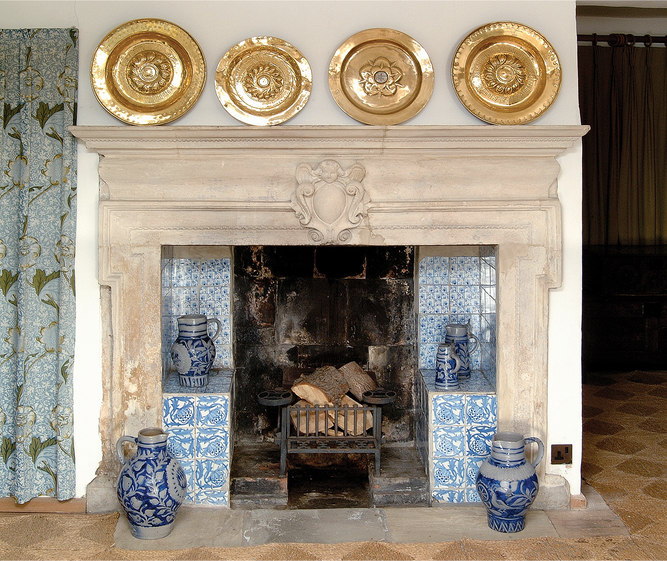
Kelmscott Manor, in Oxfordshire, now in the care of the Society of Antiquaries of London, was the rural home of William Morris: designer, craftsman, socialist and writer. He lived there with his family, leasing it as a summer home from 1871 until his death in 1896. It was purchased as a permanent home by his widow, Jane Morris, and then left to their daughter, May Morris. The property and its collections finally passed to the Society in 1962.Footnote 1 This paper is concerned with the large group of attractively decorated, grey-and-blue stoneware vessels inherited by the Society as part of the Kelmscott collection. Commonly referred to as grès de Flandres (Flemish stoneware) by Morris and his contemporaries, the term was adopted generally by antiquarian collectors in the nineteenth century as a ‘purposely vague and indefinite name’ for Rhenish stoneware, recognising that it was imported to Britain for centuries through ports in the Low Countries.Footnote 2 Now more commonly referred to as ‘Westerwald’ (after their region of manufacture), these wares were produced in the Rhineland between the seventeenth and twentieth centuries. Morris is said to have admired them, used them in his home (fig 1) and to have encouraged a fashionable taste for the richly patterned grey-and-blue stoneware still being manufactured in small, family-run workshops in the Rhineland. These continued to employ the wheel-thrown, hand-decorated methods of late medieval and early modern craft production, using local clays. We refer to this as a vernacular pottery tradition, in the same sense as one speaks of a vernacular building tradition: that is, utilising local craft skills and materials, making wares primarily for functional, everyday use and employing a repertoire of simple forms and, sometimes naively executed, decorative motifs. This is the largest collection of such Rhenish stoneware that the authors have identified in an historic house collection and includes a significant group of nineteenth-century, hand-decorated vessels of this distinctive, vernacular character.
Westerwald wares displayed at Kelmscott Manor today as presented in the Green Room. Photograph: © The Society of Antiquaries of London

The history and archaeology of Kelmscott Manor since it came into the Society’s care has been studied by many scholars.Footnote 3 Most recently it was re-examined authoritatively for the Kelmscott Manor and Estate Conservation Management Plan. Its authors observed that the Manor’s collection of furniture, household objects and fittings are a composite work, like the building itself, repaying careful scholarship while presenting challenges for curation and interpretation.Footnote 4 This article offers a contribution towards that work through this study of the Westerwald stoneware collection in the house today and its wider context. It considers its connections with Kelmscott and with Morris & Co.; the history of stoneware production in the Westerwald; and its significance for William Morris as reflected in his life, work and writing. Recent work in material culture studies has encouraged thinking beyond a fixed materiality of objects towards the richer ‘social life of things’ and entanglement of object biographies.Footnote 5 ‘That persons and things are not radically distinct categories, and that the transactions that surround things are invested with the properties of social relations’, as Arjun Appadurai suggests,Footnote 6 are notions that resonate in this study of the relationships between an object collection and the socio-economic and political context of a key figure in Victorian material culture. William Morris’s homes contained collections that were as complex as the man himself and, as Imogen Hart’s work on Arts and Crafts objects shows, entangled with his diverse, and at times contradictory, personal interests.Footnote 7
When it was opened to the public by the Society of Antiquaries in the 1960s, visitors to Kelmscott Manor were introduced to the house and its collections by A R Dufty, the Society’s General Secretary and curator, through his illustrated Guide. He commented that ‘much Grès de Flandres ware’ survived in the house and introduced a central question around the provenance of the collection.Footnote 8 Given that the house is no longer arranged as Morris knew it – and that, as a rented holiday home during his lifetime, it probably contained few of his own possessions – what certainty is there about the origins of today’s collections? We know that many of the Manor’s present contents were brought from Kelmscott House in Hammersmith after Morris’s death, and that some came from the London house of May Morris, his younger daughter.Footnote 9 May Morris inherited Kelmscott Manor from her mother in 1914 and retired to live there permanently in 1923, when she brought together items from the family’s previous homes in London and Bexleyheath.Footnote 10 Prior to May’s death in 1938, she drew up a memorandum as part of making her will, which specified that particular ‘furniture, chattels and effects’ associated with her father should be bequeathed in trust with the house and estate. However, it was May’s companion, Miss Mary Lobb, who inherited the everyday household items from the Manor: ‘all my articles chattels and effects of personal household garden or stable use’.Footnote 11 Mary Lobb’s own death followed soon after May’s and a major sale of furniture and effects from Kelmscott Manor took place in July 1939, which included the residue of the household glass, china and other wares.Footnote 12
This enquiry began with an assumption that Kelmscott’s grès de Flandres collection was assembled by William Morris and that research would focus on their provenance and manufacture, and how he acquired them.Footnote 13 As it has developed, the research has revealed more of an entanglement of relationships between Morris and his circle, changing taste in the Victorian period and Morris’s concern for the production of the wares themselves. Morris’s ownership of them – where indeed it can be demonstrated – is perhaps less significant than the ideas, connections and inter-dependencies revealed through study of them. ‘Humans and things emerge contextually in relation to each other’, as Ian Hodder suggests, and in the flows of what we know and perceive about them in material and connected relationships.Footnote 14 This paper explores how the Westerwald stoneware in the Kelmscott Manor collection today can be connected with William Morris’s life and work as a designer and maker; and, more generally, goes on to offer insights into Morris’s ideas and vision for everyday art and creativity as expressed in his lectures and socialist writing.
ENCOUNTERING GRÈS DE FLANDRES AT KELMSCOTT
The Westerwald wares at the centre of this study have a distinctive, finely textured, grey fabric, often used in thick-walled stoneware vessels, fired in kilns operating at a high temperature (1,250–1,350°C) and with a salt-glaze. The pure clay of the Westerwald gives the ware a distinctive light grey colour when fired in a reducing atmosphere in the salt-glaze kiln.Footnote 15 Although other production centres developed similar wares with similar clays, both elsewhere in Germany, in Europe more widely and in America, these Rhineland products are sufficiently distinctive for them not to be easily mistaken.Footnote 16 German stoneware of the seventeenth century and earlier has been the subject of study since the mid-nineteenth century in both Germany and Britain, when it began to be prized by antiquarian collectors.Footnote 17 Large collections were eventually acquired by both the British Museum and the Victoria and Albert Museum, and an account of its development and wider cultural context is available in David Gaimster’s comprehensive monograph.Footnote 18 Morris’s interest in, and promotion of, this particular ceramic places him, therefore, among a group of early enthusiasts and collectors, whose activities led into the formation of important national museum collections in Britain and Europe that sought to illustrate technological innovation in the decorative arts, as admirably documented by Gaimster.Footnote 19
In contrast to earlier periods of production, Westerwald wares of the late eighteenth and nineteenth centuries have received relatively little scholarly attention in Britain. Most accounts stress the simplification of the vessel forms and the ‘degeneration’ of decorative designs during this period, prior to the industrial mechanisation of production towards 1900. The intention here, however, is to reassess late eighteenth- and nineteenth-century Westerwald output, and to draw attention to a vernacular pottery tradition of significance in its own right. As we will suggest, it was this continuing, authentic vernacular tradition that engaged Morris’s personal and business interest and is evident in the collection at Kelmscott.
The history of the Kelmscott Manor collection
The Kelmscott collection today comprises twenty-nine Westerwald vessels of different forms. Individual vessels are referred to here by their ‘KM’ accession number and full details of each vessel are provided in the Gazetteer (see the Supplementary Material, Appendix SM1).This study shows that they span several centuries from the seventeenth to the early twentieth centuries, with the later, vernacular, wares of the mid-nineteenth century forming the majority.Footnote 20 In terms of condition, it is striking that more than two-thirds of the vessels are damaged and have been repaired historically. These were evidently household items in regular use then, and the 1926 inventory for May Morris’s memorandum reveals the collection distributed around the house as it might have been when in use.
Like the house itself, the collection is a composite, having developed since Morris’s time.Footnote 21 The 1939 Kelmscott sale catalogue lists several lots that include ‘Flanders ware’,Footnote 22 including, for example:

Evidently some of the grès de Flandres stoneware from the house, perhaps the less prepossessing items, were auctioned among the household effects left to Mary Lobb after May Morris’s death in 1938.
The items that May Morris intended to be kept as part of her bequest with the house, however, were listed in the memorandum of furniture and effects at Kelmscott Manor attached to her will in 1926. As Julia Dudkiewicz has shown, May Morris’s memorialisation of her father at Kelmscott Manor was the result of long and careful reflection on the way the house and its contents should be handed on as authentically as possible.Footnote 23 The memorandum itemises: ‘three grès pots’ in the Green Room, and ‘Grès de Flandres pots (three big ones, four others)’ in the Passage & Lobby to the panelled room. On the first floor there were ‘Grès de Flandres pots on bookcase’ in William Morris’s bedroom; ‘Red House grès de Flandres ware’ in the Passage Room with a washstand; and similarly in the Cheese Room on the first floor, ‘Washstand, horse and dressing table – Red House grès de Flandres ware’.Footnote 24 Possibly the Red House pieces were pitchers and pancheons used with a washstand, as a basin and ewer would have been.Footnote 25 The total number of pieces in these three upstairs rooms is not indicated, but, if the twenty-nine pieces in the collection today were all accounted for, there would have been an unfeasibly large number of pots (nineteen) distributed among them. It seems more probable that other Westerwald pieces from the London houses, brought to Kelmscott Manor by May Morris, were mingled with the collection and remained even after the 1938 sale. Importantly, though, the memorandum indicates that some of Kelmscott grès de Flandres itemised by May Morris had furnished the family’s earlier home in the Red House, Bexleyheath.
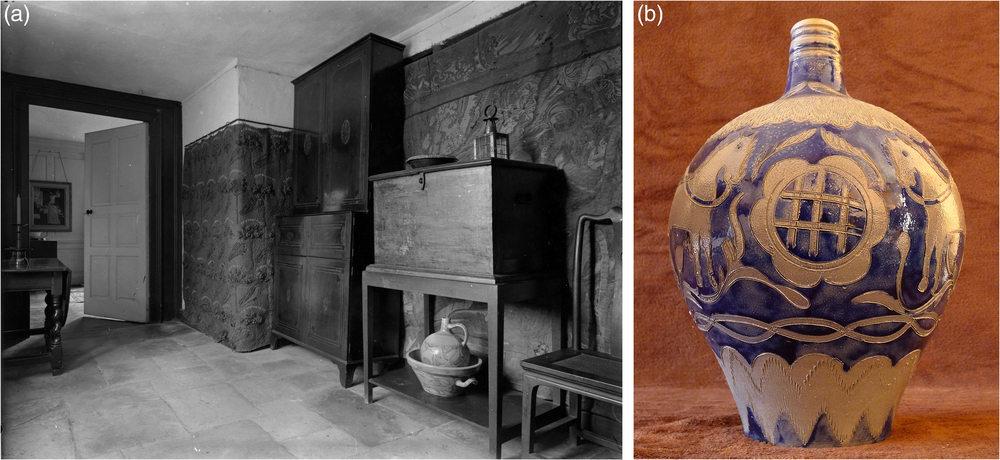
Visual records fill out the limited documentary evidence. Photographs for Country Life in 1921 illustrate Kelmscott when the house began to be opened occasionally to visitors. Although neither furnished nor arranged as when Morris lived there, these are a reliable early record of the contents of the house as May Morris intended as a memorial to her father. A photograph of the North Hall corridorFootnote 26 shows a large Westerwald flagon (fig 2, KM 163) and a Westerwald pancheon on the south side of the lobby. In another image, a spirit keg (KM 433, see fig 7) sits on the window seat opposite. An early photograph of 1897 also shows a large pitcher (KM 346) in the same passageway.Footnote 27 The flagon, keg and pitcher are all in the collection today and we can say with some certainty that these three pieces were among the grès de Flandres (‘three big ones, four others’) mentioned in May Morris’s 1926 memorandum in this location. The 1912 watercolour by Mary Annie Sloane, ‘May Morris in the Tapestry Room at Kelmscott Manor’, also shows what appear to be a number of Westerwald pots including pancheons, a vase and a jug.Footnote 28
(a) The North Hall, or Passage & Lobby, at Kelmscott Manor in 1921, with two pieces of grès de Flandres on a shelf below the chest on the right (© Country Life archives); (b) only one of these pieces (KM 163) is in the collection today. Photograph: © Gill Chitty and David Stocker

The collection of twenty-nine Westerwald vessels at Kelmscott today, then, includes items that May Morris believed to be from the Red House, belonging to the period of Morris’s early married life (1860–5) in the house designed for the couple by Philip Webb in Bexleyheath, Kent. Some sixteen to twenty pieces of Westerwald are listed as being in the house in May Morris’s 1926 memorandum and, though only a proportion of them can be specifically identified from early images, these form the core of the collection today. Two vases can be linked with Dante Gabriel Rossetti and Jane Morris in the early 1870s (see below).Footnote 29 However, the later date of certain vessels suggests that some were collected by the Morris family in the 1890s and early twentieth century.
Encountering grès de Flandres with Morris and his circle 1858–90
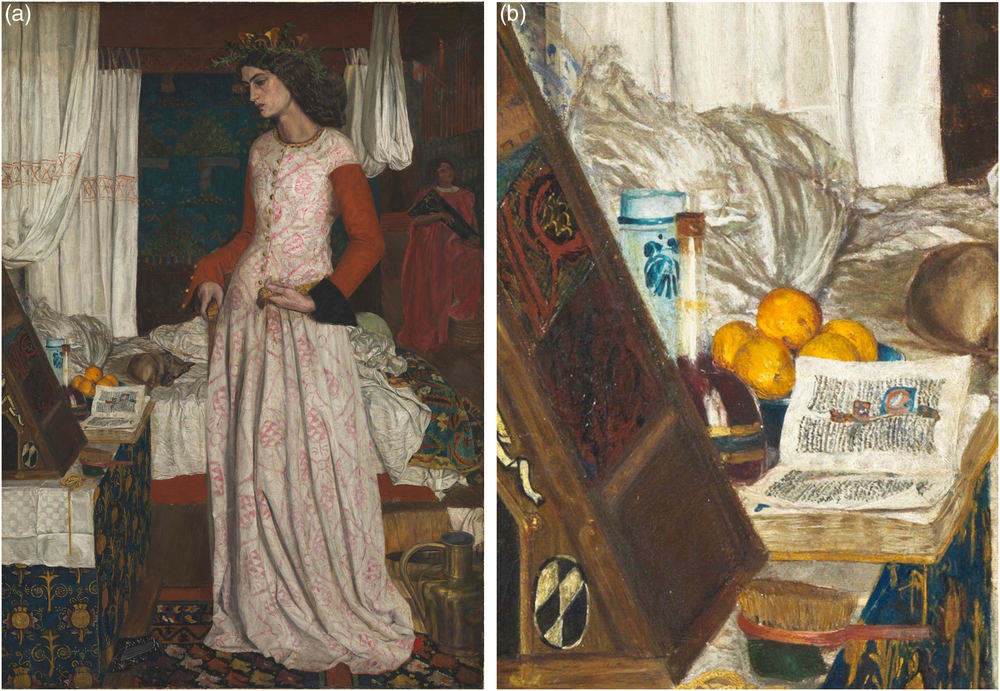
We can turn now to consider grès de Flandres in Morris’s own era, and in the circles in which he moved. As a young man interested in medievalism and Renaissance art in the mid-nineteenth century, Morris is likely to have encountered grès de Flandres as a part of the growing antiquarian interest in Renaissance and baroque German ceramics. Indeed, the earliest evidence we have of Morris’s interest is in the form of an eighteenth-century vessel.Footnote 30 It appears in a painting by Morris of his future wife, Jane Burden. Now known as La Belle Iseult, it was painted in 1858 and is believed to be Morris’s only completed easel painting (fig 3a).Footnote 31 This shows the unmistakable grey-and-blue of a Westerwald pitcher on the bedside table, partly obscured by a glass vessel (fig 3b). This image has often been described as the embodiment of the vision that Morris strove to evoke in his future work. It was, as Walter Crane expressed it, ‘the revival of the medieval spirit … in design; a return to simplicity, to sincerity; to good materials and sound workmanship’.Footnote 32 This was the world that William and Jane Morris, together with his friend and architect, Philip Webb, set out to create in Red House, their first home.Footnote 33 They moved into the recently completed, barely furnished, building in the summer of 1860 and struggled to find contemporary furnishings, decoration and tableware to suit the interior they sought to create:
… in only a few isolated cases – such as Persian carpets, and blue china or delft for vessels of household use – was there anything then to be bought ready-made that Morris could be content with in his own house. Not a chair, or table, or bed; not a cloth or paper hanging for the walls; nor tiles to line fireplaces or passages; nor a curtain or a candlestick; nor a jug to hold wine or glass to drink out of, but had to be reinvented.Footnote 34
(a) La Belle Iseult (1858) by William Morris, an early portrait of Jane Morris in an idealised medieval interior; (b) detail of La Belle Iseult showing an eighteenth-century Westerwald pitcher on the side table. Images: © Tate Britain

Webb designed many decorative items to be manufactured for them; some they devised and made themselves, such as tapestries and hangings; and some items came from makers whose work continued a tradition of craft practice, such as the blue-and-white Delft tiles from The Netherlands in the dining-room fireplace. The grès de Flandres wares formed part of an ensemble with the elaborate glass beakers and decanters in the seventeenth-century German style (commissioned from Powell’s), designed by Webb, and blue-and-white Staffordshire tableware. It is the authors’ tentative suggestion here that it was possibly on their honeymoon, through France, Belgium and the Rhine in 1859,Footnote 35 that the Morrises first encountered the continuing German stoneware tradition that evoked the same values of craft production, simple forms and stylised naturalistic decoration that Morris was to celebrate and rediscover through his own creative enterprise. Several of the Westerwald vessels now at Kelmscott Manor came from the Red House and belong to that tradition.
Morris and his collaborators founded their business enterprise, Morris, Marshall, Faulkner & Co., in 1861 in response to dissatisfaction with the poor quality of design and manufacture of decorative arts in mid-Victorian England. This was much more than an amateur venture.Footnote 36 As an innovative businessman, Morris effectively created a new business concept – a specialised interior design firm offering a complete range of products to its clients.Footnote 37 The circular announcing their opening displays an ambitious scope: murals, architectural carving, metalwork, stained glass and furniture, ‘besides every article necessary for domestic use’.Footnote 38 The wallpapers, printed fabrics, tapestries and carpets, for which Morris & Co.’s work is still widely admired, followed in successive years. The firm’s aim at the outset, however, was to establish a collective enterprise of artists, architects and designers who would combine their different skills in decorative art projects.
The initial business collaboration did not include ceramic experience (apart from tile decoration) among its talented members, and Morris & Co. was never involved directly in pottery production. Morris’s biographer, Mackail, commented on this and, crucially for this study, observed:
… while the firm never either designed or made pottery of any kind – the tiles used for painting being got from outside, chiefly from Holland – they did something towards introducing in England the knowledge of some of the best varieties of foreign manufacture, especially the simple and beautiful Grès de Flandres ware, now so common in the shops of London furnishers, which made its first appearance in England, except as a curiosity, in Morris’s showroom [authors’ italics].Footnote 39
Mackail, writing in Reference Mackail1899, is referring to the Morris & Co. showroom on Oxford Street, London, which opened in 1877. The business had developed into a very different kind of enterprise through the 1870s, especially from 1875, when the initial partnership was wound up and Morris took sole ownership and management.Footnote 40 Retail of ceramics, glass and decorative items by other makers, whose design and hand-crafted quality fitted with the Morris & Co. ethos, was increasingly available in their showrooms (William de Morgan’s Iznik-inspired earthen- and lustre-wares, for example, and, from 1894, Della Robbia pottery from Harold Rathbone’s pottery in Birkenhead). Grès de Flandres formed part of the extended Morris & Co. interior design repertoire, then, and the clear implication is that the firm was importing contemporary grès de Flandres vessels from Europe.
Morris himself travelled in Europe collecting for his showrooms, sourcing products and makers who could supply the business with traditionally produced wares. In 1873, for example, he travelled across France and Germany to Italy, writing to Philip Webb from Florence:
I have been merchandising for the Firm here, rather to Ned [Burne Jones]’s disgust … I have bought a lot of queer pots they use for hand-warmers (scaldini) of lead-glazed ware; also I have ordered a lot of flasks wickered of all sorts of pretty shapes … some things for the Firm in Paris also.Footnote 41
The Morrises had returned to the Rhineland together again in 1869, staying at the spa at Bad Ems, on the River Lahn at the southern edge of the Westerwald pottery production area. The visit to Bad Ems spa was for the sake of Jane Morris’s health and the couple spent nearly two months there while she took the waters and therapeutic baths.Footnote 42 Morris’s letters show how bored and restless he was during this visit, writing but also struggling to find things with which to occupy himself. He took energetic walks out into the Westerwald hills whenever he could get away. One can reasonably speculate that Morris must have encountered some of the small country pottery workshops producing the grès de Flandres stoneware for which the area was already renowned. If not on his walks, he will have seen these wares for sale in local markets.Footnote 43 Unfortunately, his surviving correspondence from Bad Ems makes no reference to local ceramics, but it seems likely that this visit and subsequent ones to the Rhineland were opportunities to meet local suppliers of stoneware for the firm’s showrooms in London.Footnote 44
THE WESTERWALD POTTERY INDUSTRY OF THE EIGHTEENTH AND NINETEENTH CENTURIES
The ceramics industry that surrounded Morris at Bad Ems is named from its production centre in the Westerwald hills, which lie in the wine-growing region west of the Rhine’s confluence with the Moselle at Koblenz (fig 4). Falling to the Rhine around Vallendar, opposite Koblenz, the hills lay within the former territory of the Electors of Trier (the so-called Kurtrier), which became part of the Duchy of Nassau at the start of the nineteenth century. The territory was ceded to Prussia in 1866 and sits today within the Land of Rhineland Palatinate.
Map of the Rhineland showing stoneware production centres on both sides of the River Rhine. Drawing: Dave Watt; © Copyright Gill Chitty and David Stocker

Long-standing tradition holds that potters from manufacturing centres further north, who had dominated the international stoneware trade between the fourteenth and sixteenth centuries, re-located themselves here during the late sixteenth and early seventeenth centuries.Footnote 45 It is said that the potters moved from their traditional clay-diggings and kiln sites at Köln, Raeren, Siegburg and Frechen into the Westerwald after 1586. More recent research has established, however, that stoneware manufacture was underway in the Westerwald region from at least the fourteenth century.Footnote 46 Even so, this reported migration coincided approximately with a change in the character of German stoneware, from the brown and cream-coloured salt-glazed vessels of Raeren and Siegburg, to the grey-and-blue salt-glazed wares that became so characteristic of the Westerwald. These attractively decorated drinking vessels appealed to the English market especially, and Westerwald vessels were imported to England from around 1600 until 1914.
The early Westerwald pottery tradition
Initially, migrant potters in Westerwald continued to produce vessels of very similar forms to those previously associated with Raeren and Siegburg, only now in grey-and-blue fabric. By the mid-seventeenth century, however, the Westerwald potters had developed their own distinctive vessel forms. Increasingly, painted surface decoration was enhanced by the widespread use of moulded appliqués, manufactured separately and applied to the body while still ‘green’. These appliqués took the form of trails of foliage and flower-like bosses, as well as the traditional achievements of arms that had previously been a feature of both Raeren and Siegburg products.
The year 1643 has been taken as a critical moment in the development of the Westerwald pottery industry as it marked the foundation of the jug-bakers’ guild (Kannenbäckerzunft).Footnote 47 This was a cartel of producers operating within approximately eight miles of the town of Grenzhausen and the adjacent settlements Grenzau and Höhr, and this zone of country soon became known as ‘Kannenbäckerland’.Footnote 48 Three resources were critical for a successful potter hereabouts: access to one of the closely guarded concessions to dig the pure clay in the hills; access to timber; and access to one of the banks of communal kilns that were typically located in the towns. In the towns, however, there was already a number of ‘masters’ who ran both workshops and their associated kilns, some of whom also purchased clay-digging concessions on their own behalf, becoming integrated, self-contained businesses.
Alongside such ‘masters’, however, some local farmers and landowners held onto their traditional rights to clay-digging, and onto their woodland rights, and thus to a traditional small-scale ‘craft’ production of pottery, fired in communal kiln-banks.Footnote 49 Such figures would become clay-diggers and potters in winter, when work on the land was less intensive, to supplement agricultural income. In such circumstances they might, for example, make leather-hard pots in their own outbuildings, and then take their unfired vessels into Höhr, Grenzau or Grenzhausen for firing, when it was advertised that communal kilns there were to be lit.Footnote 50
Whereas wood and clay were local materials, salt always had to be imported. During the early modern period this came from salt-pans on the Dutch and Baltic coasts, but by the nineteenth-century salt had become a complex international trade that included mined as well as sea-salt.Footnote 51 Cobalt, used to provide the distinctive blue colour, was mined in Saxony and had to be ground with silica into a powder, before being used as a paste (smalt) for decorating pottery. Cobalt processing was another Dutch industry.Footnote 52 The powder was then mixed with water by the potter and brushed onto the leather-hard pot as a wash before firing.
The ambition of Westerwald potters declined after c 1700. Until the early eighteenth century, a wide variety of vessel forms had been produced, often mimicking baroque metalwork, and decoration had been varied and incorporated many types of appliqué. As the century went on, however, forms became more limited, while decoration became increasingly simplified, deploying a limited range of formulaic designs. As the tradition of complex appliqué-work fell away, decoration was increasingly confined to simple incised patterns, with the lines providing a guide for the painter, using cobalt. Vessels themselves were still potted on the wheel, although profiles were sometimes created using templates applied to the outside once the clay had become leather-hard. These templates were known as Stege.Footnote 53
When the vessels were leather-hard, they were first decorated with linear floriated patterns, simple but vivid animal and bird forms and other motifs, inscribed with a sharp implement sometimes called a Redholz.Footnote 54 Then, in a second process, they were usually coloured with cobalt smalt, applied either inside or outside the inscribed lines. More rarely, and only at certain periods, a smalt containing manganese was also used, which gave a brown-purple colour. The inscribed decoration was usually rapid and formulaic, though not imprecise, and occasionally admirably skilful. The cobalt painting, however, was frequently more haphazard, spilling outside the framework of decoration provided by the inscribed lines.
Early Westerwald forms at Kelmscott Manor
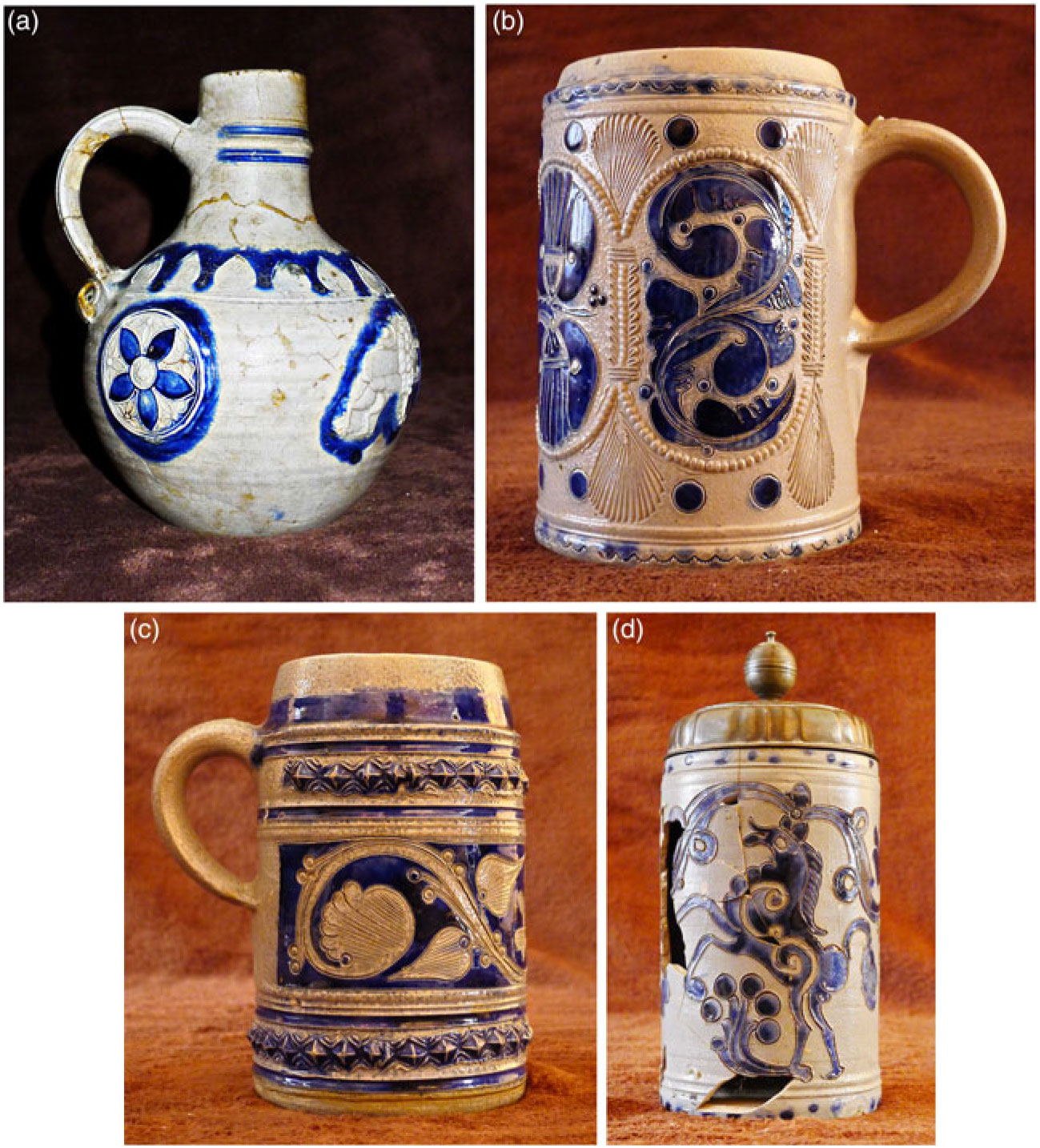
The Kelmscott collection contains several vessels that belong to the early period of Westerwald production: a kruge or ‘flagon’ vessel, KM 439, and two humpen or ‘tankard’ forms, KM 337 and KM 342. This group is eclectic in style of decoration and date range and is typical of the small collections of antique grès de Flandres assembled by private collectors in the mid-nineteenth century. Comparable small collections appear in the auctions of personal estates at Christie’s towards the end of the nineteenth century.Footnote 55
The Kelmscott flagon, KM 439, is an important early vessel, with a globular body sitting directly on an unornamented flat base, and with a strap handle (fig 5a). It belongs to the first quarter of the seventeenth century. This pot was evidently already 200 years old by the time it came into Morris’s possession.
Early stoneware in the Kelmscott Manor collection from the seventeenth and eighteenth centuries: (a) flagon from the first half of the seventeenth century (KM 439); (b) tankard from the second half of the eighteenth century (KM 337); (c) tankard from the first half of the eighteenth century (KM 342); (d) tankard from the late eighteenth or early nineteenth century (KM 434). Photographs: © Gill Chitty and David Stocker

The humpen or ‘tankard’ form, KM 337, dates from about a century later than the early flagon, but the restrained elegance of its decoration contrasts with the more robust vernacular style of the remainder of the collection (fig 5b). It is of greater refinement than many vessels of the contemporary monogram series (see below) and is aimed at a more demanding local market for tableware. Parallels place KM 337 firmly in the second half of the eighteenth century, so it would have been a century old when Morris acquired it. The ‘S’ shaped layout of the fleshy leaf-form – akin to acanthus – shown here is not only reminiscent of much Westerwald foliage decoration for the next century, but it is also a form that would have appealed to Morris, who used it in both textiles and wallpapers. We can also see this celebration of natural form on two other ‘tankards’ in the Kelmscott collection: KM 342 and KM 434 (fig 5c and d). Both vessels would also have been antiques when Morris acquired them.
With its ‘spiral’ hip and shoulder, the prancing horse on KM 434 looks almost like a work of the Jelling or Ringerike style, which would also have appealed to Morris’ interests in Nordic folk art. The rather wispy foliage streamers behind the horse’s ears also resemble foliage emerging from the ears and horns of similar beasts in Viking Age art styles. The foliage on which the horse treads, with its bunched stalks and crown of impressed circles, also appears medievalising, resembling schematic trees seen in Romanesque manuscripts, for example. It might have been these distinctive design details that attracted Morris to this piece, badly damaged though it now is. The form of animal modelling is similar to an example from the Mittelrhein-Museum, Koblenz, dated to the early nineteenth century.Footnote 56
The ‘monogram’ jug series
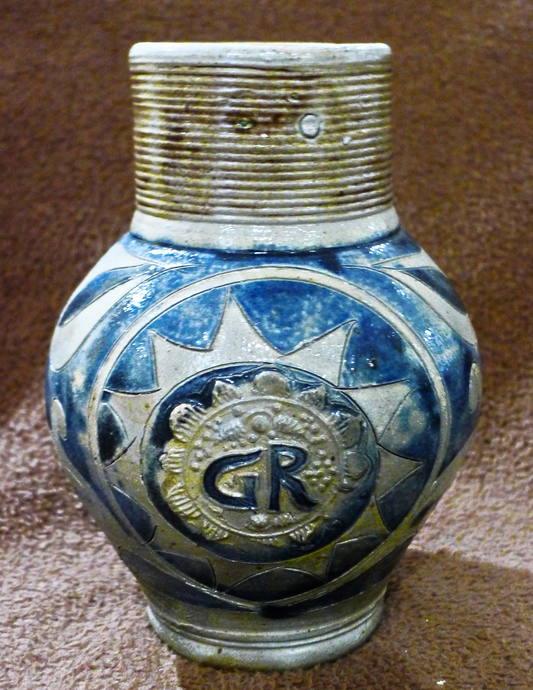
During the eighteenth century the Westerwald area produced a long series of so-called ‘GR’ jugs (krugen), evidently in very large numbers. These jugs, designed for drinking, not for pouring, have a slowly developing profile, but they became increasingly loosely decorated and, although earlier, they sometimes included additional decoration in manganese-derived purple, finally they were decorated only with the cobalt blue.Footnote 57 For antiquarians in the later nineteenth century, and indeed still for collectors today, these monogram jugs were highly collectable (fig 6). They were typical of the collections of grès de Flandres wares formed in the nineteenth century that appear in auctions in the 1890s, such as that of the artist, Myles Birket Foster (whose house was furnished by Morris & Co.).Footnote 58 Although a frequently found type in England, however, there are no examples of GR or monogram jugs in the Kelmscott collection. Nonetheless, an account is given of them here as they form an important chapter in the history of the Westerwald industry.
Example of a ‘GR’ monogram jug, a type that spans the Georgian period (1714–c 1790), popular with Victorian and later collectors, but not represented in the Kelmscott Manor ensemble, late eighteenth century. Photograph: © Copyright Gill Chitty and David Stocker

Monogram series jugs are typically small, bellied, drinking vessels with a tall cylindrical ‘rilled’ neck (that is, decorated with concentric ribs). The body was decorated with incised patterns, which, in the earliest examples, were derived from the floral and geometrical appliqué designs of the previous century, but increasingly incised foliage trails with stylised leaves and buds became standard. Over the incised decoration, frequently painted blue, was placed a separately moulded boss containing a centrally placed cartouche with the letters ‘GR’ (for George Rex). In fact, the earliest such cartouches bear the letters ‘WR’ (for William Rex) and ‘AR’ (for Anne Regina). These earlier cartouches are applied, however, to quite a wide range of vessel forms, whereas the ‘GR’ cartouches tend to be applied to jugs of the more standardised type. These cartouches reveal several important points about Westerwald production in the late seventeenth and eighteenth centuries. First, the pottery was clearly aimed at the export market, specifically at England. Second, we must presume that the trade relied on the Protestant Netherlands, as there are no examples of ‘JR’ (for James Rex) or ‘CR’ (for Charles Rex). Third, the rarer ‘WR’ cartouches demonstrate that the earliest vessels belong to the period after the so-called Glorious Revolution of 1688.
The relatively rapidly changing series of monarchs’ initials at the start of the eighteenth century offer us a well-dated sequence of vessels; those with ‘WR’ and ‘AR’ cartouches were presumably produced between 1688 and 1714. The run of four English Georges (1714–1830), on the other hand, make it possible to argue that the monogram series remained in production for a century or more. In fact, the trade in monogram jugs must have been greatly disrupted by the wars between Britain and revolutionary France, beginning in 1792. Jugs with such monograms must have come to an end by 1802, in any event, when Trier fell to Napoleon. The ‘GR’ monogram jugs, then, must date from 1714–c 1790.
As the Rhenish wine trade with England increased in the second half of the eighteenth century, the output of the ‘monogram series’ jugs probably increased also. By 1771 there were reported to be more than 600 potters at work in the Westerwald and in 1783 a new kiln capable of firing 3,200 jugs at a time was constructed in Grenzhausen.
Satellite industries around the Westerwald
A travel diary of 1785 refers to monogram series jugs being made at Gelsdorf, a village near Adendorf, located on the western bank of the Rhine and about half way between Koblenz and Köln. They are described as ‘Englische-’ or ‘Londensche Krüge’, attesting to the market they evidently supplied.Footnote 59 The vernacular pottery industry at Gelsdorf was one of several satellites of the Westerwald industry in the eighteenth and nineteenth centuries, all using very similar or identical vessel forms and decorative motifs. Three of these satellite industries are relevant to the present study, as we know that all of them were producing comparable vessels to those now at Kelmscott Manor. One of these centres was based 200km up the Rhine, around Betschdorf in Alsace, just across today’s French frontier (though within Germany from 1871 to 1919). A second centre, based around the town of Speicher, on the north bank of the Mosel river (in the Südwesteifel region), had also been producing comparable wares since at least the final quarter of the eighteenth century.Footnote 60 The production centre in the Hunsrück hills around the village of Münchwald was apparently more recently established, but also produced vessels similar to certain Kelmscott examples.
Marcel Schmitter has studied the production of Westerwald-type products in Betschdorf, and has not only developed a basic type-series, but also established a detailed genealogical history of several immigrant potter families.Footnote 61 These genealogies reveal a number of migrating potters, including the Spitz, Wingenter and Krumeich families, arriving in Betschdorf in the second quarter of the eighteenth century having received their training at towns in the Westerwald hills. They imported the high-temperature salt-glaze kiln technology to this new landscape and continued production, through changes in political administration, into modern times. Latterly they produced flagons, pitchers and the large wide-necked storage-pots called ‘crocks’ or keulsen, all similar to examples at Kelmscott.
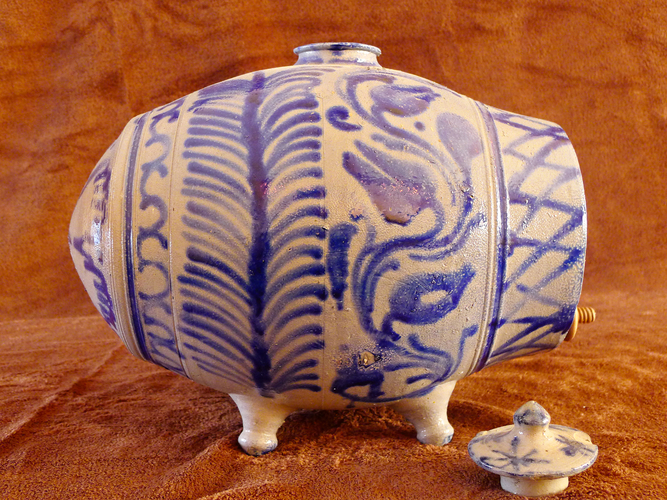
The Westerwald ‘satellite’ production centre at Speicher has been studied by Kerkhoff-Hader.Footnote 62 Also using genealogical research, Kerkhoff-Hader recruits archaeological studies to offer a complete picture of this industry. Although stoneware production began in the medieval period, by the nineteenth century this industry was producing pitchers in the Westerwald tradition, very similar to those being produced at contemporary Westerwald ateliers, with well-executed foliage and animal decoration, outlined with incised lines in the Westerwald manner. The earliest of these pitchers are said to be of eighteenth-century date,Footnote 63 as are similar-looking ‘flasks’ based on the same body-form.Footnote 64 Later examples of pitchers and flasks from Speicher, however, almost always lack an inscribed design, it being only painted in cobalt. The Südwesteifel kilns also produced a wider range of domestic vessel types from the mid-nineteenth century onwards, among which keulsen of the type represented at Kelmscott were predominant, of which the earliest dated example is inscribed 1861.Footnote 65 Like ateliers in the Westerwald, they also produced novelty spirit barrels of the type collected at Kelmscott (fig 7, KM 433).Footnote 66 In the Hunsrück hills the vernacular salt-glazed stoneware tradition seems to have originated with another branch of the Wingenter family in the final decades of the nineteenth century. The fact that this family had representatives in most of the satellite centres shows how interconnected all these producers were, and with the Westerwald itself.Footnote 67
A spirit keg (433a) with lid (433b) in the Kelmscott Manor collection, from second half of the nineteenth century. Photograph: © Copyright Gill Chitty and David Stocker

All the Westerwald ‘satellite’ ateliers not only continued the kiln technology of pre-industrial Westerwald, they also maintained the traditional vessel forms, techniques of decoration and decorative motifs, so that it is difficult to be certain which products originated in the ‘satellite’ industries and which were produced by potters remaining in the Westerwald itself. Consequently, we should be aware that some of the pitchers, pancheons and keulsen at Kelmscott may have been products of Westerwald’s satellite industries.
The ‘pitcher series’
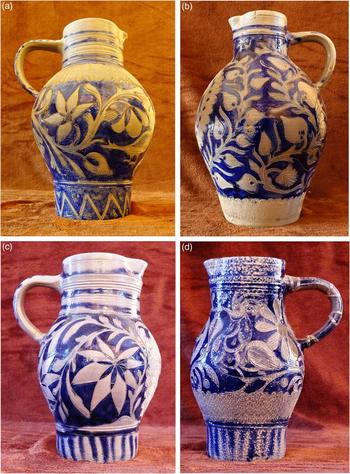
The distinctively decorated group of twelve Kelmscott vessels, described here as the ‘pitcher’ series, constitute a substantial part of the collection, for which, it seems, Morris had a particular liking. Evidently the Westerwald potters retained the globular body-form of their monogram series after c 1790 and developed it into a form of larger pitcher. The pitcher series also marks a transition from vessels designed as drinking ‘jugs’ (kruge) to larger vessels designed for pouring. As well as being based on the body-shape of the monogram series, vessels of pitcher series also often have a similar tall, cylindrical, rilled neck, decorated externally with concentric grooves, created on the wheel with a broad wooden comb.Footnote 68 Many such pitchers have the same gently waisted foot as monogram series vessels, but a tradition evidently subsequently developed of a more squared-off foot. The pitcher series also have remarkably similar forms of inscribed and painted decoration to those on the earlier monogram series jugs; certain bud- and leaf-forms are clearly seen on both monogram series and ‘pitcher series’ vessels. These decorative foliage forms are also seen on most other Westerwald products of the second half of the eighteenth century; for example, on the collection of jugs imitating porcelain in the Rijksmuseum in Amsterdam.Footnote 69 The appliqué cartouches of the monogram series, however, are never reproduced on the pitcher series vessels, although several of the larger pitchers have decoration arranged around a painted ‘sunburst-like’ motif that could be seen as the continuation of the monogram cartouche, only in a simplified and politically neutral manner (fig 8b (KM 162) and fig 8c (KM 148)). The pitcher series deployed a second decorative technique that is also sometimes found on monogram series vessels: the use of a small wooden tool with a narrow chisel-like blade on one end, called a knibis.Footnote 70 This tool was used to create ‘fans’ of distinctive indentations and other motifs, which develop across the surfaces of some vessels in complex patterns and sometimes come to dominate the entire design (fig 8a–d).
Four examples of ‘pitcher series’ jugs from Kelmscott Manor, which are typical of the series as a whole and are dated from c 1850 to the 1880s: (a) KM 166; (b) KM 162; (c) KM 148; (d) KM 319. Photographs: © Gill Chitty and David Stocker

A major difference between the two vessel forms, though, is in size. The pitchers are uniformly larger and, critically, they all have a small pinched ‘spout’ in the neck – a feature that is rare in monogram series vessels. These differences point towards variations in function between the vessels. It is thought that the monogram series jugs are associated with the Rhenish wine trade with England, though they were evidently also used for drinking English beer.Footnote 71 While they are, then, primarily drinking vessels (not requiring a spout) the rarer large examples – still without spouts – may have served as jugs to be filled from the barrel. They are said to have been shipped along with the wine barrels, partly as ballast on Rhine barges carrying the wine downstream for export, and partly as packing to stop the barrels rolling about in the hold.Footnote 72 The wine barrels were transhipped at Low Country ports into sea-going vessels for onward transport to England. The monogram series jugs were often made to standard sizes or ‘measures’, calibrated from 1 to 10, sometimes noted in cobalt wash on the sides or occasionally incised.Footnote 73 The pitcher series vessels, however, rarely have measures on them, indicating perhaps that they played a slightly different role in drinking culture. They may represent a more communal style of drinking, whereby the pitcher was filled from the barrel and then served into smaller, individually calibrated mugs or glasses for people to drink from.
The neck of the pitcher series body-form is sometimes narrowed and enclosed as a stubby tube, designed for a cork or wooden stopper, creating a form of flask. Alongside the monogram series, this vessel form also goes back to the later seventeenth century, if not earlier, where some are associated with the reign of William iii.Footnote 74 Although they are sometimes described as ‘oil jugs’, it is more likely that they were designed specifically to store and transport the distinctive brandy that was an important by-product of the Rhenish wine trade. The Kelmscott collection contains three of these flask-like variants of the pitcher series (KM 163 (see fig 2b), KM 343 and KM 347). Similar pitchers were also produced at most of the Westerwald satellite production centres well into the twentieth century, so the vessel form had a very long life. In later examples, however, the painted decoration tends to be much sparser and free-style in layout, with few if any of the distinctive ‘Westerwald’ foliage forms, which are no longer outlined with an incised line before painting.Footnote 75 All vessels at Kelmscott are earlier in date than such vessels.
It is possible that the earliest examples of the ‘pitcher series’ belong to the same period as the latest of the monogram series, as some examples share such similar vessel profiles and decoration; but it is also possible that they follow on from it, after the disruption of the French Revolution and Napoleonic Wars. Items from the pitcher series, for example, never carry manganese decoration, whereas the monogram series often have this purple colour applied to their necks. This might indicate that the pitchers date from after c 1790, when sources of manganese became unavailable through war. The earliest clearly dated example of the pitcher series body-form we have found, though with the narrow neck of a flask, is in the Kommern Museum and carries a cartouche with the date 1840.Footnote 76
We suggest, then, that the ‘pitcher series’ is best seen as a later development of the monogram series jugs and that the earliest examples will date from after about 1790, with production continuing into the early twentieth century. The manufacturing techniques remained very similar throughout this long period and, even though the appliqué cartouches of the monogram series had been dropped, the foliage decoration remained remarkably similar until production ended.
The exclusive rights that members of the Kannenbäcker’s Guild had enjoyed to dig clay on the commons were withdrawn in 1802, and in 1814 the guild was wound up altogether. But although these changes might appear to indicate a declining industry, in fact it seems to have been the consequence of its more rapid development and re-organisation under Napoleonic government and following the Congress of Vienna (1815). Between 1817 and 1867, 250 clay mines (many of them shallow shaft-mines) were leased from the Nassau government. The noted early twentieth-century Danish ceramic scholar, Emil Hannover, thought these developments were a sign that ‘a bourgeois craft became a rustic craft; stoneware became peasant art’.Footnote 77 In his view, then, once the stultifying control of the guild was finally lifted, the small ateliers in the towns and farmer-potters of the countryside were released from the regulations and restrictions that had hitherto constrained them, and were now able to expand their production in a more individualistic fashion. Whether these major institutional changes were responsible for variations in the ‘pitcher series’, however, remains unknown. It is possible that these major changes in the organisation of Westerwald pottery industry in the first two decades of the nineteenth century also coincide with the appearance in large numbers of a second distinctive vessel form during the nineteenth century: the ‘birnkrug (pear-jug) series’.
The ‘birnkrug (pear-jug) series’
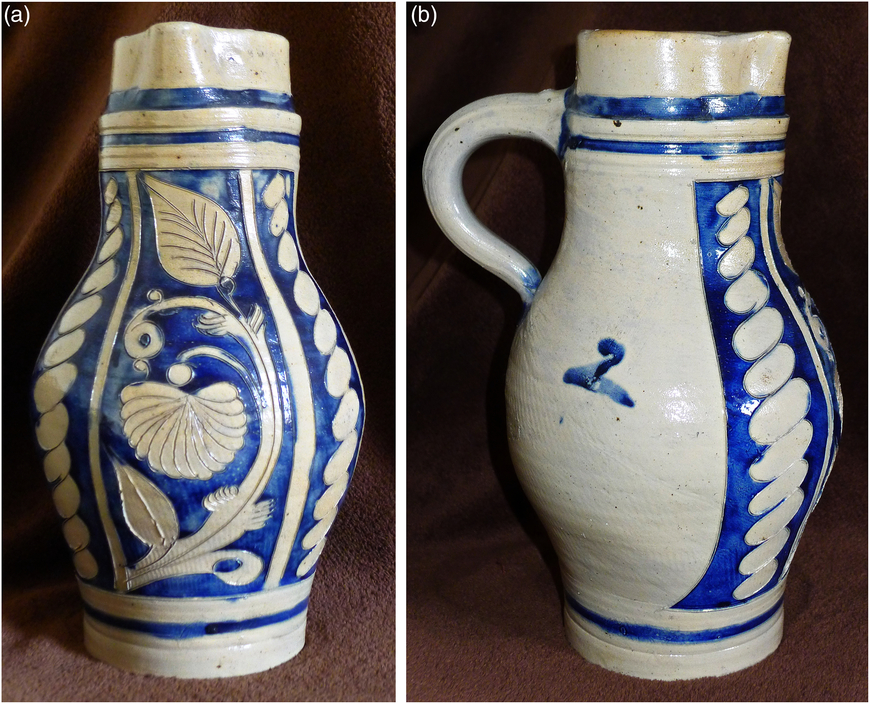
While the pitcher series forms might overlap with the earlier monogram series forms, the dominant Westerwald vessel form of the nineteenth century, and well into the twentieth, is the homogenous and uniform ‘birnkrug’. Strikingly, since these jugs were relatively common and apparently produced in large numbers during Morris’s lifetime, there are no examples in the Kelmscott collection. The jugs are named from their elongated curvy form (called Frankfurter Kannen in their day), which is loosely related to the globular form of both monogram and pitcher series. Decoration on these jugs is more regular than in either of these vessel types, being always confined to a single, framed, vertical panel on the front of the vessel. The decorative foliage forms used, however, evidently descend directly from those of the monogram series, and are often also directly comparable with vegetable forms on jugs of the pitcher series and related vessels. Such birnkrug vessels are frequently found in specific graduated sizes, with their capacity usually marked on the sides.Footnote 78 Commonly, these vessels have been fitted with ornamental pewter lids, for which all have seatings. Examples in the Rheinischen Freilichtmuseums und Landsmuseums für Volkskunde and in the Landesmuseum Trier are said to belong to the ‘second half of the eighteenth century’,Footnote 79 as are examples in the Nagel collection in Stuttgart and other private collections,Footnote 80 while a vessel apparently also of this form is stacked on a shelf behind the eponymous landlord in a painting dated 1765.Footnote 81 The vessel form, then, may have its origins in the eighteenth century, but the majority of these vessels represent a later phase of more coordinated production, after 1802, when they are associated – specifically – with the export wine trade, perhaps taking the place of the monogram series jugs in the wine barges. They occur in price-lists issued by different ateliers in Höhr between c 1870 and c 1920, while a dated example of the birnkrug form, though with a flared foot, was produced by the Wingenter family kilns at Münchwald/Struthof in the Hunsrück hills in 1905.Footnote 82 The characteristic birnkrug foliage decoration, within an inscribed outline, which is so closely related to the decoration on vessels of other forms in the Kelmscott collection, however, disappears from the price-lists reprinted by Zühlcke after 1936.Footnote 83 Birnkrugen are much the most common form of Westerwald vessel seen on the antiquities market today (fig 9a and b), and most days eBay will be offering examples for sale internationally. Monogram series and pitcher series vessels are more rarely found in this marketplace.
Example of a birnkrug, typical of handmade stoneware jugs produced on the Rhine from the mid-nineteenth century in enormous numbers. The vessel type is not represented in the Kelmscott collection: (a) view from front showing framed vertical panel of decoration; (b) view from side showing capacity mark ‘2’. Photographs: © Copyright Gill Chitty and David Stocker

Later vessel forms
Governmental changes introduced under Napoleon, and following the re-establishment of the Duchy of Nassau in 1815, may have encouraged development of the ‘birnkrug series’ of jugs. Furthermore, the absorption of Nassau by Prussia in 1866 might lie behind the development of a much wider range of vessel forms than previously seen, although throughout all these political changes design and decoration remained remarkably conservative across all vessel forms.
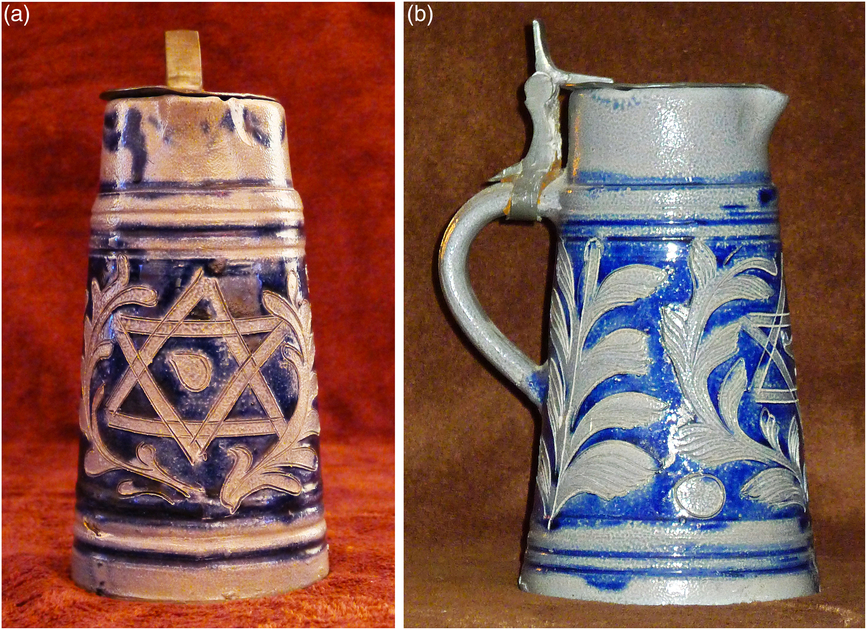
A straight-sided jug form was now produced, for example, decorated with typical conventional foliage types but frequently incorporating a Star of David. Two examples at Kelmscott (KM 341 and KM 348), both display the Star as a forward-facing trophy amid typical foliage designs (fig 10a and b). Elsewhere a vessel of this form decorated only with the Star of David, is dated ‘1880’,Footnote 84 while another of similar date was associated with a synagogue.Footnote 85 These vessels supplied a Jewish market, then, being used for water, perhaps, rather than for wine, and the form might have offered a deliberate contrast with wine-carrying pitchers. The two Kelmscott examples, with their exuberant foliage and their pewter lids may be early in this series, perhaps dating from the period 1880–1914.
Straight-sided jugs from the Kelmscott Manor collection. This vessel form continued in use well into the twentieth century, but the decoration here indicates production in the later nineteenth century: (a) KM 341; (b) KM 348. Photographs: © Copyright Gill Chitty and David Stocker

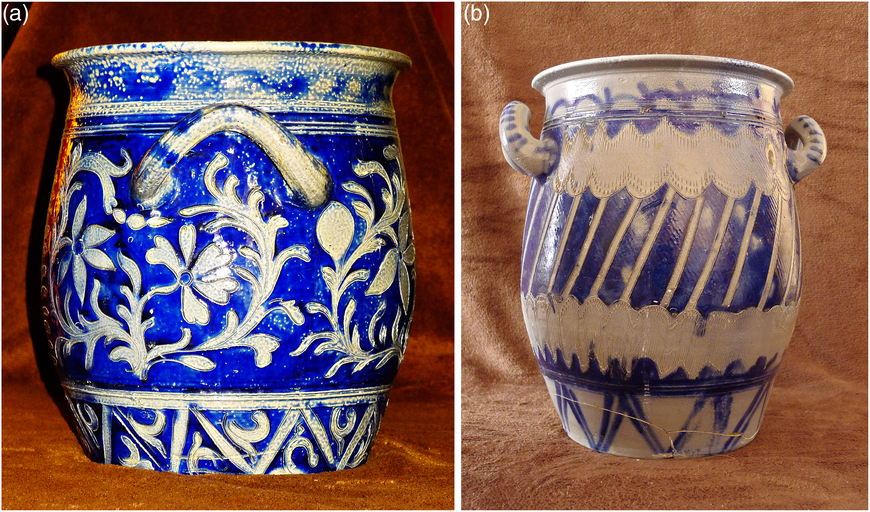
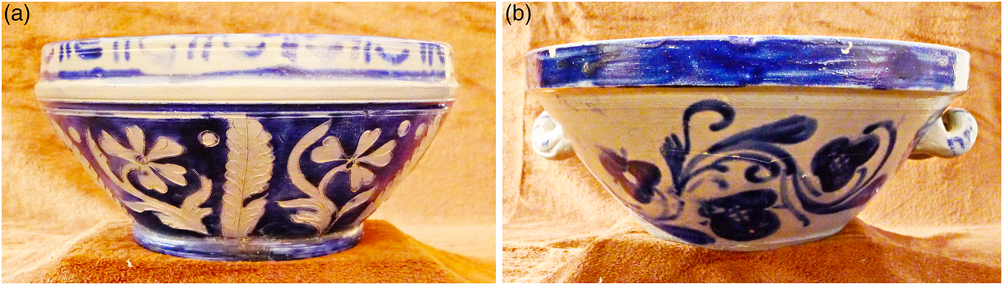
Another local market served by the small-scale pottery producers of the Westerwald in the later nineteenth century was the dairy industry. Vessels decorated in the traditional style, using the same floral motifs as the monogram, pitcher and birnkrug series, include a wide range of ‘crocks’ (keulsen) and pancheons. The crocks were containers for perishable foods, vegetables, butter and salt. The Kelmscott collection contains two vessels of crock form. One has a squat profile, decorated with well-executed foliage of traditional Westerwald type and two large, curved, handles (fig 11a, KM 435). The second is more elongated and decorated with less characteristic upright banding (fig 11b, KM 438).Footnote 86 Pancheons, like crocks, are also linked to dairying, as essential vessels for skimming and preparing milk during processing of butter and cheese. Two such pancheons at Kelmscott (fig 12a and b, KM 339 and KM 432), represent different vessel forms, both of which were widely marketed in the Rhineland from the mid-nineteenth century. Both forms – one with large curved handles – are a little deep to have been used easily when skimming milk, so both probably relate to other processing stages. Both forms, of course, were equally useful as water bowls placed on wash-stands in the bedroom.
Two crocks (keulsen) from the Kelmscott Manor collection. Towards the end of the nineteenth century, this vessel form became very common in the Rhineland. The decoration on these two vessels suggests a date in the second half of the nineteenth century, and certainly before c 1914: (a) KM 435; (b) KM 438. Photographs: © Copyright Gill Chitty and David Stocker

Two ‘pancheon’ bowls from the Kelmscott Manor collection. These vessel forms originated within the dairy industry, but were widely used as washing bowls: (a) KM 339; (b) KM 432. Photographs: © Copyright Gill Chitty and David Stocker

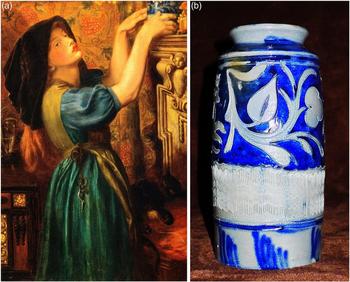
The Kelmscott collection also contains examples of handmade, vernacular pots of Westerwald type that were not domestic utilitarian wares like those we have been considering (KM 320.1 and KM 320.2, KM 340 and KM 344). All four of these vessels are evidently vases. The form itself might have ultimately derived from oriental ‘brush-pots’ made popular during the Chinoiserie fashion, starting in the later eighteenth century. All four Kelmscott examples, however, are decorated with bands of foliage and knibis ornament typical of the Westerwald ateliers, and belong to the very start of a revival of interest in Chinoiserie in the 1860s. It is one of these vases (KM 320.1) that appears in Dante Gabriel Rossetti’s painting, Marigolds, executed at Kelmscott in 1874 (fig 13a and b).Footnote 87 As they are not utilitarian in function, but rather appeal to fashionable taste in decorative art, Westerwald vessels such as these appear to represent efforts by these vernacular ateliers to supply a tourist market, which was already becoming important to the Rhineland economy in the mid-nineteenth century, catering for middle-class visitors such as the Morrises had been themselves on their wedding tour in 1859. In the cases of these ‘art’ vases, however, we might speculate that all four originally belonged to Rossetti, rather than to Morris. Not only was Rossetti – along with London neighbour, James McNeill Whistler – one of the earliest advocates of ‘Chinoiserie’ in artistic circles in late nineteenth-century London, but he was also a great collector of ceramics.Footnote 88 No evidence has yet come to light, however, that Rossetti had an interest in collecting Westerwald. On the contrary, he obsessively collected the more refined Chinese blue-and-white porcelain that his circle generically called ‘Nanking’.Footnote 89 Rossetti was, however, very much involved in furnishing and selecting decorative items for Kelmscott Manor’s interiors, together with Jane Morris, bringing items of his own from London and buying furniture locally during the period that he lived there in the 1870s. His correspondence with Jane Morris in Reference Morris1878 lists the items he requested to be returned to him in London after his sojourn at Kelmscott Manor ended. This includes a reference to ‘French blue ware’, but there is no mention of grès de Flandres specifically to link him directly with the Chinoiserie-influenced vases.Footnote 90
(a) Marigolds (1874) by Dante Gabriel Rossetti, painted at Kelmscott that year. It shows the straight-sided grès de Flandres vase, one of a pair, above the fireplace in the Green Room. Image: © Nottingham Castle Art Gallery; (b) this vase (KM 320.1) remains in the Kelmscott Manor collection today. Photograph: © Gill Chitty and David Stocker.

Factory production
Alongside the development of a genuinely domestic market for decorative ceramics, the growth of Rhineland tourism was one of the drivers of mass-production in the Westerwald. The utilitarian vernacular pottery we have been considering so far is clearly distinct from the highly decorative, mass-produced, factory-made wares that came to dominate Westerwald output in the second half of the nineteenth century. Perhaps not surprisingly, given Morris’s well-known views on industrial production, none of this mass-produced material is found within the Kelmscott collection, nevertheless we should conclude this account of Westerwald ceramics with a brief outline of this final phase of mechanised industry.
New factories dedicated to mass-production, increasingly by machine, became established in the principal towns of the Westerwald hills from c 1860.Footnote 91 The industry was dominated by three manufacturers in particular: S P Gerz (founded at Grenzhausen, 1854, licenced 1862)Footnote 92; Reinhold Hanke (founded in Höhr, 1868)Footnote 93; and Merkelbach & Wick (founded at Grenzhausen, 1872)Footnote 94. These big factories, and their lesser competitors, capitalised upon a series of technical advances, the earliest of which had been mechanical clay-cutting machinery, installed in 1848 at Höhr. In 1865 the first steam-driven machinery in the region is recorded, again in Höhr. At Baumbach in 1879 we hear of the first mechanical press for blow-moulding ceramic vessels, and in 1883 what sounds like a new ‘Hoffman’ kiln was installed at Höhr-Grenzhausen, connected to the new Koblenz to Siegen railway line.Footnote 95 By 1894 it was estimated that there were approximately 270 ceramic ‘factories’ in Westerwald, employing 2,000 workers.
Following the foundation of the school of ceramics in Höhr in 1879, the Westerwald’s new factories developed different potting techniques from their vernacular predecessors and contemporaries.Footnote 96 Some factory producers, such as Reinhold Hanke (1839–86), consciously attempted to industrialise older craft techniques, such as the use of appliqués. But the most significant innovations were aimed at producing ‘standardised’ vessels using pre-formed moulds.Footnote 97 Initially, clay was pressed into wooden moulds by hand, but eventually a slurry of clay was ‘blown’ into a plaster-of-Paris mould, allowing the entire production process to be mechanised.
From the 1860s, Westerwald factories became associated, particularly, with ornamental pots in the historizmus style, often copies – or variants – of pots produced in the Rhineland during the sixteenth and seventeenth centuries.Footnote 98 Such vessels had little practical use, but were greatly favoured as souvenirs by tourists.Footnote 99 In their reproduction of baroque forms in the second half of the nineteenth century, of course, the new Westerwald factories were participating in a much wider cultural movement for the recreation and development of earlier design-forms, such as the Gothic, that eventually embraced the entire world in contact with Europe and America. Prosperous factories coexisted with the local vernacular tradition in which we are particularly interested, then, which was still producing pitchers, flasks, birnkrugen, pancheons and crocks throughout the nineteenth century, and evidently maintaining the handmade, craft traditions of the earlier Westerwald pottery industry.Footnote 100 A stoneware kiln was photographed still in use at the Hammer atelier in Höhr-Grenzhausen at the start of the twentieth century.Footnote 101 Similar kilns were also still operating at the ‘satellite’ centres (for example, at Herforst) until 1914.Footnote 102 Stacked outside the Hammer kiln are ranks of apparently undecorated crocks, flasks and undecorated vessels of ‘pitcher series’ form.Footnote 103
If anything, the wine trade went through a period of even greater expansion during the second half of the nineteenth century, thanks in part to Queen Victoria’s visit to the Hochheim vineyards in 1850, yet the new mechanised factories do not appear to have produced vessels for wine-drinking. Perhaps the vernacular ateliers continued to supply such vessels as they always had? The industrialisation of Germany’s glass industry in the second half of the nineteenth century, however, would ensure that cheap bottles were soon available to replace the barrels in which Rhenish wine had traditionally been supplied,Footnote 104 and with the replacement of barrels by bottles, the need for wine-jugs was greatly reduced. Rather than competition from mass manufacture, then, it may have been this dramatic change in drinking culture, from barrel to bottle, which was in the major factor in the decline of Westerwald’s vernacular pottery industry.
CONCLUSION: WILLIAM MORRIS, MORRIS & CO. AND GRÈS DE FLANDRES AT KELSMCOTT
Stoneware production in the Westerwald and its satellite areas during Morris’s lifetime, then, exemplifies the transition from small-scale, independent craft production to mechanised, mass-production. It was also a period when both co-existed, producing quite different products for different markets. Morris’s interest in grès de Flandres, as represented by the Kelmscott collection, was evidently exclusively in the handmade vernacular wares then in current production in the Rhineland. Items that were popular among English collectors, such as the already antique monogram jugs, the contemporary birnkrugen and the industrially produced historizmus wares are noticeably absent. It seems likely that Morris will have observed the economic shift from craft-making to mass-production in the potteries of the Westerwald during his travels there in the 1860s, and he will also have discerned its effect in the character of its stoneware. Twenty years later he commented on this transition from skilled artisan craft to a mechanised process:
… the old lead or salt glazed earthenware; the latter known as Grès de Cologne [sic], still exists as a rough manufacture in the border lands of France and Germany, though I should think it is not destined to live much longer otherwise than as a galvanised modern antique.Footnote 105
The ‘galvanised modern antiques’ to which he alludes were presumably the factory-produced wares in historizmus style. These had been popularised in Britain by designers such as Charles Eastlake in his Hints on Household Taste (1868), which offered a popular readership encouragement to discriminate in the quality of designs and material. He singled out grès de Flandres, though hardly in a manner Morris would have endorsed, extolling the virtues of reproduction, moulded wares:
In their manufacture of stone ware the Belgians have set us a good example by their reproduction of old Grès de Flandres moulded from good old models … It is one of the most satisfactory instances which I know of improved taste in industrial art, and might with advantage be imitated in this country where we possess great executive skill with but little conceptional taste …Footnote 106
In a footnote, Eastlake adds that manufacturers like Doulton & Co. should copy ‘the beautiful specimens of Gres-de-Flandres which may be procured at a trifling cost from some of our curiosity dealers’. Eastlake appears unaware that, alongside the industrial manufacture of reproduction stoneware, a living tradition of artisan stoneware manufacture continued on the Rhine, making the wares that Morris admired and used in his contemporary home.
From the late 1860s, as Morris’s personal fortune declined through falling investments, he put more energy into the business.Footnote 107 Finally, in 1875 he bought out his original partners and took it over, renaming it Morris & Co. A move to new showrooms on Oxford Street in central London, in 1877, signalled a shift in the scale and success of the retail side. Surviving business records are not informative on this kind of detail, but we know something of the pottery that Morris & Co. was selling (see section ‘Encountering grès de Flandres with Morris and his circle 1858–90’). Morris & Co. was celebrated for its transformation of contemporary interior design, promoting simplicity of form, rich patterning, hand-crafted materials and a new taste in ceramics: ‘Blue and white Nankin, Delft or Grès de Flandres routed Dresden and Sevres from the cabinet’.Footnote 108 Morris’s ‘merchandising’ for the firm reflected these design trends, and we find grès de Flandres incorporated in decorative schemes supplied by Morris & Co. for their clients.Footnote 109
It is a curious fact that over three-quarters of the stoneware in the Kelmscott Manor collection are damaged (see section ‘The history of the Kelmscott Manor collection’) and have been repaired historically. Do these repaired vessels represent pottery damaged in transit from the Rhineland, or ‘seconds’ with firing faults, which could not be sold in the Morris & Co. shop? Were they saved for their decorative value and relegated to the country home at Kelmscott? Or, more mundanely, were these simply much-loved mugs, jugs and bowls that were the casualties of everyday domestic use? Many pieces are chipped, but in some cases the breakages were so serious that the vessels could never have been used again functionally, though they have been carefully repaired.Footnote 110 At the least, it seems, their careful repair signifies that special value was attached to them.
Kelmscott Manor, indeed, epitomises the classic elements of the Arts and Crafts domestic interior and the vision is illustrated in Dante Gabriel Rossetti’s painting Marigolds (see fig 13).Footnote 111 It belongs to the period when Rossetti was living at Kelmscott Manor with Morris’s wife, Jane, and takes the Green Room at Kelmscott Manor as its setting, depicting its limestone fireplace on which a grès de Flandres vase filled with marsh marigolds is being placed by a young girl. Pleasingly, the ‘jar’, as Rossetti called it, remains in the collection today, one of a pair of Westerwald vases (KM 320.1).Footnote 112 The female model for the painting is said to have been a local girl who worked as a house-servant, but – like many Rossetti portraits – has a strong resemblance to Jane Morris. Tantalisingly, however, it is not possible to be certain whether the vase in this picture, which we have discussed above, is the one Jane is said to have been given by Rossetti.Footnote 113
Morris and The Lesser Arts: ‘a very great industry indeed’
The future of traditional craft practice was a central concern to William Morris, as a craftsperson in his own right, as a designer and, from the mid-1870s, as a socialist. His first public lecture on ‘The Lesser Arts’ in 1877 reflected increasingly radical views on the relationship of art and labour: ‘I do not want art for a few, any more than education for a few, or freedom for a few.’Footnote 114 Just as Morris and Webb’s Manifesto for the Society for the Protection of Ancient Buildings argued compellingly for the careful conservation of historic buildings,Footnote 115 his lecture on ‘The Lesser Arts’ can be read as a manifesto for the revival of traditional crafts and trades, including ceramics, which he saw becoming ‘trivial, mechanical, unintelligent, incapable of resisting the changes pressed upon them by fashion or dishonesty’.Footnote 116
From 1877, Morris turned to public lecturing and campaigning to share his ideas about art and labour. Having placed his business on a sure footing, he began to reflect more critically than ever on the values and political implications of commercial manufacture and mass-production. He was ill-at-ease with the idea that Morris & Co. served only a middle-class wealthy market and began to speak publicly about the political economy of decorative arts.
Founding the ‘Firm’ had been much more than just a response to a gap in the market, it was an astute business decision at a key moment in changing taste. Following the Great Exhibition of 1851, and with increasing availability of goods produced by mechanised industry for an expanding middle-class market, there was a growing interest in decorative arts in the home. In the same period, social critics such as John Ruskin highlighted the increasing divide created by industrialisation and mass manufacture, the growing separation between design, creativity and the work of the craftsperson. Ruskin wrote of this most influentially in The Stones of Venice (1853) in his chapter ‘On the nature of Gothic architecture: and herein the true functions of the workman in art’.Footnote 117 Reading Ruskin was a formative experience for Morris, who spoke of its profound influence on his thinking as a young man: ‘it seemed to point out a new road on which the world should travel’.Footnote 118
By 1859, in The Two Paths, Lectures on Art, and Its Application to Decoration and Manufacture, Ruskin turned from architecture to champion the decorative arts, urging his readers to ‘get rid, then, at once of any idea of decorative art being a degraded or separate kind of art’, ‘Its nature and essence is simply its being fitted for a definite place; and, in that place, forming part of a great and harmonious whole, in companionship with other art.’Footnote 119
His influence on Morris is clear but, typically, Morris went further to embed Ruskin’s principles in his own work.Footnote 120 In ‘The Lesser Arts’, Morris speaks of the crafts as ‘that great body of art by means of which men have at all times more or less striven to beautify the familiar matters of everyday life … the sweeteners of human labour … they make our toil happy, and our rest fruitful’.Footnote 121 In these lectures Morris introduces the idea that decorative skill, even in utilitarian objects, was central to the experience of both maker and consumer:
To give people pleasure in the things they must perforce use, that is the one great office of decoration; to give people pleasure in the things they must perforce make, that is the other use of it.Footnote 122
As his public speaking developed a more radical tone, Morris promoted the decorative arts as a barometer of social well-being:
not only is it possible to make the matters needful to our daily life works of art, but there is something wrong in the civilisation that does not do this.Footnote 123
Morris’s criteria for the making of ‘daily life works of art’ are straightforward. They must show the obvious traces of the maker’s hand ‘guided directly by his brain, without more interposition of machines than is absolutely necessary to the nature of the work done’. They should evolve from the intrinsic nature of the material being used: a ‘love of nature in all its forms must be the ruling spirit of such works of art’; and, finally, he suggests the mind that guides the hand must be healthy and hopeful and ‘only so much affected by the art of past times as an art which is alive, growing and looking forward to the future’.Footnote 124 He goes on to write of pottery making as ‘perhaps (setting aside house building) the most important of the lesser arts’ setting out five principles for good pottery making, which art potteries like Harold Rathbone’s Della Robbia works in Birkenhead were soon to adopt.Footnote 125
Morris would have found all the qualities he wrote of in ‘The Lesser Arts’ – of creativity in the material form, the marks of manual making and naturalistic decoration – in the grès de Flandres he evidently enjoyed in his home. From his lectures, we can also understand that he would admire the living tradition represented by these stonewares: a hallmark, he recognised, of creative ceramic art. The lively patterning and surface decoration, entwined vines, flowers, birds and beasts, all speak to the art and designs that he created himself. Thus, the ensemble of stoneware at Kelmscott reflects both the wares the ‘Firm’ retailed and also Morris’s personal commitment to simplicity, practicality and naturalistic decoration.
Any keen observer of the Kelmscott stoneware collection will be struck, of course, by common decorative themes on the pots and in Morris’s repertoire of patterned textiles and wallpaper designs. The ‘S’ shaped leaf-form akin to acanthus on the tankard (see fig 5b, KM 337), curling vine-like foliage, tulip ‘bud’ motifs, and birds amid foliage on the pitcher series, all resonate with motifs widely used by Morris in both woven and printed textiles and wallpapers.Footnote 126 What they have in common is that ‘love of nature in all its forms’ which shaped Morris’s own richly patterned designs. In responding to the Westerwald decorative tradition as he did, he was also placing himself within it, as he wrote in 1878:
So strong is the bond between history and decoration, that in the practice of the latter we cannot, if we would, wholly shake off the influence of past times over what we do at present’.
The traditional decorative elements of grès de Flandres evidently resonated with Morris, reminding him of admired historic designs, such as those antiques he had collected. His appreciation would have been greatly enhanced by the continuance of this particular vernacular stoneware tradition, as he encountered it in the 1860s, in small independent workshops. However distantly, these ateliers followed the medieval system of craft production, albeit on an intensive proto-industrial scale involving, for example, large kiln capacity, high-temperature firings and the evolution of specialisation in the manufacturing process (throwers, mould cutters, kiln builders and stackers, etc). They exemplified for Morris, the socialist, an alternative to the factory system and an ideal where the worker took control ‘over his material, tools, and time, in fact of his work’.Footnote 127 As we would put it today, he wished to promote fair trade and ethical production. Ironically, given Morris’s idealisation of the medieval guild system for its protection of workers’ rights, it was the end of the Kannenbäcker’s Guild monopoly in the Westerwald that provided the impetus for proliferation of small independent pottery producers whose work he admired (see section ‘The “pitcher series”’).
In conclusion, for Morris, then, these pots were the product of a craft that he defined as ‘beauty produced by labour both mental and bodily’ and, importantly, in conditions that allowed the craftsperson to take pleasure in their work in order to create everyday enjoyment for others.Footnote 128 The Kelmscott Manor collection of Westerwald is highly significant for what it says about Morris’s politics and an historical moment in the transition from craft practice to factory production, as much as for the many other social relations that it illustrates: Arts and Crafts design, personal taste, creativity and ethical business. Kelmscott uniquely also offers an impressive ensemble of Westerwald stoneware, much of which is contemporary with the house as the Morris family home and closely associated with Morris, his family and his circle. The small, traditional ateliers in the Westerwald produced vessels that lack characteristic makers’ marks or dates and share a vernacular repertoire of decorative motifs, meaning that dating and provenance is problematic – hence the relative lack of study compared with better-documented earlier, and later, German stoneware. Although the Kelmscott Manor collection includes four ‘antique’ pieces, the majority of the ensemble can reasonably be dated to the decades from the 1850s to 1880s, with a small number of later pieces that may have been added by May Morris. This is a remarkable, very personal, collection of ceramics. It bears a singular relationship to the life and work of one of the most influential figures in Victorian cultural history and represents a unique lens through which to view Morris’s vision for the decorative arts.
SUPPLEMENTARY MATERIAL
For supplementary material accompanying this paper, visit https://doi.org/10.1017/S0003581519000027.
ABBREVIATIONS AND BIBLIOGRAPHY
Abbreviations
- Pub Cult
Public Culture