The term disinvestment in health care is gaining prominence internationally. It relates to the processes of (partially or completely) withdrawing health resources from existing healthcare practices, procedures, technologies, or pharmaceuticals that are deemed to deliver little or no health gain for their cost, and thus do not represent efficient health resource allocation. Arguably the goal of reducing use of less effective (or inappropriately applied) technologies or practices has been central to evidence-based medicine for well over a decade. In the early 1990s, claims were made that in all areas of health care, “30–40% of patients do not receive treatments of proven effectiveness,” and, “20–25% of patients have treatments that are unnecessary or potentially harmful” (26;Reference White28). Since then, advances have been made internationally to improve primarily the safety of health care, but also clinical- and cost-effectiveness (13;14;19).
Considerable effort and resources have been invested in Australia in developing well-defined criteria and evidence-based policy processes for assessing new and emerging health technologies, surgical procedures, and pharmaceuticals to gauge their safety, effectiveness- and cost-effectiveness (17;Reference O'Malley20). Reimbursement approval (and, therefore, universal access through Australia's Medicare system) (13) for these new services, as well as the withdrawal of reimbursement for existing services rests with the Australian Government Minister for Health and Ageing. Decisions of the Minister occur under advice from the Medical Services Advisory Committee (MSAC) and, for pharmaceuticals, the Pharmaceutical Benefits Advisory Committee (PBAC). The MSAC and the PBAC are supported by health technology assessment (HTA) groups, using stringent review processes based on the quality of data and evidence available at the time of assessment. Underpinning disinvestment, however, is recognition that these stringent assessment methods are relatively novel and the processes focus overwhelmingly on technologies or practices with new applications for reimbursement/registration within particular jurisdictions and not on existing services (even though this is within the mandate of the MSAC). Australia, therefore, like other countries, suffers from a legacy whereby many currently implemented healthcare interventions diffused before well-defined standards of cost-effectiveness became a criterion for reimbursement and there are no systematic processes in place for disinvestment.
Internationally, the notion of disinvestment is gaining prominence. Recently, for example, the United Kingdom's (UK) National Institute for Clinical Excellence (NICE) announced a formal policy agenda to, “purge from the NHS treatments that do not improve health or are poor value for money” (Reference Kmietowicz10). It is interesting to note however that subsequent to the NICE disinvestment agenda being released, a formal UK Treasury report into UK health research and funding reinforced the challenges faced in this area:
The delivery of robust scientific appraisal for technologies is coming under increasing challenge as a result of its reliance on methodologies that, it is widely recognized, need further development, given that Health Technology Assessment (HTA) is a relatively new science. Appropriate research is required to address these challenges. In particular, research into methodology for . . . disinvestment methods (Reference Cooksey3) (page 103)
In Australia and internationally, effective disinvestment, particularly of nonpharmaceuticals, appears limited. We speculate that this limitation in capacity is, at least in part, a result of methodological, as well as political and professional complexities associated with disinvesting existing practices. In this manuscript, we present the perspectives of senior Australian health policy stakeholders on the challenges associated with disinvestment, together with their suggestions for advancing the disinvestment agenda.
METHODS
For this study, standard qualitative research methods informed the design and analysis (Reference Denzin and Lincoln4). A principle was set whereby interviews would cease when saturation of responses was reached. Ten senior policy makers from Australian Commonwealth and State health departments, administrative bodies, and academic institutions were selected as a primary pool of participants and invited to take part. Purposive sampling of this core group was criterion-based, with selection informed by their current and/or past position(s)/role(s) in Australian health policy. Balance of representation was sought across departments and state versus national policy roles to ensure that stakeholders from a range of relevant jurisdictions and policy areas were included. Snow-balling was then carried out whereby the original ten participants (who agreed to take part) were asked to nominate other stakeholders whom they considered should be approached. From the outset a second pool of participants was established in the event saturation did not occur from pool one.
Stakeholders were approached by introductory e-mail, which detailed this as a research initiative, stating that their involvement would be anonymous and that results would be published. Attached to the e-mail was a three-page preparatory document containing a potential disinvestment case study that examined the efficacy of upper airway surgical procedures for the treatment of adult obstructive sleep apnea syndrome (OSA). Opinion as to the role of these procedures is divided (Reference Phillips21;Reference Powell23). Numerous reports recommend their restricted use, including the original (Reference Bridgman, Dunn and Ducharme2) and updated (Reference Sundaram, Bridgman, Lim and Lasserson27) Cochrane reviews, the Scottish Intercollegiate Guidelines Network (25), and the report of a Joint Nordic Project on OSA (24). Despite these recommendations, Australian Medicare data indicates the procedures are widespread and increasing (Reference Elshaug, Moss, Southcott and Hiller6). The prereading material consisted of a summary of the 2004 Cochrane review as well as two relevant publications in the area by this research team (Reference Elshaug, Moss, Southcott and Hiller6;7). Also included was a list of twenty-four relevant citations as presented in one of the publications by this group (Reference Elshaug, Moss, Southcott and Hiller6). This case study was used to establish a context for disinvestment from which to explore potential policy implications relating to quality and appropriateness of care, and of allocative efficiency of healthcare resources.
Stakeholders were invited to suggest a time for the interview (in person or by means of telephone if resident in a state other than South Australia) and receipt of a response was construed as providing consent. Individual semistructured interviews were conducted wherein participants were invited to discuss predetermined issues at length. Questions were not predisclosed to stakeholders. Interviews were taped (consent for this was provided by all participants) and subsequently transcribed by an independent person for thematic analysis by the lead author. Any audio that was unclear to the transcriber or thematic analyzer was returned (as text) to the participant for checking and clarification (respondent validation).
In total, participants completed a fourteen-question interview starting with three specific surgery for OSA-related questions before moving on to broader macro-level health policy issues (i.e., related to disinvestment more broadly). The interview schedule is available from the lead author upon request. In this manuscript, we report themes associated with the eleven disinvestment-related items; the specific surgery/OSA component is to be reported elsewhere. Transcripts underwent thematic analysis. Themes are presented where consensus or collective weight of opinion was demonstrated by majority of participants.
RESULTS
Sample Size and Respondent Description
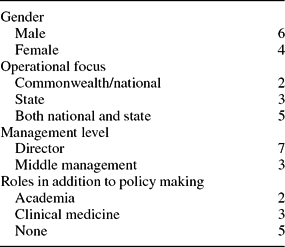
Of the original ten stakeholders, one actively declined to participate and one did not reply to e-mails. Eight agreed to participate. These eight then nominated a further six participants beyond those already involved. Of the additional six, one actively declined and one did not reply. Four new policy makers agreed to participate in the knowledge they had been nominated, taking the pool of voluntary participants to twelve (75% response/consent rate). Ten interviews were carried out before it was decided that saturation of responses had been reached (ie, consenting participants #11 and #12 were not interviewed due to saturation being reached at participant #10). Table 1 details participant characteristics.
Participant Characteristics

POLICY-MAKERS’ PERSPECTIVES
Examples of Disinvestment in Australian Health Care
Policy stakeholders could recall numerous Australian-based examples where disinvestment (eg, restricted or eliminated reimbursement) had occurred based solely on grounds of safety (pharmaceuticals primarily). However, for disinvestment due to demonstrated lack of effectiveness, recall of examples by participants was limited. Participants offered the following items as having undergone partial disinvestment (ie, restricted reimbursement): gastric freezing for ulcers; assisted reproductive technologies by age of recipient; surgical management of hernia; intra-operative esophageal echocardiography; hyperbaric oxygen therapy, and ear grommets. When asked to list any items to have undergone full disinvestment (ie, Medicare item number removed) on effectiveness grounds, these were limited to: various lobotomy procedures. Interestingly this example was noted to have occurred decades ago. Participants could offer no contemporary examples of complete and effective disinvestment. When asked to briefly identify any existing practices or technologies they believe represent potential items for prospective disinvestment analyses, the following were identified (as examples): caesarean section (rates); some spinal surgical procedures; spinal fusions for pain relief; pulmonary artery catheterization; drug-eluting stents; surgery for OSA; grommets; arthroscopy; particular models of hip replacement technology; tonsillectomy. All participants suggested that there are many more items “out there” that would fit into this category. Again, it should be noted that questions were not predisclosed to participants; therefore, these responses were “off the cuff.” Importantly, participants noted that substantial complexity and constraint in this issue relates to a general lack of evidence of effectiveness for existing practices and technologies, as distinct from clear evidence for lack of effectiveness. This reportedly hinders the decision-making processes for potential disinvestment. As summarized by one participant:
The problem which MSAC comes up against all the time and I imagine any health technology agency or even any evidence-based assessment, like Cochrane, is that there may not be evidence at all, or there may only be limited evidence and so you're having to base the decision on lack of evidence rather than evidence of lack of effectiveness . . . are you going to stop something because there's a lack of evidence? Well you wouldn't necessarily want to go down that path for an old technology because it's just that the studies haven't been done (Stakeholder #1).
This perspective was widely held and indicates that substantial challenges exist around adequate and timely definition, and acceptable proof, of practice/technology inferiority (obsolescence). Proving inferiority is perceived as not only conceptually difficult but also limited by data availability and interpretation, that is, by the nature and availability of the evidence. Stakeholder one went on to say:
You would accept different levels of evidence because [for some practices] you're never going to get higher levels . . . which is why people say it's [MSAC] inconsistent, but when you look at it, it's actually dealing with a different set of criteria almost. (Stakeholder #1).
Issue 1: The Existence of Disinvestment Policy Mechanisms in Australia
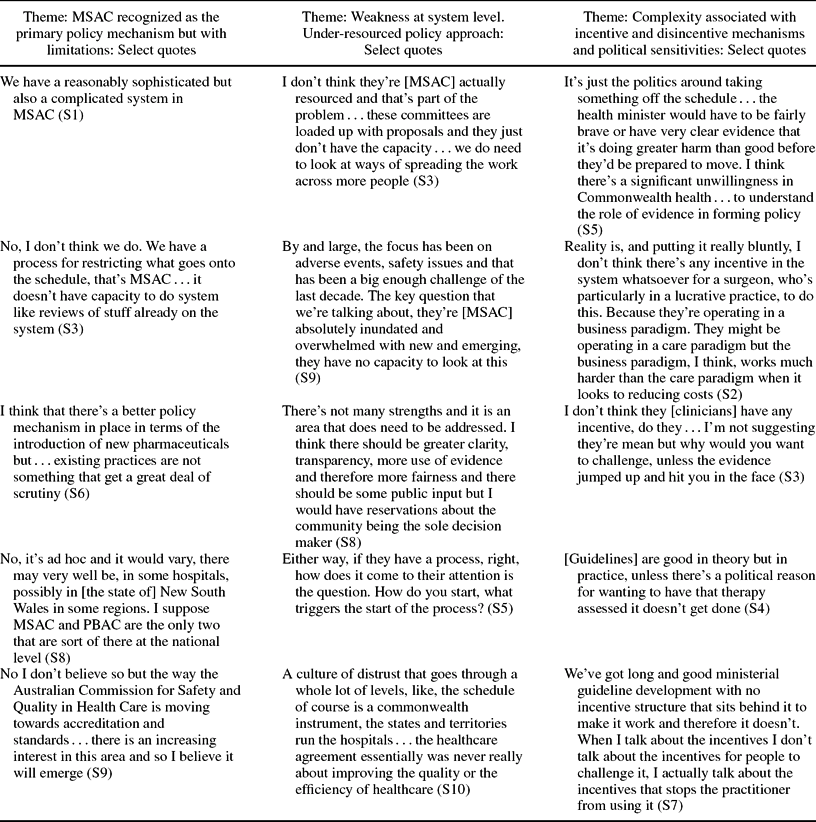
Policy stakeholders were asked a series of five semistructured questions relating to the existence in Australia of policy mechanisms or frameworks that might support an effective disinvestment strategy. Table 2 presents a synthesis of themes (with select quotations) resulting from the analysis of this topic. Participants overwhelmingly pointed to the current MSAC/PBAC models as the most logical to support disinvestment in Australia, given their existing and well tested role in facilitating the assessment of new and emerging practices, technologies (MSAC) and pharmaceuticals (PBAC). However, it was also widely acknowledged that the MSAC currently has limited capacity to perform this parallel role due to resource constraints and that it is perpetually stretched with an almost overwhelming stream of submissions for new and emerging technologies, with no residual capacity to address existing items. Other organizations such as the National Institute for Clinical Studies (NICS) and the Australian Commission for Safety and Quality in Health Care were also noted as potentially playing a role in the disinvestment arena, though it was claimed that “quality” is, at present, taking a back seat to politically sensitive issues associated with “safety” in health care (adverse events, and so on). Although the participants considered this ordering of political sensitivities to be understandable and reasonable, they noted that a focus on “quality” is parallel to, but in many ways distinct from, the complexities associated with safety and this needs to be recognized in the planning of disinvestment policy models.
Does Australia Have an Effective Disinvestment Policy Mechanism?
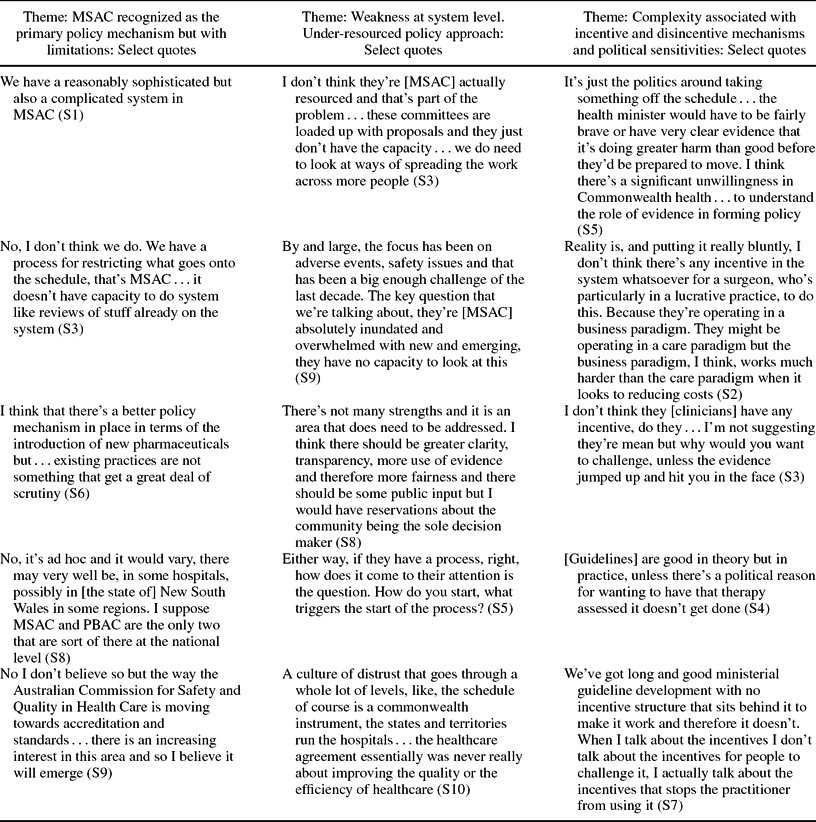
Note. Strengths and weaknesses: a synthesis of themes comprising responses to five semistructured questions. The semistructured method allowed for expanded/detailed responses to the five questions relating to disinvestment policy mechanisms. The included select quotes are chosen as offering representation of the theme/direction of consensus. No individual participant has more than one quote included in any one column within the table (participant pseudonym(s) provided, eg, S1 = Stakeholder 1). The Medical Services Advisory Committee (MSAC) advises the Minister for Health and Ageing on evidence for safety and (cost) -effectiveness of medical technologies and procedures. This advice informs decisions about public funding. The Pharmaceuticals Benefits Advisory Committee (PBAC) assesses applications for listing of medicines on the Pharmaceutical Benefits Scheme.
Participants also pointed to the complexities associated with incentive and disincentive mechanisms and how disinvestment, to be effective, must negotiate, circumvent, and overcome the political sensitivities associated with what some may perceive as overt restrictions on clinical autonomy and patient choice. Throughout these discussions were specific references to what participants perceived as overt, practical barriers to disinvestment. One of these included certain political complexities:
. . . if you wandered into a hospital and said ok, by Monday, ladies and gentlemen, anything, except what you've got clinical evidence for, you've got to stop doing. The place would explode. There are people who'd have a nervous breakdown. They'd go to the Prime Minister and say we've been denied access to our machinery for treating people with subdural hemorrhage. He'd say well, in that case it's because the administrators say we haven't got evidence it works. So the fact that they may not have evidence would become politically irrelevant. The first thing he [the PM] would do, would be to call the administrators and say what on earth do you think you're doing? (Stakeholder #4).
To overcome this, according to participants, requires continued research both for evidence generation and for the advancement of disinvestment methodologies that allow for the incorporation of multiple perspectives (researcher, clinical, consumer, and policy) into policy decision processes (discussed further).
Issue 2: Future Policy Directions for Disinvestment
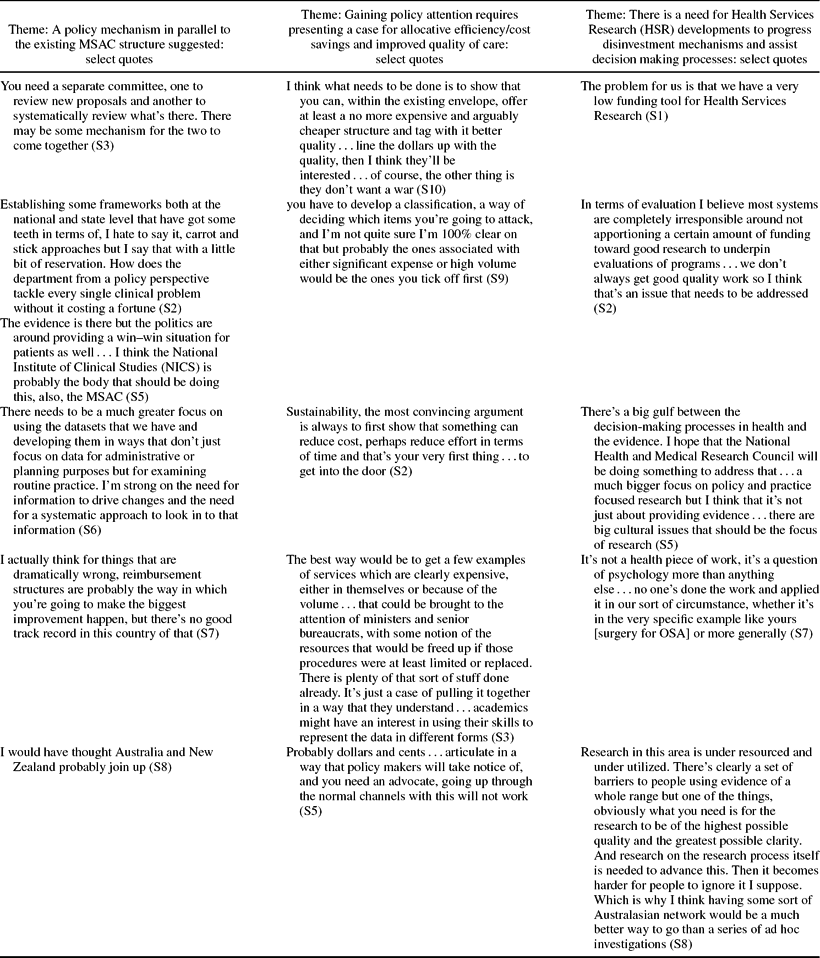
Policy stakeholders were asked additional semistructured questions relating to future policy directions for disinvestment in Australia, including the role of research and interest groups, and how disinvestment might gain greater prominence in the policy arena. Table 3 presents a synthesis of themes (with select quotations) resulting from the analysis in this area. In building from issue 1 (discussed above) there was general consensus that a parallel but separate committee based on the MSAC model would best serve a disinvestment agenda. Specifically, this might occur by means of the establishment of a legal framework to identify practices/technologies and support the health technology assessment process with potential for subsequent controls on reimbursement structures. Another of the noted barriers to disinvestment is that it remains low on the political agenda, with a perceived lack of priority. As one stakeholder offered:
Well, policy makers I think are very fine examples, actually, of Newton's regenerative second law of motion; they continue at rest or at a state of uniform velocity until they're turned. The question that every policy maker asks when they start sipping their cappuccino each morning is what would happen today if I do nothing. That's their fundamental question so if you come in with something and say hello policy maker, I'm here from Evidence Base Inc. and I've got some views for you they will look at it, peer over the froth and then say, hmm, what will happen if I do nothing. So if you really want to influence them you've gotta have something that says ‘hey policy maker, if you don't do this the cappuccino machine downstairs is going to explode’ or ‘the minister is going to have your head on a platter because this does not look good for him or her’ or ‘this is going to increase your waiting time by 20% in this department and you know how the minister reacted to that last time’. . .” (Stakeholder #4)
Not surprisingly, participants considered the best avenue to advance the disinvestment agenda within policy circles may be the accentuation of cost savings and sustainability aspects achievable with disinvestment, coupled with improved quality of care. As one participant offered:
. . .show that you can, within the existing envelope, offer at least a no more expensive and arguably cheaper structure and tag with it better quality . . . line the dollars up with the quality, then I think they'll be interested . . . (Stakeholder #10)
What is the best way forward to address disinvestment from a policy perspective, including how to bring it to the attention of health policy makers?
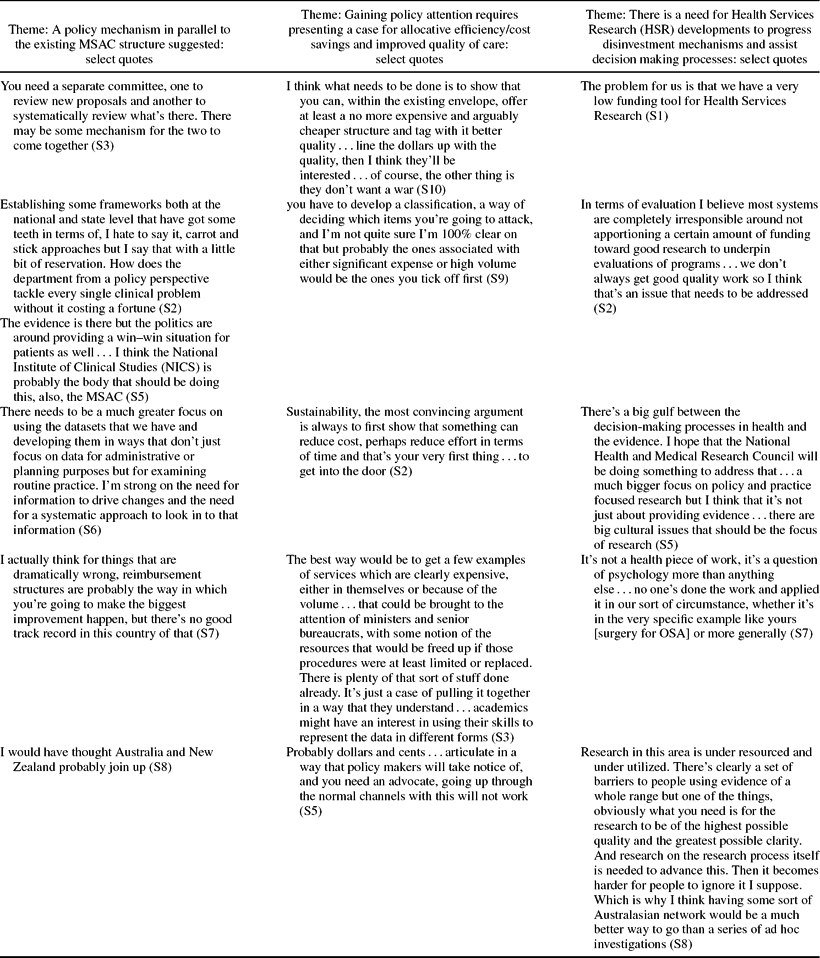
Note. The semistructured method allowed for expanded/detailed responses to the three questions relating to the future for disinvestment. The included select quotes are chosen as offering representation of the theme/direction of consensus. No individual participant has more than one quote included in any one column within the table (participant pseudonym(s) provided, eg, S1 = Stakeholder 1). The Medical Services Advisory Committee (MSAC) advises the Minister for Health and Ageing on evidence for safety and (cost) -effectiveness of medical technologies and procedures. This advice informs decisions about public funding.
Another suggested the means of advancing a disinvestment agenda was purported to lie in positioning within a disinvestment drive a killer fact that will likely spawn political action:
There are two things you should never see being made, sausages and policy . . . a great deal of stuff goes in of dubious provenance and what comes out the other end is anybody's guess so, I mean it's a pretty tough game out there and you and I know how the game's played. The ‘killer fact’ is what one person introduced me to . . . when you're dealing with policy change, the creation of the position of a killer fact is a great thing because it actually frightens people into action . . . (Stakeholder #4).
The final predominant theme centered on calls by the policy stakeholders for additional funding and collaborative support to progress advances in Health Services Research and HTA methodologies to underpin disinvestment processes (see right column, Table 3). This is grounded in recognition by participants that the HTA support structure required for disinvestment is complex. To underpin disinvestment, HTA must address challenges specific to practices that are entrenched within the medical and social system(s), including the barriers to and carriers of evidence generation and uptake. One participant offered the following:
. . . one of the really frustrating things is that we don't seem to be able to do the work that talks to us, that gets behind why people do the things they do, and what needs to happen in order to ensure more appropriate things happen . . . (Stakeholder #7)
Participants noted, for example, the necessary role that all forms of evidence potentially must play in such analyses (including gray literature) and the need for considered input from multiple stakeholder perspectives to complement evidence (eg, clinical, community, patient, and policy groups). It was also recognized that in certain instances “industry” perspectives offer heightened complexity associated with incentives and the potential for evidence manipulation:
It's [PBAC] manipulated, let's be clear about that, big, great companies can hire these shiny health economists who could make the sale of refrigerators in Alaska look positively cost-effective so it's not beyond manipulation but it's certainly better than nothing (Stakeholder #9)
DISCUSSION
In this study, we gauge the perspectives of a range of senior Australian health policy stakeholders regarding the challenges, current policy mechanisms and direction for disinvestment from ineffective or inappropriately applied healthcare practices. In Australia, the majority of healthcare services are either fully funded, or substantially subsidized by Commonwealth and State governments with investment also from private health insurance bodies (Reference Moss18). Hence, whenever questions of uncertainty of efficacy are raised, health policy makers have not only a legitimate stake, but a public expectation to be involved in the deliberations and resolutions to ensure high-quality and appropriate health care and efficient, justifiable resource allocation. Accommodating the split between Commonwealth/State and private sector decision making is yet another challenge for disinvestment.
Irrespective of the successes of the Australian policy model in assessing new and emerging technologies, there appears to exist either inadequate capacity or the lack of political will to address both new and existing (potentially obsolete) practices. As substantiated by participants in this analysis, in Australia, old technologies or practices are rarely formally de-commissioned on grounds of ineffectiveness (as opposed to safety concerns) or as new items are approved. Instead, the range of options (and, therefore, Medicare reimbursement items) grows ever larger. In this study, health policy stakeholders identified three core themes associated with the advancement of disinvestment in Australia, with possible lessons also for other jurisdictions. First, that a parallel role for Australia's assessment process for new medical technologies by means of MSAC may well be best-positioned to facilitate a formal disinvestment agenda (or an entity based on the MSAC model). However, this requires an increase in dedicated resources to address existing technologies and practices in parallel to new and emerging technologies. This realization is not restricted to Australia. Recently, Wilensky (Reference Wilensky29) intimated that similar limitations (and potential for improvement) exist in the United States (USA), suggesting investment is required to support prospective comparative trials for new versus existing practices.
Second, participants considered that a substantial challenge exists in elevating the disinvestment agenda within political circles. To do so requires an explicit focus on the potential for cost-savings coupled with improved quality of care. The challenge lies in maintaining a balance in perceived controls on clinical autonomy and patient choice. It is fundamental, therefore, that disinvestment is not perceived a blunt, all-or-nothing instrument of rationing. Indeed removing a reimbursement item number from the Schedule of Medical Benefits (or the equivalent action in international terms) might often be more than is required for successful disinvestment. More commonly, a policy-guided process of measured retraction may suffice. Such retraction may be permanent or temporary while evidence is generated to support more conclusive decisions, as currently occurs with “interim funding” conditions.
Third, policy stakeholders acknowledge that support (financial and the collaborative involvement of all relevant stakeholder groups) is needed for research advancement in not only the generation of primary data (evidence) that would make up the relevant HTA reports, but also (of equal importance) the methodological underpinning of HTA for disinvestment. Participants acknowledge that for existing items there are unique complexities that relate to the technology or practice being entrenched within the “system” and society more broadly. Some of these complexities include the following: resistance to change due to established clinical training and practice paradigms; potentially competing clinical, consumer, and political interests and values; sensitivity in formulating or modifying incentive and disincentive mechanisms; and the sunk costs of human and physical capital that would, thereby, become obsolete. Research and applied decision making in this area must, therefore, include both analysis of the “evidence” for safety, effectiveness, and cost-effectiveness as well as social, ethical, and political analyses if we are to explain why it is that ineffective healthcare practices persist. Only then is there scope to address how ineffective practices can be disinvested.
As Draborg and Gyrd-Hansen (Reference Draborg and Gyrd-Hansen5), and Lehoux and Williams-Jones (Reference Lehoux and Williams-Jones11;Reference Lehoux12) and others have articulated, HTA groups together with health service and policy researchers generally are well positioned to continue to lead and advance research in this area having broadened, “from primarily addressing effectiveness and safety issues to covering a broader array of issues such as psychological, organizational, ethical, and legal aspects” (Reference Draborg and Gyrd-Hansen5). Additional resources to support HTA/disinvestment research would facilitate priority driven, contextually relevant research to support decision-making processes and to provide the answers that policy advisors/makers need (for an interesting commentary see Pirkis et al. [22], and an initiative by Borowski et al. [1]). Moreover, it would contribute much-needed methodological advances and align with the four main characteristics of action research defined by Hart and Bond (Reference Hart and Bond9): (i) collaboration between researchers and practitioners; (ii) solution of practical problems; (iii) change in practice; and (iv) development of theory.
From an economic perspective, there remain methodological complexities in carrying out direct comparisons between the incremental benefits to be gained from a new technology or practice and the incremental benefits to be foregone with those (potentially obsolete) practices or technologies to be disinvested. There are also complexities in how this trade-off is communicated to policy makers in a form that offers some decision-making utility. Program Budgeting and Marginal Analysis offers potential in this area, given that the approach aims to consider the opportunity costs within an analysis (Reference Mitton, Patten, Donaldson and Waldner15;Reference Mooney16). However, as Gafni and Birch (Reference Gafni and Birch8) make clear, “the opportunity cost of marginal healthcare resources is a dynamic concept and its value will change as new programs are funded and/or resource constraints change” (p. 2098). To understand how a disinvestment framework might assist policy makers in making difficult choices, it is, therefore, important that the processes be justified and that the justification be transparent. As expressed by participants in this study, to do this effectively requires (collaborative) research to build these processes.
CONCLUSION
At present, Australia has limited systems in place to support disinvestment from currently used ineffective, less-effective, or inappropriately applied, healthcare practices. The potential overutilization of less than effective clinical practices and the potential underutilization of effective clinical practices not only results in less than optimal care but also fragmented, inefficient, and (many would argue) unsustainable resource allocation. Systematic policy approaches to disinvestment may improve efficiency as well as equity, quality, and safety of care, and perhaps even sustainability. Developing health technology assessment and policy research methodologies that tackle these complexities will advance the disinvestment agenda. This is a burgeoning area of priority setting in health care that requires national and international perspectives, debate, and collaboration.
CONTACT INFORMATION
Adam G. Elshaug, MPH, PhD (adam.elshaug@adelaide.edu.au), Research Fellow and Lecturer, Discipline of Public Health, The University of Adelaide, Level 9, 10 Pulteney Street (MDP 207) Adelaide, South Australia 5005, Australia; Research Fellow, Hanson Institute, Institute of Medical and Veterinary Science, Frome Road, Adelaide, South Australia, 5000, Australia
Janet E. Hiller, MPH, PhD (janet.hiller@adelaide.edu.au), Professor of Public Health, Discipline of Public Health, The University of Adelaide, Level 9, 10 Pulteney Street (MDP 207); Professor, Hanson Institute, Institute of Medical and Veterinary Science, Frome Road, Adelaide, South Australia, 5000, Australia
John R. Moss, M.Soc.Sci (john.moss@adelaide.edu.au), Associate Professor and Head, Discipline of Public Health, The University of Adelaide, Level 9, 10 Pulteney Street (MDP 207), Adelaide, South Australia, 5005, Australia
The authors gratefully acknowledge all participants for dedicating their time and insights for this project. We also acknowledge Jakob Braunack-Mayer for his assistance with transcribing the interviews reported in this manuscript. Adam Elshaug receives funding from the Faculty of Health Sciences of the University of Adelaide.