Introduction
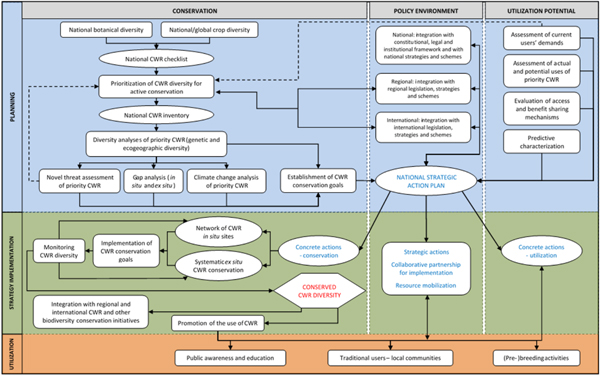
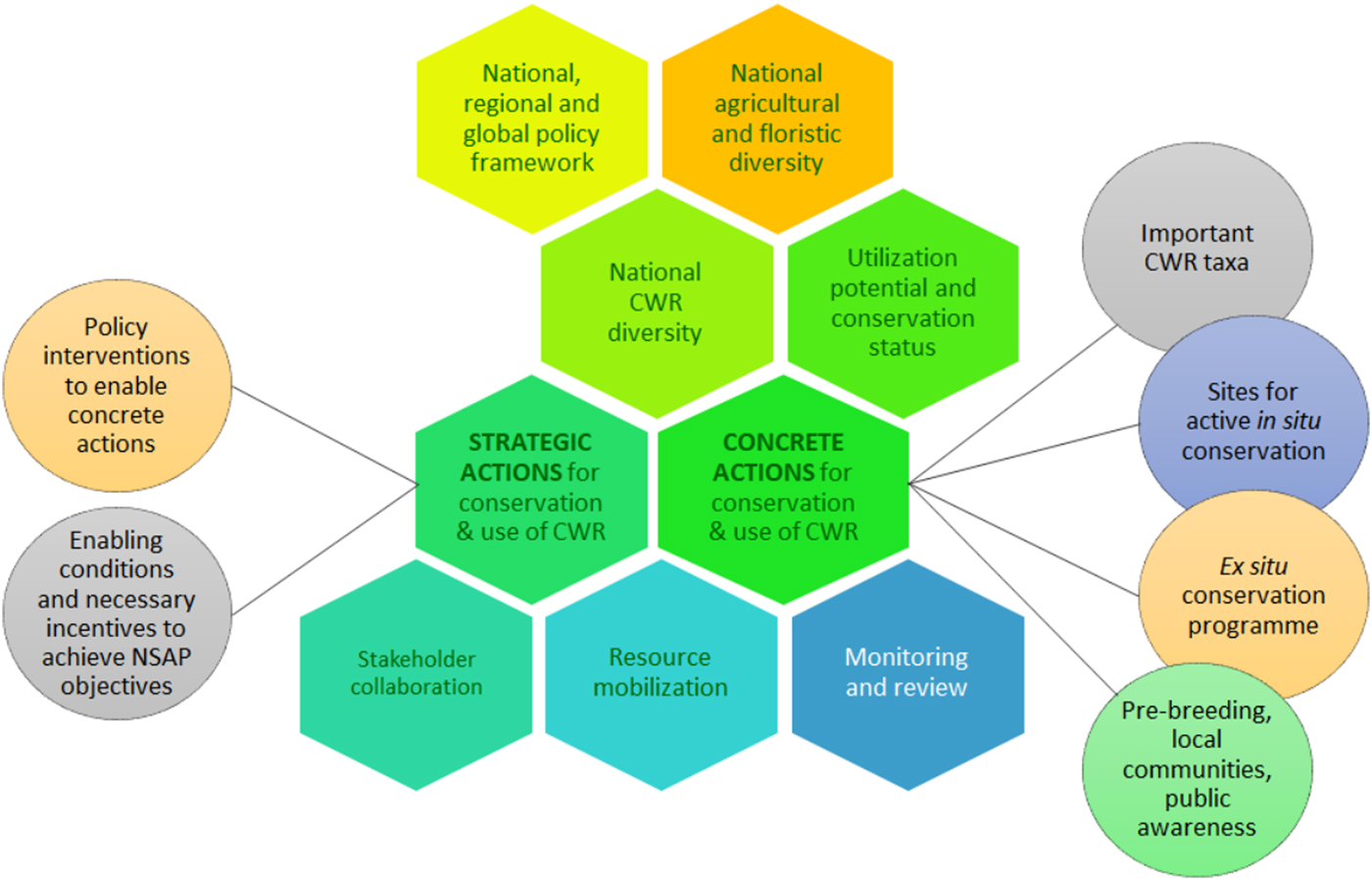
Crop wild relatives (CWR) are wild plant taxa that have an indirect use as gene donors for crop improvement due to their relatively close genetic relationship to crops and the broader genetic variation they contain than the crops themselves (Tanksley and McCouch, Reference Tanksley and McCouch1997; Maxted et al., Reference Maxted, Ford-Lloyd, Jury, Kell and Scholten2006). National CWR conservation planning aims to systematically identify the optimum representation of the nation's CWR diversity in an in situ network of genetic reserves complemented with ex situ collections of genetically representative population samples in national genebanks (Fig. 1). The conservation recommendations that result from this process are central to National Strategic Action Plans (NSAPs) for the conservation and use of CWR (Magos Brehm et al., Reference Magos Brehm, Kell, Thormann, Gaisberger, Dulloo and Maxted2017a) (Fig. 2). A NSAP aims at: (i) raising awareness of the value of national CWR diversity for food and economic security, (ii) reviewing existing policy, (iii) defining the specific actions and resources required to effectively conserve and sustainably utilize national CWR diversity, (iv) identifying capacity building needs, (v) integrating CWR conservation into existing national, regional and global conservation and sustainable use initiatives, (vi) developing a communication strategy and (vii) making sure the implementation of the NSAP objectives is sustainable. It is composed of several elements (Fig. 2) of which the concrete and the strategic actions are central. NSAPs support the implementation and monitoring of the Second Global Plan of Action for Plant Genetic Resources for Food and Agriculture (Second GPA) (FAO, 2011) and contribute to the development, amendment and implementation of National Biodiversity Strategies and Action Plans (NBSAPs) under the Convention on Biological Diversity (CBD).
Model for the development of a National Strategic Action Plan (NSAP) for the conservation and sustainable use of CWR (from Magos Brehm et al., Reference Magos Brehm, Kell, Thormann, Gaisberger, Dulloo and Maxted2017a).

Elements of a NSAP for the conservation and sustainable use of CWR.

Here we present three CWR conservation planning and two NSAP-related tools that were designed to guide and facilitate systematic in situ and ex situ CWR conservation planning, as well as to promote standardization of protocols and minimize errors and time costs. These tools can be downloaded from the Internet and links are provided in the reference list.
Interactive toolkit for crop wild relative conservation planning
The ‘Interactive Toolkit for CWR Conservation Planning’ (Magos Brehm et al., Reference Magos Brehm, Kell, Thormann, Gaisberger, Dulloo and Maxted2017a) is designed to be used by research institutes, agricultural and environmental agencies, FAO national focal points and other stakeholders involved in CWR conservation planning. The Toolkit, based on Maxted et al. (Reference Maxted, Magos Brehm and Kell2013), guides users through the steps involved in CWR conservation planning (Fig. 1). It comprises 13 modules, each of which includes:
• a brief introduction to the corresponding CWR conservation planning step;
• the methodology, which outlines the different components of each step and includes an interactive flowchart helping the user move through the various components and choose the options that are most appropriate given the user's national context;
• case studies showcasing how that step has been addressed by other researchers;
• references used in the preparation of the text;
• additional resources (tools and other practical examples) to help the user understand how to undertake the step in the process.
Templates for the preparation of a NSAP for the conservation and sustainable use of CWR and for the associated technical background document
The ‘Template for the Preparation of a NSAP for the Conservation and Sustainable Use of CWR’ (Dulloo et al., Reference Dulloo, Magos Brehm, Kell, Thormann and Maxted2017) was developed to assist countries in preparing their NSAP in a consistent and uniform manner. The NSAP is intended as a succinct and compelling document accessible to policy makers and other stakeholders. However, a more detailed scientific and technical document is also needed to record the methodologies used and results of the conservation planning process, and to inform the development and implementation of concrete and strategic actions. The ‘Template for the Preparation of a Technical Background Document for a NSAP for the Conservation and Sustainable Use of CWR’ (Magos Brehm et al., Reference Magos Brehm, Kell, Thormann, Maxted and Dulloo2017b) was developed for this purpose and forms the scientific basis of the NSAP. Both templates were prepared in MS Word format and based on Maxted et al. (Reference Maxted, Magos Brehm and Kell2013) and FAO (2017).
CWR checklist and inventory data template
The compilation of a CWR checklist and the collation of additional data for prioritizing CWR species to include in a CWR inventory are the first steps in conservation planning and for the subsequent development of a NSAP. A CWR checklist is a list of CWR taxon names (and authorities) found in a defined geographic unit (usually a country or region). It usually contains more taxa than can be actively conserved due to financial and human resources constraints (Maxted et al., Reference Maxted, Magos Brehm and Kell2013; Magos Brehm et al., Reference Magos Brehm, Kell, Thormann, Gaisberger, Dulloo and Maxted2017a) – therefore, a list of priority taxa is drawn from the checklist to form the CWR inventory. The ‘CWR Checklist and Inventory Data Template’ (Thormann et al., Reference Thormann, Kell, Magos Brehm, Dulloo and Maxted2017) was developed to help users to establish a CWR checklist and inventory in a systematic manner. It was developed in MS Excel. The descriptors used in the template (see Bioversity International and University of Birmingham, 2017) were developed in the context of three major international CWR projects: PGR Forum (http://www.pgrforum.org), the UNEP-GEF CWR project (http://www.cropwildrelatives.org) and PGR Secure (http://www.pgrsecure.org) and take into account descriptors previously published (Kell et al., Reference Kell, Moore, Iriondo, Scholten, Ford-Lloyd, Maxted, Maxted, Ford-Lloyd, Kell, Iriondo, Dulloo and Turok2008; Moore et al., Reference Moore, Kell, Maxted, Iriondo and Ford-Lloyd2008; Alercia et al., Reference Alercia, Diulgheroff and Mackay2012; Thormann et al., Reference Thormann, Alercia and Dulloo2013).
Occurrence data collation template
The collation of CWR occurrence data is a fundamental task in conservation planning because it provides the baseline information that will help defining long-term conservation recommendations for CWR diversity. Given the diverse nature of the sources of occurrence data (e.g. genebank accessions, herbarium specimens, field observations), occurrence data are normally highly variable in both format and types of information provided, and therefore need to be standardized. The ‘Occurrence Data Collation Template’ (Magos Brehm et al., Reference Magos Brehm, Kell, Thormann, Gaisberger, Dulloo and Maxted2017c) was prepared to assist users to collate CWR occurrence data in a systematic manner and standardize them to use in diversity and gap analyses, threat assessment and climate change analyses, as well as to prepare the data to undertake these analyses using the CAPFITOGEN tools (Parra-Quijano et al., Reference Parra-Quijano, Torres, Iriondo and López2016). The template was developed in MS Excel. Sources of the descriptors include Castañeda Álvarez et al. (Reference Castañeda Álvarez, Vincent, Kell, Eastwood, Maxted, Guarino, Ramanatha Rao and Goldberg2011), Alercia et al. (Reference Alercia, Diulgheroff and Mackay2012) and the import data file structure (‘ExternalSourcesDataFormat.xlsx’) created for the CAPFITOGEN tools (Parra-Quijano et al., Reference Parra-Quijano, Torres, Iriondo and López2016, http://www.capfitogen.net).
Conclusion
These tools and templates were prepared to assist countries in CWR conservation planning and in the development of a NSAP to help ensure CWR diversity is available for use thus contributing to food, nutrition and economic security. They were developed over several years of research and experience from national CWR conservation planning programmes in different parts of the world, have been tested in several contexts, and are freely available online. Although they were developed for use at the national level, they can also be used at regional and global levels and be adapted for other wild plant taxa.
Acknowledgements
The authors would like to thank the numerous experts involved in the development of CWR conservation planning methodologies across the years and their valuable feedback in the development of the Toolkit and both the NSAP and Technical Background Document templates. The five tools were developed within the framework of the ACP-EU funded project ‘In situ conservation and use of crop wild relatives in three ACP countries of the SADC region’ (SADC Crop Wild Relatives project) (http://www.cropwildrelatives.org/sadc-cwr-project/) co-funded by the European Union and implemented through the ACP-EU Co-operation Programme in Science and Technology (S&T II by the ACP Group of States) (grant agreement no. FED/2013/330-210).