The concept of adaptation is a key factor in achieving personal wellness. Evidence indicates that the occurrence of certain aversive events in a person’s life, that is the stressful life events (SLE), can lead to changes in mood and decreases physical and psychological well-being (Anders, Frazier, & Shallcross, Reference Anders, Frazier and Shallcross2012).
The association of SLE with depression has been widely studied. Research has confirmed the predictive role of SLE in the onset and development of the depressive disorder (Tao et al., Reference Tao, Li, Xie, Wang, Qiu, Wu and Gao2011), confirming that the risk of development depression tends to be higher when several SLE occur together and are closer in time (Anders et al., Reference Anders, Frazier and Shallcross2012; Tao et al., Reference Tao, Li, Xie, Wang, Qiu, Wu and Gao2011). Furthermore, not only acute and recent SLE but also severe SLE are linked to depressive symptomatology as well as poor functioning and reduced satisfaction (Muscatell, Slavich, Monroe, & Gotlib, Reference Muscatell, Slavich, Monroe and Gotlib2009).
Although in general severe SLE often act as significant predictors of depressive episodes (Tao et al., Reference Tao, Li, Xie, Wang, Qiu, Wu and Gao2011), several investigations suggest that non-severe SLE can also predict recurrent and successive depressive episodes, particularly if people do not perceive control over the stressful circumstances (Monroe et al., Reference Monroe, Torres, Guillaumot, Harkness, Roberts, Frank and Kupfer2006). Despite these findings, some investigations have shown disagreement regarding the degree of influence that SLE can have on depressed mood and well-being. These discrepancies can be understood if we consider the impact of other possible mediating variables, such as the nature and/or frequency of stressors (Monroe et al., Reference Monroe, Torres, Guillaumot, Harkness, Roberts, Frank and Kupfer2006) or the person´s beliefs about the meaning of SLE. Thus, there is a need to increase understanding of the impact that SLE can exert on depressed mood and well-being, particularly in people who are suffering from psychiatric disorders and are more vulnerable to perceive less control over stressful events.
On the other hand, depressed mood seems to be strongly associated with psychological inflexibility (Kashdan, Ferssizidis, Collins, & Muraven, Reference Kashdan, Ferssizidis, Collins and Muraven2010). One example of psychological inflexibility is Experiential Avoidance (EA). EA occurs when the person is not willing to experience unwanted private events (ie., thoughts, feelings and physiological sensations), and acts in a rigid and systematic way to alter the form and frequency of these negative experiences, even when doing so prevents him or her from achieving an adequate functioning.
EA is a core construct in Acceptance and Commitment Therapy (ACT; Hayes, Luoma, Bond, Masuda, & Lillis, Reference Hayes, Luoma, Bond, Masuda and Lillis2006), one of the modern contextual therapies, and is also included in other contextual approaches, such as dialectical behavior therapy (Linehan, Reference Linehan2003), mindfulness-based cognitive therapy (Segal, Williams, & Teasdale, Reference Segal, Williams and Teasdale2006) or metacognitive therapy (Wells, Reference Wells2009). Specifically, the metacognitive theory of Wells (Reference Wells2009) states that depressed mood can be considered as the result of the particular form in which a person thinks and assumes his or her problems. This unhelpful manner of thinking and acting is characterized by both inflexibility and the presence of negative and recurring thoughts, which reflect the engagement in some metacognitive strategies, such as rumination and worry. These metacognitive strategies are used by the person to attempt to control both negative external events and aversive internal experiences.
Based on ACT perspective, different studies have suggested that EA could be considered as a potential and functionally important factor in the development and maintenance of several psychopathological disorders (Hayes, Wilson, Gifford, Follette, & Strosahl, Reference Hayes, Wilson, Gifford, Follette and Strosahl1996; Kashdan, Barrios, Forsyth, & Steger, Reference Kashdan, Barrios, Forsyth and Steger2006), such as depression (Shallcross, Troy, Boland, & Mauss, Reference Shallcross, Troy, Boland and Mauss2010), anxiety (Bjornsson et al., Reference Bjornsson, Carey, Hauser, Karris, Kaufmann and Sheets2010), substance abuse or borderline personality disorder (Hayes et al., Reference Hayes, Wilson, Gifford, Follette and Strosahl1996). These negative outcomes appear to emerge when the use of avoidance to regulate emotional events occurs in a rigid manner, beyond its value as a survival strategy or as a short-term preventive action. Thus, although there is evidence showing that avoidance can momentarily alleviate distress in stressful circumstances, habitual and enduring attempts to avoid, suppress or control emotional experiences not only maintain dysphoric and anxious states but also can increase them.
A very important implication of this clinical research is that because EA can be considered as a toxic component, it requires to be addressed in psychotherapeutic interventions. Hence, decreasing EA, and alternatively augmenting acceptance of private negative events, represents an adequate strategy to facilitate the shift to more adaptive ways of thinking and acting (Shallcross et al., Reference Shallcross, Troy, Boland and Mauss2010).
Since depression is a very disabling condition strongly linked to stress and avoidance in people with psychiatric problems, it seems to be particularly important to examine and compare the precise role that both EA and stress can play in the contribution to depression in this population. Until now, research on this topic has not been broadly developed and has revealed mixed results. For example, Singer and Dobson (Reference Singer and Dobson2007) found that the use of acceptance, which can be considered as the opposite and helpful alternative to EA, can reduce the magnitude of depressive mood and dysfunctional attitudes in a sample of depressed patients. As stressful events were not included in this study, it was not possible to compare the relation of EA and stressful events to the presence of depression. Other results have also revealed that acceptance can be an effective emotion regulation to reduce negative affect in individuals with anxiety and mood disorders (Campbell-Sills, Barlow, Brown, & Hofmann, Reference Campbell-Sills, Barlow, Brown and Hofmann2006). Nevertheless, not all the findings are consistent since there is evidence showing that the use of acceptance is not effective to decrease the subjective level of anxiety under stressful situations (Hofmann, Heering, Sawyer, & Asnaani, Reference Hofmann, Heering, Sawyer and Asnaani2009).
Taking into account these findings, it is clear that the independent effect that EA and stress can exert on depression needs closer examination. Addressing this hypothesis would lead to generate more empirical and clinical data, which could contribute to increase the understanding of how these variables function.
On the other hand, depression has been demonstrated to negatively affect the level of functioning both in normal and psychiatric populations (Eaton, Regier, Locke, & Taube, Reference Eaton, Regier, Locke and Taube1981). Compared to healthy individuals, patients with depressive syndrome or major depressive disorder tend to display more social irritability, poorer health, and impaired performance in the workplace (Eaton et al., Reference Eaton, Regier, Locke and Taube1981). Likewise, some investigations have reported that, to assess the remission of a depressive episode and the impact of the psychological treatment, it is necessary that symptoms have been reduced or eliminated, and patients have achieved an adequate level of well-being and life satisfaction (Zimmerman et al., Reference Zimmerman, McGlinchery, Posternak, Friedman, Attiullah and Boerescu2006). According to this formulation, well-being and satisfaction seem to constitute crucial outcomes to be considered in depressed people who are receiving or have ended some kind of psychotherapeutic intervention.
With regard to the relationship of EA with well-being and satisfaction in psychiatric patients, it has been suggested that EA could prevent the retrieval of relevant information from emotional experiences, and hinders the implementation of solutions to cope with stressful situations and the progress towards valuable goals (Kashdan, Morina, & Priebe, Reference Kashdan, Morina and Priebe2009). This obstacle in problem solving, together with the assumption that one important ingredient for mental health is acceptance of life events (Keyes, Reference Keyes2007), leads to the hypothesis that EA could be especially unhelpful in maintaining well-being and satisfaction in people with mental disorders.
Although some empirical results have demonstrated that EA is associated with low life satisfaction and diminished daily positive emotions (Kashdan et al., Reference Kashdan, Barrios, Forsyth and Steger2006), other data have not supported the adverse effect of EA on well-being and satisfaction (Mitmansgruber, Beck, & Schüβler, Reference Mitmansgruber, Beck and Schüβler2008). Thus, clarification of the relationship between these variables in patients with mental disorders would be greatly improved by further examination.
Finally, based on the positive association between EA and depressive symptoms and the negative connection of this kind of symptoms with satisfaction and well-being, it could be assumed that depression may be a potential mediating mechanism. Consistent with this assumption, it could be expected that patients who avoid getting in touch with their negative thoughts, emotions or sensations, could feel more depressed, which could lead to reduce their well-being and personal satisfaction (Bjornsson et al., Reference Bjornsson, Carey, Hauser, Karris, Kaufmann and Sheets2010). To date, this mediating effect of depression has not been addressed by empirical investigations in clinical populations. However, it is clear that a better understanding of this question would yield more evidence about the possible linkages between EA, depression and the dimensions of well-being and satisfaction. And, importantly, it would also facilitate the identification of possible mechanisms responsible for change when implementing psychological treatments.
In summary, following previous research, the present study sought to examine and compare how SLE and EA were related to the presence of depression in a sample of patients with mental disorders. It also explored whether the negative impact of EA on well-being and satisfaction was mediated by the effect of depression in this group of patients. We expected that SLE and EA would be related to higher levels of depression, though we predicted that the predictive power of EA would be higher than the predictive power showed by SLE. Furthermore, we speculated that EA would be indirectly associated with reduced well-being and satisfaction through depression.
Method
Participants
Participants were recruited from a public Mental Health Centre. They were referred to this centre form Primary Care service to receive psychological treatment. This research was conducted in the line with the ethical guideline approved by local Official Colleges of Psychologists.
Patients were included in the study if, according to the diagnostic manual DSM-IV, they had a diagnosis of anxiety disorder, depressive disorder or adjustment disorder; or if they had any of these conditions as the primary diagnosis although a possible disorder associated with axis II was also suspected. Moreover, all participants were not receiving any kind of psychological treatment before the onset the study. Participants were excluded when their primary or secondary diagnosis was any of the other disorders included in the DSM-IV.
Procedure
First, patients were interviewed by a clinical psychologist who was a member of the research team. Eligible patients were informed about the nature of the study after the interview. Those who gave their informed consent to take part in the investigation received a booklet with the scales by email. They were asked to complete and send them back via email within a week and before the onset of the psychotherapeutic intervention. The booklet given to participants included a number of questions on socio-demographic aspects and several self-report questionnaires related to the variables included in the study.
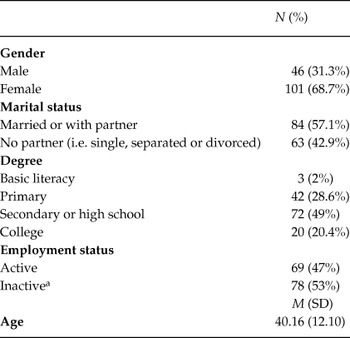
Of the 254 patients recruited, 198 met the inclusion criteria. Fifty-one were discarded because they did not fully complete the questionnaires and did not return them on time. Thus, the final sample was comprised of 147 patients. Of these, 101 were women (68.7%) and 46 men (31.3%). The mean age was 40.16 years (SD = 12.10, range 17–75 years). Twenty-two (15%) patients had a diagnosis of a depressive disorder, 25 (17%) presented an anxiety disorder, 64 (43%) suffered from an adjustment disorder, and 36 (25%) had any of the previous disorders and any suspected disorder associated with axis II. The socio-demographic characteristics of the sample are displayed in table 1.
Socio-demographic characteristics of the sample

a The Inactive category includes: on temporary leave, disabled, retired, unemployed, student or housewife.
Measures
Life events inventory
(Holmes & Rahe, Reference Holmes and Rahe1967): This questionnaire consists of a list of 43 stressful life events, including both positive and negative events. Participants are asked to circle those SLE on the list that they have suffered in the last year. Each stressful event is given a score set by the authors of the questionnaire. This score represents the units of life change that the event involves considering how stressful it has been for the person who has experienced it. The scale is scored by summing up all the items ranging the score from 0 (“no life event”) to 1.351, which is the highest one.
Satisfaction with life scale
(SWLS; Diener, Emmons, Larsen, & Griffin, Reference Diener, Emmons, Larsen and Griffin1985, Spanish version by Cabañero et al., Reference Cabañero, Richart, Cabrero, Orts, Reig and Tosal2004): This scale consists of 5 items that assess the overall judgment the participants make about the level of satisfaction with their life. The response format is a Likert-type scale with responses ranging from 1 (Strongly disagree) to 5 (Strongly agree). The range of scores is between 5 and 25 points. A high score on the scale indicates greater life satisfaction. The reliability coefficient obtained with this scale in the study was .87.
Acceptance and action questionnaire II
(AAQ-II; Bond et al., Reference Bond, Hayes, Baer, Carpenter, Guenole, Orcutt and Zettle2011; Spanish version by Ruiz, Langer, Luciano, Cangas, & Beltran, Reference Ruiz, Langer Herrera, Luciano, Cangas and Beltrán2013): This instrument measures EA and psychological inflexibility, that is, the tendency to alter the form, frequency, or situational sensitivity of negative private events, such as thoughts, emotions and physiological sensations, even when doing so leads to actions that are inconsistent with one’s values and goals (Hayes et al., Reference Hayes, Wilson, Gifford, Follette and Strosahl1996). Recent research has indicated that the AAQ-II has good psychometric properties and can be considered as a valid and reliable tool for assessing EA in people with mild to moderate depression. The reliability coefficient of this instrument in the present study was quite high (α = .90).
Beck depression inventory
(BDI; Beck, Ward, Mendelson, Mock, & Erbaugh, Reference Beck, Ward, Mendelson, Mock and Erbaugh1961; Spanish adaptation by Conde & Useros, Reference Conde and Useros1975). This self-reported scale consists of 21 items that assess the severity of depressive symptoms. Each item has 4 response options that are scored from 0 to 3. Participants must choose the option that best reflects their experience in the week before the present moment. In this study the reliability coefficient was .90.
Health survey
SF-36 (Ware, Snow, Kosinski, & Gandek, Reference Ware, Snow, Kosinski and Gandek1993; Spanish adaptation by Alonso, Prieto, & Anto, Reference Alonso, Prieto and Anto1995). This self-administered instrument has been widely used to assess clinical outcomes and detect both positive and negative states of health. It consists of 36 items and 8 subscales. Four of these subscales (i.e., physical function, physical role, bodily pain and general health) comprise the dimension of physical well-being (PWB), whereas the remaining four (i.e., vitality, social function, emotional role and mental health) encompass the dimension of emotional well-being (EWB). The scale scores range from 0 to 100, with a higher score indicating better perceived health. In our sample, the reliability coefficients of the dimensions of PWB and EWB were .92 in both cases.
Data Analysis
First, descriptive statistics were found to examine the socio-demographic and clinical characteristics of the patients. Then, Spearman´s correlation coefficients were obtained to explore the correlations among the different psychosocial variables used in the study. We calculated Spearman´s correlation coefficients since all these psychological aspects were treated as ordinal variables.
To assess the specific association of SLE and EA with depression, a hierarchical regression analysis was conducted introducing SLE in the first step and EA in the second one.
Finally, to test the indirect effect of EA on well-being and satisfaction through depression, we used the SPSS macro developed by Preacher and Hayes (Reference Preacher and Hayes2008). This method is based on the bootstrapping approach, which highlights the importance of considering the sampling distribution and the estimated confidence interval constructing around the indirect effect (Preacher & Hayes, Reference Preacher and Hayes2008; Shrout & Bolger, Reference Shrout and Bolger2002). Hence, although the above-mentioned psychosocial aspects were measured as ordinal variables, we considered the estimated confidence intervals in order to explore the possible mediating effect of depression.
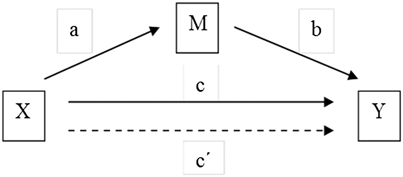
As can be seen in figure 1, the mediation model involves the total effect of X on Y (i.e., path c); the direct effect of X on Y (i.e., path c´), that is, the effect of X on Y when the mediator variable (M) is held constant; and the indirect effect of X on Y through the mediator variable (i.e., path axb). This indirect effect can also be calculated as c-c´ (see figure 1). According to the bootstrapping method, when the 95% bias corrected confidence interval (BCCI) for the path axb (i.e., indirect effect) does not contain zero, it can be concluded that the indirect effect, or the difference between path c and path c´, is statistically significant at p < .05.
Illustration of a mediational design.
Note: X = Predictor variable; Y = Outcome variable; M = Mediator variable

Estimates of unstandardized beta coefficients, standard error for each pathway (a, b, c, axb and c´), and the lower and upper levels of the 95% bias corrected confidence interval (BCCI) for the indirect effect are reported in the study. All data were analyzed by the SPSS program (version 20.0), and the significance level established for all analyses was < .05.
Results
Descriptive Statistics and Relationships among the Study Variables
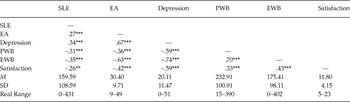
The descriptive statistics of all variables are shown in table 2. Normally distribution of the variables was analyzed confirming that skewness and kurtosis were quite acceptable in all cases. Assumptions concerning linearity and homoscedasticity were also met.
Descriptive statistics and correlations among the psychosocial variables of the study

*** p < .001; **p < .01.
Regarding the correlations among the variables, (see table 2), SLE and EA were positively associated with depression, being the magnitude of the correlation between EA and depression greater than the magnitude of the correlation found between this SLE and depression. On the other hand, both EA and depression were significantly and negatively associated with PWB, EWB and satisfaction.
Regression Analyses
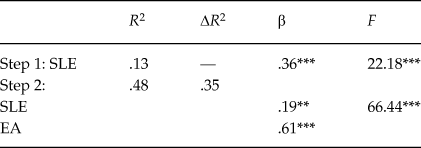
A hierarchical regression analyses was performed to compare the predictive capacity of SLE and EA in relation to the presence of depression. As can be observed in table 3, SLE accounted for 13% of the variance in depression in step 1. When EA was added to the regression model in step 2, it explained a significant increment in variance in depression (35%). Thus, although SLE and EA were both significantly related to depression, EA was a more powerful predictor of depression than SLE.
Multiple Regression analyses of SLE and EA on depression

*** p < .001; **p < .01.
Testing the Indirect Effect of Depression
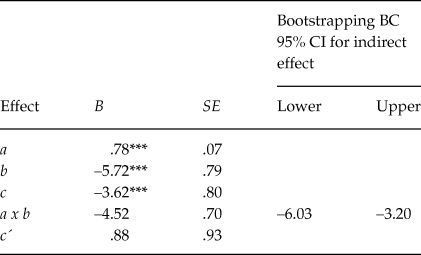
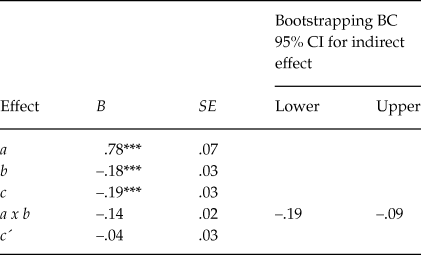
Results from the bootstrapping method indicated that there was a significant indirect effect of EA on PWB (Indirect effect = –4.52, SE = .70, 95% BCCI = –6.03 to –3.20) and satisfaction (Indirect effect = –.14, SE = .02, 95% BCCI= –.19 to –.09) via depression (see tables 4 and 5).
Mediation of the effect of EA on PWB trough depression

Note: a = Effect on EA on depression; b = Effect of depression on PWB; c = Total effect of EA on PWB; axb = Indirect effect of EA on PWB through depression; c´= Direct effect of EA on PWB after controlling for depression; BC = Bias corrected; CI = Confidence interval.
*** p < .001.
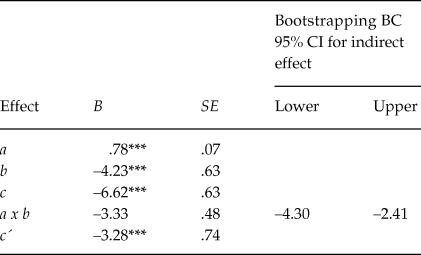
Mediation of the effect of EA on EWB through depression

Note: a = Effect on EA on depression; b = Effect of depression on EWB; c = Total effect of EA on EWB; axb = Indirect effect of EA on EWB through depression; c´= Direct effect of EA on EWB after controlling for depression; BC = Bias corrected; CI = Confidence interval.
*** p < .001.
With respect to EWB it can be observed that the indirect effect of depression was significant since the BCCI did not contain zero (Indirect effect = –3.33, SE = .48, 95% BCCI = –4.30 to –2.41). Nevertheless, it is also evident that the size of path c´ (B = –3.28, SE = .74, p < .001), which represents the effect of EA on EWB after controlling the effect of depression, was about the half of the size of path c (B = –6.62; SE = .63, p < .001). Thus, this finding is somewhat consistent with the presence of a direct effect (see table 6).
Mediation of the effect of EA on satisfaction through depression

Note: a = Effect on EA on depression; b = Effect of depression on satisfaction; c = Total effect of EA on satisfaction; axb = Indirect effect of EA on satisfaction through depression; c´ = Direct effect of EA on satisfaction after controlling for depression; BC = Bias corrected; CI = Confidence interval.
*** p < .001.
Discussion
In this study we investigated and compared the specific association of SLE and EA with depression in a sample of patients with mental disorders. We also examined the possible indirect effect of EA on well-being and satisfaction through depression in this sample.
Consistent with the formulated hypothesis, the results indicated that SLE and EA were positively and significantly associated with depression, although the amount of variance explained by EA was greater than that explained by SLE. These findings support the possibility of a complex relationship between stress, EA and depression. Hence, although the idea that stress can increase the risk of depression is well-supported in the literature (Spinhoven et al., Reference Spinhoven, Elzinga, Hovens, Roelofs, van Oppen, Zitman and Penninx2011), the results of our study suggest that EA, not only can be a potential and independent predictor of depression, but also is more related than SLE to this negative mood state. Furthermore, even though the use of avoidance can be considered as an adaptive strategy when it is sensitive to the particular time period and characteristics of the stressful situation, according to our results, the pervasive and enduring utilization of EA represents an inefficacious emotion regulation strategy since it correlates with an increased level of depression.
The possible mechanisms, by which EA, compared with SLE, may have a greater impact on depressive mood, are not entirely clear. Relying on some approaches of the third wave of cognitive-behavior therapy, such as ACT (Hayes et al., Reference Hayes, Luoma, Bond, Masuda and Lillis2006) or the metacognitive theory of Wells (Reference Wells2009), how people respond to their internal experiences can lead to increased depressive symptomatology. Thus, it could be argued that an inflexible and rigid tendency to escape from negative events, and the attempt to control them by using strategies such as distraction, rumination or behavioral disengagement, could maintain and increase those unwanted internal events and the severity of dysphoric mood. Equally, the presence of these aversive internal events would lead to more EA, thus creating an unhelpful vicious circle. As this explanation is speculative, in future research it would be worthwhile to explore and test all these processes in order to shed more light on the specific mechanisms through which EA could maintain depressive symptoms in clinical populations.
The results also showed that there was an indirect association between EA and PWB and satisfaction via depression. First, it could be suggested that the systematic attempt to either control or prevent discomfort from aversive internal experiences could make the patients feel more depressed, maybe because they realize that this strategy is unsuccessful. This failure in self-regulation, in turn, may lead to perceive more frequent or intense physical symptoms, and subsequently reduce the level of physical well-being (Kohl, Rief, & Glombiewski, Reference Kohl, Rief and Glombiewski2012).
On the other hand, with regard to the indirect relation of EA to satisfaction through depression, it is possible that patients experience more depression when using EA. This increased level of depression could also augment the probability of disengaging from important and pleasurable actions, through which patients could achieve a more fulfilling life. This disengagement could also make patients rigidly persevere in unattainable goals, thus perpetuating the presence of aversive experiences and diminishing personal satisfaction (Trew, Reference Trew2011).
When testing the indirect effect of depression on the association between EA and EWB, the results were more ambiguous. On the one side they supported the hypothesis that there was a significant indirect effect between EA and EWB via depression, but on the other, they were also consistent with the assumption that the association of EA with EWB was direct. As suggested by Shrout and Bolger (Reference Shrout and Bolger2002) this finding could be explained taking into account the relatively small sample size used in the study. Therefore, testing the significance of this indirect effect would require to be replicated by utilizing a larger sample size.
In spite of this methodological limitation, this finding is important since it provides more evidence of the negative linkages between EA, depression and EWB in a sample of patients with different psychiatric disorders. Hence, in patients who experience frequent and intense negative emotions, trying to alter or avoid this kind of emotions can increase their depressive state and lower their EWB, maybe because that strategy does not allow them to establish a connection with their own emotions and intensifies the negative emotions they are trying to avoid (Campbell-Sills et al., Reference Campbell-Sills, Barlow, Brown and Hofmann2006).
This study has several limitations that should be noted. First, the measures used were self-reported, which may have skewed patients’ answers. The use of alternative indicators, such as behavioral measures or information obtained from third parties, would have allowed for a more objective assessment of the levels of EA and depression. Second, taking into account that the study sample consisted of patients with different types of psychiatric disorders, it would be worth replicating these results with samples in which patients had an homogeneous mental disorder. Finally, given the cross-sectional nature of this study, it is not possible to establish causal relationships between variables. Hence, although the findings show that EA is associated with increased depression, it is also possible to consider that higher levels of depression could increase EA. Similarly, low levels of satisfaction and well-being could enhance a depressed mood state and more avoidance of negative inner experiences. Thus, longitudinal studies are necessary to verify this question. Nevertheless, the meditational analysis performed in this investigation can help to clarify the possible links and influences between these variables.
In summary, the results of this study provide evidence that EA is a variable strongly linked to depression in people with mental disorders. Furthermore, they confirm the hypotheses that EA exerts an indirect impact on both physical well-being and satisfaction through depression, and also suggest that to a lesser extent EA could be indirectly associated with emotional well-being via depression.
Taken together, these aspects point out that EA seems to be an important process to be addressed in psychological interventions, particularly in cognitive-behavioral therapy, which is focused on changing cognitions, metacognitions, emotions and coping strategies. Similarly, following third-generation therapies, such as ACT and metacognitive theory, psychological intervention on EA should be performed to help patients to accept their negative and interfering experiences and increase their cognitive flexibility.