

The Chairman (Mr K. A. Miller, F.F.A.): I invite Mr Kemp and Mr Patel to give the introduction and positioning of the paper, “Entity-wide risk management for pension funds”.
Mr Kemp is a leading expert in risk and quantitative finance, with over 25 years’ experience in the financial services industry. From 1996 to 2009, he was an Executive Director and Head of Quantitative Research at Threadneedle Asset Management. This role included responsibility for Threadneedle's derivatives, performance measurement, risk management, liability-driven investment and other quantitative investment activities.
Mr Kemp was a partner at Bacon & Woodrow in their investment consultancy practice. He holds a first-class honours degree in mathematics from Cambridge University. He is a Fellow of the Institute and Faculty of Actuaries and an Adjunct Professor at Imperial College Business School, London. He was elected to the Institute of Actuaries Council in 2009.
Turning to Mr Patel, he is an independent consulting actuary. Having done the rounds with a direct life insurer, a re-insurer and two pension consultancies, he is now operating as a freelance consultant in finance, risk and general actuarial matters, particularly those requiring structured common sense and joined up thinking.
Mr M. H. D. Kemp, F.I.A. (introducing the paper): Risk management is a key part of modern business life and one that many actuaries will either be involved with already or will aspire to be involved with.
The Profession, as you know, is very keen to build the reputation of actuaries within the risk management space. It has some projects currently underway seeking to identify the best way to do so. It is likely that the Profession will seek to build out from its perceived core strongholds.
The pension fund arena is an area where actuaries are very well known and respected. One would expect us to be able to take our expertise and to build within the pension fund community a very strong reputation for risk management to complement our Profession's other skill-sets.
I currently chair the Enterprise Risk Management Practice Executive Committee (ERM PEC) for the Profession. One of the things that struck me when I took over as chair about a year ago was that ERM was relatively well embedded among some parts of the actuarial professional world, particularly the insurance world, but did not seem to have been given as high a priority within the pension fund actuarial community. There are some exceptions, including some that we quote in our paper. In particular, I should like to thank Hatchett et al for writing a paper not that long ago for SIAS on pension fund enterprise risk management.
What we would like to do in introducing the paper is to provide you with some further background on the paper and its main conclusions. We also want to come up with some suggested topics to fire your imagination and debate. A little later, Mr Patel will then look at how we might apply ERM practically to pension schemes. He will focus mainly on the governance aspects of pension schemes and how ERM can be weaved into them.
So let me turn first to the paper's background. I have already explained the background as far as the ERM PEC and the UK Actuarial Profession are concerned. More generally, you do not need me to tell you that there has been an enormous amount of change in the pensions industry of late, and that this pace of change is likely to continue for some time yet. At the same time, there has also been an enormous amount of change across the wider financial and business community. In particular, there has been a strong push to enhance risk management disciplines. This, in part, reflects concerns many have expressed that some of the risk management disciplines in practice, prior to the recent credit crisis, were not up to scratch. Within this push there has been a particular focus on enterprise risk management. So, we have two strong trends but, as yet, less connection between them than we might have expected.
In our paper, we argue that actuaries should be very well placed to capitalise on both of these trends and to provide the necessary connection. Actuaries are very good at quantitative activities and have strong modelling skills. They are also very good, in our opinion, on more qualitative activities. ERM blends both of those two together. So ERM ought to provide actuaries with a very strong differentiator versus some other professions who might be trying to muscle into our core business activities.
What is this subject called ‘enterprise risk management’, or ‘ERM’, which we prefer to call ‘entity-wide risk management’ in the paper? We can view it as a framework that is applied to a sponsor or to some other entity, i.e. to some set of stakeholders. It is a framework that uses risk as its core building block to frame business decisions. So risk is its key: risk management is embedded in the entire business process in ERM.
The most important differentiator is that ERM focuses on the entire spectrum of risks to which the entire business or the entire entity is exposed and it puts risk at the core and the centre of all the decision-making. It is holistic.
Our first conclusion of the paper is that ERM is very valuable to virtually any type of pension fund. The reason for this is that it is valuable to essentially any entity, business or other organisation, so pension funds are merely a special case of its more general applicability. What makes it valuable to all of these different entity types is that it involves holistic management, focusing on things across the entire risk ‘piste’.
Where we differ, arguably, from some earlier writers is in questioning the complete applicability to pension funds of the emphasis on ‘enterprise’ that is also commonly associated with ERM.
In the term ‘enterprise risk management’, the word ‘enterprise’ has two separate connotations. The first is that you should look at things across the piste, i.e. adopt a holistic approach, which, as we have noted above, seems fully applicable to pension funds. The other angle on which people usually focus when they are talking about ERM is on upside risk and profitability. Our point is that pension funds are not primarily out to make a profit. It is incidentally helpful if they do so, but ultimately their primary purpose is to provide benefits to their beneficiaries. If the (sponsor) profit maximisation motive were the sole criterion on which to focus, then the sponsor should generally close down the pension scheme, to cut down on costs being incurred by continuing to add to pension promises.
So, we do think that ERM is crucial to pension funds. But we do so primarily because of its emphasis on holistic review and management of all the risks an entity faces rather than on its claim that it might generate more upside. When it comes to looking at the position of different stakeholders, e.g. who it is that you are advising, etc., then you need more care. Some of the principles that you might read about in other ERM texts may need modification, depending on the stakeholder, i.e. your client.
Our other main conclusion is the need to manage funding and investment policy and sponsor covenant risk in tandem within a single overarching process. That follows from the merits of looking at risks holistically. We do think that such a holistic management of risk is an aspiration that a lot of sponsors and funds are seeking to do, but whether they do so in practice is less clear to us. To be really effective, it needs to be done not just in a haphazard fashion but within a well-crafted governance framework. We also think that there are some lessons to draw from practices elsewhere, given the focus being given to ERM across businesses more generally.
To help the debate, we have combined a few topics and brought them together in four different groups.
The first set of topics is around whether ERM really is relevant to pension funds. We have asserted that it is, but some people might say this is just a case of the emperor's new clothes, and that what is being proposed is almost the same as we have always done in the past. We claim that that is not the case, but we are very happy to hear contrary views. We do accept that pension funds have unusual mixes of social purposes and other kinds of characteristics that make them different to most other business types. However, we still think that they are very amenable to ERM type analysis and approaches, but maybe you disagree.
We also assert that pension fund risk management is not just about investment risk. I know that may sound a little counter-intuitive coming from someone like me who has had a particularly strong background in investment risk disciplines over many years; but it is our view that you need to look beyond investment risk to achieve true ERM. In particular, you also need to look at things like the sponsor covenant, at some of the asymmetric risks that are not well rewarded and at who is going to benefit from the upside and/or the downside, etc.
A second group of issues involves ‘transparency of travel’. How important is it that it is obvious to others what we are trying to achieve? Clarity and transparency are usually important elements of any enterprise risk management implementation.
Within this category, we have included an analogy that maybe some people will find unhelpful. This is the analogy between pension funds and collateralised debt obligations (CDOs). These structures lost some people lots of money during the recent credit crisis and it is to be hoped that pensions will not do the same. In our view, there are certain characteristics that pension funds exhibit, particularly the way that their balance sheets are structured, which bear some similarities to CDOs. These similarities allow pension funds to learn from the experience of CDOs. But maybe you completely disagree with this analogy and wish to argue that such a comparison is inappropriate.
We've also noted some lessons and benchmarks in regard to transparency from outside the pension fund industry. Should we try and import them into the pension fund industry? They include the Principles and Practices of Financial Management (PPFM) that UK with-profits insurers need to craft and the Own Risk and Solvency Assessment (ORSA) that all insurers in Europe will need to craft under Solvency II. Also, banks are being asked to work out what to do if they go bust, i.e. to create so-called ‘living wills’. Should pension schemes be asked to do likewise? What would they do if their sponsor were to go bust? Should they have to set out in advance their strategies for dealing with these circumstances?
In terms of transparency of travel, a lot of pension funds focus much of their attention on risk through investment committees. However, is this sufficiently all-embracing to achieve the holistic risk management goal that we have been talking about? Are the funding, investment and risk policies that a pension fund will often have written down sufficiently joined up in practice?
Our third set of points for debate relate to our view that there are useful lessons on ERM from elsewhere that we should think about importing into the pension fund industry. The recent Walker Review focused on banks and other financial institutions. It suggested – and now the FSA are following that through with a mandate – that such organisations should always have a risk function and implicitly a chief risk officer. The Walker Review also stressed the need for greater board focus on risk matters. Should we be seeking similar disciplines for pension funds?
Solvency II, as I have mentioned, will require insurers to carry out Own Risk and Solvency Assessments. Maybe a requirement for an ORSA would be something that pension funds would benefit from, even if many in the pensions industry would not be keen to adopt lock, stock and barrel the capital requirements that Solvency II would impose if it were fully applied to pension funds.
Our final set of points for debate relates to the types of models that are conventionally used by actuaries and whether they are as useful as they might be for ERM purposes. There is a section in our paper looking at models and model risk. For example, should greater emphasis be given to models designed to capture simultaneously investment risk and sponsor covenant risk? Do traditional ALM type models focus too much on investment risk? Do they need to be revamped to make them more ERM-friendly?
Our paper was written relatively quickly so it does not cover all of the angles that we might have wanted to cover. In particular, it focuses more on qualitative aspects of ERM than on quantitative aspects.
I am conscious that earlier on I held up actuaries as great in both the qualitative and the quantitative components of ERM. To address this aspect, I have therefore prepared some additional modelling material not in the paper itself, although referred to in its references.
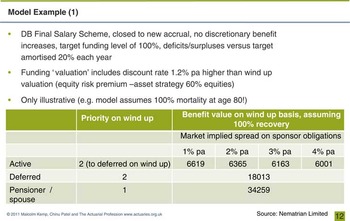
The material focuses on an illustrative example that tries to bring out some of the points described in the section in the paper on modelling. The example involves an illustrative UK defined benefit final salary pension scheme which is assumed to be closed to new accrual. A core assumption is that individuals no longer have any realistic likelihood of discretionary benefit increases. We have assumed that the trustees are targeting 100% of technical provisions, and that the deficits and surpluses above or below that 100% are amortised over some suitable time period. We also assume that technical provisions are being calculated using a discount rate which is above that accessible on a windup. More specifically, we assume that it is 1.2% per annum above it, which we can conceptually view as involving a 2% equity risk premium because we are assuming the asset strategy involves 60% equities. Importantly, we include an allowance for different individuals to have different priorities on windup. In particular, we assume that pensioners’ and spouses’ liabilities are honoured before the deferred pensioners and the actives get a penny. If windup does occur, then the actives automatically get switched into the deferred status, and so lose entitlement to additional salary inflation in excess of deferred pension increases in deferment.
The example is outlined in the following four figures.
In Figure 1 we show what individual members would get if whenever the sponsor defaults the scheme received 100% of what the sponsor had promised. All pensioners and spouses get what they have been promised, so there is no difference depending on likelihood of default. However, for actives there is some differentiation. This is because the actives, we are assuming, get salary increases prior to retirement as long as they are still active members of the scheme. When windup occurs, they instantaneously get switched into deferred status and therefore they do not get the same uplift through time as they might otherwise have done.
Values of members' benefits if pension promise honoured in full (i.e. 100% recovery) in the event of sponsor default

We are here illustrating how to focus on several different risks simultaneously, including here the risk of the scheme sponsor defaulting. I have tried to quantify this risk in the form of a market implied spread versus the risk-free yield curve. One way of thinking about this is as if the sponsor honoured only 50% of the underfunded liabilities in the event of windup then a 1% per annum market implied spread is akin to a 2% per annum (market implied) likelihood of default, coupled with each time the sponsor defaults only recovering 50% of the debt you are owed by the sponsor.
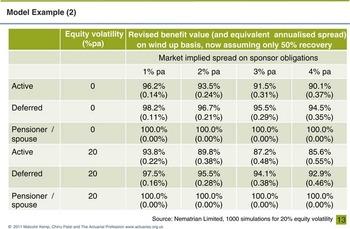
Figure 1 shows the benefit values that individuals would get, assuming that 100% of the obligation is honoured. Figure 2 considers the position if, instead of 100%, the recovery is only 50%. We see a noticeable decline in benefit value received by active beneficiaries, especially if risk of sponsor default is material.
Values of members' benefits if pension promise honoured only in part (i.e. 50% recovery) in the event of sponsor default

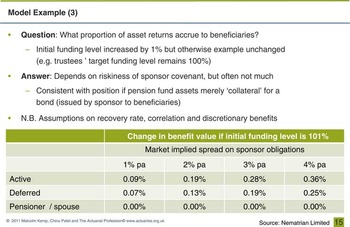
Another feature such a model can test is how much each party might benefit or lose if investment returns were favourable or unfavourable. Figure 3 shows corresponding values if, at outset, the scheme was 101% funded (versus technical provisions) rather than 100% funded. It is as if the assets have just instantaneously given us an extra 1% return. What then happens to the value of the benefits delivered? If we take the pensioners and the spouses, there is almost no change. They have a sufficiently high priority that their benefits are being modelled to be fully honoured in nearly all circumstances (because they rank higher than the deferreds and the actives). Therefore they do not get any material benefit from investment return uplifts.
Change in values of members' benefits if tangible asset base rises by 1%

More interesting is how little is the proportion of the investment return that seems to accrue to actives and deferreds in this example, and also how it varies according to the likelihood of risk of default of the sponsor.
The type of model illustrated here is the type of model that we are suggesting that people ought increasingly to focus on. It is holistic because it specifically looks at investment risk alongside other risks – here sponsor covenant risk.
I hope that this example has whetted your appetite to apply more quantitative tools to this type of issue.
Mr C. C. Patel, F.I.A. (also introducing the paper): I would like to look at the key enablers for ERM and how they are embedded into those businesses which practise ERM. Then I want to proceed to look at some of the similarities and differences between pension funds and some of these businesses, and ask the question: could similar frameworks be applied to pension funds? The answer is quite obvious to me and therefore I will proceed to set out some of the governance challenges that pension entities will need to address.
Perhaps the most important enabler of ERM is that there ought to be commitment and leadership right from the top. In practice, this will come by way of the board or the top governing body of the organisation setting out, alongside their vision and strategy for the business, a similar vision and strategy for the associated risks that the organisation can bear.
Another key enabler of ERM is that risk itself should be owned by the business. In practice this means that the culture and governance of the organisation should be such that every manager of the business, even though primarily chasing opportunities that are going to yield a profit for the business, also needs to be thinking about the risks that they are taking alongside in the pursuit of those opportunities, and whether those risks are affordable.
Is there an ideal governance framework to make this happen? In the same way that a single business model does not fit all organisations, neither does a single governance framework. The bigger the business is, the more complex it is likely to be and the more complicated the governance structure might be. The important thing is that the governance model is appropriate to the nature, scale and complexity of the business, and the risks being taken.
The key ingredients are that the risk decisions are there for the business managers to take, rather than them being taken in parallel by other parties less connected with the business, and that an effective framework is in place to promote the desired culture and behaviour. After all, good management is all about enabling people to do things which ultimately contribute to the successful delivery of the business objective. In practice, these cultural and behavioural aspects are extremely important since human beings have the unfortunate characteristic of not being as rational as the textbook.
One of the key features of ERM is that all material risks should be addressed together on an enterprise-wide basis. In practice, even if ERM is not applied in full, the process might still be applied to the major risks facing the organisation.
What might an ERM framework look like in a typical large financial organisation? A current example, perhaps even an aspiration, might be along the following lines and it would be interesting to hear about the sort of variances people encounter in practice. The governance framework in a large financial organisation would most certainly include a risk committee. This would be separate from the audit committee, following the Walker recommendations. The role of the risk committee would be to exercise oversight of risk on a centralised basis, to set the risk policy and to engage with the board and the executive management on matters involving risk – in other words take responsibility for the organisation's risk.
Following another of the Walker recommendations, there would most probably be a Chief Risk Officer (CRO) reporting to the risk committee, and with complete independence from the business units. He or she might act as the risk champion for the whole organisation, and would exercise oversight on an enterprise-wide basis on all the risk management activities. At an operational level he/she would most probably provide guidance to the risk owners on various aspects of risk management. Although reporting into the risk committee, the CRO also has a role in providing independent challenge to business decisions as they affect key areas of risk – yet another of the Walker recommendations. Supporting the risk committee and the CRO would be a risk management function, where the technical risk management expertise might reside.
Elsewhere, say in non-financial firms, the decision processes on matters involving risk would most likely be less formal, and the supporting structures a lot more fragmented. There is certainly no requirement for a CRO in such firms, and it would not be unusual for finance and treasury individuals, because of their proximity to the business, to be taking on responsibility for risk management in addition to other roles. Management of the risk elements might fit around functional responsibilities and audit committees might also have a risk oversight role. So, the governance challenges are likely to be different here because ERM might have been shoehorned into existing structures. Quite often ERM might only be confined to major risks or specific projects.
What might the risk management function look like? Again, in practice, I do not think that there is any single universally effective model. In practice we might find a large spectrum of risk management functions, characterised at one end by those that provide independent challenge to business decisions and at the other by those that involve active participation in decision-making.
We give examples of two such models in section 7.9. In the first one, the frontline managers own the risk and are responsible for business decisions as well as the associated risk decisions, while the risk management function provides the necessary support (identification, quantification, mitigation, education, etc.). The second model is one where the risk management function gets involved in deciding what types of risk the organisation carries. There may not be a clear dividing line between the business activities and the risk management function, and the governance, in terms of how the business managers operate, might be different in this situation.
Is there such a thing as good and bad ERM structures? While it is possible to identify good and bad features, again there is no universally agreed best approach. Implementing ERM involves change management and the right structures and processes have to evolve and mature over time. The hallmarks of successful ERM are how deep risk management is embedded into the culture of the business, how widespread is the practice among business managers of taking business decisions with sufficient thought about the associated risk, and whether the risk management framework has been developed sufficiently to be applied consistently across the whole enterprise.
What about the application of ERM to pensions? While pension schemes have some similarities with other financial institutions – managing discretions and conflicts is not the preserve just of pension schemes – there are many differences as well. Among them are a singular purpose to provide the promised benefits and nothing else; inability to go into the financial markets to raise capital; a legal interface between the trustees and the sponsors to complicate decision-making; a different outlook on investment risk allowing very large bets on equities uncommon in insurance companies and other institutions; different stakeholder dynamics with varying legal priorities; a social element; and a more flexible regulatory regime which accommodates greater risk without the hard capital requirements of insurance companies or banks. None of these of course make ERM inappropriate for pensions – just different.
The essence here is that pension funds, like all businesses, have a purpose and they have objectives. The purpose might not be financial and there may not be a profit motive, but that does not matter. Success for a pension fund depends on its ability to deliver its objective and there can be all manner of risks and events that can de-rail that objective. So pension schemes need to manage those risks and the arguments for ERM are just as valid. Indeed, some features of pension funds are such as to suggest a greater role for ERM – for example limited capital raising ability and consequently reduced scope for manoeuvre if things go wrong.
In section 7 of the paper, we cover many of the challenges pension funds face in trying to devise suitable ERM structures to run their businesses by embracing risks more holistically. Historically, pension funds have had a greater focus on investment efficiency but they are exposed to a lot of other risks. Covenant risk appears to have come on to the radar in recent years. Until five or six years’ ago, it was easy for sponsors, trustees and advisers to dismiss this as a remote risk but, thanks to the Pensions Regulator, it is now a major element of funding and investment strategies.
There are other risks. Among them is the new and growing market for risk transfer that brings new opportunities but requires a more complicated assessment of some old and many new risks. No longer, to my mind, is the argument valid that pension funds are a long-term business and immune from the day to day volatility of the stock markets. The timing of the opportunities for efficient risk management, their pricing, and often the means to fund them, are very much linked to the stock markets and just make the decision processes more complicated.
In pension schemes, the trustees, or the sponsor, depending on how you look at the entity, require simultaneous reconciliation of very many factors for the successful delivery of their objectives. Investment strategy is certainly one and contribution strategy is another. We have now got to a stage where many pension funds recognise the merits of running their investment and their contribution strategies in tandem. In practice, I am not sure it happens all that often, and the old practice of one chasing the other continues. I would however add to this a third component – risk strategy – and suggest that all three need to be run together. That complicates decision-making further, and calls for some smart governance of an ERM-type, but the benefits are obvious.
What would be the resulting governance challenges? To start with, the mission would need to be defined differently and with more clarity. The key management policies would need greater alignment and the oversight function broadened. As more risks get incorporated into the decision framework, the question arises as to whether the skills of investment committees (who have hitherto been the main oversight tool for financial risk) need be supplemented by other risk-based skills, and whether those committees should become broader risk committees? The availability of skilled risk resources is more of a problem for pension funds than insurance companies and banks who usually have considerable expertise in-house. Greater reliance on external resources by pension funds (the current norm being to use separate consultants for funding, investment, covenant assessment and risk transfer advice) brings additional agency problems and does not eliminate the need for further internal resources to integrate, manage and monitor enterprise-wide risks on a consistent basis.
We identify some further challenges in the paper, ranging from the need to produce value propositions which are practical and acceptable to members and sponsors, to communicating the potential impact of what are, usually, across the board policies on funding, investment and risk, to stakeholder groups with different interests and priorities in the pension fund.
A further challenge is accommodating some of the unpredictable risk from the social element of the pension design – the unpredictability of what governments will do, sometimes after the event and with retrospective impact. Does that require much more flexibility to be built into the whole framework or are there other ways of dealing with it? Certainly, it is an issue for governance.
Once the definition of the entity is widened from the pension scheme in isolation to the pension scheme and the sponsor, then of course the stakeholder base is widened as well, with a need to manage very many more management interfaces and under more decision-making constraints. The governance challenge becomes that much more complicated but the payoff should also increase.
These are some of the challenges. So, where does one start with applying ERM techniques to pensions? Financial firms might be a good starting point since most firms in this sector already practise ERM and should already have a well-defined and workable ERM structure. How do they deal with pensions? Our feeling is that pension schemes are in most cases still dealt with as a silo. A natural starting point may be to bring them into the ERM framework as an additional line of business or as another financial subsidiary, depending on the organisational structure.
Elsewhere, where the organisational structure and oversight process are more consolidated, say in non-financial firms, ERM might not be practised on a holistic basis but there might still be elements of ERM in practice for managing the significant risks from interest rates and credit exposures, currency exposures, raw materials etc. Management of such risks is not new for businesses, and appropriate processes should be in place. Many of these risks are also found in the pension fund, so a natural start here might be to try and integrate these first and then consider the significance of the rest.
In some firms some of the key risks associated with their biggest projects might be managed on an ERM basis, and it is possible that the pension schemes fund could also be looked upon as a project, particularly in businesses where the pension fund is considerably larger than the business itself.
These are some of the markers we have set out in terms of how trustees and sponsors might approach ERM for pensions.
Professor A. J. G. Cairns, F.F.A.: I was very much at the heart of the development of the syllabus for the ST9 examination on risk management, and also the CERA qualification, the international qualification on risk management. This paper is one that I would recommend to those studying for ST9, because it is extending ERM to areas where it does not normally receive much exposure, and the different perspectives that have been talked about are very important.
I should like to ask a couple of questions. The first question relates to paragraph 4.9, where the authors talk about risk appetite. What are the challenges in terms of aligning risk appetites at the level of the sponsor and risk appetite within the pension fund?
I am not an expert on, for example, trust law. It seems to me, however, that if you want to avoid conflict at potential points in the future between the pension plan trustees and the membership on the one hand and the sponsor on the other hand, one way of managing that in the future is to try to set down clear risk appetite and risk tolerances within the pension plan which can then be used to formulate the strategy. Avoiding conflict means framing these in a way that is consistent with the sponsor's own risk appetite. As someone slightly on the fringes of pension funding, I would be interested to know how people are thinking about managing that.
The second question is about the existing evidence for enterprise risk management within the context of pensions. Of course, we all know that risk management does go on in various forms in pension plans – asset liability modelling is perhaps the longest-standing illustration.
But, recent years have seen the fashionable topic of de-risking. Mostly what I see, in terms of de-risking, is a focus on existing pensioners where, for example, you have buy-outs or you have do-it-yourself buy-ins, and so on. With my own interests in longevity risk, I am seeing increasing use of customised bespoke longevity swaps where you are completely indemnifying yourself against particular risks.
But what has always remained as a question mark in my mind is the following. Suppose you have a pension plan where you have some pensioners but you also have some active members who are still, potentially, accruing benefits even if the scheme itself is closed to new entrants. But why is it that you are completely de-risking or trying to de-risk on one front – on the pensioners’ front – and on the other hand you are perfectly happy still continuing with perhaps an equity-based investment strategy for actives and deferreds?
By adopting a de-risking strategy you are taking one step up the risk management ladder but there needs to be a little bit of thinking about the question: do we want to completely de-risk the pensioners or should we aim to reduce pensioners’ risk by less than 100% while at the same time also reducing risk on the management of the assets and liabilities associated with the active members?
If we do not do that, then essentially we are treating the pension fund as two separate entities. In one entity you have a stated risk appetite, which is you are completely intolerant of risk. Then you have a second part of the pension plan where you are tolerant of risk. To me that seems not to fit well as part of a complete holistic package of risk management.
So I look forward to hearing if anybody has any answers or rationale to that particular paradox in my mind.
Mr W. D. B. Anderson, F.I.A.: I should like to respond to both invitations: from Mr Kemp on his first question about whether ERM should be applicable to pension schemes, and also to a couple of points that Professor Cairns mentioned.
Briefly, on the first question about whether ERM should be applicable to pension funds, I personally think this is something of a ‘no-brainer’: it is pretty apparent it should be.
I should like to cite two particular reasons why everybody should believe that it is a no-brainer. First of all, it is a question of best advice, which overlaps with the point made by Professor Cairns. I find it very difficult to think how you can offer best advice on a strategic approach to pension scheme funding and risk management if you do not have a pretty good view of the whole picture and understand the investment aspects, understand the strength of the employee covenant, and so forth.
Secondly, the grounds of commerciality would be the other reason why I think that everybody should be doing ERM. I think, again, this overlaps with one of Professor Cairns’ points. It is very important that you understand the risk appetite of the sponsor. Often that is pretty simple to establish: that is, that they cannot really afford the risk in the pension scheme, but they also cannot afford to de-risk the pension scheme. So they are typically caught in something of a Catch-22 situation.
It also normally follows that anything you can do to reduce the risk exposure in the pension scheme will add value to the company, and so on a simple commercial consulting level if you can draw a relationship between the employer's risk appetite, the sponsor's risk appetite, and any consultancy which leads to a lower risk in the pension fund, it will generally add to the bottom line of the employer, and they will commission that consultancy.
I think it is pretty easy to establish a case on both grounds that ERM should naturally apply to pension funds.
Very briefly, on Professor Cairns’ points about risk appetite, perhaps I could cite an example of where it is pretty obvious that trustees of pension schemes do become directly involved in ERM. Consider a pension fund which is very poorly funded. The trustees of such a pension scheme should see themselves as the unsecured creditor in the company, effectively just like a banker. It naturally follows that, where you have a pension scheme which is very large relative to its sponsor, it makes sense for the trustees to almost do a kind of reverse takeover of the business – that they become the operators of the company. Not to do that I do not think is really fulfilling their duties as trustees.
Mr T. M. Ross, F.F.A.: I suspect the authors would agree that, to some extent, this is a subject to which a great deal of common sense can be applied, but that is not to detract at all from the value of drawing these thoughts together in a coherent way.
While agreeing that it is appropriate to take a holistic view of risks – taking account, as suggested in section 4.2, of the impact of factors such as longevity and inflation on the sponsor's business and covenant – I think a word of caution is necessary because of the very different time horizons of the pension fund and the sponsor.
A pharmaceutical company might have the right products for an ageing population, but so will many of its competitors. The risks associated with a business, regardless of the attractiveness of its markets, are still very considerable in the short to medium term.
Speaking as a trustee, I believe that these hedging arguments are of doubtful merit at best, although I know that some sponsors are keen to use them, particularly when times are difficult.
The authors discuss, in sections 5.11 and 5.12, the merits of requiring pension funds to publish for their members a document akin to the Principles and Practices of Financial Management for with profits funds. I am not convinced about this. Firstly, in my experience of PPFM's, a great deal of ingenuity is brought to bear in order to protect the flexibility in the exercise of discretion that those who exercise that discretion would like to retain. As a result, these tend to be complex documents and I am doubtful whether with profits policyholders understand them without expert advice. Secondly, we already have requirements to publish Statements of Funding Principles and Statements of Investment Principles. These seem more relevant in the case of a pension fund where, unlike a with profits fund, there is a sponsor to plug funding gaps. The sponsor covenant is clearly important, perhaps more important than the exercise of trustee discretions, which is what PPFMs are essentially about. Thirdly, there is an element of negotiation inherent in the relationship between trustees and sponsors, which has no obvious equivalent in a with profits fund. That being so, trustees and indeed sponsors will want to be careful about the extent to which they commit to particular courses of action in advance of particular events occurring. Not only might unintended consequences arise, but there is also a natural tendency not to show too many negotiating cards in advance. It is important, though, that sponsors and trustees are pretty clear at a high level about what might happen in certain future circumstances, but I feel that this process is best conducted privately.
Turning to Professor Cairns’ comments about de-risking, I could not agree more. I rather suspect that the reason that the pensioner part of the pension fund is the focus of risk reduction is that it is basically the easiest bit to do and the increased profile of pension fund risk has led to a not particularly rational view that any element of de-risking is better than none. Also, hedging other risks such as inflation or longevity for younger members looks expensive and would usually result in increased deficits and recovery contributions. Whether such hedging is indeed expensive, or the costs are being understated in funding bases, is a moot point.
I conclude with just a thought about viewing final salary pension scheme risk management in a holistic way, and over time. I would like to encourage a bright young researcher to do an interesting piece of work. The context is that final salary pension schemes have suffered from very large deficits. The extent to which these have arisen from liabilities expanding more rapidly than might have been expected or assets not achieving as high a return as might have been hoped, one can debate. The piece of work is to examine the change, over the last 30 or 40 years, in the division of the profits of enterprises between the owners (i.e. the equity shareholders) and the senior management. I suspect that it has shifted dramatically in favour of the senior management. Is that one reason why the performance of equities has not been what one might have hoped? Is it also a reason why pension fund liabilities that the equities are meant to support have gone up by more than expected? This begs the question whether a more holistic view of risk might have encouraged pension funds as shareholders to have been more effective in the governance of the companies they own. Perhaps all I am saying is that investment in equities is exceptionally risky when the purpose is to support final salary pension liabilities.
Mr D. B. Martin, F.F.A.: Pensions actuaries have always been involved in risk management, although neither they nor their clients perhaps would have expressed it in that way – at least between about 20 and 10 years ago.
With the introduction of stochastic modelling and those techniques being brought into the actuarial toolkit, we have now become used to indicating expected outcomes. Using expressions like the “expanding funnel of doubt”, we illustrate the upside and downside risks. Value–at-Risk is a concept we have been using for some years.
On the investment side, asset-liability studies have indicated a range of outcomes for different strategies of investment choices. That has been done for many years now. We still have some issues, however, in setting the parameters for those studies. But, however it is done, even if a bit inconsistently between different approaches and different actuaries, it does give our clients a grasp of the risks involved.
A quickly developing area is that of covenant measurement in a quantitative way. Again, there is not a consistent way of doing that across the industry at present. But whichever method is used, it is a lot better than just listening to the chief executive of the sponsoring company going through his slides that he has presented to the city analysts the week before. There is an issue here I think, that was touched on before, which is to do with the trustee and the employer involvement. Companies find it very sensitive if trustees start looking at the risk elements of the covenant and of the sponsor. That is a barrier that has to be crossed for this risk analysis to be successful.
Much was made of the risks in the funding area, the investment area and the covenant area, and the linking of those. That I think is being increasingly done. But the paper contains a very impressive list of other risks, and I believe now most pension schemes have a risk register to cover all these other risks. They are often quantified by putting a subjective judgement on the probability of one of those events happening. Sometimes it is done on a scale of 1 to 5, rather than a fraction of one which might be more pleasing to actuaries, and then multiplying that by some measure of the effect of the outcome which again might be on a score of one to five, or perhaps better – if it is possible – to put a monetary amount on the effect of that risk if the worst happened.
It is not really a feature yet of pension scheme risk analysis to see all of these brought together in a totally consistent way. They may all be shown on the same risk register or they might all be shown as graphs on the same piece of paper. But we do have some way to go to achieving consistency. Some of the figures that Mr Kemp was showing us at the end of his presentation take us the next step beyond what was in the paper. There is an opportunity there for more work and perhaps more research to be done, but certainly there is scope for another paper about trying to bring together all the risks in a financially consistent and coherent way so that the whole picture can be looked at rather than just looking at the words involved.
I should like to finish by addressing the points that Professor Cairns asked us to think about. One of them is to do with risk appetite. I have often thought it has been difficult to try and get trustees and sponsoring employers to move away from a high equity content because if the stock market has done well recently they think they are on an upward curve and they are bound to stay where they are. They cannot bring themselves to change. If the stock market has done badly, they believe it must recover and it is not right to come out at the bottom of the market. So it never seems to be the right time to change. Therefore the risk appetite is sometimes masked by that concern.
The answer to that I think covers the other point that Professor Cairns asked us to look at, which is the fact that if you buy out your liabilities for pensioners you are taking a very risk-averse approach to one group and not for the others. The answer is what some clients are now doing, which is having a glide path to what is sometimes called ‘self-sufficiency’ rather than ‘buy-out’. Self-sufficiency may lead to buy-out but the glide path will take the upside of the risk assets and the income that they provide and the increasing value that they have, but the glide path has a programme that is pre-arranged so that you take the benefit when you get a bit of good investment return and de-risk some assets. If you have a liability-driven investment approach, then this can have a lead-in period (which can be quite long if the covenant is strong) to reach a fully de-risked position, which can include longevity swaps to get rid of some of those other risks as well.
Mr J. E. Gill, F.F.A.: I just want to raise one issue coming out of the inherent conflicts that exist between trustees and sponsors.
The suggestion that there is one overall framework, I think, is not tenable in those circumstances. There may be common elements of an ERM framework that the trustees might seek to adopt and the sponsors seek to adopt, but their overall aims and objectives are unlikely to be in such perfect synch that you would say you would have one framework. I find it personally, as a trustee of a scheme, where I am also the chief risk officer of the sponsoring employer, very hard to see how one ERM framework could adequately match the requirements of both parties.
Many of the elements already exist, e.g. coverage of the pension scheme should already be part of any functioning ERM framework that a sponsor has in place. The bigger challenge right now, I think, is for trustees to put in place an overall framework that will help them with their responsibilities.
The Chairman: I will ask Mr Lewin to close the discussion. He is an actuary who has spent most of his career managing pension schemes for large firms, including British Rail, Guinness, Associated Newspapers, Unilever and EDF Energy.
He was chairman of the trustees at Marconi in 2004/5 and has just completed a seven-year contract as an investment committee member of The Pensions Trust. In 2007 he was appointed by the Department for Work and Pensions as one of the two reviewers conducting the deregulatory review of private pensions. The report recommended changes in the law to encourage risk sharing between employers and employees.
For nearly 15 years, he has led the joint risk management initiative between the actuarial and civil engineering professions, resulting in the publication of methodologies for managing project risk and strategic risk. This work is now broadening out into enterprise risk management.
His book, “Pensions and Insurance before 1800: A Social History”, was published in 2003.
Mr C. G. Lewin, F.I.A. (closing the discussion): Section 3.8 of the paper mentions uncertainty. I am finding, I do not know if you are, in this fast-changing world that managing the broader issues of uncertainty is becoming increasingly discussed by experienced ERM practitioners.
So what is uncertainty? Uncertainty is lack of sufficient knowledge. It is helpful, I believe, to think of it as covering three principal areas: firstly, possible future scenarios and the variability of the events and impacts that may flow from them; secondly, your assumptions, and that includes not just arithmetic assumptions but assumptions about the world – to what extent will they come true?; and thirdly, relationships between different sources of uncertainty and their connections, correlations, hidden pressures and knock-on effects.
The paper mentions in Section 3.2(n) one example of uncertainty in this broader sense – shifting societal norms. Another example would be the uncertainty which scheme trustees may have about the future plans and prospects of the sponsoring company as they are unlikely to have complete information in that are. In this case they may wish to try to close the gap by obtaining independent advice to give themselves more knowledge.
There are three key points on uncertainty. The first is that major uncertainty about the future exists, even if we sometimes like to pretend it does not. Secondly, there is usually a great deal of relevant knowledge out there, which we could use to reduce our uncertainty significantly and make better decisions. Thirdly, there are practicable ways of capturing and refining such knowledge, or at least some of it.
So, a methodical search for additional relevant knowledge will help in managing uncertainty. The draft ERM guide on the Profession's website proposes an iterative methodology for doing this. We should not, as is commonly the case, close down the search for additional knowledge prematurely. Not all the extra information will be hard facts, of course. It will include supposition, insights, tendencies or inferences, but still pretty useful all the same.
Again, thinking of tools for ERM, complex systems have been studied by academics, not necessarily in the financial field at all, and the approaches and tools which they are developing may be useful in identifying and managing some of the hidden pressures surrounding pension schemes.
Some uncertainty will always remain, whichever kind of enterprise you are looking at, and hence there is a need to consider how a business, including its pension fund, can be made more robust and flexible and thus better able to withstand unknown future changes, either from within or coming from the outside world.
That is, I think, the general background of uncertainty as many people are starting to see it today.
The paper is an admirable description of the multitude of risks facing pension funds, and it makes a very good case for taking an ERM approach. Perhaps, though, a little more could have been said about the need for trustees to spot and to analyse newly emerging risks and opportunities as soon as possible and the need for them to set up organised systems for this purpose, including methodical horizon scanning, monitoring and analysing of risk events which occur and the use of pattern recognition tools.
Section 3.2(i) mentions project risk and this can be important. In a pension scheme I ran there was an urgent need to provide pension figures for a group of staff who had been made redundant at a particular location. For historical reasons, there were some quite intricate extra calculations which needed to be made for these staff and such figures had always hitherto been done by hand as each individual case came up. My experienced pensions supervisor decided to write a spreadsheet so that the work could be done more quickly, but unfortunately she forgot to get it checked, even though that was a standard rule in the department. By the time the error was discovered, it was too late to retract the figures and the cost was £1 million.
Attention should also be paid always to the risks which are already embedded in a pension scheme. They are there and you do not know it. Three examples come to mind: guarantees buried in rules drafted many years ago, deferred members who pop up unexpectedly due to poor past record keeping, and legal problems.
An example is a company which was purchased by my employer where it was later discovered that the trustees had not entered into a trust deed to authorise a rule change they had announced 20 years previously to reduce benefits. There were therefore millions of pounds worth of extra liabilities which, it was found, after a lot of agonising, could not be avoided.
A very big risk for employers who have DC schemes is the possibility of a growing dissatisfaction among scheme members, or some generations of them, about the size of their pensions. The fundamental purpose of a pension fund is, of course, to pay adequate pensions to the sponsor's past and present employees. If this objective is not achieved, there will be pressures on the sponsor which may at first be hidden but could become intense. These pressures could lead to the loss of the best employees to other jobs, strikes, damage to the company's reputation, the need to supplement pensions later at the sponsor's cost, and difficulties in implementing any downsizing that may be required.
So, looking to the future, sponsors are unlikely to be satisfied by the huge uncertainties in either straight DB or straight DC. Both carry risks for the sponsor which could turn out to be enormous. That is why I think that risk sharing between employer and employees could offer a way out. Even under existing law you could set up a new scheme which promises less than the benefit being funded.
For example, you could fund for sixtieths but promise only eightieths. Or you could have a promised retirement age of 70 years even though you are funding for age 66. So this would give an employee in the scheme the re-assurance of a much needed floor below which his benefit would not fall, so he knows he is going to get at least that, protected by the funding regulations. But it would also give the sponsor the reassurance that he would probably not have to pay more into the scheme in the future.
Alternatively, a scheme of with profit deferred annuities would have much the same effect and provide similar reassurances. That could be done as the law stands today for either of those methods of risk-sharing. If the law were changed, you could make the pension increases take the strain by funding for such increases but not guaranteeing them. So one way or another I think this idea is going to catch on and I forecast that sponsors will increasingly look at risk sharing as a realistic possibility to try and reduce the risks and hidden pressures they are currently running.
I think that UK pension saving needs to be made more attractive to young people if we are to avoid having generations of people in the future who can look forward only to a poverty-stricken retirement. So perhaps it will not be long before legal changes occur which enable scheme members to draw out part of their accumulated pension pot, whether it is DB or DC, in their 30s, say, to put down as a deposit on a house or start a new business, with safeguards such as the requirement that they must start to pay additional contributions into the scheme to make good the shortfall in their pension pot by the time they retire. This could change the whole pensions landscape and would create both new opportunities and new risks for sponsors and members. It might affect things like the cash flow of the pension scheme, for example.
Another possible change one day could be the use of pension schemes to provide post-retirement medical care or to provide an extra pension in return for a stake in the equity of a pensioner's house. Such changes would make pension schemes more relevant to people's underlying needs. If pension schemes are going to survive, some such changes will have to be looked at very seriously.
I should just like to comment briefly on one or two of the points that arose in the discussion.
It was Mr Anderson who said that any reduction in risk in the pension fund will add value to the company. I do not think that is necessarily true. If the pension scheme buys a lot of bonds to reduce its risk, certainly in the short term that is going to result in the company having to pay in a lot of extra money. If it is a bad time for the company to do that, it might have serious adverse effects on the company.
I think Mr Gill raised the question about conflicts between the trustees and the sponsors. He said that one combined system of ERM is inappropriate for that reason and trustees should do it on their own. I do not agree with that. I think that certainly there are conflicts, and they need to be recognised. However, I do believe that having one overall system of ERM is important, because some of the risks which the employer is taking in its business may be geared up by actions the pension fund takes.
Finally, I welcome this useful paper. I believe it provides a good starting point for everyone who is thinking about pension fund risk. The main task, as I think Mr Patel was indicating, is not an easy one with the limited resources that are available. There is a need to put a comprehensive and systematic ERM framework and procedures in place with a central focus on risk, a focus which will enable emerging risks to be spotted early and the uncertainties and the potential variability of outcomes and hidden pressures to be continuously identified, studied, monitored and managed. I think that, preferably, some of the staff of both the sponsor and the pension fund should be involved in a spirit of constructive partnership, despite the conflicts which might exist.
The Chairman: I will offer Mr Kemp the chance to give some brief initial thoughts on the points raised in the discussion.
Mr Kemp: Thank you very much indeed for your feedback and your positive comments on this paper. They are much appreciated. I am very glad that you, in general, thought that it was a no-brainer to focus on ERM. We look forward in the coming months and years to an increasing focus on ERM within the pension fund community.
The Chairman: It remains for me to express my own thanks and the thanks of everybody here to the authors, the closer, and all those who participated in this evening's discussion.