

Introduction
Selenium is an essential trace mineral for poultry that is required for many functions within the animal including antioxidant defence systems, thyroid function and reproduction (Surai, Reference Surai2002). Research indicates that the dietary level, as well as the dietary form, of Se is a major determinant of its efficiency (Surai and Fisinin, Reference Surai and Fisinin2014), and today Se is still one of the most discussed elements in poultry nutrition.
Se can be included in the diet in inorganic (e.g. sodium selenite or selenate; SS) or organic (e.g. Se enriched yeast, selenocysteine, selenomethionine) forms. Traditionally inorganic Se has been used in feeds, however, there has been an increasing interest in the use of organic Se in poultry diets. Organic forms of Se are reported to have higher bioavailability and antioxidant properties compared to inorganic forms (Mahan and Parret, Reference Mahan and Parrett1996; Mahan et al., Reference Mahan, Cline and Richert1999; Mahmoud and Edens, Reference Mahmoud and Edens2003; Rajashree et al., Reference Rajashree, Muthukumar and Karthikeyan2014), as they are bound to di- and tri- peptides in a manner akin to mineral structures found in natural feed materials, such as grains.
Poultry producers are constantly trying to optimise performance and production and maintain welfare standards, rather than just merely prevent nutritional deficiencies in the birds. Therefore, as Se has been shown to improve performance and production (Edens, Reference Edens, Lyons and Jacques1996), it is added to poultry diets at higher levels than those required to meet minimum animal requirements. Today's consumer demands higher meat quality, presenting new challenges to the poultry industry. The exact level and source of Se required for optimal performance, production and meat quality is of interest and still undetermined, although many studies have compared Se sources and levels on a range of individual performance and production parameters in poultry. This current trial was undertaken to add to this pool of knowledge and further investigate the effects of different levels and sources of Se on broiler performance, feathering and meat quality.
Materials and methods
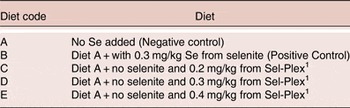
A total of 1100 male broilers (Ross 308) were obtained at one-day-old from a commercial hatchery. From this, 900 day old males, within the weight ranges 40 to 45 g, were selected and assigned by body weight to floor pens (20 chicks per pen) and nine pens were randomly assigned to each dietary treatment (Table 1).
Dietary treatments fed to broilers

1 SP and inclusion levels were supplied by Alltech.
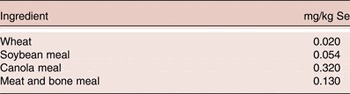
Ingredients were purchased in bulk and, prior to mixing, Se concentrations were determined in the major feed ingredients (wheat, soybean meal, canola meal and meat and bone meal) to ensure that the negative control Diet A was low in Se. The analysed Se concentrations in the feed ingredients are shown in Table 2. Total Se was determined in samples digested in tetramethylammonium hydroxide (TMAH) solution (Brunori et al., Reference Brunori, De la Calle, Angelone and Morabito1999), followed by analysis using an inductively coupled plasma–mass spectrometer (Perkin Elmer Elan DRCII).

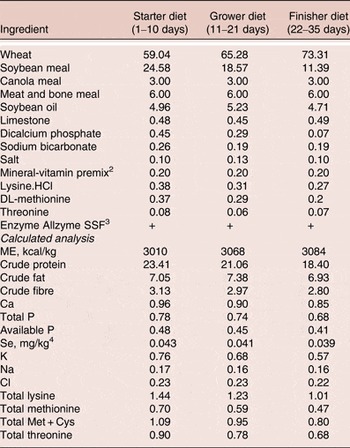
A three-phase feeding programme (starter, grower and finisher), as per standard commercial practice in New Zealand, was used (Table 3). Diets were formulated to meet specifications used by the industry. The trace mineral-vitamin premix was prepared without Se (Image Holdings Ltd, Auckland, New Zealand). Se was added in the form of SS or yeast-derived, organic use Sel-Plex® (SP) to the diets using standard operating procedures to ensure uniform mixing in the diets. Following diet mixing, the diets were cold-pelleted at 65–70°C. All diets were analysed for Se content.
Percentage composition and calculated analysis of the basal diets 1

1 Five experimental diets prepared from basal diet – no addition of Se, 0.3 mg/kg Se as sodium selenite (SS), 0.2 mg/kg as Sel-Plex (SP), 0.3 mg/kg Se as SP or 0.4 mg/kg Se as SP (see Table 1).
2 Supplied per kilogram diet: BHT antioxidant, 100 mg; biotin, 0.2 mg; calcium pantothenate, 12.8 mg; cholecalciferol, 60 µg; cyanocobalamin, 0.017 mg; folic acid, 5.2 mg; menadione, 4 mg; niacin, 35 mg; pyridoxine, 10 mg; trans-retinol, 3.33 mg; riboflavin, 12 mg; thiamine, 3.0 mg; dl-α-tocopheryl acetate, 60 mg; choline chloride, 638 mg; Co, 0.3 mg; Cu, 3 mg; Fe, 25 mg; I, 1 mg; Mn, 125 mg; Mo, 0.5 mg; Zn, 60 mg.
3 SSF, Alltech, Inc., KY, feed enzyme 200 g/tonne.
4 Calculated based on analysed Se values for individual ingredients (see Table 2).
Chicks were housed in floor pens bedded on sawdust in an environmentally controlled room with temperature maintained at 31°C during the first week and then reduced stepwise to 22°C at 42 days of age. The birds received constant illumination and had ad libitum access to feed and water.
Performance data
Body weights and feed intake were recorded at weekly intervals throughout the 42-day trial period. Mortality was recorded daily, and any bird that died was weighed and the body weight of dead birds was used to adjust FCR. On day 42, birds were individually weighed to obtain a measure of uniformity.
Feather Scores
On days 14, 28 and 42 post-hatch, feather coverage was determined for 10 birds from each pen according to the method described by Edens (Reference Edens, Lyons and Jacques1996). Feather tracts on the back, neck, dorsal wing, breast and abdomen were scored subjectively based on feather size and skin cover. Feather scoring (Kretzschmar-McCluskey et al., Reference Kretzschmar-McCluskey, Fisher and Van Tuijl2014) was based on a system ranging from 1 (poor) to 5 (good), and results for different tracts were averaged to give a total feather score.
Carcass yield and quality
Two birds per replicate pen, selected as being closest to the mean pen weight, were removed on day 42 and killed by cervical dislocation. The birds were weighed, exsanguinated, scalded, plucked, eviscerated and feet were removed. The weights of eviscerated hot carcass weight and, of breast meat and abdominal fat pad were recorded and expressed as percentage of live body weight.
Tissue Se concentrations
Breast meat samples from a pen of two birds were pooled, giving a total of 45 samples. Se concentration in the breast meat was determined in samples digested in tetramethylammonium hydroxide (TMAH) solution (Brunori et al., Reference Brunori, De la Calle, Angelone and Morabito1999), followed by analysis on an inductively coupled plasma–mass spectrometer (Perkin Elmer Elan DRCII, Waltham, MA,USA).
Drip loss
Duplicate samples of breast meat (nine per treatment; in duplicate; total of 18 per treatment) were obtained for the measurement of drip loss. The meat was ice-water chilled for four hours, blotted dry, and a 3 cm cube was cut and weighed. The samples were placed in plastic netting that would allow the escape of fluid and suspended by a stainless steel hook in a sealable jar, ensuring that the sample did not make contact with the jar. After 24 and 48 hrs of storage at chill temperatures (1–5°C), samples were removed, gently blotted dry and weighed. Drip loss was expressed as a percentage of the initial weight, and carcass weight.
Meat quality measurements
Whole breast fillets (without skin and bone) were removed to study meat quality. Twenty-seven breast fillets per treatment group, representing three samples per replicate pen, were obtained. The first set of nine samples (one per pen replicate) was used for the measurements of pH, colour and cooking losses in the fresh breast meat. The second set was used for antioxidant determination (Thiobarbituric Acid Reactive Substances: TBARS) and cooking loss measurements and were kept chilled at 4°C for seven days. The remaining samples were used for cooking loss measurements after being kept frozen at -20°C for seven days.
pH and colour of fresh meat
The pH was measured in meat chilled for 24 hrs after slaughter. Approximately 2.0–2.5 g meat was diced with scissors into a plastic vial, and 10 ml of 150 mM KCl, pH 7 was added and the sample was homogenised in an ultra-Turrax on quarter speed three or four times in 5 second bursts. pH was measured by plunging an ionode electrode with a hardened spear tip into the meat solution.
The colour of fresh meat was measured using a Minolta colorimeter. Chicken breasts (chilled for 24 hours after slaughter) were cut against the grain into uniform pieces and exposed to air for 20–30 min at room temperature. They were then packed uniformly in a petri dish, covered with a black can to provide a dark environment, placed on the colorimeter and L*, a* and b* readings were recorded. L*, a* and b* were the labels of axes used in the measurements, where L* represented the vertical axis (y-axis) that measured the white/black ratio of the sample. White was the positive and black the negative, and on a scale of 1 to 100 black was 1 and white 100. a* represented the horizontal axis (x-axis) and indicated the red-green ratio of the sample. Red was the positive and green the negative, so on a scale of 1 to 100 green was 1 and red 100. b* represented the z-axis representing the yellow-blue ratio of the sample. Yellow was the positive and blue the negative, so on a scale of 1 to 100 yellow was 1 and blue 100. In this case, the white-black axis (L) was considered the best measure of dietary treatment effect on colour.
Oxidation (as TBARS) of fresh and frozen seven day old meat
TBARS as a measure of oxidised lipids in fresh and frozen meat samples were determined using the method of Inoue et al. (Reference Inoue, Ando and Kikugawa1998). The concentration of TBARS formed was determined by isolating and then reacting with the TBA reagent and measuring the absorption intensity of the coloured chromogen at 532 nm. The Allen correction (Allen, Reference Allen1950) was used to compensate for any non-specific colour formation and eliminate background interference.
Cooking loss of chilled and frozen meat
Cooking losses were determined using samples chilled for 24 hours or frozen for seven days. Frozen samples were thawed at 4°C for 24 hours prior to cooking. Meat was cut into three or four 2.5 mm thick pieces, weighed, arranged with the cut surface facing out into polythene bags and put into a water bath at 70°C for 60 min. After 60 min, the bags were drained and the cooked meat was chilled for 24 hrs. The cooked pieces were removed from the bag, patted dry with a towel and the weight was recorded. Losses were expressed by weight difference between uncooked and cooked samples.
Statistical analysis
The data was subjected to a completely randomised design ANOVA using the GLM procedure of SAS (1997) using pen as the experimental unit. Differences were considered significant at 95% confidence limits (P < 0.05), with up to P ≤ 0.10 signifying a strong trend. When significance was detected, treatment means were separated using the Least Significance Difference test.
Results and discussion
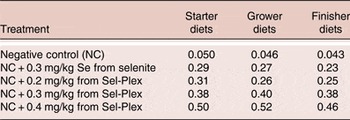
Analysed values for Se in starter, grower and finisher diets are shown in Table 4. The values determined for basal diets with no supplemental Se agreed closely with the formulated values (Table 3).
Determined selenium concentrations (mg/kg) in the dietary treatments

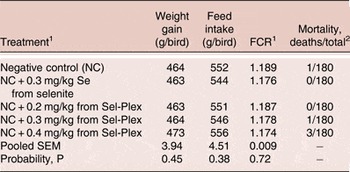
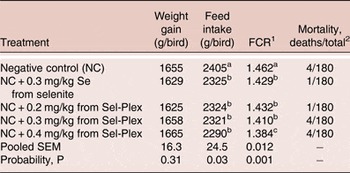
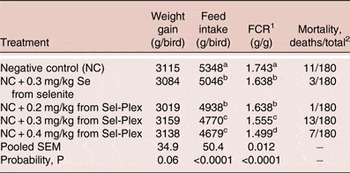
The influence of Se source and levels on the cumulative weight gain, feed intake and FCR of broilers during the three feeding phases, at d1 to 14, d1 to 28 and d1 to 42 post-hatch, is summarised in Tables 5, 6 and 7, respectively.
Influence of selenium source on performance of male broilers (1–14 days post-hatching)

Each mean represents values from nine replicates (20 birds/replicate); 1Corrected for mortality; 2Number of deaths per total number of birds (9 replicates x 20 birds).
Influence of selenium source on the performance of male broilers (1–28 days post-hatching)

a,b,c Means in the same column with different superscripts are significantly different (P < 0.05).
Each mean represents values from nine replicates (20 birds/replicate); 1Corrected for mortality; 2Number of deaths per total number of birds (9 replicates x 20 birds).
Influence of selenium source on the performance of male broilers (1–42 days post-hatching)

a,b,c,d Means in the same column with different superscripts are significantly different (P < 0.05).
Each mean represents values from nine replicates (20 birds/replicate); 1Corrected for mortality; 2Number of deaths per total number of birds (9 replicates x 20 birds).
Dietary Se levels or source had no effect (P > 0.05) on broiler performance during 1–14 d post-hatch. During 1–28 d post-hatch, weight gain was unaffected (P > 0.05) by dietary treatments. However, significant treatment effects were seen for feed intake (P < 0.05) and FCR (P < 0.001). Feed intake and FCR of broilers fed the Se-deficient negative control diet was higher (P < 0.05) than those fed diets containing SS and SP. FCR of birds fed diets with 0.3 mg/kg selenite and 0.2 and 0.3 mg/kg SP were similar (P > 0.05). The lowest (P < 0.05) FCR was recorded in birds fed the diet with 0.4 mg/kg SP.
Over the whole trial period (1–42 d of age), weight gain tended (P = 0.06) to be affected by dietary treatments which was due largely to gains of birds fed diets with 0.3 and 0.4 mg/kg SP. The feed intake and FCR of broilers fed the Se-deficient negative control diet was higher (P < 0.05) than those fed diets containing SS and SP. Feed intake and FCR of birds fed diets with 0.3 mg/kg selenite and 0.2 mg/kg SP were similar (P > 0.05), and were higher (P < 0.05) respectively than those of birds fed diets with 0.3 and 0.4 mg/kg SP. Increasing additions of SP from 0.2 to 0.4 mg/kg resulted in progressive reductions in FCR, with birds fed the 0.4 mg/kg diet having the lowest (P < 0.05) value. Compared to the treatment with 0.3 mg/kg selenite, feed conversion was lowered by 8 and 14 points in birds fed 0.3 and 0.4 mg/kg SP, respectively.
Other studies investigating the effects of different levels and sources of dietary Se on performance in broilers have produced varying results. Edens (Reference Edens, Lyons and Jacques1996) reported that replacing inorganic Se (selenite) with 0.1 or 0.2 ppm organic Se could increase the live bodyweight of broilers by approximately 95 g and could be further increased to 107 g by total removal of inorganic Se from the diet. In contrast, studies by Miller et al. (Reference Miller, Soares, Bauersfeld and Cuppett1972), Deniz et al. (Reference Deniz, Genzen and Turkmen2005), Peric et al. (Reference Perić, Milošević, Žikić, Kanački, Džinić, Nollet and Spring2009) and Oliveira et al. (Reference Oliveira, Rivera, Mesquita, Braga, Ramos and Bertechini2014) found no difference between the live weight gains of birds fed different sources and levels of dietary Se.
Other studies were in agreement with the results of this study that Se supplementation can improve FCR of broilers (Choct et al., Reference Choct, Naylor and Reinke2004; Deniz et al., Reference Deniz, Genzen and Turkmen2005; Payne and Southern, Reference Payne and Southern2005; Upton et al., Reference Upton, Edens and Ferket2008). A trial by Naylor et al. (Reference Naylor, Ravindran, Ravindran, Thomas, Kocher and Sacranie2009) compared the addition of organic Se (SP) and inorganic Se (SS) and reported that the SP had a positive effect on FCR of broilers which progressively increased with increasing levels of SP in the diet. However, studies by Edens et al., Reference Edens, Parkhurst, Havenstein and Sefton2001, Peric et al., Reference Peric, Milosevic, Zikic and Nollet2006, and Rajashree et al., Reference Rajashree and Muthukumar2013 found no significant differences in feed conversion ratio with Se supplementation.
Dietary treatments had no effect (P > 0.05) on the uniformity of final body weight of broilers.
Feather scores on d 14, 28 and 42 of age showed that the scores became poorer with age (4.9 at 14 d, 4.6 at 28 d and 3.6 at 42 d) but were unaffected by dietary Se, despite reports that intake of organic sources have been linked to improved feather production (Edens et al., Reference Edens, Parkhurst, Havenstein and Sefton2001; Choct et al., Reference Choct, Naylor and Reinke2004; Peric et al., Reference Perić, Milošević, Žikić, Kanački, Džinić, Nollet and Spring2009). The study by Edens et al. (Reference Edens, Parkhurst, Havenstein and Sefton2001) reported that organic Se enhanced feathering and that the effect was present at 21 days of age and persisted through to 42 days of age. Similarly, Peric et al. (Reference Peric, Milosevic, Zikic and Nollet2006) reported that feather scores at day 21 were increased with feeding of organic sources of Se and other minerals and that at day 42 there was also still a trend towards increased feathering. Correct feathering is important for broilers as it helps regulate body temperature and protects the skin and muscle from damage. Therefore poorly feathered birds use more energy to keep warm, potentially limiting the nutrients available for productive performance (Glatz, Reference Glatz2001).
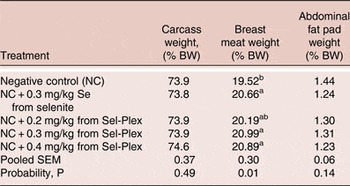
The influence of dietary treatments on carcass characteristics is shown in Table 8. Carcass recovery and relative weight of abdominal fat were unaffected by the source and levels of Se. However, breast meat yield was affected by Se, with yield from broilers fed the Se-deficient negative control diet being significantly lower (P < 0.05) than those fed diets containing SS and SP. In agreement with these findings, the majority of published research on carcass yield or abdominal fat have reported no significant differences with the inclusion of Se in the diet (Downs et al., Reference Downs, Hess and Bilgili2000; Mansoub et al., Reference Mansoub, Chekani-Azar, Mizban, Hamadani, Ahadi and Lotfi2010; Dhumal et al., Reference Dhumal, Nikam, Khose and Ingle2013; Rajashree et al., Reference Rajashree and Muthukumar2013). However, as seen in this study, others have reported differences in breast meat yield. A study by Mansoub et al. (Reference Mansoub, Chekani-Azar, Mizban, Hamadani, Ahadi and Lotfi2010) determined that breast meat increased with the replacement of SS with Se enriched yeast in diets containing α-tocopherol. A study by Choct et al. (Reference Choct, Naylor and Reinke2004) reported that birds consuming diets containing organic Se showed improved breast meat yields.
Influence of selenium source on the carcass characteristics of male broilers (1–42 days of age)

a,b Means in the same column with different superscripts are significantly different (P < 0.05).
Each mean represents values from nine replicates (20 birds/replicate).
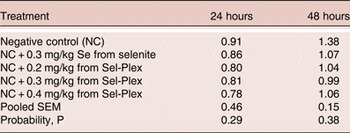
Drip loss data at 24 and 48 h post-slaughter are presented in Table 9. Drip losses from the breast meat of broilers fed the Se-deficient negative control diet were numerically higher than those fed diets containing SS and SP (P > 0.05). Drip loss and meat colour are considered two of the most important meat quality characteristics (Surai, Reference Surai2002). It has been reported that broilers fed organic Se had lower 24 hour drip loss than those fed inorganic Se (Edens, Reference Edens, Lyons and Jacques1996; Choct and Naylor, Reference Choct and Naylor2004; Choct et al., Reference Choct, Naylor and Reinke2004; Peric et al., Reference Perić, Milošević, Žikić, Kanački, Džinić, Nollet and Spring2009; Rajashree et al., Reference Rajashree and Muthukumar2013). Wang and associates (Reference Wang, Zhan, Yuan, Zhang and Wu2011) concluded that both the source of Se and exposure time significantly influenced the drip loss of breast muscle.
Influence of selenium source on drip loss from breast meat, measured at 24 and 48 hours post-slaughter

Each mean represents values from 18 meat samples (9 replicate pens x duplicates).
The pH and colour of breast meat were unaffected by Se treatments, with average pH being 5.92, and, for colour, averages for L* = 48.4; a* = 3.9 and b* = 0.3 were reported across all treatments. This is in line with the findings of Dhumal et al. (Reference Dhumal, Nikam, Khose and Ingle2013) who reported no effects of Se source or level on meat pH. However, Del Puerto et al. (Reference Del Puerto, Cabrera, Terevinto, Olivero and Saadoun2014) concluded that Se supplementation was valuable in modulating the pH, colour and glycogen content of chicken meat. They reported that the supplementation of Se caused higher pH in the resulting meat and redder Pectoralis. Conversely, Rajashree et al. (Reference Rajashree and Muthukumar2013) showed that meat pH was significantly decreased by the inclusion of Se in the diet. A high muscle pH results in a shorter shelf life due to microbial growth (Dou et al., Reference Dou, Shi, Sun and Wang2009), therefore a decrease in pH in response to Se supplementation indicates longer shelf life and better meat quality.
Pale, exudative meat can be the result of oxidative damage to cell membranes, allowing the seepage of intracellular fluids, making packaged product less attractive to consumers. A study by Boiago et al. (Reference Boiago, Borba, Leonel, Giampietro-Ganeco, Ferrari, Stefani and Souza2014) reported that the use of selenomethionine in the diet resolved pale colour and there was lower oxidation in chicken breast meat stored up to 15 days at 4°C. They concluded that organic sources of Se were more effective than inorganic sources for conserving meat quality.
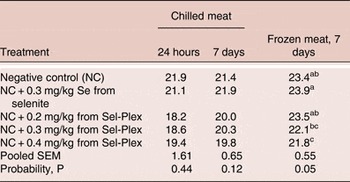
The effects of Se treatments on cooking losses from breast meat chilled for 24 h or seven days or frozen for seven days are summarised in Table 10. For cooking losses in meat chilled for seven days, losses in SP treatments were numerically lower than those in the Se-deficient diet and the selenite treatment, but this was not significant. However, cooking losses from meat frozen for seven days was significantly (P < 0.05) influenced by Se treatments. Cooking losses in the frozen meat from birds fed diets with 0.3 and 0.4 mg/kg Se as SP were lower (P < 0.05) than those from birds fed 0.3 mg/kg Se as selenite.
Influence of selenium source on cooking losses of breast meat, chilled for 24 hrs or seven days and frozen for seven days

a,b,c Means in the same column with different superscripts are significantly different (P < 0.05).
Each mean represents values from nine meat samples.
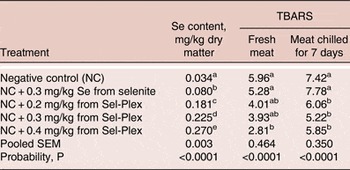
The influence of dietary treatments on the Se content of breast meat is summarised in Table 11. Both Se sources increased (P < 0.0001) tissue Se concentrations. The increases seen for 0.3 mg/kg inorganic Se diets were lower (P < 0.05) than those with 0.2 and 0.3 mg/kg organic Se. Increasing dietary Se concentrations from organic Se source increased (P < 0.05) tissue Se concentrations in a dose-dependent manner. Other published trials reported that inorganic Se was retained at a lower concentration in muscle compared to organic sources (Mahan and Parret, Reference Mahan and Parrett1996; Spears et al., Reference Spears, Grimes, Lloyd and Ward2003; Payne and Southern, Reference Payne and Southern2005; Wang et al., Reference Wang, Zhan, Yuan, Zhang and Wu2011). Specifically, Rajashree et al. (Reference Rajashree and Muthukumar2013) reported that the supplementation of organic Se in the diet increased corresponding concentrations in the meat by 97%, compared to the control diet containing no Se. In comparison, the supplementation of inorganic Se in the diet only increased the Se concentration in the meat by between 27 and 61%.
Influence of selenium source on the selenium content of fresh breast meat and oxidation level in breast meat chilled for either 24 hrs or seven days

a,b,c,d,e Means in the same column with different superscripts are significantly different (P < 0.05).
Each mean represents values from nine meat samples.
The effects of dietary treatments on the oxidative status (measured by TBARS) of breast meat chilled for 24 hr or seven days are summarised in Table 11. In chilled fresh meat, there were no differences (P > 0.05) in the degree of lipid oxidation between the negative control, 0.3 mg/kg inorganic Se and, 0.2 and 0.3 mg/kg organic Se. However, the degree of oxidation in the 0.4 mg/kg organic Se was significantly lower (P < 0.05) compared to those of the negative control and 0.3 mg/kg inorganic Se. In meat samples chilled for seven days, the degree of oxidation in the negative control and the inorganic Se treatment was similar (P > 0.05). But significant differences (P > 0.0001) were observed between the sources of Se, with samples from organic Se treatments having lower (P < 0.05) oxidation that those from the inorganic Se treatment.
Conclusions
There is a large body of research published regarding Se supplementation in poultry diets and its effect on a range of performance variables, however, the results are varied, which makes drawing definitive conclusions difficult. Taking the results of the available research together with the results of this study, it is clear Se can have positive effects on poultry health and production. Organic forms of Se, such as use Sel-Plex® offer some advantages over the traditionally used inorganic forms of Se, such as: improved bioavailability and uptake into tissues, and positive effects on certain production traits, including FCR, breast meat yield and meat quality. However, more research is required to ascertain the exact level and source of Se supplementation to produce optimal performance in poultry.