The combination of the Human Immunodeficiency Virus infection and Acquired Immunodeficiency syndrome results in a multi-system disease involving any of the organ systems of the body. Cardiovascular system dysfunction in the form of left ventricular myopathy, which may be secondary to myocarditis or cardiomyopathy, is one of the more serious complications of Human Immunodeficiency Virus infection. The median survival of such patients is markedly reduced when compared with patients with a normal heart assessed by echocardiography at a similar infection stage.Reference Lipshultz1, Reference Barbaro, Fisher and Lipshultz2 The cardiovascular manifestations are seen with advanced disease, which is associated with severe weight loss or wasting disease, Human Immunodeficiency Virus-associated encephalopathy, very low CD4 counts, and exceedingly high viral loads.Reference Al-Attar, Orav, Exil, Vlach and Lipshultz3–Reference Micon, Jeane, Maarten and Marchina5
Other cardiovascular manifestations of Human Immunodeficiency Virus infection include pericardial disease, infective endocarditis, rhythm disturbances, pulmonary heart disease, vasculitides, cardiac malignancies, and suspected congenital heart defects.Reference Al-Attar, Orav, Exil, Vlach and Lipshultz3, Reference Starc, Lipschultz and Kaplan6–8
Although these cardiovascular manifestations of Human Immunodeficiency Virus infection or Acquired Immunodeficiency Syndrome and outcomes are well documented in adults,Reference Barbaro, Fisher and Lipshultz2, Reference Barbaro, Di Lorenzo, Grisorio and Barbarini4, Reference Micon, Jeane, Maarten and Marchina5, Reference Barbaro7, Reference Sani, Okeahialam, Aliyu and Enoch9–Reference Barbaro11 there is paucity of similar information assessing cardiac outcomes in children with Human Immunodeficiency Virus infection both before and after introduction of Highly Active Antiretroviral Therapy. There was one study, done over a 2-year period, which showed that 10% of Human Immunodeficiency Virus-infected children who did not receive Highly Active Antiretroviral Therapy developed congestive heart failure and approximately 20% developed left ventricular dysfunction or dilatation.Reference Starc, Lipschultz and Kaplan6 A literature search using the Pubmed Internet database of Journal References revealed four studies that assessed the outcome of left ventricular dysfunction and cardiomyopathy in Human Immunodeficiency Virus-infected children receiving Highly Active Antiretroviral Therapy.Reference Herdy, Pinto and Lopes12–Reference Saulsbury15 All four studies documented improvement of the left ventricular function in patients receiving combination therapy compared with those who received monotherapy or those who did not receive any antiretroviral treatment. The improvement of left ventricular function was noted as early as 6 months and as late as 6 years following commencement of antiretroviral therapy. The antiretroviral drugs administered in these studies included various combinations of Zidovudine, Didanosine, Stavudine, Lamivudine, Nelfinavir, and Ritonavir. None of the patients developed cardiomyopathy secondary to the administration of Highly Active Antiretroviral Therapy, with or without Zidovudine or Didanosine in any of the four studies.Reference Herdy, Pinto and Lopes12–Reference Saulsbury15
Other studies show that antiretroviral drugs such as Zidovudine and Didanosine are associated with skeletal muscle and myocardial muscle dysfunction.Reference Damonski, Sloas and Follmann16 Left ventricular dysfunction manifesting after starting Highly Active Antiretroviral Therapy may therefore be related to Highly Active Antiretroviral Therapy. This has important implications in the antiretroviral drug therapy choices for children who have myocardial dysfunction before starting therapy, or who develop dysfunction following the commencement of antiretroviral therapy.
A retrospective study was therefore undertaken to assess the outcome of children with Human Immunodeficiency Virus infection and left ventricular dysfunction after treatment with Highly Active Antiretroviral Therapy. A simultaneous evaluation was made of their nutritional status, viral loads, and immune response to treatment.
Methods
Patients: A retrospective review was carried out using records of children below the age of 14 years with Human Immunodeficiency Virus infection and left ventricular dysfunction from the following institutions belonging to the University of the Witwatersrand teaching hospital complex in Johannesburg:
(i) The Paediatric Cardiology Division of Chris Hani Baragwanath Academic Hospital computerised database initiated in 1992.
(ii) The Paediatric Cardiac Clinic at Charlotte Maxeke Johannesburg Hospital.
(iii) The Paediatric Cardiac Clinic at Rahima Moosa Hospital.
(iv) Specialised antiretroviral treatment roll-out sites, which included the Harriet Shezi Clinic at Chris Hani Baragwanath Hospital, the IC2 Clinic at Rahima Moosa Hospital, and the Human Immunodeficiency Virus Clinic at Charlotte Maxeke Johannesburg Hospital.
The following data were entered on to the data collection sheet:
(a) Age at first presentation.
(b) Sex.
(c) Echocardiographical assessment of myocardial function before and during Highly Active Antiretroviral Therapy.
(d) List of the antiretroviral drugs received and the duration of therapy.
(e) List of heart failure medication.
(f) Changes in the CD4 percentage and viral load levels during treatment.
(g) Trends in nutritional status.
(h) Final outcome.
Glossary
CD4 percentage: A CD4 percentage was used as an indicator of immune competence because it is a more reliable measure in children. By definition, a CD4 percentage of more than 25% indicates no immunosuppression; 15% to 24% indicates moderate immunosuppression; and less than 15% indicates severe immunosuppression.17
Highly active antiretroviral therapy: is defined as an antiretroviral drug combination of three or more drugs capable of reducing the viral load to undetectable levels (less than 25 copies per millilitre).17
Human Immunodeficiency Virus positive: is the detection of Human Immunodeficiency Virus Deoxyribonucleic Acid using polymerase chain reaction in patients less than 18 months of age, or detection of Human Immunodeficiency Virus antibodies using Enzyme-linked Immunosorbent Assay in patients more than 18 months of age.17
Left ventricular dysfunction: is defined as left ventricular fractional shortening of less than 25%.Reference Starc, Lipshultz and Easley18, Reference Silverman19
Nutritional status: The weight and height z-scores were used to compare the nutritional status before and during treatment with Highly Active Antiretroviral Therapy.20
Outcome: This was recorded as death; lost to follow-up, that is, presumed dead; or alive with or without left ventricular dysfunction.
Viral load: is defined as a measure of Human Immunodeficiency Virus Ribonucleic Acid copies detected in a patient's serum. It was defined as undetectable if there were less than 25 copies per millilitre of a patient's serum.17
Statistical analysis
Variables such as fractional shortening, CD4 percentage, viral load, weight, height, or length before and during Highly Active Antiretroviral Therapy were compared using a paired t-test for normal distribution or the Mann–Whitney test for abnormal distribution. A paired t-test was used to compare variables within groups of normal (Gaussian) distribution, whereas a Wilcoxon test was employed for non-normal (non-Gaussian) distribution variables.
Inclusion criteria
(1) All patients aged less than 14 years with laboratory confirmation of Human Immunodeficiency Virus infection, which included Human Immunodeficiency Virus Enzyme-linked Immunosorbent Assay test after the age of 18 months or an Human Immunodeficiency Virus Polymerase Chain Reaction test for patients less than the age of 18 months.17
(2) All patients with left ventricular dysfunction assessed using echocardiography.
(3) All patients with recorded nutritional status.
Ethical clearance: Ethics approval to use data from the three academic institutions in Johannesburg was obtained from the University of Witwatersrand Medical Ethics Committee for Research on Human Subjects. Permission to use patient data was also obtained from the various hospital authorities. All patient data were analysed confidentially and without prejudice to the patients.
Results
Demographics
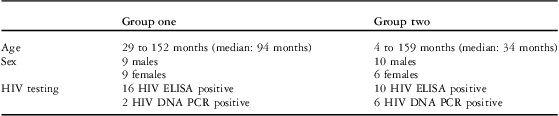
We included 34 patients who were found to be Human Immunodeficiency Virus positive and met criteria for inclusion in the analysis (Table 1). In all, 18 patients received Highly Active Antiretroviral Therapy (group one) and 16 (group two) were seen before the nationwide roll-out of Highly Active Antiretroviral Therapy in South Africa. The cardiac follow-up duration of group one patients ranged between 2 weeks and 38 months (median: 21 months), whereas the follow-up duration of the Highly Active Antiretroviral Therapy-naive group was 2 days to 9 months (median: 28 days).
Demographics.
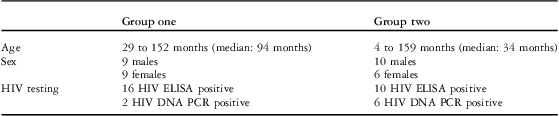
DNA = deoxyribonucleic acid; ELISA = enzyme-linked immunosorbent assay; HIV = human immunodeficiency virus; PCR = polymerase chain reaction
Left ventricular function – fractional shortening – before and during Highly Active Antiretroviral Therapy
The echocardiographic diagnosis of left ventricular dysfunction was made 1 day to 1 year and 10 months after the laboratory diagnosis of Human Immunodeficiency Virus infection in 10 patients, whereas in five patients both Human Immunodeficiency Virus infection and left ventricular dysfunction diagnoses were made on the same day. It is interesting to note that in three patients myocardial dysfunction was documented before laboratory diagnosis of Human Immunodeficiency Virus infection, that is, patient 3 – 10 months; patient 6 – 11 months; and patient 15 – 1 month.
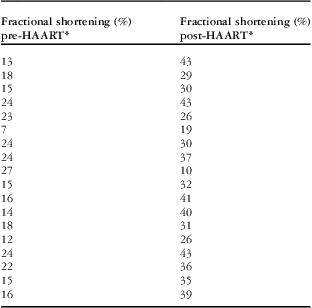
Upon review of the three cardiac databases of the Johannesburg Teaching Hospitals and clinical records, all the patients in this study were labelled as having dilated cardiomyopathy. There were no records of cardiac enzymes, electrocardiograms, and chest X-rays that were found in order to accurately categorise patients as having either acute myocarditis or dilated cardiomyopathy. The initial fractional shortening in group one ranged between 7% and 27% (median: 17%). The improvement in fractional shortening following antiretroviral therapy was statistically significant and ranged between 10% and 43% (median: 33.5%; Table 2).
Left ventricular function before (pre-) and during (post-) antiretroviral therapy.
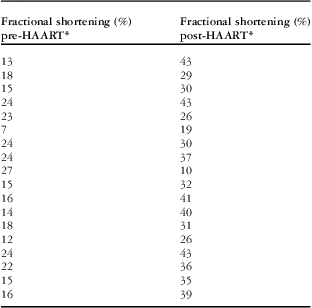
*Highly Active Antiretroviral Therapy
The initial fractional shortening in group two ranged between 9% and 23% (median: 13.5%). The fractional shortening of the seven patients who were followed up ranged between 6% and 34% (median: 19%) over a follow-up period of 2 days to 9 months (median: 28 days). The change in fractional shortening in this group was found to be statistically insignificant (p equal to 0.07). There was no significant statistical difference in the initial fractional shortening between the two groups (p equal to 0.055).
It is interesting to note that there were four patients who developed myocardial dysfunction while on Highly Active Antiretroviral Therapy because of suspected mitochondrial toxicity caused by antiretroviral drugs themselves. Only one patient had histological confirmation.
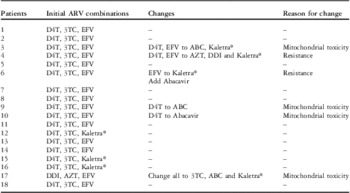
The first of the four patients (patient 3; Table 3) was diagnosed with Human Immunodeficiency Virus-associated dilated cardiomyopathy before starting Highly Active Antiretroviral Therapy, that is, Stavudine, Lamivudine, and Efavirenz. The patient had temporary normalisation of myocardial function, which was paralleled by viral suppression and an improved CD4 percentage. The patient then developed lactic acidosis associated with left ventricular dysfunction, which was attributed to mitochondrial toxicity secondary to Highly Active Antiretroviral Therapy. Stavudine and Efavirenz were replaced by Abacavir and Kaletra, which was followed by resolution of the lactic acidosis and improvement in left ventricular function.
Highly Active Antiretroviral Therapy combinations, changes, and reasons for change (median duration of therapy was 23 months).

ABC = Abacavir; AZT = Zidovudine; ARV = antiretroviral therapy; DDI = Didanosine; D4T = Stavudine; EFV = Efavirenz; 3TC = Lamivudine
*Kaletra is a combination of two Protease Inhibitors Lopinavir and Ritonavir, which is used to enhance the pharmacokinetic properties and efficacy of the individual drugsReference Van Heeswijk, Veldkamp and Mulder21
The second patient (patient 9; Table 3) had borderline left ventricular function with fractional shortening of 27% at initial assessment. This function decreased to 10% while the patient was on Highly Active Antiretroviral Therapy including Stavudine (Tables 2 and 3). Stavudine was later substituted with Abacavir with improvement of fractional shortening to 43%.
The third patient (patient 10; Table 3) developed left ventricular dysfunction associated with a moderately suppressed CD4 percentage (23.2%), with complete viral suppression (less than 25 copies per millilitre) while on a combination of Stavudine, Lamivudine, and Efavirenz. The patient was also presumed to have developed mitochondrial toxicity due to Antiretroviral Therapy. Stavudine was subsequently substituted with Abacavir, which was associated with an improvement in left ventricular function.
The fourth patient (patient 17; Table 3) developed myocardial dysfunction on a Highly Active Antiretroviral Therapy regime, which included Didanosine, Zidovudine, and Efavirenz. A myocardial biopsy showed evidence of mitochondrial toxicity. Resolution of myocardial dysfunction in this patient followed a change in therapy to Lamivudine, Abacavir, and Kaletra.
Antiretroviral therapy combinations
All patients in group one received antiretroviral therapy according to the National Antiretroviral Therapy protocol,17 and were treated for a duration of 1 to 85 months (median: 23 months). The antiretroviral drug combinations, substitutions, and reasons for change are presented in Table 3.
Cardiac failure medication
All the 18 patients in group one were commenced on antifailure medication, which included a combination of Digitalis, diuretics (Furosemide and/or Spironolactone), an Angiotensin-Converting Enzyme Inhibitor (Enalapril), and a beta blocker (Carvedilol), with or without addition of a Potassium Supplement and Acetylsalicylic Acid (Aspirin). After their improvement in cardiac function, which followed Highly Active Antiretroviral Therapy, 13 patients were weaned off antifailure therapy completely and the remaining five were in the process of being weaned off.
In the Highly Active Antiretroviral Therapy-naive group (16 patients), 14 patients were started on Digoxin, Furosemide, and Potassium supplements only, and two patients received an additional Aspirin. All of the seven patients who were followed up remained on antifailure medication at the last visit.
Changes in the CD4 T-cell subset levels and viral load levels
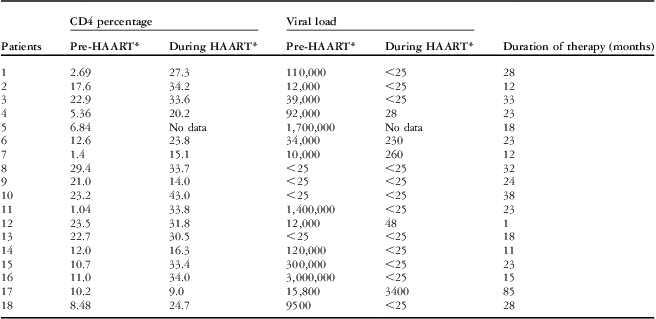
These parameters were not measured in group two because these patients were managed in the pre-Highly Active Antiretroviral Therapy era when CD4 counts and viral load testing were not done. The CD4 percentages and not absolute counts were used as a measure of immune competence in only 17 of 18 patients in group one before Highly Active Antiretroviral Therapy. The pre-Highly Active Antiretroviral Therapy CD4 percentages ranged between 1.04% and 29.40% (median: 12%). Following Highly Active Antiretroviral Therapy, the CD4 percentage improved, with statistical significance ranging from 9% to 43% (median: 30.5%; Tables 2 and 4). There was one patient (patient 9; Table 4) who showed a drop in the CD4 percentage from 21% to 14%, which was associated with worsening left ventricular function (fractional shortening decreased from 27% to 10%; Table 2). This deterioration was thought to be due to mitochondrial toxicity associated with Highly Active Antiretroviral Therapy. Patient 17 (Tables 2–4) had a marginal decline in CD4 percentage from 10.2% to 9%, which was associated with a decline in viral load but not with full viral suppression over a treatment period of 85 months. Nevertheless, the left ventricular function improved (Table 2).
Immune response and duration of Highly Active Antiretroviral Therapy.
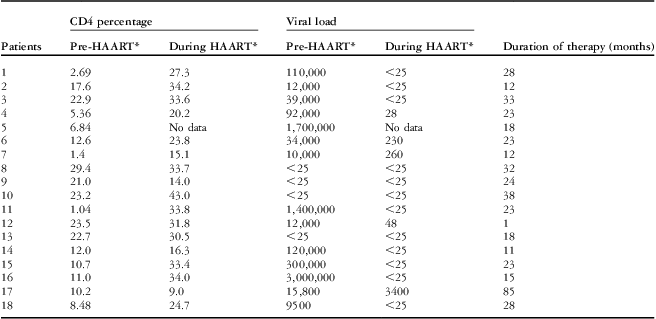
*Highly Active Antiretroviral Therapy
Viral load levels
The pre-Highly Active Antiretroviral Therapy viral load varied between 3 million copies per millilitre and undetectable levels (less than 25 copies per millilitre), with a median of 24,900 copies per millilitre (Table 4). The viral load decreased to between 3400 copies per millilitre and less than 25 copies per millilitre after starting Highly Active Antiretroviral Therapy (median: less than 25 copies per millilitre). This drop in viral load was statistically significant (p less than 0.0001). The four patients with viral load counts less than 25 copies per millilitre before Highly Active Antiretroviral Therapy were commenced on treatment based on their clinical presentation according to the National Antiretroviral Therapy Guidelines.17
Trends in nutritional status
Weight z-scores
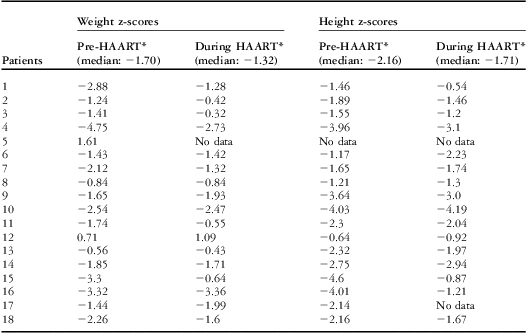
The weight z-scores for group one ranged from −4.75 to 1.61 (median: −1.70) before Highly Active Antiretroviral Therapy. There was a statistically significant (p equal to 0.0083) improvement in the scores while on Highly Active Antiretroviral Therapy to a range of −3.36 to 1.09 (median: −1.32) over a follow-up period of 2 weeks to 38 months (median: 21 months; Table 5). Patient 5 (Table 5) was omitted from the analysis because no follow-up weights were documented.
Weight and height z-scores before and during Highly Active Antiretroviral Therapy in group one patients (p-values were 0.0083 and 0.076, respectively).
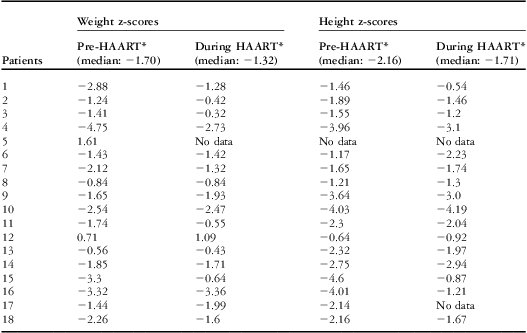
*Highly Active Antiretroviral Therapy
The initial weight z-scores in group two ranged between 1.47 and −3.69 (median: −2.47). There was poor follow-up of these patients and the weight z-scores were available in only five patients. The final z-score documented over a follow-up period of 10 days to 3 months (median: 53 days) ranged between −1.82 and −4.42 (median: −3.37). The deterioration of the weight z-scores in these five patients was statistically insignificant (p equal to 0.089).
There was no statistical difference between the initial weight z-scores of groups one and two (p equal to 0.12). The final weight z-scores were not compared between the two groups, because of the paucity of information available in group two.
Height z-scores
Only 17 patients in group one had their height recorded before Highly Active Antiretroviral Therapy and 16 during Highly Active Antiretroviral Therapy (Table 5). The initial z-scores ranged between −4.6 and −0.64 (median: −2.16). The height z-scores improved slightly to a range of −4.19 and −0.54 (median: −1.71) over a follow-up period of 2 weeks to 38 months (mean: 21 months). The difference in height z-scores before Highly Active Antiretroviral Therapy and during Highly Active Antiretroviral Therapy was statistically insignificant (p equal to 0.076).
The initial height z-scores were available in 14 out of the 16 patients in group two and ranged from 9.39 to −4.92 (median: −1.16). The final height z-scores obtained in two patients over a follow-up period of 54 days and 32 days were −1.07 and −2.63, respectively. The lack of follow-up data in the other 14 patients did not allow for assessment of a trend in height z-scores over time.
It was, however, possible to analyse the initial height z-scores between group one and two, and surprisingly this showed a statistical difference (p equal to 0.025).
Outcome
The outcome was recorded as death, lost to follow-up and possibly dead, alive with left ventricular dysfunction, or alive with normal or recovering left ventricular function.
In group one, 17 patients were alive and one patient had died from comorbidity (possibly a ruptured Wilm's tumour). Of those alive, 15 had normal left ventricular function (fractional shortening more than 25%) after Highly Active Antiretroviral Therapy over a period of 11 months to 85 months (median: 23 months). Only two patients had subnormal left ventricular function (patients 6 and 9; Tables 2 and 4) at the end of follow-up. The first patient was treated over a period of 23 months with Highly Active Antiretroviral Therapy. Resistance to Efavirenz developed after starting treatment using a combination of Stavudine, Lamivudine, and Efavirenz. Efavirenz was substituted with Kaletra, and Abacavir was added to the regimen. This change was followed by recovery of left ventricular function from an initial low fractional shortening of 7–19% at the last follow-up. The second patient (patient 9; Tables 2 and 3) had a borderline fractional shortening of 27% before Highly Active Antiretroviral Therapy. Following Highly Active Antiretroviral Therapy, the left ventricular function deteriorated to fractional shortening of 10%, the cause of which was suspected to be Highly Active Antiretroviral Therapy-induced mitochondrial toxicity. A recommendation was made to change to a less cardiotoxic antiretroviral therapy regimen. Stavudine was substituted with Abacavir, and on later enquiry at the cardiac clinic the substitution led to recovery of left ventricular function with a normal fractional shortening of 43% noted at the last visit. Examination of effects of Highly Active Antiretroviral Therapy on the immune status showed that nine patients were completely immunocompetent at final follow-up with CD4 percentages more than 25%, which was associated with adequately suppressed viral loads (less than 25 copies per millilitre) and normalisation of left ventricular function. Patients 14 and 18 (Table 4) had moderate CD4 percentage improvement associated with complete viral load suppression and normal fractional shortening. Patients 4, 6, and 7 (Table 4) had moderate improvement in CD4 percentage and incomplete but substantial viral suppression, which was associated with recovery (patient 6) or complete normalisation of left ventricular function (patients 4 and 7). Patient 5 had recovery of ventricular function, but the immune status was not recorded at follow-up (Tables 2 and 4). Patient 17 (Table 4) had a marginal drop in the CD4 percentage from 10.2% to 9% even though there was substantial viral load suppression (from 15,800 to 3400 copies per millilitre), which was associated with normalisation of left ventricular function. Patient 9 (Tables 2 and 4) showed a decrease in CD4 percentage from 21% to 14%. However, the viral load remained low (less than 25 copies per millilitre) and there was deterioration of left ventricular function. Mitochondrial toxicity was suspected in this patient (see Left ventricular function-fractional shortening-before during High Active Antiretroviral Therapy above). Patient 12 (Tables 2 and 4) had normalisation of CD4 percentage and substantial viral load suppression – from 12,000 to 48 copies per millilitre. These changes were paralleled by normalisation of left ventricular function, but the patient died from suspected ruptured Wilm's tumour. Overall, the recovery of left ventricular function in the majority of patients was paralleled by improved immune status.
The outcome of the patients in group two was very poor. The causes of death of seven patients were taken from patient in-hospital charts and death certificates. Of these patients, three had congestive cardiac failure reported as the cause of death, although there was comorbidity. The remaining four patients were reported to have died from comorbidity associated with World Health Organization Clinical Stage Four of HIV disease22 or Centre for Disease Control HIV clinical category C disease.Reference Barbaro23 There was one patient who was reported to have died suddenly at home soon after discharge. In all, eight patients were lost to follow-up, presumed to have died from complications of Human Immunodeficiency Virus infection, or Acquired Immunodeficiency Syndrome.
Discussion
This study confirms the findings of other investigatorsReference Barbaro, Fisher and Lipshultz2, Reference Pugliese, Isnardi, Saini, Scarabelli, Raddino and Torre10, Reference Herdy, Pinto and Lopes12–Reference Saulsbury15, Reference Barbaro23, Reference Verweel, van Rossum and Hartwig24, which show a statistically significant recovery of myocardial function following the institution of Highly Active Antiretroviral Therapy in both paediatric and adult patients. Interestingly, four patients developed left ventricular dysfunction while on Highly Active Antiretroviral Therapy. After myocardial biopsy, one patient was seen to have features of mitochondrial toxicity, which is a well-known complication of Highly Active Antiretroviral Therapy, in particular Nucleoside Reverse Transcriptase Inhibitors.Reference Brinkman, ter Hofstede and Burger25, Reference Behrens, Stoll and Schmidt26 Cardiac toxicity caused by Highly Active Antiretroviral Therapy manifesting as dilated cardiomyopathy in both paediatric and adult studies has been documented previously.Reference Foster and Lyall27, Reference Frericks, Dingemans and Brinkman28 The main drugs implicated are Nucleoside Reverse Transcriptase Inhibitors and include Zalcitabine, Didanosine, Stavudine, and Zidovudine. Histological changes consistent with mitochondrial toxicity within cardiomyocytes have been documented in both human and animal studies.Reference Frericks, Dingemans and Brinkman28–Reference Herskowitz, Willoughby, Baughman, Schulman and Bartlet30 These changes appear to resolve once these drugs are substituted with less cardiotoxic drugs.
It is apparent that recovery of left ventricular dysfunction parallels immunological recovery, which is evidenced by an increase in CD4 percentage and viral load suppression following introduction of Highly Active Antiretroviral Therapy. A likely explanation is that Human Immunodeficiency Virus-induced immunodeficiency exposes patients to devastating opportunistic infections17, 31 that cause myocarditis, which results in dilated cardiomyopathy and ventricular dysfunction.Reference Barbaro, Fisher and Lipshultz2, Reference Sani32–Reference Prendergast35 The Human Immunodeficiency Virus itself may directly affect the myocyte cytoskeleton, leading to cleavage of dystrophin, which results in left ventricular myocardial dysfunction. The virus has been demonstrated within cardiomyocytes using Immunosorbent hybridisation and polymerase chain reaction.Reference Calabarese, Proffitt, Yen-Lieberman, Hobbs and Ratliff36–Reference Rodriguez, Nasim and Hsia40
Starting Highly Active Antiretroviral Therapy leads to immune recovery and therefore indirectly assists in the elimination of infections causing myocardial dysfunction.Reference Pugliese, Isnardi, Saini, Scarabelli, Raddino and Torre10, Reference Barbaro23 Opportunistic cardiovascular infections, in Human Immunodeficiency Virus-infected patients, themselves are associated with severely depressed immune function (low CD4 count or percentage and high viral load), which leads to a vicious cycle and perpetuation of the infection.Reference Barbaro, Fisher and Lipshultz2–8 There was one study patient (patient 6; Tables 2–4) who was not compliant with treatment and showed no recovery of left ventricular function on initial Highly Active Antiretroviral Therapy because of the development of treatment resistance. Left ventricular function and immune status improved markedly after a change in the treatment regime. This observation may be proof that Human Immunodeficiency Virus, if not suppressed, continues to replicate within the myocardial tissue, resulting in myocardial dysfunction. Once viral suppression has been induced by treatment, the process is halted and results in recovery of myocardial function. A direct cause-and-effect of Human Immunodeficiency Virus-related myocardial inflammation or damage has previously been demonstrated in human and animal histological studies.Reference Calabarese, Proffitt, Yen-Lieberman, Hobbs and Ratliff36–Reference Lewis41
The majority of the patients in both groups were documented to have initial weight (29 out of 34 patients) and height (26 out of 34 patients) z-scores below the median for age. This was not an unexpected finding, as Human Immunodeficiency Virus infection does cause failure to thrive and has been described previously as “a wasting syndrome”.31 The institution of Highly Active Antiretroviral Therapy in the study patients was associated with improved nutritional status, which has been reported previously.Reference Barbaro23, Reference Verweel, van Rossum and Hartwig24 In contrast, the Highly Active Antiretroviral Therapy-naive patients continued to lose weight and remained stunted in their growth.
In addition to the improvement in cardiac function, immune status, and nutrition, survival in the group one patients was longer than the group two patients, most of whom were lost to follow-up and were presumed to have died. The better outcome in group one patients underscores the importance of early commencement of Highly Active Antiretroviral Therapy in patients with left ventricular dysfunction.
Conclusion
Human Immunodeficiency Virus infection is a devastating condition that leads to suppression of the immune system and results in weight loss and growth failure. Cardiovascular complications such as left ventricular dysfunction and heart failure appear to be associated with advanced disease when immune suppression and failure to thrive have manifested. This study has affirmed the important role of Highly Active Antiretroviral Therapy in normalising myocardial function in patients with Human Immunodeficiency Virus-associated left ventricular dysfunction. An important observation is the development of Highly Active Antiretroviral Therapy-associated ventricular dysfunction, which is thought to be due mitochondrial toxicity but needs further study. Substitution of known cardiotoxic medications should be considered in these patients.
Study limitations
This was a retrospective study with a small cohort of patients referred to a tertiary centre, which has allowed possible selection bias into the study. The poor follow-up and lack of information in the Highly Active Antiretroviral Therapy-naive group was too limited to allow a proper comparison between the two groups.
Recommendations
A prospective study of Human Immunodeficiency Virus-associated left ventricular dysfunction in the Highly Active Antiretroviral Therapy era may offer an excellent opportunity to properly elucidate the underlying causes of left ventricular dysfunction, as well as to monitor progress and development of Highly Active Antiretroviral Therapy-related adverse effects, such as mitochondrial toxicity, which is also known to cause left ventricular dysfunction.