Introduction: The Publishing of Poetry
In a Bookseller article entitled ‘The Publishing of Poetry’ published in 1952, T. S. Eliot gave an account of his topic based on a quarter of a century’s experience. It began with a distinctly hard-bitten emphasis:
The most important difference between poetry and any other department of publishing is, that whereas with most categories of books you are aiming to make as much money as possible, with poetry you are aiming to lose as little as possible. And I maintain that it takes as much canniness to achieve this result with your poetry as it does to make comfortable profits from some other kinds.Footnote 1
Of course, if the aim is simply to lose as little money as possible, the best way to guarantee success would be not to publish poetry at all. ‘This is the way in which many publishers solve the problem’, Eliot writes – and here we see the paradox-fancying poet peeking out from behind the besuited publisher, in this vision of not publishing poetry as the ultimate success in poetry publishing.
But there must be other reasons for doing it. Eliot’s account of them reveals his own canniness in negotiating the various forces that act upon the poetry publisher. The first is because poetry is inherently valuable, and because this is recognised by so few people that if the directors of a publishing company are among them, it is their duty to publish poetry:
English poetry has been one of the chief glories, perhaps the chief glory, of our literature in the past; and […] in consequence, it is a responsibility towards society that such a firm should do something for English poetry, by publishing the best poetry, written in our time, that it can get hold of.Footnote 2
As well as publishing the best poetry it can, a firm’s poetry list also needs to have the right combination of the ‘three classes’ into which Eliot divides poets in terms of sales. First there are ‘the poets who actually make some money’ and might sell 3,000 copies of a new book within a year and maintain steady sales on a back list; this class, Eliot remarks, ‘has a very, very small number of members indeed!’ Second are the poets who ‘have proved their worth’ in consistent critical acclaim; these poets ‘ought not to show more than a small deficit on a book at the end of twelve months’. And third are ‘the poets on whom you are losing money’, the young ones who have made a ‘promising start’ and may join the second class or may not. For Eliot, loyalty to these third-class poets is essential: ‘if the Poetry Editor is himself convinced of the exceptional merit of a poet he should stick to him through thick and thin however disappointing the response of reviewers and readers’.Footnote 3
Eliot was coming to the end of his time as a poetry publisher when he wrote this article. The publishing business he had entered in 1925 was very different from the one that was left behind after his death in 1965. But for his successors in the enterprise of publishing poetry who are the subjects of this book, the financial and practical challenges demanded no less canniness of them than they had demanded of him.
The idea of ‘the long 1960s’ is now a commonplace framing for the period that runs roughly from 1958 to 1974, during which widespread cultural, social and political changes took place.Footnote 4 For the publishing industry, the end of the long 1960s in many ways marked the beginning of the modern trade. From the early 1970s onwards, the era of conglomeration and the absorption of UK publishing into larger transnational corporate structures began in earnest. One event that foreshadows this takes place in the background of the section in this Element on Cape Goliard: the merger of Jonathan Cape and Chatto & Windus in 1969. This was among the first major mergers of publishing houses in the UK, and although at the time it was a defensive move intended, in David Finkelstein and Alistair McCleery’s words, ‘to stave off the threat of conglomerate acquisition’, it now looks like the forerunner of later developments: the consortium’s acquisition of the Bodley Head in 1973 and Virago in 1982, its acquisition by Random House in 1987, and the ultimate merger of Random House and Penguin in 2012.Footnote 5
In the conglomerate era, much higher profit margins were required of imprints than had been the case in the more leisurely, gentlemanly trade that still existed at the start of the period covered by this study. This made publishing poetry even more difficult. The major difficulty remained the fact that while lots of people like poetry to some degree, and enjoy occasionally engaging with poetry when they encounter it through the mass media or in an educational context or on occasions such as a wedding or a funeral, the number of people who like poetry to the extent of regularly buying poetry books is very small. T. S. Eliot’s class of poets who can reliably sell 3,000 copies of a book in the first year of printing has not grown any larger in the seventy-five years since he wrote his essay, despite the population of the UK increasing by 40 per cent in that period. So it is unsurprising that much poetry publishing in the era of transnational conglomeration shifted towards a different economic model. In the later twentieth and early twenty-first centuries, most poetry publishing in the UK happened on a non-profit basis, either being funded in large part by state subsidy from the Arts Councils (in the case of presses such as Bloodaxe, Carcanet or Seren) or being carried out by micro-presses from which nobody takes a salary and dividends are rare.Footnote 6
There is also a subplot in this Element about modernism. I use terms such as ‘late-modernist’ throughout to refer to work from the 1960s and early 1970s. In doing so, this study is building on the ‘temporal expansion’ characteristic of the new modernist studies as defined by Douglas Mao and Rebecca Walkowitz, whereby understanding of modernist culture can draw on ‘artifacts from the middle of the nineteenth century and the years after the middle of the twentieth as well as works from the core period of about 1890 to 1945’.Footnote 7 But the belatedness of this designation is also important, because in each of my sections there is a sense of an attempt to continue or revive a modernist project which in some way goes against the grain of its historical moment.Footnote 8
I have not dedicated sections to the two biggest publishers of poetry in the UK, Faber & Faber and Penguin. The Modern Poets series published by Penguin was by far the largest commercial success for poetry in the period, and best-selling anthologies such as The New Poetry (1962) edited by Al Alvarez were highly influential in shaping poetic culture. But these topics would dwarf the scale of this study and have been well handled by others.Footnote 9 Many other small presses of the period would also have merited fuller discussion. I could have dedicated whole sections, for instance, to Migrant Press, Trigram Press, Grosseteste Press or Wild Hawthorn Press. I could have studied the interesting case of a trade poetry list embedded in an academic publisher at Oxford University Press. Instead, I have chosen four case studies that represent different modes within UK publishing in the period. The first section concerns the publishing of Geoffrey Hill by André Deutsch, where the great Diana Athill was his main editor – a case of difficult, allusive, highbrow poetry being issued by a publisher with a general publishing list. The second section is about Fulcrum Press and in particular their publication of David Jones; Fulcrum was the largest new independent publisher specialising in poetry, attempting to rival what Faber & Faber had achieved as a start-up in the 1920s. The third section looks at the postcolonial picture, focussing on the posthumous publication of the Nigerian poet Christopher Okigbo by Heinemann Educational Books in their African Writers Series. This was an enterprise conducted largely via letters sent in fraught circumstances between London and Ibadan while Nigeria was still in the midst of the civil war that had killed Okigbo in 1967. And the fourth section concerns Cape Goliard, a unique experiment devised by Nathaniel Tarn and Tom Maschler that embedded an existing small press run by Barry Hall and Tom Raworth within a trade publisher, Jonathan Cape.
The intervention this Element makes is to bring to light four contrasting and complementary publishing histories that have largely up to now lain dormant in the archive. In doing so, it treats publishing archives not simply as contextual background but as sites in which literary value is actively negotiated, and in which the material, economic, bibliographic and paratextual conditions of the book become part-constitutive of poetic meaning. In so doing, it aligns with, and seeks to extend, approaches within book history that emphasise the sociology of texts and the interpretative force of bibliographic codes, and it brings these approaches into conversation with the study of post-war poetry. I have tried to add something to landmark recent works in publishing studies such as the mammoth volume of The Cambridge History of the Book in Britain covering the twentieth century, the edited collection The Contemporary Small Press, with its account of the ‘complex relation between small presses and the economic mainstream’ in the twenty-first century, and the pioneering work of Lise Jaillant in titles including Women Poets, Male Publishers (2025) and Publishing Modernist Fiction and Poetry (2019), in which an earlier version of my Cape Goliard section appeared.Footnote 10 In most of these books, poetry publishing is necessarily a smaller focus than other forms, and the archival aspect of Women Poets, Male Publishers is primarily based on the archives of Carcanet Press and its in-house magazine, PN Review. This Element therefore offers a differing but complementary view of the beginning of the period covered by Jaillant’s study. I have also tried to make a contribution to the scholarship on the poets featured here, especially Hill, Okigbo, Jones, Olson and Prynne, and to the history of post-war poetry culture in the UK, which has not often been understood in a book-historical context. By foregrounding conditions of book production, this Element shows how questions of format, circulation, editorial mediation and institutional support – themselves shaped by wider historical forces – are internal to the production of poetic meaning.
I have generally preferred direct quotation from unpublished archive sources to paraphrase and summary, partly because I believe that the primary value of a study such as this lies in recovering and making available parts of literary and publishing history that are otherwise unknown, and partly because the material seems so rich to me that it would be a shame not to let figures such as Diana Athill, J. H. Prynne or Nathaniel Tarn speak in their own words wherever possible. This emphasis on quotation is methodological as well as documentary; it allows the voices of editors, publishers and poets to register their own uncertainties, disagreements and improvisations, rather than being subsumed into retrospective critical coherence, and it insists on the particularity of the instance, for the in-house writing of editors as much as for poetic texts. Some of the pleasure of working on twentieth-century publishing culture comes from the fact that it was the great era of the business letter, and the ways in which the highly intelligent, often highly eccentric and disputatious characters who feature here accommodated themselves to the conventions of the form are part of the meaning of this study.
1 ‘The Recalcitrance of the World’: Geoffrey Hill and André Deutsch
In Diana Athill’s memoir, Stet: An Editor’s Life (2000), she looked back with ambivalence at that part of her career that involved editing poetry books. ‘I was nervous in the world of poetry’, she writes:
I read the work carefully, tried to make the jacket blurb say what the author wanted it to say, was moved by some of the poem as wholes and by parts of other poems … all that was all right. But I also felt a kind of nervous reverence which I now find tiresome, because it was what I supposed one ought to feel in the presence of a superior being; and poets, although they do have a twist to their nature which non-poets lack, which enables them to produce verbal artefacts of superior intensity, are not superior beings.Footnote 11
Athill concludes her brief discussion of poetry publishing in a tone of slight bafflement about why her employer, the publishing house André Deutsch, spent so long publishing poetry at all. The firm’s strengths lay in publishing prestige literary fiction by writers such as Norman Mailer, John Updike, Jean Rhys and V. S. Naipaul, which in the firm’s heyday could sell many times more copies than poetry ever could:
Poetry was never easy to sell, and we were not among the houses that were best at it. I find it hard to understand why we stayed with it as long as we did. […] Poetry may not have lost us money (we paid poets minuscule advances and designed their books very economically), but it certainly didn’t make us any, and none of us minded: an attitude which fifty – forty – thirty years ago was not worthy of remark, and now has become almost unimaginable.Footnote 12
André Deutsch’s capacity not to mind about making no money from poetry books during Athill’s time there is bound up with the fact that it was one of the few independent publishing firms in London to resist the pressures of full conglomeration throughout the 1970s and 1980s.Footnote 13 This allowed them to retain some attitudes carried forward from the era of the publisher as gentleman-amateur much longer than other publishers. We must bear in mind that Deutsch, like so many of the great twentieth-century publishers in Britain, was a Jewish émigré whose relation to the English class-system was that of an outsider, but despite this – or perhaps because of this – he aspired to the values of the gentleman-amateur in many respects. As Athill writes, one reason for maintaining a poetry list was that ‘André simply thought that a proper publisher had a poetry list, rather as, in the past, an English country gentleman […] thought that a proper house had a library’.Footnote 14
If she was ‘nervous’ around poetry and doubtful about the reasons for publishing it, Athill nonetheless edited quite a lot of it. Poets who were on the André Deutsch list at one time or another included Kevin Crossley-Holland, Roy Fuller, David Gascoyne, Elizabeth Jennings, Laurie Lee, Peter Levi, Ogden Nash, Stevie Smith, John Updike and David Wright. They also included the poet whom Athill ranked the highest among the poets in the André Deutsch stable: ‘it was Geoffrey Hill’s dense and knotty poems which were, for me, the richest in sudden flashes and enduring illuminations’, she wrote.Footnote 15 In the rest of this section, I will give an account of André Deutsch’s publishing of Geoffrey Hill during the first decade and more of Hill’s engagement with the book world, focussing on his first three book-length poetry collections, For the Unfallen (1959), King Log (1968) and Mercian Hymns (1971), and on the archival evidence supplied by the André Deutsch Collection held at Tulsa University in Oklahoma.
‘Publishing is an exercise every author ought to confront’, Geoffrey Hill said in a public dialogue many years after his association with André Deutsch had ended, because in doing so, in bringing poetic design up sharp against the designs of the literary marketplace, an author ‘confronts the recalcitrance of the world itself’.Footnote 16 These were unrehearsed, unpolished words, but nonetheless they testify to the continuity between Hill’s thinking about poetry and his thinking about publishing. Although some of his works are more bookishly conceived and intended than others, Hill was always a writer who used the book as a form to compose in. There is no volume of his in which bibliographic form is not doing some part of the work of meaning, and all his books bear considerable scrutiny for the care and intelligence with which their bibliographic codes have been shaped.
Hill’s dealings with André Deutsch began when he submitted a manuscript with the title Poems 1952–1956 on 11 January 1957, with a short covering note listing his publication credits.Footnote 17 In an interview in 2015, he recalled that he had first tried Chatto & Windus:
I submitted my first collection to Chatto & Windus, whose reader was the then very well-known Cecil Day Lewis, and he refused it, and I was deeply hurt, but the delay was invaluable, for in my submission of For the Unfallen I had included quite a number of poems that I am now very glad I did not publish, and while I brooded about this insult to my self-opinion I, in fact, wrote some much better poems. My second try was with André Deutsch, a publisher then making a name for itself in the publishing of poetry, and they accepted it. My book was accepted at a second attempt, which, compared to some people’s experience, is very good.Footnote 18
In choosing André Deutsch for his second submission attempt, he was perhaps encouraged by the fact that they had recently published A Way of Looking (1955), the first book by Elizabeth Jennings, who, like Hill, had published a pamphlet with the Oxford-based Fantasy Press and was similarly concerned with religion and reinvigorated traditional forms.Footnote 19
In early March, Deutsch sent the manuscript to Laurie Lee, with the words ‘Diana tells me that we have a rather good poetry manuscript, which I would very much like you to read’.Footnote 20 Lee had been engaged as the company’s ‘Literary Adviser’ since 1954, to read manuscripts for them and take on a small number of other editorial duties.Footnote 21 He returned this reader’s report:
These are distinguished poems, distinguished by their clear warm use of words, the level solemnity of their thought, their modesty & lack of attitudes. If I had seen this book in print I would have gratefully recognized a true strong voice among the many new ones. ‘Genesis’ & ‘An Ark on the Flood’ are particularly fine, – ‘minor Miltonic’, in the modern idiom. Weaknesses include, in the earlier poems, an almost mesmeric monotony of rhythm, so that each poem, whatever its subject, seems to read straight on from the last. (He has, however, made attempts to vary his metres in some of the later poems.) There are lines, too, that have no flow, that come at you in sharp hard words chopped by colons & commas which give an effect too harsh & fragmentary for my taste. But the general effect of his book is one of care, skill, a respect for words. I would say that he is better than several dozen of his contemporaries.Footnote 22
Given that Lee was a writer of very considerable differences in style, temperament and literary taste to Hill, and given that Hill at this point was an unknown, with none of the accrued history of interpretations which helps readers today in confronting the challenges of his work for the first time, this is a report of impressive imaginative sympathy and judgement.
A letter communicating André Deutsch’s desire to publish Hill’s collection was sent by editor-director Nicholas Bentley on 3 April 1957, offering an advance of £25 and royalties of 10 per cent on the first 1,500 copies sold, rising to 12.5 per cent thereafter.Footnote 23 (In the event, For the Unfallen took until 1977 to sell its first 1,500 copies.)Footnote 24 Owing to the smallness of the Deutsch poetry list, they would not be able to publish the book for another eighteen months, meaning that it should appear in autumn 1958. The central reason for the long delay in publication was André Deutsch’s policy of submitting every poetry book it published for consideration by the Poetry Book Society as its quarterly choice for members; the publisher did not want to put Hill’s book up in competition with another of their own titles.
Hill wrote to accept these terms in early April, and Bentley acknowledged his acceptance, while apologising for the ‘economics of poetry publishing’:
Speaking at the moment in a purely personal capacity, I feel that some apology is due for the inadequate sum that we offer by way of an advance but the economics of poetry publishing, as we know only too well, really will not allow us to go above this. However, if the book goes as well as we have reason to believe it will, this is something that will sort itself out.Footnote 25
In mid November 1957 Bentley wrote to Hill to tell him of a further delay: the book could not now appear in 1958 at all and was pushed back to spring 1959.Footnote 26 But in spring it was still not forthcoming. The delays understandably agitated Hill, who twice sought reassurance about when he could expect to receive an advance copy, first in late May 1959 – ‘You must forgive me if I appear to be a little broody about my book. So near and yet so far – these weeks are not an enjoyable limbo’Footnote 27 – and again in late August: ‘It seems that I am to exude the last scruple of blood tears and sweat over this book. Any opportunity for hope would be most welcome’.Footnote 28 Finally it was confirmed that the book would appear on 14 October 1959, almost three years after the initial submission. The first print run was 750 copies.Footnote 29
The delay between acceptance and publication gave Hill much time to revise the contents of the collection. First, in mid June 1957, he wrote to Bentley that he would like to change the title of ‘An Ark on the Flood’ (‘which has always seemed a little ingenuous’), to ‘The Living and the Dead’.Footnote 30 On 29 September he proposed a larger change: he wanted to drop ‘An Ark on the Flood’ – ‘a poem with which I have recently become increasingly dissatisfied’ – altogether, and replace it with ‘half-a-dozen short poems which I, and a few people whose opinions I value, think to be among the best I have done’. This change, he felt, would make the book ‘much more of a “whole”, and less a collection of disjointed pieces’, and would also mean that when the book appeared, ‘the most recent poems in it will only be twelve months old, instead of eighteen months, which is a big difference at my stage of development’.Footnote 31 These six poems were ‘Little Apocalypse’, ‘Elegiac Stanzas’, ‘The Lowlands of Holland’, ‘After Cumae’, ‘The Death of Shelley’ and ‘The Bibliographers’. On 15 October 1957 Hill included them at the end of the revised manuscript which he returned to Bentley. He also gave a title to the collection, which so far had only had the provisional title Poems 1952–1956: the book would be called Of Commerce and Society and would have lines from Allen Tate’s ‘More Sonnets at Christmas’ as an epigraph.Footnote 32
The further postponement until spring 1959 gave Hill time for further thoughts. On 30 January 1958 he told Bentley he wanted to add two new poems he had now completed, ‘which strengthen very much the “European” keynote of the later part of the collection, poems, in fact, about commerce and society’, and that he was close to finishing two more: ‘I plan to group these poems under the heading of Of Commerce + Society – which would “justify” my giving the title to the book so far as I can tell’.Footnote 33 By 24 April he had changed his mind about the title again, but was now altogether unsure:
Several friends have helped me to feel that there is something not wholly satisfactory in the title I chose for my book. I tried for something deliberately drab – (as opposed to, say, ‘Look! Look! Ergot!’ or ‘The Too-Redolent Salamander’) but I think, now, that I made it not so much drab as mincing. Could I beg you to bear with me while I try to cast round for something else? If all else fails, would Poems, 1952–1958 be alright? This at least has a sense of weight, while Poems by itself is just a little too eager and virginal.Footnote 34
Finally, on 9 September 1958, Hill wrote to Bentley with the news that ‘I have at last hit upon a title I like very much: “For the Unfallen”’.Footnote 35 This title was accepted, and the book eventually appeared as For the Unfallen: Poems 1952–1958. It was respectfully received, and had one very notable review, by Al Alvarez in the Observer, headlined ‘Enter a Myth-Maker’, which did, as Laurie Lee had predicted would happen in his initial reader report, recognise the emergence of ‘a true strong voice’.Footnote 36
Hill was launched as a poet, but his attitude towards the matter of public authorial self-presentation – the coalface of a writer’s confrontation with ‘the recalcitrance of the world’ – remained awkward and at odds. When asked to provide a biographical note ahead of the publication of For the Unfallen, he had returned a very sparse entry which, he claimed, ‘includes just about every printable feature of my not very exciting life’; he was reluctant even to admit to the existence of his Fantasy Press pamphlet of 1952:
I would much prefer it to be forgotten that I was ever a Young Oxford Poet; and am uneasy about the possibility of being dubbed an Academic Wit. It is true that I balance an awkward coffee-cup from time to time in the Staff Lounge, but I am not an Academic and have but small wit.Footnote 37
The claim not to be an academic seems fairly obtuse, coming from somebody employed full time by a university as a lecturer in English literature, but Hill is perhaps attempting to distance himself from the group of university-adjacent poets gathered together in Robert Conquest’s book, New Lines: An Anthology (1956), who would become known as the Movement. In the same letter, Hill could barely bring himself to supply critical quotations about his work, claiming, not very credibly, that he was unable lay hands on any:
Various people have said various pleasant things about my poetry from time to time; but these I have lost or put aside in the mistaken, though high-minded belief that I was not to be corrupted by worldly fame.
He then went back on this somewhat by suggesting that Anthony Thwaite’s phrase ‘powerful religious poet’ would be acceptable, though he still took the chance to quibble with it a little: ‘I don’t honestly feel that I could now be called a religious poet. Powerful, yes!’
The successor to For the Unfallen would not appear for another nine years after that book. On 8 March 1962, two and a half years after his debut had been published, Hill responded to an inquiry from Deutsch about his progress in terms which were not encouraging, even while they made clear his steady and patient confidence in his own powers:
It is impossible to think in terms of another collection at present. Every poem has to be dragged out of darkness, hewn from quarries of silence. I have a handful of fine things; but the second book will have to be better than the first, and I set my sights very high with For the Unfallen.Footnote 38
Hill eventually sent the typescript of his second book, King Log, on 26 June 1967, more than five years after writing this letter.Footnote 39 Diana Athill acknowledged receipt on 29 June 1967, remarking that she was ‘delighted’ to see another volume from Hill, and promising to have ‘a long discussion with André’ about the manuscript, while keeping expectations fairly damp: ‘I hope very much that we shall be able to overcome the problems – they increase every year – which have been making us cut back so severely on the publication of poetry’.Footnote 40
Having read the manuscript, she penned a handwritten note probably intended for Deutsch’s eyes:
We should decide about these. They are difficult to understand, because they are full of oblique academic allusions and are altogether rather laboriously knotty, but they are impressive (or so it seemed to me in so far as I did understand them), and he is the most highly esteemed of our poets by the pundits. Alavarez & co will sit up & take notice at his uttering again after such a long gap. I think we should publish them, if we are going to continue publishing poetry at all.Footnote 41
On 24 July 1967 Athill wrote to Hill to tell him that although she was still waiting to have a detailed editorial conversation about the poems with Deutsch, she wanted to convey her thoughts to him:
I admire the poems, particularly Funeral Music and the Arrurruz poems. The allusions often escape me – I feel I’d need to know you well before I got the full meaning of the poems. It’s probably because of having the essay on Funeral Music that those poems are the ones I enjoyed most, and this worries me a bit – a degree of condensation which makes one depend on an explanation always makes me feel rather frustrated (I’m not a good poetry reader!). But the images, colour, tone throughout the whole book – very austere and frightening. Each time I read the poems I’m more moved, groping nearer them.Footnote 42
Notwithstanding Athill’s only partial confidence in her understanding of the poems, the book was soon accepted for publication. On 11 March 1968, after requesting a publication date as soon as possible, Hill makes an unusual request:
It would please me to have as small an edition as is economically feasible and reasonable. The idea of the book as physical entity is very exciting: for the rest, the repercussive power of the printed word seems savage and daunting.Footnote 43
Such a request for a small print run must only have increased Athill’s feelings of confused nervousness around poets and their strange ways.
Hill’s anxious care for minute details served him well as an author concerned with calibrating bibliographic codes for maximal effect. His poetry books often show an intricate, elaborate deployment of paratext and peritext: in their multiple stratified divisions of title, section title, poem number or title; in their carapace of epigraphic and dedicatory text (the latter carefully distinguishing between poems ‘for’ someone, in memory of someone, ‘after’ someone); in their self-parodically scrupulous and enigmatic back matter of notes and acknowledgements; and in the thoughtfully chosen images on the front of the book.
In King Log, Hill took this tendency to an extreme by creating an elaborate two-part structure for the book. King Log appears to be the overall title for a book made up of two unequal units: a first section, gathering poems and poetic sequences under the title ‘King Log’, and a second section, marked by a new title page, named ‘Postscript: King Stork’, which contains only a single poem. When she first read the manuscript, Diane Athill was not unreasonably baffled:
Why have you put IN MEMORY OF JANE FRASER where it is, in ‘King Stork’? This is what I mean about being a bad reader – I recognize that her presence there must have a reason, but I fail to ‘get’ it.Footnote 44
What Athill didn’t realise was that ‘In Memory of Jane Fraser’ was a revised version of a poem from Hill’s first book. It was this that caused Hill to add the words ‘An Attempted Reparation’ as a subtitle, and to add the sentences that explain why he is reprinting, in his second book, a lightly revised version of a poem from his first book: ‘I dislike the poem very much and the publication of this amended version may be regarded as a necessary penitential exercise’.Footnote 45 The amended version of the poem was different by only a few words in the final line.
Hill clarified the relationship between ‘King Log’ and ‘King Stork’ for Athill in his letter of 7 February 1968. The names come from Aesop’s fable in which the frogs wish for a different king from the silent, unmoving log who rules over them, and in return Jupiter sends them a stork who eats them all up. In Hill’s hands it becomes a metaphor for the production of poetry:
King Log would seem to be indolent and self-regarding poetry and King Stork the super-ego that devours the worshippers of this wooden and floating art.Footnote 46
It’s a clever idea, but the chances of any reader independently arriving at this understanding of Hill’s intentions were very slight indeed, and the division of the book into two sections was wisely dropped for its subsequent gathering into editions of Hill’s collected works.
‘King Stork’, the section representing the punitive superego, was also going to contain a substantial biographical note on the fictional poet Sebastian Arrurruz, who was the supposed author of Hill’s sequence ‘The Songbook of Sebastian Arrurruz’. But on 6 December 1967, Hill wrote to Athill to change his mind about including the essay:
It was sweet of whoever wrote it to play along with my ‘in-game’ about ‘the Spaniard who wrote at the turn of the century’ but I’m chickening out. My temperament, I regret to discover, is not sufficiently resilient to sustain Nabokovian flights and in short I have become jealous and resentful of my own creation. People keep telling me how terrific he is and ask ‘how did you get on to him?’Footnote 47
By such decisions a poet defines how he will be read. A version of King Log that included a ‘Nabokovian’ essay on Sebastian Arrurruz would have cast Hill as a more ludic, flamboyant, metapoetic, postmodern poet – a poet happy to dally with Pessoa-style heteronyms – than he has usually been thought from his earliest reception onwards. Alan Brownjohn’s review of King Log for the New Statesman, for instance, focussed not on its playfulness but on its way of being ‘dauntingly difficult’, its ‘agonised forcefulness’, ‘violent, tortured efforts’ and ‘sick grandeur’.Footnote 48
The question of submitting King Log for consideration by the Poetry Book Society once again caused some delay in publication. This time it also caused some tension between author and editor. When Hill had learnt back in 1959 that despite the delay in publication, For the Unfallen was not to be the quarterly Choice of the PBS, he wrote to Nicholas Bentley on 30 April that while he was sorry to hear it, ‘if anything my faith in my own powers is strengthened’:
John Berryman’s Homage to Mistress Bradstreet has appeared ungarlanded, and, after Lowell, he is about the finest younger American poet (he may well be better than Lowell, certainly than Wilbur).Footnote 49
This is the earliest evidence of Hill’s attraction to Berryman’s writing, and if being ignored by the PBS was Berryman’s fate, it was okay for Hill too in 1959. But nine years later, for his second book, he could not react so coolly to having his publication date delayed for PBS submission. On 6 March 1968 Hill wrote to Athill following a telephone conversation about the postponement of King Log’s publication until July, to lay out the reasons why he was so strongly opposed to this postponement, in a list worked up with underlinings and capitalisations:
(a) This is not a first book. I am not an unknown quantity. This is a book which has been eagerly awaited, by a whole number of people, for several years. Now that the ‘grapevine’ has heard that a new book is due, I am receiving various enquiries and, already, I have been able to send the names of editors who are requesting review-copies.
(b) I would point out that For the Unfallen was NOT a Poetry Book Society choice in 1959. I forget what was. The reception of my work was influenced as much as anything by Alvarez’s laudatory review in The Observer.
(c) If the book is delayed until July it will, in my opinion, fall into the doldrums so far as the important weekly and Sunday reviewing is concerned. The summer months are bad months, with regular reviewers and readers away on holiday. To me, the REAL danger in this far outweighs the tenuous advantages of a mere possibility that the book might be chosen by the P.B.S.Footnote 50
When Athill’s reply came on 13 March 1968, it was characteristically judicious in its measured tone and careful accuracy:
I am sorry we have to argue, but must persist in doing so – having, indeed, more reason to do so than I gave you when talking on the telephone, when I believe I said that the Poetry Book Society take a couple of hundred copies of a choice. They take 750. […] From our point of view it is distinctly worth while to hope for this, and I should have thought it was from yours too – though of course I can’t tell you what you think or feel, considering that I rather resented your doing that to me when you said that Deutsch publishes poetry as a charity, so to speak, so can’t mind about how soon they sell how much of it. I know better than you do what our attitude is; you know better than I do what yours is; all either of us can do is to state our own. […]
Your points a) and b) seem to me – I’m sorry – irrelevant.Footnote 51
As a compromise, Athill suggested bringing publication forward by one month to June, and requesting a speedy decision from the PBS. Hill accepted both the importance of trying for a PBS selection and the June date.Footnote 52
In the event, King Log was not selected by the PBS as their quarterly Choice, which would have resulted in the 750 guaranteed sales to members of the Society, but was selected as their Recommendation. Hill wrote the required statement for their bulletin with almost comical brevity and evasiveness, setting his tone with an opening quotation from Dryden: ‘’Tis not my intention to make an Apology for my Poem’.Footnote 53 He was willing to have the fact of the PBS Recommendation acknowledged for promotional purposes on the book’s cover, but still held back some reservations about the manner in which it would intrude upon the design:
If this is done, may I beg that the words should not be bold-printed across the face of the utterly lovely woodcut, which would destroy the whole aesthetic purpose and defeat my cherishing. Could it be printed on a loose slip?Footnote 54
Athill confirmed that the words ‘Poetry Book Society Recommendation’ would only be printed ‘very small, at the top of the front flap, and not on the front of the jacket’.Footnote 55 Contrast this with the attitude of Laurie Lee, who, when his book My Many-Coated Man was chosen by the PBS in 1955, wrote to his publisher to request that ‘our little pointed boast’ be printed so prominently on the cover and spine that it would ‘stand out immediately’.Footnote 56
Hill was abashed at the confrontational tone of his earlier letter to Athill about the potential postponement: ‘I am more sorry than I can say that a pleasant acquaintanceship should have become clouded in this way and I can only hope that in retrospect it will appear as an episode unhappy but ephemeral’.Footnote 57 When Hill wrote this letter he and Athill had never met, but since, as he suggested, ‘letters prolong difficulties and misunderstandings that a few moments direct discussion could resolve’, and she agreed, ‘it’s far easier to give the proper weight to people’s words when one is better acquainted with them’, they soon met for lunch, and subsequently their correspondence avoided any such difficulties, with Athill serving as a sympathetic, patient, witty and supportive editor.
In Stet, Athill looked back on the relationship in these terms:
Geoffrey was a difficult writer to work with because of his anxiety: he was bedevilled by premonitions of disaster, and had to be patiently and repeatedly reassured although my own nerves, worked on by his, would be fraying even as I spoke or wrote my soothing words. […] Whatever it may be that causes a poet to know himself one, Geoffrey was walking evidence of his own sense of vocation. Living seemed to be more difficult for him than for most people.Footnote 58
One example of this anxiety appears in the archive when Hill notices that the text is printed on a slant in the paperback reprint of King Log; Athill gets her ruler out to confirm that there is a slant of a few millimetres, but then she discovers that the original hardback had the same slant, without Hill or anyone else noticing. What had seemed ‘very beautiful’ now seemed ‘an ugly book’ to Hill, a matter compounded by his ‘unhappy bias of temperament which homes in and fastens like a remora on matters which others can shrug off’.Footnote 59
In its design and conception as a book, Hill’s third collection, Mercian Hymns (1971), was no less deliberate than its predecessors. Hill describes Thomas Kinsella’s Another September, published by Dolmen Press in 1958, as ‘one of the “models” for the Mercian Hymns format’ in terms of the relatively square proportions of the page and the way in which the poems sit squarely in the middle of each page.Footnote 60 And at the time when the book was being designed, we find him closely in negotiations with Athill and the design team about the book’s format.Footnote 61 In a letter to Michael George, the in-house designer at André Deutsch, on 14 October 1970, Hill expressed his desire to have Mercian Hymns set in the typeface Joanna, ‘the favourite type of the poet and designer David Jones’, remarking that ‘Joanna seems especially attractive, particularly in its italic’.Footnote 62 Clearly Hill had been reading the 1969 Fulcrum Press edition of Jones’s book The Tribune’s Visitation – one of the subjects of my next section – which states on its acknowledgements page, ‘The book has been set throughout in the author’s favourite type Joanna’.Footnote 63 Here we see literary affinity extending beyond poetic influence to the whole business of how poets conceive of books as design objects, with Jones as the patron saint of poet-bookmakers.
In the course of correspondence about Mercian Hymns, Hill acknowledges the grinding minuteness of his care for the small details, then apologises for it and then adds:
I don’t ask for these things lightly, or indifferently or whimsically, you know. One feels immensely burdened by the THING-NESS of what one is doing: the ultimate impossibility of retraction.Footnote 64
In another letter to Athill at the time of Mercian Hymns, he apologised for ‘the pernickety character of my original enquiry’ concerning a rights issue around the Caedmon recording The Poetry and Voice of Geoffrey Hill issued on vinyl LP, but added: ‘It is the nature of the world, though, that makes one pernickety. The small print’.Footnote 65
This sense of publishing as an encounter with ‘the recalcitrance of the world’ – a site where imagination meets material and economic pressures and is shaped by the encounter – is a constant in Hill’s dealings with publishers. André Deutsch would go on to publish or co-publish a further four books of Hill’s after Mercian Hymns, but Nicholas Bentley’s blithe reassurance to him in 1957 that his tiny income from poetry ‘would sort itself out’ as his reputation increased was never really to come true. In one of the last letters from Hill in the André Deutsch archive, in June 1983, he complained wryly: ‘If I had received £100 for every “wonderful” review since 1959 I could have invested a tidy sum and retired on the interest’ – whereas in fact his royalties for all books in print for the second half of 1982 totalled £225.74.Footnote 66
And if it was André Deutsch’s gentlemanly attitude to making no money on poetry that enabled it to start issuing these books in the first place, it was the pressures of conglomeration that accounted for the decline of the firm during the 1980s, leading to its eventual sale to the Carlton Group. Today, André Deutsch leads a sad existence as a Carlton imprint specialising in military history books.
2 David Jones’s The Tribune’s Visitation (1969) and Fulcrum Press
Fulcrum Press was the publisher of books by Basil Bunting, David Jones, Lorine Niedecker, Edward Dorn, Gary Snyder, Robert Duncan, Roy Fisher and Tom Raworth among others. It issued just forty-nine titles between 1965 and 1973. Yet the distinguished American poet August Kleinzahler has written of Fulcrum Press in the London Review of Books in 2005: ‘I don’t know of a more important or influential publisher of poetry in recent history, or one which achieved so much in so narrow a window of time’, adding that ‘If Fulcrum had achieved nothing else, the publication of Bunting’s long poem Briggflatts in 1966 and his Collected Poems in 1968 would have secured its importance’.Footnote 67 Tom Pickard, a Fulcrum author, has claimed that Fulcrum ‘irreversibly altered the face of the poetry scene’.Footnote 68 And Nathaniel Tarn wrote that Fulcrum Press ‘deserves first place in a history of the New American Poetry in England’ and was ‘a major achievement of the time’.Footnote 69
Fulcrum was founded and run by Stuart Montgomery and his wife, Deirdre, and it had modernist ambitions, being framed as an explicitly Poundian publishing project. In 1961 Montgomery, a Rhodesian poet and medical student then aged twenty-three, had travelled to meet Ezra Pound in Tirolo, Italy. The topos of visiting Pound is almost a rite of passage for modernist-leaning poets from the 1950s onwards, and in ‘The Long Winter’, the penultimate poem in his second collection, Shabby Sunshine, Montgomery directly dramatises the experience:
When Montgomery visited Pound, he was in the process of writing Circe, a long poem which serves as a sort of prequel to Pound’s ‘Canto I’, and which would eventually be published in book form by Fulcrum in 1969. Pound advised him that the most useful thing he could do for poetry was to ‘get a hold of a few of your contemporaries’ and publish their work, and he mentioned the then-neglected and silent Basil Bunting.Footnote 71 Montgomery’s first idea for the name of his press was Shung, the Chinese for ‘pivot’, perhaps in homage to Pound’s translation of the Confucian Middle Way as variously The Unwobbling Pivot or The Unswerving Pivot, but he eventually settled on the more easily digestible Fulcrum.
Montgomery’s programme for Fulcrum had transatlantic crossings at its heart, as he said in an interview with Eric Mottram:
The ocean had become so large and uncrossable that good poets from one side could not be read on the other, and it applied particularly to British poets not being read in America, but also to certain schools of American poets, the Black Mountain group, not being read over here.Footnote 72
The transatlantic connection does not simply run in one direction. It was not a case of importing the latest product from an American poet such as Gary Snyder or Robert Duncan so that their influence could work on English poets, but rather of furthering a shared transnational context of writing which helped to enable exchanges of intelligence and inspiration. The titles that Fulcrum published by the American Edward Dorn, strongly influenced by his friendships with English poets Donald Davie, J. H. Prynne and Tom Raworth, are the best example of this.
The production values achieved by Fulcrum were central to their aims. In the words of Fulcrum author Lee Harwood, Montgomery defied expectations for a ‘little press’: ‘Fulcrum Press wasn’t so “little”! Stuart published “proper” printed books, not the usual duplicated/mimeo-ed publications we were used to’.Footnote 73 This was key to Montgomery’s ambitions for the press. A profile of Montgomery in the arts diary column ‘Pooter’ in the Times in 1969 claimed that ‘Fulcrum Press could be for poetry in the Seventies what Faber was in the Thirties’Footnote 74 – a line which sounds likely to have come directly from Montgomery’s mouth, for he explicitly wanted Fulcrum books to have the look of coming from an ‘established’ publisher, and thereby to challenge Faber & Faber. He achieved great success in this, publishing elegant hardbacks in large print runs, many of which were skilfully designed and printed, and drawing on his connections in the art world to secure contributions by leading visual artists such as R. B. Kitaj, Patrick Caulfield, Tom Phillips, Richard Hamilton and Barnett Newman.
Fulcrum’s success was also partly due to Stuart Montgomery’s relentless distribution efforts and commercial acumen. Contemporary accounts of Fulcrum’s operations make a picture of happily informal and domesticated working conditions. Roy Fisher recalls Basil Bunting as a close presence in the press’s activities:
I sat once at a table in Stuart and Deirdre Montgomery’s flat overlooking Southampton Row, correcting the galleys of City for the Fulcrum Press Collected Poems 1968, with Basil sitting quietly in the corner peering at The Times with the pages held close to his face. Every time I looked in his direction I felt for an adjective to cut or a construction to contract.Footnote 75
Tom Raworth likewise reported to Charles Olson that when he had finished writing the manuscript of A Serial Biography, which Fulcrum would publish in 1969, his publisher paid him a personal visit, even if he was unsure what to make of Raworth’s work:
He drove all the way down to Colchester, sat on the end of the couch for an hour while I watched t.v., then said ‘Uhhhhhhmmmmmmm’s a bit ummmmmmmm short’.
‘Ends where it has to, Stuart’ I told him, and that was the extent of our communication.Footnote 76
Montgomery was assisted by his wife, Deirdre, in the running of the press, but her contributions have not survived in the archive. In the last section we saw Diana Athill taking a leading editorial role at André Deutsch and writing her own account of it in her memoir, Stet – even if she was, in her own words, one of the many ‘badly-paid women’ working under ‘much better-paid men’ in the industry.Footnote 77 In contrast, Deirdre Montgomery’s work at Fulcrum is lost to history, one of countless ‘gendered occlusions’ that shadow publishing history.Footnote 78 There was occasional part-time help from others, and the printing of the books was outsourced, but apart from that, Deirdre and Stuart Montgomery carried out every aspect of the editing, publishing, sales and distribution themselves. The author biography on the dust-jacket to Circe tries to put some daylight between the poet and the publisher, stating that ‘[i]n his spare time’, Montgomery ‘helps with the Fulcrum Press he founded four years ago’; but really this must be a sign of some embarrassment about self-publication, since Montgomery was the prime mover in the whole operation.Footnote 79
Montgomery published his first book, Basil Bunting’s Loquitur, with the student grant money he had been given by the Southern Rhodesian government to fund his medical degree. When, in Montgomery’s words, ‘they declared their independence without consulting me’ – that is, when the Southern Rhodesian cabinet, made up largely of members of the 5 per cent white minority, declared their independence from the British crown in 1965 as a way to avoid transitioning to majority rule – he took the view that they thereby ‘forfeited any right to the return’ of what he regarded as ‘blood money’:
It had come from this dreadful Rhodesian government that I wanted to have nothing to do with, so we had to find a way of throwing this money away and it went out in one volume, all of it on Bunting’s book.Footnote 80
So this is one of history’s strange feedback loops: late-modernist poetry publishing in Britain being supported by money informally reappropriated from a government resisting the process of decolonisation. When the grant money was gone, the next few titles were funded, Montgomery claims, by a wealthy supporter named Alan Power, who ‘sold a Dubuffet painting at Christies as a sort of Fulcrum benefit’ and raised £1500 – a very considerable sum in 1965.Footnote 81 Thereafter Montgomery managed to keep Fulcrum afloat, sometimes with the help of grants from the Arts Council.
When Fulcrum published The Tribune’s Visitation by David Jones in book form in 1969, Jones’s work entered a late-modernist small-press publishing context in which he seemed like a figure from another age. In the list of Fulcrum titles printed on the back flap of the dust wrapper and on the inside back cover of the paperback, Jones, born in 1895, and his fellow Celtic modernist, Basil Bunting, born in 1900, stand alongside writers mainly born thirty or more years after them.Footnote 82 The youngest writer on the list is Tom Pickard, born in 1946, and much of the work on the list is by writers associated with the ‘New American Poetry’, as it was dubbed in Donald Allen’s flagship anthology of that name in 1960. That is to say, they were writers who wanted to get away from an Eliotic and Poundian high-modernism, with its deep roots in European culture, its thrones and hierarchies, in favour of a more demotic, more freely improvised poetics drawing on a parallel modernist tradition derived from the work of William Carlos Williams and Olson’s ‘Projective Verse’.
The distance between Jones’s poem and the work of most of his fellow Fulcrum Press poets is therefore partly based in political differences, and is also part of a history of fraught relations between high-modernism and post 1960s avant-gardism which is still continuing. The two quotations used on the back-cover blurb of The Tribune’s Visitation, from T. S. Eliot and W. H. Auden, respectively offering authoritative judgements on the ‘genius’ of Jones’s work and its ranking among ‘the finest long poems in English’, contrast with the anti-authoritarian, anti-canonical, hippy or anarchist literary politics of many of the Fulcrum authors listed on the inside-flap.
The fact that Fulcrum was issuing new work by Jones, one of Pound’s contemporaries, within a generally post-Poundian climate of opinion, adds a particular historical reflexivity to The Tribune’s Visitation. The bibliographical form and publishing history of the book and Fulcrum Press can therefore tell us much about the conditions of publishing late-modernist poetry in the UK. Jones’s poem had previously been published in The Listener in 1958, following its broadcast on the Third Programme, and it would subsequently be collected by Faber & Faber in The Sleeping Lord and Other Fragments in 1974, but in the Fulcrum edition, issued simultaneously in hardback for 25 shillings and paperback for 15 shillings, it found its definitive printed form.
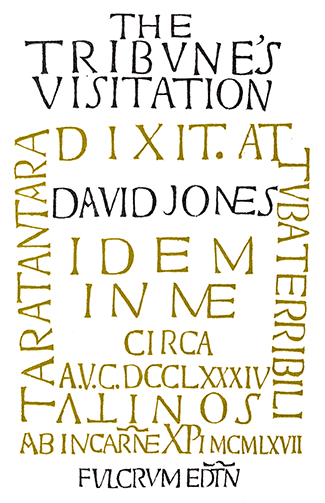
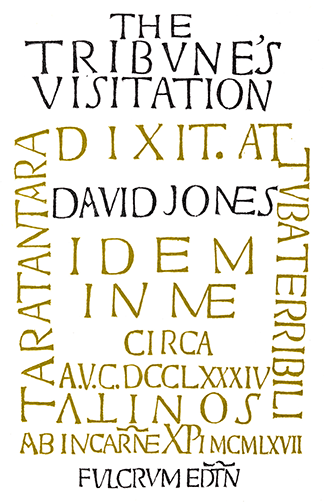
The most striking bibliographical fact about the Fulcrum edition of The Tribune’s Visitation is that both the cover and the title page show an inscription made by the author, reproduced in black and olive green, which combines the normal functions of a cover, a title page and a preliminary page of epigraphs (see Figure 1). In a lecture delivered at Newcastle University in 1969, Jones’s fellow Fulcrum Press poet Basil Bunting gives a first-hand account of the making of the inscription for The Tribune’s Visitation, letter by letter:
Title page of the Fulcrum Press edition of The Tribune’s Visitation (1971).
He maintains that the whole quality of a civilization, or a culture, can be shown in a very short inscription, or derived even from a single letter. Letters are not, to him, just an approximate notation of sound to be set down more or less automatically and read as fast as decent articulation permits. A year or two ago I had tea with David Jones while he was engaged on a piece of lettering in the Roman manner. He’d got the letter T at the beginning of one line. As we talked, he suddenly fell silent. A look of abstraction came into his face. And he set down his teacup and his piece of cake, fiddled about till he got a pencil, and stood up to his easel, and slowly, slowly, very carefully, drew in the letter H. Then he sat down again; with a sigh, he said, ‘I’ll have the E by Friday!’Footnote 83
One of the biographical difficulties surrounding Basil Bunting is that anecdotes for which he is the only recorded source often turn out to be tall tales. We should bear in mind that this was a story he spoke in a lecture which he certainly never wished to be published. Nonetheless, even if Bunting was not actually present at the moment of facture, his story is a true myth, because it gives a strong insight into the importance of lettering in Jones’s thinking, the slowness and care for detail which only increased as he grew older, and the intensity of his belief in the luminous presence of signs.
The inscription, Jones once said, was ‘my form of abstraction’, and it is in these works that word and image are united with the greatest purity of intent and execution in his oeuvre.Footnote 84 Having made drawings, engravings, watercolours, oil paintings and poems, Jones turned to the medium of the inscription in the last three decades of his life as a form of ‘gratuitous’ making, creating works which were not intended for sale, and were mainly done as gifts for friends and supporters.Footnote 85 In the context of The Tribune’s Visitation, Jones’s inscription stands in ironic relation to the Tribune’s ‘central philosophical insight’ which is, in Tom Dilworth’s words, ‘the distinction between utility and gratuity’.Footnote 86 The Tribune-persona who speaks the poem may be a pragmatist-utilitarian technocrat, condescending to ‘poets who must need weave dreams’, but before he can have his say, there stands an instance of gratuitous making to introduce him.Footnote 87
The inscription for The Tribune’s Visitation is densely overlaid with implications. This density of signification is typical of Jones’s inscriptions, yet in its formal qualities it has great simplicity. With a limited, stripped-back palette of two inks, the letters are arrayed into a shape which is geometric but freehand and wavering, patterned but irregular, with wide variations of letter size and kerning where balance requires them. The space between the first three characters in the word ‘DIXIT’, for instance, is almost equal to the width of the characters themselves, while the last two characters are almost touching each other.
Running clockwise round a square in the centre of the inscription are words from a fragment of the Annales of Ennius regarding the fall of Troy: ‘AT TUBA TERRIBILI SONITU TARATANTARA DIXIT’. Jones gives several translations of this phrase in his ‘Note on the inscription’ in the back of the book: it means something like ‘And the trumpet in terrible tones taratantara blared’ – a trumpet blast announcing both the Tribune’s arrival at a Roman military garrison and the beginning of the poem. The same line from Ennius was chosen by Geoffrey Hill as one of the epigraphs to his long poem Speech! Speech! (2000), surely with Jones’s example in mind.Footnote 88 Just as The Tribune’s Visitation was Jones’s attempt to address ‘the situation of today’, as he wrote in 1971, by conjuring with maximal rhetorical mastery the arguments endangering all the things he valued, so Hill’s Speech! Speech! attempted to wade into the corrupting rhetorics of contemporary life and overpower them.Footnote 89
In the centre of the inscription are the words ‘IDEM IN ME’, ‘The same for me’, which Jones glosses as the speech-act which seals the oath of allegiance to the state sworn by recruits to the imperial army. As well as an oath of military and political fealty, it also had a transcendental significance, Jones explains: ‘to break the sacramentum […] laid the culprit open to the avenging furies of the tutelary deities who presided over the fortunes of the Roman world-order’.Footnote 90 At the conclusion of the poem, these words break across from the inscription into the body-text, as the Tribune proposes a ritual meal and tries to persuade the soldiers he is addressing of his fellowship with them by dint of the fact that he too has spoken these words:
See! I break this barrack bread, I drink with you, this issue cup, I salute, with you, these mutilated signa, I with you have cried with all of us the ratifying formula: Idem in me!Footnote 91
The dramatic irony here is that the Tribune’s terms unknowingly make clear the analogy between the sacramentum and the Christian sacrament; in the moment of swearing political fealty to the Roman state, he is foreshadowing the rise of the new faith that would eventually become the state religion.
Beneath ‘IDEM IN ME’ come the words ‘CIRCA A.V.C. DCCLXXXIV’, which is to say ‘around ad urbe condita 784’, which is to say that the poem is set around year 784 after the founding of the city of Rome – the year we know as ad 31. This seems slightly at odds with Jones’s Introduction to the poem, which states that whereas The Fatigue was specifically set in ad 30, so that the men in that poem could be ‘accidently involved in the Passion’, The Tribune’s Visitation ‘is envisaged as being in any year of those first few decades of the 1st century’.Footnote 92 To place the action of the poem around ad 31 seems rather more specific than that.
The second date on the inscription reads ‘AB INCARNE ΧΡΙ MCMLXVII’, which is to say the year 1967 from the incarnation of Christ. The acknowledgements page of the book gives the publication copyright date as 1969, two years later, so Jones’s date must be the year that he prepared the book for the press; long delays between expected publication and actual printing were often a feature of Fulcrum’s books, since the press was reliant on piecemeal sales and grants to fund new publications in a fairly hand-to-mouth manner.
The last line of the inscription reads ‘FVLCRVM EDTN’. The date 1967 and the publisher’s name carry out banal functions; they give necessary but not very interesting bibliographical metadata. In this case, however, Jones is doing something of interest. First, by including them in his inscription, in lettering which is continuous with the epigraphs and which shows the mark of the artist’s hand, the real presence of brush-stroke, gesture and facture, he breaks down the boundary between the arena of the artist and the arena of the publisher and printer. (Note that the poem itself is centrally concerned with the permeability of boundaries, limes, territorial borders, institutional hierarchies.) There is no sense here that the actualities of preparing a work for the press are a matter of pure dailyness and contingency, to be left to the publisher and out of the artist’s hands. Instead, information about the date and imprint is bound up in the primary artistic texture. Likewise, the Acknowledgements page notes that, ‘The book has been set throughout in the author’s favourite type Joanna’Footnote 93 – a typeface designed by Jones’s friend and mentor Eric Gill. Publisher and printer are the poet’s collaborators, and the typographical arrangement of the page, the visual rhythm it establishes in the movement between justified prose paragraphs, left-justified lines of verse and indented lines of verse, and even the shape of the printed characters, bears a significant part of the text’s meaningful effect.
The formatting of the dates in the inscription itself signifies. To write ‘AB INCARNE ΧΡΙ MCMLXVII’ instead of ‘1967’, as would be the norm for a book published in the 1960s, reinscribes the time of writing into a world-historical span. In truth, all our dates take place in a world-historical span, with the conjectured date of the birth of Jesus of Nazareth as their pivot, but we don’t normally think about it; it remains far below the surface, when we say ‘2026’, that the figure means so many years since the Incarnation. Jones’s inscription reminds us that ‘1967’ means just that.
It also sets up multiple time-schemes for the book, a complex relation to world-historical time. The year in which the poem is set – the fictional time of the poem – is given in A.U.C. format, ad urbe condita, from the establishment of the city of Rome. This is picked up in the text of the poem, where the Tribune addressing the garrison describes himself as ‘a man speaking to men […] at a specific but recurring moment in urbs-time’.Footnote 94 The anachronistic allusions to Spenglerian theories of civilisational recurrence and to Wordsworth’s Preface to the Lyrical Ballads add further temporal layers to the poem’s transparencies. Jones’s poem takes place in ‘urbs-time’, the time of the city – time which imperial Rome has arrogated to itself. Yet the time of the poem’s writing works on a radically discontinuous scale, in ‘AB INCARNE ΧΡΙ MCMLXVII’, dated from the moment when the horizontal axis of human history was disrupted by a movement on the vertical plane, the descent of the Godhead in the form of Christ. While the action of the poem is set in the time-scheme of Rome, the writing of it happens in the time of Jerusalem. Already on the cover and title page, one of the themes of the poem is being established: that time itself is political, that it is inscribed by power and authority.
Jones’s version of poetic late modernism looks different when viewed in the unexpected publishing context of experimental small-press poetry in the 1960s, and his presence on the Fulcrum list should perhaps give us pause in our thinking about the history of the small-press movement. The Tribune’s Visitation is a crucial marker in the stuttering history of late modernism in England: publishing ventures like Fulcrum were driven by a dialectic between the utopian hope for a radical transformation of English culture and the elegiac sense that such an attempt, as a replaying of earlier modernist ventures, was already haunted by knowledge of its own belatedness and likely failure. In this sense, The Tribune’s Visitation is a revenant book, a book out of time, singing the song of its own belatedness while the world has changed around it and its successors are already busy pilfering the grandeur of its ruins.
The mismatch between Jones’s aesthetics and the work of some of the other writers published by Fulcrum is evident in a question posed by Eric Mottram in his interview with Montgomery, concerning Montgomery’s own work:
I am not trying to talk about like crazy influences, but I do get the sense of two older poets in your work, one is David Jones and one is Basil Bunting in this particular way, and you seem to be one of the few people I know who really respects David Jones’s work quite considerably […] Are you conscious of this? I mean it seems to me he uses mythical materials, does he not? In his case it is what used to be called the ‘Matter of Britain’, King Arthur and …, are you conscious of the affiliation?Footnote 95
Montgomery replied in a slightly guarded way: he was ‘aware of liking them for that reason’, he said, and aware that his own work resembled Bunting and Jones, but still considered Pound to be the primary influence on his Circe. Jones’s ‘mythical materials’, his high-modernist sense of how a lost cultural plenitude might be reconstructed through philological and archaeological investigation into the matter of Britain (and indeed the matter of Rome), were something which the late-modernist writers who made up the majority of the Fulcrum list, including even the editor of the press, needed to hold slightly apart from their own work.
The commercial ambitions of Fulcrum Press aroused considerable suspicion among Montgomery’s fellow small-press poets and printers. In Tom Raworth’s words:
He wanted to be a publishing house rather than having fun printing books. […] He was interested in being polite to reviewers and nice to so-and-so because they could do things for you. That wasn’t how the rest of us were thinking.Footnote 96
J. H. Prynne, meanwhile, was more critical of Montgomery’s running of Fulcrum. Writing to Peter Riley in May 1967, he expressed the urgency for the current scene of a first-rate publisher for avant-garde pamphlets and books, but questioned Montgomery’s suitability for the role: ‘I doubt he would recognise what he ought to do as he is quite assertive about his choice, & his transatlantic (financial) ambitions’.Footnote 97
By February 1969, writing to Lewis Warsh, Prynne’s sentiments against Fulcrum had grown stronger. Prynne was upset at Fulcrum’s delaying of a Lee Harwood book it was due to publish, and scornful of the character of the Fulcrum list:
Stuart Montgomery the Rhodesian police-doctor is sitting on a book of his and has been for what seems like centuries, that man was hired to Depress Art and makes a greasy living out of a false past painted to look like a real present – Robert Duncan!! God’s gift to the cosmic menopause.Footnote 98
And Prynne’s complaint – wholly unsympathetic about the difficulties involved in a small, family-run business keeping up its production schedule, and tinged with the authentic note of high-table condescension – soon spilled over from private letters into a text prepared for publication. In his review of two Harwood books for the Cambridge student newspaper Varsity, Prynne’s first paragraph diverts into ill-feeling towards Fulcrum:
Why we have had to wait so long for The White Room defies charitable guesswork. It is mostly more than 2 ½ years old. It should have been given to us on completion, not hoarded into an irrelevant myth by a publisher so timid that his authors all acquire the quaint fragrance of a mid-atlantic New Year Honours list.Footnote 99
In the cover letter he sent with his review, Prynne acknowledged that the editor of Varsity ‘may consider my remarks at the expense of Fulcrum Press rather tendentious’, but did not apologise for it, maintaining that the press ‘has despite some appearance to the contrary done consistent disservice to English poetry ever since Fulcrum began to publish’.Footnote 100
In the rivalrous and touchy world of small-press poetry, Prynne was not alone in holding strong reservations about Fulcrum’s activities. Barry Hall, the artist and printer who was a founding editor of Cape Goliard, the subject of my fourth section, wrote to Charles Olson in September 1969, responding to the suggestion that Fulcrum might publish the UK edition of the first volume of The Maximus Poems instead of Hall’s own press. Hall’s intent, understandably enough, was to dissuade Olson from Fulcrum’s attempt to poach him from Cape Goliard:
You know me, Charles, that I’m not the sort to be catty about other publishers – the more action the better, as far as we’re concerned. But you really should be warned (in confidence, of course) about Fulcrum/Montgomery. Of late our lad seems to be taking his reputation for a suicide ride; he published Ian Hamilton Finlay’s first book, in a new edition, without ever showing Ian proofs, and didn’t acknowledge the first edition (Migrant Press) apparently to give the impression that his was the first edition. He even tried to get Ian to allow a change of title so no one would know it had ever been published before.Footnote 101
Hall was successful in putting Olson off from Fulcrum, but what he didn’t know at the time was that the Ian Hamilton Finlay affair would eventually bring about Fulcrum’s downfall.
In short, what happened was that Fulcrum published Finlay’s book The Dancers Inherit the Party in 1969 and didn’t mention that the book had had two previous small printings from Gael Turnbull’s Migrant Press. Around a third of the forty-eight pages in the Fulcrum edition contained new material not included in the Migrant editions. For Finlay, not explicitly describing the book as a third edition constituted an ethical breach, and he began a furious letter-writing campaign, addressed to anyone who would listen to his grievance (and many people who wouldn’t), so that archives all over the world contain letters from him making the same accusations against Montgomery, and attacking anyone who took his side.
To give just one example, when Asa Benveniste of Trigram Press had declined to read an anti-Fulcrum letter from Finlay at a meeting of the Association of Little Presses, of which Montgomery was a Director, Finlay wrote accusing him of being part of ‘Montgomery’s Mafia’ and of censoring him, while in a letter postmarked the same day, Finlay’s wife, Sue, wrote to give Benveniste another blast:
What do you care for the Truth anyway. What do you care for decent behavior, moral standards, the rights of poetry & art, the rights of free speech. All dirty words or little jokes to you aren’t they?
Personally, being old-fashioned, loving poetry and justice, I am utterly, but utterly, disgusted at you and at the whole lot of you. You make me sick to my stomach.Footnote 102
Most poets rightly took Montgomery’s side in the dispute. Basil Bunting, for instance, having been sent a pro-Finlay circular by the poet Ronald Johnson, replied to him defending Montgomery against any charges of ‘double dealing’ in his business relations, and punching back with a stringent analysis both of the ‘self-regarding sentimentality’ of Finlay’s work, its ‘essentially trivial nature’ disguised by ‘tricks of typography’, and of what this says about Finlay’s personal reliability.Footnote 103
Eventually Finlay took Fulcrum to court, and the four-year legal proceedings effectively bankrupted Fulcrum. The case concluded in Finlay’s favour at the Glasgow City Council Department of Weights and Measures in October 1974.Footnote 104 This defeat came after the withdrawal of Arts Council support for Fulcrum in 1973, as the biographical text on the dustwrapper of Montgomery’s second book notes with some bitterness: ‘The Arts Council helped the author complete this book with a Writer’s Award but ironically delayed its appearance by cutting away the grant from Fulcrum Press’.Footnote 105 It also coincided with a general increase in production costs due to the economic crises of 1973, and with a flood in Montgomery’s basement which ruined a large amount of Fulcrum’s stock, at which point Montgomery wound up the press and filed for bankruptcy in 1974, returning to his work in medicine.
Taking the long view, Montgomery’s work as poet and publisher now seems a brief, eccentric interlude in the early career of a very eminent medical man. Montgomery is Emeritus Professor of Psychiatry at Imperial College, London, and former President of both the European College of Neuropsychopharmacology and the British Association of Psychopharmacology. With more than 500 publications to his name, he is best known for the Montgomery-Asberg Depression Rating Scale, first described in 1979, ‘the “gold standard” for measuring symptom severity in depression’. These words come from the citation that the British Association for Psychopharmacology gave Montgomery when he was the recipient of its lifetime achievement award for 2006. There Professor Montgomery’s early swerve into poetry merited a single sentence: ‘His career then followed an unconventional course as for ten years he worked full time as a poet and publisher’.Footnote 106
Poetry and psychopharmacology have little to do with each other, except for the anecdotal fact that many poets suffer from depression. Montgomery’s withdrawal from the poetry world and his commitment to medicine are commonly considered as a rupture, marking two distinct phases of his life. Yet his first book publication as a medical researcher shows continuities. Measures of Depression (1978) was Montgomery’s MD thesis, based on research carried out in Stockholm. But it was issued as a Fulcrum Press book, whereas his subsequent medical publications were issued from academic publishers, and the first words in the book are a replay of the opening words of the opening poem in Shabby Sunshine, Montgomery’s previous book, here recast as an epigraph:
In the light of this epigraph, where Montgomery expertly plies the multipart, stepped line of William Carlos Williams’s Paterson, the book’s very title seems to contain hidden poetic implication. The word ‘measure’ is unavoidably suggestive for a poet whose gifts lay in the shaping of poetic and rhythmic measures, doling and feeding out syllables on a careful line. The relation between error, pattern and intention, first ventured as a poetic pseudo-statement in this epigraph, is redescribed as an actual statement in the plain prose of the introduction to Measures of Depression:
Serendipity is still a most useful muse and mother of invention in science. Despite increasing sophistication of trial designs much of our progress in psychiatry has occurred by chance.Footnote 108
Montgomery’s prime example is the chance discovery of Monoamine Oxidase Inhibitors, which occurred during experiments for the treatment of diseases unrelated to depression. But the acknowledgements at the back of the book make a wry nod to another kind of serendipity: ‘The investigations were supported in part by […] Fulcrum Press, and the Arts Council of Great Britain’.Footnote 109
3 Christopher Okigbo’s Labyrinths (1971) and the Heinemann African Writers Series
The publishing ventures narrated in the first two sections of this Element form part of what Sandeep Parmar has called the ‘history of pervasive whiteness’ in post-war UK poetry culture, in which ‘terms like “innovative” or “experimental” were determined by the practices of almost entirely white and largely male poetic avant-gardes’.Footnote 110 But this was not the whole picture. The major historical feature of the long 1960s was of course the rapid dismantling of most of the British Empire, and in this section I will focus on the first great poet to emerge from one of the new nations created in this process, whose own practice of late-modernist writing was richly inflected by his postcolonial publishing environment.
The Heinemann African Writers Series is widely acknowledged as the most important vehicle for the global dissemination of African writing during the second half of the twentieth century, and indeed as a shaping influence on African literature.Footnote 111 It would grow to include more than 350 books between 1962 and 2003, but its beginnings were small-scale. After the success Heinemann had found with Chinua Achebe’s debut novel, Things Fall Apart, in 1958, the company decided to launch a new paperback series focussed on writing by black Africans, to be published under the auspices of Heinemann Educational Books, newly established as a separate company. They appointed Achebe as editorial adviser for the series in 1962. His role would become more hands-off over the years before he left the role in 1972 but his achievement in helping found the series and guiding its early decisions was a major one, notwithstanding the characteristic modesty of his own account of it:
Alan Hill, the publishing executive at Heinemann Publishers in England, asked me to become the first editor of the African Writers Series. Alan and I, with James Currey and a few others, developed a vision of gathering much of Africa’s literary talent under this series rubric in order to showcase the best of postcolonial African literature. We had a fascinating beginning, and ended up publishing Christopher Okigbo from Nigeria, Ayi Kwei Armah from Ghana, al-Tayyib Salih from Sudan, Ngũgĩ wa Thiong’o from Kenya, Bessie Head from Botswana, Nadine Gordimer from South Africa, and Nelson Mandela, along with several other major African writers.Footnote 112
Most accounts of the series focus on its role in shaping African fiction, which was the main focus of the list. But the most important poetry book published within the African Writers Series was Labyrinths: With Path of Thunder (1971), the posthumously published collection by the Nigerian poet, Christopher Okigbo. In Achebe’s words, ‘Okigbo conjured for us an amazing, haunting, poetic firmament of a wild and violent beauty’,Footnote 113 and his place as the founding poet of Anglophone Africa has only been critically strengthened in the years since his death.
Okigbo, like Achebe, was ethnically Igbo, and the two were classmates, separated by only two years at both Government College, Umuahia, and University College, Ibadan. Members of the small, primarily Igbo social elite tended to dominate the new nation’s institutions, both cultural and political, once it gained full independence in 1960, and this was the case for Okigbo and Achebe. They were both founding members of the Mbari Club, the Ibadan-based arts collective that issued Okigbo’s first pamphlets.Footnote 114 Achebe and Okigbo also founded their own publishing house together, Citadel Press, although it only issued one book before history intervened and the war ended the enterprise. So it was natural that Okigbo’s Labyrinths was selected as one of the first titles for the African Writers Series. After Okigbo finished revisions to the manuscript in October 1965, he sent it to Peter du Sautoy at Faber & Faber and to Aig Higo, Heinemann’s manager in Ibadan, and it was Heinemann who accepted it for publication.Footnote 115 But before the book could be published, when the predominantly Igbo region of Biafra broke away from Nigeria in 1967, Okigbo heard the call to arms and enlisted as a Major in the Biafran army. His death in August 1967 presaged the eventual surrender of Biafra after a brutal civil war. These were the circumstances in which Heinemann had to try to bring the book out.
In the early reception of Okigbo’s work, there was a tendency to position him between binaries. In some accounts, he was an alienated ‘Euromodernist’ who wrote difficult, symbolist, private poetry influenced by Mallarmé, Yeats and Eliot; he found his true voice late on with the more political sequence, Path of Thunder, written around the time of the military coup in January 1966 which preceded the declaration of the Republic of Biafra and the civil war. In this reading, Okigbo realised his mythopoetic destiny when he was killed in that war, aged thirty-five. In other accounts, as Ali Mazrui argues in The Trial of Christopher Okigbo, a strange ‘novel of ideas’ published in the African Writers Series in 1971, Okigbo committed ‘the offence of putting society before art in his scale of values’, and threw away his potential to be a ‘universal’ poet by dying in a ‘parochial’ war about ethnic loyalty.Footnote 116
If we read Okigbo’s poetry in the context of its print history, however, this opposition between aesthetics and politics dissolves. As Nathan Suhr-Sytsma has shown in an important chapter on how Okigbo’s poems were published in magazines, from his earliest involvement with the world of print, as an editor, publisher and librarian, Okigbo negotiated ways to shape a transnational, postcolonial, African modernity, and invested great imaginative power in print as a symbolic medium.Footnote 117 For Okigbo, Suhr-Sytsma argues, publishing poetry ‘should be seen as a mode not just of artistic creation, but also of self-fashioning as a modern, nationally oriented Nigerian intellectual’,Footnote 118 and the process of fashioning Okigbo continued after his death, in the way that books by and about him were brought into the world by his publishers, editors and executors.
Labyrinths: With Path of Thunder is a book made out of books, gathering together previously published sequences issued by Mbari, the crucial early Nigerian arts collective, as Heavensgate (1962), Limits (1964) and Silences (1965), and reshaping them along with other sequences into what Okigbo calls ‘a fable of man’s perennial quest for fulfilment’.Footnote 119 The thread of its elaborately nested structure is difficult to follow. The technology of the bound folio format itself becomes a unit of meaning; the ‘quest for fulfilment’ is the reader’s own quest through the labyrinth of Okigbo’s bibliographic design. Each level of the text’s hierarchical structure is distinguished typographically. Labyrinths has four parts, of which the first part, ‘Heavensgate’, has five sections, of which the first section, ‘The Passage’, is made up of three separate lyrics, which each have their own complex suggestiveness.
In the first lyric in ‘The Passage’, the prodigal poet returns to Mother Idoto, the village stream in his birthplace:
The oilbean tree, a note explains, is a totem for the worship of the river goddess. Already on the first page of the book, Okigbo is establishing the stock of images on which the rest of his poem will draw. Labyrinths is therefore a perfect symbolist long poem: like Eliot’s Four Quartets, once you get to the end of the poem, the only explanation is to go back to the beginning and start reading it again.
There’s also a transmedial aspect to the sequence, with a sophisticated dialogue going on between the text and Demas Nwoko’s drawings. In the original pamphlet publication of Heavensgate by Mbari, we find nine illustrations by Nwoko, of which four are reproduced on the endpapers of Labyrinths (see Figure 2). Nwoko was associated with the school of ‘Natural Synthesis’, and the tribal imagery of his fluid line-drawings suggests an analogy for understanding how Okigbo’s idiom combines Mallarméan free-verse symbolism with indigenous themes and rituals.
Illustration by Demas Nwoko, reproduced from the Mbari edition of Heavensgate (1962) in the front matter to Labyrinths: With Path of Thunder (1971).
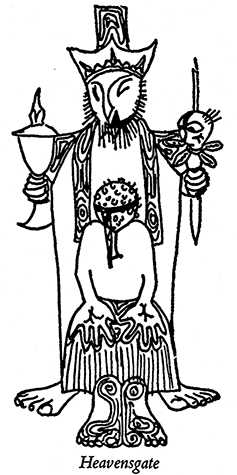
The complex unity of Labyrinths is part of the reason why Heinemann’s editors, as we see from the Heinemann publishing archives in Reading, were uncertain whether to include ‘Path of Thunder’, Okigbo’s poems written during war, in their book. Heinemann, as we have seen, already had the completed manuscript of Labyrinths in hand before Okigbo’s death. When Keith Sambrook, one of their UK-based editors, heard that ‘the next edition of Black Orpheus is to include some “war” poems called Path to Thunder which Chris wrote early in 1966’, he was unsure what to do with these new texts, but he noted that the new sequence was among ‘the poems that Chinua [Achebe] thought would be in Chris’s final selection of his own verse’.Footnote 121 Aig Higo, Heinemann’s man in Ibadan, agreed about the inclusion, but Sunday Anozie, the critic who wrote the first study of Okigbo’s work and who was giving informal editorial assistance with Heinemann’s book, took the opposite view:
quite frankly I hold views dissimilar to those of Aig and Chinua for three reasons:- (i) From a purely literary standpoint I don’t think that Labyrinths and Path of Thunder hang together thematically: in fact the latter begins a new sequence altogether which Chris had probably hoped to complete in ’67 or ’68 and also publish in a separate vol. To publish them now together looks like it’ll distort the original thematic perspective in Labyrinths described by Chris himself as ‘a fable of man’s perennial quest for fulfillment’. (ii) Chris has offered us in the Labyrinths MS a carefully annotated selection of his own poetry and this I think is ideal for your present purpose; in other words, conscious of this more formal public début he had chosen and dressed himself in his best clothes and certainly would not like anything else to be tagged on to him at this stage. (iii) You might of course decide later on to present a more complete picture of Okigbo; in that case the future edition would necessarily have to include not only Lab. and Path. but also a number of other isolate poems written by Chris – and it will require a lot of research effort and goodwill.Footnote 122
Sambrook was fairly persuaded by Anozie’s argument:
The Path of Thunder poems rather emphasise political events which were very important to Chris and ultimately destructive. But the poems he put together himself to make up Labyrinths are quite outside these events and to marry them up with poems that spring directly from these events does jar.Footnote 123
But Achebe continued to take the view that the new poems should be included in the book, and Higo came round to his way of seeing things, writing that ‘Christopher was a many-sided man and it was only the whole man taken together that made sense to me. The bits always jarred’.Footnote 124
James Currey, overall editor of the African Writers Series, was consulted, and Sambrook reported his view that ‘we should publish Labyrinths and Path of Thunder in the same volume making clear that they belong to different parts of Chris’s life’.Footnote 125 This was the approach they eventually took, with the Path of Thunder sequence included but clearly marked off from Labyrinths. The title of the book became Labyrinths: With Path of Thunder. A new half-title page was inserted designating the later sequence as a ‘Postscript’, with the words ‘Poems prophesying war’ – a title chosen by the editors of Black Orpheus as a general heading for a section of the magazine including Okigbo’s poems along with poems by Ken Saro-Wiwa – converted into a sub-title. The sharp distinction between Okigbo’s modernist, symbolist poems and his political ones was created typographically, even while the subtitle alludes to ‘Kubla Khan’, the ur-text of romantic orientalism.
Labyrinths was published as number 62 in the African Writers Series in a huge first edition, by the standards of contemporary poetry, of 11,000 copies, showing the power the series had to shape worldwide understanding of contemporary African writing. The book stands somewhat aslant in relation to the other titles in the series. The only other collections of new poetry in English published in the first decade of the series were Satellites (1967) by the Gambian writer Lenrie Peters and Letters to Martha (1968) by the South African Dennis Brutus; both of those books show a directness and literalness in their approach to political and internationalist subject matter that is far removed from Okigbo’s conjurations of mysterious private symbolism. The African Writers Series was abundantly successful in creating what John Spiers, theorising the publishing series, has called a ‘niche-space’ for itself within the literary marketplace.Footnote 126 But it had to be a capacious niche to hold Okigbo’s spiky and alienating poems, which read rather like the work of a poet of an earlier generation – like the 1920s and 1930s work of Hart Crane or Dylan Thomas in his womb-and-tomb period, poets still newly abuzz with the excitement of high-modernist writing. We could read this as an instance of the ‘colonial lag’ much debated by scholars of World English.Footnote 127 Transcribed onto poetic style history, the lag is fruitful and generative for Okigbo, so that his poems sound like those of no one else writing in the 1960s.
Despite the major editorial question around Labyrinths being settled by August 1968, the book didn’t appear until September 1971, three and a half years after Okigbo’s death. In between, there arose a tangled and confused copyright situation which attests to the intense difficulty of resolving questions about rights for a posthumous book by a writer from a country in the middle of a civil war. The main parties involved were Heinemann, Okigbo’s widow Safi, who had since remarried, and Mbari, who had first published the poems in pamphlet form and in their journal, Black Orpheus. Initially there seemed to be no great dispute and a royalty split of 2.5 per cent to Mbari and 7.5 per cent to Safi was easily agreed, notwithstanding the delays and problems caused by having to pass letters through intermediaries and to have them go via London, the Heinemann office in Ibadan (the federalist capital) and the breakaway state of Biafra. Heinemann were keen to avoid getting the lawyers involved, since they ‘would charge fees which would make the book’s economics look silly’.Footnote 128
But several unexpected problems were then thrown up. First, Heinemann got wind of the rumour that somebody called Obemselu was claiming to be the executor and had sold the rights to Doubleday Anchor in the US. ‘This is fairly annoying news’, James Currey wrote with wry understatement;Footnote 129 but a few days later, Doubleday confirmed that it wasn’t true.Footnote 130 Next, Currey learnt that one of the poet’s brothers was now involved: ‘Longmans have been paying commission fees to Pius Okigbo who has a document to prove that he is literary executor!’Footnote 131 This rumour turned out to be true. Heinemann received a letter from the law firm Linklaters & Paines, acting on behalf of Pius Okigbo, which argues that since Okigbo and his wife had divorced in December 1966,
Mrs. Sephy [sic] Okigbo has no right whatsoever to assign any rights to the late Christopher Okigbo’s poems or property and that she cannot legally act for their son Ibrahimiat, who is only some six years old. Dr. Okigbo considers that he is the only person who has any right to deal with the late CO’s property, and to act on behalf of Ibrahimiat.Footnote 132
This was surprising news to Heinemann, not least because they had been under the understanding that Okigbo’s child was a girl named Obiageli, not a boy named Ibrahimiat. They knew nothing of his supposed divorce late in 1966. In fact, it never happened: ‘It would be just like Chris to say that he divorced me over the phone to impress his friends’, his widow has said.Footnote 133 James Currey’s frustration was starting to boil over at this new obstruction, two years into the process of trying to publish the book:
The lawyers are really enjoying this one. The complications are really making them lick their lips. […] Everybody’s happy about the wretched poems being published, everybody except the lawyers wants them out as soon as possible.Footnote 134
Clarification on the question of Okigbo’s child came via Aig Higo: she was in fact a girl named Annabel Obiageli, and her uncle Pius was confused: ‘her maternal grandfather was Ibrahim and Ibrahimat was the pet-name Chris gave her’.Footnote 135
In response to this, Pius Okigbo’s lawyers wrote to Heinemann’s lawyers stating that ‘if the child is a female child, then she has no rights at all in the estate, which rests absolutely in our client and his brother’.Footnote 136 It was James Currey who had to communicate this claim to Okigbo’s widow Safi, and to deal with the fall-out, as he reported to his Heinemann colleagues:
Naturally she was furious about the outrage to her daughter. She says she will certainly contest Dr. Pius Okigbo’s claim.
Personally, I can sympathise with the doctor who may well be in a state of trauma after the turn of events. But I cannot understand his lawyers. What law in what land dispossesses a child of the father’s estate for being a daughter. I am not Ibo but I wonder if even they have that kind of custom or law.
Secondly, if Dr. Okigbo and his lawyers insist on making such claims, it must be remembered that he has not the field quite to himself. Chris’s father is still alive. Then there is his eldest brother Lawrence at the Ministry of Agriculture and Forestry. He comes before Pius. And there are several others in the family at Ojoto. Unless they have all agreed and appointed the doctor sole executor of the estate in favour of the direct heiress who is a minor, I do not see how Dr. Okigbo can go on acting the way he has been doing. […]
But since things are in this mess, we have to find some solution. I do not think your new formula of ‘Legal Personal Representatives of CO’ tidies it up. Who are so called? The characters sound so nebulous and ponderous I just can’t picture them? As with the role of Dr Pius behind, where lies their sanction?
At this point, it may perhaps be best for all the parties interested to meet here in Nigeria and finish with this business once and for all. Incidentally, Sephy says she does not mind Lawrence Okigbo acting as guardian and keeper of any trust that might be set up for her daughter […] But she will certainly resist attempts by Pius to assume that role. Let’s act quickly with all hands firm at last on one rope before we all get lost in the tortuous turns of Labyrinths.Footnote 137
In the event, the copyright dispute was rather fudged: Okigbo’s older brother Lawrence gave a written statement authorising publication, Pius was formally appointed as executor, but the contract was drawn up along the lines of the original proposed royalty split, with 7.5 per cent royalties going to his widow on behalf of his daughter Obiageli, and 2.5 per cent to Mbari. ‘It became impossible to get agreement during the civil war as to whether the royalties should be paid to the daughter through the Mbari Club in the West or through Pius Okigbo in the East’, Okigbo’s biographer writes;Footnote 138 on the copyright page of Labyrinths, Heinemann used the formula ‘the legal representatives of the estate of Christopher Okigbo’. The contracts were finally signed and the book published on 20 September 1971.
Even more intractable difficulties than they faced with Labyrinths meant that the publication of a second Okigbo-related book in the African Writers Series had to be abandoned altogether. Even the title of this book was too controversial to be fixed on. The editor, Ulli Beier, first proposed the book as New Writing from Nsukka in 1964, and it had a substantial selection from Okigbo’s poetry in it. After the Biafran secession, the civil war and Okigbo’s death, the matter of the title took on a new symbolic and political urgency. In 1968, as editing was well underway, Beier mooted several titles for the anthology – ‘Nsukka Poetry? Biafran poetry? Ibo poetry?’ – and stated that ‘I should like to use Biafra, but that’s explosive’.Footnote 139 Keith Sambrook replied to him, noting that ‘[o]f course Biafra is the correct title but it is impossible for obvious reasons at present’.Footnote 140 The title Nsukka: An Anthology of Poetry Dedicated to Christopher Okigbo was chosen as a compromise – Nsukka being the Biafran capital and the town where Okigbo was killed – and ‘Biafra’ became the title of one of the book’s sections. But even this was too much for Aig Higo, Heinemann’s Nigeria manager, who was based in federalist Ibadan. He put it bluntly in a letter to James Currey: ‘if you expect this branch of Heinemann to continue to exist, you must eliminate the word “Biafra” from it’, and then even more bluntly a few weeks later in: ‘The point is, James, “Biafra” is dead; never lived’.Footnote 141
In a desperate attempt to salvage the book, Currey suggested some compromises: either publishing the book as it stood in every territory except Nigeria or publishing it without the final section, entitled ‘Biafra’.Footnote 142 But when contributor Onwuchekwa Jemie got wind of this, having consulted with several Biafran poets then based in the US, his reply was firm in ‘rejecting ANY anthology of poetry by Biafrans […] which does not express our total commitment to the Biafran cause’, and contrasting how Okigbo and other Biafran writers had been ‘swallowed by this war’ with how Heinemann’s editors were ‘sitting comfortably in London, hoping to make a profit on their work’.Footnote 143 In the end, faced with these fiercely opposed positions, Heinemann decided to drop the book completely – following Aig Higo’s advice when he wrote: ‘I believe we should not be involved in any way in the diplomatic and literary cross-fire’.Footnote 144
Wole Soyinka, in a draft preface to his Heinemann anthology Poems of Black Africa (1975) preserved in the archive, has described the work of publishing African writing in the West during the years of decolonisation as a ‘second scramble for Africa’, which may have done as much literary harm as good in its desire to shape a ‘monster creation’ called ‘African poetry’.Footnote 145 This is a harsh view of an enterprise which often had to negotiate with great tact and invention between conflicting imperatives. In the posthumous publication of Okigbo’s poetry by Heinemann, we see such publishing efforts coming up sharp against the violent and contested reality of postcolonial history.
Because of his early death and the ambiguous potency of his work, Okigbo has become a much-mythologised figure. Geoffrey Hill, who met Okigbo and was in Nigeria at the time when the Biafran War broke out, was ‘haunted’ or even ‘possessed’, in Suhr-Sytsma’s words, by Okigbo’s exemplary fate, and addressed him in several poems with an obliqueness that Okigbo would have recognised.Footnote 146 As well as basing a character on him in Anthills of the Savannah (1986) and writing about him in numerous overlapping essays, Chinua Achebe has also elegised him:
And Okigbo still looms large in the imagination of younger Nigerian writers, such as Chimamanda Ngozi Adichie, who has written illuminatingly about her fictionalisation of him in Half of a Yellow Sun (2006): ‘I wanted to pay tribute to Okigbo, who exemplifies the monumental loss of human capital that Biafra represented, but I used only an essence of the real Okigbo’.Footnote 148 The copyright disputes over his work – a common-enough occurrence in cases involving a recently deceased author – and the other challenges faced by the project of publishing Okigbo gain an added potency and resonance in this case, not just for what they reveal about postcolonial publishing in politically unstable times but because of what they reveal about how Okigbo was constructed after his death as an author and as a symbolic literary property by parties with contested interests in his legacy.
4 ‘A Little Press Within a Large House’: Nathaniel Tarn and Cape Goliard
On 31 July 1968, the poet, anthropologist and editor Nathaniel Tarn addressed a meeting of publishing executives from Jonathan Cape in words that must make for the most extraordinary opening to a business meeting ever:
I hope you will bear with me if I put these objects on the table. Primitive peoples encourage themselves when talking with the presence of familiar, perhaps magical objects. If this is magic, it is not aimed at you, but is here merely to reinforce my own spirit.Footnote 149
The identity of the objects is not recorded. Tarn was speaking, in his role as Cape’s editorial consultant, to a group of the most senior people at the company and chose to distinguish himself from them by performing the role of participant-observer in his own anthropological ritual. This was perhaps not regular behaviour in the clubbable world of 1960s London publishing.
His aim was to defend, and to argue for the continuing importance of, two recently founded imprints that were incurring financial losses: Cape Editions, which published anthropological, structuralist and other non-fiction texts, and Cape Goliard, which published late-modernist experimental poetry. In the fifteen months before this meeting, Cape Goliard had published works in elegant hardbacks with wide distribution by writers including Charles Olson, Robert Creeley, Allen Ginsberg, Pablo Neruda, J. H. Prynne and Tom Raworth. It published only around fifty books, pamphlets, prints and miscellaneous items between 1967 and 1971. Yet its publishing programme made enough impact for the American LANGUAGE poet Ron Silliman to claim in 1996 that the press’s efforts ‘were major and still reverberated in the American literary scene’.Footnote 150
Although short-lived, Cape Goliard occupies a significant place in the history of poetry publishing in several ways. In Section 2, we saw Stuart and Deirdre Montgomery’s Fulcrum Press attempt to create a publishing arena that would put post-Poundian modernist poetry at the centre of literary production in the UK, and Cape Goliard represents the other half of that story. In Tarn’s words, the press was created for ‘publishing Objectivists, Black Mountaineers, and their kin when these were in the wilderness’, so that ‘the fate of American poetry was for these years virtually in the hands of British publishers’.Footnote 151 This is a slight overstatement, but it is credible to say that the fate of those strands of late-modernist poetry that followed in the steps of Pound and William Carlos Williams was in British hands. Charles Olson did not have a reliable American publisher at the time, but through Cape Goliard’s co-publication agreement with Grossman of New York, he was being read in America in editions conceived and printed in London. The publishing arena created by the press, along with Fulcrum’s simultaneous work, brought late-modernist poetry in the UK and the US closer together in this brief period than they have been at any other point.
Tarn’s defence of his work with Cape began with an account of the history of his relations with the firm since 1964, when he started writing reader’s reports on submitted manuscripts. His poetry programme took centre stage, and he compared his achievement with Cape Goliard to the founding of the premier modernist poetry publisher in Britain, Faber & Faber:
I created here a poetry scene which is now being talked about in the same breath as, let us say, Fabers. Only a shallow epoch could talk that way: Fabers is thirty years or more deep, ours is only four or five. But the fact that this talk can go on is a sign of […] an achievement which continues to require careful nursing.Footnote 152
Although Tarn did not mention who exactly was talking about Cape Goliard ‘in the same breath’ as Faber, he stressed that these were the people he cared about – ‘This is the world I am in, this is what I see, I am proud of it and it is unique’ – and that their values were at odds with those of the publishing professionals he was addressing:
But there is another world in which you live. In the world of sales, the series have failed. You tell me so and I accept the evidence.Footnote 153
To accept the evidence for the sales failure of Cape Goliard and Cape Editions, however, was not to accept that the ventures were a failure. Tarn went on to make several different arguments for the unjustness of writing them off after only a year, even while ruefully admitting that the work he had done for Cape ‘may be a luxury in this extraordinary country’.
Four years earlier, when Tarn had proposed his schemes to Cape’s Director Tom Maschler, his optimism was of a different order. The prospectus Tarn drew up argued that ‘the publication of poetry is important in its own right and requires no justification whatsoever’, and that the only acceptable attitude for a publisher is to accept its intrinsic value and do ‘everything in his power to start, keep and expand a poetry List’. It ended with a bold suggestion:
Above all, the defeatist attitude that ‘poetry is a luxury because it does not sell’ should be banned on principle for ten years from a Publisher’s conversation.Footnote 154
Having asked in 1964 for a moratorium of ten years on the idea that poetry is a luxury, in 1968, barely a year into the programme, Tarn discovered that he himself was the luxury.
The story of Cape Goliard’s creation illustrates the extent to which both trade publishing and literary avant-gardes are formed along lines of social acquaintance. By the 1960s, the networks of acquaintance in which the activities of late-modernist poetry were constituted usually had relatively little overlap with the networks which structured trade publishing as an industry. In the case of Cape Goliard, however, Nathaniel Tarn was unusual in being able to move between both worlds, making him the ideal instigator of an avant-garde poetry project embedded in a trade publishing house.
Tarn’s understanding of English-language poetry’s recent history was defined by his self-declared ‘opposition to “little-englandism”’.Footnote 155 In his own writing, he wanted to move beyond the idioms available in the work of poets associated with the Group, the circle of writers whose meetings he briefly attended, or its better-known equivalent, the Movement, and to contribute to the ongoing modernist movement. Tarn described his understanding of late modernism in broad-brush, swashbuckling terms in his 1968 essay, ‘World Wide Open: The Work Laid before Us in this Disunited Kingdom’:
The modern revolution in English language poetry is American: Eliot/Pound. Local post-Georgian poetry of validity is not English but Celtic: Yeats, Joyce, MacDiarmid, Dylan Thomas. A first English reaction fades out after a praiseworthy but inconsequential brush with politics: Auden et al. Thomas, in whom Surrealism has its British day, provokes a new wave of little-englandism: ‘Movement’ and ‘Kitchen Sink’. […] The rest is beer and marital squabbles: politics at the level of the Profumo case. THEN the English language is discovered to have survived and to be thriving in America: Pound, W. Carlos Williams, Zukofsky, Lowenfels; Olson, Duncan, Creeley […]Footnote 156
In the view of literary history laid out here, modernism was an ongoing revolutionary movement in need of renewal in the 1960s. After the initial impact made by Pound, Eliot and their Celtic contemporaries, Tarn argues, the dominant voices in English poetry had slipped back into traditional modes, in the absence of ‘a new Poetics’, and needed to be reconnected with the Americans who came in Pound and Eliot’s wake. In the younger British poets Tarn would publish at Cape Goliard – writers such as J. H. Prynne and Tom Raworth – he found writers as keen as he was to take up the challenge of renewing the ‘modern revolution’ in Anglophone poetry for the 1960s.
Already somewhat unusual among British poets of the time for the cosmopolitanism of his background (he was born in Paris and raised in Belgium) and the range of his intellectual interests, Tarn was also distinguished by the directness of his ambitions in relation to the poetry world. The self-servingness of his narrative of twentieth-century poetry makes this clear, as it makes its sweeping generalisations and exclusions in order to frame a picture in which Tarn himself can emerge as the saviour. In 1964, Tarn got the break he wanted when he met Tom Maschler. Born in 1933, Maschler was five years younger than Tarn, but had enjoyed great success at a young age, moving rapidly through jobs within the publishing world to become a director of Jonathan Cape in 1960, aged just twenty-seven.
Every recollection of Maschler mentions his ambition, energy, pushiness and confidence; he was a man who could make things happen. He was also, among publishers, someone with unusually high ideals to go with his finely tuned editorial instincts: Michael S. Howard’s 1971 history of the firm quotes Maschler on his ambition to have Cape rival Suhrkamp and Einaudi in the ‘purity’ of their standards, and to cross-subsidise valuable but economically unprofitable books with the profits from bestsellers:
We must strive always to remain in a position where we can afford to publish authors who have something of value to contribute to our culture, irrespective of their commercial potential.Footnote 157
When Maschler met Nathaniel Tarn in early November 1963, introduced by John Fowles, the two men had much in common; a friendship developed, and quickly Tarn entered into an informal arrangement to recommend new poets and write reader’s reports for Cape. Tarn, however, had bigger plans than this. From January 1964 he had begun to urge Maschler on two related schemes. The first scheme, for a series of short theoretical texts by continental authors to be published in affordable paperbacks with the aim of introducing the latest thinking in structuralist criticism and anthropology, would become Cape Editions, of which Tarn was the general editor. Its first books were Charles Olson’s Call Me Ishmael and works by Claude Lévi-Strauss and Roland Barthes, and it would go on to publish writings by Fidel Castro, André Breton, Vaclav Havel and others.
The second scheme was for a new poetry programme for Cape. Tarn’s work in preparation was extensive: the prospectus he sent to Maschler introducing ‘the concept of the Little Press within a Publishing House’ stretched to more than fifty pages of material of various kinds.Footnote 158 After making his argument for the urgency of establishing a poetry list and providing extensive lists of poets to whose work the rights might be acquired, Tarn lamented the haphazardness of poetry publishing from the poet’s point of view: the terrible delays, the gap between the world of little magazines and London publishing offices, and the paralysing effect of the risk and investment required in issuing new poetry in hardback slim volumes. The solution, ‘to promote greater fluidity and freer experimentation in publishing’, was the concept of a ‘LITTLE PRESS WITHIN A MAJOR PUBLISHING HOUSE’, which would combine the prestige and the distributional resources of a publishing house, as the era of mass conglomeration approached, with the freedom of a small press in the modernist tradition. Tarn stressed that little-press publishing did not mean ‘anything in any way inferior to hardbacks’, but instead ‘conditions of greater fluidity and greater experimentation with less expense and less risk’.Footnote 159
Eventually, Maschler was persuaded by both proposals, and from 1967 Tarn resigned from his lecturer post at the University of London’s School of Oriental and African Studies to be appointed as a full time editorial consultant to Cape, serving as the general editor of the Cape Editions imprint, and as an editorial representative on the proposed ‘LITTLE PRESS WITHIN A MAJOR PUBLISHING HOUSE’. The next task was to find a little press for Cape to buy up.
Goliard Press had been run since late 1964 by artist and engraver Barry Hall and poet and printer Tom Raworth. It was Raworth’s third significant small-press venture: between 1961 and 1964, he produced the magazine Outburst and several poetry booklets under the imprint of Matrix Press, as a means of fostering his connections with the American writers with whom he had been in correspondence since the late 1950s, including Charles Olson, Edward Dorn, Robert Creeley, Allen Ginsberg and Amiri Baraka (then still known by the name Leroi Jones). At the time when he met Hall, Raworth was growing weary with his solo work as a small-press printer: ‘tired of working, printing, writing – generally rushing around’.Footnote 160 The idea of starting a press to do larger books in collaboration with Hall refired his enthusiasm. According to Raworth, Hall’s interests in poetry and art ‘matched and/or complemented mine’,Footnote 161 and the two men soon found that they ‘could work together without much problem’:Footnote 162
We found a run-down stable in Fairhazel Garden, behind Finchley Road tube station, and through some contact at his work Barry tracked down another (but larger than mine) second-hand treadle press, with a variety of cases of type, a guillotine, and various other print-shop necessities.Footnote 163
So Goliard Press was born, unpromisingly, in a stable. (Raworth: ‘There were cobbles on the floor and the loft was actually still full of shit’).Footnote 164 Nowhere has the name been accounted for, but the historical goliards were a ‘class of educated jesters, buffoons, and authors of loose or satirical Latin verse’ in the twelfth and thirteenth centuries, with the word likely derived from Latin gula, ‘gluttony’.Footnote 165 An appropriate flag under which to make a noisy and disrespectful impact on the polite world of English letters. Perhaps the allusion to medieval poetic culture also makes Goliard (like its contemporary small presses ‘Fulcrum’ and ‘Trigram’) a recognisably Poundian name, since Ezra Pound in his London years had done so much to make a place for troubadours and jongleurs in the modernist imagination.
Goliard Press published only a small number of books, but could fairly claim to be at the centre of new avant-garde writing in England. Its first publication was a poem by the English Beat poet Michael Horovitz, Nude Lines for Larking in Present-Night Soho (Raworth: ‘I think it should have been Rude Lines for Barking – Michael’s terrible handwriting’),Footnote 166 and this was followed by work from other English writers who were in touch with various international avant-garde scenes, including Elaine Feinstein, Christopher Logue and Raworth himself.
In 1966, Goliard published Charles Olson’s ‘West’. Olson had been dissatisfied with the production of his previous books, notably the first volume of The Maximus Poems published by Jonathan Williams at Jargon Press; Olson wanted the printed page to replicate as closely as possible the spacing effects he was able to achieve with his typewriter, in spite of the very great difficulties of doing so with letterpress type. Goliard had the advantage that ‘West’ was not a work of much extent or typographic complexity, with a fairly sparse number of words on each page. It also had the advantage of being run by an artist and a poet with a gifted eye for satisfying and original layouts. As Raworth recalls:
We were fairly arrogant. […] Olson bombarded us with letters about West: move this here, move that there, do this, do that – until we stopped opening the mail, did the book the way we thought, and on publication received an ecstatic telegram of thanks.Footnote 167
The letters from Olson about ‘West’ do not survive in the archive, but the setting typescript prepared by Raworth and annotated by Olson does – it has been scrawled over by Olson in three different coloured inks, handwriting flying off the page at various angles, with wild arrows linking one thought to the next.Footnote 168
This book particularly caught the attention of Tom Maschler when Nathaniel Tarn showed him a spread of various small-press publications, with a view to approaching one of them for a merger. Maschler had been on the trail of Olson for Cape since Tarn had suggested his name in 1964. It’s not really clear what interest Maschler had in Olson’s work, but he had an astute businessman’s eye for the coming thing, and a strong desire to get a piece of the action for Cape. But as Maschler later recalled, ‘Charles was, when it came to business matters, about the most reluctant correspondent I have ever encountered’.Footnote 169 Letters would go unanswered, or if they were answered, the replies would be baffling and oblique. Olson appeared unable to supply copies of most of his own texts, or to clarify which works had been licensed to which publishers, and Maschler found himself having to deal with intermediaries such as J. H. Prynne just to be able to read the works that he wished to publish. This was not the treatment that one of the most powerful men in London publishing was used to; but it did not dissuade him, and part of the attraction of the Goliard Press was that acquiring the press looked like it would mean getting Olson.
In some ways the arrangement also suited Goliard. A letter of September 1966 from Raworth to Olson, responding to his request for Goliard to publish Maximus Poems IV, V, VI, gave a clear picture of the practical limitations of the press’s capacities as an independent venture – ‘Barry (my partner) and I work full time at other jobs […] we get to the press in our spare time, at most 2 days a week’.Footnote 170 The incorporation of Goliard Press into Cape Goliard, a subsidiary company of Jonathan Cape, early in 1967, enabled the press to become a full time concern, paid for the renovation of the stables off the Finchley Road where the press was located and allowed it to commit to productions on a much larger scale than it had previously been capable of.
The first Cape Goliard publication was A Sight by Robert Creeley and R. B. Kitaj: not a book but a portfolio of three large screenprints, featuring a reproduction of Creeley’s handwritten poem, ‘A Sight’, with artwork by Kitaj.Footnote 171 In its production it was an exemplary work of collaboration, with the holograph of the poem donated by Creeley in response to a fundraising request, and the printing done by Asa Benveniste at Trigram Press, since he was better resourced for large-scale silkscreen work.Footnote 172 Kitaj would later comment that his contributions were ‘hopelessly obscure and awful’,Footnote 173 in line with his general tendency to downplay his graphic work (he excluded all print work from his 1994 Tate Gallery retrospective), but nonetheless A Sight marks a distinguished beginning for Cape Goliard and a fitting one in regard to Nathaniel Tarn’s conception of how a ‘little press within a major publishing house’ could bring the energy of transatlantic innovation to British literary culture on an ambitious scale.
The same is true of perhaps the most impressive and important books Cape Goliard would go on to publish: the three volumes of Charles Olson’s major poetry – Maximus Poems IV, V, VI (1968); the second edition of The Maximus Poems (1970); and Archaeologist of Morning (1970), effectively Olson’s collected non-Maximus poems. The last two of these were published after the author’s death, and Cape Goliard also published two other Olson books: Letters for Origin 1950–1956 (1969) and a second edition of West in 1969, while the prose books Call Me Ishmael and Mayan Letters (both 1968), which had previously been published in the US, were reissued in the Cape Editions series. Olson, then, was at the heart of the Cape poetry list in these years. When Olson sent through the manuscript of Maximus Poems IV, V, VI, Tom Maschler expressed his excitement dryly – ‘It will be a Christmas called Maximus for us all’Footnote 174 – while Barry Hall was less reserved, predicting that ‘There will be no better book printed’,Footnote 175 and declaring afterwards that everyone at Cape Goliard was ‘damned proud of the book […] To our minds, it is our arrival’.Footnote 176
The major technical challenge the firm faced was in setting the text. When he sent the manuscript, Olson raised this with Maschler as a matter of the first importance (insertions in square brackets are his own):
The problem mainly anyway is to have a type-face which gives anyway very delicate spacing [between lines in particular: my style anyway so closely shades prose anyway, that the desirable is not at all a poetic type-face at the same time that (1) the placement on the page; & (2) the breathing of all spacements are as close as imaginable to the way my ‘Royal’ machine [whatever that face is] does this]Footnote 177
The difficulty was that Olson wanted to be highly exacting and precise in his relation to the production of his books, but by this stage in his life he was very far from possessing a level of competence and attention to detail that would enable him to work helpfully with typesetters and printers. He wanted a typeface which gave ‘very delicate spacing’ but was ‘not at all a poetic type-face’, which is to say that he didn’t really know what he wanted, and didn’t have much regard for how letterpress printing was actually carried out. When Barry Hall returned the proofs of Maximus Poems IV, V, VI six months later, he tried tactfully to explain the matter to Olson’s intermediary:
There should be few problems with the proofs as long as Charles realizes that there exists a natural, and sometimes rather sizeable, difference between the length of a type-written line and the same line when type-set, and that some of his vertical alignments are simply impossible to achieve in print.Footnote 178
In the event, Hall achieved some remarkable layouts for the pages in the Maximus books in which Olson’s technique of ‘open field composition’, as he named it in the essay ‘Projective Verse’ (1950), stretches typographic convention to the limit.Footnote 179
The other aspect of Maximus Poems IV, V, VI that required careful planning was the cover. Olson wanted the cover to feature an image of the continents at a midpoint of splitting away from the original supercontinent, based on a drawing by the Canadian geographer John Tuzo Wilson that Olson had seen in the Scientific American in 1963. He asked his publisher to track down and adapt this image (again the inconsistent use of square brackets is Olson’s own):
Will you kindly have someone take this step – & start thinking how to make a map AND WITH COLOUR! which will look practically as though it was a present day Ordinance [sic] map in its professionalism? [Even though of course there can be no such details, solely these mad great masses of the Male Continents all surrounded by Two Seas, the Biggest & the lovely Female gulf?Footnote 180
Barry Hall eventually managed to ‘re-draw it (in the same projection) and do it in three colours – brown landmass and blue sea, overlaid with black continent outlines, longitude and latitude lines and continent names – the same tints standardly used for ordnance maps’Footnote 181 – with results that make for one of the most striking poetry dust-jackets of the decade (see Figure 3).
Cover of the 1968 Cape Goliard edition of Charles Olson’s Maximus Poems IV, V, VI.
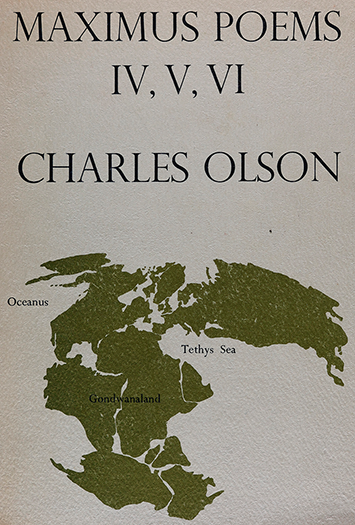
In featuring a map on the cover, the book followed the 1961 Jargon Press edition of The Maximus Poems, which had a map of Gloucester, Massachusetts, and it became the sibling of two other books also published in 1968: The North Atlantic Turbine by Edward Dorn, published by Fulcrum Press, which featured a map of the Atlantic in between the North American and European landmasses, and Kitchen Poems by J. H. Prynne, published by Cape Goliard. When read in conjunction with the unpublished correspondence between the poets, the work of Olson, Dorn and Prynne in these years comes to seem like a continuous effort, a shared transnational context of late-modernist writing fostered by ardent exchanges of intelligence and inspiration, and the books’ covers bear quiet witness to this.
The map on the cover of Prynne’s Kitchen Poems is bisected by a coastline, with the land area to the left almost featureless except for a few dotted coastal towns and inland refineries, and the sea on the right divided into hundreds of small numbered squares (see Figure 4). Prynne gave his own account of the image’s significance in 1971, describing his first encounter with the
Cover of the 1968 Cape Goliard edition of Kitchen Poems by J. H. Prynne.
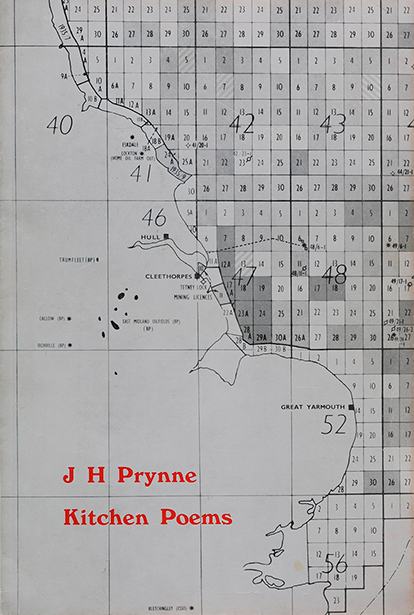
horrific vision of the Shell/Esso/BP claim map of the North Sea gas area, in which England appears as a blank white space, and the sea is portioned off into tiny little packets over which about 300,000 lawyers were litigating furiously, like knitting in the middle of the North Sea.Footnote 182
The Continental Shelf Act, which licensed seismic exploration of the area, came into force in 1964, making Prynne’s cover image one of some topical relevance, even if few people at the time would have predicted how crucial North Sea Oil would be to the next few decades of economic life in the UK.
The title of the book extends its concern with economics. The kitchen, Prynne said, is ‘a very good place to start getting clear about certain kinds of commodity link-up in the world around, which basically work down to what you eat’.Footnote 183 The combined implication of title and cover image, then, is that his poems aim to extend enquiry beyond English poetry’s traditional range of discourses: into the smallest, most daily business of food production and sustenance; into an understanding of place which takes in the enormous scale of continental shelves; and into the forms of economic activity which structure our experience of all these things. All of which seems dauntingly ambitious, for a slim booklet of five curiously prosaic-seeming poems, the text of which covers only fourteen pages.
The publication of Prynne’s elegant hardback with a total first-edition print run of almost 4,000 copies on both sides of the Atlantic seems like it should mark the decisive entry of English late-modernist poetry into the publishing mainstream. But the folder held in the Cape archive shows why that decisive moment misfired. Already in August 1967 Prynne was concerned about any delay in his date of publication, since, as he said, ‘this small collection is a work of some polemic & topical relevance, and I am anxious it should appear in some form or other without delay’.Footnote 184 When Cape Goliard’s production rate turned out to be slower than they had hoped, and Prynne was told by Barry Hall that his book was being pushed back to May 1968, his letter to Graham C. Greene seethed with anger and indignation beneath the surface formality and courtesy:
You may remember that I have from the first stressed my anxiety that there should be no delay in the appearance of these poems, which are explicitly topical & which are already beginning to lose the particular force which I intended them to have. […] I have just received the enclosed reply, which has made me very angry indeed. I am afraid that I remain entirely unconvinced over the need for a five month production delay in the printing of what is a mere pamphlet and which could be run off by a hardworking printer in seven days flat.Footnote 185
Prynne’s strong sense of the immediate topicality of his poems has not really been shared by readers. Terry Eagleton, reviewing Kitchen Poems, acknowledged that there was a critique in the book of ‘the spiritual structure of neo-capitalism’ but found the force of that critique blunted by Prynne’s failure or refusal to ‘communicate’ – a telling sign, for Luke Roberts, of the way in which Prynne would ‘never quite become the Marxist poet his critics might want him to be’.Footnote 186 But for Prynne, his experience with Cape Goliard was the moment for a decisive break with the world of trade publishing. Subsequently, Prynne’s new works were usually issued by small presses run by acquaintances, hand-produced quickly and in cheap formats, distributed outside of the economics of scarcity and exchange. The move to exclusive small-press distribution coincided with Prynne’s abandonment of the Olsonian project, and foreshadowed the gradual turn in his work to an increasingly hermetic style enjoyable primarily to a small coterie of initiates who had come under the charismatic sway of the poet in person.
The Creeley–Kitaj screenprints, the Olson Maximus volumes and Prynne’s Kitchen Poems show how the most impressive Cape Goliard books marry texts of considerable innovation to design characterised by the ‘greater fluidity and greater experimentation’ that Tarn had foreseen, while maintaining the production standard associated with a major publishing house. The aesthetic excitement of Cape Goliard is well caught by Iain Sinclair, in his nostalgic account of Tom Raworth’s ‘emergence in the 1960s with a succession of crafted and customised books, objects so desirable (so distant now) that, in memory, they seem edible’:
The smell of quality glue. Sour-cream paper with a tidemark like an invisible tattoo: the sacred papyrus of the state-sponsored leisured classes, students, ex-students, dole bandits and freeloaders with the habit of literacy. […] You owed it to the poet to make a decent fist of reading the thing.Footnote 187
For Tom Raworth, however, despite the beautiful books, Goliard’s incorporation into Cape represented too compromising an engagement with trade publishing, and though he continued with the firm as an author, he withdrew from the scheme as a printer-publisher early in 1967, before it had even begun.
Raworth gave his own account of the matter in a 1972 interview:
No hard feelings anywhere. I just had the feeling that if Cape wanted to do books of poetry they would slide those in as well. And I didn’t want to print anyone I didn’t want to print.Footnote 188
If Raworth had remained in the scheme, he would have had to compromise on editorial decisions, with the opinions of Tarn, Maschler and Graham C. Greene all carrying weight. But it seems that as much as Cape ‘sliding in’ the books they wanted to the Cape Goliard list, as Raworth feared, the interference went in the other direction, whereby authors whom Tarn and Hall wanted for Cape Goliard were poached for Cape’s main list; Robert Duncan is the foremost example.
Although Raworth declared in 1972 that there were ‘No hard feelings anywhere’, letters of the time suggest the true strength of his feelings on how he was treated. In July 1967 he wrote to Olson narrating his last encounter with Tom Maschler:
Maschler is such a thick cunt that he passes being amusing and is dangerous. […] That motherfucker really thought I was some sort of fey ‘writer’ from the hills … when I finally got in touch with him and said what about some money for like my half of the press, my name of the press, the stock of books I’d printed, the goodwill etc. he was really astounded. Oh really, he said, I can’t really talk about that, you see, I have someone waiting downstairs for me in the car. You better talk about it was my snappy rejoinder … But it’s ‘allen ginsberg’ waiting for me he said … my parentheses indicating hushed breath, awe, etc. Then I dropped the magic word ‘solicitor’ and I think he told Allen to hold on. Not that that did much good … he’d got Barry to sign so many things that it ended up Barry had made himself responsible for ‘compensating’ me (i.e. that cunt obviously KNEW all the time they should pay something, but just thought I didn’t. And assumed my good nature/friendly relations with Barry would stop me taking Cape to court … as then anything I could have done … like getting an injunction, would have directly affected Barry. So that basic, and naive, sense of ‘business’ that Maschler has, works.Footnote 189
Already we see a suggestion that the ways and imperatives of a little press might not sit as easily within a large publishing house as Nathaniel Tarn had hoped. Tom Maschler’s ‘basic, and naive, sense of “business”’, in leaving Raworth unable to sue for better terms without harming Barry Hall, shows a different understanding of art and commerce than the model of cooperative harmony under which Goliard Press had begun. In Raworth’s letter, several different kinds of authority that operate in farcically discontinuous spheres come into collision. Raworth has, in his own terms, taken Maschler’s measure, and yet his moral and artistic authority are impotent in the world of ‘business’, where deals get done. He invokes a potential trump card with his ‘magic word “solicitor”’, but it turns out Maschler had seen this coming way back down the road, when he set up the deal to make Hall responsible for compensating Raworth. Raworth begins by seeing through Maschler’s attempts to patronise him as a ‘fey “writer” from the hills’, and with his star-struck name-dropping about Allen Ginsberg, but ends by actually being the naïve figure, played and owned by a practised business-world operator; the sweary letter to Olson is the self-consolation of the defeated. Maschler’s authority was always going to be the winner on his home turf.Footnote 190
The publishing files held in the Jonathan Cape archive are full of instances of how the ways of working which suited a small press didn’t suit the lead times and the commercial imperatives of the trade publisher. Barry Hall disliked needing to provide cover images months in advance of a book’s publication for publicity and sales purposes; the reviews the books received were small in number, and often hostile in tone, especially in the London literary press, where poetry reviewing was dominated by critics sceptical of modernist experiment, such as Ian Hamilton and Anthony Thwaite; the sales figures were poorer than expected; and the loss of spontaneity caused by extended lead times and larger print runs was a source of continuing frustration.
Tarn was in the same position as Prynne in finding that publication of one of his books was delayed as the press worked out its production rate. But his position was complicated by the fact that Tarn was a director of Cape Goliard as well as an author. When the publication date of Where Babylon Ends was pushed back for the second time, Tarn wrote to Maschler to remonstrate, making a general point in the process:
On a publishing point, I am rather amazed to find that all the reasons for setting up a little press in the first place are being sacrificed to the considerations which govern big-publishing. All this nonsense has blown up on scores of salesmanship. Next it will be because the reviewers will not be ready.Footnote 191
Five months later, Tarn had gone from being ‘amazed’ to find that trade publishing considerations were overpowering small-press ones, to feeling resigned about the matter:
I am not comforted by the way in which Cape-Goliard is being rendered indistinguishable from Cape itself: poetry takes longer now than it used to. I fear Raworth may have been right: lamb and tiger do not mix.Footnote 192
From this moment onwards, relations deteriorated rapidly. Maschler wrote to Tarn to tell him that his conduct at a recent meeting had been ‘intolerable’,Footnote 193 only for Tarn to reply, ‘I have moods like other people have epileptic fits’, and to refuse to apologise, since ‘one does not apologize for having the measles or a common cold’.Footnote 194 By the end of June, the idea that Tarn’s ‘association’ with Cape might be ‘re-examined’ was growing bones, and on 23 June 1968, a meeting of Cape Goliard directors ended with an ominous suggestion, as recorded in Tarn’s typed notes on the occasion: ‘The remark I liked least was that if my salary were cut out, things would return more or less to normal: yours is the biggest overhead’.Footnote 195
One difficulty for Tarn was that he had no contract with Cape; the ‘arrangement’ by which the firm paid him £4,000 a year to be an editorial consultant had been sealed in a letter from Maschler. Having suggested that a cut to Tarn’s salary would help in reducing overheads, it was only a short step to what Maschler told Tarn over the telephone: that ‘the overhead they are bearing in my salary is crippling and must be curtailed or terminated’.Footnote 196 Tarn wanted to carry on being paid to do the work he had started, preferably on the current terms, but if need be, on reduced terms. Finally, on 30 July 1968, after Tarn ‘had calculated staying at 2,500’, a figure in the range of £1,000 to £1,500 was suggested as the limit of what Cape could afford. The fateful meeting with the top executives of the firm, with which I began this section, was scheduled for the next day.
On the morning of the meeting, Tarn met with the playwright Arnold Wesker, who was close friends with both him and Maschler. Tarn rehearsed his speech for the meeting, and Wesker brought to the situation a dramatist’s eye for conflicting characters:
What had begun as the discovery of an intellectual on whom he could lean had turned, for TM, into a battle of personalities. Old stuff.Footnote 197
This has the ring of truth in describing relations between Tarn and Maschler, both European émigrés of much energy, ambition and self-regard, the one an artist and polymath intellectual, the other a self-made man of the world who never went to university.
Having placed his magical objects on the table and recounted the history of his dealings with Cape, the first argument Tarn made was that the losses being sustained by his projects were small in the overall context of the company and were outweighed by their value in bringing prestige to the firm. Next he appealed to his colleagues’ sense of justice towards him personally, in curtailing his Cape projects after only one year when he had ‘made a very great change in my life, leaving a good position in a university for this job’. Finally he suggested what else might be done, before giving up on Cape Editions and Cape Goliard as unaffordable luxuries:
We could discuss market research into what everyone agrees to be the mystery of no sales in the series. […] We could see if patience is not a virtue for Cape Editions as it is for so many other projects, including Cape-Goliard.Footnote 198
But Tarn’s argument did not sway the executives. His full time arrangement was to be cancelled at the end of 1968, with the offer of six further months from January 1969 at a rate of £2,500 a year while he found other work.Footnote 199 Soon he had found a visiting appointment at Buffalo University for Summer 1969 and a visiting professorship at Princeton for the start of 1970, and by September 1968 he was in Guatemala, writing to Barry Hall to describe the stripped-down life he was now leading: ‘Absolute solitude; writing a lot; somewhat pauperised; but loving it. Daily diet of avocado and rice, for the most part. Have not seen a newspaper for weeks and do not miss them. Far, far away’.Footnote 200
Having conceived of the Cape poetry programme in terms of national importance – ‘The Work Laid before Us in This Disunited Kingdom’ – Tarn saw the curtailment of his ambitions for it as the end of England, the last nail in the coffin of a dead culture which, out of key with his time, he had tried to resuscitate. He never lived in England again.
Barry Hall continued to produce Cape Goliard books, many of them commissioned by Tarn, for almost two years after his departure. With the overhead of Tarn’s salary off the books, the financial pressure on the press was reduced, so that the Cape directors’ view for the time being, as Hall communicated to Tarn, was that ‘this was a small, unknown outfit and that things would improve; back titles would sell etc.’.Footnote 201 But without Tarn to act as a buffer between the printer and the Cape executives, Hall’s frustration grew. In Tom Raworth’s account, Hall ‘just got bored of it all’:
Barry got bored, […] and as I remember it left the rollers inked just across the type as being printed, locked the door, and went to Africa. Asa Benveniste told me he went by some months afterwards and looked through the window and things were still there. Cape hadn’t even bothered to go in and clean up or anything. The machines were still there.Footnote 202
A sad end for one of the most important poetry publishers of the 1960s. In Tom Maschler’s memoir, Publisher (2005), looking back over a long career in the industry, Cape Goliard is dealt with in fewer than a hundred words, as an aside in the chapter on his acquaintance with Allen Ginsberg, and it receives no mention in the separate chapter on ‘Poets’.Footnote 203
Coda
In the article on ‘The Publishing of Poetry’ with which I began my introduction, T. S. Eliot goes into considerable detail on the complicated matter of ‘prestige’. Despite his assertion that ‘we are not quite sure what it is, we are never quite sure that we have got it, and we are never sure how much it is worth when we have it’, prestige is nonetheless central to Eliot’s conception of poetry publishing.Footnote 204 Prestige for him is like happiness for John Stuart Mill; it can only be had by aiming for something else: ‘If you publish poetry solely in order to get prestige, you are unlikely to get it, and you will probably waste money instead of merely losing it’. Instead, prestige ‘must come as a by-product’:
You won’t get prestige – not the right kind – merely by taking over poets who have already established their reputation: the firm itself must have had something to do with building that reputation. You must be known to have backed the right authors long before they became famous. […] So prestige has two parts: (1) having picked the right authors in the past; (2) going on guessing about the younger generation.Footnote 205
Eliot himself had a strong track record for making such guesses about the younger generation, from the publication of W.H. Auden’s Poems (1930) through to Ted Hughes’s The Hawk in the Rain (1957), although along with the hits there are an equal number of misses and missed opportunities, seen from the perspective of today.
Part of the difficulty faced by a publisher such as Cape Goliard is that they were trying to conjure for themselves the prestige – or we might say the symbolic capital – of modernist culture without having the time for their guesses about poetic value to be proved wrong or right. Tarn’s ambitious account of poetic history, in which high modernism leads directly to Cape Goliard’s own efforts to carry the flame forward, reads precisely like an attempt at social positioning, in Bourdieuvian terms. They were trying to take over the prestige acquired by earlier modernist poets and publishers, and to get more for themselves by publishing the younger generation. But whereas the publishing of modernist writers first time round was largely shielded from the market through lucrative networks of private patronage, Cape Goliard were completely exposed to market forces in a rapidly modernising publishing industry. The fact that few readers enjoyed or understood the poetry of J. H. Prynne or Tom Raworth or took seriously their publisher’s claims that they represented the next generation of major modernist writers was therefore a serious obstacle.
The stories of Fulcrum Press and Cape Goliard mark crucial staging posts in the history of relations between poetry and the publishing industry, and between modernism and the market in general. The petering-out of Cape Goliard and the acrimonious winding-up of Fulcrum act out in miniature the history of 1960s cultural optimism and its dissipation, and both mark a moment of retreat for avant-garde poetry in Britain. Thereafter, second-generation American modernist poets such as Charles Olson, Edward Dorn, Robert Duncan and Louis Zukofsky usually had no UK publisher at all, and were little read outside a handful of academic specialists. British writers influenced by them, such as Raworth and Prynne, were limited to circulation in small-press editions of a few hundred copies, cheaply produced and barely distributed beyond circles of personal acquaintance.
Poets such as Geoffrey Hill and Christopher Okigbo, who could be described as modernist writers but not avant-gardists – in some way they are retro-modernists – likewise remained fairly marginal in UK publishing culture in the following decades. Okigbo seems peculiarly out of time: a young poet of the 1960s who wrote like a young poet of the 1920s and was already a legend and a ghost before his first book had even appeared. Hill made it into Penguin by the time of his Collected Poems in 1985, and academics started to write books about him, but his readership always remained a fraction of the size of near contemporaries of his such as Ted Hughes, Philip Larkin or Seamus Heaney. The poetry lists of trade publishers were dominated by writers of less allusive density than Hill, less obscurely coded symbolism than Okigbo, and more immediate clarity and simplicity of paraphrasable theme and utterance, as exemplified by the big-name poets who would find relative mainstream success in the period up to the end of the twentieth century, such as Hughes and Heaney or, from a somewhat younger generation, Carol Ann Duffy and Simon Armitage. The possibilities of British poetry publishing up to the end of the twentieth century, the shape of the field of contemporary poetry and the kinds of work being produced in different corners of that field were all set out in the years described in this study, when the most ambitious hopes of publishing transatlantic late-modernist poetry for a broad readership flared briefly then faded out.
Acknowledgements
Most of the research in this Element derives from a Leverhulme Trust Early Career Fellowship that I held at the University of Reading from 2012 to 2015, and I’m indebted to Andreas Heiner and his colleagues at the Leverhulme Trust for their support. They would perhaps be justified in thinking that it represents rather slender and belated returns for their money, but those years of generous funding and intellectual and creative freedom sponsored more than is contained here, so I owe the Trust a great deal. I’m also very grateful to the Department of English Literature at Reading and in particular to Peter Robinson, who commissioned me to write a chapter on poetry publishing for his Oxford Handbook of Contemporary British and Irish Poetry and did much to help with my Leverhulme application and subsequent research. It was a pleasure to work alongside Peter and my other colleagues at Reading at that time, and I’m grateful in particular to Conor Carville, Natalie Pollard and Steven Matthews. My colleagues in the Department of English Language and Literature and the Department of Arts and Sciences at UCL have been an inspiration since then; thank you in particular to Tim Beasley-Murray, Dennis Duncan, Mark Ford, Dai George, Phil Horne, Julia Jordan, Eric Langley and John Mullan. I am very grateful to Sam Rayner and Andrew Nash for their editorial input and to everyone else at CUP involved in production.
Some of the material in this Element appeared in different forms in Strangeness and Power: Essays on the Poetry of Geoffrey Hill (Exeter: Shearsman, 2019), edited by Andrew Michael Roberts; Publishing Modernist Fiction and Poetry (Edinburgh: Edinburgh University Press, 2019), edited by Lise Jaillant; and David Jones: A Christian Modernist (Leiden: Brill, 2018), edited by Jamie Callison, Erik Tonning, Anna Johnson and Paul Fiddes. Thank you to the editors and publishers of those books. Thanks are also due to the librarians, archivists and special collections staff of Cambridge University Library, the University of Connecticut, King’s College London, the University of Tulsa, the University of Reading, Stanford University and Washington University. For quotations from unpublished correspondence, I am grateful to the authors and their estates, and in particular to James Currey and to the estates of Diana Athill, Barry Hall, Aig Higo, Geoffrey Hill, Laurie Lee, Tom Maschler, Charles Olson, J. H. Prynne, Tom Raworth, Keith Sambrook and Nathaniel Tarn. All reasonable efforts have been made to trace copyright holders and to obtain their permission for the use of copyright material. The publisher apologises for any errors or omissions and would be grateful if notified of any corrections that should be incorporated in future editions.
A melancholy aspect of this Element’s long gestation is that it has outlived many of its subjects. Achebe, Athill, Higo, Hill, Maschler, Prynne, Raworth, Sambrook and Tarn were all alive when I started this research, and I would like to pay tribute to the memory of their work as writers and publishers.
This study is dedicated to Eve Houghton.
Series Editor
Samantha J. Rayner
University College London
Samantha J. Rayner is Professor of Publishing and Book Cultures at UCL. She is also Director of UCL’s Centre for Publishing, co-Director of the Bloomsbury CHAPTER (Communication History, Authorship, Publishing, Textual Editing and Reading) and co-Chair of the Bookselling Research Network.
Associate Editor
Leah Tether
University of Bristol
Leah Tether is Professor of Medieval Literature and Publishing at the University of Bristol. With an academic background in medieval French and English literature and a professional background in trade publishing, Leah has combined her expertise and developed an international research profile in book and publishing history from manuscript to digital.
Advisory Board
Simone Murray, Monash University
Claire Squires, University of Stirling
Andrew Nash, University of London
Leslie Howsam, Ryerson University
David Finkelstein, University of Edinburgh
Alexis Weedon, University of Bedfordshire
Alan Staton, Booksellers Association
Angus Phillips, Oxford International Centre for Publishing
Richard Fisher, Yale University Press
John Maxwell, Simon Fraser University
Shafquat Towheed, The Open University
Jen McCall, Central European University Press/Amsterdam University Press
About The Series
This series aims to fill the demand for easily accessible, quality texts available for teaching and research in the diverse and dynamic fields of Publishing and Book Culture. Rigorously researched and peer-reviewed Elements will be published under themes, or ‘Gatherings’. These Elements should be the first checkpoint for researchers or students working on that area of publishing and book trade history and practice: we hope that, situated so logically at Cambridge University Press, where academic publishing in the UK began, it will develop to create an unrivalled space where these histories and practices can be investigated and preserved.
Publishing and Book History
Gathering Editor: Andrew Nash
Andrew Nash is Reader in Book History and Director of the London Rare Books School at the Institute of English Studies, University of London. He has written books on Scottish and Victorian Literature, and edited or co-edited numerous volumes including, most recently, The Cambridge History of the Book in Britain, Volume 7 (Cambridge University Press, 2019).
Gathering Editor: Leah Tether
Leah Tether is Professor of Medieval Literature and Publishing at the University of Bristol. With an academic background in medieval French and English literature and a professional background in trade publishing, Leah has combined her expertise and developed an international research profile in book and publishing history from manuscript to digital.