There is no doubt that in some way or other, linguistic systems respond to change in ways that maintain meaning – more or less
William Labov (Reference Labov1994: 569)Generally speaking, low-level phonetic variation among contrastive values is passively delimited such that a comfortable perceptual ‘buffer zone’ is maintained between one value and its immediate systemic ‘neighbors’ (see e.g. Martinet Reference Martinet1952; Hockett Reference Hockett1955, Reference Hockett1967; Lindblom, MacNeilage & Studdert-Kennedy Reference Lindblom, MacNeilage, Studdert-Kennedy, Butterworth, Comrie and Dahl1984; Labov Reference Labov1994; Flemming Reference Flemming1995; de Boer Reference de Boer2001; Silverman Reference Silverman2006). However, under certain circumstances this buffer zone can be fatally breached such that one value may (diachronically) merge or (synchronically) neutralize with another. Martinet (Reference Martinet1952), for example, observes that there is a strong tendency for merged values to have been phonological neighbors in the past, in the sense that they had already shared a significant number of phonetic features. For Martinet, though, the fact that a language possesses similar values does not necessarily increase the likelihood of these values' merging or neutralizing. What crucially matters, according to Martinet, is the extent to which this opposition minimally distinguishes meaningful units of the language (minimal pairs), since the amount of homophony in a lexicon may have an impact on communicative success: the more homophony, the more likely that the speech signal will contain lexical ambiguities, and so the more often speech might induce confusion in listeners. Under the assumption that successful speech is more likely to establish itself as the conventionalized norm than is unsuccessful speech, then ceteris paribus speech with fewer homophones is more likely to establish itself as the conventionalized norm than is speech with more homophones. In all, according to Martinet, the tendency toward merger or neutralization of an opposition is favored to the extent that:
1. The values in opposition are phonetically similar.
2. The number of minimal morpheme pairs that the opposition is responsible for is low.
3. The number of minimal pairs within a correlated opposition is low, or the opposition is uncorrelated (in the sense of Trubetzkoy Reference Trubetzkoy1939/1969).
4. The minimal pairs belong to different syntactic categories.
5. The token frequency of one or both members of the minimal pairs is low.
6. The presence of additional morphological markers serves a disambiguating function.
Ultimately, however, merger or neutralization is not likely to take place simply because some of the relevant morphemes have a low token frequency, or because some of the relevant minimal pairs happen to belong to different syntactic categories, etc. Rather if sounds are to merge or neutralize, then, according to Martinet's ‘functional load’ criteria, the output of the process – across the lexicon in use – should not yield a significant increase in the amount of communicative confusion.
Armed with these intuitively appealing criteria for the determination of functional load, Martinet is nonetheless quick to retreat:
It is clear that the functional yield of an opposition can only be evaluated with any degree of accuracy if we deal with linguistic stages for which fairly exhaustive word lists are available. This circumstance makes it practically impossible to check the validity of the functional assumption in the case of prehistoric sound shifts. (Martinet Reference Martinet1952: 9)
It is not the purpose of the present study to investigate the role that ‘functional load’ may or may not play in (diachronic) sound mergers; Martinet's concerns appear fully justified in that, even at our present level of knowledge, extensive information about the lexicon in use is typically exceedingly difficult to ascertain for two different stages of a language, i.e. both before and after a merger takes place (but see Surendran & Niyogi Reference Surendran and Niyogi2003, Reference Surendran, Niyogi and Thomsen2006 for an example from Cantonese; see also King Reference King1967 and Hockett Reference Hockett1967, who disagree with each other on the merits of Martinet's proposals). Instead, in this paper I report on a case study of (synchronic) neutralization and its functional consequences. With today's computer-tallied corpora, such an investigation can be readily undertaken.
Taking all of Martinet's criteria into account, the hypothesis to be explored herein is straightforward:
Neutralizing alternations are more likely to be present in a language if their outputs do not significantly increase the level of homophony; derived homophony should not be excessive.
The wording of this hypothesis is intentionally vague, because I do not pretend to be able to zero in on a numerical upper limit of derived homophony. While this value may ultimately be ascertained by thoroughly investigating many languages, I intend merely to show that, in a given language, the amount of derived homophony is remarkably low.
The overall goal of the present study is to reintroduce Martinet's proposals into modern discourse on phonological theory, and to provide a case study showing that a language may indeed possess significant amounts of neutralization with negligible counter-functional consequences. The focus of this paper is neutralization in Korean. Indeed, Korean is the prototypical ‘Linguistics 101’ example of neutralization, as neutralization here involves so many contrastive values.
Section 1 investigates the extent of potential homophony in Korean due to six neutralizing alternations: aplosivization, nasal lateralization, liquid nasalization, cluster reinforcement, assibilation, and nasal assimilation (Martin Reference Martin1992), and shows that these induce very little homophony. Also briefly considered is variable assimilation of labials-to-dorsals, and coronals-to-labials and coronals-to-dorsals. Overall, it is found that, despite extensive neutralization, derived homophony in Korean is remarkably rare.
In section 2, actual patterns of neutralization in Korean are compared to hypothetical neutralizing patterns, including would-be word-initial laryngeal neutralization, would-be nasal lateralization, and would-be nasal+stop assimilation. It is shown that these hypothetical patterns, had they evolved in Korean, would have induced far more homophony than is actually found.
In section 3, some of the historical pressures that seem to have influenced the present-day Korean pattern are briefly considered, especially the role that Chinese has played in the history of the Korean sound pattern; I further discuss current developments in Korean, suggesting that these historical trends are continuing into the present. I speculate that ‘functional load’ (in the sense of Martinet) might indeed play a role in the diachronic comportment of linguistic sound systems.
1. Neutralization in Korean
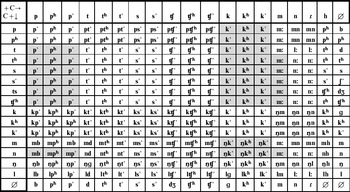
Table 1 provides intervocalic consonantal values in Korean (adapted from Martin Reference Martin1992). The first column lists morpheme-final consonants; the first row lists following morpheme-initial consonants, and the table's interior indicates the phonetic values of all combinations of these morphologically-ordered elements.
Korean intervocalic values (shaded cells are variably implemented)

In all, there are 304 morphologically-ordered sequences here. Variable values are in shaded boxes. Including these variable values among the neutralized values for now, the 304 morphologically ordered sequences reduce to only 75 phonetic values, a reduction of about 75%. In this section I show that, despite this drastic reduction in the number of intervocalic values, derived homophony remains minimal. I consider in turn (1.1) aplosivization, (1.2) nasal lateralization, (1.3) liquid nasalization, (1.4) nasal assimilation, (1.5) coronal assibilation, (1.6) cluster reinforcement, and (1.7) variable assimilation.
The data for this study were tallied from the Sejong Corpus, a database collected from written sources (http://sejong.or.kr/). The version of the Sejong Corpus used here is the same as that used in Albright (Reference Albright and Good2008). The Hangul was Romanized by Albright using HCode Hangul Code Conversion software (Lee Reference Lee1994). As noun roots often appear unsuffixed as well as suffixed in Korean (unlike verb roots, which are obligatorily suffixed), they are far more likely to engage in neutralizing alternations involving their final consonantal elements. For this reason, only nouns are considered herein.
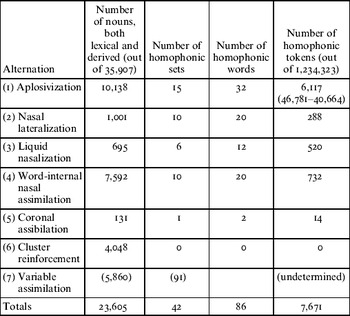
All told, out of 35,907 distinct nouns in the corpus, the six categorical neutralizing alternations (below) are shown to derive only 42 sets of homophones, involving 86 words. This is a very low level of homophony.
1.1 Aplosivization induces very little homophony
Cross-linguistically, laryngeal neutralization is quite prevalent among non-prevocalic stops, and virtually unattested among prevocalic ones (Lombardi Reference Lombardi1991; Steriade Reference Steriade1995, Reference Steriade1997, Reference Steriade, Hume and Johnson2000). This position of neutralization typically involves the loss of stop release, or aplosivization. For aerodynamic and auditory reasons, stop releases are the optimal location for laryngeally-based cues (Kingston Reference Kingston1985, Reference Kingston, Kingston and Beckman1990; Bladon Reference Bladon and McGregor1986; Silverman Reference Silverman1995, Reference Silverman1996; Wright Reference Wright, Hayes, Kirchner and Steriade2004). If a stop is not released into a more open gesture such as a vowel, it may lose the phonetic cues associated with this interval of the speech stream, among them, cues to the state of the larynx. In the limiting case, the perceptual distinction among contrastive laryngeal states is extinguished completely. This is laryngeal neutralization due to aplosivization.
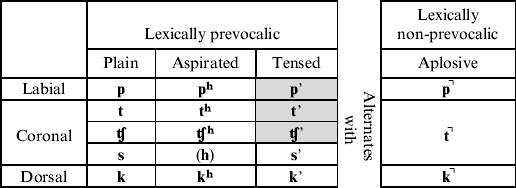
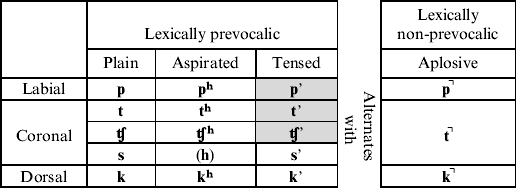
Table 2 displays the pattern of aplosivization in Korean, a pattern that seems to have gradually entered Korean during and after The Kolye Dynasty, from about 1000 to 600 years ago, the era of extensive borrowing from Chinese (Martin Reference Martin1992). (Shaded values do not alternate, as they never appear in morpheme-final position.) The plain obstruents, the aspirated plosives (and h), and the tensed obstruents may appear before vowels in Korean. Aplosives are found elsewhere, that is, in lexical non-prevocalic contexts. Due to the rich suffixing system in Korean, the plosives (except for the tense anterior plosives), the fricatives, as well as h, all alternate with the aplosives. Two values neutralize to the labial aplosive, seven values neutralize to the coronal aplosive, and three values neutralize to the dorsal aplosive. Altogether, twelve values neutralize to three, which constitutes a remarkably high 75% reduction in the number of contrasts here.
Distribution of Korean obstruents (and h)
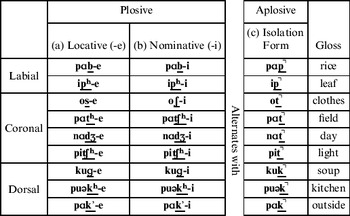
Some examples of alternating values are provided in table 3 (adapted from Jun Reference Jun2007). In table 3, note especially that there is an array of laryngeal distinctions in root-final position when a vowel-initial suffix is added (3a, b; underlined). However, these distinctions all neutralize to their corresponding aplosive value when lexically non-prevocalic (3c; also underlined). Note that coronals palatalize before i, and plain plosives voice between sonorants.
Examples of plosive-aplosive alternation in Korean

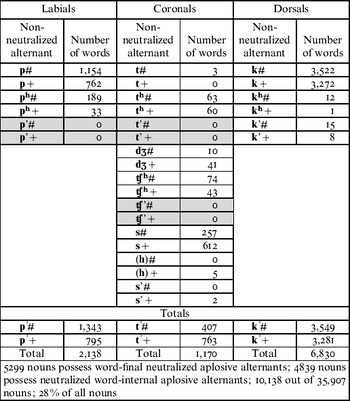
All told, the Sejong Project corpus lists 35,907 different nouns (not the number of tokens). Of this total, 10,138 nouns (28% of the total) possess aplosive alternants: 5,299 are word-final, and 4,839 are word-internal. These are pooled according to their word- and morpheme-final plosive (i.e. non-neutralized) alternant in table 4 (these would be ‘underlying forms’ in a theory that hypothesizes the existence of this abstract level of representation). In principle, a given form can be counted more than once if, for example, it possesses both word-internal and word-final aplosive alternants, though this rarely seems to occur. At 28%, it is clear that the proportion of the noun vocabulary that is subject to neutralizing aplosivization is not insignificant.
Distribution of word-final (#) and morpheme-final (+) obstruents/h for 10,138 nouns, from the Sejong Project

Korean indeed possesses nouns that are rendered homophonous as a consequence of neutralizing aplosivization. An oft-cited example of derived noun homophony is provided in table 5. The Native (i.e. non-Sino-Korean) Korean words for ‘day,’ ‘face’, and ‘sickle’ are phonetically distinct when suffixed with the vowel-initial suffix i (the Nominative marker). However, when any of these words is suffixed with a consonant-initial suffix such as kwɑ ‘and’, the root-final obstruent aplosivizes to t⌝, and the words are rendered phonetically non-distinct.
Derived homophony in Korean

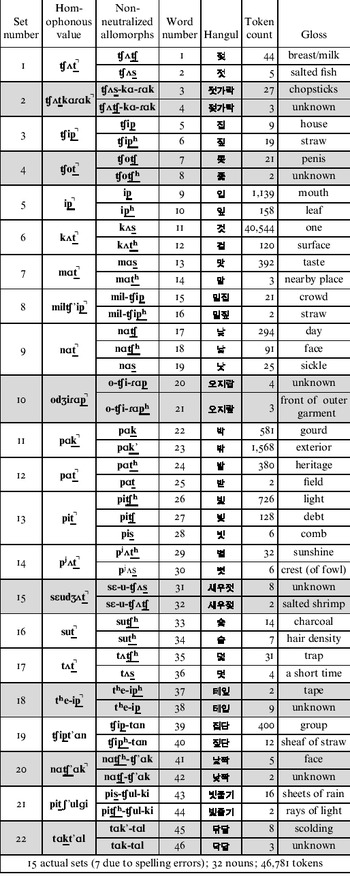
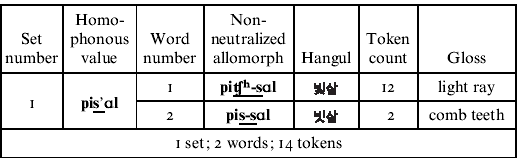
Among the 10,138 nouns that are subject to aplosivization, the sets in table 6 comprise an exhaustive list of the homophonous words. Certain words in the corpus have eluded a dictionary search, and are unfamiliar to native speakers of Korean, and these are marked ‘unknown’ – these sets are shaded. These facts, coupled with the very low token frequencies here, suggest that these are mere spelling errors documented in the Sejong Project corpus. (The significance of these errors is discussed in section 1.7.) Not including these suspect forms, in total, only 15 sets (32 words in all) – out of a total of 35,907 nouns in the corpus – are subject to derived homophony due to aplosivization.
Homophonic noun sets due to aplosivization (shaded cells possess spelling errors)

It should be emphasized that the Sejong Project corpus tallies fully inflected words across the lexicon in use, and not simply bare roots. Consequently, it is not the case that all possible derived homophonic roots are documented here. Indeed, certain known potentially homophonous roots are absent from the corpus in their bare form, for example, otʃ ʰ ‘lacquer’ – os ‘clothing’. Rather, the list in table 6 consists of those words documented in the Sejong Project corpus – whether bare roots or inflected – that are homophonous as a consequence of neutralizing aplosivization. This is an important point, because the present investigation intends to document homophony across the lexicon in use, and not across the lexicon in toto. The exhaustive list in table 6 makes it clear that the counter-functional consequences of neutralizing aplosivization among nouns must be exceedingly meager: only 32 out of 35,907 nouns are homophonous due to aplosivization.
Moreover, words that engage in aplosivization typically have a low token count. In table 6, I provide the token counts of all the relevant forms, tallied from the Sejong Project corpus. While the mean token count among nouns is 35, ten of the 15 noun sets possess at least one member with a token count below ten. While there are 46,781 tokens, a full 40,544 are of one word ( ), while its homophone (
 ) has a token count of 120. If we discount this one set – which, due to the high frequency of the one word and the low frequency of its homophone, is scarcely likely to induce confusion – then, out of 1,234,323 noun tokens, the total number of homophonic tokens due to aplosivization reduces to 6,117.
To summarize, the most salient – and saliently divergent – findings of our discussion are:
(i) Korean aplosivization induces the neutralization of a remarkably high number of oppositions: twelve values neutralize to three; 28% of the nouns are subject to neutralizing aplosivization, and yet (ii) Korean aplosivization induces the homophony of a remarkably low number of nouns: 15 sets of nouns are homophonous (32 nouns out of 35,907: <0.1%; 6,117 noun tokens out of 1,234,323 tokens: <0.1%). This is a very low level of homophony.
1.2 Nasal lateralization induces very little homophony
Coronal nasals and laterals bear certain perceptual similarities, since their formant transitions are rather comparable, and they both possess formants and anti-formants. In Korean, their perceptual confusability has apparently culminated in a neutralizing alternation: a sequence of a lateral or tap and a coronal nasal in either order is realized as a long lateral: n+ɾ, l+ɾ, l+n→lː (Kim-Renaud Reference Kim-Renaud1975, Martin Reference Martin1992, Davis & Shin Reference Davis and Shin1999). This process entered the language about 400 years ago (Martin Reference Martin1992: 52).
As the non-prevocalic lateral alternates with the tap when prevocalic, the acoustic connection between this latter alternant and the coronal nasal becomes rather tenuous. Though aerodynamically a non-obstruent (since the duration of its oral closure is insufficient to significantly reduce trans-glottal airflow), the tap possesses neither formants nor anti-formants; it is an extremely short oral stop. However, critical to the implementation of a tap is an oral opening both after and before the oral closure: a tap is only a tap if the tongue makes brief contact with a passive articulator. In the context of a preceding gesture that involves prolonged contact between these two articulators – such as a coronal nasal or a lateral – there is little opportunity for the tongue to fall away from its contact site, and then quickly re-implement contact. Rather, tongue contact is likely to be maintained – much like aplosivization – resulting in a single gesture. This results in either a longer lateral or a longer coronal nasal. Nasal lateralization, consequently, may be seen as an analogous to aplosivization: due to the absence of lateral or nasal release, tongue contact is maintained for the duration of the morphologically-ordered consonantal sequence. Since the lateral and the coronal nasal are confusable, the origins of this neutralization pattern now come into focus.
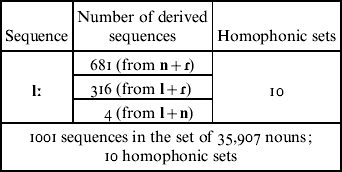
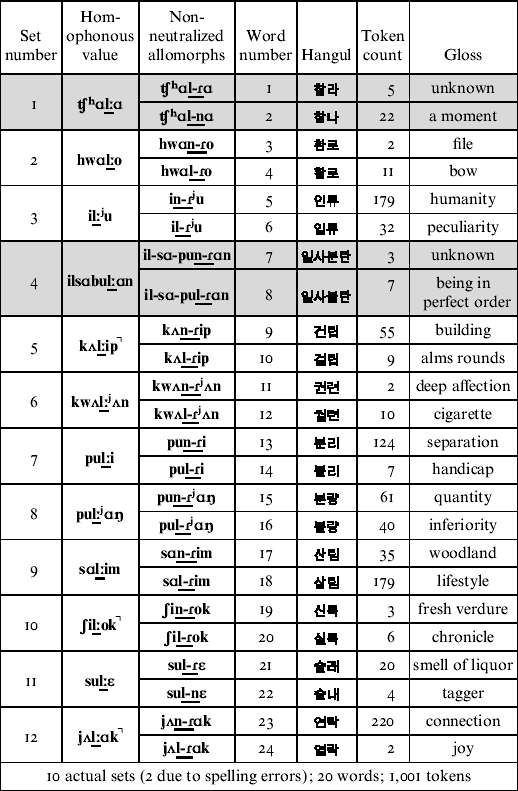
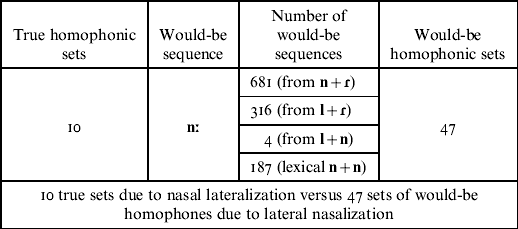
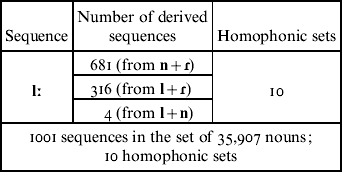
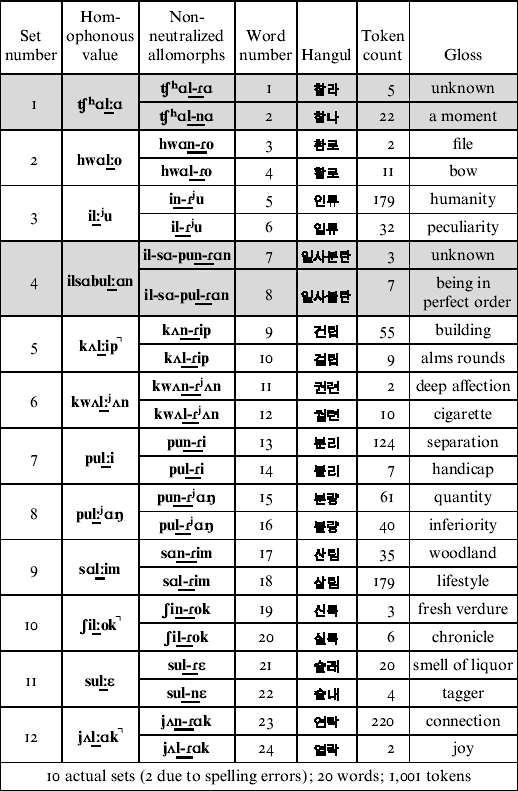
Table 7 tallies the number of derived lː sequences found in the corpus. Out of 1,001 nouns in the corpus possessing lː, 681 derive from n+ɾ, 316 derive from l+ɾ and four derive from l+n. Table 8 provides an exhaustive list of derived homophonic sets due to nasal lateralization. There are ten homophonic sets, and 1001 homophonic tokens. Two additional cases are probably spelling errors. Seven of the actual sets possess at least one member with a token count under ten.
Derived lː sequences
Homophonic noun sets due to nasal lateralization
1.3 Liquid nasalization induces very little homophony
Another neutralizing alternation in Korean involves the nasalization of non-coronal obstruent – liquid (tap) sequences: p+ɾ→mn, k+ɾ→ŋn (Kim-Renaud Reference Kim-Renaud1975, Martin Reference Martin1992, Davis & Shin Reference Davis and Shin1999). This alternation is mentioned only in passing by Martin (Reference Martin1992) ; he does not discuss when the pattern may have entered the language. Surely there is no phonetic motivation for the pattern. Rather, this alternation has the ‘feel’ of being analogically derived from nasal assimilation (to be discussed in section 1.4). It is likely, therefore, that the alternation is a relatively recent innovation.
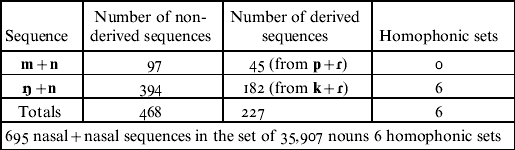
In all, 695 nouns listed in the corpus possess the relevant sequences. As shown in table 9, there are 119 nouns possessing mn (45 derive from p+ɾ and 74 are lexical m+n) and 576 nouns possessing ŋn (182 derive from k+ɾ and 394 are lexical ŋ+n).
Number of nouns subject to liquid nasalization neutralization
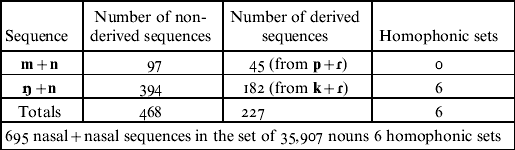
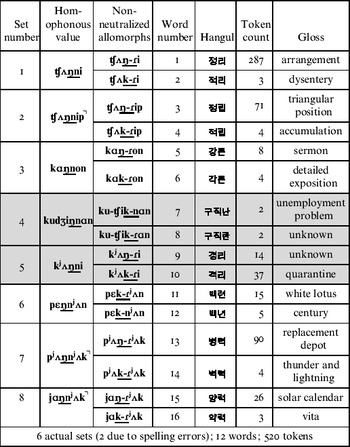
In table 10 I provide an exhaustive list of homophones due to liquid nasalization. There are eight cases in all, two of which are suspected spelling errors. Excluding these two sets, a total of 520 nouns tokens (out of 1,234,323) are homophonous, which verges on 0% of the total.
Homophonic noun sets due to liquid nasalization

1.4 Nasal assimilation induces very little homophony
Korean has a process of nasal assimilation such that any obstruent that comes to precede a nasal becomes nasal itself (Kim-Renaud Reference Kim-Renaud1975, Martin Reference Martin1992, Davis & Shin Reference Davis and Shin1999). This process entered Korean at least 600 years ago (Martin Reference Martin1992: 52). There are two domains of application of this pervasive process: across morpheme boundaries, and across word boundaries (Kim-Renaud Reference Kim-Renaud1975).
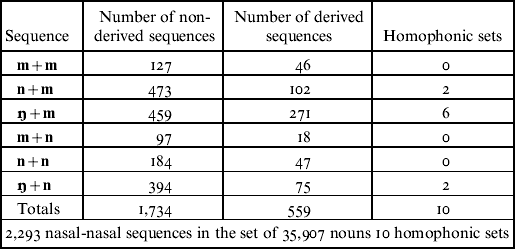
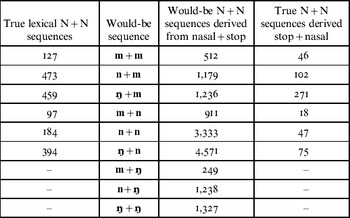
Regarding word-internal nasal sequences, 559 are derived through nasal assimilation: 46 nouns possess m+m, 102 n+m, 271 ŋ+m, 18 m+n, 47 n+n, and 75 ŋ+n. Meanwhile, there are 1,734 non-derived nasal–nasal sequences: 127 m+m, 473 n+m, 459 ŋ+m, 97 m+n, 184 n+n, and 394 ŋ+n. In all, then, there are 2,293 nasal–nasal sequences in the set of 35,907 nouns. These figures are displayed in table 11.
Number of nouns subject to nasal assimilation neutralization
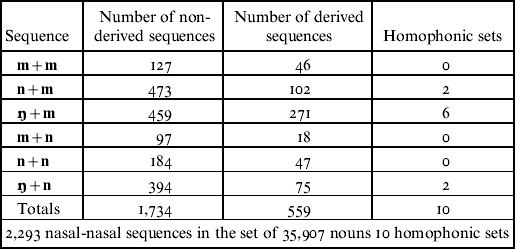
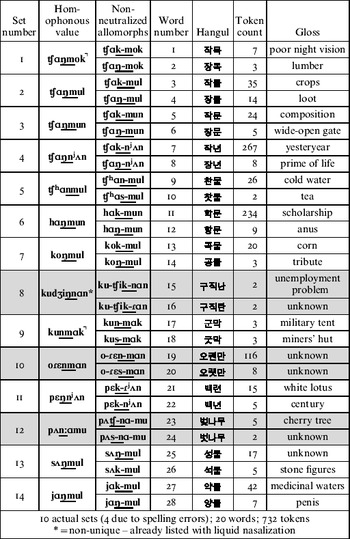
The sets in table 12 constitute an exhaustive list of homophones found in the Sejong Project corpus due to word-internal nasal assimilation. Discounting four probable spelling errors, there are ten homophonic sets out of 2,293 neutralized nouns in the list of 35,907 nouns. There are 732 homophonic tokens out of 1,234,323.
Homophonic noun sets due to word-internal nasal assimilation

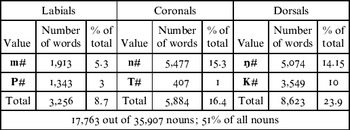
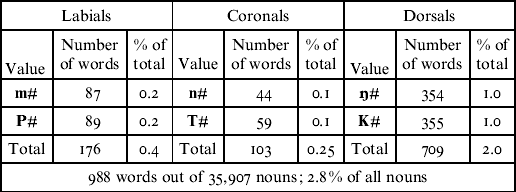
Hwang (Reference Hwang2008) investigates the amount of potential noun homophony due to the word boundary process. Her results in table 13 show that a full 51% of all nouns (17,763 out of 35,907) are potentially subject to neutralizing nasal assimilation (P=any labial obstruent, T=any coronal obstruent, K=any dorsal obstruent). Despite the enormous amount of potential neutralization here, Hwang shows that a mere 2.8% of the noun inventory is potentially subject to derived homophony as a consequence of nasal neutralization. Her results are displayed in table 14.
Potential word-final nasal-assimilated nouns

Potential word-final nasal-assimilated homophones
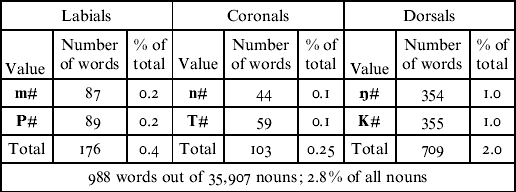
Hwang is careful to point out that these numerical results do not show the actual rate of homophonic usage. Rather, these totals merely indicate the potential for derived homophony. Crucially, any noun that might be subject to derived homophony as a consequence of word-final nasal assimilation must be immediately followed by a nasal in the next word. This being the case, the amount of actual homophony is likely to be extremely low indeed. To get a sense of this value, there are 3,404 nouns in the corpus that are nasal-initial. Assuming this is representative of the language as a whole, this constitutes about 10% of the lexicon. This suggests that the likelihood of derived homophony in the present case is probably about one-tenth of 2.8%, or .28%. This result is fully in keeping with the remarkably low levels of derived homophony found elsewhere.
1.5 Coronal assibilation induces very little homophony
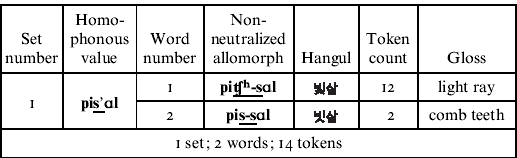
Coronal obstruents assibilate before s and sʼ, resulting in (neutralized) sʼ (Martin Reference Martin1992). Out of the 35,907 nouns in the corpus, 131 words possess the relevant values: 41 lexical, 9 derived. There is a total of one homophonic set as a result of this alternation, 14 tokens in all, as shown in table 15. Out of 1,234,323 noun tokens, 14 are homophonous due to coronal assibilation.
Homophonic noun set due to coronal assibilation
1.6 Cluster reinforcement induces no homophony
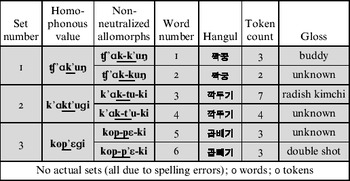
When a non-aspirated obstruent comes to follow another obstruent, the second value tenses (Kim-Renaud Reference Kim-Renaud1975, Martin Reference Martin1992); this process is called cluster reinforcement. There are 4,048 nouns in the corpus that possess word-medial tensed obstruents: 449 pʼ, 476 ť, 1017 ť, 1090 sʼ, and 1016 kʼ. In table 16 I provide a list of the homophonic sets due to cluster reinforcement. All three sets are probable spelling errors. There is thus no homophony as a consequence of cluster reinforcement.
Homophonic noun sets due to cluster reinforcement

1.7 Variable assimilation might induce more homophony (but might not)
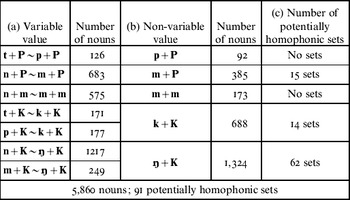
In colloquial Korean speech, coronals (excluding the lateral) variably assimilate to a following consonant (Kim-Renaud Reference Kim-Renaud1975, Martin Reference Martin1992), and labials variably assimilate to a following dorsal. In theory, this assimilation process, unlike the others discussed herein, has the potential to induce a non-negligible amount of homophony. In table 17 I provide the total number of nouns that are potentially subject to this process (17a) alongside the total number of non-variable (genuinely morphologically-sequenced) values with which the variable forms might neutralize (17b). Finally, I provide the total number of potentially homophonic sets (17c).
Potential homophony due to variable assimilation

A sizable number of homophonic sets, 62, is possible here. An important point to keep in mind, however, is that this is a variable pattern of neutralization: sometimes neutralization occurs (more often in casual speech), and sometimes it doesn't (more often in formal speech). Jun (Reference Jun1995), for example, investigates the variable labial-to-dorsal obstruent assimilation pattern using the aerodynamic methodology introduced by Silverman & Jun (Reference Silverman and Jun1994). He reports gestural reduction of labials (in p+k sequences) to occur about 35% of the time in casual speech, and about 15% of the time in formal speech. However, Jun finds that this variable pattern does not vary between discrete values kː versus pk. Rather, the variation is gradient, such that tokens may, in theory, fall anywhere on the phonetic continuum between these two endpoints. This sort of variation sets up a situation in which near-neutralizations are practically inevitable: some speech tokens are nearly – but, crucially, not completely – neutralized, and so contrasts may remain recoverable despite the near-obliteration of their acoustic distinctiveness. Many cases of near-neutralization are documented in the phonetics literature, increasingly so as analytic techniques become more sophisticated (e.g. Dinnsen & Charles-Luce Reference Dinnsen and Charles-Luce1984 and Charles-Luce Reference Charles-Luce1993 for Catalan; Charles-Luce Reference Charles-Luce1985, Port & O'Dell Reference Port and O'Dell1985, and Port & Crawford Reference Port and Crawford1989 for German; Slowiaczek & Dinnsen Reference Slowiaczek and Dinnsen1985 for Polish; Pye Reference Pye1986 for Russian; Warner, Jongman, Sereno & Kemps Reference Warner, Jongman, Sereno and Kemps2004 for Dutch; Bishop Reference Bishop2007 for Andalusian Spanish).
Among variable processes such as Korean coronal assimilation, it is quite possible that potentially homophonic forms in particular are more likely to maintain their distinctive status than are neutralized heterophones, at least in semantically ambiguous contexts. For example, Charles-Luce (Reference Charles-Luce1985) finds that potential homophones in Catalan are more likely to remain acoustically distinct from each other in semantically ambiguous contexts, in comparison to both homophones in semantically transparent contexts and, presumably, to neutralized values in heterophones. Comparable findings are reported for Dutch (Warner, Jongman, Sereno & Kemps Reference Warner, Jongman, Sereno and Kemps2004).
Anecdotally, an informal, non-systematic dictionary investigation of potentially homophonic sets due to variable coronal assimilation (approximately forty-five minutes checking an online dictionary ‘Babylon Korean Dictionary’, http://www.babylon.com/dictionary/1271/ Babylon-Korean-English.html) revealed only a few spelling errors documented in the corpus for words with optionally assimilated sequences. This suggests that such sequences are indeed realized as variably- and partially-assimilated, at least a significant portion of the time. Were these sequences completely neutralized, we might expect a higher number of spelling errors: completely neutralized forms are more likely to be subject to spelling errors, since, for such forms, there is less spur-of-the-moment (while writing or typing) evidence to suggest that their phonetic properties are a consequence of neutralization. Indeed, the documented spelling errors in the Sejong Project corpus are not random, but instead always reflect accurate pronunciations of the (presumably intended) word. (I note here that Kim & Jongman (Reference Kim and Jongman1996), in their investigation of Korean neutralizing aplosivization, find no evidence of near-neutralization under any circumstances. That is, in the case of aplosivization at least – and unlike coronal and labial assimilation – neutralization is apparently complete.)
1.8 Summary of neutralizing alternations in Korean
We have now investigated six categorical neutralizing alternations and one variable/gradient neutralizing alternation in Korean. I summarize the numerical results in table 18. There are 42 homophonic sets out of 35,907 nouns involving 86 words. In running Korean speech, out of 1,234,323 noun tokens encountered, chances are that about 7,671 will be homophonous. This is a very low level of homophony.
Summary of neutralizing alternations and derived homophony

2. ‘A very low level of homophony’ compared to what?
As pointed out by Surendran & Niyogi (Reference Surendran, Niyogi and Thomsen2006), totals such as those presented here acquire greater significance when they are compared to values that do not merge (or, for present purposes, neutralize). In this section I specifically do not compare actual patterns of derived homophony to those that might be encountered assuming raw consonant and vowel combinatorics. Since languages never possess unconstrained combinations of consonants and vowels, such a comparison would not provide a realistic basis for comparison. Rather, in this section I compare actual patterns of neutralization (along with their amounts of derived homophony) to hypothetical patterns of neutralization (along with their amounts of derived homophony). Two of the three patterns I consider, although plausible and within the realm of possibility, are in fact unattested in Korean. I will examine, in turn, true word-final aplosivization versus hypothetical word-initial laryngeal neutralization, true nasal lateralization versus lateral nasalization hypothetical, and true stop+nasal assimilation versus hypothetical nasal+stop assimilation. The first of these hypothetical cases is an implausible development, but the second and third are quite plausible indeed. It turns out that these hypothetical patterns of neutralization would derive a very large number of homophonic sets, in comparison to the meager amount of actual derived homophony. These results are thus consistent with the hypothesis that patterns of neutralization are more likely to be tolerated when they do not result in a significant increase in the amount of derived homophony. Again, I reiterate that the goal of the present investigation is not to zero in on a genuine upper limit for derived homophony. Rather, the present investigation is merely a single case study.
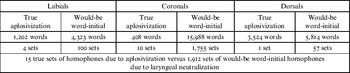
Our first comparison is between true neutralizing aplosivization versus hypothetical word-initial laryngeal neutralization. In table 19 I compare the number of words and the number of minimally distinctive sets, in both word-initial and word-final position. It is quite clear from these figures that the functional load of word-initial obstruent oppositions is far heavier than that of their word-final counterparts: 26,125 nouns begin with obstruents out of 35,907; 1,912 sets would be homophones due to laryngeal neutralization. By contrast, in reality, 5,134 words end with obstruents, and 15 homophonic sets arise due to aplosivization. This should not be surprising. Recall my proposal that languages do not evolve towards a state in which derived homophony is excessive. Initial laryngeal neutralization among Korean root-initial plosives would induce just such an excessive amount of homophony.
Genuine sets of homophones due to word-final aplosivization versus would-be homophonic noun sets due to word-initial laryngeal neutralization

On the one hand, it might be argued that comparing genuine aplosivization to hypothetical word-initial neutralization heightens the significance of the present findings. Languages naturally evolve toward states that exploit the acoustic/auditory space to good advantage, and so lexicons are naturally structured such that more words are distinguished in contexts that are capable of saliently encoding critically distinctive cues, for example, lexically prevocalic contexts over lexically non-prevocalic ones.
On the other hand, it might be objected that, since languages never neutralize consonantal laryngeal distinctions in #CV contexts, any comparison to this hypothetical pattern is unilluminating. Consequently, in the following subsections I consider two more plausible hypothetical cases of neutralization. In each case, the actual amount of derived homophony is far lower than the would-be amount.
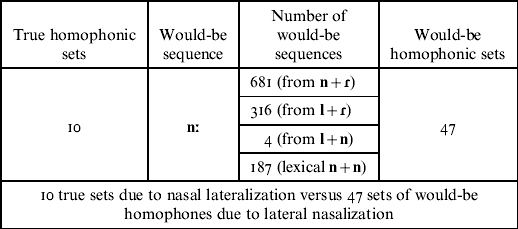
In table 20 I compare cases of true nasal lateralization to hypothetical lateral nasalization. In comparison to the ten actual homophonic sets due to nasal lateralization, there are 47 would-be homophonic sets due to lateral nasalization.
Genuine sets of homophones due to nasal lateralization versus would-be homophonic noun sets due to lateral nasalization
A comparable result is obtained when comparing true stop+nasal assimilated sequences to hypothetical nasal+stop assimilated sequences: there are 10 sets of homophones due to stop+nasal assimilation, while there would be 1100 sets of homophones due to nasal+stop assimilation, 1072 if we discount unattested +ŋ forms (table 21).
Would-be nasal+stop word-internal nasal assimilation sequences versus true stop+nasal word-internal nasal assimilation sequences

To summarize the results of this section, the six categorical cases of neutralization found in Korean yield a total of 42 sets of homophones. By comparison, the three hypothetical cases of neutralization that are not found in Korean would produce 3,059 homophonic sets.
3. A brief history of Korean neutralization
Korean witnessed a massive influx of Chinese words in its distant past – beginning at least 1300 hundred years ago, with the greatest amount of borrowing during the Kolye Dynasty, about 600–1000 years ago – which served to supplant a significant portion of its native vocabulary, particularly its noun inventory. During the era of borrowing, Chinese possessed a very limited set of consonants in root-final position: p⌝ t⌝ k⌝ m n ŋ. The Korean of this era had these endings, though Middle Chinese final t was typically – and oddly – incorporated into Korean as l. This is odd since, as stated, Native Korean indeed possessed t-final words. However, t-final Sino-Korean words were usually written with lkʔ, in an apparent effort to call attention to their phonetically checked nature, at least in prescriptive pronunciations. Martin (Reference Martin1997) plausibly suggests that the sound in question was borrowed as a tap (ɾ). The dearth of roots with final t even in Middle Korean – only forty-eight verbs and a few nouns, according to Martin (Reference Martin1997) – suggests a frequency effect: the loan pattern may have been influenced by the infrequency of Native Korean t-final roots, and the high frequency of Native Korean ɾ/l-final roots. Though nothing crucial hinges on this issue, and though the question is far from resolved (indeed, I am doing Martin an injustice by simplifying his remarkably detailed discussion), I operate herein under the assumption that Middle Chinese root-final t was borrowed as ɾ, and alternated with l when non-prevocalic, much as this value does today.
In addition to these simple stop endings, Korean roots possessed what Martin (Reference Martin1992) terms ‘overstuffed’ endings, among them pʰptptʰpspstpskptstsʰ tʰ sp st sn sk kʰ ks lk lp lpʰ lm nts nʰ (the affricates were not yet palatalized; they were dental) (Martin Reference Martin1992, Sohn Reference Sohn1999, Song Reference Song2005). Martin believes that up to 600 years ago, these endings were realized intact when a vowel followed, but by 400 years ago they had been reduced to a single member when non-prevocalic. Contemporary Korean root-final tensed values seem to be the reflexes of at least some of these previously complex root-final clusters; other root-final clusters survive to the present, including ps ls ks nkʧ ltʰ lh nh lk lp lpʰ (Ko Reference Ko2006). Also around 600 years ago, root-final ts tsʰ s began to reduce to s when non-prevocalic.
By 400 years ago, non-prevocalic s (which was now an alternant of ts tsʰ s) had succumbed to aplosivation, neutralizing to t⌝. However, Manchu and Mongol loanwords were written with a final s as recently as 200 years ago. In the case of final h, it was dropped word-finally, but realized as post-aspiration when a lexical stop followed. In Contemporary Korean, root-final h has been completely eliminated among noun roots, surviving only in some (morphologically complex) forms.
The huge influx of Sino-Korean nouns was largely coincident with the onset of the process of root-final consonant attrition. What seems to have happened is that this property came to influence Korean phonotactics at large. The gradual attrition of the Korean system of root-final values thus appears to have been set in motion by the influx of Sino-Korean forms.
The trend towards simplification of the Korean coda system has continued down to recent times. Consider some additional findings, which demonstrate that root-final values in Korean are actually merging (in addition to neutralizing).
First, Ito (Reference Ito2006) observes that since the Middle Korean period, ten (out of 13) t-final roots have changed to s. She further reports that polysyllabic nouns were much more likely to change to s than were monosyllabic nouns.
Second, according to Jun (Reference Jun2007), young Korean speakers are introducing a significant amount of variation in the phonetic values among prevocalic root-final obstruents, though with preferences for some values over others. Among roots that heretofore have contrasted t tʰ s kʧ kʧʰ prevocalically, there is now a substantial amount of variation among these values. In other words, the distinction among these prevocalic root-final values appears to be breaking down. Simplifying somewhat, among the coronals, s is the favored variant; among the labials (p pʰ), p is the favored variant; among the dorsals (k kʰ kʼ), k is the favored variant. These favored variants are also the most frequent in terms of the number of words that possess them. Jun suggests that this is no coincidence: the token prevalence of some variants over others is arguably a consequence of the lexical prevalence of some values over others.
Third, Kang (Reference Kang, Kuno, Lee, Whitman, Maling, Kang, Sells and Sohn2006) observes that those coronal-final roots that vary toward s tend to be low-frequency items.
Fourth, Albright (Reference Albright and Good2008) shows that these root-final mergers in Korean actually cause very little ambiguity, due to statistical asymmetries in the lexicon of Korean, and due to their frequencies of usage.
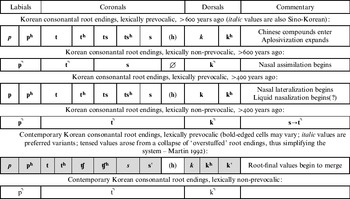
The upshot is that root-final obstruents in the noun system are becoming increasingly subject not only to neutralization, but to full merger as well, with few counter-functional consequences. Table 22 provides a simplified timeline of this diachrony. Note in particular that root-final consonant clusters are not listed. Many such clusters evolved into tensed obstruents. Consequently, the introduction of root-final tensed values actually involves a decrease in the number of root endings, and not the increase that is suggested by the display.
Simplified timeline of Korean obstruent root ending attrition

In short, the inventory of root-final values in Korean seems to be in a rather steady – if slow – state of attrition. The current proposal is that this tendency has remained in place due to the absence of functional pressures that might inhibit it, since, as shown in section 1, the attrition does not create a significant amount of homophony.
4. Concluding remarks
Despite the very significant extent of neutralization in Korean, the counter-functional consequences are quite meager: out of 35,907 nouns in the Sejong Corpus, there are only 42 sets of homophones as a consequence of the six categorical neutralizing alternations investigated. These findings are consistent with the hypothesis that, even when there is a natural phonetic tendency toward a particular phonetic state (say, non-prevocalic aplosivization among obstruents, or various sorts of neutralizing consonantal assimilations), a given language will most likely not evolve toward that state if excessive homophony were to result, because the very speech tokens that are produced with homophone-inducing neutralized alternants are also the very speech tokens that might confuse listeners. Accordingly, as a natural, passive consequence, such tokens would not be reproduced as these listeners become speakers (Labov Reference Labov1994, Silverman Reference Silverman2006). Rather, in such a language, there is likely to be a natural, passive maintenance of contrast, for it is exactly those speech tokens that are communicated successfully to listeners that are more likely to take hold and to become conventionalized as the speech norm. Indeed, as Hoenigswald (Reference Hoenigswald1960: 80) writes, ‘it is entirely conceivable that threatened homonymy should also be considered as counteracting the forces of “articulatory ease” in holding back an entire merger process and in preserving a phonemic contrast even where it is not minimal’. By contrast, in Korean, there may be no functional counter-pressure inhibiting the natural tendency toward neutralization, since the introduction of the neutralizing patterns does not have significant counter-functional consequences, in the form of significantly increasing the amount of derived homophony.
I have not attempted to specify or determine a numerical upper limit for derived homophony. While this value may ultimately be empirically ascertainable by thoroughly investigating many languages, in this paper I have merely shown that, in Korean at least, the amount of derived homophony is remarkably low. The very low levels of homophony in Korean become especially salient by comparing actual homophonic sets to plausible would-be homophonic sets. Indeed, the present findings suggest that anti-homophony and Martinet's original formulation of the ‘functional load’ argument are genuine factors acting on linguistic sound systems.