A man who is not afraid is not aggressive, a man who has no sense of fear of any kind is really a free, a peaceful man.
Jiddu Krishnamurti
Anger and aggression are often linked together, but contemporary psychologists have largely overlooked the potential importance of an association between aggression and fear. The main premise of this article is that anxiety (a particular variant of fear) may be one of the key emotional underpinnings of childhood aggression and the relative neglect of anxiety in developmental and intervention theories may have led to an incomplete understanding of children's aggressive behavior.
Aggression is the most widely studied of all child behavior problems, and a wide range of treatment and prevention programs have been developed, yet prevalence rates and outcomes remain disturbing. Half of all referrals to children's mental health agencies are for oppositional or aggressive behavior problems (Patterson, Dishion, & Chamberlain, Reference Patterson, Dishion, Chamberlain and Giles1993; Stouthamer-Loeber, Loeber, & Thomas, Reference Stouthamer-Loeber, Loeber and Thomas1992). Left untreated, aggression is highly persistent (Farrington, Reference Farrington and Huesmann1994; Jester et al., Reference Jester, Nigg, Buu, Puttler, Glass and Heitzeg2008; Loeber & Farrington, Reference Loeber and Farrington2000; Temcheff et al., Reference Temcheff, Serbin, Martin-Storey, Stack, Hodgins and Ledingham2008; Tremblay, Pihl, Vitaro, & Dobkin, Reference Tremblay, Pihl, Vitaro and Dobkin1994) and predicts later delinquency, marital problems, depression, substance abuse, and severe difficulties in peer relations, academic functioning, occupational stability, and employment (Campbell, Spieker, Burchinal, Poe, & The NICHD Early Child Care Research Network, Reference Campbell, Spieker, Burchinal and Poe2006; Katja & Pulkkinen, Reference Katja and Pulkkinen2000; Loeber, Reference Loeber, Lahey and Kazdin1988, Reference Loeber1990; Loeber, Burke, Mutchka, & Lahey, Reference Loeber, Burke, Mutchka and Lahey2004; O'Donnel et al., Reference O'Donnel, Stueve, Myint-U, Duran, Agronick and Wilson-Simmons2006; Stattin & Magnusson, Reference Stattin and Magnusson1989; Stipek & Miles, Reference Stipek and Miles2008). Childhood aggression not only is detrimental to the child but also has a significant impact on the well-being of the victims, and the public costs associated with violence are enormous (e.g., to mental health institutions, juvenile justice systems, schools; Krug, Mercy, Dahlberg, & Zwi, Reference Krug, Mercy, Dahlberg and Zwi2002). Some progress has been made in identifying treatments that are effective in decreasing childhood aggression. However, despite their popularity, they remain only moderately effective (Connor, Reference Connor2002; Kazdin, Reference Kazdin1987, Reference Kazdin2001a, Reference Kazdin, Nathan and Gorman2002; Weisz, Doss, & Hawley, Reference Weisz, Doss and Hawley2005). One of the main reasons for these modest effects may be that the vast majority of aggressive children exhibit co-occurring, clinically elevated, anxiety symptoms; yet, anxiety is neglected in contemporary developmental theories of aggression, and it is largely ignored in intervention models.
Anxiety is a biologically basic emotion that arises in situations that are ambiguous, potentially threatening and unpredictable (Darwin, Reference Darwin1872; Fridja, Reference Fridja1986; Izard, Reference Izard1991). A great deal of research has focused on anxiety and its influence on inhibition and withdrawal (e.g., Gray, Reference Gray1982; Gray & McNaughton, Reference Gray and McNaughton2000), but almost no studies focus on anxiety's influence on children's aggressive behavior. The main objective of the current paper is to introduce a developmental and clinical model of the role of anxiety in children's aggression and suggest research strategies to test the model. Three new hypotheses emerge from the model:
-
1. Early unpredictable parenting induces anxiety in children that in turn generates aggressive behavior.
-
2. Prolonged periods of anxiety in real time (from moment to moment) deplete children's capacity to inhibit their impulses and trigger bouts of aggression as a result; aggression in turn functions to regulate, or decrease, initial levels of anxiety.
-
3. Minor daily stressors give rise to anxiety, but cognitive perseveration (worrying and rumination) maintains anxious moods, predisposing children to aggress.
These hypotheses remain largely untested at this point; thus, the two main goals of the current paper are to review extant research that is consistent with the model and to suggest research designs and methodologies that can test it more specifically. Some considerations for clinical practice that follow directly from the proposed model are presented. It is argued that in order to most effectively decrease children's aggressive behavior, treatment programs need to target anxiety rather than focus solely on the aggression itself.
Subtypes of Aggression
My contention that anxiety is critical for understanding aggressive behavior is meant to apply to the majority of aggressive children and youth, but there are categories of aggressive behavior to which it does not apply. Several classification systems have been proposed, but one of the most widely used is the distinction between reactive and proactive aggression. Proactive aggression is instrumental, goal-directed, and often premeditated, whereas reactive aggression is hostile, retaliatory, and “hot-blooded” (Feshbach, Reference Feshbach and Mussen1970; Dodge, Reference Dodge, Garber and Dodge1991; Dodge & Coie, Reference Dodge and Coie1987; Hinshaw & Zupan, Reference Hinshaw, Zupan, Stoff, Breiling and Maser1997). A recent meta-analysis by Polman, de Castro, Koops, van Boxtel, and Merk (Reference Polman, de Castro, Koops, van Boxtel and Merk2007) demonstrated the extent to which these forms of aggression are overlapping. Correlations between measures of reactive and proactive aggression ran as high as r = .87, suggesting that there is no clear distinction and/or many children exhibit both types of aggression.
In this review, I am concerned with modeling the emergence and stabilization of reactive aggression, by far the most prevalent type of aggression (Feshbach, Reference Feshbach and Mussen1970; Dodge, Reference Dodge, Garber and Dodge1991; Dodge & Coie, Reference Dodge and Coie1987; Hinshaw & Zupan, Reference Hinshaw, Zupan, Stoff, Breiling and Maser1997; see review by Bubier & Drabnick, Reference Bubier and Drabnick2009). This kind of aggression has been described as defensive in function and is often said to be accompanied by fear, anger, or frustration (Merk, de Castro, Koops, & Matthys, Reference Merk, de Castro, Koops and Matthys2010; Scarpa, Haden, & Tanaka, 2010; Vitaro, Brendgan, & Barker, Reference Vitaro, Brendgan and Barker2006). However, these negative emotions should not be assumed to function in a similar manner. Although reactive aggression may result from frustration alone, I argue that anxiety is a key causal engine in most acts of reactive aggression. Past research and theory on reactive aggression has largely remained at the descriptive or nosological level, at least when it comes to specifying the emotional underpinnings of aggression. My intention is to go further and model the precise mechanisms by which anxiety (the emotion, not the disorder) triggers aggression, how anxious moods heighten the probability of aggression, and the implications for prevention and treatment.
As noted, reactive aggression may be in response to frustration, not anxiety; this subcategory of aggressive behavior will not be addressed in this review. In addition, there is a very small proportion of children who exhibit instrumental or proactive aggression exclusively; these children cold-bloodedly premeditate acts of aggression and consider plans and goals before acting out. These children may be “fledgling psychopaths” (Lynam, Reference Lynam1996), and they too are not addressed by the current modeling.
Comorbidity in Aggressive Children
In order to make the case for the importance of anxiety for aggressive children, we need to establish that many clinically aggressive children experience problematic anxiety in the first place. One way to do so is to examine the clinical literature on children's behavior disorders. Aggressive children are often comorbid for anxiety problems (DSM-IV-TR; Fleitlich-Bilyk & Goodman, Reference Fleitlich-Bilyk and Goodman2004; Ford, Goodman, & Meltzer, Reference Ford, Goodman and Meltzer2003; Greene et al., Reference Greene, Biederman, Zerwas, Monuteaux, Goring and Faraone2002; Marmorstein, Reference Marmorstein2007; Oland & Shaw, Reference Oland and Shaw2005; Shields & Cicchetti, Reference Shields and Cicchetti2001; Zoccolillo, Reference Zoccolillo1992). Rates of anxiety disorders in conduct-disordered children range from 22% to 33% in community samples and 60% to 75% in clinic-referred samples (Boylan, Vaillancourt, Boyle, & Szatmari, Reference Boylan, Vaillancourt, Boyle and Szatmari2007; Russo & Beidel, 1993; Zoccolillo, Reference Zoccolillo1992). These are probably underestimates given that, generally, adults and peers pay more attention to children's disruptive, violent behavior than to their distress (e.g., Luby, Belden, Sullivan, & Spitznagel, Reference Luby, Belden, Sullivan and Spitznagel2007; Stallings & March, Reference Stallings, March and March1995), and adults are less likely to recognize internalizing symptoms like depressive affect in children with externalizing problems such as aggression (Achenbach, McConaughy, & Howell, Reference Achenbach, McConaughy and Howell1987; De Los Reyes & Kazdin, Reference De Los Reyes and Kazdin2005; Kolko & Kazdin, Reference Kolko and Kazdin1993; Muris, Merckelbach, Ollendick, King, & Bogie, Reference Muris, Merckelbach, Ollendick, King and Bogie2002; Wu et al., Reference Wu, Hoven, Bird, Moore, Cohen and Alegria1999).
In our own research program, with three clinic-referred samples, 75% to 85% of aggressive children and adolescents also showed anxiety problems (Lewis et al., Reference Lewis, Granic, Lamm, Steiben, Todd and Moadab2008; Granic, Meusel, Woltering, Lamm, & Lewis, 2012; Woltering, Granic, Lamm, & Lewis, Reference Woltering, Granic, Lamm and Lewis2011). These high rates of co-occurrence made it useful to distinguish children who exhibit “pure” aggressive behavior, with no anxiety symptoms (AGG), from children who show elevated symptoms of both aggression and anxiety (AGG/ANX). Past findings have demonstrated that AGG children compared to AGG/ANX children exhibit distinct parent–child interactions (Granic & Lamey, Reference Granic and Lamey2002) and unique brain activation patterns associated with emotion regulation (Stieben et al., Reference Stieben, Lewis, Granic, Zelazo, Segalowitz and Pepler2007; Lamm, Granic, Zelazo, & Lewis, Reference Lamm, Granic, Zelazo and Lewis2011). These subtypes in turn are associated with diverse treatment outcomes (Beauchaine, Gartner & Hagen, Reference Beauchaine, Gartner and Hagen2000; Beauchaine, Webster-Stratton & Reid, Reference Beauchaine, Webster-Stratton and Reid2005; Costin & Chambers, Reference Costin and Chambers2007; Kazdin & Whitley, Reference Kazdin and Whitley2006).
Longitudinal studies of anxious and aggressive symptoms and disorders
The most common way that researchers have addressed a possible causal link between anxiety and aggression is through longitudinal research that attempts to delineate pathways of these problem behaviors. This body of research focuses on comorbidity issues and the extent to which one set of symptoms, or a disorder, may act as risk factors for the other. To summarize this line of research (for a review, see Bubier & Drabnick, Reference Bubier and Drabnick2009), there is some evidence that anxiety disorders (e.g., separation anxiety, social phobia) precede, and may act as risk factors for, the emergence and/or maintenance of aggressive behavior disorders (e.g., conduct disorder, oppositional defiant disorder; Bittner et al., Reference Bittner, Egger, Erkanli, Costello, Foley and Angold2007; Ialongo, Edelsohn, Werthamer-Larsson, Crockett, & Kellam, Reference Ialongo, Edelsohn, Werthamer-Larsson, Crockett and Kellam1994; Last, Perrin, Hersen, & Kazdin, Reference Last, Perrin, Hersen and Kazdin1996; Vittaro, Brendgen, & Tremblay, 2002). In contrast, there are also several studies that have documented the opposite causal direction (Burke, Loeber, Lahey, & Rathouz, Reference Burke, Loeber, Lahey and Rathouz2005; Lahey, Loeber, Burke, Rathouz, & McBurnett, Reference Lahey, Loeber, Burke, Rathouz and McBurnett2002; McBurnett et al., Reference McBurnett, Lahey, Frick, Risch, Loeber and Hart1991; Speltz, McClellan, DeKlyen, & Jones, Reference Speltz, McClellan, DeKlyen and Jones1999). The problem with many of these studies is that they only test one hypothesized causal direction and causal relations may change with development (Cicchetti & Toth, Reference Cicchetti, Toth, Cicchetti and Toth1991). However, even if we were to show that anxiety disorders precede aggressive behavior disorders in development or vice versa, the causal story would still be missing. Anxiety and aggression could result from a third factor or from entirely independent factors. Moreover, subclinical anxious feelings may still fuel aggressive tendencies even if there is no diagnosis of anxiety. What we do know is that, by the time children have been referred for treatment for their aggression, the vast majority of them also have serious problems with anxiety (e.g., Lewis et al., Reference Lewis, Granic, Lamm, Steiben, Todd and Moadab2008; Stieben et al., Reference Stieben, Lewis, Granic, Zelazo, Segalowitz and Pepler2007; Woltering et al., Reference Woltering, Granic, Lamm and Lewis2011).
Given the body of research that has examined the timing of and relations between anxiety and aggressive behavior disorders and symptomotology, it may seem that I have overstated the paucity of research on the role of anxiety in aggressive behavior. However, none of the studies I reviewed addressed the mechanisms by which anxiety and aggression become linked in real time and over development. Instead, the studies reviewed thus far are correlational or descriptive in nature, even when they are longitudinal. By strictly focusing on the relation between clusters of symptoms from one time point to another, researchers make no attempt to explain how anxiety may fuel and maintain aggressive tendencies moment to moment and what the developmental consequences might be. The current review attempts to model these explanatory mechanisms on a fine-grained scale.
In the following section, I lay out three hypotheses that serve as cornerstones to a model of the causal role of anxiety in aggressive behavior problems, both over development and within situations. For each hypothesis, the extant research and relevant theory is reviewed, novel theoretical extensions are offered, and new studies that directly address these claims are proposed for future work.
Hypothesis 1
Early unpredictable parenting induces anxiety in children, which then gives rise to aggressive behavior.
Extant research and relevant theory
Psychoanalytic and attachment approaches
Freud (1926/Reference Freud1959) was the first to theorize about the developmental impact of anxiety: when young infants feel anxious, they instinctually reach for their mothers for soothing and comfort. A mother who is temporarily out of reach, or even the expectation that the mother may become unreachable at some point, induces intense feelings of anxiety; so does the possibility of punishment coming from either parent at a slightly later stage. For Freud, it was not the behavior of the parent per se that induces anxiety, it was the anticipation of that behavior and its fundamental unpredictability (Freud, 1926/1964). Klein (Reference Klein1948) picked up on Freud's notions of anxiety and explicitly linked them to aggression. For Klein, anxiety came in two types: one was anxiety about the loss of the mother and the other was fear of retribution. Both sources of anxiety are defended against by means of aggression, which may further induce anxiety in anticipation of retribution. Although these psychoanalytic models are compelling, they have remained outside the arena of empirical testing, with the possible exception of Margaret Mahler's work in the 1970s.
Mahler, Pine, and Bergman (Reference Mahler, Pine and Bergman1975) demonstrated how young children, especially around the age of 18 months, peaked in their feelings of anxiety when the mother was perceived as inaccessible. This “crisis” phase heralded a flowering of social intelligence. Along with separation anxiety, Mahler also observed the concomitant onset of temper tantrums and rage attacks. It is interesting that the age at which Mahler documented peaks in anxiety corresponds precisely with well-established normative peaks in physical aggression (just before 2 years; Tremblay et al., Reference Tremblay, Japel, Perusse, McDuff, Boivin and Zoccolillo1999). Thus, anxiety and aggression seem to become pronounced emotional experiences in early childhood, and they may become linked by the end of this period.
Attachment theory is thought to be the most successful spinoff of psychoanalytic theory. Thus, it is not surprising that anxiety also plays a central role in the attachment framework; the original two insecure attachment styles were labeled anxious–avoidant and anxious–ambivalent (Ainsworth, Blehan, Waters, & Wall, Reference Ainsworth, Blehan, Waters and Wall1978). Attachment styles are thought to emerge in reference to the sensitivity with which primary caregivers respond to their children (e.g., Bowlby, Reference Bowlby1969; Mikulincer & Shaver, Reference Mikulincer and Shaver2007; van IJzendoorn, Schuengel, & Bakermans-Kranenburg, Reference van IJzendoorn, Schuengel and Bakermans-Kranenburg1999). For children who develop insecure attachment styles, early experiences with a mother who is either unavailable or unpredictable give rise to anxiety. Both anxious–insecure attachment styles have been empirically linked to the development of aggressive and/or delinquent behavior (Allen, Porter, McFarland, McElhaney, & Marsh, Reference Allen, Porter, McFarland, McElhaney and Marsh2007; Greenberg, Speltz, DeKlyen, & Jones, Reference Greenberg, Speltz, DeKlyen and Jones2001; Spelz et al., 1999); however, none of these studies actually measured anxiety per se in these children (they were simply classified as one of the two insecure subtypes). Although these attachment studies did not test the link directly, the results suggest that the anxiety that underlies the development of insecure attachment styles may also provide the foundation for subsequent problems with aggression. Thus, from the psychoanalytic perspective as well as a more contemporary attachment theory approach, anxiety may be an important causal engine that emerges in infancy and early childhood and elicits aggressive feelings or actions that may stabilize into aggressive personalities over time.
Behavioral approaches
From the behavioral research on parent–child interactions, there are particular interaction patterns that have been repeatedly implicated in the development of childhood aggression (e.g., Dumas & LaFreniere, Reference Dumas and LaFreniere1993; Patterson, Reference Patterson1982; Patterson, Reid, & Dishion, Reference Patterson, Reid and Dishion1992; Snyder & Patterson, Reference Snyder and Patterson1995) or anxiety (Barrett, Dadds, & Rapee, Reference Barrett, Dadds and Rapee1996; Dadds, Barrett, Rapee, & Ryan, Reference Dadds, Barrett, Rapee and Ryan1996; Donenberg & Weisz, Reference Donenberg and Weisz1997). A large body of research has shown that when children use aversive interaction tactics (e.g., coercion, tantrums) to avoid complying with parental demands, and the parent acquiesces repeatedly, the child learns to use aggression more often (for reviews, see Hill & Maughan, Reference Hill and Maughan2001; Hinshaw, Reference Hinshaw2002; Kazdin, Reference Kazdin, Nathan and Gorman2002; Moffitt, Reference Moffitt1993) and the parent becomes more and more permissive to avoid conflict (for a review, see Granic & Patterson, Reference Granic and Patterson2006; Patterson, Reference Patterson1986; Snyder, Edwards, McGraw, Kilsgore, & Holton, Reference Snyder, Edwards, McGraw, Kilsgore and Holton1994). When children experience this permissive parenting exclusively, they are likely to develop AGG problems, with no anxiety-related issues (Granic & Patterson, Reference Granic and Patterson2006). In contrast, parents of pure AGG children are often overcontrolling and use hostile, retaliatory behavior to quash oppositional behavior (Dumas, LaFreniere, & Serketich, Reference Dumas, LaFreniere and Serketich1995; Siqueland et al., 1996). However, children with parents who combine permissive and hostile/controlling methods tend to raise children who exhibit AGG/ANX tendencies (Granic & Lamey, Reference Granic and Lamey2002; Granic & Patterson, Reference Granic and Patterson2006). Other researchers have described a related parenting style as inconsistent or indiscriminant parenting (Dumas & LaFreniere, Reference Dumas and LaFreniere1993; LaFreniere & Dumas, Reference LaFreniere and Dumas1995).
As noted earlier, the distinction between the parent–child interactions of pure AGG versus AGG/ANX children has some correlational support (Granic & Lamey, Reference Granic and Lamey2002; Grimbos & Granic, Reference Grimbos and Granic2009; Sanders, Dadds, Johnston, & Cash, Reference Sanders, Dadds, Johnston and Cash1992). However, developmental studies that identify the causal pathways that connect these parenting behaviors with AGG/ANX symptoms have yet to be conducted. Furthermore, the switch back and forth from permissive to hostile parenting behaviors makes it impossible for children to predict their parents' actions. Thus, consistent with the psychoanalytic and attachment principles outlined above, unpredictability may capture a key feature of interaction styles that lead to childhood anxiety (Granic & Patterson, Reference Granic and Patterson2006). Unpredictable threat is inherently linked to anxiety in humans and other animals (Darwin, Reference Darwin1872; Fridja, Reference Fridja1986; Izard, Reference Izard1991). Feelings of anxiety may in turn give rise to aggressive behavior.
Although psychoanalytic/attachment and behavioral approaches have suggested a link between unpredictable parenting, anxiety, and aggression, empirical support is either missing or flawed: (a) studies generally use questionnaire methods to ask participants how consistently they parent (Brody et al., Reference Brody, Ge, Conger, Gibbons, McBride Murray and Gerrard2001, Reference Brody, Ge, Kim, McBride Murray, Simons and Gibbons2003; Laird, Pettit, Dodge, & Bates, Reference Laird, Pettit, Dodge and Bates2003), whereas it is widely acknowledged that observational methods are optimal for measuring parent–child behaviors most relevant to the development of anxiety (e.g., Gonzalez, Moore, Garcia, Thienemann, & Huffman, Reference Gonzalez, Moore, Garcia, Thienemann and Huffman2011; Hawes & Dadds, Reference Hawes and Dadds2006; McLeod, Wood, & Weisz, Reference McLeod, Wood and Weisz2007; Wood, McLeod, Sigman, Wei-Chin, & Chu, Reference Wood, McLeod, Sigman, Wei-Chin and Chu2003) and aggression (e.g., Dumas & LaFreniere, Reference Dumas and LaFreniere1993; LaFreniere & Dumas, Reference LaFreniere and Dumas1995; Patterson, Reference Patterson1982; Patterson et al.,Reference Patterson, Reid and Dishion1992; Snyder & Patterson, Reference Snyder and Patterson1995); (b) when observations are collected, studies rarely compare two or more observational sessions (e.g., the Strange Situation studies in the attachment literature; van IJzendoorn et al., Reference van IJzendoorn, Schuengel and Bakermans-Kranenburg1999) so predictability across episodes cannot be measured; (c) most often, global ratings instead of real-time measures are used to quantify observations of parenting. However, global ratings are poor indices of predictability because predictability is inherently a time-based concept; it is important to establish how consistently a parent reacts toward a child from moment to moment, whether those real-time patterns are different across contexts, and whether they remain consistent over development. Thus, assessing predictability requires process-level research designs and measures (e.g., Granic & Hollenstein, Reference Granic and Hollenstein2003, Reference Granic, Hollenstein, Cicchetti and Cohen2006).
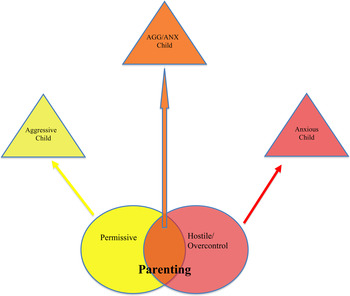
Pulling together the theoretical insights from psychoanalytic and attachment approaches and linking them to the behavioral extant research on parent–child relations, I propose a novel developmental model that links anxiety and aggression. We have shown that anxiety and aggression problems co-occur at high rates in children, suggesting some causal link. For those children who are comorbid for anxiety and aggression problems, aggression in real time may emerge in response to triggers of anxiety present since early parent–child interactions. This anxiety may be about anticipating hostile retaliation from the parent when they have been “bad.” However, children's anxiety is also about the difficulty of predicting how the parent will react in the first place. Figure 1 represents the current model at the developmental scale. I have reviewed behavioral research showing that “purely” aggressive children seem to have parents that are overly permissive and “purely” anxious children have hostile and overcontrolling parents. I propose that children who are both anxious and aggressive have parents who are sometimes permissive (reinforcing aggression) and sometimes hostile/overcontrolling (triggering anxiety) in response to the same type of (mis)behavior. The day-to-day unpredictability of these parental reactions may not only exacerbate anxiety but also link it with aggressive behaviors reinforced by parental permissiveness. The importance of parental unpredictability in the development of childhood anxiety and aggression has been pointed to by others, yet very little explicit modeling and almost no empirical research directly tests this assumption.
(Color online) Unpredictable oscillations between permissiveness and hostile/overcontrolling parenting leads to the development of co-occurring anxiety and aggression problems.

Directions for novel research
Given the diversity of theoretical avenues that have placed emphasis on unpredictability, it is crucial to establish the extent to which unpredictable parenting may contribute to the early onset and amplification of anxiety and subsequent aggression. Observational and longitudinal designs with nonclinical but at-risk children may be particularly powerful to track the emergence of AGG/ANX children's psychopathology. Parents and children can be videotaped in their homes, for example, from as early as 3 years of age, every 6 months for several years, to track the emergence of children's comorbid symptomotology.
Measuring predictability meaningfully requires not only observational methods but also a process-level analytic approach that can tap changes from moment to moment in parent–child interactions. How these moment-to-moment patterns change over the course of development is also critical for understanding the impact of unpredictability. Predictability can be assessed within an interaction episode (e.g., how consistently does a parent communicate her disapproval following noncompliant behaviors during one particular discussion) and it can also be assessed across interaction episodes (e.g., how much does that level of consistency change over the course of 1 year).
Dynamic systems methods have been particularly successful at addressing predictability in child and family systems (e.g., Dishion, Nelson, Winter, & Bullock, Reference Dishion, Nelson, Winter and Bullock2004; Granic & Hollenstein, Reference Granic and Hollenstein2003, Reference Granic, Hollenstein, Cicchetti and Cohen2006; Granic, Hollenstein, Dishion, & Patterson, Reference Granic, Hollenstein, Dishion and Patterson2003; Hollenstein, Granic, Stoolmiller, & Snyder, Reference Hollenstein, Granic, Stoolmiller and Snyder2004; Lewis, Lamey & Douglas, Reference Lewis, Lamey and Douglas1999; Lickwarck-Aschoff, Hasselman, Cox, Pepler, & Granic, 2012; Lunkenheimer, Olson, Hollenstein, Sameroff, & Winter, Reference Lunkenheimer, Olson, Hollenstein, Sameroff and Winter2011). These methodologies allow researchers to examine several coexisting interaction patterns and explore movement from one to the other in real time (Granic & Hollenstein, Reference Granic and Hollenstein2003, Reference Granic, Hollenstein, Cicchetti and Cohen2006; Lewis et al., Reference Lewis, Lamey and Douglas1999). This movement can be quantified and the level of predictability over time can be established empirically through process-level indices.
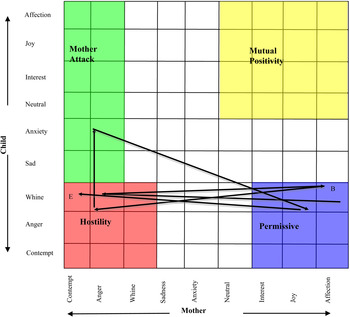
A concrete example may prove useful. Figure 2 shows a state space grid (Lewis et al., Reference Lewis, Lamey and Douglas1999), a dynamic systems method we have previously used to represent and measure parent–child behavior in real and developmental time (Granic et al., Reference Granic, Hollenstein, Dishion and Patterson2003; Granic, O'Hara, Pepler, & Lewis, Reference Granic, O'Hara, Pepler and Lewis2007; Hollenstein et al., Reference Hollenstein, Granic, Stoolmiller and Snyder2004). Parent–child interactions that are video recorded every 6 months (for example) over the course of several years, can be subsequently coded for affective behavior. It would be ideal to use a real-time coding system. For instance, nine common affective codes that can capture parent–child interactions are shown in Figure 2; the parent's behavior is tracked on the x axis and the child's behavior on the y axis. State space grids can be constructed for all dyadic observations at each assessment wave separately.
(Color online) State space with the four regions (highlighted) representing dyadic patterns of interest. The trajectory shown is an interaction pattern that is expected to characterize aggressive–anxious (AGG/ANX) children. The “B” cell is where the dyad begins, and the “E” cell is where it ends. Mother is highly unpredictable (e.g., there are many transitions between cells for her) and she moves back and forth from affectionate/joyful to angry/contemptuous in response to the same child behavior (i.e., whining).

With this methodology, the dyad's trajectory (i.e., the sequence of codes) is plotted on a grid of cells. To test my proposed model, four grid regions are of particular interest, representing different styles of parent–child interactions (see Figure 2). The total duration in each region can be computed with the expectation that the two bottom regions (permissiveness and hostility) will be occupied for longer durations for children who eventually develop AGG/ANX problems. In addition, at least three measures of unpredictability can be derived from the grids: entropy, number of transitions, and dispersion.
Because it would be particularly important to establish the predictability of mother's responses to the same child affective behavior (e.g., whining), movement between “mutual hostility” and “permissive” can be quantified for analyses. These indices of predictability can then be combined with macromeasures of anxiety and aggression (e.g., using the Child Behavior Checklist; Achenbach, Reference Achenbach1991) to run statistical models that can differentiate trajectories of change, measured across the longitudinal waves. Mediational analyses can be conducted within this framework such that, for example, maternal unpredictability at Wave 1 predicts anxiety at Waves 2 and 3 and aggression at Waves 4 and 5. Thus, the proposed model of parenting precursors to the development of the AGG/ANX profile can be directly tested. Moreover, observations coded in real time would allow the sequential tracking, on a fine-grained level, of children's expression of anxiety and aggression patterns during episodes characterized by heightened parental unpredictability.
Testing the proposed model in Figure 1 seems like an important first step for establishing the parenting factors that give rise to the development of co-occurring childhood aggression and anxiety. A dynamic systems approach holds particular promise, given that it provides a means by which predictability can be quantified in both real and developmental time. However, the dynamic systems approach in developmental psychology is still primarily a descriptive one, and the proposed method of testing the model does not provide a precise mechanism by which anxiety links up with aggression intraindividually. To establish such a mechanism, we need to study the instances during which anxiety is triggered within an individual and the conditions under which it does or does not lead to aggression in real time.
Hypothesis 2
Prolonged periods of anxiety deplete children's capacity to inhibit impulses and trigger bouts of aggression that in turn function to regulate initial anxiety levels.
Extant research and relevant theory
Given the high prevalence rates of co-occurring anxiety and aggression, why has so little research attempted to understand the precise mechanisms by which feelings of anxiety and the tendency to act out aggressively are linked? One reason may be that the association is simply counterintuitive: If a child is fearful, one might think that he is less likely to lash out and aggress. Individuals with antisocial and aggressive personalities sometimes lack fearful inhibition (Gray, Reference Gray1982) and show low trait anxiety (Cleckley, Reference Cleckley1982); anxiety inhibits aggressive behavior in some contexts (e.g., Ferreira, Hansen, Nielsen, Archer, & Minor, Reference Ferreira, Hansen, Nielsen, Archer and Minor1989; Gray, Reference Gray1987; Hard & Hansen, Reference Hard and Hansen1985). However, in two recent reviews, one on rodents (Neumann, Veenema, & Beiderbeck, Reference Neumann, Veenema and Beiderbeck2010) and the other on clinical children (Bubier & Drabnick, Reference Bubier and Drabnick2009), anxiety and aggression were shown to co-occur more often than not. This seems paradoxical: How can anxiety inhibit aggressive impulses while also being associated with higher levels of aggression? It may be difficult to reconcile these contradictory findings unless we examine more closely the real-time causal relations between anxiety and aggression.
The research on emotion and emotion regulation in developmental psychopathology and neuroscience provides some hints as to the processes by which anxiety links with aggression for some children. When children are clinically anxious, they have learned to anticipate threat in neutral circumstances (Pine, Reference Pine2003). As a result they become overvigilant concerning potential threats, especially in challenging circumstances (Eisenberg, Hofer, & Vaughn, Reference Eisenberg, Hofer, Vaughn and Gross2007; Eisenberg & Morris, Reference Eisenberg and Morris2003; Salters-Pedneault, Roemer, Tull, Rucker, & Mennin, Reference Salters-Pedneault, Roemer, Tull, Rucker and Mennin2006). They tend to amplify their fears by focusing on stress-inducing stimuli rather than recruiting a flexible repertoire of regulation strategies (e.g., problem solving; Bradley, Reference Bradley2000).
Children who perceive their environment as aversive or threatening will normally tend to withdraw or avoid the source of threat (Amstadter, Reference Amstadter2008), but in other cases, aggression emerges by way of one of two routes: one direct (the top arrow, Figure 3) and one indirect, through loss of inhibitory control, or ego depletion. The direct route is consistent with Gray's updated model (1994), which posits a neural subsystem that underpins fight or flight responses and defensive aggression. In a recent empirical review of neuroscientific evidence, Potegal and Stemmler (Reference Potegal, Stemmler and Potegal2010) argued that the medial hypothalamus and periaqueductal gray most likely underlie defensive aggression (see also Adams, Reference Adams2006; Siegel, Reference Siegel2004; Siegel, Roeling, Gregg, & Kruk, Reference Siegel, Roeling, Gregg and Kruk1999). They further proposed that defensive aggression is fear driven, based on the anatomy of these circuits. Thus, there is some evidence on the neural level that “hot,” reactive aggression is specifically triggered by anxiety-driven circuitry.
(Color online) Hypothesized real-time model linking anxiety to aggression.

The notion of a direct route from anxious feelings to aggression is based on animal models (e.g., Potegal & Stemmler, Reference Potegal, Stemmler and Potegal2010). However, because humans are routinely engaged in some level of inhibitory control (Carlson & Wang, Reference Carlson and Wang2007; Fox & Calkins, Reference Fox and Calkins2003), these models are no doubt incomplete. I propose that an indirect route from anxiety to aggression works through the loss of inhibitory control, a process akin to Baumeister and colleagues' ego depletion (Baumeister, Bratslavsky, Muraven, & Tice, Reference Baumeister, Bratslavsky, Muraven and Tice1998; Baumeister & Heatherton, Reference Baumeister and Heatherton1996; Baumeister, Vohs, & Tice, Reference Baumeister, Vohs and Tice2007). Their work shows that the biological substrates of self-control become diminished or used up within minutes (for a review, see Heatherton & Wagner, Reference Heatherton and Wagner2011). It may be that anxiety at first serves to inhibit aggression (Gray, Reference Gray1987, Reference Gray1994; Salters-Pedneault, et al., Reference Salters-Pedneault, Roemer, Tull, Rucker and Mennin2006), but over time, it may lead to the disinhibition of aggressive behavior through ego depletion.
Longitudinal and correlational studies that tap global constructs of anxiety and aggression are unlikely to disentangle these dual effects of anxiety on aggression. To address this gap, models need to be developed and commensurate studies need to be conducted that focus on the mechanisms by which anxiety and aggression influence each other in the lived experiences of children. Toward this goal, Figure 3 presents a conceptual model for the real-time link between anxiety and aggression for AGG/ANX children. The most important contribution of this model is the role of ego depletion, which helps to reconcile the seemingly paradoxical effects of anxiety on the tendency to aggress. At first, anxiety may serve to inhibit impulsive acts of reactive aggression. However, sustaining inhibitory control while attending to potential threats (e.g., unpredictable parent hostility) may lead to ego depletion, causing AGG/ANX children to eventually “snap” and aggress against perceived sources of threat.
Moreover, consistent with early psychoanalytic thinking (c.f., Greenberg et al., Reference Greenberg, Speltz, DeKlyen and Jones2001; Spelz et al., 1999), I propose that, for AGG/ANX children, aggression itself is a regulatory response that decreases anxiety because it increases a sense of power and efficacy. Disinhibition in general (letting go of control) may often paradoxically induce feelings of power (Hirsh, Galinsky, & Zhong, Reference Hirsh, Galinsky and Zhong2011; Lewis, Reference Lewis2011). Thus, aggression may become highly useful and rewarding for these children because it works; it makes them feel better.
Directions for novel research
The proposed real-time model (Figure 3) is a novel one and needs to be systematically tested with studies that induce anxiety, measure inhibitory control (and its loss through ego depletion), and track levels of aggression over time. In animal studies (mice in particular), anxiety levels have repeatedly been shown to positively covary with aggression levels (e.g., Bosch, Meddle, Beiderbeck, Douglas, & Neumann, Reference Bosch, Meddle, Beiderbeck, Douglas and Neumann2005; Nyberg, Vekovischeva, & Sandnabba, Reference Nyberg, Vekovischeva and Sandnabba2003). Human studies that experimentally induce increasing levels of anxiety and then allow an opportunity for aggression would be informative in this regard.
For example, AGG/ANX children and a comparison group could be run through an anxiety-induction go/no-go procedure (e.g., Lewis et al., Reference Lewis, Granic, Lamm, Steiben, Todd and Moadab2008; Stieben et al., Reference Stieben, Lewis, Granic, Zelazo, Segalowitz and Pepler2007; Woltering et al., Reference Woltering, Granic, Lamm and Lewis2011). As with many of these paradigms, children will need to click a button (i.e., go) for each letter or picture presented onscreen but avoid clicking (i.e., no-go) when an infrequent alternative letter or picture is presented. No-go trials require participants to withhold a prepotent response and thus tap inhibitory control mechanisms (Simpson & Riggs, Reference Simpson and Riggs2005). Because ego depletion can be conceptualized as the loss of inhibitory control, the errors in the no-go trials can be used as a marker for ego depletion.
To induce anxiety the task can be rigged such that points are gained in an initial block of trials then drop to near zero while the opponent's points rise in an anxiety-induction phase. Because anxiety manifests in sympathetic arousal, heart rate can serve as an index for anxiety levels throughout the task. An opportunity to aggress may then be introduced during the task such that the game stops and participants' accumulated points are displayed, perhaps in contrast with a fictitious opponent. Then participants can be allowed to administer a blast of noise at this fictitious opponent, for example, by using the Taylor Aggression Paradigm (Taylor, Reference Taylor1967). This task allows participants to react to their loss of points by blasting their opponent with a loud noise, varying in intensity from “not painful at all” to “extremely painful.”
Thus, with this type of set-up, the extent to which anxiety levels just prior to the opportunity to aggress predict levels of subsequent aggression can be examined. Accelerated error rates over the course of the task can serve as a measure of ego depletion and should predict increases in the intensity of aggression for the AGG/ANX group but not for a normal control group. Furthermore, one can adjust the design to take away the opportunity to aggress. If aggression functions to regulate anxiety as hypothesized, then heart rate should increase during the emotion-induction block and remain high for AGG/ANX children when they have no opportunity to aggress.
The kind of paradigm that I have just described assumes that errors on the no-go trials are due to increasing anxiety that brings the child closer and closer to becoming depleted. However, differences in these error rates can also be more simply conceptualized as indexing individual differences in trait levels of inhibitory control. The errors themselves do not distinguish between the real-time process of decreasing inhibition and trait levels of disinhibition. It is clear that lower trait levels of inhibition do distinguish aggressive children from their typically developing peers (e.g., Nigg, Reference Nigg2000); to more rigorously test the real-time model, the process (loss of inhibition) and the trait (lack of inhibition) would need to be distinguished by baseline measures tapping inhibitory control. These levels could be taken as moderators or used as a means by which children are grouped and compared.
Study designs can also do more than systematically increase anxiety levels. For example, evidence for the role of anxiety might also include oxytocin administration studies. Oxytocin is known to decrease anxiety (Huber, Veinante, & Stoop, Reference Huber, Veinante and Stoop2005). Within-subject ABA designs that induce anxiety, provide conditions to aggress, then administer oxytocin to decrease anxiety, and again assess aggressive behavior, would provide one possible test of the link between anxiety and aggression.
Hypothesis 3
Minor daily stressors give rise to anxiety while cognitive perseveration maintains anxious moods, both disposing children toward aggression.
Extant research and relevant theory
Anxiety often does not diminish in a few minutes; it can extend into anxious moods that persist for hours and even days. If the previous arguments are valid, then these moods should further predispose AGG/ANX children to aggress against perceived threats. There is no research on the factors that trigger and subsequently maintain aggressive children's anxious moods. The literature on stress, however, is helpful. In particular, minor, everyday stressors seem to play a critical role in the development of psychopathology, perhaps even more than do traumatic events (e.g., Cohn et al., Reference Cohn, Fredrickson, Brown, Mikels and Conway2009). The impact of daily life stressors on adult psychopathology is undisputed (e.g., Myin-Germeys et al., Reference Myin-Germeys, Oosrschot, Collip, Lataster, Delespaul and van Os2009; Wichers et al., Reference Wichers, Peeters, Geschwind, Jacobs, Simons and Derom2010). However, far less is known about how everyday stressors (e.g., not being picked to be on a team, being teased in the playground, getting a bad grade) affect children's development. If several daily stressors cluster closely in time, children may become locked into attending to ongoing threats, perpetuating their anxious moods over hours. However, most children experience daily stressors without developing AGG/ANX problems. Thus, an additional mediating mechanism is necessary that maintains and amplifies anxious moods: cognitive perseveration (e.g., worrying, ruminating).
Research on adult anxiety disorders and cardiovascular health suggests that cognitive perseveration is a key mechanism by which individuals maintain and amplify anxious moods (Brosschot, Reference Brosschot2010; Pieper, Brosschot, van der Leeden, & Thayer, Reference Pieper, Brosschot, van der Leeden and Thayer2010; Verkuil, Brosschot, Gebhardt, & Thayer, in press). AGG/ANX children may not only attend to actual threatening cues in the form of daily life stressors but may also excessively anticipate, worry about, and ruminate over the impact of these threats, even when they are in a safe context. Thus, these children “carry” their anxiety-fueled threat distortions with them into contexts that may seem banal or even safe to others around them.
Consistent with social information processing accounts of childhood aggression (e.g., Dodge, Reference Dodge1980; Dodge, Price, Bachorowski, & Newman, Reference Dodge, Price, Bachorowski and Newman1990; Dodge & Somberg, Reference Dodge and Somberg1987), the daily stressors that may be most salient for aggressive children are social in nature. Aggressive children repeatedly have been shown to attribute hostile intentions to peers in ambiguous (Aydin & Markova, Reference Aydin and Markova1979; Dodge, Reference Dodge1980), and even positive, prosocial circumstances (Dodge, Murphy, & Buchsbaum, Reference Dodge, Murphy and Buchsbaum1984). The emotional underpinnings of these hostile attributions are still unknown, but negative affect has been suggested as one mechanism and anxiety may be that affect (Dodge & Somberg, Reference Dodge and Somberg1987).
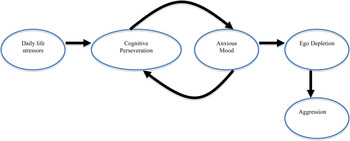
In addition to focusing and perseverating on current or anticipated hostile interactions, much of AGG/ANX children's cognitive perseveration may be allocated toward maintaining inhibitory control (e.g., “That guy is looking at me weird … I should just ignore him”). Consistent with the real-time model presented in Figure 3, it may be that after hours of attempting to inhibit recurrent aggressive impulses, these children finally lose self-control (become ego depleted) and subsequently aggress (e.g., “I can't handle this anymore! I'm going to wipe that grin off him!”). This model suggests that children may act out aggressively later in the day and later in the week. Their capacity to inhibit impulses may wane as they are repeatedly challenged with threatening stimuli during the day or as they experience clusters of daily stressors over the course of a week. Figure 4 summarizes the impact of daily life stressors on aggressive behavior via anxious moods that are maintained by cognitive perseveration.
(Color online) The role of daily life stressors and cognitive perseveration on anxious moods and subsequent aggression.

Directions for novel research
Part of the reason why we know so little about how anxious moods affect children's aggressive behavior has to do with methodological limitations inherent in most child-focused research. To understand how moods influence behavior, detailed information about emotions, their durations, and the context in which they emerge is necessary. Process-level methods are needed, but observational methods are difficult to employ for these purposes because researchers cannot videotape children throughout the whole of their day, across their varied social contexts (e.g., at home, in the playground, in the classroom). Questionnaires pose even greater challenges because asking individuals to report on their moods retrospectively introduces systematic biases due to current emotional states and recall failures. Moreover, research on child psychopathology most often relies on reports from parents and teachers, distancing the phenomena of lived emotional experiences even further from the source.
One way to address these limitations is to apply experience-sampling methods (ESMs). ESMs involve contacting participants several times every day, over the course of several days or weeks, to answer a brief set of questions about their current emotions, thoughts, and context (usually on a smartphone or similar portable electronic device; e.g., Larson & Lampman-Petraitis, Reference Larson and Lampman-Petraitis1989; Silk et al., Reference Silk, Forbes, Whalen, Jakubcak, Thompson and Ryan2010). Participants can report what they are feeling that very moment, who they are with, and what they are doing; thus, retrospective biases are eliminated, detailed sampling of individuals' emotional lives is collected, and the data are highly ecologically valid (Myin-Germeys et al., Reference Myin-Germeys, Oosrschot, Collip, Lataster, Delespaul and van Os2009; Silk et al., Reference Silk, Forbes, Whalen, Jakubcak, Thompson and Ryan2010; Wichers et al., Reference Wichers, Peeters, Geschwind, Jacobs, Simons and Derom2010).
ESM designs can be employed to test the relation between daily life stressors, anxiety, and aggression, as well as the mediating role of cognitive perseveration; they can reveal relations between the frequency and intensity of anxiety and subsequent aggressive behavior. Moreover, the relation between the intensity of daily stressors and anxiety levels should be mediated by the degree of cognitive perseveration, and high ratings of cognitive perseveration on several consecutive calls would be expected to implicate ego depletion and thus predict aggression. It is critical that an ESM design has the potential to extend the real-time model illustrated in Figure 3 from the momentary impact of anxious feelings to the more extended influence of anxious moods. Moreover, ESM studies allow for a more ecologically valid assessment of the daily life experiences of AGG/ANX children, experiences often neglected in contemporary research.
Clinical Implications
The three main hypotheses that have been presented as part of a theoretical model linking anxiety and aggression, in real time and over development, lead to some clear implications for prevention and treatment. Despite promising outcomes from randomized controlled studies with aggressive children, there remains enormous variability in treatment outcomes, and processes of change are rarely examined (Brestan & Eyberg, Reference Brestan and Eyberg1998; Eyberg, Nelson & Boggs, Reference Eyberg, Nelson and Boggs2008; Kazdin, Reference Kazdin2001a, Reference Kazdin, Nathan and Gorman2002, Reference Kazdin2007). Based on the current model, I propose that treatment for aggressive children is less effective than it could be because anxiety is the driver of aggression for the majority of children, yet this is completely ignored in existing interventions. Moreover, some of the most strongly supported treatment protocols for aggression place children in contexts that can be viewed as highly anxiety producing. For example, many cognitive–behavioral group interventions for children use role-playing methods that involve asking children to act out scenarios during which they were previously aggressive (e.g., Augimeri, Farrington, Koegl, & Day, Reference Augimeri, Farrington, Koegl and Day2007; Koegl, Farrington, Augimeri, & Day, Reference Koegl, Farrington, Augimeri and Day2008; Lochman, Reference Lochman1992; Lochman & Lenhart, Reference Lochman and Lenhart1993). These public performances may cause some children intense feelings of anxiety that may limit the utility of these exercises for reducing future acts of aggression. A more serious effect is that these experiences may completely “turn off” the children and frighten them further, potentially exacerbating aggressive behavior problems or leading to attrition and negative appraisals about the efficacy of treatment programs in general.
There are additional iatrogenic considerations to keep in mind that are specific to anxiety problems. Many standard manuals on the treatment and prevention of anxiety disorders warn that insufficient duration of exposure to fear-inducing stimuli (not providing enough time for the client to get used to, and overcome, particular fears) may actually exacerbate symptoms of anxiety (Lilienfeld, Reference Lillienfeld2007; Shipley & Boudewyns, Reference Shipley and Boudewyns1980; Stone & Borkovec, Reference Stone and Borkovec1975). The danger for children who are anxious but have been referred to treatment for only their aggression may be that they are exposed directly to the fear-inducing contexts that most distress them (e.g., provocations by peers, disapproval by counselors, teachers, or parents), but the therapists are not trained to help the child work through their distress. In other words, for many children in anger and aggression programs, we may be treating the symptoms, completely avoiding the causes and thus making some children worse.
On a more optimistic note, it is likely that many of the most effective treatments for aggressive children in the real world are already implicitly, if not explicitly, targeting children's anxiety. My own clinical research experience with children's mental health agencies in both North America and Europe suggests that the role of anxiety in childhood aggression is very much acknowledged and even addressed by frontline therapists in everyday practice. However, this clinical reality has yet to become explicit in most research programs that examine the efficacy of treatments for aggressive behavior problems. It is interesting that one of the original developers of effective, cognitive–behavioral prevention programs for childhood aggression recently noted that, when he and others are conducting their intervention, they often implement classic anxiety-reduction techniques (e.g., exposure therapy) before they proceed with their main cognitive–behavioral program to target aggression (J. E. Lochman, personal communication, May 2012). This may be more common than expected in community-based practice, and it echoes the need for the systematic testing of the effectiveness of targeting anxiety.
If anxiety is one of the causal generators of reactive aggressive behavior, this does not necessarily suggest that aggression-focused treatments are useless for AGG/ANX children. Rather, targeting anxiety at the beginning of therapy may be all that is needed to maximize the efficacy of these programs. Once children stop focusing exclusively on threats and learn to regulate their anxious moods, it may be that they can more flexibly allocate their attention to relevant aspects of their environment. With this more flexible attention allocation, their implementation of nonaggressive problem-solving strategies (a cognitive–behavioral skill taught in many programs for aggressive children) may be more successful.
The suggestion that anxiety-focused treatment is more effective than aggression-focused treatment for AGG/ANX children needs rigorous testing. However, even if this hypothesis is borne out, it may still be the case that some combination of these strategies will ultimately be most effective. Two types of research designs could be implemented to get a better sense of the best approach with AGG/ANX comorbid children. The first could be a straightforward randomized control trial (RCT) meant to establish the relative efficacy of anxiety-versus aggression-focused treatments on decreasing children's aggression.
The unique strengths of an RCT design are (a) it provides an opportunity to experimentally test causation, (b) it does so in an ecologically valid paradigm outside the laboratory, and (c) its results can be immediately relevant to clinical contexts where they can have their greatest impact. For example, among the most effective treatments for aggressive children are family-based parent management training combined with child-focused cognitive behavioral therapy (for reviews, see Brestan & Eyeberg, Reference Brestan and Eyberg1998; Dumas, Reference Dumas1989; Eyberg et al., Reference Eyberg, Nelson and Boggs2008; Kazdin, Reference Kazdin1987, Reference Kazdin2001a, Reference Kazdin, Nathan and Gorman2002; Tremblay, Pagani-Kurtz, Masse, Vitaro, & Pihl, Reference Tremblay, Pagani-Kurtz, Masse, Vitaro and Pihl1995; Weisz, Doss, & Howley, Reference Weisz, Doss and Hawley2005). AGG/ANX children and their parents could be randomly assigned to one of two interventions: a parent management training/cognitive behavioral therapy program that focuses on either (a) anxiety (Barrett, Duffy, Dadds, & Rapee, Reference Barrett, Duffy, Dadds and Rapee2001; Dadds, Spence, Holland, Barrett, & Laurens, Reference Dadds, Spence, Holland, Barrett and Laurens1997; Flannery-Schroeder & Kendall, Reference Flannery-Schroeder and Kendall2000; Kendall et al., Reference Kendall, Flannery-Schroeder, Panichelli-Mindel, Southam-Gerow, Henin and Warman1997) or on (b) aggression (Barkley, Reference Barkley2000; Bloomquist & Schnell, Reference Bloomquist and Schnell2002; Forgatch & DeGarmo, Reference Forgatch, DeGarmo, Cox and Brooks-Gunn1999; Martinez & Forgatch, Reference Martinez and Forgatch2001). It is essential that both anxiety- and aggression-focused programs would have already been shown to be effective in previous RCT trials and that both are manualized, based on the same principles (e.g., cognitive–behavioral, parenting skills), and delivered for the same duration. If the comorbid children in the anxiety-based treatment protocol show more pronounced improvements in aggression compared with children in the aggression-based treatment group, then this would provide some evidence for the causal influence of anxiety on aggression problems.
The second type of treatment design could be combined with an RCT but the focus would be on examining mechanisms of change that account for improvements in children's anxious and aggressive symptoms. If RCT results turn out as hypothesized, it would remain unclear whether decreases in anxiety specifically caused the changes in aggressive behavior. Moreover, the model that I have presented posits that specific changes in parenting and cognitive perseveration will be associated with reductions in children's anxiety and subsequent aggression. However, change processes associated with treatment cannot be tapped by simply assessing outcome variables.
What is needed is a fine-grained assessment of emotional and behavioral changes in both parents and children, over the course of treatment, to pinpoint the timing of key changes (e.g., beginning, middle or end of treatment), their proximal causes (e.g., changes from unpredictable to predictable parenting in the home, reductions in cognitive perseveration), and the temporal sequence of those changes (e.g., decreases in anxiety should precede decreases in aggressive behavior). Toward these goals, the same ESM procedures that were described earlier could be combined with an RCT to examine precise relations between changes in anxiety and aggression. Observations of parent–child interactions over the course of therapy (e.g., every 2 weeks) can also be used to identify parenting and emotional change processes associated with decreases in aggression (Lichwarck-Aschcoff et al., Reference Lichwarck-Aschoff, Hasselman, Cox, Pepler and Granic2012).
In sum, if the proposed model of AGG/ANX children's development is correct, then one of the most important implications is its clinical relevance. Conducting an RCT comparing two well-validated treatments (anxiety and aggression focused) and identifying the precise mechanisms by which problem behaviors are reduced has the potential to advance both theory and practice in the field.
Scope of the Model
I have reviewed information most pertinent to a model that emphasizes how anxiety influences reactive aggression in childhood, including research on parent–child relationships, comorbidity rates, neural processes of emotion regulation, and treatment implications. My main aim was not to flesh out a comprehensive model of childhood aggression (for this type of integrative theoretical model, see Granic & Patterson, Reference Granic and Patterson2006) but to highlight often neglected internalizing mechanisms that may play a central role in the etiology and treatment of children's behavior problems. There are additional factors that influence the development of child psychopathology: Child temperament plays a central role in vulnerability to behavioral and anxiety problems (Calkins & Fox, Reference Calkins and Fox2002; Caspi, Henry, McGee, Moffitt, & Silva, Reference Caspi, Henry, McGee, Moffitt and Silva1995; Frick & Morris, Reference Frick and Morris2004; Muris & Ollendick, Reference Muris and Ollendick2005; Nigg, Goldsmith, & Sachek, Reference Nigg, Goldsmith and Sachek2004) and future research could integrate temperament data when testing the proposed model. There are additional ways to conceptualize comorbidity in children. Comorbidity for ADHD is high among aggressive children (Hinshaw, Reference Hinshaw1987, Reference Hinshaw1994). Diagnoses of depression may also co-occur frequently with those of children's anxiety, especially because the discriminant validity of distinctions between childhood anxiety and depression is highly controversial (e.g., Cole, Truglio, & Peeke, Reference Cole, Truglio and Peeke1997; Kazdin, Reference Kazdin1987; Patterson, Greising, Hyland, & Burger, Reference Patterson, Greising, Hyland and Burger1997; Laurent & Ettelson, Reference Laurent and Ettelson2001; Turner & Barrett, Reference Turner and Barrett2003). However, my current purpose was not to focus on nosological issues or diagnostic criteria. Instead, my focus was on how anxiety, a basic emotion with well-established behavioral concomitants and a distinct psychophysiological signature (Izard, Reference Izard1991; Fridja, Reference Fridja1986), impacts aggressive behavior. Genetic makeup is surely relevant (Caspi et al., Reference Caspi, Sugden, Moffitt, Taylor, Craig and Harrington2003; Copeland et al., Reference Copeland, Sun, Costello, Angold, Heilig and Barr2011; Dodge & Pettit, Reference Dodge and Pettit2003; Raine, Reference Raine2002) and there is little doubt that designs could be developed that incorporate Gene × Environment interactions. This would help determine for whom the model is most relevant, based on whether these emotional mechanisms differ for different genotypes.
Summary
I have reported that about 75% of aggressive children are also comorbid for anxiety, yet none of our most advanced developmental models of aggression incorporate the role of anxiety, and our treatment programs largely ignore this comorbidity. Theoretical insights and extant research were brought to bear on a novel model of the potential impact of anxiety on reactive aggressive behavior. Specific suggestions were made about new research programs that could systematically test the hypotheses set out by this model. I suggested a variety of potentially innovative approaches, proposing that the link between anxiety and aggression can be examined in observational, experimental, and diary designs, at time scales ranging from seconds to years, and in the context of clinical and intervention trials, to establish causal specificity and real-world applicability.
If the hypotheses laid out in this article are supported by a new set of studies that directly test the effects of anxiety on aggression, then clinical practice could incorporate this knowledge to improve care for aggressive children. Supervisors and managers may need to train front-line clinicians to identify anxiety symptoms early and to target these symptoms effectively. Moreover, it is important to note that about 25% of children are anticipated not to have problems with anxiety; these are the children for whom an anxiety-focused treatment may not be appropriate. By highlighting these subtype differences in clinical practice, treatments may be tailored to diverse children and families. If we know more about these subtypes of aggressive children, and we focus on identifying the most relevant treatment strategies, programs can be distilled to their essential components, leading to stronger, more beneficial and cost-effective interventions.