The first glyphosate-resistant (GR) broadleaf weed in the world was horseweed; its existence was confirmed in Delaware in the United States in 2000 (VanGessel Reference VanGessel2001). In Canada, GR horseweed was first reported in Essex County, Ontario, in 2010, and by 2012 it had been documented in eight counties within Ontario (Byker et al. Reference Byker, Soltani, Robinson, Tardif, Lawton and Sikkema2013c). Some biotypes of horseweed in Ontario have multiple resistance to glyphosate and cloransulam-methyl (Byker et al. Reference Byker, Soltani, Robinson, Tardif, Lawton and Sikkema2013c). The spread of resistant biotypes is aided by self-compatibility and the ability to produce a large number of wind-dispersed seeds per plant, which allows resistant biotypes to easily spread to neighboring areas (Weaver Reference Weaver2001; Zelaya et al. Reference Zelaya, Owen and VanGessel2004). Since horseweed can germinate in undisturbed soils, between cropland and noncropland there is a large area for resistant biotypes to establish and spread (Nandula et al. Reference Nandula, Reddy, Duke and Poston2005).
Horseweed is a winter or summer annual weed in the Asteraceae family (Frankton and Mulligan Reference Frankton and Mulligan1987). The seeds of horseweed are small, 1 to 2 mm long (Frankton and Mulligan Reference Frankton and Mulligan1987), with an attached pappus that aids in wind dispersal (Royer and Dickenson Reference Royer and Dickinson1999). When plants germinate in the fall, a basal rosette forms with round to oval-shaped hairy leaves with coarsely toothed margins; the following spring, the stem elongates while the rosette deteriorates (Frankton and Mulligan Reference Frankton and Mulligan1987). A basal rosette is not formed by spring-germinated horseweed (Bhowmik and Bekech Reference Bhowmik and Bekech1993). The mature leaves of horseweed have an alternate arrangement on the stem, are oblong to lance shaped and bristly haired, and range from 2 to 10 cm in length (Royer and Dickenson Reference Royer and Dickinson1999). Horseweed has a single erect stem that is densely covered in hairs (Loux et al. Reference Loux, Stachler, Johnson, Nice, Davis and Nordby2006) and can grow up to 180 cm in height (Frankton and Mulligan Reference Frankton and Mulligan1987). As the plant matures, multiple flowering branches emerge that contain small flower heads on branched terminal clusters (Frankton and Mulligan Reference Frankton and Mulligan1987; Royer and Dickenson Reference Royer and Dickinson1999). Each of these flowers is self-compatible (Weaver Reference Weaver2001) and primarily self-pollinated (Smisek Reference Smisek1995). A 40-cm-tall horseweed plant can produce approximately 2,000 seeds, while a plant 1.5 m in height can produce 230,000 seeds (Weaver Reference Weaver2001).
POST herbicides in soybean are not effective for control of GR horseweed (Davis et al. Reference Davis, Gibson, Bauman, Weller and Johnson2009). Burndown and residual chemistries applied preplant (PP) have been shown to provide effective control of GR horseweed. At 8 wk after application (WAA), glyphosate (900 g ai ha−1) plus 2,4-D at 560 and 1,120 g ai ha−1 controlled GR horseweed 73 to 95% and 85 to 95%, respectively (Byker et al. Reference Byker, Soltani, Robinson, Tardif, Lawton and Sikkema2013b). At 8 WAA, glyphosate (900 g ai ha−1) plus metribuzin (1,120 g ai ha−1) applied PP controlled GR horseweed 97 to 99% (Byker et al. Reference Byker, Soltani, Robinson, Tardif, Lawton and Sikkema2013b).
Saflufenacil is a WSSA Group 14, protoporphyrinogen IX oxidase (PPO) inhibiting herbicide in the pyrimidinedione chemical family (Grossman et al. 2010). Byker et al. (Reference Byker, Soltani, Robinson, Tardif, Lawton and Sikkema2013b) reported that saflufenacil (25 g ai ha−1) plus glyphosate (900 g ai ha−1) provided 88 to 100% control of GR horseweed 4 WAA in soybean. Variable results were reported by Ford et al. (Reference Ford, Soltani, Robinson, Nurse, McFadden and Sikkema2014b), in which saflufenacil (50 g ai ha−1) provided 98 to 100% control 8 WAA at four of five sites, but only 49% control was obtained at a fifth site. Others have reported variable control of GR horseweed with saflufenacil in growers’ fields and published literature. For example, Ikley (Reference Ikley2012) reported saflufenacil (25 g ai ha−1) applied with methylated seed oil (MSO) at 1% v/v and ammonium sulfate (AMS) at 2% v/v provided 35, 32, and 30% control of GR horseweed at 7, 14, and 28 d after application (DAA), respectively, in a greenhouse study. The addition of glyphosate (900 g ai ha−1) to saflufenacil (25 g ai ha−1) plus MSO (1% v/v) and AMS (2% v/v) improved the control to 61, 67, and 57% at 7, 14, and 28 DAA, respectively (Ikley Reference Ikley2012). Reports from published literature and growers’ fields indicate variable control of GR horseweed with saflufenacil.
The time of day (TOD) of herbicide application can affect herbicide efficacy, although this is dependent on the herbicide and weed species (Stewart et al. Reference Stewart, Nurse and Sikkema2009). Several factors that change throughout the day, such as air temperature, relative humidity (RH), and light intensity, cause plant physiological changes that may account for variable weed control due to TOD (Stewart et al. Reference Stewart, Nurse and Sikkema2009). Cuticular wax and plasma membrane fluidity increases with air temperature, which results in greater herbicide uptake (Johnson and Young Reference Johnson and Young2002). RH can affect weed control as reported by Coezter et al. (2001),in which redroot pigweed (Amaranthus retroflexus L.) control with glufosinate increased as RH was increased from 35 to 90% in studies conducted in growth chambers. In contrast, Stewart et al. (Reference Stewart, Nurse and Sikkema2009) did not observe a correlation between RH and herbicide efficacy. During early morning and late evening applications, heavy dew on plant leaves has been suspected of causing herbicide runoff and/or dilution (Doran and Andersen Reference Doran and Andersen1976); however, Stewart et al. (Reference Stewart, Nurse and Sikkema2009) concluded that dew did not contribute to the TOD effect as much as other environmental factors. Some weed species such as redroot pigweed, common lambsquarters (Chenopodium album L.), and velvetleaf (Abutilon theophrasti Medik.) have been reported to change their leaf angle in response to light availability (Andersen and Koukkari Reference Andersen and Koukkari1978; Kraatz and Andersen Reference Kraatz and Andersen1980). Leaf-angle changes could decrease herbicide efficacy due to less leaf area being available to intercept the herbicide, as Stewart et al. (Reference Stewart, Nurse and Sikkema2009) suggested; leaf angle variations may have contributed to greater weed control between 0900 and 1800 hours.
Since horseweed can germinate in the spring, summer, or fall (Weaver Reference Weaver2001), there can be a range of plant heights and densities at the time of PP herbicide application. In one year of a 2 yr study by Mellendorf et al. (Reference Mellendorf, Young, Matthews and Young2013), control of GR horseweed with saflufenacil (25 g ai ha−1) applied with 1% v/v crop oil concentrate was>98% for plants 5 to 45 cm in height. In the first year of the Mellendorf et al. (Reference Mellendorf, Young, Matthews and Young2013) study, GR horseweed control with glyphosate (900 g ai ha−1) plus saflufenacil (25 g ai ha−1) decreased 1% for each 8 cm increase in plant height ; however, control was still>94%. Reduced control of GR horseweed with saflufenacil (25 g ai ha−1) alone has been attributed to extensive regrowth from large rosettes (Ikley Reference Ikley2012). It has been suggested by Ikley (Reference Ikley2012) that saflufenacil likely did not translocate past the apical meristem and toward the roots, because plants in the rosette form have other growing points protected by the apical meristem. To avoid variability in weed control, it is important to have optimal criteria for foliar herbicide applications such as optimal spray coverage, proper adjuvant system, optimal environmental conditions (i.e., adequate sunlight and warm air temperatures), and relatively small weed size; these factors promote optimal foliar activity of a PPO-inhibiting herbicide such as saflufenacil (Mellendorf et al. Reference Mellendorf, Young, Matthews and Young2013).
GR horseweed can result in soybean yield losses of up to 93% where no weed management tactics are employed (Byker et al. Reference Byker, Soltani, Robinson, Tardif, Lawton and Sikkema2013b). Poor control of GR horseweed results in increased seed production (Weaver Reference Weaver2001) and widespread wind dispersal up to 550 km from the parent plant (Shields et al. Reference Shields, Dauer, VanGessel and Neumann2006). Since POST herbicides in soybean do not provide consistent control of GR horseweed, PP or PRE herbicides must be used in reduced and no-till soybean production (Loux et al. Reference Loux, Stachler, Johnson, Nice, Davis and Nordby2006; Davis et al. Reference Davis, Gibson, Bauman, Weller and Johnson2009). Excellent control of GR horseweed can sometimes be achieved with saflufenacil (Byker et al. Reference Byker, Soltani, Robinson, Tardif, Lawton and Sikkema2013a); however, an inquiry into the factors that cause variable control is needed. The objective of these studies was to determine the effect of TOD of application and the effect of GR horseweed height and density on control with saflufenacil in soybean. It is hypothesized that GR horseweed can be controlled in soybean with saflufenacil by optimizing the time of application.
Materials and Methods
Three separate field studies were conducted to evaluate the effect of GR horseweed height and density and TOD on control of GR horseweed, glyphosate plus saflufenacil. These studies were conducted in field sites previously confirmed to have GR horseweed present (Byker et al. Reference Byker, Soltani, Robinson, Tardif, Lawton and Sikkema2013a; Ford et al. Reference Ford, Soltani, Robinson, Nurse, McFadden and Sikkema2014a). Each study had six location years over a 2 yr period (2014, 2015), totaling 18 field trials. A randomized complete block design with four replications was used for the TOD trial. The trial plots were 2.25-m wide by 8-m long with three rows of soybean spaced 0.75 m apart. The treatments were applied at seven different times of the same day for each location year, from 0600 to 2400 hours at 3 h intervals. Weedy and weed-free controls were included in each replicate.
The height and density trials had four untreated and four treated replicates, each 38 m long and 3 m wide, alternating in sequence. The treatments for the height trial were seven different categories of GR horseweed plant heights from up to 1 cm to>25 cm. The height trial had 10 horseweed plants (subsamples) per treatment, randomly distributed throughout one half of the trial replicates, totaling 70 plants. This was repeated for the other half of the replicate for a total of 140 plants per trial. Each plant in the height trial was marked with a wire flag that was angled in the same direction as the spray would be applied, to avoid interference with spray deposition. The GR horseweed density trial had seven density treatments ranging from 1 to 20 horseweed plants m−2 up to>800 plants m−2. Each treatment had ten 0.25 m−2 quadrants randomly distributed throughout half of the replicate, totaling 70 quadrants. This was repeated for the other half of the replicate for a total of 140 quadrants per trial. Quadrants and flags were randomly distributed throughout the trial area; however, GR horseweed heights and densities needed to represent the associated treatment, so placement was random but representative of the treatment. Spray application occurred after all quadrants or flags were placed.
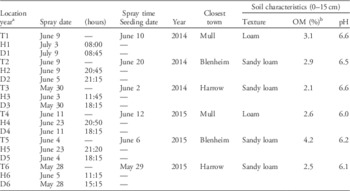
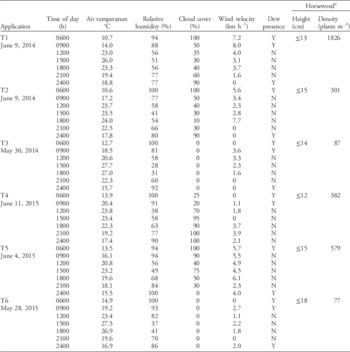
A CO2 compressed backpack sprayer calibrated to deliver 200 L ha−1 of spray mixture at 240 kPa was used to apply all herbicide treatments. All applications for the TOD study were 0 to 5 d PP, while the height and density trials were conducted in a noncrop area with the herbicide applied POST to the GR horseweed. The sprayer boom was 1.5 m wide with four ULD120-02 nozzles (Hypro, New Brighton, MN) spaced 50 cm apart. Untreated (weedy) and weed-free controls were included in each replicate of the TOD trials. The weed-free control was treated with a PP tank mix of glyphosate (1,800 g ai ha−1), saflufenacil (25 g ai ha−1), metribuzin (400 g ai ha−1), and Merge ® (BASF Canada, Mississauga, ON, L5R 4H1) surfactant (1 L ha−1), followed by hand hoeing if required. The herbicide application for all trials across all treatments was a tank mix of glyphosate (900 g ai ha−1), saflufenacil (25 g ai ha−1), and Merge surfactant (1 L ha−1). Quizalofop-p-ethyl (36 g ai ha−1) and glyphosate (900 g ai ha−1) were applied as cover sprays for the TOD trial in 2014 and 2015, respectively, to remove potentially confounding effects of other weed species. Pictures were taken of randomly marked plants in TOD trials to visually inspect leaf angle variation across application times; leaf angle was not measured. Information on herbicide application dates, herbicide application times, seeding dates, and soil characteristics are listed in Table 1. Details on the environmental conditions at each application for all studies are listed in Table 2.
Location and agronomic information for factors influencing glyphosate-resistant horseweed control with glyphosate plus saflufenacil studies in Ontario, Canada, in 2014 and 2015.

a T1–T6, location years for time of day of glyphosate plus saflufenacil application study; H1–H6, location years for height of horseweed at glyphosate plus saflufenacil application study; D1–D6, location years for density of horseweed at glyphosate plus saflufenacil application study. See Table 2 for year-by-year breakdown.
b OM, organic matter
Environmental measurements at each application for the effect from time of day of glyphosate plus saflufenacil application on glyphosate-resistant horseweed control study from 2014 and 2015 in Ontario, Canada.

a Horseweed height and density on the day of treatment application from untreated control plots.
Control of GR horseweed was visually assessed at 1, 2, and 4 WAA for all studies, 6 WAA for the height and density studies, and 8 WAA for the TOD study. A scale of 0 to 100% was used, in which 0 was no control and 100 was plant death. In the TOD study, at 8 WAA, GR horseweed dry weight and density were measured by counting the number of plants in two 0.25 m2 quadrants per plot and then cutting them at the soil surface. Cut plants were placed into paper bags and dried to a constant weight at 60 C and then weighed. Dry weight was similarly measured in the density study; however, all marked quadrants were harvested at 6 WAA; the height trial was similar but only involved the individually marked plants for dry weight. Soybean yield was measured for the TOD study by pulling a 2 m length from the center row and threshing it in a stationary threshing machine at soybean maturity. The weight and moisture content of the harvested grain was recorded for each plot. The soybean grain yield is presented in kilograms per hectare at 13% grain moisture.
The PROC NLIN procedure in SAS (v. 9.4; SAS Institute, Cary, NC) was used to analyze the responses in all studies. The significance of environment, replication within environment, and environment by treatment interaction from zero was tested using a likelihood ratio test. No significant environment by treatment interaction was found, so all environments were combined for analysis. The weed-free and weedy controls were not included in the regression analysis. For the TOD study, all parameters were fit to a quadratic parabolic curve model (Equation 1), and PROC REG was used to test for lack of fit. The lack of fit for the linear and quadratic terms was not significant, confirming the appropriateness of the quadratic parabolic model. Because the equation includes an estimated parameter by the regression output, a one-sided hypothesis test could be conducted to determine confidence bounds (University of California–Los Angeles [UCLA] Statistical Consulting Group 2016).
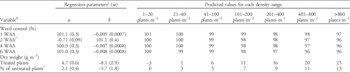
The GR horseweed height study used a linear model (Equation 2) for all parameters, because the height treatments were equally spaced with the exception of the up to 1 cm treatment and lack of fit was not significant (>0.05). In the GR horseweed density study, all parameters were fit to an exponential model (Equation 3) or a linear model. If lack of fit was not significant for the linear model, then it was used. When lack of fit was significant for the linear model, it was tested for the exponential model, and if lack of fit was not significant, the exponential model was applied. The predicted values in Tables 3 to 5 were generated using the appropriate regression model based on lack of fit.
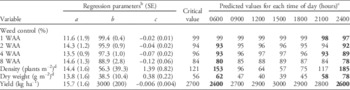
Regression parameters of parabolic curve equation for glyphosate-resistant horseweed control 1, 2, 4, and 8 WAA, density, dry weight, and soybean yield for time of day of glyphosate plus saflufenacil application study conducted in 2014 and 2015 in Ontario, Canada.Footnote a

a Abbreviation: WAA, weeks after application.
b Parameters: a, time of day at vertex; b, predicted value at vertex; c, constant.
c Numbers in bold are significantly less than the parameter maximum or significantly greater than the parameter minimum as defined by the critical value that is the one-sided confidence bound where P<0.05.
d Measured at 8 WAA
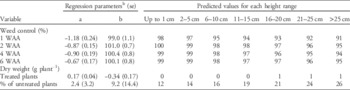
Regression parameters of linear equation for glyphosate-resistant horseweed control 1, 2, 4, and 6 WAA, dry weight of treated plants, and dry weight of treated plants as a percentage of untreated plants for height at application of glyphosate plus saflufenacil study conducted in 2014 and 2015 in Ontario, Canada.Footnote a

a Abbreviation: WAA, weeks after application.
b Parameters: a, slope; b, intercept.
Regression parameters of exponential and linear equations for glyphosate-resistant horseweed control 1, 2, 4, and 6 WAA, dry weight of treated plants, and dry weight of treated plants as a percentage of untreated plants for density at application of glyphosate plus saflufenacil study conducted in 2014 and 2015 in Ontario, Canada.Footnote a

a Abbreviation: WAA, weeks after application.
b An asterisk (*) indicates a linear equation was used; otherwise, an exponential equation was used.
c Parameters: a, intercept; b, slope (for exponential equation); a, slope; b, intercept (for linear equation).
Equation 4 was used to calculate the critical value for the estimate of the parameter maximum/minimum to determine treatment differences (UCLA Statistical Consulting Group 2016). If the parameter estimate for a treatment is within the bounds between estimate maximum/minimum and the critical value, it is not significantly different (P>0.05).
In the TOD study, all parameters were regressed against time of application, represented by TIME in the equation. For the height study, all parameters were regressed against GR horseweed height at application, represented by HEIGHT in the equation. In the density study, all parameters were regressed against GR horseweed density at application, represented by DENSITY in the equation.
 $${\rm Quadratic}\,{\rm parabolic}\,{\rm curve}\,{\rm model}\;\;Y\, {\equals}\, c\left( {{\rm TIME}{\minus}a} \right)^{2} {\plus}b$$
where a is the TOD at the vertex, b is the predicted value at the vertex, and c is the constant.
 $${\rm Linear}\,{\rm model}\;\;Y\, {\equals}\, a\left( {{\rm HEIGHT}} \right){\plus}b $$
where a is the slope, and b is the intercept.
 $${\rm Exponential}\,{\rm model}\;\;Y\, {\equals}\, a\,{\times}{\rm e}^{{\left( {{\rm b}\,{\rm DENSITY}} \right)}} $$
where a is the magnitude, and b is the slope.
 $${\rm Critical}\,{\rm value}\;\;C\, {\equals}\, d-\left( {t_{{{\rm obs}}} {\times}{\rm SE}} \right)$$
where d is the estimate of the parameter maximum/minimum, t obs is the value from a one-sided T table that corresponds to P (0.05) and degrees of freedom associated with the residual sum of squares, and SE is the standard error of the parameter.
Results and Discussion
Study 1. Effect of Time of Day on Glyphosate plus Saflufenacil Efficacy
Control of GR horseweed was consistently>90% at 1 and 2 WAA at all TODs with glyphosate plus saflufenacil. At 1 WAA, glyphosate plus saflufenacil provided 97% or more control of GR horseweed across all TODs (Table 3). The highest control of 99% was from 0600 to 1800 hours. At 2 WAA, glyphosate plus saflufenacil provided 92 to 96% control of GR horseweed with the greatest control from 0900 to 2100 hours. Glyphosate plus saflufenacil provided the lowest control of 93 and 92% when applied at 0600 and 2400 hours, respectively. The results from this study are similar to Byker et al. (Reference Byker, Soltani, Robinson, Tardif, Lawton and Sikkema2013a), who reported that saflufenacil (25 g ai ha−1) plus glyphosate (900 g ai ha−1) provided 98 and>90% control at 1 and 2 WAA, respectively.
At 4 WAA, glyphosate plus saflufenacil provided 89 to 97% control of GR horseweed with the greatest control from 0900 to 1800 hours (Table 3). Control was less at 0600 hours and from applications 2100 hours and later, decreasing to 93% control at 0600 hours and 89% control at 2400 hours. At 4 WAA, Byker et al. (Reference Byker, Soltani, Robinson, Tardif, Lawton and Sikkema2013a) reported that saflufenacil (25 g ai ha−1) plus glyphosate (900 g ai ha−1) provided>95% control, which is consistent with these findings when applied between 900 and 1800 hours. Similarly, control of velvetleaf, redroot pigweed, and common lambsquarters was decreased with applications made in the early morning or late evening, as reported by Stewart et al. (Reference Stewart, Nurse and Sikkema2009). Control of redroot pigweed was reduced up to 26% when applied at 2400 hours compared with the maximum control of>95% at 1500 hours. In contrast, control of barnyardgrass [Echinochloa crus-galli (L.) Beauv.] and common ragweed (Ambrosia artemisiifolia L.) was not affected by TOD for applications of glufosinate, as reported by Stewart et al. (Reference Stewart, Nurse and Sikkema2009).
At 8 WAA, the largest range in control of GR horseweed was observed due to TOD application of glyphosate plus saflufenacil. Saflufenacil applied at 1500 hours provided 89% control of GR horseweed (Table 3), with applications at 600 and 2400 hours providing 80 and 78% control, respectively. In contrast, Ford et al. (Reference Ford, Soltani, Robinson, Nurse, McFadden and Sikkema2014a) reported>98% control of GR horseweed at four sites with glyphosate plus saflufenacil; however, the rate was 50 g ai ha−1; in contrast, at one site only 49% control was obtained. Where Ford et al. (Reference Ford, Soltani, Robinson, Nurse, McFadden and Sikkema2014a) reported excellent control of horseweed, the TOD of application was 1000 hours at two sites and 1700 hours at two others; the site with 49% control was sprayed at 1000 hours. Ford et al. (Reference Ford, Soltani, Robinson, Nurse, McFadden and Sikkema2014a) stated that the site with less control may be due to the GR horseweed present, which was primarily fall germinated and relatively larger at application than at the other four sites. Similar to the maximum control in the present study, Budd et al. (Reference Budd, Soltani, Robinson, Hooker, Miller and Sikkema2016) reported 88% control of GR horseweed with glyphosate plus saflufenacil applied from 0630 to 1000 hours across six sites.
The density of GR horseweed was lowest when glyphosate plus saflufenacil was applied from 0900 to 2100 hours, which is an inverse of the control data (Table 3). The density of GR horseweed was greater for applications at 0600 and 2400 hours, with 153 plants m−2 and 185 plants m−2, respectively. There was a decrease of 69% in GR horseweed density when glyphosate plus saflufenacil was applied at 2400 hours compared with 1500 hours. Where Ford et al. (Reference Ford, Soltani, Robinson, Nurse, McFadden and Sikkema2014a) had excellent control with glyphosate plus saflufenacil (50 g ai ha−1), GR horseweed density was<1 plant m−2 across four sites but was 38 plants m−2 where control was low (49% control at 8 WAA).
At 8 WAA, the GR horseweed dry weight followed the same trend as the density data. Dry weight data was lowest at the 1500 hours application timing (Table 3). Earlier and later application times had greater dry weight, with 62 g m−2 at 0600 hours and 78 g m−2 at 2400 hours. There was a 50% decrease in dry weight when glyphosate plus saflufenacil was applied at 1500 hours compared with 2400 hours (39 g m−2 at 1500 hours and 78 g m−2 at 2400 hours). Where Ford et al. (Reference Ford, Soltani, Robinson, Nurse, McFadden and Sikkema2014a) had excellent control of GR horseweed with glyphosate plus saflufenacil (50 g ai ha−1) at four sites, dry weight was 1 g m−2 or less and 183 g m−2 at one site with low control (49% control at 8 WAA), which is a much wider range in dry weight than observed in the present study.
The 0900 to 2100 hours TOD range resulted in the greatest control of GR horseweed at 8 WAA and also resulted in the highest soybean yield. The soybean yield maximum of 3000 kg ha−1 was obtained when glyphosate plus saflufenacil was applied at 1500 hours (Table 3). Applications earlier or later than 1500 hours resulted in an incrementally less soybean yield of 2400 and 2600 kg ha−1 when glyphosate plus saflufenacil was applied at 600 and 2400 hours, respectively. The reason for differences in soybean yield among herbicide application timings can be attributed to differences in weed interference as indicated by the control, density, and dry weight data. The difference in soybean yield due to TOD was 600 kg ha−1 or 20% (3000 kg ha−1 at 1500 hours and of 2400 kg ha−1at 600 h). Similarly, Stewart et al. (Reference Stewart, Nurse and Sikkema2009) reported reduced corn (Zea mays L.) yield for some herbicides when applied early in the day (glufosinate, diflufenzopyr/dicamba, and bromoxynil) or late in the day (glufosinate, diflufenzopyr/dicamba, bromoxynil, atrazine, glyphosate, and nicosulfuron).
Where weed control was greatest, air temperature was greatest, cloud cover was lowest, RH was lowest, and dew was not present (Table 2). None of these factors were individually controlled, so we were unable to determine the relative influence of each factor on weed control. Stewart et al. (Reference Stewart, Nurse and Sikkema2009) concluded that air temperature had the largest influence on herbicide efficacy, while RH and dew did not impact herbicide efficacy appreciably.
Upon visual inspection of the images taken of marked plants at each application time, leaf angle for horseweed leaves did not appear to change throughout the day (unpublished data). In contrast, velvetleaf, common lambsquarters, and redroot pigweed can have differing leaf angles throughout the day, resulting in reduced herbicide interception and retention with herbicides applied either early or late in the day (Stewart et al. Reference Stewart, Nurse and Sikkema2009).
Study 2. Effects of GR Horseweed Height on Glyphosate plus Saflufenacil Efficacy
At 1 WAA, glyphosate plus saflufenacil provided 98% control of GR horseweed for plant heights up to 1 cm (Table 4). As the height of GR horseweed increased to>25 cm, control was 91%. At 2 WAA, glyphosate plus saflufenacil provided 95 to 100% control of GR horseweed, with the lower control for the larger plants at the time of application and death of most small plants. In a field study by Mellendorf et al. (Reference Mellendorf, Young, Matthews and Young2013), saflufenacil (25 g ai ha−1) alone provided>94% control of GR horseweed that was 5 to 45 cm in height at the time of application. Those authors reported a decrease in control of 1% for every 8 cm increase in GR horseweed height, which was similar to the results from the present study, in which glyphosate was tank mixed. In the second year of their study, Mellendorf et al. (Reference Mellendorf, Young, Matthews and Young2013) reported control was not affected by height. Where saflufenacil (25 g ai ha−1) was tank mixed with glyphosate, Mellendorf et al. (Reference Mellendorf, Young, Matthews and Young2013) noted no differences in control due to differences in GR horseweed height at application, which is in contrast to the results from the present study, in which plant death occurred for most plants less than 5 cm in height and some regrowth was noted on larger plants.
At 4 WAA, glyphosate plus saflufenacil provided 94 to 99% control of GR horseweed (Table 4). The control of GR horseweed with glyphosate plus saflufenacil resulted in plant death for most small plants and some regrowth in larger plants. Similarly, control of GR horseweed with saflufenacil at 6 WAA was maximized for plants up to 5 cm in height, with 99% control due to death of most plants and minimal green tissue; as height increased, control decreased to 95% for plants>25 cm in height, as fewer plants were completely dead and more regrowth occurred. In a field study for GR horseweed control in corn with 2,4-D choline/glyphosate DMA at various rates, no difference in control was found due to varying horseweed height at application, as similar rates were predicted to control 10, 20, or 30 cm plants (Ford et al. Reference Ford, Soltani, Robinson, Nurse, McFadden and Sikkema2014b).
The percent dry weight of saflufenacil-treated GR horseweed plants at 6 WAA was least at 12% for plants up to 1 cm in height (Table 4). For GR horseweed>1 cm, the percent dry weight relative to untreated plants increased up to 26% for plants>25 cm tall.
Study 3. Effects of GR Horseweed Density on Glyphosate plus Saflufenacil Efficacy
At 1, 2, and 4 WAA, glyphosate plus saflufenacil provided complete control of GR horseweed with densities of 1 to 40 plants m−2 (Table 5). With density>800 plants m−2, control was 97, 96, and 96% at 1, 2, and 4 WAA, respectively, due to some plants with regrowth. Byker et al. (Reference Byker, Soltani, Robinson, Tardif, Lawton and Sikkema2013a) reported 99 to 100% control of GR horseweed with glyphosate plus saflufenacil (25 g ai ha−1) at sites with densities of 7, 29 to 81, and 48 to183 plants m−2, and 95 and 88% control at sites with 92 to 103 and 158 to 184 plants m−2, respectively; perhaps the control seen by Byker et al. (Reference Byker, Soltani, Robinson, Tardif, Lawton and Sikkema2013a) across the various densities of GR horseweed indicates that density was not a key factor in the degree of saflufenacil efficacy. At 6 WAA, glyphosate plus saflufenacil provided 100% control of GR horseweed with densities of 1 to 20 plants m−2. For densities that were>20 plants m−2, control of GR horseweed with saflufenacil decreased to 96%, as there were plants with regrowth present. In contrast, Budd et al. (Reference Budd, Soltani, Robinson, Hooker, Miller and Sikkema2016) found 88% control of GR horseweed with saflufenacil (25 g ai ha−1) plus glyphosate at 8 WAA with densities at application ranging from 153 to 1,344 plants m−2 across six sites.
For 21 to 40 plants m−2 of GR horseweed, the dry weight at 6 WAA was 1 g m−2 or 3% of the untreated control (Table 5). Where control of GR horseweed with saflufenacil was lowest (401 to 800,>800 plants m−2), dry weight of GR horseweed at 6 WAA was 20 and 25 g m−2 or 11 and 13% of the untreated control, respectively; the larger amount of dry weight for high GR horseweed densities is due to plant regrowth after application. This is similar to Budd et al. (Reference Budd, Soltani, Robinson, Hooker, Miller and Sikkema2016), who reported that GR horseweed control with saflufenacil (25 g ai ha−1) plus glyphosate resulted in a dry weight of 33.5 g m−2 or 11% of the untreated control due to plant regrowth. In contrast, Byker et al. (Reference Byker, Soltani, Robinson, Tardif, Lawton and Sikkema2013a) reported dry weight of GR horseweed at 4 WAA of less than 1 g m−2 or 1% of the untreated control, with densities at glyphosate plus saflufenacil (25 g ai ha−1) application ranging from 7 to 184 plants m−2 across five sites.
In summary, glyphosate plus saflufenacil can provide excellent control of GR horseweed; however, control appears to be influenced by TOD of application. In this study, the greatest control of GR horseweed with glyphosate plus saflufenacil was achieved when application occurred between 0900 and 2100 hours. Interestingly, GR horseweed control was reduced from applications of glyphosate plus saflufenacil at 0600 and 2400 hours. The GR horseweed density measurement at 8 WAA follows the same pattern as the percent control, with the least density from applications between 0900 and 2100 hours. The dry weight measurement of GR horseweed was greatest from applications at 0600, 2100, and 2400 hours, which follows a trend similar to that of the other data.
In the TOD study, there appeared to be a relationship between GR horseweed control and soybean yield. Where no weed control tactics are used, GR horseweed interference can reduce soybean yield up to 93% (Byker et al. Reference Byker, Soltani, Robinson, Tardif, Lawton and Sikkema2013b). The difference between the highest and lowest yields for different TOD saflufenacil applications was 600 kg ha−1. The average cash price for soybean from September 2013 to December 2015 was Can$465.40 1000 kg−1 (R Bos, Hensall District Coop, personal communication). Soybean at Can$465.40 1000 kg−1 with a 600kg ha−1 difference in yield from GR horseweed interference due to the time of saflufenacil application equated to a yield loss of Can$279.25 ha−1 just because it was sprayed at 0600 hours instead of 1500 hours; across 100 ha of soybean, that would be a loss of Can$27,925. It is very interesting how not only is there an effect from the TOD when glyphosate plus saflufenacil is applied on the control of GR horseweed, but how much it could directly cost farmers with respect to gross returns per hectare.
There appear to be relationships among environmental conditions such as air temperature, cloud cover, RH, and dew presence throughout the day and control of GR horseweed with glyphosate plus saflufenacil. The importance of each of these environmental factors individually could not be determined in this study, as none was independently controlled; future research may investigate the roles of these factors on GR horseweed control with glyphosate plus saflufenacil.
The height and density of GR horseweed at application did not have as large an impact on control with glyphosate plus saflufenacil as TOD of application. Greater than 90% control of GR horseweed was obtained with glyphosate plus saflufenacil across all heights and densities evaluated in this study. Conditions at application may have been favorable for excellent control of GR horseweed in this study; the TOD of application for the height and density studies was within the range of optimal control times, as shown in the TOD study (Table 1). Where Ford et al. (Reference Ford, Soltani, Robinson, Nurse, McFadden and Sikkema2014a) had poor control (49% at 8 WAA) of GR horseweed with saflufenacil (50 g ai ha−1) plus glyphosate, it was suggested to be due to primarily having fall-germinated horseweed plants that were large at the time of application; in the present study, there were few sites with fall-germinated horseweed and, where present, it was less than 20% of the population (CMB, personal observation). The excellent control obtained in the height and density studies may be due to predominantly spring-germinated GR horseweed and that the TOD of application was within the optimal range as determined by the TOD study. Future research could examine the effect of control with glyphosate plus saflufenacil on spring vs. fall-germinated GR horseweed.
This research concludes that control of GR horseweed with glyphosate plus saflufenacil is influenced by TOD, while there is minimal impact of GR horseweed height or density at optimal TOD applications. Improved control of GR horseweed with glyphosate plus saflufenacil is obtained with applications made during the daytime hours. Given the competitiveness with soybean and large seed-distribution potential of GR horseweed, optimal control is required to prevent yield loss and manage resistant populations to reduce the spread of GR biotypes.