This study concerns semantic organization in bilinguals and the interface between semantic systems and cognitive organization. The precise focus is on categorization in the bilingual's two languages, in particular where the organization of categories encoded in the two lexical systems differs. The question of interest is whether and where the semantic organizations of the two languages remain separate and whether and where they converge. What types of categories are most vulnerable to inter-language influence and which types of bilinguals (early, late) are most susceptible to such influence? We explore these questions here with experimental data from Arabic–English early and late L2 bilinguals.Footnote 1
Research on interaction
The relationship between a bilingual's two languages has been the focus of a wide range of literature over the last few decades. Much work has focused on morpho-syntax and on the lexicon, but until recently relatively little has focused on semantics and categorization. A great deal of literature has concentrated on the issue of whether the bilingual's two systems are autonomous or inter-dependent (Döpke, Reference Döpke1998, Reference Döpke and Döpke2000; Hulk & Müller, Reference Hulk and Müller2000; Meisel, Reference Meisel, Hyltenstam and Obler1989, Reference Meisel, Cenoz and Genesee2001; Paradis & Genesee, Reference Paradis and Genesee1996). Other work has concerned whether the bilingual's or L2 speaker's two systems are both ‘on line’ at all times (Dijkstra & van Hell, Reference Dijkstra and van Hell2003; Dijkstra & Van Heuven, Reference Dijkstra, Van Heuven, Grainger and Jacobs1998; Grosjean, Reference Grosjean1998, Reference Grosjean and Nicol2001), with considerable focus on the lexicons and lexical access. That work consistently reveals that the forms in one language call up associated form(s) in the other language, and has implications both for the representation of the two languages and for control and inhibition in switching between the two languages (e.g., Abutalebi & Green, Reference Abutalebi and Green2007; Costa, Colomé & Caramazza, Reference Costa, Colomé and Caramazza2000; Green, Reference Green1998).
Others have examined whether the meanings of L2 words are accessed via association with the corresponding L1 words or via direct links to the conceptual representations of the words’ meanings. Evidence on asymmetries in translation between the two languages and in picture naming in the L1 and L2 has been taken to indicate conceptual mediation in going from L1 to L2, but lexical mediation in going from L2 to L1 (Kroll & Stewart, Reference Kroll and Stewart1994). Kroll and Curley (Reference Kroll, Curley, Gruneberg, Morris and Sykes1988) have argued for a developmental progression in L2 knowledge, starting initially with lexical associations with L1 words and developing, with experience and greater fluency, into more direct links with concepts. (See also Jiang, Reference Jiang2000.)
Semantic interaction
Much of the work involving the lexicon, however, has focused on words as integral units, often with the implicit assumption that the words of one language are directly semantically related or comparable with the words of the other. And, relatedly, many have assumed identity of semantics with concepts. Both of these are problematic (see, e.g., Jarvis & Pavlenko, Reference Jarvis and Pavlenko2008; Juffs, Reference Juffs, Ritchie and Bhatia2009) and require closer scrutiny.
Semantics of words
The semantic organization of the words in the bilingual's two languages cannot consist of simple isomorphism between the two systems. As recent work on ‘translation ambiguity’ (non-isomorphism in cross-language translation equivalents) has begun to highlight, a word in one language can often have more than one translation equivalent in the other (Elston-Güttler & Williams, Reference Elston-Güttler and Williams2008; Prior, MacWhinney & Kroll, Reference Prior, MacWhinney and Kroll2007; Tokowicz, Kroll, De Groot & van Hell, Reference Tokowicz, Kroll, De Groot and van Hell2002), with anywhere from 25% (Tokowicz et al., Reference Tokowicz, Kroll, De Groot and van Hell2002) to 69% (Prior et al., Reference Prior, MacWhinney and Kroll2007) of words non-isomorphic between the two languages.
Words and categories in one language can refer to a subset or a superset of the classes labeled in the other language; words can cross-cut and overlap one another; and words can be related in a ‘mix and match’ fashion (Malt, Sloman & Gennari, Reference Malt, Sloman and Gennari2003). For example, in English we have fingers and toes, in Spanish speakers have one category, dedos; in Spanish, one distinguishes walls inside a house, paredes, from walls around a castle, muros, and walls around a city, murallas, whereas in English these are all walls; similarly, Arabic maktab corresponds to both desk and office in English; compare British English use of toilet for both the fixture and the room it is in. Differences are not limited to words for concrete objects: Welsh torri corresponds to English break, cut, and mow; Welsh canu corresponds to English sing and play (a musical instrument); and English fold corresponds to Arabic yitwi (e.g., for clothes) and yirabie (e.g., for folding arms). And often there are multiply overlapping relations. For example, English key corresponds in Spanish to llave for door keys, tecla for computer or piano keys, tono for the key in which a musical piece is written, clave for important or fundamental things. But Spanish tono also corresponds to English tone; tecla for a piano key could be note in English (“Which note should I play?”); but then note also corresponds to nota in Spanish; and so on.
Furthermore, sometimes a concept is encoded in one language, but not another. English generic nut encompassing cashews, peanuts, pecans, etc., has no equivalent in Spanish. Spanish estrenar, meaning doing or using something for the first time – wearing a new pair of shoes, playing a new musical instrument, using some new dishes, showing a new film, has no comparable term in English. For locations, English distinguishes between containment within (in) versus surface support (on); Korean cross-cuts these, distinguishing placing things into a tight-fitting relation, kkita, versus a loose-fitting relation, nehta (Bowerman & Choi, Reference Bowerman, Choi, Bowerman and Levinson2001; Choi, Reference Choi2006). (See further informative examples in Jarvis & Pavlenko, Reference Jarvis and Pavlenko2008.)
Such examples are pervasive across languages, because the semantic organization and category boundaries in each language are conventionalized in language-specific ways (Ameel, Malt, Storms & Van Assche, Reference Ameel, Malt, Storms and Van Assche2009; Lakoff, Reference Lakoff1987). The language-specific semantic structure ‘sets’ the conventionalized manner in which objects, events, and relations are reified in a language and provides a ‘filter’ through which concepts are both viewed and encoded.
One could draw an analogy: Semantics is to concepts as phonology is to phones. Semantics and phonology are abstract, language-specific systems that organize the raw materials of concepts and phones. In the case of phonology, children have available from birth the capacities to (learn to) articulate and discriminate any speech sound possible in the world's languages. As infants gain experience with the ambient language, they begin to ignore (or cease to be able to discriminate) the speech sounds that are not relevant to the language being learned, but retain abilities relevant to the sounds of the language being learned. From these they build up the phonology of the language they are learning. In a similar fashion, in the case of semantics, infants come equipped with a store of conceptual abilities (see below). If the ambient language highlights a given conceptual distinction, the child will incorporate that into the semantic system being learned; if not, the child may cease to attend to that distinction (Choi, Reference Choi2006).
Developmental research has shown that children are guided from the beginning by the semantic organization of the language they are learning. This has been documented for, e.g., spatial expressions (Bowerman, Reference Bowerman, Bloom, Peterson, Nadel and Garrett1996a, Reference Bowermanb; Bowerman & Choi, Reference Bowerman, Choi, Bowerman and Levinson2001; Choi, Reference Choi2006; Narasimhan & Brown, Reference Narasimhan and Brown2009), for the expression of motion (e.g., Berman & Slobin, Reference Berman, Slobin, Berman and Slobin1994), for words for eating and falling (de León, Reference de León2009), for tense and aspect (Li, Reference Li2009; Weist, Reference Weist, Guo, Lieven, Ervin-Tripp, Budwig, Őzçalişkan and Nakamura2008, Reference Weist, Łobacz, Nowak and Zabrocki2009), and for noun reference (Gathercole & Min, Reference Gathercole and Min1997; Gathercole, Thomas & Evans, Reference Gathercole, Thomas and Evans2000; Imai & Gentner, Reference Imai and Gentner1997).
Children do not establish such categories and semantic boundaries effortlessly, however. They make well-documented errors of overextension and underextension in the process (e.g., Dromi, Reference Dromi1987, Reference Dromi2009), and they go through developmental changes – e.g., U-shaped curves – as they draw stronger links between distinct aspects of the system (e.g., Bowerman, Reference Bowerman, Strauss and Stavy1982). Furthermore, the organization established through the initially learned words or structures can have an effect on children's expectations about the semantic organization in new words and related realms (Choi, Reference Choi2009; Hohenstein, Naigles & Eisenberg, Reference Hohenstein, Naigles, Eisenberg, Hall and Waxman2004; Slobin, Reference Slobin1996, Reference Slobin2009), as well as on the conceptual underpinnings and attentional preferences of children and adults (Choi, Reference Choi2006; Gopnik & Choi, Reference Gopnik and Choi1990; Lucy, Reference Lucy1992, Reference Lucy1996; Smith, Reference Smith and MacWhinney1999).
This developmental perspective on linguistic semantics has important implications for the bilingual or L2 learner. To be fluent in two languages, the learner/speaker has to manage two different semantic category systems, with distinct organization and distinct boundaries and associations. The simultaneous bilingual has to develop these in tandem; the later L2 learner must develop a second system with a first system already established, either partially or fully. A simple equation or direct linking of the semantics of the two systems would lead to serious miscommunication; yet proficient bilinguals largely communicate successfully in each of their languages (Prior et al., Reference Prior, MacWhinney and Kroll2007).
Semantics and concepts
Nearly all researchers arguing for language-specific influences on semantics in first-language development emphasize that this language-specific influence interacts with influence from more universal aspects of cognitive development in children. In learning their specific language, children could be described as resolving a ‘mapping problem’ – solving the puzzle of what X might mean when someone uses X in a particular context (linguistic and non-linguistic). Children share universal or universally learned cognitive ‘preparedness’ (McCune, Reference McCune2006; Weist, Reference Weist, Łobacz, Nowak and Zabrocki2009) for language, grounded in infant cognition (e.g., Baillargeon, Reference Baillargeon1987; Carey, Reference Carey, Nelson and Luciana2001; McCune, Reference McCune2006; Spelke, Reference Spelke1990; Spelke, Breinlinger, Macomber & Jacobson, Reference Spelke, Breinlinger, Macomber and Jacobson1992; Wynn, Reference Wynn1996; Xu & Carey, Reference Xu and Carey1996) or emergent cognitive understanding (Gathercole, Reference Gathercole2009b; Weist, Reference Weist, Łobacz, Nowak and Zabrocki2009). This influences what can be entertained as possible semantic content of linguistic forms, without equating semantics and cognition: “early lexical learning is guided by the particular intersection of linguistic and cognitive factors in the native language” (de León, Reference de León2009, p. 91).
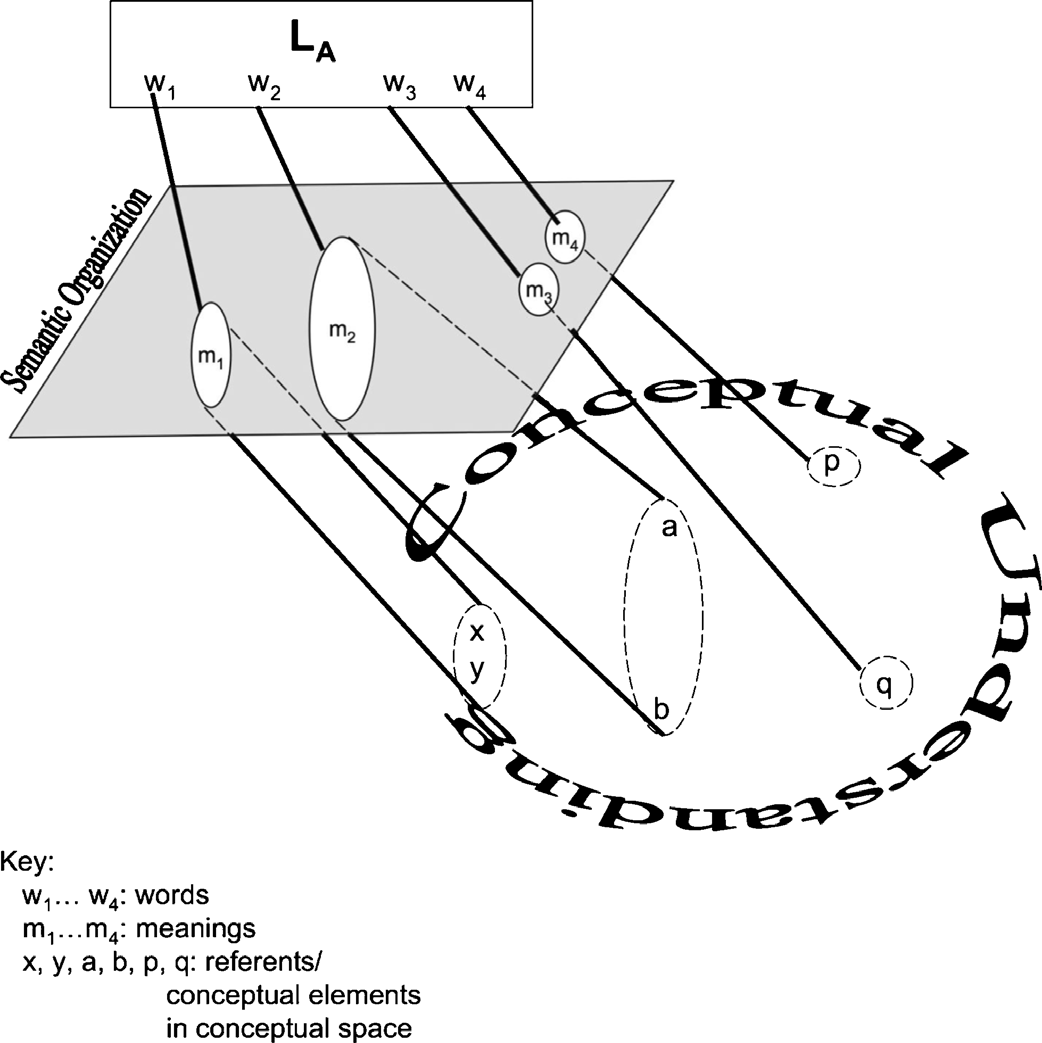
The implication of these studies is that there are two differentiable levels – related but separable – for semantics and cognitive knowledge, wherein the semantic system provides a ‘filter’ through which the conceptual space is viewed (Gathercole, Reference Gathercole2006; Slobin's ‘thinking for speaking’, Reference Slobin1996). Those cognitive notions that get systematically encoded in a given language become highlighted or attended to; those that are not encoded become de-emphasized or ignored. A schematized representation of this might be as in Figure 1. In Figure 1, the words (w1 . . . w4) in LanguageA encode meanings (m1 . . . m4) within the semantic system; these meanings refer to and highlight some aspects (x, y, a, b, p, q) of the conceptual space.
Schematic relationship of semantics and cognition.

This separation of semantics and cognition contrasts with what has sometimes been assumed in the bilingual and L2 literature, either implicitly or explicitly (e.g., Costa, Colomé & Caramazza, Reference Costa, Colomé and Caramazza2000), where semantics has sometimes been identified with concepts. That position has, at the same time, been vociferously challenged by others (e.g., Jarvis & Pavlenko, Reference Jarvis and Pavlenko2008; Paradis, Reference Paradis, De Groot and Kroll1997; Pavlenko, Reference Pavlenko1999, Reference Pavlenko2009). Recognizing a distinction between conceptual understanding and semantic organization has important theoretical ramifications. The bilingual child or the L2 learner is faced with having to develop two (non-identical) mapping ‘solutions’ for the semantics of his/her two languages. And learning the new language (sometimes in conjunction with learning associated cultural and social concepts) can lead to conceptual restructuring as well (Jarvis & Pavlenko, Reference Jarvis and Pavlenko2008). If semantics and concepts are one and the same thing, then this would never be possible.
The way in which the learner develops the two semantic systems and the success in doing so could depend on a variety of factors (Pavlenko, Reference Pavlenko and Pavlenko2009). One of the most important factors is likely to be the relative timing of the acquisition of the two systems. In a (later) L2 bilingual, the L1 semantic system and its mapping solution have largely been resolved. Acquisition of the L2 system will be affected by the fact that a fully developed semantic system is already in place, as well as, importantly, a fully developed conceptual system.
In the case of an early L2 bilingual or a simultaneous bilingual, on the other hand, all three systems are developing at the same time – the LanguageA semantics, the LanguageB semantics, and the conceptual understanding of the world. Due to the fact that these are concurrent developments, and given that semantic and cognitive developments interact in children's emerging systems, we can expect certain ramifications in simultaneous and early L2 bilinguals that we do not see in later L2 learners. For example, in late L2 learners we may expect more ‘parasitic’-type linking of the L2 onto the L1, whereas in simultaneous or early L2 bilinguals, we can expect more ‘synergies’ across the three systems. Just as monolingual children take up suggestions from their (one) language on how to categorize in language-specific ways, it follows that early bilingual children will also be taking cues from the input on language-specific categorization, but they will be doing so from two languages.
Recent evidence
Recent work on bilinguals and L2 learners has begun to provide evidence of crosslinguistic semantic influence. Malt and Sloman (Reference Malt and Sloman2003) have found that L2 learners never fully take on the semantic categorization of concrete objects (bottles and dishes) in the L2. Jiang (Reference Jiang2002, Reference Jiang2004) reported that L2 learners’ use of words for problem, question, marry in English and Chinese (all words showing one-to-many correspondences across the two languages) similarly show L1-to-L2 semantic influence.
At the same time, Pavlenko (Reference Pavlenko2003) has documented L2-to-L1 influence in Russian–English bilinguals’ conceptions of personal space and privacy, as a result of exposure to the use of the terms in an immersion environment in the L2, English.Footnote 2 Wolff and Ventura (Reference Wolff and Ventura2009) have similarly reported L2-to-L1 influence in the understanding of causal expressions. Brown and Gullberg (Reference Brown and Gullberg2008) have reported bi-directional influence on the degree to which Japanese L1 speakers of English L2 use manner gestures while speaking either Japanese or English.
Similar effects apply in the case of simultaneous bilinguals. Ameel and colleagues (Ameel et al., Reference Ameel, Malt, Storms and Van Assche2009; Ameel, Storms, Malt & Sloman Reference Ameel, Storms, Malt and Sloman2005) recently found that simultaneous Dutch–French bilinguals showed some convergence of categories of bottles and dishes across their two languages, so that their semantic groupings were distinct in both languages from what was observed for monolinguals. Bilinguals showed both less complex categories and semantic convergence for both the centers and the boundaries of the cross-language categories.
It may be that in the development of two semantic systems, certain types of semantic distinctions are more susceptible to interaction or transfer than others. L2 learners can be conservative in their extensions of some uses of words from their L1 to their L2. Kellerman's (Reference Kellerman1978, Reference Kellerman1979, Reference Kellerman, Gass and Selinker1983) classic study, for example, looked at judgments of L1 Dutch speakers on the range of usage of the word break in their L2, English. Even though English break and Dutch breken “break” share multiple polysemous applications, the Dutch–English speakers only accepted some of the Dutch phrases as permissible in English translation, while rejecting others. For example, they judged He broke his leg and She broke his heart as very acceptable, but, at the other extreme, they found His fall was broken by a tree and A game would break up the afternoon a bit highly unacceptable. The participants, thus, showed ‘avoidance’, or a reluctance to transfer some expressions from the L1 to the L2, in contrast with some other types of words that commonly show transference (Odlin, Reference Odlin1992). (See Han, Reference Han2004.)
What might make some semantic types more susceptible to interaction than others? The answer is likely to lie, at least in part, in links between the semantic system of each language and the conceptual space shared by the two languages and the type of categories involved. The relation of the semantic organization to the conceptual organization may be key. Links between members of a category that are conceptually ‘close’ (e.g., breaking a window and breaking a toy) may be processed differently from links between members of a category that are conceptually more ‘distant’ (e.g., breaking a window and breaking a drug ring). Some recent work in relation to ‘translation ambiguity’ supports this possibility. Elston-Güttler & Williams (Reference Elston-Güttler and Williams2008) examined learners’ judgments of distinct L2 words that were translations of polysemous L1 words – e.g., English bag and pocket for German Tasche; English snake and queue for German Schlange. These authors found that polysemous L1 words whose two uses were judged to be close by native German monolinguals (e.g., Tasche for bags and pockets) showed more interlanguage interference in L2 speakers’ use of the corresponding English words than polysemous L1 words whose uses were judged to be more distant (Schlange for snakes and queues).Footnote 3
One way to investigate the role of the links between the conceptual and semantic organization in bilinguals’ two-language semantic systems might be to examine how bilinguals process and understand distinct types of categories, distinct in terms of the internal makeup of the category. Some linguistically reified categories might be considered more ‘coherent’, others more ‘heterogeneous’ in makeup, depending on the similarity across the members within the category. Internally coherent semantic categories might be considered to correspond to items that are closely connected conceptually more than internally heterogeneous categories are. Such distinct types might be affected differently and be more or less susceptible to interaction in the bilingual's organization of the two semantic systems.
Category types
Lexical items within a language are not all of the same type in terms of their internal consistency and how they pull together disparate portions of the conceptual space. Some categories have internal composition as has been assumed under the objectivist tradition (Lakoff, Reference Lakoff1987). That tradition views word meaning and categorization as homogeneous, with all members of the category equally representative of the category; the category is built around necessary and sufficient conditions or features, which are ‘given’ by the world. According to the traditional approach, all words fall into this type: a dog is a four-leggedanimalthat barks; a sister is a femalesibling, an even number is a wholenumberdivisible by two with no remainder, fifty-nine refers to a set whose members, when counted, take you up to fifty-nine in the counting sequence.
However, while cases like even number and fifty-nine appear to be good examples of such ‘classical’ categories, others like dog and sister are problematic, in that they show much more complex internal structure than this suggests (Wittgenstein, Reference Wittgenstein1953/2001). Such words – and perhaps most words in a language – are used in complexive or polysemous ways, involving uses that go beyond these ‘core’ meanings. Thus, for example, sister is not only used for female biological siblings, but also, e.g., for nuns, for female friends, and, in Britain, for nurses. These legitimate and conventionalized uses of sister do not share a single set of necessary and sufficient conditions that ‘define’ sister. Instead they are linked in a ‘radial’ structure (Lakoff, Reference Lakoff1987) – they have a central use that ‘radiates’ in conventionalized (i.e., established in the language) and ‘motivated’ ways (i.e., they make psychological sense) to other uses. The ‘motivation’ behind the links might be based on metaphorical extension (nuns are like biological sisters – hence, they are called sisters), metonymy (a part, e.g., the wheels, stands for the whole, the car – I bought some new wheels), parallel shape, location, or function (e.g., leg: A table leg has a similar shape [long, thin], relative location [below something it supports], and function [supports a major element of the whole] as a human leg), and the like. Another example is break, above. Break may have as its central, or prototypical, sense either the physical action that an agent applies to a patient (I broke the window) or the change of state of an object from being integral to non-integral (The glass broke) (which is prototypical is not important for the discussion here). These uses are linked metaphorically with other uses: e.g., He broke my heart, Stan Musial broke the record for home runs in 1954. These extensions of break are ‘motivated’, but they are not necessarily predictable; they are conventionalized in the given language (Hampton, Reference Hampton2007; Lakoff, Reference Lakoff1987). And what is conventionalized in one language is not necessarily conventionalized in the same way in another language. Hence, the categories must be learned.
The relationship between the semantic organization and conceptual underpinnings differs across these two distinct types of categories. Classical categories, whose membership can be specified with criterial features, have members that share those criterial characteristics – i.e., they necessarily have some commonality on some similarity metric, and are therefore located in proximity within the conceptual space. Radial categories, on the other hand, by definition have members that do not all share criterial characteristics, and will be more scattered across the conceptual space.
This difference can be predicted to have consequences for when and where cross-linguistic influences may occur in bilinguals’ semantic systems. First, not only will members of a classical category be close to one another in conceptual space, but the language, by packaging the members together, may even draw attention to the similarities between members and diminish attention to their differences. Members of a radial category, on the other hand, are linked with the central instance in multiple ways, so this will serve to maintain some conceptual distance between members. At the same time, the link between any two members of the category will highlight some aspect that the two members share.Footnote 4
Second, considering the timing of development, simultaneous bilinguals or early L2 learners should be more susceptible to semantic interaction between their two languages than late bilinguals, at least if interaction means influence in both directions. This is because, as discussed above, young children are constructing semantic categories at the same time as they are developing an understanding of the world and the things in it. The semantic categorization is guided by the language being learned, and that in turn can affect attentional behavior in children. An early bilingual will be guided by two languages, a late bilingual initially by one. In the latter case, the second language is less likely to influence the organization of the semantics of the first language because the L1 system is already well established.
Note that the prediction here regarding early bilinguals runs counter to some proposals. Elston-Güttler and Williams (Reference Elston-Güttler and Williams2008, p. 185) have suggested that semantic interaction in bilinguals is less likely to occur in simultaneous bilinguals than in later, L2 bilinguals. This is based on their (implicit) assumption that there is a common ‘store’ of conceptual underpinnings for both the L1 and the L2, and the simultaneous bilingual will be able to access this ‘store’ from the beginning. Here, in contrast, the prediction is quite the opposite: As the child is constructing the categories in his/her two languages, the semantics of the two languages are likely to become intertwined under certain conditions. We are likely to observe a ‘synthesis’/‘symbiosis’ of the semantics of the two languages in those cases in which the linguistic categories draw on aspects that are conceptually close – i.e., in relation to classical categories. Where languages link elements that are less close conceptually (i.e., in radial categories), there is less likely to be a convergence of the two semantic systems.
The following study explores such possible crosslinguistic influences in Arabic–English bilinguals’ semantic categorization.
Method
The study examined the interpretation of Arabic and English words by Arabic- and English-speaking monolinguals and early and late bilinguals. Words chosen differed semantically, in range of application, in the two languages. Participants were given a forced-choice task wherein they had to decide which of several pictures could be labelled by a given term. The choices included referents that were appropriate for one language but not the other, plus entities that were related in systematic ways with appropriate referents.
Linguistic stimuli
The design involved sets of Arabic and English words that differed in their boundaries of application. In every case, a word in one of the languages had ‘wider’ application – i.e., encompassed the sets of referents that were named by two separate lexical items in the other language. Thus, for example, Arabic saeah includes what is named by both English clock and watch; Arabic asabie encompasses both English fingers and toes; conversely, English tree corresponds to Arabic shajarah “(deciduous) tree” and nakhla “date tree”; similarly, English fold encompasses both Arabic yitwi “fold [as for clothes]” and yirabie “fold [as for arms]”). In half of the sets, the Arabic words had ‘wider’ application (i.e., can be used in relation to a larger set of referents), and in half the English words had wider application.
Words also fell into three category types, defined according to their usage in the ‘wider’ language.Footnote 5 The first two types were classical and radial categories, as follows.
Classical: A category in the wider language could be defined in terms of necessary and sufficient conditions (Arabic asabie = small appendage, one of five, emanating from a human limb [i.e., fingers and toes]).
Radial: A category in which there is a ‘central’ use of a word, but that use is linked with ‘motivated’ extensions to related uses. For example, Arabic aien refers centrally to an anatomical eye, but is conventionally used for stove burners as well, by metaphorical extension.
A third type was used as a control type. Both classical and radial categories consist of a single category with a single label (and, therefore, single form). The application of these two types differs in terms of the structure of the category. Another set of words used here consisted of words with a single form, but two categories – homophones.
Homophones: Two (distinct!) words that happen to have the same form (i.e., sound alike) but refer to clearly distinct categories. For example, English boxing means both “punching in a boxing match” and “putting in boxes”. There is no conceptual link between the uses.Footnote 6
Classical, radial, and homophone types might be thought of as lying on a continuum, when viewed in terms of their application to two or more distinct referents. In each case, there is a single surface form. But across the three types, there is increasing conceptual distance between the two referents – classical: conceptually close; radial: more distant, but linkable; homophones: conceptually so distant that they are not linkable.
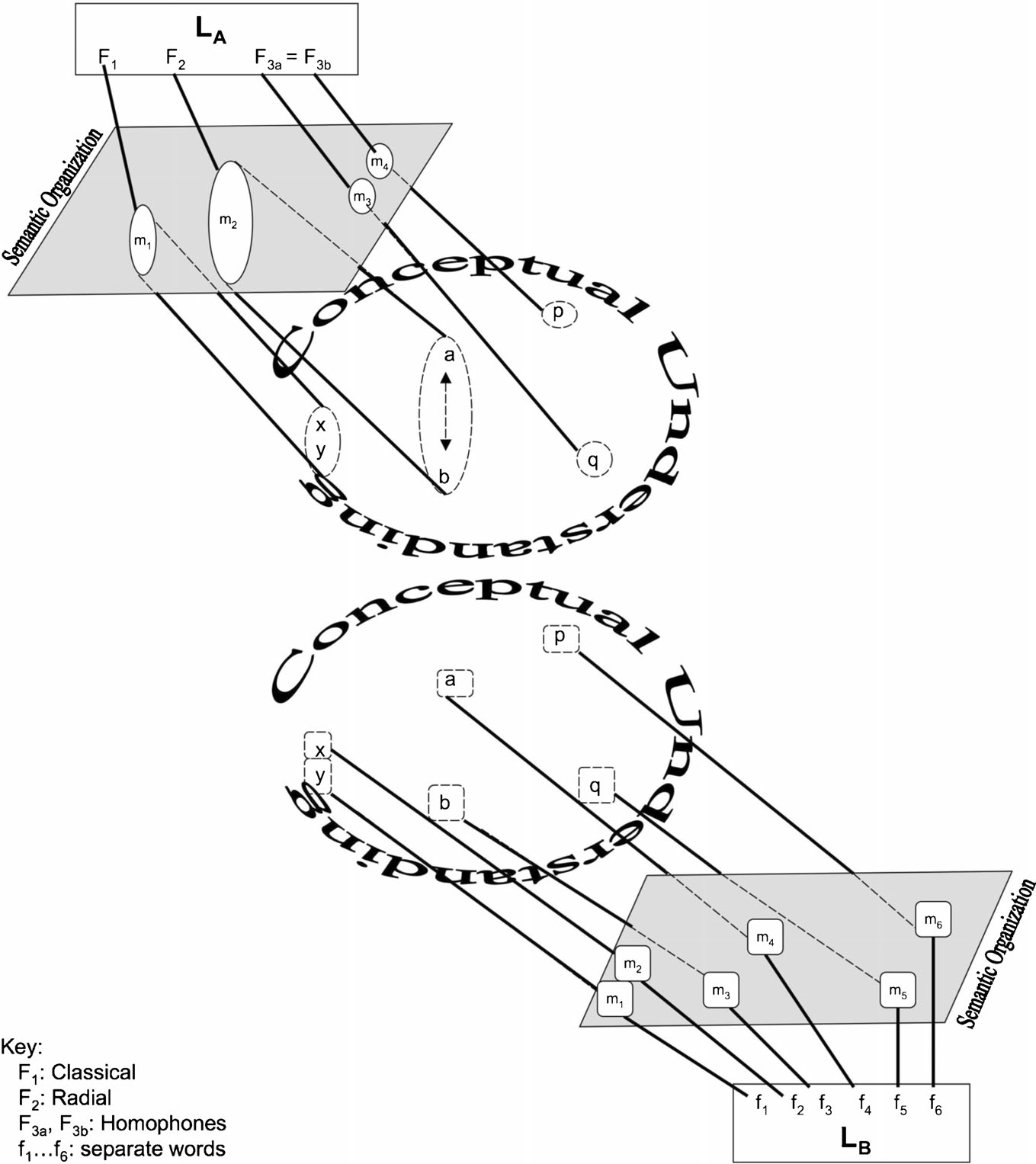
Figure 2 shows a hypothetical example of three sets of words that are wider in LanguageA, narrower in LanguageB, but that correspond to the same sets of referents, x, y, a, b, p, q in the same conceptual space (shown separated simply for ease of exposition). In LanguageA, the word form F1 labels a classical category that comprises referents x and y; word form F2 labels a radial category that comprises referents a and b; and word forms F3a and F3b are homophones, each a label for its own semantic content and separate referents, p and q. In hypothetical LanguageB, the corresponding words, f1 through f6, refer individually to the subset categories that encompass individually x, y, a, b, p, and q.
Categories in two languages, LanguageA with ‘wider’ categories than LanguageB.

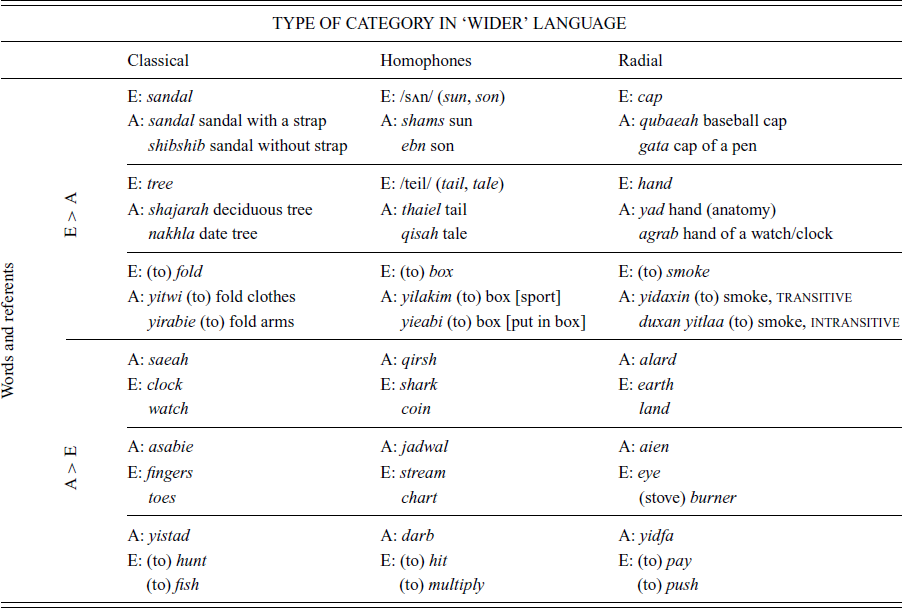
Word sets were chosen for each sub-type, with half of them cases in which English had a wider category than Arabic (‘E>A’) and half of them cases in which Arabic had a wider category than English (‘A>E’). A total of 18 word sets were tested. In each cell there were two noun sets and one verb set. The words and categories chosen were those shown in Table 1.

Nonlinguistic stimuli
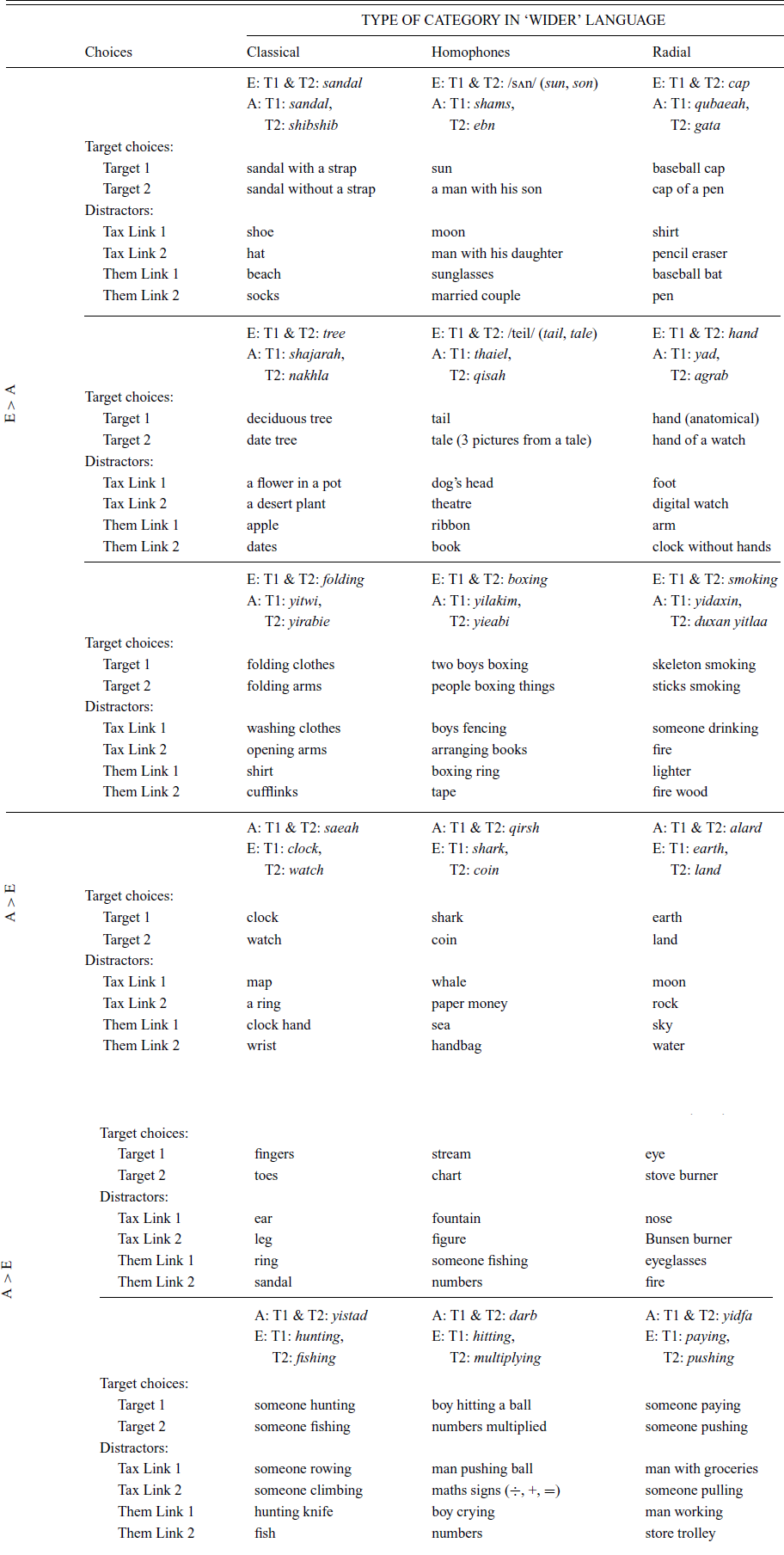
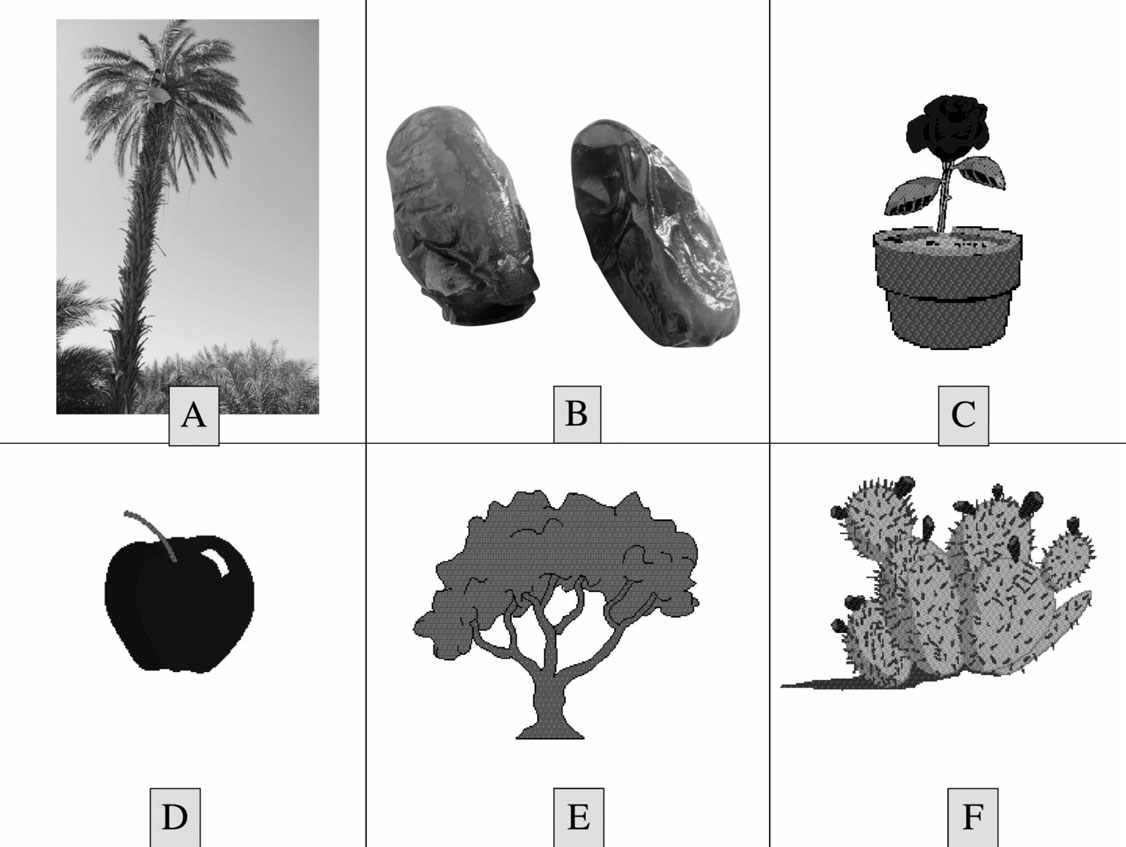
For each stimulus set, six pictures were assembled. Picture choices for each set were designed carefully to fit strict criteria – two ‘target’ stimuli, two taxonomically linked distractor items, and two thematically linked distractor items. The two ‘target’ stimuli were items that could be named by the (single) word in the wider language (e.g. tree) and by the two words in the narrower language (e.g., a deciduous tree and a date tree). The two taxonomically linked distractor items were items that belong, respectively, to two superordinate categories to which the two target items belong (e.g., a flower in a pot; a desert plant). The two thematically linked distractor items were items that are associated, respectively, with one of the two target items (apple, date).
The pictures shown for each item set are indicated in Table 2. A sample stimulus picture set is shown in Figure 3.

Sample stimulus set, tree/shajara “deciduous tree”, nakhla “date tree”.

Two conditions were prepared, an Arabic condition and an English condition. A given participant was assigned to one of these conditions. The same sets of pictures were shown, six at a time, for the words in the two languages. For each language, the appropriate word was used. When the language had the narrower terms, the term for target 1 was used (e.g., clock or eye).
Procedure
Each participant was given an answer sheet with the numbers 1 to 18 for the 18 stimulus items and the letters A through F associated with each number. Participants were asked either in Arabic or in English to choose pictures that were “labeled by” the word they heard in the relevant language: “Is there anything here that you can label as X?” They were asked to place a number “1” on the answer sheet with the letter corresponding with their choice. They were then asked, “Is there anything else here that you can label as X?” If so, they were asked to place a “2” by the corresponding letter. This continued, with the participant putting “3”, “4”, and so forth until s/he judged that there were no more items that could bear the given label. Items were presented in randomized order.
Participants
Seventy-two participants were tested, including Arabic- and English-speaking monolinguals, and Arabic–English bilinguals who had begun learning English either as early L2 learners or late L2 learners. Arabic-speaking monolinguals and bilinguals were tested in Saudi Arabia. Monolingual English-speaking participants were tested in Chicago. All participants were young adult college students, aged 18 to 25, all from middle to upper-middle class backgrounds. Monolinguals from both language groups all reported either no or minimal knowledge (i.e., just a few words) of any other language. Bilingual participants were all L1 Arabic speakers, and they were classified as ‘early’ bilinguals if they began English before age 6 and as ‘late’ bilinguals if they began English after age 12. Both groups of bilinguals learned English as a foreign language in school in Saudi Arabia; none used English in the home. The early bilingual group all began English in preschool, before age 6. The late bilinguals all began English in grade 7 or later (age 12 or older). The late bilinguals were college students who were enrolled in the fourth or fifth year of a five-year translation degree program; the early bilinguals were college students enrolled in the fourth year of a four-year English literature and language degree program. The degree programs both include courses on listening and speaking, reading and reading comprehension, writing, grammar, and vocabulary. Both degree programs also include at least three courses on translation. The contexts of use of English are similar for the two groups: Both have access to English-language media with Arabic subtitles, and to a wide range of books in English. Few have regular access to native English speakers, but both groups speak English to one another while studying in their degree programmes and have done so for at least four years prior to this study. The Saudi participants were all females. The monolingual English participants consisted of 11 females and 1 male. All participants gave informed consent.
Monolinguals were tested in their single language; bilinguals were tested in either Arabic or English. There were 12 participants in each group for each language – that is, 12 monolingual Arabic, 12 monolingual English, 24 early bilinguals, and 24 late bilinguals in total.
Predictions
Language
Overall performance by the bilinguals should be better on Arabic than on English, since Arabic is the bilinguals’ first language. That is, the bilinguals’ performance in Arabic should be closer to that of monolingual Arabic speakers than their performance in English will be to that of monolingual English speakers.
Word groups
The best performance overall by the bilinguals should occur with the word sets in the homophone groups, because homophones are actually two distinct words referring to two conceptually distinct categories. Homophonic use of a word should not carry over from one language to the other.
The lowest performance (i.e., least like monolinguals) should be in relation to the word sets in the classical groups. This is because the referents of classical categories in the wider language are treated as ‘the same’ by the language, which should highlight the conceptual similarities across members of the category.
The word sets corresponding to radial categories should elicit bilingual performance intermediate between the classical and homophonic sets, since radial categories are conceptually between the other two types, with members that are conceptually distinct but are brought together by the language on the basis of some meaningful link.
Participant groups
Monolinguals should in general perform better than bilinguals. Bilinguals may overextend the word in the narrower language, due to the influence of the wider category in the wider language, and, conversely, they may underextend the wider category because of influence from the narrower category in the narrow language. This is predicted to be especially true in the classical categories, and more evident in the case of the early bilinguals, in both directions, than the late bilinguals, for whom the effect is predicted to occur only in the direction of the L1 to the L2.
Width
It is not clear whether it should be harder to learn an L2 category that is wider or narrower than the L1 category. According to the subset principle (Wexler & Manzini, Reference Wexler, Manzini, Roeper and Williams1987), one could predict that it will be easier to broaden a narrow category in going from the L1 category to the L2 category than it would be to narrow down a broad category in going from a wide L1 category to a narrower L2 category. The former requires only positive evidence to ‘expand’ the L1 category; that is, one would simply need to hear the L2 word used in relation to a referent beyond the narrow set to know that the word should be expanded. In contrast, to narrow down an application of a word that is too broad requires negative evidence to ‘cut down’ the L1 category; that is, one must be corrected or get other feedback that a word has been mis-applied to the element of the wider set.
Another possibility that would lead to similar results (showing preference for narrower categories initially over broader categories) is that learners may approach the learning of word meaning ‘cautiously’, consistent with Kellerman's findings with break, discussed above. That is, learners may begin with restricted application rather than general application of words in a new language rather than begin with overly broad applications, and only expand the use of a word when ‘invited’ by the input language to do so. Such an approach may interact with the category type – that is, caution may be more apparent in relation to categories that are radial than in relation to classical categories, as the members of the latter types may be perceived as ‘the same’ more than members of the former types.
An alternative prediction might be based on a principle of Contrast (Clark, Reference Clark1993) or of Mutual Exclusivity (Markman, Reference Markman, Byrnes and Gelman1991). Contrast, which holds that children assume that no two words can have the same meaning, and Mutual Exclusivity, which claims that children have a bias against an object having more than one name, might lead to the prediction that it would be easier to go from wider to narrower boundaries in the L2 than from narrower to wider boundaries. If a learner has acquired one word for a category (e.g. finger), and then hears a contrasting word for another member of the same (L1) category (toe), Contrast and Mutual Exclusivity would predict that this will lead to the division of the category into two sub-categories. (Prior to learning that contrasting word, however, the learner may start out assuming that the first word applies to the broader category.)
Results
Two major sets of analyses were conducted. The first explores correct choices of the target stimuli; the second examines choices beyond those targets.
Correct responses, target choices
The first set of analyses examined the distribution of choices of the target items, T1 and T2. Responses were scored according to the expected responses for each language. For each language, when that language had the wider category, participants were scored “1” if they chose both target items; they were scored “0” if they chose only one or neither of the target items. When the language had the narrower category, participants were scored “1” if they chose only target one; they were scored “0” if they chose both targets or target two or neither target. (Initially two sets of analyses were conducted. In the first, correctness of scores was based exclusively on responses to the targets – i.e., a response was considered correct if the respondent chose the correct target(s), regardless of the performance on the distractors. In the other, correctness of scores was based on the whole range of responses across the targets and distractors – i.e., a response was considered correct if the participant chose the correct target(s) and only the correct target(s) [.e., no choices of distractor items]. The patterns of responses were similar in the two cases [with the latter scores being simply slightly lower overall], so only the first set of analyses will be reported here. Information on the choice of distractors will be covered in the following section on choices beyond the targets.)
The performance on the two languages was analyzed separately. We will start with the L2, English.
English
Analyses of variance were performed in which word group (classical, radial, homophonous) and width (English wider than Arabic, Arabic wider than English) were treated as within-subject variables, and participant group (monolingual, early bilingual, late bilingual) was between-subjects. Results showed main effects of word group, F(2,66) = 19.69, p < .000, width, F(1,33) = 20.74, p < .000, and participant group, F(2,33) = 32.62, p < .000.
In general, participants performed better on classical categories (1.80, out of 3) and homophone categories (1.92) than on radials (1.54) (pairwise comparisons: classical vs. radials, p < .004, classical vs. homophones, p < .000). Performance was in general worse for categories for which English was wider than Arabic (1.49) than for those for which Arabic was wider than English (2.02). And both early bilinguals (1.51) and late bilinguals (1.2) performed less well overall than monolinguals (2.53) [Tukey's HSD, ps < .000].
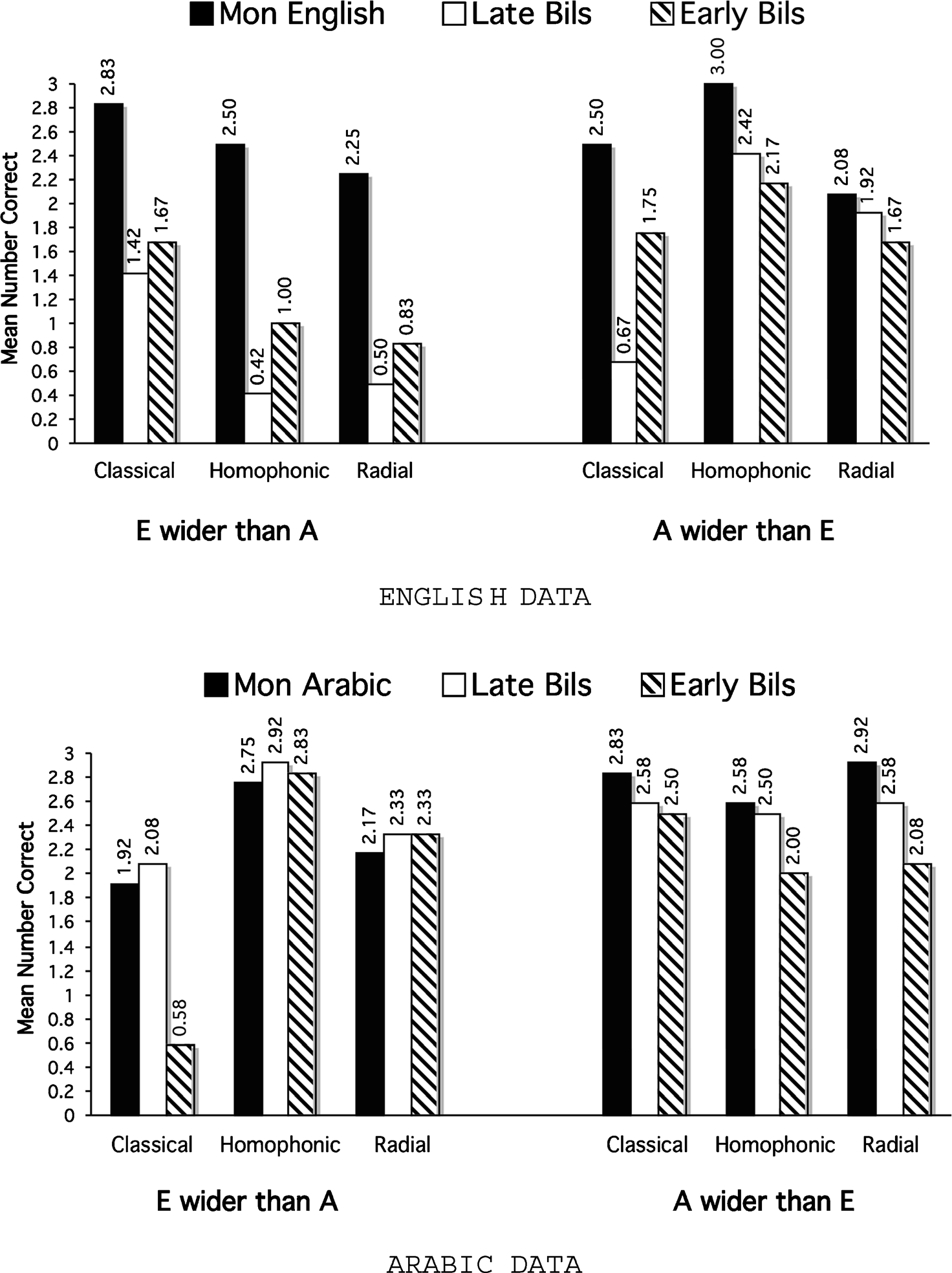
These main effects were modified, however, by two- and three-way interaction effects: Word Group × Width, F(2,66) = 21.58, p < .000, Word Group × Participant Group, F(4,66) = 3.82, p < .007, Width × Participant Group, F(2,33) = 5.42, p < .009, and Word Group × Width × Participant Group, F(4,66) = 4.17, p < .005. Performance by Word Group × Width × Participant Group is shown for English at the top of Figure 4.
Performance by Word Group × Width × Participant Group, target choices.

Follow-up analyses indicate that on the classical categories, width was not significant, nor was Width × Participant Group, but all three participant groups performed differently, F(2,33) = 30.64, p < .000: Monolinguals scored 2.67, early bilinguals 1.71, and late bilinguals 1.04 on the classical category words, all differences significant at ps < .008, Tukey's HSD.
On the homophone categories, width was significant, F(1,33) = 71.95, p < .000, as were participant group, F(2,33) = 20.73, p < .000, and Width × Participant Group, F(2,33) = 9.07, p < .001. When English was wider than Arabic, participants differed, F(1,33) = 25.53, p < .000, with the monolinguals performing significantly differently from both the early and late bilinguals, ps < .000. The bilinguals rarely chose both responses for the homophonic word. When English was narrower than Arabic, participant groups also differed, F(2,33) = 4.97, p < .013. In this case, the monolinguals (3.00) were significantly different from the early bilinguals (2.17), p < .012, and nearly significantly different from the late bilinguals (2.42), p = .095. (Close examination of the data indicates that, unlike with the A>E classical category words – where many of the bilinguals chose both targets, extending the Arabic category to English – no bilingual chose both targets for any of the A>E homophonic words. [A high incidence of errors occurred with the English word stream. Note: Approximately 25% of Saudi Arabia is desert.])
In the case of the radial categories, there was a significant effect of width, F(1,33) = 15.81, p < .000, of participant group, F(2,33) = 17.48, p < .000, and of Width × Participant Group, F(2,33) = 7.0, p < .003. Follow-up analyses revealed no difference across groups when radial categories were narrower in English than in Arabic, but when English was wider than Arabic, participant groups differed on radials, F(2,33) = 18.08, p < .000, with both the early and late bilingual groups performing significantly lower than the monolingual group, ps < .000 Tukey's HSD.
These results for English, then, reveal that when English is wider than Arabic, both early and late bilinguals undergeneralize English boundaries for all three category types; they do not know that English is wider than Arabic, or they do not know both uses of the homophonic and radial category forms.
When English is narrower than Arabic, the late bilinguals make more errors in the classical categories than the early bilinguals: They overgeneralize the Arabic boundaries to English. The early bilinguals show better knowledge than the late bilinguals that the English classical categories are narrower than the corresponding Arabic categories.
Arabic
Analyses of variance were again performed in which word group (classical, radial, homophonous) and width (English wider than Arabic, Arabic wider than English) were treated as within-subject variables, and participant group (monolingual, early bilingual, late bilingual) was between-subjects. Results showed main effects of word group, F(2,66) = 16.67, p < .000, width, F(1,33) = 5.35, p < .027, and participant group, F(2,33) = 8.46, p < .001.
In general, participants performed least well on classical categories (2.08), next best on radials (2.40), and best on homophone categories (2.60) (pairwise comparisons: classical vs. radials, p < .002; classical vs. homophones, p < .000; homophones vs. radials, p < .013). (Two- and three-way interactions, however, to be discussed, reveal qualifications of these general findings.) Performance was in general worse for categories for which English was wider than Arabic (2.21) than for those for which Arabic was wider than English (2.51). And early bilinguals (2.06) performed significantly differently from both late bilinguals (2.50) and monolinguals (2.53) [Tukey's HSD, monolingual vs. early, p < .002, late vs. early, p < .004].
These main effects were modified, however, by two- and three-way interaction effects: Word Group × Width, F(2,66) = 32.89, p < .000, Word Group × Participant Group, F(4,66) = 2.67, p < .04, and Word Group × Width × Participant Group, F(4,66) = 6.80, p < .000. Performance by Word Group × Width × Participant Group is shown for Arabic at the bottom of Figure 4.
Follow-up analyses indicate that on the classical categories, width was significant, F(1,33) = 37.77, p < .000, as were participant group, F(2,33) = 16.00, p < .000, and Width × Participant Group, F(2,33) = 5.41, p < .009. Further analyses indicate that when Arabic was wider than English, there was no difference across participant groups on the classical categories. When English was wider than Arabic, on the other hand, the early bilinguals performed significantly differently from the other two groups, ps < .001. Examination of the data reveals that they were more likely than the others to choose both targets, extending the English boundaries to their L1, Arabic.
For the homophone categories in Arabic, the only significant effect was width, F(1,33) = 8.2, p < .007. Those words for which English was wider (i.e., only one target was relevant for Arabic) scored higher (2.83) than those for which Arabic was wider (and, hence, required choice of two targets) (2.36).
For radial categories, there was no significant effect. However, there was a near-significant interaction of Width × Participant Group, F(2,33) = 3.02, p = .06. Follow-up exploration reveals a significant difference between the performance of the monolinguals and the early bilinguals when Arabic had a wider category than English, p < .038.
These results suggest that, on the whole, all participant groups performed similarly in their L1, Arabic, except in two cases. When Arabic was wider than English, for radial categories, there was a tendency for the early bilinguals to undergeneralize Arabic. This suggests a possible conservative approach to the application of the L1 radial words.
The second exception was with classical categories, when Arabic was narrower than English. In this case, early bilinguals showed a clear effect of overgeneralizing the boundaries from their L2, English, to the Arabic classical words.
Distribution of responses beyond targets
A second set of analyses examined the types of extensions participants made beyond the targets – whether to the taxonomically or the thematically related distractors. Differences in such choices across groups could reveal possible differences in boundaries for words and their applications. For example, it might be that bilinguals have a sense of the meaning of a word in their L2, but have not established the same boundaries as are used by the monolingual speakers of that language. They may, therefore, extend the words taxonomically more than their monolingual peers.
Participants were given a score of 1 for every choice of a taxonomic distractor and a 1 for every choice of a thematic distractor. The effects were analyzed for the two languages separately.
English
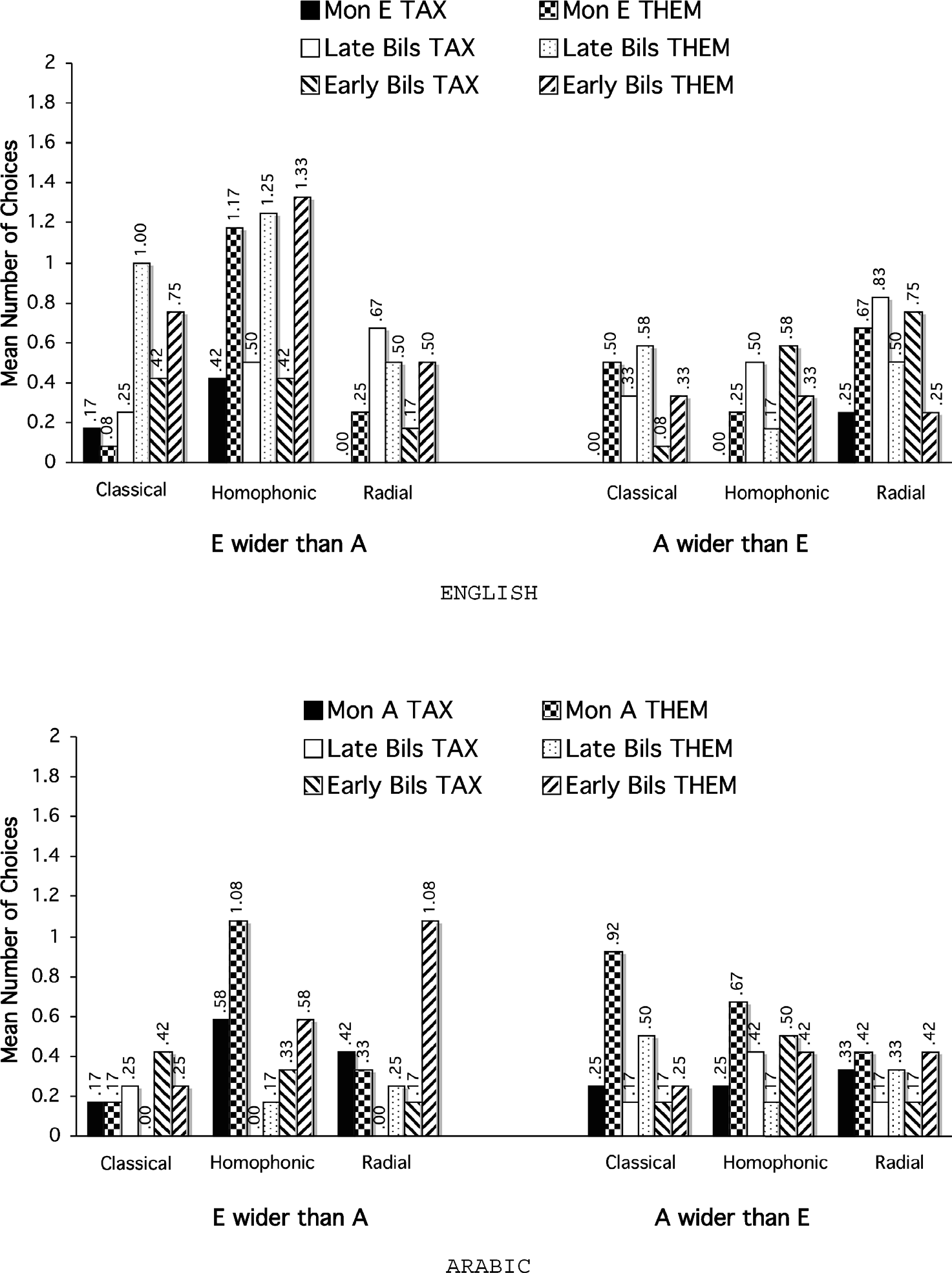
An ANOVA in which word group, width, participant group, and type choice (taxonomic, thematic) were entered as variables revealed main effects of word group, F(2,66) = 4.65, p < .013, width, F(1,33) = 6.99, p < .012, type choice, F(1,33) = 8.7, p < .006, and a near-significant effect of participant group, F(2,33) = 2.57, p < .092. Homophonic words elicited more extensions overall (.56) than classical words (.38), p < .05, pairwise comparison, and nearly significantly more than radials (.44), p = .095. E>A words elicited more extensions (.55) than A>E words (.38). There were more thematic extensions (.57) than taxonomic (.35). And monolinguals gave nearly significantly fewer extensions (.30) than either early (.49) or late (.59) bilinguals, p = .08, Tukey's HSD.
Main effects were modified by interactions of Word Group × Width, F(2,66) = 13.16, p < .000, Word Group × Type Choice, F(2,66) = 3.72, p < .029, Width × Type Choice, F(1,33) = 12.21, p < .001, Width × Type Choice × Participant Group, F(2,33) = 3.54, p < .040, and Word Group × Width × Type Choice, F(2,66) = 8.23, p < .001. Performance by word group, width, type choice, and participant group is shown for English at the top of Figure 5.
Extensions beyond targets to taxonomically and thematically related choices.

Follow-up analyses indicate that on classical categories, type choice was significant, F(1,33) = 10.19, p < .003, with more thematically related choices (.54) than taxonomically related choices (.21). On classical E>A categories, participants chose thematic choices (.61) more than taxonomic ones (.28), F(1,33) = 4.74, p < .037, and participant groups differed, F(2,33) = 5.05, p < .012, with monolinguals making fewer extensions (.13) than early (.58) or late (.63) bilinguals, p < .034, p < .019, respectively. On classical A>E categories, all participants chose more thematic choices (.47) than taxonomic choices (.14), F(1,33) = 8.52, p < .006.
With homophonic words, there were significant differences by width, F(1,33) = 22.80, p < .000, by type choice, F(1,33) = 9.85, p < .004, and by Width × Type Choice, F(1,33) = 18.33, p < .000. With E>A homophones, there were significantly more thematic choices (1.25) than taxonomic (.44), F(1,33) = 20.60, p < .000. With A>E homophones, participant groups differed, F(2,33) = 3.53, p < .04, with monolinguals giving significantly fewer extensions (.04) than early bilinguals (.46), p < .014, and nearly significantly fewer than the late bilinguals (.33), p < .079, Tukey's HSD.
On radials, there were near-significant differences by width, F(1,33) = 3.99, p < .054, near-significant by Width × Type Choice, F(1,33) = 3.40, p = .074, and significant differences by Width × Type Choice × Participant Group, F(2,33) = 3.80, p < .033. With E>A radials, there were no differences. With A>E radials, there was a significant Type Choice × Participant group interaction, F(2,33) = 3.30, p < .049, due to the fact that late bilinguals gave more taxonomic choices (.83) than monolinguals (.25), p < .038, Tukey's HSD.
Arabic
An ANOVA in which word group, width, participant group, and type choice (taxonomic, thematic) were entered as variables revealed a near-significant main effect of word group, F(2,66) = 2.93, p = .061, and a significant effect of type choice, F(1,33) = 9.81, p < .004. Homophonic words elicited more extensions overall (.43) than classical words (.29), p < .014, pairwise comparison. (Radials (.34) were between these two.) There were more thematic extensions (.44) than taxonomic (.26).
Main effects were modified by interactions of Word Group × Width × Type Choice, F(2,66) = 7.25, p < .001, and of Word Group × Type Choice × Participant Group, F(4,66) = 3.19, p < .018. Performance by word group, width, type choice, and participant group is shown for Arabic at the bottom of Figure 5.
On the classical categories, there was a significant effect of Width × Type Choice, F(1,33) = 8.78, p < .006. On A>E classical categories, there were more thematic choices (.56) than taxonomic choices (.19), F(1,33) =6.96, p < .013.
With homophonic categories, there was an effect of participant group, F(2,33) = 3.87, p < .031, and a Width × Participant Group interaction, F(2,33) = 3.72, p < .035. Monolinguals differed significantly from late bilinguals, p < .024, with the late bilinguals giving fewer extensions (.19 vs. .65). With E>A homophones, participants gave significantly more thematic extensions (.61) than taxonomic (.31), F(1,33) = 10.16, p < .003, and participant groups differed, F(2,33) = 6.32, p < .005, with monolinguals (.83) differing significantly in extensions overall from late bilinguals (.08), p < .003 (early bilinguals: .46).
With radials, there was a significant effect of type choice, F(1,33) = 7.10, p < .012, with more thematic choices overall (.47) than taxonomic (.21).
These results concerning extensions beyond the targets reveal some consistent findings. First, across the groups, choices of thematically related items were more prevalent than choices of taxonomically related items. This is surprising in the light of theories such as the Taxonomic Bias (Markman, Reference Markman, Byrnes and Gelman1991; Waxman & Kosowski, Reference Waxman and Kosowski1990). However, it is consistent with cognitive linguistics positions that word meaning is embedded in scenes of use (Croft & Cruse, Reference Croft and Cruse2004; Langacker, Reference Langacker1986), not stored in terms of necessary and sufficient conditions for application. Meanings of words derive from the contexts in which they can be used. Those contexts typically contain thematically associated elements. This preference for thematic extensions over taxonomic extensions applied specifically within many of the word groups, as well – e.g., in the cases of E>A and A>E classical words in English, of E>A homophones in English, of E>A radials in English; and of A>E classical words in Arabic, of E>A homophones in Arabic, and of E>A radials in Arabic. There was only one clear place where taxonomic choices outnumbered thematic: among the early bilinguals in relation to A>E radials in English.
A second overall finding is that both monolinguals and bilinguals made such overextensions. Differences across groups were not necessarily always in the same direction: In English, the monolinguals made overextensions less often than the bilinguals. This was true overall relative to both bilingual groups, as well as for certain word groups, such as the E>A classical words (both bilingual groups) and the A>E homophonic words (relative to the early bilinguals). In Arabic, in contrast, the late bilinguals made overextensions less often than monolinguals in relation to homophones, and less than the early bilinguals in relation to the E>A radials.
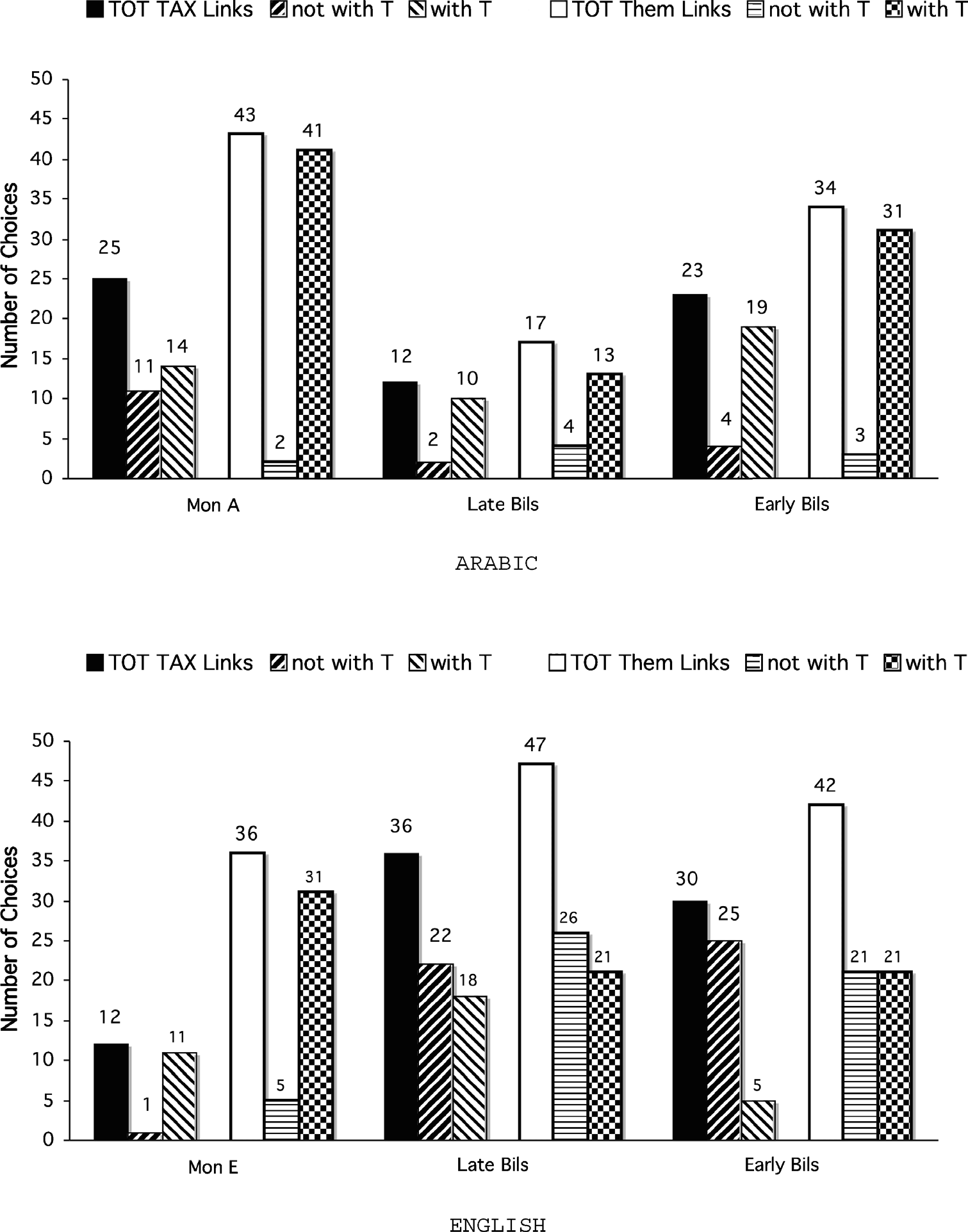
One intriguing question is whether the overextensions across the groups were functionally similar. One way to examine this issue is to explore when the overextensions occurred. If the choices of taxonomically or thematically related items were true overextensions of the word in question, they should have occurred in conjunction with the choice of the target item(s) that were the central referents for the words. Such co-choosing would indicate that the participant knows the meaning of the word in question but either chose to extend it to its contexts of use or allowed its boundary to be rather ‘fuzzy’. However, choices of the taxonomically or thematically related items might have occurred when the participant did not also choose the core target item(s), indicating perhaps an absence of full knowledge of the meaning of a word. Such choices would appear to reflect a more vague sense of the meaning of a word or total absence of knowledge. In order to examine this, all choices of taxonomically and thematically related items were scored as being in conjunction with the choice of a related target item (“with T”) or not (“not with T”). The patterns are shown in Figure 6 for Arabic at the top and English at the bottom. For each language, Figure 6 shows first the total number of taxonomically and thematically linked choices by group and then the number in each case that did not occur in conjunction with the choice of a related target and those that co-occurred with such a choice.
Choices of taxonomic and thematic distractors as a function of choices of the related target (T1 or T2).

For Arabic, these speakers’ L1, the patterns across groups is very similar. Choices of taxonomically and thematically linked items overwhelmingly occurred when the participants also chose the related target item. Compare this with the patterns for English. In English, the monolinguals’ choices are similar to those of the participants tested in Arabic (for all of them, their L1): Choices were overwhelmingly made in conjunction with the related target choice. This contrasts with what the patterns are for the bilinguals in English. In English, the bilinguals’ choices of taxonomic and thematic distractors occurred about half the time when the related target was also chosen, and half the time without the related target item. The one exception is the early bilinguals’ choices of the taxonomically linked distractors, for which choices were overwhelmingly made in the absence of the choice of the related target.
These data suggest that such choices, on the whole, may have been made differently in the case of the bilinguals in their L2 than they were in the case of monolinguals and bilinguals in their L1. Several possibilities suggest themselves: One is that the bilingual participants did not fully know the meaning of some of the words in question in the L2. Another is that the bilingual participants’ (L2) knowledge of the words in question is more vulnerable, less solid than that of monolinguals or L1 speakers. The early bilinguals’ performance in relation to the taxonomically linked distractors – wherein they appear to have chosen taxonomically related distractors primarily when they did not choose the target – suggests that in some cases they had some notion of the meaning or application of a word, but they did not quite have the precise meaning in place. That is, the choice of the taxonomically related distractor may have been instead of the correct target.
Discussion
The results of this study indicate important interactions in the semantics of bilinguals’ two languages, as well as a crucial role for cognitive processing in the determination of which semantic categories get affected in the two-language interaction. They also suggest an important influence of the age of acquisition of the second language on the type of interaction that occurs.
First, in the L2, English, when the semantic categories are wider than in the L1, Arabic, there is overall lower performance across category types for both sets of bilinguals. This suggests that both early and late bilinguals do not know that many of the English categories in such cases are wider than the corresponding Arabic categories.
When the categories in English are narrower than those in Arabic, there is generally good performance by the bilinguals in relation to homophone and radial categories. However, in relation to classical categories, both bilingual groups performed less well than monolinguals. They were applying the broader Arabic boundaries in such cases to English. Furthermore, the late bilinguals did this more often than the early bilinguals. It appears that the early bilinguals were more successful at discerning the English-relevant boundaries than the late bilinguals in relation to the A>E English classical categories.
One question that the present data set cannot fully address is a possible role of language proficiency in the L2 performance of the two groups. We were not able to obtain independent measures of the English abilities of the participants, so possible differences in proficiency across groups could confound the results – e.g., it is possible that despite similar experience with exposure to English, one group was more proficient overall than the other in English. However, we do have data from a distinct study in which we were able to collect independent language measures in the bilinguals’ two languages, and the data from that study show results similar to those obtained for the bilinguals here. In that study, on bilinguals in Miami (Gathercole, Reference Gathercole2009a; Gathercole et al., Reference Gathercole, Moawad, Stadthagen-González, Thomas, Pérez Tattam, Yavas, Campusano, Morrish and Tomos2009; Stadthagen-González, Pérez Tattam, Yavas & Campusano, Reference Stadthagen-González, Pérez Tattam, Yavas and Campusano2009), we grouped Spanish–English adult bilinguals according to the language(s) spoken to them in the home when they were children – only Spanish or both Spanish and English. Critically, we also tested bilinguals for English and Spanish vocabulary levels, on the BPVS (Dunn, Dunn & Whetton, Reference Dunn, Dunn and Whetton1982) and the TVIP (Dunn, Padilla, Lugo & Dunn, Reference Dunn, Padilla, Lugo and Dunn1986), and for English and Spanish receptive grammar. The bilinguals and the monolinguals all performed within the normal range for the two languages on vocabulary, and there was no significant difference in abilities on the receptive grammar task in either language between the groups. Despite this parity in overall knowledge of the two languages, the monolinguals and bilinguals, like those tested here, differed on our categorization tasks, in ways that were consistent with differences in the timing of exposure to and acquisition of the two languages. Those who grew up in only-Spanish homes, and hence had earlier and more extensive exposure to Spanish, performed more like Spanish monolinguals on a semantic task like that used here, and those who grew up in Spanish- and English-speaking homes, and hence had earlier and more extensive exposure to English, performed more like English monolinguals.
Turning to the bilinguals’ first language, Arabic, we find, first, that the late bilinguals’ performance is indistinguishable from that of the monolinguals. The early bilinguals, however, show interactive effects on their L1. This occurs to a small extent in the A>E radial categories, where the early bilinguals show more conservative application of the Arabic words than the other participants. But it occurs to a very large extent in the E>A classical categories, indicating that the early bilinguals’ boundaries for such words in their L1 have been broadened to be more like those of the comparable English words.
Why are the classical categories the most affected, why are they affected in the early bilinguals’ L1, and why do early bilinguals perform better than late bilinguals on the A>E classical categories in English? The answer to all of these questions appears to lie in the fact that classical categories involve referents that are conceptually close in the cognitive space of learners/speakers and that early bilinguals are acquiring both languages at a time when they are constructing the categories in both languages, while late bilinguals are acquiring their second language long after they have constructed categories in their L1. The concurrent timing of development of the two languages in the early bilinguals appears to influence the development of the classical categories in the two languages, so that in both of them the boundaries are affected by the location of the boundary in the other language.
If this interpretation of the data is correct, these results shed light on recently proposed models of semantic and conceptual access and processing in bilinguals. Some have posited a single conceptual/semantic store for both the bilingual's two languages, others have distinguished these. The models have collectively attempted to clarify a number of phenomena. These include differential strengths of links in going from L1 to L2 words versus L2 to L1 words (e.g., in the Revised Hierarchical Model, Kroll & Stewart, Reference Kroll and Stewart1994, and the Modified Hierarchical Model, Pavlenko, Reference Pavlenko and Pavlenko2009); developmental changes from lexical to conceptual mediation in L2 learning (Revised Hierarchical Model); differing levels of transfer across distinct word types (e.g., concrete words vs. abstract words, nouns vs. verbs) (e.g., Shared Asymmetrical Model, Dong, Gui & MacWhinney, Reference Dong, Gui and MacWhinney2005); and distinctions between semantic and conceptual transfer (Jarvis & Pavlenko, Reference Jarvis and Pavlenko2008; Pavlenko, Reference Pavlenko and Pavlenko2009). (See insightful review in Pavlenko, Reference Pavlenko and Pavlenko2009.) An adequate model of semantic knowledge and interaction in bilinguals needs to accommodate all of these and more.
One crucial component not often addressed has to be the inclusion of a developmental perspective on bilingual semantics. A developmental perspective is needed for two reasons: (i) so that changes within and across the individual bilingual's system can be accommodated, and (ii) so that differences across early and late bilinguals can be captured (Hernandez, Li & MacWhinney, Reference Hernandez, Li and MacWhinney2005; Pavlenko, Reference Pavlenko and Pavlenko2009; Zhao & Li, in press).
Let us return to the diagrams in Figure 2. Let us suppose a bilingual were to learn the two hypothetical languages depicted there, with linguistic forms in the two languages referring to the same elements in the conceptual space, but packaging the categories distinctly. It is clear from several decades now of research that the complete linguistic knowledge (encompassing both languages) could not be seen as a simple overlay of the two systems as is. The two systems would interact in complex ways.
The complexity and nature of the interaction will depend on multiple factors – with the timing of acquisition (early bilingualism or late L2 learning) high on the list. In the two cases, how might the learner's system differ from a simple overlay of the two diagrams in Figure 2? Let us focus on each in turn.
Late L2 learner
For the late L2 learner, the situation is one in which one of the linguistic systems – and the corresponding conceptual underpinnings – are already in place. Learning the L2 with a fully fledged L1 system already available will necessarily entail drawing on both the linguistic mappings already established in the L1 and the conceptual store underpinning them. New L2 words will be learned in non-linguistic contexts that will be understood according to the conceptual organization already in place, and they will be linked with associated L1 words that are similarly associated with the given contexts. The L1 words provide a well-established organization of the categories and a well-worked perspective on them. This will lead to the effects in evidence regarding early lexical mediation for L2 words. More recent computational modelling has supported this view. According to a model developed by Zhao and Li (in press), late-learner L2 words are embedded into the existing L1 lexicon map and are, thus, parasitic on it. With time and experience, the late L2 learner will begin to develop an emergent semantic system for the L2, one with its own semantic system (Pavlenko, Reference Pavlenko and Pavlenko2009). (That emergent system could take the form either of a new set of abstractions related to the new language or of strengthened connections linking the L2 items more strongly to one another than to L1 items, but within a larger, multiply linked system including both languages.) As that system develops, two things will occur: (i) L2 words will begin to have more direct access to conceptual underpinnings and will not necessarily need to access concepts via the L1 (Kroll & Stewart, Reference Kroll and Stewart1994), and (ii) the conceptual underpinnings themselves may undergo restructuring as the new semantic system provides a new focus on the conceptual space (Jarvis & Pavlenko, Reference Jarvis and Pavlenko2008).
Part of the work entailed in developing the L2 semantic system is reorganizing category boundaries in cases like those studied here. In some cases, where the L2 makes finer distinctions than the L1, the L2 learner will need to differentiate a category that was not differentiated in the L1, and to establish the new boundaries for those sub-categories. This task will be easier for categories and words involving conceptually distant members; harder for those containing conceptually close items. The former may involve less conceptual reorganization, except insofar as the wider categories provide an explicit link between the members (as per the example of curling iron versus curling tongs, footnote 4). In the case of conceptually close items, as in classical categories, the categorization that was established by the L1 needs to be broken apart, with new (obligatory) attention to a discrimination that was not attended to in the L1. (See Pavlenko's (Reference Pavlenko and Pavlenko2009) similar discussion of semantic transfer versus conceptual transfer.) This latter case can be seen to be parallel to the process of differentiation necessary for learners to split what is an allophonic variation in the L1 (e.g., [p] vs. [ph] in English) into a phonemic contrast in the L2 (e.g., /p/ vs. /ph/ in Korean).
In other cases, the L2 learner may need to collapse a distinction that is made in the L1, when the L2 has a wider category boundary. The data here suggest that such collapsing is not automatic, especially in cases in which the members of the category are conceptually distinct. And in such cases of conceptual distance, even where the two languages share links, as in the case of Dutch breken – English break, the learner appears to be conservative in transferring the L1 categorization scheme to the L2.
Early L2 or simultaneous learner
Contrast this with the case of the simultaneous bilingual or early L2 bilingual, who begins learning the L2 before the L1 system is fully developed. In this case, the child learner does not have a fully developed organization yet of any of the three components related to full bilingual competence – the LanguageA semantic system, the LanguageA semantic system, or, importantly, the conceptual underpinnings. Development of the two languages will occur in tandem, and alongside the development of the underlying understanding in the conceptual space.
In general, each word the child is learning is embedded in linguistic input primarily associated with words and structures from the language corresponding to that word, so the two languages can be expected to develop alongside one another without extensive overlap in the morpho-syntactic realms (Gathercole, Reference Gathercole2007). However, the two languages coincide in the input in relation to factors critical to the development of the semantics of the words: Both languages are being used in relation to the same or similar contexts of use, and both are being processed and built up via the child's shared emerging understanding of objects and events in those contexts.
This development in tandem has implications for the learning of categories whose members are conceptually close versus those whose members are conceptually distant. In connection with the former, the L1 acquisition literature makes it clear that the language itself plays a role in helping the child to establish boundaries (e.g., between fingers and toes), but that the child also makes use of his or her knowledge of the shared perceptual or functional characteristics of members to help determine extension possibilities and limits. It is precisely these categories with conceptually close members that we can expect to involve the most convergent interaction in the early bilingual.
In connection with categories whose members are conceptually distant, it may even be that initially a child does not realize that the same form is being used in relation to the two distinct elements. Karmiloff-Smith's (Reference Karmiloff-Smith1977) groundbreaking work on children's learning of homophonic and plurifunctional forms indicated that initially children are very often unaware that two (identical) forms in their system are even related. It is only with time and experience that they begin to bring the two initially separately learned uses together and even sometimes try to differentiate them. Such conceptually distinct items that are linked via a single form in one language should be more immune to crosslinguistic influence between the early bilingual's two languages.
Conclusion
The results of this study confirm that semantic development in bilingual learners is sensitive to a variety of factors, including the relationship between the semantic and conceptual organization for the two languages, and the timing of the language learning itself. The results of the present study support the position that an adequate model of language learning and emergent organization in bilinguals should take into account, among other factors, all of the following:
a. a distinction between conceptual and semantic organization;
b. the nature/type of the semantic categories themselves;
c. the location and distance of the members of a category in the conceptual space;
d. the relative timing of the acquisition of the two linguistic systems; and
e. a developmental perspective, both in relation to internal changes on the semantic and conceptual system, and in relation to differences between early and late language learning.
By incorporating such factors into our models, we can develop a deeper understanding of many aspects of language development, including:
a. changes from lexical to conceptual mediation in late L2 bilinguals’ semantic systems;
b. differences in the degree to which bilinguals develop convergent semantic categories, dependent on the type of category involved;
c. possible conservative spreading of newly acquired L2 words to members of categories that are conceptually distant; and
d. resistance to semantic interaction in the case of homophonic forms (which share form, but do not share conceptual categorization).