


Introduction
Generalised anxiety disorder (GAD) is a highly prevalent common mental health disorder, second only to depression; it is estimated up to one in 20 individuals will experience GAD in their lifetime (Ruscio et al., Reference Ruscio, Hallion, Lim, Aguilar-Gaxiola, Al-Hamzawi, Alonso and De Almeida2017). GAD is characterised by pathological worry, rumination and cognitive distress that penetrates across several domains of an individualʼs life, along with physical complaints such as increased blood pressure and tension (International Classification of Diseases-10; World Health Organization, 2010). The economic burden of anxiety disorders is large, being the sixth leading cause of disability globally (Baxter et al., Reference Baxter, Vos, Scott, Ferrari and Whiteford2014). GAD makes a substantial contribution to this burden, with rates of up to 15–20% in primary care alone (Holaway et al., Reference Holaway, Rodebaugh and Heimberg2006; Shepardson et al., Reference Shepardson, Buchholz, Weisberg and Funderburk2018). The prevalence of common mental health problems is gradually rising, with longer term trends showing steady increases (9.3%) from 2007 to 2014 (McManus et al., Reference McManus, Bebbington, Jenkins and Brugha2016). In response to inclines in the prevalence of common mental health problems, and associated costs, the Improving Access to Psychological Therapies (IAPT) initiative (Clark, Reference Clark2011) aims to deliver evidence-based interventions recommended by the National Institute for Health and Clinical Excellence (NICE) within an economical and pragmatic framework. NICE recommend group and individual cognitive behavioural therapy (CBT) for GAD; however, there is a paucity of research to support the utility of group-delivered CBT (gCBT) in comparison with individual CBT (NICE, 2011).
The lack of data to either support or refute the efficacy of group-based treatments for GAD is likely to influence the choice of treatments in IAPT services and public perceptions of the legitimacy of group treatment (McCrone et al., Reference McCrone, Dhanasiri, Patel, Knapp and Lawton-Smith2008; Sharp et al., Reference Sharp, Power and Swanson2004). Group CBT may offer several advantages over individual CBT, both conceptually and practically.
Therapeutic factors specific to gCBT may aid patients in recovery, such as normalisation and vicarious reinforcement in a safe, collaborative environment (Whitfield, Reference Whitfield2010). This is supported by reports of peer support, acceptance and connectiveness in group settings (Huntley et al., Reference Huntley, Araya and Salisbury2012). There are also public mental health benefits from accessing individuals who feel too stigmatised to enter traditional one-to-one therapy (Whitfield, Reference Whitfield2010), thereby supporting those who would otherwise not pursue psychological support. This is in line with IAPTʼs ethos of increasing access (Clark, Reference Clark2011).
Practically, gCBT has been suggested to be more cost-effective than individual CBT, when equal efficacy is assumed (Liber et al., Reference Liber, Van Widenfelt, Utens, Ferdinand, Van der Leeden, Gastel and Treffers2008). Generally, literature suggests that gCBT may be more cost-effective than individual CBT for depression (Tucker and Oei, Reference Tucker and Oei2007) and produces superior cost-effectiveness ratios for panic disorder and agoraphobia (Roberge et al., Reference Roberge, Marchand, Reinharz and Savard2008). Whilst Scott and Stradling (Reference Scott and Stradling1990) suggest that gCBT modalities can result in 50% cost savings, it should be noted that research on the fiscal advantages of gCBT are not yet fully supported, due to the complexity of such calculations (Tucker and Oei, Reference Tucker and Oei2007). Along with wait-list times of appropriate referrals needed for gCBT (Liber et al., Reference Liber, Van Widenfelt, Utens, Ferdinand, Van der Leeden, Gastel and Treffers2008), therapist adherence and manualisation are likely to influence cost-effectiveness, with greater adherence being associated with greater symptom relief (Bright et al., Baker, Reference Bright, Neimeyer and Baker1999; Oei and Boschen, Reference Oei and Boschen2009). Nevertheless, preliminary support suggests that gCBT may offer a more cost-effective alternative to individual CBT, particularly in settings which lend themselves to standardisation and have access to large numbers of referrals, such as IAPT services (Oei and Dingle, Reference Oei and Dingle2008). Therefore, group treatments may offer advantages over individual CBT in IAPT in terms of increased cost-effectiveness (Tucker and Oei, Reference Tucker and Oei2007) and participation (Oei and Dingle, Reference Oei and Dingle2008).
The need to increase availability of CBT and demands for a cost-effective treatment further provides a strong rationale for gCBT, which may explain why more IAPT services are deploying group treatments for anxiety (Wykes, Reference Wykes2013). However, the lack of evidence and the gap between research trials and implementation between clinical practice is large (Scott, Reference Scott2018); thus gaps need to be addressed to facilitate adaptations from research to routine practice (Shafran et al., Reference Shafran, Clark, Fairburn, Arntz, Barlow, Ehlers, Freeston, Garety, Hollon, Ost and Salkovskis2009). Whilst randomised control trials (RCTs) are viewed as the gold standard of intervention research, they prioritise internal over ecological validity, causing difficulties with generalisation to clinical settings (Kodal et al., Reference Kodal, Fjermestad, Bjelland, Gjestad, Öst, Bjaastad, Haugland, Havik, Heiervang and Wergeland2018). On the other hand, support from clinically representative settings aid the establishment of a treatmentʼs efficacy (Gunter and Whittal, Reference Gunter and Whittal2010). As such, there is a need for explorative research for gCBT in clinical settings to facilitate the transferability of research into practice to understand its efficacy (Chorpita, Reference Chorpita, Kazdin and Weisz2003).
The effectiveness of gCBT has been studied in other disorders, with research generally finding equal efficacy with individual CBT. For example, a meta-analysis of studies on depression, bipolar, panic and social anxiety disorders, found rates of recovery, improvement and deterioration did not vary between individual and group formats (Burlingame et al., Reference Burlingame, Gleave, Erekson, Nelson, Olsen, Thayer and Beecher2016b). Indeed, systematic evaluations of non-randomised effectiveness studies of group-based psychological therapies for depression suggest that gCBT can produce long-term gains (Hans and Hiller, Reference Hans and Hiller2013), finding no significant differences between individual CBT and gCBT in symptom reduction (Huntley et al., Reference Huntley, Araya and Salisbury2012). Scrutiny of GAD outcome studies have suggested that gCBT is a third less efficacious than individually delivered CBT (Fisher and Durham, Reference Fisher and Durham1999), with a more recent meta-analysis of GAD reporting greater improvements in worry outcomes in individual CBT, as opposed to gCBT, at post-treatment (Covin et al., Reference Covin, Ouimet, Seeds and Dozois2008). However, discrepancies in the age of participants between individual and group may have confounded reliable interpretation of outcomes, particularly given the likely increased distress and resistance to change that may be associated with longer chronicity in GAD. The lack of relevant studies of gCBT may create scepticism about its use as a first line of treatment (Schwartze et al., Reference Schwartze, Barkowski, Strauss, Burlingame, Barth and Rosendahl2017). This is important considering that literature on GAD is under-developed in the anxiety field in general (Cuijpers et al., Reference Cuijpers, Cristea, Karyotaki, Reijnders and Huibers2016).
Research aimed at understanding gCBT across anxiety disorders rarely uses comparison group for context; a further recent meta-analysis of gCBT in mental health community samples found large effects in reducing symptoms of panic, depression and GAD, but utilised no comparator (Heatherington et al., Reference Heatherington, Harrington, Harrington, Niemeyer, Weinberg and Friedlander2014). Although the broader literature suggests that gCBT is likely to be effective, it cannot be determined whether it is as efficacious as individual CBT. This is highly relevant due to the growing pressure on National Health Service (NHS) services to meet the needs of individuals with mental health problems, when group formats are considered more economically viable. When equal efficacy has been established, authors attribute null differences to the small number of studies included and the large number of predictors used (Cuijpers et al., Reference Cuijpers, Cristea, Karyotaki, Reijnders and Huibers2016). As such, studies examining efficacy may be undermined perhaps due to the lack of formats bearing direct comparison. This gives rise to a need for research that examines gCBT outcomes in the context of individual CBT, that is relevant and informative to clinical settings.
The few GAD studies that have conducted comparative research within the same study have largely come from paediatric populations (e.g. Flannery-Schroeder and Kendall, Reference Flannery-Schroeder and Kendall2000). Recently, McKinnon et al. (Reference McKinnon, Keers, Coleman, Lester, Roberts, Arendt and Fjermestad2018) concluded that gCBT was equally effective as individual CBT in reducing clinical severity in pre-adolescent children with GAD. This is supported by Manassis et al. (Reference Manassis, Mendlowitz, Scapillato, Avery, Fiksenbaum, Freire and Owens2002), who in an RCT of group and individual CBT for childhood anxiety, found no main effects of treatment format in functioning or anxiety reduction. However, the average age of onset for GAD is commonly estimated to be between 31 and 34.9 years (de Lijster et al., Reference de Lijster, Dierckx, Utens, Verhulst, Zieldorff, Dieleman and Legerstee2017; Kessler et al., Reference Kessler, Berglund, Demler, Jin, Merikangas and Walters2005), which is significantly later than other anxiety disorders. As such, there is a need for replication of findings within adult populations, who represent a significant proportion of those with GAD (de Lijster et al., Reference de Lijster, Dierckx, Utens, Verhulst, Zieldorff, Dieleman and Legerstee2017).
Withstanding the dearth of studies examining outcomes for group and individual CBT for GAD in adult populations, Dugas et al. (Reference Dugas, Ladouceur, Léger, Freeston, Langolis, Provencher and Boisvert2003) in a controlled replication study with adults (Ladouceur et al., Reference Ladouceur, Dugas, Freeston, Léger, Gagnon and Thibodeau2000), found that gCBT produced greater improvement on all measures in adults, compared with wait-list controls; and showed a similar efficacy of gCBT to individually delivered CBT for GAD in the Ladouceur et al. (Reference Ladouceur, Dugas, Freeston, Léger, Gagnon and Thibodeau2000) study. Although between-studies comparisons should be interpreted with caution, it is one of the only controlled studies with adults that demonstrates group efficacy in GAD patients using the same protocol and patient factors. Indeed, in a recent review of 25 years of group therapy literature, Schwartze et al. (Reference Schwartze, Barkowski, Strauss, Burlingame, Barth and Rosendahl2017) argue that the evidence base is too small to draw meaningful conclusions in support of gCBT, and Burlingame and Jensen (Reference Burlingame and Jensen2017) comment that convincing evidence specific to GAD is lacking, as group data on GAD is missing from literature (Burlingame and Jensen, Reference Burlingame and Jensen2017). This warrants further exploration into the effectiveness of gCBT for GAD.
As well as improving functioning, an effective treatment should be acceptable and provide quality of improvement (Barkham et al., Reference Barkham, Connell, Stiles, Miles, Margison, Evans and Mellor-Clark2006). Non-completers show a worse prognosis than completers (Manassis et al., Reference Manassis, Mendlowitz, Scapillato, Avery, Fiksenbaum, Freire and Owens2002; Swift and Greenburg, Reference Swift and Greenberg2014) and missed/incomplete treatment sessions cost in terms of finance, targets and time in IAPT (Radhakrishnan et al., Reference Radhakrishnan, Hammond, Jones, Watson, McMillan-Shields and Lafortune2013). Non-completers commonly terminate therapy prior to session 5 and may return for further treatment, utilising more resources than completers (Heatherington et al., Reference Heatherington, Harrington, Harrington, Niemeyer, Weinberg and Friedlander2014; Perreault et al., Reference Perreault, Julien, White, Bélanger, Marchand, Katerelos and Milton2014). Retention is therefore important for both service users and service providers. There is some evidence suggesting that gCBT elicits higher attrition than individual CBT (Heimberg et al., Reference Heimberg, Salzman, Holt and Blendell1993; Fernandez et al., Reference Fernandez, Salem, Swift and Ramtahal2015). However, the evidence is overall mixed and differences in attrition may be due to other variables that differed between studies, rather than variations in the treatment approach (Swift and Greenburg, Reference Swift and Greenberg2014). It is evident that further research into the efficacy of gCBT for GAD is warranted.
Group interventions may provide a more cost-effective alternative treatment format (Oei and Dingle, Reference Oei and Dingle2008) and represent a significant ‘step’ in the current stepped-care model of psychological therapies services in the UK NHS. Given the high level of utility of group formats in the provision of IAPT services, a pragmatic explorative study of the efficacy and acceptability of GAD treatments would produce ecologically valid findings that inform our understanding of comparative formats. RCTs are often criticised for optimised conditions and lack of ecological validity – here we attempt to address this by scrutinising these outcomes from a pragmatic setting and comparing this with research using gold standard well-controlled approaches such as the RCT.
Aims
This study sought to offer an exploration of non-randomised comparison outcomes for gCBT and individual CBT at high intensity, within a stepped-care model of a routine IAPT service for GAD. Symptom reduction, clinical recovery and acceptability of treatment format are explored.
Method
Design
A retrospective design was used to compare the efficacy of symptom reduction over time in gCBT and individual CBT. Initial assessment (T1) and last treatment session (T2) were used to measure clinical change, with anxiety and depression symptoms as the primary dependent variables, and clinical recovery and attrition as secondary outcome variables.
Sample
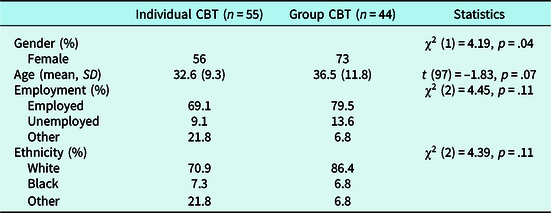
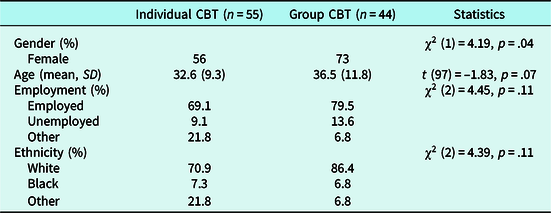
Overall, participants (n = 99) were predominantly White (78%), followed by Black (7%) and other ethnicities (14%). The average age was 34.5 years (SD = 10.6) and most participants were female (64.5%). Most participants were either employed full- or part-time (74%), were unemployed (11%) or classified as ‘other’ (14%). Patients had a primary diagnosis of GAD, assessed using the ICD-10 criteria (Department of Health, 2007), were at least aged 18 years, resided in the same borough as the IAPT service and attended at least one treatment session of gCBT or individual CBT. See Table 1 for demographic information by group.
Sample characteristics, reported by group
Allocation
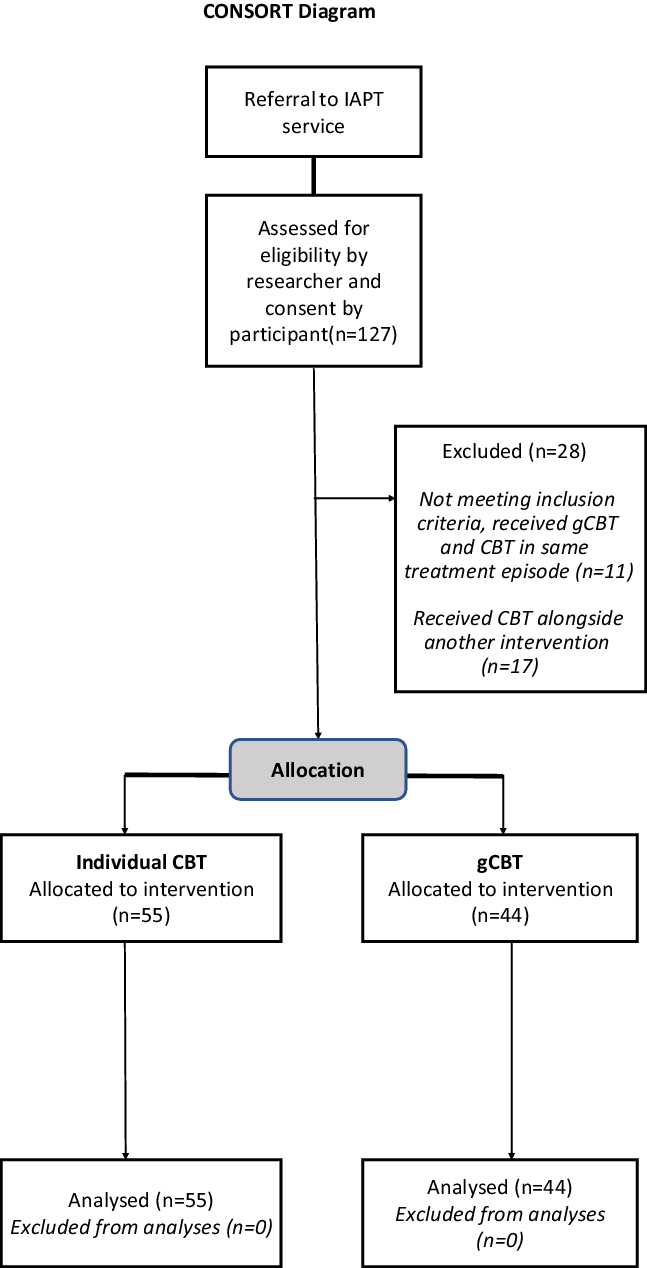
Participants self-referred or accessed the IAPT service through a general or health practitioner. They then completed an initial assessment [a semi-structured interview using the Patient Health Questionnaire-9 (PHQ-9) and the Generalised Anxiety Disorder-7 (GAD-7)] either by telephone, or face-to-face if telephone triage was not possible. A diagnosis of GAD was made by the assessing practitioner and their supervising psychologist. If there was disagreement, cases were taken to supervision. If patients met diagnostic criteria, they were offered to either attend group or individual CBT for GAD. Individuals were placed on a waiting list for gCBT or individual CBT for GAD at high intensity (HI). See the CONSORT diagram in Fig. 1.
CONSORT diagram of group allocation.

CBT intervention for GAD
Participants received up to 12 weekly, 90-minute sessions for those in the group intervention, or 12 weekly, 1-hour sessions for those in the individual intervention condition. Both interventions utilised the same treatment protocol (Dugas et al., Reference Dugas, Gagnon, Ladouceur and Freeston1998) as recommended by NICE and the Department of Health (Roth and Pilling, 2007). The first few sessions consisted of psychoeducation about how the perception and interpretation of uncertainty is important in maintaining worry and anxiety. Subsequent sessions aimed to improve identification and acceptance of uncertain situations, supplemented by breathing and relaxation techniques, thought records and thought challenging homework. In the current study, six groups ran over 2 years and the average gCBT group contained seven patients (mode = 9).
Procedure
A search on the IAPT serviceʼs online clinical database (IAPTus) was conducted to extract patient records of those who received treatment for GAD between April 2015 and April 2017. Participants were screened to ensure (a) GAD was the primary diagnosis, (b) they were treated using the NICE endorsed treatment approach (Dugas et al.ʼs model of uncertainty, Reference Dugas, Gagnon, Ladouceur and Freeston1998), (c) they had not received both gCBT and individual CBT in one treatment episode, and (d) they received only CBT during sessions within one episode of care (i.e. not CBT plus interpersonal therapy within one episode). Case records were individually inspected to ensure inclusion criteria were met. Participants were subdivided into two groups: individual CBT (n = 55) and gCBT (n = 44) for GAD (see Fig. 1). Only those receiving HI CBT were included in the analysis, as GAD groups were not offered at low intensity (LI) in the service from which these data were drawn. Patients treated with individual therapies based on models differing to Dugas et al.ʼs model of uncertainty were not included in the analysis, to allow for comparison with the gCBT group, which exclusively uses the Dugas model.
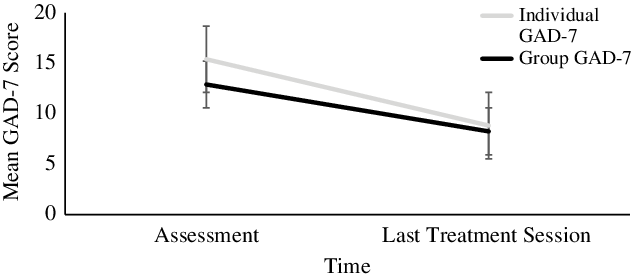
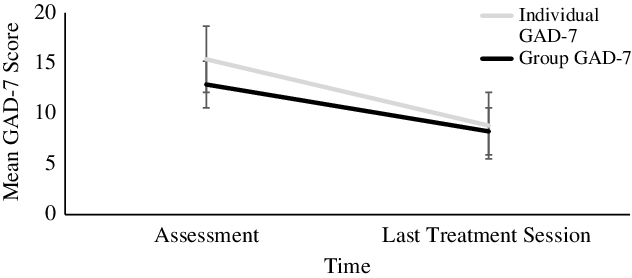
Reduction in GAD-7 scores over time for individual CBT (n = 55) and gCBT (n = 44) groups (left).
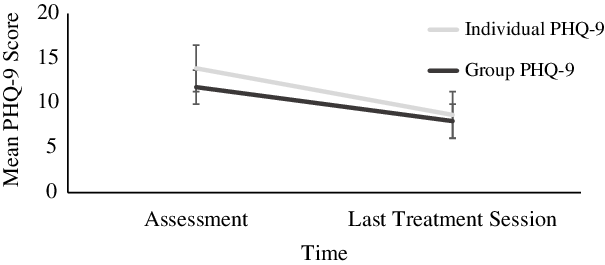
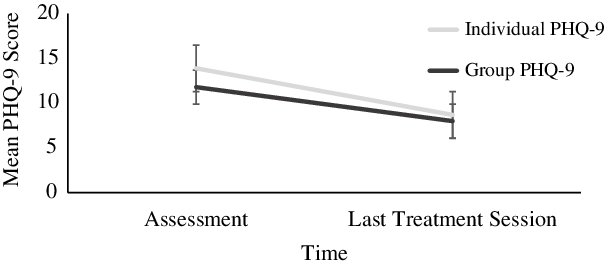
Reduction in PHQ-9 scores over time for individual CBT (n = 55) and gCBT (n = 44) groups (right).
Demographic data, outcome data at T1 and T2, number of treatment sessions and treatment episodes they received were also extracted.
Measures
Change in clinical severity and recovery, was established using cut-offs on the GAD-7 (Spitzer et al., Reference Spitzer, Kroenke, Williams and Löwe2006) and the PHQ-9 (Kroenke et al., Reference Kroenke, Spitzer and Williams2001).
The GAD-7 is a 7-item self-report questionnaire for screening and measuring symptoms of GAD, such as frequency of pathological worry and feelings of catastrophe (Spitzer et al., Reference Spitzer, Kroenke, Williams and Löwe2006). The GAD-7 uses a 4-point scale (0 = not at all to 3 = nearly every day) and scores are added together to give a total that describes the severity of the anxiety over the last 2 weeks. A cut-off score of 8 is recommended to identify the likely presence of a diagnosable anxiety disorder (Kroenke et al., Reference Kroenke, Spitzer, Williams, Monahan and Löwe2007), as commonly used in IAPT services (National Collaborating Centre for Mental Health, 2018). The GAD-7 has demonstrated good reliability and construct validity across primary care clinics (Spitzer et al., Reference Spitzer, Kroenke, Williams and Löwe2006).
The PHQ-9 (Kroenke et al., Reference Kroenke, Spitzer and Williams2001) screens for symptoms and severity of depression in a 9-item self-report questionnaire. The PHQ-9 uses a 4-point scale (0 = not at all to 3 = nearly every day) and scores are added together to give a total that describes the severity of the depression over the last 2 weeks. A cut-off score of 10 indicates the presence of clinical depression (Manea et al., Reference Manea, Gilbody and McMillan2012; National Collaborating Centre for Mental Health, 2018). The PHQ-9 has been shown to be a reliable measure of depression in primary care clinics (Kroenke et al., Reference Kroenke, Spitzer and Williams2001).
Clinical recovery
Patients were classed as recovered if they obtained scores both below case-level depression (PHQ-9 score ≥10) and anxiety symptoms (GAD-7 score ≥ 8) at last point of contact (post-treatment). Definitions of clinical recovery differ in scientific literature and between designs (e.g. Sharp et al., Reference Sharp, Power and Swanson2004 and Richards and Borglin, Reference Richards and Borglin2011). Although these criteria do not use the definition of reliable and clinically significant change (Jacobson and Truax, Reference Jacobson and Truax1991), these are the standard criteria for recovery currently applied in IAPT services (Clark, Reference Clark2011). As such, the criteria reflect consequential recovery rates that are acknowledged by services in practice. Patients scored above clinical thresholds at T1.
Attrition
Attrition was established through defining drop-outs as those who failed to complete at least five (of 12) treatment sessions (Heatherington et al., Reference Heatherington, Harrington, Harrington, Niemeyer, Weinberg and Friedlander2014). Therefore, cases were classified as either drop=outs (attending fewer than five treatment sessions) or completers (attending five or more treatment sessions).
Data analysis
Data were analysed using IBM SPSS Statistics-23. Data were anonymised at point of collection to ensure confidentiality and anonymity. The last available PHQ-9 and GAD-7 scores of participants before discharge was used as a proxy for outcomes (in line with intention-to-treat principles). To investigate statistically significant differences in anxiety and depression over time, paired t-tests were conducted on PHQ-9 and GAD-7 scores at T1 and T2, respectively. This was done for both individual and group CBT groups. Clinical recovery and attrition in individual and gCBT for GAD were explored as percentages, presented later in the results, along with other clinically relevant outcomes.
Further statistical exploration of demographic data (gender, ethnicity and employment case-level depression) of individual CBT and gCBT groups were conducted through chi-squared tests. Other relevant clinical characteristics of gCBT and individual CBT groups were explored through chi-squared tests (instances of case-level depression, recovery rates, attrition rates) and paired t-tests (number of treatment sessions attended and number of clinical episodes).
Results
Group characteristics
Table 1 reports that baseline characteristics for both conditions reflected a high degree of similarity across the two conditions. There was a non-significant difference in employment of those in gCBT and individual CBT, with those in gCBT appearing better engaged in employment. A statistically greater number of females attended gCBT and there was generally more ethnic diversity in individual CBT, although this did not reach statistical significance.
Anxiety and depression reduction in group and individual CBT
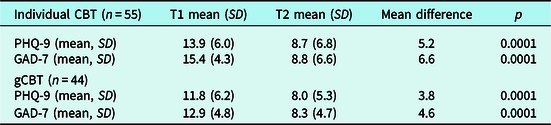
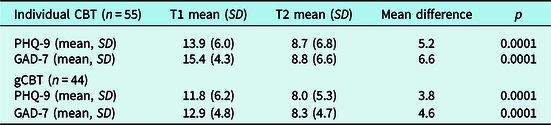
PHQ-9 scores in gCBT were found to significantly reduce between T1 and T2 [t (44) = 4.28, p < .001. d = 0.65], see Fig. 3. GAD-7 scores also significantly reduced over time in the gCBT group [t (44) = 5.99, p < .001, d = .90], as shown in Table 2 and illustrated in Fig. 2. Similarly, individual CBT yielded significant reductions in PHQ-9 scores [t (54) = 4.96, p < .001, d = 0.67; see Fig. 3] and GAD-7 scores [t (54) = 6.95, p < .001, d = 0.94; see Fig. 2].
Symptom reduction over time in gCBT and individual CBT
Clinical recovery in group and individual CBT
Clinical recovery rates in gCBT and individual CBT are detailed in Table 3. Over half of those in individual CBT reached below clinical thresholds (53%), whilst 41% of those in gCBT were deemed as recovered at last point of contact. Although more of those in individual CBT achieved recovery, gains made were not significantly different from that of gCBT [χ2 (1) = 1.37, p = .24]. It is interesting to note that descriptively those in individual CBT experienced greater case-levels of depression than those in gCBT, suggesting a greater degree of functional impairment in individual CBT groups. However, this difference did not reach statistical significance.
Clinical recovery in gCBT and individual CBT

Attrition in group and individual CBT
Attrition rates of gCBT and individual CBT are presented in Table 4. Descriptively, both interventions yielded similar attrition. Under a third of those in individual CBT (27.3%) and gCBT (29.5%) terminated their therapy before session 5. Those in individual CBT attended an average of 9.9 treatment sessions (SD = 4.3) and similarly, those in gCBT attended 8.7 sessions. Table 4 also shows the mean number of clinical episodes that patients in individual CBT and gCBT experienced. Statistically, however, differences in attrition [χ2 (1) = .062, p = .83], treatment sessions attended [t (97) = 1.54, p = .13] and clinical episodes [χ2 (5) = 4.37, p = .50] were not significant.
Attrition, number of treatment sessions attended and number of clinical treatment episodes experienced in gCBT and individual CBT

Discussion
The study sought to explore the efficacy of gCBT relative to individual CBT for GAD in a routine setting, using a pragmatic naturalistic rather than a controlled comparison. Positive significant outcomes are reported overall for both groups in terms of reductions in anxiety and depression at post-treatment, with medium to large effect sizes. Around half of those in individual CBT recovered (53%), with those in gCBT reporting acceptable outcomes also (41%). Both interventions appeared well-adhered to, with under a third of patients prematurely terminating therapy in both gCBT and individual CBT groups [χ2 (1) = .062, p = .83].
Both gCBT and individual CBT interventions were well attended, with patients attending 8.7 of 12 treatment sessions in gCBT and 9.9 of 12 treatment sessions in individual CBT. Those in gCBT and individual CBT experienced a mean of 1.39 and 1.33 treatment episodes, respectively. As re-referrals and missed treatment sessions are costly in terms of therapeutic time and allocation of resources (Cairns, Reference Cairns2014), this study provides insight into important questions over the longevity and acceptability of gCBT, in the context of outcomes of individual CBT from a routine IAPT service.
Clinical recovery in IAPT is defined as a shift to below the clinical threshold at post-treatment (Richards and Borglin, Reference Richards and Borglin2011) with IAPT aiming for a recovery rate of 50% for those who complete treatment (Dormon, Reference Dormon2015; NHS Digital, 2017). According to results of the current study, individual CBT achieved this rate (53%), whilst gCBT reached below this target (41%). Findings are consistent with outcomes from an observational prospective cohort study of 32 IAPT services in their first year, which found on average that 40% of patients recovered overall (Gyani et al., Reference Gyani, Shafran, Layard and Clark2013), again replicating previous findings with an alternative design. However, more recent reports suggest that 52.5% of eligible referrals moved to recovery in 2018 (NHS Digital, 2018). GAD patients tend to have a worse prognosis than those with other anxiety disorders, which blanket targets do not account for (Walczak et al., Reference Walczak, Ollendick, Ryan and Esbjørn2017). This is noteworthy and should be considered in the context of these findings. As such, the current study provides a bridge from research to understanding recovery in clinical practice.
The results support the existing limited literature on format efficacy, provided by RCTs (Burlingame et al., Reference Burlingame, Seebeck, Janis, Whitcomb, Barkowski, Rosendahl and Strauss2016a; Manassis et al., Reference Manassis, Mendlowitz, Scapillato, Avery, Fiksenbaum, Freire and Owens2002; Sharp et al., Reference Sharp, Power and Swanson2004). Results replicate findings of the RCT in Manassis et al. (Reference Manassis, Mendlowitz, Scapillato, Avery, Fiksenbaum, Freire and Owens2002), where significant post-intervention reductions in anxiety and improvements of global functioning were cited in pre-adolescent children with GAD and social anxiety, regardless of treatment format. Results further support findings that gCBT is as effective as individual CBT at reducing measures of anxiety and depression in adults with other disorders, such as social anxiety (Sharp et al., Reference Sharp, Power and Swanson2004). The current study also compliments finding from a 25-year meta-analysis of controlled studies that have directly compared individual CBT with gCBT across a range of disorders, finding no differences between formats for rates of treatment acceptance, recovery, attrition and improvement (Burlingame and Jensen, Reference Burlingame and Jensen2017).
However, literature to date has been inconsistent over the efficacy and acceptability of gCBT, with the quality of evidence cited in meta-analyses and the relevance of results obtained from RCTs being brought into question (Schwartze et al., Reference Schwartze, Barkowski, Strauss, Burlingame, Barth and Rosendahl2017). This pragmatic exploration of gCBT outcomes aids our understanding of attrition and recovery in ecologically relevant settings, whilst extending and replicating findings from well-controlled comparative formats from other populations. As research on the utilisation of gCBT for GAD is under-developed in comparison with individually delivered CBT (Burlingame and Jensen, Reference Burlingame and Jensen2017), current findings support the deployment of gCBT for GAD in IAPT services (NICE, 2011). Further research should continue to explore and more robustly compare these formats in pragmatic naturalistic settings where barriers to treatment and treatment delivery form part of an implementation analysis.
Due to the pragmatic nature of the study the clinical relevance is high; however, we cannot readily generalize due to the exploratory nature of this study. The conditions, participants and therapists within the service were not subject to controls, in line with the observational nature of the study. This increases the ecological relevance of the study, offering new and novel insights and evidence to support current research in the field. Although the strength of RCTs is their high treatment fidelity with minimal bias, most RCTs are narrow in their research focus and restrictive in their participant selection, with most patients being secondary-care patients, who differ from patients seen in primary care on many levels (Hotopf, Reference Hotopf2002). The design features of RCTs also mean that procedures of the study are typically removed from routine clinical practice (Hotopf, Reference Hotopf2002). As a result of the high level of control that RCTs are able to employ, with optimal conditions of patient selection and timings of interventions made possible, RCTs can be criticised for being limited in their generalisability to settings where conditions naturally differ from that trial (Treweek and Zwarenstein, Reference Treweek and Zwarenstein2009). Therefore, this study meets the call for routine-based efficacy studies in the field on gCBT (van Ingen and Novicki, Reference van Ingen and Novicki2009) which are needed in order for IAPT services to benefit from the increased access to psychological interventions that gCBT facilitates (Scott, Reference Scott2018). This study expands the evidence-base for group therapy, which may help to address any misconceptions professionals and patients have about its efficacy (Piper, Reference Piper2008) and supports findings from other research designs in the field, such as RCTs. By using different research designs and settings to replicate findings, we gain more confidence in our conclusions.
Results from our exploration of treatment formats for GAD did not support the notion that gCBT yields higher rates of attrition (Fernandez et al., Reference Fernandez, Salem, Swift and Ramtahal2015), as suggested by previous research replicating a CBT intervention for GAD, where drop-out rates were significantly higher in group than individual format (Ladouceur et al., Reference Ladouceur, Dugas, Freeston, Léger, Gagnon and Thibodeau2000). Our findings are supported by a recent large meta-analysis, which concluded no differences in attrition between individual and gCBT (Burlingame et al., Reference Burlingame, Seebeck, Janis, Whitcomb, Barkowski, Rosendahl and Strauss2016a). RCTs yield significantly lower attrition rates than that of clinical practice (Richards and Borglin, Reference Richards and Borglin2011; Swift and Greenburg, Reference Swift and Greenberg2012). For example, Ladouceur et al. (Reference Ladouceur, Dugas, Freeston, Léger, Gagnon and Thibodeau2000) reported 0% attrition in the individual CBT group, yet on average, a quarter of patients in IAPT drop out after just one session (Ali et al., Reference Ali, Rhodes, Moreea, McMillan, Gilbody, Leach, Lucock, Lutz and Delgadillo2017). This illustrates that non-completers are likely to be more common in clinical practice than in RCTs, possibly due to increased pressures and demands on both the trial and participants; optimal participant selection is not possible in clinical settings. Findings indicate that gCBT does not yield significantly higher attrition, with a third of patients who dropped out in both treatment groups.
Considering the results of the current study, the potential of treating larger numbers of patients simultaneously has positive implications in providing cost-efficient therapies in primary care services and beyond. As gCBT is easily standardised and manualised, a large number of patients can be treated by fewer staff members in less time, saving therapeutic resources (Oei and Dingle, Reference Oei and Dingle2008). Although the current study was unable to measure cost-effectiveness, NICE (2011) comment that for high-intensity populations, gCBT is likely to be more cost-effective than individual CBT. In a climate of long waiting lists and limited resources, the universal benefits of gCBT can provide a treatment that is not only cost-effective, but clinically sound (Manassis et al., Reference Manassis, Mendlowitz, Scapillato, Avery, Fiksenbaum, Freire and Owens2002; Olatunji et al., Reference Olatunji, Cisler and Deacon2010). In order for wide-scale dissemination to occur, demonstration of cost-effectiveness is needed, as such assumptions are not yet grounded in robust literature (Gunter and Whittal, Reference Gunter and Whittal2010). Whilst treatment provision is only one aspect of calculating cost-effectiveness at a health-service level or wider (Chisholm et al., Reference Chisholm, Sweeny, Sheehan, Rasmussen, Smit, Cuijpers and Saxena2016), with the assumption of five patients per group, gCBT can produce the same improvement with 60% of the time consumed in individual treatment (Burlingame et al., Reference Burlingame, Gleave, Erekson, Nelson, Olsen, Thayer and Beecher2016b). Taken together, group treatment requires fewer therapeutic resources and can treat more patients from the same resource, suggesting that gCBT has the potential to be a more cost-effective format than individual CBT. This can produce long-term savings, with the assumption of equal efficacy. Comparative research is encouraged with an economic analysis of the treatment, in order to inform policy with certainty.
Strengths and limitations
The results of the study should be interpreted in light of its strengths and limitations. The use of naturalistic data in the current study has the advantages of ecological validity and clinical relevance for practitioners. Unlike controlled trials, where duration of treatment is fixed per protocol, in the current study the wide variation of treatment session attendance reflects routine in clinical practice, as patients attended to attain a good-enough level of improvement (Barkham et al., Reference Barkham, Connell, Stiles, Miles, Margison, Evans and Mellor-Clark2006). In addition, there were few exclusions to receiving intervention in the current study, whereas clinical trials more frequently screen out on the basis of comorbidity. It is purported that routine practitioner therapists digress from CBT protocols, to instead rely more on experience than experimental research due to the large gap in conditions between RCTs and daily practice (Becker et al., Reference Becker, Zayfert and Anderson2004). Considering that some disorders, like GAD, are under-represented in the anxiety field (Burlingame and Jensen, Reference Burlingame and Jensen2017) this is unsurprising. Chorpita (Reference Chorpita, Kazdin and Weisz2003) suggests that in order to increase the utility of the research evidence-base, RCTs should be used in combination with transportability studies that are representative of clinical settings. As individual CBT is more widely understood and accepted, this study increases the relative paucity of evidence relating to gCBT. Further effectiveness data should be gathered to continue to address this gap.
A further strength of the study is the use of an intention-to-treat analysis, a more conservative measurement appropriate to routine practice setting where non-completers are more common (Heritier et al., Reference Heritier, Gebski and Keech2003). As the majority of patients who do not attend the last scheduled session show a poorer trajectory, missing data could lead to the assumption that patients improve more than they actually did (Clark, Reference Clark2011). In addition, weekly measurement of symptoms meant that data was available even in cases of premature termination (Gyani et al., Reference Gyani, Shafran, Layard and Clark2013). As data completeness is less common in clinical settings than in RCTs, this approach can be used for other naturalistic studies (Shafran et al., Reference Shafran, Clark, Fairburn, Arntz, Barlow, Ehlers, Freeston, Garety, Hollon, Ost and Salkovskis2009).
Noted limitations of the current study are the exploratory nature and the lack of scientific justification for direct comparison between the groups due to the extraneous variables ubiquitous in the clinical setting that hamper interpretation of findings. However, this study is the first of its kind, and provides further evidence of the comparative efficacy of gCBT using a research design without the gold standard RCT. We suggest this is a meaningful contribution from a pragmatic setting, despite lack of absolute confidence in generalisability. This study is also limited by potential selection bias due to absence of well-controlled conditions or random allocation to condition. However, in practice patients are selected for treatments based on their presenting symptoms, as it is unethical to not best improve chances of recovery (Manassis et al., Reference Manassis, Mendlowitz, Scapillato, Avery, Fiksenbaum, Freire and Owens2002). This is demonstrated herewith, as those in individual CBT were more severely impaired than those in gCBT, which highlights the potential of individual factors to determine allocation to therapy. In this sense, RCTs offer a more sensitive way of determining added effects of treatments to recovery, but such selection is not representative of clinical practice (Clark et al., Reference Clark, Layard, Smithies, Richards, Suckling and Wright2009).
The small sample size is a limitation of the current study and a greater powered study on a larger scale is recommended to replicate findings. To place this sample into context, indicators from the Annual Report on the use of IAPT Services England 2018–2019 suggest that 40,059 referrals are made for CBT at HI for GAD. Around 23% of all referrals for all mental health concerns received HI therapy alone and 39% of referrals received both HI and LI therapies (NHS Digital, 2019). However, small sample sizes are a common methodological problem when analysing interventions. Small samples also appear to be common in other primary care studies; however, these may be better controlled (Barrowclough et al., Reference Barrowclough, Haddock, Lobban, Jones, Siddle, Roberts and Gregg2006; Holmes et al., Reference Holmes, Donovan, Farrell and March2014; Manassis et al., Reference Manassis, Mendlowitz, Scapillato, Avery, Fiksenbaum, Freire and Owens2002; Sharp et al., Reference Sharp, Power and Swanson2004). Given the explorative nature of the study, a direct comparative investigation is required to statistically compare the relative efficacy of gCBT and individual CBT.
A further limitation is that the long-term effects of the two modalities are unknown. Considering patients as ‘recovered’ at the last therapy session can be criticised for being over-optimistic (Bockting et al., Reference Bockting, Hollon, Jarrett, Kuyken and Dobson2015). In contrast, mental health policies for primary care emphasise recovery at the point of discharge (Department of Health, 2014), which may reinforce short-term perceptions about disorders. Tyrer and Baldwin (Reference Tyrer and Baldwin2006) suggest that GAD treatments rarely result in complete resolution of symptoms in the long-term, with only a third maintaining gains (Whitfield, Reference Whitfield2010). Results therefore need to be considered in light of knowledge of natural recovery and outcomes of RCTs (Richards and Borglin, Reference Richards and Borglin2011). However, findings from gCBT delivered for depression in a routine setting suggest that post-treatment gains remained stable at 3-month follow-up, with large effect sizes (Thimm and Antonsen, Reference Thimm and Antonsen2014). Future studies should offer post-treatment follow-up appointments, to measure the comparative long-term impact of gCBT (Ali et al., Reference Ali, Rhodes, Moreea, McMillan, Gilbody, Leach, Lucock, Lutz and Delgadillo2017). Although IAPT do offer 6-month follow-ups, these are not mandatory and have to be initiated by the treating therapist (Dormon, Reference Dormon2015), even if patients did consent to further contact. This can explain the lack of follow-up data available, limiting the ability to inform policy about best practice and delivery of psychological services.
Conclusions
This study aimed to explore the effectiveness and acceptability of individual CBT and group CBT, for the treatment of GAD in a routine IAPT service offering an explorative comparative description. Both treatment conditions produced statistically significant reductions in depression and anxiety, with descriptively comparable rates of clinical recovery and attrition. Given the efficacy, applicability and efficiency of gCBT, this study supports the use of group CBT for GAD, and their alignment with IAPTʼs targets of improving access and recovery. Future research should seek to replicate these findings on a larger scale and consider both pragmatic and more robust well-controlled statistical designs, with longer follow-up in a routine care setting.
Acknowledgements
We would like to thank Dr Sarah Halligan for her initial involvement with this work. We would also like to thank the IAPT Service (Back on Track, West London Mental Health NHS Trust) from which these data are drawn. This study was completed as part of a broader service evaluation and formed part of a programme of study at the University of Bath.
Financial support
This research received no specific grant from any funding agency, commercial or not-for-profit sectors.
Conflicts of interest
The authors report no conflicts of interest with respect to this publication.
Ethical statement
Ethical approval was obtained from the Psychology Department at the University of Bath (reference no. 17-045) in March 2017.
Key practice points
(1) gCBT and individual CBT can produce reductions in self-reported anxiety and depression over time in a routine IAPT service.
(2) Fifty-three per cent of patients attending individual CBT reached clinical recovery, with comparative rates of 41% in gCBT.
(3) gCBT may provide a potentially cost-effective alternative to individual CBT, given descriptively similar attrition and recovery rates.
(4) CBT therapists may consider the unique positives of gCBT beyond the benefits of treating more patients out of the same therapeutic resource.





Comments
No Comments have been published for this article.