Introduction
The immunohaematological system is a crucial defence against the impact of infectious organisms, such as bacteria and parasites. It has been demonstrated that various xenobiotics have immunological effects in wildlife which can increase susceptibility to infectious diseases (Grasman Reference Grasman2002, Bustnes et al. Reference Bustnes, Hanssen, Folstad, Erikstad, Hasselquist and Skaare2004). There is evidence that seabirds with high levels of persistent organic pollutants (POPs) have decreased reproduction and survival rates, increased parasitic load, greater wing asymmetry and evidenced immunohaematological disorders (Sagerup et al. Reference Sagerup, Henriksen, Skorping, Skaare and Gabrielsen2000, Bustnes et al. Reference Bustnes, Erikstad, Skaare, Bakken and Mehlum2003, Reference Bustnes, Hanssen, Folstad, Erikstad, Hasselquist and Skaare2004). Studies performed on polar region birds have demonstrated an inverse relationship between contaminant levels and immunohaematological function, where at higher contaminant concentrations there is an increased risk of acquiring parasitic infections (Sagerup et al. Reference Sagerup, Henriksen, Skorping, Skaare and Gabrielsen2000, Bustnes et al. Reference Bustnes, Hanssen, Folstad, Erikstad, Hasselquist and Skaare2004).
Haematology is valuable for clinical diagnosis in birds (Hawkey et al. Reference Hawkey, Samour, Henderson and Hart1985, Vleck et al. Reference Vleck, Vertalino, Vleck and Bucher2000), enabling assessment of overall health and providing information on physiological and immunological responses, reproduction and possible presence of pathogens (Vleck et al. Reference Vleck, Vertalino, Vleck and Bucher2000, Vanstreels et al. Reference Vanstreels, Miranda, Ruoppolo, Reis, Costa, Pessoa, Torres, da Cunha, Piuco, Valiati, González-Acuña, Labruna, Petry, Epiphanio and Catao-Dias2014).
Leukocytes are part of the immune system and are considered to be very sensitive indicators of the physiological status of birds. Through the study of leukocytes it is possible to detect and observe disorders, individual level alterations or susceptibility of a species to acquire parasites that would otherwise pass unnoticed. Some studies describe leukocytes as non-specific cells, generally considered indicative of a state in homeostasis, where a higher frequency of these cells may indicate an infection or immunosuppression (Bustnes et al. Reference Bustnes, Hanssen, Folstad, Erikstad, Hasselquist and Skaare2004). Heterophil cells are relevant during innate immune responses towards infectious agents, taking part in the initial stages of most infections, and are the main method of bacterial control (Bustnes et al. Reference Bustnes, Hanssen, Folstad, Erikstad, Hasselquist and Skaare2004, Mitchell & Johns Reference Mitchell and Johns2008). In contrast, lymphocytes take charge of adaptive immune responses (Bustnes et al. Reference Bustnes, Hanssen, Folstad, Erikstad, Hasselquist and Skaare2004, Mitchell & Johns Reference Mitchell and Johns2008) and thus provide valuable information regarding the general immunological state of a bird. Through the heterophil/lymphocyte (H/L) ratio the degree of stress in birds can be determined in a simple and safe way (Gross & Siegel Reference Gross and Siegel1983, Bustnes et al. Reference Bustnes, Hanssen, Folstad, Erikstad, Hasselquist and Skaare2004). The H/L ratio is a reliable indicator of stress factors such as inanition, infectious disease, migration and certain contaminants.
The lack of industry, and the very limited population and its remoteness from peopled areas make the Antarctic an ideal region to assess the presence of contaminants and the alterations in wildlife linked to exposure to these compounds is of interest (Ballschmiter et al. Reference Ballschmiter, Scholz, Buchert, Zell, Figge, Polzhofer and Hoerschelmann1981). Within the Antarctic fauna, marine seabirds are the best bioindicators of environmental change since they enable monitoring of the presence of, and exposure to, contaminants (Boersma Reference Boersma2008). Penguins are widely distributed seabirds in Antarctica and constitute a significant element of total biomass (Lescroël et al. Reference Lescroël, Ridoux and Bost2004). Therefore, penguins are useful for gathering information on the presence of, and exposure to, environmental contaminants in Antarctica (Corsolini et al. Reference Corsolini, Borghesi, Schiamone and Focardi2007). Chinstrap penguins (Pygoscelis antarctica Forster) are good bioindicators of environmental stress. Chinstrap penguins nest on Penguin Island, King George Island, Admiralty Bay, Cape Shirreff, Signy Island, Livingston Island, Anvers Island and in the Palmer Station region (Cimino et al. Reference Cimino, Fraser, Irwin and Oliver2013). Their diet is based on Antarctic krill (Euphausia superba Dana), supplemented with fish and crustaceans (Espejo et al. Reference Espejo, Celis, González-Acuña, Jara and Barra2014)
The main objectives of this study were to determine the levels of POPs along with relevant variables of immunohaematological states through leukocyte counts of blood samples from three chinstrap penguin populations distributed across the Antarctic Peninsula, and to assess possible alterations that might be associated with these contaminants.
Materials and methods
Area of study
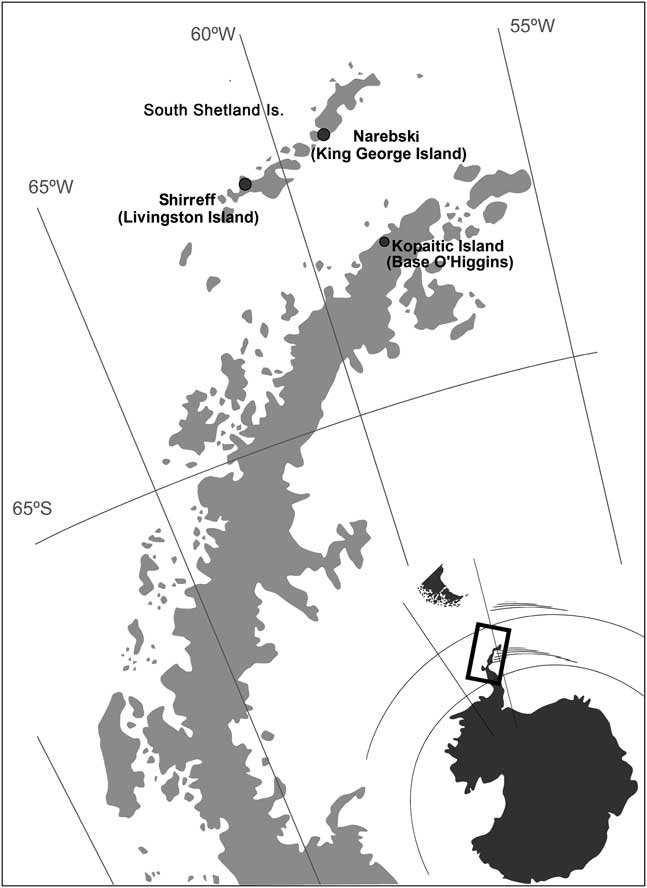
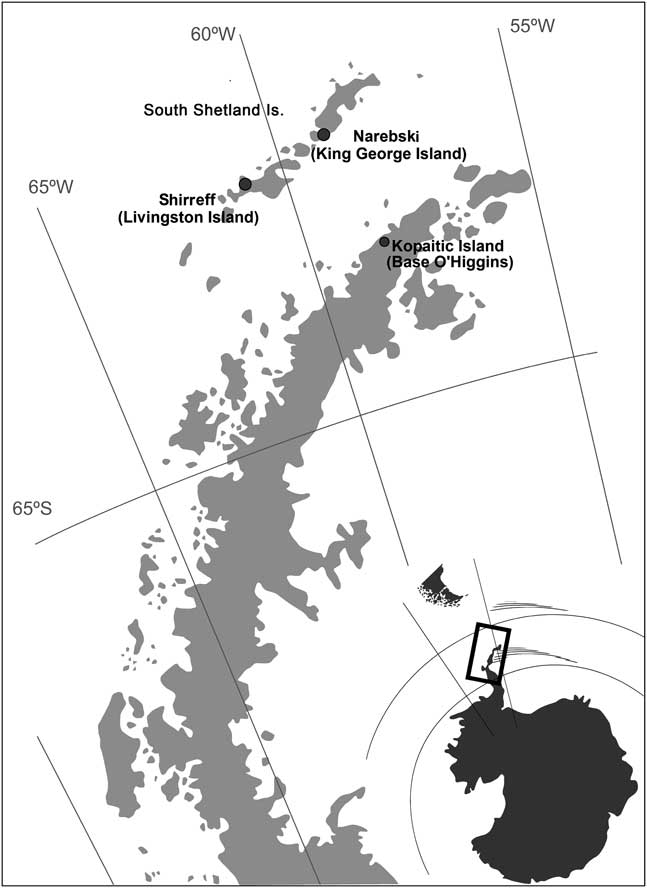
This study was conducted during the ECA 48 Antarctic Expedition (Chilean Antarctic Institute) in the summer of 2012. The chinstrap penguin colonies sampled were from three areas: Cape Shirreff on Livingston Island (62°27'S, 60°47'W), Kopaitic Island (63°19'S, 57°53'W) close to the Chilean base O’Higgins and Narębski Point on King George Island (62°13'S, 58°45'W) (Fig. 1). Cape Shirreff and Narębski Point colonies were from Antarctic Specially Protected Areas (ASPA) numbers 149 and 171, respectively.
Sampling locations on the Antarctic Peninsula.
Blood samples were taken from 15 adult, sexually mature individuals at each of the three colonies. Blood samples (1.5 ml) were collected from the brachial vein, put into Vacutainer tubes and stored at -20°C until analysis. Blood extraction, manipulation and immobilization were performed according to Wilson (Reference Wilson1997) in order to minimize stress associated with the procedure.
Analysis of organochlorines
All extractions and quantifications were carried out at the Environmental Chemistry Laboratory of the Environmental Sciences Faculty in Universidad de Concepción, Chile. The contaminants were extracted via the modified QuEChERS method described by Asensio-Ramos et al. (Reference Asensio-Ramos, Hernández-Borges, Ravelo-Pérez and Rodríguez-Delgado2010). One millilitre of sampled blood was put in a 50 ml centrifuge tube with 10 ml of n-hexane to gas chromatography MS SupraSolv® (Merck) and stirred in a vortex mixer. Magnesium sulfate, disodium citrate salts, trisodium citrate and NaCl were added to each tube. The samples were subjected to sonication in an ultrasonic bath for 15 minutes, and subsequently all tubes were centrifuged (4°C, 20 minutes at 5000 rpm). Depending on the extract obtained, clean-up was performed by adding magnesium sulfate and primary-secondary amine (PSA). Then n-hexane extracts were reduced in a rotary evaporator (40°C). The final extract (1 ml) was stored in an amber vial, brought to dryness under a stream of nitrogen and the internal standard (PCNB, 5 ppb) added, suspending it in a final volume of 1 ml with n-hexane. The samples were injected into a gas chromatograph with an electron capture detector (GC-ECD) auto system by Perkin Elmer, series 9000. The injector and GC-ECD were 240°C and 360°C, respectively. The analytes of interest were separated using a PTE-5 capillary column (30 m×0.25 mm inner diameter and 0.25 µm thick stationary phases) and helium as the make-up gas. The temperature programme of the column was: 100°C for 10 minutes using a gradient of 5°C min-1 to reach 280°C for 12 minutes. The total run time was 58 minutes. Analysis of POPs in blood samples was accompanied by a rigorous quality control programme. This consisted of repetitive analysis of blank samples and stool samples doped with known concentrations of the analytes of interest. Detection limits were 0.002 µg l-1. The analytes of interest were hexachlorobenzene (HCB), dichlorodiphenyltrichloroethane (DDT) and its corresponding metabolites (DDE, DDD and DDT), α-endosulfan, β-endosulfan and polychlorinated biphenyl (PCB 118, 138, 153 and 180).
Percentage count of leukocytes
Blood smears were performed in situ with anticoagulant-free blood and May-Grünwald Giemsa stains following traditional staining protocols (Moreno et al. Reference Moreno, Yorio, Garcia-Borboroglu, Potti and Villar2002). The blood smears were fixed in May-Grünwald for 3 minutes and afterwards stained with Giemsa solution for c. 10–15 minutes. The samples were subsequently analysed through a Zeiss microscope at the Clinical Immunology Laboratory at the Chemistry and Pharmacy Faculty of Universidad de Concepción. A total of 200 leukocytes were counted for differential leukocyte counts in accordance with protocols by Hawkey et al. (Reference Hawkey, Horsley and Keymer1989), for which the number of basophils, monocytes, heterophils, eosinophils and lymphocytes were counted. The H/L ratio was determined (Gross & Siegel Reference Gross and Siegel1983, Moreno et al. Reference Moreno, de León, Fargallo and Moreno1998). A qualitative assessment of cellular alterations was also performed.
Relative condition factor
In order to assess the general health of the penguins, a relative condition factor (relCF) was calculated using a regression of residuals of logarithmically transformed body mass (BM) against body length (BL), according to Brown (Reference Brown1996) and Labocha & Hayes (Reference Labocha and Hayes2012). The relCF gives an indication of whether a penguin has a good body condition (positive value) or a less than good body condition (negative value).
Statistical analysis
An analysis of variance (ANOVA) was used to analyse the database, with normality and homogeneity of variance tests. Evaluated parameters included contaminant levels and analysed biomarkers in all three study locations. As the data failed to pass the normality tests, a non-parametric statistical test (Kruskal-Wallis) was performed, and correlations for pollutants, leukocytes and condition factor were calculated using Spearman’s correlations. A value of P<0.05 was considered significant. All analyses used InfoStat software (Di Rienzo et al. Reference Di Rienzo, Casanoves, Balzarini, González, Tablada and Robledo2009)
Results
Organochlorine levels
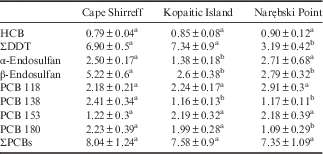
Across the three chinstrap penguin populations, ΣDDT (3.19–6.90 ng g-1 wet weight) and ΣPCBs (7.35–8.04 ng g-1 ww) presented the highest concentrations of all analysed organochlorinated contaminants (Table I). The lowest concentrations were exhibited by HCB (0.79, 0.85 and 0.90 ng g-1 ww at Cape Shirreff, Kopaitic Island and Narębski Point, respectively). Significant differences between locations were only found for ΣDDT, α-endosulfan, β-endosulfan, PCB 138 and PCB 180 (ANOVA, P<0.05, Table I). Significantly higher concentrations of ΣDDT and PCB 180 were found at Cape Shirreff (6.90 and 2.23 ng g-1 ww, respectively) and Kopaitic Island (7.34 and 1.99 ng g-1 ww) relative to Narębski Point (ANOVA, P<0.05, Table I). At Cape Shirreff, PCB 138 and β-endosulfan concentrations (2.41 and 5.22 ng g-1 ww, respectively) were significantly higher compared to Kopaitic Island (1.16 and 2.6 ng g-1 ww) and Narębski Point (1.17 and 2.79 ng g-1 ww) (ANOVA, P<0.05, Table I). α-Endosulfan showed similar levels at Cape Shirreff (2.5 ng g-1 ww) and Narębski Point (2.71 ng g-1 ww), concentrations that were higher than at Kopaitic Island (1.38 ng g-1 ww) (ANOVA, P<0.05, Table I).
Concentration (ng g-1 wet weight) of persistent organic pollutants in blood samples of chinstrap penguins (mean±standard error) from different locations on the Antarctic Peninsula.

HCB=hexachlorobenzene, DDT=dichlorodiphenyltrichloroethane, PCB=polychlorinated biphenyl.
ΣDDT=p,p-DDD, p,p'-DDE and p'p-DDT.
Same letter indicates absence of statistical significant difference (ANOVA, P=0.05).
Leukocyte counts, H/L ratio and red blood cells
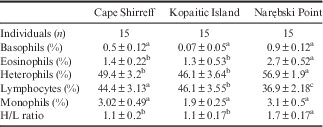
Basophils and monocytes did not show significant differences between the three areas surveyed (ANOVA, P=0.0662, Table II). Eosinophil and heterophil values were significantly higher in Narębski Point samples (56.9%) than in Cape Shirreff and Kopaitic Island samples (ANOVA, P<0.05, Table II). Lymphocyte levels showed statistically significant differences across all three chinstrap penguin populations, with the highest levels found at Cape Shirreff (Table II).
Differential leukocyte counts (mean±standard error) and H/L ratios for chinstrap penguins from different locations on the Antarctic Peninsula.
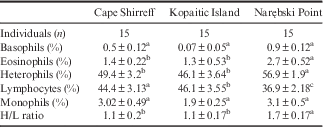
Same letter indicates absence of statistical significant difference (ANOVA, P=0.05).
All three populations showed H/L ratios >1, with the highest value at Narębski Point (ANOVA, P<0.05, Table II).
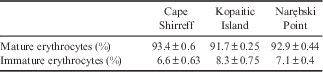
Red blood cell counts showed that there were no significant differences between the three locations with regard to the levels of mature (ANOVA, P=0.2881, Table III) and immature erythrocytes (ANOVA, P=0.2545, Table III).
Mature and immature erythrocytes (mean±standard error) from blood sample smears obtained from chinstrap penguin from different locations on the Antarctic Peninsula.

Cytological alterations
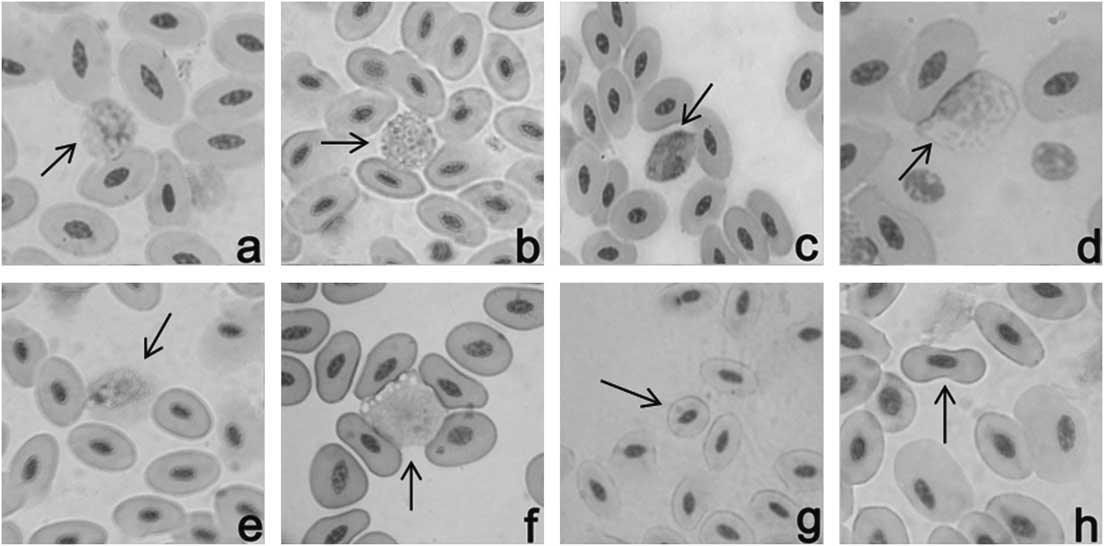
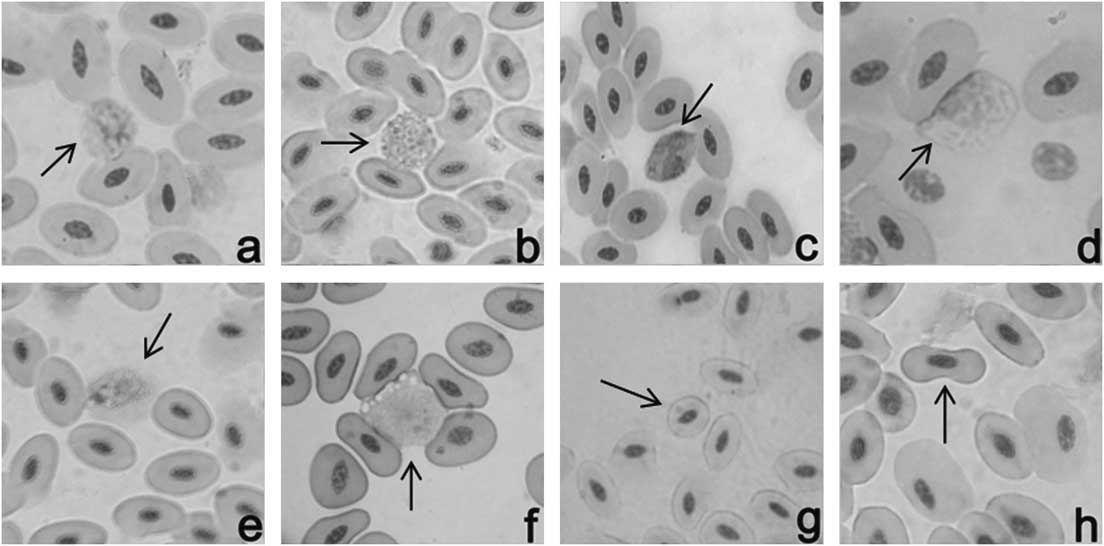
Different cytological alterations between chinstrap populations were observed in the blood smears. Toxic heterophil cells were observed, with concomitant short granulations. This indicates that the heterophil cells had been degranulated previously due to a reaction. It is possible to observe relative heteropenia in some of the smears. Activated, binucleate and granulated lymphocytes were also observed; some of the smears showed signs of lymphocytosis (high number of lymphocytes). Vacuolated monocytes, spherocytes and poikilocytes were also observed (Fig. 2).
Cytological alterations found in leukocytes and erythrocytes of chinstrap penguins from the three study locations. a. Toxic heterophil, b. heterophil with short granulations, c. binucleate lymphocyte, d. granulated lymphocyte, e. activated lymphocyte, f. vacuolated monocyte, g. spherocyte and h. poikilocyte. The photographs were taken with Nikon Coolpix L810 camera on a Zeiss microscope with 100x magnification.
Relative condition factor
Adult penguins at Narębski Point were significantly longer than the penguins at Kopaitic Island and Cape Shirreff (ANOVA, P<0.001, Table IV). These penguins also exhibited a higher average BM than the penguins in the colonies at Kopaitic Island and Cape Shirreff (ANOVA, P<0.001, Table IV). However, there was no significant difference in mean relCF between the sites (ANOVA, P=1.00, Table IV).
Body mass (BM), body length (BL) and relative condition factor (relCF) (mean±standard error) for chinstrap penguins from different locations on the Antarctic Peninsula.

* relCF calculated as logres BM/BL.
Pooled data for adult female and male chinstrap penguins.
Same letter indicates absence of statistical significant difference (ANOVA, P=0.05).
Correlations between contaminant levels, leukocytes and relative condition factor
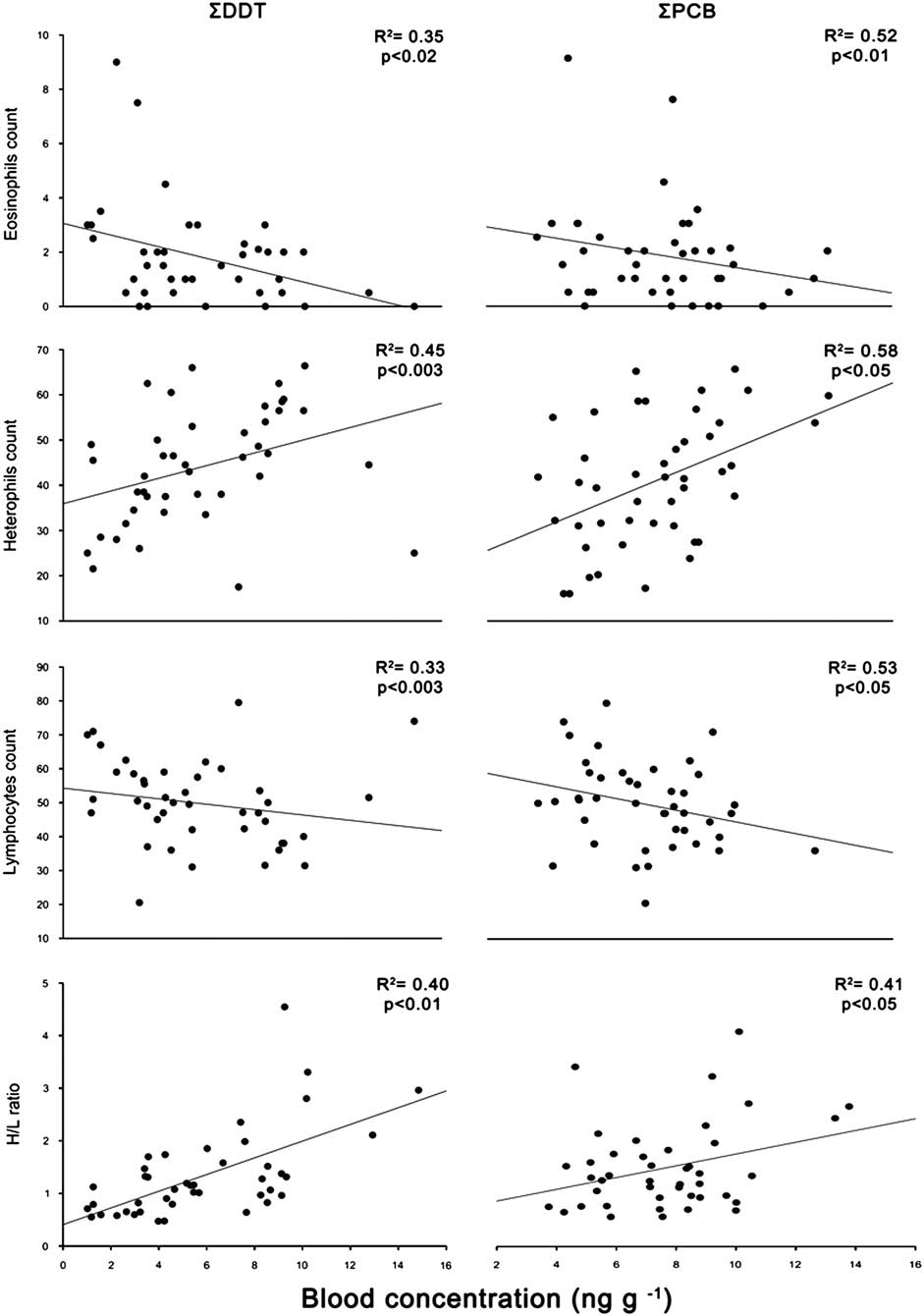
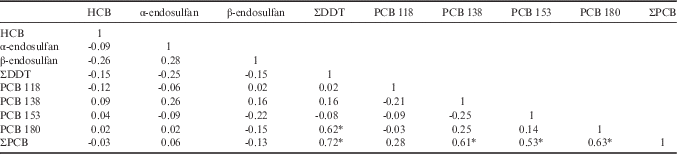
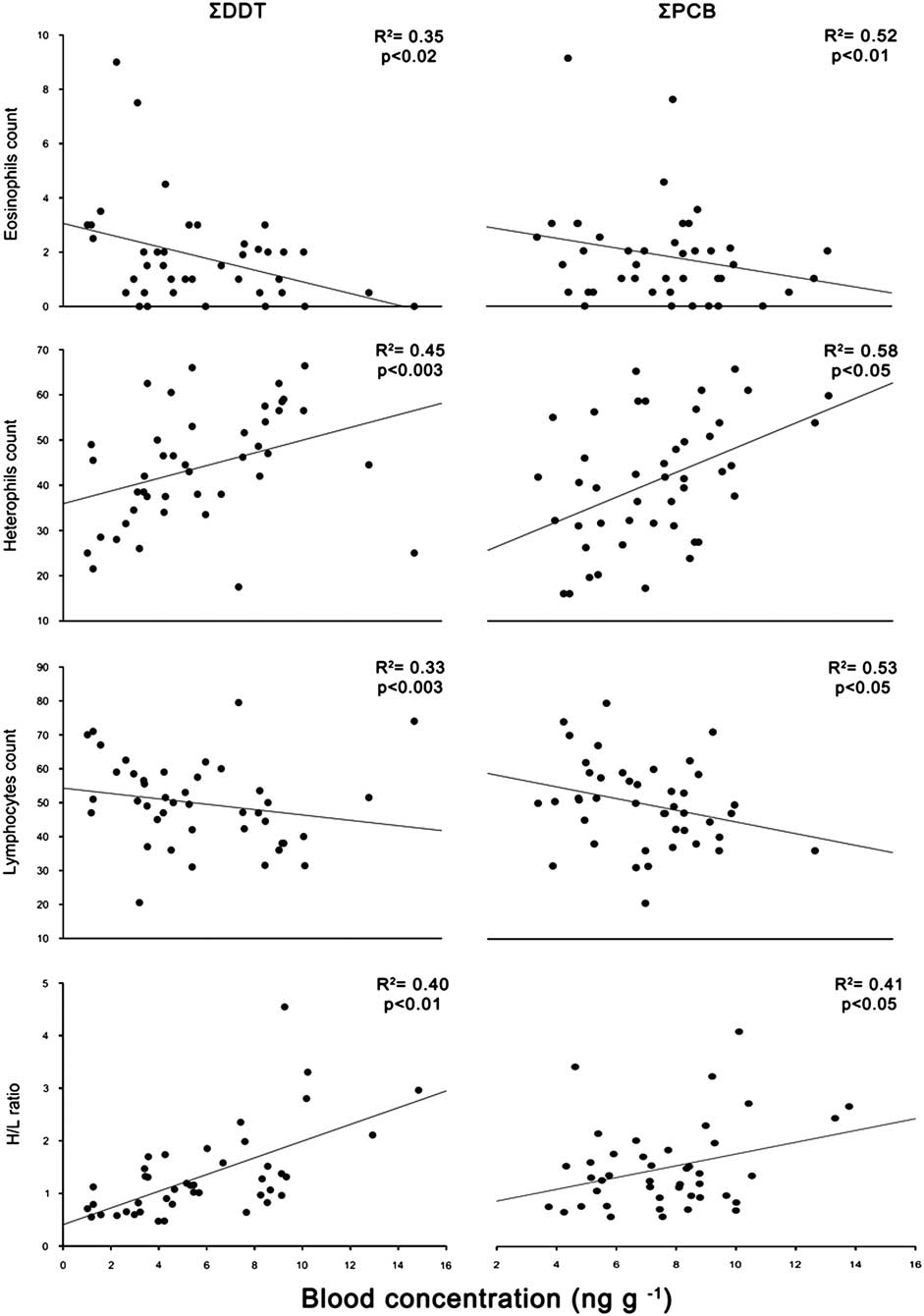
Of all analysed contaminants, leukocyte counts and condition factor scores across the three study sites, only eosinophil counts, heterophil counts, lymphocyte counts and H/L ratios showed significant correlations to both ΣDDT and ΣPCB levels in blood samples (Fig. 3). Correlations between some pollutants, such as ΣDDT and ΣPCBs (PCB 138, 153 and 180), were also observed (ANOVA, P<0.05, Table V).
Correlation of leukocytes and H/L ratio to blood concentrations of ΣDDT and ΣPCB in chinstrap penguins.
Correlation coefficients for relationships between different organochlorines in the blood of chinstrap penguins on the Antarctic Peninsula.

*Statistically significant (ANOVA, P<0.05).
Discussion
Recent studies have demonstrated that there has been a significant reduction in the levels of some organic contaminants in Antarctica and levels of some POPs in Antarctic wildlife (Van den Brink et al. Reference Van den Brink, Riddle, van den Heuvel-Greve and van Franeker2011). This trend was shown for HCB in this study, with HCB levels lower than those reported using the same work matrix by Corsolini et al. (Reference Corsolini, Borghesi, Schiamone and Focardi2007). However, the levels detected for ΣDDT closely match those reported by Corsolini et al. (Reference Corsolini, Borghesi, Schiamone and Focardi2007) for p'p-DDE obtained on an equal matrix, which would imply that these contaminants are still as important or relevant within the Antarctic food web. Furthermore, PCB levels detected in this study proved to be higher than those reported by Corsolini et al. (Reference Corsolini, Borghesi, Schiamone and Focardi2007) (4.5±2.4 ng g-1).
There is also information on the presence of newly detected contaminants, including endosulfans. Endosulfans were originally described in Antarctic penguins by Cipro et al. (Reference Cipro, Colabuono, Taniguchi and Montone2013) in chinstrap penguin egg samples (1.03 ng g-1 ww). However, this is the first study to report α- and β-endosulfan levels in chinstrap penguin blood samples. The presence of endosulfans in Antarctica could be explained by recent intensive use of this insecticide in South America, especially in Argentina, where it was manufactured, formulated and commercialized until its use was prohibited in July 2013 (Pérez et al. Reference Pérez, Menone and Doucette2013).
Significant differences across several contaminants (α-endosulfan, β-endosulfan, ΣDDT, and PCB 138 and 180) could be explained by diet, geographical differences and temporal variance.
Basophils are white blood cells that show up in the early stages of inflammatory processes. An increase in number is associated with chronic diseases (Mitchell & Johns Reference Mitchell and Johns2008, Gálvez et al. Reference Gálvez, Ramírez and Osorio2009). The basophil count numbers for chinstrap penguins from this study were similar to the numbers shown by Zinsmeister & Vanderheyden (Reference Zinsmeister and Vanderheyden1987) (0.3%) and Vanstreels et al. (Reference Vanstreels, Miranda, Ruoppolo, Reis, Costa, Pessoa, Torres, da Cunha, Piuco, Valiati, González-Acuña, Labruna, Petry, Epiphanio and Catao-Dias2014) (0.2% and 0.1% at Demay Point and the Keller Peninsula, respectively).
Monocytes were found in smaller quantities, 0–3% is considered within normal range for an avian species (Gálvez et al. Reference Gálvez, Ramírez and Osorio2009). The results from this study show a close similarity to the data obtained from Zinsmeister & Vanderheyden (Reference Zinsmeister and Vanderheyden1987) (2.4%), albeit higher than those obtained by Vanstreels et al. (Reference Vanstreels, Miranda, Ruoppolo, Reis, Costa, Pessoa, Torres, da Cunha, Piuco, Valiati, González-Acuña, Labruna, Petry, Epiphanio and Catao-Dias2014) (0.7% and 1.8% at Demay Point and the Keller Peninsula, respectively).
Heterophils are the most frequently observed leukocytes in blood smears, and can be associated with cell phagocytosis as a response to inflammatory and acute infectious processes (Bustnes et al. Reference Bustnes, Hanssen, Folstad, Erikstad, Hasselquist and Skaare2004, Mitchell & Johns Reference Mitchell and Johns2008, Gálvez et al. Reference Gálvez, Ramírez and Osorio2009), being the main control method against bacterial infections. The levels observed in this study are lower than those previously shown by Zinsmeister & Vanderheyden (Reference Zinsmeister and Vanderheyden1987) (61.6%). However, the levels for Cape Shirreff and Kopaitic Island were similar to those obtained by Vanstreels et al. (Reference Vanstreels, Miranda, Ruoppolo, Reis, Costa, Pessoa, Torres, da Cunha, Piuco, Valiati, González-Acuña, Labruna, Petry, Epiphanio and Catao-Dias2014) (47.6% and 37.28% at Demay Point and the Keller Peninsula, respectively).
Eosinophils, in high concentrations, are often linked to parasitic infections and related to hypersensitivity, allergic reactions and significant tissue damage (Zinsmeister & Vanderheyden Reference Zinsmeister and Vanderheyden1987, Mitchell & Johns Reference Mitchell and Johns2008, Gálvez et al. Reference Gálvez, Ramírez and Osorio2009). Eosinophil counts were within reference values (0–2%) and were similar to those reported by Vanstreels et al. (Reference Vanstreels, Miranda, Ruoppolo, Reis, Costa, Pessoa, Torres, da Cunha, Piuco, Valiati, González-Acuña, Labruna, Petry, Epiphanio and Catao-Dias2014) (2.9% and 1.1% at Demay Point and the Keller Peninsula, respectively). The chinstrap penguins living in Narębski Point presented higher levels of eosinophils than the other two study sites, which would indicate a distinct immune deficiency in these individuals. However, no relationships were observed between higher levels of eosinophils and parasites. No haemoparasites were discovered in any samples, a similar result to Vanstreels et al. (Reference Vanstreels, Miranda, Ruoppolo, Reis, Costa, Pessoa, Torres, da Cunha, Piuco, Valiati, González-Acuña, Labruna, Petry, Epiphanio and Catao-Dias2014).
Lymphocytes are the second most common white blood cells, following heterophils, and form a fundamental part of the immune system in birds (Mitchell & Johns Reference Mitchell and Johns2008, Gálvez et al. Reference Gálvez, Ramírez and Osorio2009). At Narębski Point the lymphocyte levels were similar to those reported by Graczyk et al. (Reference Graczyk, Shaw, Cranfield and Beall1994) (39.4%) in parasite-free African black-footed penguins (Spheniscus demersus L.) and Hawkey et al. (Reference Hawkey, Samour, Henderson and Hart1985) (30%) in healthy gentoo penguins (Pygoscelis papua Forster) in captivity. Zinsmeister & Vanderheyden (Reference Zinsmeister and Vanderheyden1987) also found similar results for wild gentoo penguins (35.8%). Lymphocyte counts from Cape Shirreff and Kopaitic Island were higher than those at Narębski Point, but similar to results obtained by Vanstreels et al. (Reference Vanstreels, Miranda, Ruoppolo, Reis, Costa, Pessoa, Torres, da Cunha, Piuco, Valiati, González-Acuña, Labruna, Petry, Epiphanio and Catao-Dias2014) (48.7% at Demay Point and 59.8% at the Keller Peninsula). Vanstreels et al. (Reference Vanstreels, Miranda, Ruoppolo, Reis, Costa, Pessoa, Torres, da Cunha, Piuco, Valiati, González-Acuña, Labruna, Petry, Epiphanio and Catao-Dias2014) also screened specimens for the presence of endoparasites. There was no evidence of endoparasites in the penguin blood samples in the current study. The results from Narębski Point are also similar to those reported by Graczyk et al. (Reference Graczyk, Shaw, Cranfield and Beall1994) in parasite-infected African black-footed penguins. Despite the fact that they are different species, that information can be used as a reference in birds with parasites, without discarding any haematological differences that might exist between them.
The H/L ratio shows a close relationship towards physiological changes triggered by the presence of contaminants, bacterial infections and inflammatory reactions (Gross & Siegel Reference Gross and Siegel1983, Hawkey et al. Reference Hawkey, Samour, Henderson and Hart1985), all of which translates to a distinct susceptibility in birds to develop pathologies. Values ≥1 are considered to indicate stress (Gross & Siegel Reference Gross and Siegel1983). Research has shown that birds not under stress present H/L ratio values of 0.62 during nesting periods and 0.71 during moments of strife (fighting and attacking other bird individuals) (Vleck et al. Reference Vleck, Vertalino, Vleck and Bucher2000). In this study, all three penguin populations demonstrated H/L ratio values >1, indicating that the birds were under a certain degree of physiological stress, which could be generated by a variety of environmental factors, such as the observed contaminants. This indicates an enhanced response during a state of stress and matches the report by Mandal et al. (Reference Mandal, Chakraborty and Lahiri1986) regarding contaminant-caused heterophilia and lymphopenia, and values obtained for stressed penguins by Vleck et al. (Reference Vleck, Vertalino, Vleck and Bucher2000).
The three study populations did not show any significant differences in red blood cell counts, and the percentages found were within previously established physiological ranges for wild birds (Gálvez et al. Reference Gálvez, Ramírez and Osorio2009).
Thus it becomes evident that the cytological abnormalities described in this study can be explained through the exposure to certain external agents, which induce specific alterations in this species of penguin. Although the aetiology of these alterations is not clear, it can be inferred that it is the result of an environmental factor. Based on current information, the cause could also be the presence of some anthropogenic contaminants previously reported for the Antarctic Continent (Celis et al. Reference Celis, Jara, González-Acuña, Barra and Espejo2012, Espejo et al. Reference Espejo, Celis, González-Acuña, Jara and Barra2014).
The results obtained in this study are similar to those obtained by Bustnes et al. (Reference Bustnes, Hanssen, Folstad, Erikstad, Hasselquist and Skaare2004) regarding correlations in glaucous gulls (Larus hyperboreus Gunnerus), a top predator of the Arctic ecosystem. Bustnes et al. reported positive correlations of ΣPCBs, oxychlordane and HCB levels to leukocytes, such as heterophils and lymphocytes. In addition, a study by Henriksen et al. (Reference Henriksen, Gabrielsen, Trudeau, Wolkers, Sagerup and Skaare2000) suggested that organochlorine loads can determine the proliferation of leukocytes in glaucous gulls; organochlorine concentrations found in that study corresponded to 3.5 and 1.2 µg g-1 for ΣPCBs and DDE respectively, which were lower than the values found in this study. The evidence indicates that DDT and PCBs have immunotoxic consequences in seagulls (Grasman & Fox Reference Grasman and Fox2001) and glaucous gulls (Bustnes et al. Reference Bustnes, Erikstad, Skaare, Bakken and Mehlum2003). Therefore, it is very likely that the presence of DDT and PCBs would cause some form of immunological stress (Bustnes et al. Reference Bustnes, Hanssen, Folstad, Erikstad, Hasselquist and Skaare2004). This matches the results of this study, where relationships between ΣDDT and ΣPCB concentrations and eosinophils, lymphocytes, heterophils and H/L ratios indicate that these birds are under physiological stress, partly induced by exposure to these contaminants.
A common challenge in ecotoxicological studies is that wildlife is exposed to a wide array of contaminant types (PAHs, trace metals, etc.) which makes it difficult to pinpoint precise correlations between the effects of those contaminants on the studied fauna (Bustnes et al. Reference Bustnes, Erikstad, Skaare, Bakken and Mehlum2003, Reference Bustnes, Hanssen, Folstad, Erikstad, Hasselquist and Skaare2004). Therefore, it is difficult to conclude that these contaminants could be the sole cause of the reported physiological alterations. Despite this, we can still assert that these types of pollutants are distinctly important, and could be influencing leukocyte production and growth, thus indirectly affecting the immune system. There are two possible explanations for the relationships found between the contaminant concentrations and heterophils and lymphocytes. First, POPs concentrations could be diminishing the immune cells functions, resulting in an increase of the production of these cells to compensate and to fight back against low tier infections (Grasman & Fox Reference Grasman and Fox2001). Secondly, POPs-derived immunosuppression may be contributing to the presence of infections and thereafter be causing an increase or decrease in heterophils and lymphocytes (Grasman Reference Grasman2002, Bustnes et al. Reference Bustnes, Hanssen, Folstad, Erikstad, Hasselquist and Skaare2004), a situation most commonly linked to parasite infections (Sagerup et al. Reference Sagerup, Henriksen, Skorping, Skaare and Gabrielsen2000).
In contrast, the study shows that DDT and PCBs cause a decrease in the activation of eosinophils, potentially associated with the presence of parasites. The analysed blood smears did not show evidence of endoparasites, but this does not completely rule out the possibility of parasitic nematodes, viral infections, bacterial infections or other external forms.
Despite the differences in (average) relCF values from Cape Shirreff (positive) and the other two sites (negative), there is no significant statistical difference. Type I error for this study was set at 0.05, and if we consider a 10% of difference between groups as recommended by Munkittrick et al. (Reference Munkittrick, Arens, Lowell and Kaminski2009), the statistical power (Type II error) was only 0.05. González-Acuña et al. (Reference González-Acuña, Hernández, Moreno, Herrmann, Palma, Latorre, Medina-Vogel, Kinsella, Martin, Araya, Torres, Fernandez and Olsen2013) had the same problem when they compared condition factor in gentoo penguins, yielding only a statistical power of 0.058 for adults and 0.232 for the chicks. Higher sample sizes must be used in order to be able to properly assess differences in condition factors for penguins in different locations.
For various species of birds it becomes difficult to establish haematological reference values. This research gives information relating to haematological behaviour response in chinstrap penguins when exposed to contaminant agents, which can be used as a point of reference for further POPs studies.
Conclusions
This study indicates that organic pollutants, such as ΣDDT and ΣPCB may be altering certain haematological and immunological parameters in populations of chinstrap penguins living in the Antarctic Peninsula. However, it is necessary to complement this research with additional information in order to elucidate causal relationships between contaminants and haematological responses, as well as to include other immunological parameters (immunoglobulin Y, lisozyme, etc.).
Acknowledgements
Many thanks to INACH for financing the projects T 18-09 (R. Barra), T 12-13 (D. González-Acuña) and T 31-11 (G. Chiang), as well as providing the chance to do research on Antarctic birds. Ms Solange Jara-Carrasco is a CONICYT grant holder for doctorate candidates. This paper is part of the Solange Jara-Carrasco PhD thesis supervised by R. Barra. Thanks to a scholarship doctoral thesis Support 2012, Folio 24121098 of CONICYT. Thanks to the research group of Dr Gonzalez-Acuna for obtaining samples. The suggestions of two anonymous referees were of great help in improving the previous version of this paper. Permits to access ASPA 149 and 171 were issued by the Chilean Government.
Author contribution
Dr (C) Solange Jara-Carrasco: conception of research, concepts/approach and preparation/editing of the manuscript. Ms Margarita González: conception of research, preparation/editing of the manuscript. Dr Daniel González-Acuña: interpretation of the findings, data analysis and preparation/editing of the manuscript. Dr Gustavo Chiang: interpretation of the findings, data analysis and preparation/editing of the manuscript. Dr José Celis: developed the concepts and approach and preparation/editing of the manuscript. Winfred Espejo: data analysis of samples and preparation/editing of the manuscript. P. Mattatall: execution of experiments. Dr R. Barra: conception of research, interpretation of the findings, data analysis and preparation/editing of the manuscript.