Introduction
Cryopreservation of embryos stored in liquid nitrogen offers several advantages, both from the biological and commercial stand points, enabling preservation of breeds and of endangered species, facilitating genetic interchange and maximizing animal resources (Celestinos & Gatica, Reference Celestinos and Gatica2002).
The technique of embryo transfer was first implemented in the 1970s and has been developed continually and perfected since that time. For example, in a country like Brazil, by 1995, 40,000 embryos were transferred and by 1999 this figure went up to 74,000, of which 60% were frozen (Thibier, Reference Thibier1997; Hasler, Reference Hasler, Schatten and Constantinescu2007).
However, it is still necessary to improve the protocols for embryo cryopreservation as the pregnancy rates have not surpassed 60% (Hasler, Reference Hasler1992; Spell et al., Reference Spell, Beal, Corah and Lamb2001; Dobrinsky, Reference Dobrinsky2002) even in cattle under optimal management conditions and production systems. In addition to this factor, it is difficult to keep quality controls during the different steps related to embryo transfer. For instance, once the embryo is thawed, it is immediately transferred with no knowledge of possible damage to the cells, especially for embryos wrongly classified as viable by stereoscopic microscopy, and which are actually undergoing an obvious deterioration (Aguilar et al., Reference Aguilar, Galina, Merchant, Montiel, Canseco and Marquez2002; Marquez-Alvarado et al., Reference Marquez-Alvarado, Galina, Castilla, Leon and Moreno-Mendoza2004). This limitation may become more accentuated when embryos are frozen with ethylene glycol and thawing occurs directly in the cow (Voelkel & Hu, Reference Voelkel and Hu1992; Larocca & Fernandez, Reference Larocca and Fernandez1997).
Embryo culture has been suggested as a possible alternative to assess embryo development and quality, thus determining the viability of these embryonic cells. In fact, Contreras et al. (Reference Contreras, Galina, Avila, Aspron and Moreno-Mendoza2008) followed up embryos for 24 h and suggested that 4 h was the minimum convenient time to evaluate the progress of embryo development. Other studies, mainly in embryos that were cultured in vitro and cryopreserved, have reported 20 to 50% of viability after 72 h of culturing (Zhang et al., Reference Zhang, Barry, Denniston, Bunch and Godke1992; Semple et al., Reference Semple, Betteridge and Leibo1995). These reports concluded that the viability of thawed embryos was associated significantly to the status of the embryo at the moment of freezing. The knowledge obtained when culturing embryos might be applied as a useful non-invasive procedure to assess the viability of frozen embryos stored in private farms in a number locations, particularly in countries that are situated in the tropical regions of the world.
Materials and methods
Forty-seven embryos frozen using ethylene glycol as a preservative were obtained from private farmers. These embryos were classified by experienced clinicians who render this service to the cattle sector in the State of Chiapas, Mexico. This practice is a common feature in preparing embryos for future transfer in developing countries. The cultured group was established with 20 good quality and 16 fair embryos; the non-cultured group was formed by six good quality embryos and five fair.
Culture
Embryos were thawed first for 10 s at ambient temperature, followed by 20 s in a water bath at 30 °C, finally in a One Step EmCare ICPBio (Auckland, New Zealand) medium for 6 min and in a Holding Plus® (Bioniche, Animal Health. Canada Inc.) medium for 5 min. Then, they were placed in 24-well plates on a 0.4 m pore filter (millicell-cm) floating on 0.5 ml culture medium with the next components: McCoy5a modified medium (Microlab, Mexico) supplemented with 10% fetal bovine serum (Sigma, USA) and 200 IU/ml penicillin G sodium, and 200 μg/ml streptomycin sulfate (Gibco, USA). One embryo was placed per well, and all were incubated at 37 °C, 60% humidity, and 5% CO2/95% air for 4 h. Morphology and development were monitored with photographs taken at the beginning and at the end of culture according to the method suggested by Contreras et al. (Reference Contreras, Galina, Avila, Aspron and Moreno-Mendoza2008).
Detection of cell proliferation (BrdU) and apoptosis (TUNEL)
All embryos were treated with a 0.1% Triton 72 X-100 solution (Gibco BRL, Grand Island, NY, USA) for 2 min to allow the zona pellucida to be permeable. Next, they were processed according to the directions of a commercial kit: 5-bromo-2′-deoxy-uridine (BrdU) for labelling (ROCHE Diagnostics Kit, Indianapolis, IN, USA). This kit allows detection of cell proliferation. At the end of BrdU treatment, they were fixed in 4% paraformaldehyde (Aldrich Chemicals Company Inc., USA) in phosphate-buffered saline (PBS), pH 7.4 for 30 min. After this event, embryos were washed twice in PBS for 5 min and incubated for 1 h at 37 °C with 100 μl TUNEL solution (In Situ Cell Death Detection Kit, AP Mca. ROCHE Diagnostics Kit, Indianapolis, USA). This kit allows the estimation of the number of cells in the process of apoptosis. These procedures were applied to evaluate the proliferation and apoptosis rate after culture. A confocal LSM 5 Pascal, Zeiss (Argon-Krypton laser) microscope, with BP 450–490 filter, was used to count cell nuclei undergoing proliferation and apoptosis.
Statistical analysis
Percentage of embryos favourably developing in culture and percentage of embryos showing degeneration were calculated. In addition, an analysis of variance was performed using the following model: Yij: μ + Ti + ɛij
Where: Yij = measurement observed in the jth replicate of the ith treatment; μ = overall grand mean; Ti = effect of the ith treatment and ɛij = experimental error associated with the jth replicate of the ith treatment. When the model was significant at P < 0.05, comparison of means was performed with a Tukey test. Statistical analysis was conducted using the statistical software SPSS 13.0.
Results
Evaluation in culture
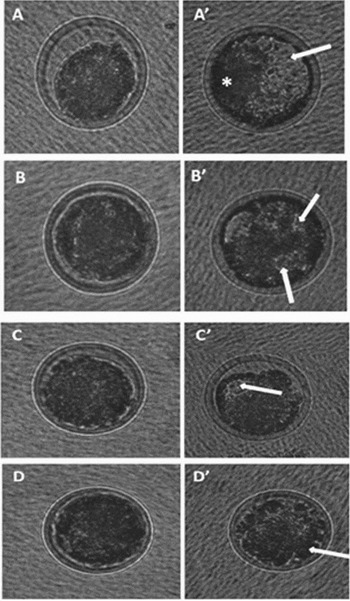
Embryos classified as good, 54% (11/20) kept a favourable development during the 4 h of culture, their blastomeres conserved adequate cohesion, presented no harm in the zona pellucida and showed minimal formation of cell detritus or vesicles. Likewise, 42% (7/16) of fair embryos rendered similar results. In 10% of the cases in either good or fair embryos, they continued their development advancing from morula to the blastocyst stage. The remaining embryos in both categories showed changes indicative of degeneration, mainly in blastomere colouring, vesicle formation, and cell detritus, as well as severe damage in the zona pellucida. Figure 1 divided into four panels shows in panel (A) a good quality morula, in which a homogeneous and compact cell mass may be distinguished. After 4 h of culture, a change in the blastocyst stage was observed indicating progress in the development of the cell (A′).
Thawed embryos kept in culture. (A–D) Initials show the beginning of culturing. (A′–D′) Indicate culturing after 4 h. The asterisk shows the intracytoplasmic membranes (ICM), arrows show a blastocele. Notched arrows show vesicular formation and extruded blastomeres.

In Panel (B) a good quality morula can be observed at the beginning of culturing, in (B′) an illustration of the formation of different size vesicles with some degeneration in the cell structure can be observed.
Panel (C) denotes a fair quality morula and the beginning of blastocele formation indicative of a favourable development on the embryo (C′).
In Panel (D), a fair morula can be observed decreasing in quality while increasing the number of extruded blastomeres at the end of culture (D′).
Counting of positive nuclei to BrdU and TUNEL
An average of 14.7 ± 7.4 (mean ± SE) TUNEL positive nuclei and 4.2 ± 2.3 (mean ± SE) BrdU positive nuclei were obtained in good quality embryos. In the case of the fair embryo group, the average was 17.2 ± 8.9 TUNEL positive nuclei and 1 ± 2 BrdU positive nuclei. Good quality embryos in the non-cultured group showed that the average of positive nuclei for TUNEL was 13 ± 8.3 and for BrdU was 2.1 ± 1.9. The average of fair embryos was 20.2 ± 9.2 positive nuclei for TUNEL and 1.4 ± 1.4 positive nuclei for BrdU. When comparing the averages of positive nuclei TUNEL and BrdU, no significant differences were found between control and cultured treatments in good and fair embryos.
Discussion
Fifty-four of the good quality embryos (n = 11) and 42% of fair embryos (n = 7) kept their viability during culture, whilst 46% of good quality embryos (n = 9) and 68% of the fair (n = 9) showed degenerative changes after 4 h of culture. These results differ from those obtained by Contreras et al. (Reference Contreras, Galina, Avila, Aspron and Moreno-Mendoza2008) where 100% of the embryos classified as good or fair kept their viability even after 8 h in culture. The differences may be explained by the fact that in the abovementioned study, the authors scored, froze and stored the embryos under controlled conditions for 5 months. In the present study, the source, score criteria, storage time and conditions were unknown to the authors. It is recognized that the right evaluation of embryos is the main factor affecting the pregnancy rate in an embryo transfer program (Lindner & Wright, Reference Lindner and Wright1983; Hasler et al., Reference Hasler, McCauley, Lathrop and Foote1987, Reference Hasler, Henderson, Hurtgen, Jin, McCauley, Mower, Neely, Shuey, Stokes and Trimmer1995; Reichenbach et al., Reference Reichenbach, Liebrich, Berg and Brem1992; Cutini et al., Reference Cutini, Teruel and Cabodevila2000). Variability in the scoring system in Bos indicus breeds has been previously reported (Aguilar et al., Reference Aguilar, Galina, Merchant, Montiel, Canseco and Marquez2002; Lopez-Damian et al., Reference Lopez-Damian, Galina, Merchant, Cedillo-Pelaez and Aspron2008) Therefore, the poor performance during culture in embryos used in this study may be due in part, to subjectivity when carrying out the morphological assessment under farm conditions. This has been indeed the only criterion for the selection of embryos identified as suitable for freezing.
Embryos exposed to freezing suffer reduction in cell volume as a result of osmotic dehydration and solidification during chilling. These events may lead to cell damage (Schneider & Mazur, Reference Schneider and Mazur1984; Dobrinsky, Reference Dobrinsky1996; Baguisi et al., Reference Baguisi, Lonergan, Overstrom and Boland1999). For these reasons, the procedure of freezing embryos destined to be used under tropical conditions, a location where the ET industry is booming, should be revised.
There was no statistical difference (P > 0.05) when assessing embryos from the cultured and the non-cultured groups, using the TUNEL-BrdU technique. Thus, embryos exposed to a culture medium in this study not necessarily improved the development of the embryo, but provided the necessary conditions for them to maintain the cells viable.
Finally, it is known that the management of embryos stored in a liquid nitrogen tank is fundamental for keeping cells frozen in favourable conditions. Marquez-Alvarado et al. (Reference Marquez-Alvarado, Galina, Castilla, Leon and Moreno-Mendoza2004) suggested that failure to maintain a proper level of liquid nitrogen in the tank, may compromise the embryo viability and thus the potential to produce a pregnancy. In addition, it is known that embryo quality varies along the different seasons of the year, thus, embryos produced in the rainy season are of better quality (Bastidas & Randel, Reference Bastidas and Randel1987; Marquez et al., Reference Marquez, Galina, Moreno, Ruiz, Ruiz and Merchant2005; Chebel et al., Reference Chebel, Demetrio and Metzger2008; Gutierrez, Reference Gutierrez2009). Not knowing the management conditions and the season of the year in which embryos of the present study were produced, makes it a considerable challenge to interpret the results in this study. Obtaining approximately half of viable embryos after a short time in culture, allows us to suggest that the pregnancy results reported by different authors (Hasler, Reference Hasler2001; Dobrinsky, Reference Dobrinsky2002; Martinez et al., Reference Martinez, Brogliatti, Valcarcel and de Las2002) can be, in the most part, a consequence of all these elements involved in embryo technology. Further experiments are necessary to distinguish the advantages in culture, both in fresh embryos destined to be frozen, and cells frozen stored for a certain period of time, and then thawed to be transferred to the cow.
Based on the results of the present experiment, culturing for a short period of time before transferring, might be a useful technique to determine which embryos have higher probabilities of continuing their development and of establishing a pregnancy in the recipient cow.
Acknowledgements
The authors are grateful to the program PAPIIT IN 200810–3 of the National University of Mexico and M. en C. Esmeralda Lira-Romero for technical assistance.