Sleep-related symptoms and sleep-disordered breathing are increasingly recognised as important public health concerns, particularly among middle-aged and older adults(Reference Gottesman, Lutsey and Benveniste1,Reference Heinzer, Marti-Soler and Haba-Rubio2) . Insufficient or poor-quality sleep, as well as sleep-related breathing disorders, is associated with adverse health outcomes, including obesity, type 2 diabetes, CVD, cognitive decline and premature mortality(Reference Gottesman, Lutsey and Benveniste1). Given the bidirectional relationship between sleep and psychological stress, identifying modifiable lifestyle factors that may influence both is important(Reference Hirotsu, Tufik and Andersen3). Sleep disturbances and perceived stress may share biological and behavioural pathways(Reference Almojali, Almalki and Alothman4,Reference Yasugaki, Okamura, Kaneko and Hayashi5) . Emerging evidence suggests that dietary factors, particularly high sugar intake, may contribute to both sleep disturbances and stress-related outcomes(Reference Hirotsu, Tufik and Andersen3,Reference Alahmary, Alduhaylib and Alkawii6) .
Among dietary exposures, sugar-sweetened beverages (SSB) have received considerable attention due to their widespread consumption and high added sugar content(Reference Malik, Popkin and Bray7). SSB, defined as beverages containing caloric sweeteners such as sucrose, high-fructose corn syrup, glucose syrup or honey, represent a major source of free sugar intake(Reference Malik and Hu8). Rapid absorption of simple sugars may induce glycaemic fluctuations, which may disrupt sleep and increase perceived stress(Reference Karakas9,Reference Janssen10) . In addition, high sugar intake has been associated with low-grade inflammation and alterations in neurotransmitter pathways, including serotonin and melatonin pathways involved in circadian regulation(Reference Ma, Nan and Liang11,Reference Mantantzis, Campos and Darimont12) .
Despite these proposed mechanisms, epidemiologic evidence remains limited and inconsistent(Reference Alahmary, Alduhaylib and Alkawii6,Reference Mantantzis, Campos and Darimont12–Reference Boozari, Saneei and Safavi14) . Some studies suggest that higher SSB consumption is associated with shorter sleep duration, poorer sleep quality, daytime tiredness and other sleep-related symptoms(Reference Shahdadian, Boozari and Saneei13,Reference Boozari, Saneei and Safavi14) , whereas others report attenuated or non-significant associations after adjustment for confounders(Reference Alahmary, Alduhaylib and Alkawii6,Reference Mantantzis, Campos and Darimont12) . In addition, prior studies have primarily focused on adolescents or younger adults, although physiological responses to dietary sugar may differ with aging(Reference Mander, Winer and Walker15). Furthermore, while the relationship between SSB consumption and sleep-related symptoms has received some attention, the association between SSB consumption and perceived stress remains largely unexplored in epidemiologic research, despite biological plausibility through shared neuroendocrine pathways involving the hypothalamic–pituitary–adrenal axis and neurotransmitter dysregulation(Reference Janssen10,Reference Mantantzis, Campos and Darimont12) . Age-related changes in sleep architecture, circadian rhythms and glucose metabolism may increase susceptibility to sugar-related disturbances(Reference Boozari, Saneei and Safavi14), and sex differences may further influence these associations(Reference Andersen, Hachul and Ishikura16,Reference Lok, Qian and Chellappa17) .
Nevertheless, to our knowledge, no study has simultaneously examined SSB consumption in relation to multiple sleep-related symptoms and perceived stress in a nationally representative sample of adults aged ≥40 years, a population particularly vulnerable to both age-related sleep deterioration and dietary sugar-related metabolic dysregulation. Therefore, using data from the Korea National Health and Nutrition Examination Survey (KNHANES) 2019–2023, this study examined associations between SSB consumption and sleep-related symptoms (observed sleep apnoea, snoring and daytime tiredness) and perceived stress among Korean adults aged ≥40 years.
Methods
Study design and population
This cross-sectional study utilised data from the eighth and ninth KNHANES, a nationally representative survey conducted by the Korea Disease Control and Prevention Agency (KDCA)(Reference Kweon, Kim and Jang18,Reference Lee, Kim and Park19) . Data from 2019 to 2023 were included, as the sleep-related questionnaire items analysed in this study (observed sleep apnoea, snoring and daytime tiredness) were administered during these years in collaboration with the Korean Society of Otorhinolaryngology-Head and Neck Surgery and were discontinued thereafter(Reference Lee, Kim and Park19). Eligible participants were adults aged ≥40 years with complete data on sleep-related symptoms, perceived stress and covariates. This age restriction was necessitated by the KNHANES survey design, in which the sleep-related questionnaire items analysed in this study were administered only to respondents aged ≥40 years. Pregnant or lactating individuals and those with implausible energy intake (<500 or >5000 kcal/day) were excluded(Reference Rhee, Sampson and Cho20,Reference Kim, Shin and Park21) . This study was conducted according to the guidelines laid down in the Declaration of Helsinki, and all procedures involving human subjects were approved by the Institutional Review Board of the Korea Centers for Disease Control and Prevention (IRB nos. 2018-01-03-C-A; 2018-01-03-2C-A; 2018-01-03-5C-A; 2018-01-03-4C-A; 2022-11-16-R-A and 2022-11-16-R-03). Written informed consent was obtained from all subjects.
Exposure assessment: sugar-sweetened beverage consumption
SSB consumption was assessed using the 24-h dietary recall survey conducted as part of KNHANES. Beverages reported in the 24-h dietary recall were classified according to the KNHANES beverage classification system (Supplementary Table 1). Among these, beverages containing added sugars, including carbonated drinks, fruit drinks and other sweetened beverages, were defined as SSB (Supplementary Table 2). Total SSB consumption (g/d) was calculated by summing the amount consumed across all eligible SSB items reported in the 24-h dietary recall. Participants consuming <3 g/d of SSB were classified as non-consumers/negligible consumers, whereas those consuming ≥3 g/d were classified as consumers. Among consumers, SSB consumption was categorised into quartiles, and the first three quartiles (Q1–Q3) combined as the moderate consumer group and the highest quartile (Q4) defined as the high consumer group.
Outcome definition: sleep and perceived stress
Sleep-related symptoms (observed sleep apnoea, snoring and daytime tiredness) were assessed via self-reported questionnaire items from the KNHANES health interview. Observed sleep apnoea was defined as a self-reported history of having a witnessed breathing cessation during sleep. Snoring was defined as snoring louder than conversational speech or audible from an adjacent room. Daytime tiredness was defined as a ‘yes’ response to frequent daytime tiredness or drowsiness. Perceived stress was assessed using a single-item questionnaire rated on a 4-point scale (1 = feel very high stress; 2 = feel high stress; 3 = feel low stress and 4 = feel very low stress). Participants who reported a score of 1 or 2 were classified as having perceived stress.
Covariates
Covariates were selected based on prior literature(Reference Boozari, Saneei and Safavi14,Reference Shin, Kim and Ha22) and included age, sex, education level, household income, marital status, physical activity, smoking status, alcohol consumption, obesity status and total energy intake. Demographic variables such as age, household income and education level were obtained from a self-report questionnaire. Education level was categorised into four groups: elementary school or lower, middle school, high school and college or higher. Household income was divided into quartiles. Marital status was classified into four categories: single, married, widowed and divorced or separated. Health-related lifestyle variables included smoking status (non-smoker or ex-smoker and current smoker), alcohol consumption (non-drinker or ex-drinker and current drinker) and physical activity (yes or no). Obesity status was defined using BMI, calculated as weight (kg) divided by height squared (m2), with BMI ≥ 25 kg/m2 classified as obesity according to Asian-specific criteria(Reference Okawa, Mitsuhashi and Tsuda23). Total energy intake was derived from the 24-h dietary recall data.
Statistical analysis
All statistical analyses accounted for the complex sampling design of KNHANES, including sampling weights, stratification and clustering. To assess the potential for selection bias, baseline characteristics were compared between participants included in the final analytic sample and those excluded because of missing outcome or covariate data among eligible adults aged ≥40 years (Supplementary Table 3). Descriptive characteristics of participants were presented according to SSB consumption categories (none, moderate- and high-consumers). Continuous variables were expressed as weighted means with sd, and categorical variables were presented as unweighted frequencies with weighted percentages. Multivariable logistic regression models were used to estimate OR and 95 % CI for the associations between SSB consumption and sleep-related symptoms (observed sleep apnoea, snoring and daytime tiredness) as well as perceived stress. Non-consumers of SSB were used as the reference group.
Models were adjusted for age, sex, education level, household income, marital status, smoking status, alcohol consumption, physical activity, obesity status and total energy intake. The interaction between SSB consumption and sex was examined in the fully adjusted models, followed by sex-stratified analyses. All analyses were performed using SAS software (version 9.4; SAS Institute Inc.), and statistical significance was defined as a two-sided P value < 0·05.
Results
Study population
A total of 35 753 participants were identified from the KNHANES 2019–2023 cycles. After excluding participants younger than 40 years (n 13 264), pregnant or lactating women (n 10), individuals with missing data on sleep-related variables and perceived stress (n 2453), those with missing covariates (n 2573) and participants reporting implausible total energy intake (<500 or >5000 kcal/day, n 198), a total of 17 255 participants were included in the final analysis. The participant selection process is presented in Figure 1. Compared with participants included in the final analytic sample, those excluded because of missing outcome or covariate data differed significantly in several baseline characteristics, including age, sex, obesity status, smoking status, physical activity, educational level, marital status and household income (Supplementary Table 3).
Flow chart of participant selection for the study population from KNHANES 2019–2023.

Characteristics of participants according to sugar-sweetened beverage consumption
Participant characteristics according to SSB consumption are presented in Table 1. Among the 17 255 participants (mean age 60·2 (sd 11·7) years, 57·5 % women), 7086 (41·1 %) were non-consumers of SSB, 7627 (44·2 %) were moderate consumers (Q1–Q3) and 2542 (14·7 %) were high consumers (Q4). The mean SSB consumption was 77·6 (sd 76·8) g/d in the moderate consumer group and 439·5 (sd 212·1) g/d in the high consumer group. Participants with high SSB consumption were younger than non-consumers (56·2 (sd 11·3) v. 60·4 (sd 11·6) years, P < 0·001), and the proportion of men was higher in the high SSB consumption group (47·6 %) than in the non-consumer group (38·4 %) (P < 0·001). Participants in the high SSB consumption group were more likely to report current smoking and alcohol consumption, had higher levels of total energy intake and had higher socio-economic status, as reflected by greater educational attainment and household income (all P < 0·001).
Characteristics of study participants by SSB consumption category (n 17 255)

Table 1. Long description
A table comparing characteristics of study participants by sugar-sweetened beverage (SSB) consumption categories. The table has 17255 participants divided into three groups: non-negligible consumers, moderate consumers, and high consumers. The table includes variables such as SSB consumption, SSB-derived sugar intake, age, BMI, total energy intake, sex, obesity status, smoking status, alcohol consumption, physical activity, educational level, marital status, and household income quartiles. Each row provides data for each variable across the three consumption categories. For example, the mean SSB consumption for moderate consumers is 77.6 g/day, while for high consumers it is 439.5 g/day. The table also shows that high consumers are younger, more likely to be men, and have higher total energy intake compared to non-consumers.
Q, quartile; SSB, sugar-sweetened beverage.
Distribution of sleep-related symptoms and perceived stress
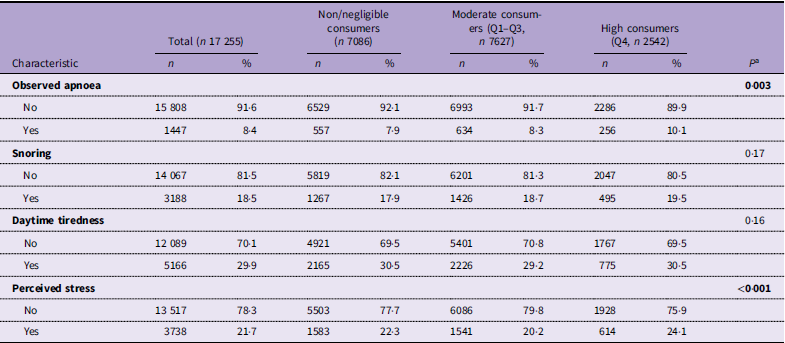
The distribution of sleep-related symptoms and perceived stress across SSB consumption groups is shown in Table 2. The prevalence of snoring and daytime tiredness did not differ across SSB consumption categories (P = 0·17 and P = 0·16, respectively). Conversely, the prevalence of observed sleep apnoea differed across groups (P = 0·003), with the highest prevalence observed in the high SSB consumption group (10·1 %), followed by moderate consumers (8·3 %) and non-consumers (7·9 %). Perceived stress also varied across SSB consumption groups (P < 0·001), with the highest prevalence observed among moderate consumers (79·8 %), followed by non-consumers (77·7 %) and high consumers (75·9 %).
Values are presented as weighted mean (sd) for continuous variables or unweighted frequency (weighted %) for categorical variables. P values were calculated using survey-weighted linear regression for continuous variables and Rao–Scott χ2 tests for categorical variables. Distribution of sleep-related symptoms and perceived stress across SSB consumption groups

Table 2. Long description
The table presents the distribution of sleep-related symptoms and perceived stress across different sugar-sweetened beverage (SSB) consumption groups. It includes data for 17,255 individuals, divided into three groups: non/negligible consumers (7,086), moderate consumers (7,627), and high consumers (2,542). The table has four rows and five columns, with column headers being Total, Non/negligible consumers, Moderate consumers, and High consumers. Row labels include Observed apnoea, Snoring, Daytime tiredness, and Perceived stress. Each row provides the number and percentage of individuals in each category for the different consumption groups. Notable trends include a higher percentage of observed apnoea and perceived stress in high consumers compared to other groups.
Q, quartile; SSB, sugar-sweetened beverage.
a Values are presented as unweighted frequency (weighted %). P values were calculated using Rao–Scott χ2 tests for categorical variables.
Associations of sugar-sweetened beverage consumption with sleep-related symptoms and perceived stress
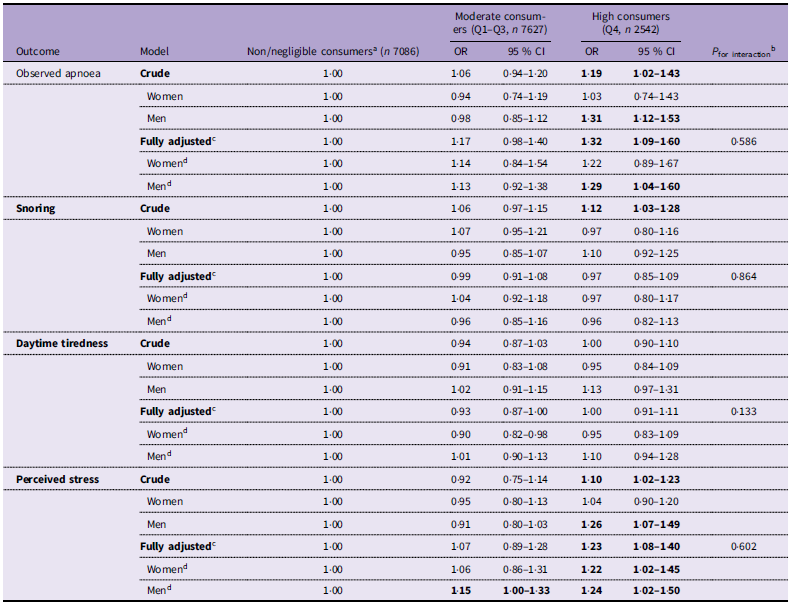
Multivariable logistic regression analyses are presented in Table 3. After adjusting for potential confounders, higher SSB consumption was associated with increased odds of observed sleep apnoea compared with non-consumers (OR 1·32, 95 % CI 1·09–1·60), whereas no association was observed in the moderate consumer group (OR 1·17, 95 % CI 0·98–1·40). SSB consumption was not significantly associated with snoring or daytime tiredness in either consumer group. High SSB consumption was also associated with increased odds of perceived stress (OR 1·23, 95 % CI 1·08–1·40), while the moderate consumer group showed no association (OR 1·07, 95 % CI 0·89–1·28).
Associations between sugar-sweetened beverage consumption and sleep-related symptoms and perceived stress among Korean adults aged ≥40 years

Table 3. Long description
The table presents the results of multivariable logistic regression analyses examining the association between sugar-sweetened beverage (SSB) consumption and various health outcomes. It includes data for non/negligible consumers, moderate consumers, and high consumers, with separate analyses for women and men. The outcomes measured are observed apnoea, snoring, daytime tiredness, and perceived stress. The table has 16 rows and 8 columns. Column headers are Outcome, Model, Non/negligible consumers (n 7086), Moderate consumers (Q1-Q3, n 7627), High consumers (Q4, n 2542), and P for interaction. Row labels include Crude, Women, Men, and Fully adjusted. Each cell contains odds ratios (OR) and 95% confidence intervals (CI) for the respective groups and outcomes. Notable trends include higher odds of observed sleep apnoea and perceived stress among high consumers compared to non-consumers, while moderate consumers show no significant association for these outcomes. SSB consumption is not significantly associated with snoring or daytime tiredness in either consumer group.
Q, quartile; SSB, sugar-sweetened beverage.
Values are OR (95 % CI). Bold values indicate statistical significance (P < 0·05).
a Non-/Negligible consumers were used as the reference group. Moderate consumers: Q1–Q3 (≥3 to ≤163·5 g/day of SSB consumption); high consumers: Q4 (>163·5 g/day of SSB consumption).
b P for interaction was obtained from the fully adjusted logistic regression model by including multiplicative interaction terms between SSB consumption category and sex.
c Fully adjusted models were adjusted for age, sex, education level, household income, marital status, smoking status, alcohol consumption, physical activity, obesity status and total energy intake.
d Sex-stratified models were adjusted for the same covariates except sex.
Sex-stratified analyses
Sex-stratified analyses are presented in Table 3. For observed sleep apnoea, high SSB consumption was significantly associated with increased odds among men (OR 1·29, 95 % CI 1·04–1·60), but not among women (OR 1·22, 95 % CI 0·89–1·67). No associations were observed for snoring or daytime tiredness in either sex. For perceived stress, high SSB consumption was significantly associated with increased odds in both men (OR 1·24, 95 % CI 1·02–1·50) and women (OR 1·22, 95 % CI 1·02–1·45). Among men, moderate SSB consumption (Q1–Q3) also showed a borderline association with perceived stress (OR 1·15, 95 % CI 1·00–1·33). Despite the slightly greater magnitude of the association between high SSB consumption and observed sleep apnoea among men than among women, no statistically significant interaction between SSB consumption and sex was observed for any study outcome (all P for interaction > 0·05).
Discussion
This study examined the association between SSB consumption, sleep-related symptoms and perceived stress among Korean adults aged ≥40 years using KNHANES 2019–2023. To our knowledge, this is among the first studies to comprehensively examine these associations in a large nationally representative sample of middle-aged and older adults. The main findings are as follows: higher SSB consumption was associated with observed sleep apnoea and perceived stress; the association with sleep apnoea was significant only among men, whereas perceived stress was elevated in both sexes; and no significant associations were found for snoring or daytime tiredness.
Previous epidemiologic studies examining the relationship between SSB consumption and sleep outcomes have reported mixed findings. Some population-based studies have suggested that higher intake of SSB is associated with shorter sleep duration, poorer sleep quality and increased daytime fatigue(Reference Shahdadian, Boozari and Saneei13,Reference Boozari, Saneei and Safavi14) . However, other studies have reported attenuated or non-significant associations after adjusting for lifestyle and metabolic factors(Reference Alahmary, Alduhaylib and Alkawii6,Reference Mantantzis, Campos and Darimont12) . Differences in study populations, age distribution, dietary assessment methods and definitions of sleep outcomes may partly explain these inconsistencies. Beyond these factors, heterogeneity across studies may also reflect differences in how SSB consumption was defined and measured. Previous studies have assessed SSB exposure using various metrics, including consumption frequency, servings per day or beverage consumption (g/day), with differences in beverage classification and portion size estimation. These methodological differences may result in different exposure classifications for participants with similar beverage consumption patterns, thereby influencing effect estimates and limiting direct comparability across studies. Consequently, these differences should be considered when interpreting inconsistent findings across the literature(Reference Alahmary, Alduhaylib and Alkawii6,Reference Mantantzis, Campos and Darimont12–Reference Boozari, Saneei and Safavi14) .
Several biological mechanisms may explain the observed association between higher SSB consumption and increased likelihood of observed sleep apnoea. High intake of added sugars may lead to rapid fluctuations in blood glucose levels, resulting in compensatory hyperinsulinaemia and reactive hypoglycaemia(Reference Karakas9,Reference Janssen10) . These glycaemic variations may activate the HPA axis and increase cortisol secretion, which may disrupt sleep architecture and impair respiratory stability during sleep(Reference Hirotsu, Tufik and Andersen3,Reference Janssen10) . In addition, excessive sugar intake has been linked to increased systemic inflammation and oxidative stress, both of which have been implicated in the pathophysiology of sleep-disordered breathing(Reference Ma, Nan and Liang11,Reference Yi, Zhao and Tan24) .
The absence of significant associations for snoring and daytime tiredness may reflect several factors. First, snoring is strongly influenced by anatomical and structural characteristics of the upper airway, such as neck circumference and soft palate size, which may dominate over dietary influences and attenuate the detectable effect of SSB consumption(Reference Nokes, Orr and White25). Second, daytime tiredness has a highly heterogeneous aetiology, encompassing anaemia, depression, chronic pain and poor sleep quality from various causes, which may dilute the specific signal attributable to SSB consumption(Reference Martins and Conde26). Third, both outcomes were assessed using simple binary self-report items, which have limited sensitivity and specificity compared with objective measures, further reducing the ability to detect modest associations.
Our findings regarding the relationship between SSB consumption and perceived stress are also biologically plausible. Notably, the crude prevalence of perceived stress was highest among moderate consumers (79·8 %), followed by non-consumers (77·7 %) and high consumers (75·9 %), which may appear paradoxical. This pattern likely reflects confounding by age and sex composition, given that high consumers were substantially younger and more male-predominant than the other groups, and these demographic characteristics are generally associated with lower crude stress prevalence. After adjustment for these and other covariates, high SSB consumption was associated with increased odds of perceived stress (OR 1·23, 95 % CI 1·08–1·40), consistent with the direction suggested by biological mechanisms(Reference Karakas9,Reference Janssen10) . Diets high in added sugars have been associated with dysregulation of neuroendocrine pathways, including activation of the HPA axis and increased cortisol secretion(Reference Knezevic, Nenic and Milanovic27). In addition, high sugar intake has been associated with alterations in neurotransmitter systems, including serotonin and dopamine pathways, which play important roles in mood regulation and stress perception(Reference Mantantzis, Campos and Darimont12,Reference Jacques, Chaaya and Beecher28) . Importantly, this association may reflect a bidirectional relationship, whereby stress is associated with increased SSB consumption through reward-related pathways(Reference Hirotsu, Tufik and Andersen3,Reference Jacques, Chaaya and Beecher28–Reference Fish-Williamson and Hahn-Holbrook30) .
In sex-stratified analyses, the association between high SSB consumption and observed sleep apnoea was significant only among men. However, formal interaction analyses showed no statistically significant interaction between SSB consumption and sex (P for interaction = 0·586), indicating that the associations did not differ significantly by sex. Therefore, these sex-stratified findings should be interpreted cautiously and should not be considered evidence of true sex-specific differences. Nevertheless, previously proposed biological and methodological mechanisms may help explain the apparent sex-specific pattern observed in the present study, although this interpretation requires further investigation. Men generally have a higher prevalence of sleep-disordered breathing, increasing statistical power to detect dietary associations, while women are known to be underdiagnosed due to differences in symptom presentation(Reference Geer and Hilbert31,Reference Lindberg, Benediktsdottir and Franklin32) . In the present study, observed sleep apnoea was assessed based on third-party witnessing of breathing cessation, which may further underestimate the true burden in women, particularly those living alone or presenting with less typical symptoms. In addition, men tend to accumulate more visceral and upper-body adipose tissue around the neck and upper airway, increasing susceptibility to airway narrowing during sleep(Reference Nokes, Orr and White25). Excessive sugar intake may contribute to metabolic changes that promote adipose tissue accumulation and worsen upper airway collapsibility(Reference Nokes, Orr and White25,Reference Martins and Conde26) . Women may also experience partial protective effects from sex hormones, particularly oestrogen, which has been suggested to influence respiratory stability and airway muscle tone(Reference Zhou, Li and Chen33). Notably, the association between SSB consumption and perceived stress was observed in both men and women, suggesting that the relationship between SSB consumption and perceived stress may be relatively consistent across sexes(Reference Krolick and Shi34). Of interest, moderate SSB consumption showed a borderline association with perceived stress among men (OR 1·15, 95 % CI 1·00–1·33), suggesting that even moderate SSB consumption may be associated with perceived stress among men.
From a public health perspective, these findings underscore the potential role of SSB consumption in sleep health and psychological well-being among middle-aged and older adults. In South Korea, SSB consumption has increased markedly over recent decades, with national survey data showing that age-standardised mean SSB consumption rose from 38·8 g/day in 2011 to 58·2 g/d in 2022(Reference Lim, Lee and Choue35,Reference Oh, Jo and Kim36) . Concurrently, average sleep duration declined from 7·5 to 7·1 h between 2009 and 2018, with moderate-to-severe depression prevalence nearly doubling (4·6 % to 8·4 %) over the same period(Reference Lim, Lee and Choue35,Reference Yoon, Oh and Hwang37) . Given these trends, identifying modifiable dietary factors that may influence these outcomes is an important public health priority. Future prospective and intervention studies are needed to determine whether reducing SSB consumption improves sleep-related and psychological outcomes.
This study has several strengths. First, it used nationally representative data from KNHANES, allowing the findings to be generalised to the Korean adult population. Second, multiple sleep-related outcomes and perceived stress were simultaneously evaluated, enabling a more comprehensive assessment. Third, the models adjusted for a wide range of sociodemographic, lifestyle and dietary covariates, reducing the likelihood of confounding. However, several limitations should also be considered. First, due to the cross-sectional design of the study, causal relationships between SSB consumption and sleep-related outcomes cannot be established. Second, SSB consumption was assessed using a single 24-h dietary recall, which may not fully capture habitual beverage intake and may result in misclassification of SSB consumers, particularly non-consumers who may occasionally consume SSB, although single recalls collected from a sufficiently large sample can still provide valid estimates of population-level mean intake(Reference Kirkpatrick, Guenther and Subar38). Third, although several sleep-related symptoms were evaluated, key sleep outcomes such as sleep duration and sleep quality were not assessed. In addition, the evaluated sleep-related outcomes were based on self-reported questionnaire items rather than objective measures such as polysomnography or actigraphy, which may be subject to recall bias or misclassification. In particular, observed sleep apnoea relied on third-party witnessing of breathing cessation, which may result in underreporting among individuals living alone or women with atypical symptom presentation. Fourth, the present study was conducted using a single nationally representative dataset without external validation in independent cohorts. Future studies using prospective designs or external cohort data are warranted to confirm the generalisability of our findings. Fifth, although the largest proportion of excluded individuals reflected the age-restricted nature of the sleep-related questionnaire items, additional exclusions among adults aged ≥40 years occurred because of missing outcome or covariate data and other eligibility criteria. Comparison of baseline characteristics between included and excluded participants (Supplementary Table 3) showed some statistically significant differences, suggesting the possibility of selection bias. Therefore, the findings should be interpreted with appropriate caution. Finally, although multiple potential confounders were considered, residual confounding by overall dietary patterns or other unmeasured lifestyle factors cannot be excluded.
Conclusions
Higher consumption of SSB was associated with a greater likelihood of observed sleep apnoea and perceived stress among Korean adults aged 40 years and older. The relationship with observed sleep apnoea was particularly evident among men, whereas perceived stress was associated with higher SSB consumption in both sexes. These findings suggest that higher SSB consumption is associated with sleep-related and psychological health outcomes. Prospective studies are warranted to clarify the temporal relationships and mechanisms underlying these associations.
Supplementary material
For supplementary material/s referred to in this article, please visit https://doi.org/10.1017/S0007114526108228
Data availability statement
The data used in this study are publicly available from the Korea National Health and Nutrition Examination Survey (KNHANES) website (https://knhanes.kdca.go.kr).
Acknowledgements
The authors declare none.
Conceptualisation, MK, JJ; Data Curation, MK, JJ, JJL; Formal analysis, MK, JJL; Investigation, MK, JJ; Methodology, MK, JJL; Resources, JJ, JJL; Supervision, JJ, JJL; Validation, JJL; Visualisation, MK, JJL; Writing – Original Draft, MK; Writing – Review & Editing, MK, JJ, JJL. All authors read and approved the final manuscript.
This research received no specific grant from any funding agency, commercial or not-for-profit sectors.
There are no conflicts of interest.