Introduction
Rice is one of the most important sources of human energy worldwide (GRiSP 2013). In California (CA), more than 200,000 ha of rice are grown in the Sacramento Valley using a water-seeded, continuously flooded system. Rice growers in California flood their rice fields at the beginning of the growing season and then pregerminated rice seed is direct seeded onto the flooded field by airplane. A flood depth of 10 to 15 cm is maintained throughout the growing season. In 2010, rice production contributed approximately $1.7 billion to the gross domestic product in CA (Richardson and Outlaw Reference Richardson and Outlaw2010). In addition, rice fields provide many ecosystem services, including wildlife habitat for more than 230 species (Sterling and Buttner Reference Sterling and Buttner2011).
Weed competition is a major biological constraint of rice production, and weed control has been a major concern of growers since 1912, when rice production in CA began. The continuous monoculture cropping of rice has resulted in the proliferation of highly competitive weeds that are adapted to aquatic environments (Bayer et al. Reference Bayer, Hill, Seaman, Kurtz and Colbert1985; Brim-Deforest et al. Reference Brim-Deforest, Al-Khatib and Fischer2017; Fischer et al. Reference Fischer, Ateh, Bayer and Hill2000). In general, grasses are considered the most difficult weeds to control because of the narrow selectivity between the grass crop and grass weeds (Carey et al. Reference Carey, Talbert, Baltazar and Smith1992). Many grass weed species are problematic in CA rice production, including barnyardgrass [Echinochloa crus-galli (L.) P. Beauv.], late watergrass [E. phyllopogon (Stapf) Koso-Pol], early watergrass [E. oryzoides (Ard.) Fristch], and bearded sprangletop.
Bearded sprangletop is a tufted, semiaquatic grass and is a native plant in CA. Bearded sprangletop is a prolific seed producer (McCarty et al. Reference McCarty, Porter, Colvin, Shilling and Hall1995) and is a common weed in dry-seeded rice systems and in flooded rice where the water level has been allowed to recede (Altop et al. Reference Altop, Husrev, Phillippo and Zandstra2015; Brim-DeForest et al. Reference Brim-DeForest, Alarcon-Reverte and Fischer2015; Hall Reference Hall1978). Although other species like weedy rice (Oryza sativa) and various Echinochloa species are more serious competitors than bearded sprangletop, rice yield can be reduced as much as 36% when bearded sprangletop was not controlled (Smith Reference Smith1983).
Effective preplanting weed control and proper cultural practices, including water management, are used in rice weed management programs; however, herbicides continue to be the most important component in CA rice weed control. Currently, there are eight modes of action labeled for use in CA rice, accounting for 15 herbicide labels in total. Of the labeled herbicides, six modes of action are labeled for grass control: acetyl-coenzyme A carboxylase inhibitors (e.g., cyhalofop), pigment synthesis inhibitors (e.g., clomazone), lipid synthesis inhibitors (e.g., thiobencarb), photosystem II inhibitors (e.g., propanil), acetolactate synthase inhibitors (e.g., orthosulfamuron, bispyribac, penoxsulam, imazosulfuron), and 4-hydroxyphenylpyruvate dioxygenase inhibitors (e.g., benzobicyclon). However, the number of available herbicides that can control bearded sprangletop (four: cyhalofop, clomazone, thiobencarb, and benzobicyclon) are currently limited. Reliance on herbicides, a lack of crop rotation, and populations of bearded sprangletop confirmed resistant to cyhalofop and thiobencarb (Brim-Deforest et al. Reference Brim-DeForest, Alarcon-Reverte and Fischer2015) have narrowed control options even more.
Clomazone is the most widely used herbicide for bearded sprangletop control. Clomazone has been used in CA rice production since 2004 to control late watergrass, early watergrass, barnyardgrass, and bearded sprangletop. Clomazone is a proherbicide that is activated within the plant after conversion to the active metabolite 5-ketoclomazone. This metabolite inhibits the deoxyxylulose 5-phosphate synthase in the first committed step of the non-mevalonate isoprenoid pathway in plastids (Fergatoglu and Barrett Reference Fergatoglu and Barrett2006), which results in impaired chloroplast development and pigment loss in susceptible plants (Duke and Paul Reference Duke and Paul1986).
Of the 15 herbicides labeled for use in CA rice production, 11 have confirmed resistance of at least one weed species. Weed resistance to rice herbicides is perilous to CA rice production. Anecdotal evidence of bearded sprangletop resistant to clomazone has been noted by CA rice growers. Clomazone resistance has been documented in other weedy grass species (namely, barnyardgrass, early watergrass, and late watergrass) in CA rice (Yasuor et al. Reference Yasuor, TenBrook, Tjeerdema and Fischer2008). Thus, the objectives of this research were to evaluate the extent of clomazone resistance in bearded sprangletop populations from the rice-producing areas in CA and determine the level of resistance.
Materials and Methods
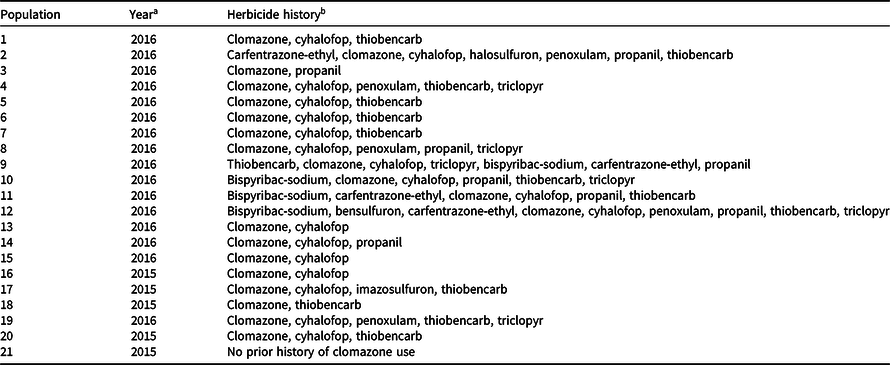
Bearded sprangletop seed was collected from 21 fields in the Sacramento Valley in 2015 and 2016 (Table 1). Fields were selected on suspicion of resistance. At each location, at least 30 mature plants were randomly selected and harvested to obtain a composite seed sample. In addition, bearded sprangletop seeds from a population known to be susceptible to clomazone was collected from the Rice Research Station at Biggs, CA.
Field history of bearded sprangletop collection sites.

a Year seed was field collected.
b Herbicide used in field the year before collection.
Bearded sprangletop has a dormancy period (Altop et al. Reference Altop, Husrev, Phillippo and Zandstra2015). To overcome this dormancy, seeds were stored in a freezer at −20 C for 3 mo and then soaked in deionized water in the refrigerator at 4 C. Water was changed in seed tubes every day for 2 wk. Then seeds were placed on wet filter paper and incubated at 40 C with a 16-h photoperiod. Germinated seeds were placed in a 4-cm−3 pots filled with a Yolo clay loam (fine-silty, mixed, nonacid, thermic Typic Xerorthents; 1.7% organic matter). Pots were placed in a tubs, separated by replicate, and flooded to 10-cm depth 4 d after transplanting. The average daily temperature in the greenhouse was 28 C ± 5 C. The photoperiod was 16 h, and natural sunlight was supplemented by high-pressure sodium lamps yielding approximately 400 µmol m−2 sec−1 photosynthetic photon flux.
Four d after transplanting, a granular formulation of clomazone was applied to the water. In the initial screening, three clomazone rates were used: 0, 736, and 2,200 g ai ha−1, which correspond to 0×, 1×, and 3× the recommended label rate in CA. Three bearded sprangletop populations that exhibited the highest percentage survival to treatment of the 3× rate of clomazone and a susceptible population were selected for additional characterization with a dose-response study in 2017. For the dose-response study, clomazone was applied into the water at 0, 92, 184, 368, 736, 2,200, 6,624, and 8,832 g ha−1, which correspond to approximately 0×, 0.125×, 0.25×, 0.5×, 1×, 3×, 9, and 12× the recommended field rate in CA rice.
Visible injury ratings were recorded at 7, 14, and 21 d after treatment (DAT), based on a scale of 0% (no control) to 100% (plant mortality). Plants were harvested at 21 DAT and dried at 70 C for 72 h and weighed.
Treatments were arranged in a randomized complete block design with four replications, and the study was repeated. Blocking was used to account for light and temperature gradients in the greenhouse. Data were analyzed using R software (R Foundation, Vienna, Austria). Data from repeated experiments were pooled when experiment-by-treatment interactions were not significant by ANOVA. The clomazone rate that caused 50% fresh biomass reduction (GR50) was determined using percent growth (fresh weight as percentage of the nontreated control) fitted to a log-logistic regression model using SigmaPlot, version 14.0 2018, statistical software (Systat Software, Inc., San Jose, CA).
Results and Discussion
Clomazone Resistance Survey
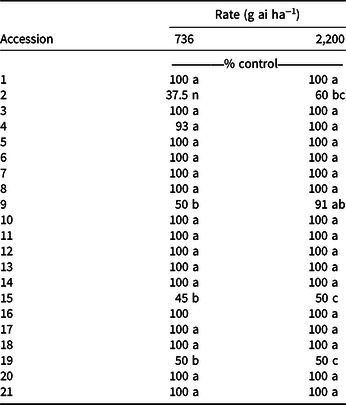
Of 21 populations tested, 17 were susceptible and four (5%) were resistant to clomazone (Table 2). Clomazone caused severe injury on susceptible (S)-biotype plants within 7 DAT at both rates used. Symptoms were, generally, stunting, chlorosis followed by bleaching of leaf tissue, and necrosis. All S populations were dead at 3 wk after treatment (Table 2).
Control of bearded sprangletop as affected by two rates of clomazone 3 wk after treatment.a

a Within columns, means accompanied by the same letter do not differ according to Tukey honestly significant difference test at P = 0.05.
All resistant (R)-population plants were injured by clomazone 7 DAT. Injury symptoms were slight chlorosis, stunting, and bleaching of leaf tissue. Plants were stunted, but the growing point was alive. R populations showed slight symptoms after exposure to clomazone at 736 g ha−1 and greater injury from the 2,200 g ha−1 rate. However, by 3 WAT, injured leaves recovered, and plants had resumed normal growth.
Nontreated populations Lep-15 and Lep-19 had less biomass compared with the S population. In addition, nontreated Lep-2 and Lep-9 biomass was not different from that of S plants (data not shown). The dry weight of R populations decreased with increasing clomazone treatment rate, indicating a dose response and possible metabolic resistance (Yasuor et al. Reference Yasuor, TenBrook, Tjeerdema and Fischer2008). Lep-2, Lep-15, and Lep-19, which had the greatest level of resistance compared with other populations, were subjected to a dose-response study.
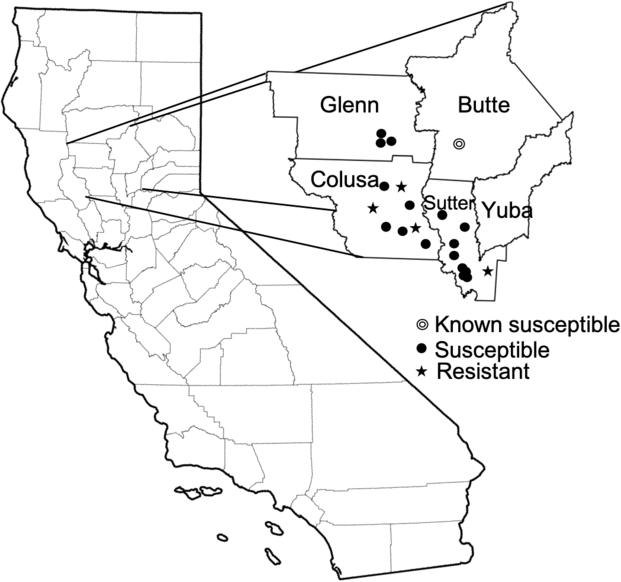
R populations came from different fields managed with difference practices in Colusa and Sutter counties in north central CA. The locations of these fields suggest the R populations may have evolved independently multiple times (Figure 1). R populations were in fields that had diverse herbicide-use histories; however, only few of the herbicides used are labeled for bearded sprangletop control (Table 1). Although fields used in this study had a history of clomazone use and suspected clomazone resistance, only 5% of the populations tested were resistant to clomazone. The possible reason for the complaints of failure of bearded sprangletop control in CA rice is likely due to late weed emergence timing and mistimed applications of clomazone (Driver and Al Khatib Reference Driver and Al-Khatib2019).
Location of bearded sprangletop populations tested for clomazone resistance. Closed circles indicated a field collection site. Open circles indicated a known susceptible field site. Stars indicate clomazone-resistant population sites.

Dose Response
At low rates, S plants exhibited clomazone symptoms similar to those described in the previous section. The clomazone dose-response study established 100% mortality of S population at a rate of 184 g ha−1 (0.25× use rate).
The R populations were markedly less affected by clomazone compared with the S population. The rate required to cause greater than 50% mortality of resistant bearded sprangletop was more than 2,020 g ha−1. Lep-19 exhibited less than 50% bleaching symptoms at rates lower than 736 g ha−1, but plants recovered by 3 WAT. At the 736 g ha−1 rate, plants from this population exhibited 50% injury at 3 WAT. Lep-19 treated with rates higher than 736 g ha−1 were completely bleached by 14 DAT. At 3 WAT, rates of 2,200 g ha−1 and higher caused severe plant necrosis. Lep-15 was less affected by clomazone compared with Lep-19. Lep-15 treated with rates lower than 736 g ha−1 fully recovered by 3 WAT. At 2,200 g ha−1, Lep-15 exhibited 50% injury at 7 DAT. Lep-2 was the least affected by clomazone, with complete mortality not reached until treatment with at the 6,624 g ha−1 rate. Lep-2 recovered at 3 WAT when rates of 2,200 g ha−1 and lower were used. At rates 6,624 g ha−1 or higher, Lep-2 showed severe plant bleaching 7 DAT, with complete plant bleaching at 2 WAT, followed by necrosis (data not shown).
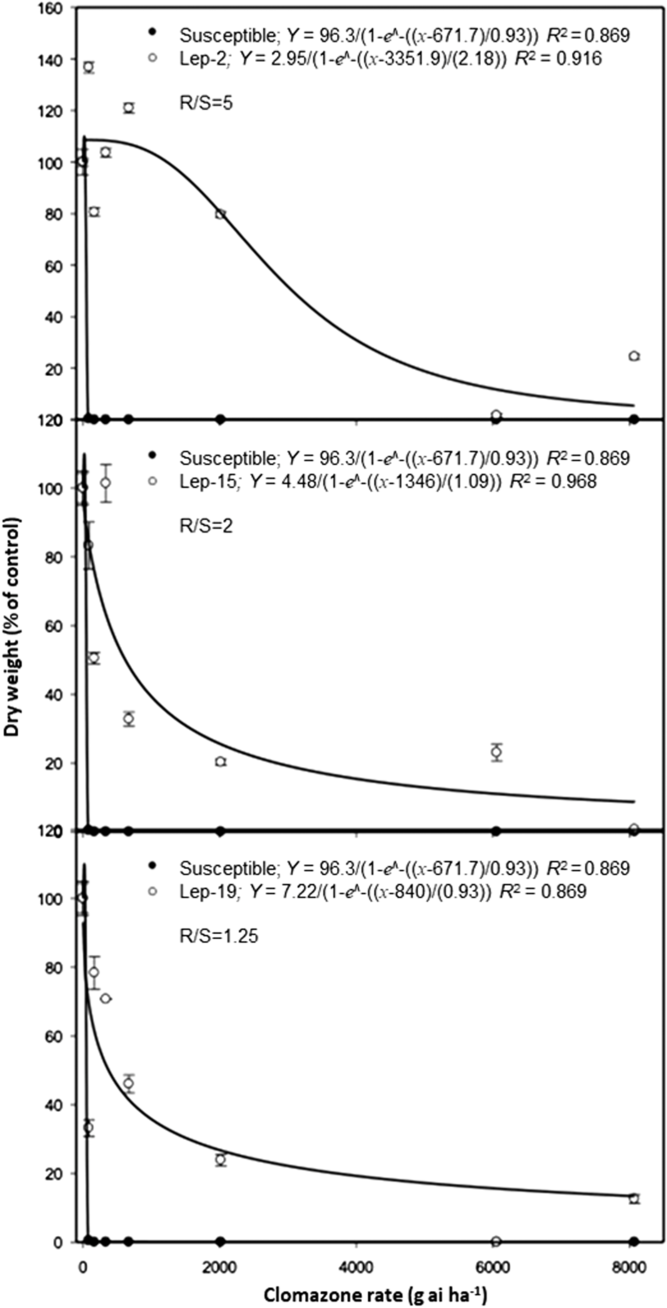
The clomazone GR50 for Lep-19, Lep-15, and Lep-2 were 841, 1,346, and 3,365 g ha−1, respectively, whereas the GR50 for the S population was 84 g ha−1 (Figure 2). The GR50 of the S population used in this study was similar to that of the GR50 reported for other clomazone-resistant populations of rigid ryegrass (Lolium rigidum Gaudin) (117 g ha−1) (Tardif and Powles Reference Tardif and Powles1999) and barnyardgrass (290 g ha−1) (Yasuor et al. Reference Yasuor, TenBrook, Tjeerdema and Fischer2008). The reduction in biomass in this study is consistent with these other reported cases of clomazone resistance (Tardif and Powles Reference Tardif and Powles1999; Yasuor et al. Reference Yasuor, TenBrook, Tjeerdema and Fischer2008). On the basis of the resistant-to susceptible ratio of GR50, Lep-19, Lep-15, and Lep-2 were 1.25-, 2-, and 5-fold resistant to clomazone, respectively. The low level of resistance to clomazone in our study was not surprising, because research on other weed species showed that the resistant-to susceptible ratio is approximately 2 (Tardif and Powles Reference Tardif and Powles1999; Yasuor et al. Reference Yasuor, TenBrook, Tjeerdema and Fischer2008). The clomazone use rate in California rice production is higher than for other production systems in which other clomazone-resistant weeds were reported and could account for the higher levels of resistance found in our study. The method of application in California rice production, in addition to later weed emergence timing, likely has an indirect effect on the concentration of herbicide the plants received (Driver and Al Khatib Reference Driver and Al-Khatib2019)). This repeated low-dose exposure could have led to the nontarget site resistance found in this study.
Dry weight of clomazone-susceptible (closed circle) and -resistant populations (open circle) as affected by different rates of clomazone. Abbreviation: R/S, resistant-to-susceptible ratio.

Research has shown that low levels of clomazone resistance in late watergrass (Yasuor et al. Reference Yasuor, TenBrook, Tjeerdema and Fischer2008) and rigid ryegrass (Tardif and Powles Reference Tardif and Powles1999) were caused by recurrent, low herbicide-dose selection (Busi and Powles Reference Busi and Powles2009; Manalil et al. Reference Manalil, Busi, Renton and Powles2011; Neve and Powles Reference Neve and Powles2005). Each R population identified in our research came from fields under different management and are probably independent occurrences of resistance, which can account for the different levels of resistance in each population.
After a conventional into-the-water clomazone treatment in the greenhouse, resistance was confirmed in four populations (5%) of the 21 populations tested, which had varying levels of resistance. To our knowledge, this is the first reported case of clomazone-resistant bearded sprangletop.
Despite many claims of bearded sprangletop clomazone resistance by CA rice growers, only a few populations were confirmed resistant under controlled conditions. Rather than being solely due to resistance, other factors may be contributing to clomazone failures on bearded sprangletop in CA (Driver et al. 2019). The level of resistance found in CA bearded sprangletop populations ranged from 1.25- to 5-fold. Low levels of resistance are likely due to the recurrent low doses of clomazone in the water by the time bearded sprangletop emerges (Busi and Powles Reference Busi and Powles2009; Manalil et al. Reference Manalil, Busi, Renton and Powles2011; Neve and Powles Reference Neve and Powles2005).
The use of clomazone in CA rice production in the future could be beneficial because there is not widespread resistance. However, it should be used at the appropriate timing and as part of an herbicide program to prevent further development of clomazone resistance.
Acknowledgements
This research was supported, in part, by funding from the California Rice Research Board. The authors acknowledge the support of the Melvin Androus Endowment and a Jastro Shields Scholarship from the Plant Sciences Department at University of California, Davis. No conflicts of interest have been declared.