Introduction
Over the course of the 1990s, with the fall of the Iron Curtain and the dissolution of the Soviet Union and Yugoslavia, Europe saw an unprecedented increase in asylum migration and irregular flows. Concurrently, the phenomenon of migrant smuggling gained increasing notoriety. During that time, a group of researchers joined together to develop a more holistic understanding of migrant smuggling by examining the phenomenon from different angles and in different European geopolitical contexts.Footnote 1 The main goals were to identify and describe different types and patterns of migrant smuggling and to explain the dynamics of the underlying operations. A comparative perspective was developed on the basis of a common empirical research agenda, with separate but interlinking lines of inquiry focusing on each respective national context, and this was underpinned by a joint theoretical framework. This comparative perspective shed light on the similarities and differences among smuggling processes directed toward Europe, allowing for a clearer identification and better understanding of the variables that might account for the differences while also leading to the formulation of generic migrant smuggling types. In the years since, combating migrant smuggling has developed into a key policy priority for the European Union (EU) as well as internationally. Conflicts in a number of sub-Saharan African countries, the Arab spring protests, the Syrian Civil War, and the civil war and collapse of state structures in Libya have all contributed to a dramatic increase in the number of irregular arrivals to Europe. The revitalization of smuggling routes and operations has simultaneously revived the debate on migrant smugglers’ modus operandi. In 2015, I had the opportunity to coordinate a major research project on five distinct smuggling routes toward Europe and to undertake an in-depth analysis of related developments.Footnote 2 Drawing on extensive primary and secondary data gathered between 2002 and 2005, and again in 2015, this article aims at deepening our conceptual understanding of the organizational and procedural aspects of migrant smuggling.
The approach taken here is twofold. As a first step, the article presents six generic types of migrant smuggling based on empirical work conducted in the early 2000s. Presenting together all six types—which have thus far only been examined separatelyFootnote 3 —the article provides a comprehensive typology that integrates both a top-down perspective (based on law enforcement data) and a bottom-up perspective (based on information retrieved from migrant interviews).Footnote 4 The typology thus provides a set of explanatory models that allow for a better description, analysis, and classification of migrant smuggling. In a second step, this typology is tested against recent empirical findings in order to examine whether these six types are still applicable, require adaptation, or should be dismissed as inapplicable to the current context.
Developing a typology on migrant smuggling
Over the last decade, a rich body of literature on migrant smuggling has developed, including attempts to understand the phenomenon from a more theoretical perspective. In its early days, this academic debate centered on questions of whether and to what extent migrant smuggling can essentially be understood as a profit-oriented business,Footnote 5 is run by hierarchically organized criminal networks,Footnote 6 and is dominated by “established branches of well-organized international gangster syndicates.”Footnote 7 In unraveling cooperation structures and the individual roles and responsibilities of those engaged in migrant smuggling, researchers have found little evidence that organized crime has been involved in the smuggling of migrants on a regular basis.Footnote 8 Instead, the findings point toward migrant smuggling operating more like a “transnational service industry”Footnote 9 composed of a range of transnational networks whose members specialize in concrete and differentiated tasks, with all being contingent on local contexts, on the distances to be covered, and on the obstacles to be overcome. These findings have been complemented by studies examining the role of social networks and social capital in migrant smuggling,Footnote 10 human rights perspectives,Footnote 11 and gender dimensions.Footnote 12 This should not imply, however, that the organized crime perspective is obsolete: migrant smuggling continues to be discussed in the context of international definitions of organized crime,Footnote 13 though it is widely agreed that, in terms of the social organization of the phenomenon, the network model dominates.Footnote 14 Outside academia, the characteristics of actors involved in the organization of migrant smuggling, as well as their business tactics, have been analyzed as well.Footnote 15 Such classifications, however, have largely been produced for law enforcement purposes, or else developed so as to rectify an at times one-sided discourse that portrays smugglers as scrupulous profiteers of and the main culprits in fostering irregular migration. As a rule, the migrant perspective is seldom represented in such classifications. This article aims to narrow this knowledge gap by combining two approaches: first, a top-down perspective with a focus on how the smuggling business is organized, which actors are involved, and how they work together; and second, a bottom-up perspective focusing on migrants’ perspectives and their “relative power” in achieving their ultimate goal of arriving at their destination.
A descriptive typology is proposed, following Elman’s distinction of descriptive, classificatory, and explanatory typologies.Footnote 16 Descriptive typologies aim at organizing empirically observed cases according to certain attributes. The types expounded upon here were constituted through the use of three categories of attributes. The first category is the regularly observed forms of interaction among smugglers, as well as between smugglers and their clients. The second category comprises the methods regularly used to organize the actual migrant smuggling process. The third category refers to the outcome of a given migrant smuggling process: either the successful arrival at a final destination or the end of the business relationship between smuggler and client. The regularly observed constellations of attributes across these three categories resulted in six identified types of migrant smuggling. Though portions of this typology have been presented already,Footnote 17 until now they have never been presented in their entirety, as a complementary approach.
Methodologically, the top-down approach is based on Neske’s work, which analyzed 51 smuggling court proceedings in Germany in the early 2000s.Footnote 18 As is in the nature of law enforcement and prosecution, police investigations and court proceedings place emphasis on the perpetrators, and thus are best suited for understanding the migrant smuggling process from the operational perspective. On the other hand, migrants’ own first-hand experiences with smugglers provide the best sources for understanding how smuggling impacts their migration process, their mobility options, and the level of agency they have in this process. Taking this approach, the bottom-up perspective employed here is based on 102 in-depth qualitative interviews with refugees and other migrants in the NetherlandsFootnote 19 and AustriaFootnote 20 who began their migration journeys in the Middle East, the Horn of Africa, West Africa, and the countries of the former Soviet Union.
The testing of the six previously identified generic types is primarily based on five case studies conducted in the framework of a large-scale study on migrant smuggling toward Europe. Coordinated by myself, these case studies were conducted by research teams with extensive experience in related research and in the relevant national contexts. Fieldwork for these studies was conducted between January and May 2015 in 11 countries along five selected migration routes toward Europe. It included 100 semi-structured qualitative interviews with policy makers, local authorities, and civil society actors; seven with migrant smugglers; and 68 problem-centered interviews with migrants.Footnote 21 The interview materials were analyzed on the country level. In order to guarantee a harmonized approach, the case study teams applied common tools for data collection and analysis (including interview guidelines and frameworks for analysis). Moreover, an internal review process was implemented in order to ensure the complementarity and coherence of the analysis.
This typology does not claim to be wholly comprehensive. What is more, it should be noted that a given empirically observed case may be attributed to more than one of the six smuggling types depending on whether a top-down or bottom-up perspective is taken. Nevertheless, through analysis of recent empirical material against the proposed typology, it can be concluded that these types indeed can still be applied to the cases observed, and they do describe typical processes and forms of interaction in a structured and simplified way.
The Top-down Approach
The following three types of migrant smuggling focus on the organizational environment in which smugglers are embedded and the broader strategies they apply in order to successfully carry out their activities. The underlying questions include how migrant smuggling is organized, which actors are involved, and how these actors work together.
Type I : Partial SmugglingFootnote 22
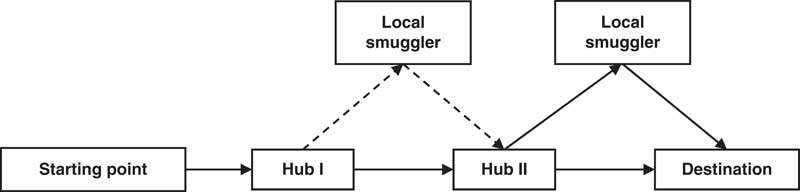
Partial Smuggling processes are small-scale smuggling operations that most frequently occur when the respective distances that have to be overcome are comparatively short; e.g., across one specific border or between specific stages of a more extensive migration project. It occurs most frequently when migrants are forced to move in a step-by-step manner (e.g., due to insufficient financial capital) or where they organize certain parts of the journey themselves and make contact with smugglers only at specific critical points along a migratory route.Footnote 23 ((Graph 1))
■ Source: Adapted from Matthias Neske, Menschenschmuggel: Deutschland als Transit- und Zielland (Stuttgart: Lucius & Lucius, 2007), 194.
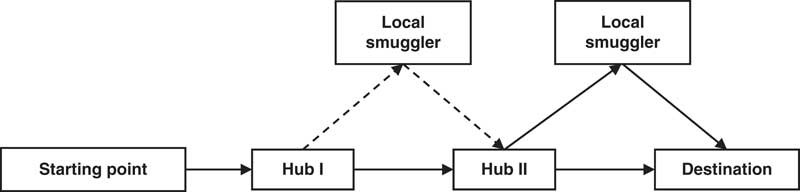
Modeling Partial Smuggling
Partial Smuggling involves all elements of a migration process, but in a discontinuous way: migrants begin from a country of departure, pass through different transit countries, and finally arrive at the country of destination. The continuity of the process is interrupted at specific stages; namely, in “hubs.” Traveling via hubs is as a constant in Partial Smuggling processes. Hubs can be described as geographic and functional nodes in irregular migration processes that have emerged over time and that link respective stages in related processes. Certain transit locations develop into hubs due to their reputation as a marketplace for migrant smuggling services: smugglers recruit, establish, and set up their businesses in places where they can expect to encounter large numbers of clients. From an operational perspective, hubs are places where smuggling processes are initiated or reorganized and which provide the necessary technical and logistical infrastructure for smugglers to organize the “collecting,” “grouping,” and “regrouping” or “passing on” of migrants from one smuggling network—or individual smuggler—to another.Footnote 24
Given their importance for the functioning of smuggling operations, well-established hubs can be found on nearly every route. Examples include the southeastern land and air routes leading from the Middle East and South Asia through Turkey and the Balkans, and the Mediterranean routes, which include the focal points of İstanbul, İzmir, Edirne and other locations in Turkey, Alexandria on the Egyptian coast, Tripoli and Metema in Libya, and Beirut in Lebanon. However, hubs can also be small border villages or refugee centers inside a country, as has been observed in the Western Balkans,Footnote 25 or major cities within the EU, like Athens, Rome, and Milan.Footnote 26
Smugglers engaged in Partial Smuggling tend to be only locally active, to work independently either on their own account or in cooperation with others (whether on a steady basis or only occasionally), and to receive financial benefit from offering their local services.Footnote 27 As they are hired for one single action only and are not involved in the migratory stages before or after, they usually do not know (or need to know) much about their clients (i.e., their background, route, or final destination). However, they do need to know the terrain in which they are operating, to be able to organize vehicles for transportation, and to have contacts with border guards or other officials who are ready to turn a blind eye or accept a bribe. As a result, Partial Smuggling often includes those who belong to the resident community on either side of the border and who can easily establish links to the other side when needed. Payment modalities include cash payment, either before departure or immediately after safe arrival on the other side.Footnote 28 However, in order to improve their market position, more experienced smugglers may offer several crossing attempts with one catch-all price. In this way, “high-quality smugglers can signal to their potential clients that their services are of higher values than those of others and that they therefore merit higher smuggling fees.”Footnote 29
Type II: Document SmugglingFootnote 30
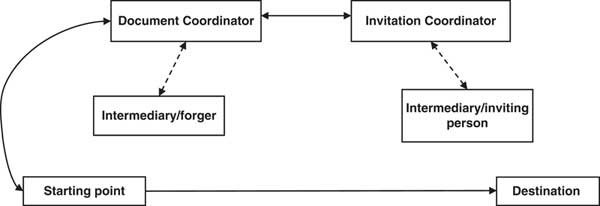
Document Smuggling is a more sophisticated type of migrant smuggling based on the very specific skills, knowledge, and abilities of migrant smugglers. In this case, the smugglers are in a position to access either valid travel documents obtained under false pretenses or high-quality forgeries. This requires a greater degree and higher level of organization on the smugglers’ side, including contacts in the destination countries. Document Smuggling entails only a very short period of interaction between smuggler and client. Once the documents have been handed over to the client, the journey can begin without any further assistance. In contrast to other types of smuggling, in which smugglers tend to avoid official border crossing points in favor of clandestine crossing, Document Smuggling journeys follow conventional travel routes. Border crossing with forged, falsified, altered, or fraudulently obtained documents takes place across official crossing points and often makes use of public transport.Footnote 31 Document forgery is particularly observed in countries where legally obtaining a passport or a visa is already difficult or else only accessible by bribing intermediaries, agents, or officials.Footnote 32 ((Graph 2))
■ Source: Adapted from Neske, Menschenschmuggel, 222.
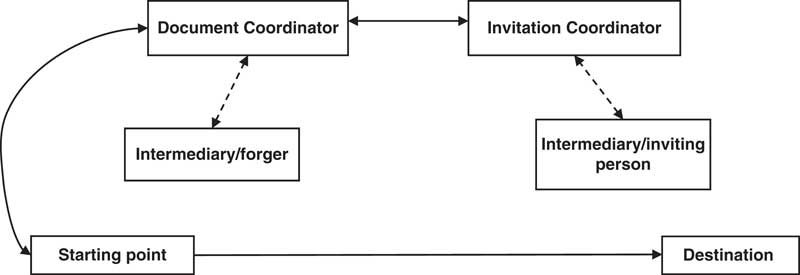
Modeling Document Smuggling
The basics of this model remain as in Type I. However, due to the fact that obtaining false documents allows migrants to organize their journey in a direct and holistic manner from departure to destination, migrants do not require assistance from local smugglers in hubs along the way. Only a few individuals are involved in a Document Smuggling process: a document coordinator in the country of origin, who is responsible for organizing documents; and, if an authentic visa is to be used, a destination coordinator who has good contacts with embassies and is able to organize the documentation necessary to comply with visa requirements.Footnote 33 Destination coordinators use their knowledge of loopholes in laws and procedures to invite and register persons unknown to them. When false or forged documents are used, a destination coordinator is not needed. In any case, document smugglers engage a number of intermediaries, including document forgers, service advertisers, and those who can provide letters of invitation.Footnote 34 Sponsors supporting invitations may be immediate collaborators, persons involved for humanitarian motives, or any person taking advantage of an opportunity to earn extra money through the commission they receive.
Specialists in forgery or document manipulation are not universally available. As a result, the manufacturing and distribution of such documents are organized cooperatively and across continents. Older case reports referred to forgers operating in Bangkok or Singapore and falsifying all kinds of documents, including Malaysian, Indian, and European passports. One example from 2013 referred to forgers operating in Africa who sold stolen or expired passports for alteration by specialists in Pakistan.Footnote 35 More recently, it has been noted that “the most important centres of forgery are reportedly based in Turkey and Thailand, from where the documents are sent by mail to customers all over the world.”Footnote 36 Document smugglers or coordinators usually see themselves as “travel agents,” considering “smugglers” to be those persons responsible for clandestine border crossings. Indeed, research has demonstrated that they are often locally known travel agents or businessmen.Footnote 37
Document Smuggling is, by and large, a smuggling method for the “privileged”Footnote 38 : it is relatively safe and comfortable, and it comes at rather high costs. Comparatively high fees for organizing genuine visas or high-quality false travel documents must be paid before the start of the actual journey. This includes commission fees for all actors with a stake in the production, organization, and distribution of such documents. As compared to other types of smuggling, Document Smuggling is the technique most closely linked to corruption and cooperation with legitimate businesses and authorities.Footnote 39
Type III: Organized Chain SmugglingFootnote 40
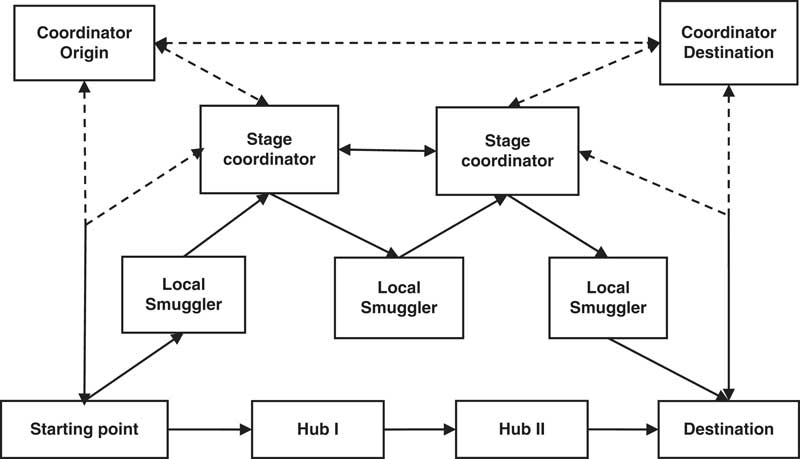
At first glance, Organized Chain Smuggling shows some similarities with Partial Smuggling. However, there is a considerable difference, which is observable in the organizational structure and the continuous nature of the former’s journey. Organized Chain Smuggling comprises the entire journey from the country of departure to the country of final destination via at least one transit country, and is suited to covering great distances.Footnote 41 Organizing such a journey involves different actors who are connected in either loose or semi-stable networks and who operate in a “smuggling chain.” Organized Chain Smuggling requires cooperation between people in different countries and regions, and as a result, the distance covered by this type of smuggling can reach up to several thousand kilometers and encompass several transit countries and hub cities where, managed by “stage coordinators,” migrants are regrouped and handed over to local operational staff tasked with particular crossings. The techniques applied show similar features across regions and continents, varying only in terms of the particular physical obstacles to be overcome (i.e., a land, sea, or air border).((Graph 3))
■ Source: Adapted from Neske, Menschenschmuggel, 194.
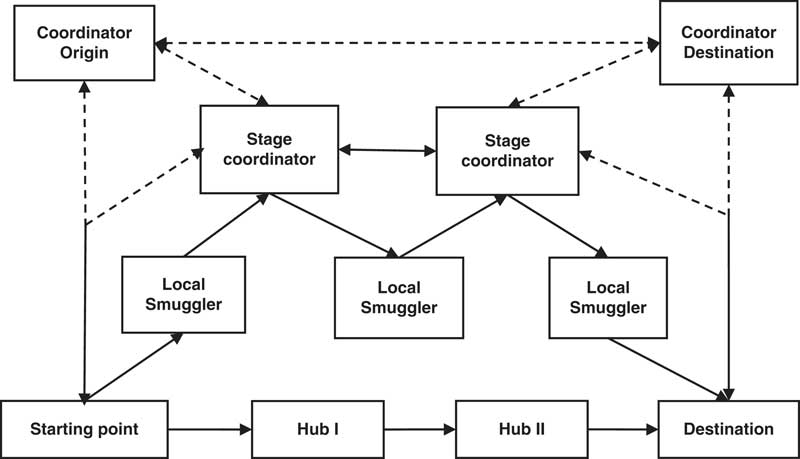
Modeling Organized Chain Smuggling
Organizing a “smuggling chain” process implies a division of labor on the horizontal as well as on the vertical level. On the horizontal level, a smuggling chain is linked by stage coordinators, who ensure that all necessary services are provided at each stage and who coordinate smooth handovers with their counterparts at the previous or following stage.Footnote 42 On the vertical level, stage coordinators arrange all the necessary services and tasks—accommodation, vehicles, transport, border crossing, and so on—from external service providers hired at the local level. More sophisticated networks involve specialized actors. These can often be socially respected people in the community who coordinate all aspects of mobilization (i.e., initiating business relations between smuggler and client at the point of origin) and/or insertion (i.e., the arrival of clients and ensuring migrants’ access to support in the country of destination at the end of the journey). Both maintain close contact with the involved stage coordinators and take responsibility for the smuggling operation vis-à-vis migrants and their families.Footnote 43 In this regard, both have particular responsibilities toward family members—who often pay for the migrant’s journey either at individual stage intervals along the journey or at the final destination—and must keep them informed of the journey’s progress. There is a clear dividing line between stage coordinators and local smugglers. As in the case of Partial Smuggling, local smugglers typically know the country and terrain in which they are operating, but they are not necessarily connected to the coordinating and managerial figures involved in the smuggling chain.Footnote 44 Thus, stage coordinators and local smugglers are not acting as part of a joint enterprise. Even so, in cases where stage coordinators and local smugglers have maintained successful cooperation over a longer period of time, a more established network may emerge, in a phenomenon similar to the establishment of a circle of business partners as seen in any other type of commerce.Footnote 45
Long-distance operations in particular show a highly complex organization that involves transnational networking and cooperation. Each subnetwork needs to hand over groups of migrants at hubs to the next subnetwork. As such, functioning structures as well as the organizational forms linking the different managerial levels need to be in place at each stage and in parallel. It is precisely this network-oriented organizational setup that makes such migrant smuggling operations highly efficient in practical terms. Flexibility in a regularly changing environment “can only be guaranteed when a limited number of central persons make the decisions and when ‘external’ service providers outside the ‘organization’ are recruited for the execution of the actual crossing.”Footnote 46 On the managerial levels, interpersonal trust relationships based on a sense of belonging to the same kin or friendship group are central for the cooperation of different actors. Thus, managerial positions across a network often share the same ethnic, cultural, or linguistic background. In terms of clients, such actors also prefer to operate for clientele considered “their own people.”Footnote 47 This not only eases communication among the various actors but, more importantly, supports trust relations between them.
Given its high degree of organization, one might assume that Organized Chain Smuggling is only available to migrants with considerable financial means. However, smugglers offer complex mechanisms of down payment or deposits, which ensures that even less wealthy migrants can take at least the first step in their journey via this method. Smugglers may also offer different types of insurance or warranties guaranteeing successful arrival.Footnote 48 In such cases, money is deposited, payment is based on a payment plan, and the money is released after the migrant’s safe arrival at a certain agreed-upon destination. Related financial transactions along the route and in the country of destination are primarily made via established formal or informal money transfer systems, such as the well-known hawala system.Footnote 49 What is more, these money transfer systems are utilized not only by migrants, but also by members of a smuggling network, who use the systems to arrange their own financial transactions.Footnote 50
The Bottom-up Approach
The previous sections shed light on different types of migrant smuggling by examining the organizational environment in which smugglers are embedded, as well as the broader strategies they apply to carry out their business successfully. By contrast, the following three types place emphasis on the migrants’ own position in smuggling. In terms of operational aspects, this second set of types overlaps with the first set. However, the perspective taken is different. It is commonly accepted that smuggling networks play a decisive role in channeling irregular migration flows through and to certain countries. Since the arrival at a desired destination is of utmost importance, examining the conditions of arrival and the “relative power” migrants have in this process are central. The three types described below are identified with such a bottom-up perspective, and their development, which involves different types of interactions between smugglers and migrants, was based on Robinson and Segrott’s model of decision making.Footnote 51
Type IV: Service SmugglingFootnote 52
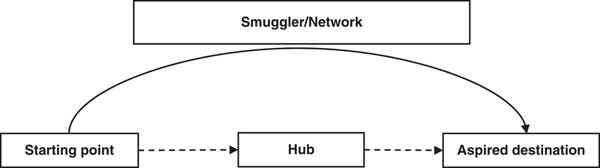
The research conducted on migrant smuggling a decade ago revealed a surprising truth: in some smuggling operations, the clients have quite a strong position, and as a result smugglers’ offers can come fairly close to what might be described as a service. In Service Smuggling, migrants have a precise idea of where they want to go. They have a comparatively strong position in the smuggling process and are in control of the decision-making process with regards to the final destination, which is defined from the very beginning and is not subject to change throughout the process. Service Smuggling is frequently observed in settings where smugglers are obliged to care about their performance and where they must rely on their reputation and on trust from their clients. In this type, migrants prefer lower risks and higher prices to lower prices with higher risks. Migrants who are in the position to pay more will reach their destination in a shorter time and will have a stronger guarantee of arriving there. ((Graph 4))
■ Source: Author.
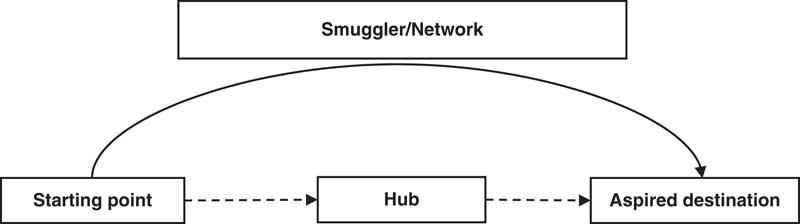
Modeling Service Smuggling
At the beginning of their relationship, migrants identify a smuggler who will agree to convey them to their desired destination, after which the two parties agree on a trajectory and on the fee for arrival there. Smugglers deliver on this agreement, or at least credibly try to do so. They have a strong interest in successfully delivering their services, as repeated failure would be communicated through migrants’ communities very quickly and the consequential loss of reputation would put them out of business within a short time.Footnote 53 A closer relationship between smuggler and client, particularly at the beginning of the journey, constitutes one especially important factor that impacts the evolution of this smuggling type. In Service Smuggling, the existence of comparatively close ties of friendship, kinship, or shared community of origin of both smuggler and client is a frequently observed feature, as already noted. In many cases, a successful smuggler is well known and recommended within family networks and/or the migrant’s community. Accordingly, it is these networks that provide migrants with the information needed to carry out a migration project, help to mobilize the financial resources required, assist the actual smuggling process, and provide the necessary support in all matters of insertion into the country of destination.Footnote 54 In some cases, smugglers may engage in Service Smuggling for political, ideological, humanitarian, or other personal motives (e.g., helping a friend or someone from the same community), and sometimes at a reduced fee (e.g., “at cost”).Footnote 55 Migrant networks and communities thus form a vital part of smuggling in general and of Service Smuggling in particular, coming into play at various stages before, during, and after a concrete smuggling project. The sharing of travel documents of conationals serves as just one example of this. Similar examples that have been comprehensively described in relation to smuggling processes originating in the Middle East and South AsiaFootnote 56 elucidate the significance of personal ties between smugglers and migrants. In one example, sub-Saharan Africans had to pay more to Moroccan smugglers to make the crossing from Morocco to Spain than Moroccans had to pay to make the same crossing.Footnote 57 In this case, the Moroccan migrants had personal links with their smugglers, or at least shared ethnic, national, or linguistic ties, a fact that can also decrease the danger of potential fraud and exploitation. Thus, Service Smuggling is accessible only to migrants who have well-established community networks as well as access to information about and contacts with smugglers. Since smugglers engaging in Service Smuggling regard reputation and reliability as a unique selling point within an entire community, they regularly offer different types of insurance that the agreed-upon final destination will be reached, in order that the money not be wasted in case of a failed attempt. As already described for Organized Chain Smuggling, such guarantees not only allow providers to charge higher prices for their services, but also function as a strong and positive message to potential clients and the community at large. As assurance, deposited money is released to the smuggler by a third party only after the client has confirmed safe arrival at a certain agreed-upon stage or at the final destination. This also means that migrants involved in this type are able to carry less cash on their journey and thus feel safer during the smuggling process, since the money is withheld until confirmation of their arrival.Footnote 58
Type V: Directive SmugglingFootnote 59
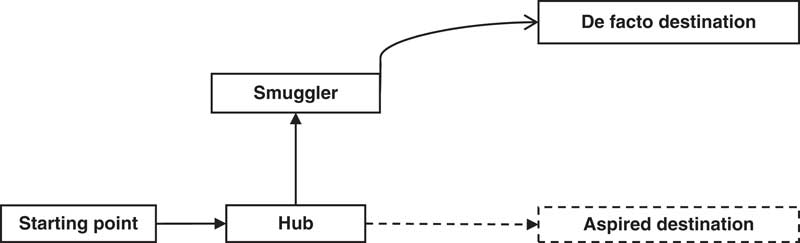
Directive types of smuggling can be defined as cases in which it is exclusively the smugglers who decide where migrants arrive; thus, in such cases, smugglers are the ones channeling the migration route. Contrary to Service Smuggling, in Directive Smuggling the client-provider relationship is characterized by migrants with a comparatively weaker position in deciding the final destination. Ultimately, it is the smugglers who decide on the final destination and who steer the direction.Footnote 60 Such cases also include instances of deliberate deception or failure in performance on the part of the smugglers involved. Directive Smuggling occurs more frequently where migrants move forward stage by stage and hire smugglers only for the more difficult stages. Migrants involved in this type usually lack the necessary financial means and contacts that would allow them to purchase safer and more reliable services. This weak market position is exacerbated by the fact that the contact between smuggler and client is limited to one single operation only. In a desperate situation, migrants may simply not have the possibility to develop any concrete preference with regard to a country of destination, and so they simply accept what seems to be the best offer. In Directive Smuggling, migrants “hope for the best” rather than “trust in the smuggler.” ((Graph 5))
■ Source: Author.
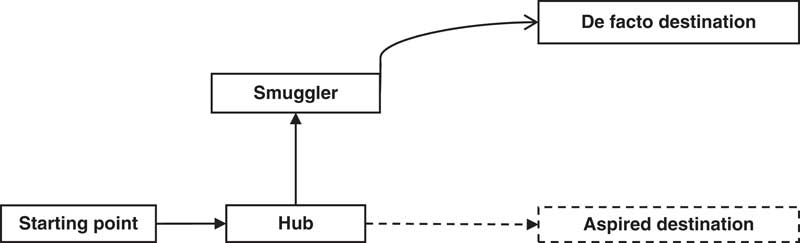
Modeling Directive Smuggling
Two subtypes of Directive Smuggling can be identified: 1) Intended Directive Smuggling as a business practice, and 2) Directive Smuggling as related to underperformance and an inability to react to unforeseen circumstances.Footnote 61 In both cases, smugglers channel flows by directing their clients toward or away from particular transit and destination countries without taking into account their clients’ requests. On the one hand, this channeling often arises from the simple fact that providers only have limited options in terms of what they can provide, and thus they offer specific destinations within their range as “the best place to go.”Footnote 62 When migrants are already en route and cut off from alternative information sources, deception is likely, and “smugglers are in a strong position to actively shape migrants’ perceptions and decisions.”Footnote 63 On the other hand, however, channeling might also result from the fact that migrants—particularly those fleeing immediate danger—may not have any specific country in mind as their next or final destination, and so they leave it to the smuggler to decide on the best direction.Footnote 64 Such channeling is therefore not necessarily always to the migrants’ disadvantage. In these situations, smugglers may in fact serve as important information providers and can act as “honest brokers” of migrants’ interests.
However, in cases of the second subtype—and unlike in the case of Service Smuggling, where unforeseen circumstances (e.g., changes in policies and control measures) are anticipated and part of the deal—such circumstances may fully curb a Directive Smuggling operation. This does not imply deliberate deception, but rather the inability to adapt to circumstances and cope with changing interventions during the process. Situations such as these may lead to smugglers simply interrupting the journey and letting their clients down, in which case migrants may be apprehended or stuck in transit and therefore may consider either staying in the transit location or redirecting their route. Thus, overall, the migrant’s choice with regard to a final destination is limited not only by what a smuggler offers, but also by the capacities of smugglers to adapt to circumstances and cope with changing interventions.
In comparison with Service Smuggling, in Directive Smuggling payment arrangements are less client-oriented. As the contact between smuggler and client is usually limited to one single action, the payment must be given to the smuggler after arrival, or even in advance.
Type VI: Negotiable SmugglingFootnote 65
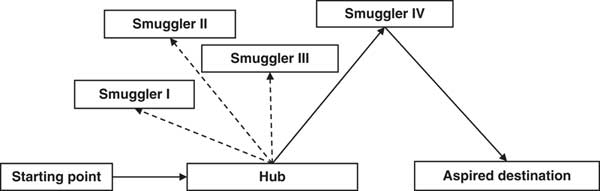
While, in the previous two bottom-up approach types, either migrants (Service Smuggling) or migrant smugglers (Directive Smuggling) decide on the destination or the direction of the next stage of a smuggling operation, the third bottom-up approach type is the result of negotiations between the two. In this case, the choice of the following or final destination results from negotiations between migrants and smugglers in relation to the offers available at certain locations and for certain segments. Negotiable Smuggling is found on routes that are connected by well-established hubs. In fact, it is the hubs that determine the routes, because they provide flourishing markets with access to smugglers who possess a certain degree of professionalism and are willing to negotiate offers and services. ((Graph 6))
■ Source: Author.
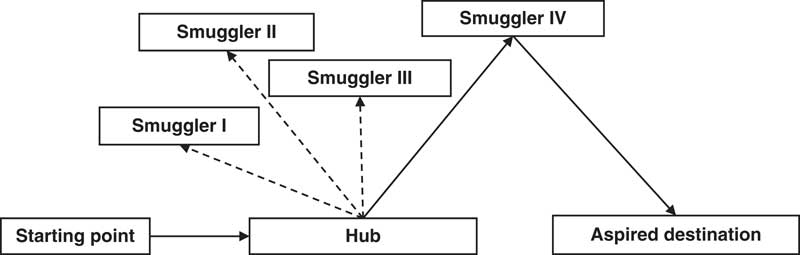
Modeling Negotiable Smuggling
Negotiable Smuggling is most likely to be found in cases where migrants organize their journeys in stages that involve stays in hubs, where a broad range of offers can be found. While hubs are important for smugglers (as noted above in connection with Partial Smuggling), they also represent centers of attraction for migrants who have organized earlier stages of their journeys on their own, but who for the onward journey intend to rely on the services of a smuggler or else to change to a new service provider at a given stage of the process. Hubs gain a reputation among migrants for providing the necessary infrastructure and services to assist them in their planning: they allow migrants to gather as much information as possible in order to gain an accurate impression of the market situation and the services available, and, as such, some migrants are even ready to take complicated detours to reach them.Footnote 66 Smugglers openly advertise their services in hubs and actively recruit potential clients in locations with a high and concentrated population of migrants, such as in neighborhoods where migrant businesses can be found, in refugee reception facilities, or in the vicinity of ports, train stations, and bus terminals, as was observed to an excessive degree in autumn 2015 at such transit locations as the central train stations in Budapest and Vienna. Migrants often have prolonged periods of stay in a hub, where they can not only meet fellow migrants in transit, but also rely on established ethnic communities and networks both to find work so as to gain the financial capital needed for the next stage, and to identify the right contacts. In this sense, prolonged stay may even prove to be beneficial. Negotiable Smuggling can be assessed as the type that comes closest to a real market situation: clients are able to collect information on various offers and select among providers according to the destination, quality of services, and prices offered. The competition among smugglers along the more frequented routes and in the more developed hubs also forces individual providers to constantly improve their services while simultaneously maintaining their reliability. Ideally, this contributes to better offers and services for migrants. Social networks are of vital importance for strengthening this negotiation power, with reported success rates, the experiences of other clients, and information about opportunities, risks, and prices being communicated quickly through migrant communities. As a smuggling service is not a standardized product, however, it can take quite exhaustive negotiations to attain the best offer regarding destination, prices, and services.Footnote 67
Recent developments
In recent years, the exceptionally high demand for smuggling services in the aftermath of the Arab spring protests and due to the ongoing nature of the Syrian Civil War, combined with changing geopolitical dynamics, has led to the expansion and initiation of new markets across nearly all migrant smuggling routes toward Europe. Consequently, in the current context one can observe the use and adaptation of the various types described above.
For example, new alliances have emerged in Organized Chain Smuggling, even as the geographic expansion of markets and the constantly changing accessibility of routes has resulted in harsher market conditions.Footnote 68 New actors have entered the market, networks have become congested, and ripple effects have led to a redirecting of flows.Footnote 69 At the same time, despite both public and political debate emphasizing the prominence of “international smuggling organizations,” Partial Smuggling dominates in many regions. In this context, migrants organize and travel in single stages, with local smugglers awaiting potential clients in hubs in order to facilitate the actual border crossing. Indeed, Partial Smuggling has experienced a real revival, and has been observed in action with many of those making the journey across the Western Balkan route,Footnote 70 the Mediterranean,Footnote 71 the Sahara Desert,Footnote 72 and into the Schengen area.Footnote 73 Since the concrete operations of Partial Smuggling are short-lived and one-off, essentially anyone with the right contacts, knowledge of the particular border region, and/or access to the necessary vehicles can enter into business as smugglers. As a consequence, some of the typical elements associated with Directive Smuggling—such as situations where smugglers betray migrants or consciously put them in danger—may now in fact occur more frequently. For instance, in the case of sea crossings, with their intrinsic logistical and technical requirements and the need to handle hundreds of persons at one time, traditional smugglers had difficulties in handling the sheer number of clients. Now, as anyone with access to a boat can potentially initiate a migrant smuggling service, such crossings have become increasingly unsafe with inexperienced migrant smugglers entering the market in an attempt to benefit from the increased demand for services.Footnote 74 In the Mediterranean especially, markets have revitalized one previously observed strategy that might be described as “moving as many people as possible as quickly as possible”—a strategy that is clearly not easily compatible with any kind of service orientation. While post-arrival payment arrangements, such as those seen with Service Smuggling,Footnote 75 certainly do still exist for those who can afford it,Footnote 76 in some contexts they seem to have completely disappeared. For crossings from Libya, for example, informants in Italy have reported that migrants are required to pay in cash and in advance before departure, and they also have to pay for each individual attempt (even in cases of failure).Footnote 77 Rather than competing over the best offer, an increase in callousness or even violence toward migrants can be observed. In post-Gaddafi Libya, with its collapsed state structures where smugglers operate in the absence of the rule of law and base their activities around an economy of migrant exploitation,Footnote 78 Service Smuggling is obviously absent for migrants traveling into, through, or from Libya. The elements of mutual trust and support for migrants’ networks that characterize Service Smuggling have been further perverted in recent examples seen in Egypt’s Sinai region, where migrants, particularly those from the Horn of Africa, have been held hostage until such time as their relatives or communities of origin pay a ransom.Footnote 79 Nonetheless, as confirmed by an Afghan member of a smuggling network in GreeceFootnote 80 and an Ethiopian smuggler operating between Ethiopia and Sudan,Footnote 81 Service Smuggling is still performed in certain contexts. In these examples, the smugglers in question described trying to attract clients and outperform their competition by improving the quality of their services, saying that “it affects the business if we don’t treat them well.”Footnote 82 As in the past, common ties with migrant smugglers support trust relations and are beneficial to the migrants’ position in the smuggling process. This is particularly true where a trusted middleman (e.g., a hawaladar Footnote 83 ) is involved, as well as in cases where familial relations are established. As an example of the latter case, one Syrian migrant in Greece explained that he only accepted pre-financing in return for a cheaper rate because his wife was related to a member of the smuggling network.Footnote 84 Trusted by their fellow countrymen and by the community, the Syrian smugglers who recently entered the smuggling market in Egypt in order to organize passage for Syrians also display elements of Service Smuggling: in this example, the money would only be released after the migrants had reported safe arrival at the agreed-upon destination.Footnote 85
In terms of prices, these are primarily tailored to the financial means of individual migrants and can be related to certain aspects of Negotiable Smuggling. According to 2015 research on the Mediterranean route, wealthier Syrians reportedly paid the highest fees and thus enjoyed “safer” journeys, while sub-Saharan Africans sat in the cheaper, and most dangerous, positions below deck. One Syrian interviewee in Greece explained that Syrians arriving in 2014 were ready to pay even higher fees than what was being suggested, provided that they could move on immediately, “so [smugglers] hike up the price.”Footnote 86 Even so, Italian authorities report that even for routes where it would not be expected, such as from Egypt to Italy, negotiations are nonetheless possible: those with family in Egypt may pay a reduced price, families on board may receive a collective price, and children may go uncharged.Footnote 87 Similar arrangements have been reported by a smuggler in Greece, with special reduced rates being offered for families or children.Footnote 88 In addition, negotiations may include an agreement concerning the number of failures permitted before an attempt is considered unsuccessful. Only then is the money either reimbursed to the migrant (as highlighted by an Afghan migrant in Turkey) or else the smuggler starts charging again for subsequent attempts (as explained by one Afghan smuggler operating in Greece).Footnote 89
Negotiable Smuggling has also changed due to the emergence of a new type of smuggler, one who could be described more as a “migrant” than a “smuggler” but who still carries out some of the tasks typically assigned to the latter. Using the experience and networks they have developed during their own journey, migrants who are taking a stage-by-stage approach but run out of money along the way may instead effectively pay in kind by taking up work with smugglers and offering their services as recruiters, guides, drivers, or skippers in order to raise money to pay for the next portion(s) of their journey, or even in return for free passage.Footnote 90 However, even when such negotiations prove successful, a smuggling operation can still easily transform into Directive Smuggling when such inexperienced collaborators are given responsibility or when the initially negotiated conditions change over the course of the journey.
With regard to Document Smuggling, large-scale group visits—which served as the basis for developing this typeFootnote 91 —appear to have significantly decreased in the recent context. Nevertheless, smaller-scale practices of this type persist, including facilitators providing guidance as to which documents to submit for a visa application, or registering on a migrant’s behalf for an international event and booking appropriate accommodation in the intended destination in order to support a visa application.Footnote 92 At the same time, less sophisticated forms of facilitation—such as “boarding pass swapping”Footnote 93 —have continued, if not expanded to other routes. As identified by the Turkish administration at one airport in İstanbul, a smuggler and a migrant may buy a flight ticket to destination that is easily accessible, typically in terms of visa requirements, but after check-in they then exchange fake documents and an alternative ticket to an EU member state so that the migrant can start the journey.Footnote 94 While the media and public debate tend to focus on a sensationalized portrayal of actual or alleged smuggling kingpins and their mafia affiliations, corruption and the bribing of state officials play an often underexposed yet still crucial role as well. Visa scams and corruption scandals capture the occasional media attention, but the actual significance and impact of officials’ wrongdoing in relation to the smuggling market remain underestimated. While all types of smuggling may involve corruption, Document Smuggling has traditionally been quite, although not exclusively, dependent on such corruption. In the past, obtaining visas by artifice and in an organized way was observed primarily in Eastern European countries of origin, particularly Ukraine, as well as in Latin American countries and China.Footnote 95 Nowadays, however, there is reason to suspect that smugglers have once again refocused on obtaining visas in a fraudulent manner, with transnational networks operating out of India, Pakistan, Bangladesh, and Turkey.Footnote 96 This development may be explained by the fact that improved document security standards have augmented the cost of producing high-quality fake documents. There are also indications that forgers may be moving away from the practice of altering travel documents, concentrating instead on incorrect or falsified breeder documents on which legitimate passports or visas may be issued.Footnote 97 Just as in the past, today’s document fraud follows routes with high tourist or other bona fide traveler flows. False documents and visas still appear most commonly at air borders, which ironically are the border type with the highest security standards.Footnote 98
Finally, the advent of smart phones, social media, messenger services, and other modern communication and navigation tools has impacted each and every type of smuggling described above. Social media has opened an entirely new market for the promotion of detailed smuggling services, including advertisements for forged, fake, falsified, altered, or fraudulently obtained travel documents, with prices varying according to quality. While in the past marketing depended on word-of-mouth recommendations or advertising in local newspapers or with related “travel agencies,”Footnote 99 today both smuggling services and travel documents are extensively offered online via self-proclaimed travel agencies, and others as well. In the case of Organized Chain Smuggling, such new technological developments have significantly simplified communication and coordination among the various actors involved at the different stages of the process. In the past, frequent examples of Directive Smuggling included cases where migrants were stranded in an alternative countryFootnote 100 or trapped by the so-called “İzmir trick,”Footnote 101 in which migrants embark in one country but upon “arrival” find themselves only a few kilometers from where they had embarked. Today, such deception has been aggravated by the introduction of mobile navigation technology, which has allowed smugglers to avoid accompanying groups on their journey—particularly in the case of Partial Smuggling. Instead, as a strategy, smugglers abandon migrants to undertake the journey on their own with the use of their mobile phones and/or GPS as a guide, with the aim—in the best case—being for them to be rescued by others.Footnote 102 Many of the serious recent incidents and deaths reported along smuggling routes can be attributed to such forms of Directive Smuggling. At the same time, such recent technologies also permit migrants to move at a reduced cost in cases where they decide to cross (land) borders on their own, as they are able to use their phones and the GPS signal of a map application as guides.Footnote 103
In Service Smuggling, on the other hand, the common practice of releasing deposited money only after the client has confirmed safe arrival at the agreed-upon destination has recently been supplemented through the use of technology. Nowadays, for instance, in order to provide proof of safe arrival, the migrant might—together with a digitally written or verbal confirmation of arrival—send a photo of him/herself in front of an iconic landmark located at the destination.Footnote 104
At first glance, it appears that in the current context Negotiable Smuggling has decreased in importance. Serious negotiation is only possible when there are actually various offers to choose from and when migrants are well informed about their options, yet in a context such as the current one, where supply is composed of high numbers of smugglers whose business is not based on market competition, such negotiations seem difficult to pursue. However, migrants’ ideas concerning where to go and how to arrive there are based on support from and the exchange of information with others, particularly via new modes of communication. Today, information can be shared more quickly than ever before, allowing migrants to make their decision independently, whether at the individual level or collectively.Footnote 105 Social media has also facilitated publicizing a smuggler’s performance, providing information to those who are planning their journey, and sharing positive and negative experiences as well as information on the conditions of the journey, on alternative next steps, on payment arrangements, on the success rate of a given smuggler, and so on. In the words of one Syrian migrant interviewed in Macedonia: “You have everything on the Internet. There are Facebook pages specifically explaining this route, created by people who already experienced this journey. Everything is explained there, point by point, including the possible risks.”Footnote 106 Furthermore, information regarding the legal and practical aspects of immigration, asylum, and reception conditions—which determine migrants’ opportunity structures upon arrival—is shared quickly within both analogFootnote 107 and digital migrant and family networks. This significantly reduces migrants’ dependency on information from those smugglers who may promote one destination over another, thereby theoretically also counteracting certain forms of Directive Smuggling.Footnote 108 It is obvious that migrants trust family members and fellow successful migrants more than smugglers, who they consider a necessary evil that must be dealt with in order to facilitate the border crossing.Footnote 109
Conclusions
This article has depicted six complementary descriptive types of migrant smuggling. Three of these—Partial Smuggling, Document Smuggling, and Organized Chain Smuggling—adopt a top-down perspective focusing on the organizers of migrant smuggling, while the other three—Service Smuggling, Directive Smuggling, and Negotiable Smuggling—approach the same phenomenon from a bottom-up perspective, emphasizing the clients’ point of view, based on the actual outcome of a given migrant smuggling process. From the clients’ perspective, Document Smuggling and Organized Chain Smuggling are the most reliable when it comes to achieving the main goal of arrival at an agreed-upon destination. Still, both of these types of services come with disadvantages. For one thing, they are comparatively expensive, and moreover they are not available at every point of departure or transit. Cases of deception or of migrant smugglers (rather than the migrants themselves) exclusively deciding on the final destination, such as occurs in Directive Smuggling, also occur in Organized Chain Smuggling and to a certain extent in Partial Smuggling as well. At the same time, in Partial Smuggling, migrants can also occupy a comparatively strong position on the smuggling market. Traveling via hubs, which offer a broad range of providers and specialized services, puts migrants in a position to be able to obtain reliable information and choose from among a variety of different options, thereby supporting Negotiable Smuggling. The use of new forms of social media and online communication technology can similarly strengthen migrants’ negotiating positions.
Migrant smuggling has always been a complex market for highly differentiated services offered by a multitude of providers. Even so, actually testing the above typology against recent empirical material has shed light on certain important changes and adaptations. Changing geopolitical dynamics have led to the expansion and opening of new smuggling markets, and in response to this growing demand, a great number of smugglers lacking the experience and necessary business ethics have entered the business. Consequently, smuggling networks have become increasingly unsafe and violent, putting migrants at even greater risk.
A clear division in services has developed: safer journeys for those who can afford it, alongside services of reduced quality for the masses. Of course, an increase in supply generates an increase in support services, in which all have a stake and are able to receive concomitant benefits. At the same time, smugglers have reacted to the changed environment by moving toward increased specialization and focusing on specific services (like the provision of falsified or altered documents), or by specializing in the organization of clandestine border crossings in specific regions or along specific routes that are easier to control. Supported by the advent of smart phones, modern means of communication, and navigational tools, one observes a new form of the trend toward the self-organization of irregular migration processes: migrants now organize certain parts of the journey themselves, or are made to do so by smugglers. As a result, when migrants are left to their own devices, there are no smugglers with them who can respond and adapt to any unforeseen situations along the journey, and consequently migrants traveling in an irregular manner increasingly enter into dangerous situations, risk their lives at sea or in the desert, or end up in unintended destinations. Becoming stranded in undesired locations and remaining effectively “in transit” as a more permanent state are attributes that may continue to apply to an increasing number of irregular migrants in the future.
The main aim of this article has been to present a comprehensive typology of migrant smuggling that would allow for a better description and analysis of migrant smuggling cases, and to subsequently test this typology against recent empirical material in order to understand the typology’s current applicability, including in what areas adaptations might be called for. Over the last 15 years, migrant smuggling has adapted in various ways in terms of modus operandi, routes, and diverging market conditions. Nevertheless, the six descriptive types of migrant smuggling outlined above, whose development began over a decade ago, are still applicable and relevant today, even if the relative importance of each type might have shifted.